S-1/A
As filed with the Securities and Exchange Commission on September 8, 2025
Registration No. 333-289786
UNITED STATES
SECURITIES AND EXCHANGE COMMISSION
Washington, D.C. 20549
AMENDMENT NO. 1
TO
FORM S‑1
REGISTRATION STATEMENT
Under
The Securities Act of 1933
Netskope, Inc.
(Exact name of registrant as specified in its charter)
|
|
|
Delaware (State or other jurisdiction of incorporation or organization) |
7372
(Primary Standard Industrial Classification Code Number) |
46-1141117 (I.R.S. Employer Identification Number) |
2445 Augustine Drive, Suite 301 Santa Clara, California 95054 (800)-979-6988 (Address, including zip code, and telephone number, including area code, of registrant's principal executive offices) |
|
Sanjay Beri Chief Executive Officer 2445 Augustine Drive, Suite 301 Santa Clara, California 95054 (800)-979-6988 (Name, address, including zip code, and telephone number, including area code, of agent for service) |
Copies to:
|
|
|
Allison B. Spinner Andrew S. Gillman Shannon R. Delahaye Wilson Sonsini Goodrich & Rosati Professional Corporation 650 Page Mill Road Palo Alto, California 94304 (650) 493-9300 |
Andrew Del Matto Chief Financial Officer James Bushnell General Counsel Netskope, Inc. 2445 Augustine Drive, Suite 301 Santa Clara, California 95054 (800)-979-6988 |
Bradley C. Weber Kim S. de Glossop Goodwin Procter LLP 601 Marshall Street Redwood City, California 94063 (650) 752-3100 |
Approximate date of commencement of proposed sale to the public: As soon as practicable after this registration statement becomes effective.
If any of the securities being registered on this Form are to be offered on a delayed or continuous basis pursuant to Rule 415 under the Securities Act of 1933 check the following box: ☐
If this Form is filed to register additional securities for an offering pursuant to Rule 462(b) under the Securities Act, please check the following box and list the Securities Act registration statement number of the earlier effective registration statement for the same offering. ☐
If this Form is a post-effective amendment filed pursuant to Rule 462(c) under the Securities Act, check the following box and list the Securities Act registration statement number of the earlier effective registration statement for the same offering. ☐
If this Form is a post-effective amendment filed pursuant to Rule 462(d) under the Securities Act, check the following box and list the Securities Act registration statement number of the earlier effective registration statement for the same offering. ☐
Indicate by check mark whether the registrant is a large accelerated filer, an accelerated filer, a non-accelerated filer, a smaller reporting company, or an emerging growth company. See the definitions of "large accelerated filer," "accelerated filer," "smaller reporting company" and "emerging growth company" in Rule 12b-2 of the Exchange Act.
|
|
|
|
Large accelerated filer |
☐ |
Accelerated filer |
☐ |
Non-accelerated filer |
☒ |
Smaller reporting company |
☐ |
|
|
Emerging growth company |
☒ |
If an emerging growth company, indicate by check mark if the registrant has elected not to use the extended transition period for complying with any new or revised financial accounting standards provided pursuant to Section 7(a)(2)(B) of Securities Act. ☐
The registrant hereby amends this registration statement on such date or dates as may be necessary to delay its effective date until the registrant shall file a further amendment which specifically states that this registration statement shall thereafter become effective in accordance with Section 8(a) of the Securities Act of 1933 or until the registration statement shall become effective on such date as the Securities and Exchange Commission, acting pursuant to said Section 8(a), may determine.
The information contained in this preliminary prospectus is not complete and may be changed. These securities may not be sold until the registration statement filed with the Securities and Exchange Commission is effective. This preliminary prospectus is not an offer to sell these securities and is not soliciting an offer to buy these securities in any jurisdiction where the offer or sale is not permitted.
Subject to Completion, dated SEPTEMBER 8, 2025
47,800,000 Shares

Netskope, Inc.
Class A Common Stock
This is an initial public offering of shares of Class A common stock of Netskope, Inc.
Prior to this offering, there has been no public market for our Class A common stock. It is currently estimated that the initial public offering price will be between $15.00 and $17.00 per share.
We have applied to list our Class A common stock on the Nasdaq Global Select Market under the symbol "NTSK."
Following this offering, we will have three series of authorized common stock, Class A common stock, Class B common stock, and Class C common stock. The rights of the holders of our Class A common stock, Class B common stock, and Class C common stock will be substantially identical, except with respect to voting and conversion rights. Each share of Class A common stock will be entitled to one vote per share. Each share of Class B common stock will be entitled to 20 votes per share and will be convertible at any time into one share of Class A common stock. Each share of Class C common stock will have no voting rights, except as otherwise required by law, and will be convertible into one share of Class A common stock, as described herein. Immediately following the completion of this offering, outstanding shares of Class B common stock will represent approximately 99.3% of the voting power of our outstanding capital stock and no shares of Class C common stock will be issued and outstanding.
We are an "emerging growth company" as defined under the federal securities laws and, as such, have elected to comply with certain reduced public company reporting requirements in this prospectus and may elect to do so in future filings.
See the section titled "Risk Factors" beginning on page 23 to read about factors you should consider before deciding to invest in shares of our Class A common stock.
Neither the Securities and Exchange Commission nor any state securities commission has approved or disapproved of these securities or passed upon the accuracy or adequacy of this prospectus. Any representation to the contrary is a criminal offense.
|
|
|
|
|
|
|
Per Share |
|
Total |
Initial public offering price |
|
$ |
|
$ |
Underwriting discounts and commissions(1) |
|
$ |
|
$ |
Proceeds, before expenses, to Netskope, Inc. |
|
$ |
|
$ |
(1)See the section titled "Underwriting" for a description of the compensation payable to the underwriters.
We have granted the underwriters an option, exercisable for 30 days from the date of this prospectus, to purchase up to 7,170,000 additional shares of our Class A common stock from us to cover-over-allotments, if any, at the initial public offering price, less underwriting discounts and commissions.
The underwriters expect to deliver the shares against payment in New York, New York on , 2025.
|
|
|
|
|
|
|
|
|
Morgan Stanley |
|
J.P. Morgan |
BMO Capital Markets |
TD Cowen |
Citizens Capital Markets |
Mizuho |
RBC Capital Markets |
Wells Fargo Securities |
Deutsche bank Securities |
Oppenheimer & Co. |
BTIG |
KeyBanc Capital Markets |
Piper Sandler |
William Blair |
Santander |
|
Credit Agricole CIB |
Prospectus dated , 2025
TABLE OF CONTENTS
Through and including , 2025 (the 25th day after the date of this prospectus), all dealers effecting transactions in these securities, whether or not participating in this offering, may be required to deliver a prospectus. This is in addition to a dealer's obligation to deliver a prospectus when acting as an underwriter and with respect to an unsold allotment or subscription.
Neither we nor any of the underwriters have authorized anyone to provide you with information that is different than the information contained in this prospectus and any free writing prospectus prepared by or on behalf of us or to which we have referred you. Neither we nor the underwriters take any responsibility for, and cannot provide any assurance as to the reliability of, any other information that others may give you. The information contained in this prospectus or in any applicable free writing prospectus is accurate only as of the date of this prospectus or such free writing prospectus, as applicable, regardless of the time of delivery of this prospectus or any such free writing prospectus or of any sale of the securities offered hereby. Our business, operating results, financial condition and prospects may have changed since that date.
This prospectus is an offer to sell only the securities offered hereby and only under circumstances and in jurisdictions where it is lawful to do so. Neither we nor any of the underwriters have taken any action that would permit this offering or possession or distribution of this prospectus in any jurisdiction where action for that purpose is required, other than in the United States. Persons who have come into possession of this prospectus in a jurisdiction outside the United States are required to inform themselves about and to observe any restrictions relating to this offering and the distribution of this prospectus.
LETTER FROM OUR CO-FOUNDER AND CEO
In 2012, I saw the future unfolding before my eyes: a digital cloud-driven world exploding with possibilities, yet teetering on the brink of chaos - an unsecured, wild west environment defined by escalating complexity, limited visibility, a lack of control, and mounting challenges in delivering a consistent, high-quality secure digital experience at scale. I knew then that something entirely new needed to be created - something designed not just to keep up, but to lead the way in a rapidly evolving digital world.
I began my journey to bring a lifelong vision into reality - to build a generational company that redefines security and networking for a new era. This has never been just about launching a business; it's been about creating a meaningful, lasting impact and leaving a professional legacy rooted in purpose, GRIT, and values that have guided me every step of the way.
In many ways, I felt my whole life had prepared me for this path - from my early days helping my mom sell lipsticks door to door as a kid, and watching my dad, a nuclear reactor quality engineer by trade and the kindest soul I've ever known, live with unwavering integrity in everything he did. My high-tech career, the majority spent in security and networking - spanning small startups to global enterprises, and roles across product, go-to-market, and general management - also gave me the experience, perspective, and resilience to take on this passion with clarity and conviction.
Netskope - Born for the Cloud & AI Era
At that point in 2012, I could see that a digital revolution was coming, not just evolution - from the internet era to a digital world that would become a complex mesh of global connections that spanned continents and industries, linking employees, partners, customers, and even machines in an intricate dance of data exchanges and dynamic interactions. This wasn't going to be about websites anymore; it would be about cloud applications, mobile devices, IoT sensors, and the early inklings of AI systems, all communicating and exchanging information at an unprecedented scale. Add to that an ever-increasing torrent of data, and cyber threats morphing faster than anyone could track.
But what truly struck me was the disconnect. I could see that the internet would evolve into a dynamic, data-rich ecosystem, speaking a new 'language' based on APIs and JSON that legacy security and networking simply couldn't understand, let alone protect. This language wasn't going to be spoken just by users; it would be the chatter of devices, the pulse of apps, and now, the emerging voice of AI agents, all engaged in a constant stream of digital interactions. And I truly believed at the heart of it all would be data, the lifeblood of modern organizations, needing protection more than ever. We were facing a seismic shift - one that was breaking the foundations of traditional security and networking systems.
That's why Netskope was born - to architect the future of secure, high-performance digital interactions. Netskope One isn't just a platform; it's the key to unlocking the full potential of the cloud, AI, and ultimately organizations. I envisioned a world where organizations could innovate fearlessly, where productivity soared, and where teams - human and non-human alike - could collaborate securely from anywhere, on any device, with anyone or anything.
To truly realize this vision, we built the Netskope One platform to shatter the legacy security and networking trade-offs. It ensures that users and data, two of an organization's most valuable assets, remain protected at every turn, and that organizations themselves are actively defended against ever-evolving threats. Through the Netskope One platform, we bring advanced security right to the edge via our lightning-fast global private cloud. We designed it to understand the new 'language' of this modern internet, to leverage AI for superior insight and control over every digital interaction, whether from a user, a device, an app, or an AI agent, and to safeguard data and organizations against both threats and data leaks, in real time. We are not just building a platform; we are building the foundation for the next era of secure high performance business.
Our Innate Desire to Make the Digital World Better
There's a battle raging and constantly escalating in the digital world, and on one side are some of the most depraved and destructive people and groups in the world - cybercriminals, relentless and evolving, driven by greed and malice. They exploit every weakness - gaps in visibility, outdated infrastructure, siloed systems, human error, and the lack of real-time insight and control - holding businesses hostage and stealing the very lifeblood of modern enterprises: data. I've seen firsthand how organizations, eager to embrace innovation, are forced to slam on the brakes, their progress stalled by legacy security and networking systems that cannot keep pace with the speed and complexity of the modern digital landscape and cloud and AI era.
It is not just businesses suffering; it is end users, the individuals just trying to do their jobs, constantly frustrated by clunky security and networking that sacrifices performance and makes their digital experience a nightmare. That's why this isn't just a job for me; it's a mission. We built Netskope to fight back, to empower businesses to fully embrace technology without compromise, and to ensure that everyone, everywhere, can have a fast, seamless, and secure digital experience. We're here to unleash data, to enable its use in the right way, and to ensure that innovation thrives, not just survives, in the face of relentless cyber threats. Ultimately, we're not just building a company; we're contributing to a more secure, productive, and seamless digital world, one that empowers individuals and organizations to reach their full potential.
Innovate or Die
I have always believed in the phrase 'innovate or die'; it's a core principle at Netskope. In the relentless battle against cybercriminals and navigating the constantly changing digital landscape, remaining stagnant and failing to evolve simply isn't an option. That's why we pour unwavering commitment into research and development, relentlessly pushing the boundaries of what's possible. We're not content with incremental improvements; we're driven by a burning desire to disrupt, to redefine, to create breakthroughs that will fundamentally change the game.
I was fortunate to have met my co-founder and CTO Krishna Narayanaswamy in 2006, and when I decided to build Netskope I knew I had to call him to join me. A humble, kind soul who combined such immense intellect and experience in networking, security, and analytics with a deep passion for innovation, while exemplifying the culture we both believed in. We and Team Netskope will never stop innovating, never stop questioning, and never stop investing in the future. We know, deep in our core, that our ability to stay ahead, to protect our customers, and to shape the next era of business depends on our unwavering commitment to innovation.
GRIT & Doing it the Right Way
I have always believed that true success isn't measured by titles or milestones, but by the quiet moments - when I lay my head on the pillow at night, look myself in the mirror, or share time with my wife, my daughter, the rest of my family, teammates, friends, and those who believed in us and the company now and over the years. In those moments, I want to know - in my heart and soul - that I did it the right way. That definition of 'the right way' was instilled in me early on by my parents. They may not have understood modern technology, but they deeply understood GRIT. And GRIT has become the foundation of who I am, and the core of Netskope and our Team - in our culture, in how we lead, and in how we show up every single day.
Guts to stay true to a vision others may not yet see, to challenge the status quo with purpose, even when the current pulls hard the other way. Resolve to build patiently, brick by brick, knowing that anything worth doing is never easy. Integrity to walk what is sometimes the harder path - the right path - with our values intact. And Tenacity to seek out the hungry, the driven, the hunters who chase impact - not just those who wait for it to arrive. Guts. Resolve. Integrity. Tenacity. Grit.
Go Long & Our Commitment to Enduring Success, Innovation, and Positive Impact
At the heart of our philosophy at Netskope is a fundamental belief in 'going long' and delivering consistent long-term growth, innovation, and positive impact. Becoming a public company is not the destination, but rather another significant milestone on our journey - one that we hope will amplify awareness of our groundbreaking Netskope One platform. Our high win rate (our 'batting average' as I like to call it) speaks volumes about the platform's strength. Going public, in our view, is about getting us more 'at bats,' and expanding our awareness, reach, and hence positive impact.
I am deeply thankful to our customers and partners for putting their trust in us, to our Team of Netskopers for the passion and heart they bring to our mission every day, to our Families who have been our rocks along the way, and to our current and future shareholders for believing in what we're building together.
We are still in the early innings of a market we've re-imagined and helped define. This is just the beginning, and we are incredibly energized to lead this space for decades to come. I've always believed in 'skating to where the puck is going,' but on a grander scale and timeline. We will continue to prioritize long-term success over short-term gains. This principle has been at the core of our philosophy, shaping everything from the investments we make to the success we achieve and the impact we have. We're committed to delivering long term shareholder value, driving innovation, leading with purpose, and showing relentless GRIT - for decades to come.
Sanjay Beri
Co-Founder and CEO
PROSPECTUS SUMMARY
The following summary highlights information contained elsewhere in this prospectus. It does not contain all the information you should consider before investing in our Class A common stock. You should read this entire prospectus carefully, including the sections titled "Risk Factors" and "Management's Discussion and Analysis of Financial Condition and Results of Operations," and our consolidated financial statements and related notes included elsewhere in this prospectus, before making an investment decision. In this prospectus, unless the context requires otherwise, all references to "we," "our," "us," "Netskope," and the "Company" refer to Netskope, Inc. and its consolidated subsidiaries. Our fiscal year end is January 31, and our fiscal quarters end on April 30, July 31, October 31, and January 31. Our fiscal year ended January 31, 2024, fiscal year ended January 31, 2025, and fiscal year ending January 31, 2026 are referred to herein as "fiscal 2024", "fiscal 2025", and "fiscal 2026", respectively.
Overview
We are redefining security and networking for the era of cloud and AI.
The cloud and AI have completely revolutionized work. We are more dispersed, more productive, and more automated than ever before, and the rate of change is only accelerating. Not since the internet has there been such a transformative tectonic shift. But, with it has come collateral damage—traditional security and networking are now broken.
We founded Netskope to address this revolution. We built Netskope One, our unified, cloud-native platform from the ground up to solve the challenge of securing and accelerating the digital interactions of enterprises in this new era. Organizations rely on our Netskope One platform to provide profound contextual intelligence into their data and digital interactions, securing them with precision, without sacrificing the digital experience. We leverage our patented technologies to enable dynamic, granular context-aware policies that allow us to protect sensitive data, stop threats, support regulatory compliance, and elevate the digital experience.
By converging advanced security and modern networking capabilities with deep analytics, based on our analysis of IDC data, we believe our unified solution addresses a large total addressable market that is projected to reach $138.9 billion by 2028, growing at a 16.8% compound annual growth rate ("CAGR") from 2024 to 2028, providing us with a sustained and durable opportunity. We believe we are in the early days of addressing the nascent market opportunity for AI security that we project will grow to $30.8 billion by 2028, contributing an incremental $9.9 billion to our estimated total addressable market by 2028.1
Organizations today operate in a digital landscape that is heterogeneous and highly connected. It is comprised of globally dispersed users and non-human entities such as devices, applications, automated systems, and AI agents that interact with each other and a plethora of managed and unmanaged Software-as-a-Service ("SaaS") applications, websites, AI, private applications, and other ecosystem applications across data centers and private and public clouds. With this new digital landscape, enterprises need a security and networking platform that can handle these far more complex, distributed, and dynamic sets of connections—all with more advanced security measures—to keep the organization, its people, and its data safe.
The substrate for this digital landscape is the modern internet. No longer just a collection of static web pages of the 2000-2010 era, it is dynamic, interactive, and data-rich, and powered by the cloud and AI. In addition, continuously evolving technologies, such as AI, are voraciously consuming organizational data but also generating it at unprecedented scale. This data is increasingly spread across the cloud and shadow IT systems and accessed by human and non-human entities worldwide, beyond locked down on-premises corporate IT environments. Data is the lifeblood of modern organizations, but protecting it and the broader organization has never been more difficult.
1 See the section titled "Business—Our Market Opportunity" for a more detailed discussion of the assumptions underlying our estimate of the total addressable market for our unified solution and AI security.
Meanwhile, cyber adversaries are leveraging cloud and AI technologies to launch widespread and sophisticated attacks. Ransomware-as-a-Service groups have emerged, deploying an onslaught of rapidly morphing attack campaigns. Nefarious actors trick victims into executing commands that infect their machine with malware, such as the LummaStealer campaign that transpired in early 2025. AI advances have armed attackers with new tools, such as deepfakes, to steal data for financial gain, espionage, or digital warfare. Organizations also face significant compliance risk from constantly growing security and data privacy regulations.
Legacy appliance-based and first-generation cloud security solutions were designed for a legacy internet and data footprint, where simple rules-based threat detection and block-or-allow policies were sufficient. Moreover, traditional corporate networks were not designed to support the scale, flexibility, performance, and advanced security that is essential in the cloud and AI era. This frustrates users and creates an untenable situation for organizations, forcing them to trade performance for security, or vice versa. In many cases, users may be allowed to directly access an application without security to avoid a bad user experience. The fragmented nature of these legacy solutions, and the way they were architected, fundamentally limits their ability to address the complex and continuously evolving security and networking challenges that are the new reality for organizations. These tradeoffs hurt security, limit resilience and performance, create greater regulatory risk, and increase operational costs.
Architecture is critical when addressing these challenges. Our Netskope One platform uses a unique architecture built from the ground up as a unified platform with a converged security, network, and analytics technology stack that runs on our NewEdge global private cloud network ("NewEdge network") to deliver highly secure and performant digital interactions.
Our Netskope One platform deeply understands the dynamic "language" of the modern internet. This means enabling real-time contextual visibility into, and control over, an organization's traffic. For example, our Netskope One platform sees if a user is entering sensitive corporate data into a prompt of a personal instance of an application such as Google Gemini or ChatGPT and then coaches or re-directs them towards the corporate instance—in real-time. This sophisticated contextual awareness is critical for safely enabling the widespread adoption of cloud and AI tools that drive business innovation and productivity today.
Our Netskope One platform leverages our proprietary AI models to detect, classify, track, and control sensitive data no matter where it is or how it is being used, stop threats no matter where they originate, and improve the digital experience globally whether a human or non-human entity is involved. We solve organizations' security versus performance tradeoff challenges with our NewEdge network, which is comprised of more than 120 full-compute edge data centers in more than 75 regions, with all of our capabilities available for every customer in every data center. Architected to deliver advanced security capabilities as close to the end user as possible, our NewEdge network greatly reduces the need to re-route traffic back and forth between data centers and provides a seamless, resilient user experience across locations and devices. This enables blazing fast traffic on-ramps and processing and optimized access to critical business applications and content.
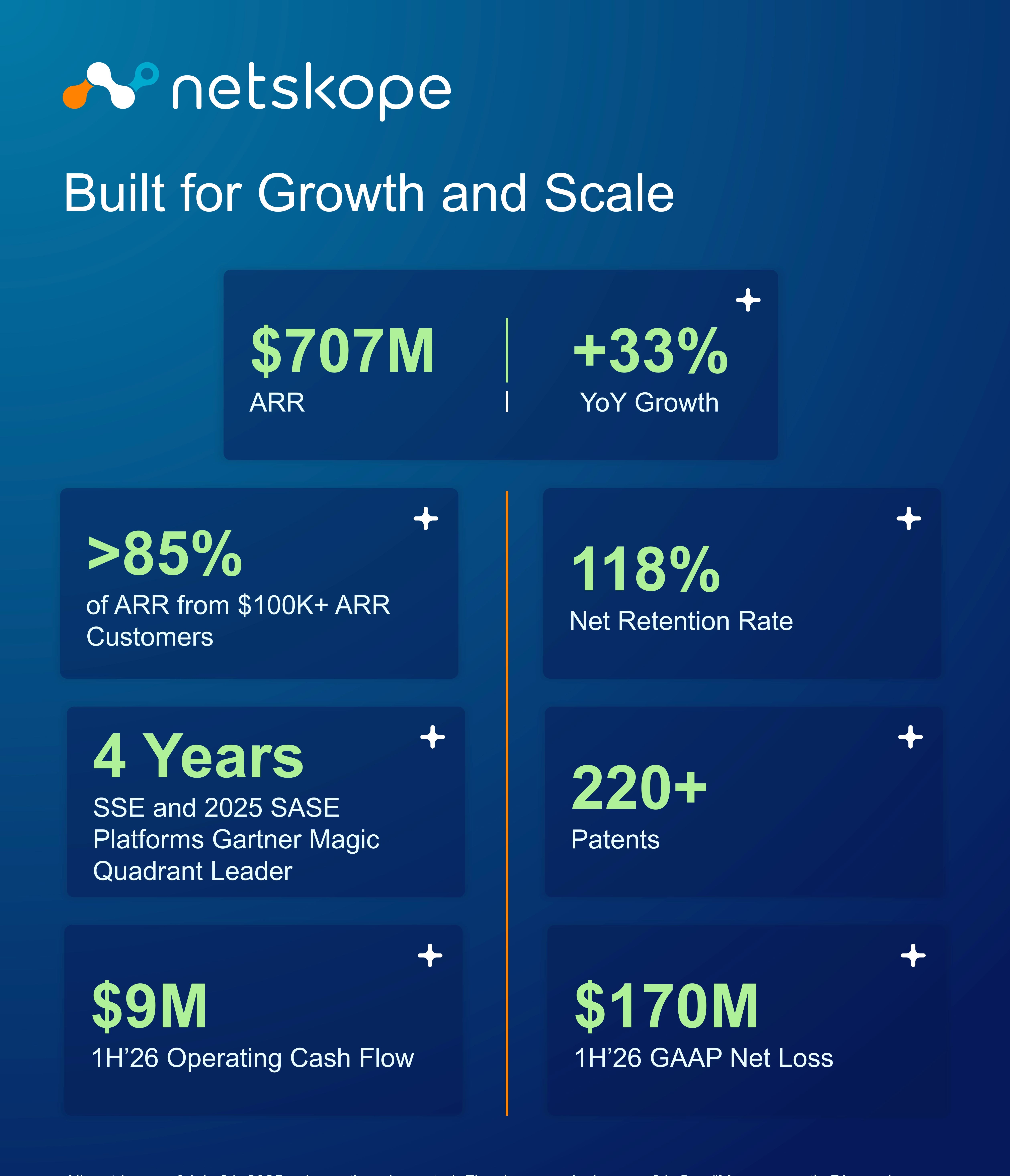
Our customers rely on us to protect their sensitive data, stop threats, accelerate their digital interactions, and deliver significantly higher operational simplicity. They include some of the largest and most complex organizations around the world and across industries. As of July 31, 2025, we had 4,317 customers,2 a 21% year-over-year increase from 3,571 customers as of July 31, 2024. As of July 31, 2025, more than 30% of the Fortune 100 and approximately 18% of the Forbes Global 2000 were our customers.
2 Customers refers to end customers. For more information, see Note 2 "Basis of Presentation and Summary of Significant Accounting Policies" in the notes to our consolidated financial statements included elsewhere in this prospectus.
As the digital and threat landscape continues to evolve, we have grown rapidly since our inception. Our Annual Recurring Revenue ("ARR")3 increased 33% year-over-year to $707 million as of July 31, 2025, compared to $531 million as of July 31, 2024. Our revenue increased 31% year-over-year to $328 million for the six months ended July 31, 2025, compared to $251 million for the six months ended July 31, 2024. Net loss improved to $170 million for the six months ended July 31, 2025, compared to $207 million for six months ended July 31, 2024.
We have achieved strong retention metrics, as evidenced by our dollar-based net retention rate ("NRR")4, which increased to 118% as of July 31, 2025, compared to 113% as of July 31, 2024. In addition, our dollar-based gross retention rate ("GRR")5 increased to 96% as of July 31, 2025, compared to 95% as of July 31, 2024.
In recent periods, we have invested in research and development to drive rapid innovation, leveraging our core platform to serve our customers' needs and further strengthen our technology leadership. We have also invested in expanding our salesforce and channel partners to pursue attractive growth opportunities both domestically and internationally. Netskope is built to scale. As a result, our loss from operations improved to $91 million for the six months ended July 31, 2025 from $161 million for the six months ended July 31, 2024, while our non-GAAP loss from operations improved to $63 million for the six months ended July 31, 2025 from $123 million for the six months ended July 31, 2024. For the five most recent fiscal quarters ended July 31, 2024, October 31, 2024, January 31, 2025, April 30, 2025 and July 31, 2025, our incremental operating margin was 12%, 83%, 85%, 108%, and 74%, while our incremental non-GAAP operating margin was 10%, 72%, 72%, 100%, and 58%, respectively.
Our operating cash flow margin improved to 3% for the six months ended July 31, 2025 from (42%) for the six months ended July 31, 2024. See the section titled "Management's Discussion and Analysis of Financial Condition and Results of Operations—Non-GAAP Financial Measures" for information regarding our use of non-GAAP loss from operations and incremental non-GAAP operating margin and a reconciliation of non-GAAP loss from operations to loss from operations.
Industry Background
Cloud and AI are Transforming the Internet
The internet is no longer just a collection of static web pages. The modern digital landscape is dynamic, data-rich, and interactive, spanning the web, data centers, managed and unmanaged SaaS applications, private and public clouds, and ecosystem applications. Today's internet and software applications use modern languages and methods of exchanging information, rich context, and data, notably via Application Programming Interfaces ("APIs") and new protocols, such as Model Context Protocol ("MCP") and the Agent2Agent ("A2A") protocol typically encoded using JavaScript Object Notation ("JSON"). Applications now connect directly to AI models via APIs and various protocols— sending requests, initiating third-party services, and receiving responses in real-time—all of which increase the complexity of these interactions and some of which require little or no human interaction. The challenge is security—organizations must have very granular visibility and context of the modern digital landscape so they can enable its use but must also do so securely and with a great end user experience. This requires a real-time, deep understanding of the contextual parameters of each digital interaction to enable more granular levels of dynamic and comprehensive control—a necessity for organizations modernizing their security while prioritizing business adoption of new technologies.
3 See the section titled "Management's Discussion and Analysis of Financial Condition and Results of Operations—Overview" for a description of how we calculate ARR.
4 See the section titled "Management's Discussion and Analysis of Financial Condition and Results of Operations—Overview" for a description of how we calculate NRR.
5 See the section titled "Management's Discussion and Analysis of Financial Condition and Results of Operations—Overview" for a description of how we calculate GRR.
Protecting Data—the Lifeblood of Modern Business—Has Never Been More Difficult or More Important
The vast amount of data an organization has and creates is often one of its greatest assets and competitive differentiators. It is mission critical for organizations to classify and protect this data. The challenge is that this growing amount of sensitive data is no longer maintained in secure, centralized corporate systems. Data now resides across digital environments, including corporate managed and unmanaged decentralized cloud services, the web, AI, SaaS applications, Infrastructure-as-a-Service, Platform-as-a-Service, private applications, endpoints, on-premises networks, databases, data lakes, data warehouses, email, and other IT systems. The nature of how it moves within and outside of an organization's control is dramatically different than it was a decade ago. For example:
•New data sharing behaviors, such as image, audio, and video sharing, undermine the effectiveness of conventional, static text-based data identification methods that traditional data loss prevention ("DLP") solutions mainly rely upon.
•Generative AI applications can create synthetic data ranging from realistic text and images to code, audio, and video content, which often mimics real-world data. This synthetic data serves to train other AI systems, enhance simulations, or generate personalized content, but it also raises concerns about the origin and authenticity of the data, which can be exploited to forge documents or create deepfake communications that look and sound authentic and can evade legacy data inspection techniques.
•Agentic AI, characterized by its autonomous decision-making capabilities, creates operational data that includes logs of actions, decisions, and interactions with other systems. This data travels between interconnected enterprise systems, APIs, and cloud infrastructures—from creation, through various stages of processing, to its eventual use in business analytics or automated responses. This introduces new vectors for data leakage and unauthorized access that legacy data inspection tools were not designed to look for.
Modern Business Needs Fast, Secure, and Resilient Performance that Far Exceeds the Capability of Existing Network Architectures
Traditional networks were built for a world where users typically worked from fixed locations, such as offices or campuses, and their applications and data resided in a corporate data center. The world we now live in is vastly different.
Extended enterprises need to provide ubiquitous access to their globally distributed business partners, suppliers, contractors, and acquired businesses. Furthermore, many digital interactions are now automatically initiated by internet of things/operational technology devices, factory floors, applications, robots, and AI agents, which we collectively refer to as "non-human entities." As a result, it is now an organizational imperative to deliver a fast and seamless experience for all digital interactions.
Cyber Risk Is One of the Greatest Challenges Organizations Face
Adversaries continue to find new and innovative ways to trick organizations and their employees into downloading and opening high-risk file types such as executables, archives, documents, and scripts while evading inspection. Adversaries are increasingly targeting cloud and SaaS applications directly, stealing tokens and credentials, and tricking victims into authorizing the attacker to directly access their data, bypassing the endpoint completely. Examples of these include:
•Ransomware-as-a-Service groups have emerged, deploying an onslaught of campaigns, including double-extortion schemes where data is stolen, encrypted, and leaked if the ransom is not paid.
•Nefarious actors have deployed fake CAPTCHA pages to trick victims into executing a command that infects their machine with malware, such as the LummaStealer campaign that transpired in early 2025.
•Recent AI advances have armed attackers with new tools to create increasingly convincing and targeted baits, including deepfakes, making social engineering more difficult to detect.
Limitations of Legacy Systems
Legacy systems suffer from a number of fundamental architectural shortcomings, including:
Inability to Provide Real-time Granular Inspection and Control of Digital Activity, Forcing Organizations to Block Essential Applications or Allow Them to be Used and Accept the Risks
Many legacy security systems are not capable of understanding the dynamic, data-rich, and interactive language of the modern internet. As a result, they lack real-time granular visibility and context of each interaction and cannot go beyond rigid and rudimentary controls such as blocking or allowing based on basic application access rules, device posture, or common activity types. Moreover, these legacy security systems were built for a world of human-generated traffic and struggle to manage the velocity and risks of machine-to-machine communication between non-human entities, creating critical blind spots.
Lacking a Unified, Comprehensive Approach to Data Security
Many organizations today rely on a myriad of disparate point solutions for data security, each intended for a specific digital environment. This fragmented approach with disjointed controls and policies leaves IT teams struggling to gain full visibility into where their data resides, what type of data it is, who is accessing it, and how it is being used holistically. This has two important consequences:
•Increased exposure to data breaches. Without unified, comprehensive data security in place, data is more vulnerable to breaches, theft, and misuse, which can have significant adverse consequences.
•Stifled productivity and agility. Teams may be reluctant to share or experiment with data, fearing security breaches or non-compliance with regulations. As a result, organizations that do not modernize their data security find themselves locked out of their own data, unable to leverage it effectively for new business models, solutions, or customer experiences.
Cannot Apply Advanced Security and Networking Controls at Scale Without Degrading Performance
Legacy security and networking systems suffer from one or more of the following architectural limitations.
•They lack advanced security controls. Their technology and architecture were built for securing legacy internet traffic, not for the era of the modern cloud and AI. As a consequence, they cannot understand the context needed to determine what should, or should not, require inspection. In addition, they have rudimentary data security capabilities and lack the sophisticated methods of inspection and advanced algorithms, including the use of AI, needed to identify sensitive data across all formats of data and stop threats. They also lack the ability to conduct data and advanced threat inspection in real-time at scale for cloud and AI applications.
•They lack advanced security capabilities at the edge and therefore must re-route traffic back to central corporate data centers or limited cloud enforcement points to enforce the required security controls, which leads to a poor user experience. This is because:
oLegacy systems are built on a centralized compute model, not taking user experience into account. Over time, ever increasing throughput of traffic has resulted in an unacceptably slow experience for human and non-human entities.
oTheir networks leverage the public cloud providers' infrastructure, much of which is not intended to handle compute-intensive products from edge locations. This limits the number of locations where their security services can operate and hinders the control they can exert over traffic routing. In addition, public cloud providers control how they prioritize traffic.
oThey are unable to process encrypted traffic, which makes up 80-95% of internet traffic according to the Electronic Frontier Organization, at the scale and speed required by modern organizations.
Siloed, Cumbersome, and Closed Security and Networking Infrastructure
Organizations are burdened with a plethora of disparate security and networking appliances and cloud tools, each requiring separate management consoles, policies, and configurations. Even when all of these are sourced from a single vendor, they are often fragmented and inefficient. Instead of receiving the seamless single console, policy framework, and network experience they hope for, organizations get only a "platform" that is unintegrated, complex, costly to deploy, difficult to operate, and many times designed to be closed in order to lock-in customers.
Our Revolutionary Approach
Our Netskope One platform is architected from the ground up to address the limitations of existing solutions and help customers modernize security and networking for the cloud and AI era. Our platform simplifies administration, integrates with and enhances existing investments, protects people, non-human entities, and data from pervasive threats, enables tool and capabilities consolidation without requiring complete system overhauls, and balances the historically conflicting needs of networking and security.
With the widespread adoption of SaaS and cloud, and the beginnings of an era expected to be dominated by AI, the way that essential security and networking services are delivered must fundamentally change in order to satisfy modern business needs. We deliver a modern solution; our team has not only built a converged platform, but has also fully reimagined the architecture of security, networking, and analytics for the cloud and AI era.
Architecture is critical, and platform architecture itself is as important as the individual security, network, and analytics services that it delivers. The traditional methods of delivering these services are inadequate for the demands of today and tomorrow. A modern architecture is necessary for greater visibility and control over data, threats, and access, ensuring all enterprise traffic remains fast and secure when everything, everywhere, is online and interconnected, while addressing the increasing velocity and volume of security threats.
Thanks to the differentiated architecture of our Netskope One platform, which includes context-based security, our NewEdge network—one of the world's largest and most connected global private security cloud networks—and our ability to deliver market-leading security, network, and analytics products efficiently to wherever users, devices, applications, and data live, organizations no longer need to compromise between security and network performance.
Deeply Understands the Language of the Modern Internet
The modern digital landscape of cloud and AI is comprised of dynamic, highly interactive applications powered by a layer of APIs and protocols, such as MCP and A2A using JSON-based data encoding that contain granular information about the digital interaction. Our patented technologies and our Zero Trust Engine were built from the ground up to operate at this layer, enabling us to inspect, analyze, and control traffic in real-time and at high speed. We leverage this profound contextual intelligence to understand and control more than 100 different activity types across thousands of cloud, SaaS, and AI applications, over a billion websites, and countless data lakes, stores, and private applications. This contextual intelligence and control goes far beyond basic application access rules, device posture, and common activities (e.g., upload or download) that legacy solutions are limited to.
This in-depth understanding of each digital interaction allows us to drive situation-specific policy actions such as Coach, Encrypt, Legal Hold, and Quarantine, to safeguard data and neutralize threats with exceptional precision. For example, a user accessing a personal instance of a Google Gemini can be coached and redirected to the corporate instance.
Unified Approach to Data Security
Our Netskope One platform's unified platform approach enables organizations to discover, classify, and protect data, while providing the appropriate level of access based on context in real-time.
Our Netskope One platform delivers deep, real-time visibility and control into organizations' data across the digital landscape, allowing security teams to track where sensitive information resides, who is accessing it, and how it is being used. Our platform leverages our proprietary AI and ML models to detect, classify, track, and control sensitive data no matter where it is, and automatically flags and addresses security and privacy risks, which includes coaching users in real-time with situation-specific guidance on how they can handle data safely. Our unified policies are designed to be applied consistently across data types—whether structured or unstructured, in-motion or at-rest, on-premises, in the cloud, or on an endpoint—closing security gaps and facilitating compliance with regulations and data sovereignty laws.
Ability to Apply Advanced Security Controls at Scale while Accelerating Performance
Our NewEdge network provides the foundation for delivering our converged security, networking, and analytics capabilities. The NewEdge network is purpose-built, leveraging bare metal servers with vendor-agnostic hardware. Currently, it comprises more than 120 data centers in more than 75 unique regions, each offering full compute at the edge and capabilities for in-region traffic processing for all products in our Netskope One platform. In addition, our NewEdge network provides more than 200 localization zones around the world, ensuring that customer end users receive local content, in the local language.
Our Netskope One platform converges security, networking, and analytics capabilities into a single unified, cloud-native architecture. This integration resolves the traditional conflict between security and networking teams, where it was believed that high performance could only be achieved at the expense of security efficacy, or vice versa. Our Netskope One platform sacrifices neither—organizations get advanced security and highly performant and resilient networking. This results in greater security efficacy and an exceptional user experience, while simplifying operations through a single console, engine, network, gateway, and client.
AI is Foundational to our Platform
At the heart of our Netskope One platform lies a deep commitment to AI, brought to life by Netskope AI Labs. This dedicated team of AI scientists, security researchers, and product engineers boasts a proven track record in solving complex security and fraud challenges across diverse domains.
Key Benefits for Our Customers
Accelerates and Secures Organizations' Adoption of Cloud and AI
Our platform empowers organizations to confidently embrace cloud and AI. It enables the inspection and implementation of real-time, granular, and contextual security controls across the digital landscape. Our platform also facilitates the swift and secure integration of advanced AI applications by enabling customers to deploy sophisticated global security policies that promote access to generative AI and agentic AI applications, while stopping sensitive data leaks and threats.
Significantly Reduces Risks for Organizations
•Enabling a True Zero Trust Architecture. Our Zero Trust Engine continuously gathers risk telemetry and contextual awareness across users, devices, non-human entities, threats, data, and more. It understands the language of the modern internet in real-time across the web, cloud, SaaS, AI applications, and private applications for broad visibility and protection. Our platform proactively mitigates cyber threats in real-time, which can prevent incidents and stop attacks early. Our Netskope One platform enables a true least-privilege architecture, enhancing detection, investigation, prevention, and response capabilities.
•Reducing Risks for the Extended Enterprise. Netskope One Private Access and our Zero Trust Engine extend zero trust principles to external parties to provide granular control and visibility into third-party access, even with unmanaged devices.
Enables a Fast, Resilient Experience for All Digital Interactions
Our NewEdge network is designed to be ultrafast, highly elastic, built for scale, and capable of providing cloud-delivered security and networking services directly where the users (human and non-human entities) and workplaces are, without performance trade-offs. With intelligent traffic route control, we are able to deliver consistent performance under dynamic network conditions, while our highly available infrastructure is backed by "five nines" (99.999%) performance guarantees.
Enables Hybrid and Remote Work and Helps Customers Attract and Retain Talent
Our Netskope One platform provides full visibility from device to application, enabling IT and network teams to quickly diagnose and resolve traffic performance issues—oftentimes before they happen—allowing organizations to scale operations and support a distributed workforce through hybrid and remote work arrangements. With minimal latency and precise policy enforcement, our platform allows human and non-human entities to connect instantly and securely from any location.
Reduces Cost and Complexity and Addresses Cybersecurity Talent Shortages by Enabling Organizations to Do More with Less
We simplify security, networking, and analytics for organizations by integrating fragmented point solutions into a unified cloud-native platform. By reducing reliance on legacy hardware appliances, sunsetting legacy data centers, and streamlining and thinning the on-premises footprint, organizations benefit from lower deployment and operational costs while enhancing efficiency.
Enables an Open Ecosystem for the Benefit of the IT Industry and Customers
Netskope Cloud Exchange champions an open ecosystem by offering seamless integration with hundreds of cloud services, IT platforms, and third-party applications. Our comprehensive suite includes more than 100 pre-built integrations, many of which can operate across multiple systems right out of the box, allowing businesses to employ best-of-breed solutions from different IT vendors, providing flexibility while prioritizing security.
Our Competitive Strengths
Deep Technology Moat
Our patented technologies and unified platform enable advanced security controls while accelerating performance at scale and providing the following key advantages:
•Advanced Security Built for the Cloud and AI Era.
oOur patented technology operates at the API/JSON, application, and protocol layers, allowing real-time inspection, analysis, and control of modern internet and private traffic, leveraging contextual intelligence across human and non-human entities, activities, behavior, data, threats, and more.
oOur proprietary AI models precisely identify sensitive data, enhancing accuracy and minimizing false positives. Our unified policies, applied consistently across data types, are designed to eliminate security gaps and ensure compliance.
•Designed to Deliver Accelerated Performance and Resilience at Scale. All of our NewEdge network data centers are available to all customers and are capable of running all of our products. With more than 120 data centers, more than 200 localization zones, and more than 10,000 network adjacencies across more than 75 regions, our advanced network architecture and resilience measures are backed by 99.999% uptime guarantees for all inline services, providing a seamless user experience. Built for scale, our NewEdge network can handle heavy traffic loads, providing users and organizations with a fast and reliable network that can adapt to their evolving needs.
•True Convergence of Security and Networking. Our Netskope One platform is a unified, cloud-native platform with truly converged security, networking, and analytics capabilities. With a single console, engine, client, network, and gateway, our platform is designed to significantly reduce complexity and costs while increasing performance and resilience. Our converged architecture, extended by our Netskope One Gateway, delivers consistent security and networking policies and optimized performance, enabling a true Secure Access Services Edge ("SASE") and Security Services Edge ("SSE") architecture (and more) that adapts to the dynamic needs of modern businesses.
Recognized Industry Leadership
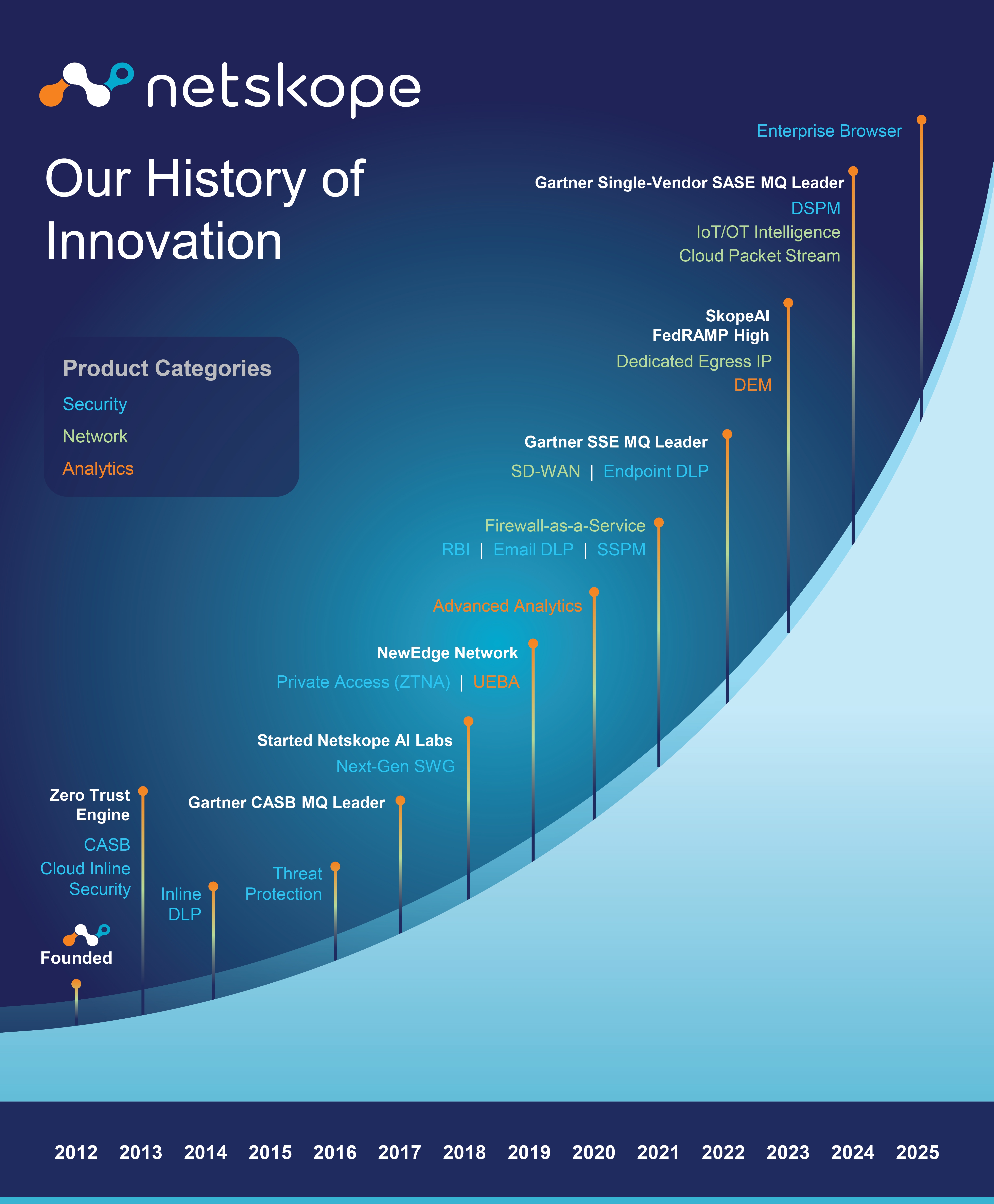
We are recognized as a leader in markets that are central to a multi-decade IT transformation and have received accolades from numerous publications, including being named as a leader in Gartner® Magic Quadrant™ for Security Service Edge every year since its inception in 2022 through 2025, a leader in Gartner® Magic Quadrant™ for SASE Platforms in 2024 and 2025, a leader in The Forrester Wave™: Security Service Edge (SSE) Solutions for Q1 2024, and a leader in the 2025 IDC MarketScape for Worldwide DLP Vendor Assessment.
Broad and Deep Partner Ecosystem
Our partner ecosystem is a key component of our business strategy. We believe in the power of collaboration and working with a broad and diverse set of partners globally. Our ecosystem encompasses many of the world's leading security and network value added resellers ("VARs") and distributors, technology alliances, service and telecommunications partners, managed service providers ("MSPs"), system integrators, and other strategic partners. We have cultivated strong, deep technology partnerships with industry leaders across the IT ecosystem, including Amazon, CrowdStrike, Google, MetTel, Microsoft, Okta, and Telstra.
Strong International Presence
Our international footprint is a testament to our ability to serve the world's largest customers with our global operations. For fiscal 2025 and the second quarter of fiscal 2026, revenue from regions outside the Americas (which we define as the United States, Canada, and Latin America) comprised 43% and 43% of our total revenue, respectively, underscoring our commitment to transforming and modernizing organizations for the cloud and AI era on a global scale.
Visionary and Experienced Management Team
We are guided by a visionary and experienced management team. Our leadership team is deeply committed to driving continuous innovation and collaboratively engaging with the industry and community to advance security, networking, and analytics solutions.
Our Market Opportunity
By converging advanced security and modern networking capabilities with deep analytics, based on our analysis of IDC data, we believe our unified solution addresses a large total addressable market that is projected to reach $138.9 billion by 2028, growing at a 16.8% CAGR from 2024 to 2028, providing us with a sustained and durable opportunity. We believe we are in the early days of addressing the nascent market opportunity for AI security that we project will grow to $30.8 billion by 2028, contributing an incremental $9.9 billion to our estimated total addressable market by 2028.6
Our Growth Strategies
•Win New Customers. We are executing a disciplined approach to expanding our presence across major accounts, enterprises, and the mid-market.
•Expand within Existing Customers. We drive growth within our existing customer base by expanding the adoption of our Netskope One platform through product cross-sell and by expanding deployments across additional customer business units, use cases, and geographies. Our ability to expand is demonstrated through our strong NRR, which increased to 118% as of July 31, 2025, compared to 113% as of July 31, 2024.
•Broaden Reach into the Public Sector. We are investing in the acquisition of public sector customers to capture additional revenue streams and diversify our customer base, including U.S. federal government agencies, supported by our recent FedRAMP High Authorization. In addition, we maintain an extensive portfolio of third-party assessments and certifications for government sectors worldwide, including SSAE-18/SOC-2 Type 2. We also hold certifications in Germany (C5), UK (Cyber Essentials), Australia (IRAP), Canada (Protective-B), and Spain (Esquema Nacional de Seguridad). We have also self-certified under the EU-U.S. Data Privacy Framework (EU-U.S. DPF), the UK Extension to the EU-U.S. Data Privacy Framework (UK Extension to the EU-U.S. DPF), and the Swiss-U.S. Data Privacy Framework (Swiss-U.S. DPF). These assessments demonstrate our commitment to security and compliance across various industries and geographies to further penetrate new customer categories.
•Grow our International Footprint. We have strategically invested in and expanded our international presence, particularly in Europe, the Middle East and Africa ("EMEA"), and Asia Pacific and Japan ("APJ").
•Expand our Domestic Footprint. We have built a substantial business internationally over the years, and we are now even more focused on increasing the size of our Americas salesforce to drive increased growth, especially in the U.S.
•Grow our Partner Ecosystem. Our partner ecosystem enhances the distribution of our platform and expands our go-to-market reach. We continue to expand our channel partnerships with VARs, distributors, technology alliance partners, system integrators, MSPs, and global telecommunications service providers to continue to grow efficiently.
•Enhance our Platform Capabilities through Strategic M&A. When we evaluate companies externally, we look for great technical teams who fit our culture of collaboration, innovation, and putting customers first.
6 See the section titled "Business—Our Market Opportunity" for a more detailed discussion of the assumptions underlying our estimate of the total addressable market for our unified solution and AI security.
Risk Factors Summary
Our business is subject to numerous risks and uncertainties, including those highlighted in the section titled "Risk Factors" immediately following this prospectus summary. The following is a summary of certain of the principal risks we face:
•We have a history of losses, anticipate increases in our operating expenses in the near-term, and may not achieve or sustain profitability. If we cannot achieve and sustain profitability, our business, results of operations, and financial condition will be adversely affected.
•We have experienced rapid growth in recent periods, and our recent growth rates may not be indicative of our future growth.
•Our future revenues and operating results will be harmed if we are unable to acquire new customers, if our customers do not renew their arrangements with us, or if we are unable to expand sales to our existing customers.
•If the market for security, networking, and analytics does not grow, our ability to grow our business and our results of operations may be adversely affected.
•Our business and growth depend in part on the success of our relationships with our partner ecosystem. If we are unable to maintain or develop these relationships, our business, results of operations and financial condition could be materially and adversely affected.
•Our operating results may fluctuate significantly, which could make our future results difficult to predict and could cause our operating results to fall below expectations.
•If we do not effectively develop and expand our sales and marketing capabilities, we may be unable to add new customers or increase sales to our existing customers, and our business will be adversely affected.
•Our sales cycle is long and unpredictable, and our sales efforts require considerable time and expense.
•Our international operations expose us to significant risks, and failure to manage those risks could materially and adversely impact our business, results of operations and financial condition.
•If we fail to obtain, maintain, protect, defend, or adequately enforce our intellectual property or proprietary rights, our competitive position could be impaired, and we may lose valuable assets, generate reduced revenue, and incur costly litigation to protect our rights.
•Our use of AI and ML, and the integration of AI and ML within our platform and products, may not be successful and may present business, compliance, and reputational challenges, which could lead to operational or reputational damage, competitive harm, legal and regulatory risk, and additional costs, any of which could adversely affect our business, results of operations, and financial condition.
•If our internal networks, systems or data are or are perceived to have been breached, our platform and products may be perceived as insecure, our reputation may be damaged, and our financial results may be negatively impacted.
•The actual or perceived failure of our platform and products to block malware or prevent a security breach or incident could harm our reputation and adversely impact our business, results of operations, and financial condition.
•If we are not able to satisfy data protection, security, privacy and other government- and industry-specific requirements or regulations, our business, results of operations and financial condition could be harmed.
•Servicing our substantial indebtedness may require a significant amount of cash, and we may not have sufficient cash flow from our business or the ability to raise funds necessary to satisfy our obligations under our indebtedness. Our debt could also expose us to other risks that could adversely affect our business, financial condition and results of operations.
•The multi-class structure of our common stock will have the effect of concentrating voting control with the holders of our outstanding Class B common stock. This ownership will limit or preclude your ability to influence corporate matters.
•We cannot predict the effect our multi-class structure may have on the trading price of our Class A common stock.
Our Risk Factors are not guarantees that no such conditions exist as of the date of this prospectus and should not be interpreted as an affirmative statement that such risks or conditions have not materialized, in whole or in part. If we are unable to adequately address these or the other risks we face, our business, operating results, financial condition, and future prospects could be adversely affected. As a result, you could lose all or part of your investment.
Channels for Disclosure of Information
Investors, the media and others should note that, following the effectiveness of the registration statement of which this prospectus forms a part, we intend to announce material information to the public through filings with the Securities and Exchange Commission ("SEC") the investor relations page on our website, press releases, public conference calls and webcasts.
The information disclosed through the foregoing channels could be deemed to be material information. As such, we encourage investors, the media, and others to follow the channels listed above and to review the information disclosed through such channels. However, information disclosed through these channels does not constitute part of this prospectus and is not incorporated by reference herein.
Any updates to the list of disclosure channels through which we will announce information will be posted on the investor relations page on our website.
Corporate Information
We were incorporated in Delaware in October 2012. Our principal executive offices are located at 2445 Augustine Drive, Suite 301, Santa Clara, California 95054. Our telephone number is (800) 979-6988. Our website is netskope.com. Information contained on, or that can be accessed through, our website is not a part of, and is not incorporated into, this prospectus, and the inclusion of our website address in this prospectus is an inactive textual reference only.
We use Netskope, the Netskope logo and other marks as trademarks in the United States and other countries. This prospectus contains references to our trademarks and service marks and to those belonging to other entities. Solely for convenience, trademarks and trade names referred to in this prospectus, including logos, artwork and other visual displays, may appear without the ® or TM symbols, but such references are not intended to indicate in any way that we will not assert, to the fullest extent under applicable law, our rights or the rights of the applicable licensor to these trademarks and trade names. We do not intend our use or display of other entities' trade names, trademarks or service marks to imply a relationship with, or endorsement or sponsorship of us by, any other entity.
Implications of Being an Emerging Growth Company
We are an "emerging growth company" as defined in the Jumpstart Our Business Startups Act of 2012, as amended (the "JOBS Act"). As such, we may take advantage of reduced disclosure and other requirements otherwise generally applicable to public companies, including:
•presentation of only two years of audited financial statements and related financial disclosure;
•exemption from the requirement to have our registered independent public accounting firm perform an attestation of internal control over financial reporting under Sarbanes-Oxley Act Section 404(b);
•exemption from compliance with the requirement of the Public Company Accounting Oversight Board ("PCAOB") regarding the communication of critical audit matters in the auditor's report on the financial statements;
•reduced disclosure about our executive compensation arrangements; and
•exemption from the requirement to hold non‑binding advisory votes on executive compensation or golden parachute arrangements.
We will remain an emerging growth company until the earliest to occur of: (1) the last day of the fiscal year in which we have at least $1.235 billion in annual revenue; (2) the date we qualify as a "large accelerated filer," with at least $700.0 million of equity securities held by non-affiliates; (3) the date on which we have issued more than $1.0 billion in non-convertible debt securities during the prior three-year period; and (4) the last day of the fiscal year ending after the fifth anniversary of our initial public offering.
As a result of this status, we have taken advantage of reduced reporting requirements in this prospectus and may elect to take advantage of other reduced reporting requirements in our future filings with the SEC. In particular, in this prospectus, we have provided only two years of audited financial statements and only two years of related management's discussion and analysis of financial condition and results of operations, and we have not included all of the executive compensation-related information that would be required if we were not an emerging growth company. In addition, the JOBS Act provides that an emerging growth company may take advantage of an extended transition period for complying with new or revised accounting standards, delaying the adoption of these accounting standards until they would apply to private companies unless it otherwise irrevocably elects not to avail itself of this exemption. We have elected to use this extended transition period for complying with new or revised accounting standards until we are no longer an emerging growth company or until we affirmatively and irrevocably opt out of the extended transition period. As a result, our consolidated financial statements may not be comparable to the financial statements of companies that comply with new or revised accounting pronouncements as of public company effective dates.
THE OFFERING
|
|
Class A common stock offered by us |
47,800,000 shares. |
|
|
Underwriters' option to purchase additional shares from us |
7,170,000 shares. |
|
|
Class A common stock to be outstanding immediately after this offering |
47,800,000 shares (or 54,970,000 shares if the underwriters exercise their option to purchase additional shares in full). |
|
|
Class B common stock to be outstanding immediately after this offering |
334,273,197 shares. |
|
|
Class C common stock to be outstanding immediately after this offering |
None. |
|
|
Total Class A common stock, Class B common stock, and Class C common stock to be outstanding immediately after this offering |
382,073,197 shares (or 389,243,197 shares if the underwriters exercise their option to purchase additional shares in full). |
|
|
Use of proceeds |
We estimate that the net proceeds to us from the sale of shares of our Class A common stock in this offering will be approximately $ 719.2 million (or approximately $828.2 million if the underwriters exercise their option to purchase additional shares in full), based upon the assumed initial public offering price of $16.00 per share, which is the midpoint of the estimated offering price range set forth on the cover page of this prospectus, and after deducting estimated underwriting discounts and commissions and estimated offering expenses payable by us. The principal purposes of this offering are to increase our capitalization and financial flexibility, create a public market for our Class A common stock, facilitate future access to the public equity markets by us, our employees and our stockholders, and increase our visibility in the marketplace. We intend to use the net proceeds from this offering for general corporate purposes, including working capital, operating expenses and capital expenditures. We also intend to use a portion of the net proceeds we receive from this offering to satisfy the anticipated tax withholding and remittance obligations related to the settlement of our outstanding restricted stock units ("RSUs") in connection with this offering. We may also use a portion of the net proceeds to acquire or invest in complementary businesses, products, services, technologies, or other assets. We do not, however, have any agreements or commitments to enter into any acquisitions or investments at this time. We may also use the net proceeds from this offering to repay all or a portion of the outstanding indebtedness under our Convertible Notes (as defined below). See the section titled "Use of Proceeds." However, we do not currently intend to use the proceeds from this offering to repay our outstanding indebtedness. |
|
|
|
|
Voting rights |
Each share of our Class A common stock will be entitled to one vote per share. Each share of our Class B common stock will be entitled to 20 votes per share. Shares of our Class C common stock have no voting rights, except as otherwise required by law. Holders of our Class A common stock and Class B common stock will generally vote together as a single class, unless otherwise required by law or our certificate of incorporation. Immediately following the completion of this offering, holders of our outstanding Class B common stock will hold approximately 99.3% of the voting power of our outstanding capital stock and will have the ability to control the outcome of matters submitted to our stockholders for approval, including the election of our directors and the approval of any change in control transaction. Additionally, our executive officers, directors, and holders of 5% or more of our common stock will hold, in the aggregate, approximately 54.4% of the voting power of our outstanding capital stock following this offering. Prior to the effectiveness of our registration statement related to this offering, our Chief Executive Officer and Chairman is expected to enter into a voting agreement with one of our non-executive co-founders for 1.6% of the voting power, resulting in an aggregate 8.4% of the voting power of our outstanding capital stock following the completion of this offering. See the section titled "Description of Capital Stock." |
|
|
Risk factors |
See the section titled "Risk Factors" and other information included in this prospectus for a discussion of factors you should carefully consider before deciding to invest in our Class A common stock. |
|
|
Proposed Nasdaq trading symbol |
"NTSK" |
|
|
The total number of shares of Class A common stock and Class B common stock that will be outstanding immediately after this offering is based on no shares of our Class A common stock, 334,273,197 shares of our Class B common stock, and no shares of our Class C common stock outstanding as of July 31, 2025 (assuming (i) the conversion of all of our convertible preferred stock into shares of our common stock immediately prior to the filing and effectiveness of our amended and restated certificate of incorporation in connection with this offering (the "Preferred Stock Conversion"), (ii) the filing and effectiveness of our amended and restated certificate of incorporation in Delaware and the effectiveness of our amended and restated bylaws, which will each occur immediately prior to the completion of this offering and will effect the reclassification of our common stock into Class B common stock (the "Reclassification"), and (iii) the net issuance of an estimated 6,059,110 shares of our Class B common stock subject to RSUs for which the service condition was satisfied as of July 31, 2025, and for which we expect the performance condition to be satisfied upon the effectiveness of the registration statement of which this prospectus forms a part (after withholding an estimated 4,570,907 shares of our Class B common stock subject to RSUs to satisfy estimated tax withholding obligations at an assumed tax withholding rate of 43%) (the "RSU Settlement")), and excludes:
•53,487,228 shares of Class B common stock issuable upon the exercise of outstanding options as of July 31, 2025, with a weighted-average exercise price of $5.80 per share;
•26,000 shares of Class B common stock issuable upon the exercise of outstanding options that were granted after July 31, 2025, with an exercise price of $17.01 per share;
•50,843,151 shares of Class B common stock issuable in connection with the vesting and settlement of RSUs and performance-based RSUs ("PSUs") outstanding as of July 31, 2025, but for which the service or market condition was not satisfied as of such date;
•1,910,705 shares of Class B common stock issuable in connection with the settlement of RSUs that were granted after July 31, 2025 upon satisfaction of both the service condition and the liquidity event condition;
•up to a maximum of 28,267,156 shares of Class B common stock issuable upon conversion of our Convertible Notes, assuming the Convertible Notes are held until the applicable maturity date;
•38,210,000 shares of Class A common stock reserved for future issuance under our 2025 Equity Incentive Plan (the "2025 Plan"), which will become effective on the business day immediately prior to the date of effectiveness of the registration statement of which this prospectus forms a part; and
•7,650,000 shares of Class A common stock reserved for future issuance under our 2025 Employee Stock Purchase Plan (the "ESPP"), which will become effective on the business day immediately prior to the date of effectiveness of the registration statement of which this prospectus forms a part.
The 2025 Plan and the ESPP each provide for annual automatic increases in the number of shares of our Class A common stock reserved thereunder, and the 2025 Plan also provides for increases to the number of shares of our Class A common stock that may be granted thereunder based on shares under our 2012 Stock Incentive Plan (the "2012 Plan") and our 2022 Stock Incentive Plan (the "2022 Plan") that expire, are forfeited or are repurchased by us, as more fully described in the section titled "Executive Compensation—Employee Benefits and Stock Plans."
For a description of the terms of our Convertible Notes, as well as an illustrative calculation of the number of shares of Class B common stock issuable upon conversion of the Convertible Notes as of July 31, 2025 and the maturity date of the Convertible Notes, please see the section titled "Management's Discussion and Analysis of Financial Condition and Results of Operations—Liquidity and Capital Resources—Convertible Notes."
Except as otherwise indicated, all information in this prospectus assumes or gives effect to the following:
•the Preferred Stock Conversion will occur immediately prior to the completion of this offering;
•the Reclassification will occur immediately prior to the completion of this offering;
•no exercise of outstanding options described above or settlement of outstanding RSUs other than the RSU Settlement;
•the RSU Settlement will occur upon the effectiveness of our registration statement related to this offering;
•the filing and effectiveness of our amended and restated certificate of incorporation and the adoption of our amended and restated bylaws, which will occur immediately prior to the completion of this offering; and
•no exercise of the underwriters' option to purchase additional shares.
SUMMARY CONSOLIDATED FINANCIAL AND OTHER DATA
The following tables set forth a summary of our consolidated financial data as of, and for the periods ended on, the dates indicated. The consolidated statements of operations and cash flows data for fiscal 2024 and 2025, are derived from our audited consolidated financial statements and related notes included elsewhere in this prospectus. The consolidated statements of operations and cash flows data for the six months ended July 31, 2024 and 2025, and the consolidated balance sheet data as of July 31, 2025, are derived from our unaudited interim consolidated financial statements included elsewhere in this prospectus. You should read this data together with our consolidated financial statements and related notes appearing elsewhere in this prospectus and the information in "Management's Discussion and Analysis of Financial Condition and Results of Operations." Our historical results are not necessarily indicative of our future results, and our quarterly results are not necessarily indicative of the results to be expected for the full year or any other period. The summary consolidated financial data in this section are not intended to replace, and are qualified in their entirety by, the consolidated financial statements and related notes included elsewhere in this prospectus.
Consolidated Statements of Operations Data:
|
|
|
|
|
|
|
|
|
|
|
|
|
|
|
|
|
|
|
Fiscal Year Ended
January 31, |
|
|
Six Months Ended
July 31, |
|
|
|
2024 |
|
|
2025 |
|
|
2024 |
|
|
2025 |
|
|
|
(in thousands, except share and per share data) |
|
Revenue |
|
$ |
406,883 |
|
|
$ |
538,268 |
|
|
$ |
251,250 |
|
|
$ |
328,494 |
|
Cost of revenue(1) |
|
|
163,633 |
|
|
|
190,369 |
|
|
|
94,444 |
|
|
|
95,737 |
|
Gross profit |
|
|
243,250 |
|
|
|
347,899 |
|
|
|
156,806 |
|
|
|
232,757 |
|
Operating expenses: |
|
|
|
|
|
|
|
|
|
|
|
|
Sales and marketing(1) |
|
|
263,096 |
|
|
|
280,828 |
|
|
|
151,626 |
|
|
|
147,426 |
|
Research and development(1) |
|
|
224,496 |
|
|
|
254,189 |
|
|
|
130,356 |
|
|
|
140,737 |
|
General and administrative(1) |
|
|
68,456 |
|
|
|
68,623 |
|
|
|
35,555 |
|
|
|
35,917 |
|
Total operating expenses |
|
|
556,048 |
|
|
|
603,640 |
|
|
|
317,537 |
|
|
|
324,080 |
|
Loss from operations |
|
|
(312,798 |
) |
|
|
(255,741 |
) |
|
|
(160,731 |
) |
|
|
(91,323 |
) |
Loss on changes in fair value of convertible notes |
|
|
(38,575 |
) |
|
|
(98,627 |
) |
|
|
(45,124 |
) |
|
|
(77,402 |
) |
Other income, net |
|
|
13,305 |
|
|
|
4,101 |
|
|
|
2,758 |
|
|
|
4,122 |
|
Loss before provision for income taxes |
|
|
(338,068 |
) |
|
|
(350,267 |
) |
|
|
(203,097 |
) |
|
|
(164,603 |
) |
Provision for income taxes |
|
|
6,784 |
|
|
|
4,243 |
|
|
|
3,632 |
|
|
|
4,940 |
|
Net loss |
|
$ |
(344,852 |
) |
|
$ |
(354,510 |
) |
|
$ |
(206,729 |
) |
|
$ |
(169,543 |
) |
Net loss per share attributable to common
stockholders, basic and diluted(2) |
|
$ |
(3.77 |
) |
|
$ |
(3.64 |
) |
|
$ |
(2.18 |
) |
|
$ |
(1.59 |
) |
Weighted-average shares used in computing net loss
per share attributable to common stockholders,
basic and diluted(2) |
|
|
91,394,561 |
|
|
|
97,515,591 |
|
|
|
94,670,774 |
|
|
|
106,429,655 |
|
Pro forma net loss per share attributable to common
stockholders, basic and diluted (unaudited)(3) |
|
|
|
|
$ |
(1.88 |
) |
|
|
|
|
$ |
(0.73 |
) |
Weighted-average shares used in computing pro
forma net loss per share attributable to common
stockholders, basic and diluted (unaudited)(3) |
|
|
|
|
|
319,844,914 |
|
|
|
|
|
|
327,954,658 |
|
(1)Includes stock-based compensation expense as follows:
|
|
|
|
|
|
|
|
|
|
|
|
|
|
|
|
|
|
|
Fiscal Year Ended
January 31, |
|
|
Six Months Ended
July 31, |
|
|
|
2024 |
|
|
2025 |
|
|
2024 |
|
|
2025 |
|
|
|
(in thousands) |
|
Cost of revenue |
|
$ |
2,925 |
|
|
$ |
2,477 |
|
|
$ |
1,341 |
|
|
$ |
927 |
|
Sales and marketing |
|
|
25,125 |
|
|
|
18,341 |
|
|
|
10,532 |
|
|
|
6,459 |
|
Research and development |
|
|
27,150 |
|
|
|
24,698 |
|
|
|
12,860 |
|
|
|
8,799 |
|
General and administrative |
|
|
5,791 |
|
|
|
5,318 |
|
|
|
2,607 |
|
|
|
1,457 |
|
Total stock-based compensation expense |
|
$ |
60,991 |
|
|
$ |
50,834 |
|
|
$ |
27,340 |
|
|
$ |
17,642 |
|
(2)See Notes 2 and 15 to our consolidated financial statements included elsewhere in this prospectus for an explanation of the calculation of our basic and diluted net loss per share attributable to common stockholders.
(3)The following table sets forth the computation of pro forma net loss per share attributable to common stockholders, basic and diluted, for the period presented:
|
|
|
|
|
|
|
|
|
|
|
Fiscal Year Ended
January 31, |
|
|
Six Months Ended
July 31, |
|
(in thousands, except share and per share data) |
|
2025 |
|
|
2025 |
|
Numerator: |
|
|
|
|
|
|
Net loss |
|
$ |
(354,510 |
) |
|
$ |
(169,543 |
) |
Stock-based compensation expense related to vesting of RSUs |
|
|
(245,306 |
) |
|
|
(70,488 |
) |
Pro forma net loss, basic and diluted |
|
$ |
(599,816 |
) |
|
$ |
(240,031 |
) |
Denominator: |
|
|
|
|
|
|
Weighted-average shares used in computing net loss per share |
|
|
97,515,591 |
|
|
|
106,429,655 |
|
Pro forma adjustment to reflect assumed conversion of convertible
preferred stock into common stock |
|
|
218,897,608 |
|
|
|
218,897,608 |
|
Pro forma adjustment to reflect the assumed vesting of the RSUs, net
of shares withheld to satisfy tax withholding obligations |
|
|
3,431,715 |
|
|
|
2,627,395 |
|
Weighted-average shares used in computing pro forma net loss per
share attributable to common stockholders, basic and diluted |
|
|
319,844,914 |
|
|
|
327,954,658 |
|
Pro forma net loss per share attributable to common stockholders, basic and diluted |
|
$ |
(1.88 |
) |
|
$ |
(0.73 |
) |
Consolidated Balance Sheet Data:
|
|
|
|
|
|
|
|
|
|
|
|
|
|
|
As of July 31, 2025 |
|
|
|
Actual |
|
|
Pro Forma (1) |
|
|
Pro Forma as Adjusted (2)(3) |
|
|
|
(in thousands) |
|
Cash, cash equivalents, and marketable securities |
|
$ |
261,407 |
|
|
$ |
261,407 |
|
|
$ |
911,204 |
|
Working (deficit) capital (4) |
|
|
(45,428 |
) |
|
|
(118,563 |
) |
|
|
600,647 |
|
Total assets |
|
|
827,387 |
|
|
|
827,387 |
|
|
|
1,473,013 |
|
Convertible notes |
|
|
700,341 |
|
|
|
700,341 |
|
|
|
700,341 |
|
Total liabilities |
|
|
1,439,466 |
|
|
|
1,512,601 |
|
|
|
1,439,017 |
|
Convertible preferred stock |
|
|
1,050,561 |
|
|
|
- |
|
|
|
- |
|
Additional paid-in capital |
|
|
458,186 |
|
|
|
1,751,384 |
|
|
|
2,470,589 |
|
Accumulated deficit |
|
|
(2,119,055 |
) |
|
|
(2,434,849 |
) |
|
|
(2,434,849 |
) |
Total stockholders' (deficit) equity |
|
|
(612,079 |
) |
|
|
(685,214 |
) |
|
|
33,996 |
|
________________
(1)The pro forma consolidated balance sheet data gives effect to (1) the Preferred Stock Conversion, as if such conversion had occurred on July 31, 2025; (2) the filing of our amended and restated certificate of incorporation, which will occur immediately prior to the completion of this offering and will effect the Reclassification, as if the Reclassification had occurred on July 31, 2025; (3) an increase to additional paid-in capital and accumulated deficit related to stock-based compensation expense of $315.8 million associated with the RSU Settlement; (4) the net issuance of an estimated 6,059,110 shares of our Class B common stock upon the RSU Settlement; and (5) a liability of $73.1 million to satisfy a portion of the anticipated tax withholding and remittance obligations related to the RSU Settlement.
(2)The pro forma as adjusted consolidated balance sheet data gives effect to (1) the pro forma adjustments set forth in footnote (1) above; (2) the issuance and sale by us of 47,800,000 shares of Class A common stock in this offering at the assumed initial public offering price of $16.00 per share, which is the midpoint of the estimated offering price range set forth on the cover page of this prospectus, and after deducting estimated underwriting discounts and commissions and estimated offering expenses payable by us; and (3) a cash payment of $73.1 million to satisfy our tax withholding and remittance obligations related to the RSU Settlement.
(3)Each $1.00 increase or decrease in the assumed initial public offering price of $16.00 per share, which is the midpoint of the estimated offering price range set forth on the cover page of this prospectus, would increase or decrease, as applicable, each of our cash and cash equivalents, additional paid-in capital, total stockholders' equity (deficit) and total capitalization by approximately $40.8 million, assuming that the number of shares offered by us, as set forth on the cover page of this prospectus, remains the same, and after deducting estimated underwriting discounts and commissions and estimated offering expenses payable by us. Similarly, each increase or decrease of 1.0 million in the number of shares offered by us would increase or decrease, as applicable, each of our cash and cash equivalents, additional paid-in capital, total stockholders' equity (deficit) and total capitalization by approximately $15.2 million, assuming that the assumed initial public offering price remains the same, and after deducting the underwriting discounts and commissions and estimated offering expenses payable by us.
(4)Working capital (deficit) is defined as current assets less current liabilities.
Consolidated Statement of Cash Flows Data:
|
|
|
|
|
|
|
|
|
|
|
|
|
|
|
|
|
|
|
Fiscal Year Ended
January 31, |
|
|
Six Months Ended
July 31, |
|
|
|
2024 |
|
|
2025 |
|
|
2024 |
|
|
2025 |
|
|
|
(in thousands) |
|
Net cash (used in) provided by operating activities |
|
$ |
(167,166 |
) |
|
$ |
(110,678 |
) |
|
$ |
(105,914 |
) |
|
$ |
8,714 |
|
Net cash provided by investing activities |
|
|
176,950 |
|
|
|
2,244 |
|
|
|
53,682 |
|
|
|
19,604 |
|
Net cash provided by financing activities |
|
|
6,286 |
|
|
|
109,861 |
|
|
|
13,575 |
|
|
|
16,481 |
|
Key Business Metric and Non-GAAP Financial Measures:
We review a number of operating and financial metrics, including the following key metric and non-GAAP financial measures to evaluate our business, measure our performance, identify trends affecting our business, formulate business plans, and make strategic decisions. Non-GAAP financial information is presented for supplemental informational purposes only, has limitations as an analytical tool, and should not be considered in isolation or as a substitute for financial information presented in accordance with U.S. generally accepted accounting principles ("GAAP"). See the sections titled "Management's Discussion and Analysis of Financial Condition and Results of Operations—Key Business Metric" for additional information regarding our key business metric and "Management's Discussion and Analysis of Financial Condition and Results of Operations—Non-GAAP Financial Measures" for additional information and reconciliations of our non-GAAP financial measures to the most directly comparable financial measures prepared in accordance with GAAP.
|
|
|
|
|
|
|
|
|
|
|
|
|
|
|
|
|
|
|
Fiscal Year Ended
January 31, |
|
|
Six Months Ended
July 31, |
|
|
|
2024 |
|
|
2025 |
|
|
2024 |
|
|
2025 |
|
Dollar-based net retention rate |
|
|
115 |
% |
|
|
113 |
% |
|
|
113 |
% |
|
|
118 |
% |
Gross margin |
|
|
60 |
% |
|
|
65 |
% |
|
|
62 |
% |
|
|
71 |
% |
Non-GAAP gross margin |
|
|
65 |
% |
|
|
69 |
% |
|
|
67 |
% |
|
|
74 |
% |
Operating margin |
|
|
(77 |
)% |
|
|
(48 |
)% |
|
|
(64 |
)% |
|
|
(28 |
)% |
Non-GAAP operating margin |
|
|
(56 |
)% |
|
|
(34 |
)% |
|
|
(49 |
)% |
|
|
(19 |
)% |
Net cash (used in) provided by operating activities as a
percentage of revenue |
|
|
(41 |
)% |
|
|
(21 |
)% |
|
|
(42 |
)% |
|
|
3 |
% |
Free cash flow margin |
|
|
(51 |
)% |
|
|
(28 |
)% |
|
|
(50 |
)% |
|
|
(1 |
)% |
RISK FACTORS
Investing in our Class A common stock involves a high degree of risk. You should carefully consider the risks and uncertainties described below, together with all of the other information contained in this prospectus, including our consolidated financial statements and the related notes thereto, before making a decision to invest in our Class A common stock. The risks and uncertainties described below are not the only ones we face. Additional risks and uncertainties that we are unaware of, or that we currently believe are not material, may also become important factors that affect us. If any such risks or any of the following risks occur, our business, results of operations, and financial condition could be materially and adversely affected. Also, the price of our Class A common stock could decline due to any of these risks, and as a result, you could lose all or part of your investment.
Because of the following factors, as well as other factors affecting our businesses, financial condition, operating results, and prospects, past financial performance should not be considered a reliable indicator of future performance, and investors should not rely on historical trends to anticipate trends or results in the future.
Risks Related to Our Business and Industry
We have a history of losses, anticipate increases in our operating expenses in the near-term, and may not achieve or sustain profitability. If we cannot achieve and sustain profitability, our business, results of operations, and financial condition will be adversely affected.
We have experienced net losses in each period since inception. We generated net losses of $344.9 million and $354.5 million for fiscal 2024 and fiscal 2025, respectively. We experienced a net loss of $206.7 million and $169.5 million for the six months ended July 31, 2024 and 2025, respectively. As of July 31, 2025, we had an accumulated deficit of $2.1 billion. While we have experienced rapid revenue growth in recent periods, we are not certain whether or when we will obtain a high enough volume of sales to achieve or maintain profitability in the future. We expect our operating expenses will increase over time as we continue to invest meaningfully in expanding our sales force, increasing our marketing efforts, expanding into new markets and further developing our technology architecture and platform, and as we incur additional expenses as a result of operating as a public company, including costs to comply with the rules and regulations applicable to companies listed on a national securities exchange, costs related to compliance and reporting obligations, and increased expenses for insurance, investor relations, and professional services. In addition, our ability to achieve and maintain profitability will be highly dependent on our ability to successfully market our platform and products to new and existing customers. These efforts may prove to be more expensive than we currently anticipate, and we may not succeed in increasing our revenue sufficiently, or at all, to offset these higher expenses. Our efforts and investments to implement systems and processes to scale operations may not be sufficient or may not be effective. As a result, we may incur significant losses in the future for a number of reasons, including the other risks described herein, unforeseen expenses, difficulties, complications, or delays, and other unknown events. If we are unable to achieve and sustain profitability, the value of our business and the trading price of our Class A common stock may significantly decrease.
In addition, in the several quarters following the completion of this offering, we expect to recognize significant stock-based compensation expense related to certain outstanding RSUs that are subject to performance-based conditions that will be satisfied in connection with this offering, which will contribute to increases in our operating expenses any will negatively impact our ability to achieve profitability. In particular, if the offering had been completed as of July 31, 2025, we would have recognized approximately $315.8 million of stock-based compensation expense associated with the satisfaction of the performance-based condition for certain outstanding RSUs, for which the service-based conditions have been fully or partially satisfied prior to this offering, which will also negatively impact our results of operations for that quarter.
We have experienced rapid growth in recent periods, and our recent growth rates may not be indicative of our future growth.
We were founded in 2012 and have been growing rapidly over the last several years, with revenue of $406.9 million and $538.3 million for fiscal 2024 and 2025, respectively, and $251.3 million and $328.5 million for the six months ended July 31, 2024 and 2025, respectively, and we may continue to experience rapid growth in the future. As a result, our ability to forecast our future results of operations is subject to a number of uncertainties, including our ability to effectively plan for and model future growth. Many factors may contribute to declines in our revenue growth rate, including increased competition, slowing demand for our platform and products from existing and new customers, a failure by us to capitalize on growth opportunities, terminations of contracts by our existing customers, and the maturation of our business, among others. Our recent and historical growth should not be considered indicative of our future performance. Even if our revenue continues to increase over the long term, our revenue growth rate has in the past declined, and we expect our revenue growth rate to decline in the future, as a result of a variety of factors, including the maturation of our business. We have encountered in the past, and will encounter in the future, risks and uncertainties frequently experienced by growing companies in rapidly changing industries. If our assumptions regarding these risks and uncertainties, which we use to plan and operate our business, are incorrect or change, or if we do not address these risks successfully, our operating and financial results could differ materially from our expectations, our growth rates may slow and our business, results of operations, and financial condition could be harmed.
Overall growth of our revenue also depends on a number of factors, including our ability to acquire new customers, retain our existing customers and expand sales to existing customers; offer a compelling platform and products; execute an effective sales and marketing strategy; attract, effectively train, and retain new sales, marketing, professional services, and support personnel in the markets we pursue; develop or expand relationships with channel partners; expand into new geographies and vertical markets; develop and deploy new products, features, and functionalities; and provide quality customer support once deployed.
We may not successfully accomplish any of these objectives. If we do not, or if the assumptions that we use to plan our business are incorrect or change in reaction to changes in our market, or if we are unable to maintain our revenue growth for any reason, including the reasons listed above, it may be difficult to achieve and maintain profitability, the trading price of our Class A common stock may be volatile, demand for our platform and products could decline, and our business, financial condition, and results of operations may be adversely affected.
Our future revenues and operating results will be harmed if we are unable to acquire new customers, if our customers do not renew their arrangements with us, or if we are unable to expand sales to our existing customers.
To continue to grow our business, we must continue to add new customers. Our success in adding new customers depends on numerous factors, including our ability to offer a compelling platform and products; execute an effective sales and marketing strategy; attract, effectively train, and retain new sales, marketing, professional services, and support personnel in the markets we pursue; develop or expand relationships with channel partners, including system integrators, VARs, technology partners, and MSPs; expand into new geographies and vertical markets; deploy our platform and products for new customers; and provide quality customer support once deployed.
In addition, we also believe that it is important to our continued growth that our existing customers renew their arrangements with us when their contract terms expire. A substantial majority of our customers purchase subscriptions with a contract term of one to three years. Our customers have no obligation to renew their contracts with us, and some of our customers have in the past chosen not to do so. Even if our customers do choose to renew their contracts, they may decide not to renew their contracts for a similar contract period, at the same prices and terms, or with the same or a greater number of users or capacity. Our customer retention and expansion are difficult to accurately predict and may decline or fluctuate as a result of a number of factors, including our customers' satisfaction with our platform and products and their spending levels, our pricing, industry developments, competition, changing regulatory environments, and general economic conditions. Our ability to increase revenue also depends on our ability to expand our customer relationships over time by increasing the number of products we offer and use cases we serve and the number, business functions and locations of users for whom our customers license our products. Our ability to increase sales to existing customers depends on several factors, including their experience with implementing and using our platform and products and the existing products they have implemented, their ability to integrate our platform and products with existing technologies, and our pricing model.
Furthermore, the market for security, networking, and analytics products such as ours is relatively new, and if we are unable to convince organizations of the benefits of our platform and products, then we may be unable to acquire new customers or keep existing customers. If we are unable to successfully acquire new customers, retain our existing customers, expand sales to existing customers, or introduce new products, our business, results of operations, and financial condition would be adversely affected. The adverse effect on our financial results may be particularly acute because of the significant research, development, marketing, sales, and other expenses we will have incurred in connection with the new products.
If the market for security, networking, and analytics does not grow, our ability to grow our business and our results of operations may be adversely affected.
The market for security, networking, and analytics, including our platform and products, is rapidly evolving. We believe our future success will depend in large part on growth in the market for security, networking, and analytics. We also believe that our platform and products represent a significant shift from on-premises appliance-based security solutions. While cloud-based security, networking, and analytics solutions have seen increased adoption, traditional on-premises security and networking appliance and software solutions continue to be rooted in the infrastructure of many of our potential customers, particularly large enterprises, because of their prior investment in, and their familiarity with, such solutions. As such, it is difficult to predict future demand for cloud-based security, networking, and analytics or the success of competitive products, and, as a result, customer adoption and retention rates for these products and the future growth of this market. Any expansion in this market depends on a number of factors, including the cost, performance, perceived value associated with our platform and products and similar solutions of our competitors, and enterprises' potential preference to manage security with existing appliances and infrastructure alone as opposed to investing in a security, networking, and analytics platform such as ours. The markets for some of our products are new, unproven, and evolving, and our future success depends on growth and expansion of these markets. Trends in hybrid and remote work may also impact our business. For example, some large enterprises have publicly signaled an intent to reduce hybrid and remote work, and a widespread reduction in hybrid and remote work could adversely impact demand for our platform and products. If our platform and products do not achieve widespread adoption or there is a reduction in demand for our platform and products due to a lack of customer acceptance, technological challenges, competing products or solutions, concerns relating to privacy, data protection, or cybersecurity, decreases in corporate spending, changes in hybrid and remote work arrangements, weakening economic conditions or otherwise, it could result in early terminations, reduced customer retention rates, or decreased revenue, any of which would adversely affect our business, results of operations and financial condition.
Additionally, if the incidence of security breaches and incidents were to decline, or enterprises or governments were to perceive that the incidence of security breaches and incidents had declined, our ability to attract and retain customers could be adversely affected. We may face additional difficulties in attracting organizations that use legacy systems and products to purchase our platform and products if they believe that these legacy systems and products are more cost-effective, are bound by long term contracts, or provide a level of security that is sufficient to meet their needs. Furthermore, the use of cloud security, networking, and analytics is relatively new, and if we are unable to convince organizations of the benefits of our platform and products, then we may be unable to acquire new customers or keep existing customers. If organizations do not continue to adopt our platform for any of the reasons discussed above or for other reasons not contemplated, our sales will not grow as quickly as anticipated, or at all, and our business, operating results and financial condition will be adversely affected.
Our business and growth depend in part on the success of our relationships with our partner ecosystem. If we are unable to maintain or develop these relationships, our business, results of operations and financial condition could be materially and adversely affected.
We rely extensively on our ecosystem of channel partners, including VARs and distributors, technology alliances, service and telecommunications partners, MSPs, system integrators, and other strategic partners to deliver, customize, integrate, and manage our platform and products for substantially all of our customers. A significant portion of our sales also originates within our partner ecosystem. For example, sales through our top five partners and their affiliates, in aggregate, represented 32% of our revenue for fiscal 2024 and 33% of our revenue for fiscal 2025. Further, sales through our top five partners and their affiliates, in aggregate, represented 32% of our revenue for the six months ended July 31, 2024 and 35% of our revenue for the six months ended July 31, 2025. We have experienced, and may in the future experience, consolidation in our partner ecosystem through the merger of certain of our channel partners, which may increase our reliance on individual channel partners. Not only does our joint sales approach require additional investment to grow and train our sales force, but we believe that continued growth in our business is dependent upon identifying, developing and maintaining strategic relationships with our existing and potential channel partners. Our arrangements with our channel partners are generally non-exclusive, meaning they may offer customers the products and services of several different companies, including products and services that compete with our platform and products. If our channel partners do not effectively market and sell our platform and products, choose to use greater efforts to market and sell our competitors' products or services, fail to meet the needs of our customers, or cease marketing our platform and products or providing services to us, our ability to grow our business and sell our platform and products may be adversely affected. Our channel partners may cease marketing our platform and products with limited or no notice and with little or no penalty. If one or more of our channel partners determines that it is unable to both provide services to us or cooperate with us in our go-to-market efforts while at the same time providing services to our competitors, those channel partners may cease marketing our platform and products or otherwise cease providing services to us or cooperating with us in our go-to-market efforts. Our ability to achieve revenue growth in the future will depend in part on our maintaining successful relationships with our channel partners, identifying additional channel partners and training our channel partners to independently sell and deploy our platform and products. If we are unable to maintain our relationships with our existing channel partners or develop successful relationships with new channel partners or if our channel partners fail to perform, the demand for our platform and our products could decline, and our business, results of operations and financial condition could be materially and adversely affected.
We also collaborate with adjacent technology vendors to offer comprehensive solutions to our respective customers, including through mutual referrals and integrations and through cloud marketplace programs. If we do not effectively collaborate with such technology partners, or if they elect to terminate their relationships with us or develop and market solutions that compete with our platform and products, our business, results of operations and financial condition could be materially and adversely affected.
Our operating results may fluctuate significantly, which could make our future results difficult to predict and could cause our operating results to fall below expectations.
Our quarterly revenue and operating results tend to fluctuate from period to period, and we believe that our quarterly results may vary significantly in the future. Consequently, you should not rely on the results of any one quarter as an indication of future performance. Period-to-period comparisons of our revenue and operating results may not be meaningful and, as a result, may not fully reflect the underlying performance of our business.
Our quarterly operating results may fluctuate as a result of a variety of factors, including, but not limited to, those listed below, many of which are outside of our control:
•our ability to achieve broad market acceptance and the level of demand for our platform and our products;
•our ability to attract new customers, particularly large enterprises;
•our ability to retain customers and expand their usage of our platform and products, particularly our largest customers;
•increases in and timing of operating expenses, particularly for sales and marketing, that we may incur to grow and expand our operations and to remain competitive;
•our ability to successfully expand in the United States and internationally and further penetrate key markets;
•the effectiveness of our sales and marketing programs;
•the length and unpredictable nature of our sales cycle;
•the timing and availability of renewals;
•technological changes and the timing and success of new service introductions by us or our competitors or any other change in the competitive landscape of our market;
•pricing pressure as a result of competition or otherwise;
•the mix of revenue and associated costs attributable to our various products, which may impact our gross margins and operating income;
•the mix of revenue attributable to larger transactions as opposed to smaller transactions and the associated volatility and timing of our transactions;
•the mix of subscription, billing, and payment terms, which affects discounts and revenue, and may result in a decrease in gross margins and deferred revenue and impact the timing of cash flows;
•the loss or deterioration of our channel partnerships and other relationships influencing our sales execution;
•changes in customers' budgets and in the timing of their purchasing decisions, including seasonal buying patterns for IT spending;
•the timing and success of new product introductions by our competitors and by us;
•reputational harm as a result of actual, perceived or purported significant security breaches or incidents impacting, or technological failures, disruptions or difficulties with, our internal networks, systems or data, or our platform and our products;
•changes in the legislative or regulatory environment affecting our platform or customers' use of our platform;
•fluctuations in stock-based compensation expense, including the stock-based compensation expense that we expect to incur in connection with this offering;
•foreign exchange gains and losses related to operating expenses incurred and any sales denominated in currencies other than the U.S. dollar;
•costs related to the acquisition of businesses, talent, technologies, or intellectual property, including potentially significant amortization costs and possible write-downs;
•our ability to control costs, including our operating expenses;
•the collectability of receivables from customers and channel partners, which may be hindered or delayed if these customers or channel partners experience financial distress;
•economic conditions specifically affecting industries in which our customers participate;
•natural disasters or other catastrophic events; and
•litigation-related costs, settlements, or adverse litigation judgments.
Any one or more of the factors above may result in significant fluctuations in our results of operations. We also intend to continue to invest significantly to grow our business in the near future rather than optimizing for profitability or cash flows.
The variability and unpredictability of our quarterly results of operations or other operating metrics could result in our failure to meet our expectations or those of industry or financial analysts. If we fail to meet or exceed such expectations for these or any other reasons, the market price of our Class A common stock could fall substantially, and we could face costly lawsuits, including securities class action suits.
If we do not effectively develop and expand our sales and marketing capabilities, we may be unable to add new customers or increase sales to our existing customers, and our business will be adversely affected.
To increase the number of customers and increase the market acceptance of our platform, we will need to expand our sales and marketing operations, including our domestic and international sales forces. Although we have a channel sales model, our sales representatives typically engage in direct interaction with our prospective customers. Therefore, we continue to be substantially dependent on our sales force to obtain new customers. Increasing our customer base and achieving broader market acceptance of our platform will depend, to a significant extent, on our ability to expand and further invest in our sales and marketing operations and activities, particularly in the United States. There is significant competition for sales personnel with the advanced sales skills and technical knowledge we need. We believe that selling security, networking, and analytics solutions requires particularly talented sales personnel with the ability to communicate the transformative potential of our platform and products. These requirements are heightened as the number and variety of products we offer increases, and in recent periods we have invested significantly in training and recruiting sales personnel to effectively sell our expanding portfolio of products. Our ability to achieve significant growth in revenue in the future will depend, in large part, on our success in recruiting, training and retaining enough talented sales personnel in both the U.S. and international markets.
New hires require significant training and may take significant time before they achieve full productivity. As a result, our new hires and planned hires may not become as productive as we would like, and we may be unable to hire or retain enough qualified individuals in the future. As a result of our rapid growth, a large percentage of our sales and marketing team is new to our company and selling our platform and products, and therefore this team may be less effective than our more seasoned employees. Furthermore, hiring sales personnel in new countries, or expanding our existing presence, requires upfront and ongoing expenditures that we may not recover if the sales personnel fail to achieve full productivity. We cannot predict whether, or to what extent, our sales will increase as we expand our sales force or how long it will take for sales personnel to become productive. The effectiveness of our sales and marketing has also varied over time and, together with the effectiveness of any partners or resellers we may engage, may vary in the future. Our business and operating results may be harmed if our efforts do not generate a correspondingly significant increase in revenue. We may not achieve anticipated revenue growth from expanding our sales force if we are unable to hire, develop and retain talented sales personnel, if our new sales personnel are unable to achieve desired productivity levels in a reasonable period of time, or if our sales and marketing programs are not effective.
Our sales cycle is long and unpredictable, and our sales efforts require considerable time and expense.
The length and unpredictability of the sales cycle for our platform and products makes it difficult to identify a regular cadence to our sales. We and our channel partners are often required to spend significant time and resources to better educate and familiarize potential customers with the value proposition of our platform and products. Customers often view the purchase of our platform and products as a strategic decision and significant investment and, as a result, frequently require considerable time to evaluate, test, and qualify our platform and products, as well as those of our competitors, prior to purchasing our platform and products. Large enterprises and government entities in particular often undertake a significant evaluation process that further lengthens the sales cycle. In 2023, we achieved FedRAMP High certification, and given our limited experience with selling to the government, any sales to government entities could require particularly significant investments of time and expense. In addition, the impact of macroeconomic conditions could materially and adversely affect our business, results of operations and financial condition by reducing sales, lengthening sales cycles and lowering prices for our platform and products. During the sales cycle, we expend significant time and money on sales and marketing and contract negotiation activities, which ultimately may not result in a sale. Additional factors that may influence the length and variability of our sales cycle include:
•the discretionary nature of purchasing and budget cycles and decisions;
•lengthy purchasing approval processes;
•the evaluation of competing products during the purchasing process;
•the time, complexity, and expense involved in replacing existing solutions;
•announcements or planned introductions of new products, features, or functionality by us or our competitors;
•the practice of large enterprises often driving their purchasing cycles based on internal factors rather than marketing cycles; and
•evolving functionality demands.
Our sales force develops relationships directly with our customers, and together with our channel account teams, works with our channel partners on account penetration, account coordination, sales and overall market development. We spend substantial time and resources on our sales efforts without any assurance that our efforts will produce a sale. Platform purchases are frequently subject to budget constraints, multiple approvals and unanticipated administrative, processing and other delays. As a result, it is difficult to predict whether and when a sale will be completed.
If our efforts in pursuing sales and customers are unsuccessful, or if our sales cycles lengthen, our revenue could be lower than expected, which would have an adverse effect on our business, operating results, and financial condition.
We recognize most of our revenue ratably over the term of our agreements with customers and, as a result, downturns or upturns in sales may not be immediately reflected in our operating results and may be difficult to discern.
Our platform and products are sold under a subscription model, with typical terms of one to three years. Our business, results of operations, and financial condition could be materially and adversely affected if we fail to successfully manage our subscription model, which depends upon our ability to, among other things, properly price our subscription-based arrangements, maintain systems and processes to properly account for and administer subscriptions, deliver our platform and products, retain our customers, and further develop or acquire related technologies and infrastructure.
We recognize most of our revenue ratably over the terms of our agreements with customers. As a result, a portion of the revenue that we report in each period will be derived from the recognition of deferred revenue relating to agreements entered into during previous periods. Consequently, a decline in new subscription sales or renewals in any one period may not be immediately reflected in our revenue results for that period. This decline, however, will negatively affect our revenue in future periods. Additionally, subscriptions that are invoiced annually in advance or multi-year in advance contribute significantly to our short-term and long-term deferred revenue. Earlier this year, we shifted more of our business to annual billing of multi-year contracts. As a result, we expect our growth rate of billings and deferred revenues to decline in subsequent quarters, and we may experience negative growth in billings or deferred revenue in certain quarters in the future. Accordingly, the effect of downturns or upturns in market acceptance of our platform and products, in new sales and our rate of renewals may not be fully reflected in our results of operations until future periods. Although our contracts are generally non-cancellable, customers could request to cancel existing arrangements under certain circumstances, which would adversely impact our results of operations.
We expect to continue to invest in research and development, sales and marketing, network infrastructure, general and administrative functions, and other areas to grow our business. We may also be unable to reduce our cost structure in line with a significant deterioration in sales or renewals. Such costs are generally expensed as incurred (with the exception of sales commissions and certain research and development costs), as compared to the corresponding revenue, substantially all of which is recognized ratably in future periods. As a result, we are likely to recognize the costs associated with these investments earlier than some of the anticipated benefits, and the return on these investments may develop more slowly, or may be lower, than we expect, which could adversely affect our operating results.
We face intense competition in our market, both from larger, well-established companies and from emerging companies, and we may lack sufficient financial and other resources to maintain and improve our competitive position.
The market for security, networking, and analytics is intensely competitive and is characterized by constant change and innovation. We face competition from large, well-known companies that offer security, networking, and/or analytics within their product portfolios, and vendors with whom we have not traditionally competed but who may either introduce new products or incorporate features into existing products that compete with our platform and products. Our primary competitors include companies such as Broadcom, Cisco, Fortinet, Palo Alto Networks, and Zscaler. We consider the following types of companies our competitors or potential competitors:
•independent IT security vendors, which offer a mix of network and/or security products;
•large networking and other vendors that offer security appliances and/or incorporate security capabilities into their networking products and other services;
•companies with point solutions that compete with some of the features of our platform and products, such as proxy, firewall, cloud access security broker, sandboxing and advanced threat protection, data loss prevention, encryption, load balancing, and virtual private network ("VPN"); and
•other providers of IT security services that offer, or may leverage related technologies to introduce, products that compete with or are alternatives to our platform and products.
Many of our existing competitors have, and some of our potential competitors could have, substantial competitive advantages such as:
•greater name recognition, longer operating histories and larger customer bases;
•larger sales and marketing budgets and resources;
•broader distribution and established relationships with channel partners and customers;
•greater customer support resources;
•greater resources to make acquisitions and enter into strategic partnerships;
•lower labor and research and development costs;
•larger and more mature intellectual property rights portfolios; and
•substantially greater financial, technical and other resources.
Our competitors may be successful in convincing IT decision makers that legacy appliance-based security, networking, and analytics solutions or hybrid cloud solutions based on legacy technology are sufficient to meet their security, networking, and analytics needs and provide security, networking, and analytics performance that competes with our platform and products. Our competitors may also seek to extend or supplement their existing offerings to provide security, networking, and analytics solutions that more closely compete with our offerings. Further, many organizations have invested substantial personnel and financial resources to design and operate their appliance-based networks and have established deep relationships with appliance vendors. As a result, these organizations may prefer to purchase from their existing suppliers rather than add or switch to a new supplier.
Some of our larger competitors have substantially broader and more diverse product and services offerings, which may allow them to leverage their relationships based on other products or incorporate functionality into existing products to gain business in a manner that discourages users from purchasing our platform and products, including through selling at zero or negative margins, offering free services and other concessions, bundling products or maintaining closed technology platforms. Many competitors that specialize in providing protection from a single type of security threat may be able to deliver these targeted security products to the market more quickly than we can or to convince organizations that these limited products meet their needs.
In addition, merger and acquisition transactions in the technology industry continue to occur, particularly transactions involving cloud-based technologies. Accordingly, there is a greater likelihood that we will compete with other large technology companies in the future. Some of our competitors have made acquisitions or entered into strategic relationships to offer a more comprehensive product than they individually had offered. Companies and alliances resulting from these possible consolidations and partnerships may create more compelling product offerings and be able to offer more attractive pricing, making it more difficult for us to compete effectively. In addition, continued industry consolidation may adversely impact customers' perceptions of the viability of small and medium-sized technology companies and consequently their willingness to purchase from those companies.
New start-up companies that innovate and competitors that are making significant investments in research and development may invent similar or superior products and technologies that compete with our platform and products, and our business could be materially and adversely affected if such technologies or products are widely adopted. Conditions in our market could change rapidly and significantly as a result of technological advancements, partnering by our competitors, or continuing market consolidation. These competitive pressures in our market or our failure to compete effectively may result in price reductions, fewer orders, reduced revenue, and gross margins, increased net losses, and loss of market share. Any failure to meet and address these factors would adversely affect our business, results of operations, and financial condition.
If we fail to effectively manage our growth, we may be unable to execute our business plan, maintain high levels of service, adequately address competitive challenges or maintain our corporate culture, and our business, results of operations, and financial condition would be harmed.
Our business has experienced significant growth and is becoming increasingly complex. We increased the number of our employees from 2,541 as of July 31, 2024 to 2,910 as of July 31, 2025. The number of countries in which we have employees remained unchanged at 33 over the same period. Further, we increased the number of our customers from 3,571 as of July 31, 2024 to 4,317 as of July 31, 2025 with the number of countries in which we have customers growing from 84 as of July 31, 2024 to 90 as of July 31, 2025. We expect this growth to continue. This growth has placed and may continue to place significant demands on our operational infrastructure, financial resources and management team. To effectively manage this growth, we have made, and plan to continue to make, substantial investments to improve our operational, financial, and management controls, as well as our reporting systems and procedures. Our success will depend in part on our ability to manage this complexity effectively without undermining our corporate culture, which we believe has been central to our success. These and other improvements in our systems and controls will require significant capital expenditures and the allocation of valuable management and employee resources. If we fail to implement these improvements effectively, our ability to manage our expected growth, ensure uninterrupted operation of our platform and key business systems and comply with the rules and regulations applicable to public companies could be impaired, the quality of our platform and products could suffer and we may not be able to adequately address competitive challenges.
As our customer base continues to grow, we likely will need to expand our professional services and other personnel, and maintain and enhance our existing partner network, to provide a high level of customer service. We also will need to effectively manage our direct and indirect sales processes as the number and type of our sales personnel and channel partners continue to grow and become more complex, particularly to the extent we continue to expand into new geographies and vertical markets. This complexity is further driven by the number of products offered through our platform and the various ways in which we sell our platform and products, including on a per subscription or bundled basis. If we do not effectively manage the increasing complexity of our business and operations and the integration of new products, features and functionality added to our platform, the quality of our platform, products, and customer service could suffer and we may not be able to compete effectively. These factors could impair our ability, and our channel partners' ability, to attract new customers, retain existing customers, expand our customers' use of our platform and products, and continue to provide high levels of customer service, all of which would adversely affect our reputation, overall business, results of operations, and financial condition.
In addition, we believe that our corporate culture has been a contributor to our success, which we believe fosters innovation, teamwork and an emphasis on customer-focused results. We also believe that our culture creates an environment that drives and perpetuates our strategy and cost-effective distribution approach. In the past we have, and in the future we may, restructure or reduce our workforce to align people, roles and projects to our strategic priorities. Any restructuring, reduction or realignment in the workforce has the potential to negatively impact employee morale or make it more difficult to attract and retain talent. As we continue to grow, or if we undertake future restructuring efforts, we may find it difficult to maintain our corporate culture. Preservation of our corporate culture is also made more difficult by our hybrid work environment, and most of our employees continue to work from home on a full time or part time basis. Any failure to preserve our culture could harm our future success, including our ability to retain and recruit personnel, innovate, operate effectively, and execute on our business strategy. If we experience any of these effects in connection with future growth, it could materially impair our ability to attract new customers, support and retain existing customers and expand their use of our platform, all of which would materially and adversely affect our business, results of operations, and financial condition.
Seasonality may cause fluctuations in our sales and results of operations.
Historically, we have experienced seasonality in sales, as we typically experience a higher percentage of our sales to new customers and renewal subscriptions with existing customers in the fourth quarter of our fiscal year. We believe that this results from the procurement, budgeting, and deployment cycles of many of our customers, particularly our enterprise customers, as well as the timing and structure of our sales compensation programs. Because our contracts typically provide for annual up-front payments, this seasonality is reflected in changes to our deferred revenue and remaining performance obligations. This seasonality is reflected to a much lesser extent, and sometimes is not immediately apparent, in revenue, due to the fact that we recognize subscription revenue ratably over the term of the subscription, which is generally one to three years. We expect that this seasonality will continue to affect our sales and results of operations in the future and might become more pronounced as we continue to target larger enterprise customers. We expect that seasonality may also reduce our ability to predict cash flow and optimize the timing of our operating expenses.
If we are not able to maintain and enhance our brand or reputation as an industry leader and innovator, our business, results of operations and financial condition may be adversely affected.
We believe that maintaining and enhancing our reputation as a leader and innovator in the market for security, networking, and analytics is critical to our relationship with our existing customers and channel partners and our ability to attract new customers. The successful promotion of our brand attributes will depend on a number of factors, including our marketing efforts, our ability to continue to develop high-quality products, functionalities and features, and our ability to successfully differentiate our platform and products from competitive products and services. Our brand promotion activities may not be successful or yield increased revenue. In addition, independent industry analysts often provide reports evaluating our products, as well as those of our competitors, and the perception of our platform and products in the marketplace may be significantly influenced by these reports. If these reports are negative, or less positive as compared to those of our competitors, our reputation may be adversely affected. Additionally, the performance of our channel partners may affect our brand and reputation if customers do not have a positive experience with our platform and products as implemented by our channel partners or with the implementation generally. The promotion of our brand requires us to make substantial expenditures, and we anticipate that the expenditures will increase as our market becomes more competitive, as we expand into new geographies and vertical markets, and as more sales are generated through our channel partners. To the extent that these activities yield increased revenue, this revenue may not offset the increased expenses we incur. If we do not successfully maintain and enhance our brand and reputation, the demand for our platform and products may decline, and our business, results of operations and financial condition may be adversely affected.
Our international operations expose us to significant risks, and failure to manage those risks could materially and adversely impact our business, results of operations and financial condition.
Historically, we have derived a significant portion of our revenue from outside the United States. During fiscal 2025, EMEA and APJ contributed 24% and 19% of our revenue, respectively, representing 47% and 40% year-over-year growth. Further, revenue contributed from EMEA and APJ comprised 25% and 19% for the six months ended July 31, 2025, representing 37% and 33% year-over-year growth, respectively. As of July 31, 2025, approximately 65% of our full-time employees were located outside of the United States. We have offices in the United Kingdom, France, Spain, India, Taiwan, and other locations. We also host our network of data centers in more than 75 unique regions with more than 200 localization zones globally. We are continuing to adapt to and develop strategies to address international markets and our growth strategy includes continued expansion into target geographies, but there is no guarantee that such efforts will be successful. We expect that our international operations will continue to grow in the future, as we continue to pursue opportunities in international markets. These international operations will require significant management attention and financial resources and are subject to substantial risks, including:
•political, economic and social uncertainty or international conflict;
•unexpected costs for the localization of our platform and products, including translation into foreign languages and adaptation for local practices and regulatory requirements;
•greater difficulty in enforcing contracts and accounts receivable collection, and longer collection periods;
•reduced or uncertain protection for intellectual property rights in some countries;
•greater risk of unexpected changes in regulatory practices, tariffs and tax laws and treaties;
•greater risk of a failure of foreign employees, partners, distributors and resellers to comply with both U.S. and foreign laws, including antitrust regulations, anti-bribery laws, export and import control laws, trade and economic sanctions and any applicable trade regulations ensuring fair trade practices;
•requirements to comply with foreign laws and regulations relating to privacy, data protection, cybersecurity and information security and the risks and costs of noncompliance;
•increased expenses incurred in establishing and maintaining office space and equipment for our international operations;
•difficulties in complying with laws and regulations relating to AI and ML;
•greater difficulty in identifying, attracting and retaining local qualified personnel, and the costs and expenses associated with such activities;
•differing employment laws and practices, and labor relations issues;
•difficulties in managing and staffing international offices and increased travel, infrastructure and legal compliance costs associated with multiple international locations;
•fluctuations in exchange rates between the U.S. dollar and foreign currencies in markets where we do business and related impact on sales cycles; and
•the impact of natural disasters and catastrophic events on customers, partners, suppliers, employees, and the global economy.
As we continue to develop and grow our business globally, our success will depend, in part, on our ability to anticipate and effectively manage these risks. The expansion of our existing international operations and entry into additional international markets will require significant management attention and financial resources. Our failure to successfully manage our international operations and the associated risks could limit the future growth of our business.
We rely on a limited number of vendors and suppliers globally for certain equipment, software, and services that we use to operate our platform and products, and any disruption, whether as a result of tariffs or otherwise, in the availability or price of such equipment, software, and services could increase our expenses or delay our ability to expand or increase the capacity of our global data center network or otherwise operate our business.
We rely on a limited number of vendors and suppliers globally for certain of the equipment, software and services we use to operate our global data center network and provide our platform and products to our customers, including sole or limited sourced hardware, software and SaaS services. Our reliance on these vendors and suppliers exposes us to risks, including reduced control over costs and constraints based on the then-current availability, terms and pricing offered by these vendors and suppliers. For example, we generally purchase equipment or the components of equipment on a purchase order basis, and do not have long-term contracts guaranteeing supply. In addition, the technology industry has experienced component shortages, delivery delays, price increases and service interruptions in the past, and we may experience shortages, delays, materially increased costs or service interruptions in the future, including as a result of natural disasters, acts of war or international conflicts, epidemics or global pandemics, increased demand in the industry, trade policy, or if our suppliers do not have sufficient rights to supply the components in all jurisdictions in which we may host our platform and products. While global economic conditions have not had a material impact on our supply chain to date, these conditions have increased our costs in the past and could result in disruptions and delays for components in the future. For instance, there is a risk that current geopolitical, diplomatic and other developments affecting the relationship between China and Taiwan may materially and negatively impact the availability of certain critical components that we use in our data centers, which we source from overseas. The availability or price of such components may also be impacted by global trade policy, including the introduction or modification of tariffs affecting such components. For example, the current U.S. presidential administration has recently imposed tariffs on countries globally. If our supply of certain components is disrupted or delayed, there can be no assurance that available alternatives can serve as adequate replacements for the existing components or that alternatives will be available on terms that are favorable to us, if at all. Concentration among the vendors who host our co-located data centers may also increase our costs and exposure to business disruptions arising from our relationships with such vendors, including in the event that such vendors experienced a material service interruption or in the event that we are unable to renew our agreements with such vendors on terms that are favorable to us, if at all. Any disruption or delay in access to components, critical software and services that we use to operate our business may increase our costs, delay opening new data centers, delay increasing capacity or replacing defective equipment at existing data centers, or cause other constraints on our operations that could damage our channel partner or customer relationships or otherwise have a material adverse impact on our business.
Adverse economic conditions or reduced security, networking, or analytics spending may adversely impact our revenue and profitability.
Our operations, performance and growth depend in part on worldwide economic conditions and the impact these conditions have on levels of spending on security, networking, and analytics. Our business depends on the overall demand for security, networking, and analytics and on the economic health and general willingness of our current and prospective customers to purchase our platform and products. A broad reduction in security, networking, or analytics spending would have a material impact to our business.
The United States and the global economy have in the past few years experienced high levels of inflation. While inflation rates have recently moderated, the existence of inflation in the U.S. and global economy and the pricing pressure created by rising inflation in prior periods has resulted, and may continue to result, in high interest rates and capital costs, shipping costs, supply shortages, increased costs of labor, weakening exchange rates and other similar effects. Elevated inflation rates can affect our expenses, especially employee compensation. In addition, rising interest rates could adversely affect the value of our investments and cash on hand and increase our borrowing costs. Inflation and related increases in interest rates could also increase our customers' operating costs, which could result in reduced security, networking, or analytics budgets, less demand for our platform and products, or delays in new orders, renewals or payments due to us. Because our customer contracts have typical terms of one to three years and are generally billed annually in advance, whereas our expenses in delivering cloud security platform are generally expensed as incurred, our ability to adjust our pricing in a timely manner in response to inflation or other macroeconomic conditions is limited.
Governments have implemented and are implementing fiscal policy interventions in response to high levels of inflation, including raising interest rates or keeping them at elevated levels. These interventions may also reduce economic growth rates, create recessions and increase unemployment rates. This could have an adverse effect on our consolidated financial condition and results of operations. For example, if our customers were to reduce their IT budgets or workforces in response to deteriorating economic conditions, they may not purchase or renew subscriptions for our platform and products or may renew for fewer products or users.
In addition, we or our customers may be affected by changes in trade policies, treaties, government regulations, and tariffs, as well as geopolitical volatility. For example, uncertainty as to the impact of the imposition of tariffs on certain countries by the current U.S. presidential administration, as well as any potential retaliatory measures by impacted trade partners, could adversely impact trade relations, result in higher costs, and thereby decrease the purchasing power of our customers, which could delay purchasing decisions, impact payment terms and collections, increase pressure on us to provide discounts, and create general market instability. Trade protection measures, retaliatory actions, tariffs and increased barriers, policies favoring domestic industries, or increased import or export licensing requirements or restrictions could have a negative effect on the overall macro economy and our customers, and our ability to sell our products or deliver services in certain jurisdictions, which could have an adverse impact on our operating results.
The impact of economic conditions, including the ongoing effects of inflation, high interest rates, trade policy, and regional or global recessions could materially and adversely affect our business, results of operations and financial condition in a number of ways, including by reducing sales, lengthening sales cycles and requiring us to lower prices for our platform and products.
Our ability to maintain customer satisfaction depends in part on the quality of our customer support, including the quality of the support provided on our behalf by certain channel partners. Failure to maintain high-quality customer support could have an adverse effect on our business, results of operations, and financial condition.
If we do not provide high quality support to our customers, our ability to renew subscriptions, increase the number of users and sell additional products to customers may be adversely affected. We believe that successfully delivering our platform and products requires a highly skilled level of customer support and engagement. We or our channel partners must assist our customers to deploy our platform and products, resolve performance issues, address interoperability challenges with a customer's existing network and security infrastructure and respond to security threats and cyberattacks. Many enterprises, particularly large organizations, have very complex networks and require high levels of focused support to fully realize the benefits of our platform. Any failure by us to maintain the expected level of support could reduce customer satisfaction and hurt our customer retention, particularly with respect to our large enterprise customers. Additionally, if our channel partners do not provide support to the satisfaction of our customers, particularly with implementation of our platform and products, we may be required to supplement their customer support ourselves, which would require us to hire additional personnel and to invest in additional resources. We may not be able to hire such resources fast enough to keep up with demand, particularly if the sales of our platform exceed our internal forecasts. We may also not be successful in our efforts to fully onboard new hires and provide adequate training to our employees, many of whom continue to work remotely. To the extent that we or our channel partners are unsuccessful in hiring, training and retaining adequate support resources, our ability and the ability of our channel partners to provide adequate and timely support to our customers will be negatively impacted, and our customers' satisfaction with our platform could be adversely affected. We currently rely in part on contractors provided by third-party service providers internationally to provide support services to our customers, and we expect to expand our international customer service support team to other countries. Any failure to properly train or oversee such contractors could result in a poor customer experience and an adverse impact on our reputation and ability to renew subscriptions or engage new customers. Furthermore, as we sell our platform and products internationally, our support organization faces additional challenges, including those associated with delivering support, training and documentation in languages other than English. Any failure to maintain high-quality customer support, or a market perception that we do not maintain high-quality support, could materially harm our reputation, adversely affect our ability to sell our platform and products to existing and prospective customers and could harm our business, results of operations, and financial condition.
Our success depends on the experience and expertise of our senior management team and key employees, particularly our co-founder and Chief Executive Officer, and if we are unable to hire, retain, train, and motivate our personnel, our business, operating results, and prospects may be harmed.
Our success has depended, and continues to depend, on the efforts and talents of our senior management team and key employees, including our leadership team, engineers, product managers, sales and marketing personnel, and professional services personnel. In particular, we are highly dependent on the services of Sanjay Beri, our co-founder and Chief Executive Officer, who is critical to our future vision and strategic direction. We rely on our leadership team in the areas of operations, security, marketing, sales, support and general and administrative functions, and on individual contributors on our research and development team. Although we have entered into employment agreements with our key personnel, these agreements have no specific duration and constitute at-will employment. Our future success will also depend upon our continued ability to identify, hire, and retain additional skilled and highly qualified personnel, which will require significant time, expense, and attention.
The majority of our employees, including all of our officers and key employees, are employed on an at-will basis, which means that they could terminate their employment with us at any time. The loss of one or more members of our senior management team, particularly if closely grouped, could adversely affect our ability to execute our business plan and thus, our business, operating results, and prospects. We do not maintain key man insurance on any of our officers or key employees, and we may not be able to find adequate replacements.
Competition for well-qualified employees in all aspects of our business, including sales, professional services, network engineering, and software engineering, is intense. We have from time to time experienced, and may in the future have, difficulty hiring and retaining employees with appropriate qualifications, and many of the companies with which we compete for experienced personnel have greater resources than we have. If we hire employees from our competitors or other companies, these employees' former employers may attempt to assert that we or these employees have breached legal obligations, resulting in a diversion of our time and resources. We may need to invest significant amounts of cash and equity to attract and retain new employees, and we may never realize returns on these investments. Additionally, many of our employees may be able to receive significant proceeds from sales of our Class A common stock in the public markets after this offering, which may reduce their motivation to continue to work for us. If the perceived value of our stock awards declines, it may adversely affect our ability to recruit and retain highly skilled employees. If we are unable to hire, retain, train, and motivate our personnel, our business, operating results, and prospects may be harmed.
We have limited experience with our pricing models, and changes in our subscription or pricing models could adversely affect our business, financial condition, and results of operations.
We generate revenue primarily from subscriptions to our platform and products, together with related support services. We offer subscription plans that combine multiple products, and also offer separate subscriptions to individual products and platform functionalities. We have limited experience with respect to determining the optimal prices and pricing models for our subscription plans and products. As the markets for our products mature, as we enter into newer product markets for our business, or as competitors introduce new products or services that compete with ours, we may adjust our subscription or pricing models (including changing the timing of customers' payments over the course of their subscriptions) or promotional programs. Any decrease in the sales prices for access to our platform and products, without a corresponding decrease in costs or increase in sales volume, would adversely affect our revenue, gross margin, financial condition, and cash flow.
We also have limited experience in determining which products and functionality to offer as part of our subscription plans and which to offer as separate products. Our limited experience in determining the optimal manner in which to bundle our various products and functionalities could reduce our ability to capture the value delivered by our offerings, which could adversely impact our business, results of operations, and financial condition.
We provide service level commitments under our customer contracts. If we fail to meet these contractual commitments, we could be obligated to provide credits for future service and our business could suffer.
Our customer agreements contain service level commitments, which contain specifications regarding the availability and performance of our platform and products. Any failure of or disruption to our infrastructure could impact the performance or availability of our platform and products. If we are unable to meet our stated service level commitments or if we suffer extended periods of poor performance or unavailability of our platform and products, we may be contractually obligated to provide affected customers with service credits for future subscriptions, and, in certain cases, refunds. In addition, the limitation of liability provisions in our customer agreements may not fully or effectively protect us from claims as a result of federal, state or local laws or ordinances or unfavorable judicial decisions in the United States or other countries. We have at times made payments or issued customers credits arising under our service level commitments. Our reputation could be adversely affected, and our revenue, other results of operations and financial condition could be harmed, if we suffer performance issues or downtime that exceeds the service level commitments under our agreements with our customers, particularly if such issues are widespread.
Our future growth depends, in part, on sales to government entities, which are subject to a number of challenges and risks.
We derived approximately 10% and 10%, respectively, of our revenue from sales of our platform and products to federal, state, local, and foreign governments and public universities in fiscal 2024 and fiscal 2025, and a part of our growth strategy is to pursue successful procurement of government and other public sector contracts. Factors that could impede our ability to maintain or increase the amount of revenue derived from the public sector include:
•changes in fiscal or contracting policies;
•decreases in overall levels of government spending or available government funding;
•changes in government programs or applicable requirements;
•the adoption of new laws or regulations or changes to existing laws or regulations; and
•delays or changes in the government appropriations or other funding authorization processes.
The occurrence of any of the foregoing could cause governments, governmental agencies, and others in the public sector to delay or refrain from purchasing our platform and products or otherwise have an adverse effect on our business, operating results, and financial condition.
Additionally, the sale of our platform and products to the public sector is tied to budget cycles, and there are government requirements and authorizations that we may be required to meet. Further, we may be subject to audits and investigations relating to the contracts we enter into with the public sector, and violations could result in penalties and sanctions, including contract termination, refunding or forfeiting payments, fines and suspension, or debarment from future public sector business. Selling to these entities can be highly competitive, expensive, and time consuming, often requiring significant upfront time and expense. Public sector entities often require contract terms that differ from our standard arrangements and impose additional compliance requirements, require increased attention to pricing practices, or are otherwise time consuming and expensive to satisfy. For example, some of our government entity customers contract with us on the basis of our authorization under the U.S. Federal Risk and Authorization Management Program ("FedRAMP"), which has in the past required and may in the future require us to undertake additional actions and expense to ensure compliance. Public sector entities may also have statutory, contractual, or other legal rights to terminate contracts with us or our partners for convenience, for lack of funding, or due to a default, and any such termination may adversely impact our future results of operations. If we represent that we meet certain standards, authorizations (such as FedRAMP), or requirements and do not meet them, or if such authorizations are suspended or revoked, we could be subject to increased liability from our customers, investigation by regulators, or termination rights. Even if we do meet them, the additional costs associated with providing our service to public sector entities could harm our margins. Moreover, changes in underlying regulatory requirements could be an impediment to our ability to efficiently provide our service to public sector customers and to grow or maintain our customer base. Any of these risks related to contracting with public sector entities could adversely impact our future sales and results of operations or make them more difficult to predict.
Future acquisitions, strategic investments, partnerships, or alliances could be difficult to identify and integrate, divert the attention of key management personnel, disrupt our business, dilute stockholder value, and adversely affect our results of operations, financial condition, and prospects.
In the future, we expect that our business strategy may include acquisitions of other companies, products, and technologies. As a function of the industry in which we operate, we may acquire development stage companies that are not yet profitable, and that require continued investment, which could adversely affect our results of operations and liquidity as well as our ability to meet expectations or financial guidance, particularly if such expectations or guidance predate such acquisitions. Development stage companies generally involve a higher degree of risk as compared to later stage companies and have not been proven, require additional capital to develop, and typically do not generate enough revenue to offset increased expenses associated therewith. We also may enter into other strategic relationships with other businesses, which could involve joint ventures, preferred or exclusive licenses, additional channels of distribution, or investments in other companies.
Identifying candidates for strategic transactions can be difficult, time-consuming, and costly, and we may not be able to successfully complete identified strategic transactions. The risks we face in connection with strategic transactions include:
•an acquisition may negatively affect our operating results or balance sheet because it may require us to incur charges or assume substantial levels of debt or other liabilities, may cause adverse tax consequences or unfavorable accounting treatment, may expose us to claims and disputes by stockholders and third parties, including intellectual property claims and disputes, or may not generate sufficient financial return to offset additional costs and expenses related to the acquisition;
•we may encounter difficulties or unforeseen expenditures in integrating the business, technologies, products, personnel, or operations of any company that we acquire;
•a strategic transaction may disrupt our ongoing business, divert resources, increase our expenses, and distract our management;
•an acquisition may result in a delay or reduction of customer purchases for both us and the company acquired due to customer uncertainty about continuity and effectiveness of service from either company;
•we may encounter difficulties in, or may be unable to, successfully sell any acquired products;
•our use of cash in strategic transactions would limit other potential uses for our cash;
•if we incur debt to fund any strategic transactions, such debt may subject us to material restrictions on our ability to conduct our business; and
•if we issue a significant amount of equity securities in connection with future strategic transactions, existing stockholders may be diluted and earnings per share may decrease.
The occurrence of any of these risks could adversely affect our business, results of operations, and financial condition.
If we are unable to effectively manage certain risks and challenges related to our operations in India and Taiwan, our business could be harmed.
We believe that our significant presence in India and Taiwan provides important advantages for our business, such as direct access to a large pool of skilled professionals. However, it also creates certain risks that we must effectively manage. As of July 31, 2025, 27% of our global work force was based in India and 8% of our global work force was based in Taiwan, comprised mostly of R&D, support and operations professionals. Wage costs in India and Taiwan for skilled professionals are currently lower than in the United States for comparably skilled professionals. However, wages and benefit costs in India and Taiwan are increasing at a faster rate than in the United States, which could result in us incurring increased costs for technical professionals at a faster rate. There is intense competition in India and Taiwan for skilled technical professionals, and we expect this competition to increase. As a result, we may be unable to retain our current employee base in India and Taiwan or hire additional new talent or do so cost-effectively. In addition, India has recently experienced significant inflation and low economic growth. India also has experienced natural disasters, civil unrest and terrorism and, in the past, has been involved in conflicts with neighboring countries. If we are unable to effectively manage any of the foregoing risks related to our India and Taiwan operations, our development efforts and operations could be impaired, which could materially and negatively impact our growth and operating results.
If our estimates or judgments relating to our critical accounting policies prove to be incorrect, or financial reporting standards or interpretations change, our operating results could be adversely affected.
The preparation of financial statements in conformity with GAAP requires management to make estimates and assumptions that affect the amounts reported in our consolidated financial statements and accompanying notes. We base our estimates on historical experience and on various other assumptions that we believe to be reasonable under the circumstances, as described in the section titled "Management's Discussion and Analysis of Financial Condition and Results of Operations." The results of these estimates form the basis for making judgments about the carrying values of assets, liabilities, and equity and the amount of revenue and expenses that are not readily apparent from other sources. Significant assumptions and estimates used in preparing our consolidated financial statements include those related to the fair value allocation of multiple performance obligations in revenue recognition, the assumptions underlying the fair value used for equity-based compensation expense, the fair value of our Convertible Notes and estimated useful lives, and impairment of intangible assets and goodwill arising from business combinations. Our operating results may be adversely affected if our assumptions change or if actual circumstances differ from those in our assumptions, which could cause our operating results to fall below the expectations of securities analysts and investors, resulting in a decline in the trading price of our Class A common stock.
Additionally, changes in existing accounting or taxation rules or practices, new accounting pronouncements or taxation rules, or varying interpretations of current accounting pronouncements or taxation practice could harm our operating results or the manner in which we conduct our business. Further, such changes could potentially affect our reporting of transactions completed before such changes are effective.
GAAP is subject to interpretation by the Financial Accounting Standards Board, the SEC, and various bodies formed to promulgate and interpret appropriate accounting principles. A change in these principles or interpretations could have a significant effect on our reported financial results and could affect the reporting of transactions completed before the announcement of a change. Adoption of such new standards and any difficulties in implementation of changes in accounting principles, including the ability to modify our accounting systems, could cause us to fail to meet our financial reporting obligations, which could result in regulatory discipline and harm investors' confidence in us.
We rely on third parties for certain essential financial and operational services, and a failure or disruption in these services could materially and adversely affect our ability to manage our business effectively.
We rely on third parties to provide many essential financial and operational services to support our business. Many of these vendors are less established and have shorter operating histories than traditional software vendors. Moreover, these vendors provide their services to us via a cloud-based model instead of software that is installed on our premises. As a result, we depend upon these vendors to provide us with services that are always available and are free of errors or defects that could cause disruptions in our business processes. Any failure by these vendors to do so, or any disruption in our ability to access the internet, would materially and adversely affect our ability to manage our operations, and could adversely affect our reputation.
We track certain business and operational metrics, which are subject to inherent challenges in measurement, and actual or perceived inaccuracies in such metrics may harm our reputation and materially adversely affect our stock price, business, results of operations, and financial condition.
We track certain business and operational metrics, including metrics such as NRR, which may differ from estimates or similar metrics published by third parties due to differences in sources, methodologies, or the assumptions on which we rely. Our internal systems and tools are subject to a number of limitations, and our methodologies for tracking these metrics may change over time, which could result in unexpected changes to our metrics, including any metrics we publicly disclose. If the internal systems and tools we use to track these metrics undercount or overcount performance or contain algorithmic or other technical errors, the data we report may not be accurate. Investors should not place undue reliance on these metrics as an indicator of our future or expected results. If investors or analysts do not perceive any metrics we publicly disclose to be accurate representations of our business, or if we discover material inaccuracies in such metrics, our reputation, business, results of operations, and financial condition would be harmed.
Our estimated market opportunity and forecasts of our market and market growth may prove to be inaccurate. Moreover, even if our estimate of the market size is accurate, there can be no assurance that we will serve a significant portion of the market, and even if our estimated market opportunity achieves the forecasted growth, there can be no assurance that our business will grow at similar rates, or at all.
Our estimated market opportunity and growth forecasts included in this prospectus relating to our market opportunity and the expected growth in those markets are subject to significant uncertainty and are based on assumptions and estimates, which may prove to be inaccurate. The markets for cloud-based security, networking, analytics, and AI security are at an early stage and are rapidly evolving. As a result, the size and future growth of these markets are difficult to accurately estimate and subject to change. In addition, third-party estimates of our addressable markets reflect the opportunity available from all participants and potential participants, and we cannot predict with precision our ability to address this demand or the extent of market adoption of our platform and products.
Moreover, the market segments we are targeting may grow at different rates. The variables that go into the calculation of our market opportunity are subject to change over time, and there is no guarantee that any particular number or percentage of addressable businesses covered by our market opportunity estimates will purchase our products or generate any particular level of revenue for us. Any expansion in our market opportunity depends on a number of factors, including the cost, performance, and perceived value associated with our products and the products of our competitors. Moreover, even if this market meets our size estimate and experiences the forecasted growth, there can be no assurance that our business will serve a significant portion of this market, and we may not grow our business at a similar rate or at all. Our growth is subject to many factors, including our success in implementing our business strategy, which is subject to many risks and uncertainties. Accordingly, our estimated market opportunity and the forecasts of market growth included in this prospectus should not be taken as indicative of our future growth.
We are exposed to fluctuations in currency exchange rates, which could negatively affect our results of operations.
Our sales contracts are primarily denominated in U.S. dollars, and therefore, most of our revenue is not subject to foreign currency risk. However, in the event of a strengthening of the U.S. dollar against foreign currencies in which we conduct business, the cost of our products to our end-customers outside of the United States would increase, which could lead to a decline in the demand for our platform and products, which could, in turn, adversely affect our financial condition and operating results. The deterioration of currencies in which our customers do business could also increase the likelihood of non-payment and result in requests for concessions or cancellations by customers having significant exposures to such currencies. In addition, increased international sales in the future, including through our channel partners and other partnerships or as a result of our acquisitions, may result in increased foreign currency denominated sales, increasing our foreign currency risk.
Our operating expenses incurred outside the United States and denominated in foreign currencies are generally increasing and are subject to fluctuations due to changes in foreign currency exchange rates. If we are not able to successfully hedge against the risks associated with foreign currency fluctuations, our financial condition and operating results could be adversely affected. We have a foreign currency risk management program, although we do not generally enter into foreign currency forward contracts to mitigate variability in gains and losses generated from the remeasurement of certain monetary assets and liabilities denominated in foreign currencies.
If we become more exposed to currency fluctuations and are not able to successfully hedge against the risks associated with currency fluctuations, our operating results could be materially and adversely affected. Further, unanticipated changes in currency exchange rates may result in poorer overall financial performance.
We are exposed to the credit and liquidity risk of our customers, and to credit exposure in weakened markets, which could result in material losses.
Our sales are made on an open credit basis, according to agreed upon payment terms or contractual billing schedules. Such payment terms or billing schedules subject us to risk of non-payment by our customers, including as a result of insolvency. We maintain reserves we believe are adequate to cover exposure for doubtful accounts to mitigate credit risks of these customers. However, these programs may not be effective in reducing our credit risks.
Our exposure to the credit risks described above may increase if our customers are adversely affected by a global economic downturn or periods of economic uncertainty. If we are unable to adequately control these risks, our business, operating results, and financial condition could be harmed. In addition, in the past, we have experienced non-material losses due to bankruptcies among customers. If these losses increase due to global economic conditions, they could harm our business and financial condition.
Risks Related to Our Technology and Our Intellectual Property Rights
If we fail to obtain, maintain, protect, defend, or adequately enforce our intellectual property or proprietary rights, our competitive position could be impaired, and we may lose valuable assets, generate reduced revenue, and incur costly litigation to protect our rights.
We believe our intellectual property and other proprietary rights are an essential asset of our business, and our success and ability to compete depend in part upon protection of our intellectual property and proprietary rights. We rely on a combination of patent, copyright, trademark and trade secret laws, as well as confidentiality procedures and contractual provisions, to establish and protect our intellectual property rights, all of which provide only limited protection. We endeavor to protect our intellectual property and proprietary rights by relying on foreign, federal, state, and common law rights; implementing physical, operational, and managerial protections of our confidential information; and entering into contracts providing for confidentiality obligations, assignment of inventions, licenses of intellectual property and similar contractual terms. The prosecution, defense, enforcement, protection, and maintenance of registrations and applications for registration of intellectual property and proprietary rights require significant resources. Given the costs and expenses of obtaining, maintaining, protecting, exploiting, defending, and enforcing our intellectual property rights, we may choose not to obtain, maintain, protect, exploit, defend, or enforce certain intellectual property rights that later turn out to be important.
The efforts we have taken to protect our intellectual property and proprietary rights may not be sufficient or effective, and our intellectual property and proprietary rights may be held invalid or unenforceable. Moreover, we cannot assure you that any patents will be issued with respect to our currently pending patent applications in a manner that gives us adequate defensive protection or competitive advantages, or that any patents issued to us will not be challenged, invalidated or circumvented. We have filed for patents in the United States and in certain non-U.S. jurisdictions, but such protections may not be available in all countries in which we operate or in which we seek to enforce our intellectual property rights, or may be difficult to enforce in practice. For example, many foreign countries have compulsory licensing laws under which a patent owner must grant licenses to third parties. In addition, many countries limit the enforceability of patents against certain third parties, including government agencies or government contractors. In these countries, patents may provide limited or no benefit. Moreover, we may need to expend additional resources to defend our intellectual property rights in these countries, and our inability to do so could impair our business or adversely affect our international expansion. Our currently issued patents and any patents that may be issued in the future with respect to pending or future patent applications may not provide sufficiently broad protection or they may not prove to be enforceable in actions against alleged infringers. Additionally, the U.S. Patent and Trademark Office and various foreign governmental patent agencies require compliance with a number of procedural, documentary, fee payment and other similar provisions during the patent application process and to maintain issued patents. There are situations in which noncompliance can result in abandonment or lapse of the patent or patent application, resulting in partial or complete loss of patent rights in the relevant jurisdiction. If this occurs, it could materially harm our business, operating results, financial condition and prospects.
We may not be effective in policing unauthorized use of our intellectual property rights, and even if we do detect violations, litigation may be necessary to enforce our intellectual property rights. In addition, our intellectual property may be stolen, including by cybercrimes, and we may not be able to identify the perpetrators or prevent the exploitation of our intellectual property by our competitors or others. Protecting against the unauthorized use of our intellectual property rights, technology and other proprietary rights is expensive and difficult, particularly outside of the United States. Any enforcement efforts we undertake, including litigation, could be time-consuming and expensive and could divert management's attention, either of which could harm our business, operating results and financial condition. Further, attempts to enforce our rights against third parties could also provoke these third parties to assert their own intellectual property or other rights against us, or result in a holding that invalidates or narrows the scope of our rights, in whole or in part. The inability to adequately protect and enforce our intellectual property and other proprietary rights could seriously harm our business, operating results, financial condition and prospects. Even if we are able to secure our intellectual property rights, we cannot assure you that such rights will provide us with competitive advantages or distinguish our platform and products from those of our competitors or that our competitors will not independently develop similar technology, duplicate any of our technology, or design around our patents.
While it is our policy to require our employees, contractors, and other parties with whom we conduct business who may be involved in the conception or development of intellectual property for us to execute agreements assigning such intellectual property to us, we may be unsuccessful in executing such an agreement with each party who, in fact, conceives or develops intellectual property that we regard as our own. Additionally, any such assignment of intellectual property rights may not be self-executing or the assignment agreements may be breached, and we may be forced to bring claims against third parties, or defend claims that they may bring against us, to determine the ownership of what we regard as our intellectual property. Further, although it is our policy to enter into confidentiality agreements with employees and third parties to protect our trade secrets and other proprietary rights, we cannot guarantee that we have entered into such agreements with each party that has or may have had access to our trade secrets, confidential information, software, or other proprietary technology and, even if entered into, these agreements may otherwise fail to effectively prevent disclosure of our proprietary or confidential rights, information, or technologies, may be limited as to their term, or may not provide an adequate remedy in the event of unauthorized disclosure, misappropriation, use, or other violation of our trade secrets, confidential information, and other proprietary rights or technologies.
Our use of AI and ML, and the integration of AI and ML within our platform and products, may not be successful and may present business, compliance, and reputational challenges, which could lead to operational or reputational damage, competitive harm, legal and regulatory risk, and additional costs, any of which could adversely affect our business, results of operations, and financial condition.
We have incorporated, and expect to continue to incorporate, AI and ML into our platform and products. The rapid evolution of AI and ML requires the application of resources to develop, test and maintain our platform and products to help ensure that AI and ML are implemented responsibly in order to benefit our business, while also minimizing any unintended or harmful impact. As with many developing technologies, AI and ML present risks and challenges, many of which may be unknown, that could affect their further development, adoption and use. These risks and challenges could undermine public confidence in AI and ML, which could slow or even halt its adoption and negatively affect our business. Further, quickly-evolving legal and regulatory environments and evolving industry standards and policy recommendations relating to social and ethical issues related to AI and ML, may cause us to incur increased research and development or compliance costs or divert resources from development or other efforts. The use of AI and ML technologies presents emerging ethical issues that could become controversial. As a result of these and other challenges associated with our use, development, and implementation of AI and ML, we may in the future be subject to new and evolving rules and regulations regulating AI in various jurisdictions, such as the European Union's Artificial Intelligence Act and state legislation proposed, and in certain cases enacted, in the U.S. addressing AI, new and evolving applications of data protection, privacy, cybersecurity, information security, intellectual property and other laws, legal claims, demands and liability, regulatory investigations and other proceedings, competitive harm, and brand or reputational harm.
Our ability to introduce new security, networking, and analytics products, features, and functionality is dependent on adequate research and development resources. If we do not adequately fund our research and development efforts, we may not be able to compete effectively, and our business and results of operations may be harmed.
The market in which we compete is relatively new and subject to rapid technological change, evolving industry standards, and changing regulations, as well as changing customer needs, requirements, and preferences. To remain competitive, we must continue to offer new security, networking, and analytics products, features, and functionalities and enhancements to our platform and products. Maintaining adequate research and development resources, such as the appropriate personnel and development technology, to meet the demands of the market, is essential. We may be unable to develop products, features, and functionality internally due to certain constraints, such as high employee turnover, lack of management ability, or a lack of other research and development resources. Further, many of our competitors expend a considerably greater amount of funds on their respective research and development programs, and those that do not may partner with or be acquired by larger companies resulting in the devotion of greater resources to our competitors' research and development programs. Our failure to maintain adequate research and development resources or to compete effectively with the research and development programs of our competitors would give an advantage to such competitors, and our business, results of operations, and financial condition could be adversely affected. Moreover, our research and development efforts may not successfully anticipate market needs or result in significant new marketable products or enhancements to our platform and products, design improvements, cost savings, revenues, or other expected benefits. Any new products, features, or functionalities that we develop or acquire might not be introduced in a timely or cost-effective manner and might not achieve the broad market acceptance necessary to generate significant revenue. If we are unable to generate an adequate return on such investments, we may not be able to compete effectively, and our business and results of operations may be adversely affected. There can be no assurance that we will successfully identify opportunities for new products, develop and bring new products to market in a timely manner, achieve market acceptance of our platform and products, or that products and technologies developed by others will not render our platform, products, and technologies obsolete or noncompetitive.
If the global network of data centers that deliver our platform and products was damaged or otherwise failed to meet the requirements of our business, our ability to provide our platform and products to our customers and maintain the performance of our platform and products could be negatively impacted, which could cause our business to suffer.
We currently host our platform and products and serve our customers from a global network of over 120 data centers. While we have electronic access to the components and infrastructure of our platform that are hosted by third parties, we do not control the operation of these facilities. Consequently, we may be subject to service disruptions as well as a lack of adequate support for our data center operations due to reasons that are outside of our direct control. Our data centers are vulnerable to damage and connections to our data centers may be interrupted by a variety of sources, including earthquakes, floods, fires, power loss, system or infrastructure failures, computer viruses, physical or electronic break-ins, human error or interference (including by disgruntled employees, former employees or contractors) and other catastrophic events, some of which may be exacerbated by the effects of climate change. Our data centers may also be subject to national or local administrative actions; changes in government regulations, including, for example, the impact of global economic and other sanctions like those levied in response to the current conflict between Russia and Ukraine; changes to legal or permitting requirements and litigation to stop, limit or delay operations. Despite precautions taken at these facilities, such as disaster recovery and business continuity arrangements, the occurrence of a natural disaster or an act of terrorism, a decision to close the facilities without adequate notice or other unanticipated problems at these facilities could result in interruptions or delays in our platform and products, impede our ability to scale our operations or have other adverse impacts upon our business. In addition, if we do not accurately plan for our infrastructure capacity requirements or experience significant strains on our data center capacity, we may experience delays and additional expenses in arranging new data centers, and our customers could experience performance degradation or service outages that may subject us to financial liabilities, result in customer losses and materially harm our business.
If our internal networks, systems or data are or are perceived to have been breached, our platform and products may be perceived as insecure, our reputation may be damaged and our financial results may be negatively impacted.
Cyber attacks or other cybersecurity breaches, incidents, or disruptions with respect to our networks, systems, or applications, including loss or unavailability of, or unauthorized access to, or disclosure or other processing of, our proprietary, confidential, or sensitive information, including personal information, could disrupt our operations, compromise sensitive information related to our business or personal information processed by us or on our behalf, and expose us to liability, which could harm our reputation and adversely affect our business, results of operations, and financial condition. It is virtually impossible for us to entirely mitigate the risk of breaches of our platform or other security incidents affecting our platform or our internal systems, networks or data. As we grow, we may become a more attractive target for cyber attacks. Our security, networking, and analytics products analyze and otherwise process proprietary and confidential information, including personal information. Companies in our industry are subject to a wide variety of attacks on their networks and systems. As a well-known provider of security, networking, and analytics, we pose an attractive target for such attacks, and as our footprint grows larger, we may become an even more attractive target for cyber attacks. We have previously experienced, and may in the future experience, various attempts to access or disrupt our networks, systems, and applications. For example, in February 2023, we experienced a significant denial of service attack, which was mitigated within hours but temporarily impacted performance and some services. We face threats from a variety of sources, including sophisticated nation-state and nation-state supported actors, cyber criminals, terrorists, and politically motivated groups or individuals that pose risks to our networks and systems, our platform, our third-party service providers, and our customers' systems and the proprietary, confidential, or sensitive information, including personal information processed by us or on our behalf. The growth in state sponsored cyber activity, including those actions taken in connection with the current conflict between Russia and Ukraine, showcase the increasing sophistication of cyber threats. As a result, we may be unable to anticipate these techniques or implement adequate measures to prevent an electronic intrusion into our customers through our platform or to prevent breaches and other security incidents affecting our platform, internal networks, systems or data. Further, we may be unable to remediate or otherwise respond to any identified breach or other incident in a timely manner.
The nature of the attacks perpetrated against us may include, among others, theft of sensitive information, exploitation of our platform and products as part of a supply chain attack against our customers, distributed denial of service attacks, manipulation of data, ransomware, or others. Any of these attacks, if successful, can lead to significant interruptions in our operations, loss of sensitive data and income, reputational harm, and diversion of funds. We currently expend significant, and may in the future be required to expend significantly more, capital and financial resources to protect against any such threats or to alleviate problems caused by breaches in security.
Moreover, future or past business transactions (such as acquisitions or integrations) could expose us to additional cybersecurity risks and vulnerabilities, as our systems could be negatively affected by vulnerabilities present in acquired or integrated entities' systems and technologies. Furthermore, we may discover security issues that were not found during due diligence of such acquired or integrated entities, and it may be increasingly difficult to integrate companies into our IT environment and security program successfully, or at all.
Despite significant efforts to create security barriers to safeguard against such threats, it is impossible for us to entirely mitigate these risks. Despite our security measures, our and our third-party service providers' IT and infrastructure may be vulnerable to security risks, including loss or theft of, damage to, or unauthorized access to, use, disclosure or other processing of proprietary information or other customer data, employee error or misconduct, denial of service attacks, and other means to disrupt our platform or our or our service providers' networks and systems, and hacking attacks or other cyber attacks originated from our infrastructure. The security measures we have integrated into our internal networks, systems and platform, which are designed to detect unauthorized activity and help protect our proprietary, confidential, or sensitive information, including personal information, and to help prevent data loss and prevent or minimize security breaches, incidents, or disruptions, may not function as expected or may not be sufficient to protect our internal networks and platform against certain attacks. In addition, techniques used to sabotage or obtain unauthorized access to networks in which data is stored or through which data is transmitted change frequently, generally are not recognized until launched against a target, and may be difficult to discover for an extended period. Even if identified, we may be unable to adequately investigate or remediate incidents or breaches due to attackers increasingly using tools and techniques that are designed to circumvent controls, to avoid detection, and to remove or obfuscate forensic evidence. For example, threat actors may leverage emerging AI technologies to develop new hacking tools and attack vectors, exploit vulnerabilities, obscure their activities, increase the frequency or intensity of attacks, and increase the difficulty of threat attribution and remediation. Such cyber attacks and other cybersecurity breaches, incidents, or disruptions may continue to evolve in frequency and sophistication, and we may be unable to anticipate these techniques and implement adequate preventative, detection, mitigation or other measures.
If an actual or perceived breach of security occurs with respect to, or an actual or perceived security incident impacts, us or any of our third-party service providers, whether as result of third-party action, employee error, malfeasance, or otherwise, the market perception of the effectiveness of our security measures could be harmed, our brand and reputation could be impacted, we could lose potential sales and existing customers, our ability to operate our business could be impaired, we could be subject to claims, demands and litigation, regulatory audits, investigations, enforcement actions and other proceedings, additional reporting requirements, and restrictions on data processing, and we may be subject to fines or penalties or otherwise incur significant liabilities. Some of our contracts may contain relatively high limitations of liability for such events, and even where they do, there can be no assurance that any such limitations of liability are or will be sufficient to protect us from liabilities, damages, or claims related to any such actual or perceived breaches or incidents. Further, our platform and products may be perceived as less desirable, which could negatively affect our business and damage our reputation. Our ability to retain existing customers, expand product adoption and penetration with our existing customers, and acquire new customers is dependent upon our reputation as a trusted provider of security, networking, and analytics. The importance of our reputation in retaining existing business and acquiring new business is heightened by our focus on enterprise customers. In addition, we have numerous customers that operate in highly-regulated industries in which our customers' data is considered particularly sensitive, such as financial services and healthcare. An actual or perceived security breach or incident could damage our relationships with customers, result in the loss of customers, and make it more challenging to acquire new customers, and such damage would likely be heightened in the event a network or security breach or incident occurred in the highly-regulated industries we serve.
Our operations involve analyzing and processing our customers' and other third parties' confidential and proprietary information, including, in some cases, personal information. We have legal and contractual obligations with respect to the confidentiality and use of such information. Security incidents impacting our platform or the systems of our third-party service providers could result in a risk of loss of, damage to, or unauthorized access to or acquisition, use, disclosure, or other processing of the information we process on behalf of our customers. Any such actual or perceived incident could require notification under applicable laws and regulations or other actual or asserted obligations to which we are or may become subject and could lead to claims, demands, and litigation, regulatory audits, investigations, enforcement actions, and other proceedings, and fines, penalties and other possible liability, damage our relationships with our existing customers, trigger indemnification and other contractual obligations, cause us to incur investigation, mitigation, and remediation expenses, and have a negative impact on our ability to attract and retain new customers. Furthermore, any such incident, including a breach of our customers' systems, could compromise our networks or networks secured by our platform and products, creating system disruptions or slowdowns and exploiting security vulnerabilities of our or our customers' networks, and the information stored on or otherwise processed by our or our customers' systems could be accessed, disclosed, or otherwise processed without authorization, altered, lost, or stolen, which could subject us to liability and cause us financial harm. An actual or perceived breach of, or incident impacting, our networks, our customers' networks, those of our third-party service providers or other networks secured by our platform and products, whether or not due to a vulnerability in our platform, may also undermine confidence in our platform or our industry and result in expenditure of significant resources in efforts to analyze, correct, eliminate, or work around errors or defects, delayed or lost revenue, delay in the development or release of new products, features, or functionalities, an increase in collection cycles for accounts receivable, damage to our brand and reputation, negative publicity, loss of channel partners, customers and sales, increased costs to remedy any problem, increased insurance expense, and costly litigation.
While we maintain insurance, our insurance may be insufficient to cover all liabilities incurred in relation to actual, perceived or purported security breaches or other security incidents. We also cannot be certain that our insurance coverage will be adequate for liabilities actually incurred, that insurance will continue to be available to us on economically reasonable terms, or at all, or that any insurer will not deny coverage as to any future claim. The successful assertion of one or more large claims against us that exceed available insurance coverage, or the occurrence of changes in our insurance policies, including premium increases or the imposition of large deductible or co-insurance requirements, could have a material adverse effect on our business, including our financial condition, operating results and reputation.
In addition, if a high-profile security breach or incident occurs with respect to another security, networking, or analytics provider, our customers and potential customers may lose trust in the value of security, networking, and analytics solutions generally, including our platform and products, which could adversely impact our ability to retain existing customers or attract new ones, potentially causing a negative impact on our business. Any of these negative outcomes could adversely impact market acceptance of our platform and products and could adversely affect our business, results of operations, and financial condition.
The actual or perceived failure of our platform and products to block malware or prevent a security breach or incident could harm our reputation and adversely impact our business, results of operations, and financial condition.
Our platform and products may fail to detect or prevent security breaches or incidents for any number of reasons. Our platform is complex and may contain performance issues that are not detected until after its deployment. We also provide frequent product, feature, and functionality updates and enhancements, which increases the possibility of errors, and our reporting, tracking, monitoring and quality assurance procedures may not be sufficient to ensure we detect any such defects in a timely manner. We have in the past identified, and may in the future identify, vulnerabilities in our platform and products, including due to reporting from bounty hunting programs. Even once identified, addressing vulnerabilities may require customers to take action to reconfigure their systems or our product implementation to resolve such vulnerabilities, and failure to timely take such actions may result in the perceived failure of our platform and products to perform satisfactorily. The performance of our platform can be negatively impacted by our failure to enhance, expand or update our platform, bugs, errors or defects in our software, improper classification of websites by our vendors who provide us with lists of malicious websites, improper deployment or configuration of our platform and products and many other factors.
In addition, the techniques used by cyber threat actors, including state sponsored actors, to access or sabotage networks and other systems change frequently and generally are not recognized until launched against a target. There is a risk that our platform and products are unable to detect or prevent cyber threats until after our customers are impacted. The growth in state sponsored cyber activity showcases the increasing sophistication of cyber threats and dramatically expands the global threat landscape. Moreover, as our platform and products are adopted by an increasing number of enterprises, it is possible that the individuals and organizations behind cyber threats will focus on finding ways to defeat our platform and products or to target our systems. If this happens, our platform and products could be targeted by attacks designed to defeat our platform and products, disrupt our business, or create the perception that our platform and products is not capable of providing superior security, any of which could have a serious impact on our reputation as a provider of security, networking, and analytics. Further, high profile security breaches or incidents, whether actual, perceived, or purported, and in particular those of security, networking, or analytics providers, may cause our customers and potential customers to lose trust in security, networking, and analytics solutions generally, and with respect to security in particular, which could materially and adversely impact our ability to retain existing customers or attract new customers.
Increasingly, enterprises are subject to a wide variety of attacks on their networks and systems, including traditional threat actors, malicious code (such as viruses and worms), social engineering attacks (such as deep fakes), targeted phishing attacks, distributed denial-of-service attacks, advanced attacks conducted or sponsored by nation-states or affiliated actors, advanced persistent threat intrusions, ransomware and other malware and theft or misuse of intellectual property or business or personal data, including by disgruntled employees, former employees or contractors. No security solution, including our platform and products, can address all possible attacks or other security threats, which are becoming increasingly frequent and sophisticated with the development of AI and ML, or block all methods of penetrating a network or otherwise perpetrating a security breach or incident. Our customers typically rely on complex network and security infrastructures, which include products and services from multiple vendors, to secure their networks. If any of our customers becomes infected with malware or experiences a security breach or incident, or if this is perceived or purported to have occurred, such customer could be disappointed with our platform and products, regardless of whether our platform and products are intended to block the attack or other means of perpetrating the incident or would have done so if our platform was configured properly. Additionally, if any enterprise known to use our platform and products is the subject of an actual, perceived or purported cyberattack or security breach or incident that becomes publicized, our current or potential customers may look to our competitors for alternatives to our platform and products.
The limitation of liability provisions in our standard terms and conditions of sale may not fully or effectively protect us from any or all claims under or as a result of federal, state, or local laws or ordinances, unfavorable judicial decisions in the United States or other countries, or otherwise. In addition, even claims that ultimately are unsuccessful could result in our expenditure of funds in litigation, divert management's time and other resources, and harm our reputation.
From time to time, industry or financial analysts and research firms test our products against other security products. Our platform and products may fail to detect or prevent threats in any particular test for a number of reasons, including misconfiguration. To the extent potential customers, industry or financial analysts or testing firms believe that the occurrence of a failure to detect or prevent any particular threat is a flaw or indicates that our platform and products do not provide significant value, our reputation and business could be materially harmed.
Any actual or perceived flaws in our platform or any actual, perceived or purported security breaches or other security incidents impacting our customers could result in:
•a loss of existing or potential customers or channel partners;
•delayed or lost sales and harm to our financial condition and results of operations;
•a delay in attaining, or the failure to attain, market acceptance;
•the expenditure of significant financial resources in efforts to analyze, correct, eliminate, remediate or work around errors or defects, to address and eliminate vulnerabilities and to address any applicable legal or contractual obligations relating to any actual, perceived or purported security breach or incident;
•negative publicity and damage to our reputation and brand; and
•legal claims and demands (including for stolen assets or information, repair of system damages, and compensation to customers and business partners), litigation, regulatory inquiries or investigations and other liability.
Any of the above results could materially and adversely affect our business, results of operations, and financial condition.
Additionally, with data security being a critical competitive factor in our industry, we make public statements in our policies, on our website, and elsewhere describing the security or performance of our platform and products. As a result, we may face claims, including claims of unfair or deceptive trade practices alleging these statements are not accurate, brought by the U.S. Federal Trade Commission, state, local or foreign regulators and private litigants.
Further, our platform and products may be used by customers or third parties that obtain access to or influence the uses of our products in ways viewed as objectionable or that could violate local law or regulation. For example, some jurisdictions impose content moderation requirements on the internet, and operation of our platform and products in such jurisdictions may require us to comply with or facilitate such content moderation or censorship. In other jurisdictions such as certain European nations, the use of certain of our product features to monitor user activities is prohibited by applicable data privacy regulations. The use of our platform and products to facilitate such activities could result in negative press coverage and negatively affect our reputation.
Interruptions, outages, or other disruptions affecting the delivery or use of our platform and products, or any of the third-party cloud-based systems that we use in our operations, may adversely affect our business, operating results, and financial condition.
Our continued growth depends in part on the ability of our existing customers and new customers to consistently access our platform and products at any time and within an acceptable amount of time. Any interruption or delay in the delivery of our platform and products will negatively impact our customers. One function of our platform and products is to enable secure connections to cloud-based applications and other destinations via the internet. Our customers depend on the continuous availability of our platform and products to access the internet, and our platform and products are designed to operate without interruption in accordance with our service level commitments. However, our platform and products are complex and may contain defects or errors that are not detected until after deployment. Further, some of our software and features are powered by ML and AI, which depend on datasets and algorithms that could be flawed, including through inaccurate, insufficient, outdated, or biased data. In addition, our ability to access certain third-party cloud or SaaS solutions, including those of our service providers and of our customers, is important to our operations and the delivery of our customer support and professional services. If we fail to timely detect defects or errors affecting deployment or use, or if our entire platform or individual products were to fail, customers and users could lose access to critical services and applications until such disruption is resolved or customers deploy disaster recovery measures to bypass our platform and products to access the internet. The adverse effects of any service interruptions on our reputation and financial condition may be disproportionately heightened due to the nature of our business and the fact that our customers expect continuous and uninterrupted service and have a low tolerance for interruptions of any duration. While we do not consider them to have been material, we have experienced, and may in the future experience, service disruptions and other performance problems due to a variety of factors.
The following factors, many of which are beyond our control, can affect the delivery and availability of our platform and products:
•the development and maintenance of the infrastructure of the internet;
•the performance and availability of third-party telecommunications services with the necessary speed, data capacity and security for providing reliable internet access and services;
•decisions by the owners and operators of the data centers where our NewEdge network infrastructure is deployed or by global telecommunications service provider partners who provide us with network bandwidth to terminate our contracts, discontinue services to us, shut down operations or facilities, increase prices, change service levels, limit bandwidth, declare bankruptcy or prioritize the traffic of other parties;
•the occurrence of earthquakes, floods, fires, pandemics, power loss, system failures, physical or electronic break-ins, acts of war, international conflicts (such as the current conflicts between Russia and Ukraine and in the Middle East) or terrorism, human error or interference (including by disgruntled employees, former employees or contractors) and other catastrophic events;
•cyberattacks, including denial of service attacks, targeted at, directed toward, or otherwise impacting us, our data centers, our global telecommunications service provider partners or the infrastructure of the internet;
•government action to limit access to the internet or telecommunications services;
•failure by us to maintain and update our cloud infrastructure to meet our traffic capacity requirements;
•errors, defects or performance problems in our software, including those potentially introduced by our software updates and third-party software incorporated in our software, which we use to operate our platform;
•improper classification of IP addresses used to provide our platform and products as malicious sites by customers or third party reputation services which result in access to or by our platform and products being restricted;
•improper classification of websites by our vendors who provide us with lists of malicious websites;
•improper deployment or configuration of our platform and products by us, our channel partners, or our customers;
•the failure of our redundancy systems, in the event of a service disruption at one of our data centers, to provide failover to other data centers in our data center network; and
•the failure of our disaster recovery and business continuity arrangements.
The occurrence of any of these factors, or if we are unable to efficiently and cost-effectively fix such errors or other problems that may be identified, could damage our reputation, negatively impact our relationship with our customers or otherwise materially harm our business, results of operations and financial condition.
In addition, we provide our platform and products through a cloud-based inline proxy, and some governments, third-party products, websites or services may block proxy-based traffic under certain circumstances. For example, vendors may attempt to block traffic from our platform and products or blacklist our IP addresses because they cannot identify the source of the proxy-based traffic. Our competitors may use this as an excuse to block traffic from their solutions or blacklist our IP addresses, which may result in our customers' traffic being blocked from our platform and products. If our customers experience significant instances of traffic blockages, they will experience reduced functionality or other inefficiencies, which would reduce customer satisfaction with our platform and products and likelihood of renewal.
We have experienced, and may in the future experience, service disruptions, outages, and other performance problems both in the delivery of our platform and products and in third-party SaaS solutions we use due to a variety of factors, including infrastructure changes, malicious actors, human or software errors, or capacity constraints. In some instances, we may not be able to identify the cause or causes of these performance problems within an acceptable period of time. If our platform and products or the third-party SaaS solutions we depend on are unavailable or if our customers are unable to access our platform and products within a reasonable amount of time or at all, our business would be negatively affected.
We host our platform and products primarily using our own dedicated private cloud infrastructure known as the NewEdge network. Although we have disaster recovery plans that utilize multiple locations, any incident affecting our infrastructure that may be caused by fire, flood, severe storm, earthquake, or other natural disasters, cyber attacks, terrorist or other attacks, public health issues, or other similar events could negatively affect our platform and products. A service disruption affecting our platform and products for any of the foregoing or other reasons would negatively impact our ability to serve our customers and could damage our reputation with current and potential customers, expose us to liability, cause us to lose customers, or otherwise harm our business. We may also incur significant costs for using alternative equipment or taking other actions in preparation for, or in reaction to, events that damage the NewEdge network, which would also likely require significant investments of time.
We also rely on third-party software to provide many essential financial and operational services to support our business. Some of these vendors are less established and have shorter operating histories than traditional software vendors. Moreover, many of these vendors provide their services to us via a cloud-based model instead of software that is installed on our premises. As a result, we depend upon these vendors to provide us with services that are always available and are free of errors or defects that could cause disruptions in our business processes. Interruptions, outages, or other disruptions affecting third-party SaaS solutions that we rely on can significantly impact our business, operating results, and financial condition. Such disruptions could cause operational delays, inefficiencies, and customer dissatisfaction, which could result in increased customer churn, revenue loss, and increased mitigation costs and potential penalties for not meeting service-level agreements. Frequent or significant disruptions could damage our reputation, making it harder to attract and retain customers. Additionally, service disruptions can result in non-compliance with regulatory requirements, which could lead to legal penalties and increased scrutiny.
Incorrect or improper implementation or use of our platform and products could result in customer dissatisfaction and harm our business, financial condition, and results of operations.
Our platform and products are deployed in a wide variety of IT infrastructures, including large-scale, complex technology environments, and we believe our future success will depend, at least in part, on our ability to support such deployments. Implementations of our platform and products may be technically complicated, and it may not be easy to maximize the value of our platform and products without proper implementation, training, and support. Some of our customers have experienced difficulties implementing our platform and products in the past and may experience implementation difficulties in the future. If we, our channel partners or our customers do not implement our platform and products successfully, customer perceptions of our platform and products may be impaired, our reputation and brand may suffer, or customers may choose not to renew their contracts or purchase additional products from us.
Any failure by customers to appropriately implement our platform and products could result in customer dissatisfaction, impact the perceived reliability of our platform and products, result in negative press coverage, negatively affect our reputation, and harm our business, financial condition, and results of operations.
If our platform and products do not interoperate with our customers' systems and security infrastructure or with third-party products, websites or services, our platform and products may become less competitive and our results of operations may be harmed.
Our platform and products must interoperate with our customers' existing and planned systems and security infrastructure. These complex systems are developed, delivered and maintained by the customer and a myriad of vendors and service providers. As a result, the components of our customers' infrastructure have different specifications, rapidly evolve, utilize multiple protocol standards, include multiple versions and generations of products and may be highly customized. We must be able to interoperate and provide our platform and products to customers with highly complex and customized systems, which requires careful planning and execution between our customers, our customer support teams and our channel partners. Further, when new or updated elements of our customers' infrastructure or new industry standards, regulations, or protocols are introduced, we may have to update or enhance our platform and products to allow us to continue to serve customers. Our competitors or other vendors may refuse to work with us to allow their products to interoperate with our platform and products, which could make it difficult for our platform and products to function properly in customer networks that include these third-party products.
We may not deliver or maintain interoperability quickly or cost-effectively, or at all. These efforts require significant capital investment and engineering resources. If we fail to maintain compatibility of our platform and products with our customers' network, security, and analytics infrastructures, our customers may not be able to fully utilize our platform and products, and we may, among other consequences, lose or fail to increase our market share and experience reduced demand for our platform and products, which would materially harm our business, operating results and financial condition.
We use third-party licensed software and cloud services in or with our platform and products, and the inability to maintain these licenses or issues with the software we license or services we leverage could result in increased costs or reduced service levels, which would adversely affect our business.
Our platform and products include software or other intellectual property licensed from certain third parties, and we use certain software and other intellectual property licensed from third parties in our business. We anticipate that we will continue to rely on such third-party software and intellectual property in the future, and from time to time, we may be required to renegotiate our current third-party licenses or license additional technology from third parties to develop new products, features, and functionality, enhancements thereto, or to facilitate new business models. This exposes us to risks over which we may have little or no control. For example, the third-party software we currently license may not always be available, or available on commercially reasonable terms, and we may not have access to alternative third-party software in the event of any issues with such software. When our licenses for such software expire, our costs may increase or we may not be able to maintain or renew such licenses on commercially reasonable terms. In addition, a third party may assert that we or our customers are in breach of the terms of applicable licenses, which could, among other things, force us to cease use of such software and give such third party the right to terminate the applicable license or seek damages from us, or both. Additionally, we may not have the right to control the maintenance, prosecution, preparation, filing, enforcement, defense, or litigation of intellectual property that we license from third parties and are reliant on our licensors to do so. We also cannot be certain that activities such as intellectual property protection, maintenance, prosecution, and enforcement by our licensors have been or will be conducted consistent with our best interests or in compliance with applicable laws and regulations or will result in valid and enforceable intellectual property rights. It is possible that our licensors' infringement proceedings or defense activities may be less vigorous than had we conducted them ourselves or may not be conducted in accordance with our best interests. Furthermore, we cannot be certain that our licensors are not infringing, misappropriating, or otherwise violating the intellectual property rights of third parties or that our licensors have sufficient rights to the licensed intellectual property in all jurisdictions in which we may offer our platform and products. Our inability to obtain or maintain certain licenses or other rights, to obtain or maintain such licenses or rights on favorable terms, or the need to engage in litigation or any other proceedings regarding these matters could result in delays in releases of new products, features, or functionalities and could otherwise disrupt our business, until equivalent technology can be identified, licensed, or developed, if at all. Also, to the extent that our platform and products depend upon the successful operation of third-party software in conjunction with our software, any undetected errors, vulnerabilities, compromises, or defects in such third-party software could prevent the deployment or impair the functionality of our platform and products, delay introduction of new products, features, or functionalities, result in a failure of our platform or products, and injure our reputation. Any of the foregoing could materially adversely affect our business, results of operations, and financial condition.
Claims by others that we infringe their proprietary technology or other rights, or other lawsuits asserted against us, could result in significant costs and substantially harm our business, results of operations, and financial condition.
A number of companies in our industry hold a large number of patents and also protect their copyright, trade secret and other intellectual property rights, and companies in the networking and security industry frequently enter into litigation based on allegations of patent infringement or other violations of intellectual property rights. In addition, patent holding companies seek to monetize patents they previously developed, have purchased or otherwise obtained. Many companies, including our competitors, may now, and in the future, have significantly larger and more mature patent, copyright, trademark and trade secret portfolios than we have, which they may use to assert claims of infringement, misappropriation and other violations of intellectual property rights against us and which may lead to litigation. For example, in 2022, we filed in the Northern District of California for declaratory judgement in response to communications by Fortinet alleging that we have been infringing certain of their patents, which proceeding remains ongoing. In addition, intellectual property litigation may involve non-practicing entities or other patent owners who have no relevant product offerings or revenue and against whom our own patents may therefore provide little or no deterrence or protection. As we face increasing competition and gain an increasingly higher profile the possibility of intellectual property rights claims against us grows. Claims asserting that we are infringing third parties' intellectual property, even if without merit, could harm our business, including by increasing our costs, reducing our revenue, creating customer concerns that result in delayed or reduced sales, distracting our management from the running of our business and requiring us to cease use of important intellectual property. In addition, because patent applications can take years to issue and are often afforded confidentiality for some period of time, there may currently be pending applications, unknown to us, that later result in issued patents that could cover one or more of our products. Moreover, in a patent infringement claim against us, we may assert, as a defense, that we do not infringe the relevant patent claims, that the patent is invalid or both. The strength of our defenses will depend on the patents asserted, the interpretation of these patents, and our ability to invalidate the asserted patents. However, we could be unsuccessful in advancing non-infringement and/or invalidity arguments in our defense. In the United States, issued patents enjoy a presumption of validity, and the party challenging the validity of a patent claim must present clear and convincing evidence of invalidity, which is a high burden of proof. Conversely, the patent owner need only prove infringement by a preponderance of the evidence, which is a lower burden of proof. Furthermore, because of the substantial amount of discovery required in connection with patent and other intellectual property rights litigation, there is a risk that some of our confidential information could be compromised by the discovery process.
As the number of products and competitors in our market increases and overlaps occur, claims of infringement, misappropriation and other violations of intellectual property rights may increase. Our insurance may not cover intellectual property rights infringement claims. Third parties have in the past and may in the future also assert infringement claims against our customers or channel partners, with whom our agreements may obligate us to indemnify against these claims. In addition, to the extent we hire personnel from competitors, we may be subject to allegations that such employees have divulged proprietary or other confidential information to us.
From time to time, the U.S. Supreme Court, other U.S. federal courts and the U.S. Patent and Trademark Appeals Board, and their foreign counterparts, have made and may continue to make changes to the interpretation of patent laws in their respective jurisdictions. We cannot predict future changes to the interpretation of existing patent laws or whether U.S. or foreign legislative bodies will amend such laws in the future. Any changes may lead to uncertainties or increased costs and risks surrounding the outcome of third-party infringement claims brought against us and the actual or enhanced damages, including treble damages, that may be awarded in connection with any such current or future claims and could have a material adverse effect on our business and financial condition.
We are unable to predict the likelihood of success in defending against current or future infringement claims. In the event that we fail to successfully defend ourselves against an infringement claim, a successful claimant could secure a judgment or otherwise require payment of legal fees, settlement payments, ongoing royalties or other costs or damages; or we may agree to a settlement that prevents us from offering certain products, features, or functionalities; or we may be required to obtain a license, which may not be available on reasonable terms, or at all, to use the relevant technology. If we are prevented from using certain technology or intellectual property, we may be required to develop alternative, non-infringing technology, which could require significant time, during which we could be unable to continue to offer our affected products, features, or functionalities, effort and expense and may ultimately not be successful. Any of these outcomes could result in a material adverse effect on our business. Even if we were to prevail, third-party infringement lawsuits could be costly and time-consuming, divert the attention of our management and key personnel from our business operations, deter channel partners from selling or licensing our platform and products and dissuade potential customers from purchasing our platform and products, which would also materially harm our business. In addition, any public announcements of the results of any proceedings in third-party infringement lawsuits could be negatively perceived by industry or financial analysts and investors and could cause our stock price to experience volatility or decline. Further, the expense of litigation and the timing of this expense from period to period are difficult to estimate, subject to change and could adversely affect our results of operations.
Any of these events could materially and adversely harm our business, results of operations, and financial condition.
Some of our technology incorporates "open source" software, and we license some of our software through open source projects, which could negatively affect our ability to sell our platform and subject us to possible litigation.
Some aspects of our platform and products are built using open source software, and we intend to continue to use open source software in the future. From time to time, we contribute software source code to open source projects under open source licenses or release internal software projects under open source software licenses and anticipate doing so in the future. Open source software is generally freely accessible, usable, and modifiable. However, certain open source licenses may, in certain circumstances, require us to offer our products that incorporate the open source software for no cost, make available source code for modifications or derivative works we create based upon the open source software, incorporate or use the open source software, and/or license such modifications or derivative works under the terms of the particular open source license or otherwise unfavorable terms. The terms of certain open source licenses to which we are subject have not been interpreted by U.S. or foreign courts, and there is a risk that open source software licenses could be construed in a manner that imposes unanticipated conditions or restrictions on our ability to monetize our platform and products. While we try to insulate our proprietary code from the effects of such open source license provisions, we cannot guarantee that we will be successful, that all open source software is reviewed prior to use in our platform and products, that our developers have not incorporated open source software into our platform and products in potentially disruptive ways, or that they will not do so in the future. Additionally, we may from time to time face claims from third parties claiming ownership of, or demanding release of, the open source software or derivative works that we developed using such software, which could include our proprietary source code, or otherwise seeking to enforce the terms of the applicable open source software license. These claims could result in costly litigation and could require us to make our software source code freely available, purchase a costly license, or cease offering the implicated products unless and until we can re-engineer them to avoid infringement or violation. This re-engineering process could require significant additional research and development resources, and we may not be able to complete it successfully. We could also be subject to suits by parties claiming ownership of what we believe to be open source software. In addition to risks related to license requirements, use of certain open source software can lead to greater risks than use of third-party commercial software, as open source licensors generally do not provide warranties or controls on the origin of software and, thus, may contain security vulnerabilities or broken code. Moreover, some open source projects have known security and other vulnerabilities and architectural instabilities, or are otherwise subject to security attacks due to their wide availability, and are provided on an "as-is" basis. There is typically no support available for open source software, and we cannot ensure that the authors of such open source software will implement or push updates to address security risks or will not abandon further development and maintenance. Further, our use of any AI tools that use, incorporate, or output any open source software may heighten the foregoing risks. Any of these risks could be difficult to eliminate or manage, and if not addressed, could have a negative effect on our business, operating results, and financial condition.
Indemnity provisions in various agreements potentially expose us to substantial liability for intellectual property infringement and other losses.
Our agreements with certain of our customers or other third parties may include indemnification or other provisions under which we agree to indemnify or otherwise be liable to them for losses suffered or incurred as a result of claims of intellectual property infringement, damages caused by us to property or persons, or other liabilities relating to or arising from the use of our platform or other acts or omissions. The term of these contractual provisions often survives termination or expiration of the applicable agreement. We have in the past been sued on the basis of alleged violation of patents, and as we continue to grow, the possibility of these and other intellectual property rights claims against us may increase. For any intellectual property rights indemnification claim against us or our customers, we may incur significant legal expenses and must pay damages, pay license fees and/or stop using technology found to be in violation of the third party's rights. Large indemnity payments could harm our business, results of operations, and financial condition. We may also have to seek a license for the disputed technology. Such license may not be available on reasonable terms, if at all, and may significantly increase our operating expenses or may require us to restrict our business activities and limit our ability to deliver certain products. As a result, we may also be required to develop alternative non-infringing technology, which could require significant effort and expense and/or cause us to alter our platform, which could negatively affect our business.
From time to time, customers, particularly larger enterprises, require us to indemnify or otherwise be liable to them for breach of confidentiality, violation of applicable law, or failure to implement adequate security measures with respect to their data stored, transmitted, or accessed using our platform. Our customer agreements provide limited indemnification to our customers based on third-party claims related to our violation of intellectual property rights, and some of our customer agreements offer indemnification for claims beyond that scope. The existence of such a dispute may have adverse effects on our customer relationship and reputation and we may still incur substantial liability related to them.
Any assertions by a third party, whether or not successful, with respect to such indemnification obligations could subject us to costly and time-consuming litigation, expensive remediation and licenses, divert management attention and financial resources, harm our relationship with that customer and other current and prospective customers, reduce demand for our platform and products, and harm our brand, business, results of operations, and financial condition.
Risks Related to Laws and Regulations
If we are not able to satisfy data protection, security, privacy and other government- and industry-specific requirements or regulations, our business, results of operations and financial condition could be harmed.
The regulatory frameworks for privacy, data protection and security matters are rapidly evolving and are likely to remain volatile for the foreseeable future. Our handling of personal data is subject to various laws and regulations addressing privacy, data protection, cybersecurity, information security and other regulations or requirements where we offer our platform and products around the world. We also may be or become subject to codes of conduct, rules or other actual or asserted obligations relating to privacy, data protection, cybersecurity, information security or other matters, including such obligations promulgated or otherwise adopted by industry or other self-regulatory bodies or other cybersecurity or information security or data protection-related organizations. Further, we may be bound by additional, more stringent contractual obligations and other actual and asserted obligations, such as industry standards, relating to our collection, use, disclosure, and other processing of personal and other information. For example, we have numerous customers that operate in highly-regulated industries in which our customers' data is considered particularly sensitive, such as financial services and healthcare, and contracts with customers in these industries may require that we comply with the regulatory standards governing such customers' businesses. Changes in laws or regulations that adversely affect the use of the internet, including laws impacting net neutrality, could also impact our business. For example, the availability of our platform and products in certain jurisdictions has in the past been temporarily disrupted due to government actions requiring us to implement certain content moderation standards applicable under local law.
The U.S. federal government, and various state and foreign governments, have adopted or proposed laws and regulations on the collection, use, storage, disclosure, and other processing of information relating to individuals. Such laws and regulations may, among other things, require companies to implement privacy and security policies, permit customers to access, correct and delete information stored or maintained by such companies, inform individuals of security breaches that affect their information and, in some cases, obtain individuals' consent to use information for certain purposes. For example, the California Consumer Privacy Act took effect in January 2020 and was subsequently modified by the California Privacy Rights Act, which took effect in January 2023. Numerous other states have enacted, and others are expected to enact, privacy laws that have gone into effect, or will go into effect through 2026, and a federal privacy law is being considered. In addition, in certain jurisdictions, regulatory requirements may be more stringent than those in the U.S. For example, the European Union's General Data Protection Regulation provides for substantial obligations relating to the handling, storage and other processing of information relating to individuals and fines of up to €20 million or 4% of the annual global revenue of the noncompliant company, whichever is greater. The number of emerging and existing data protection, privacy and security laws and regulations creates the risk that obligations may be interpreted inconsistently between jurisdictions which may generate tension with our efforts to align our practices to comply with our privacy, data protection, and security obligations globally. Many of these laws and regulations impose substantial penalties for noncompliance.
We expect that there will continue to be new proposed laws, regulations and industry standards concerning privacy, data protection, cybersecurity, information security and telecommunications services jurisdictions in which we operate or may operate, and we cannot yet determine the impact such future laws, regulations and standards may have on our business. Needing to address new and evolving laws, regulations, standards and other obligations, and changes in the interpretation of existing laws, regulations, standards and other obligations, relating to privacy, data protection or security could require us to modify our platform and products, restrict our business operations, increase our costs and impair our ability to maintain and grow our customer base and increase our revenue. New and evolving requirements may increase compliance costs, lead to increased regulatory scrutiny or liability, may require additional contractual negotiations, and may adversely impact our business, results of operations, and financial condition. In view of the foregoing, we cannot assure our compliance with all such laws, regulations, standards and obligations. Any failure or perceived failure by us to comply with applicable laws, regulations, standards or actual or asserted obligations, or any actual, perceived or purported security breach or other security incident, whether or not resulting in unauthorized access to, or acquisition, release or transfer of information relating to individuals or other data, may result in regulatory investigations, enforcement actions and other proceedings, private claims, demands, and litigation, fines and penalties or adverse publicity, and could cause our customers and prospective customers to lose trust in us, which could have an adverse effect on our reputation and business.
We may also from time to time be subject to obligations relating to personal data by contract, or become, or face assertions that we are, subject to self-regulatory obligations, industry standards, or other obligations relating to privacy, data protection, cybersecurity and information security. Additionally, the Federal Trade Commission and many state attorneys general have brought enforcement actions in connection with federal and state consumer protection laws for false or deceptive acts or practices in relation to the collection, use, dissemination, and security of information relating to individuals. Internationally, data localization laws may mandate that personal data collected in a foreign country be processed and stored within that country.
We and our customers may face risk of enforcement actions or other proceedings by data protection authorities or other regulatory authorities, private claims, demands, and litigation, fines, penalties, and other potential liabilities, and adverse publicity including reputational damage and loss of customer confidence for actual or alleged violations of any of the foregoing obligations. Any such claims could result in substantial costs, ongoing remedial, audit and reporting obligations, and diversion of resources, and distract management and technical personnel. These potential proceedings, liabilities, and other matters could also have an overall negative effect on our business, operating results, and financial condition. The amount and scope of insurance we maintain may not cover all types of claims that may arise or otherwise compensate us for all related losses.
New legislation affecting the scope of information regulated by laws, regulations or other actual or asserted obligations where we or our customers and partners have operations, especially relating to classification of Internet Protocol addresses, machine identification, AI and machine learning, location data, and other information, may limit or inhibit our ability to operate or expand our business, including limiting strategic partnerships that may involve the sharing or other uses or processing of data. We may be required to engage in significant expenditures and efforts in our attempts order to comply with current and evolving laws, regulations, and other actual and asserted obligations relating to privacy, data protection, cybersecurity and information security. Notably, public perception of potential privacy, data protection, or information security concerns—whether or not valid—may harm our reputation and inhibit adoption of our platform and products and subscriptions by current and future customers. Each of these laws and regulations, and any changes to these laws and regulations, or new laws and regulations, could impose significant limitations, or require changes to our business model or practices or growth strategy, which may increase our compliance expenses and make our business more costly or less efficient to conduct.
Regulatory and legislative developments related to the use of AI and ML could adversely affect our use of such technologies in our platform and products and our business.
We use AI and ML throughout our business. As the regulatory framework for AI, ML, and automated decision making evolves, our business, financial condition, and results of operations may be adversely affected. The regulatory framework for AI, ML, and similar technologies and automated decision making is changing rapidly. It is possible that new laws and regulations will be adopted in the United States and in non-U.S. jurisdictions or that existing laws and regulations may be interpreted in ways that would affect the operation of our platform and products and the way in which we use AI, ML, and similar technologies. We may not be able to adequately anticipate or respond to these evolving laws and regulations, and we may need to expend additional resources to adjust our platform and products in certain jurisdictions if applicable legal frameworks are inconsistent across jurisdictions. In addition, because these technologies are themselves highly complex and rapidly developing, it is not possible to predict all of the legal or regulatory risks that may arise relating to our use of such technologies. Further, the cost to comply with such laws or regulations could be significant and could increase our operating expenses, which would adversely affect our business, financial condition, and results of operations.
For example, in August 2024, the EU Artificial Intelligence Act (the "AI Act"), which establishes broad obligations for the development and use of AI-based technologies in the EU based on their potential risks and level of impact, came into force. This framework categorizes AI systems, based on the risks associated with such AI systems' intended purposes, as creating unacceptable or high risks, with all other AI systems being considered low risk. Furthermore, the AI Act includes requirements around transparency, conformity assessments and monitoring, risk assessments, human oversight, security, accuracy, general purpose AI, and foundation models, and provides for fines of up to the greater of €35 million or 7% of worldwide annual turnover for violations. There is a risk that our current or future AI-powered solutions may obligate us to comply with the applicable requirements of the AI Act, which may impose additional costs on us, increase our risk of liability, or adversely affect our business. For example, the AI Act prohibits certain uses of AI systems and places numerous obligations on providers and deployers of permitted AI systems, with heightened requirements based on AI systems that are considered high risk. This regulatory framework is expected to have a material impact on the way AI is regulated in the EU and beyond, and, together with developing regulatory guidance and judicial decisions in this area, may affect our use of AI and our ability to provide and to improve our platform and products, require additional compliance measures and changes to our operations and processes, result in increased compliance costs and potential increases in civil claims against us, and could adversely affect our business, financial condition, and results of operations.
We will face risks associated with the potential growth of our business within certain heavily regulated industry verticals.
We market and sell our platform and products to customers in heavily regulated industry verticals, including the financial services and healthcare industries. As a result, we face additional regulatory scrutiny, risks, and burdens from the governmental entities and agencies that regulate those industries. Entering new heavily regulated verticals and expanding in those verticals in which we are already operating will continue to require significant resources to address potential regulatory scrutiny, risks, and burdens, and there is no guarantee that such efforts will be successful or beneficial to us. Additionally, our customers have in the past faced, and may in the future face, evolving industry standards and regulations, including relating to cloud security and AI, which require us to update or enhance our platform and products to allow us to continue to serve such customers. If we are unable to successfully penetrate these verticals, maintain our market share in such verticals in which we already operate or cost-effectively comply with governmental and regulatory requirements applicable to our activities with customers in such verticals, our business, financial condition, and results of operations may be harmed.
We are subject to anti-corruption, anti-bribery and similar laws, and noncompliance with such laws can subject us to criminal penalties or significant fines and harm our business and reputation.
We are subject to the U.S. Foreign Corrupt Practices Act of 1977, the U.K. Bribery Act 2010 and other anti-corruption, anti-bribery, anti-money laundering and similar laws in the United States and other countries in which we conduct activities. Anti-corruption and anti-bribery laws, which have been enforced aggressively and are interpreted broadly, prohibit companies and their employees and agents from promising, authorizing, making or offering improper payments or other benefits to government officials and others in the private sector. We leverage third parties, including channel partners, to sell subscriptions to our platform and conduct our business abroad. We and these third-party intermediaries may have direct or indirect interactions with officials and employees of government agencies or state-owned or affiliated entities and we may be held liable for the corrupt or other illegal activities of these third-party business partners and intermediaries, our employees, representatives, contractors, channel partners and agents, even if we do not explicitly authorize such activities. While we have policies and procedures to address compliance with such laws, we cannot assure you that all of our employees and agents will not take actions in violation of our policies and applicable law, for which we may be ultimately held responsible. As we increase our international sales and business, our risks under these laws may increase. Noncompliance with these laws could subject us to investigations, severe criminal or civil sanctions, settlements, prosecution, loss of export privileges, suspension or debarment from U.S. government contracts, other enforcement actions, disgorgement of profits, significant fines, damages, other civil and criminal penalties or injunctions, whistleblower complaints, adverse media coverage and other consequences. Any investigations, actions or sanctions could materially harm our reputation, business, results of operations and financial condition.
We are subject to governmental export and import controls and trade and economic sanctions that could impair our ability to compete in international markets and subject us to liability if we are not in full compliance with applicable laws.
Our business activities are subject to various restrictions under U.S. export and similar laws and regulations, including the U.S. Department of Commerce's Export Administration Regulations and various economic and trade sanctions regulations administered by the U.S. Department of the Treasury's Office of Foreign Assets Control. The U.S. export controls and trade and economic sanctions include restrictions or prohibitions on the sale or supply of certain products and services to U.S. embargoed or sanctioned countries and governments of these countries, as well as other persons and entities. For example, the U.S. and other countries have implemented economic and other sanctions, as well as increased export controls in response to the current conflict between Russia and Ukraine. These export controls and sanctions and any additional restrictions may impact our ability to continue to operate in Russia and other affected regions. In addition, various countries regulate the import of certain technology and have enacted or could enact laws that could limit our ability to provide our platform and products or could limit our customers' ability to access or use our platform and products in those countries.
Although we take precautions to prevent our platform and products from being provided in violation of such laws, our platform and products may have been in the past, and could in the future be, provided inadvertently in violation of such laws, despite the precautions we take. If we fail to comply with these laws and regulations, we and certain of our employees could be subject to civil or criminal penalties, including the possible loss of export privileges and fines. We may also be materially and adversely affected through penalties, reputational harm, loss of access to certain markets, or otherwise. Obtaining the necessary authorizations, including any required licenses, for a particular transaction may be time-consuming, is not guaranteed and may result in the delay or loss of sales opportunities. In addition, changes in our platform, or changes in export, sanctions and import laws and regulations, could delay the introduction and sale of subscriptions to our platform in international markets, prevent users in certain countries from accessing our platform and products or, in some cases, prevent the provision of our platform and products to certain countries, governments, persons or entities altogether. Any change in export or import regulations, economic sanctions or related laws, shift in the enforcement or scope of existing regulations or change in the countries, governments, persons or technologies targeted by such regulations could decrease our ability to sell subscriptions to our platform or provide software to existing customers or potential new customers with international operations. Any decrease in our ability to sell subscriptions to our platform or provide software could materially and adversely affect our business, results of operations and financial condition.
We are subject to the tax laws of various jurisdictions, and we could be obligated to pay additional taxes.
We are subject to federal, state, and local income taxes in the United States and numerous foreign jurisdictions. Determining our provision for income taxes requires management's judgment, and the ultimate tax outcome may be uncertain. Our corporate structure and associated transfer pricing policies are designed to support our business in international markets, and consider the functions, risks and assets of the various entities involved in the intercompany transactions. In addition, our provision for income taxes is subject to volatility and could be adversely affected by many factors, including, among other things, changes to our corporate structure and associated transfer pricing policies, changes in the timing or amounts of earnings in jurisdictions with differing statutory tax rates, changes in the valuation of deferred tax assets and liabilities, changes in tax rates, new or revised tax laws or interpretations of existing tax laws and policies, and our ability to operate our business in a manner consistent with our corporate structure and intercompany arrangements. For example, on July 4, 2025, the United States enacted federal tax legislation commonly referred to as the One Big Beautiful Bill Act. We are currently evaluating the full impact of this legislation on us. Additionally, certain jurisdictions, including the U.K. and France, have introduced digital services taxes, which are generally taxes on gross revenue generated from users or customers located in those jurisdictions, and other jurisdictions are considering enacting similar laws. The taxing authorities of the jurisdictions in which we operate or regularly target may challenge our methodologies for pricing intercompany transactions pursuant to our intercompany arrangements, disagree with our determinations as to the income and expenses attributable to specific jurisdictions. If such a challenge or disagreement were to occur, and our position was not sustained, or if there are changes in tax laws or the way existing tax laws are interpreted or applied, we could be required to pay additional taxes, interest and penalties. While we regularly assess the adequacy of our provision for income taxes, there can be no assurance that the outcomes of such challenges or disagreements, or the changes in tax laws or their interpretation and application, will not have a material impact on our business, results of operations and financial condition.
Many countries are beginning to implement legislation and other guidance to align their international tax rules with the Organisation for Economic Cooperation and Development's ("OECD") Base Erosion and Profit Shifting recommendations and action plan that aim to standardize and modernize global corporate tax policy, including changes to cross-border tax, transfer pricing documentation rules, and nexus-based tax incentive practices. The OECD is also continuing discussions surrounding fundamental changes in the allocation of profits among tax jurisdictions in which companies do business, as well as the implementation of a global minimum tax (namely the "Pillar One" and "Pillar Two" proposals). Many countries have enacted or begun the process of enacting laws based on Pillar Two proposals. On June 28, 2025, the G7 released a joint statement announcing an understanding regarding a proposed "side-by-side" solution that would exempt U.S.-parented multinational businesses from certain provisions of Pillar Two; however, no agreement regarding implementation of the proposal has yet been reached. The enactment of Pillar Two or other developments or changes in U.S. federal, state, or international tax laws or tax rulings may adversely impact our provision for income taxes, net income and cash flows.
Our ability to use our net operating loss carryforwards and certain other tax attributes may be limited.
As of January 31, 2025, we had net operating loss carryforwards for U.S. federal income tax purposes and state income tax purposes of approximately $1,036.5 million and $553.1 million, respectively, available to offset future taxable income. Our federal net operating loss carryforwards may be carried forward indefinitely, but the deductibility of such carryforwards generally is limited to 80% of our current year taxable income. Beginning in 2026, $479.8 million of state net operating losses will begin to expire at different times. The remaining $73.4 million of state net operating losses will carry forward indefinitely.
As of January 31, 2025, we also had U.S. federal and California research and development and other tax credit carryforwards of $40.1 million and $28.2 million, respectively. If not utilized, the federal research and development tax credit carryforwards will begin expiring at different times beginning in 2033. Our California research and development tax credits may be carried forward indefinitely. Realization of these net operating loss and research and development tax credit carryforwards depends on future income, and there is a risk that a portion of our existing carryforwards could expire unused and be unavailable to offset future income tax liabilities, which could materially and adversely affect our results of operations.
In addition, under Section 382 of the Internal Revenue Code of 1986, as amended (the "Code"), if a corporation undergoes an "ownership change," generally defined as a greater than 50% change (by value) in its equity ownership by "5% shareholders" over a three-year period, the corporation's ability to use its pre-change net operating loss carryforwards and other pre-change tax attributes, such as research and development tax credits, to offset its post-change income may be limited. As a result, in the event that it is determined that we have in the past experienced an ownership change, or if we experience one or more ownership changes in the future as a result of subsequent shifts in our stock ownership, our ability to use our pre-change net operating loss carryforwards and other pre-change tax attributes to offset U.S. federal taxable liability may be subject to limitations, which could potentially result in increased future tax liability to us. Furthermore, our state carryforwards may be subject to similar and additional limitations.
Taxing authorities may successfully assert that we should have collected or in the future should collect sales and use, value added or similar taxes, and we could be subject to liability with respect to past or future sales, which could adversely affect our operating results.
We do not collect sales and use, value added or similar taxes in all jurisdictions in which we have sales because we have been advised that such taxes are not applicable to our platform and products in certain jurisdictions. Sales and use, value added and similar tax laws and rates vary greatly by jurisdiction. Certain jurisdictions in which we do not collect such taxes may assert that such taxes are applicable, which could result in tax assessments, penalties and interest, to us or our customers for the past amounts, and we may be required to collect such taxes in the future. If we are unsuccessful in collecting such taxes from our customers, we could be held liable for such costs, which may materially and adversely affect our operating results.
Risks Related to Our Indebtedness
Servicing our substantial indebtedness may require a significant amount of cash, and we may not have sufficient cash flow from our business or the ability to raise funds necessary to satisfy our obligations under our indebtedness. Our debt could also expose us to other risks that could adversely affect our business, financial condition and results of operations.
On December 22, 2022, we issued $401.0 million in aggregate principal amount of our 3.75% Convertible Senior PIK Toggle Notes due 2027 (as amended to extend the maturity date to 2028, the "2028 Notes"), which, effective upon the completion of this offering, mature on December 15, 2028. On September 30, 2024, we issued $75.0 million in aggregate principal amount of our 3.00% Convertible Senior PIK Toggle Notes due 2029 (the "2029 Notes" and, together with the 2028 Notes, the "Convertible Notes"), which mature on August 1, 2029. We may also incur additional indebtedness to meet our future financing needs. We may be required to use a substantial portion of our cash flows from operations to pay interest, principal or other required payments on our indebtedness. The delivery of shares of our Class B common stock upon conversion of the Convertible Notes could result in significant dilution to our existing stockholders and further limit or preclude their ability to influence corporate matters. Following this offering, assuming the conversion of the Convertible Notes into 24,945,005 shares of Class B common stock, based upon the aggregate principal and accrued and unpaid interest on such Convertible Notes as of July 31, 2025 and an assumed initial public offering price of $16.00 per share (which is the midpoint of the estimated offering price range set forth on the cover page of this prospectus), holders of our Convertible Notes would collectively hold in the aggregate approximately 6.9% of the voting power of our capital stock. Together with our executive officers, directors, and holders of 5% or more of our common stock, this concentrated control could significantly influence corporate matters, including the election of directors, amendments of our organizational documents, and any merger, consolidation, sale of all or substantially all of our assets, or other major corporate transaction requiring stockholder approval. In addition, this may prevent or discourage unsolicited acquisition proposals or offers for our capital stock that Class A common stockholders may feel are in their best interest as one group of our stockholders. For a description of the terms of our Convertible Notes, as well as an illustrative calculation of the number of shares of Class B common stock issuable upon conversion of the Convertible Notes as of July 31, 2025 and the maturity date of the Convertible Notes, please see the section titled "Management's Discussion and Analysis of Financial Condition and Results of Operations—Liquidity and Capital Resources—Convertible Notes."
Our ability to make scheduled payments in respect of, to pay interest on, or to refinance our indebtedness, including the Convertible Notes, depends on our future performance, which is subject to economic, financial, competitive and other factors beyond our control. Such payments will reduce the funds available to us for working capital, capital expenditures and other corporate purposes and may limit our ability to obtain additional financing for working capital, capital expenditures, expansion plans and other investments. Our business may not be able to generate cash flows from operations in the future that are sufficient to service our debt and make necessary capital expenditures. If we are unable to generate such cash flows, we may be required to adopt one or more alternatives, such as selling assets or obtaining additional debt financing or equity capital on terms that may be onerous or highly dilutive. Our ability to refinance our indebtedness will depend on the capital markets and our financial conditions at such time. We may not be able to engage in any of these activities or engage in these activities on desirable terms, which could result in a default on our debt obligations, which would adversely affect our financial condition. Further, the terms of our Convertible Notes include a number of covenants that limit our ability and our subsidiaries' ability to, among other things, incur additional indebtedness. The terms of our Convertible Notes may restrict our current and future operations and could adversely affect our ability to finance our future operations or capital needs.
In addition, our indebtedness, combined with our other financial obligations and contractual commitments, could have other important consequences. For example, they could:
•make us more vulnerable to adverse changes in general U.S. and worldwide economic, industry, and competitive conditions and adverse changes in government regulation;
•limit our flexibility in planning for, or reacting to, changes in our business and our industry;
•place us at a disadvantage compared to our competitors who have less indebtedness;
•limit our ability to borrow additional amounts to fund acquisitions, for working capital and for other general corporate purposes;
•subject us to risks associated with variable interest rates to the extent applicable to such indebtedness; and
•make an acquisition of our company less attractive or more difficult.
Any of these factors could harm our business, results of operations, and financial condition. In addition, if we incur additional indebtedness, the risks related to our business and our ability to service or repay our indebtedness would increase.
In addition, a failure by us to comply with the covenants or payment requirements specified in our Convertible Notes could result in an event of default under the Convertible Notes, which would give the holders the right to default interest and a right to accelerate payment of the Convertible Notes. If the indebtedness under our Convertible Notes were to be accelerated, we may not have sufficient cash or be able to borrow sufficient funds to refinance the indebtedness or sell sufficient assets to repay the indebtedness, which could immediately adversely affect our business, cash flows, results of operations, and financial condition. Even if we were able to obtain new financing, it may not be on commercially reasonable terms or on terms that are acceptable to us. As of January 31, 2025 and July 31, 2025, the principal and accrued interest of the outstanding Convertible Notes was $509.6 million and $518.9 million in the aggregate, respectively.
We may not have the ability to raise the funds necessary to redeem the Convertible Notes, or to repay the principal and accrued interest of the Convertible Notes in cash at their maturity, and our future debt may contain limitations on our ability to pay cash upon conversion or repurchase of the Convertible Notes.
Holders of the Convertible Notes will have the right to require us to repurchase the Convertible Notes upon the occurrence of certain fundamental changes that may occur before the maturity date, including a change of control. Upon the holders' exercise of such right, we would be required to repurchase the Convertible Notes for a price range, which shall be in an amount equal to the excess of (i) 140% of the principal amount of such Convertible Notes on or before the second anniversary of the issue date of the Convertible Notes, (ii) 155% of the principal amount of such Convertible Notes after the second anniversary but on or before the third anniversary of the issue date of the Convertible Notes, or (iii) 170% of the principal amount of such Convertible Notes after the third anniversary of the issue date of the Convertible Notes. We will also have the right to redeem the Convertible Notes commencing one year after the date of the completion of this offering if the price of our Class A common stock has increased to over 200% (or, in the case of the 2028 Notes, beginning on December 15, 2027, over 230%) of the then-applicable conversion price for each of at least twenty (20) trading days (whether or not consecutive) during the thirty (30) consecutive trading days prior to providing notice of such redemption. In addition, pursuant to the terms of the Convertible Notes, we will be required to repay the Convertible Notes in cash at their maturity unless earlier converted, redeemed, or repurchased. Moreover, pursuant to the terms of the Convertible Notes, we may, at our option, elect to settle conversions of the Convertible Notes in cash in lieu of issuing shares of our Class B common stock, or a combination of cash and shares of our Class B common stock, with cash in lieu of any fractional shares. However, we may not have enough available cash on hand or be able to obtain financing at the time we are required to make repurchases of any Convertible Notes surrendered therefor or pay cash with respect to Convertible Notes being converted or at their maturity.
In addition, our ability to repurchase the Convertible Notes or to pay cash upon conversion (if we elect to settle such conversions in cash in lieu of issuing shares of our Class B common stock) or at their maturity may be limited by law, regulatory authority, or agreements governing our future indebtedness. Our failure to repurchase Convertible Notes at a time when the repurchase is required by the Convertible Notes or to pay cash upon conversions of the Convertible Notes or at their maturity as required by the applicable indenture governing the Convertible Notes would constitute a default thereunder. A default under the applicable indenture could also lead to a default under agreements governing our future indebtedness. If the payment of the related indebtedness were to be accelerated after any applicable notice or grace periods, we may not have sufficient funds to repay such indebtedness and repurchase the Convertible Notes or pay cash with respect to the conversion of the Convertible Notes (if we elect, at our option, to settle such conversions in cash in lieu of issuing shares of our Class B common stock) or at maturity of the Convertible Notes.
Risks Related to This Offering and Ownership of Our Class A Common Stock
The market price of our Class A common stock may be volatile, and you could lose all or part of your investment.
The market price of our Class A common stock may fluctuate substantially in response to a number of factors, including those described in this "Risk Factors" section, many of which are beyond our control and may not be related to our operating performance. These fluctuations could cause you to lose all or part of your investment in our Class A common stock. Factors that could cause fluctuations in the market price of our Class A common stock include the following:
•actual or anticipated changes or fluctuations in our operating results;
•the financial projections we may provide to the public, any changes in these projections or our failure to meet these projections;
•announcements by us or our competitors of new products or new or terminated significant contracts, commercial relationships or capital commitments;
•industry or financial analyst or investor reaction to our press releases, other public announcements and filings with the SEC;
•rumors and market speculation involving us or other companies in our industry;
•price and volume fluctuations in the overall stock market from time to time;
•volume fluctuations in the trading of our Class A common stock from time to time;
•changes in operating performance and stock market valuations of other technology companies generally, or those in our industry in particular;
•the sales of shares of our Class A common stock by us or our stockholders;
•issuances of shares of our common stock, whether in connection with an acquisition or upon conversion of some or all of our outstanding Convertible Notes;
•failure of industry or financial analysts to maintain coverage of us, changes in financial estimates by any analysts who follow our company, or our failure to meet these estimates or the expectations of investors;
•actual or anticipated developments in our business or our competitors' businesses or the competitive landscape generally;
•litigation involving us, our industry or both, or investigations by regulators into our operations or those of our competitors;
•developments or disputes concerning our intellectual property rights or our platform and products, or third-party proprietary rights;
•announced or completed acquisitions of businesses or technologies by us or our competitors;
•actual or perceived privacy, data protection, or security incidents or breaches;
•new laws or regulations or new interpretations of existing laws or regulations applicable to our business and our responses thereto;
•any major changes in our management or our board of directors, particularly with respect to Mr. Beri;
•general economic conditions and slow or negative growth of our markets; and
•other events or factors, including those resulting from war, incidents of terrorism, global pandemics or responses to these events.
In addition, if the market for technology stocks or the stock market in general experiences a loss of investor confidence, the trading price of our Class A common stock could decline for reasons unrelated to our business, operating results, or financial condition. The trading price of our Class A common stock might also decline in reaction to events that affect other companies in our industry even if these events do not directly affect us. In the past, following periods of volatility in the trading price of a company's securities, securities class action litigation has often been brought against that company. If our stock price is volatile, we may become the target of securities litigation. Securities litigation could result in substantial costs and divert our management's attention and resources from our business. This could have an adverse effect on our business, operating results, and financial condition.
The requirements of being a public company may strain our resources, increase our costs, and distract management, and we may be unable to comply with these requirements in a timely or cost-effective manner.
As a public company, we will be subject to the reporting requirements of the Securities Exchange Act of 1934, as amended (the "Exchange Act"), the Sarbanes-Oxley Act of 2002 (the "Sarbanes-Oxley Act"), the Dodd-Frank Wall Street Reform and Consumer Protection Act of 2010, the listing requirements of the Nasdaq Global Select Market ("Nasdaq") and other applicable securities rules and regulations. Complying with these statutes, regulations, and requirements will occupy a significant amount of time of our board of directors and management and will significantly increase our costs and expenses. We will need to:
•institute a more comprehensive compliance function;
•comply with rules promulgated by Nasdaq;
•continue to prepare and distribute periodic public reports in compliance with our obligations under the federal securities laws;
•establish and administer new internal policies, such as those relating to insider trading; and
•involve and retain to a greater degree outside counsel and accountants in the above activities.
In addition, changing laws, regulations, and standards relating to corporate governance and public disclosure are creating uncertainty for public companies, increasing legal and financial compliance costs, and making some activities more time consuming. These laws, regulations, and standards are subject to varying interpretations, in many cases due to their lack of specificity, and, as a result, their application in practice may evolve over time as new guidance is provided by regulatory and governing bodies. This could result in continuing uncertainty regarding compliance matters and higher costs necessitated by ongoing revisions to disclosure and governance practices. We intend to invest substantial resources to comply with evolving laws, regulations, and standards, and this investment may result in increased general and administrative expenses and a diversion of management's time and attention from revenue-generating activities to compliance activities. If our efforts to comply with new laws, regulations, and standards differ from the activities intended by regulatory or governing bodies due to ambiguities related to their application and practice, regulatory authorities may initiate legal proceedings against us, and our business may be adversely affected.
In addition, we expect that being a public company subject to these rules and regulations may make it more difficult and more expensive for us to obtain director and officer liability insurance, and we may be required to accept reduced policy limits and coverage or incur substantially higher costs to obtain the same or similar coverage. As a result, it may be more difficult for us to attract and retain qualified individuals to serve on our board of directors or as executive officers. We are currently evaluating these rules, and we cannot predict or estimate the amount of additional costs we may incur or the timing of such costs.
As a result of disclosure of information in our filings with the SEC, our business and financial condition have become more visible, which we believe may result in threatened or actual litigation, including by competitors and other third parties. If such claims are successful, our business and results of operations could be adversely affected, and even if the claims do not result in litigation or are resolved in our favor, these claims, and the time and resources necessary to resolve them, could divert the resources of our management and adversely affect our business and results of operations.
Our failure to achieve and maintain an effective system of disclosure controls and internal control over financial reporting could adversely affect our financial position and lower our stock price.
As a public company, we will be subject to the reporting requirements of the Exchange Act, the Sarbanes-Oxley Act and the applicable listing standards of Nasdaq. We expect that the requirements of these rules and regulations will increase our legal, accounting, and financial compliance costs, make some activities more difficult, time-consuming, and costly, and place significant strain on our personnel, systems, and resources. The Sarbanes-Oxley Act requires, among other things, that we maintain effective disclosure controls and procedures and internal control over financial reporting. In order to maintain and improve the effectiveness of our disclosure controls and procedures and internal control over financial reporting, we have expended, and anticipate that we will continue to expend, significant resources, including accounting-related costs and significant management oversight.
Our internal resources and personnel may in the future be insufficient to avoid accounting errors, and there can be no assurance that we will not have material weaknesses in the future. Any failure to develop or maintain effective controls or any difficulties encountered implementing required new or improved controls could harm our operating results or cause us to fail to meet our reporting obligations and may result in a restatement of our financial statements for prior periods. Any failure to implement and maintain effective internal control over financial reporting also could adversely affect the results of periodic management evaluations and annual independent registered public accounting firm attestation reports regarding the effectiveness of our internal control over financial reporting that we will eventually be required to include in our periodic reports that will be filed with the SEC.
Ineffective disclosure controls and procedures and internal control over financial reporting could also cause investors to lose confidence in our reported financial and other information, which would likely have a negative effect on the trading price of our Class A common stock. In addition, if we are unable to continue to meet these requirements, we may not be able to remain listed on Nasdaq. We are not currently required to comply with the SEC rules that implement Section 404 of the Sarbanes-Oxley Act and are therefore not required to make a formal assessment of the effectiveness of our internal control over financial reporting for that purpose. As a public company, we will be required to provide an annual management report on the effectiveness of our internal control over financial reporting commencing with our second annual report on Form 10-K. This assessment will need to include disclosure of any material weaknesses identified by our management in our internal control over financial reporting. We will also be required to disclose changes made in our internal control and procedures on a quarterly basis. Our independent registered public accounting firm will not be required to report on the effectiveness of our internal control over financial reporting pursuant to Section 404 of the Sarbanes-Oxley Act until our second annual report required to be filed with the SEC. At such time, our independent registered public accounting firm may issue a report that is adverse in the event it is not satisfied with the level at which our controls are documented, designed, or operating.
Any failure to maintain effective disclosure controls and internal control over financial reporting could have an adverse effect on our business, results of operations and financial condition, and could cause a decline in the price of our Class A common stock.
Our management team has limited experience managing a public company.
Most members of our management team have limited experience managing a publicly traded company, interacting with public company investors, and complying with the increasingly complex laws pertaining to public companies. Our management team may not successfully or efficiently manage our transition to being a public company that is subject to significant regulatory oversight and reporting obligations under the federal securities laws and the continuous scrutiny of securities analysts and investors. These new obligations and constituents will require significant attention from our senior management and could divert their attention away from the day-to-day management of our business, which could harm our business, financial condition, and results of operations.
Our business could be impacted as a result of actions by activist shareholders or others.
We may be subject, from time to time, to legal and business challenges in the operation of our company due to actions instituted by activist shareholders or others. Responding to such actions could be costly and time-consuming, may not align with our business strategies and could divert the attention of our board of directors and senior management from the pursuit of our business strategies. Perceived uncertainties as to our future direction as a result of shareholder activism may lead to the perception of a change in the direction of the business or other instability and may affect our relationships with our end-customers, prospective and current employees and others.
The multi-class structure of our common stock will have the effect of concentrating voting control with the holders of our outstanding Class B common stock. This ownership will limit or preclude your ability to influence corporate matters.
Following this offering, our Class B common stock will have 20 votes per share, our Class A common stock, which is the stock we are offering in this offering, will have one vote per share, and our Class C common stock will have no voting rights, except as otherwise required by law. Following this offering, holders of our outstanding Class B common stock will hold in the aggregate 99.3% of the voting power of our capital stock and will be able to control all matters submitted to our stockholders for approval. Additionally, our executive officers, directors, and holders of 5% or more of our common stock will hold, in the aggregate, approximately 54.4% of the voting power of our outstanding capital stock following this offering. Prior to the effectiveness of our registration statement related to this offering, our Chief Executive Officer and Chairman is expected to enter into a voting agreement with one of our non-executive co-founders for 1.6% of the voting power, resulting in an aggregate 8.4% of the voting power of our outstanding capital stock following the completion of this offering. This concentrated control will limit or preclude the ability of holders of Class A common stock to influence corporate matters for the foreseeable future, including the election of directors, amendments of our organizational documents, and any merger, consolidation, sale of all or substantially all of our assets, or other major corporate transaction requiring stockholder approval. In addition, this may prevent or discourage unsolicited acquisition proposals or offers for our capital stock that Class A common stockholders may feel are in their best interest as one group of our stockholders.
Future transfers by holders of shares of Class B common stock will generally result in those shares converting to Class A common stock, except for certain transfers permitted by our amended and restated certificate of incorporation, including transfers for tax and estate planning purposes so long as the transferring holder of Class B common stock continues to hold exclusive voting and dispositive power with respect to the shares transferred or shares voting and dispositive power with respect to such shares only with certain family members or professional service providers. Further, all shares of Class B common stock will be converted into shares of Class A common stock following the earliest to occur of certain events as described in our amended and restated certificate of incorporation. See the section titled "Description of Capital Stock—Common Stock—Conversion of Class B Common Stock."
In addition, because our Class C common stock carries no voting rights (except as otherwise required by law), if we issue Class C common stock in the future, the holders of Class B common stock may be able to elect all of our directors and to determine the outcome of most matters submitted to a vote of our stockholders for a longer period of time than would be the case if we had issued Class A common stock rather than Class C common stock in such future transactions. See the section titled "Description of Capital Stock—Anti-Takeover Effects of Certain Provisions of Delaware Law, Our Amended and Restated Certificate of Incorporation and Our Amended and Restated Bylaws" for additional information.
We cannot predict the effect our multi-class structure may have on the trading price of our Class A common stock.
We cannot predict whether our multi-class structure will result in a lower or more volatile trading price of our Class A common stock, adverse publicity, or other adverse consequences. For example, certain index providers have announced restrictions affecting companies with multiple-class share structures in certain of their indices. In July 2017, FTSE Russell announced that it would require new constituents of its indices to have greater than 5% of a company's voting rights in the hands of public stockholders. Under this policy, the multi-class structure of our common stock could make us ineligible for inclusion in certain indices and, as a result, mutual funds, exchange-traded funds, and other investment vehicles that attempt to passively track those indices would not invest in our Class A common stock. Because of the multi-class structure of our common stock, we may be excluded from certain indices, and other stock indices may take similar actions. Given the sustained flow of investment funds into passive strategies that seek to track certain indices, exclusion from certain stock indices could preclude investment by many of these funds and could make our Class A common stock less attractive to other investors. As a result, the trading price of our Class A common stock could be adversely affected.
There is currently no public trading market for our Class A common stock, and an active trading market may not develop or be sustained following this offering.
No public market for our Class A common stock currently exists. An active public trading market for our Class A common stock may not develop following the completion of this offering or, if developed, it may not be sustained. The lack of an active market may impair your ability to sell your shares at the time you wish to sell them or at a price that you consider reasonable. The lack of an active market may also reduce the fair value of your shares. An inactive market may also impair our ability to raise capital to continue to fund operations by selling shares and may impair our ability to acquire other companies or technologies by using our shares as consideration.
If industry or financial analysts do not publish research or issue inaccurate or unfavorable research about us, our business or our market, or if they change their recommendation regarding our Class A common stock adversely, our stock price and trading volume could decline.
The trading market for our Class A common stock is influenced by the research and reports that industry or financial analysts publish about us, our business, our market, or our competitors. We do not control these analysts or the content and opinions included in their reports. If any of the analysts who cover us issues an inaccurate or unfavorable opinion regarding our business or our stock price, our stock price would likely decline. In addition, the stock prices of many companies in the technology industry have declined significantly after those companies have failed to meet, or significantly exceed, the financial guidance publicly announced by the companies or the expectations of analysts. If our financial results fail to meet, or significantly exceed, our announced guidance or the expectations of analysts or public investors, analysts could downgrade our Class A common stock or publish unfavorable research about us. If one or more of these analysts cease coverage of our company or fail to publish reports on us regularly, our visibility in the financial markets could decrease, which in turn could cause our stock price or trading volume to decline.
Sales of substantial amounts of our Class A common stock in the public markets, or the perception that they might occur, could reduce the price that our Class A common stock might otherwise attain and may dilute your voting power and your ownership interest in us.
Sales of a substantial number of shares of our Class A common stock in the public market, particularly sales by our directors, executive officers and significant stockholders, or the perception that these sales could occur, could adversely affect the market price of our Class A common stock and may make it more difficult for you to sell your Class A common stock at a time and price that you deem appropriate.
After this offering, we will have 47,800,000 outstanding shares of Class A common stock. The Class A common stock offered hereby will be freely tradable without restriction under the Securities Act of 1933, as amended (the "Securities Act"), except for any shares of Class A common stock that may be held or acquired by our directors, executive officers and other affiliates (as that term is defined in the Securities Act), which will be restricted securities under the Securities Act.
In connection with the offering, we and all of our directors and officers and certain other holders that together represent approximately 94.3% of our outstanding Class A common stock and securities convertible into or exercisable or exchangeable (directly or indirectly) for our Class A common stock are or will be subject to lock-up agreements with the underwriters agreeing that, without the prior written consent of Morgan Stanley & Co. LLC ("Morgan Stanley"), on behalf of the underwriters, subject to certain exceptions, we and they will not, in accordance with the terms of such agreements, during the period ending on the earlier of (i) 12:01 AM Eastern Time on the second trading day after the date that we publicly announce earnings for the second quarter following the most recent period for which financial statements are included in this prospectus (which release of earnings for this purpose shall not include "flash" numbers), provided that such release of earnings is at least 145 days after the date of this prospectus, and (ii) the end of the 180th day after the date of this prospectus (the "lock-up period"):
(1)offer, pledge, sell, contract to sell, sell any option or contract to purchase, purchase any option or contract to sell, grant any option, right or warrant to purchase, lend, make any short sale, or otherwise transfer or dispose of, directly or indirectly, any shares of our Class A common stock or any securities convertible into or exercisable or exchangeable for our Class A common stock;
(2)enter into any swap, hedging transaction or other arrangement that transfers to another, in whole or in part, any of the economic consequences of ownership of the Class A common stock or any securities convertible into or exercisable or exchangeable for our Class A common stock; or
(3)publicly disclose the intention to take any such actions;
whether any such transaction described in (1) or (2) above is to be settled by delivery of Class A common stock or other securities convertible into or exercisable or exchangeable for our Class A common stock, in cash or otherwise. In addition, we have agreed not to file any registration statement with the SEC relating to the offering of any shares of Class A common stock or any securities convertible into or exercisable or exchangeable for Class A common stock during the lock-up period other than a registration statement on Form S-8. All of our directors and officers and certain other holders that together represent approximately 94.3% of our outstanding Class A common stock and securities convertible into or exercisable or exchangeable for our Class A common stock have also agreed that, without the prior written consent of Morgan Stanley, on behalf of the underwriters, such person will not, during the lock-up period, make any demand for, or exercise any right with respect to, the registration of any shares of Class A common stock or any security convertible into or exercisable or exchangeable for Class A common stock.
Furthermore, (i) an additional approximately 0.1% of our outstanding Class A common stock and securities directly or indirectly convertible into or exchangeable or exercisable for our Class A common stock are subject to the market standoff provisions in our amended and restated investors' rights agreement, pursuant to which such holders have agreed to not sell or otherwise transfer, dispose of, make any short sale of, grant any option for the purchase of, or enter into any hedging or similar transaction with the same economic effect as a sale of any of our Class A common stock or other securities held immediately prior to the effectiveness of the registration statement of which this prospectus forms a part; and (ii) an additional approximately 5.1% of our outstanding Class A common stock and other securities are subject to the market standoff provisions in our 2012 Plan, 2022 Plan and the related forms of agreement thereunder, pursuant to which such holders have generally agreed to not directly or indirectly, engage in any transaction prohibited by the underwriter, or sell, make any short sale of, contract to sell, transfer the economic risk of ownership in, loan, hypothecate, pledge, grant any option for the purchase of, or otherwise dispose or transfer for value or agree to engage in any of the foregoing transactions with respect to any Class A common stock or other securities without the prior written consent of the Company or its underwriters. The forms and specific restrictive provisions within these market standoff provisions vary among security holders.
As a result of the foregoing and other such market standoff agreements, approximately 99.9% of our outstanding Class A common stock and securities directly or indirectly convertible into or exchangeable or exercisable for our Class A common stock are subject to a lock-up agreement or market standoff provision during the lock-up period. We have agreed to enforce all such market standoff provisions on behalf of the underwriters and not to release, amend or waive any such market standoff provisions during the lock-up period without the prior written consent of Morgan Stanley, on behalf of the underwriters, provided that we may release shares from such restrictions to the extent such shares would be permitted to be transferred under the form of lock-up agreement with the underwriters entered into by our directors, officers and certain other record holders of our securities as described herein.
In addition, pursuant to certain exceptions to the lock-up and market standoff agreements, up to approximately 2,209,585 shares of our Class A common stock will be eligible for sale in the open market during the lock-up period in sell-to-cover transactions in order to satisfy tax withholding obligations in connection with the settlement of RSUs that will vest after the date of this prospectus and prior to the expiration of the lock-up period. We expect the settlement of these RSUs to begin on the January 1, 2026 quarterly vesting date and to extend over a multi-day period based on trading volumes. Because the purpose of the sell-to-cover transactions is to generate proceeds sufficient to satisfy tax withholding obligations, the exact number of shares sold will depend on the sale prices of the Class A common stock in such transactions. In addition, the exact number of shares of our Class A common stock eligible for sale in the open market in connection with such tax withholding obligations may differ based on our stockholders' personal tax rates.
Furthermore, as further described and subject to the conditions set forth in the sections titled "Shares Eligible for Future Sale" and "Underwriting," the terms of the lock-up agreement entered into by our officers, directors and certain other holders provide that if (i) the party to the lock-up agreement is an employee of the Company as of the date of this prospectus (excluding our directors and any officer within the meaning of Section 16(a) of the Exchange Act) who continues to provide service to the Company through the Initial Earnings Release Date (as defined below) and (ii) the closing price per share of the Class A common stock on Nasdaq is at least 25% greater than the initial public offering price per share of the Class A common stock set forth on the cover page of this prospectus for at least five trading days (one of which must be a trading day occurring after the Initial Earnings Release Date) in any consecutive ten trading day period, then such holder may sell in the public market, subject to compliance with applicable securities laws and the Company's insider trading policy, beginning at the later of (A) 12:01 AM Eastern Time on the second trading day immediately following the Company's release of earnings (which release of earnings for this purpose shall not include "flash" numbers) for the first completed quarter following the most recent period for which financial statements are included in this prospectus, and (B) the first date that is (x) more than 90 days following the date of this prospectus and (y) not during a Company blackout period (the later of (A) and (B), the "Initial Earnings Release Date"), up to 17,845,175 shares of our Class A common stock (including shares issuable upon exercise of stock options or warrants or vesting and settlement of RSUs) will become eligible for sale in the public market, subject in some cases to the restrictions of Rule 144.
Upon the expiration of the lock-up period described above, substantially all of the securities subject to such lock-up and market standoff restrictions will become eligible for sale, subject to compliance with applicable securities laws. Furthermore, Morgan Stanley may waive the lock-up and market standoff agreements entered into by our executive officers, directors, and record holders of our securities before they expire. All of these shares of Class A common stock will, however, be able to be resold after the expiration of the lock-up period, as well as pursuant to customary exceptions thereto or upon the waiver of the lock-up agreement by Morgan Stanley on behalf of the underwriters. See the sections titled "Shares Eligible for Future Sale" and "Underwriting," for more information. We also intend to register shares of Class A common stock that we may issue under our equity compensation plans. Once we register these shares, they can be freely sold in the public market upon issuance, subject to the lock-up agreements. As restrictions on resale end, the market price of our stock could decline if the holders of currently restricted shares of Class A common stock sell them or are perceived by the market as intending to sell them.
We may also issue our shares of Class A common stock or securities convertible into shares of our Class A common stock from time to time in connection with a financing, acquisition, investments or otherwise. Any such issuance could result in substantial dilution to our existing stockholders and cause the market price of our Class A common stock to decline.
We may need additional capital, and we cannot be certain that additional financing will be available on favorable terms, or at all.
Historically, we have financed our operations primarily through the sale of our debt and equity securities as well as payments received from customers. We expect that the proceeds of this offering, together with our existing cash, cash equivalents, short-term investments and anticipated payments from customers will be sufficient to meet our anticipated cash needs for working capital, capital expenditures and Convertible Notes repayment requirements for at least the next 12 months. We may need to raise additional funds to fund our operating expenses, make capital purchases, acquire or invest in business or technology, and we may not be able to obtain those funds on favorable terms, or at all. If we raise additional equity financing, our stockholders may experience significant dilution of their ownership interests and the per share value of our Class A common stock could decline. Furthermore, if we engage in additional debt financing, the holders of our debt would have priority over the holders of our Class A common stock, and we may be required to accept terms that restrict our ability to incur additional indebtedness or our ability to pay any dividends on our Class A common stock, though we do not intend to pay dividends in the foreseeable future. We may also be required to take other actions, any of which could harm our business and operating results. If we need to access the capital markets, there can be no assurance that financing may be available on attractive terms, if at all. If we are unable to obtain adequate financing on terms satisfactory to us, when we require it, our ability to continue to support our business growth and to respond to business challenges could be significantly limited, and our business, operating results, financial condition and prospects could be materially and adversely affected.
You will experience immediate and substantial dilution in the net tangible book value of the shares of Class A common stock you purchase in this offering.
The initial public offering price of our Class A common stock is substantially higher than the pro forma net tangible book value per share of our Class A common stock immediately after this offering. If you purchase shares of our Class A common stock in this offering, you will suffer immediate dilution of $16.49 per share, representing the difference between our pro forma as adjusted net tangible book value per share after giving effect to the sale of Class A common stock in this offering and an assumed initial public offering price of $16.00 per share, the midpoint of the estimated price range set forth on the cover page of this prospectus. See the section titled "Dilution."
We are an "emerging growth company" and we cannot be certain if the reduced disclosure requirements applicable to emerging growth companies will make our Class A common stock less attractive to investors.
We are an "emerging growth company," as defined in the JOBS Act, and have the option to use certain exemptions from various reporting requirements that are applicable to other public companies that are not emerging growth companies including, but not limited to, not being required to comply with the auditor attestation requirements of Section 404, reduced disclosure obligations regarding executive compensation in our periodic reports and proxy statements, and exemptions from the requirements of holding a nonbinding advisory vote on executive compensation and stockholder approval of any golden parachute payments not previously approved. We may take advantage of these reporting exemptions until we are no longer an emerging growth company. We will remain an emerging growth company until the earlier of (i) the last day of the fiscal year (A) following the fifth anniversary of this offering, (B) in which we have total annual revenue of at least $1.235 billion, or (C) in which we are deemed to be a large accelerated filer, with at least $700 million of equity securities held by non-affiliates as of the prior June 30th, and (ii) the date on which we have issued more than $1 billion in non-convertible debt during the prior three-year period.
Under the JOBS Act, emerging growth companies can also delay adopting new or revised accounting standards until such time as those standards apply to private companies. We have elected to use this extended transition period for complying with new or revised accounting standards that have different effective dates for public and private companies until the earlier of the date we (i) are no longer an emerging growth company or (ii) affirmatively and irrevocably opt out of the extended transition period provided in the JOBS Act. As a result, our financial statements may not be comparable to companies that comply with new or revised accounting pronouncements as of public company effective dates. Further, we may take advantage of some of the other reduced regulatory and reporting requirements that will be available to us so long as we qualify as an "emerging growth company."
Among other things, this means that our independent registered public accounting firm will not be required to provide an attestation report on the effectiveness of our internal controls over financial reporting so long as we qualify as an emerging growth company, which may increase the risk that weaknesses or deficiencies in our internal controls over financial reporting go undetected. Likewise, so long as we qualify as an emerging growth company, we may elect not to provide you with certain information, including certain financial information and certain information regarding compensation of our executive officers, that we would otherwise have been required to provide in filings we make with the SEC, which may make it more difficult for investors and securities analysts to evaluate our company. As a result, investor confidence in our company and the market price of our Class A common stock may be adversely affected. Further, we cannot predict if investors will find our Class A common stock less attractive because we will rely on these exemptions. If some investors find our Class A common stock less attractive as a result, there may be a less active trading market for our Class A common stock and our stock price may be more volatile.
Management will have broad discretion over the use of our proceeds from this offering.
The principal purposes of this offering include increasing our capitalization and financial flexibility, creating a public market for our stock, thereby enabling access to the public equity markets by our employees and stockholders, obtaining additional capital, and increasing our visibility in the marketplace. We intend to use our net proceeds from this offering for general corporate purposes, including working capital, operating expenses, and capital expenditures, and to repay indebtedness. See the section titled "Use of Proceeds." We cannot specify with certainty the particular uses of the net proceeds to us from this offering. Accordingly, we will have broad discretion in using these proceeds and might not be able to obtain a significant return, if any, on investment of these net proceeds. Investors in this offering will need to rely upon the judgment of our management with respect to the use of our proceeds. If we do not use the net proceeds that we receive in this offering effectively, our business, operating results, and financial condition could be harmed.
We do not intend to pay dividends in the foreseeable future. As a result, your ability to achieve a return on your investment will depend on appreciation in the price of our Class A common stock.
We have never declared or paid any cash dividends on our common stock. We currently intend to retain all available funds and any future earnings for use in the operation of our business and do not anticipate paying any dividends on our Class A common stock in the foreseeable future. Any determination to pay dividends in the future will be at the discretion of our board of directors. Accordingly, investors must rely on sales of their Class A common stock after price appreciation, which may never occur, as the only way to realize any future gains on their investments.
Delaware law and provisions in our amended and restated certificate of incorporation and amended and restated bylaws could make a merger, tender offer or proxy contest difficult, thereby depressing the market price of our Class A common stock.
Our status as a Delaware corporation and the anti-takeover provisions of the Delaware General Corporation Law (the "DGCL") may discourage, delay, or prevent a change in control by prohibiting us from engaging in certain business combinations with an interested stockholder for a period of three years after the date of the transaction in which the person became an interested stockholder, even if a change of control would be beneficial to our existing stockholders. In addition, our amended and restated certificate of incorporation and amended and restated bylaws, as they will be in effect following this offering, will contain a number of provisions that may make the acquisition of our company more difficult. Such provisions include:
•a multi-class common stock structure, which will provide our pre-offering stockholders, including certain of our executive officers, employees, directors, and their affiliates, with significant influence over matters requiring stockholder approval, including the election of directors and significant corporate transactions, such as a merger or other sale of our company or its assets;
•requiring approval of the holders of at least two-thirds of the outstanding shares of our Class B common stock for certain corporate actions including (i) any amendment to the amended and restated certificate of incorporation that alters the voting, conversion or other rights, powers, preferences, or restrictions of the Class B common stock, (ii) reclassification of Class A common stock or Class C common stock into shares having rights as to dividends or liquidation that are senior to the Class B common stock, (iii) an increase to the voting power of the Class A common stock or Class C common stock, and (iv) issuance of shares of any class or series of capital stock (other than Class B common stock) having more than one vote per share;
•authorizing only our board of directors to fill vacant directorships, and the number of directors constituting our board of directors will be permitted to be set only by a resolution adopted by a majority of the authorized number of directors;
•a classified board of directors, consisting of three classes of directors with staggered three-year terms who are only able to be removed from office for cause;
•authorizing stockholder action only at an annual or special meeting of stockholders, and providing that a special meeting of our stockholders may only be called by a majority of the authorized number of directors, the chair of our board of directors, our chief executive officer, or our president;
•requiring advance notice procedures for stockholders to nominate candidates for election as directors or to bring matters before an annual meeting of stockholders;
•not providing for cumulative voting;
•authorizing undesignated preferred stock, the terms of which may be established and shares of which may be issued without further action by our stockholders, except that the approval of holders of two-thirds of the outstanding shares of our Class B common stock voting as a separate series will be required to authorize, or issue, any shares (other than Class B common stock) having the right to more than one vote per share;
•providing that certain litigation against us can only be brought in Delaware; and
•requiring the approval of the holders of at least two-thirds of the voting power of our then-outstanding capital stock to amend the foregoing provisions of our certificate of incorporation or amend any provision of our bylaws.
These provisions, alone or together, could discourage, delay or prevent a transaction involving a change in control of our company. These provisions could also discourage proxy contests and make it more difficult for stockholders to elect directors of their choosing and to cause us to take other corporate actions they desire, any of which, under certain circumstances, could limit the opportunity for our stockholders to receive a premium for their shares of our Class A common stock, and could also affect the price that some investors are willing to pay for our Class A common stock.
Our amended and restated bylaws that will become effective in connection with this offering will generally provide that the Court of Chancery of the State of Delaware (or another state court in Delaware) and the federal district courts of the United States will be the exclusive forums for substantially all disputes between us and our stockholders, which could limit our stockholders' ability to obtain a favorable judicial forum for disputes with us or our directors, officers, stockholders or employees.
Our amended and restated bylaws that will become effective in connection with this offering generally provide that, unless we consent in writing to the selection of an alternative forum, the Court of Chancery of the State of Delaware (or, if the Court of Chancery of the State of Delaware does not have jurisdiction, another state court in Delaware or the federal district court for the District of Delaware) is, to the fullest extent permitted by law, the sole and exclusive forum for the following types of proceedings:
•any derivative action or proceeding brought on behalf of us;
•any action asserting a claim of breach of a fiduciary duty owed by any of our directors, officers, stockholders, or other employees to us or our stockholders;
•any action asserting a claim arising pursuant to any provision of the DGCL or our amended and restated certificate of incorporation or our amended and restated bylaws (as either may be amended from time to time); or
•any action asserting a claim governed by the internal affairs doctrine.
Nothing in our amended and restated bylaws will preclude stockholders that assert claims under the Exchange Act from bringing such claims in federal court, subject to applicable law. Our amended and restated bylaws further provide that, unless we consent in writing to the selection of an alternative forum, the federal district courts of the United States will be the exclusive forum for resolving any complaint asserting a cause of action arising under the Securities Act or the rules and regulations thereunder.
Although we believe these provisions benefit us by providing increased consistency in the application of Delaware law for the specified types of actions and proceedings, these exclusive-forum provisions may make it more expensive for stockholders to bring a claim than if the stockholders were permitted to select another jurisdiction and may limit a stockholder's ability to bring a claim in a judicial forum that it finds favorable for disputes with us or our directors, officers, stockholders, or other employees, which may discourage lawsuits against us and our directors, officers, stockholders, and other employees. Our amended and restated bylaws also limit the ability of a person to bring a claim in a judicial forum that it finds favorable for disputes arising under the Securities Act against any person in connection with any offering of the Company's securities, including any auditor, underwriter, expert, control person, or other defendant. Any person or entity purchasing, holding, or otherwise acquiring any interest in any of our securities shall be deemed to have notice of and consented to these provisions. The enforceability of similar choice of forum provisions in other companies' governing documents has been challenged in legal proceedings, and it is possible that a court could find these types of provisions to be inapplicable or unenforceable. We also note that stockholders cannot waive compliance (or consent to noncompliance) with the federal securities laws and the rules and regulations thereunder. If a court were to find either exclusive-forum provision in our amended and restated bylaws to be inapplicable or unenforceable in an action, we may incur additional costs associated with resolving the dispute in other jurisdictions, which could significantly harm our business.
We may issue preferred stock whose terms could adversely affect the voting power or value of our Class A common stock.
Our certificate of incorporation that will become effective in connection with this offering will authorize us to issue, without the approval of our stockholders (except that the approval of holders of two-thirds of the outstanding shares of our Class B common stock voting as a separate series will be required to authorize, or issue, any shares (other than Class B common stock) having the right to more than one vote per share), one or more classes or series of preferred stock having such designations, preferences, limitations, and relative rights, including preferences over our Class A common stock respecting dividends and distributions, as our board of directors may determine. The terms of one or more classes or series of preferred stock could adversely impact the voting power or value of our Class A common stock. For example, we might grant holders of preferred stock the right to elect some number of our directors in all events or on the happening of specified events or the right to veto specified transactions. Similarly, the repurchase or redemption rights or liquidation preferences we might assign to holders of preferred stock could affect the residual value of our Class A common stock.
General Risk Factors
We may become involved in litigation that may materially and adversely affect us.
From time to time, we may become, involved in various legal proceedings relating to matters incidental to the ordinary course of our business, including patent, commercial, product liability, employment, class action, whistleblower and other litigation and claims, and governmental and other regulatory investigations and proceedings. For example, we have in the past been sued on the basis of alleged violation of patents, and as we continue to grow, the possibility of these and other intellectual property rights claims against us may increase. Such matters can be time-consuming, divert management's attention and resources, cause us to incur significant expenses or liability and/or require us to change our business practices. In addition, the expense of litigation and the timing of this expense from period-to-period are difficult to estimate, subject to change and could adversely affect our results of operations. Because of the potential risks, expenses and uncertainties of litigation, we may, from time to time, settle disputes, even where we have meritorious claims or defenses, by agreeing to settlement agreements. Because litigation is inherently unpredictable, we cannot assure you that the results of any of these actions will not have a material adverse effect on our business, results of operations, and financial condition.
Our business is subject to the risks of earthquakes, fire, floods and other natural catastrophic events, and to interruption by man-made problems such as power disruptions, computer viruses, acts of war, international conflicts, terrorism, and security breaches or incidents.
Our business operations have been, and could in the future be, subject to disruption by natural disasters such as earthquakes, fire, floods or public health emergencies such as an outbreak of a pandemic or epidemic disease, as well as man-made problems such acts of war, international conflicts such as the current conflicts between Russia and Ukraine and in the Middle East, terrorism and other geopolitical unrest, or fear of such events. Such events could also cause disruptions in the businesses of our partners, customers or suppliers, national economies, or the world economy as a whole. In addition, computer malware, viruses and computer hacking, fraudulent use attempts and phishing attacks have become more prevalent in our industry, and may become more frequent and effective through the use of AI, and our internal systems may be victimized by such attacks. Although we maintain incident management and disaster response plans, in the event of a major disruption caused by a natural disaster or man-made problem, we may be unable to continue our operations and may endure system interruptions, reputational harm, delays in our development activities, lengthy interruptions in service, security breaches and incidents and loss of critical data. Our insurance may not be sufficient to cover losses or additional expense that we may sustain in the event of a natural disaster or man-made problem. Though it is difficult to determine what, if any, harm may directly result from any specific interruption or attack, any failure to maintain performance, reliability, security and availability of our platform to the satisfaction of our users may materially harm our reputation and our ability to retain existing customers and attract new customers.
SPECIAL NOTE REGARDING FORWARD-LOOKING STATEMENTS
This prospectus contains forward-looking statements within the meaning of the federal securities laws, which involve substantial risks and uncertainties. Forward-looking statements generally relate to future events or our future financial or operating performance. All statements other than statements of historical fact included in this prospectus, including statements regarding our future operating results and financial condition, our business strategy and plans, market growth, and objectives of management are forward-looking statements. In some cases, you can identify forward-looking statements because they contain words such as "may," "might," "will," "should," "expect," "plan," "anticipate," "could," "would," "intend," "target," "goal," "objective," "seek," "project," "contemplate," "believe," "estimate," "predict," "potential" or "continue" or the negative of these words or other similar terms or expressions that concern our expectations, strategy, plans or intentions. Forward-looking statements contained in this prospectus include, but are not limited to, statements about:
•our future financial performance, including our expectations regarding our revenue, expenses, cost of revenue, operating expenses, other business or operational metrics, and non-GAAP financial measures, our ability to determine reserves, and our ability to achieve and maintain future profitability;
•the sufficiency of our cash, cash equivalents and investments to meet our liquidity needs;
•our estimated market opportunity and forecasts of our market, including market size and market growth, which may prove to be inaccurate;
•our growth strategy, including our ability to attract and retain customers and to expand platform usage with existing customers;
•anticipated trends, growth rates, and challenges in our business and the markets we serve;
•our expectations regarding the expansion of our international footprint and growth of our partner ecosystem;
•our expectations regarding future cyber risks and the cost of future cyber attacks;
•our expectations regarding future dividend payments or issuances of additional capital stock;
•our expectations and management of future growth;
•our ability to grow and maintain successful relationships with our channel partners;
•the length and unpredictable nature of our sales cycle;
•our ability to compete successfully against current and future competitors;
•future investments in talent and in developing and enhancing our business and platform;
•our ability to develop and introduce new products and solutions and bring them to market in a timely manner;
•our ability to successfully and timely execute on, integrate, and realize the benefits of any acquisition, investment, strategic partnership, or other strategic transaction we may make or undertake;
•our ability to manage the increasing complexity of our operations;
•our ability to maintain and enhance our brand or reputation as an industry leader and innovator;
•our expectations regarding general economic conditions in the United States and globally, including the effects of global geopolitical conflicts, inflation and interest rates, monetary policy changes, trade policy changes, and tariffs;
•our ability to manage risk associated with our business, including as we expand the scope of our business;
•our ability to hire, retain, train, and motivate our personnel and management team and our ability to maintain our corporate culture;
•our ability to successfully introduce, use, and integrate AI and ML with our platform and products;
•our ability to develop, obtain, maintain, and protect our own intellectual property, and license intellectual property from third parties;
•breaches in our security, cyber attacks, or other cyber risks;
•interruptions, outages, or other disruptions affecting the delivery of our platform and products or any of the third-party cloud-based systems that we use in our operations;
•our ability to adapt and respond to rapidly changing technology, industry standards, regulations, or customer needs, requirements, or preferences;
•the ability of our platform and products to effectively interoperate with our customers' existing or future IT infrastructures;
•our ability to comply with our policies relating to privacy, data protection or cybersecurity or related legal or regulatory requirements;
•the impact of various tax laws and regulations, including our failure to comply therewith;
•the potential effect on our business of litigation to which we may become a party;
•our anticipated tax withholding and remittance obligations in connection with the RSU Settlement and other RSU settlements following this offering;
•the increased expenses associated with being a public company; and
•our anticipated uses of net proceeds from this offering.
We caution you that the foregoing list may not contain all of the forward-looking statements made in this prospectus.
You should not rely upon forward-looking statements as predictions of future events. We have based the forward-looking statements contained in this prospectus primarily on our current expectations and projections about future events and trends that we believe may affect our business, financial condition, results of operations and prospects. The outcome of the events described in these forward-looking statements is subject to risks, uncertainties and other factors, including those described in the sections titled "Risk Factors" and "Management's Discussion and Analysis of Financial Condition and Results of Operations" in this prospectus. Moreover, we operate in a very competitive and rapidly changing environment. New risks and uncertainties emerge from time to time and it is not possible for us to predict all risks and uncertainties that could have an impact on the forward-looking statements contained in this prospectus. We cannot assure you that the results, events and circumstances reflected in the forward-looking statements will be achieved or occur, and actual results, events or circumstances could differ materially from those described in the forward-looking statements.
Moreover, the forward-looking statements made in this prospectus relate only to events as of the date on which the statements are made. We undertake no obligation to update any forward-looking statements made in this prospectus to reflect events or circumstances after the date of this prospectus or to reflect new information or the occurrence of unanticipated events, except as required by law. We may not actually achieve the plans, intentions or expectations disclosed in our forward-looking statements and you should not place undue reliance on our forward-looking statements. Our forward-looking statements do not reflect the potential impact of any future acquisitions, mergers, dispositions, joint ventures or investments we may make.
In addition, statements that "we believe" and similar statements reflect our beliefs and opinions on the relevant subject. These statements are based upon information available to us as of the date of this prospectus, and while we believe such information forms a reasonable basis for such statements, such information may be limited or incomplete, and our statements should not be read to indicate that we have conducted an exhaustive inquiry into, or review of, all potentially available relevant information. These statements are inherently uncertain, and investors are cautioned not to unduly rely upon these statements.
MARKET, INDUSTRY, AND OTHER DATA
This prospectus contains statistical data, estimates, forecasts and information concerning our industry, including with respect to the size of the markets we serve, that are based on various third‑party sources, industry publications and reports, other publicly available information and our own internal information. This information involves a number of assumptions and limitations and is inherently imprecise, and you are cautioned not to give undue weight to such estimates and information. While we believe such information is reliable, we have not independently verified the accuracy or completeness of the data contained in these industry publications and other publicly available information. In addition, the markets we serve are subject to a high degree of uncertainty and risk due to a variety of factors, including those described in the section titled "Risk Factors." These and other factors could cause results to differ materially from those expressed in these sources, publications and reports.
The sources of certain statistical data, estimates and forecasts contained in this prospectus include the following independent industry publications or reports:
•Cdata, Data Connectivity: The Missing Link for IT, January 16, 2024;
•Electronic Frontier Foundation, The Last Mile of Encrypting the Web: 2023 Year in Review, December 25, 2023;
•Forrester, The Forrester Wave™: Forrester Wave Security Service Edge Solutions, Q1 2024, March 20, 2024;
•Forrester, The State of Technical Debt in the US, 2024, August 30, 2024;
•Forrester Consulting, The Total Economic Impact™ of Netskope SSE, October 2024, which we commissioned;
•Gartner®, Critical Capabilities for Security Service Edge, February 16, 2022;
•Gartner®, Critical Capabilities for Security Service Edge, April 17, 2023;
•Gartner®, Critical Capabilities for Security Service Edge, April 17, 2024;
•Gartner®, Critical Capabilities for Security Service Edge, May 21, 2025;
•Gartner®, Critical Capabilities for Single-Vendor SASE, July 3, 2024;
•Gartner®, Critical Capabilities for SASE Platforms, July 14, 2025;
•Gartner®, Magic Quadrant™ for Security Service Edge, March 30, 2022;
•Gartner®, Magic Quadrant™ for Security Service Edge, April 10, 2023;
•Gartner®, Magic Quadrant™ for Security Service Edge, April 15, 2024;
•Gartner®, Magic Quadrant™ for Security Service Edge, May 20, 2025;
•Gartner®, Magic Quadrant™ for Single-Vendor SASE, July 3, 2024;
•Gartner®, Magic Quadrant™ for SASE Platforms, July 9, 2025;
•IDC, IDC MarketScape: Worldwide DLP 2025 Vendor Assessment, March 2025;
•IDC, Network Infrastructure Tracker Q4 2024, March 2025;
•IDC, Revelations in the Global StorageSphere, September 2024;
•IDC, Security Products Tracker Forecast 2024 1H, November 2024;
•IDC, Semiannual Software Tracker Forecast 2024 1H, November 2024;
•IDC, Software and Public Cloud Services Spending Guide 2025 V1, February 2025;
•IDC, The Multiple Layers of API Security Across the DevOps Pipeline, December 2023;
•IDC, Worldwide 5G and 4G/LTE Enterprise Wireless WAN Forecast 2024-2028, July 2024;
•IDC, Worldwide AI and Generative AI Spending Guide, V1 2025, February 2025;
•IDC, Worldwide Black Book Live Edition, March 2025;
•IDC, Worldwide Datacenter Interconnection Services Forecast 2024-2028, May 2024;
•IDC, Worldwide Enterprise Network Observability Forecast 2024-2028, December 2024;
•IDC, Worldwide IaaS Networking Forecast 2024-2028, September 2024;
•IDC, Worldwide Multi-Cloud Networking Forecast 2024-2028, September 2024;
•IDC, Worldwide SD-WAN Infrastructure Forecast 2024-2028, July 2024;
•S&P, 2024 Thales Cloud Security Study, 2024;
•Statista, Average number of software as a service (SaaS) applications used by organizations in the U.S. from 2015 to 2024, January 8, 2025;
•Statista, Volume of data/information created, captured, copied, and consumed worldwide from 2010 to 2023, with forecasts from 2024 to 2028, November 21, 2024;
•Statista, Worldwide; Statista Technology Market Insights; 2018 to 2029, 2025; and
•U.S. Department of Labor, Trendlines: Changes in the U.S. Labor Supply, August 2024.
GARTNER is a registered trademark and service mark of Gartner, Inc. ("Gartner") and/or its affiliates in the U.S. and internationally and is used herein with permission. All rights reserved. The Gartner content described herein (the "Gartner Content") represents research opinion or viewpoints published, as part of a syndicated subscription service, by Gartner, and is not a representation of fact. The Gartner Content speaks as of its original publication date (and not as of the date of this prospectus), and the opinions expressed in the Gartner Content are subject to change without notice.
USE OF PROCEEDS
We estimate that the net proceeds from this offering will be approximately $719.2 million, assuming an initial public offering price of $16.00 per share, which is the midpoint of the estimated offering price range set forth on the cover page of this prospectus, after deducting underwriting discounts and commissions and estimated offering expenses payable by us. If the underwriters exercise their option to purchase additional shares in full, we estimate that the net proceeds will be approximately $828.2 million, after deducting underwriting discounts and commissions and offering expenses payable by us.
Each $1.00 increase or decrease in the assumed initial public offering price of $16.00 per share, which is the midpoint of the estimated offering price range set forth on the cover page of this prospectus, would increase or decrease, as applicable, the net proceeds to us from this offering by $45.4 million, assuming the number of shares offered by us, as set forth on the cover page of this prospectus, remains the same and after deducting estimated underwriting discounts and commissions and estimated offering expenses payable by us. We may also increase or decrease the number of shares we are offering. Each increase or decrease of 1.0 million shares in the number of shares offered by us would increase or decrease, as applicable, the net proceeds to us from this offering by $15.2 million, assuming that the assumed initial public offering price remains the same and after deducting estimated underwriting discounts and commissions and estimated offering expenses payable by us. We do not expect that a change in the initial public offering price or the number of shares by these amounts would have a material effect on our use of the proceeds from this offering, although it may impact when we may need to seek additional capital.
The principal purposes of this offering are to increase our capitalization and financial flexibility, create a public market for our Class A common stock, facilitate future access to the public equity markets by us, our employees and our stockholders, and increase our visibility in the marketplace. We intend to use the net proceeds from this offering for general corporate purposes, including working capital, operating expenses and capital expenditures. We may also use a portion of the net proceeds to acquire or invest in complementary businesses, products, services, technologies, or other assets. We do not, however, have agreements or commitments to enter into any acquisitions or investments at this time. We may also use the net proceeds from this offering to repay all or a portion of the outstanding indebtedness under our Convertible Notes, as described in the section titled "Management's Discussion and Analysis of Financial Condition and Results of Operations—Liquidity and Capital Resources—Convertible Notes." However, we do not currently intend to use the proceeds from this offering to repay our outstanding indebtedness.
We intend to use a portion of the net proceeds we receive from this offering to satisfy our anticipated tax withholding and remittance obligations of $73.1 million related to the RSU Settlement. These amounts are based upon the assumed initial public offering price of $16.00 per share, which is the midpoint of the estimated offering price range set forth on the cover page of this prospectus, and an assumed 43% tax withholding rate. Each $1.00 increase or decrease in the assumed initial public offering price of $16.00 per share, which is the midpoint of the estimated offering price range set forth on the cover page of this prospectus, would increase or decrease, as applicable, the amount we would be required to pay to satisfy our tax withholding and remittance obligations related to the RSU Settlement by $4.6 million.
Because we expect to use the net proceeds from this offering for working capital and other general corporate purposes, our management will have broad discretion over the use of the net proceeds from this offering. As of the date of this prospectus, we intend to invest the net proceeds that are not used as described above in capital-preservation investments, which may include short-term and intermediate-term interest-bearing obligations, investment-grade investments, certificates of deposit, bank deposits or direct or guaranteed obligations of the U.S. government.
Dividend Policy
We have never declared or paid any cash dividends on our capital stock, and we do not currently intend to pay any cash dividends on our capital stock in the foreseeable future. We currently intend to retain all available funds and any future earnings to support operations, repay any outstanding indebtedness under the Convertible Notes, and to finance the growth and development of our business. Any future determination to pay dividends will be made at the discretion of our board of directors subject to applicable laws and will depend upon, among other factors, our operating results, financial condition, contractual restrictions and capital requirements.
CAPITALIZATION
The following table summarizes our cash and cash equivalents, as well as our capitalization, as of July 31, 2025:
•on a pro forma basis to give effect to (1) the Preferred Stock Conversion, as if such conversion had occurred on July 31, 2025; (2) the filing of our amended and restated certificate of incorporation, which will occur immediately prior to the completion of this offering and will effect the Reclassification, as if the Reclassification had occurred on July 31, 2025; (3) an increase to additional paid-in capital and accumulated deficit related to stock-based compensation expense of $315.8 million associated with the RSU Settlement; (4) the net issuance of an estimated 6,059,110 shares of our Class B common stock upon the RSU Settlement; and (5) a liability of $73.1 million to satisfy a portion of the anticipated tax withholding and remittance obligations related to the RSU Settlement; and
•on a pro forma as adjusted basis to reflect (1) the pro forma adjustments set forth above; (2) the issuance and sale by us of 47,800,000 shares of Class A common stock in this offering at the assumed initial public offering price of $16.00 per share, which is the midpoint of the estimated offering price range set forth on the cover page of this prospectus, and after deducting estimated underwriting discounts and commissions and estimated offering expenses payable by us; and (3) a cash payment of $73.1 million to satisfy our tax withholding and remittance obligations related to the RSU Settlement.
The pro forma as adjusted information set forth in the table below is illustrative only and will be adjusted based on the actual initial public offering price and other final terms of this offering. You should read this table together with our consolidated financial statements and the related notes included elsewhere in this prospectus and the section titled "Management's Discussion and Analysis of Financial Condition and Results of Operations."
|
|
|
|
|
|
|
|
|
|
|
|
|
|
|
As of July 31, 2025 |
|
|
|
Actual |
|
|
Pro Forma |
|
|
Pro Forma
As Adjusted (1) |
|
|
|
(in thousands, except share data) |
|
Cash and cash equivalents and marketable securities |
|
$ |
261,407 |
|
|
$ |
261,407 |
|
|
$ |
911,204 |
|
Convertible Senior PIK Toggle Notes due 2028 (2) (3) |
|
$ |
610,663 |
|
|
$ |
610,663 |
|
|
$ |
610,663 |
|
Convertible Senior PIK Toggle Notes due 2029 (3) |
|
|
89,678 |
|
|
|
89,678 |
|
|
|
89,678 |
|
Convertible preferred stock, par value $0.0001 per share,
218,898,192 shares authorized, 218,897,608 shares issued and
outstanding, actual; no shares authorized, issued or outstanding,
pro forma and pro forma as adjusted |
|
|
1,050,561 |
|
|
|
— |
|
|
|
— |
|
Stockholders' equity (deficit): |
|
|
|
|
|
|
|
|
|
Preferred stock, par value $0.0001 per share, no shares authorized,
issued or outstanding, actual; 300,000,000 shares authorized and
no shares issued or outstanding, pro forma and pro forma
as adjusted |
|
|
— |
|
|
|
— |
|
|
|
— |
|
Common stock, par value $0.0001 per share, 464,163,736 shares
authorized, 109,316,479 shares issued and outstanding, actual;
no shares authorized, issued or outstanding, pro forma and
pro forma as adjusted |
|
11 |
|
|
|
— |
|
|
|
— |
|
Class A common stock, $0.0001 par value per share, no shares
authorized, issued and outstanding, actual; 3,000,000,000
shares authorized, no shares issued and outstanding, pro
forma; 3,000,000,000 shares authorized, 47,800,000 shares
issued and outstanding, pro forma as adjusted |
|
|
— |
|
|
|
— |
|
|
5 |
|
Class B common stock, $0.0001 par value per share, no shares
authorized, issued and outstanding, actual; 600,000,000 shares
authorized, 334,273,197 shares issued and outstanding, pro
forma; 600,000,000 shares authorized, 334,273,197 shares
issued and outstanding, pro forma as adjusted |
|
|
— |
|
|
33 |
|
|
33 |
|
Class C common stock, $0.0001 par value per share, no shares
authorized, issued and outstanding, actual; 1,000,000,000
shares authorized, no shares issued and outstanding, pro
forma; 1,000,000,000 shares authorized, no shares issued
and outstanding, pro forma as adjusted |
|
|
— |
|
|
|
— |
|
|
|
— |
|
Additional paid-in capital |
|
|
458,186 |
|
|
|
1,751,384 |
|
|
|
2,470,589 |
|
Accumulated other comprehensive loss |
|
|
(1,782 |
) |
|
|
(1,782 |
) |
|
|
(1,782 |
) |
Accumulated deficit |
|
|
(2,119,055 |
) |
|
|
(2,434,849 |
) |
|
|
(2,434,849 |
) |
Total stockholders' equity (deficit) |
|
|
(612,079 |
) |
|
|
(685,214 |
) |
|
|
33,996 |
|
Total capitalization |
|
$ |
88,262 |
|
|
$ |
15,127 |
|
|
$ |
734,337 |
|
(1)Each $1.00 increase or decrease in the assumed initial public offering price of $16.00 per share, which is the midpoint of the estimated offering price range set forth on the cover page of this prospectus, would increase or decrease, as applicable, each of our cash and cash equivalents, additional paid-in capital, total stockholders' equity (deficit) and total capitalization by approximately $40.8 million, assuming that the number of shares offered by us, as set forth on the cover page of this prospectus, remains the same, and after deducting estimated underwriting discounts and commissions and estimated offering expenses payable by us. Similarly, each increase or decrease of 1.0 million in the number of shares offered by us would increase or decrease, as applicable, each of our cash and cash equivalents, additional paid-in capital, total stockholders' equity (deficit) and total capitalization by approximately $15.2 million, assuming that the assumed initial public offering price remains the same, and after deducting the underwriting discounts and commissions and estimated offering expenses payable by us. To the extent that our tax withholding and remittance obligations related to the RSU
Settlement exceed the estimates set forth herein, we intend to use cash on hand to satisfy any such excess tax withholding and remittance obligations.
(2)Pursuant to that certain First Supplemental Indenture, dated April 25, 2025, effective upon the completion of this offering, the 2028 Notes will mature on December 15, 2028. See the section titled "Management's Discussion and Analysis of Financial Condition and Results of Operations—Liquidity and Capital Resources—Convertible Notes."
(3)Represents the fair value of the notes.
The total number of shares of Class A common stock, Class B common stock, and Class C common stock that will be outstanding immediately after this offering is based on no shares of our Class A common stock, 334,273,197 shares of our Class B common stock, and no shares of our Class C common stock outstanding as of July 31, 2025 (after giving effect to the Preferred Stock Conversion, Reclassification, and RSU Settlement), and excludes:
•53,487,228 shares of Class B common stock issuable upon the exercise of outstanding options as of July 31, 2025, with a weighted-average exercise price of $5.80 per share;
•26,000 shares of Class B common stock issuable upon the exercise of outstanding options that were granted after July 31, 2025, with an exercise price of $17.01 per share;
•50,843,151 shares of Class B common stock issuable in connection with the vesting and settlement of RSUs and PSUs outstanding as of July 31, 2025, but for which the service or market condition was not satisfied as of such date;
•1,910,705 shares of Class B common stock issuable in connection with the settlement of RSUs that were granted after July 31, 2025 upon satisfaction of both the service condition and the liquidity event condition;
•up to a maximum of 28,267,156 shares of Class B common stock issuable upon conversion of our Convertible Notes, assuming the Convertible Notes are held until the applicable maturity date;
•38,210,000 shares of Class A common stock reserved for future issuance under our 2025 Plan, which will become effective on the business day immediately prior to the date of effectiveness of the registration statement of which this prospectus forms a part; and
•7,650,000 shares of Class A common stock reserved for future issuance under our ESPP, which will become effective on the business day immediately prior to the date of effectiveness of the registration statement of which this prospectus forms a part.
The 2025 Plan and the ESPP each provide for annual automatic increases in the number of shares of our Class A common stock reserved thereunder, and the 2025 Plan also provides for increases to the number of shares of our Class A common stock that may be granted thereunder based on shares under the 2012 Plan and the 2022 Plan that expire, are forfeited or are repurchased by us, as more fully described in the section titled "Executive Compensation—Employee Benefits and Stock Plans."
For a description of the terms of our Convertible Notes, as well as an illustrative calculation of the number of shares of Class B common stock issuable upon conversion of the Convertible Notes as of July 31, 2025 and the maturity date of the Convertible Notes, please see the section titled "Management's Discussion and Analysis of Financial Condition and Results of Operations—Liquidity and Capital Resources—Convertible Notes."
DILUTION
If you invest in our Class A common stock in this offering, your ownership interest will be diluted to the extent of the difference between the initial public offering price per share of our Class A common stock and the pro forma as adjusted net tangible book value per share of our Class A common stock immediately after this offering. Net tangible book value dilution per share to new investors represents the difference between the amount per share paid by purchasers of shares of our Class A common stock in this offering and the pro forma as adjusted net tangible book value per share of our Class A common stock immediately after completion of this offering.
Net tangible book value per share is determined by dividing our total tangible assets less our total liabilities by the number of shares of our common stock outstanding. Our historical net tangible book value as of July 31, 2025 was $(834.5) million, or $(7.63) per share. Our pro forma net tangible book value as of July 31, 2025 was $(907.62) million, or $(2.72) per share, based on the total number of shares of our Class A common stock, Class B common stock, and Class C common stock outstanding as of July 31, 2025, after giving effect to Preferred Stock Conversion, Reclassification, and RSU Settlement into an aggregate of 334,273,197 shares of Class B common stock.
After giving effect to the sale by us of 47,800,000 shares of our Class A common stock in this offering at the assumed initial public offering price of $16.00 per share, which is the midpoint of the estimated offering price range set forth on the cover page of this prospectus, and after deducting estimated underwriting discounts and commissions and estimated offering expenses payable by us, our pro forma as adjusted net tangible book value as of July 31, 2025 would have been $(188.41) million, or $(0.49) per share. This represents an immediate increase in pro forma net tangible book value of $2.23 per share to our existing stockholders and an immediate dilution in pro forma as adjusted net tangible book value of $16.49 per share to investors purchasing shares of our Class A common stock in this offering at the assumed initial public offering price. The following table illustrates this dilution:
|
|
|
|
|
|
|
|
|
Assumed initial public offering price per share |
|
|
|
|
$ |
16.00 |
|
Historical net tangible book value per share as of July 31, 2025 |
$ |
|
(7.63 |
) |
|
|
|
Pro forma increase in net tangible book value per share as of July 31, 2025 |
|
|
4.91 |
|
|
|
|
Pro forma net tangible book value per share as of July 31, 2025 |
|
|
(2.72 |
) |
|
|
|
Increase in pro forma net tangible book value per share attributable to investors purchasing shares of Class A common stock in this offering |
|
|
2.23 |
|
|
|
|
Pro forma as adjusted net tangible book value per share immediately after this offering |
|
|
|
|
|
(0.49 |
) |
Dilution in pro forma as adjusted net tangible book value per share to new investors in this offering |
|
|
|
|
|
16.49 |
|
Each $1.00 increase or decrease in the assumed initial public offering price of $16.00 per share, which is the midpoint of the estimated offering price range set forth on the cover page of this prospectus, would increase or decrease, as applicable, our pro forma as adjusted net tangible book value per share by approximately $0.11, and would increase or decrease, as applicable, dilution per share to new investors purchasing shares of Class A common stock in this offering by $0.89, assuming that the number of shares offered by us, as set forth on the cover page of this prospectus, remains the same and after deducting estimated underwriting discounts and commissions and estimated offering expenses payable by us. Similarly, each increase or decrease of 1.0 million shares in the number of shares of our Class A common stock offered by us would increase or decrease, as applicable, our pro forma as adjusted net tangible book value by approximately $0.04 per share and increase or decrease, as applicable, the dilution to new investors purchasing shares of Class A common stock in this offering by $0.04 per share, assuming the assumed initial public offering price remains the same, and after deducting estimated underwriting discounts and commissions and estimated offering expenses payable by us.
If the underwriters exercise their option in full to purchase 7,170,000 additional shares of Class A common stock in this offering, the pro forma as adjusted net tangible book value per share after the offering would be $(0.20) per share, the increase in the pro forma net tangible book value per share to existing stockholders would be $2.51 per share and the pro forma as adjusted dilution to new investors purchasing Class A common stock in this offering would be $16.20 per share.
The following table presents, on a pro forma as adjusted basis to give effect to this offering, as of July 31, 2025, after giving effect to the Preferred Stock Conversion, Reclassification, and RSU Settlement, the differences between the existing stockholders and the new investors purchasing shares of our Class A common stock in this offering with respect to the number of shares purchased from us, the total consideration paid or to be paid to us and the average price per share paid or to be paid to us at the assumed initial public offering price of $16.00 per share, which is the midpoint of the estimated offering price range set forth on the cover page of this prospectus, before deducting estimated underwriting discounts and commissions and estimated offering expenses payable by us:
|
|
|
|
|
|
|
|
|
|
|
|
|
|
|
|
|
|
|
Shares Purchased |
|
Total Consideration |
|
Average
Price Per |
|
|
|
Number |
|
|
Percent |
|
Amount |
|
|
Percent |
|
Share |
|
Existing stockholders before this offering |
|
|
334,273,197 |
|
|
87.5% |
|
$ |
1,751,417 |
|
|
69.6% |
|
$ |
5.24 |
|
Investors participating in this offering |
|
|
47,800,000 |
|
|
12.5% |
|
|
764,800 |
|
|
30.4% |
|
$ |
16.00 |
|
Total |
|
|
382,073,197 |
|
|
100.0% |
|
$ |
2,516,217 |
|
|
100.0% |
|
$ |
6.59 |
|
Each $1.00 increase or decrease in the assumed initial public offering price of $16.00 per share, which is the midpoint of the estimated offering price range set forth on the cover page of this prospectus, would increase or decrease, as applicable, the total consideration paid by new investors and the total consideration paid by all stockholders by approximately $40.8 million, assuming that the number of shares offered by us, as set forth on the cover page of this prospectus, remains the same and after deducting estimated underwriting discounts and commissions and estimated offering expenses payable by us. Similarly, each increase or decrease of 1.0 million in the number of shares offered by us would increase or decrease, as applicable, total consideration paid by new investors and total consideration paid by all stockholders, by approximately $15.2 million, assuming that the assumed initial public offering price remains the same, and after deducting the underwriting discounts and commissions and estimated offering expenses payable by us.
The table above assumes no exercise of the underwriters' option to purchase 7,170,000 additional shares in this offering. If the underwriters' option to purchase additional shares is exercised in full, the total number of shares of our Class A common stock held by existing stockholders would be reduced to 85.9% of the total number of shares of our Class A common stock outstanding after this offering, and the total number of shares of Class A common stock held by investors purchasing shares of Class A common stock in the offering would be increased to 14.1% of the total number of shares of our Class A common stock outstanding after this offering.
The total number of shares of Class A common stock, Class B common stock, and Class C common stock that will be outstanding immediately after this offering is based on no shares of our Class A common stock, 334,273,197 shares of our Class B common stock, and no shares of our Class C common stock outstanding as of July 31, 2025 (after giving effect to the Preferred Stock Conversion, Reclassification, and RSU Settlement), and excludes:
•53,487,228 shares of Class B common stock issuable upon the exercise of outstanding options as of July 31, 2025, with a weighted-average exercise price of $5.80 per share;
•26,000 shares of Class B common stock issuable upon the exercise of outstanding options that were granted after July 31, 2025, with an exercise price of $17.01 per share;
•50,843,151 shares of Class B common stock issuable in connection with the vesting and settlement of RSUs and PSUs outstanding as of July 31, 2025, but for which the service or market condition was not satisfied as of such date;
•1,910,705 shares of Class B common stock issuable in connection with the settlement of RSUs that were granted after July 31, 2025 upon satisfaction of both the service condition and the liquidity event condition;
•up to a maximum of 28,267,156 shares of Class B common stock issuable upon conversion of our Convertible Notes, assuming the Convertible Notes are held until the applicable maturity date;
•38,210,000 shares of Class A common stock reserved for future issuance under our 2025 Plan, which will become effective on the business day immediately prior to the date of effectiveness of the registration statement of which this prospectus forms a part; and
•7,650,000 shares of Class A common stock reserved for future issuance under our ESPP, which will become effective on the business day immediately prior to the date of effectiveness of the registration statement of which this prospectus forms a part.
The 2025 Plan and the ESPP each provide for annual automatic increases in the number of shares of our Class A common stock reserved thereunder, and the 2025 Plan also provides for increases to the number of shares of our Class A common stock that may be granted thereunder based on shares under the 2012 Plan and the 2022 Plan that expire, are forfeited or are repurchased by us, as more fully described in the section titled "Executive Compensation—Employee Benefits and Stock Plans."
For a description of the terms of our Convertible Notes, as well as an illustrative calculation of the number of shares of Class B common stock issuable upon conversion of the Convertible Notes as of July 31, 2025 and the maturity date of the Convertible Notes, please see the section titled "Management's Discussion and Analysis of Financial Condition and Results of Operations—Liquidity and Capital Resources—Convertible Notes."
To the extent that any outstanding options to purchase our common stock are exercised, outstanding RSUs vest, or new awards are granted under our equity compensation plans, or we issue additional shares of our common stock or convertible notes, there will be further dilution to investors participating in this offering.
MANAGEMENT'S DISCUSSION AND ANALYSIS OF FINANCIAL CONDITION AND RESULTS OF OPERATIONS
You should read the following discussion and analysis of our financial condition and results of operations together with our consolidated financial statements and the related notes and other financial information included elsewhere in this prospectus. Some of the information contained in this discussion and analysis or set forth elsewhere in this prospectus, including information with respect to our plans and strategy for our business, includes forward-looking statements that involve risks and uncertainties. You should review the "Risk Factors" section of this prospectus for a discussion of important factors that could cause actual results to differ materially from the results described in or implied by the forward-looking statements contained in the following discussion and analysis. The objective of this section is to provide investors with an understanding of the financial drivers and levers in our business and describe the financial performance of the business.
Our fiscal year end is January 31, and our fiscal quarters end on April 30, July 31, October 31, and January 31. Our fiscal year ended January 31, 2024, fiscal year ended January 31, 2025, and fiscal year ending January 31, 2026 are referred to herein as "fiscal 2024", "fiscal 2025", and "fiscal 2026", respectively.
Overview
We are redefining security and networking for the era of cloud and AI.
The cloud and AI have completely revolutionized work. We are more dispersed, more productive, and more automated than ever before, and the rate of change is only accelerating. Not since the internet has there been such a transformative tectonic shift. But, with it has come collateral damage—traditional security and networking are now broken.
We founded Netskope to address this revolution. We built Netskope One, our unified, cloud-native platform from the ground up to solve the challenge of securing and accelerating the digital interactions of enterprises in this new era. Organizations rely on our Netskope One platform to provide profound contextual intelligence into their data and digital interactions, securing them with precision, without sacrificing the digital experience. We leverage our patented technologies to enable dynamic, granular context-aware policies that allow us to protect sensitive data, stop threats, support regulatory compliance, and elevate the digital experience.
By converging advanced security and modern networking capabilities with deep analytics, based on our analysis of IDC data, we believe our unified solution addresses a large total addressable market that is projected to reach $138.9 billion by 2028, growing at a 16.8% compound annual growth rate ("CAGR") from 2024 to 2028, providing us with a sustained and durable opportunity. We believe we are in the early days of addressing the nascent market opportunity for AI security that we project will grow to $30.8 billion by 2028, contributing an incremental $9.9 billion to our estimated total addressable market by 2028.7
Organizations today operate in a digital landscape that is heterogeneous and highly connected. It is comprised of globally dispersed users and non-human entities such as devices, applications, automated systems, and AI agents that interact with each other and a plethora of managed and unmanaged Software-as-a-Service applications, websites, AI, private applications, and other ecosystem applications across data centers and private and public clouds. With this new digital landscape, enterprises need a security and networking platform that can handle these far more complex, distributed, and dynamic sets of connections—all with more advanced security measures—to keep the organization, its people, and its data safe.
7 See the section titled "Business—Our Market Opportunity" for a more detailed discussion of the assumptions underlying our estimate of the total addressable market for our unified solution and AI security.
Legacy appliance-based and first-generation cloud security solutions were designed for a legacy internet and data footprint, where simple rules-based threat detection and block-or-allow policies were sufficient. Moreover, traditional corporate networks were not designed to support the scale, flexibility, performance, and advanced security that is essential in the cloud and AI era.
Architecture is critical when addressing these challenges. Our Netskope One platform uses a unique architecture built from the ground up as a unified platform with a converged security, network, and analytics technology stack that runs on our NewEdge global private cloud network ("NewEdge network") to deliver highly secure and performant digital interactions. Our Netskope One platform deeply understands the dynamic "language" of the modern internet. This means enabling real-time contextual visibility into, and control over, an organization's traffic.
As the digital and threat landscape continues to evolve, we have grown rapidly since our inception. Our Annual Recurring Revenue ("ARR")8 increased 33% year-over-year to $707 million as of July 31, 2025, compared to $531 million as of July 31, 2024. Our revenue increased 31% year-over-year to $328 million for the six months ended July 31, 2025, compared to $251 million for the six months ended July 31, 2024. Net loss improved to $170 million for the six months ended July 31, 2025, compared to $207 million for six months ended July 31, 2024. Similarly, our ARR increased 30% year-over-year to $618 million as of January 31, 2025, compared to $475 million as of January 31, 2024. Our revenue grew 32% year-over-year to $538 million for fiscal 2025, compared to $407 million for fiscal 2024. Net loss increased to $355 million for fiscal 2025 from $345 million for fiscal 2024.
We have achieved strong retention metrics, as evidenced by our dollar-based net retention rate ("NRR")9, which increased to 118% as of July 31, 2025, compared to 113% as of July 31, 2024. In addition, our dollar-based gross retention rate ("GRR")10 increased to 96% as of July 31, 2025, compared to 95% as of July 31, 2024.
In recent periods, we have invested in research and development to drive rapid innovation, leveraging our core platform to serve our customers' needs and further strengthen our technology leadership. We have also invested in expanding our salesforce and channel partners to pursue attractive growth opportunities both domestically and internationally. Netskope is built to scale. As a result, our loss from operations improved to $91 million for the six months ended July 31, 2025 from $161 million for the six months ended July 31, 2024, while our non-GAAP loss from operations improved to $63 million for the six months ended July 31, 2025 from $123 million for the six months ended July 31, 2024. In addition, our loss from operations improved to $256 million in fiscal 2025 from $313 million in fiscal 2024, while our non-GAAP loss from operations improved to $181 million in fiscal 2025 from $229 million in fiscal 2024. For the five most recent fiscal quarters ended July 31, 2024, October 31, 2024, January 31, 2025, April 30, 2025, and July 31, 2025 our incremental operating margin was 12%, 83%, 85%, 108%, and 74%, while our incremental non-GAAP operating margin was 10%, 72%, 72%, 100%, and 58%, respectively.
8 We define Annual Recurring Revenue ("ARR") as the annualized value of our cloud subscription contracts that are active as of the measurement date, assuming any contract that expires during the next 12 months is renewed on its existing terms. Provided that we are actively negotiating a renewal or new agreement with a customer after the expiration of a contract, we continue to include that contract's annualized value in ARR until the customer notifies us of their decision not to renew. ARR excludes non-recurring components of revenue such as professional services, training, sales of hardware, and other non-recurring revenue.
9 Our dollar-based Net Retention Rate ("NRR") reflects the percentage of our ARR from existing customers, inclusive of the effects of upsell, cross-sell, contraction, and churn. We calculate this by first determining the ARR of the cohort of customers established on the same date of the prior fiscal year (the "Prior Period ARR"). We then calculate the ARR from these same subscription customers as of the current period end (the "Current Period ARR"). Current Period ARR includes any expansion and is net of contraction and churn over the trailing 12 months, but excludes ARR from new customers. We then divide the Current Period ARR by the Prior Period ARR to arrive at our NRR.
10 Our dollar-based Gross Retention Rate ("GRR") reflects the percentage of ARR retained from existing customers, inclusive of the effects of churn. We calculate this by first determining the Prior Period ARR. We then deduct from the Prior Period ARR any ARR from subscription customers that are no longer active at the end of that reporting period over that year (the "Current Period Remaining ARR"). We then divide the total Current Period Remaining ARR by the total Prior Period ARR to arrive at our GRR. GRR includes the impact of customer losses but does not include the impact of customer expansion or contraction.
Our operating cash flow margin improved to 3% for the six months ended July 31, 2025 from (42%) for the six months ended July 31, 2024. See the section titled "Management's Discussion and Analysis of Financial Condition and Results of Operations—Non-GAAP Financial Measures" for information regarding our use of non-GAAP loss from operations and incremental non-GAAP operating margin and a reconciliation of non-GAAP loss from operations to loss from operations.
Our focus on innovation and dedication to customer experience has allowed us to achieve a number of key milestones. Our revenue has grown significantly over time as we have launched new products on our platform.
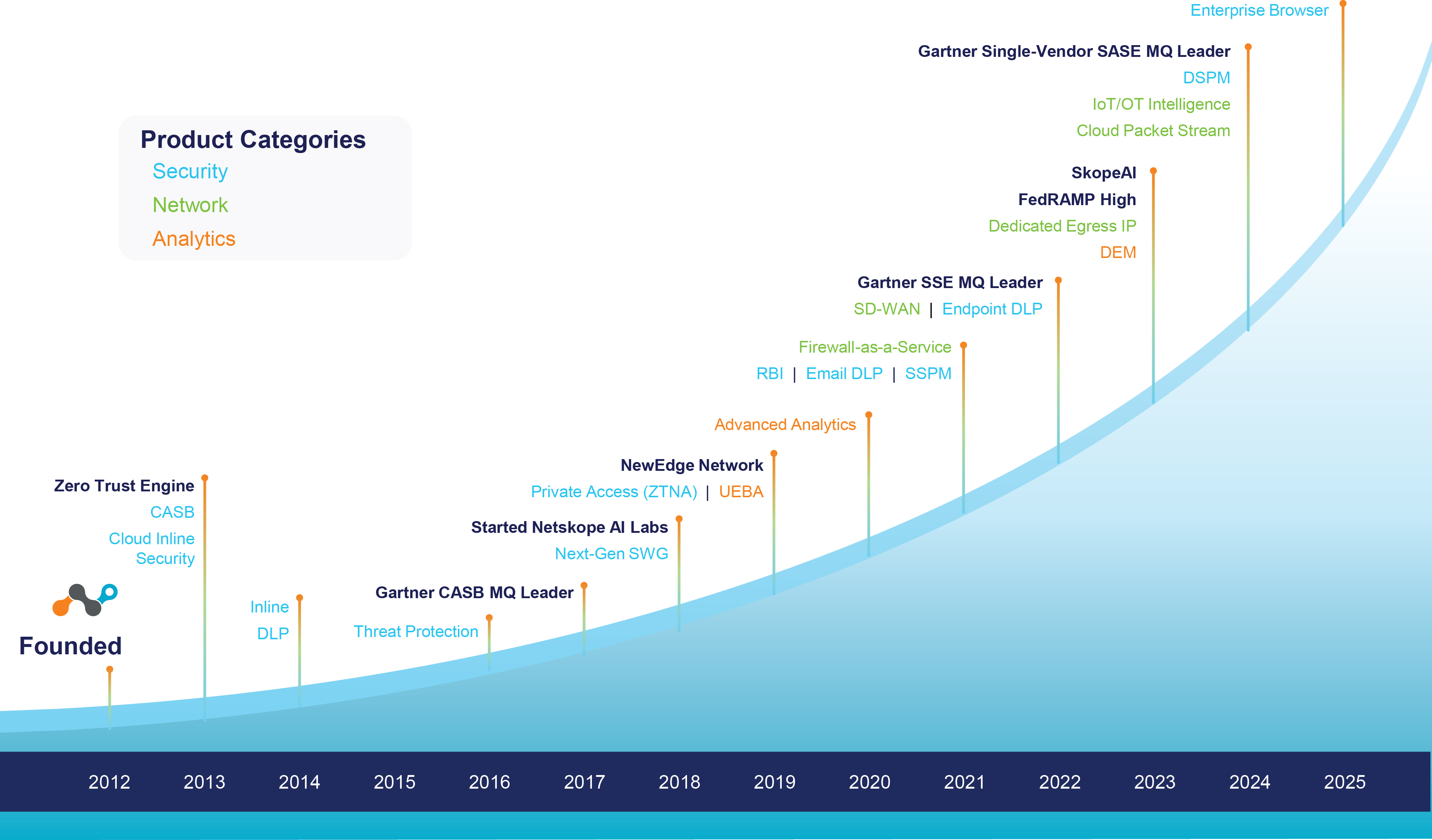
Our Business Model
We generate substantially all of our revenue from the sale of cloud subscriptions to our Netskope One platform. We generally price our subscriptions based on the scale of the customer's organization and products deployed. A substantial majority of our customers purchase subscriptions with a contract term of one to three years. We recognize revenue from our subscriptions ratably over the term of the subscription. Our go-to-market strategy is focused on acquiring new customers and driving increased adoption of our platform from existing customers.
Our customers typically start with the most prevalent use cases of enabling fast and secure AI, cloud and web access, or modernizing remote access and enterprise networking. As our customers realize tangible value from the products that they deploy, they often purchase more subscriptions, increase the number of users in more departments and geographies, and extend the number of applications covered. As part of our Netskope One platform, customers have the option to purchase our products in bundles, or standalone in various configurations. For example, with our Security Service Edge ("SSE") package, we offer Next-Gen Secure Web Gateway ("Next-Gen SWG"), Cloud Access Security Broker ("CASB") Inline, and our Zero Trust Network Access ("Private Access") products. In addition, customers have the option to add other products from our more than 20 products offered as part of our platform.
As our pace of innovation and product releases have increased in recent years, our customers continue to adopt a broader portion of our Netskope One platform. As of July 31, 2025, the percent of customers with subscriptions for three or more products, four or more products, and five or more products was 72%, 51%, and 35%, respectively, which represents an increase from 52%, 29%, and 18%, respectively, as of January 31, 2022.
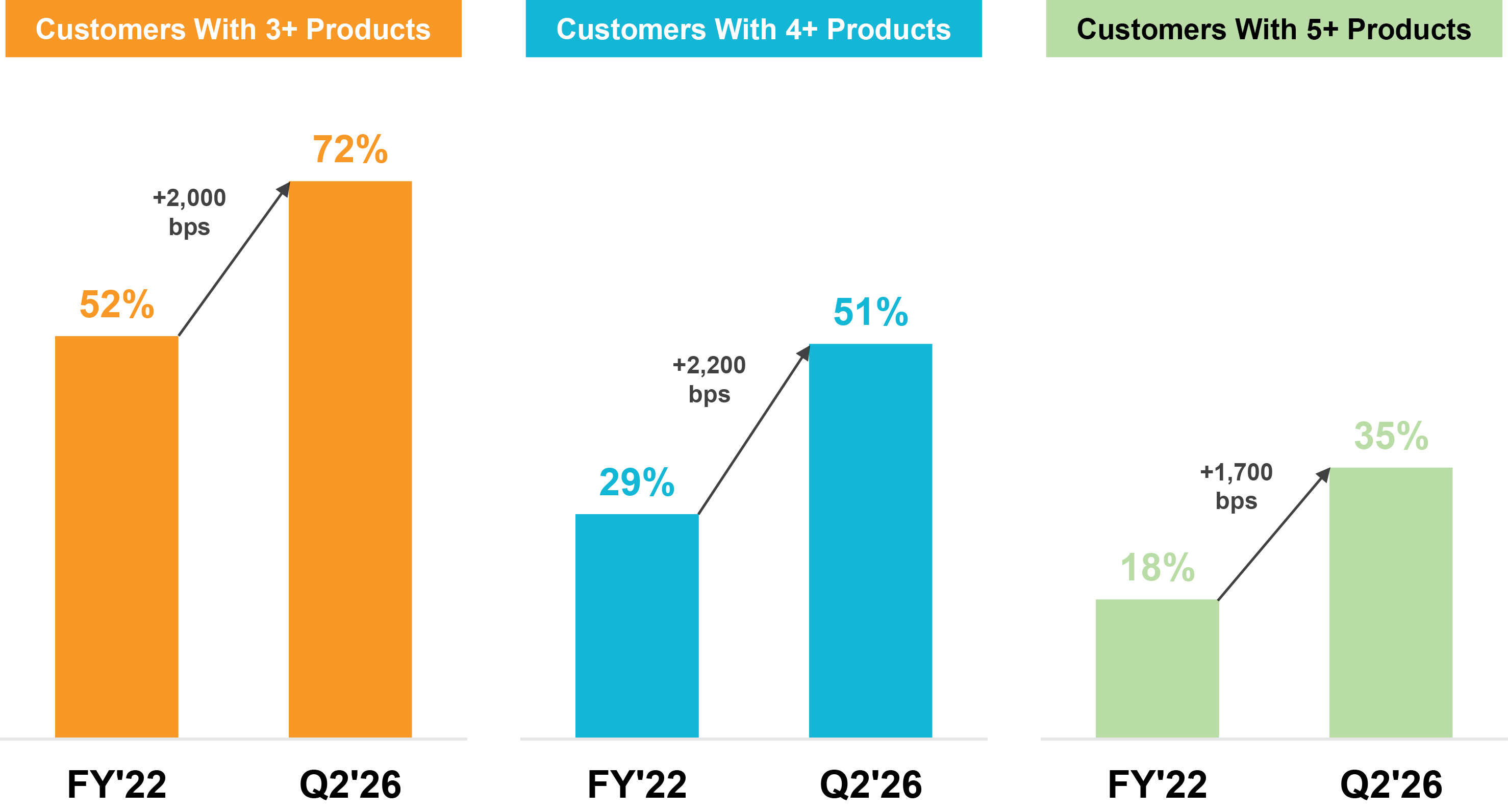
Our platform and products are deployed by organizations of all sizes across a broad range of industries around the world. Our direct sales team is primarily focused on large and mid-market enterprises and governments. We sell to information technology executives, including Chief Information Officers, Chief Information Security Officers, and networking, infrastructure, and operations teams. We work closely with our channel partners, which include VARs, distributors, technology alliance partners, system integrators, MSPs, and global telecommunications service providers, to sell and deliver our platform and products. Additionally, we offer our platform and products through the major cloud marketplaces, providing additional purchasing options for our customers.
Key Factors Affecting Our Performance
Pace of Modernization of Security and Networking for Organizations. The rapid evolution of enterprise IT is driving organizations to replace legacy systems with cloud-based and hybrid solutions, fundamentally altering the way security and networking solutions are deployed and operated. We believe that as enterprises undergo digital transformation, they increasingly rely on advanced technologies such as AI to gain granular visibility and control over information flows. This trend is compounded by the growing imperative to understand and secure data in an environment where hybrid and remote work models are common. Moreover, organizations' expanding global operations and the relentless push for improved user experience has driven the convergence of security and networking that is reshaping industry standards. While we are in the early stages of this transformation, we believe that the pace of modernization will continue to accelerate, reinforcing the demand for our platform.
Our Ability to Add New Customers. Our ability to grow our customer base is a key indicator of both our market penetration and the future opportunities available to us.
As of July 31, 2025, we had 4,317 customers, which represented a 21% year-over-year increase from 3,571 customers as of July 31, 2024. As of January 31, 2025, we had 3,913 customers, which represented a 19% year-over-year increase from 3,293 customers as of January 31, 2024. Many of the world's largest organizations rely on us to help them modernize their security and networking infrastructure. As of July 31, 2025, more than 30% of the Fortune 100, and approximately 18% of Forbes Global 2000 were our customers. This demonstrates our ability to serve the world's leading companies and our significant opportunity to grow in the markets we serve.
We continue to increase the number of customers who have entered into substantial subscriptions with us. As of July 31, 2025, we had 111 customers with ARR over $1 million, representing 37% of our total ARR. This reflects a 32% year-over-year increase from 84 customers who made up 34% of our total ARR as of July 31, 2024. As of January 31, 2025, we had 98 customers with ARR over $1 million, representing 35% of our total ARR. This reflects a 24% year-over-year increase from 79 customers who made up 34% of our total ARR as of January 31, 2024.
Furthermore, as of July 31, 2025, we had 1,372 customers with ARR over $100,000, representing 86% of our total ARR. This reflects a 25% year-over-year increase from 1,095 customers who made up 85% of our total ARR as of July 31, 2024. As of January 31, 2025, we had 1,254 customers with ARR over $100,000, representing 86% of our total ARR. This reflects a 29% year-over-year increase from 973 customers who made up 84% of our total ARR as of January 31, 2024.
We believe that the number of customers with ARR over $100,000 and ARR over $1 million indicates our ability to scale with customers and the strategic importance of our platform for large enterprises and government entities. Further, our customer base is diversified, with no single customer accounting for more than 3% of our ARR as of July 31, 2025.
Our Ability to Retain and Expand Within Our Existing Customers. We believe that our ability to retain and expand within our existing customers is a testament to the technological strength and extensibility of our Netskope One platform and our customer relationships. As our customers realize tangible value from the products that they deploy, they often purchase more subscriptions, increase the number of users in more departments and geographies, and extend the number of applications covered.
We have achieved strong retention metrics, evidenced by our NRR, which increased to 118% as of July 31, 2025, compared to 113% as of July 31, 2024. In addition, our GRR increased to 96% as of July 31, 2025, compared to 95% as of July 31, 2024.
Investments in Sales and Marketing. We plan to continue investing in the expansion of our salesforce and channel partners to pursue attractive growth opportunities both domestically and internationally. In the Americas (which we define as the United States, Canada, and Latin America), this includes continuing the growth of our sales team, selling into the U.S. federal government market now that we have achieved FedRAMP High Authorization, and growing our channel partners, including MSPs, to expand within the mid-market. As a result of these investments, year-over-year growth in ARR for our Americas region accelerated from 22% as of July 31, 2024 to 35% as of July 31, 2025.
We have also made, and plan to continue to make, significant investments to expand geographically, particularly in Europe, the Middle East, and Africa ("EMEA") and Asia Pacific and Japan ("APJ"). In EMEA and APJ, we are growing our sales team and continue to expand our ecosystem of channel partners, including MSPs. We believe that our market opportunity is large, and we are committed to long-term growth through strategic investments in our business. Our geographic reach continues to expand. For the six months ended July 31, 2025, revenue contributed from the Americas, EMEA, and APJ comprised 56%, 25%, and 19% of our total revenue, respectively. This represents year-over-year growth of 28% in the Americas, 37% in EMEA, and 33% in APJ compared to the six months ended July 31, 2024. We see significant opportunities for continued expansion across all regions.
We focus on maximizing the lifetime value of our customer relationships, and we continue to make significant investments in order to grow our customer base. We measure the efficiency of new customer acquisition and unit economics by comparing a customer's lifetime value ("LTV")11, to a customer's acquisition cost ("CAC")12, at the end of each fiscal quarter to calculate our LTV:CAC ratio.
Our LTV:CAC ratio was greater than 10x for the three months ended July 31, 2025. The ratio has been greater than 8x for each of the last four fiscal quarters. This ratio helps us assess the effectiveness of our sales and marketing investments and our ability to drive sustainable growth.
Investment in Innovation. We plan to continue investing in research and development to drive rapid innovation, leveraging our core platform to serve our customers' needs and further strengthen our technology leadership. We believe this will lead to continued increased customer acquisition, expansion, and retention. We also intend to continue evaluating strategic acquisitions and investments in businesses and technologies that enhance our product capabilities, allow us to enter adjacent markets, and accelerate time to market.
11 We calculate LTV by dividing (i) the product of (A) average ARR per customer and (B) our non-GAAP gross margin for each fiscal quarter, which excludes stock-based compensation expense and amortization of acquired intangible assets, by (ii) (A) one minus (B) our dollar-based GRR for each fiscal quarter, which represents the percentage of ARR that did not renew over the trailing four quarters.
12 We calculate CAC by dividing (i) the sum of total adjusted sales and marketing expenses for the trailing four quarters, which excludes stock-based compensation expense and amortization of acquired intangible assets, by (ii) the sum of total gross new customers landed for the trailing four quarters.
Key Business Metric
We monitor the following key metric to help us evaluate our business, measure our performance, identify trends affecting our business, formulate business plans, and make strategic decisions.
Dollar-Based Net Retention Rate
Our ability to maintain long-term revenue growth and achieve profitability is dependent on our ability to retain and grow revenue generated from our existing customers. We believe that we will achieve these objectives by continuing to focus on customer success and loyalty and by continuously innovating our platform. Our NRR may fluctuate from period to period as we continue to expand our business.
|
|
|
|
|
|
|
|
|
|
|
|
|
|
|
|
|
|
|
As of January 31, |
|
|
As of July 31, |
|
|
|
2024 |
|
|
2025 |
|
|
2024 |
|
|
2025 |
|
Dollar-based net retention rate |
|
|
115 |
% |
|
|
113 |
% |
|
|
113 |
% |
|
|
118 |
% |
Components of Results of Operations
Revenue
We generate revenue primarily from subscriptions to the more than 20 products within our Netskope One platform, along with related support services. Subscription revenue accounted for approximately 98% of our total revenue in fiscal 2024 and 99% of our total revenue in fiscal 2025. During the six months ended July 31, 2024 and 2025, subscription revenue accounted for approximately 99% of the Company's total revenue. Customers do not take possession of cloud-based software; instead, our commitment is to provide our security, networking, and analytics platform throughout the contractual term. As a result, we recognize subscription revenue ratably over the contract term, which typically ranges from one to three years.
Professional services and hardware account for an immaterial portion of our total revenue.
Cost of Revenue
Our cost of revenue consists of direct costs associated with providing our platform and products and our related professional services, including colocation and network transit expenses to operate our global data centers, depreciation of our data center equipment, cloud infrastructure and software expenses, and amortization of capitalized internal-use software. It also includes employee-related compensation expenses, such as salaries, bonuses, stock-based compensation expense, and employee benefits for teams supporting cloud operations and customer support and service organizations, and allocated overhead costs. We continuously work on optimizing these costs through strategic partnerships, improved operational efficiencies, and technological advancements.
In the several quarters following the closing of this offering, we expect to recognize a portion of stock-based compensation expense related to the equity awards that include a liquidity-based performance condition that will be met in connection with this offering. We expect our cost of revenue as a percentage of revenue to increase in the near term due to the stock-based compensation expense that we expect to recognize in connection with this offering, but over the long term, we expect our cost of revenue as a percentage of revenue to decrease through improved operational efficiencies and technological advancements.
Additionally, we have made significant strategic investments to expand the global coverage of our NewEdge network to serve enterprises worldwide, which has historically increased our cost of revenue. As we have built our NewEdge network to include data centers in more than 75 unique regions with more than 200 localization zones globally, we do not anticipate future expansion requirements at the same rate. We expect the level of investment as a percentage of revenue to decrease over the long term as we realize the benefits of scale and operating leverage from previous investments we have made.
Gross Profit and Gross Margin
Gross profit is revenue less cost of revenue and gross margin is gross profit expressed as a percentage of revenue. Both gross profit and gross margin have been and will continue to be affected by various factors, including the costs associated with infrastructure and services. We expect gross margin to decrease in the near term due to the stock-based compensation expense that we expect to recognize in connection with this offering, but over the long term, we expect it will increase due to the factors described above.
Operating Expenses
Operating expenses consist of sales and marketing, research and development, and general and administrative expenses. Employee-related compensation expenses are the most significant component of operating expenses and consist of salaries, benefits, bonuses, stock-based compensation expense, and in the case of sales and marketing expenses, sales commissions. Operating expenses also include other non-employee costs such as cloud infrastructure expenses, office space costs, fees for third-party professional services, and costs associated with software and subscription services.
In the several quarters following the closing of this offering, we expect to recognize a portion of stock-based compensation expense related to the equity awards that include a liquidity-based performance condition that will be met in connection with this offering. We expect our operating expenses as a percentage of revenue to increase in the near term due to the stock-based compensation expense that we expect to recognize in connection with this offering, but over the long term, we expect our operating expenses as a percentage of revenue to decrease, although they may fluctuate from period to period due to the timing and extent of these expenses.
Sales and Marketing
Sales and marketing expenses consist primarily of employee-related compensation expenses, sales commissions, marketing campaigns, marketing events, brand-building activities, promotions, and travel and entertainment expenses. Our sales and marketing strategies are comprehensive, involving direct sales efforts, channel partnerships, and digital marketing initiatives. We expect to expand our market presence both domestically and internationally, educate potential customers about the benefits of our platform and products, and drive both customer acquisition and retention.
We expect our sales and marketing expenses will increase in dollar amount as we continue to invest meaningfully in expanding our sales force, increasing our marketing efforts, and expanding into new markets, but over the long term, we expect our sales and marketing expenses as a percentage of revenue to decrease.
Research and Development
Research and development expenses consist primarily of employee-related compensation expenses, cloud infrastructure expenses related to the development of our platform and products, consulting fees, and software and subscription services. We prioritize research and development expenses to continuously enhance our product features, security protocols, and user experience, ensuring that we can respond swiftly to new cyber threats and customer needs.
We expect our research and development expenses to increase in dollar amount as we continue to increase investments in our technology architecture and platform. However, we anticipate research and development expenses to decrease as a percentage of our total revenue over the long term although our research and development expenses may fluctuate as a percentage of revenue from period to period depending on the timing of these expenses.
General and Administrative
General and administrative expenses consist primarily of employee-related compensation expenses, and other expenses for our executive, finance, legal, and human resources organizations. General and administrative expenses also include external legal, accounting, consulting, professional services fees, software and subscription services, facilities expenses, and other corporate expenses.
Following the closing of this offering, we expect to incur additional expenses as a result of operating as a public company, including costs to comply with the rules and regulations applicable to companies listed on a national securities exchange, costs related to compliance and reporting obligations, and increased expenses for insurance, investor relations, and professional services. As our business expands, we expect our general and administrative expenses will increase in dollar amount to support our growth, but over the long term, we expect our general and administrative expenses as a percentage of revenue to decrease.
Loss on Changes in Fair Value of Convertible Notes
We issued Convertible Notes in December 2022 and September 2024. We have elected to account for the Convertible Notes using the fair value option under Accounting Standards Codification ("ASC") 825, Financial Instruments. As a result, we are required to determine the fair value of the Convertible Notes on a quarterly basis using a complex valuation model. If the fair value of the Convertible Notes increases during a given period, we recognize a loss on the change in fair value of Convertible Notes in our statement of operations for that period. Conversely, if the fair value of the Convertible Notes decreases, we recognize a gain on the change in fair value of Convertible Notes in that period. See the sections titled "—Liquidity and Capital Resources—Convertible Notes" and "—Critical Accounting Policies and Estimates—Fair Value Assumptions of Convertible Notes."
Other Income, net
Other income, net consists primarily of interest income, amortization of premiums and accretion of discounts on investment, convertible note issuance cost, and gains and losses from foreign currency transactions.
Provision for Income Taxes
Provision for income taxes consists primarily of income taxes in certain foreign jurisdictions in which we conduct business. We maintain a full valuation allowance against net U.S. federal and state deferred tax assets as it is more likely than not that they will not be realized based on our history of losses.
On July 4, 2025, the United States enacted tax reform legislation through the One Big Beautiful Bill Act. Included in this legislation are provisions that allow for the immediate expensing of domestic U.S. research and development expenses, immediate expensing of certain capital expenditures, and other changes to the U.S. taxation of profits derived from foreign operations. Because we have a valuation allowance on our U.S. deferred tax assets, the tax law did not impact tax expense or cash paid for taxes for the six months ended July 31, 2025, when the law was enacted.
Results of Operations
The following table sets forth our results of operations for the periods presented:
|
|
|
|
|
|
|
|
|
|
|
|
|
|
|
|
|
|
|
Fiscal Year Ended
January 31, |
|
|
Six Months Ended
July 31, |
|
|
|
2024 |
|
|
2025 |
|
|
2024 |
|
|
2025 |
|
|
|
(in thousands) |
|
Revenue |
|
$ |
406,883 |
|
|
$ |
538,268 |
|
|
$ |
251,250 |
|
|
$ |
328,494 |
|
Cost of revenue(1) |
|
|
163,633 |
|
|
|
190,369 |
|
|
|
94,444 |
|
|
|
95,737 |
|
Gross profit |
|
|
243,250 |
|
|
|
347,899 |
|
|
|
156,806 |
|
|
|
232,757 |
|
Operating expenses: |
|
|
|
|
|
|
|
|
|
|
|
|
Sales and marketing(1) |
|
|
263,096 |
|
|
|
280,828 |
|
|
|
151,626 |
|
|
|
147,426 |
|
Research and development(1) |
|
|
224,496 |
|
|
|
254,189 |
|
|
|
130,356 |
|
|
|
140,737 |
|
General and administrative(1) |
|
|
68,456 |
|
|
|
68,623 |
|
|
|
35,555 |
|
|
|
35,917 |
|
Total operating expenses |
|
|
556,048 |
|
|
|
603,640 |
|
|
|
317,537 |
|
|
|
324,080 |
|
Loss from operations |
|
|
(312,798 |
) |
|
|
(255,741 |
) |
|
|
(160,731 |
) |
|
|
(91,323 |
) |
Loss on changes in fair value of convertible notes |
|
|
(38,575 |
) |
|
|
(98,627 |
) |
|
|
(45,124 |
) |
|
|
(77,402 |
) |
Other income, net |
|
|
13,305 |
|
|
|
4,101 |
|
|
|
2,758 |
|
|
|
4,122 |
|
Loss before provision for income taxes |
|
|
(338,068 |
) |
|
|
(350,267 |
) |
|
|
(203,097 |
) |
|
|
(164,603 |
) |
Provision for income taxes |
|
|
6,784 |
|
|
|
4,243 |
|
|
|
3,632 |
|
|
|
4,940 |
|
Net loss |
|
$ |
(344,852 |
) |
|
$ |
(354,510 |
) |
|
$ |
(206,729 |
) |
|
$ |
(169,543 |
) |
(1) Includes stock-based compensation as follows:
|
|
|
|
|
|
|
|
|
|
|
|
|
|
|
|
|
|
|
Fiscal Year Ended
January 31, |
|
|
Six Months Ended
July 31, |
|
|
|
2024 |
|
|
2025 |
|
|
2024 |
|
|
2025 |
|
|
|
(in thousands) |
|
Cost of revenue |
|
$ |
2,925 |
|
|
$ |
2,477 |
|
|
$ |
1,341 |
|
|
$ |
927 |
|
Sales and marketing |
|
|
25,125 |
|
|
|
18,341 |
|
|
|
10,532 |
|
|
|
6,459 |
|
Research and development |
|
|
27,150 |
|
|
|
24,698 |
|
|
|
12,860 |
|
|
|
8,799 |
|
General and administrative |
|
|
5,791 |
|
|
|
5,318 |
|
|
|
2,607 |
|
|
|
1,457 |
|
Total stock-based compensation expense |
|
$ |
60,991 |
|
|
$ |
50,834 |
|
|
$ |
27,340 |
|
|
$ |
17,642 |
|
The following table sets forth the components of our consolidated statements of operations as a percentage of revenue for each of the periods presented:
|
|
|
|
|
|
|
|
|
|
|
|
|
|
|
|
|
|
|
Fiscal Year Ended
January 31, |
|
|
Six Months Ended
July 31, |
|
|
|
2024 |
|
|
2025 |
|
|
2024 |
|
|
2025 |
|
Revenue |
|
|
100 |
% |
|
|
100 |
% |
|
|
100 |
% |
|
|
100 |
% |
Cost of revenue |
|
|
40 |
|
|
|
35 |
|
|
|
38 |
|
|
|
29 |
|
Gross profit |
|
|
60 |
|
|
|
65 |
|
|
|
62 |
|
|
|
71 |
|
Operating expenses: |
|
|
|
|
|
|
|
|
|
|
|
|
Sales and marketing |
|
|
65 |
|
|
|
52 |
|
|
|
60 |
|
|
|
45 |
|
Research and development |
|
|
55 |
|
|
|
47 |
|
|
|
52 |
|
|
|
43 |
|
General and administrative |
|
|
17 |
|
|
|
13 |
|
|
|
14 |
|
|
|
11 |
|
Total operating expenses |
|
|
137 |
|
|
|
112 |
|
|
|
126 |
|
|
|
99 |
|
Loss from operations |
|
|
(77 |
) |
|
|
(48 |
) |
|
|
(64 |
) |
|
|
(28 |
) |
Loss on changes in fair value of convertible notes |
|
|
(9 |
) |
|
|
(18 |
) |
|
|
(18 |
) |
|
|
(24 |
) |
Other income, net |
|
|
3 |
|
|
|
1 |
|
|
|
1 |
|
|
|
1 |
|
Loss before provision for income taxes |
|
|
(83 |
) |
|
|
(65 |
) |
|
|
(81 |
) |
|
|
(51 |
) |
Provision for income taxes |
|
|
2 |
|
|
|
1 |
|
|
|
1 |
|
|
|
2 |
|
Net loss |
|
|
(85 |
)% |
|
|
(66 |
)% |
|
|
(82 |
)% |
|
|
(53 |
)% |
Note: Certain figures may not sum due to rounding.
Comparison of the Fiscal Years Ended January 31, 2024 and 2025
Revenue
|
|
|
|
|
|
|
|
|
|
|
|
|
|
|
|
|
|
|
Fiscal Year Ended
January 31, |
|
|
Change |
|
|
|
2024 |
|
|
2025 |
|
|
$ |
|
|
% |
|
|
|
(in thousands, except percentages) |
|
Revenue |
|
$ |
406,883 |
|
|
$ |
538,268 |
|
|
$ |
131,385 |
|
|
|
32 |
% |
Revenue increased by $131.4 million, or 32%, in fiscal 2025 compared to fiscal 2024. The increase in revenue was driven by an increase in customers and the growing demand for our products from existing customers. Approximately 32% of the increase was driven by the addition of new customers and approximately 68% of the increase was driven by expansion within our existing customers.
Cost of Revenue, Gross Profit, and Gross Margin
|
|
|
|
|
|
|
|
|
|
|
|
|
|
|
|
|
|
|
Fiscal Year Ended
January 31, |
|
|
Change |
|
|
|
2024 |
|
|
2025 |
|
|
$ |
|
|
% |
|
|
|
(in thousands, except percentages) |
|
Cost of revenue |
|
$ |
163,633 |
|
|
$ |
190,369 |
|
|
$ |
26,736 |
|
|
|
16 |
% |
Gross profit |
|
|
243,250 |
|
|
|
347,899 |
|
|
|
104,649 |
|
|
|
43 |
% |
Gross margin |
|
|
60 |
% |
|
|
65 |
% |
|
|
|
|
|
|
Cost of revenue increased by $26.7 million, or 16%, in fiscal 2025 compared to fiscal 2024. The increase was due to an $11.4 million increase in colocation and network transit expenses, a $4.8 million increase in cloud infrastructure and software expenses, a $3.6 million increase in outside services, a $2.7 million increase in employee-related compensation expenses, and a $2.5 million increase in amortization of capitalized internal-use-software.
Gross profit increased by $104.6 million, or 43%, in fiscal 2025 compared to fiscal 2024, and gross margin increased to 65% in fiscal 2025 from 60% in fiscal 2024, in each case primarily due to faster revenue growth from new customer acquisition and expansion within our existing customer base, compared to slower cost of revenue growth from improved efficiencies managing our global data centers and cloud infrastructure operations.
Sales and Marketing
|
|
|
|
|
|
|
|
|
|
|
|
|
|
|
|
|
|
|
Fiscal Year Ended
January 31, |
|
|
Change |
|
|
|
2024 |
|
|
2025 |
|
|
$ |
|
|
% |
|
|
|
(in thousands, except percentages) |
|
Sales and marketing |
|
$ |
263,096 |
|
|
$ |
280,828 |
|
|
$ |
17,732 |
|
|
|
7 |
% |
Sales and marketing expenses increased by $17.7 million, or 7%, in fiscal 2025 compared to fiscal 2024, due to a $10.2 million increase in amortization of capitalized commissions, a $2.5 million increase in marketing programs and events aimed at driving customer engagement and brand visibility, a $2.5 million increase in contracted services to support sales efforts, and a $1.1 million increase in sales-related services and events. These increases were partially offset by a $1.2 million decrease in travel-related costs.
Research and Development
|
|
|
|
|
|
|
|
|
|
|
|
|
|
|
|
|
|
|
Fiscal Year Ended
January 31, |
|
|
Change |
|
|
|
2024 |
|
|
2025 |
|
|
$ |
|
|
% |
|
|
|
(in thousands, except percentages) |
|
Research and development |
|
$ |
224,496 |
|
|
$ |
254,189 |
|
|
$ |
29,693 |
|
|
|
13 |
% |
Research and development expenses increased by $29.7 million, or 13%, in fiscal 2025 compared to fiscal 2024, due to a $25.0 million increase in employee-related compensation expenses, a $2.9 million increase in cloud infrastructure expenses incurred developing our platform and products, and a $1.1 million increase in allocated overhead costs.
General and Administrative
|
|
|
|
|
|
|
|
|
|
|
|
|
|
|
|
|
|
|
Fiscal Year Ended
January 31, |
|
|
Change |
|
|
|
2024 |
|
|
2025 |
|
|
$ |
|
|
% |
|
|
|
(in thousands, except percentages) |
|
General and administrative |
|
$ |
68,456 |
|
|
$ |
68,623 |
|
|
$ |
167 |
|
|
|
1 |
% |
General and administrative expenses increased by $0.2 million, or 1%, in fiscal 2025 compared to fiscal 2024. The increase was due to a $1.4 million increase in employee-related compensation expenses and a $1.6 million increase in legal and accounting services. The increase was partially offset by a $1.3 million decrease in facility-related expenses, net of sublease income, and the absence of a $1.3 million impairment charge related to subletting of an operating lease for an office that was recognized in fiscal 2024.
Loss on Changes in Fair Value of Convertible Notes
|
|
|
|
|
|
|
|
|
|
|
|
|
|
|
|
|
|
|
Fiscal Year Ended
January 31, |
|
|
Change |
|
|
|
2024 |
|
|
2025 |
|
|
$ |
|
|
% |
|
|
|
(in thousands, except percentages) |
|
Loss on changes in fair value of convertible notes |
|
$ |
(38,575 |
) |
|
$ |
(98,627 |
) |
|
$ |
(60,052 |
) |
|
|
156 |
% |
Loss on change in fair value of Convertible Notes increased by $60.0 million, or 156%, in fiscal 2025 compared to fiscal 2024. The increase was primarily due to a higher fair value of our common stock, growth in the principal balance due to the payment-in-kind feature of the Convertible Notes, and an increase in both the volatility and an increase in probability of an IPO (as defined below) assumption used in the valuation model.
Other Income, net
|
|
|
|
|
|
|
|
|
|
|
|
|
|
|
|
|
|
|
Fiscal Year Ended
January 31, |
|
|
Change |
|
|
|
2024 |
|
|
2025 |
|
|
$ |
|
|
% |
|
|
|
(in thousands, except percentages) |
|
Other income, net |
|
$ |
13,305 |
|
|
$ |
4,101 |
|
|
$ |
(9,204 |
) |
|
|
(69 |
)% |
Other income, net decreased by $9.2 million, or 69%, in fiscal 2025 compared to fiscal 2024. The decrease was due to a $7.5 million reduction in the amortization of premiums from our investments, a $1.2 million decrease in interest income, and the recognition of $0.6 million in debt issuance cost during fiscal 2025.
Provision for Income Taxes
|
|
|
|
|
|
|
|
|
|
|
|
|
|
|
|
|
|
|
Fiscal Year Ended
January 31, |
|
|
Change |
|
|
|
2024 |
|
|
2025 |
|
|
$ |
|
|
% |
|
|
|
(in thousands, except percentages) |
|
Provision for income taxes |
|
$ |
6,784 |
|
|
$ |
4,243 |
|
|
$ |
(2,541 |
) |
|
|
(37 |
)% |
Provision for income taxes decreased by $2.5 million, or 37%, in fiscal 2025 compared to fiscal 2024, primarily due to the establishment of deferred tax liability as part of the acquisition of Dasera, Inc., augmenting our Data Security Posture Management product, under purchase accounting. This resulted in the release of a $2.2 million valuation allowance which provided a tax benefit recognized in fiscal 2025.
Comparison of the Six Months Ended July 31, 2024 and 2025
Revenue
|
|
|
|
|
|
|
|
|
|
|
|
|
|
|
|
|
|
|
Six Months Ended
July 31, |
|
|
Change |
|
|
|
2024 |
|
|
2025 |
|
|
$ |
|
|
% |
|
|
|
(in thousands, except percentages) |
|
Revenue |
|
$ |
251,250 |
|
|
$ |
328,494 |
|
|
$ |
77,244 |
|
|
|
31 |
% |
Revenue increased by $77.2 million, or 31%, in the six months ended July 31, 2025 compared to the six months ended July 31, 2024. The increase in revenue was driven by an increase in customers and the growing demand for our products from existing customers. Approximately 46% of the increase was driven by the addition of new customers and approximately 54% of the increase was driven by expansion within our existing customers.
Cost of Revenue, Gross Profit, and Gross Margin
|
|
|
|
|
|
|
|
|
|
|
|
|
|
|
|
|
|
|
Six Months Ended
July 31, |
|
|
Change |
|
|
|
2024 |
|
|
2025 |
|
|
$ |
|
|
% |
|
|
|
(in thousands, except percentages) |
|
Cost of revenue |
|
$ |
94,444 |
|
|
$ |
95,737 |
|
|
$ |
1,293 |
|
|
|
1 |
% |
Gross profit |
|
|
156,806 |
|
|
|
232,757 |
|
|
|
75,951 |
|
|
|
48 |
% |
Gross margin |
|
|
62 |
% |
|
|
71 |
% |
|
|
|
|
|
|
Cost of revenue increased by $1.3 million, or 1%, in the six months ended July 31, 2025 compared to the six months ended July 31, 2024. The increase was primarily due to a $3.1 million increase in colocation and network transit expenses and a $1.1 million increase in employee-related compensation expenses. The increase was partially offset due to a $2.3 million decrease in cloud infrastructure and software expenses and a $1.4 million decrease in data center depreciation.
Gross profit increased by $76.0 million, or 48%, in the six months ended July 31, 2025 compared to the six months ended July 31, 2024, and gross margin increased to 71% from 62%, primarily due to faster revenue growth from new customer acquisition and expansion within our existing customer base, compared to slower cost of revenue growth from improved efficiencies managing our global data centers and cloud infrastructure operations.
Sales and Marketing
|
|
|
|
|
|
|
|
|
|
|
|
|
|
|
|
|
|
|
Six Months Ended
July 31, |
|
|
Change |
|
|
|
2024 |
|
|
2025 |
|
|
$ |
|
|
% |
|
|
|
(in thousands, except percentages) |
|
Sales and marketing |
|
|
151,626 |
|
|
|
147,426 |
|
|
$ |
(4,200 |
) |
|
|
(3 |
)% |
Sales and marketing expenses decreased by $4.2 million, or 3%, in the six months ended July 31, 2025 compared to the six months ended July 31, 2024. The decrease was primarily due to a $6.0 million decrease in employee-related compensation expenses, including a $4.1 million decrease in stock-based compensation largely due to our shift to restricted stock units ("RSUs") that are tied to a liquidity-based performance condition. These decreases were partially offset by a $3.6 million increase in the amortization of capitalized sales commissions associated with increased bookings and customer acquisition in recent periods.
Research and Development
|
|
|
|
|
|
|
|
|
|
|
|
|
|
|
|
|
|
|
Six Months Ended
July 31, |
|
|
Change |
|
|
|
2024 |
|
|
2025 |
|
|
$ |
|
|
% |
|
|
|
(in thousands, except percentages) |
|
Research and development |
|
$ |
130,356 |
|
|
$ |
140,737 |
|
|
$ |
10,381 |
|
|
|
8 |
% |
Research and development expenses increased by $10.4 million, or 8%, in the six months ended July 31, 2025 compared to the six months ended July 31, 2024. The increase was primarily due to a $9.1 million increase in employee-related compensation expenses, partially offset by a $4.1 million decrease in stock-based compensation largely due to our shift to RSUs that are tied to a liquidity-based performance condition. In addition, outside services increased by $4.6 million.
General and Administrative
|
|
|
|
|
|
|
|
|
|
|
|
|
|
|
|
|
|
|
Six Months Ended
July 31, |
|
|
Change |
|
|
|
2024 |
|
|
2025 |
|
|
$ |
|
|
% |
|
|
|
(in thousands, except percentages) |
|
General and administrative |
|
$ |
35,555 |
|
|
$ |
35,917 |
|
|
$ |
362 |
|
|
|
1 |
% |
General and administrative expenses increased by $0.4 million, or 1%, in the six months ended July 31, 2025 compared to the six months ended July 31, 2024. The increase was primarily due to a $1.7 million increase in professional services fees. This increase was partially offset by a $1.0 million reduction in employee-related compensation expenses, including decrease in stock-based compensation largely due to our shift to RSUs that are tied to a liquidity-based performance condition.
Loss on Changes in Fair Value of Convertible Notes
|
|
|
|
|
|
|
|
|
|
|
|
|
|
|
|
|
|
|
Six Months Ended
July 31, |
|
|
Change |
|
|
|
2024 |
|
|
2025 |
|
|
$ |
|
|
% |
|
|
|
(in thousands, except percentages) |
|
Loss on changes in fair value of convertible notes |
|
$ |
(45,124 |
) |
|
$ |
(77,402 |
) |
|
$ |
(32,278 |
) |
|
|
72 |
% |
Loss on change in fair value of Convertible Notes increased by $32.3 million, or 72%, in the six months ended July 31, 2025 compared to the six months ended July 31, 2024. The increase was primarily due to an increase in fair value of our common stock, growth in the principal balance due to the payment-in-kind feature of the Convertible Notes, and an increase in probability of an IPO assumption used in the valuation model.
Other Income, net
|
|
|
|
|
|
|
|
|
|
|
|
|
|
|
|
|
|
|
Six Months Ended
July 31, |
|
|
Change |
|
|
|
2024 |
|
|
2025 |
|
|
$ |
|
|
% |
|
|
|
(in thousands, except percentages) |
|
Other income, net |
|
$ |
2,758 |
|
|
$ |
4,122 |
|
|
$ |
1,364 |
|
|
|
49 |
% |
Other income, net increased by $1.4 million, or 49%, in the six months ended July 31, 2025 compared to the six months ended July 31, 2024. The increase was primarily attributable to the net foreign currency exchange gain.
Provision for Income Taxes
|
|
|
|
|
|
|
|
|
|
|
|
|
|
|
|
|
|
|
Six Months Ended
July 31, |
|
|
Change |
|
|
|
2024 |
|
|
2025 |
|
|
$ |
|
|
% |
|
|
|
(in thousands, except percentages) |
|
Provision for income taxes |
|
$ |
3,632 |
|
|
$ |
4,940 |
|
|
$ |
1,308 |
|
|
|
36 |
% |
Provision for income taxes increased primarily due to higher foreign tax liabilities associated with our international operations.
Non-GAAP Financial Measures
In addition to our results determined in accordance with GAAP, we believe the following non-GAAP measures are useful in evaluating our operating performance. We use the following non-GAAP financial information to evaluate our business, measure our performance, identify trends affecting our business, formulate business plans, and make strategic decisions. We believe that non-GAAP financial information, when taken collectively, may be helpful to investors because it provides consistency and comparability with past financial performance. However, non-GAAP financial information is presented for supplemental informational purposes only, has limitations as an analytical tool, and should not be considered in isolation or as a substitute for financial information presented in accordance with GAAP.
Other companies, including companies in our industry, may calculate similarly titled non-GAAP measures differently or may use other measures to evaluate their performance, all of which could reduce the usefulness of our non-GAAP financial measures as tools for comparison.
We believe that the exclusion of stock-based compensation expense and related payroll taxes from certain of our non-GAAP measures is appropriate because it eliminates the impact of non-cash expenses for stock-based compensation costs that are based upon valuation methodologies and assumptions that vary over time, and the amount of the expense can vary significantly due to factors that are unrelated to our core operating performance and that can be outside of our control. Although we exclude stock-based compensation expense and related payroll taxes from certain of our non-GAAP measures, stock-based compensation has been, and will continue to be, an important part of our future compensation strategy and a significant component of our future expenses, and may increase in future periods.
A reconciliation is provided below for each non-GAAP financial measure to the most directly comparable financial measure stated in accordance with GAAP. Investors are encouraged to review the related GAAP financial measures and the reconciliation of these non-GAAP financial measures to their most directly comparable GAAP financial measures and not rely on any single financial measure to evaluate our business.
Non-GAAP Gross Profit and Non-GAAP Gross Margin
Non-GAAP gross profit and non-GAAP gross margin are defined as GAAP gross profit and GAAP gross margin, respectively, excluding stock-based compensation and related payroll tax expense and amortization of acquired intangible assets. We believe these non-GAAP measures offer additional consistency and comparability with our historical financial performance, providing management and investors with more meaningful period-to-period comparisons. These metrics are designed to remove the impact of certain variables that can fluctuate for reasons unrelated to our underlying operating performance.
The following table provides a reconciliation of our non-GAAP gross profit to our gross profit and of our non-GAAP gross margin to our gross margin, for each of the periods presented:
|
|
|
|
|
|
|
|
|
|
|
|
|
|
|
|
|
|
|
Fiscal Year Ended
January 31, |
|
|
Six Months Ended
July 31, |
|
|
|
2024 |
|
|
2025 |
|
|
2024 |
|
|
2025 |
|
|
|
(in thousands, except percentages) |
|
Revenue |
|
$ |
406,883 |
|
|
$ |
538,268 |
|
|
$ |
251,250 |
|
|
$ |
328,494 |
|
Gross profit |
|
$ |
243,250 |
|
|
$ |
347,899 |
|
|
$ |
156,806 |
|
|
$ |
232,757 |
|
Add: Stock-based compensation expense and related payroll
taxes |
|
|
2,926 |
|
|
|
2,478 |
|
|
|
1,341 |
|
|
|
941 |
|
Add: Amortization of acquired intangible assets |
|
|
20,112 |
|
|
|
20,965 |
|
|
|
9,471 |
|
|
|
9,675 |
|
Non-GAAP gross profit |
|
$ |
266,288 |
|
|
$ |
371,342 |
|
|
$ |
167,618 |
|
|
$ |
243,373 |
|
Gross margin |
|
|
60 |
% |
|
|
65 |
% |
|
|
62 |
% |
|
|
71 |
% |
Non-GAAP gross margin |
|
|
65 |
% |
|
|
69 |
% |
|
|
67 |
% |
|
|
74 |
% |
We expect non-GAAP gross margin will increase over the long term through improved operational efficiencies, scale benefits, and technological advancements.
Non-GAAP Loss from Operations and Non-GAAP Operating Margin
Non-GAAP loss from operations and non-GAAP operating margin are defined as GAAP loss from operations and GAAP operating margin, respectively, excluding stock-based compensation expense and related payroll taxes, transaction costs related to acquisitions, amortization of acquired intangible assets, impairment of right-of-use assets, and legal reserve and settlement charges. We believe these non-GAAP measures offer our management and investors additional consistency and comparability with our historical financial performance, enabling more meaningful period-to-period comparisons. These metrics are designed to remove the impact of certain variables that can fluctuate for reasons unrelated to our underlying operating performance.
The following table provides a reconciliation of our non-GAAP loss from operations to our loss from operations and of our non-GAAP operating margin to our operating margin, for each of the periods presented:
|
|
|
|
|
|
|
|
|
|
|
|
|
|
|
|
|
|
|
Fiscal Year Ended
January 31, |
|
|
Six Months Ended
July 31, |
|
|
|
2024 |
|
|
2025 |
|
|
2024 |
|
|
2025 |
|
|
|
(in thousands, except percentages) |
|
Revenue |
|
$ |
406,883 |
|
|
$ |
538,268 |
|
|
$ |
251,250 |
|
|
$ |
328,494 |
|
Loss from operations |
|
$ |
(312,798 |
) |
|
$ |
(255,741 |
) |
|
$ |
(160,731 |
) |
|
$ |
(91,323 |
) |
Add: Stock-based compensation expense and related payroll
taxes |
|
|
61,003 |
|
|
|
51,139 |
|
|
|
27,461 |
|
|
|
18,042 |
|
Add: Acquisition-related expenses |
|
|
692 |
|
|
|
459 |
|
|
|
17 |
|
|
|
— |
|
Add: Amortization of acquired intangible assets |
|
|
21,103 |
|
|
|
22,747 |
|
|
|
10,298 |
|
|
|
10,725 |
|
Add: Impairment of right-of-use assets |
|
|
1,256 |
|
|
|
— |
|
|
|
— |
|
|
|
— |
|
Non-GAAP loss from operations |
|
$ |
(228,744 |
) |
|
$ |
(181,396 |
) |
|
$ |
(122,955 |
) |
|
$ |
(62,556 |
) |
Operating margin |
|
|
(77 |
)% |
|
|
(48 |
)% |
|
|
(64 |
)% |
|
|
(28 |
)% |
Non-GAAP operating margin |
|
|
(56 |
)% |
|
|
(34 |
)% |
|
|
(49 |
)% |
|
|
(19 |
)% |
We expect non-GAAP operating margin to improve over the long term through continued operational efficiencies, scale benefits, and technological advancements.
Free Cash Flow and Free Cash Flow Margin
Free cash flow is defined as net cash used in operating activities less purchases of property and equipment and intangible assets and capitalized internal-use software. Free cash flow margin is determined by dividing free cash flow by revenue. We believe that free cash flow and free cash flow margin serve as valuable indicators of liquidity, providing management and investors with insights into the cash generated from our operations. After accounting for investments in property and equipment, intangible assets, and internal-use software, this cash is available for strategic initiatives, such as investing in our business and strengthening our financial position. Free cash flow does not represent the total change in our cash balance in any given period.
The following table summarizes our cash flows and provides a reconciliation of free cash flow to net cash (used in) provided by operating activities and of our free cash flow margin to our net cash (used in) provided by operating activities as a percentage of revenue for each of the periods presented:
|
|
|
|
|
|
|
|
|
|
|
|
|
|
|
|
|
|
|
Fiscal Year Ended
January 31, |
|
|
Six Months Ended
July 31, |
|
|
|
2024 |
|
|
2025 |
|
|
2024 |
|
|
2025 |
|
|
|
(in thousands, except percentages) |
|
Net cash (used in) provided by operating activities |
|
$ |
(167,166 |
) |
|
$ |
(110,678 |
) |
|
$ |
(105,914 |
) |
|
$ |
8,714 |
|
Less: Purchase of property and equipment and intangible
assets |
|
|
(33,955 |
) |
|
|
(37,032 |
) |
|
|
(19,775 |
) |
|
|
(9,038 |
) |
Less: Capitalization of internal-use software costs |
|
|
(7,197 |
) |
|
|
(3,390 |
) |
|
|
(818 |
) |
|
|
(1,873 |
) |
Free cash flow |
|
$ |
(208,318 |
) |
|
$ |
(151,100 |
) |
|
$ |
(126,507 |
) |
|
$ |
(2,197 |
) |
Net cash (used in) provided by operating activities as a
percentage of revenue |
|
|
(41 |
)% |
|
|
(21 |
)% |
|
|
(42 |
)% |
|
|
3 |
% |
Free cash flow margin |
|
|
(51 |
)% |
|
|
(28 |
)% |
|
|
(50 |
)% |
|
|
(1 |
)% |
We expect free cash flow and free cash flow margin to improve over the long term through continued operational efficiencies, scale benefits, and technological advancements.
Quarterly Results of Operations and Other Data
The following tables set forth our unaudited quarterly consolidated statements of operations data as well as the percentage of revenue that each line item represents for each quarter. The information for each quarter has been prepared on a basis consistent with our audited consolidated financial statements included elsewhere in this prospectus and reflect, in the opinion of management, all adjustments of a normal, recurring nature that are necessary for a fair presentation of the financial information contained in those statements. Our historical results are not necessarily indicative of the results that may be expected in the future. The following quarterly financial data should be read in conjunction with our consolidated financial statements included elsewhere in this prospectus.
Consolidated Summary Statements of Operations Data
|
|
|
|
|
|
|
|
|
|
|
|
|
|
|
|
|
|
|
|
|
|
|
|
|
|
|
|
|
|
|
|
|
|
|
|
|
|
|
|
|
|
|
Three Months Ended |
|
|
|
|
|
|
|
|
|
April 30,
2023 |
|
|
July 31,
2023 |
|
|
October 31,
2023 |
|
|
January 31,
2024 |
|
|
April 30,
2024 |
|
|
July 31,
2024 |
|
|
October 31,
2024 |
|
|
January 31,
2025 |
|
|
April 30,
2025 |
|
|
July 31,
2025 |
|
|
|
(in thousands) |
|
Revenue |
|
$ |
88,708 |
|
|
$ |
98,155 |
|
|
$ |
106,132 |
|
|
$ |
113,888 |
|
|
$ |
120,997 |
|
|
$ |
130,253 |
|
|
$ |
138,532 |
|
|
$ |
148,486 |
|
|
$ |
157,736 |
|
|
$ |
170,758 |
|
Cost of revenue(1)(3) |
|
|
37,221 |
|
|
|
39,368 |
|
|
|
42,687 |
|
|
|
44,357 |
|
|
|
47,219 |
|
|
|
47,225 |
|
|
|
46,765 |
|
|
|
49,160 |
|
|
|
48,223 |
|
|
|
47,514 |
|
Gross profit |
|
|
51,487 |
|
|
|
58,787 |
|
|
|
63,445 |
|
|
|
69,531 |
|
|
|
73,778 |
|
|
|
83,028 |
|
|
|
91,767 |
|
|
|
99,326 |
|
|
|
109,513 |
|
|
|
123,244 |
|
Operating expenses: |
|
|
|
|
|
|
|
|
|
|
|
|
|
|
|
|
|
|
|
|
|
|
|
|
|
|
|
|
|
|
Sales and marketing(1)(3) |
|
|
60,686 |
|
|
|
65,619 |
|
|
|
67,062 |
|
|
|
69,729 |
|
|
|
74,892 |
|
|
|
76,734 |
|
|
|
65,765 |
|
|
|
63,437 |
|
|
|
69,376 |
|
|
|
78,050 |
|
Research and development(1)(3) |
|
|
55,985 |
|
|
|
56,323 |
|
|
|
58,654 |
|
|
|
53,534 |
|
|
|
64,829 |
|
|
|
65,527 |
|
|
|
62,402 |
|
|
|
61,431 |
|
|
|
67,881 |
|
|
|
72,856 |
|
General and administrative(1)(2)(4) |
|
|
16,622 |
|
|
|
16,607 |
|
|
|
18,369 |
|
|
|
16,858 |
|
|
|
18,966 |
|
|
|
16,589 |
|
|
|
17,434 |
|
|
|
15,634 |
|
|
|
17,614 |
|
|
|
18,303 |
|
Total operating expenses |
|
|
133,293 |
|
|
|
138,549 |
|
|
|
144,085 |
|
|
|
140,121 |
|
|
|
158,687 |
|
|
|
158,850 |
|
|
|
145,601 |
|
|
|
140,502 |
|
|
|
154,871 |
|
|
|
169,209 |
|
Loss from operations |
|
$ |
(81,806 |
) |
|
$ |
(79,762 |
) |
|
$ |
(80,640 |
) |
|
$ |
(70,590 |
) |
|
$ |
(84,909 |
) |
|
$ |
(75,822 |
) |
|
$ |
(53,834 |
) |
|
$ |
(41,176 |
) |
|
$ |
(45,358 |
) |
|
$ |
(45,965 |
) |
Net loss |
|
$ |
(84,786 |
) |
|
$ |
(74,593 |
) |
|
$ |
(94,843 |
) |
|
$ |
(90,630 |
) |
|
$ |
(95,157 |
) |
|
$ |
(111,572 |
) |
|
$ |
(70,743 |
) |
|
$ |
(77,038 |
) |
|
$ |
(79,242 |
) |
|
$ |
(90,301 |
) |
|
|
|
|
|
|
|
|
|
|
|
|
|
|
|
|
|
|
|
|
|
|
|
|
|
|
|
|
|
|
|
(1) Includes stock-based compensation expense and related payroll taxes as follows: |
|
Cost of revenue |
|
$ |
671 |
|
|
$ |
714 |
|
|
$ |
784 |
|
|
$ |
757 |
|
|
$ |
701 |
|
|
$ |
640 |
|
|
$ |
589 |
|
|
$ |
548 |
|
|
$ |
520 |
|
|
$ |
421 |
|
Sales and marketing |
|
|
6,037 |
|
|
|
6,098 |
|
|
|
6,558 |
|
|
|
6,433 |
|
|
|
5,565 |
|
|
|
5,049 |
|
|
|
4,143 |
|
|
|
3,840 |
|
|
|
3,403 |
|
|
|
3,378 |
|
Research and development |
|
|
6,826 |
|
|
|
6,408 |
|
|
|
6,910 |
|
|
|
7,016 |
|
|
|
6,599 |
|
|
|
6,300 |
|
|
|
5,884 |
|
|
|
5,963 |
|
|
|
5,345 |
|
|
|
3,517 |
|
General and administrative |
|
|
1,649 |
|
|
|
1,407 |
|
|
|
1,559 |
|
|
|
1,176 |
|
|
|
1,395 |
|
|
|
1,212 |
|
|
|
1,711 |
|
|
|
1,000 |
|
|
|
905 |
|
|
|
553 |
|
Total stock-based compensation
expense and related payroll taxes |
|
$ |
15,183 |
|
|
$ |
14,627 |
|
|
$ |
15,811 |
|
|
$ |
15,382 |
|
|
$ |
14,260 |
|
|
$ |
13,201 |
|
|
$ |
12,327 |
|
|
$ |
11,351 |
|
|
$ |
10,173 |
|
|
$ |
7,869 |
|
|
|
|
|
|
|
|
|
|
|
|
|
|
|
|
|
|
|
|
|
|
|
|
|
|
|
|
|
|
|
|
(2) Includes acquisition-related expenses (credits) as follows: |
|
General and administrative |
|
$ |
— |
|
|
$ |
2 |
|
|
$ |
572 |
|
|
$ |
118 |
|
|
$ |
19 |
|
|
$ |
(2 |
) |
|
$ |
443 |
|
|
$ |
(1 |
) |
|
$ |
— |
|
|
$ |
— |
|
|
|
|
|
|
|
|
|
|
|
|
|
|
|
|
|
|
|
|
|
|
|
|
|
|
|
|
|
|
|
|
(3) Includes amortization of acquired intangible assets as follows: |
|
Cost of revenue |
|
$ |
5,205 |
|
|
$ |
4,542 |
|
|
$ |
5,059 |
|
|
$ |
5,306 |
|
|
$ |
4,682 |
|
|
$ |
4,789 |
|
|
$ |
5,174 |
|
|
$ |
6,320 |
|
|
$ |
6,082 |
|
|
$ |
3,593 |
|
Sales and marketing |
|
|
— |
|
|
|
— |
|
|
|
252 |
|
|
|
383 |
|
|
|
374 |
|
|
|
383 |
|
|
|
421 |
|
|
|
534 |
|
|
|
516 |
|
|
|
534 |
|
Research and development |
|
|
86 |
|
|
|
90 |
|
|
|
90 |
|
|
|
90 |
|
|
|
70 |
|
|
|
— |
|
|
|
— |
|
|
|
— |
|
|
|
— |
|
|
|
— |
|
Total amortization of acquired
intangible assets |
|
$ |
5,291 |
|
|
$ |
4,632 |
|
|
$ |
5,401 |
|
|
$ |
5,779 |
|
|
$ |
5,126 |
|
|
$ |
5,172 |
|
|
$ |
5,595 |
|
|
$ |
6,854 |
|
|
$ |
6,598 |
|
|
$ |
4,127 |
|
|
|
|
|
|
|
|
|
|
|
|
|
|
|
|
|
|
|
|
|
|
|
|
|
|
|
|
|
|
|
|
(4) Includes impairment of right-of-use assets as follows: |
|
General and administrative |
|
$ |
— |
|
|
$ |
— |
|
|
$ |
— |
|
|
$ |
1,256 |
|
|
$ |
— |
|
|
$ |
— |
|
|
$ |
— |
|
|
$ |
— |
|
|
$ |
— |
|
|
$ |
— |
|
Percentage of Revenue Data
|
|
|
|
|
|
|
|
|
|
|
|
|
|
|
|
|
|
|
|
|
|
|
|
|
|
|
|
|
|
|
|
|
|
|
|
|
|
|
|
|
|
|
Three Months Ended |
|
|
|
|
|
|
April 30,
2023 |
|
|
July 31,
2023 |
|
|
October 31,
2023 |
|
|
January 31,
2024 |
|
|
April 30,
2024 |
|
|
July 31,
2024 |
|
|
October 31,
2024 |
|
|
January 31,
2025 |
|
|
April 30,
2025 |
|
|
July 31,
2025 |
|
|
|
(as a percentage of total revenue) |
|
Revenue |
|
|
100 |
% |
|
|
100 |
% |
|
|
100 |
% |
|
|
100 |
% |
|
|
100 |
% |
|
|
100 |
% |
|
|
100 |
% |
|
|
100 |
% |
|
|
100 |
% |
|
|
100 |
% |
Cost of revenue |
|
|
42 |
|
|
|
40 |
|
|
|
40 |
|
|
|
39 |
|
|
|
39 |
|
|
|
36 |
|
|
|
34 |
|
|
|
33 |
|
|
|
31 |
|
|
|
28 |
|
Gross profit |
|
|
58 |
|
|
|
60 |
|
|
|
60 |
|
|
|
61 |
|
|
|
61 |
|
|
|
64 |
|
|
|
66 |
|
|
|
67 |
|
|
|
69 |
|
|
|
72 |
|
Operating expenses: |
|
|
|
|
|
|
|
|
|
|
|
|
|
|
|
|
|
|
|
|
|
|
|
|
|
|
|
|
|
|
Sales and marketing |
|
|
68 |
|
|
|
67 |
|
|
|
63 |
|
|
|
61 |
|
|
|
62 |
|
|
|
59 |
|
|
|
47 |
|
|
|
43 |
|
|
|
44 |
|
|
|
46 |
|
Research and development |
|
|
63 |
|
|
|
57 |
|
|
|
55 |
|
|
|
47 |
|
|
|
54 |
|
|
|
50 |
|
|
|
45 |
|
|
|
41 |
|
|
|
43 |
|
|
|
43 |
|
General and administrative |
|
|
19 |
|
|
|
17 |
|
|
|
17 |
|
|
|
15 |
|
|
|
16 |
|
|
|
13 |
|
|
|
13 |
|
|
|
11 |
|
|
|
11 |
|
|
|
11 |
|
Total operating expenses |
|
|
150 |
|
|
|
141 |
|
|
|
136 |
|
|
|
123 |
|
|
|
131 |
|
|
|
122 |
|
|
|
105 |
|
|
|
95 |
|
|
|
98 |
|
|
|
99 |
|
Loss from operations |
|
|
(92 |
)% |
|
|
(81 |
)% |
|
|
(76 |
)% |
|
|
(62 |
)% |
|
|
(70 |
)% |
|
|
(58 |
)% |
|
|
(39 |
)% |
|
|
(28 |
)% |
|
|
(29 |
)% |
|
|
(27 |
)% |
Net loss |
|
|
(96 |
)% |
|
|
(76 |
)% |
|
|
(89 |
)% |
|
|
(80 |
)% |
|
|
(79 |
)% |
|
|
(86 |
)% |
|
|
(51 |
)% |
|
|
(52 |
)% |
|
|
(50 |
)% |
|
|
(53 |
)% |
Note: Certain figures may not sum due to rounding.
Quarterly Trends in Revenue
Our quarterly revenue increased sequentially in each quarter presented, primarily driven by higher subscriptions to our platform by new customers and expansion with existing customers. While we typically enter into a higher percentage of subscriptions and renewals in the fourth quarter of our fiscal year, we recognize subscription revenue ratably over the term of the contract. Consequently, a significant portion of the revenue reported in each period is derived from the recognition of deferred revenue associated with orders received in prior periods and does not result in seasonal fluctuations in our revenue.
Quarterly Trends in Operating Expenses
Our quarterly operating expenses have generally increased in each quarter presented when compared to the results of the same quarter in the prior year, primarily driven by higher employee-related compensation expenses in research and development to support our continued innovation of existing products and development of new products and in sales and marketing to support the growth of new customer acquisition and expansion with our existing customers.
Non-GAAP Financial Measures
|
|
|
|
|
|
|
|
|
|
|
|
|
|
|
|
|
|
|
|
|
|
|
|
|
|
|
|
|
|
|
|
|
|
|
|
|
|
|
|
|
|
|
Three Months Ended |
|
|
|
|
|
|
April 30,
2023 |
|
|
July 31,
2023 |
|
|
October 31,
2023 |
|
|
January 31,
2024 |
|
|
April 30,
2024 |
|
|
July 31,
2024 |
|
|
October 31,
2024 |
|
|
January 31,
2025 |
|
|
April 30,
2025 |
|
|
July 31,
2025 |
|
|
|
(in thousands, except for percentages) |
|
Gross margin |
|
|
58 |
% |
|
|
60 |
% |
|
|
60 |
% |
|
|
61 |
% |
|
|
61 |
% |
|
|
64 |
% |
|
|
66 |
% |
|
|
67 |
% |
|
|
69 |
% |
|
|
72 |
% |
Non-GAAP gross margin |
|
|
65 |
% |
|
|
65 |
% |
|
|
65 |
% |
|
|
66 |
% |
|
|
65 |
% |
|
|
68 |
% |
|
|
70 |
% |
|
|
72 |
% |
|
|
74 |
% |
|
|
75 |
% |
Operating margin |
|
|
(92 |
)% |
|
|
(81 |
)% |
|
|
(76 |
)% |
|
|
(62 |
)% |
|
|
(70 |
)% |
|
|
(58 |
)% |
|
|
(39 |
)% |
|
|
(28 |
)% |
|
|
(29 |
)% |
|
|
(27 |
)% |
Non-GAAP operating margin |
|
|
(69 |
)% |
|
|
(62 |
)% |
|
|
(55 |
)% |
|
|
(42 |
)% |
|
|
(54 |
)% |
|
|
(44 |
)% |
|
|
(26 |
)% |
|
|
(15 |
)% |
|
|
(18 |
)% |
|
|
(20 |
)% |
Net cash (used in) provided by operating activities
as a percentage of revenue |
|
|
(50 |
)% |
|
|
(48 |
)% |
|
|
(40 |
)% |
|
|
(29 |
)% |
|
|
(42 |
)% |
|
|
(43 |
)% |
|
|
(8 |
)% |
|
|
4 |
% |
|
|
16 |
% |
|
|
(10 |
)% |
Free cash flow margin |
|
|
(60 |
)% |
|
|
(62 |
)% |
|
|
(51 |
)% |
|
|
(35 |
)% |
|
|
(55 |
)% |
|
|
(46 |
)% |
|
|
(21 |
)% |
|
|
3 |
% |
|
|
11 |
% |
|
|
(12 |
)% |
Non-GAAP Gross Profit and Non-GAAP Gross Margin
The following table provides a reconciliation of non-GAAP gross profit to gross profit and of non-GAAP gross margin to gross margin, for each of the periods indicated:
|
|
|
|
|
|
|
|
|
|
|
|
|
|
|
|
|
|
|
|
|
|
|
|
|
|
|
|
|
|
|
|
|
|
|
|
|
|
|
|
|
|
|
Three Months Ended |
|
|
|
|
|
|
April 30,
2023 |
|
|
July 31,
2023 |
|
|
October 31,
2023 |
|
|
January 31,
2024 |
|
|
April 30,
2024 |
|
|
July 31,
2024 |
|
|
October 31,
2024 |
|
|
January 31,
2025 |
|
|
April 30,
2025 |
|
|
July 31,
2025 |
|
|
|
(in thousands, except for percentages) |
|
Revenue |
|
$ |
88,708 |
|
|
$ |
98,155 |
|
|
$ |
106,132 |
|
|
$ |
113,888 |
|
|
$ |
120,997 |
|
|
$ |
130,253 |
|
|
$ |
138,532 |
|
|
$ |
148,486 |
|
|
$ |
157,736 |
|
|
$ |
170,758 |
|
Gross profit |
|
$ |
51,487 |
|
|
$ |
58,787 |
|
|
$ |
63,445 |
|
|
$ |
69,531 |
|
|
$ |
73,778 |
|
|
$ |
83,028 |
|
|
$ |
91,767 |
|
|
$ |
99,326 |
|
|
$ |
109,513 |
|
|
$ |
123,244 |
|
Add: Stock-based compensation expense and
related payroll taxes |
|
|
671 |
|
|
|
714 |
|
|
|
784 |
|
|
|
757 |
|
|
|
701 |
|
|
|
640 |
|
|
|
589 |
|
|
|
548 |
|
|
|
520 |
|
|
|
421 |
|
Add: Amortization of acquired intangible assets |
|
|
5,205 |
|
|
|
4,542 |
|
|
|
5,059 |
|
|
|
5,306 |
|
|
|
4,682 |
|
|
|
4,789 |
|
|
|
5,174 |
|
|
|
6,320 |
|
|
|
6,082 |
|
|
|
3,593 |
|
Non-GAAP gross profit |
|
$ |
57,363 |
|
|
$ |
64,043 |
|
|
$ |
69,288 |
|
|
$ |
75,594 |
|
|
$ |
79,161 |
|
|
$ |
88,457 |
|
|
$ |
97,530 |
|
|
$ |
106,194 |
|
|
$ |
116,115 |
|
|
$ |
127,258 |
|
Gross margin |
|
|
58 |
% |
|
|
60 |
% |
|
|
60 |
% |
|
|
61 |
% |
|
|
61 |
% |
|
|
64 |
% |
|
|
66 |
% |
|
|
67 |
% |
|
|
69 |
% |
|
|
72 |
% |
Non-GAAP gross margin |
|
|
65 |
% |
|
|
65 |
% |
|
|
65 |
% |
|
|
66 |
% |
|
|
65 |
% |
|
|
68 |
% |
|
|
70 |
% |
|
|
72 |
% |
|
|
74 |
% |
|
|
75 |
% |
Our non-GAAP gross margin increased over the last four quarters from 68% during the three months ended July 31, 2024 to 75% during the three months ended July 31, 2025.
Incremental Gross Margin and Incremental non-GAAP Gross Margin
The following table provides a reconciliation of incremental non-GAAP gross margin to incremental gross margin, for each of the periods indicated:
|
|
|
|
|
|
|
|
|
|
|
|
|
|
|
|
|
|
|
|
|
|
|
|
|
|
|
|
|
|
|
|
|
|
|
|
|
|
|
|
|
|
|
Three Months Ended |
|
|
|
|
|
|
April 30,
2023 |
|
|
July 31,
2023 |
|
|
October 31,
2023 |
|
|
January 31,
2024 |
|
|
April 30,
2024 |
|
|
July 31,
2024 |
|
|
October 31,
2024 |
|
|
January 31,
2025 |
|
|
April 30,
2025 |
|
|
July 31,
2025 |
|
|
|
(in thousands, except for percentages) |
|
Revenue |
|
$ |
88,708 |
|
|
$ |
98,155 |
|
|
$ |
106,132 |
|
|
$ |
113,888 |
|
|
$ |
120,997 |
|
|
$ |
130,253 |
|
|
$ |
138,532 |
|
|
$ |
148,486 |
|
|
$ |
157,736 |
|
|
$ |
170,758 |
|
Gross profit |
|
|
51,487 |
|
|
|
58,787 |
|
|
|
63,445 |
|
|
|
69,531 |
|
|
|
73,778 |
|
|
|
83,028 |
|
|
|
91,767 |
|
|
|
99,326 |
|
|
|
109,513 |
|
|
|
123,244 |
|
Non-GAAP gross profit |
|
|
57,363 |
|
|
|
64,043 |
|
|
|
69,288 |
|
|
|
75,594 |
|
|
|
79,161 |
|
|
|
88,457 |
|
|
|
97,530 |
|
|
|
106,194 |
|
|
|
116,115 |
|
|
|
127,258 |
|
Year-over-year change in revenue |
|
|
— |
|
|
|
— |
|
|
|
— |
|
|
|
— |
|
|
|
— |
|
|
|
32,098 |
|
|
|
32,400 |
|
|
|
34,598 |
|
|
|
36,739 |
|
|
|
40,505 |
|
Year-over-year change in gross profit |
|
|
— |
|
|
|
— |
|
|
|
— |
|
|
|
— |
|
|
|
— |
|
|
|
24,241 |
|
|
|
28,322 |
|
|
|
29,795 |
|
|
|
35,735 |
|
|
|
40,216 |
|
Year-over-year change in non-GAAP gross profit |
|
|
— |
|
|
|
— |
|
|
|
— |
|
|
|
— |
|
|
|
— |
|
|
|
24,414 |
|
|
|
28,242 |
|
|
|
30,600 |
|
|
|
36,954 |
|
|
|
38,801 |
|
Incremental gross margin |
|
|
— |
|
|
|
— |
|
|
|
— |
|
|
|
— |
|
|
|
— |
|
|
|
76 |
% |
|
|
87 |
% |
|
|
86 |
% |
|
|
97 |
% |
|
|
99 |
% |
Incremental non-GAAP gross margin |
|
|
— |
|
|
|
— |
|
|
|
— |
|
|
|
— |
|
|
|
— |
|
|
|
76 |
% |
|
|
87 |
% |
|
|
88 |
% |
|
|
101 |
% |
|
|
96 |
% |
Incremental gross margin is intended to measure the efficiency of our revenue growth in generating incremental gross profit. It is calculated as the year-over-year change in gross profit, divided by the year-over-year change in revenue. Incremental non-GAAP gross margin is intended to measure the efficiency of our revenue growth in generating incremental non-GAAP gross profit. It is calculated as the year-over-year change in non-GAAP gross profit, divided by the year-over-year change in revenue. These measures provide insight into what portion of each marginal dollar of revenue translates into incremental gross profit or non-GAAP gross profit, as applicable, reflecting our ability to grow revenue, manage cost of revenue, and efficiently scale.
Non-GAAP Loss from Operations and Non-GAAP Operating Margin
The following table provides a reconciliation of non-GAAP loss from operations to loss from operations and of non-GAAP operating margin to operating margin, for each of the periods indicated:
|
|
|
|
|
|
|
|
|
|
|
|
|
|
|
|
|
|
|
|
|
|
|
|
|
|
|
|
|
|
|
|
|
|
|
|
|
|
|
|
|
|
|
Three Months Ended |
|
|
|
|
|
|
April 30,
2023 |
|
|
July 31,
2023 |
|
|
October 31,
2023 |
|
|
January 31,
2024 |
|
|
April 30,
2024 |
|
|
July 31,
2024 |
|
|
October 31,
2024 |
|
|
January 31,
2025 |
|
|
April 30,
2025 |
|
|
July 31,
2025 |
|
|
|
(in thousands, except for percentages) |
|
Revenue |
|
$ |
88,708 |
|
|
$ |
98,155 |
|
|
$ |
106,132 |
|
|
$ |
113,888 |
|
|
$ |
120,997 |
|
|
$ |
130,253 |
|
|
$ |
138,532 |
|
|
$ |
148,486 |
|
|
$ |
157,736 |
|
|
$ |
170,758 |
|
Loss from operations |
|
$ |
(81,806 |
) |
|
$ |
(79,762 |
) |
|
$ |
(80,640 |
) |
|
$ |
(70,590 |
) |
|
$ |
(84,909 |
) |
|
$ |
(75,822 |
) |
|
$ |
(53,834 |
) |
|
$ |
(41,176 |
) |
|
$ |
(45,358 |
) |
|
$ |
(45,965 |
) |
Add: Stock-based compensation expense and
related payroll taxes |
|
|
15,183 |
|
|
|
14,627 |
|
|
|
15,811 |
|
|
|
15,382 |
|
|
|
14,260 |
|
|
|
13,201 |
|
|
|
12,327 |
|
|
|
11,351 |
|
|
|
10,173 |
|
|
|
7,869 |
|
Add: Acquisition-related expenses (credits) |
|
|
— |
|
|
|
2 |
|
|
|
572 |
|
|
|
118 |
|
|
|
19 |
|
|
|
(2 |
) |
|
|
443 |
|
|
|
(1 |
) |
|
|
— |
|
|
|
— |
|
Add: Amortization of acquired intangible assets |
|
|
5,291 |
|
|
|
4,632 |
|
|
|
5,401 |
|
|
|
5,779 |
|
|
|
5,126 |
|
|
|
5,172 |
|
|
|
5,595 |
|
|
|
6,854 |
|
|
|
6,598 |
|
|
|
4,127 |
|
Add: Impairment of right-of-use assets |
|
|
— |
|
|
|
— |
|
|
|
— |
|
|
|
1,256 |
|
|
|
— |
|
|
|
— |
|
|
|
— |
|
|
|
— |
|
|
|
— |
|
|
|
— |
|
Non-GAAP loss from operations |
|
$ |
(61,332 |
) |
|
$ |
(60,501 |
) |
|
$ |
(58,856 |
) |
|
$ |
(48,055 |
) |
|
$ |
(65,504 |
) |
|
$ |
(57,451 |
) |
|
$ |
(35,469 |
) |
|
$ |
(22,972 |
) |
|
$ |
(28,587 |
) |
|
$ |
(33,969 |
) |
Operating margin |
|
|
(92 |
)% |
|
|
(81 |
)% |
|
|
(76 |
)% |
|
|
(62 |
)% |
|
|
(70 |
)% |
|
|
(58 |
)% |
|
|
(39 |
)% |
|
|
(28 |
)% |
|
|
(29 |
)% |
|
|
(27 |
)% |
Non-GAAP operating margin |
|
|
(69 |
)% |
|
|
(62 |
)% |
|
|
(55 |
)% |
|
|
(42 |
)% |
|
|
(54 |
)% |
|
|
(44 |
)% |
|
|
(26 |
)% |
|
|
(15 |
)% |
|
|
(18 |
)% |
|
|
(20 |
)% |
Our non-GAAP operating margin increased over the last four quarters from (44%) during the three months ended July 31, 2024 to (20%) during the three months ended July 31, 2025.
Incremental Operating Margin and Incremental non-GAAP Operating Margin
The following table provides a reconciliation of incremental non-GAAP operating margin to incremental operating margin, for each of the periods indicated:
|
|
|
|
|
|
|
|
|
|
|
|
|
|
|
|
|
|
|
|
|
|
|
|
|
|
|
|
|
|
|
|
|
|
|
|
|
|
|
|
|
|
|
Three Months Ended |
|
|
|
|
|
|
April 30,
2023 |
|
|
July 31,
2023 |
|
|
October 31,
2023 |
|
|
January 31,
2024 |
|
|
April 30,
2024 |
|
|
July 31,
2024 |
|
|
October 31,
2024 |
|
|
January 31,
2025 |
|
|
April 30,
2025 |
|
|
July 31,
2025 |
|
|
|
(in thousands, except for percentages) |
|
Revenue |
|
$ |
88,708 |
|
|
$ |
98,155 |
|
|
$ |
106,132 |
|
|
$ |
113,888 |
|
|
$ |
120,997 |
|
|
$ |
130,253 |
|
|
$ |
138,532 |
|
|
$ |
148,486 |
|
|
$ |
157,736 |
|
|
$ |
170,758 |
|
Loss from operations |
|
|
(81,806 |
) |
|
|
(79,762 |
) |
|
|
(80,640 |
) |
|
|
(70,590 |
) |
|
|
(84,909 |
) |
|
|
(75,822 |
) |
|
|
(53,834 |
) |
|
|
(41,176 |
) |
|
|
(45,358 |
) |
|
|
(45,965 |
) |
Non-GAAP loss from operations |
|
|
(61,332 |
) |
|
|
(60,501 |
) |
|
|
(58,856 |
) |
|
|
(48,055 |
) |
|
|
(65,504 |
) |
|
|
(57,451 |
) |
|
|
(35,469 |
) |
|
|
(22,972 |
) |
|
|
(28,587 |
) |
|
|
(33,969 |
) |
Year-over-year change in revenue |
|
|
— |
|
|
|
— |
|
|
|
— |
|
|
|
— |
|
|
|
— |
|
|
|
32,098 |
|
|
|
32,400 |
|
|
|
34,598 |
|
|
|
36,739 |
|
|
|
40,505 |
|
Year-over-year change in loss from operations |
|
|
— |
|
|
|
— |
|
|
|
— |
|
|
|
— |
|
|
|
— |
|
|
|
3,940 |
|
|
|
26,806 |
|
|
|
29,414 |
|
|
|
39,551 |
|
|
|
29,857 |
|
Year-over-year change in non-GAAP loss from
operations |
|
|
— |
|
|
|
— |
|
|
|
— |
|
|
|
— |
|
|
|
— |
|
|
|
3,050 |
|
|
|
23,387 |
|
|
|
25,083 |
|
|
|
36,917 |
|
|
|
23,482 |
|
Incremental operating margin |
|
|
— |
|
|
|
— |
|
|
|
— |
|
|
|
— |
|
|
|
— |
|
|
|
12 |
% |
|
|
83 |
% |
|
|
85 |
% |
|
|
108 |
% |
|
|
74 |
% |
Incremental non-GAAP operating margin |
|
|
— |
|
|
|
— |
|
|
|
— |
|
|
|
— |
|
|
|
— |
|
|
|
10 |
% |
|
|
72 |
% |
|
|
72 |
% |
|
|
100 |
% |
|
|
58 |
% |
Incremental operating margin is intended to measure the efficiency of our revenue growth in generating incremental operating income. It is calculated as the year-over-year change in loss from operations, divided by the year-over-year change in revenue. Incremental non-GAAP operating margin is intended to measure the efficiency of our revenue growth in generating incremental non-GAAP operating income. It is calculated as the year-over-year change in non-GAAP loss from operations, divided by the year-over-year change in revenue. These measures provide insight into what portion of each marginal dollar of revenue translates into incremental operating income or non-GAAP operating income, reflecting our ability to grow revenue, manage expenses, and efficiently scale.
Free Cash Flow and Free Cash Flow Margin
The following table summarizes our cash flows and provides a reconciliation of free cash flow to net cash (used in) provided by operating activities and of our free cash flow margin to our net cash (used in) provided by operating activities as a percentage of revenue for each of the periods indicated:
|
|
|
|
|
|
|
|
|
|
|
|
|
|
|
|
|
|
|
|
|
|
|
|
|
|
|
|
|
|
|
|
|
|
|
|
|
|
|
|
|
|
|
Three Months Ended |
|
|
|
|
|
|
April 30,
2023 |
|
|
July 31,
2023 |
|
|
October 31,
2023 |
|
|
January 31,
2024 |
|
|
April 30,
2024 |
|
|
July 31,
2024 |
|
|
October 31,
2024 |
|
|
January 31,
2025 |
|
|
April 30,
2025 |
|
|
July 31,
2025 |
|
|
|
(in thousands, except for percentages) |
|
Net cash (used in) provided by operating activities |
|
$ |
(44,439 |
) |
|
$ |
(47,237 |
) |
|
$ |
(42,591 |
) |
|
$ |
(32,899 |
) |
|
$ |
(50,534 |
) |
|
$ |
(55,380 |
) |
|
$ |
(10,884 |
) |
|
$ |
6,121 |
|
|
$ |
25,592 |
|
|
$ |
(16,878 |
) |
Less: Purchase of property and equipment and
intangible assets |
|
|
(6,931 |
) |
|
|
(11,401 |
) |
|
|
(9,533 |
) |
|
|
(6,090 |
) |
|
|
(15,415 |
) |
|
|
(4,360 |
) |
|
|
(15,999 |
) |
|
|
(1,258 |
) |
|
|
(7,410 |
) |
|
|
(1,628 |
) |
Less: Capitalized internal-used software |
|
|
(2,084 |
) |
|
|
(1,736 |
) |
|
|
(2,016 |
) |
|
|
(1,361 |
) |
|
|
(458 |
) |
|
|
(360 |
) |
|
|
(1,761 |
) |
|
|
(811 |
) |
|
|
(726 |
) |
|
|
(1,147 |
) |
Free cash flow |
|
$ |
(53,454 |
) |
|
$ |
(60,374 |
) |
|
$ |
(54,140 |
) |
|
$ |
(40,350 |
) |
|
$ |
(66,407 |
) |
|
$ |
(60,100 |
) |
|
$ |
(28,644 |
) |
|
$ |
4,052 |
|
|
$ |
17,456 |
|
|
$ |
(19,653 |
) |
Net cash (used in) provided by operating activities
as a percentage of revenue |
|
|
(50 |
)% |
|
|
(48 |
)% |
|
|
(40 |
)% |
|
|
(29 |
)% |
|
|
(42 |
)% |
|
|
(43 |
)% |
|
|
(8 |
)% |
|
|
4 |
% |
|
|
16 |
% |
|
|
(10 |
)% |
Free cash flow margin |
|
|
(60 |
)% |
|
|
(62 |
)% |
|
|
(51 |
)% |
|
|
(35 |
)% |
|
|
(55 |
)% |
|
|
(46 |
)% |
|
|
(21 |
)% |
|
|
3 |
% |
|
|
11 |
% |
|
|
(12 |
)% |
Liquidity and Capital Resources
Since inception, we have financed operations primarily through private placements of our equity securities, issuance of convertible notes, and payments received from our customers. As of July 31, 2025, our principal source of liquidity was available cash, cash equivalents, and marketable securities aggregating to $261.4 million. Since our inception, we have generated operating losses, as reflected in our accumulated deficit of $2.1 billion as of July 31, 2025. While we have historically incurred annual negative cash flows from operating activities since inception, we generated positive operating cash flow in the fourth quarter of fiscal 2025 and first quarter of fiscal 2026. We anticipate continued improvement over the long term. Notwithstanding the foregoing, we may still incur operating losses and generate negative cash flows from operations in the future due to the investments we intend to continue to make in our business. As a result, we may require additional capital resources to execute strategic initiatives to grow our business.
We believe that our existing cash, cash equivalents, and marketable securities will be sufficient to support our working capital and capital expenditure requirements for at least the next 12 months. Our future capital requirements will depend on many factors, including but not limited to our obligation to repay any balance under our Convertible Notes, our revenue growth rate, timing of cash receipt and payments, and the timing and extent of spending to support strategic initiatives. We may be required to seek additional equity or debt financing. In the event that we require additional financing, we may not be able to raise such financing on terms acceptable to us or at all. If we are unable to raise additional capital or generate cash flows necessary to expand our operations and invest in continued innovation, we may not be able to compete successfully, which would harm our business, operating results, and financial condition.
Cash Flows
The following table shows a summary of our cash flows for the periods presented:
|
|
|
|
|
|
|
|
|
|
|
|
|
|
|
|
|
|
|
Fiscal Year Ended
January 31, |
|
|
Six Months Ended
July 31, |
|
|
|
2024 |
|
|
2025 |
|
|
2024 |
|
|
2025 |
|
|
|
(in thousands) |
|
Net cash (used in) provided by operating activities |
|
$ |
(167,166 |
) |
|
$ |
(110,678 |
) |
|
$ |
(105,914 |
) |
|
$ |
8,714 |
|
Net cash provided by investing activities |
|
|
176,950 |
|
|
|
2,244 |
|
|
|
53,682 |
|
|
|
19,604 |
|
Net cash provided by financing activities |
|
|
6,286 |
|
|
|
109,861 |
|
|
|
13,575 |
|
|
|
16,481 |
|
Operating Activities
Our largest source of operating cash is payments received from our customers. Our primary uses of cash from operating activities are for employee and related expenses, sales and marketing expenses, cloud infrastructure expenses, and overhead expenses.
Cash used in operating activities during fiscal 2024 was $167.2 million, primarily consisting of our net loss of $344.9 million, adjusted for non-cash items totaling $183.0 million, and net cash outflows of $5.3 million resulting from changes in our operating assets and liabilities. The main drivers of the changes in operating assets and liabilities were an $83.7 million increase in deferred revenue, primarily from increased subscription contracts, and a $6.5 million increase in accrued compensation and benefits due to increased headcount. These increases were partially offset by a $58.7 million increase in deferred contract acquisition costs, a $7.9 million increase in prepaid expenses and other assets, an $8.2 million increase in accounts receivable due to an increase in sales, and a $7.0 million decrease in accounts payable.
Cash used in operating activities during fiscal 2025 was $110.7 million, primarily consisting of our net loss of $354.5 million, adjusted for non-cash items totaling $254.3 million, and net cash outflows of $10.5 million resulting from changes in our operating assets and liabilities. The main drivers of the changes in operating assets and liabilities were a $152.9 million increase in deferred revenue, primarily from increased subscription contracts, and a $13.4 million increase in accrued compensation and benefits due to increased headcount. These increases were partially offset by an $81.1 million increase in accounts receivable due to an increase in sales, a $66.2 million increase in deferred contract acquisition costs, a $4.1 million increase in prepaid expenses and other assets, and an $8.9 million increase in other non-current assets.
Cash used in operating activities during the six months ended July 31, 2024 was $105.9 million, primarily consisting of our net loss of $206.7 million, adjusted for non-cash items totaling $125.3 million, and net cash outflow of $24.5 million resulting from changes in our operating assets and liabilities. The main drivers of the change in operating assets and liabilities were a $29.2 million increase in deferred contract acquisition costs, a $21.3 million increase in accounts receivable, reflecting the timing of billings and collections, and a $4.9 million decrease in accrued compensation and benefits. These outflows were partially offset by a $24.1 million increase in deferred revenue and a $5.1 million increase in accounts payable.
Cash provided by operating activities during the six months ended July 31, 2025 was $8.7 million, primarily consisting of our net loss of $169.5 million, adjusted for non-cash items totaling $152.2 million, and net cash inflow of $26.1 million resulting from changes in our operating assets and liabilities. The main drivers of the change in operating assets and liabilities were a $47.8 million decrease in accounts receivable, reflecting the timing of billings and collections, a $16.1 million increase in deferred revenue, a $8.9 million increase in accrued expenses and other current liabilities, and a $4.5 million increase in accounts payable. These inflows were partially offset by a $34.3 million increase in deferred contract acquisition costs, a $7.2 million decrease in accrued compensation and benefits, and a $6.8 million increase in prepaid expenses and other current assets.
Investing Activities
Cash provided by investing activities during fiscal 2024 was $177.0 million, consisting primarily of $363.9 million in proceeds from maturities of marketable securities. The amount was offset by $133.2 million of purchases of marketable securities, $30.6 million of purchases of property and equipment to support additional data center growth, $13.6 million of payments for business acquisitions, net of cash acquired, $7.2 million of capitalized internal-use software costs, and $3.3 million of purchases of intangible assets.
Cash provided by investing activities during fiscal 2025 was $2.2 million, consisting primarily of $149.6 million in proceeds from maturities of marketable securities. The amount was offset by $104.5 million of purchases of marketable securities, $33.7 million of purchases of property and equipment to support additional data center growth, $3.4 million of capitalized internal-use software costs, $3.3 million of purchases of intangible assets, and $2.5 million of payments for a business combination.
Cash provided by investing activities during the six months ended July 31, 2024 was $53.7 million, consisting primarily of $88.7 million in proceeds from maturities of marketable securities. The amount was offset by $18.5 million of purchases of property and equipment to support additional data center growth, $14.4 million of purchases of marketable securities, and $1.2 million of purchases of intangible assets.
Cash provided by investing activities during the six months ended July 31, 2025 was $19.6 million, consisting primarily of $52.9 million in proceeds from maturities of marketable securities. The amount was offset by $22.4 million of purchase of marketable securities, $9.0 million of purchases of property and equipment to support additional data center growth, and $1.9 million of capitalized internal-use software costs.
Financing Activities
Cash provided by financing activities during fiscal 2024 was $6.3 million, consisting of $10.2 million of net proceeds from the issuance of our common stock through exercise of stock options, offset by $3.9 million of payments for holdback related to a business combination.
Cash provided by financing activities during fiscal 2025 was $109.9 million, consisting of $74.4 million in net proceeds from the issuances of Convertible Notes, and $35.6 million of net proceeds from the issuance of our common stock through the exercise of stock options.
Cash provided by financing activities during the six months ended July 31, 2024 was $13.6 million, driven by net proceeds from the issuance of our common stock through the exercise of stock options.
Cash provided by financing activities during the six months ended July 31, 2025 was $16.5 million, consisting of $21.3 million in net proceeds from the issuance of our common stock through the exercise of stock options, partially offset by $3.6 million payment of deferred offering costs related to our IPO preparation, and $1.2 million of payments for holdback related to a business combination.
Convertible Notes
In December 2022, we issued $401.0 million in aggregate principal amount of our 3.75% Convertible Senior PIK Toggle Notes due 2027 (as amended to extend the maturity date to 2028, the "2028 Notes") pursuant to an indenture, dated as of December 22, 2022, as supplemented by that certain First Supplemental Indenture, dated April 25, 2025 (as supplemented, the "2028 Notes Indenture"), between us and U.S. Bank Trust Company, National Association, as trustee (the "Trustee"). In September 2024, we issued $75.0 million in aggregate principal amount of our 3.00% Convertible Senior PIK Toggle Notes due 2029 (the "2029 Notes" and, together with the 2028 Notes, the "Convertible Notes"), pursuant to an indenture, dated as of September 30, 2024 (the "2029 Notes Indenture" and, together with the 2028 Notes Indenture, the "Indentures"), between us and the Trustee. The 2028 Notes accrue interest at a rate of 3.75% per annum and pursuant to the terms of the 2028 Notes Indenture, effective upon the completion of this offering, will mature on December 15, 2028 (the "2028 Note Maturity Date"), unless earlier repurchased, redeemed, or converted. The 2029 Notes accrue interest at a rate of 3.00% per annum and will mature on August 1, 2029 (the "2029 Note Maturity Date" and, together with the 2028 Note Maturity Date, each a "Maturity Date"), unless earlier repurchased, redeemed, or converted. Interest on the Convertible Notes is payable quarterly in arrears in cash or by increasing the principal amount thereof, at our election.
Our obligations under the Convertible Notes are guaranteed by each of our subsidiaries other than certain excluded subsidiaries. The Convertible Notes are senior, unsecured obligations and the guarantees are senior, unsecured obligations of our subsidiary guarantors.
Prior to the IPO, the Convertible Notes are convertible at the option of the holders following the second anniversary of the issuance date of such Convertible Notes until the relevant Maturity Date, at a conversion rate equal to 42.1046 shares of Class A common stock per $1,000 principal amount of 2028 Notes (equal to a conversion price of approximately $23.75 per share), or 34.4632 shares of Class A common stock per $1,000 principal amount of 2029 Notes (equal to a conversion price of approximately $29.02 per share).
Following this offering, holders of the Convertible Notes may convert such Convertible Notes following the date that is nine calendar months after such offering until the relevant Maturity Date, at a conversion price equal to the lesser of (i) the conversion price in effect immediately before the open of business on the effective date of this offering, which is approximately $23.75, in the case of the 2028 Notes, and approximately $29.02, in the case of the 2029 Notes, and (ii) 130% of the price of our Class A common stock in this offering, or $20.80 per share of Class B common stock, based on the midpoint of the estimated offering price range set forth on the cover page of this prospectus. Upon a conversion following this offering, we will settle conversions in shares of Class B common stock, cash, or a combination thereof, at our election.
For illustrative purposes only, if the conversion price of the Convertible Notes was equal to $20.80, or 130% of the assumed initial offering price of $16.00 per share, which is the midpoint of the estimated offering price range set forth on the cover page of this prospectus, the number of shares of Class B common stock that would be issuable upon conversion of the Convertible Notes are as follows:
|
|
|
|
|
|
|
|
|
|
|
|
|
|
|
|
|
|
|
As of July 31, 2025(1) |
|
|
As of Maturity Date(2) |
|
|
|
Aggregate
Principal and
Accrued and
Unpaid Interest |
|
|
Shares of Class B
Common Stock
Issuable Upon
Conversion |
|
|
Assumed Aggregate
Principal and
Accrued and
Unpaid Interest |
|
|
Shares of Class B
Common Stock
Issuable Upon
Conversion |
|
2028 Notes |
|
$ |
441,964,072 |
|
|
|
21,248,262 |
|
|
$ |
501,292,935 |
|
|
|
24,100,610 |
|
2029 Notes |
|
|
76,892,295 |
|
|
|
3,696,743 |
|
|
|
86,664,205 |
|
|
|
4,166,546 |
|
(1)A $1.00 increase in the assumed conversion price of $20.80 would decrease the number of shares of Class B common stock issuable upon the conversion of the Convertible Notes by 1,144,234 shares of Class B common
stock, subject to the cap on conversion price set forth above. Similarly, a $1.00 decrease in the assumed conversion price of $20.80 would increase the number of shares of Class B common stock issuable upon the conversion of the Convertible Notes by 1,259,887 shares of Class B common stock.
(2)A $1.00 increase in the assumed conversion price of $20.80 would decrease the number of shares of Class B common stock issuable upon the conversion of the Convertible Notes by 1,296,623 shares of Class B common stock, subject to the cap on conversion price set forth above. Similarly, a $1.00 decrease in the assumed conversion price of $20.80 would increase the number of shares of Class B common stock issuable upon the conversion of the Convertible Notes by 1,427,677 shares of Class B common stock.
Holders of the Convertible Notes are also entitled to convert such Convertible Notes upon certain corporate transactions or if we call Convertible Notes for redemption following a change in tax law.
Pursuant to the terms of the Convertible Notes, we are required to offer to redeem the Convertible Notes upon the occurrence of certain change of control events, our liquidation or dissolution or, after this offering, the delisting of our Class A common stock. We would be required to repurchase the Convertible Notes at a price equal to the greater of (i) a specified premium, which shall be in an amount equal to the excess of (x) 140% of the principal amount of such Convertible Notes on or before the second anniversary of the issue date of the Convertible Notes, (y) 155% of the principal amount of such Convertible Notes after the second anniversary but on or before the third anniversary of the issue date of the Convertible Notes, or (z) 170% of the principal amount of such Convertible Notes after the third anniversary of the issue date of the Convertible Notes and (ii) the principal amount thereof and all accrued and unpaid interest thereon.
Effective upon the completion of this offering, and so long as the holders of the 2028 Notes have made no prior repurchase demand, holders of the 2028 Notes can, during the period beginning 120 days prior to the 2028 Note Maturity Date (or earlier, if we so choose) and ending 91 days prior to the 2028 Note Maturity Date, submit a repurchase demand requiring us to offer to repurchase their 2028 Notes at a repurchase price equal to the principal amount of such 2028 Notes and an amount equal to a rate of return of 14.0% per annum, compounded quarterly. Holders of the 2029 Notes can require us to repurchase their 2029 Notes following the date that is the earlier of (i) September 30, 2028, and (ii) the third anniversary of this offering, at a repurchase price equal to the principal amount of such 2029 Notes and an amount equal to a rate of return of 13.5% per annum, compounded quarterly.
The table below reflects the maximum amount potentially owed under the Convertible Notes, assuming that the Convertible Notes are held until the Maturity Date.
|
|
|
|
|
|
|
|
|
|
|
|
|
Rate of Return (1) |
|
|
Maturity Date |
|
Amount |
|
|
|
(dollars in millions) |
|
2028 Notes |
|
|
14.0 |
% |
|
December 2028 |
|
$ |
915.7 |
|
2029 Notes |
|
|
13.5 |
|
|
August 2029 |
|
|
142.6 |
|
(1) Compounded quarterly.
We may not redeem the Convertible Notes prior to the occurrence of this offering, other than following certain changes in tax law. On or after the one year anniversary of the completion of this offering, we may redeem all or any portion of the Convertible Notes for cash at a redemption price equal to 100% of the principal amount thereof, plus accrued and unpaid interest, if the price of our Class A common stock is at least 200% (or in the case of the 2028 Notes, beginning on December 15, 2027, at least 230%) of the then-applicable conversion price for each of at least twenty (20) trading days (whether or not consecutive) during the thirty (30) consecutive trading days prior to providing notice of such redemption. No sinking fund is provided for the Convertible Notes. So long as 10% of each series of Convertible Notes remain outstanding, we are restricted in the amount of indebtedness we may incur without the consent of holders of at least 55% of the then-outstanding aggregate principal amount of the relevant series of Convertible Notes. Following this offering, the Convertible Notes contain customary anti-dilution adjustments. Each indenture contains customary events of default, the occurrence of which would enable the Trustee or the holders of at least 25% in aggregate principal amount of such series of Convertible Notes to accelerate our obligations under such Convertible Notes.
Remaining Performance Obligations
Remaining performance obligations represents the amount of contracted future revenue that has not yet been recognized as of the end of each period, including both deferred revenue that has been invoiced and non-cancelable committed amounts that will be invoiced and recognized as revenue in future periods. As of July 31, 2025, the aggregate amount of the transaction price13 allocated to remaining performance obligations was $994.6 million. We expect to recognize 56% of the remaining performance obligations over the next 12 months and the remainder thereafter.
Contractual Obligations and Commitments
As of July 31, 2025, our commitments consisted of (i) obligations under operating leases for offices and data centers on an undiscounted basis, of which $12.6 million is due within 12 months and $33.5 million is due thereafter, (ii) Convertible Note obligations, with an aggregate principal amount of $401 million, effective upon the completion of this offering, due in fiscal 2029 and an aggregate principal amount of $75 million due in fiscal 2030, and (iii) purchase obligations with various parties for products and services entered into in the normal course of business, of which $88.5 million is due within the next 12 months and $336.1 million is due thereafter.
Quantitative and Qualitative Disclosures About Market Risk
We have operations in the United States and internationally, and we are exposed to market risk in the ordinary course of our business.
Interest Rate Risk
As of July 31, 2025, we had a total of $261.4 million of cash, cash equivalents, and marketable securities, which consisted primarily of money market funds, commercial paper, and corporate debt securities. We also had $1.2 million of restricted cash as of July 31, 2025, primarily due to collateral in connection with certain facility lease agreements. Our cash, cash equivalents, and marketable securities bear interest and are held for working capital purposes. We do not enter into investments for trading or speculative purposes. Interest rates on the Convertible Notes are fixed, however, the fair value of the Convertible Notes are exposed to interest rate risk. Generally, the interest rate related to the changes in the U.S. Treasury rate will not significantly impact Convertible Notes valuation. We do not believe a hypothetical 10% increase or decrease in interest rates would have resulted in a material impact to our operating results.
13 For a discussion of the transaction price, see Note 2 “Basis of Presentation and Summary of Significant Accounting Policies” in the notes to our consolidated financial statements appearing elsewhere in this prospectus.
Currency Risk
The vast majority of our sales contracts are denominated in U.S. dollars, with a small number of contracts denominated in foreign currencies. A portion of our operating expenses are incurred outside the United States, denominated in foreign currencies and subject to fluctuations due to changes in foreign currency exchange rates, particularly changes in the Indian Rupee, Taiwanese Dollar, and Euro. Our consolidated results of operations and cash flows are, therefore, subject to fluctuations due to changes in foreign currency exchange rates and may be adversely affected in the future due to changes in foreign exchange rates. To date, we have not entered into any hedging arrangements with respect to foreign currency risk or other derivative financial instruments, although we may choose to do so in the future. We do not believe a hypothetical 10% increase or decrease in the relative value of the U.S. dollar to other foreign currencies would have a material impact on our results of operations.
Inflation Rate Risk
We do not believe that inflation has had a material effect on our business, financial condition or results of operations. Nonetheless, if our costs were to become subject to significant inflationary pressures, we may not be able to fully offset such higher costs through price increases. Our inability or failure to do so could harm our business, financial condition and results of operations.
Critical Accounting Policies and Estimates
Our consolidated financial statements and related notes are prepared in accordance with U.S. GAAP. The preparation of consolidated financial statements also requires us to make estimates and assumptions that affect the reported amounts of assets, liabilities, revenue, expenses, and related disclosures. Our estimates are based on historical experience and various other assumptions that we believe to be reasonable under the circumstances, and we evaluate our estimates and assumptions on an ongoing basis. Actual results could differ significantly from the estimates made by management. To the extent that there are differences between our estimates and actual results, our future financial statement presentation, financial condition, operating results, and cash flows will be affected.
The accounting estimates and assumptions discussed in this section are those that we consider to be the most critical to our consolidated financial statements. An accounting estimate is considered critical if both (a) the nature of the estimate or assumption is material due to the levels of subjectivity and judgment involved, and (b) the impact within a reasonable range of outcomes of the estimate and assumption is material to our financial condition.
Revenue Recognition
We generate revenue primarily from sales of subscriptions to access our platform, along with related support services. Customers receive continuous access to our platform and do not have the right to take possession of the software.
We account for revenue contracts with customers in accordance with ASC 606, Revenue from Contracts with Customers. Revenue is recognized when, or as, control of a promised service is transferred to the customer in an amount that reflects the consideration we expect to be entitled to in exchange for those services.
Contracts with customers may contain multiple performance obligations. Our contracts are generally non-cancellable over the contractual term and are subject to standard terms and conditions. Any non-standard terms are evaluated on a case-by-case basis to determine their impact on the timing of revenue recognition.
Common Stock Valuations
The fair value of the common stock underlying our stock-based awards has historically been determined by our board of directors, with input from management and reference to contemporaneous unrelated independent third party valuations. We believe that our board of directors has the relevant experience and expertise to determine the fair value of our common stock. Given the absence of a public trading market of our common stock, and in accordance with the American Institute of Certified Public Accountants Practice Aid, Valuation of Privately-Held-Company Equity Securities Issued as Compensation, our board of directors exercised reasonable judgment and considered numerous objective and subjective factors to determine the best estimate of the fair value of our common stock. These factors included, but were not limited to:
•the results of contemporaneous independent third party valuations of our common stock;
•the prices, rights, preferences, and privileges of our convertible preferred stock relative to those of its common stock;
•the lack of marketability of our common stock;
•actual operating and financial results;
•current business conditions and projections;
•the operational and financial performance of comparable publicly traded companies;
•the likelihood of achieving a liquidity event, such as an initial public offering or sale of our Company, given prevailing market conditions; and
•the U.S. and global capital market conditions and overall economic conditions.
The determination of the fair value of our common stock involves the use of estimates, judgments, and assumptions that are highly complex and subjective, such as those regarding our expected future revenue, expenses, future cash flows, discount rates, market multiples, the selection of comparable public companies, and the probability of and timing associated with possible future events. Changes in any or all of these estimates and assumptions or the relationships between those assumptions impact our valuations and may have a material impact on the valuation of our common stock.
The resulting estimated fair value of our business is then allocated to each class of stock using the Option Pricing Method ("OPM"), or a hybrid of the Probability Weighted Expected Return Method ("PWERM"), and OPM. In connection with this offering, we allocated the fair value of our business based on a hybrid of the OPM and the PWERM. Using the PWERM, a probability-weighted analysis of values for our common stock was estimated assuming possible future events for our company, including a scenario assuming we become a publicly traded company and a scenario assuming we continue as a privately held company. A discount for lack of marketability was applied to the resulting per share value to arrive at the fair value of our common stock on a non-marketable basis.
In addition, we also considered any secondary transactions involving our common stock. In our evaluation of those transactions, we considered the facts and circumstances of each transaction to determine the extent to which they represented a fair value exchange. Factors considered include transaction volume, the number of participants, timing, whether the transactions occurred between willing and unrelated parties, and whether the transactions involved parties with access to our financial information.
Following this offering, the fair value of our Class A common stock will be based on the closing price as reported on the date of grant on the stock exchange on which we are listed.
Fair Value Assumptions of Convertible Notes
We account for the Convertible Notes under the fair value option election of ASC 825, Financial Instruments, as the Convertible Notes are a financial instrument containing embedded features where the entire financial instrument is measured at its issue-date estimated fair value and then subsequently remeasured at estimated fair value on a recurring basis at each reporting period date. The fair value of the Convertible Notes is measured using a scenario-based binomial lattice model. The scenarios consist of (a) Scenario 1 - likelihood of achieving a liquidity event, such as an initial public offering ("IPO") and (b) Scenario 2 - we will remain private. The determination of the fair value of the Convertible Notes is complex and highly judgmental due to the significant estimation of inputs, such as the fair value of common stock, the volatility of the common stock, the time to expiration of the Convertible Notes, credit spread, and the risk-free interest rate for a period that approximates the time to expiration.
We performed sensitivity analyses on the key inputs and assumptions used in determining the estimated fair value of Convertible Notes. Assuming all other assumptions and inputs used in the scenario-based binomial lattice model are held constant, a hypothetical 10% increase in the fair value of our common stock would result in increase in the fair value of our Convertible Notes of approximately $10.4 million and $13.4 million as of January 31, 2025 and July 31, 2025, respectively, whereas a hypothetical 10% decrease would result in decrease in the fair value of our Convertible Notes of approximately $5.7 million and $7.4 million as of January 31, 2025 and July 31, 2025, respectively.
Recent Accounting Pronouncements
For a description of our recently adopted accounting pronouncements and recently issued accounting standards not yet adopted, see Note 2 "Basis of Presentation and Summary of Significant Accounting Policies" in the notes to our consolidated financial statements appearing elsewhere in this prospectus.
JOBS Act Accounting Election
We are an emerging growth company, as defined in the Jumpstart Our Business Startups Act (the "JOBS Act"). The JOBS Act provides that an emerging growth company can take advantage of an extended transition period for complying with new or revised accounting standards. This provision allows an emerging growth company to delay the adoption of some accounting standards until those standards would otherwise apply to private companies. We have elected to use this extended transition period until the earlier of the date we (i) are no longer an emerging growth company or (ii) affirmatively and irrevocably opt out of the extended transition period provided in the JOBS Act. As a result, our financial statements may not be comparable to companies that comply with new or revised accounting pronouncements as of public company effective dates.
Business
Overview
We are redefining security and networking for the era of cloud and AI.
The cloud and AI have completely revolutionized work. We are more dispersed, more productive, and more automated than ever before, and the rate of change is only accelerating. Not since the internet has there been such a transformative tectonic shift. But, with it has come collateral damage—traditional security and networking are now broken.
We founded Netskope to address this revolution. We built Netskope One, our unified, cloud-native platform from the ground up to solve the challenge of securing and accelerating the digital interactions of enterprises in this new era. Organizations rely on our Netskope One platform to provide profound contextual intelligence into their data and digital interactions, securing them with precision, without sacrificing the digital experience. We leverage our patented technologies to enable dynamic, granular context-aware policies that allow us to protect sensitive data, stop threats, support regulatory compliance, and elevate the digital experience.
By converging advanced security and modern networking capabilities with deep analytics, based on our analysis of IDC data, we believe our unified solution addresses a large total addressable market that is projected to reach $138.9 billion by 2028, growing at a 16.8% compound annual growth rate ("CAGR") from 2024 to 2028, providing us with a sustained and durable opportunity. We believe we are in the early days of addressing the nascent market opportunity for AI security that we project will grow to $30.8 billion by 2028, contributing an incremental $9.9 billion to our estimated total addressable market by 2028.14
Organizations today operate in a digital landscape that is heterogeneous and highly connected. It is comprised of globally dispersed users and non-human entities such as devices, applications, automated systems and AI agents that interact with each other and a plethora of managed and unmanaged Software-as-a-Service ("SaaS") applications, websites, AI, private applications, and other ecosystem applications across data centers and private and public clouds. With this new digital landscape, enterprises need a security and networking platform that can handle these far more complex, distributed, and dynamic sets of connections—all with more advanced security measures—to keep the organization, its people, and its data safe.
The substrate for this digital landscape is the modern internet. No longer just a collection of static web pages of the 2000-2010 era, it is dynamic, interactive, and data-rich, and powered by the cloud and AI. In addition, continuously evolving technologies, such as AI, are voraciously consuming organizational data, but also generating it at unprecedented scale. This data is increasingly spread across the cloud and shadow IT systems and accessed by human and non-human entities worldwide, beyond locked down on-premises corporate IT environments. Data is the lifeblood of modern organizations, but protecting it and the broader organization has never been more difficult.
Meanwhile, cyber adversaries are leveraging cloud and AI technologies to launch widespread and sophisticated attacks. Ransomware-as-a-Service groups have emerged, deploying an onslaught of rapidly morphing attack campaigns. Nefarious actors trick victims into executing commands that infect their machine with malware, such as the LummaStealer campaign that transpired in early 2025. AI advances have armed attackers with new tools, such as deepfakes, to steal data for financial gain, espionage, or digital warfare. Organizations also face significant compliance risk from constantly growing security and data privacy regulations.
14 See the section titled "Business—Our Market Opportunity" for a more detailed discussion of the assumptions underlying our estimate of the total addressable market for our unified solution and AI security.
Legacy appliance-based and first-generation cloud security solutions were designed for a legacy internet and data footprint, where simple rules-based threat detection and block-or-allow policies were sufficient. Moreover, traditional corporate networks were not designed to support the scale, flexibility, performance, and advanced security that is essential in the cloud and AI era. This frustrates users and creates an untenable situation for organizations, forcing them to trade performance for security, or vice versa. In many cases, users may be allowed to directly access an application without security to avoid a bad user experience. The fragmented nature of these legacy solutions, and the way they were architected, fundamentally limits their ability to address the complex and continuously evolving security and networking challenges that are the new reality for organizations. These tradeoffs hurt security, limit resilience and performance, create greater regulatory risk, and increase operational costs.
Architecture is critical when addressing these challenges. Our Netskope One platform uses a unique architecture built from the ground up as a unified platform with a converged security, network, and analytics technology stack that runs on our NewEdge global private cloud network ("NewEdge network") to deliver highly secure and performant digital interactions.
Our Netskope One platform deeply understands the dynamic "language" of the modern internet. This means enabling real-time contextual visibility into, and control over, an organization's traffic. For example, our Netskope One platform sees if a user is entering sensitive corporate data into a prompt of a personal instance of an application such as Google Gemini or ChatGPT and then coaches or re-directs them towards the corporate instance—in real-time. This sophisticated contextual awareness is critical for safely enabling the widespread adoption of cloud and AI tools that drive business innovation and productivity today.
Our Netskope One platform leverages our proprietary AI models to detect, classify, track, and control sensitive data no matter where it is or how it is being used, stop threats no matter where they originate, and improve the digital experience globally whether a human or non-human entity is involved. We solve organizations' security versus performance tradeoff challenges with our NewEdge network, which is comprised of more than 120 full-compute edge data centers in more than 75 regions, with all of our capabilities available for every customer in every data center. Architected to deliver advanced security capabilities as close to the end user as possible, our NewEdge network greatly reduces the need to re-route traffic back and forth between data centers and provides a seamless, resilient user experience across locations and devices. This enables blazing fast traffic on-ramps and processing and optimized access to critical business applications and content.
Our customers rely on us to protect their sensitive data, stop threats, accelerate their digital interactions, and deliver significantly higher operational simplicity. They include some of the largest and most complex organizations around the world and across industries. As of July 31, 2025, we had 4,317 customers, which represents a 21% year-over-year increase from 3,571 customers as of July 31, 2024. As of January 31, 2025, we had 3,913 customers, which represented a 19% year-over-year increase from 3,293 customers as of January 31, 2024. As of July 31, 2025, more than 30% of the Fortune 100 and approximately 18% of the Forbes Global 2000 were our customers.
As the digital and threat landscape continues to evolve, we have grown rapidly since our inception. Our Annual Recurring Revenue ("ARR")15 increased 33% year-over-year to $707 million as of July 31, 2025, compared to $531 million as of July 31, 2024. Our revenue increased 31% year-over-year to $328 million for the six months ended July 31, 2025, compared to $251 million for the six months ended July 31, 2024. Net loss improved to $170 million for the six months ended July 31, 2025, compared to $207 million for six months ended July 31, 2024. Similarly, our ARR increased 30% year-over-year to $618 million as of January 31, 2025, compared to $475 million as of January 31, 2024. Our revenue grew 32% year-over-year to $538 million for fiscal 2025, compared to $407 million for fiscal 2024. Net loss increased to $355 million for fiscal 2025 from $345 million for fiscal 2024.
15 See the section titled "Management's Discussion and Analysis of Financial Condition and Results of Operations—Overview" for a description of how we calculate ARR.
We have achieved strong retention metrics, as evidenced by our dollar-based net retention rate ("NRR")16, which increased to 118% as of July 31, 2025, compared to 113% as of July 31, 2024. Our NRR was 113% and 115% as of January 31, 2025 and 2024, respectively. In addition, our dollar-based gross retention rate ("GRR")17 increased to 96% as of July 31, 2025, compared to 95% as of July 31, 2024.
In recent periods, we have invested in research and development to drive rapid innovation, leveraging our core platform to serve our customers' needs and further strengthen our technology leadership. We have also invested in expanding our salesforce and channel partners to pursue attractive growth opportunities both domestically and internationally. Netskope is built to scale. As a result, our loss from operations improved to $91 million for the six months ended July 31, 2025 from $161 million for the six months ended July 31, 2024, while our non-GAAP loss from operations improved to $63 million for the six months ended July 31, 2025 from $123 million for the six months ended July 31, 2024. In addition, our loss from operations improved to $256 million in fiscal 2025 from $313 million in fiscal 2024, while our non-GAAP loss from operations improved to $181 million in fiscal 2025 from $229 million in fiscal 2024. For the five most recent fiscal quarters ended July 31, 2024, October 31, 2024, January 31, 2025, April 30, 2025, and July 31, 2025 our incremental operating margin was 12%, 83%, 85%, 108%, and 74%, while our incremental non-GAAP operating margin was 10%, 72%, 72%, 100%, and 58%, respectively.
Our operating cash flow margin improved to 3% for the six months ended July 31, 2025 from (42%) for the six months ended July 31, 2024. See the section titled "Management's Discussion and Analysis of Financial Condition and Results of Operations—Non-GAAP Financial Measures" for information regarding our use of non-GAAP loss from operations and incremental non-GAAP operating margin and a reconciliation of non-GAAP loss from operations to loss from operations.
Industry Background
Cloud and AI are Transforming the Internet
The internet is no longer just a collection of static web pages. The modern digital landscape is dynamic, data-rich, and interactive, spanning the web, data centers, managed and unmanaged SaaS applications, private and public clouds, and ecosystem applications. Powered by the cloud and AI, modern advancements have transformed how and where we access information, communicate, collaborate, interact with services, and even create new experiences, making the internet more powerful, adaptive, and responsive, and more essential to modern business, than ever before. With enterprise spend on cloud and generative AI expected to reach approximately $1.5 trillion and $226.5 billion, respectively, by 2028 according to IDC, the success of organizations worldwide depends significantly on the security, performance, and resilience of the experiences across this dynamic and feature-rich digital landscape.
Today's internet and software applications use modern languages and methods of exchanging information, rich context, and data, notably via Application Programming Interfaces ("APIs") and new protocols, such as Model Context Protocol ("MCP") and the Agent2Agent ("A2A") protocol typically encoded using JavaScript Object Notation ("JSON"). For example, modern AI applications rely on thousands of APIs, each transmitting vast amounts of dynamic information. Applications now connect directly to AI models via APIs—sending requests, initiating third-party services, and receiving responses in real-time—all of which increase the complexity of these interactions and some of which require little or no human interaction. Protocols, such as MCP and A2A, enable LLMs and agents to access external systems, such as browsers, SaaS applications, data stores, databases, and other systems. SaaS applications such as Office365 and Slack integrate with numerous different applications, enabling seamless data exchange with a variety of external tools and services. API endpoints are the connection mechanisms underpinning the majority of internet traffic today, underscoring the shift from traditional static content delivery to dynamic, data-rich interactions in a world where everything on the internet is connected.
16 See the section titled "Management's Discussion and Analysis of Financial Condition and Results of Operations—Overview" for a description of how we calculate NRR.
17 See the section titled "Management's Discussion and Analysis of Financial Condition and Results of Operations—Overview" for a description of how we calculate GRR.
Organizations are embracing the use of cloud and AI, as users work flexibly from any device or location and increasingly interconnected "non-human entities" such as internet of things ("IoT")/operational technology ("OT") devices, factory floors, applications, robots, and AI agents are deployed—or they risk falling behind. As of February 2025, 92% of organizations that we surveyed for our Cloud and Threat Report were using some type of AI application. In addition, enterprises use 112 SaaS applications on average according to Statista. The challenge is security—organizations must have very granular visibility and context of the modern digital landscape so they can enable its use but must also do so securely and with a great end user experience. This requires a real-time, deep understanding of the contextual parameters of each digital interaction to enable more granular levels of dynamic and comprehensive control—a necessity for organizations modernizing their security while prioritizing business adoption of new technologies.
Protecting Data—the Lifeblood of Modern Business—Has Never Been More Difficult, or More Important
According to Statista, the data generated in 2024 was nearly 75 times greater than the data generated in 2010. With billions of people using the web, cloud, SaaS, IoT devices, smartphones, and social media, every click, swipe, and sensor reading can generate massive amounts of data in an organization. With AI, streaming services, and smart technologies, data creation has surged to unprecedented levels.
The vast amount of data an organization has and creates is often one of its greatest assets and competitive differentiators. It is mission critical for organizations to classify and protect this data. The challenge is that this growing amount of sensitive data is no longer maintained in secure, centralized corporate systems. Data now resides across digital environments, including corporate managed and unmanaged decentralized cloud services, the web, AI, SaaS applications, Infrastructure-as-a-Service ("IaaS"), Platform-as-a-Service ("PaaS"), private applications, endpoints, on-premises networks, databases, data lakes, data warehouses, email, and other IT systems.
Beyond the volume of data being generated, the nature of how it moves within and outside of an organization's control is dramatically different than it was a decade ago. For example:
•New data sharing behaviors, such as image, audio, and video sharing, undermine the effectiveness of conventional, static text-based data identification methods that traditional data loss prevention ("DLP") solutions mainly rely upon.
•Generative AI applications can create synthetic data ranging from realistic text and images to code, audio, and video content, which often mimics real-world data. This synthetic data serves to train other AI systems, enhance simulations, or generate personalized content, but it also raises concerns about the origin and authenticity of the data, which can be exploited to forge documents or create deepfake communications that look and sound authentic and can evade legacy data inspection techniques.
•Agentic AI, characterized by its autonomous decision-making capabilities, creates operational data that includes logs of actions, decisions, and interactions with other systems. This data travels between interconnected enterprise systems, APIs, and cloud infrastructures—from creation, through various stages of processing, to its eventual use in business analytics or automated responses. This introduces new vectors for data leakage and unauthorized access that legacy data inspection tools were not designed to look for.
Furthermore, organizational data has become a highly sought after prize for cybercriminals, and organizations face relentless, sophisticated cyber threats that try to steal it. Cyber threats, including insider theft, ransomware, and nation-state espionage, are projected to cost businesses more than $10 trillion worldwide in 2025 alone, according to a report prepared by Statista. Organizations therefore must adopt proactive, vigilant security measures to safeguard the diverse, valuable, and increasingly vulnerable data essential to their operations.
Modern Business Needs Fast, Secure, and Resilient Performance that Far Exceeds the Capability of Existing Network Architectures
Traditional networks were built for a world where users typically worked from fixed locations, such as offices or campuses, and their applications and data resided in a corporate data center. The world we now live in is vastly different.
Digitally-native Generation Z and Millennials, who according to the U.S. Department of Labor now comprise a majority of the workforce, generally expect seamless and always available access to data and applications from any device, whether they are in an office, branch, manufacturing floor, their home, working from a coffee shop or anywhere else. Extended enterprises need to provide ubiquitous access to their globally distributed business partners, suppliers, contractors, and acquired businesses. Furthermore, many digital interactions are now automatically initiated by IoT/OT devices, factory floors, applications, robots, and AI agents, which we collectively refer to as "non-human entities." As a result, it is now an organizational imperative to deliver a fast and seamless experience for all digital interactions.
With this new paradigm, an organization's network needs to handle a far more complex, distributed, and dynamic set of connections that require more advanced security measures. Traditional network architectures and networks were not designed to support the level of scale, flexibility, and advanced security that organizations now view as essential. This has led to frustration from users and an untenable situation for organizations that are forced to trade performance for security, or vice versa. In many cases, organizations accept the risk of allowing users to directly access an application without securing the traffic, just so they do not have to disrupt performance.
This problem is exacerbated by the increasing use of the open internet as a corporate network, where digital interactions traverse a growing number of disparate networks and clouds that can be unreliable, uncontrollable, unpredictable, and inefficient. This results in reduced security and resilience, greater regulatory risk, and increased operational costs. Organizations need a more agile, resilient, and intelligent network infrastructure to overcome these drawbacks.
Cyber Risk Is One of the Greatest Challenges Organizations Face
Beyond the continuing growth in the number of attackers and ever-increasing speed and sophistication at which they operate, the risk of cyber attacks has increased due to the size and complexity of the attack surface, which has expanded to include public cloud, SaaS, AI, and private applications across disparate devices and locations that extend far beyond the traditional corporate perimeter. Not only must organizations continue to grapple with traditional threats such as phishing, malware, ransomware, infostealers, and insider threats, they must also protect themselves against emerging threats such as application credential and token theft, illicit authorization, deepfakes, AI data leaks, and attacks on AI LLMs and infrastructure. Many organizations lack full visibility into and control over their traffic, including traffic destined for web, cloud, AI, private applications, and more, leaving them vulnerable to attack.
At the same time, many organizations continue to allow unrestricted access to SaaS applications, including unauthorized or high-risk applications, leading to uncontrolled data movement, insider threats, and regulatory non-compliance. Furthermore, organizations are often quick to integrate new technologies such as generative and agentic AI which promise increases in efficiency and profit into their critical workflows, creating new opportunities for data loss and infiltration by adversaries.
Adversaries continue to find new and innovative ways to trick organizations and their employees into downloading and opening high-risk file types such as executables, archives, documents, and scripts while evading inspection. Adversaries are increasingly targeting cloud and SaaS applications directly, stealing tokens and credentials, and tricking victims into authorizing the attacker to directly access their data, bypassing the endpoint completely. Examples of these include:
•Ransomware-as-a-Service groups have emerged, deploying an onslaught of campaigns, including double-extortion schemes where data is stolen, encrypted, and leaked if the ransom is not paid.
•Nefarious actors have deployed fake CAPTCHA pages to trick victims into executing a command that infects their machine with malware, such as the LummaStealer campaign that transpired in early 2025.
•Recent AI advances have armed attackers with new tools to create increasingly convincing and targeted baits, including deepfakes, making social engineering more difficult to detect.
Moreover, cyberthreats now extend beyond traditional attacks—focused on financial gain or espionage—to more sophisticated attacks where nation-states engage in digital warfare to damage critical infrastructure, disrupt communications channels, erode trust in information systems, undermine economic stability, challenge the safety of nations, and reshape the geopolitical landscape.
Organizations also face significant and increasing compliance risk from a constantly evolving regulatory landscape governing data use, privacy, and the use of AI, including GDPR, HIPAA, EU-US Data Privacy Framework, Australia Privacy Act, Canada Privacy Act, Brazil's General Data Protection Law, CCPA, and the EU AI Act. Failure to comply can result in severe penalties, loss of trust, and reputational damage, as evidenced by Meta's record-breaking €1.2 billion fine for inadequately protecting personal data during cross-border transfers.
Organizations need modern, comprehensive, and proactive security solutions to protect an ever-growing attack surface against increasingly sophisticated cyber threats and data breaches.
Limitations of Legacy Systems
Appliance-centric and first generation cloud security solutions were not built to address the challenges of the modern digital landscape, preventing organizations from fully embracing cloud and AI in a safe, resilient, and performant way. According to a Forrester survey, 44% of U.S. IT and technology decision makers report that technical debt has a moderate or significant impact on organizations' ability to innovate, whereas 60% of surveyed global and digital IT professionals are aware of the risks of technical debt and fund and prioritize it appropriately.
Legacy systems suffer from a number of fundamental architectural shortcomings, including:
Inability to Provide Real-time Granular Inspection and Control of Digital Activity, Forcing Organizations to Block Essential Applications or Allow Them to be Used and Accept the Risks
Many legacy security systems are not capable of understanding the dynamic, data-rich, and interactive language of the modern internet. As a result, they lack real-time granular visibility and context of each interaction, and cannot go beyond rigid and rudimentary controls such as blocking or allowing based on basic application access rules, device posture, or common activity types. This leads to undesirable consequences.
•For example, completely blocking AI applications such as Google Gemini because their systems cannot discern the content or context of prompts and interactions leaves organizations and employees without the applications and tools that could improve productivity and deliver competitive advantage. Conversely, organizations will sometimes allow both corporate and personal instances, and transmission of any type of data, for the hundreds of SaaS applications they rely heavily on, such as Microsoft Office 365, Google Workspace, Slack, and Zoom. This leads to unchecked risks, including data loss, regulatory violations, and susceptibility to emerging cyber threats.
Moreover, these legacy security systems were built for a world of human-generated traffic and struggle to manage the velocity and risks of machine-to-machine communication between non-human entities, creating critical blind spots.
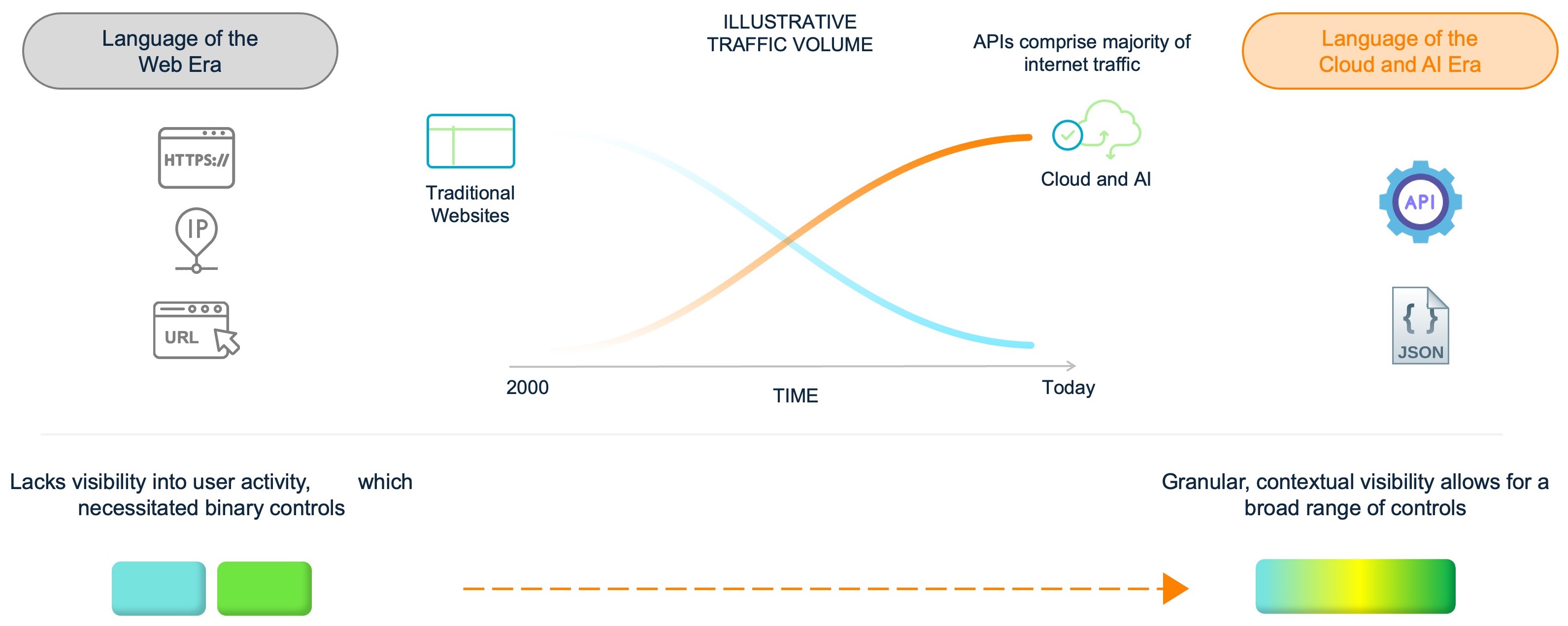
Lacking a Unified, Comprehensive Approach to Data Security
Massive volumes of data and new data sharing behaviors unlocked by cloud, SaaS, and AI have increased the risk of data leakage. At the same time, many organizations today rely on a myriad of disparate point solutions for data security, each intended for a specific digital environment. In addition, these security tools are often built to inspect either data-at-rest or data-in-motion, but few tools adequately do both. The emergence of agentic AI tools is expected to only exacerbate this problem.
This fragmented approach with disjointed controls and policies leaves IT teams struggling to gain full visibility into where their data resides, what type of data it is, who is accessing it, and how it is being used holistically. This has two important consequences:
•Increased exposure to data breaches. Without unified, comprehensive data security in place, data is more vulnerable to breaches, theft, and misuse, which can have significant adverse consequences. Sensitive information—whether it is customer details, financial records, or intellectual property—must be protected to ensure privacy, maintain trust, and comply with regulations. Without robust security, organizations risk losing not only their data but also their reputation, customer loyalty, and even their ability to operate in a competitive landscape.
•Stifled productivity and agility. Innovation thrives on access to data to analyze trends, test new ideas, and experiment with new products or services. Teams may be reluctant to share or experiment with data, fearing security breaches or non-compliance with regulations. As a result, organizations that do not modernize their data security find themselves locked out of their own data, unable to leverage it effectively for new business models, solutions, or customer experiences. In a 2024 study by cdata, 61% IT professionals reported that security concerns keep data out of the hands of those who need it most, and it is the top reason IT professionals say that data requests move (too) slowly, or never materialize at all. This can not only delay decision making but also directly reduce overall productivity.
While data drives growth and innovation, it cannot be optimally used or protected if siloed point solutions are the only mechanisms in place to safeguard it. Without a unified approach to data security, organizations not only expose themselves to major risks, but also hinder their ability to unlock the full potential of their data and compete in a rapidly evolving digital world.
Cannot Apply Advanced Security and Networking Controls at Scale Without Degrading Performance
Legacy security and networking systems suffer from one or more of the following architectural limitations.
•They lack advanced security controls. Their technology and architecture were built for securing legacy internet traffic, not for the era of the modern cloud and AI. As a consequence, they cannot understand the context needed to determine what should, or should not, require inspection. In addition, they have rudimentary data security capabilities and lack the sophisticated methods of inspection and advanced algorithms, including the use of AI, needed to identify sensitive data across all formats of data and stop threats. They also lack the ability to conduct data and advanced threat inspection in real-time at scale for cloud and AI applications.
•They lack advanced security capabilities at the edge, and therefore must re-route traffic back to central corporate data centers or limited cloud enforcement points to enforce the required security controls, which leads to a poor user experience. This is because:
oThey were not designed and built with the scale, software architecture, and network and infrastructure compute required to perform all of the granular inspection and control that organizations need at the locations that are closest to users. Legacy systems are built on a centralized compute model, not taking user experience into account. Over time, ever increasing throughput of traffic has resulted in an unacceptably slow experience for human and non-human entities.
oTheir networks leverage the public cloud providers' infrastructure, much of which is not intended to handle compute-intensive products from edge locations. This limits the number of locations where their security services can operate, and hinders the control they can exert over traffic routing. In addition, public cloud providers control how they prioritize traffic, which creates unpredictability for organizations who need their security and network to scale up whenever they need it.
oThey are unable to process encrypted traffic, which makes up 80-95% of internet traffic according to the Electronic Frontier Organization, at the scale and speed required by modern organizations.
Consequently, when advanced security controls and networking configurations are applied at scale when using legacy systems, there is often a significant degradation in performance for both human and non-human entities. Organizations thus can face a dilemma: they must either disable these advanced security measures entirely or activate them only selectively. This leads to inconsistent security protocols, decreased productivity for users and systems, and an increased susceptibility to data breaches and cyber threats.
Siloed, Cumbersome, and Closed Security and Networking Infrastructure
Organizations are burdened with a plethora of disparate security and networking appliances and cloud tools, each requiring separate management consoles, policies, and configurations. Even when all of these are sourced from a single vendor, they are often fragmented and inefficient. Instead of receiving the seamless single console, policy framework, and network experience they hope for, organizations get only a "platform" that is unintegrated, complex, costly to deploy, difficult to operate, and many times designed to be closed in order to lock-in customers. This places significant strain on organizational resources and hurts the overall security posture of the organization in the following manner:
•Disparate or poorly integrated acquired point products and services wrapped together in one price list is not a platform. Organizations do not want "price list platforms," which is when vendors compile separate products and include these products on a price list and describe such list as a "platform." Poorly integrated acquisitions result in products that do not work well together, management of the products is extremely complicated, and customers expend valuable time and resources trying to attain the platform effect.
•Patched together "platforms" do not actually make customers more secure. Attackers and criminals benefit from "price list platforms." Attackers are able to exploit "platforms" which, under the surface, are comprised of a patchwork of legacy technologies which often have exploitable gaps in coverage and lack advanced capabilities. Attackers just need to find the gap in order to gain access to an enterprise's most important assets. In the mid-to-large enterprise category especially, defense in depth, best-of-breed, and open integration matters. An ecosystem approach is critical, and multiple security and networking platforms will coexist in an ecosystem where it makes sense to have them.
Chief Information Officers ("CIOs") and Chief Information Security Officers ("CISOs") of large enterprises tend not to want a single vendor for all of their security and networking needs but do not want scores of them either. Therefore, the "goldilocks" of deciding what capabilities to converge into platforms lies in the difference between true integration rather than mere aggregation. An ecosystem of multiple complementary platforms is what CIOs, CISOs, and infrastructure and operations leaders typically favor for simplicity, flexibility, and efficiency.
Our Revolutionary Approach
Our Netskope One platform is architected from the ground up to address the limitations of existing solutions and help customers modernize security and networking for the cloud and AI era. Our platform simplifies administration, integrates with and enhances existing investments, protects people, non-human entities, and data from pervasive threats, enables tool and capabilities consolidation without requiring complete system overhauls, and balances the historically conflicting needs of networking and security.
With the widespread adoption of SaaS and cloud, and the beginnings of an era expected to be dominated by AI, the way that essential security and networking services are delivered must fundamentally change in order to satisfy modern business needs. We deliver a modern solution; our team has not only built a converged platform, but has also fully reimagined the architecture of security, networking, and analytics for the cloud and AI era.
Architecture is critical, and platform architecture itself is as important as the individual security, network, and analytics services that it delivers. The traditional methods of delivering these services are inadequate for the demands of today and tomorrow. A modern architecture is necessary for greater visibility and control over data, threats, and access, ensuring all enterprise traffic remains fast and secure when everything, everywhere, is online and interconnected, while addressing the increasing velocity and volume of security threats.
Thanks to the differentiated architecture of our Netskope One platform, which includes context-based security, our NewEdge network—one of the world's largest and most connected global private security cloud networks—and our ability to deliver market-leading security, network, and analytics products efficiently to wherever users, devices, applications, and data live, organizations no longer need to compromise between security and network performance.
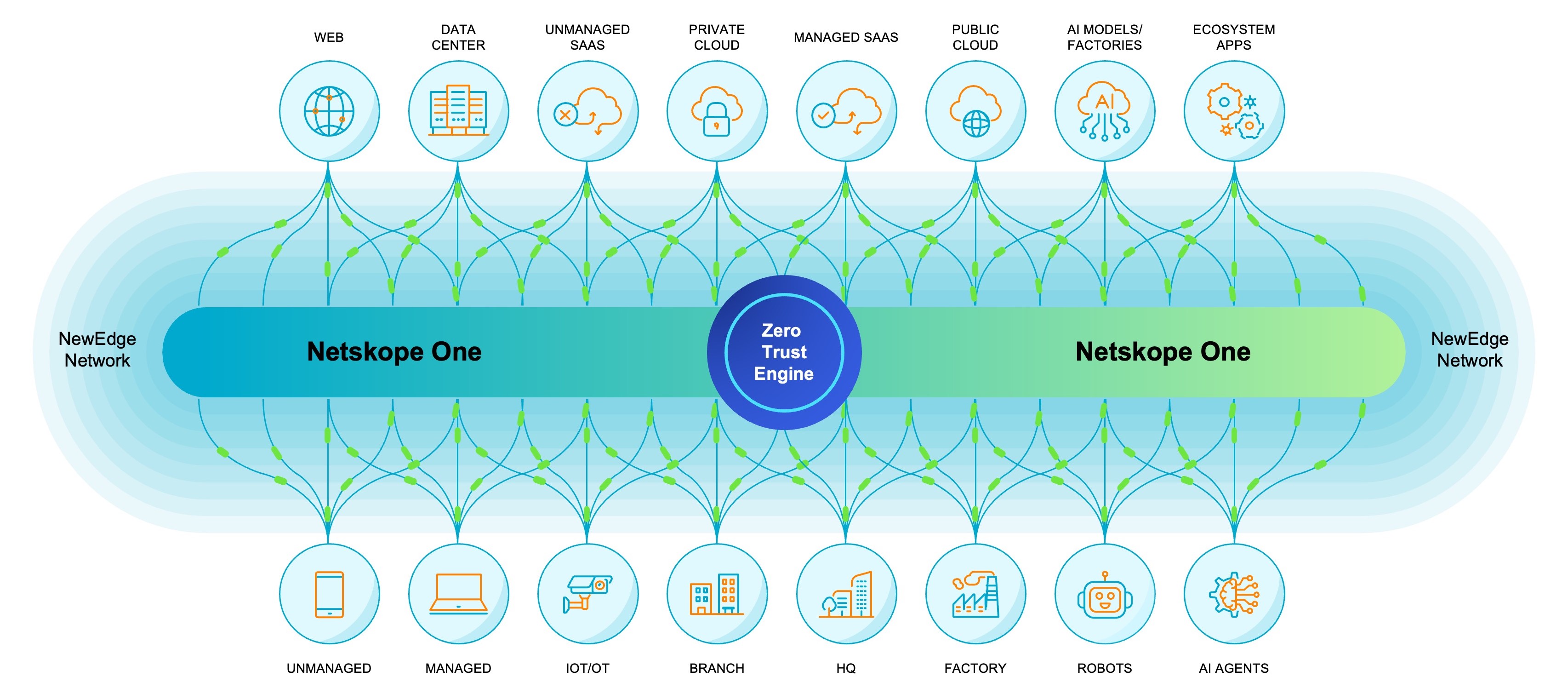
Deeply Understands the Language of the Modern Internet
The modern digital landscape of cloud and AI is comprised of dynamic, highly interactive applications powered by a layer of APIs and protocols, such as MCP and A2A, using JSON-based data encoding that contain granular information about the digital interaction. Our patented technologies and our Zero Trust Engine were built from the ground up to operate at this layer, enabling us to inspect, analyze, and control traffic in real-time and at high speed. We leverage this profound contextual intelligence to understand and control more than 100 different activity types across thousands of cloud, SaaS, and AI applications, over a billion websites, and countless data lakes, stores, and private applications. This contextual intelligence and control goes far beyond basic application access rules, device posture, and common activities (e.g., upload or download), to answer questions such as:
•Is the identity involved a human employee or a non-human entity?
•Is a user attempting to move sensitive data from a corporate instance of Google Drive to their personal instance?
•Is a user attempting to share a screenshot of a confidential design document with someone outside of the organization?
•Is the user prompting Google Gemini with sensitive data?
•Is an unauthorized user attempting to delete an S3 Bucket or stop an EC2 instance in AWS?
•Is the user attempting to create a Gist (posting a chat) in GitHub that contains sensitive data?
•Is a database query returning sensitive data to a user that does not have permission to access the data?
•Is the user's behavior exhibiting high, medium, or low risk patterns?
•Is a compromised user who would normally be allowed to access sensitive data attempting to do so from an unsecured location?
This in-depth understanding of each digital interaction allows us to drive situation-specific policy actions such as Coach, Encrypt, Legal Hold, and Quarantine, to safeguard data and neutralize threats with exceptional precision. For example, a user accessing a personal instance of a Google Gemini can be coached and redirected to the corporate instance.
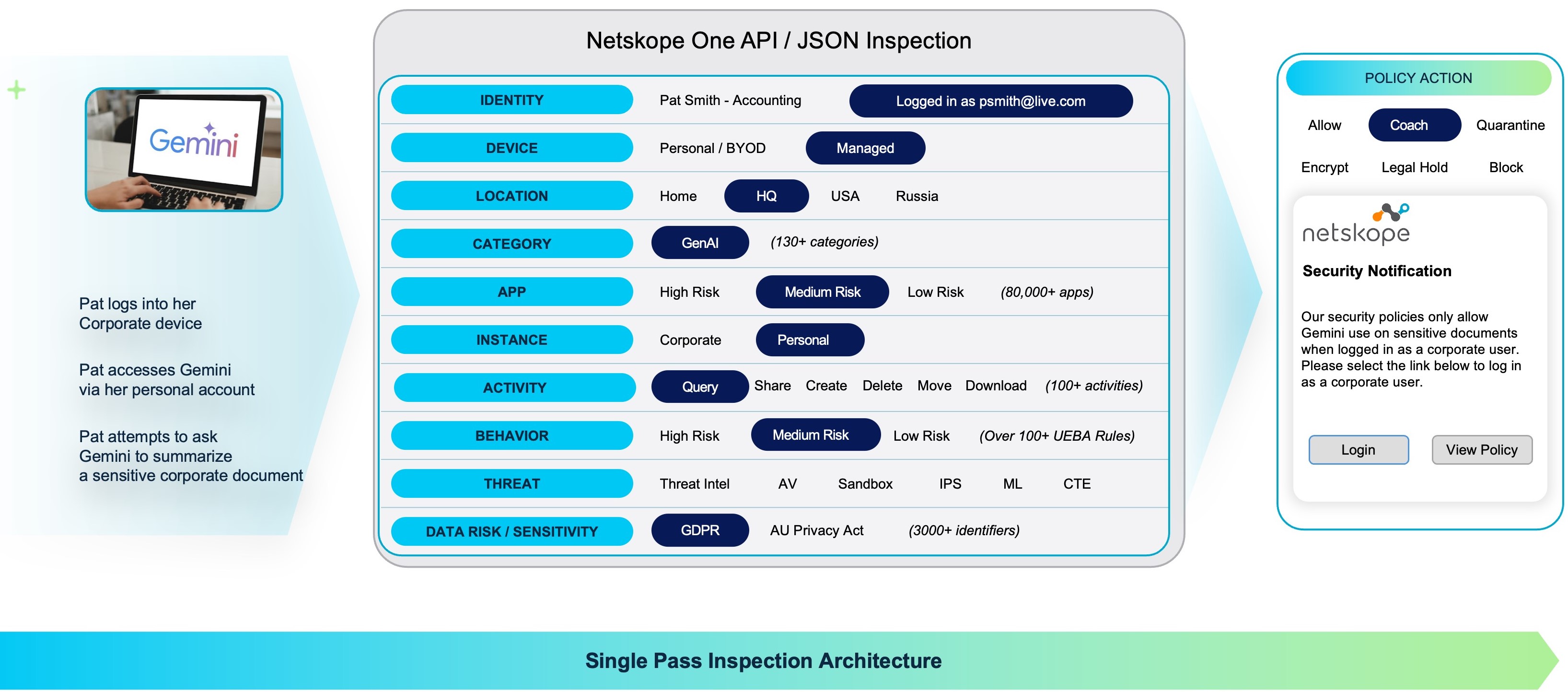
Unified Approach to Data Security
Our Netskope One platform's unified platform approach enables organizations to discover, classify, and protect data, while providing the appropriate level of access based on context in real-time. Unlike vendors that focus on only a single facet of data security, or platform vendors with limited data security capabilities, the Netskope One platform:
•Provides real-time and complete data visibility and control across the digital landscape.
•Extends across structured and unstructured data in-motion, in-use, and at-rest.
•Delivers highly differentiated contextual awareness (including how, with whom or what, where, and when) this data is being used to deliver granular, least-privileged access to data, greatly reducing the risk of data leakage and breaches.
•Offers precise data discovery and classification capabilities—with over 3,000 data identifiers, support for over 2,000 file types, and over 40 regulatory and compliance templates—enabling distinction of sensitive data from the sea of information in an organization's environment.
•Applies an array of proprietary AI and ML models that augment traditional DLP policies and controls, including data classification and real-time user coaching with situation-specific guidance on how they can handle data safely.
Our Netskope One platform delivers deep, real-time visibility and control into organizations' data across the digital landscape, allowing security teams to track where sensitive information resides, who is accessing it, and how it is being used. Our precise data discovery and classification capabilities allow our customers to achieve enhanced accuracy in detection, minimizing false positives and restrictive policies that hinder full productivity and access to important data. Our platform leverages our proprietary AI and ML models to detect, classify, track, and control sensitive data no matter where it is, and automatically flags and addresses security and privacy risks, which includes coaching users in real-time with situation-specific guidance on how they can handle data safely. Our unified policies are designed to be applied consistently across data types—whether structured or unstructured, in-motion or at-rest, on-premises, in the cloud, or on an endpoint—closing security gaps and facilitating compliance with regulations and data sovereignty laws.
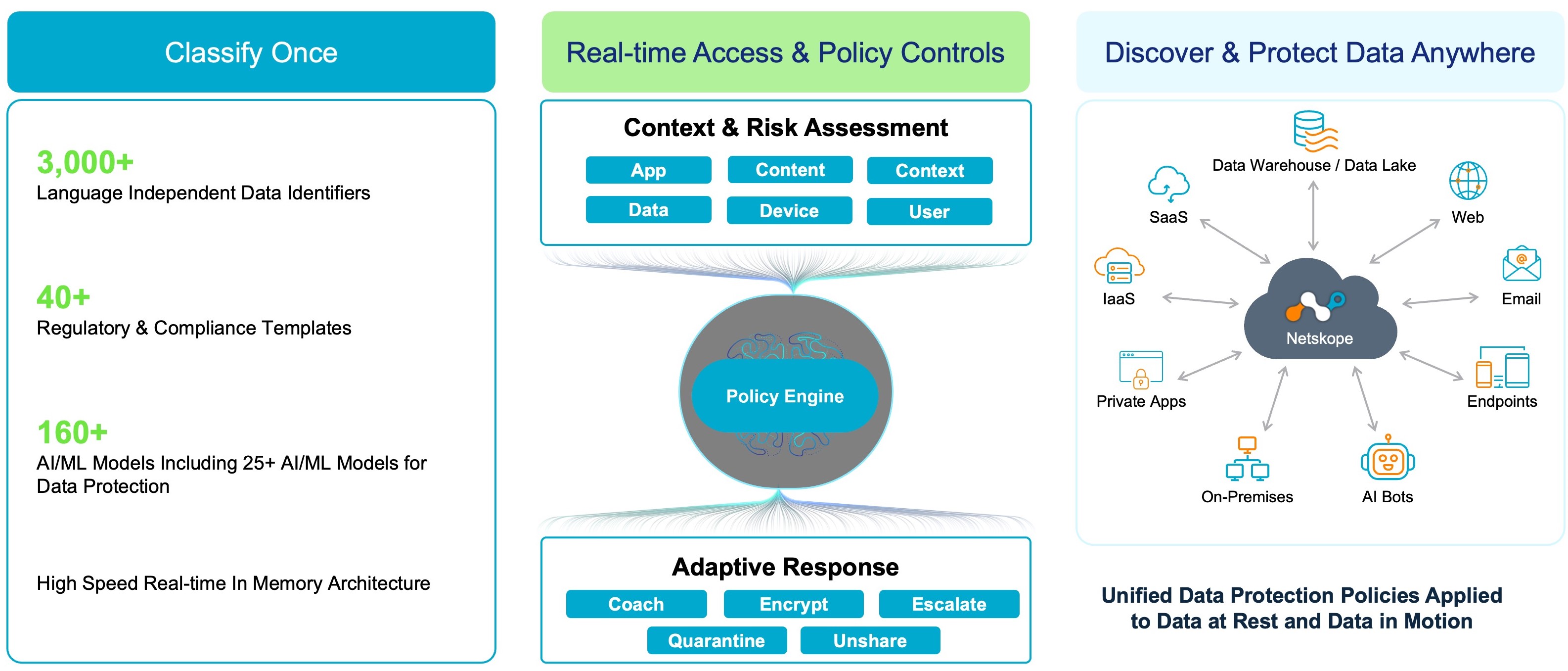
Ability to Apply Advanced Security Controls at Scale while Accelerating Performance
Our NewEdge network provides the foundation for delivering our converged security, networking, and analytics capabilities. The NewEdge network is purpose-built, leveraging bare metal servers with vendor-agnostic hardware. Currently, it comprises more than 120 data centers in more than 75 unique regions, each offering full compute at the edge and capabilities for in-region traffic processing for all products in our Netskope One platform. In addition, our NewEdge network provides more than 200 localization zones around the world, ensuring that customer end users receive local content, in the local language. Each of our NewEdge network data centers are available to all customers and capable of running all of our products. For example, there is no traffic re-routing to other data centers to run certain products that are not available in the originating data center, allowing our NewEdge network to deliver superior performance with the lowest possible latency.
Our NewEdge network leverages an extensive interconnection strategy, featuring over 10,000 network adjacencies to over 700 unique Autonomous System Numbers. This strategy uses premium transit and comprehensive peering with Internet Service Providers and leading web, content delivery, cloud, and SaaS providers. For example, our NewEdge network maintains peering and direct interconnection with Amazon Web Services, Google Cloud Platform, and Microsoft Azure datacenters in mutually available locations, along with other major cloud and SaaS platforms.
The private cloud architecture of our NewEdge network enables advanced integrations that further extend this interconnection strategy directly to our customers. For example, we recently completed direct interconnects via Private Network Interconnect between our NewEdge network and a number of our large enterprise and telecommunications customers' data centers, increasing their performance and resilience.
Converged Security, Networking, and Analytics Platform at the Global Edge
Our Netskope One platform converges security, networking, and analytics capabilities into a single unified, cloud-native architecture. This integration resolves the traditional conflict between security and networking teams, where it was believed that high performance could only be achieved at the expense of security efficacy, or vice versa. Our Netskope One platform sacrifices neither—organizations get advanced security and highly performant and resilient networking. This results in greater security efficacy and an exceptional user experience, while simplifying operations through a single console, engine, network, gateway, and client.
Our Netskope One platform streamlines security operations and reduces complexity, while enabling organizations to apply consistent security policies. Furthermore, extending our converged products to every data center in our Netskope NewEdge network enables organizations to efficiently secure their data, while also optimizing performance and reducing latency. This allows for a more agile and responsive security posture, adapting to the dynamic needs of the modern, distributed workforce and extended enterprise. It also extends visibility and control. From a single console, network and operations teams can see the end-to-end experience of any user, network, application, or device, while security teams can similarly enjoy a global view of trust levels.
Our Netskope One platform's convergence of networking and security also extends to branch and multi-cloud environments through our Netskope One Gateway, forming a new thin, lightweight on-premises network edge. It consolidates software-defined wide-area network ("SD-WAN") and a range of local network services and leverages the deep context of our Zero Trust Engine to prioritize business-critical applications. It is available in physical, virtual, cloud, or client form factors and is designed to eliminate the need for disparate network and security appliances at each location, reducing complexity and cost at scale. Netskope One Gateway software also runs as a service within our Netskope NewEdge network to optimize transcontinental site-to-site and site-to-cloud traffic. Combining our Netskope One Gateway at the network edge with our Security Service Edge ("SSE") offering enables organizations to achieve a true Secure Access Service Edge ("SASE") architecture that converges security and networking in a single platform, delivering secure and optimized connectivity for users and applications, regardless of their location.
AI is Foundational to our Platform
At the heart of our Netskope One platform lies a deep commitment to AI, brought to life by Netskope AI Labs. This dedicated team of AI scientists, security researchers, and product engineers boasts a proven track record in solving complex security and fraud challenges across diverse domains. Their objective is to advance the state-of-the-art AI/ML technology that powers our Netskope One platform, and their work is crucial to our ability to deliver cutting-edge security, networking, and analytics solutions. With over 160 ML models and more than 40 patents, Netskope AI Labs not only adds features, but also builds foundational elements used throughout our products. Through continuous innovation in the AI/ML space and constant evolution of our models and techniques, we strive to stay ahead of emerging threats and challenges and to provide our customers with the most effective security and performance possible. The Netskope AI Labs' innovations also manifest in our Netskope One platform's ability to secure AI usage and enable organizations to take advantage of generative and agentic AI safely. We refer to our suite of AI innovations across the platform as SkopeAI.
Key Benefits for Our Customers
Our Netskope One platform is designed to empower organizations to confidently adopt cloud and AI technologies with robust security and seamless performance. It significantly reduces risks through unified data security and advanced threat protection, enabling a true zero trust architecture. Our Netskope One platform extends zero trust principles to external parties, fostering secure collaboration and reducing breach risks. It delivers fast, resilient digital interactions, supporting hybrid and remote work and thereby helping organizations to attract and retain global talent. By simplifying security and networking, our Netskope One platform addresses cybersecurity talent shortages and reduces operational costs. Its open ecosystem promotes innovation and flexibility, allowing organizations to harness best-in-class solutions from diverse vendors.
Accelerates and Secures Organizations' Adoption of Cloud and AI
Our platform empowers organizations to confidently embrace cloud and AI. It enables the inspection and implementation of real-time, granular, and contextual security controls across the digital landscape. Our platform also facilitates the swift and secure integration of advanced AI applications by enabling customers to deploy sophisticated global security policies that promote access to generative AI and agentic AI applications, while stopping sensitive data leaks and threats. We offer our customers deep visibility and control over the storage and utilization of the data being fed into and generated by these AI applications, driving innovation along with robust data governance. By leveraging our platform, organizations gain the visibility, resilience, performance, and control necessary to lead in business and technological innovation.
Significantly Reduces Risks for Organizations
•Enabling a True Zero Trust Architecture. Effective zero trust implementation hinges on context. Instead of binary access decisions based solely on identity, context-aware zero trust considers multiple factors: the device, location, application, data, and user behavior. By incorporating this information, zero trust makes intelligent and granular access decisions, enhancing security without reducing productivity. Our Zero Trust Engine is central to this approach, continuously gathering risk telemetry and contextual awareness across users, devices, non-human entities, threats, data, and more. It understands the language of the modern internet in real-time across the web, cloud, SaaS, AI applications, and private applications, providing broad visibility and protection. Our platform proactively mitigates cyber threats in real-time, which can prevent incidents and stop attacks early. For example, our platform detected and alerted a customer of a potential ransomware attack during the data exfiltration stage itself, which meant that the customer could stop the attack before the perpetrator could start to encrypt data. In another example, our platform protected customers from becoming victims to the LummaStealer attack by detecting and blocking fake CAPTCHA web pages from tricking the customer into executing a command that would infect their environment with malware. Context-aware analytics offer deep visibility into and control of security posture, leveraging rich metadata across various factors. Our Netskope One platform enables a true least-privilege architecture, enhancing detection, investigation, prevention, and response capabilities. Data is seamlessly shared within our platform and integrated with third-party solutions, providing enhanced security efficacy and a comprehensive security ecosystem.
•Reducing Risks for the Extended Enterprise. In today's interconnected world, secure collaboration with partners, contractors, and third parties is crucial. However, third-party access introduces risks due to varying security postures and limited oversight. Broad, unmonitored access can significantly raise the risk of data breaches, malware infections, and insider threats. Netskope One Private Access and our Zero Trust Engine extend zero trust principles to external parties to provide granular control and visibility into third-party access, even with unmanaged devices. Without these capabilities, organizations cannot fully implement zero trust across their ecosystem.
Our customers typically see a notable reduction in severe breach risk using improved malware protection and tightened DLP controls. Our platform's enhanced visibility into risky user behaviors combined with stronger real-time granular security controls can significantly reduce security incidents and accelerate breach resolution times.
Enables a Fast, Resilient Experience for All Digital Interactions
Our NewEdge network is designed to be ultrafast, highly elastic, built for scale, and capable of providing cloud-delivered security and networking services directly where the users (human and non-human entities) and workplaces are, without performance trade-offs. With intelligent traffic route control, we are able to deliver consistent performance under dynamic network conditions, while our highly available infrastructure is backed by "five nines" (99.999%) performance guarantees. Ultimately, a fast and resilient experience leads to greater productivity for human and non-human entities alike, and legacy technology is often cited as a reason for lost productivity.
Enables Hybrid and Remote Work and Helps Customers Attract and Retain Talent
By removing geographic barriers to secure connectivity and enabling safe use of cloud and AI, organizations can support hybrid and remote workers, expanding their talent pool and attracting top candidates globally. Our Netskope One platform provides full visibility from device to application, enabling IT and network teams to quickly diagnose and resolve traffic performance issues—oftentimes before they happen—allowing organizations to scale operations and support a distributed workforce through hybrid and remote work arrangements. With minimal latency and precise policy enforcement, our platform allows human and non-human entities to connect instantly and securely from any location. Customers can benefit from gains in end-user productivity across their organizations due to the time saved per day and the better work experience for remote workers.
Reduces Cost and Complexity and Addresses Cybersecurity Talent Shortages by Enabling Organizations to Do More with Less
We simplify security, networking, and analytics for organizations by integrating fragmented point solutions into a unified cloud-native platform. By reducing reliance on legacy hardware appliances, sunsetting legacy data centers, and streamlining and thinning the on-premises footprint, organizations benefit from lower deployment and operational costs while enhancing efficiency.
For example, our unified data security capabilities reduce the need for multiple data protection tools, each often having its own console and policy, which reduces data leakage risks from sources such as corporate managed and unmanaged decentralized cloud services, the web, AI, SaaS applications, IaaS, PaaS, private applications, endpoints, on-premises networks, databases, data lakes, data warehouses, email, and other IT systems. Further, our advanced threat protection minimizes false positives, reducing alert fatigue and allowing security and network teams to focus on higher-value initiatives.
Our Netskope One platform reduces the operational burden on security and networking teams by automating routine security tasks and providing highly actionable, context-rich insights. With our Netskope One platform, organizations can streamline their security and networking operations, enabling fewer staff to manage complex hybrid and cloud environments effectively. Shifting from unpredictable capital expenditures to a predictable operational expense model allows for better budget management and operational cost efficiencies.
A quantified benefit analysis that we commissioned found that a composite organization, based on four of our interviewed customers, would realize an estimated $2.4 million over three years in retained profits and recaptured end-user efficiencies by mitigating the impacts of outages and downtime on revenue operations and staff productivity. The study found that the composite multibillion-dollar organization improved visibility during troubleshooting which helped reduce the mean time to resolve ("MTTR") incidents. Combined with other network and security operations improvements, this was estimated to reattribute nearly 400 hours of effort per resource to more productive tasks over the course of three years.
Enables an Open Ecosystem for the Benefit of the IT Industry and Customers
Netskope Cloud Exchange ("NCE") champions an open ecosystem by offering seamless integration with hundreds of cloud services, IT platforms, and third-party applications. Our comprehensive suite includes more than 100 pre-built integrations, many of which can operate across multiple systems right out of the box, allowing businesses to employ best-of-breed solutions from different IT vendors, providing flexibility while prioritizing security.
NCE's open architecture also promotes and supports open industry standards, allowing organizations to quickly scale and leverage their investments without being locked into proprietary solutions. Our ecosystem accelerates digital transformation by simplifying complex integrations, fostering innovation, and enhancing customer experiences.
Our Competitive Strengths
Deep Technology Moat
Our ability to win with customers is driven by our deep technology moat. Our patented technologies and unified platform enable advanced security controls while accelerating performance at scale and providing the following key advantages:
•Advanced Security Built for the Cloud and AI Era.
oOur patented technology operates at the API/JSON, application, and protocol layers, allowing real-time inspection, analysis, and control of modern internet and private traffic, leveraging contextual intelligence across human and non-human entities and their instances, activities, behavior, data, threats and more.
oOur unified data security approach discovers, classifies, and protects data no matter where it resides—whether in motion or at rest, across the web, SaaS, cloud, AI, private applications, on-premises environments, endpoints, data lakes, and data warehouses. Our proprietary AI models precisely identify sensitive data, enhancing accuracy and minimizing false positives. Our unified policies, applied consistently across data types, are designed to eliminate security gaps and ensure compliance.
oAI is foundational to our platform. Our dedicated AI Labs team, with a proven track record in solving security and fraud challenges, has developed over 160 machine learning models and more than 40 patents. Our proprietary AI capabilities are infused across the entire Netskope One platform. We refer to our suite of AI innovations across the platform as SkopeAI.
•Designed to Deliver Accelerated Performance and Resilience at Scale. All of our NewEdge network data centers are available to all of our customers and are capable of running all of our products. With more than 120 data centers, more than 200 localization zones, and more than 10,000 network adjacencies across more than 75 unique regions, our advanced network architecture and resilience measures are backed by 99.999% uptime guarantees for all inline services, providing a seamless user experience. Additionally, through intelligent traffic route control, our NewEdge network dynamically adjusts traffic flows to respond to real-time network conditions, promoting consistent performance and enhancing user experience. Built for scale, our NewEdge network can handle heavy traffic loads, providing users and organizations with a fast and reliable network that can adapt to their evolving needs.
•True Convergence of Security and Networking. Our Netskope One platform is a unified, cloud-native platform with truly converged security, networking, and analytics capabilities. With a single console, engine, client, network, and gateway, our platform is designed to significantly reduce complexity and costs while increasing performance and resilience. Our converged architecture, extended by our Netskope One Gateway, delivers consistent security and networking policies and optimized performance, enabling a true SASE and SSE architecture (and more) that adapts to the dynamic needs of modern businesses. Our Netskope One platform is a platform built the right way, delivering simplicity and efficacy while working effectively with other leading IT solutions in an organization's overall strategy.
Recognized Industry Leadership
We are recognized as a leader in markets that are central to a multi-decade IT transformation and have received accolades from numerous publications, including:
•A Leader in Gartner® Magic Quadrant™ for Security Service Edge every year since its inception in 2022 through 2025, positioning the furthest in completeness of vision and among the top two in ability to execute in the 2023, 2024, and 2025 reports.
•Ranked highest in the 2025 Gartner® Critical Capabilities for SSE report in three of the six use cases evaluated, Essential SSE, Private Application Access, and SaaS Enablement, and the only Magic Quadrant for SSE Leader to rank in the top two for all six use cases.
•A Leader in Gartner® Magic Quadrant™ for SASE Platforms in 2024 and 2025, positioning the furthest in completeness of vision and among the top two in ability to execute in the 2025 report.
•Ranked highest in the 2025 Gartner® Critical Capabilities for SASE Platforms report in three of the four use cases evaluated, achieving the highest aggregate score overall. Netskope's number one ranking spanned the Foundational SASE Platform, Zero Trust SASE Platform, and "Coffee Shop" Networking use cases.
•A Leader in The Forrester Wave™: Security Service Edge (SSE) Solutions for Q1 2024, scoring the highest in the current offering category of all vendors evaluated.
•A leader in the 2025 IDC MarketScape for Worldwide DLP Vendor Assessment.
Broad and Deep Partner Ecosystem
Our partner ecosystem is a key component of our business strategy. We believe in the power of collaboration and working with a broad and diverse set of partners globally. Our ecosystem encompasses many of the world's leading security and network value added resellers ("VARs") and distributors, technology alliances, service and telecommunications partners, managed service providers ("MSPs"), system integrators, and other strategic partners. Our extensive partnerships further enhance our ability to deliver customized, integrated, and fully managed solutions to enterprises of all sizes.
We have cultivated strong, deep technology partnerships with industry leaders across the IT ecosystem, including Amazon, CrowdStrike, Google, MetTel, Microsoft, Okta, and Telstra. Our go-to-market strategy is built upon clearly defined and agreed-upon business objectives and commitments, including bi-directional referral programs. We are dedicated to ensuring seamless and powerful integrations that empower our customers, as evidenced by the more than 100 pre-built integrations with our technology partners currently using our NCE.
Strong International Presence
Our international footprint is a testament to our ability to serve the world's largest customers with our global operations. For fiscal 2025 and the second quarter of fiscal 2026, revenue from regions outside the Americas comprised 43% and 43% of our total revenue, respectively, underscoring our commitment to transforming and modernizing organizations for the cloud and AI era on a global scale. This international presence is a byproduct of our ability to deliver a comprehensive solution, with world-class support and customer success, to a diverse customer base worldwide. Our architecture and technology enable organizations operating in different regulatory, cultural, and compliance environments to confidently choose us as their partner.
Visionary and Experienced Management Team
We are guided by a visionary and experienced management team, led by co-founder and CEO Sanjay Beri, who has more than 25 years of experience in the security and networking industry. We have built a dynamic, highly-experienced and proven leadership team, drawing top-tier talent from the security, cloud, big data, AI, and networking sectors. Our leadership team is deeply committed to driving continuous innovation and collaboratively engaging with the industry and community to advance security, networking, and analytics solutions. Our mission extends beyond business success to creating a safer digital world, fostering a strong, transparent culture, and ensuring our customers achieve their goals.
Our Market Opportunity
By converging advanced security and modern networking capabilities with deep analytics, based on our analysis of IDC data, we believe our unified solution addresses a large total addressable market that is projected to reach $138.9 billion by 2028, growing at a 16.8% CAGR from 2024 to 2028, providing us with a sustained and durable opportunity. We believe we are in the early days of addressing the nascent market opportunity for AI security that we project will grow to $30.8 billion by 2028, contributing an incremental $9.9 billion to our estimated total addressable market by 2028.
Our opportunity spans the following key categories:
Security Products
Our security products are designed to cater to the escalating need for real-time, context-aware protection. This includes safeguarding human users, non-human entities, and data from cyber threats through the use of zero trust principles without compromising performance.
Based on our analysis of IDC data, we project the global market for our security products will grow from $24.4 billion in 2024 to $43.2 billion in 2028, at a 15.3% CAGR.
Our market opportunity projection is based on core categories that IDC defines as Secure Web Gateway, including Cloud Access Security Broker and Networking Sandboxing; VPN/zero trust network access ("ZTNA"); Information Protection; and Virtual Client Computing. We refer to these markets as cloud inline security, cloud access security broker ("CASB"), DLP, threat protection, next-gen secure web gateway ("Next-Gen SWG"), Private Access/ZTNA, remote browser isolation ("RBI"), SaaS security posture management ("SSPM"), data security posture management ("DSPM"), and enterprise browser. Our Netskope One platform also delivers an array of advanced inspection and threat protection capabilities consistently across all controls, including antimalware and multistage sandboxing with deobfuscation, recursive file unpacking, AI/ML malware detection, file detonation and MITRE ATT&CK analysis with patient zero protection and alerts, DNS security, and insider threat protection with AI/ML-based anomaly detections for insider risk, compromised accounts, and data exfiltration.
Networking Products
The rapid adoption of cloud, SaaS, and AI has outgrown the design of traditional network architectures. Legacy VPNs, proxies, and firewalls—many of which we believe have or will soon hit a typical refresh cycle period—contribute to performance bottlenecks, security gaps, and operational complexity. Data is the lifeblood of the modern organization, and modern organizations need a modern networking approach that delivers secure, high-performance access to the web, cloud, SaaS, AI, private applications, and all of their proprietary data, regardless of where it is located.
Based on our analysis of IDC data, we project the global market for our networking products will grow from $40.7 billion in 2024 to $78.4 billion by 2028, at a 17.8% CAGR.
Our market opportunity projection is based on core categories that IDC defines as Firewall / UTM; Internet / Video, SD-WAN Infrastructure, Cloud and Data Center Interconnects, 5G and 4G LTE Enterprise Wireless WAN, Delivery Platform as a Service, Delivery Platform Software, Segmentation, and IaaS Networking. We address this opportunity with our Netskope NewEdge network to deliver advanced networking products that are optimized, low-latency, and highly performant, while enforcing security at the edge. Key solutions include dedicated egress IP, Netskope One SD-WAN, Firewall-as-a-Service ("FWaaS"), and IoT/OT Intelligence. We also enable enterprise-grade connectivity with Cloud Packet Stream, intelligent traffic route control, and localization zones.
Analytics Products
Cybercriminals constantly adapt their tactics, launching sophisticated attacks that disrupt businesses and expose sensitive data. Attackers leave breadcrumbs behind in the form of data, and advanced analytics enable organizations to sift through these digital trails and identify anomalies that point to potential threats.
Based on our analysis of IDC data, we project the global market for our analytics products will grow from $9.2 billion in 2024 to $17.1 billion by 2028, at a 16.7% CAGR.
Our market opportunity projection is based on core categories that IDC defines as Enterprise Network Observability, Tier 2 SOC Analytics, and Cloud-Native XDR. We address this opportunity by providing deep visibility and analytics through solutions such as User and Entity Behavior Analytics ("UEBA") for anomaly and insider threat protection, Advanced Analytics for modernizing the way security and network operations teams measure and analyze cloud, AI and web risk and activity, NCE for seamless integration with hundreds of partners in the IT ecosystem, and Digital Experience Management ("DEM") to deliver proactive performance optimization, rapid issue resolution, and deep visibility from endpoint to application.
AI Security
AI applications have revolutionized corporate workflows, but they also pose significant data security risks. Organizations need ways to safely use AI applications by implementing application access control, real-time user guidance, and data protection. Our platform addresses these emerging challenges to promote the responsible use of AI. We estimate that AI security spend presents a $30.8 billion opportunity in 2028.18
Our Growth Strategies
We are executing a disciplined, multi-pronged approach to drive new customer acquisition worldwide and expand and upsell our solutions across our installed base. Key elements of our growth strategies include:
•Win New Customers. We are executing a disciplined approach to expanding our presence across major accounts, enterprises, and the mid-market.
oMajor accounts. We intend to continue to grow our penetration of the largest enterprises, and see potentially significant opportunities for further adoption. As of July 31, 2025, we counted more than 30% of the Fortune 100, and approximately 18% of the Forbes Global 2000, as our customers;
oEnterprises. We intend to also continue to grow our customer base in the broader set of enterprises that have between 2,000 to 39,999 employees;
18 According to IDC, in 2024, spending on security software was $124 billion, while spending on overall IT software and hardware was $2.8 trillion. Based on our analysis of IDC data, security software expenditures accounted for 4.4% of overall IT spending. To estimate our AI security opportunity, we apply the same percentage to the IDC estimates of $226.5 billion of generative AI spend and $477.4 billion of other AI spend in 2028. Of the projected $30.8 billion total AI security opportunity in 2028, we believe that approximately $20.9 billion spent on other AI security would be included in our estimates of the addressable markets for security, networking, and analytics products above and $9.9 billion spent on generative AI security would be incremental to such estimates.
oMid-market. We have also increased our focus on the mid-market, which we define as customers with fewer than 2,000 employees, as we are seeing growing interest and demand for our Netskope One platform, facilitated by features designed for this group and the MSPs that frequently serve them.
•Expand within Existing Customers. We drive growth within our existing customer base by expanding the adoption of our Netskope One platform through product cross-sell and by expanding deployments across additional customer business units, use cases, and geographies. We have built our platform to include over 20 products, with continuous expansion as we have historically delivered an average of two new products per year. With less than half of our customer base using four or more products as of January 31, 2025, we believe there is a large cross-sell opportunity within our customer base. Many customers start with us by focusing on new use cases, challenges, requirements, and risks, and upgrade from legacy technology over time as their contracts end. Furthermore, as our platform has expanded, we have extended our reach within organizations beyond the CISO into CIOs and infrastructure & operations leaders. Our ability to expand is demonstrated through our strong NRR, which increased to 118% as of July 31, 2025, compared to 113% as of July 31, 2024.
•Broaden Reach into the Public Sector. We are investing in the acquisition of public sector customers to capture additional revenue streams and diversify our customer base, including U.S. federal government agencies, supported by our recent FedRAMP High Authorization. In addition, we maintain an extensive portfolio of third-party assessments and certifications for government sectors worldwide, including SSAE-18/SOC-2 Type 2, HIPAA/HITECH, CSA STAR Level 2, and ISO 27001/27017/27018 for international markets. We also hold certifications in Germany (C5), UK (Cyber Essentials), Australia (IRAP), Canada (Protective-B), and Spain (Esquema Nacional de Seguridad). We have also self-certified under the EU-U.S. Data Privacy Framework (EU-U.S. DPF), the UK Extension to the EU-U.S. Data Privacy Framework (UK Extension to the EU-U.S. DPF), and the Swiss-U.S. Data Privacy Framework (Swiss-U.S. DPF). These assessments demonstrate our commitment to security and compliance across various industries and geographies to further penetrate new customer categories.
•Grow our International Footprint. We have strategically invested in and expanded our international presence, particularly in Europe, the Middle East and Africa ("EMEA"), and Asia Pacific and Japan ("APJ"). For the six months ended July 31, 2025, EMEA and APJ contributed 25% and 19% of our revenue, respectively, representing 37% and 33% year-over-year growth, and these two regions continue to represent potentially significant opportunities for us. We also intend to continue growing our customer base through additional investments in new key regions, including Southeast Asia, Japan, Latin America, and the broader European and Middle Eastern regions.
•Expand our Domestic Footprint. We have built a substantial business internationally over the years, and we are now even more focused on increasing the size of our Americas salesforce to drive increased growth, especially in the U.S. Our go-to-market strategy prioritizes comprehensive sales, solutions engineering, and channel enablement, equipping our teams to accelerate customer acquisition and platform adoption.
•Grow our Partner Ecosystem. Our partner ecosystem enhances the distribution of our platform and expands our go-to-market reach. We continue to expand our channel partnerships with VARs, distributors, technology alliance partners, system integrators, MSPs, and global telecommunications service providers to continue to grow efficiently.
•Enhance our Platform Capabilities through Strategic M&A. When we evaluate companies externally, we look for great technical teams who fit our culture of collaboration, innovation, and putting customers first. We prioritize those who, like us, have architected and built their technology leveraging modern methods so that it can ultimately be seamlessly integrated to support our unified platform strategy. When we acquire a company for its technology and talent, we have a dedicated team and process to relentlessly focus on integrating the technology into our platform in a holistic fashion.
Our Products and Platform
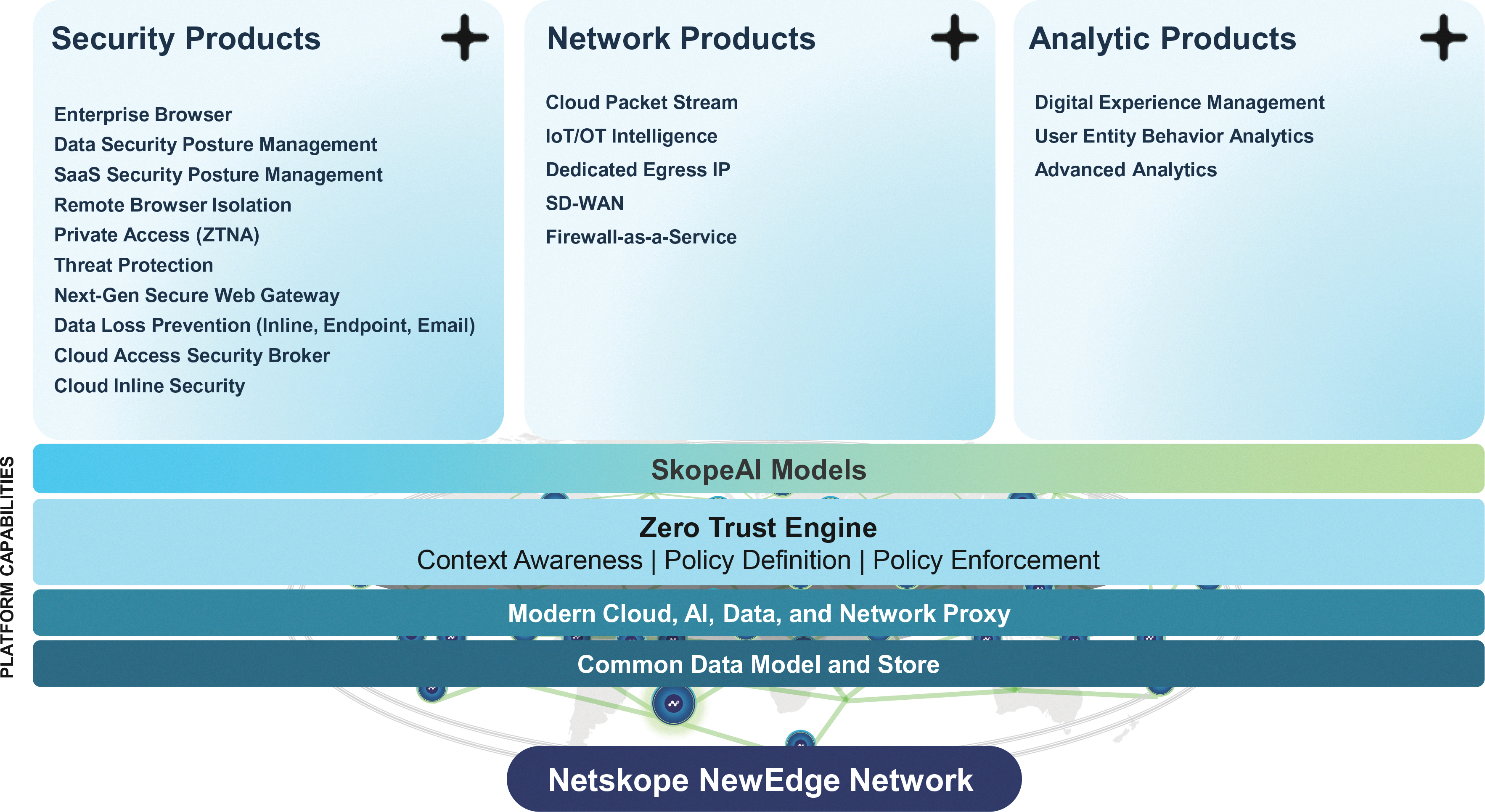
Our Netskope One platform is our comprehensive solution that integrates security, networking, and analytics products into a single, unified platform.
Security. Our platform is designed to address the complex and rapidly evolving needs of modern organizations by providing a robust suite of security products. These products include the following:
•Cloud Inline Security: Provides real-time inline data protection and threat defense for an organization's cloud and SaaS traffic of any type, inclusive of corporate and shadow usage, with the ability to decode application context and control application activities, continuously inspecting and securing traffic from users, devices, IoT/OT, applications, and AI to cloud services, while accelerating performance.
•Cloud Access Security Broker ("CASB"): Delivers comprehensive and adaptive visibility and security controls for cloud and SaaS in an out-of-band manner, including access control, threat, and data protection. Our CASB can combine its out-of-band capabilities such as data and threat detection and inventory, remediating controls, and event log analysis, with our real-time preventive controls for human and non-human entities across the digital landscape for all cloud-based services and applications.
•Data Loss Prevention ("DLP"): A comprehensive and advanced DLP solution that discovers and secures sensitive data across web, cloud, AI, private applications, networks, email services, endpoints, users, and devices. Our DLP solution includes three products: Inline, Endpoint, and Email.
•Threat Protection: This provides high-efficacy threat detection and blocking for advanced malware (such as ransomware), phishing, and other threats. It uses a comprehensive, multi-engine approach with anti-malware, intrusion prevention, and multistage sandboxing with deobfuscation and recursive file unpacking, machine learning for risky malware file types, detonation, and MITRE ATT&CK analysis for over 30 file types, patient zero protection and alerts, and sandbox and retrohunt APIs. All of them are enhanced with curated threat intelligence from threat sources that include millions of indicators from our Netskope One platform and Netskope Threat Labs and are updated multiple times per hour.
•Next-Gen Secure Web Gateway ("Next-Gen SWG"): Our Next-Gen SWG goes well beyond traditional SWGs, which only provide web filtering and basic TLS decryption. Our Next-Gen SWG performs high-performance, highly resilient TLS decryption and incorporates cloud inline security and threat protection capabilities to prevent malware, detect advanced threats, filter websites by category, protect data, and secure the web, applications, AI, and cloud services within a single-pass architecture for users, non-human entities, and more, irrespective of location.
•Private Access / Zero Trust Network Access ("ZTNA"): With Private Access, enterprises can fully replace their legacy VPNs with a cloud-based, remote access solution that we believe offers superior performance and tighter security based on zero trust principles. Leveraging identity, risk, and context scoring for each interaction's originator (managed or unmanaged user devices, IoT/OT devices, and more), Private Access extends and enforces adaptive access.
•Remote Browser Isolation ("RBI"): RBI isolates risky and uncategorized websites by downloading and assembling web pages into a cloud-based container and mapping them into safe images that are presented to end-users, delivering seamless, safe viewing of websites, and isolating end-user devices from potentially malicious website code.
•SaaS Security Posture Management ("SSPM"): SSPM is designed to continuously monitor and harden critical SaaS applications by removing risky integrations and implementing enhanced security settings and entitlement controls, all in alignment to industry security benchmarks and customer specific best practices. SSPM also reduces misconfiguration-related security and compliance risks.
•Data Security Posture Management ("DSPM"): DSPM automates data security and governance by empowering security and compliance teams to automatically discover and classify data, provide access governance, and monitor risky data use for structured, unstructured, and semi-structured data in the cloud and on-premises, including data lakes and data warehouses.
•Enterprise Browser: Enterprise Browser streamlines the security of how unmanaged devices and the extended enterprise connect to the web, applications, AI, and other corporate resources. It seamlessly integrates and leverages all other products in the Netskope One platform to deliver a secure and performant end user experience globally. This is a crucial difference from "standalone" enterprise browser tools, because organizations can rely on seamless, secure access to web sites and applications for unmanaged devices and temporary workers, and can also prevent data leakage to applications and unmanaged devices by consistently applying adaptive policy controls.
Networking. Our platform incorporates a range of networking products that enhance performance, resilience, connectivity, and security. These include the following:
•Firewall-as-a-Service: Delivers FWaaS for egress traffic, controlling, and protecting traffic from layer 3-7 for all ports and protocols. FWaaS traffic is inspected by our threat and data protection capabilities and is secured by comprehensive DNS security.
•IoT/OT Intelligence: Provides visibility into connected devices across enterprise networks and branch offices, securing IoT and OT devices through context-driven classification, risk assessment, network segmentation, and access control.
•SD-WAN: Provides secure, reliable connectivity for each branch, cloud, remote user, or IoT/OT device, delivering consistent performance and unified policy enforcement.
•Dedicated Egress IP: Provides organizations with unique, static IP addresses for their outbound traffic, allowing organizations to ensure their cloud- or AI-bound traffic originates from a consistent, allowlist-friendly IP address and to exert stricter security control using conditional access policies.
•Cloud Packet Stream: Extends comprehensive visibility and analysis by mirroring customer traffic from our Netskope One platform so that it can be ingested directly by customer tools or exported into third-party vendor solutions for deeper analysis. This enables compliance, threat hunting, and performance monitoring use cases.
Analytics. Our platform also empowers organizations with rich insights into user activity, data movement, and security events across the web, cloud, SaaS, AI, private applications, and other environments. It also offers enhanced visibility into performance metrics and capabilities to detect, troubleshoot, and address performance degradation for human and machine-machine interactions. These products include:
•Advanced Analytics: Advanced Analytics allows customers to build custom queries and visualizations for Netskope-generated data, including event and signal correlations and risk identification, and to understand how their risk is being managed. It provides visibility and insights, among other things, into user activity, data movement, and security events across the web, cloud, SaaS, AI, private applications and other environments. Advanced Analytics also enables organizations to generate customized reports and dashboards for a variety of use cases including compliance, threat protection, and data protection.
•User and Entity Behavior Analytics ("UEBA"): UEBA detects insider threats by analyzing traffic and user behaviors across the web, cloud, SaaS, AI applications, endpoint processes, data stores, data warehouses, data lakes, private applications, shadow IT, and public-facing custom applications, applying AI/ML and statistical analysis to spot anomalous activities and implement dynamic user trust score based on inline access control.
•Digital Experience Management ("DEM"): DEM offers enhanced visibility into performance metrics for human and non-human entities, and includes telemetry and tools to detect, troubleshoot, and address sources of performance degradation, whether these are related to the customer environment, the network interconnect, or the infrastructure.
Our dedication to AI/ML manifests in various critical areas of our platform, including:
•AI Operations: We harness AI for workflow automation, application health monitoring, root cause analysis, and adaptive incident prioritization.
•Behavioral Analysis: AI-driven detection and statistical modeling identify anomalous behaviors linked to malicious insiders, compromised accounts, brute-force attacks, and data exfiltration.
•Cloud Security: Our ML models classify cloud applications, assess risks, and evaluate connection reliability to enhance overall cloud security.
•Data Security: We leverage natural language processing ("NLP") and computer vision techniques to accurately and efficiently identify sensitive documents and images.
•GenAI for Security: We utilize generative AI technologies to provide policy recommendations, answer routine queries, and optimize internal processes, documentation, and workflows.
•IoT/OT and Device Intelligence: AI-powered classification and dynamic device grouping enable advanced anomaly detection using multiple ML techniques.
•SD-WAN: AI/ML-driven anomaly detection for wide-area network ("WAN") access.
•Threat Detection: We enhance malware and phishing URL detection by using ML methods that complement signature, heuristics, and sandbox techniques.
•Web Security: NLP and computer vision models enable scalable, intelligent website content filtering and categorization.
Our platform is continually evolving, with ongoing innovation and new products being added to the platform. We are committed to staying at the forefront of security, networking, analytics, AI, and technology by providing a platform that meets the ever-changing needs of our customers. Our focus on innovation allows us to provide cutting-edge solutions that help businesses navigate the complexities of the digital world.
Netskope NewEdge Network
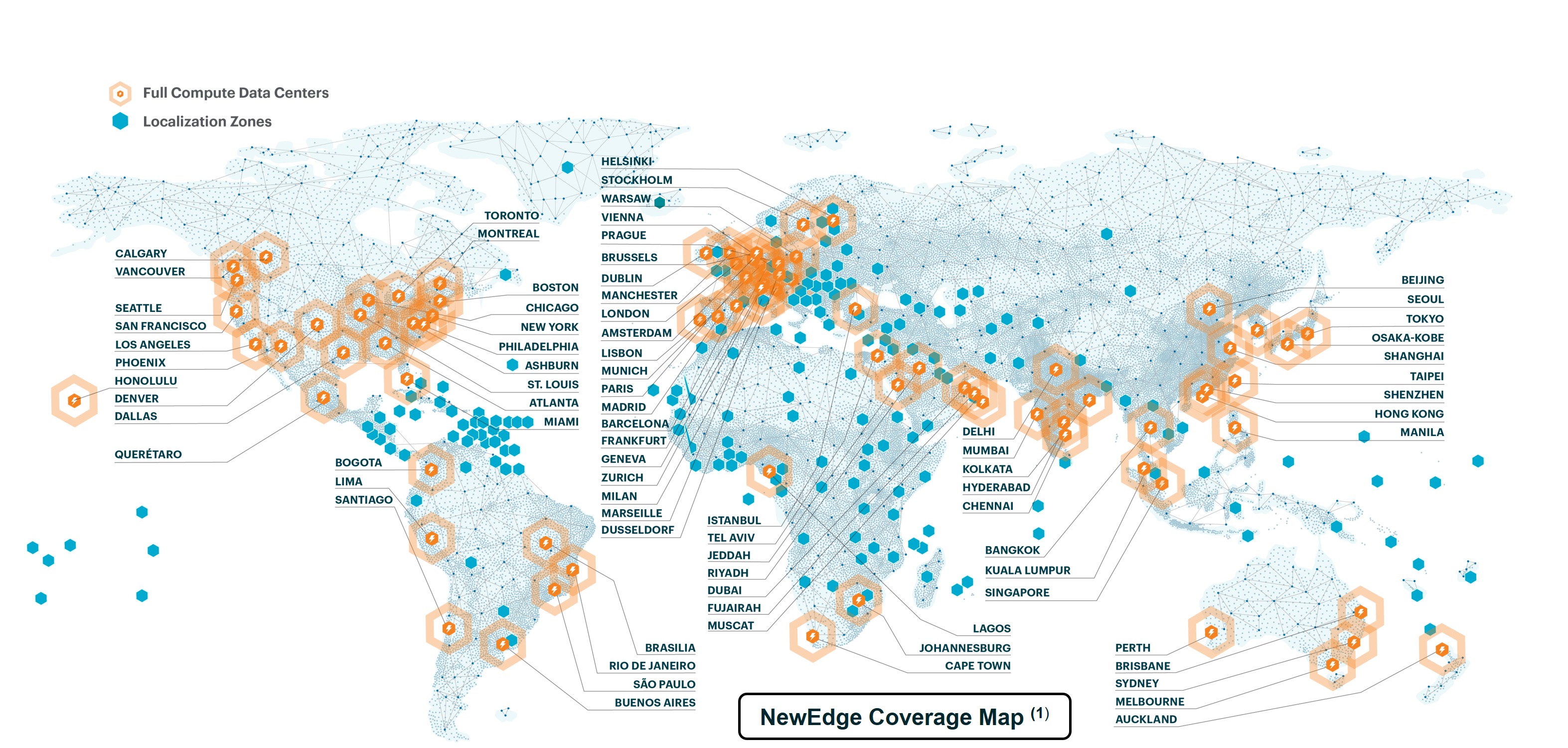
(1)Each region can contain multiple data centers.
Underpinning its network performance advantages, the efficient processing of traffic within our NewEdge network data centers is achieved by security and networking functions implemented as scalable microservices. These microservices operate independently, while efficiently sharing resources, and their architecture enables intelligent, scalable, and high-performance traffic processing while incorporating rich context and performing deep inspection. Our NewEdge network also leverages a single-pass design that is designed to minimize the performance impact of multi-layered traffic processing and achieve the lowest possible latency, supporting a superior end-to-end user, device, and application experience. Our NewEdge network is backed by a latency guarantee of 10 milliseconds for non-decrypted traffic, 50 milliseconds for decrypted traffic inspection, and 99.999% uptime.
From a network and service resilience perspective, our NewEdge network implements a layered approach beginning with its extensive global footprint of data centers positioned strategically at the edge, as close to users, devices, and sites as possible. Our infrastructure plans are intended to ensure consistent availability of abundant capacity, adding resources in regions well ahead of anticipated demand, and prioritizing adding new data centers in existing regions (where possible) to maximize resilience and capacity rather than expanding existing facilities. Regardless of which data center traffic egresses from, NewEdge Localization Zones ensure that end users always receive local content, in the appropriate local language, without running into legacy issues with geo-fencing or blocking. In addition to positively impacting the overall digital experience, this is important for resilience, as well as compliance with data sovereignty regulations important for networking and security teams.
To achieve our overall resilience objectives, we implement proactive measures such as Auto Failout, which is designed to automatically remove data centers from service if performance degradation is detected. Additionally, our innovative NewEdge Traffic Management technology connects users or non-human entities to the "nearest" data center based on the best performance, determined by round-trip time latency measurements. This system maintains awareness of nearby data centers so that during a service impairment event, connections can automatically shift to the next best-performing data center within seconds and without manual intervention. In addition, we leverage AI/ML to optimize access and performance of applications throughout our entire network and to troubleshoot network availability.
Our convergence of networking and security also extends to branch and multi-cloud environments through our Netskope One Gateway, forming a new thin, lightweight on-premises network edge. Our Netskope One Gateway, available in physical, virtual, cloud, or client form factors, consolidates SD-WAN and a range of local network services such as routing, WiFi, 5G, firewall, IPS, IoT/OT intelligence, DEM, and Edge Compute, along with a seamless on-ramp to our Netskope One platform, into one simple, zero-touch provisioned device. This microservices-based architecture is designed to eliminate the need for disparate network and security appliances at each location, reducing complexity and cost at scale. Netskope One Gateway software also runs as a service within our NewEdge network to optimize transcontinental site-to-site and site-to-cloud traffic. Combining our SD-WAN product at the network edge with our SSE offering enables organizations to achieve a true SASE architecture that converges security and networking in a single platform, delivering secure and optimized connectivity for users and applications, regardless of their location.
Our Customers
The following is a representative sampling of our customers:
|
|
|
AMETEK |
Exclusive Networks |
Omnicom |
Ashland |
Home Depot |
Qualcomm |
ASICS |
Hugo Boss |
Suncorp |
Bayer |
LifeLabs |
SunLife Financial |
Bel Group |
Magna International |
Tata Motors |
BMO |
ManTech |
Tyson Foods |
Colgate-Palmolive |
MetTel |
|
The customer examples below illustrate how customers from different industries benefit from our Netskope One platform:

ASICS is currently transforming its network and security infrastructure to align with Adaptive Trust principles, supporting its cloud-first and hybrid workforce model. In collaboration with Netskope's architecture team, it has designed a unified SASE deployment that spans its global operations. This initiative focuses on enabling secure access from anywhere, enhancing agility, and integrating risk-based policy enforcement into its user and data interactions.
Key Architectural Priorities
•Eliminating legacy perimeter bottlenecks: ASICS has moved to direct-to-cloud routing using Netskope's infrastructure, streamlining network access and improving performance.
•Unifying security functions: ASICS' design combines essential security functions into a single inspection point, reducing complexity, including Next-Gen SWG, Cloud Inline, ZTNA, and DLP.
•Implementing adaptive access controls: ASICS is finalizing policies that dynamically adjust based on user identity, device posture, location, and risk context, ensuring a more flexible security environment.
•Designing around the principle of least privilege: ASICS is replacing its legacy VPN with fine-grained ZTNA access to private applications, enhancing its security posture.
Integrated Ecosystem Approach
Our products seamlessly interoperate with ASICS' broader security ecosystem to enable a resilient security framework. ASICS is integrating our products with other dynamic policy enforcement, enhanced device risk scoring, high-fidelity anomaly detection, and automated incident management tools already in its stack. This approach harmonizes its detection and response capabilities while ensuring centralized visibility and control.
Execution and Outcome
Working closely with its regional security, networking, and compliance teams, the ASICS team's rollout is aimed at minimizing user disruption while meeting critical business timelines. Key global locations are being onboarded via NewEdge points of presence, ensuring low-latency access and effective regional policy enforcement.
Additionally, ASICS is developing custom dashboards and governance workflows tailored to its internal risk and compliance teams, leveraging the Netskope One platform. This ongoing implementation is expected to strengthen ASICS' security framework and empower it to operate confidently in a complex and evolving digital landscape.
This initiative reflects ASICS' commitment to maintaining a robust security posture in support of its business objectives. With Netskope's support and expertise, ASICS is well-equipped to meet the challenges of the digital age, delivering visibility, control, and performance while minimizing operational complexity.
"Netskope is committed to continuous improvement and innovation in the security landscape. They enabled us to operationalize Adaptive Trust at scale, securely connecting users to data with precision, performance, and policy control, anywhere, anytime, on any device."
— Shirin Khimji, Global Head of Zero Trust, ASICS Technology Ltd

Challenge
•Leading with a Digital First mindset, BMO takes an innovative approach to providing digital strategies and tools that help customers make real financial progress.
•BMO had multiple business groups that were all leveraging a variety of different business tools. With the emergence of next generation technologies, BMO was looking for a way to maintain and improve the visibility and control of data moving across the organization and its partners.
•The bank was searching for an innovative and unified solution that would set the foundation for its digital future, improve security, visibility and employee experience, while continuing to meet regulatory requirements.
•BMO was also tasked with protecting and maintaining corporate network performance amidst the growing demand for digital banking services.
Netskope Solution
•To address these challenges, Netskope partnered with BMO's network and security teams to deploy the Netskope One platform.
•The implementation includes:
oNetskope's Security Service Edge package, which includes Next-Gen SWG and CASB to provide seamless control over data movement and enhanced security for cloud services;
oNetskope's data security to safeguard sensitive information and robust DLP & SSPM measures;
oAdvanced Analytics for actionable insights into cloud app usage and RBI;
oDedicated Egress IP addresses in order to avoid a shared IP address pool where others can impact reputation ratings and block lists; and
oNewEdge network for optimized connectivity and performance.
Results and Impact
•Successfully replaced legacy technology across 50,000 users without compromising network performance or employee productivity.
•Gained visibility and real-time granular controls across an optimized global cloud infrastructure.
•Met the needs of both security and networking teams via a single pane of glass, saving time on investigations and realizing cost avoidance and efficiency.
•Obtained superior service coverage, performance and resilience without compromising security across users, web and cloud applications (particularly in unique and hard to reach regions of the world).

Colgate-Palmolive is a caring, innovative growth company that is reimagining a healthier future for all people, their pets, and our planet. Focused on Oral Care, Personal Care, Home Care and Pet Nutrition, Colgate-Palmolive sells its products in more than 200 countries and territories. Colgate-Palmolive's commitment to innovation has seen it shift to a cloud-first model and prioritize intellectual property data protection.
Challenge
Colgate-Palmolive's primary concerns were to protect its valuable intellectual property from insider threats, increasing visibility of cloud usage, and ensuring the performance of cloud applications.
As the company continued to innovate and expand its global operations, maintaining a balance between data protection and accessibility became more critical.
Netskope Solution
To address these challenges, Netskope partnered with Colgate-Palmolive's network security and R&D team to deploy Netskope's SSE package of products.
The implementation included Netskope's Advanced Analytics for actionable insights into cloud app usage; Netskope's data security to safeguard sensitive information and its robust DLP measures; CASB to provide seamless control over data movement and enhanced security for cloud services; and the NewEdge network.
Results and Impact
•Gained actionable insights into cloud app usage
•Allowed safeguard rails to contain sensitive information within Colgate-Palmolive's ecosystem
•Enabled seamless control over data movement and enhanced security for cloud services
•Benefited from a unified, global cloud on-ramp architecture providing secure, low-latency access to web and cloud applications
"Netskope is a valued partner for us, seamlessly integrating networking and security into a single platform and streamlining our data protection processes."

Exclusive Networks ("Exclusive") is a global cybersecurity distributor that provides partners and customers with a wide range of services and product portfolios via proven routes to market. With offices in over 45 countries and the ability to serve customers in over 170 countries, Exclusive combines a local perspective with the scale and delivery of a single global organization. In 2024, Exclusive strengthened its North American business with the 100% acquisition of Cloudrise, a U.S. based managed security services provider and strategic Netskope partner.
Challenge
As a global cybersecurity distributor and managed services provider, Exclusive seeks continued expansion of its security business, selecting high-quality vendors to create an optimal balance of products that help define, develop, and drive new market opportunities. As our market presence grew and we became a recognized leader in security, networking, and analytics solutions, both Exclusive and Cloudrise built steadily expanding partner relationships with us over a multi-year period.
Netskope Expansion
Exclusive has sought to establish itself as a "one-stop shop for everything Netskope", empowering partners and customers to deliver a complete Netskope experience while helping enterprise end-user customers benefit from the capabilities of the Netskope One platform, including SSE and SASE capabilities and the performance benefits of our underlying NewEdge network infrastructure.
Results and Impact
Netskope is a leading global vendor for Exclusive, offering the advanced capabilities of the Netskope One platform, which Exclusive distributes via an array of tailored services to customers in over 170 countries. In addition, Exclusive has leveraged our Netskope Academy to educate professionals in optimizing the deployment and ongoing management of our cutting-edge technologies.
"The Netskope One platform offers superior protection and performance. As we have built a global business, we remain deliberate about the technology providers we partner with as we expand. Netskope is a strategic vendor for Exclusive and in high demand with customers wanting to make a successful, secure transition to a cloud-first technology environment."
- Paul Eccleston, Chief Business Innovation Officer

Qualcomm relentlessly innovates to deliver intelligent computing everywhere, helping the world tackle some of its most important challenges. Building on 40 years of technology leadership in creating era-defining breakthroughs, they deliver a broad portfolio of solutions built with their leading-edge AI, high-performance, low-power computing, and connectivity. Their Snapdragon® platforms power extraordinary consumer experiences, and their Qualcomm Dragonwing™ products empower businesses and industries to scale to new heights. Together with their ecosystem partners, Qualcomm enables next-generation digital transformation to enrich lives, improve businesses, and advance societies.
Opportunity
Qualcomm is developing the critical wireless technologies the world runs on today and has 170 offices in more than 30 countries. With thousands of distributed employees in various regions, they sought a security and networking platform that would optimize cost and protect against security risks without slowing down their network.
Netskope Solution
Netskope partnered with Qualcomm network and security teams to deploy the Netskope One platform. The implementation includes our SSE package, which includes Next-Gen SWG and CASB to provide seamless control over data movement and enhanced security for cloud services; Netskope data security to safeguard sensitive information and robust DLP measures; Advanced Analytics for actionable insights into cloud application usage; and our NewEdge network to meet the unique needs of servicing user, site, application, and cloud traffic, including in China.
Results and Impact
Through collaboration with Netskope, Qualcomm has enhanced network performance and traffic processing efficiency and expanded peering capabilities. Qualcomm has also improved visibility into global data movement. Qualcomm's teams have adjusted security policies and configurations to reduce risk and enhance protection. This collaboration allows Qualcomm to secure users, data, and devices more effectively, while also improving user experience, increasing employee productivity, and reducing costs and complexity for network security teams.
How a Fortune 500 Global Services Company Transformed its Security and Networking with Netskope
A Fortune 500 global services company operates worldwide and has thousands of clients and more than 70,000 employees. The company sought our assistance with the project described below.
Challenge
•In 2017, this Fortune 500 global services company embarked on a transformative journey to become a cloud-first organization, marking a significant milestone in its strategic use of technology. This decision involved a comprehensive plan to consolidate diverse technology solutions. Its mission was to find a technology partner and platform to eliminate duplicate spend on security and infrastructure technologies, reduce cost, increase security maturity, and provide secure access and high network speed for hybrid employees across the globe.
Netskope Solution
•To effectively address the challenges of secure data and network management, we have partnered with this company's network and security teams to deploy the comprehensive capabilities of the Netskope One platform. This strategic implementation encompasses several key components designed to enhance data control and security across various operations. Netskope's SSE package of products, which includes Next-Gen SWG, CASB, and Private Access products, provides robust security measures and seamless control over data movement; FWaaS controls egress traffic for users and offices through firewall protection; Netskope data security and comprehensive DLP safeguard sensitive information; and User & Entity Behavior Analytics along with Advanced Analytics provide actionable insights into application usage. In addition, our Private Access solutions optimize access to all private applications from any location, and the platform capabilities are all fully enabled by the NewEdge network, which is critical to optimizing connectivity and performance, catering to the specific needs associated with user, site, application, and cloud traffic, especially within regions that have varying requirements for the protection and governance of data.
Results and Impact
•The Netskope One platform enabled the company to consolidate disparate legacy technology solutions from multiple vendors into a unified platform, allowing standard configuration and consistent policy enforcement across both managed and unmanaged devices, facilitating seamless on-premises and remote user access and also enabling the secure use of generative AI tools.
•The company has achieved a modern zero trust architecture for access to private applications both on-premises and in the cloud, and significantly reduced the operational burden previously associated with maintaining multiple network solutions.
•The company achieved comprehensive monitoring capabilities that are applied consistently to over 70,000 users worldwide across 350 diverse locations in 40 countries, ensuring uniformity in security irrespective of geographical or operational variance while safeguarding against the loss of sensitive data and actively defending against malware and other security threats in real time.
"We consider Netskope one of our most important strategic partners for security and networking. The Netskope One platform has allowed us to consolidate technology platforms, reduce costs, protect data from constant threats, and enable modern, hybrid work with safe access to cloud, web, Al, and private applications." - CIO, global services company
Sales and Marketing
Sales
Our sales strategy is built on a disciplined categorization of our customer base and strong focus on customer success that drives recurring revenue growth worldwide. Our customers fall into three main categories:
•Major Accounts, which are customers with 40,000 or more employees;
•Enterprises, which are customers with 2,000 to 39,999 employees; and
•Mid-Market, which are customers with fewer than 2,000 employees.
As of July 31, 2025, our Major Accounts and Enterprises categories together accounted for approximately 80% of our ARR, with the Mid-Market category contributing the remaining approximately 20%. Our land-and-expand approach is core to our sales strategy. We typically establish an initial foothold with a customer through two or more products. Our platform's unified architecture, ease of deployment, and broad coverage of modern security, networking, and analytics use cases simplify expansion efforts, making it easier for our sales and customer success teams to increase user count, add new products, address new use cases, and deepen customer adoption of our platform over time.
To support this expansion, we maintain continuous customer engagement through our direct sales force, channel partners, and global customer success team. Our enterprise field sales and customer success teams work directly with partners and large customers, supporting deployment, optimizing usage, and driving adoption of additional products. In the mid-market, we focus on leveraging a combination of MSPs, our own mid-market sales teams, and partner-led service models to expand customer relationships at scale.
Marketing
Our marketing strategy is designed to grow our brand awareness, generate a robust opportunity pipeline, showcase our technological and platform leadership, and ultimately drive organizations to evaluate us, as we have a high win rate once organizations try our Netskope One platform. Our digital-first, account-based approach targets key decision-makers in IT, security, and networking—ensuring that our message is both consistent and compelling across global and regional markets. We employ a wide range of digital programs, including search engine marketing, online and social media initiatives, and content syndication. We host online virtual events focused on key industry topics, such as SASE Week and Data Security Converged, to reach thousands of professionals wherever they are.
We focus our marketing efforts across the entire customer's journey with content designed to educate and help professionals evaluate solutions. Our approach to content includes producing our own Security Visionaries Podcast, creating use case demo videos, and writing educational books such as The Cyber Savvy Board Room.
To support customer adoption and retention, we provide structured training through our Netskope Academy, making it easier for organizations to onboard, expand their deployments, and optimize their security strategies. Our training includes SASE Accreditation, which helps our customers' personnel enhance their professional credentials. As our platform evolves, we continuously educate customers on new capabilities to drive deeper engagement through interactive webinars, regionally-based user group meetings, technical customer advisory boards, and the online Netskope Community (a cloud security and cybersecurity online forum). Netskope Academy (a training solution for employees, partners, and customers), SASE Accreditation (introductory training on SASE), and the Netskope Community are educational programs and forums also available to all of our partners and their sales and solutions engineering teams, helping drive our partner adoption and expansion.
In addition to digital efforts, we run large-scale events, including the global SASE Summit, which spans over 30 cities worldwide and provides a platform for industry leaders, customers, and partners to engage with our latest innovations. We also engage in regional events that target specific industries or customer personas, as well as large tradeshows such as the RSA Conference, AWS re:Invent, and Black Hat.
Partnerships and Strategic Relationships
We collaborate with a variety of technology and ecosystem partners through direct partnership and our NCE. NCE offers customers a powerful and simple integration tool to leverage their IT investments, offering seamless integration with hundreds of IT platforms, cloud services and third-party application partners.
We have also forged strong technology partnerships with leading companies such as Amazon, CrowdStrike, Google, MetTel, Microsoft, Okta, and Telstra. These relationships provide significant value to our joint customers through bi-directional integrations. Each partnership includes well-established go-to-market strategies, agreed-upon business objectives, and commitments such as bi-directional referral programs and cloud marketplace initiatives where applicable.
Our partner ecosystem encompasses premier VARs, distributors, technology alliance partners, global system integrators, service providers, MSPs, and global telecommunications service providers, allowing us to serve a diverse range of accounts from large multinationals to mid-market enterprises around the world.
•Distributors, such as 2SB, Exclusive Networks, Ingram Micro, and Tokyo Electron streamline the procurement process, resell our products and facilitate distribution of both software and hardware throughout the world.
•Global System Integrators, such as, Deloitte, TCS, and Wipro have strong strategic consulting relationships with our customers and engage to drive architecture, integration, and portfolio rationalization decisions with their clients.
•Service Providers and MSPs, such as FIS, MetTel, Orange, Telefonica, and Telstra help augment the reach of our direct sales organization and offer our solutions, both packaged with additional managed services or without.
•VARs, such as Optiv, Presidio, SHI, Trace3, and WWT provide vertical expertise and technical advice in addition to reselling our platform. Many of our reseller partners have extensive sales and marketing efforts designed to promote our products and provide implementation and ongoing services for our Netskope One platform.
At the heart of our partner strategy is our award-winning Evolve Partner Program. This initiative provides comprehensive training, co-marketing opportunities, and incentive programs designed to help our partners achieve maximum growth and profitability while transforming enterprise security, networking, and analytics. Additionally, the Service Delivery Specialization within the Evolve Program recognizes partner organizations that excel in architecting, deploying, and optimizing our products, with rigorous certification, customer satisfaction, and geographical coverage standards. Our MSP program enables partners to deliver our platform and products on a fully managed basis, meeting the growing demand for outsourced security, networking, and analytics which is especially relevant for the mid-market. We are also working to expand our presence with major telecommunication providers to bring our platform to a broader enterprise and mid-market audience.
Research and Development
Our research and development team is responsible for the design, development, testing, operation, and quality of our platform. This investment has resulted in over 210 patents related to AI/ML, anomaly detection, cloud risk, cloud application classification, cloud security, data protection, encryption, inline inspection, IoT, networking, private application access and control, posture management, threat protection, and user and entity behavior and analytics. Our research and development team includes our Netskope AI Labs team, whose contributions have led to over 40 AI/ML patents granted and over 160 AI/ML models deployed including 25+ AI/ML models for data protection. Our research and development leadership team is located in Santa Clara, California, supported by our Centers of Excellence located across the Americas, Europe, and Asia.
We have consistently invested in research and development because we believe that the industry requires constant innovation in order to truly stay ahead of the curve when it comes to the challenges that our customers face. We believe that if you do not innovate, you die as a company. We intend to continue to invest in our research and development capabilities to extend our platform and drive innovation of new products to expand our market size and customer and industry impact.
Threat Research
Our Netskope Threat Labs team discovers, analyzes, and designs defenses against the latest web, cloud, and AI threats affecting organizations. With original research and in-depth analysis of web, cloud, and AI-related threats—including cloud phishing, AI-generated phishing, scams, deepfakes, malware, ransomware, command and control, data exfiltration, and data exposure—Netskope Threat Labs protects organizations from malicious actors and contributes to the global security community with research, advice, and best practices.
Over time, the team has publicly reported on various web, cloud, and AI threats in more than 400 reports, presentations, and blogs, sharing detailed intelligence for each threat with the broader community. The team's research has been included more than 2,000 times in articles appearing worldwide, including more than 350 times in articles in U.S.-based publications including Forbes, The Hacker News, and Dark Reading. Reports published by the team include the annual Netskope Cloud and Threat Report, which delivers deep insights into the adoption of cloud applications, changes in the cloud-enabled threat landscape, and risks to enterprise data, and specific themed reports that highlight particular regions, industries, or topics such as AI security risks.
As of April 1, 2025, over the past year, our team has discovered over 1,300 previously unknown malware variants (Zero Day threats), tracked more than 75 adversary groups, and cataloged approximately 130 million malicious URLs and domains spanning 14 security risk categories, 1 million malware hashes, and an estimated 146 million newly observed or registered domains.
Researchers, engineers, and data scientists on the team have collaborated to develop patented and AI-powered solutions in several key areas, including a phishing detection system designed to find fake login pages, multiple engines using static and dynamic analysis to detect evasive and targeted malware threats, and an innovative behavioral analytics platform that can identify hidden threats, including compromised devices, compromised accounts, and insider threats. Led by renowned security researchers, distinguished engineers, and principal architects with experience founding and leading companies in Silicon Valley and around the world, Netskope Threat Labs is based in our Santa Clara headquarters with team members worldwide. The researchers are regular presenters and volunteers at top security conferences, including DEF CON, Black Hat, and RSA Conference.
Competition
We face competition from large, well-known companies that offer security, networking, and/or analytics within their product portfolios, and vendors with whom we have not traditionally competed but who may either introduce new products or incorporate features into existing products that compete with our platform and products. We consider the following types of companies our competitors or potential competitors:
•Independent IT security vendors, which offer a mix of network and/or security products;
•Large networking and other vendors that offer security appliances and/or incorporate security capabilities into their networking products and other services;
•Companies with point solutions that compete with some of the features of our platform and products, such as proxy, firewall, CASB, sandboxing and advanced threat protection, DLP, encryption, load balancing, and VPN; and
•Other providers of IT security services that offer, or may leverage related technologies to introduce, products that compete with or are alternatives to our platform and products.
Our primary competitors include companies such as Broadcom, Cisco, Fortinet, Palo Alto Networks, and Zscaler.
The principal competitive factors in the markets in which we operate include:
•Delivering security from cloud with zero trust principles, regardless of location;
•Platform extensibility, effectiveness, simplicity, and ability to integrate with security and networking ecosystems;
•Reliability, availability, and scalability of the platform;
•Rapid deployment and delivery of new capabilities;
•Comprehensive approach to securing and accelerating performance across the digital landscape;
•Price, total cost of ownership, and cost savings;
•Brand awareness, reputation, and customer trust;
•Strength of sales, marketing, and channel partnerships; and
•Quality of customer support and ease of deployment.
We believe we are well-positioned against our competitors based on these factors. However, many of our competitors have substantially greater financial, technical, and operational resources, larger sales and marketing teams, broader distribution networks, and established brand recognition. As competition intensifies, we must continue to innovate, execute on our go-to-market strategy, and expand our customer base to maintain and grow our market position.
Culture
For us, culture is paramount. We recognize that facing the rapidly escalating security and networking challenges of today demands more than just technology—it requires a unified team deeply committed to core values. This is why we employ a core philosophy of GRIT: Guts, Resolve, Integrity, and Tenacity. GRIT is not just an acronym; it permeates every aspect of how we operate.
GRIT embodies our:
•Guts to proactively and boldly confront and solve evolving cybersecurity, networking, and IT challenges, to implement robust defenses, and create an exceptional user experience.
•Resolve in our ability to withstand setbacks, learn from failures, and keep pushing forward in the face of adversity.
•Integrity in how we conduct ourselves, with a steadfast commitment to ethical practices and "doing it the right way."
•Tenacity in our relentless pursuit of progress—never settling, always striving to break new ground, and inspiring those around us to rise to every challenge with unwavering determination.
At the heart of our success are six foundational cultural traits that guide how we innovate, collaborate, and deliver exceptional value to our customers, partners, team members, families, communities, and investors every day:
Be Collaborative and Transparent
Every one of our team members works hard, and we work together. Our company leadership is clear, open, honest, and transparent.
Cut the Bureaucracy
We have no place for politics or bureaucracy. Accountability matters, everyone rolls up their sleeves, and the best ideas win.
Make it Happen
Whether it is a customer need, a new industry innovation, or enabling our best partners, we make it happen. No excuses. It is in our DNA.
Put Customers First
The success of our customers means more to us than anything else. We earn their trust by being in the trenches with them. Their success is our top priority—and we always have their back.
Innovate Boldly
We challenge the status quo to deliver cutting-edge solutions. By pushing boundaries and embracing fresh ideas, we drive innovation without compromise.
Strengthen our Communities
We give back by sharing our time, energy, and resources to improve the places where we live and work. Supporting our communities is a core part of who we are.
Cultivate Belonging
We intentionally create an inclusive environment where everyone feels valued and heard. A sense of belonging fosters creativity, openness, and trust across our people, customers, partners, and products.
Intellectual Property
Our success depends in part upon our ability to protect and use our core technology and intellectual property rights. We rely on a combination of patents, copyrights, trademarks, trade secrets, know-how, contractual provisions, and confidentiality procedures to protect our intellectual property rights. As of July 31, 2025, we had over 220 issued patents and over 75 pending patent applications in the United States and abroad. These patents and patent applications seek to protect our proprietary inventions relevant to our business. Our issued patents are scheduled to expire between 2026 and 2045 and cover various aspects of our platform and products. In addition, we have registered "Netskope" as a trademark in the United States and other jurisdictions, and we have filed other trademark applications in the United States. We are also the registered holder of a variety of domestic and international domain names that include "Netskope"—including "Netskope.com"—and also many variations.
In addition to the protection provided by our intellectual property rights, we enter into proprietary information and invention assignment agreements or similar agreements with our employees, consultants, and contractors. We further control the use of our proprietary technology and intellectual property rights through provisions in our subscription agreements. For additional information, see the section titled "Risk Factors—Risks Related to Our Technology and Our Intellectual Property Rights."
Government Regulation
Our business activities are subject to various federal, state, local, and foreign laws, rules, and regulations. Compliance with these laws, rules, and regulations has not had, and is not expected to have, a material effect on our capital expenditures, results of operations, or competitive position as compared to prior periods. Nevertheless, compliance with existing or future governmental regulations applicable to our business or to our customers, including, but not limited to, those pertaining to global trade, anti-corruption, anti-bribery, anti-money laundering, business acquisitions, consumer and data protection, privacy, business resiliency, employment, labor, use of AI and ML, and taxes, could have a material impact on our business in subsequent periods. For more information on the potential impacts of government regulations affecting our business, see the section titled "Risk Factors—Risks Related to Laws and Regulations."
Security, Privacy, and Data Protection
We are committed to privacy-by-design and embed privacy considerations and protections into the design and architecture of our products and platform from the outset, ensuring user privacy is prioritized throughout.
Security
To ensure the highest standards of user privacy, we devote considerable resources to our information security program. Our security program is aligned with applicable standards and regulations, including the ISO/IEC 27001 standard, and is regularly audited and assessed by third parties, including an annual SOC 2 Type 2 audit.
Our security program focuses on preserving the confidentiality, integrity, and availability of the personal data and other confidential information of our customers. To this end, our team of security professionals, in partnership with peers across our company, work to implement best practices, identify and mitigate risks, and continually evaluate ways to improve our global information security program. These steps include classification and inventorying of data, encryption of in-transit and at-rest sensitive data and personal information, network and application security and penetration testing, minimizing and authorizing access controls, and multi-factor authentication for system access. We also employ regular system monitoring, logging, and alerting to retain and analyze the security state of our corporate and production infrastructure. In addition, we take steps to help ensure that appropriate security measures are maintained by the third-party vendors we use, including the conducting of due diligence prior to engagement as well as regular security reviews and assessments.
Privacy and Data Protection
The privacy of our customers' data is critical to our continued growth and success, and as a result, the ability to support our customers' compliance with data protection and privacy laws that regulate the storage, sharing, use, processing, transfer, disclosure, and protection of personal data is core to our strategy and integral to the creation of trust in our platform. Privacy is a shared responsibility among all of our employees. We also have a privacy team that builds and executes on our privacy program, including support for data protection and privacy-related requests.
We are committed to helping our customers comply with applicable privacy and data protection laws. We seek to update our practices and contractual commitments for changes in privacy and data protection laws. Despite measures we put in place, we may be unable to comply or ensure compliance by our customers in all respects with all applicable privacy and data protection laws or to anticipate or prevent unauthorized access to our data or the data of our customers. For additional information about our approach to privacy and data protection, please see the section titled "Risk Factors—Risks Related to Laws and Regulations."
Employees and Human Capital Resources
As of July 31, 2025, we had 2,910 employees. We also engage contractors and consultants. None of our employees are represented by a labor union or covered under a collective bargaining agreement other than mandatory collective bargaining and works councils in various EU and Latin American countries. We have not experienced any work stoppages due to employee disputes, and we consider our relationship with our employees to be good.
Our human capital resources objectives include, as applicable, identifying, recruiting, retaining, incentivizing, and integrating our existing and new employees. The principal purposes of our equity incentive plans are to attract, retain, and reward personnel through the granting of share-based compensation awards in order to increase stockholder value and the success of our company by motivating such individuals to perform to the best of their abilities and achieve our objectives.
Facilities
Our corporate headquarters is located in Santa Clara, California, and consists of approximately 43,000 square feet of office space pursuant to a lease that expires in 2030. We lease additional offices in the United States and around the world, including in Missouri in the United States and in the United Kingdom, France, Australia, India, Japan, Spain, Singapore, and Taiwan and lease space in highly secure colocation facilities for our data centers in over 75 regions across the globe.
We lease all of our facilities and do not own any real property. We believe that our existing facilities are adequate and suitable for our current needs and that, should it be needed, suitable additional or alternative space will be available as and when needed.
Legal Proceedings
From time to time, we may be subject to legal proceedings and claims arising in the ordinary course of our business. We are not currently a party to or aware of any proceedings that we believe will have, individually or in the aggregate, a material adverse effect on our business, financial condition, or results of operations.
MANAGEMENT
Executive Officers and Directors
The following table sets forth information regarding our executive officers and directors as of July 31, 2025:
|
|
|
Name |
Age |
Position(s) |
Executive Officers |
|
|
Sanjay Beri |
49 |
Chief Executive Officer and Chairman |
Andrew Del Matto |
66 |
Chief Financial Officer |
Raphaël Bousquet |
51 |
Chief Revenue Officer |
|
|
|
Non-Employee Directors |
|
|
Kimberly Alexy(1)(3) |
54 |
Director |
William Griffith |
53 |
Director |
Arif Janmohamed(2) |
49 |
Director |
Enrique Salem(1)(2)(4) |
59 |
Director |
Eric Wolford(1)(3) |
58 |
Director |
(1)Member of the audit committee
(2)Member of the compensation committee
(3)Member of the nominating and corporate governance committee
(4)Lead independent director
Executive Officers
Sanjay Beri. Sanjay Beri has served as our Chief Executive Officer and as a member of our board of directors since he co-founded the Company in October 2012 and currently serves as chairman of our board of directors. From August 2004 to September 2012, Mr. Beri served in various executive roles at Juniper Networks, Inc., a developer of networking products, most recently as Vice President and General Manager, Access/Security and Pulse Business Unit from June 2007 to August 2012. In 1999, he co-founded Ingrian Networks, Inc., an enterprise data protection and privacy solutions company, that was acquired by SafeNet Inc. Mr. Beri holds an Honors BSc in Computer Engineering from the University of Waterloo, M.S. in Electrical Engineering from Stanford University, and M.B.A. from the University of California, Berkeley, Haas School of Business.
We believe Mr. Beri is qualified to serve as a member of our board of directors because of the perspective and experience he brings as our Chief Executive Officer and as our co-founder, as well as his prior business experience.
Andrew Del Matto. Andrew Del Matto has served as our Chief Financial Officer since May 2019. From February 2018 to April 2019, Mr. Del Matto served as Executive Vice President and Chief Financial Officer at Citrix Systems, Inc., a public software company. From January 2014 to February 2018, he served as Chief Financial Officer at Fortinet, Inc., a public cybersecurity company. From January 2005 to December 2013, Mr. Del Matto served in various executive roles at Symantec Corporation, a public cybersecurity company, including as acting Chief Financial Officer from October 2013 to December 2013 and as Senior Vice President and Chief Accounting Officer from April 2012 to October 2013. He began his career with KPMG LLP as a certified public accountant. Mr. Del Matto holds a B.S. from Ohio University and an M.B.A. from Golden Gate University.
Raphaël Bousquet. Raphaël Bousquet has served as our Chief Revenue Officer since November 2024. From February 2024 to November 2024, Mr. Bousquet served as our Executive Vice President, Worldwide Sales and Channel and as our Senior Vice President, EMEA and LATAM from August 2021 to February 2024. From February 2016 to July 2021, he served as Vice President EMEA South, Israel & Alps at Palo Alto Networks, Inc., a cybersecurity company. Mr. Bousquet holds a Master in Management from Grenoble Ecole de Management in Grenoble, France.
Non-Employee Directors
Kimberly Alexy. Kimberly Alexy has served as a member of our board of directors since May 2021. Since June 2005, Ms. Alexy has served as the Principal of Alexy Capital Management, a private investment management firm that she founded. From August 2012 until June 2014, she served as an Adjunct Lecturer at San Diego State University in the Graduate School of Business. Ms. Alexy currently serves on the board of directors of Western Digital Corporation, a data storage company, and SanDisk Corporation, a computer technology company, and previously served on the boards of directors of Alteryx, Inc., an enterprise software provider acquired by Clearlake Capital Group and Insight Partners, Five9, Inc., a provider of cloud contact center software, and Mandiant, Inc., a cybersecurity company acquired by Google LLC ("Mandiant"). She is a Chartered Financial Analyst (CFA) and holds a B.A. from Emory University and an M.B.A. with a concentration in Finance and Accounting from the College of William and Mary.
We believe Ms. Alexy is qualified to serve as a member of our board of directors due to her experience investing in technology companies and her service as a director of multiple publicly traded companies.
William Griffith. William Griffith has served as a member of our board of directors since February 2023. Since January 2013, Mr. Griffith has been a Partner of ICONIQ Capital, LLC, a global investment firm ("ICONIQ") where he founded ICONIQ's venture and growth investing platform. From August 2000 to December 2011, he was at Technology Crossover Ventures, a private equity and venture capital firm where he was a General Partner. Mr. Griffith began his career in investment banking at Morgan Stanley and at the Beacon Group, a private equity firm acquired by JPMorgan Chase. Mr. Griffith has served on the board of directors of Procore Technologies, Inc., a publicly traded construction management software company, since December 2015, and ServiceTitan, Inc., a publicly-traded cloud-based software company that powers the trades, since November 2016, as well as serving on the boards of directors of several privately-held companies. Mr. Griffith previously served on the board of directors of BlackLine, Inc., a publicly traded enterprise software company and Orbitz Worldwide, Inc., a publicly traded online travel company that was acquired by Expedia Group, Inc. He holds an A.B. in History and Engineering from Dartmouth College and an M.B.A. from Stanford University Graduate School of Business.
We believe Mr. Griffith is qualified to serve as a member of our board of directors due to his extensive investment experience in the technology sector, and his service as a director of multiple publicly traded companies.
Arif Janmohamed. Arif Janmohamed has served as a member of our board of directors since May 2013. Since June 2008, Mr. Janmohamed has served as a Partner at Lightspeed Venture Partners, a venture capital firm ("Lightspeed Venture Partners"). Prior to joining Lightspeed Venture Partners, Mr. Janmohamed held roles at various technology companies, including Cisco Systems, Inc., a technology solutions company, from 2006 to 2008. Mr. Janmohamed holds a B.Sc. in Computer Engineering from University of Waterloo, Canada and an M.B.A. from The Wharton School of the University of Pennsylvania.
We believe Mr. Janmohamed is qualified to serve as a member of our board of directors given his leadership and business experience, technical knowledge, and his deep understanding of our business and industry as an early investor.
Enrique Salem. Enrique Salem has served as a member of our board of directors since September 2013. Since July 2014, Mr. Salem has served as a Managing Director at Bain Capital Ventures, a venture capital firm. He previously served as President, Chief Executive Officer, and Chief Operating Officer, at Symantec Corporation, now known as Gen Digital, Inc., a cybersecurity company. Mr. Salem currently serves on the board of directors of Docusign, Inc., a cloud-based digital transaction administration platform and previously served on the boards of directors of Atlassian Corporation, a software company, Forescout Technologies, Inc., a provider of network security control solutions, Mandiant, and Rubrik, Inc., a cybersecurity company. Mr. Salem holds an A.B. in Computer Science from Dartmouth College.
We believe Mr. Salem is qualified to serve as a member of our board of directors due to his extensive investment, management, and leadership experience, and his service as a director of multiple publicly traded companies.
Eric Wolford. Eric Wolford has served as a member of our board of directors since May 2014. Since January 2014, Mr. Wolford has served as a venture partner at Accel, a venture capital firm ("Accel"). He currently serves on the boards of directors of several privately-held companies. Mr. Wolford holds a B.S. in Pre-Medicine from Pepperdine University and an M.B.A. from the New York University Stern School of Business.
We believe Mr. Wolford is qualified to serve as a member of our board of directors due to his experience investing in, and serving on the board of directors of, various technology companies.
Family Relationships
There are no family relationships among any of our executive officers or directors.
Code of Business Conduct and Ethics
Our board of directors has adopted a code of business conduct and ethics that applies to all of our directors, officers and employees, including our principal executive officer, principal financial officer, principal accounting officer or controller or persons performing similar functions, as well as our contractors, consultants and agents. Following this offering, the full text of our code of business conduct and ethics will be posted on the investor relations page on our website. We intend to disclose any amendments to our code of business conduct and ethics, or waivers of its requirements, applicable to our principal executive officer, principal financial officer, principal accounting officer or controller, or persons performing similar functions, on our website identified above, or in filings under the Exchange Act.
Board of Directors
Our business and affairs are managed under the direction of our board of directors. Our board of directors currently consists of six directors. Pursuant to our current certificate of incorporation and voting agreement, our current directors were elected as follows:
•Sanjay Beri was elected as the designee nominated by holders of our common stock;
•Arif Janmohamed was elected as the designee nominated by Lightspeed Venture Partners IX, L.P.;
•Eric Wolford was elected as the designee nominated by Accel XII L.P.;
•William Griffith was elected as the designee nominated by entities affiliated with ICONIQ; and
•Kimberly Alexy and Enrique Salem were elected as the designees nominated by the holders of preferred stock and common stock, voting together.
Our voting agreement will terminate and our current certificate of incorporation will be amended and restated in connection with this offering. After this offering, the number of directors will be fixed by our board of directors, subject to the terms of our amended and restated certificate of incorporation and amended and restated bylaws. Each of our current directors will continue to serve as a director until the election and qualification of his or her successor, or until his or her earlier death, resignation or removal.
Classified Board of Directors
We have adopted an amended and restated certificate of incorporation that will become effective immediately prior to the completion of this offering. Our amended and restated certificate of incorporation will provide that, upon completion of this offering, our board of directors will be divided into three classes with staggered three-year terms who are only able to be removed from office for cause. Only one class of directors will be elected at each annual meeting of stockholders, with the other classes continuing for the remainder of their respective three-year terms. Our current directors will be divided among the three classes as follows:
•the Class I directors will be Sanjay Beri and Arif Janmohamed, and their terms will expire at the annual meeting of stockholders to be held in 2026;
•the Class II directors will be Enrique Salem and Eric Wolford, and their terms will expire at the annual meeting of stockholders to be held in 2027; and
•the Class III directors will be Kimberly Alexy and William Griffith, and their terms will expire at the annual meeting of stockholders to be held in 2028.
Each director's term will continue until the election and qualification of their successor, or their earlier death, resignation, or removal. Any increase or decrease in the number of directors will be distributed among the three classes so that, as nearly as practicable, each class will consist of one-third of our directors.
Director Independence
Our board of directors has undertaken a review of the independence of each director. Based on information provided by each director concerning his or her background, employment and affiliations, our board of directors has determined that Kimberly Alexy, William Griffith, Arif Janmohamed, Enrique Salem, and Eric Wolford, representing five of our six directors, do not have a relationship that would interfere with the exercise of independent judgment in carrying out the responsibilities of a director and that each of these directors is an "independent director" as defined under the listing standards of Nasdaq. In making these determinations, our board of directors considered the current and prior relationships that each non-employee director has with our company and all other facts and circumstances that our board of directors deemed relevant in determining their independence, including the beneficial ownership of our capital stock by each non-employee director, and the transactions involving them described in the section titled "Certain Relationships and Related Party Transactions."
Lead Independent Director
Our board of directors has adopted corporate governance guidelines that will become effective as of the effective date of the registration statement of which this prospectus forms a part. Our corporate governance guidelines will provide that if our chairperson is not an independent director, our board of directors will select an independent director to serve as our lead independent director. Our board of directors has appointed Mr. Salem to serve as our lead independent director. As lead independent director, Mr. Salem will preside over periodic meetings of our independent directors, serve as a liaison between the chairperson of our board of directors and the independent directors, and perform such additional duties as our board of directors may otherwise determine and delegate.
Board Committees
Our board of directors has established an audit committee, a compensation committee and a nominating and corporate governance committee. The composition and responsibilities of each of the committees of our board of directors is described below. Members will serve on these committees until the earlier of their resignation or removal by our board of directors in its discretion.
Audit Committee
Upon the effectiveness of the registration statement of which this prospectus forms a part, the members of our audit committee will be Kimberly Alexy, Enrique Salem, and Eric Wolford, with Kimberly Alexy serving as chairperson, each of whom meets the requirements for independence under the rules and regulations of the SEC and the listing standards of Nasdaq applicable to audit committee members. Each member of our audit committee also meets the financial literacy requirements of the listing standards of Nasdaq. In addition, our board of directors has determined that each of Kimberly Alexy and Enrique Salem is an audit committee financial expert within the meaning of Item 407(d) of Regulation S-K under the Securities Act and meets the financial sophistication requirements of the listing standards of Nasdaq. Following completion of this offering, our audit committee will, among other things:
•select, retain, compensate, evaluate, oversee and, where appropriate, terminate our independent registered public accounting firm;
•review and approve the scope and plans for the audits and the audit fees and approve all non-audit and tax services to be performed by the independent auditor;
•evaluate the independence and qualifications of our independent registered public accounting firm;
•review our financial statements, and discuss with management and our independent registered public accounting firm the results of the annual audit and the quarterly reviews;
•review and discuss with management and our independent registered public accounting firm the quality and adequacy of our internal controls and our disclosure controls and procedures;
•discuss with management our procedures regarding the presentation of our financial information, and review earnings press releases and guidance;
•oversee the design, implementation and performance of our internal audit function, if any;
•set hiring policies with regard to the hiring of employees and former employees of our independent auditor and oversee compliance with such policies;
•review, approve and monitor related party transactions;
•review our policies on risk assessment and risk management;
•adopt and oversee procedures to address complaints regarding accounting, internal accounting controls and auditing matters, including confidential, anonymous submissions by our employees of concerns regarding questionable accounting or auditing matters;
•review and discuss with management and our independent auditor the adequacy and effectiveness of our legal, regulatory and ethical compliance programs; and
•review and discuss with management and our independent auditor our guidelines and policies to identify, monitor and address enterprise risks.
Our audit committee will operate under a written charter, to be effective upon the effectiveness of the registration statement of which this prospectus forms a part, that satisfies the applicable rules and regulations of the SEC and the listing standards of Nasdaq.
Compensation Committee
Upon the effectiveness of the registration statement of which this prospectus forms a part, the members of our compensation committee will be Enrique Salem and Arif Janmohamed, with Enrique Salem serving as chairperson, each of whom meets the requirements for independence under the rules and regulations of the SEC and the listing standards of Nasdaq applicable to compensation committee members. Each member of our compensation committee is also a non-employee director, as defined pursuant to Rule 16b-3 promulgated under the Exchange Act. Following completion of this offering, our compensation committee will, among other things:
•review, approve, or make recommendations to our board of directors regarding the compensation for our executive officers, including our chief executive officer;
•review and make recommendations to our board of directors regarding the compensation for our non-employee directors;
•review, approve, and administer our employee benefit and equity incentive plans;
•establish and review the compensation plans and programs of our employees, and ensure that they are consistent with our general compensation strategy;
•approve the retention of compensation consultants or other advisers; and
•approve or make recommendations to our board of directors regarding the creation or revision of any clawback policy.
Our compensation committee will operate under a written charter, to be effective upon the effectiveness of the registration statement of which this prospectus forms a part, that satisfies the applicable rules and regulations of the SEC and the listing standards of Nasdaq.
Nominating and Corporate Governance Committee
Upon the effectiveness of the registration statement of which this prospectus forms a part, the members of our nominating and corporate governance committee will be Eric Wolford and Kimberly Alexy, with Eric Wolford serving as chairperson, each of whom meets the requirements for independence under the listing standards of Nasdaq. Following completion of this offering, our nominating and corporate governance committee will, among other things:
•review and assess and make recommendations to our board of directors regarding desired qualifications, expertise and characteristics sought of board members;
•identify, evaluate, select or make recommendations to our board of directors regarding nominees for election to our board of directors;
•develop policies and procedures for considering stockholder nominees for election to our board of directors;
•review our succession planning process for our chief executive officer and any other members of our executive management team;
•review and make recommendations to our board of directors regarding the composition, organization and governance our board of directors and its committees;
•review and make recommendations to our board directors regarding our corporate governance guidelines and corporate governance framework;
•oversee director orientation for new directors and continuing education for our directors;
•oversee the evaluation of the performance of our board of directors and its committees;
•review and monitor compliance with our code of business conduct and ethics, and review conflicts of interest of our board members and officers other than related party transactions reviewed by our audit committee; and
•administer policies and procedures for communications with the non-management members of our board of directors.
Our nominating and corporate governance committee will operate under a written charter, to be effective upon the effectiveness of the registration statement of which this prospectus forms a part, that satisfies the applicable listing standards of Nasdaq.
Compensation Committee Interlocks and Insider Participation
The members of our compensation committee are Enrique Salem and Arif Janmohamed. None of the members of our compensation committee is or has been an officer or employee of our company. None of our executive officers currently serves, or in the past year has served, as a member of the board of directors or compensation committee (or other board committee performing equivalent functions or, in the absence of any such committee, the entire board of directors) of any entity that has one or more executive officers serving on our board of directors or compensation committee.
Risk Oversight
Our board of directors will oversee the risk management activities designed and implemented by our management. Our board of directors will execute its oversight responsibility for risk management both directly and through its committees. The full board of directors will also consider specific risk topics, including risks associated with our strategic plan, business operations and capital structure. In addition, our board of directors will receive detailed regular reports from members of our senior management and other personnel that include assessments and potential mitigation of the risks and exposures involved with their respective areas of responsibility.
Director Compensation
No compensation was provided to our non-employee directors for fiscal 2025. Directors who are also our employees receive no additional compensation for their service as directors. We do reimburse our directors for expenses associated with attending meetings of our board of directors and committees of our board of directors. The compensation received by Mr. Beri as an employee is set forth in the section titled "Executive Compensation."
No equity awards were granted to non-employee directors for fiscal 2025.
On May 25, 2021, we granted options to Ms. Alexy and Mr. Salem, each covering 421,600 shares of our Class B common stock, granted pursuant to the terms and conditions of our 2012 Plan and a stock option agreement thereunder. One-fourth of the shares subject to the option vested on May 19, 2022, and the remainder vests in 36 equal monthly installments thereafter. Each option award is subject to vesting acceleration in full pursuant to the terms of the applicable award agreement and upon Ms. Alexy or Mr. Salem's Involuntary Termination (as defined in the applicable award agreement) within 12 months following the consummation of a change in control.
Prior to this offering, we did not have a formal policy with respect to compensation payable to our non‑employee directors for service as directors.
Outside Director Compensation Policy
In August 2025, our board of directors adopted, and our stockholders approved, a new compensation policy for our directors, which will govern their cash and equity compensation following the completion of this offering (the "Director Compensation Policy").
Following the effectiveness of our Director Compensation Policy, each non-employee director will receive cash and equity compensation for board services described below. We also will continue to reimburse our eligible non-employee directors for reasonable, customary, and documented travel expenses to board and committee meetings.
The Director Compensation Policy includes a maximum annual limit of $750,000 of cash compensation and equity awards that may be paid, issued, or granted to a non-employee director in any fiscal year, increased to $1,000,000 in the initial fiscal year of service as a non-employee director. For purposes of this limitation, the value of equity awards will be based on the grant date fair value (determined in accordance with GAAP). Any cash compensation paid or equity awards granted to a person for his or her services as a consultant (other than as a non-employee director), will not count for purposes of the limitation. The maximum limit does not reflect the intended size of any potential compensation or equity awards to our non-employee directors.
Cash Compensation
We anticipate that, following the completion of this offering, eligible non-employee directors will be entitled to receive the following cash compensation for their services:
•$35,000 per year for service as a board member;
•$50,000 per year for service as non-executive chair of the board of directors;
•$20,000 per year for service as lead independent director;
•$20,000 per year for service as chair of the audit committee;
•$10,000 per year for service as a member of the audit committee;
•$15,000 per year for service as chair of the compensation committee;
•$7,500 per year for service as a member of the compensation committee;
•$10,000 per year for service as chair of the nominating and corporate governance committee; and
•$5,000 per year for service as a member of the nominating and corporate governance committee.
Each eligible non-employee director who serves as the chair of a committee will receive only the additional annual fee as the chair of the committee and not the additional annual fee as a member of the committee, except that if a nonemployee director serves as chair of the board of directors, they will be entitled to the annual fee for such services as well as the fee for serving as a member of the board of directors. All cash payments to non-employee directors will be paid quarterly in arrears on a prorated basis.
Equity Compensation
Initial Award
Each person who first becomes an eligible non-employee director following the completion of this offering will receive an initial award of RSUs covering shares of our Class A common stock (the "Initial Award") that have an aggregate grant date fair value as of such Initial Award's grant date equal to $400,000. The Initial Award will be granted on the first trading day on or after the date on which such individual first becomes a non-employee director, whether through election by our stockholders or appointment by our board of directors to fill a vacancy. The Initial Award will vest in equal annual installments on each of the first three anniversaries of such Initial Award's grant date, subject to the eligible non-employee director continuing to provide services to us through the applicable vesting date. If the person was a member of the board of directors and also an employee, becoming an eligible non-employee director due to termination of employment will not entitle the eligible non-employee director to an Initial Award.
Annual Award
Each eligible non-employee director automatically will receive, on the date of each annual meeting of stockholders starting in calendar year 2026, an annual award of RSUs covering shares of our Class A common stock (the "Annual Award"), that have an aggregate grant date fair value as of such Annual Award's grant date equal to $200,000. The Annual Award will vest on the one-year anniversary of the grant date of the Annual Award or, if earlier, the day before our annual meeting of stockholders that follows the grant date of the Annual Award, subject to the eligible non-employee director continuing to provide services to us through the applicable vesting date.
In the event of a "change in control" (as defined in our 2025 Plan (as defined below)), each non-employee director will fully vest in his or her outstanding Company equity awards, including any Initial Award or Annual Award, provided that the eligible non-employee director continues to be a non-employee director through the "change in control."
Limitation of Liability and Indemnification of Directors and Officers
We have adopted an amended and restated certificate of incorporation, which will become effective immediately prior to the completion of this offering, and which will contain provisions that limit the liability of our directors and officers for monetary damages to the fullest extent permitted by the law. Any amendment to, or repeal or elimination of, or adoption of any provision of our amended and restated certificate of incorporation inconsistent with these provisions will not eliminate, reduce or otherwise adversely affect any limitation on the personal liability of our directors or officers existing at the time of such amendment, repeal, or elimination or adoption of such an inconsistent provision. In addition, if the DGCL is amended to provide for further elimination or limitations on the personal liability of directors and officers of corporations, then the personal liability of our directors and officers will be further eliminated or limited to the greatest extent permitted by the DGCL. Delaware law prohibits our amended and restated certificate of incorporation from limiting the liability of our directors or officers for the following:
•any breach of the director's or officer's duty of loyalty to us or to our stockholders;
•acts or omissions of a director or officer not in good faith or that involve intentional misconduct or a knowing violation of law;
•with respect to a director, unlawful payment of dividends or unlawful stock repurchases or redemptions;
•any transaction from which the director or officer derived an improper personal benefit; and
•with respect to an officer, any action by or in our right.
In addition, we have adopted amended and restated bylaws, which will become effective as of immediately prior to the completion of this offering, and which provide that we will indemnify our directors and officers, and may indemnify our employees, agents and any other persons, to the fullest extent permitted by the DGCL. Our amended and restated bylaws also provide that we must advance expenses incurred by or on behalf of a director or officer in advance of the final disposition of any action or proceeding, subject to limited exceptions.
Further, we have entered into indemnification agreements with each of our directors and executive officers that may be broader than the specific indemnification provisions contained in the DGCL. These indemnification agreements require us, among other things, to indemnify our directors and executive officers against liabilities that may arise by reason of their status or service. These indemnification agreements also require us to advance all expenses reasonably and actually incurred by the directors and executive officers in investigating or defending any such action, suit or proceeding. We believe that these agreements are necessary to attract and retain qualified individuals to serve as directors and executive officers.
We have obtained insurance policies under which, subject to the limitations of the policies, coverage is provided to our directors and executive officers against loss arising from claims made by reason of breach of fiduciary duty or other wrongful acts as a director or executive officer, including claims relating to public securities matters, and to us with respect to payments that may be made by us to these directors and executive officers pursuant to our indemnification obligations or otherwise as a matter of law. At present, we are not aware of any pending litigation or proceeding involving any person who is or was one of our directors or officers, or is or was one of our directors or officers serving at our request as a director, officer, employee or agent of another corporation, partnership, joint venture, trust or other enterprise, for which indemnification is sought, and we are not aware of any threatened litigation that may result in claims for indemnification.
EXECUTIVE COMPENSATION
Our named executive officers, consisting of our principal executive officer and the two most highly compensated executive officers (other than our principal executive officer), as of January 31, 2025, were:
•Sanjay Beri, our Chief Executive Officer;
•Raphaël Bousquet, our Chief Revenue Officer; and
•Andrew Del Matto, our Chief Financial Officer.
Summary Compensation Table for Fiscal 2025
The following table sets forth information regarding the compensation awarded to, earned by or paid to our named executive officers for fiscal 2025:
|
|
|
|
|
|
|
|
|
|
|
|
|
|
|
|
|
|
|
|
|
|
|
|
|
|
|
Name and
Principal Position |
|
Year |
|
Salary
($) |
|
|
Stock
Awards
($) (1) |
|
|
Option
Awards
($) (2) |
|
|
Non-Equity
Incentive
Plan
Compensation
($) (3) |
|
|
All Other Compensation
($) |
|
|
Total
($) |
|
Sanjay Beri
Chief Executive Officer |
|
2025 |
|
|
535,001 |
|
|
|
- |
|
|
|
- |
|
|
|
436,025 |
|
|
1,650(4) |
|
|
|
972,676 |
|
Raphaël Bousquet
Chief Revenue Officer |
|
2025 |
|
|
480,129 |
|
|
|
5,088,110 |
|
|
|
2,661,096 |
|
|
|
776,746 |
|
|
53,620(5) |
|
|
|
9,059,701 |
|
Andrew Del Matto
Chief Financial Officer |
|
2025 |
|
|
517,500 |
|
|
- |
|
|
|
- |
|
|
|
406,237 |
|
|
|
- |
|
|
|
923,737 |
|
(1)The amounts reported represent the aggregate grant-date fair value of the RSUs calculated in accordance with ASC 718, Compensation—Stock Compensation. Such grant date fair values do not take into account any estimated forfeitures. Stock awards reflected in the table above represent RSUs that are subject to both a service condition and a performance condition. The grant-date fair value of RSUs granted during the fiscal year reported in the table above assumes achievement of the performance condition as of the grant date. Note that while the grant-date fair value assuming achievement of the performance condition is included in the table above, the achievement of the performance condition was not deemed probable on the date of grant. The assumptions used in calculating the grant-date fair value of the awards reported in this column are set forth in Notes 2 and 12 to our consolidated financial statements included elsewhere in this prospectus. These amounts do not reflect the actual economic value that may be realized by the named executive officer.
(2)The amounts reported represent the aggregate grant-date fair value of the options calculated in accordance with ASC 718, Compensation—Stock Compensation. Such grant date fair values do not take into account any estimated forfeitures. The assumptions used in calculating the grant-date fair value of the options reported in this column are set forth in Note 12 to our consolidated financial statements included elsewhere in this prospectus. These amounts do not reflect the actual economic value that may be realized by the named executive officer.
(3)The amounts reported in this column represent amounts earned under each named executive officer's annual bonus and, in the case of Mr. Bousquet, his individualized sales commission plan, as described in the section titled "Fiscal 2025 Non-Equity Incentive Plans."
(4)The amount reported represents the medical waiver payments to Mr. Beri in exchange for Mr. Beri declining to use Company medical coverage.
(5)The amount reported represents $14,571 in car and home allowance and $39,049 in pension and life insurance premiums.
Fiscal 2025 Non-Equity Incentive Plans
Each of our named executive officers is eligible to receive performance-based cash bonuses, which are designed to provide appropriate incentives to our executives to achieve defined performance goals and to reward our executives for individual achievement towards these goals. The performance-based bonus each named executive officer is eligible to receive is generally based on the extent to which we achieve the corporate goals that our board of directors or compensation committee establishes.
For fiscal 2025, Messrs. Beri and Del Matto were each eligible to receive a bonus at an annual target of 50% of his annual base salary. Our corporate performance objectives for fiscal 2025 related to achievement of the following corporate goals of ARR, NRR, GRR, organic cash burn, and gross margin. In addition, annual bonuses can be adjusted based on individual performance during fiscal 2025. In March 2025, our compensation committee approved payments under our fiscal 2025 bonus plan to our named executive officers (other than Mr. Bousquet) equal to 94% of their target bonus amount based on achievement of 94% of the relevant corporate goals in fiscal 2025 and 100% of the individual performance factor.
For fiscal 2025, Mr. Bousquet participated in an individualized sales commission plan with a target cash compensation opportunity of 425,000 EUR. For fiscal 2025, he was paid monthly commissions based on attainment of certain sales targets relating to annual contract value and total contract value.
The total amount of non-equity incentive plan compensation paid to our named executive officers for fiscal 2025 is set forth in the "Non-Equity Incentive Plan Compensation" of the "Summary Compensation Table" above.
Outstanding Equity Awards at Fiscal 2025 Year-End
The following table sets forth information regarding outstanding equity awards held by our named executive officers as of January 31, 2025.
|
|
|
|
|
|
|
|
|
|
|
|
|
|
|
|
|
|
|
|
|
|
|
|
|
|
|
|
|
|
|
|
|
Option Awards |
Stock Awards |
|
Name |
Grant
Date |
Number of
Securities
Underlying
Unexercised
Options
Exercisable (#) |
Number of
Securities
Underlying
Unexercised
Options
Unexercisable (#) |
|
Equity
Incentive
Plan Awards:
Number of
Securities
Underlying
Unexercised
Unearned
Options (#) |
Option
Exercise
Price ($) |
|
Option
Expiration
Date |
Number of
Shares or
Units of
Stock That
Have Not
Vested (#) |
Market
Value of
Shares or
Units of
Stock That
Have Not
Vested ($) |
|
Equity
Incentive
Plan Awards:
Number of
Unearned
Shares, Units
or Other
Rights That
Have Not
Vested (#) |
Equity
Incentive
Plan Awards:
Market or
Payout Value
of Unearned
Shares, Units
or Other
Rights That
Have Not
Vested ($) (1) |
|
Sanjay |
8/21/2018 |
|
1,088,680 |
|
(2) |
|
|
|
|
|
$ |
1.49 |
|
8/22/2028 |
|
|
|
|
|
|
|
|
|
|
Beri |
8/21/2018 |
|
|
|
|
|
|
1,350,000 |
|
(3) |
$ |
1.49 |
|
8/22/2028 |
|
|
|
|
|
|
|
|
|
|
|
1/27/2023 |
|
|
|
|
|
|
|
|
|
|
|
|
|
|
|
|
|
9,618,295 |
|
(4), (13) |
$ |
119,363,041 |
|
Raphaël |
8/24/2021 |
|
301,875 |
|
(5) |
|
43,125 |
|
|
|
|
$ |
8.45 |
|
8/25/2031 |
|
|
|
|
|
|
|
|
|
|
Bousquet |
8/31/2023 |
|
48,125 |
|
(6) |
|
61,875 |
|
|
|
|
$ |
10.43 |
|
9/1/2033 |
|
|
|
|
|
|
|
|
|
|
|
3/6/2024 |
|
104,270 |
|
(7) |
|
350,730 |
|
|
|
|
$ |
11.25 |
|
3/7/2034 |
|
|
|
|
|
|
|
|
|
|
|
6/5/2024 |
|
|
|
|
|
|
|
|
|
|
|
|
51,210 |
|
(8) |
|
635,516 |
|
|
|
|
|
|
|
9/5/2024 |
|
|
|
|
|
|
|
|
|
|
|
|
400,000 |
|
(9) |
|
4,964,000 |
|
|
|
|
|
|
Andrew |
6/18/2019 |
|
3,266,835 |
|
(10) |
|
|
|
|
|
$ |
2.41 |
|
6/19/2029 |
|
|
|
|
|
|
|
|
|
|
Del Matto |
1/27/2023 |
|
|
|
|
|
|
|
|
|
|
|
|
500,000 |
|
(11) |
|
6,205,000 |
|
|
|
|
|
|
|
1/27/2023 |
|
|
|
|
|
|
|
|
|
|
|
|
|
|
|
|
|
500,000 |
|
(12), (13) |
$ |
6,205,000 |
|
(1)This amount reflects the fair market value of our common stock of $12.41 as of January 31, 2025 (the determination of the fair market value by our board of directors as of the most proximate date) multiplied by the amount shown in the column for the number of shares or units that have not vested.
(2)This option became fully vested on August 1, 2022.
(3)Amount reflects shares of our Class B common stock subject to a stock option granted pursuant to the terms and conditions of our 2012 Plan and a stock option agreement thereunder. One-eighth of the shares subject to the stock option vest upon the occurrence of an initial public offering and the remainder vests in 42 equal monthly installments thereafter. The stock option grant is subject to full vesting acceleration pursuant to the terms of the applicable stock option agreement upon a double trigger occurring after the closing of an initial public offering.
(4)Amount reflects shares of our Class B common stock subject to an award of RSUs pursuant to the terms and conditions of our 2022 Plan and an RSU agreement thereunder. The RSUs vest upon the satisfaction of three conditions: a service condition, a performance condition, and a market condition. The service condition for the RSUs is satisfied in 60 monthly installments beginning on January 1, 2023. The performance condition for the RSUs is satisfied upon the occurrence of a qualifying liquidity event, defined as the earlier of a successful initial public offering or change in control. The market condition is satisfied upon the Company achievement certain market capitalization milestones: 12.5% of the RSUs upon the Company's achievement of each of the first two market capitalization milestones and 25% of the RSUs upon the Company's achievement of each of the next three market capitalization milestones. The award of RSUs is subject to vesting acceleration pursuant to the terms of the applicable award agreement and upon the consummation of a change in control and subject to continued service through the consummation of the change in control, the service condition will be satisfied in full. This award was cancelled in April 2025. See the section titled "—CEO Fiscal 2026 Equity Awards" for further details.
(5)Amount reflects shares of our Class B common stock subject to a stock option granted pursuant to the terms and conditions of our 2012 Plan and a stock option agreement thereunder. One-fourth of the shares subject to the stock option vested on July 31, 2022, and the remainder vests in 36 equal monthly installments thereafter. The stock option grant is subject to vesting acceleration under our Severance Plan (as defined below). See "—Potential Payments upon Termination or Change in Control—Executive Change in Control Severance Plan" below for further details.
(6)Amount reflects shares of our Class B common stock subject to a stock option granted pursuant to the terms and conditions of our 2022 Plan and a stock option agreement thereunder. The shares subject to the stock option vest in 48 equal monthly installments beginning on April 1, 2023. The stock option grant is subject to vesting acceleration under our Severance Plan. See the section titled "—Potential Payments upon Termination or Change in Control—Executive Change in Control Severance Plan" below for further details.
(7)Amount reflects shares of our Class B common stock subject to a stock option granted pursuant to the terms and conditions of our 2022 Plan and a stock option agreement thereunder. The shares subject to the stock option vest in 48 equal monthly installments beginning on February 1, 2024. The stock option grant is subject to vesting acceleration under our Severance Plan. See the section titled "—Potential Payments upon Termination or Change in Control—Executive Change in Control Severance Plan" below for further details.
(8)Amount reflects shares of our Class B common stock subject to an award of RSUs pursuant to the terms and conditions of our 2022 Plan and an RSU agreement thereunder. The RSUs vest upon the satisfaction of both a service condition and a performance condition. The service condition for the RSUs is satisfied in 16 equal quarterly installments beginning on April 1, 2024. The performance condition for the RSUs is satisfied upon the occurrence of a qualifying liquidity event, defined as the earlier of a successful initial public offering or change in control. The award of RSUs is subject to vesting acceleration under our Severance Plan. See the section titled "—Potential Payments upon Termination or Change in Control—Executive Change in Control Severance Plan" below for further details.
(9)Amount reflects shares of our Class B common stock subject to an award of RSUs pursuant to the terms and conditions of our 2022 Plan and an RSU agreement thereunder. The RSUs vest upon the satisfaction of both a service condition and a performance condition. The service condition for the RSUs is satisfied in 16 equal quarterly installments beginning on October 1, 2024. The performance condition for the RSUs is satisfied upon the occurrence of a qualifying liquidity event, defined as the earlier of a successful initial public offering or change in control. The award of RSUs is subject to vesting acceleration under our Severance Plan. See the section titled "—Potential Payments upon Termination or Change in Control—Executive Change in Control Severance Plan" below for further details.
(10)This option became fully vested on May 7, 2023.
(11)Amount reflects shares of our Class B common stock subject to an award of RSUs pursuant to the terms and conditions of our 2022 Plan and an RSU agreement thereunder. The RSUs vest upon the satisfaction of both a service condition and a performance condition. The service condition for the RSUs is satisfied as to 15% of the RSUs on April 1, 2024, 15% of the RSUs on April 1, 2025, 30% of the RSUs on April 1, 2026, and 40% of the RSUs on April 1, 2027. The performance condition for the RSUs is satisfied upon the occurrence of an initial public offering or change in control pursuant to which the shares subject to the RSU will be exchanged for consideration of which at least 50% of such consideration is made up of cash and/or readily tradeable securities, or the RSU will be settled for cash and/or readily tradeable securities, or as otherwise determined by the board of directors. The award of RSUs is subject to vesting acceleration under our Severance Plan. See the section titled "—Potential Payments upon Termination or Change in Control—Executive Change in Control Severance Plan" below for further details.
(12)Amount reflects shares of our Class B common stock subject to an award of RSUs pursuant to the terms and conditions of our 2022 Plan and an RSU agreement thereunder. The RSUs vest upon the satisfaction of a performance condition and a market condition. The performance condition for the RSUs is satisfied upon the occurrence of a qualifying liquidity event, defined as the earlier of a successful initial public offering or certain change in control events. The market condition is satisfied upon the Company achievement certain market capitalization milestones: 12.5% of the RSUs upon the Company's achievement of each of the first two market capitalization milestones and 25% of the RSUs upon the Company's achievement of each of the next three market capitalization milestones. The award of RSUs is subject to vesting acceleration under our Severance Plan. In July 2025, the market condition for this award was modified to align the market condition milestones with the performance-based RSU granted to our CEO in fiscal 2026. See the sections titled "—CEO Fiscal 2026 Equity Awards; CFO Equity Award Modification" and "—Potential Payments upon Termination or Change in Control—Executive Change in Control Severance Plan" below for further details.
(13)Following the completion of this offering, the market capitalization will be measured as of the closing of the IPO and as of each monthly anniversary thereafter (each a "Monthly Performance Measurement Date") during the remaining term of the award to determine the extent to which the market condition has been satisfied as of the Monthly Performance Measurement Date. Market capitalization will be measured based on the highest 60-day trading average per share of our Class A common stock ending during the applicable month, as reasonably determined by our board of directors or a designated committee thereof, and determined on a prorated basis if the market capitalization as of the applicable Monthly Performance Measurement Date is between any two market capitalization milestones. Upon a change in control, the market condition will be satisfied with respect to that number of RSUs on the market capitalization milestone(s) determined based on the higher of the price per share of our Class A common stock payable in that change in control or, if applicable, the 60-day trading average ending prior to the consummation of the change in control, as reasonably determined by our board of directors or an authorized committee of our board of directors, and determined on a prorate basis if the market capitalization is between two market capitalization milestones.
Named Executive Officer Employment Arrangements
We have entered or anticipate entering into confirmatory employment agreements with Messrs. Beri and Del Matto and an employment agreement with Mr. Bousquet, providing for the terms set forth below.
Sanjay Beri
Mr. Beri's confirmatory employment agreement will not have a specific term and will provide that Mr. Beri is an at-will employee. The agreement will supersede all existing agreements and understandings that Mr. Beri may have concerning his employment relationship with us. We expect that Mr. Beri's confirmatory employment agreement will provide that he will continue to receive his current annual base salary of $550,000, and be eligible for a target annual bonus at 70% of his annual base salary.
Raphaël Bousquet
Mr. Bousquet's employment agreement has a term expiring on June 1, 2026 with an automatic renewal clause. Mr. Bousquet's employment agreement provides that he will receive an annual base salary of 1,929,733 AED and be eligible for commissions with a target amount of 100% of his annual base salary and be provided monthly allowances for transportation, housing and education.
Andrew Del Matto
Mr. Del Matto's confirmatory employment agreement does not have a specific term and provides that Mr. Del Matto is an at-will employee. The agreement supersedes all existing agreements and understandings that Mr. Del Matto may have concerning his employment relationship with us. Mr. Del Matto's confirmatory employment agreement provides that he will continue to receive his current annual base salary of $548,550, and be eligible for a target annual bonus at 50% of his annual base salary.
CEO Fiscal 2026 Equity Awards; CFO Equity Award Modification; CRO Fiscal 2026 Equity Awards
In April 2025, our board of directors granted a one-time grant to Mr. Beri of 9,028,328 time-based RSUs (the "FY26 CEO RSUs") and 9,028,328 performance-based RSUs (the "FY26 CEO PSUs") under our 2022 Plan. In exchange for the grant of FY26 CEO RSUs and FY26 CEO PSUs, Mr. Beri agreed to cancel and forfeit his grant of 9,618,295 performance-based RSUs granted on January 27, 2023, and described in more detail in footnote 4 to the "Outstanding Equity Awards at Fiscal 2025 Year-End" table above.
The FY26 CEO RSUs vest upon the satisfaction of both a service condition and a performance condition, subject to the terms of the 2022 Plan and a restricted unit award agreement covering such award. The service condition for the FY26 CEO RSUs is satisfied over five years in equal quarterly installments from January 1, 2025, subject to Mr. Beri's continuous service. The performance condition for the FY26 CEO RSUs is satisfied upon the occurrence of a qualifying liquidity event, defined as the earlier of a successful initial public offering or change in control, subject to Mr. Beri's continuous service. Upon a change in control, 100% of the FY26 CEO RSUs shall vest. The FY26 CEO RSUs, to the extent unvested, expire on the earlier of seven years from the grant date or the termination of Mr. Beri's continuous service.
The FY26 CEO PSUs are eligible to vest upon the satisfaction of three conditions: a service condition, a performance condition, and a market condition, subject to the terms of the 2022 Plan and a restricted unit award agreement covering such award. The FY26 CEO PSUs, to the extent unvested, expire on the earlier of seven years after the grant date, the consummation of a change in control, or the termination of Mr. Beri's continuous service.
The service condition for the FY26 CEO PSUs is satisfied over four years in equal monthly installments from the closing of our initial public offering. Upon a change in control, 100% of the FY26 CEO RSUs shall satisfy the service condition.
The performance condition for the FY26 CEO PSUs is satisfied upon the occurrence of a qualifying liquidity event, defined as the earlier of a successful initial public offering or change in control, subject to Mr. Beri's continuous service.
The market condition is satisfied upon the Company's achievement certain market capitalization milestones: 1/3 of the FY26 CEO PSUs upon the Company's achievement of each of the three market capitalization milestones (achievement of a $10 billion market capitalization, $12.5 billion market capitalization, and $15 billion market capitalization), subject to Mr. Beri's continuous service (collectively, the "Market Condition Milestones").
Following the completion of this offering, our market capitalization will be measured as of the closing of the IPO and as of each monthly anniversary thereafter (each a "Monthly Performance Measurement Date") during the remaining term of the FY26 CEO PSUs to determine the extent to which the market condition has been satisfied as of the Monthly Performance Measurement Date. Our market capitalization will be measured based on the highest 60-day trading average per share of our Class A common stock ending during the applicable month, as reasonably determined by our board of directors or a designated committee thereof. To the extent the market capitalization as of the applicable Monthly Performance Measurement Date is between any two market capitalization milestones, the number of FY26 CEO PSUs satisfying the market condition as of the applicable Monthly Performance Measurement Date shall be determined on a pro rata basis using straight line interpolation. If a particular market capitalization milestone is satisfied as measured as of one Monthly Performance Measurement Date but decreases as measured on a subsequent Monthly Performance Measurement Date, the market condition will remain satisfied with respect to the market capitalization milestone that was previously satisfied (and no additional FY26 CEO PSUs will satisfy the market capitalization milestone based on achieving that same milestone again).
Upon a change in control, the market condition will be satisfied with respect to that number of FY26 CEO PSUs based on the market capitalization milestone(s) achievement determined based on the higher of the price per share of our Class A common stock payable in that change in control or, if applicable, the 60-day trading average ending prior to the consummation of the change in control, as reasonably determined by our board of directors or an authorized committee of our board of directors. If the market capitalization is between any two market capitalization milestones, the number of FY26 CEO PSUs with respect to which the market condition will be determined on a pro rata basis using straight line interpolation.
In July 2025, our board of directors modified the RSU award covering 500,000 shares originally granted to Mr. Del Matto on January 27, 2023 to change the original market condition milestones of this grant to the Market Condition Milestones.
In August 2025, our board of directors granted an annual refresh grant and a promotion grant to Mr. Bousquet of 200,000 time-based RSUs and 250,000 time-based RSUs, respectively (the "FY26 CRO RSUs") under our 2022 Plan. The FY26 CRO RSUs vest upon the satisfaction of both a service condition and a performance condition. The service condition for the FY26 CRO RSUs is satisfied in 16 equal quarterly installments beginning on October 1, 2025. The performance condition for the FY26 CRO RSUs is satisfied upon the occurrence of a qualifying liquidity event, defined as the earlier of a successful initial public offering or change in control. The award of FY26 CRO RSUs is subject to vesting acceleration under our Severance Plan. See the section titled "—Potential Payments upon Termination or Change in Control—Executive Change in Control Severance Plan" below for further details.
We do not intend to have a policy or practice to time equity grants based on the release of material non-public information.
Potential Payments upon Termination or Change in Control
Executive Change in Control Severance Plan
Our Executive Change in Control Severance Plan (the "Severance Plan") is designed to attract, retain, and reward senior level employees. The severance payments and benefits under the Severance Plan generally are in lieu of any other severance payments and benefits to which a participant was entitled before signing his or her participation agreement under the Severance Plan, except as specifically provided under the participation agreement.
Our board of directors has designated each of our executive officers as a participant under our Severance Plan eligible for the rights to the applicable payments and benefits described below.
In the event of a "termination" of the employment of an executive officer by us for a reason other than "cause" or the executive officer's death or "disability" (as such terms are defined in our Severance Plan), that occurs outside the change in control period (as described below), the executive officer will be entitled to the following payments and benefits:
•Continuing payments equal to 12 months of the executive officer's annual base salary; and
•reimbursement, or taxable lump sum payment in lieu of reimbursement, equal to the premium cost of continued health coverage under the Consolidated Omnibus Reconciliation Act of 1985, as amended ("COBRA") (or similar benefit, in the case for Mr. Bousquet), for a period of 12 months.
In the event of a "termination" of the employment by us for a reason other than "cause" or the participant's death or "disability" or by the participant for "good reason" (as such terms are defined in our Severance Plan), in either case, occurring within a period beginning 3 months prior to and ending 12 months following a "change in control" (as defined in our Severance Plan, and such period the "change in control period"), the participant will be entitled to the following payments and benefits:
•a lump sum payment equal to (i) 12 months (or in the case of Mr. Beri, 18 months), plus (ii) 100% of the participant's target annual bonus as in effect for the fiscal year in which the qualifying termination of employment occurs;
•reimbursement, or taxable lump sum payment in lieu of reimbursement, equal to the premium cost of continued health coverage under the COBRA (or similar benefit, in the case for Mr. Bousquet) for a period of 12 months (or in the case of Mr. Beri, 18 months); and
•100% accelerated vesting of all outstanding equity awards, and, with respect to equity awards with performance-based vesting, all performance goals or other vesting criteria will be deemed achieved at 100% of target levels for the relevant performance period(s), unless otherwise determined by the applicable agreement governing the equity award with performance-based vesting.
In the case of Mr. Bousquet, his severance entitled under the Severance Plan is the greater of the payments and benefits provided above or the statutory severance.
The receipt of the payments and benefits provided for under the Severance Plan described above is conditioned on the executive officer signing and not revoking a separation and release of claims agreement and such release becoming effective and irrevocable no later than the 60th day following the named executive officer's involuntary termination of employment, as well as continued compliance with any confidentiality, proprietary information, and inventions agreement applicable to the executive officer.
Any provision in a participant's existing offer letter, employment agreement, and/or equity award agreement with the Company that provides for vesting of participant's RSUs upon (i) the effective date of the initial public offering of the Company's securities or (ii) the date of an acquisition or such other similar terms as set forth therein will not be superseded by the Severance Plan or the participation agreement, and will continue in full force and effect pursuant to its existing terms.
In addition, if any of the payments or benefits provided for under our Severance Plan or otherwise payable to the executive officer would constitute "parachute payments" within the meaning of Section 280G of the Code and could be subject to the related excise tax, the executive officer will receive either full payment of such payments and benefits or such lesser amount that would result in no portion of the payments and benefits being subject to the excise tax, whichever results in the greater amount of after-tax benefits to them. Our Severance Plan does not require us to provide any tax gross-up payments to the executive officers.
Employee Benefit and Stock Plans
2025 Equity Incentive Plan
Our board of directors has adopted, and prior to the completion of this offering, we expect our stockholders to approve, our 2025 Equity Incentive Plan (the "2025 Plan"). We expect that our 2025 Plan will be effective on the business day immediately prior to the effective date of the registration statement of which this prospectus forms a part. Our 2025 Plan will provide for the grant of incentive stock options, within the meaning of Section 422 of the Code, to our employees and any parent and subsidiary corporations' employees, and for the grant of nonstatutory stock options, restricted stock, RSUs, stock appreciation rights, performance awards to our employees, directors, and consultants, and our parent and subsidiary corporations' employees and consultants. We expect that our 2022 Plan will terminate immediately prior to effectiveness of the 2025 Plan with respect to the grant of future awards.
Authorized Shares
A total of 38,210,000 shares of our Class A common stock will be reserved for issuance pursuant to our 2025 Plan. In addition, the shares reserved for issuance under our 2025 Plan also will include a number of shares of Class A common stock equal to the number of shares of Class B common stock subject to stock options, RSUs or similar awards granted under our 2012 Plan and 2022 Plan that, on or after the date our board of directors approved our 2025 Plan, expire or otherwise terminate without having been exercised in full, are tendered to or withheld by us for payment of an exercise price or for satisfying tax withholding obligations, or are forfeited to or repurchased by us due to failure to vest (provided that the maximum number of shares of Class A common stock that may be added to our 2025 Plan pursuant to this sentence is 105,800,420 shares). The number of shares available for issuance under our 2025 Plan will also include an annual increase on the first day of each fiscal year beginning on February 1, 2026, equal to the least of:
•38,210,000 shares of Class A common stock;
•five percent (5%) of the outstanding shares of capital stock as of the last day of the immediately preceding fiscal year; or
•such other amount as our board of directors may determine.
If an award granted under the 2025 Plan expires or becomes unexercisable without having been exercised in full, is surrendered pursuant to an exchange program or, with respect to restricted stock, RSUs, or performance awards, is forfeited or repurchased due to failure to vest, then the unpurchased shares (or for awards other than stock options or stock appreciation rights, the forfeited or repurchased shares) will become available for future grant or sale under the 2025 Plan. With respect to stock appreciation rights, only the net shares actually issued will cease to be available under the 2025 Plan and all remaining shares under stock appreciation rights will remain available for future grant or sale under the 2025 Plan. Shares that have actually been issued under the 2025 Plan under any award will not be returned to the 2025 Plan; provided, however, that if shares issued pursuant to awards of restricted stock, RSUs, or performance awards are repurchased or forfeited, such shares will become available for future grant under the 2025 Plan. Shares used to pay the exercise price of an award or to satisfy the tax withholding obligations related to an award will become available for future grant or sale under the 2025 Plan. To the extent an award is paid out in cash rather than shares, such cash payment will not result in a reduction in the number of shares available for issuance under the 2025 Plan.
Plan Administration
Our board of directors or one or more committees appointed by our board of directors will administer our 2025 Plan. The compensation committee is expected to administer our 2025 Plan. In addition, if we determine it is desirable to qualify transactions under our 2025 Plan as exempt under Rule 16b-3 of the Exchange Act, such transactions will be structured with the intent that they satisfy the requirements for exemption under Rule 16b-3. Subject to the provisions of our 2025 Plan, the administrator has the power to administer our 2025 Plan and make all determinations deemed necessary or advisable for administering the 2025 Plan, including, but not limited to, the power to determine the fair market value of our common stock, select the service providers to whom awards may be granted, determine the number of shares covered by each award, approve forms of award agreements for use under the 2025 Plan, determine the terms and conditions of awards (including, but not limited to, the exercise price, the time or times at which the awards may be exercised, any vesting acceleration or waiver or forfeiture restrictions, and any restriction or limitation regarding any award or the shares relating thereto), construe and interpret the terms of our 2025 Plan and awards granted under it, prescribe, amend, and rescind rules relating to our 2025 Plan, including creating sub-plans, and modify or amend each award, including, but not limited to, the discretionary authority to extend the post-termination exercisability period of awards (provided that no option or stock appreciation right will be extended past its original maximum term), and to allow a participant to defer the receipt of payment of cash or the delivery of shares that would otherwise be due to such participant under an award. The administrator also has the authority to allow participants the opportunity to transfer outstanding awards to a financial institution or other person or entity selected by the administrator and to institute an exchange program by which outstanding awards may be surrendered or cancelled in exchange for awards of the same type which may have a higher or lower exercise price and/or different terms, awards of a different type, and/or cash, or by which the exercise price of an outstanding award is increased or reduced. The administrator's decisions, interpretations, and other actions are final and binding on all participants.
Stock Options
Stock options may be granted under our 2025 Plan. The exercise price of options granted under our 2025 Plan must at least be equal to the fair market value of our Class A common stock on the date of grant. The term of an option may not exceed ten years. With respect to any participant who owns more than 10% of the voting power of all classes of our outstanding stock, the term of an incentive stock option granted to such participant must not exceed five years and the exercise price must equal at least 110% of the fair market value on the grant date. The administrator will determine the methods of payment of the exercise price of an option, which may include cash, shares, or other property acceptable to the administrator, as well as other types of consideration permitted by applicable law. After the termination of service of an employee, director, or consultant, he or she may exercise his or her option for the period of time stated in his or her option agreement. In the absence of a specified time in an award agreement, if termination is due to death or disability, the option will remain exercisable for twelve months. In all other cases, in the absence of a specified time in an award agreement, the option will remain exercisable for three months following the termination of service. An option may not be exercised later than the expiration of its term. Subject to the provisions of our 2025 Plan, the administrator determines the other terms of options.
Stock Appreciation Rights
Stock appreciation rights may be granted under our 2025 Plan. Stock appreciation rights allow the recipient to receive the appreciation in the fair market value of our Class A common stock between the exercise date and the date of grant. Stock appreciation rights may not have a term exceeding ten years. After the termination of service of an employee, director, or consultant, he or she may exercise his or her stock appreciation right for the period of time stated in his or her stock appreciation rights agreement. In the absence of a specified time in an award agreement, if termination is due to death or disability, the stock appreciation rights will remain exercisable for twelve months. In all other cases, in the absence of a specified time in an award agreement, the stock appreciation rights will remain exercisable for three months following the termination of service. However, in no event may a stock appreciation right be exercised later than the expiration of its term. Subject to the provisions of our 2025 Plan, the administrator determines the other terms of stock appreciation rights, including when such rights become exercisable and whether to pay any increased appreciation in cash or with shares of our common stock, or a combination thereof, except that the per share exercise price for the shares to be issued pursuant to the exercise of a stock appreciation right will be no less than 100% of the fair market value per share of Class A common stock on the date of grant.
Restricted Stock
Restricted stock may be granted under our 2025 Plan. Restricted stock awards are grants of shares of our Class A common stock that vest in accordance with terms and conditions established by the administrator. The administrator will determine the number of shares of restricted stock granted to any employee, director, or consultant and, subject to the provisions of our 2025 Plan, will determine the terms and conditions of such awards. The administrator may impose whatever conditions to vesting it determines to be appropriate (for example, the administrator may set restrictions based on the achievement of specific performance goals or continued service to us); provided, however, that the administrator, in its sole discretion, may accelerate the time at which any restrictions will lapse or be removed. Recipients of restricted stock awards generally will have voting and dividend rights with respect to such shares upon grant without regard to vesting, unless the administrator provides otherwise. Shares of restricted stock that do not vest are subject to our right of repurchase or forfeiture.
Restricted Stock Units
RSUs may be granted under our 2025 Plan. RSUs are bookkeeping entries representing an amount equal to the fair market value of one share of our Class A common stock. Subject to the provisions of our 2025 Plan, the administrator determines the terms and conditions of RSUs, including the vesting criteria and the form and timing of payment. The administrator may set vesting criteria based upon the achievement of company-wide, divisional, business unit or individual goals (including, but not limited to, continued employment or service), applicable federal or state securities laws or any other basis determined by the administrator in its discretion. The administrator, in its sole discretion, may pay earned RSUs in the form of cash, in shares or in some combination thereof. Notwithstanding the foregoing, the administrator, in its sole discretion, may accelerate the time at which any vesting requirements will be deemed satisfied.
Performance Awards
Performance Awards may be granted under our 2025 Plan. Performance awards will result in a payment to a participant only if performance goals established by the administrator are achieved or the awards otherwise vest. The administrator will establish performance objectives or other vesting criteria in its discretion, which, depending on the extent to which they are met, will determine the number and/or the value of performance awards to be paid out to participants. The administrator may set performance objectives based on the achievement of company-wide, divisional, business unit, or individual goals (including, but not limited to, continued employment or service), applicable federal or state securities laws, or any other basis determined by the administrator in its discretion. After the grant of a performance award, the administrator, in its sole discretion, may reduce or waive any performance criteria or other vesting provisions for such performance awards.
Non-Employee Directors
Our 2025 Plan provides that all non-employee directors will be eligible to receive all types of awards (except for incentive stock options) under our 2025 Plan. Prior to the completion of this offering, we intend to implement a formal policy pursuant to which our non-employee directors will be eligible to receive equity awards under our 2025 Plan. In order to provide a maximum limit on the awards that can be made to our non-employee directors, our 2025 Plan provides that in any given fiscal year, a non-employee director will not be paid cash retainers or granted awards having a grant-date fair value greater than $750,000, but this limit is increased to $1,000,000 in connection with his or her initially joining the board of directors (in each case, excluding awards granted to him or her as a consultant or employee). The grant-date fair values will be determined according to GAAP. The maximum limits do not reflect the intended size of any potential grants or a commitment to make grants to our non-employee directors under our 2025 Plan in the future.
Non-Transferability of Awards
Unless the administrator provides otherwise, our 2025 Plan generally does not allow for the transfer of awards and only the recipient of an award may exercise an award during his or her lifetime. If the administrator makes an award transferrable, such award will contain such additional terms and conditions as the administrator deems appropriate.
Certain Adjustments
In the event of certain changes in our capitalization, to prevent diminution or enlargement of the benefits or potential benefits available under our 2025 Plan, the administrator will adjust the number and class of shares that may be delivered under our 2025 Plan and/or the number, class, and price of shares covered by each outstanding award, and the numerical share limits set forth in our 2025 Plan.
Dissolution or Liquidation
In the event of our proposed liquidation or dissolution, the administrator will notify participants as soon as practicable and all awards will terminate immediately prior to the consummation of such proposed transaction.
Merger or Change in Control
Our 2025 Plan provides that in the event of our merger with or into another corporation or entity or a change in control (as defined in our 2025 Plan), each outstanding award will be treated as the administrator determines, including, without limitation, that (i) awards will be assumed, or substantially equivalent awards will be substituted, by the acquiring or succeeding corporation (or an affiliate thereof) with appropriate adjustments as to the number and kind of shares and prices; (ii) upon written notice to a participant, that the participant's awards will terminate upon or immediately prior to the consummation of such merger or change in control; (iii) outstanding awards will vest and become exercisable, realizable, or payable, or restrictions applicable to an award will lapse, in whole or in part prior to or upon consummation of such merger or change in control, and, to the extent the administrator determines, terminate upon or immediately prior to the effectiveness of such merger or change in control; (iv) (A) the termination of an award in exchange for an amount of cash and/or property, if any, equal to the amount that would have been attained upon the exercise of such award or realization of the participant's rights as of the date of the occurrence of the transaction (and, for the avoidance of doubt, if as of the date of the occurrence of the transaction the administrator determines in good faith that no amount would have been attained upon the exercise of such award or realization of the participant's rights, then such award may be terminated by us without payment), or (B) the replacement of such award with other rights or property selected by the administrator in its sole discretion; (v) with respect only to an award (or portion thereof) that is unvested as of immediately prior to the effective time of the merger or change in control, the termination of the award immediately prior to the effective time of the merger or change in control with such payment to the participant (including no payment) as the administrator determines in its discretion; or (vi) any combination of the foregoing. The administrator will not be obligated to treat all awards, all awards a participant holds, or all awards of the same type, similarly.
In the event an option or stock appreciation right is not assumed or substituted in the event of a merger or change in control, the administrator will notify each participant in writing or electronically that the option or stock appreciation right, as applicable, will be exercisable for a period of time determined by the administrator in its sole discretion, and the option or stock appreciation right, as applicable, will terminate upon the expiration of such period.
Awards granted to our outside directors will vest fully and become immediately exercisable, all restrictions on his or her restricted stock and RSUs will lapse and all performance goals or other vesting requirements for his or her performance shares and units will be deemed achieved at 100% of target levels and all other terms and conditions met.
Clawback
Awards will be subject to any clawback policy that we are required to adopt pursuant to the listing standards of any national securities exchange or association on which our stock is listed or as otherwise required by applicable laws, and the administrator also may specify in an award agreement that the participant's rights, payments, and/or benefits with respect to an award will be subject to reduction, cancellation, forfeiture, and/or recoupment upon the occurrence of certain specified events. Our board of directors may require a participant to forfeit, return, or reimburse us all or a portion of the award and/or shares issued under the award, any amounts paid under the award, and any payments or proceeds paid or provided upon disposition of the shares issued under the award in order to comply with such clawback policy or applicable laws.
Amendment and Termination
The administrator has the authority to amend, suspend or terminate our 2025 Plan provided such action does not impair the existing rights of any participant. Our 2025 Plan automatically will terminate in 2035, unless we terminate it sooner.
2022 Stock Incentive Plan
Our board of directors adopted our 2022 Stock Incentive Plan (the "2022 Plan") in October 2022 and our stockholders approved our 2022 Plan in December 2022. The 2022 Plan was most recently amended in August 2024. Our 2022 Plan permits the grant of incentive stock options, within the meaning of Section 422 of the Code to our employees or any employees of our parent, subsidiary or affiliate corporations and for the grant of nonstatutory stock options, restricted stock awards, stock appreciation rights, RSUs and other stock awards are permitted to our employees, consultants, advisors, and non-employee directors and any of our parent, subsidiary, or affiliate corporations. As of July 31, 2025, stock options covering 6,482,724 shares of our Class B common stock, RSUs (subject to service-based and liquidity-based vesting conditions) covering 48,744,840 shares of our Class B common stock, and PSUs (subject to service-based, liquidity-based, market-based, and performance-based vesting conditions, as applicable) covering 12,728,328 shares of our Class B common stock were outstanding under the 2022 Plan. The 2022 Plan is expected to be terminated in connection with this offering and we are not expected to grant any additional awards under the 2022 Plan. However, the 2022 Plan is expected to continue to govern the terms and conditions of the outstanding awards previously granted thereunder.
Plan Administration
Our board of directors or any committee designated by our board of directors in accordance with the 2022 Plan administers our 2022 Plan. Our administrator has full authority and discretion to take any actions it deems necessary or advisable for the administration of the 2022 Plan, including but not limited to the authority and discretion to determine (i) the cash, shares, or combination thereof for the settlement of awards, (ii) the terms of the assumed, substituted, or replaced awards, (iii) the number of awards granted, (iv) the waiver of transfer restrictions, (v) the purchase price and exercise price, (vi) the term of awards, (vii) when all or any installment of an award is to become exercisable, (viii) the accelerated exercisability in the event of a change in control or other events, and (ix) terms of post-termination exercise.
In addition, our administrator may modify, extend or renew outstanding options and stock appreciation rights and accept the cancelation of outstanding options and stock appreciation rights, whether or not granted under the 2022 Plan, in return for the grant of new options or stock appreciation rights for the same or a different number of shares or exercise price, or in return for the grant of a different award for the same or a different number of shares. The foregoing notwithstanding, no modification of an option and stock appreciation rights, except as required to comply with any applicable law, shall, without the consent of the participant, materially impair the participant's rights or increase the participant's obligations under such option. The administrator's decisions, interpretations, and any other actions are final and binding on all participants.
Options
Stock options may be granted under our 2022 Plan. Each option granted under our 2022 Plan shall be evidenced by an option award agreement between the participant and the Company. Each such option shall be subject to all applicable terms and conditions of the 2022 Plan and may be subject to additional terms and conditions imposed by the administrator as set forth in the applicable option award agreement, provided that such terms and conditions are not inconsistent with the 2022 Plan.
Each option award agreement shall specify the number of shares of Class B common stock that are subject to the option, a per share exercise price for the option, the term of the option, the date when all or any installment of the option is to become exercisable, and whether the option is intended to be an incentive stock option or nonstatutory stock option. The administrator shall determine the per share exercise price of an option in its sole discretion, provided that no option shall have an exercise price per share of less than 100% of the fair market value of a share on the date of grant and that an incentive stock option issued to a participant who owns more than 10% of the total combined voting power of all classes of our outstanding stock or of any of our parent or subsidiary corporations (a "Ten Percent Stockholder") shall not have a per share exercise price less than 110% of the fair market value of a share on the date of grant. The administrator shall determine the term of an option in its sole discretion, provided that the term of an option shall not exceed 10 years from the date of grant and that the term of an incentive stock option granted to a Ten Percent Stockholder shall not exceed 5 years from the date of grant.
Each option shall be exercisable in accordance with the applicable option award agreement. The administrator may in its discretion provide for accelerated exercisability in the event of a change in control or other event, provided that the vesting and exercisability of an option granted to a non-employee director for non-employee director service shall be automatically accelerated in full in the event of a change in control. The administrator may permit a participant to early exercise an option. The administrator will determine the methods of payment of the exercise price of an option, which may include cash or cash equivalents, and, at the discretion of the administrator, other types of consideration permitted under the 2022 Plan, including but not limited to surrender of stock, services rendered, promissory notes, sale proceeds from exercise and sale of awards, exercise and pledge of shares of Class B common stock as loan security, and net exercise.
Following the termination of a participant's service, such participant shall have the right to exercise his or her option as set forth in the applicable option award agreement. After the termination of service of a participant, such participant may exercise the participant's option for the period of time stated in the participant's option agreement. If a participant's service terminates other than for cause or the participant's death or disability, then the participant may exercise the vested portion of his or her option for at least 30 days after the termination. If a participant's service terminates due to the participant's death or disability, then the participant may exercise the vested portion of his or her option for at least 6 months after the termination. If the participant's service is terminated for cause, the award agreement may provide that the participant's right to exercise terminates immediately on the effective date of the participant's termination. If the administrator amends the option within 30 days following the participant's termination other than for cause to increase the number of vested shares of Class B common stock for which the option would be exercisable, the option shall not be considered to have terminated upon termination of service with respect to such additional number of vested shares of Class B common stock, and such amendment shall be given effect as of the date of termination of service. However, in no event may an option be exercised later than the expiration of its term. Subject to the provisions of our 2022 Plan, the administrator determines the other terms of options.
Our 2022 Plan generally does not allow for the transfer of options other than by beneficiary designation, will, or the laws of descent and distribution. During the lifetime of a participant, his or her options shall be exercisable only by such participant or such participant's guardian or legal representative. However, in the administrator's sole discretion, the holder of a nonstatutory stock option may transfer such option to a revocable trust, to one or more family members, or to a trust established for the benefit of such participant and/or one or more family members to the extent permitted by applicable law.
Restricted Stock Award
Restricted shares of our Class B common stock may be awarded or sold under our 2022 Plan. Each such award granted under our 2022 Plan shall be evidenced by an award agreement between the participant and the Company. The administrator may impose on restricted shares of Class B common stock whatever terms, conditions and restrictions pertaining to the acquisition of such shares of Class B common stock that it determines to be appropriate, provided that such terms and conditions are set forth in the applicable award agreement and are consistent with the 2022 Plan. The administrator shall determine the consideration for such restricted shares of Class B common stock, provided that the consideration for newly issued shares of Class B common stock shall not be less than the par value of such shares of Class B common stock. The administrator will determine the methods of payment of the consideration, which may include cash or cash equivalents, and, at the discretion of the administrator, other types of consideration permitted under the 2022 Plan as previously discussed in the "Options" section.
Each award of restricted shares of Class B common stock shall automatically expire if not exercised within 30 days after the Company communicates the award to the individual to whom the right was granted. Our 2022 Plan generally does not allow for the transfer of offers to purchase restricted shares of Class B common stock, and only the recipient of an award to purchase restricted shares of Class B common stock may exercise such award, except to the extent otherwise determined by our administrator.
Repurchase Right, Transfer and Vesting Restrictions
Shares of Class B common stock purchased upon exercise of an award and any dividends paid with respect to such shares of Class B common stock, shall be subject to vesting, forfeiture conditions, rights of repurchase, rights of first refusal, and other transfer restrictions as the administrator determines, subject to the provisions of the 2022 Plan and as provided for in the applicable award agreement. The administrator in its sole discretion shall determine when such conditions, rights, or restrictions lapse and may provide for accelerated vesting in the event of a change in control or other events, provided that in the event of a change in control, the vesting of a restricted stock award granted to a non-employee director for service as a non-employee director shall be automatically accelerated in full.
Stock Appreciation Rights
Stock appreciation rights may be granted under our 2022 Plan. Each stock appreciation right granted under our 2022 Plan shall be evidenced by a stock appreciation right award agreement between the participant and the Company. Each such stock appreciation right shall be subject to all applicable terms and conditions of the 2022 Plan and may be subject to additional terms and conditions imposed by the administrator as set forth in the applicable stock appreciation right award agreement, provided that such terms and conditions are not inconsistent with the 2022 Plan.
Each stock appreciation right award agreement shall specify the number of shares of Class B common stock to which the stock appreciation right pertains, a per stock appreciation right exercise price, the term of the stock appreciation right, and the date when all or any installment of the stock appreciation right is to become exercisable. No stock appreciation right shall have an exercise price per stock appreciation right of less than 100% of the fair market value of a share on the date of grant. The administrator shall determine the term of the stock appreciation right in its sole discretion, provided that the term of the stock appreciation right shall not exceed 10 years from the date of grant.
Each stock appreciation right shall be exercisable in accordance with the applicable stock appreciation right award agreement. The administrator may in its discretion provide for accelerated exercisability in the event of a change in control or other event, provided that the vesting and exercisability of a stock appreciation right granted to a non-employee director for non-employee director service shall be automatically accelerated in full in the event of a change in control. Stock appreciation rights may be awarded in combination with options, and such awards may provide that the stock appreciation right will not be exercisable unless the related options are forfeited. The administrator in its discretion shall determine the amount of shares of Class B common stock, cash, or a combination thereof equal to the amount by which the fair market value of the shares of Class B common stock subject to the stock appreciation right, on the date of surrender, exceeds the exercise price to be provided to the participant upon his or her exercise of the stock appreciation right.
Following the termination of a participant's service, such participant shall have the right to exercise his or her stock appreciation rights as set forth in the applicable stock appreciation rights award agreement. However, each stock appreciation right award agreement shall provide that if a participant's service terminates other than for cause or the participant's death or disability, then the participant may exercise the vested portion of his or her stock appreciation rights for at least 30 days after the termination. Additionally, each stock appreciation rights award agreement shall provide that if a participant's service terminates due to the participant's death or disability, then the participant may exercise the vested portion of his or her stock appreciation rights for at least 6 months after the termination. If the participant's service is terminated for cause, the stock appreciation rights award agreement may provide that the participant's right to exercise terminates immediately on the effective date of the participant's termination. If the administrator amends the stock appreciation rights within 30 days following the participant's termination other than for cause to increase the number of vested shares of Class B common stock for which the stock appreciation right would be exercisable, the stock appreciation right shall not be considered to have terminated upon termination of service with respect to such additional number of vested shares of Class B common stock, and such amendment shall be given effect as of the date of termination of service. However, in no event may a stock appreciation right be exercised later than the expiration of its term. Subject to the provisions of our 2022 Plan, the administrator determines the other terms of stock appreciation rights.
Our 2022 Plan generally does not allow for the transfer of stock appreciation rights other than by beneficiary designation, will, or the laws of descent and distribution. During the lifetime of a participant, his or her stock appreciation rights shall be exercisable only by such participant or such participant's guardian or legal representative. However, in the administrator's sole discretion, the participant may transfer stock appreciation rights to a revocable trust, to one or more family members, or to a trust established for the benefit of such participant and/or one or more family members to the extent permitted by applicable law.
Restricted Stock Units
RSUs may be granted under our 2022 Plan. Each RSU granted under our 2022 Plan shall be evidenced by a RSU award agreement between the participant and the Company. Each such RSU shall be subject to all applicable terms and conditions of the 2022 Plan and may be subject to additional terms and conditions imposed by the administrator as set forth in the applicable RSUs award agreement, provided that such terms and conditions are not inconsistent with the 2022 Plan. A participant or a transferee of the participant shall have no rights as a stockholder with respect to any shares of Class B common stock covered by the RSU until such participant becomes entitled to receive the shares of Class B common stock covered by the RSU upon settlement of the award. Unless the restricted unit award agreement provides otherwise, the participant shall have no right to be credited with amounts equal to the dividends paid on the shares of Class B common stock subject to the RSU award and shall have no rights other than those of a general creditor of the Company.
Each RSU award agreement shall specify the number of shares of Class B common stock that are subject to the RSU. Unless otherwise provided in the RSU award agreement, no consideration other than services shall be required of the participant. Each award of a RSU may or may not be subject to vesting, as specified in the applicable RSU award agreement. The administrator may in its discretion provide for the vesting of RSUs in the event of a change in control or other event, provided that the vesting of a RSU granted to a non-employee director for non-employee director service shall be automatically accelerated in full in the event of a change in control. Unless otherwise provided in the RSU award agreement, RSUs shall generally be settled when they vest and may be made in the form of cash or whole shares of Class B common stock or a combination thereof, as determined by the administrator in its sole discretion.
Our 2022 Plan generally does not allow for the transfer of RSUs other than by beneficiary designation, will, or the laws of descent and distribution.
Other Stock Awards
The administrator may grant other forms of award under the 2022 Plan that are based in whole or in part on our common stock or the value thereof and determine the terms and conditions of such awards.
Certain Adjustments
In the event of certain changes in our capitalization, the administrator will adjust the number of shares of Class B common stock available for future awards under our 2022 Plan, the number and exercise price of shares of Class B common stock covered by each outstanding option, and/or the price of shares of Class B common stock subject to the Company's right of repurchase.
Dissolution or Liquidation
In the event of our proposed dissolution or liquidation, all outstanding options will terminate immediately prior to the consummation of such proposed transaction.
Mergers, Consolidation and Other Corporate Transactions
Our 2022 Plan provides that in the event of a merger, consolidation, a sale of all or substantially all of our stock or assets, or such other corporate transactions such as a separation or reorganization, outstanding awards shall be treated as the administrator determines, in each case without the participant's consent. Subject to Section 409A of the Code, the administrator may provide, without limitation, for one or more of the following: (i) the continuation of the outstanding awards by us if we are the surviving corporation, (ii) the assumption, in whole or in part, of the outstanding awards by the surviving corporation or its successor or parent, (iii) the substitution, in whole or in part, by the surviving corporation or its successor or parent with its own awards, (iv) exercisability and settlement, in whole or in part, to the extent vested and exercisable followed by cancellation upon or immediately prior to the transaction, or (v) settlement of the intrinsic value of the outstanding awards to the extent vested and exercisable followed by cancellation. For the avoidance of doubt, if the administrator determines in good faith that no amount would have been attained upon the exercise of such award or realization of the participant's rights, then such award may be terminated without payment. For the avoidance of doubt, the value of property provided in settlement of an award shall be determined by the administrator and to the extent permitted under Section 409A of the Code, the settlement of an award may provide for payment to be made on a delayed and/or continent basis in connection with the transaction. Additionally, any acceleration of a payment that is subject to Section 409A of the Code shall be delayed, if necessary, until the earliest time that such payment would not trigger additional taxes under Section 409A of the Code. The administrator in its discretion may suspend the right of participants to exercise outstanding awards during a limited time of period preceding the closing of the transaction if such suspension is administratively necessary for the closing of the transaction, and may terminate the rights of holders of options from early exercise such that following the closing, the option may only be exercised to the extent vested.
Buyout Provisions
The administrator may at any time (i) offer to buy out an award previously granted for a payment of cash or cash equivalents, or (ii) authorize a participant to elect to cash out an award previously granted, in either case at such time and upon such terms and conditions as the administrator shall establish.
Transfer Restrictions
Participants who have acquired shares of Class B common stock of any right to acquire shares of Class B common stock under the 2022 Plan shall not sell, assign, pledge or otherwise transfer any such shares of Class B common stock or any rights or interests therein, whether voluntarily or involuntarily, by operation of law, by gift or otherwise, without our prior written consent. The transfer restrictions shall not apply for the following: (i) transfers by law or intestacy to the participant's immediate family members, custodians or trustees for the benefit of such immediate family members, or a limited partnership or limited liability company whose ownership interests are wholly owned by the participant, the immediate family members, or trusts for the benefit of said persons; (ii) a bona fide pledge or mortgage of securities with a commercial lending institution that creates a mere security interest; and (iii) transfers of any or all of the securities to the Company. The transfer restrictions shall terminate immediately prior to the closing of a firm commitment underwritten public offering of the Company.
Amendment, Termination
Our administrator has the authority to amend, suspend, or terminate the 2022 Plan. An amendment will not be subject to Company stockholder approval unless it increases the number of shares of Class B common stock available under the 2022 Plan or materially changes the class of persons eligible to be participants under the 2022 Plan. As noted above, our 2022 Plan is expected to terminate in connection with this offering and following such termination, no further awards will be granted thereunder. All outstanding awards will continue to be governed by their existing terms.
2012 Stock Incentive Plan
In October 2012, our board of directors adopted and our stockholders approved our 2012 Stock Incentive Plan (the "2012 Plan"). The 2012 Plan was terminated in connection with the adoption of our 2022 Plan. However, the 2012 Plan continued to govern outstanding awards granted thereunder.
Our 2012 Plan permitted the grant of incentive stock options, within the meaning of Section 422 of the Code, nonstatutory stock options, and restricted shares of Class B common stock of our common stock. Our 2012 Plan permitted the grant of incentive stock options to our employees or any employees of our parent or subsidiary corporations and for the grant of nonstatutory stock options and the award or sale of restricted shares of Class B common stock of our common stock to our employees, consultants, advisors, and non-employee directors and any of our parent and subsidiary corporations. As of July 31, 2025, stock options covering 47,004,504 shares of our Class B common stock were outstanding under the 2012 Plan.
Plan Administration
Our board of directors or any committee designated by our board of directors in accordance with the 2012 Plan administers our 2012 Plan. Our administrator has full authority and discretion to take any actions it deems necessary or advisable for the administration of the 2012 Plan, including but not limited to the authority and discretion to determine: (i) the purchase price and the exercise price, (ii) the term of an option, (iii) whether all or any installment of an option is to become exercisable, (iv) whether to provide for accelerated exercisability in the event of a change in control or other events, (v) whether to permit the transfer of nonstatutory stock options to a trust or a family member, and (vi) the payment method of the exercise price, including the acceptance of cash, cash equivalents, stock, past or future services, promissory notes, sale proceeds, and pledges. In addition, our administrator may modify, extend or renew outstanding options and accept the cancelation of outstanding options, whether or not granted under the 2012 Plan, in return for the grant of new options for the same or a different number of shares or exercise price. The foregoing notwithstanding, no modification of an option shall, without the consent of the optionee, materially impair the optionee's rights or increase the optionee's obligations under such option. The administrator's decisions, interpretations, and any other actions are final and binding on all participants.
Options
Stock options may be granted under our 2012 Plan. Each option granted under our 2012 Plan shall be evidenced by a stock option agreement between the optionee and the Company. Each such option shall be subject to all applicable terms and conditions of the 2012 Plan and may be subject to additional terms and conditions imposed by the administrator as set forth in the applicable stock option agreement, provided that such terms and conditions are not inconsistent with the 2012 Plan.
Each stock option agreement shall specify the number of shares that are subject to the option, a per share exercise price for the option, the term of the option, the date when all or any installment of the option is to become exercisable, and whether the option is intended to be an incentive stock option or nonstatutory stock option. The administrator shall determine the per share exercise price of an option in its sole discretion, provided that no option shall have an exercise price per share of less than 100% of the fair market value of a share on the date of grant and that an incentive stock option issued to a Ten Percent Stockholder shall not have a per share exercise price less than 110% of the fair market value of a share on the date of grant. The administrator shall determine the term of an option in its sole discretion, provided that the term of an option shall not exceed 10 years from the date of grant and that the term of an incentive stock option granted to a Ten Percent Stockholder shall not exceed 5 years from the date of grant.
Each option shall be exercisable in accordance with the applicable stock option agreement. The administrator may in its discretion provide for accelerated exercisability in the event of a change in control or other event, provided that an option granted to a non-employee director for non-employee director service shall be automatically accelerated in full in the event of a change in control. The administrator may permit an optionee to early exercise an option. The administrator will determine the methods of payment of the exercise price of an option, which may include cash or cash equivalents, and, at the discretion of the administrator, other types of consideration permitted under the 2012 Plan, including but not limited to surrender of stock, services rendered, promissory notes, sale proceeds from exercise and sale of awards, and exercise and pledge of shares as loan security.
Following the termination of an optionee's service, such optionee shall have the right to exercise his or her option as set forth in the applicable stock option agreement. However, each stock option agreement shall provide that if an optionee's service terminates other than for cause, the optionee's death or disability, then the optionee may exercise the vested portion of his or her option for at least 30 days after the termination. Additionally, each stock option agreement shall provide that if an optionee's service terminates due to the optionee's death or disability, then the optionee may exercise the vested portion of his or her option for at least 6 months after the termination. If the optionee's service is terminated for cause, the stock option agreement may provide that the optionee's right to exercise terminates immediately on the effective date of the optionee's termination. However, in no event may an option be exercised later than the expiration of its term. Subject to the provisions of our 2012 Plan, the administrator determines the other terms of options.
Our 2012 Plan generally does not allow for the transfer of options other than by beneficiary designation, will, or the laws of descent and distribution. During the lifetime of an optionee, his or her options shall be exercisable only by such optionee or such optionee's guardian or legal representative. However, in the administrator's sole discretion, the holder of a nonstatutory stock option may transfer such option to a revocable trust, to one or more family members, or to a trust established for the benefit of such optionee and/or one or more family members to the extent permitted by applicable law.
Certain Adjustments
In the event of certain changes in our capitalization, the administrator will adjust the number of shares available for future awards under our 2012 Plan, the number and exercise price of shares covered by each outstanding option, and/or the price of shares subject to the Company's right of repurchase.
Dissolution or Liquidation
In the event of our proposed dissolution or liquidation, all outstanding options will terminate immediately prior to the consummation of such proposed transaction.
Merger and Consolidation
Our 2012 Plan provides that in the event of a merger, consolidation or sale, each outstanding option will be subject to the agreement of merger, consolidation, or sale. Such agreement may provide for one or more of the following, in each case without a participant's consent: (i) continuation of the outstanding options by us if we are the surviving corporation, (ii) assumption of the 2012 Plan and outstanding options by the surviving corporation or its parent, (iii) substitution by the surviving corporation or its parent with options with substantially the same terms as each outstanding option, (iv) immediate exercisability of such outstanding options followed by cancelation, or (v) settlement of the intrinsic value of the outstanding options followed by cancelation of such options. As noted above, options granted to non-employee directors for their service on the board of directors shall be automatically accelerated in full in the event of a change in control.
Amendment, Termination
Our administrator has the authority to amend, suspend, or terminate the 2012 Plan. An amendment will not be subject to Company stockholder approval unless it increases the number of shares available under the 2012 Plan or materially changes the class of persons eligible to be participants under the 2012 Plan. As noted above, our 2012 Plan has been terminated, and no further awards will be granted thereunder. All outstanding awards will continue to be governed by their existing terms.
2025 Employee Stock Purchase Plan
Our board of directors has adopted, and prior to the completion of this offering, we expect our stockholders to approve, our ESPP. Our ESPP will be effective on the business day immediately prior to the effective date of the registration statement of which this prospectus forms a part. However, no offering period or purchase period will begin unless and until otherwise determined by our board of directors.
Authorized Shares
A total of 7,650,000 shares of our Class A common stock will be available for sale under our ESPP. The number of shares of our Class A common stock that will be available for sale under our ESPP also includes an annual increase on the first day of each fiscal year beginning on February 1, 2026, equal to the least of:
•one percent (1%) of the outstanding shares of our capital stock as of the last day of the immediately preceding fiscal year; or
•such other amount as our board of directors may determine.
Plan Administration
Our board of directors, or a committee appointed by our board of directors, will administer our ESPP, and have full but non-exclusive authority to interpret the terms of our ESPP and determine eligibility to participate, subject to the conditions of our ESPP, as described below. We expect our compensation committee to administer our ESPP. The administrator will have full and exclusive discretionary authority to construe, interpret, and apply the terms of the ESPP, to delegate ministerial duties to any of our employees, to designate separate offerings under the ESPP, to designate our subsidiaries and affiliates as participating in the ESPP, to determine eligibility, to adjudicate all disputed claims filed under the ESPP and to establish procedures that it deems necessary or advisable for the administration of the ESPP, including, but not limited to, adopting such procedures, sub-plans, and appendices to the ESPP enrollment agreement as are necessary or appropriate to permit participation in the ESPP by employees who are foreign nationals or employed outside the United States. The administrator's findings, decisions and determinations are final and binding on all participants to the full extent permitted by law.
Eligibility
Generally, all of our employees will be eligible to participate if they are customarily employed by us, or any participating subsidiary, for at least 20 hours per week and more than five months in any calendar year. The administrator, in its discretion, may, prior to an enrollment date for all options granted on such enrollment date in an offering, determine that an employee who (i) has not completed at least two years of service (or a lesser period of time determined by the administrator) since his or her last hire date, (ii) customarily works not more than 20 hours per week (or a lesser period of time determined by the administrator), (iii) customarily works not more than five months per calendar year (or a lesser period of time determined by the administrator), (iv) is a highly compensated employee within the meaning of Section 414(q) of the Code, or (v) is a highly compensated employee within the meaning of Section 414(q) of the Code with compensation above a certain level or is an officer or subject to disclosure requirements under Section 16(a) of the Exchange Act, is or is not eligible to participate in such offering period.
However, an employee may not be granted rights to purchase shares of our common stock under our ESPP if such employee:
•immediately after the grant would own capital stock possessing 5% or more of the total combined voting power or value of all classes of our capital stock; or
•hold rights to purchase shares of our Class A common stock under all of our employee stock purchase plans that accrue at a rate that exceeds $25,000 worth of shares of our Class A common stock for each calendar year.
Offering Periods; Purchase Periods
Our ESPP will include a component that allows us to make offerings intended to qualify under Section 423 of the Code and a component that allows us to make offerings not intended to qualify under Section 423 of the Code to designated companies, as described in our ESPP. Our ESPP will provide for consecutive, overlapping twelve (12)-month offering periods. The offering periods will be scheduled to start on the first trading day on or after March 1 and September 1 of each year, except the first offering period will commence on the effective date of the registration statement of which this prospectus forms a part and will end on the first trading day on or before August 31, 2026, and the second offering period will commence on the first trading day on or after March 1, 2026. Each offering period will include purchase periods, which, unless the administrator provides otherwise, will (i) commence on the first trading day on or after February 28 and August 31 and (ii) terminate on the last trading day on or before August 31 of the same year and February 28 of the following year, respectively, except that the first purchase period under our ESPP will commence on the effective date of the registration statement of which this prospectus forms a part and will end on March 2, 2026.
Contributions
Our ESPP will permit participants to purchase shares of our common stock through contributions (in the form of payroll deductions or otherwise to the extent permitted by the administrator) of up to 15% of their eligible compensation. During a purchase period, a participant may purchase a number of shares of our Class A common stock up to the lesser of (i) 5,000 shares of Class A common stock or (ii) $12,500 divided by the purchase price for that purchase period.
Exercise of Purchase Right
Amounts contributed and accumulated by the participant will be used to purchase shares of our Class A common stock at the end of each six (6)-month purchase period. The purchase price of the shares will be 15% of the lower of the fair market value of our Class A common stock on the first trading day of the offering period or on the exercise date. Participants may end their participation at any time during an offering period and will be paid their accrued contributions that have not yet been used to purchase shares of our Class A common stock. Participation ends automatically upon termination of employment with us.
Non-Transferability
A participant may not transfer rights granted under our ESPP (other than by will, the laws of descent and distribution or as otherwise provided under our ESPP).
Merger or Change in Control
Our ESPP provides that in the event of a merger or change in control, as defined under our ESPP, a successor corporation may assume or substitute each outstanding purchase right. If the successor corporation refuses to assume or substitute for the outstanding purchase right, the offering period then in progress will be shortened, and a new exercise date will be set that will be before the date of the proposed merger or change in control. The administrator will notify each participant that the exercise date has been changed and that the participant's option will be exercised automatically on the new exercise date unless prior to such date the participant has withdrawn from the offering period.
Amendment; Termination
The administrator will have the authority to amend, suspend, or terminate our ESPP, except that, subject to certain exceptions described in our ESPP, no such action may adversely affect any outstanding rights to purchase shares of our Class A common stock under our ESPP. Our ESPP automatically will terminate in 2045, unless we terminate it sooner.
Executive Incentive Compensation Plan
Our board of directors adopted our Executive Incentive Compensation Plan (the "Incentive Compensation Plan") in August 2025. Our Incentive Compensation Plan will allow us to provide cash incentive awards to employees selected by our board of directors or the compensation committee, or the administrator, including our named executive officers, based upon performance goals established by the administrator. Pursuant to the Incentive Compensation Plan, the administrator, in its sole discretion, will establish a target award for each participant and a bonus pool, with actual awards payable from such bonus pool, with respect to the applicable performance period.
Under our Incentive Compensation Plan, the administrator will determine the performance goals applicable to any award, which goals may include, without limitation, attainment of research and development milestones; sales bookings; business divestitures and acquisitions; capital raising; cash flow; cash position; contract awards or backlog; corporate transactions; customer renewals; customer retention rates from an acquired company, subsidiary, business unit or division; earnings (which may include any calculation of earnings, including but not limited to earnings before interest and taxes, earnings before taxes, earnings before interest, taxes, depreciation and amortization and net taxes); earnings per share; expenses; financial milestones; gross margin; growth in stockholder value relative to the moving average of the S&P 500 Index or another index; internal rate of return; leadership development or succession planning; license or research collaboration arrangements; market share; net income; net profit; net sales; new product or business development; new product invention or innovation; number of customers; operating cash flow; operating expenses; operating income; operating margin; overhead or other expense reduction; patents; procurement; product defect measures; product release timelines; productivity; profit; regulatory milestones or regulatory-related goals; retained earnings; return on assets; return on capital; return on equity; return on investment; return on sales; revenue; revenue growth; sales results; sales growth; savings; stock price; time to market; total stockholder return; working capital; unadjusted or adjusted actual contract value; unadjusted or adjusted total contract value; and individual objectives such as peer reviews or other subjective or objective criteria. The performance goals may differ from participant to participant and from award to award.
The administrator of our Incentive Compensation Plan may, in its sole discretion and at any time, increase, reduce, or eliminate a participant's actual award, and/or increase, reduce, or eliminate the amount allocated to the bonus pool for a particular performance period. The actual award may be below, at, or above a participant's target award, in the discretion of the administrator. The administrator may determine the amount of any increase, reduction, or elimination on the basis of such factors as it deems relevant, and it is not required to establish any allocation or weighting with respect to the factors it considers.
Actual awards will be paid in cash (or its equivalent) in a single lump sum only after they are earned, which usually requires continued employment through the date the actual award is paid. The administrator reserves the right to settle an actual award with a grant of an equity award under our then-current equity compensation plan, which equity award may have such terms and conditions, as the administrator determines. Payment of awards occurs as soon as administratively practicable after they are earned, but no later than the dates set forth in our Incentive Compensation Plan.
Our board of directors and our compensation committee will have the authority to amend, alter, suspend, or terminate our Incentive Compensation Plan, provided such action does not impair the existing rights of any participant with respect to any earned awards.
Compensation Recovery Policy
In August 2025, our board of directors adopted an executive compensation clawback policy (the "Clawback Policy"), applicable to our current and future former executive officers in compliance with the requirements under the Dodd-Frank Wall Street Reform and Consumer Protection Act as implemented by SEC rules and regulations and Nasdaq listing standards. The Clawback Policy will provide for the non-discretionary recovery of excess incentive-based compensation from current and former executive officers in the event of an accounting restatement, whether or not the executive officer was at fault for the restatement. As will be described in more detail in the Clawback Policy, excess compensation generally is incentive-based compensation that exceeds the amount a covered executive otherwise would have received had the compensation been determined based on the restated amounts. Excess compensation generally will be covered by the Clawback Policy if received by an individual following the effective date of the policy and during the three completed fiscal years immediately prior to the date it is determined that an accounting restatement is required, such amounts were received after the individual became an executive officer and such individual was an executive officer at any time during the applicable performance period.
401(k) Plan
We maintain a 401(k) retirement savings plan for the benefit of our employees, including our named executive officers, who satisfy certain eligibility requirements. Under the 401(k) plan, eligible employees may elect to defer a portion of their compensation, within the limits prescribed by the Code, on a pre-tax or after-tax (Roth) basis, through contributions to the 401(k) plan. The 401(k) plan permits us to make certain matching contributions. The 401(k) plan is intended to qualify under Sections 401(a) and 501(a) of the Code. As a tax-qualified retirement plan, pre-tax contributions to the 401(k) plan and earnings on those pre-tax contributions are not taxable to the employees until distributed from the 401(k) plan, and earnings on Roth contributions are not taxable when distributed from the 401(k) plan.
CERTAIN RELATIONSHIPS AND RELATED PARTY TRANSACTIONS
In addition to the compensation arrangements, including employment, termination of employment and change in control arrangements, and indemnification agreements, discussed in the sections titled "Management" and "Executive Compensation," the following is a description of each transaction since February 1, 2022, and each currently proposed transaction, in which:
•we have been or are to be a participant;
•the amount involved exceeded or exceeds $120,000; and
•any of our directors, executive officers, or beneficial holders of more than 5% of any class of our capital stock, or any immediate family member of, or person sharing the household with, any of these individuals or entities, had or will have a direct or indirect material interest.
Investors' Rights Agreement
We are party to an amended and restated investors' rights agreement, dated July 7, 2021 and as amended October 2, 2024, pursuant to which certain holders of our capital stock, including entities affiliated with Lightspeed Venture Partners, entities affiliated with Accel and entities affiliated with ICONIQ, have the right to demand that we file a registration statement or request that their shares of our capital stock be covered by a registration statement that we are otherwise filing. Messrs. Janmohamed, Wolford and Griffith are affiliated with Lightspeed Venture Partners, Accel and ICONIQ, respectively.
Right of First Refusal
Pursuant to our equity compensation plans and certain agreements with our stockholders, including an amended and restated right of first refusal and co-sale agreement, dated July 7, 2021, with certain holders of our capital stock, including entities affiliated with Lightspeed Venture Partners, entities affiliated with Accel, entities affiliated with ICONIQ and Mr. Beri (including an affiliated trust), we or our assignees have a right to purchase shares of our capital stock which stockholders propose to sell to other parties. This right will terminate upon the completion of this offering. Messrs. Janmohamed, Wolford and Griffith are affiliated with Lightspeed Venture Partners, Accel and ICONIQ, respectively.
Voting Agreement
We are a party to an amended and restated voting agreement, dated July 7, 2021, under which certain holders of our capital stock, including entities affiliated with Lightspeed Venture Partners, entities affiliated with Accel, entities affiliated with ICONIQ and Mr. Beri (including an affiliated trust), have agreed to vote their shares of our capital stock on certain matters, including with respect to the election of directors. The voting agreement will terminate upon the completion of this offering. Messrs. Janmohamed, Wolford and Griffith are affiliated with Lightspeed Venture Partners, Accel and ICONIQ, respectively.
Limitation of Liability and Indemnification of Directors and Officers
We expect to adopt an amended and restated certificate of incorporation, which will become effective immediately prior to the completion of this offering, and which will contain provisions that limit the liability of our directors and officers for monetary damages to the fullest extent permitted by the DGCL. In addition, we expect to adopt amended and restated bylaws, which will become effective as of immediately prior to the completion of this offering, and which will provide that we will indemnify our directors and officers, and may indemnify our employees, agents and any other persons, to the fullest extent permitted by the DGCL. Further, we have entered into or will enter into indemnification agreements with each of our directors and executive officers that may be broader than the specific indemnification provisions contained in the DGCL. See the section titled "Management—Limitation of Liability and Indemnification of Directors and Officers."
Policies and Procedures for Related Person Transactions
We intend to adopt a formal, written policy regarding related person transactions, which will become effective upon the effectiveness of the registration statement of which this prospectus forms a part. This written policy regarding related person transactions will provide that a related person transaction is a transaction, arrangement or relationship or any series of similar transactions, arrangements or relationships, in which we are a participant and in which a related person has, had or will have a direct or indirect material interest and in which the aggregate amount involved exceeds $120,000. Our policy will also provide that a related person means any of our executive officers and directors (including director nominees), in each case at any time since the beginning of our last fiscal year, or holders of more than 5% of any class of our voting securities and any member of the immediate family of, or person sharing the household with, any of the foregoing persons. Our audit committee will have the primary responsibility for reviewing and approving or disapproving related person transactions. In addition to our policy, our audit committee charter that will be in effect upon the effectiveness of the registration statement of which this prospectus forms a part will provide that our audit committee shall review and approve or disapprove any related person transactions. In determining whether to approve or ratify any such transaction, our audit committee will take into account, among other factors it deems appropriate, (i) whether the transaction is on terms no less favorable than terms generally available to unaffiliated third parties under the same or similar circumstances and (ii) the extent of the related party's interest in the transaction.
All related person transactions described in this section occurred prior to adoption of the formal, written policy described above, and therefore these transactions were not subject to the approval and review procedures set forth in the policy.
PRINCIPAL STOCKHOLDERS
The following table sets forth the beneficial ownership of our capital stock as of July 31, 2025 by:
•each person, or group of affiliated persons, known by us to beneficially own more than 5% of any class of our common stock;
•each of our named executive officers;
•each of our directors; and
•all of our executive officers and directors as a group.
We have determined beneficial ownership in accordance with the rules and regulations of the SEC, and thus it represents sole or shared voting or investment power with respect to our securities. Unless otherwise indicated, the persons or entities identified in the table have sole voting power and sole investment power with respect to all shares shown as beneficially owned by them, subject to community property laws where applicable. The information does not necessarily indicate beneficial ownership for any other purpose, including for purposes of Section 13(d) and 13(g) of the Exchange Act.
The percentage of beneficial ownership prior to the offering shown in the table is based upon no shares of Class A common stock, 334,273,197 shares of Class B common stock, and no shares of Class C common stock outstanding as of July 31, 2025, assuming the completion of the Preferred Stock Conversion, Reclassification, and RSU Settlement. The percentage of beneficial ownership after the offering shown in the table is based on 47,800,000 shares of Class A common stock, 334,273,197 shares of Class B common stock, and no shares of Class C common stock outstanding after the closing of this offering, assuming no exercise of the underwriters' option to purchase additional shares.
We have deemed shares of our Class B common stock subject to stock options that are currently exercisable or exercisable within 60 days of July 31, 2025, and RSUs that would vest based on time and service-based vesting conditions, assuming any applicable liquidity event condition had been achieved, within 60 days of July 31, 2025, to be outstanding and to be beneficially owned by the person holding the stock option or RSU for the purpose of computing the percentage ownership of that person. We did not deem these shares outstanding, however, for the purpose of computing the percentage ownership of any other person.
Unless otherwise indicated, the address for each person or entity listed in the table is c/o Netskope, Inc., 2445 Augustine Drive, Suite 301, Santa Clara, California 95054.
|
|
|
|
|
|
|
|
|
|
|
|
|
|
|
|
|
|
|
|
|
|
|
Shares Beneficially Owned |
|
|
% of Total |
|
% of Total |
|
% of Total |
|
% of Total |
|
|
|
|
|
Outstanding Before |
|
Voting Power Before |
|
Outstanding After |
|
Voting Power After |
Name of Beneficial Owner |
|
Class A Shares |
|
% |
|
Class B Shares |
|
|
% |
|
|
Offering |
|
Offering |
|
Offering |
|
Offering |
Greater than 5% Stockholders: |
|
|
|
|
|
|
|
|
|
|
|
|
|
|
|
|
|
|
Entities affiliated with Lightspeed Venture Partners(1) |
|
— |
|
* |
|
|
64,493,207 |
|
|
19.3 |
|
|
19.3 |
|
19.3 |
|
16.9 |
|
19.2 |
Entities affiliated with ICONIQ(2) |
|
— |
|
* |
|
|
64,267,513 |
|
|
19.2 |
|
|
19.2 |
|
19.2 |
|
16.8 |
|
19.1 |
Entities affiliated with Accel(3) |
|
— |
|
* |
|
|
29,637,545 |
|
|
8.9 |
|
|
8.9 |
|
8.9 |
|
7.8 |
|
8.8 |
Named Executive Officers and Directors: |
|
|
|
|
|
|
|
|
|
|
|
|
|
|
|
|
|
|
Sanjay Beri(4) |
|
— |
|
* |
|
|
24,449,151 |
|
|
7.3 |
|
|
7.3 |
|
7.3 |
|
6.4 |
|
7.2 |
Raphaël Bousquet(5) |
|
— |
|
* |
|
|
1,004,128 |
|
|
* |
|
|
* |
|
* |
|
* |
|
* |
Andrew Del Matto(6) |
|
— |
|
* |
|
|
3,432,460 |
|
|
|
1.0 |
|
|
1.0 |
|
1.0 |
|
* |
|
* |
Kimberly Alexy(7) |
|
— |
|
* |
|
|
421,600 |
|
|
* |
|
|
* |
|
* |
|
* |
|
* |
William Griffith(8) |
|
— |
|
* |
|
|
64,267,513 |
|
|
19.2 |
|
|
19.2 |
|
19.2 |
|
16.8 |
|
19.1 |
Arif Janmohamed(9) |
|
— |
|
* |
|
|
4,340,640 |
|
|
1.3 |
|
|
1.3 |
|
1.3 |
|
1.1 |
|
1.3 |
Enrique Salem(10) |
|
— |
|
* |
|
|
1,420,562 |
|
|
* |
|
|
* |
|
* |
|
* |
|
* |
Eric Wolford |
|
— |
|
* |
|
— |
|
|
* |
|
|
* |
|
* |
|
* |
|
* |
All executive officers and directors as a group (8 persons)(11) |
|
— |
|
* |
|
|
99,336,054 |
|
|
29.2 |
|
|
29.2 |
|
29.2 |
|
25.6 |
|
29.2 |
* Represents beneficial ownership of less than 1%.
†The Class B common stock is convertible at any time by the holder into shares of Class A common stock on a share-for-share basis, such that each holder of Class B common stock beneficially owns an equivalent number of Class A common stock.
# Percentage total voting power represents voting power with respect to all shares of our Class A common stock and Class B common stock, as a single class. Each holder of Class B common stock shall be entitled to 20 votes per share of Class B common stock and each holder of Class A common stock shall be entitled to one vote per share of Class A common stock on all matters submitted to our stockholders for a vote. The Class A common stock and Class B common stock vote together as a single class on all matters submitted to a vote of our stockholders, except as may otherwise be required by law or our amended and restated certificate of incorporation.
(1)Consists of (i) 20,231,286 shares of Class B common stock held of record by Lightspeed Venture Partners IX, L.P., or Lightspeed IX; (ii) 219,075 shares of Class B common stock held of record by Lightspeed Venture Partners XII, L.P., or Lightspeed XII; (iii) 8,818,610 shares of Class B common stock held of record by Lightspeed Venture Partners Select, L.P., or Lightspeed Select; (iv) 7,508,890 shares of Class B common stock held of record by Lightspeed Venture Partners Select II, L.P., or Lightspeed Select II; (v) 15,608,645 shares of Class B common stock held of record by Lightspeed SPV II, LLC, or Lightspeed SPV II; (vi) 7,765,561 shares of Class B common stock held of record by Lightspeed SPV II-B, LLC, or Lightspeed SPV II-B; (vii) 4,340,640 shares of Class B common stock held of record by Lightspeed Opportunity Fund, L.P., or Lightspeed Opportunity Fund; and (viii) 500 shares of Class B common stock held of record by LSS Fund II, LLC, or LSS Fund II. Lightspeed General Partner IX, L.P., or Lightspeed GP IX, is the general partner of Lightspeed IX and Lightspeed Ultimate General Partner IX, Ltd., or Lightspeed UGP IX, is the general partner of Lightspeed GP IX. Barry Eggers, Ravi Mhatre, and Peter Nieh, the directors of Lightspeed UGP IX, share voting and investment power with respect to the shares held of record by Lightspeed IX. Lightspeed General Partner XII, L.P., or Lightspeed GP XII, is the general partner of Lightspeed XII and Lightspeed Ultimate General Partner XII, Ltd., or Lightspeed UGP XII, is the general partner of Lightspeed GP XII. Messrs. Eggers, Mhatre, and Nieh, the directors of Lightspeed UGP XII, share voting and investment power with respect to the shares held of record by Lightspeed XII. Lightspeed General Partner Select, L.P., or Lightspeed GP Select, is the general partner of Lightspeed Select and Lightspeed Ultimate General Partner Select, Ltd., or Lightspeed UGP Select, is the general partner of Lightspeed GP Select. Messrs. Eggers, Mhatre, and Nieh, the directors of Lightspeed UGP Select, share voting and investment power with respect to the shares held of record by Lightspeed Select. Lightspeed General Partner Select II, L.P., or Lightspeed GP Select II, is the general partner of Lightspeed Select II and Lightspeed Ultimate General Partner Select II, Ltd., or Lightspeed UGP Select II, is the general partner of Lightspeed GP Select II. Messrs. Eggers, Mhatre, and Nieh, the directors of Lightspeed UGP Select II, share voting and investment power with respect to the shares held of record by Lightspeed Select II. LS SPV Management, LLC, or LS SPV Mgmt, is the manager of Lightspeed SPV II and Lightspeed SPV II-B. Messrs. Eggers, Mhatre, and Nieh, the managers of LS SPV Mgmt, share voting and dispositive power with respect to the shares held of record by Lightspeed SPV II and Lightspeed SPV II-B. Lightspeed General Partner Opportunity Fund, L.P., or Lightspeed GP Opportunity Fund, is the general partner of Lightspeed Opportunity Fund and Lightspeed Ultimate General Partner Opportunity Fund, Ltd., or Lightspeed UGP Opportunity Fund, is the general partner of Lightspeed GP Opportunity Fund. Arif Janmohamed, one of our directors, and Mr. Mhatre, the directors of Lightspeed UGP Opportunity Fund, share voting and investment power with respect to the shares held of record by Lightspeed Opportunity Fund. Lightspeed Scout Management, LLC is the manager of LSS Fund II. Barry Eggers, Ravi Mhatre, and Peter Nieh, the managing members of Lightspeed Scout Management, LLC, share voting and investment power with respect to the shares held of record by LSS Fund II. The address for the entities affiliated with Lightspeed Venture Partners is 2200 Sand Hill Road, Menlo Park, California 94025.
(2)Consists of (i) 12,874,066 shares of Class B common stock held of record by ICONIQ Strategic Partners II, L.P., or ICONIQ II; (ii) 10,077,800 shares of Class B common stock held of record by ICONIQ Strategic Partners II-B, L.P., or ICONIQ II-B; (iii) 2,339,380 shares of Class B common stock held of record by ICONIQ Strategic Partners II Co-Invest, L.P. (Series NS), or Co-Invest II Series NS; (iv) 8,127,540 shares of Class B common stock held of record by ICONIQ Strategic Partners VI, L.P., or ICONIQ VI; (v) 11,976,293 shares of Class B common stock held of record by ICONIQ Strategic Partners VI-B, L.P., or ICONIQ VI-B; and (vi) 18,872,434 shares of Class B common stock held of record by ICONIQ Strategic Partners VI Co-Invest, L.P. (Series NS), or Co-Invest VI Series NS. ICONIQ Strategic Partners II GP, L.P., or ICONIQ GP II, is the sole general partner of ICONIQ II, ICONIQ II-B and Co-Invest II Series NS and ICONIQ Strategic Partners II TT GP, Ltd., or ICONIQ Parent GP II, is the sole general partner of ICONIQ GP II. As the sole equity holders of ICONIQ Parent GP II, Divesh Makan and William J. G. Griffith, one of our directors, may each be deemed to have voting, investment and dispositive power with respect to the shares held of record by ICONIQ II, ICONIQ II-B and Co-Invest II Series NS. ICONIQ Strategic Partners VI GP, L.P., or ICONIQ GP VI, is the sole general partner of ICONIQ V, ICONIQ VI-B and ICONIQ Co-Invest VI Series NS and ICONIQ Strategic Partners VI TT GP, Ltd., or ICONIQ Parent GP VI, is the sole general partner of ICONIQ VI GP. As the sole equity holders of ICONIQ Parent GP VI, Messrs. Makan and Griffith and Matthew Jacobson may each be deemed to have voting, investment and dispositive power with respect to the shares held of record by ICONIQ VI, ICONIQ VI-B and Co-Invest VI Series NS. The address for the entities affiliated with ICONIQ is c/o ICONIQ, 50 Beale Street, Suite 2300, San Francisco, California 94105.
(3)Consists of (i) 13,030,880 shares of Class B common stock held of record by Accel XII L.P., or A12; (ii) 675,644 shares of Class B common stock held of record by Accel XII Strategic Partners L.P., or A12SP; (iii) 41,134 shares of Class B common stock held of record by Accel XIV L.P., or A14; (iv) 1,670 shares of Class B common stock held of record by Accel XIV Strategic Partners L.P., or A14SP; (v) 2,196 shares of Class B common stock held of record by Accel XIV Investors (2019) L.L.C., or AI19; (vi) 14,267,686 shares of Class B common stock held of record by Accel Growth Fund IV L.P., or AGF4; (vii) 81,169 shares of Class B common stock held of record by Accel Growth Fund IV Strategic Partners L.P., or AGF4SP; (viii) 682,419 shares of Class B common stock held of record by Accel Growth Fund Investors 2016 L.L.C., or AGFI16; and (ix) 854,747 shares of Class B common stock held of record by Accel Investors 2014 L.L.C., or AI14. Accel XII Associates L.L.C., or A12A, is the General Partner of A12 and A12SP, and has sole voting and investment power with respect to the shares held of record by A12 and A12SP. Andrew G. Braccia, Sameer K. Gandhi, Ping Li, Ryan J. Sweeney and Richard P. Wong are the Managing Members of A12A and share such powers. Accel XIV Associates L.L.C., or A14A, is the General Partner of both A14 and A14SP, and has sole voting and investment power with respect to the shares held of record by A14 and A14SP. Messrs. Braccia, Gandhi, Li, Sweeney and Wong are the Managing Members of A14A and share such powers. Messrs. Braccia, Gandhi, Li, Sweeney and Wong are the Managing Members of AI19 and share voting and investment power with respect to the shares held of record by AI19. Accel Growth Fund IV Associates L.L.C., or AGF4A, is the General Partner of AGF4 and AGF4SP and has sole voting and investment power with respect to the shares held of record by AGF4 and AGF4SP. Messrs. Braccia, Gandhi, Li, Sweeney and Wong are the Managing Members of AGF4A and share such powers. Messrs. Braccia, Gandhi, Li, Sweeney and Wong are the Managing Members of AGFI16 and share the voting and investment power with respect to the shares held of record by AGFI16. Messrs. Braccia, Gandhi, Li, Sweeney and Wong are the Managing Members of AI14 and share voting and investment power with respect to the shares held of record by AI14. The address for the entities affiliated with Accel is c/o Accel, 500 University Avenue, Palo Alto, California 94301.
(4)Consists of (i) 22,288,889 shares of Class B common stock held of record by the 2012 Sanjay Beri and Ava Malla Revocable Trust for which Mr. Beri serves as trustee; (ii) 1,257,430 shares of Class B common stock subject to options exercisable within 60 days of July 31, 2025, all of which are fully vested; and (iii) 902,832 shares of Class B common stock issuable upon settlement of RSUs within 60 days of July 31, 2025. Prior to the effectiveness of our registration statement related to this offering, Mr. Beri is expected to enter into a voting agreement with one of our non-executive co-founders for an additional 1.6% of the voting power of our outstanding capital stock following the completion of this offering.
(5)Consists of (i) 910,000 shares of Class B common stock subject to options exercisable within 60 days of July 31, 2025, of which 591,562 are fully vested and (ii) 94,128 shares of Class B common stock issuable upon settlement of RSUs within 60 days of July 31, 2025.
(6)Consists of (i) 3,266,835 shares of Class B common stock subject to options exercisable within 60 days of July 31, 2025, all of which are fully vested and (ii) 165,625 shares of Class B common stock issuable upon settlement of RSUs within 60 days of July 31, 2025.
(7)Consists of 421,600 shares of Class B common stock held of record by Ms. Alexy.
(8)Consists of shares of Class B common stock held by entities affiliated with ICONIQ. See footnote (2) above.
(9)Consists of 4,340,640 of Class B common stock held by Lightspeed Opportunity Fund. See footnote (1) above.
(10)Consists of 1,220,562 shares of Class B common stock held of record by Mr. Salem and (ii) 200,000 shares of Class B common stock held of record by The Enrique Salem 2017 Grantor Retained Annuity Trust for which Mr. Salem serves as trustee.
(11)Consists of (i) 92,739,204 shares of Class B common stock beneficially owned by our executive officers and directors; (ii) 5,434,265 shares of Class B common stock subject to options exercisable within 60 days of July 31, 2025; and (iii) 1,162,585 shares of Class B common stock issuable upon settlement of RSUs within 60 days of July 31, 2025.
DESCRIPTION OF CAPITAL STOCK
General
The following description summarizes certain important terms of our capital stock, as they are expected to be in effect immediately prior to the completion of this offering. We expect to adopt an amended and restated certificate of incorporation that will become effective immediately prior to the completion of this offering, and amended and restated bylaws that will become effective as of immediately prior to the completion of this offering, and this description summarizes the provisions that are expected to be included in such documents. Because it is only a summary, it does not contain all the information that may be important to you. For a complete description of the matters set forth in this section titled "Description of Capital Stock," you should refer to our amended and restated certificate of incorporation, amended and restated bylaws and amended and restated investors' rights agreement, which are included as exhibits to the registration statement of which this prospectus forms a part, and to the applicable provisions of Delaware law.
Immediately prior to the completion of this offering, our authorized capital stock will consist of 4,900,000,000 shares of capital stock, $0.0001 par value per share, of which:
•3,000,000,000 shares are designated as Class A common stock;
•600,000,000 shares are designated as Class B common stock;
•1,000,000,000 shares are designated as Class C common stock; and
•300,000,000 shares are designated as preferred stock.
Assuming the completion of the Preferred Stock Conversion, Reclassification, and RSU Settlement, as of July 31, 2025, there were no shares of our Class A common stock outstanding, 334,273,197 shares of our Class B common stock outstanding, held by 3,605 stockholders of record, no shares of our Class C common stock outstanding, and no shares of our preferred stock outstanding.
Common Stock
We have three series of authorized common stock designated as Class A common stock, Class B common stock, and Class C common stock. The rights of the holders of our Class A common stock, Class B common stock, and Class C common stock are identical, except with respect to voting and conversion.
Pursuant to our amended and restated certificate of incorporation, our board of directors has the authority, without stockholder approval except as required by the listing standards of Nasdaq, to issue additional shares of our Class A common stock. Until the Final Conversion Date (as defined below), subject to limited exceptions set forth in our amended and restated certificate of incorporation, any issuance of additional shares of Class B common stock requires the approval by the affirmative vote of the holders of two-thirds of the outstanding shares of our Class B common stock. After the Final Conversion Date, additional shares of Class B common stock may not be issued.
Dividend Rights
Subject to the prior rights of holders of all classes and series of stock at the time outstanding having prior rights as to dividends, the holders of our Class A common stock, Class B common stock, and Class C common stock are entitled to receive dividends out of funds legally available if our board of directors, in its discretion, determines to issue dividends and then only at the times and in the amounts that our board of directors may determine. See the section titled "Dividend Policy" for more information.
No Preemptive or Similar Rights
Our Class A common stock, Class B common stock, and Class C common stock are not entitled to preemptive rights, and are not subject to redemption or sinking fund provisions. Our Class A common stock is not subject to conversion provisions.
Voting Rights
Holders of our Class A common stock are entitled to one vote per share held as of the applicable record date on all matters submitted to a vote of the holders of our Class A common stock, holders of our Class B common stock are entitled to 20 votes per share held as of the applicable record date on all matters submitted to a vote of the holders of our Class B common stock, and holders of our Class C common stock are not entitled to vote on any matter that is submitted to a vote of stockholders, except as otherwise required by law. The holders of our Class A common stock and Class B common stock will generally vote together as a single class on all matters submitted to a vote of our stockholders, unless otherwise required by Delaware law or our amended and restated certificate of incorporation. Delaware law could require holders of our Class A common stock, Class B common stock, or Class C common stock to vote as a separate series if we were to seek to amend our amended and restated certificate of incorporation in a manner that alters or changes the powers, preferences, or special rights of such series of common stock in a manner that affected such shares adversely but does not so affect the entire class of common stock.
Our stockholders do not have the ability to cumulate votes for the election of directors. As a result, except as otherwise required by law or our governing documents, the holders of a plurality of the voting power of the shares present in person or represented by proxy at a meeting and entitled to vote on the election of directors can elect all of the directors standing for election, if they should so choose. With respect to matters other than the election of directors, at any meeting of the stockholders at which a quorum is present or represented, the affirmative vote of a majority of the voting power of the shares cast affirmatively or negatively shall be the act of the stockholders, except as otherwise provided by law, our governing documents or the rules of the stock exchange on which our securities are listed. The holders of a majority of the voting power of the capital stock issued and outstanding and entitled to vote as of the applicable record date, present in person or represented by proxy, shall constitute a quorum for the transaction of business at all meetings of the stockholders, unless otherwise required by law, our governing documents or the rules of the stock exchange on which our securities are listed.
Under our amended and restated certificate of incorporation, approval of the holders of at least a majority of the outstanding shares of our Class A common stock, Class B common stock and Class C common stock, each voting as a separate series, is required in order for the Class A common stock, Class B common stock and Class C common stock to be treated differently with respect to, among other things, dividends, distributions and the consideration paid or distributed to stockholders in a change of control. In addition, until the Final Conversion Date, the prior affirmative vote of the holders of two-thirds of the outstanding shares of our Class B common stock will be required to:
•amend or repeal, or adopt any provision of the amended and restated certificate of incorporation inconsistent with, or otherwise alter, any provision of the amended and restated certificate of incorporation relating to the voting, conversion, or other rights, powers, preferences, or restrictions of the Class B common stock;
•reclassify any outstanding shares of Class A common stock or Class C common stock into shares having rights as to dividends or liquidation that are senior to the Class B common stock or, in the case of Class A common stock, the right to have more than one vote for each share thereof and, in the case of Class C common stock, the right to have any vote for any share thereof, except as required by law; or
•authorize, or issue any shares of, any class or series of our capital stock (other than Class B common stock) having the right to more than one vote for each share thereof.
Liquidation Rights
Subject to certain limited exceptions set forth in our amended and restated certificate of incorporation, in the event of a Liquidation Event (as defined in our amended and restated certificate of incorporation) in connection with which our board of directors has determined to effect a distribution of assets of the Company to any holder or holders of common stock, then, subject to the rights of any preferred stock that may then be outstanding, the assets legally available for distribution to stockholders (including after the payment of all of our debts and other liabilities and the satisfaction of any liquidation preference granted to the holders of any then-outstanding shares of preferred stock, if applicable) shall be distributed on an equal priority, pro rata basis to the holders of common stock, unless different treatment of the shares of each such series is approved by the affirmative vote of the holders of a majority of the outstanding shares of Class A common stock, Class B common stock and Class C common stock, each voting separately as a series.
Fully Paid and Nonassessable
In connection with this offering, our legal counsel will opine that the shares of our Class A common stock to be issued in this offering will be fully paid and non-assessable.
Conversion of Class B Common Stock
Each outstanding share of our Class B common stock is convertible at any time at the option of the holder into one share of our Class A common stock. In addition, each outstanding share of our Class B common stock will convert automatically into one share of our Class A common stock upon any transfer, whether or not for value, except for certain transfers exempted by our amended and restated certificate of incorporation, including, but not limited to, certain transfers effected for estate planning purposes.
Each outstanding share of Class B common stock shall automatically convert into one share of our Class A common stock following the earliest to occur of (i) the date specified by the holders of two-thirds of the then outstanding shares of Class B common stock, voting as a separate series, or in the affirmative written election executed by the holders of two-thirds of the then outstanding shares of Class B common stock; (ii) 5:00 p.m. Eastern Time on the date that is ten years after the closing date of the initial sale of shares of Class A common stock in this initial public offering; (iii) the date fixed by our board of directors that is no less than 61 days and no more than 180 days following the first time after 11:59 p.m. Eastern Time on the closing date of the initial sale of shares of Class A common stock in this initial public offering that (A) Mr. Beri is both no longer providing services to us as an officer, employee, or consultant and is no longer a member of our board of directors as a result of his voluntary resignation or as a result of his request or agreement not to be renominated as a director or (B) Mr. Beri's employment with us is terminated for Cause (as defined in our amended and restated certificate of incorporation); and (iv) the date that is twelve months following the death or Disability (as defined in our amended and restated certificate of incorporation) of Mr. Beri, which period may be extended for up to 18 months upon the approval of a majority of the independent directors then in office (the "Final Conversion Date"). Following the conversion of all outstanding shares of our Class B common stock into Class A common stock, no further shares of our Class B common stock will be issued or reissued.
Conversion of Class C Common Stock
After the conversion or exchange of all outstanding shares of our Class B common stock into shares of Class A common stock, each outstanding share of Class C common stock shall automatically convert into one share of Class A common stock, on the date or time specified by the holders of a majority of the outstanding shares of Class A common stock, voting as a separate series.
Preferred Stock
Our board of directors will have the authority, subject to limitations prescribed by Delaware law, to issue shares of authorized but unissued preferred stock in one or more series, and to fix the designations, powers, preferences and rights, and the qualifications, limitations or restrictions thereof, in each case without further vote or action by our stockholders (except that the approval of holders of two-thirds of the outstanding shares of our Class B common stock voting as a separate series will be required to authorize, or issue, any shares (other than Class B common stock) having the right to more than one vote per share). These powers, rights, and preferences could include dividend rights, dividend rate, conversion rights, voting rights, rights and terms of redemption (including sinking fund provisions), redemption price(s) and liquidation preferences, and the number of shares constituting any series or the designation of such series, any or all of which may be greater than the rights of the common stock. The issuance of preferred stock could adversely affect the voting power of holders of common stock and the likelihood that such holders will receive dividend payments and payments upon liquidation. In addition, the issuance of preferred stock could have the effect of delaying, deferring or preventing a change in our control or other corporate action. As of the closing of this offering, no shares of preferred stock will be outstanding.
Options
As of July 31, 2025, we had outstanding options to purchase an aggregate of 53,487,228 shares of our Class B common stock, with a weighted-average exercise price of $5.80 per share, under our 2012 Plan and 2022 Plan.
Restricted Stock Units
As of July 31, 2025, we had 61,473,168 shares of our Class B common stock subject to outstanding RSUs under our 2012 Plan and 2022 Plan.
Voting Agreement
Prior to the effectiveness of our registration statement related to this offering, Mr. Beri is expected to enter into a voting agreement with one of our co-founders, which voting agreement will remain in effect after the completion of this offering. This voting agreement will cover 1.6% of the voting power of our outstanding capital stock following the completion of this offering and will also cover any shares acquired by such stockholder after our IPO. We are not a party to this voting agreement. Under this voting agreement, the proxyholder, Mr. Beri, has the authority (and irrevocable proxy) to direct the vote and vote these shares at his discretion on all matters to be voted upon by stockholders.
Shares subject to the voting agreement will no longer be subject to the provisions of the voting agreement if they are transferred, assigned, pledged, or otherwise disposed of, except for permitted transfers under the amended and restated certificate of incorporation. The voting agreement will terminate on the express written consent of the proxyholder, the date on which the Final Conversion Date occurs or the date on which the stockholder or the stockholder's permitted transferees ceases to own any of the shares subject to the voting agreement.
Allocation Right
Pursuant to our amended and restated investors' rights agreement, SCGE Fund, L.P. (known as Sequoia Capital Global Equities or “SCGE”) has the right to purchase from us up to 15 percent of the aggregate number of shares offered in our initial public offering (excluding shares subject to the underwriters’ option to purchase additional shares), subject to compliance with applicable securities laws.
Registration Rights
Upon the completion of this offering, under our amended and restated investors' rights agreement, the holders of up to 220,501,863 shares of our Class B common stock or their transferees, will have the right to require us to register the offer and sale of their shares, or to include their shares in any registration statement we file, in each case as described below.
Demand Registration Rights
After the completion of this offering, the holders of up to 219,461,683 shares of our Class B common stock will be entitled to certain demand registration rights. At any time beginning six months after the effective date of the registration statement of which this prospectus forms a part, the holders of at least 30% of the shares having registration rights then outstanding can request that we file a registration statement on Form S‑1 to register the offer and sale of their shares, the aggregate proceeds of which (after deduction for underwriter's discounts and expenses related to the issuance) must exceed $30 million. We are only obligated to effect two such registrations. These demand registration rights are subject to specified conditions and limitations, including the right of the underwriters to limit the number of shares included in any such registration under certain circumstances. If we determine that it would be materially detrimental to us to effect such a demand registration, then we have the right to defer such registration, not more than once in any 12‑month period, for a period of not more than 120 days.
Form S‑3 Registration Rights
After the completion of this offering, the holders of up to 219,461,683 shares of our Class B common stock will be entitled to certain Form S‑3 registration rights. At any time when we are eligible to file a registration statement on Form S‑3, the holders of at least 20% of the shares having these registration rights then outstanding can request that we register the offer and sale of their shares of our common stock on a registration statement on Form S‑3 so long as the request covers securities the anticipated aggregate public offering price of which, net of certain selling expenses, is at least $3 million. We are obligated to effect up to two such registrations in a given 12 month period. These Form S‑3 registration rights are subject to specified conditions and limitations, including the right of the underwriters to limit the number of shares included in any such registration under certain circumstances. If we determine that it would be materially detrimental to us to effect such a registration, then we have the right to defer such registration, not more than once in any 12‑month period, for a period of not more than 120 days.
Piggyback Registration Rights
After the completion of this offering, the holders of up to 220,501,863 shares of our Class B common stock will be entitled to certain "piggyback" registration rights. If we propose to register the offer and sale of our common stock under the Securities Act, all holders of these shares then outstanding can request that we include their shares in such registration, subject to certain marketing and other limitations, including the right of the underwriters to limit the number of shares included in any such registration statement under certain circumstances. As a result, whenever we propose to file a registration statement under the Securities Act, other than with respect to (1) a registration relating to any employee benefit, incentive or similar plan, (2) a registration relating to a transaction covered by Rule 145 promulgated under the Securities Act, (3) a registration on any form that does not include substantially the same information as would be required to be included in a registration statement covering the sale of the registrable securities or (4) a registration in which the only stock being registered is common stock issuable upon conversion of debt securities also being registered, the holders of these shares are entitled to notice of the registration and have the right, subject to certain limitations, to include their shares in the registration.
Expenses of Registration
We will pay the registration expenses (other than underwriting discounts, selling commissions and stock transfer taxes) of the holders of the shares to be offered and sold pursuant to the registrations described above, including the reasonable fees and disbursements of one counsel chosen by the holders of the shares included in such registrations not to exceed $30,000 for each registration.
Termination
The registration rights terminate upon the earliest of (1) as to a given holder of registration rights, when such holder of registration rights can sell all of such holder's registrable securities without limitation in a 90-day period pursuant to Rule 144 promulgated under the Securities Act and (2) the date that is five years after the closing of this offering.
Anti-Takeover Effects of Certain Provisions of Delaware Law, Our Amended and Restated Certificate of Incorporation and Our Amended and Restated Bylaws
Certain provisions of Delaware law, our amended and restated certificate of incorporation and our amended and restated bylaws, which are summarized below, may have the effect of delaying, deferring or discouraging another person from acquiring control of us. They are also designed, in part, to encourage persons seeking to acquire control of us to negotiate first with our board of directors. We believe that the benefits of increased protection of our potential ability to negotiate with an unfriendly or unsolicited acquirer outweigh the disadvantages of discouraging a proposal to acquire us because negotiation of these proposals could result in an improvement of their terms.
Delaware Law
We will be governed by the provisions of Section 203 of the DGCL. Section 203 generally prohibits a publicly held Delaware corporation from engaging in a "business combination" (as defined in Section 203 of the DGCL) with any "interested stockholder" (defined in Section 203 of the DGCL generally as any person who beneficially owns 15% or more of the outstanding voting stock of such corporation or any person affiliated with such person) for a period of three years after the date of the transaction in which the person became an interested stockholder, unless:
•the business combination or transaction which resulted in the stockholder becoming an interested stockholder was approved by the board of directors prior to the time that the stockholder became an interested stockholder;
•upon consummation of the transaction which resulted in the stockholder becoming an interested stockholder, the interested stockholder owned at least 85% of the voting stock of the corporation outstanding at the time the transaction commenced, excluding for purposes of determining the number of shares outstanding (but not the outstanding voting stock owned by the interested stockholder) those shares owned by (1) persons who are directors and also officers of such corporation and (2) employee stock plans in which employee participants do not have the right to determine confidentially whether shares held subject to the plan will be tendered in a tender or exchange offer; or
•at or subsequent to such time, the business combination is approved by the board of directors and authorized at an annual or special meeting of stockholders, and not by written consent, by the affirmative vote of at least two-thirds of the outstanding voting stock which is not owned by the interested stockholder.
Section 203 defines a business combination to include:
•mergers or consolidations involving the corporation, or any direct or indirect majority-owned subsidiary of the corporation, and the interested stockholder or any other entity if the merger or consolidation is caused by the interested stockholder;
•any sale, transfer, pledge or other disposition involving the interested stockholder of 10% or more of the assets of the corporation or any direct or indirect majority-owned subsidiary of the corporation;
•subject to exceptions, any transaction that results in the issuance or transfer by the corporation, or any direct or indirect majority-owned subsidiary of the corporation, of any stock of the corporation or such subsidiary to the interested stockholder;
•any transaction involving the corporation, or any direct or indirect majority-owned subsidiary of the corporation, that has the effect of increasing the proportionate share of the stock or any class or series of the corporation or such subsidiary beneficially owned by the interested stockholder, subject to certain exceptions; and
•the receipt by the interested stockholder of the benefit of any loans, advances, guarantees, pledges or other financial benefits provided by or through the corporation or any direct or indirect majority-owned subsidiary, subject to certain exceptions.
These provisions may have the effect of delaying, deferring or preventing changes in control of our company.
Amended and Restated Certificate of Incorporation and Amended and Restated Bylaws Provisions
Provisions of our amended and restated certificate of incorporation and our amended and restated bylaws, which will become effective immediately prior to the completion of this offering, will include a number of provisions that could deter hostile takeovers or delay or prevent changes in control of our board of directors or management, including the following:
Multi-Class Common Stock
As described above in the section titled "—Common Stock—Voting Rights," our amended and restated certificate of incorporation provides for a multi-class common stock structure, which will provide our pre-offering equityholders, including certain of our executive officers, employees, directors, and their affiliates, with significant influence over matters requiring stockholder approval, including the election of directors and significant corporate transactions, such as a merger or other sale of our company or its assets.
Separate Class B Vote for Certain Actions
Until the Final Conversion Date, our Class B common stock will have the right to vote as a separate series on certain actions that affect the rights of our Class B common stock. See the section above titled "—Common Stock—Voting Rights."
Board of Directors Vacancies
Our amended and restated certificate of incorporation and amended and restated bylaws will provide that only our board of directors may fill vacant directorships or other unfilled board seats, subject to the rights of the holders of preferred stock. In addition, the number of directors constituting our board of directors will be permitted to be set only by a resolution adopted by a majority of the authorized number of directors, subject to the rights of the holders of any series of preferred stock to elect additional directors under specified circumstances. These provisions would prevent a stockholder from increasing the size of our board of directors and then gaining control of our board of directors by filling the newly created seats with its own nominees. This will make it more difficult to change the composition of our board of directors and will promote continuity of management.
Classified Board of Directors
Our amended and restated certificate of incorporation will provide that our board of directors is classified into three classes of directors with staggered three-year terms who are only able to be removed from office for cause. Only one class of directors will be elected at each annual meeting of stockholders, with the other classes continuing for the remainder of their respective three-year terms. A third party may be discouraged from making a tender offer or otherwise attempting to obtain control of us as it is more difficult and time consuming for stockholders to replace a majority of the directors on a classified board of directors. See the section titled "Management—Classified Board of Directors."
Stockholder Action; Special Meeting of Stockholders
Our amended and restated certificate of incorporation will provide that our stockholders may not take action by written consent, but may only take action at annual or special meetings of our stockholders, except for the rights of the holders of the Class B common stock to vote separately as a series as specifically set forth in our amended and restated certificate of incorporation and the rights of the holders of any series of preferred stock. As a result, a holder controlling a majority of the voting power of our capital stock would not be able to amend our amended and restated bylaws or remove directors without holding a meeting of our stockholders called in accordance with our amended and restated certificate of incorporation and amended and restated bylaws. Our amended and restated certificate of incorporation and amended and restated bylaws will further provide that, subject to the terms of any series of preferred stock, special meetings of our stockholders may be called only by a majority of the authorized number of directors, the chair of our board of directors, our chief executive officer, or our president, thus prohibiting a stockholder from calling a special meeting. These provisions might delay the ability of our stockholders to force consideration of a proposal or for stockholders controlling a majority of the voting power of our capital stock to take any action, including the removal of directors.
Advance Notice Requirements for Stockholder Proposals and Director Nominations.
Our amended and restated bylaws will provide advance notice procedures for stockholders seeking to bring business before our annual meeting of stockholders or to nominate candidates for election as directors at our annual meeting of stockholders or any special meeting of stockholders. Our amended and restated bylaws will also specify certain requirements regarding the form and content of a stockholder's notice. These provisions might preclude our stockholders from bringing matters before our annual meeting of stockholders or from making nominations for directors at meetings of stockholders if the proper procedures are not followed. We expect that these provisions may also discourage or deter a potential acquirer from conducting a solicitation of proxies to elect the acquirer's own slate of directors or otherwise attempting to obtain control of our company.
No Cumulative Voting
The DGCL provides that stockholders are not entitled to cumulate votes in the election of directors unless a corporation's certificate of incorporation provides otherwise. Our amended and restated certificate of incorporation will not provide for cumulative voting.
Issuance of Undesignated Preferred Stock
Our board of directors will have the authority, without further action by our stockholders (except that the approval of holders of two-thirds of the outstanding shares of our Class B common stock voting as a separate series will be required to authorize, or issue, any shares (other than Class B common stock) having the right to more than one vote per share), to issue up to 300,000,000 shares of undesignated preferred stock with rights, powers, and preferences, including voting rights, designated from time to time by our board of directors. The existence of authorized but unissued shares of preferred stock would enable our board of directors to render more difficult or to discourage an attempt to obtain control of us by means of a merger, tender offer, proxy contest or other means.
Amendment of Certain Charter and Bylaws Provisions
Any amendment of the above provisions in our amended and restated certificate of incorporation will require approval by holders of at least two-thirds of the voting power of our then outstanding capital stock entitled to vote generally in the election of directors, voting together as a single class. See also above under "Separate Class B Vote for Certain Actions." Our amended and restated bylaws will also provide that the affirmative vote of the holders of at least two-thirds of the total voting power of our outstanding voting securities, voting together as a single class, is required for stockholders to alter, amend, repeal, or adopt any provision of our bylaws.
Exclusive Forum
Our amended and restated bylaws will provide that, unless we consent in writing to the selection of an alternative forum, the sole and exclusive forum for (1) any derivative action or proceeding brought on our behalf, (2) any action asserting a claim of breach of a fiduciary duty owed by any of our directors, stockholders, officers or other employees to us or our stockholders, (3) any action arising pursuant to any provision of the DGCL or our amended and restated certificate of incorporation or our amended and restated bylaws or (4) any action asserting a claim that is governed by the internal affairs doctrine shall, to the fullest extent permitted by law, be the Court of Chancery of the State of Delaware (or, if the Court of Chancery does not have jurisdiction, another State court in Delaware or the federal district court for the District of Delaware), except for, as to each of (1) through (4) above, any claim as to which such court determines that there is an indispensable party not subject to the jurisdiction of such court (and the indispensable party does not consent to the personal jurisdiction of such court within ten days following such determination). Nothing in our amended and restated bylaws will preclude stockholders that assert claims under the Exchange Act from bringing such claims in federal court, subject to applicable law. Our amended and restated bylaws will also provide that, unless we consent in writing to the selection of an alternative forum, the federal district courts of the United States will be the sole and exclusive forum for resolving any complaint asserting a cause of action arising under the Securities Act or the rules and regulations promulgated thereunder against any person in connection with any offering of our securities, including, without limitation and for the avoidance of doubt, any auditor, underwriter, expert, control person or other defendant. Any person or entity purchasing, holding, or otherwise acquiring any interest in our securities shall be deemed to have notice of and consented to these bylaw provisions. Our stockholders will not be deemed to have waived our compliance with the federal securities laws and the rules and regulations thereunder as a result of our exclusive forum provisions. Although we believe these provisions benefit us by providing increased consistency in the application of Delaware law or the Securities Act, as applicable, for the specified types of actions and proceedings, the provisions may have the effect of discouraging lawsuits against us or our directors, officers, and employees even though an action, if successful, might benefit our stockholders. If a court were to find any of the forum selection provisions contained in our amended and restated bylaws to be inapplicable or unenforceable in an action, we may incur additional costs associated with resolving the dispute in other jurisdictions, which could have an adverse effect on our business, financial condition, results of operations, cash flows, and prospects and result in a diversion of the time and resources of our employees, management and board of directors.
Indemnification
Our amended and restated bylaws provide that, subject to certain exceptions, we must indemnify our directors and officers to the fullest extent authorized by the DGCL. We are expressly authorized to, and do, carry directors' and officers' insurance providing coverage for our directors, certain officers and certain employees for some liabilities. We believe that these indemnification provisions and insurance are useful to attract and retain qualified directors and executive officers.
Director and Officer Exculpation
Our amended and restated certificate of incorporation eliminates personal liability of our directors and officers for monetary damages for breach of fiduciary duty as a director or officer of the Company, to the fullest extent permitted by Delaware law. The limitation on liability of directors and officers in our amended and restated certificate of incorporation and indemnification provisions in our amended and restated bylaws may discourage stockholders from bringing a lawsuit against directors or officers for breach of their fiduciary duty. These provisions may also have the effect of reducing the likelihood of derivative litigation against directors and officers, even though such an action, if successful, might otherwise benefit us and our stockholders. In addition, your investment may be adversely affected to the extent we pay the costs of settlement and damage awards against directors and officers pursuant to these indemnification provisions. See the section titled "Management—Limitation of Liability and Indemnification of Directors and Officers."
Transfer Agent and Registrar
Upon the completion of this offering, the transfer agent and registrar for our common stock will be Computershare Trust Company, N.A. The transfer agent and registrar's address is 150 Royall Street, Canton, Massachusetts 02021.
Listing
We have applied to list our Class A common stock on the Nasdaq Global Select Market under the symbol "NTSK."
SHARES ELIGIBLE FOR FUTURE SALE
Prior to this offering, there has been no public market for our Class A common stock, and we cannot predict the effect, if any, that market sales of shares of our Class A common stock or the availability of shares of our Class A common stock for sale will have on the market price of our Class A common stock prevailing from time to time. Future sales of shares of our Class A common stock in the public market, or the availability of such shares for sale in the public market, could adversely affect market prices of our Class A common stock prevailing from time to time. As described below, only a limited number of shares of our Class A common stock will be available for sale shortly after this offering due to contractual and legal restrictions on resale. Nevertheless, sales of our Class A common stock in the public market after such restrictions lapse, or the perception that those sales may occur, could adversely affect the prevailing market price at such time and our ability to raise equity capital in the future.
Upon the completion of this offering, based on our shares of our capital stock outstanding as of July 31, 2025 and after giving effect to the Preferred Stock Conversion, Reclassification, and RSU Settlement, we will have a total of 47,800,000 shares of our Class A common stock outstanding, 334,273,197 shares of our Class B common stock outstanding, and no shares of Class C common stock outstanding. Of these outstanding shares, all 47,800,000 shares of our Class A common stock sold in this offering will be freely tradable, except that any shares purchased in this offering by our "affiliates," as that term is defined in Rule 144 under the Securities Act, would only be able to be sold in compliance with the Rule 144 limitations described below.
The remaining outstanding shares of our Class A common stock (including shares issuable upon conversion of our Class B common stock) will be, and shares subject to stock options and RSUs will be upon issuance, deemed "restricted securities" as that term is defined under Rule 144. Restricted securities may be sold in the public market only if their offer and sale is registered under the Securities Act or if the offer and sale of those securities qualify for an exemption from registration, including exemptions provided by Rules 144 and 701 under the Securities Act, which are summarized below. As a result of the lock‑up agreements and market standoff provisions described below and subject to the provisions of Rules 144 or 701, shares of our Class A common stock will be available for sale in the public market as follows:
•beginning on the date of this prospectus, all 47,800,000 shares of our Class A common stock sold in this offering will be immediately available for sale in the public market;
•beginning on the Initial Earnings Release Date (as defined below), up to 17,845,175 shares of our Class A common stock (including shares issuable upon exercise of stock options or warrants or vesting and settlement of RSUs) will become eligible for sale in the public market, subject in some cases to the restrictions of Rule 144; and
•beginning on the earlier of (i) 12:01 AM Eastern Time on the second trading day after the date that we publicly announce earnings for the second quarter following the most recent period for which financial statements are included in this prospectus (which release of earnings for this purpose shall not include "flash" numbers), provided that such release of earnings is at least 145 days after the date of this prospectus, and (ii) the end of the 180th day after the date of this prospectus, subject to the terms of the lock‑up agreements and market standoff provisions described below, all remaining shares will become eligible for sale in the public market, of which 209,402,697 shares of our Class A common stock (including shares issuable upon conversion of our Class B common stock or issuable upon exercise of stock options or warrants or vesting and settlement of RSUs) will be held by affiliates and subject to the volume and other restrictions of Rule 144, as described below.
In addition, pursuant to certain exceptions to the lock-up and market standoff agreements, we expect up to approximately 2,209,585 shares of our Class A common stock will be eligible for sale in the open market during the lock-up period in sell-to-cover transactions in order to satisfy tax withholding obligations in connection with the settlement of RSUs and PSUs that may vest after the date of this prospectus and prior to the expiration of the lock-up period beginning on the January 1, 2026 quarterly vesting date and to extend over a multi-day period based on trading volumes. Because the purpose of the sell-to-cover transactions is to generate proceeds sufficient to satisfy tax withholding obligations, the exact number of shares sold will depend on the sale prices of the Class A common stock in such transactions. In addition, the exact number of shares of our Class A common stock eligible for sale in the open market in connection with such tax withholding obligations may differ based on our stockholders' personal tax rates.
Lock-Up and Market Standoff Agreements
We and all of our directors and officers and certain other holders that together represent approximately 94.3% of our outstanding Class A common stock and securities convertible into or exercisable or exchangeable (directly or indirectly) for our Class A common stock are or will be subject to lock-up agreements with the underwriters agreeing that, without the prior written consent of Morgan Stanley, on behalf of the underwriters, subject to certain exceptions, we and they will not, in accordance with the terms of such agreements, during the period ending on the earlier of (i) 12:01 AM Eastern Time on the second trading day after the date that we publicly announce earnings for the second quarter following the most recent period for which financial statements are included in this prospectus (which release of earnings for this purpose shall not include "flash" numbers), provided that such release of earnings is at least 145 days after the date of this prospectus, and (ii) the end of the 180th day after the date of this prospectus (the "lock-up period"):
(1)offer, pledge, sell, contract to sell, sell any option or contract to purchase, purchase any option or contract to sell, grant any option, right or warrant to purchase, lend, make any short sale, or otherwise transfer or dispose of, directly or indirectly, any shares of our Class A common stock or any securities convertible into or exercisable or exchangeable for our Class A common stock;
(2)enter into any swap, hedging transaction or other arrangement that transfers to another, in whole or in part, any of the economic consequences of ownership of the Class A common stock or any securities convertible into or exercisable or exchangeable for our Class A common stock; or
(3)publicly disclose the intention to take any such actions;
whether any such transaction described in (1) or (2) above is to be settled by delivery of Class A common stock or other securities convertible into or exercisable or exchangeable for our Class A common stock, in cash or otherwise. In addition, we have agreed not to file any registration statement with the SEC relating to the offering of any shares of Class A common stock or any securities convertible into or exercisable or exchangeable for Class A common stock during the lock-up period other than a registration statement on Form S-8. All of our directors and officers and certain other holders that together represent approximately 94.3% of our outstanding Class A common stock and securities convertible into or exercisable or exchangeable for our Class A common stock have also agreed that, without the prior written consent of Morgan Stanley, on behalf of the underwriters, such person will not, during the lock-up period, make any demand for, or exercise any right with respect to, the registration of any shares of Class A common stock or any security convertible into or exercisable or exchangeable for Class A common stock.
Furthermore, (i) an additional approximately 0.1% of our outstanding Class A common stock and securities directly or indirectly convertible into or exchangeable or exercisable for our Class A common stock are subject to the market standoff provisions in our amended and restated investors' rights agreement, pursuant to which such holders have agreed to not sell or otherwise transfer, dispose of, make any short sale of, grant any option for the purchase of, or enter into any hedging or similar transaction with the same economic effect as a sale of any of our Class A common stock or other securities held immediately prior to the effectiveness of the registration statement of which this prospectus forms a part; and (ii) an additional approximately 5.1% of our outstanding Class A common stock and other securities are subject to the market standoff provisions in our 2012 Plan, 2022 Plan and the related forms of agreement thereunder, pursuant to which such holders have generally agreed to not directly or indirectly, engage in any transaction prohibited by the underwriter, or sell, make any short sale of, contract to sell, transfer the economic risk of ownership in, loan, hypothecate, pledge, grant any option for the purchase of, or
otherwise dispose or transfer for value or agree to engage in any of the foregoing transactions with respect to any Class A common stock or other securities without the prior written consent of the Company or its underwriters. The forms and specific restrictive provisions within these market standoff provisions vary among security holders.
As a result of the lock-up and market standoff agreements described herein, and subject to the provisions of Rule 144 or Rule 701, shares of our Class A common stock will be available for sale in the public market as follows:
|
|
|
|
|
|
|
Type of Release |
|
Expected Timing |
|
Release Trigger |
|
Shares Released |
Employee Release |
|
December 17, 2025 |
|
The later of: (A) 12:01 AM Eastern Time on the second trading day immediately following the Company's release of earnings (which release of earnings for this purpose shall not include "flash" numbers) for the first completed quarter following the most recent period for which financial statements are included in this prospectus, and (B) the first date that is (x) more than 90 days following the date of this prospectus and (y) not during a Company blackout period (the later of (A) and (B), the "Initial Earnings Release Date"); provided that (I) the holder is an employee of the Company as of the date hereof (excluding our directors and any officer within the meaning of Section 16(a) of the Exchange Act) who continues to provide service to the Company through the Initial Earnings Release Date; and (II) the closing price per share of our Class A common stock on Nasdaq is at least 25% greater than the initial public offering price per share of the Class A common stock set forth on the cover page of this prospectus for at least five trading days (one of which must be a trading day occurring after the Initial Earnings Release Date) in any consecutive ten trading day period |
|
Approximately 17.8 million shares, representing a number of shares of Class A common stock not in excess of 25% of the aggregate number of shares of Class A common stock and securities convertible into or exercisable or exchangeable for our Class A common stock owned by such holder as of the date of this prospectus and vested through the first day of the month in which the Initial Earnings Release Date occurs |
Full Release |
|
February 10, 2025 |
|
The earliest of: (i) 12:01 AM Eastern Time on the second trading day after the date that we publicly announce earnings for the second quarter following the most recent period for which financial statements are included in this prospectus (which release of earnings for this purpose shall not include "flash" numbers), provided that such release of earnings is at least 145 days after the date of this prospectus, and (ii) the end of the 180th day after the date of this prospectus |
|
All remaining shares (including shares of our Class A common stock issuable upon conversion of Class B common stock, exercise of stock options or warrants, or vesting and settlement of RSUs) |
The lock-up and market standoff agreements described herein are subject to a number of customary exceptions. Morgan Stanley, in its sole discretion, may release the Class A common stock and any securities convertible into or exercisable or exchangeable for Class A common stock subject to the lock-up agreements or the market standoff provisions described herein
in whole or in part at any time. See the section titled "Underwriting" for more information about these exceptions and further description of these agreements.
Rule 144
In general, under Rule 144 as currently in effect, once we have been subject to the public company reporting requirements of Section 13 or Section 15(d) of the Exchange Act for at least 90 days, a person who is not deemed to have been one of our affiliates for purposes of the Securities Act at any time during the 90 days preceding a sale and who has beneficially owned the shares of our Class A common stock proposed to be sold for at least six months is entitled to sell those shares without complying with the manner of sale, volume limitation or notice provisions of Rule 144, subject to compliance with the public information requirements of Rule 144 and subject to applicable lock-up restrictions. If such a person has beneficially owned the shares proposed to be sold for at least one year, including the holding period of any prior owner other than our affiliates, then that person would be entitled to sell those shares without complying with any of the requirements of Rule 144.
In general, under Rule 144, as currently in effect, our affiliates or persons selling shares of our Class A common stock on behalf of our affiliates are entitled to sell upon expiration of the lock-up agreements and market standoff provisions described above, within any three‑month period, a number of shares that does not exceed the greater of:
•1% of the number of shares of our Class A common stock then outstanding, which will equal approximately 478,000 shares immediately after this offering; and
•the average weekly trading volume of our Class A common stock during the four calendar weeks preceding the date of filing of a notice on Form 144 with respect to the sale.
Sales under Rule 144 by our affiliates or persons selling shares of our Class A common stock on behalf of our affiliates are also subject to certain manner of sale provisions and notice requirements and to the availability of current public information about us.
Rule 701
In general, under Rule 701 a person who purchased shares of our capital stock pursuant to a written compensatory plan or contract and who is not deemed to have been one of our affiliates during the immediately preceding 90 days may sell these shares in reliance upon Rule 144, but without being required to comply with the notice, manner of sale or public information requirements or volume limitation provisions of Rule 144. Rule 701 also permits affiliates to sell their Rule 701 shares under Rule 144 without complying with the holding period requirements of Rule 144. All holders of Rule 701 shares, however, are required to wait until 90 days after the effective date of this prospectus before selling such shares pursuant to Rule 701, subject to the expiration of the lock-up and market standoff agreements described herein.
Registration Rights
Pursuant to our amended and restated investors' rights agreement, upon the completion of this offering, the holders of up to 220,501,863 shares of our Class B common stock, or certain permitted transferees, will be entitled to certain rights with respect to the registration of the offer and sale of those shares under the Securities Act. These registration rights are described under the section titled "Description of Capital Stock—Registration Rights." Upon the effectiveness of a registration statement covering these shares, the shares would become freely tradable without restriction under the Securities Act, subject to the Rule 144 limitations applicable to affiliates, and a large number of shares may be sold into the public market.
Registration Statement on Form S‑8
We intend to file a registration statement on Form S‑8 under the Securities Act promptly after the completion of this offering to register shares of our common stock subject to options outstanding, as well as reserved for future issuance, under our equity compensation plans. The registration statement on Form S‑8 is expected to become effective immediately upon filing, and shares covered by the registration statement will then become eligible for sale in the public market, subject to the Rule 144 limitations applicable to affiliates, vesting restrictions and any applicable market standoff provisions and lock‑up
agreements. See the section titled "Executive Compensation—Employee Benefit and Stock Plans" for a description of our equity compensation plans.
MATERIAL U.S. FEDERAL INCOME TAX CONSIDERATIONS FOR NON‑U.S. HOLDERS OF OUR CLASS A COMMON STOCK
The following is a summary of material U.S. federal income tax considerations of the ownership and disposition of our Class A common stock acquired in this offering by a "non-U.S. holder" (as defined below) but does not purport to be a complete analysis of all the potential tax considerations relating thereto. This summary is based on the provisions of the Code, Treasury Regulations promulgated thereunder and administrative rulings and judicial decisions, all as of the date hereof. These authorities may be changed, possibly retroactively, so as to result in U.S. federal income tax considerations different from those set forth below. We have not sought, and do not intend to seek, any ruling from the Internal Revenue Service (the "IRS"), with respect to the statements made and the conclusions reached in the following summary, and there can be no assurance that the IRS or a court will agree with such statements and conclusions.
This summary also does not address the tax considerations arising under the laws of any U.S. state or local or non-U.S. jurisdiction or under U.S. federal gift and estate tax rules, or the effect, if any, of the Medicare contribution tax on net investment income. In addition, this discussion does not address tax considerations applicable to an investor's particular circumstances or to investors that may be subject to special tax rules, including, without limitation:
•banks, insurance companies, regulated investment companies, real estate investment trusts or other financial institutions;
•persons subject to the alternative minimum tax;
•tax-exempt organizations;
•pension plans and tax-qualified retirement plans;
•controlled foreign corporations, foreign controlled foreign corporations, passive foreign investment companies and corporations that accumulate earnings to avoid U.S. federal income tax;
•entities or arrangements classified as partnerships for U.S. federal income tax purposes or other pass-through entities (or investors in such entities or arrangements);
•brokers or dealers in securities or currencies;
•traders in securities that elect to use a mark-to-market method of tax accounting for their securities holdings;
•persons who own, or are deemed to own, more than five percent of our capital stock (except to the extent specifically set forth below);
•certain former citizens or long-term residents of the United States;
•persons who hold our Class A common stock as a position in a hedging transaction, "straddle," "conversion transaction," or other risk reduction transaction;
•persons who hold or receive our Class A common stock pursuant to the exercise of any option or otherwise as compensation;
•persons who do not hold our Class A common stock as a capital asset within the meaning of Section 1221 of the Code (generally, property held for investment);
•persons deemed to sell our Class A common stock under the constructive sale provisions of the Code; or
•persons subject to special tax accounting rules as a result of any item of gross income with respect to our Class A common stock being taken into account in an "applicable financial statement" as defined in Section 451(b) of the Code.
In addition, if a partnership (or other entity or arrangement classified as a partnership or flow-through for U.S. federal income tax purposes) holds our Class A common stock, the tax treatment of a beneficial owner of such entity generally will depend on the status of the beneficial owner and upon the activities of the entity. A beneficial owner of a partnership or flow-through entity that will hold our Class A common stock should consult his, her or its own tax advisor regarding the tax considerations of the purchase, ownership and disposition of our Class A common stock through such flow-through entity.
THIS DISCUSSION OF U.S. FEDERAL INCOME TAX CONSIDERATIONS IS FOR GENERAL INFORMATION PURPOSES ONLY AND IS NOT TAX ADVICE. YOU ARE URGED TO CONSULT YOUR TAX ADVISOR WITH RESPECT TO THE APPLICATION OF THE U.S. FEDERAL INCOME TAX LAWS TO YOUR PARTICULAR SITUATION, AS WELL AS ANY TAX CONSIDERATIONS OF THE PURCHASE, OWNERSHIP AND DISPOSITION OF OUR CLASS A COMMON STOCK ARISING UNDER THE U.S. FEDERAL GIFT OR ESTATE TAX RULES OR UNDER THE LAWS OF ANY U.S. STATE OR LOCAL, NON-U.S. OR OTHER TAXING JURISDICTION OR UNDER ANY APPLICABLE TAX TREATY.
Non‑U.S. Holder Defined
For purposes of this discussion, you are a "non-U.S. holder" if you are a beneficial owner of our Class A common stock that, for U.S. federal income tax purposes, is neither a partnership (or other entity classified as a partnership or flow-through entity for U.S. federal income tax purposes) nor:
•an individual who is a citizen or resident of the United States;
•a corporation or other entity taxable as a corporation created or organized in the United States or under the laws of the United States or any political subdivision thereof, or otherwise treated as such for U.S. federal income tax purposes;
•an estate whose income is subject to U.S. federal income tax regardless of its source; or
•a trust (x) whose administration is subject to the primary supervision of a U.S. court and that has one or more U.S. persons, who have the authority to control all substantial decisions of the trust or (y) that has made a valid election under applicable Treasury Regulations to be treated as a U.S. person.
Distributions
As described in the section titled "Dividend Policy," we have never declared or paid cash dividends on our capital stock, and we do not anticipate paying any dividends on our Class A common stock following the completion of this offering. However, if we do make distributions on our Class A common stock, those payments will constitute dividends for U.S. federal income tax purposes to the extent paid from our current or accumulated earnings and profits, as determined under U.S. federal income tax principles. To the extent those distributions exceed both our current and our accumulated earnings and profits, the excess will constitute a return of capital and will first reduce your basis in our Class A common stock, but not below zero, and then will be treated as gain from the sale of stock as described below under "—Gain on Disposition of Class A Common Stock."
Subject to the discussions below regarding effectively connected income, backup withholding and Foreign Account Tax Compliance Act ("FATCA") withholding, any dividend paid to you generally will be subject to U.S. federal withholding tax either at a rate of 30% of the gross amount of the dividend or such lower rate as may be specified by an applicable income tax treaty between the United States and your country of residence. In order to receive a reduced treaty rate, you must provide us or the applicable paying agent with a properly executed IRS Form W-8BEN or W-8BEN-E or other appropriate version of IRS Form W-8 (or successor form) certifying qualification for the reduced rate. Under applicable Treasury Regulations, we may withhold up to 30% of the gross amount of the entire distribution even if the amount constituting a dividend, as described above, is less than the gross amount. You may obtain a refund of any excess amounts withheld by filing an appropriate claim for refund with the IRS. If you hold our Class A common stock through a financial institution or other agent acting on your behalf, you will be required to provide appropriate documentation to the agent, which then will be required to provide certification to us or our paying agent, either directly or through other intermediaries.
Dividends received by you that are treated as effectively connected with your conduct of a U.S. trade or business (and, if required by an applicable income tax treaty, that are attributable to a permanent establishment or fixed base maintained by you in the United States) are generally exempt from the 30% U.S. federal withholding tax, subject to the discussions below regarding backup withholding and FATCA withholding. In order to obtain this exemption, you must provide us with a properly executed IRS Form W‑8ECI or other applicable IRS Form W‑8 properly certifying such exemption. Such effectively connected dividends, although not subject to U.S. federal withholding tax, generally are taxed at the U.S. federal income tax rates applicable to U.S. persons, net of certain deductions and credits. In addition, if you are a corporate non‑U.S. holder, dividends you receive that are effectively connected with your conduct of a U.S. trade or business may also be subject to a branch profits tax at a rate of 30% or such lower rate as may be specified by an applicable income tax treaty between the United States and your country of residence. You should consult your tax advisor regarding the tax consequences of the ownership and disposition of our Class A common stock, including the application of any applicable tax treaties that may provide for different rules.
Gain on Disposition of Class A Common Stock
Subject to the discussions below regarding backup withholding and FATCA withholding, you generally will not be required to pay U.S. federal income tax on any gain realized upon the sale or other disposition of our Class A common stock unless:
•the gain is effectively connected with your conduct of a U.S. trade or business (and, if an applicable income tax treaty so provides, the gain is attributable to a permanent establishment or fixed base maintained by you in the United States);
•you are an individual who is present in the United States for a period or periods aggregating 183 days or more during the calendar year in which the sale or disposition occurs and certain other conditions are met; or
•our Class A common stock constitutes a "United States real property interest" by reason of our status as a "United States real property holding corporation," or a USRPHC, for U.S. federal income tax purposes at any time within the shorter of the five-year period preceding your disposition of, or your holding period for, our Class A common stock.
We believe that we are not currently and will not become a USRPHC for U.S. federal income tax purposes, and the remainder of this discussion so assumes. However, because the determination of whether we are a USRPHC depends on the fair market value of our United States real property interests relative to the fair market value of our United States and worldwide real property interests plus our other assets used or held for use in a trade or business, there can be no assurance that we will not become a USRPHC in the future. Even if we become a USRPHC, however, as long as our Class A common stock is regularly traded on an established securities market, your Class A common stock will be treated as United States real property interests only if you actually (directly or indirectly) or constructively hold more than five percent of our regularly traded common stock at any time during the shorter of the five-year period preceding your disposition of, or your holding period for, our Class A common stock.
If you are a non-U.S. holder described in the first bullet above, you generally will be required to pay tax on the gain derived from the sale (net of certain deductions and credits) under U.S. federal income tax rates applicable to U.S. persons, and a corporate non-U.S. holder described in the first bullet above also may be subject to the branch profits tax at a 30% rate, or such lower rate as may be specified by an applicable income tax treaty. If you are an individual non‑U.S. holder described in the second bullet above, you will be subject to tax at 30% (or such lower rate specified by an applicable income tax treaty) on the gain derived from the sale, which gain may be offset by U.S. source capital losses for the year, provided you have timely filed U.S. federal income tax returns with respect to such losses. You should consult your tax advisor regarding any applicable income tax or other treaties that may provide for different rules.
Backup Withholding and Information Reporting
Generally, we must report annually to the IRS the amount of dividends paid to you, your name and address and the amount of tax withheld, if any. A similar report will be sent to you. Pursuant to applicable income tax treaties or other agreements, the IRS may make these reports available to tax authorities in your country of residence.
Payments of dividends on or of proceeds from the disposition of our Class A common stock made to you may be subject to backup withholding at the then-applicable statutory rate unless you establish an exemption, for example, by properly certifying your non‑U.S. status on a properly completed IRS Form W‑8BEN or W‑8BEN‑E or another appropriate version of IRS Form W‑8. Notwithstanding the foregoing, backup withholding and information reporting may apply if either we or our paying agent has actual knowledge, or reason to know, that you are a U.S. person.
Backup withholding is not an additional tax; rather, the U.S. federal income tax liability of persons subject to backup withholding will be reduced by the amount of tax withheld. If withholding results in an overpayment of taxes, a refund or credit may generally be obtained from the IRS, provided that the required information is furnished to the IRS in a timely manner.
Additional Withholding Requirements under the Foreign Account Tax Compliance Act
FATCA, including sections 1471 through 1474 of the Code and the Treasury Regulations and other official IRS guidance issued thereunder, generally imposes a U.S. federal withholding tax of 30% on dividends on, and the gross proceeds from a sale or other disposition of, our Class A common stock, paid to a "foreign financial institution" (as specially defined under these rules), unless such institution enters into an agreement with the U.S. government to, among other things, withhold on certain payments and to collect and provide to the U.S. tax authorities substantial information regarding the U.S. account holders of such institution (which includes certain equity and debt holders of such institution, as well as certain account holders that are non-U.S. entities with U.S. owners) or otherwise establishes an exemption. FATCA also generally imposes a U.S. federal withholding tax of 30% on dividends on, and the gross proceeds from a sale or other disposition of, our Class A common stock paid to a "non-financial foreign entity" (as specially defined under these rules) unless such entity provides the withholding agent with a certification identifying the substantial direct and indirect U.S. owners of the entity, certifies that it does not have any substantial U.S. owners, or otherwise establishes an exemption.
The withholding obligations under FATCA generally apply to dividends on our Class A common stock and to the payment of gross proceeds of a sale or other disposition of our Class A common stock. However, the U.S. Treasury Department has issued proposed regulations that, if finalized in their present form, would eliminate FATCA withholding on gross proceeds of the sale or other disposition of our Class A common stock (but not on payments of dividends). The preamble of such proposed regulations states that they may be relied upon by taxpayers until final regulations are issued or until such proposed regulations are rescinded. The withholding tax will apply regardless of whether the payment otherwise would be exempt from withholding tax, including under the exemptions described above. Under certain circumstances, you might be eligible for refunds or credits of such taxes. An intergovernmental agreement between the United States and your country of residence may modify the requirements described in this section. You should consult with your own tax advisors regarding the application of FATCA withholding to your investment in, and ownership and disposition of, our Class A common stock.
The preceding discussion of U.S. federal income tax considerations is for general information only. It is not tax advice to investors in their particular circumstances. You should consult your own tax advisor regarding the particular U.S. federal, state and local and non‑U.S. tax considerations of purchasing, owning and disposing of our Class A common stock, including the consequences of any proposed change in applicable laws.
UNDERWRITING
Under the terms and subject to the conditions in an underwriting agreement dated the date of this prospectus, the underwriters named below, for whom Morgan Stanley & Co. LLC and J.P. Morgan Securities LLC are acting as representatives, have severally agreed to purchase, and we have agreed to sell to them, severally, the number of shares indicated below:
|
|
|
Name |
|
Number of
Shares |
Morgan Stanley & Co. LLC |
|
|
J.P. Morgan Securities LLC |
|
|
BMO Capital Markets Corp. |
|
|
TD Securities (USA) LLC |
|
|
Citizens JMP Securities, LLC |
|
|
Mizuho Securities USA LLC |
|
|
RBC Capital Markets, LLC |
|
|
Wells Fargo Securities, LLC |
|
|
Deutsche Bank Securities Inc. |
|
|
Oppenheimer & Co. Inc. |
|
|
BTIG, LLC |
|
|
KeyBanc Capital Markets Inc. |
|
|
Piper Sandler & Co. |
|
|
William Blair & Company, L.L.C. |
|
|
Santander US Capital Markets LLC |
|
|
Credit Agricole Securities (USA) Inc. |
|
|
Total: |
|
|
The underwriters and the representatives are collectively referred to as the "underwriters" and the "representatives," respectively. The underwriters are offering the shares of Class A common stock subject to their acceptance of the shares from us and subject to prior sale. The underwriting agreement provides that the obligations of the several underwriters to pay for and accept delivery of the shares of Class A common stock offered by this prospectus are subject to the approval of certain legal matters by their counsel and to certain other conditions. The underwriters are obligated to take and pay for all of the shares of Class A common stock offered by this prospectus if any such shares are taken. However, the underwriters are not required to take or pay for the shares covered by the underwriters' over-allotment option described below.
The underwriters initially propose to offer part of the shares of Class A common stock directly to the public at the offering price listed on the cover page of this prospectus and part to certain dealers at a price that represents a concession not in excess of $ per share under the public offering price. After the initial offering of the shares of Class A common stock, the offering price and other selling terms may from time to time be varied by the representatives.
We have granted to the underwriters an option, exercisable for 30 days from the date of this prospectus, to purchase up to 7,170,000 additional shares of Class A common stock at the public offering price listed on the cover page of this prospectus, less underwriting discounts and commissions. The underwriters may exercise this option solely for the purpose of covering over-allotments, if any, made in connection with the offering of the shares of Class A common stock offered by this prospectus. To the extent the over-allotment option is exercised, each underwriter will become obligated, subject to certain conditions, to purchase about the same percentage of the additional shares of Class A common stock as the number listed next to the underwriter's name in the preceding table bears to the total number of shares of Class A common stock listed next to the names of all underwriters in the preceding table.
The following table shows the per share and total public offering price, underwriting discounts and commissions and proceeds before expenses to us. These amounts are shown assuming both no exercise and full exercise of the underwriters' option.
The estimated offering expenses payable by us, exclusive of the underwriting discounts and commissions, are approximately $7.4 million. We have agreed to reimburse the underwriters for their expenses relating to clearance of this offering with the Financial Industry Regulatory Authority ("FINRA"), up to $60,000.
|
|
|
|
|
|
|
|
|
|
|
Total |
|
|
Per
Share |
|
No
Exercise |
|
Full
Exercise |
Public offering price |
|
$ |
|
$ |
|
$ |
Underwriting discounts and commissions to be paid by us |
|
$ |
|
$ |
|
$ |
Proceeds, before expenses, to us |
|
$ |
|
$ |
|
$ |
The underwriters have informed us that they do not intend sales to discretionary accounts to exceed 5% of the total number of shares of Class A common stock offered by them.
We have applied to list our Class A common stock on the Nasdaq Global Select Market under the trading symbol "NTSK."
We and all of our directors and officers and certain other holders that together represent approximately 94.3% of our outstanding Class A common stock and securities convertible into or exercisable or exchangeable (directly or indirectly) for our Class A common stock are or will be subject to lock-up agreements with the underwriters agreeing that, without the prior written consent of Morgan Stanley, on behalf of the underwriters, subject to certain exceptions, we and they will not, in accordance with the terms of such agreements, during the period ending on the earlier of (i) 12:01 AM Eastern Time on the second trading day after the date that we publicly announce earnings for the second quarter following the most recent period for which financial statements are included in this prospectus (which release of earnings for this purpose shall not include "flash" numbers), provided that such release of earnings is at least 145 days after the date of this prospectus, and (ii) the 180th day after the date of this prospectus (the "lock-up period"):
(1)offer, pledge, sell, contract to sell, sell any option or contract to purchase, purchase any option or contract to sell, grant any option, right or warrant to purchase, lend, make any short sale, or otherwise transfer or dispose of, directly or indirectly, any shares of our Class A common stock or any securities convertible into or exercisable or exchangeable for our Class A common stock;
(2)enter into any swap, hedging transaction, or other arrangement that transfers to another, in whole or in part, any of the economic consequences of ownership of the Class A common stock or any securities convertible into or exercisable or exchangeable for our Class A common stock; or
(3)publicly disclose the intention to take any such actions;
whether any such transaction described in (1) or (2) above is to be settled by delivery of Class A common stock or other securities convertible into or exercisable or exchangeable for our Class A common stock, in cash or otherwise. In addition, we have agreed not to file any registration statement with the SEC relating to the offering of any shares of Class A common stock or any securities convertible into or exercisable or exchangeable for Class A common stock during the lock-up period other than a registration statement on Form S-8. All of our directors and officers and certain other holders that together represent approximately 94.3% of our outstanding Class A common stock and securities convertible into or exercisable or exchangeable for our Class A common stock have also agreed that, without the prior written consent of Morgan Stanley, on behalf of the underwriters, such person will not, during the lock-up period, make any demand for, or exercise any right with respect to, the registration of any shares of Class A common stock or any security convertible into or exercisable or exchangeable for Class A common stock.
Notwithstanding the foregoing, the terms of the lock-up agreement entered into by our officers, directors and certain other holders provide that if (i) the party to the lock-up agreement is an employee of the Company as of the date of this prospectus (excluding our directors and any officer within the meaning of Section 16(a) of the Exchange Act) who continues to provide service to the Company through the Initial Earnings Release Date (as defined below) and (ii) the closing price per share of the Class A common stock on Nasdaq is at least 25% greater than the initial public offering price per share of the Class A common stock set forth on the cover page of this prospectus for at least five trading days (one of which must be a trading day occurring after the Initial Earnings Release Date) in any consecutive ten trading day period, then such holder may sell in the public market, subject to compliance with applicable securities laws and the Company's insider trading policy, beginning at the later of (A) 12:01 AM Eastern Time on the second trading day immediately following the Company's release of earnings (which release of earnings for this purpose shall not include "flash" numbers) for the first completed quarter following the most recent period for which financial statements are included in this prospectus, and (B) the first date that is (x) more than 90 days following the date of this prospectus and (y) not during a Company blackout period (the later of (A) and (B), the "Initial Earnings Release Date"), a number of shares of Class A common stock not in excess of 25% of the aggregate number of shares of Class A common stock and securities convertible into or exercisable or exchangeable for our Class A common stock owned by such holder as of the date of this prospects and vested through the first day of the month in which the Initial Earnings Release Date occurs.
Furthermore, (i) an additional approximately 0.1% of our outstanding Class A common stock and securities directly or indirectly convertible into or exchangeable or exercisable for our Class A common stock are subject to the market standoff provisions in our amended and restated investors' rights agreement, pursuant to which such holders have agreed to not sell or otherwise transfer, dispose of, make any short sale of, grant any option for the purchase of, or enter into any hedging or similar transaction with the same economic effect as a sale of any of our Class A common stock or other securities held immediately prior to the effectiveness of the registration statement of which this prospectus forms a part; and (ii) an additional approximately 5.1% of our outstanding Class A common stock and other securities are subject to the market standoff provisions in our 2012 Plan, 2022 Plan and the related forms of agreement thereunder, pursuant to which such holders have generally agreed to not directly or indirectly, engage in any transaction prohibited by the underwriter, or sell, make any short sale of, contract to sell, transfer the economic risk of ownership in, loan, hypothecate, pledge, grant any option for the purchase of, or otherwise dispose or transfer for value or agree to engage in any of the foregoing transactions with respect to any Class A common stock or other securities without the prior written consent of the Company or its underwriters. The forms and specific restrictive provisions within these market standoff provisions vary among security holders. For example, although some of these market standoff agreements do not specifically restrict hedging transactions and others may be subject to different interpretations between us and security holders as to whether they restrict hedging, our insider trading policy prohibits hedging, short sales, and certain other transactions involving derivative securities by all of our current directors, officers, employees, contractors, and consultants. Sales, short sales, or hedging transactions involving our equity securities, whether before or after this offering and whether or not we believe them to be prohibited, could adversely affect the price of our Class A common stock.
As a result of the foregoing and other such market standoff agreements, approximately 99.9% of our outstanding Class A common stock and securities directly or indirectly convertible into or exchangeable or exercisable for our Class A common stock are subject to a lock-up agreement or market standoff provision during the lock-up period. We have agreed to enforce all such market standoff provisions on behalf of the underwriters and not to release, amend or waive any such market standoff provisions during the lock-up period without the prior written consent of Morgan Stanley, on behalf of the underwriters, provided that we may release shares from such restrictions to the extent such shares would be permitted to be transferred under the form of lock-up agreement with the underwriters entered into by our directors, officers and certain other record holders of our securities as described herein.
The restrictions imposed by the lock-up agreements and market standoff provisions on our directors, officers and certain other holders of our securities as described herein during the lock-up period are subject to certain exceptions, including with respect to:
(a)transactions relating to shares of Class A common stock or any other securities convertible into or exercisable or exchangeable (directly or indirectly) for, or that represent the right to receive, shares of Class A common stock (the "other securities") acquired (1) from the underwriters in the offering or (2) in open market transactions after the completion of the offering, provided that no public announcement or filing under Section 16(a) of the Exchange Act shall be required or shall be voluntarily made during the lock-up period in connection with subsequent sales of Class A common stock or other securities acquired in the offering or in such open market transactions;
(b)transfers of shares of Class A common stock or other securities upon death or by will, testamentary document or intestate succession, including to the transferee's nominee or custodian;
(c)transfers of Class A common stock or other securities as a bona fide gift, charitable contribution, or for bona fide estate planning purposes;
(d)transfers of shares of Class A common stock or other securities to an immediate family member of the holder or any trust for the direct or indirect benefit of the holder or an immediate family member of the holder;
(e)transfers or distributions of shares of Class A common stock or other securities by a stockholder that is a trust to a trustor or beneficiary of the trust or to the estate of a beneficiary of such trust;
(f)if the holder is a corporation, partnership, limited liability company, trust or other business entity, (1) transfers or distributions of shares of Class A common stock or other securities to current or former partners (general or limited), members, managers, beneficiaries, stockholders or holders of similar equity interests in the holder, or to the estates of any of the foregoing (or in each case its nominee or custodian) or (2) transfers or distributions of shares of Class A common stock or other securities to another corporation, partnership, limited liability company, trust, or other business entity (or in each case its nominee or custodian) that is an affiliate of the holder, or to any investment fund or other entity controlled or managed by the holder or affiliates of the holder;
(g)transfers of shares of Class A common stock or other securities by operation of law pursuant to a qualified domestic order or in connection with a divorce settlement or other court order;
(h)the receipt by the holder of shares of Class A common stock upon the exercise, vesting, or settlement of options, RSUs, or other equity awards granted under an equity incentive plan or other equity award arrangement, which plan or arrangement is described in this prospectus or the exercise or conversion of warrants, convertible securities or other shares of convertible capital stock of the Company as described in this prospectus; provided that any shares of Class A common stock received as a result of such exercise, vesting or settlement shall remain subject to the terms of the lock-up agreement;
(i)transfers of shares of Class A common stock or other securities (1) to the Company for the purposes of exercising or settling (including any transfer for the payment of tax withholdings or remittance payments, including estimated taxes, due as a result of vesting, settlement, or exercise of such options, RSUs, or other rights) on a "net exercise" or "cashless" basis options, RSUs, or other rights to purchase shares of Class A common stock or (2) in "sell to cover" or similar open market transactions to generate such amount of cash needed for the payment of taxes or remittance payments, including estimated taxes, due as a result of the vesting, settlement, or exercise of options, RSUs, or other rights; provided that such options, RSUs, or other rights were granted under an equity incentive plan or other equity award arrangement, which plan or arrangement is described in this prospectus and to the extent permitted by the instruments representing such equity awards, and only in an amount reasonably determined by the Company to be necessary to cover the applicable exercise price or tax withholding obligations, including estimated taxes, of the holder in connection with the vesting, settlement or exercise of such options, RSUs, or other rights; provided that any "net exercise" or "cashless exercise" pursuant to clause (1) is effected solely by the surrender of outstanding equity awards (or the Class A common stock issuable upon the exercise
thereof) to the Company and our cancellation of all or a portion thereof to pay the exercise price and/or withholding tax and remittance obligations; and provided further, that in the case of clause (1), any shares of Class A common stock received by the holder as a result of such exercise, vesting or settlement shall remain subject to the terms of the lock-up agreement;
(j)transfers to the Company of shares of Class A common stock or other securities in connection with the Company's repurchase from the holder of shares of Class A common stock or other securities pursuant to arrangements under which the Company has the option to repurchase such shares of Class A common stock or other securities or a right of first refusal with respect to such shares of Class A common stock or other securities;
(k)transfers of shares of Class A common stock or other securities in connection with a change of control after the completion of this offering that has been approved by the Company's board of directors and made to all holders of Class A common stock; provided that in the event that a change of control transaction is not completed, the Class A common stock or other securities held by the holder shall remain subject to the provisions of this paragraph;
(l)(1) the conversion of outstanding preferred stock into shares of Class A common stock in connection with the consummation of the offering or (2) any conversion, reclassification, exchange or swap of preferred stock, Class A common stock or other securities as described in this prospectus; provided that such shares of Class A common stock received upon conversion, reclassification, exchange or swap remain subject to the terms of the lock-up agreement; provided further that for the avoidance of doubt no transfers are permitted under this clause (l) except for transfers to and from the Company;
(m)any sales of Class A common stock by the holder to the underwriters pursuant to the underwriting agreement; or
(n)establishing or facilitating the establishment of a trading plan on behalf of a stockholder, officer or director of the Company pursuant to Rule 10b5-1 under the Exchange Act for the transfer of shares of Class A common stock or other securities, provided that (i) such plan does not provide for the transfer of Class A common stock or other securities during the Restricted Period and (ii) to the extent a public announcement or filing under the Exchange Act, if any, is required of or voluntarily made by or on behalf of the holder or the Company regarding the establishment of such plan, such announcement or filing shall include a statement to the effect that no transfer of Class A common stock may be made under such plan during the Restricted Period;
provided, that with respect to (b)-(g) above, the recipient shall deliver a lock-up agreement and with respect to (b)-(j) and (l) above, no public announcements or filings under Section 16(a) of the Exchange Act or any other public filing or disclosure reporting a reduction in beneficial ownership of shares of Class A common stock, shall be required or shall be voluntarily made during the lock-up period other than any Schedule 13G, 13D or Form 13F (or any amendments to such schedules or forms) with respect to such transfer, disposition or distribution (other than, in the case of a transfer or other disposition pursuant to (I) (b), (c), or (f) above, to the extent such transfer or other disposition is to a nominee or custodian of a person or entity to whom a disposition or transfer would be permissible under (b), (c) or (f) above, or (II) (h) or (i) above, if the holder is subject to Section 16 reporting with respect to the Company under the Exchange Act and any Form 4 or Form 5 is required to be filed under the Exchange Act, any such filing will indicate by footnote disclosure or otherwise the nature of the transfer, disposition or distribution), and (C) in the case of any transfer or distribution pursuant to (b)-(f) above, such transfer or disposition shall not involve a disposition for value.
The restrictions imposed on us as described herein during the lock-up period are subject to certain exceptions, including with respect to: (a) shares to be sold in this offering, (b) the issuance of shares of Class A common stock upon the exercise of an option or warrant, the vesting and settlement of RSUs outstanding as of the date hereof pursuant to the terms of an equity compensation plan described in this prospectus, or the conversion of a security outstanding on the date hereof as described in this prospectus, (c) the grant of options or any other type of equity award described in this prospectus, or the issuance of shares of Class A common stock (whether upon the exercise of stock options or otherwise) to the Company's employees, officers, directors, advisors or consultants, in each case pursuant to the terms of an equity compensation plan described in this prospectus, (d) our filing of a registration statement on Form S-8 relating to the issuance, vesting, exercise or settlement of equity awards granted or to be granted pursuant to any equity compensation plan described in this prospectus, (e) facilitating the establishment of a trading plan on behalf of a stockholder, officer or director pursuant to Rule 10b5-1 under the Exchange Act for the transfer of shares of Class A common stock, provided that (i) such plan does not provide for the transfer of Class A common stock during the lock-up period (except to the extent otherwise allowed pursuant to the form lock-up agreement) and (ii) to the extent a public announcement or filing under the Exchange Act, if any, is required of or voluntarily made by the Company regarding the establishment of such plan, such announcement or filing shall include a statement to the effect that no transfer of Class A common stock may be made under such plan during the lock-up period, or (f) the sale or issuance of or entry into an agreement to sell or issue Class A common stock or any securities convertible into or exercisable or exchangeable for Class A common stock in connection with one or more mergers; acquisitions of securities, businesses, property or other assets, products or technologies; joint ventures; commercial relationships or other strategic corporate transactions or alliances; provided that the aggregate amounts of Class A common stock or any securities convertible into or exercisable or exchangeable for Class A common stock (on an as-converted, as-exercised or as-exchanged basis) that the Company may sell or issue or agree to sell or issue pursuant to this clause (f) shall not exceed 10% of the total number of shares of Class A common stock issued and outstanding immediately following the completion of the transactions contemplated by the terms of the underwriting agreement determined on a fully-diluted basis; provided, that each recipient of Class A common stock or any securities convertible into or exercisable or exchangeable for Class A common stock pursuant to clause (b), (c) or (f) of this paragraph, shall deliver a lock-up agreement.
Morgan Stanley, in its sole discretion, may release the Class A common stock and any securities convertible into or exercisable or exchangeable for Class A common stock subject to the lock-up agreements or the market standoff provisions described above in whole or in part at any time.
In order to facilitate the offering of our Class A common stock, the underwriters may engage in transactions that stabilize, maintain, or otherwise affect the price of our Class A common stock. Specifically, the underwriters may sell more shares than they are obligated to purchase under the underwriting agreement, creating a short position. A short sale is covered if the short position is no greater than the number of shares available for purchase by the underwriters under the over-allotment option described above. The underwriters can close out a covered short sale by exercising the over-allotment option or purchasing shares in the open market. In determining the source of shares to close out a covered short sale, the underwriters will consider, among other things, the open market price of shares compared to the price available under the over-allotment option. The underwriters may also sell shares in excess of the over-allotment option, creating a naked short position. The underwriters must close out any naked short position by purchasing shares in the open market. A naked short position is more likely to be created if the underwriters are concerned that there may be downward pressure on the price of our Class A common stock in the open market after pricing that could adversely affect investors who purchase shares of Class A common stock in this offering. As an additional means of facilitating this offering, the underwriters may bid for, and purchase, shares of Class A common stock in the open market to stabilize the price of our Class A common stock. These activities may raise or maintain the market price of our Class A common stock above independent market levels or prevent or retard a decline in the market price of our Class A common stock. The underwriters are not required to engage in these activities and may end any of these activities at any time.
We and the underwriters have agreed to indemnify each other against certain liabilities, including liabilities under the Securities Act.
A prospectus in electronic format may be made available on websites maintained by one or more underwriters, or selling group members, if any, participating in this offering. The representatives may agree to allocate a number of shares of Class A common stock to underwriters for sale to their online brokerage account holders. Internet distributions will be allocated by the representatives to underwriters that may make Internet distributions on the same basis as other allocations.
Other Relationships
The underwriters and their respective affiliates are full service financial institutions engaged in various activities, which may include securities trading, commercial and investment banking, financial advisory, investment management, investment research, principal investment, hedging, financing and brokerage activities. Certain of the underwriters and their respective affiliates have, from time to time, performed, and may in the future perform, various financial advisory and investment banking services for us, for which they received or will receive customary fees and expenses.
In addition, in the ordinary course of their various business activities, the underwriters and their respective affiliates may make or hold a broad array of investments and actively trade debt and equity securities (or related derivative securities) and financial instruments (including bank loans) for their own account and for the accounts of their customers and may at any time hold long and short positions in such securities and instruments. Such investment and securities activities may involve our securities and instruments. The underwriters and their respective affiliates may also make investment recommendations or publish or express independent research views in respect of such securities or instruments and may at any time hold, or recommend to clients that they acquire, long or short positions in such securities and instruments. Furthermore, certain affiliates of Morgan Stanley & Co. LLC are holders of our Convertible Notes.
Pricing of the Offering
Prior to this offering, there has been no public market for our Class A common stock. The initial public offering price will be determined by negotiations between us and the representatives. Among the factors to be considered in determining the initial public offering price will be our future prospects and those of our industry in general, our sales, earnings, and certain other financial and operating information in recent periods, and the price-earnings ratios, price-sales ratios, market prices of securities and certain financial and operating information of companies engaged in activities similar to ours.
Selling Restrictions
European Economic Area
In relation to each Member State of the European Economic Area (each, a "Member State"), no shares of our Class A common stock have been offered or will be offered pursuant to the offering to the public in that Member State prior to the publication of a prospectus in relation to our Class A common stock which has been approved by the competent authority in that Member State or, where appropriate, approved in another Member State and notified to the competent authority in that Member State, all in accordance with the Prospectus Regulation, except that offers of our Class A common stock may be made to the public in that Member State at any time under the following exemptions under the Prospectus Regulation:
a.to any legal entity which is a qualified investor as defined in the Prospectus Regulation;
b.to fewer than 150 natural or legal persons (other than qualified investors as defined in the Prospectus Regulation), subject to obtaining the prior consent of the representatives; or
c.in any other circumstances falling within Article 1(4) of the Prospectus Regulation,
provided that no such offer of shares shall require us or any of the representatives to publish a prospectus pursuant to Article 3 of the Prospectus Regulation or supplement a prospectus pursuant to Article 23 of the Prospectus Regulation, and each person who initially acquires any shares or to whom any offer is made will be deemed to have represented, acknowledged, and agreed to and with each of the representatives and us that it is a "qualified investor" within the meaning of Article 2(e) in the Prospectus Regulation.
In the case of any shares being offered to a financial intermediary as that term is used in Article 5 of the Prospectus Regulation, each such financial intermediary will be deemed to have represented, acknowledged, and agreed that the shares acquired by it in the offer have not been acquired on a nondiscretionary basis on behalf of, nor have they been acquired with a view to their offer or resale to, persons in circumstances which may give rise to an offer of any shares to the public other than their offer or resale in a Member State to qualified investors as so defined or in circumstances in which the prior consent of the representatives has been obtained to each such proposed offer or resale.
For the purposes of this provision, the expression an "offer of shares to the public" in relation to any shares in any Member State means the communication in any form and by any means of sufficient information on the terms of the offer and the shares of our Class A common stock to be offered so as to enable an investor to decide to purchase or subscribe for any shares of our Class A common stock, the expression "Prospectus Regulation" means Regulation (EU) 2017/1129 (as amended).
United Kingdom
No shares of our Class A common stock have been offered or will be offered pursuant to the offering to the public in the UK prior to the publication of a prospectus in relation to the shares of Class A common stock which (i) has been approved by the Financial Conduct Authority or (ii) is to be treated as if it had been approved by the Financial Conduct Authority in accordance with the transitional provisions in Article 74 (transitional provisions) of the Prospectus Amendment etc. (EU Exit) Regulations 2019/1234, except that shares of our Class A common stock may be offered to the public in the UK at any time:
a.to any legal entity which is a qualified investor as defined under Article 2 of the UK Prospectus Regulation;
b.to fewer than 150 natural or legal persons (other than qualified investors as defined under Article 2 of the UK Prospectus Regulation), subject to obtaining the prior consent of underwriters for any such offer; or
c.in any other circumstances falling within Section 86 of the Financial Services and Markets Act 2000 ("FSMA"),
provided that no such offer of shares of our Class A common stock shall require us or any underwriter to publish a prospectus pursuant to Section 85 of the FSMA or supplement a prospectus pursuant to Article 23 of the UK Prospectus Regulation. For the purposes of this provision, the expression an "offer to the public" in relation to the shares of our Class A common stock in the UK means the communication in any form and by any means of sufficient information on the terms of the offer and any shares of our Class A common stock to be offered so as to enable an investor to decide to purchase or subscribe for any shares of our Class A common stock and the expression "UK Prospectus Regulation" means Regulation (EU) 2017/1129 as it forms part of UK domestic law by virtue of the European Union (Withdrawal) Act 2018, as amended by the European Union (Withdrawal Agreement) Act 2020.
In addition, in the UK, this document is being distributed only to, and is directed only at, and any offer subsequently made may only be directed at persons who are "qualified investors" (as defined in the Prospectus Regulation) (i) who have professional experience in matters relating to investments falling within Article 19(5) of the FSMA (Financial Promotion) Order 2005, as amended (the "Order"), and/or (ii) who are high net worth companies (or persons to whom it may otherwise be lawfully communicated) falling within Article 49(2)(a) to (d) of the Order (all such persons together being referred to as "relevant persons") or otherwise in circumstances which have not resulted and will not result in an offer to the public of the shares of our Class A common stock in the UK within the meaning of the FSMA.
Any person in the UK that is not a relevant person should not act or rely on the information included in this document or use it as basis for taking any action. In the UK, any investment or investment activity that this document relates to may be made or taken exclusively by relevant persons.
Japan
No registration pursuant to Article 4, paragraph 1 of the Financial Instruments and Exchange Law of Japan (Law No. 25 of 1948, as amended) (the "FIEL") has been made or will be made with respect to the solicitation of the application for the acquisition of the shares of Class A common stock.
Accordingly, the shares of Class A common stock have not been, directly or indirectly, offered or sold and will not be, directly or indirectly, offered or sold in Japan or to, or for the benefit of, any resident of Japan (which term as used herein means any person resident in Japan, including any corporation or other entity organized under the laws of Japan) or to others for re-offering or re-sale, directly or indirectly, in Japan or to, or for the benefit of, any resident of Japan except pursuant to an exemption from the registration requirements, and otherwise in compliance with, the FIEL and the other applicable laws and regulations of Japan.
For Qualified Institutional Investors ("QII")
Please note that the solicitation for newly-issued or secondary securities (each as described in Paragraph 2, Article 4 of the FIEL) in relation to the shares of Class A common stock constitutes either a "QII only private placement" or a "QII only secondary distribution" (each as described in Paragraph 1, Article 23-13 of the FIEL). Disclosure regarding any such solicitation, as is otherwise prescribed in Paragraph 1, Article 4 of the FIEL, has not been made in relation to the shares of Class A common stock. The shares of Class A common stock may only be transferred to QIIs.
For Non-QII Investors
Please note that the solicitation for newly-issued or secondary securities (each as described in Paragraph 2, Article 4 of the FIEL) in relation to the shares of Class A common stock constitutes either a "small number private placement" or a "small number private secondary distribution" (each as is described in Paragraph 4, Article 23-13 of the FIEL). Disclosure regarding any such solicitation, as is otherwise prescribed in Paragraph 1, Article 4 of the FIEL, has not been made in relation to the shares of Class A common stock. The shares of Class A common stock may only be transferred en bloc without subdivision to a single investor.
Brazil
The offer and sale of our shares of Class A common stock has not been, and will not be, registered (or exempted from registration) with the Brazilian securities commission, Comissão de Valores Mobiliários, or CVM, and, therefore, will not be carried out by any means that would constitute a public offering in Brazil under CVM resolution No. 160, dated July 13, 2022, as amended ("CVM Resolution 160"), or unauthorized distribution under Brazilian laws and regulations. The shares of our Class A common stock will be authorized for trading on organized non-Brazilian securities markets and may only be offered to Brazilian professional investors (as defined by applicable CVM regulation), who may only acquire our shares of Class A common stock through a non-Brazilian account, with settlement outside Brazil in non-Brazilian currency. The trading of these securities on regulated securities markets in Brazil is prohibited.
Switzerland
The shares of Class A common stock may not be publicly offered in Switzerland and will not be listed on the SIX Swiss Exchange ("SIX") or on any other stock exchange or regulated trading facility in Switzerland.
This document does not constitute a prospectus within the meaning of, and has been prepared without regard to the disclosure standards for issuance prospectuses under, art. 652a or art. 1156 of the Swiss Code of Obligations or the disclosure standards for listing prospectuses under art. 27 ff. of the SIX Listing Rules or the listing rules of any other stock exchange or regulated trading facility in Switzerland. Neither this document nor any other offering or marketing material relating to the shares of our Class A common stock or the offering may be publicly distributed or otherwise made publicly available in Switzerland. Neither this document nor any other offering or marketing material relating to the offering, us, or the shares of our Class A common stock have been or will be filed with or approved by any Swiss regulatory authority. In particular, this document will not be filed with, and the offer of our Class A common stock will not be supervised by, the Swiss Financial Market Supervisory Authority FINMA ("FINMA"), and the offer of Class A common stock has not been and will not be authorized under the Swiss Federal Act on Collective Investment Schemes ("CISA"). The investor protection afforded to acquirers of interests in collective investment schemes under the CISA does not extend to acquirers of shares of our Class A common stock.
Canada
The shares of Class A common stock may be sold only to purchasers purchasing, or deemed to be purchasing, as principal that are accredited investors, as defined in National Instrument 45-106 Prospectus Exemptions or subsection 73.3(1) of the Securities Act (Ontario), and are permitted clients, as defined in National Instrument 31-103 Registration Requirements, Exemptions and Ongoing Registrant Obligations. Any resale of the shares of Class A common stock must be made in accordance with an exemption from, or in a transaction not subject to, the prospectus requirements of applicable securities laws.
Securities legislation in certain provinces or territories of Canada may provide a purchaser with remedies for rescission or damages if this prospectus (including any amendment thereto) contains a misrepresentation, provided that the remedies for rescission or damages are exercised by the purchaser within the time limit prescribed by the securities legislation of the purchaser's province or territory. The purchaser should refer to any applicable provisions of the securities legislation of the purchaser's province or territory for particulars of these rights or consult with a legal advisor.
Pursuant to section 3A.3 (or, in the case of securities issued or guaranteed by the government of a non-Canadian jurisdiction, section 3A.4) of National Instrument 33-105 Underwriting Conflicts (NI 33-105), the underwriters are not required to comply with the disclosure requirements of NI 33-105 regarding underwriter conflicts of interest in connection with this offering.
Hong Kong
Shares of our Class A common stock may not be offered or sold by means of any document other than (i) in circumstances which do not constitute an offer to the public within the meaning of the Companies Ordinance (Cap. 32, Laws of Hong Kong), (ii) to "professional investors" within the meaning of the Securities and Futures Ordinance (Cap. 571, Laws of Hong Kong) and any rules made thereunder or (iii) in other circumstances which do not result in the document being a "prospectus" within the meaning of the Companies Ordinance (Cap. 32, Laws of Hong Kong), and no advertisement, invitation or document relating to shares of our Class A common stock may be issued or may be in the possession of any person for the purpose of issue (in each case whether in Hong Kong or elsewhere), which is directed at, or the contents of which are likely to be accessed or read by, the public in Hong Kong (except if permitted to do so under the laws of Hong Kong) other than with respect to shares of our Class A common stock which are or are intended to be disposed of only to persons outside Hong Kong or only to "professional investors" within the meaning of the Securities and Futures Ordinance (Cap. 571, Laws of Hong Kong) and any rules made thereunder.
Singapore
This prospectus has not been registered as a prospectus with the Monetary Authority of Singapore. Accordingly, this prospectus and any other document or material in connection with the offer or sale, or invitation for subscription or purchase, of shares of our Class A common stock may not be circulated or distributed, nor may the shares of Class A common stock be offered or sold, or be made the subject of an invitation for subscription or purchase, whether directly or indirectly, to persons in Singapore other than (i) to an institutional investor pursuant to Section 274 of the Securities and Futures Act, Chapter 289 of Singapore ("SFA"), (ii) to a relevant person or any person pursuant to Section 275(1A) of the SFA, and in accordance with the conditions specified in Section 275 of the SFA, or (iii) otherwise pursuant to, and in accordance with the conditions of, any other applicable provision of the SFA.
Where shares of Class A common stock are subscribed or purchased under Section 275 by a relevant person which is:
a.a corporation (which is not an accredited investor (as defined in Section 4A of the SFA)) the sole business of which is to hold investments and the entire share capital of which is owned by one or more individuals, each of whom is an accredited investor; or
b.a trust (where the trustee is not an accredited investor) whose sole purpose is to hold investments and each beneficiary of the trust is an individual who is an accredited investor, securities or securities based derivatives contracts (each as defined in Section 2(1) of the SFA) of that corporation or the beneficiaries' rights and interest in that trust shall not be transferable within six months after that corporation or that trust has acquired shares of Class A common stock under Section 275 of the SFA except:
(1)to an institutional investor or to a relevant person, or to any person pursuant to Section 275(1A), and in accordance with the conditions, specified in Section 275 of the SFA;
(2)where no consideration is or will be given for the transfer;
(3)where the transfer is by operation of law;
(4)as specified in Section 276(7) of the SFA; or
(5)as specified in Regulation 37A of the Securities and Futures (Offers of Investments) (Securities and Securities based Derivatives Contracts) Regulation 2018.
Solely for purposes of the notification requirements under Section 309B(1)(c) of the SFA, we have determined, and hereby notify all relevant persons, that the shares are "prescribed capital markets products" (as defined in the Securities and Futures (Capital Markets Products) Regulations 2018) and Excluded Investment Products (as defined in MAS Notice SFA 04-N12: Notice on the Sale of Investment Products and MAS Notice FAA-N16: Notice on Recommendations on Investment Products).
Australia
No placement document, prospectus, product disclosure statement or other disclosure document has been lodged with the Australian Securities and Investments Commission ("ASIC"), in relation to the offering. This prospectus does not constitute a prospectus, product disclosure statement or other disclosure document under the Corporations Act 2001 (the "Corporations Act") and does not purport to include the information required for a prospectus, product disclosure statement or other disclosure document under the Corporations Act.
Any offer in Australia of the shares may only be made to persons (the "Exempt Investors") who are "sophisticated investors" (within the meaning of section 708(8) of the Corporations Act), "professional investors" (within the meaning of section 708(11) of the Corporations Act) or otherwise pursuant to one or more exemptions contained in section 708 of the Corporations Act so that it is lawful to offer the shares without disclosure to investors under Chapter 6D of the Corporations Act.
The shares applied for by Exempt Investors in Australia must not be offered for sale in Australia in the period of 12 months after the date of allotment under the offering, except in circumstances where disclosure to investors under Chapter 6D of the Corporations Act would not be required pursuant to an exemption under section 708 of the Corporations Act or otherwise or where the offer is pursuant to a disclosure document which complies with Chapter 6D of the Corporations Act. Any person acquiring shares must observe such Australian on-sale restrictions.
This prospectus contains general information only and does not take into account the investment objectives, financial situation or particular needs of any particular person. It does not contain any securities recommendations or financial product advice. Before making an investment decision, investors need to consider whether the information in this prospectus is appropriate for their needs, objectives, and circumstances and, if necessary, seek expert advice on those matters.
Dubai International Financial Centre
This prospectus relates to an Exempt Offer in accordance with the Offered Securities Rules of the Dubai Financial Services Authority (the "DFSA"). This prospectus is intended for distribution only to persons of a type specified in the Offered Securities Rules of the DFSA. It must not be delivered to, or relied on by, any other person. The DFSA has no responsibility for reviewing or verifying any documents in connection with Exempt Offers. The DFSA has not approved this prospectus nor taken steps to verify the information set forth herein and has no responsibility for the prospectus. The shares of Class A common stock to which this prospectus relates may be illiquid and/or subject to restrictions on their resale. Prospective purchasers of the shares offered should conduct their own due diligence on the shares. If you do not understand the contents of this prospectus, you should consult an authorized financial advisor.
LEGAL MATTERS
Wilson Sonsini Goodrich & Rosati, Professional Corporation, Palo Alto, California, which has acted as our counsel in connection with this offering, will pass upon the validity of the shares of our Class A common stock being offered by this prospectus. Goodwin Procter LLP, Redwood City, California, is acting as counsel for the underwriters.
Experts
The consolidated financial statements of Netskope, Inc. as of January 31, 2024 and 2025, and for each of the years in the two-year period ended January 31, 2025, have been included herein in reliance upon the report of KPMG LLP, independent registered public accounting firm, appearing elsewhere herein, and upon the authority of said firm as experts in accounting and auditing.
Where You Can Find Additional Information
We have filed with the SEC a registration statement on Form S‑1 under the Securities Act with respect to the shares of our Class A common stock offered by this prospectus. This prospectus constitutes only a part of the registration statement. Some items are contained in exhibits to the registration statement as permitted by the rules and regulations of the SEC. For further information with respect to us and our Class A common stock, we refer you to the registration statement, including the exhibits filed as a part of the registration statement. Statements contained in this prospectus concerning the contents of any contract or document referred to are not necessarily complete. If a contract or document has been filed as an exhibit to the registration statement, please see the copy of the contract or document that has been filed. Each statement in this prospectus relating to a contract or document filed as an exhibit is qualified in all respects by the filed exhibit. The SEC also maintains an Internet website at www.sec.gov that contains reports, proxy and information statements and other information about issuers, like us, that file electronically with the SEC.
Immediately upon the effectiveness of the registration statement of which this prospectus forms a part, we will become subject to the information and reporting requirements of the Exchange Act and, in accordance with this law, will file periodic reports, proxy statements and other information with the SEC. We also maintain a website at netskope.com. Upon the effectiveness of the registration statement of which this prospectus forms a part, you may access these materials free of charge as soon as reasonably practicable after they are electronically filed with, or furnished to, the SEC. Information contained on our website is not a part of or incorporated by reference into this prospectus and the inclusion of our website address in this prospectus is an inactive textual reference only.
INDEX TO CONSOLIDATED FINANCIAL STATEMENTS
REPORT OF INDEPENDENT REGISTERED PUBLIC ACCOUNTING FIRM
To the Stockholders and Board of Directors
Netskope, Inc.:
Opinion on the Consolidated Financial Statements
We have audited the accompanying consolidated balance sheets of Netskope, Inc. and subsidiaries (the Company) as of January 31, 2024 and 2025, the related consolidated statements of operations, comprehensive loss, changes in stockholders’ deficit, and cash flows for the years then ended, and the related notes (collectively, the consolidated financial statements). In our opinion, the consolidated financial statements present fairly, in all material respects, the financial position of the Company as of January 31, 2024 and 2025, and the results of its operations and its cash flows for each of the years in the two-year period ended January 31, 2025, in conformity with U.S. generally accepted accounting principles.
Basis for Opinion
These consolidated financial statements are the responsibility of the Company’s management. Our responsibility is to express an opinion on these consolidated financial statements based on our audits. We are a public accounting firm registered with the Public Company Accounting Oversight Board (United States) (PCAOB) and are required to be independent with respect to the Company in accordance with the U.S. federal securities laws and the applicable rules and regulations of the Securities and Exchange Commission and the PCAOB.
We conducted our audits in accordance with the standards of the PCAOB. Those standards require that we plan and perform the audit to obtain reasonable assurance about whether the consolidated financial statements are free of material misstatement, whether due to error or fraud. Our audits included performing procedures to assess the risks of material misstatement of the consolidated financial statements, whether due to error or fraud, and performing procedures that respond to those risks. Such procedures included examining, on a test basis, evidence regarding the amounts and disclosures in the consolidated financial statements. Our audits also included evaluating the accounting principles used and significant estimates made by management, as well as evaluating the overall presentation of the consolidated financial statements. We believe that our audits provide a reasonable basis for our opinion.
/s/ KPMG LLP
We have served as the Company's auditor since 2019.
Santa Clara, California
April 25, 2025
Netskope, Inc.
Consolidated Balance Sheets
(in thousands, except share and per share amounts)
|
|
|
|
|
|
|
|
|
|
|
|
|
|
|
As of January 31, |
|
|
As of July 31, |
|
|
|
2024 |
|
|
2025 |
|
|
2025 |
|
|
|
|
|
|
|
|
|
(unaudited) |
|
Assets |
|
|
|
|
|
|
|
|
|
Current assets: |
|
|
|
|
|
|
|
|
|
Cash and cash equivalents |
|
$ |
163,054 |
|
|
$ |
166,012 |
|
|
$ |
210,811 |
|
Marketable securities |
|
|
123,910 |
|
|
|
80,679 |
|
|
|
50,596 |
|
Accounts receivable, net |
|
|
113,952 |
|
|
|
195,100 |
|
|
|
147,307 |
|
Inventories |
|
|
7,306 |
|
|
|
5,763 |
|
|
|
5,436 |
|
Deferred contract acquisition costs |
|
|
35,758 |
|
|
|
42,860 |
|
|
|
46,471 |
|
Prepaid expenses and other current assets |
|
|
36,151 |
|
|
|
37,991 |
|
|
|
48,721 |
|
Total current assets |
|
|
480,131 |
|
|
|
528,405 |
|
|
|
509,342 |
|
Property and equipment, net |
|
|
94,290 |
|
|
|
99,480 |
|
|
|
95,463 |
|
Operating lease right-of-use assets |
|
|
33,155 |
|
|
|
34,571 |
|
|
|
33,664 |
|
Intangible assets, net |
|
|
36,535 |
|
|
|
37,242 |
|
|
|
26,517 |
|
Goodwill |
|
|
57,176 |
|
|
|
61,083 |
|
|
|
61,083 |
|
Restricted cash |
|
|
2,716 |
|
|
|
1,185 |
|
|
|
1,185 |
|
Deferred contract acquisition costs, noncurrent |
|
|
64,989 |
|
|
|
78,805 |
|
|
|
84,167 |
|
Other assets, noncurrent |
|
|
4,796 |
|
|
|
17,735 |
|
|
|
15,966 |
|
Total assets |
|
$ |
773,788 |
|
|
$ |
858,506 |
|
|
$ |
827,387 |
|
Liabilities and stockholders’ deficit |
|
|
|
|
|
|
|
|
|
Current liabilities: |
|
|
|
|
|
|
|
|
|
Accounts payable |
|
$ |
7,532 |
|
|
$ |
2,652 |
|
|
$ |
7,044 |
|
Accrued compensation and benefits |
|
|
49,428 |
|
|
|
62,781 |
|
|
|
55,587 |
|
Deferred revenue |
|
|
335,351 |
|
|
|
430,156 |
|
|
|
453,300 |
|
Operating lease liabilities, current |
|
|
11,323 |
|
|
|
10,267 |
|
|
|
10,435 |
|
Accrued expenses and other current liabilities |
|
|
23,924 |
|
|
|
20,852 |
|
|
|
28,404 |
|
Total current liabilities |
|
|
427,558 |
|
|
|
526,708 |
|
|
|
554,770 |
|
Deferred revenue, noncurrent |
|
|
101,580 |
|
|
|
160,151 |
|
|
|
153,077 |
|
Convertible notes |
|
|
472,500 |
|
|
|
626,622 |
|
|
|
700,341 |
|
Operating lease liabilities, noncurrent |
|
|
24,680 |
|
|
|
25,808 |
|
|
|
25,348 |
|
Other liabilities, noncurrent |
|
|
4,290 |
|
|
|
4,806 |
|
|
|
5,930 |
|
Total liabilities |
|
|
1,030,608 |
|
|
|
1,344,095 |
|
|
|
1,439,466 |
|
Commitments and contingencies (Note 7) |
|
|
|
|
|
|
|
|
|
Stockholders’ deficit: |
|
|
|
|
|
|
|
|
|
Convertible preferred stock; $0.0001 par value, issued in series; 218,898,192,
218,898,192, and 218,898,192 shares authorized as of January 31, 2024, January 31,
2025, and July 31, 2025 (unaudited), respectively; 218,893,378,
218,897,608, and 218,897,608 shares issued and outstanding as of January 31,
2024, January 31, 2025, and July 31, 2025 (unaudited), respectively |
|
|
1,050,561 |
|
|
|
1,050,561 |
|
|
|
1,050,561 |
|
Common stock; $0.0001 par value; 388,160,000, 464,163,736, and
464,163,736 shares authorized; 94,536,186, 104,589,784, and
109,316,479 shares issued and outstanding as of January 31, 2024,
January 31, 2025, and July 31, 2025 (unaudited), respectively; including
Founders preferred stock of 3,160,000, 3,160,000, and 3,160,000 shares
authorized; 3,160,000, 3,160,000 and 3,160,000 shares issued and
outstanding as of January 31, 2024, January 31, 2025, and July 31, 2025
(unaudited), respectively |
|
|
9 |
|
|
|
10 |
|
|
|
11 |
|
Additional paid-in capital |
|
|
312,444 |
|
|
|
418,791 |
|
|
|
458,186 |
|
Accumulated other comprehensive loss |
|
|
(24,832 |
) |
|
|
(5,439 |
) |
|
|
(1,782 |
) |
Accumulated deficit |
|
|
(1,595,002 |
) |
|
|
(1,949,512 |
) |
|
|
(2,119,055 |
) |
Total stockholders’ deficit |
|
|
(256,820 |
) |
|
|
(485,589 |
) |
|
|
(612,079 |
) |
Total liabilities and stockholders’ deficit |
|
$ |
773,788 |
|
|
$ |
858,506 |
|
|
$ |
827,387 |
|
The accompanying notes are an integral part of these consolidated financial statements
Netskope, Inc.
Consolidated Statements of Operations
(in thousands, except share and per share amounts)
|
|
|
|
|
|
|
|
|
|
|
|
|
|
|
|
|
|
|
Fiscal Year Ended
January 31, |
|
|
Six Months Ended
July 31, |
|
|
|
2024 |
|
|
2025 |
|
|
2024 |
|
|
2025 |
|
|
|
|
|
|
|
|
|
(unaudited) |
|
Revenue |
|
$ |
406,883 |
|
|
$ |
538,268 |
|
|
$ |
251,250 |
|
|
$ |
328,494 |
|
Cost of revenue |
|
|
163,633 |
|
|
|
190,369 |
|
|
|
94,444 |
|
|
|
95,737 |
|
Gross profit |
|
|
243,250 |
|
|
|
347,899 |
|
|
|
156,806 |
|
|
|
232,757 |
|
Operating expenses: |
|
|
|
|
|
|
|
|
|
|
|
|
Sales and marketing |
|
|
263,096 |
|
|
|
280,828 |
|
|
|
151,626 |
|
|
|
147,426 |
|
Research and development |
|
|
224,496 |
|
|
|
254,189 |
|
|
|
130,356 |
|
|
|
140,737 |
|
General and administrative |
|
|
68,456 |
|
|
|
68,623 |
|
|
|
35,555 |
|
|
|
35,917 |
|
Total operating expenses |
|
|
556,048 |
|
|
|
603,640 |
|
|
|
317,537 |
|
|
|
324,080 |
|
Loss from operations |
|
|
(312,798 |
) |
|
|
(255,741 |
) |
|
|
(160,731 |
) |
|
|
(91,323 |
) |
Loss on changes in fair value of convertible notes |
|
|
(38,575 |
) |
|
|
(98,627 |
) |
|
|
(45,124 |
) |
|
|
(77,402 |
) |
Other income, net |
|
|
13,305 |
|
|
|
4,101 |
|
|
|
2,758 |
|
|
|
4,122 |
|
Loss before provision for income taxes |
|
|
(338,068 |
) |
|
|
(350,267 |
) |
|
|
(203,097 |
) |
|
|
(164,603 |
) |
Provision for income taxes |
|
|
6,784 |
|
|
|
4,243 |
|
|
|
3,632 |
|
|
|
4,940 |
|
Net loss |
|
$ |
(344,852 |
) |
|
$ |
(354,510 |
) |
|
$ |
(206,729 |
) |
|
$ |
(169,543 |
) |
Net loss per share attributable to common stockholders,
basic and diluted |
|
$ |
(3.77 |
) |
|
$ |
(3.64 |
) |
|
$ |
(2.18 |
) |
|
$ |
(1.59 |
) |
Weighted-average shares used in computing net loss per
share attributable to common stockholders, basic and
diluted |
|
|
91,394,561 |
|
|
|
97,515,591 |
|
|
|
94,670,774 |
|
|
|
106,429,655 |
|
The accompanying notes are an integral part of these consolidated financial statements
Netskope, Inc.
Consolidated Statements of Comprehensive Loss
(in thousands)
|
|
|
|
|
|
|
|
|
|
|
|
|
|
|
|
|
|
|
Fiscal Year Ended January 31, |
|
|
Six Months Ended July 31, |
|
|
|
2024 |
|
|
2025 |
|
|
2024 |
|
|
2025 |
|
|
|
|
|
|
|
|
|
(unaudited) |
|
Net loss |
|
$ |
(344,852 |
) |
|
$ |
(354,510 |
) |
|
$ |
(206,729 |
) |
|
$ |
(169,543 |
) |
Other comprehensive (loss) income: |
|
|
|
|
|
|
|
|
|
|
|
|
Unrealized gain (loss) on marketable securities, net
of tax |
|
|
417 |
|
|
|
(112 |
) |
|
|
(129 |
) |
|
|
(26 |
) |
Unrealized (loss) gain on convertible notes, net of
tax |
|
|
(13,645 |
) |
|
|
19,505 |
|
|
|
3,765 |
|
|
|
3,683 |
|
Total other comprehensive (loss) income, net of tax |
|
|
(13,228 |
) |
|
|
19,393 |
|
|
|
3,636 |
|
|
|
3,657 |
|
Total comprehensive loss |
|
$ |
(358,080 |
) |
|
$ |
(335,117 |
) |
|
$ |
(203,093 |
) |
|
$ |
(165,886 |
) |
The accompanying notes are an integral part of these consolidated financial statements
Netskope, Inc.
Consolidated Statements of Changes in Stockholders' Deficit
(in thousands, except share amounts)
|
|
|
|
|
|
|
|
|
|
|
|
|
|
|
|
|
|
|
|
|
|
|
|
|
|
|
|
|
|
|
|
|
|
|
Convertible
Preferred Stock |
|
|
Common Stock |
|
|
Additional
Paid-In |
|
|
Accumulated
Other
Comprehensive |
|
|
Accumulated |
|
|
Total
Stockholders' |
|
|
|
Shares |
|
|
Amount |
|
|
Shares |
|
|
Amount |
|
|
Capital |
|
|
(Loss) Income |
|
|
Deficit |
|
|
Deficit |
|
Balance as of January 31, 2023 |
|
|
218,893,378 |
|
|
$ |
1,050,561 |
|
|
|
91,649,072 |
|
|
$ |
9 |
|
|
$ |
238,954 |
|
|
$ |
(11,604 |
) |
|
$ |
(1,250,150 |
) |
|
|
27,770 |
|
Issuance of common stock upon exercise of
stock options |
|
|
— |
|
|
|
— |
|
|
|
2,557,821 |
|
|
|
— |
|
|
|
9,826 |
|
|
|
— |
|
|
|
— |
|
|
|
9,826 |
|
Issuance of common stock subject to
repurchase rights |
|
|
— |
|
|
|
— |
|
|
|
329,293 |
|
|
|
— |
|
|
|
— |
|
|
|
— |
|
|
|
— |
|
|
|
— |
|
Vesting of early exercised stock options |
|
|
— |
|
|
|
— |
|
|
|
— |
|
|
|
— |
|
|
|
2,220 |
|
|
|
— |
|
|
|
— |
|
|
|
2,220 |
|
Stock-based compensation |
|
|
— |
|
|
|
— |
|
|
|
— |
|
|
|
— |
|
|
|
61,444 |
|
|
|
— |
|
|
|
— |
|
|
|
61,444 |
|
Other comprehensive loss |
|
|
— |
|
|
|
— |
|
|
|
— |
|
|
|
— |
|
|
|
— |
|
|
|
(13,228 |
) |
|
|
— |
|
|
|
(13,228 |
) |
Net loss |
|
|
— |
|
|
|
— |
|
|
|
— |
|
|
|
— |
|
|
|
— |
|
|
|
— |
|
|
|
(344,852 |
) |
|
|
(344,852 |
) |
Balance as of January 31, 2024 |
|
|
218,893,378 |
|
|
|
1,050,561 |
|
|
|
94,536,186 |
|
|
|
9 |
|
|
|
312,444 |
|
|
|
(24,832 |
) |
|
|
(1,595,002 |
) |
|
|
(256,820 |
) |
Issuance of common stock upon exercise of
stock options |
|
|
— |
|
|
|
— |
|
|
|
8,107,164 |
|
|
|
1 |
|
|
|
35,646 |
|
|
|
— |
|
|
|
— |
|
|
|
35,647 |
|
Issuance of preferred stock upon exercise of
warrants |
|
|
4,230 |
|
|
|
— |
|
|
|
— |
|
|
|
— |
|
|
|
— |
|
|
|
— |
|
|
|
— |
|
|
|
— |
|
Issuance of common stock and assumed
equity awards related to acquisition |
|
|
— |
|
|
|
— |
|
|
|
1,947,810 |
|
|
|
— |
|
|
|
18,114 |
|
|
|
— |
|
|
|
— |
|
|
|
18,114 |
|
Repurchase of employee early exercised
common stock |
|
|
— |
|
|
|
— |
|
|
|
(1,376 |
) |
|
|
— |
|
|
|
— |
|
|
|
— |
|
|
|
— |
|
|
|
— |
|
Vesting of early exercised stock options |
|
|
— |
|
|
|
— |
|
|
|
— |
|
|
|
— |
|
|
|
1,660 |
|
|
|
— |
|
|
|
— |
|
|
|
1,660 |
|
Stock-based compensation |
|
|
— |
|
|
|
— |
|
|
|
— |
|
|
|
— |
|
|
|
50,927 |
|
|
|
— |
|
|
|
— |
|
|
|
50,927 |
|
Other comprehensive income |
|
|
— |
|
|
|
— |
|
|
|
— |
|
|
|
— |
|
|
|
— |
|
|
|
19,393 |
|
|
|
— |
|
|
|
19,393 |
|
Net loss |
|
|
— |
|
|
|
— |
|
|
|
— |
|
|
|
— |
|
|
|
— |
|
|
|
— |
|
|
|
(354,510 |
) |
|
|
(354,510 |
) |
Balance as of January 31, 2025 |
|
|
218,897,608 |
|
|
$ |
1,050,561 |
|
|
|
104,589,784 |
|
|
$ |
10 |
|
|
$ |
418,791 |
|
|
$ |
(5,439 |
) |
|
$ |
(1,949,512 |
) |
|
$ |
(485,589 |
) |
Netskope, Inc.
Consolidated Statements of Changes in Stockholders' Deficit (Continued)
(in thousands, except share amounts)
|
|
|
|
|
|
|
|
|
|
|
|
|
|
|
|
|
|
|
|
|
|
|
|
|
|
|
|
|
|
|
|
|
|
|
Convertible
Preferred Stock |
|
|
Common Stock |
|
|
Additional
Paid-In |
|
|
Accumulated
Other
Comprehensive |
|
|
Accumulated |
|
|
Total
Stockholders' |
|
|
|
Shares |
|
|
Amount |
|
|
Shares |
|
|
Amount |
|
|
Capital |
|
|
Income (Loss) |
|
|
Deficit |
|
|
Deficit |
|
Balance as of January 1, 2024 |
|
|
218,893,378 |
|
|
$ |
1,050,561 |
|
|
|
94,536,186 |
|
|
$ |
9 |
|
|
$ |
312,444 |
|
|
$ |
(24,832 |
) |
|
$ |
(1,595,002 |
) |
|
|
(256,820 |
) |
Issuance of common stock upon exercise of
stock options (unaudited) |
|
|
— |
|
|
|
— |
|
|
|
3,146,501 |
|
|
|
1 |
|
|
|
13,578 |
|
|
|
— |
|
|
|
— |
|
|
|
13,579 |
|
Vesting of early exercised stock options
(unaudited) |
|
|
— |
|
|
|
— |
|
|
|
— |
|
|
|
— |
|
|
|
866 |
|
|
|
— |
|
|
|
— |
|
|
|
866 |
|
Stock-based compensation (unaudited) |
|
|
— |
|
|
|
— |
|
|
|
— |
|
|
|
— |
|
|
|
27,383 |
|
|
|
— |
|
|
|
— |
|
|
|
27,383 |
|
Other comprehensive income (unaudited) |
|
|
— |
|
|
|
— |
|
|
|
— |
|
|
|
— |
|
|
|
— |
|
|
|
3,636 |
|
|
|
— |
|
|
|
3,636 |
|
Net loss (unaudited) |
|
|
— |
|
|
|
— |
|
|
|
— |
|
|
|
— |
|
|
|
— |
|
|
|
— |
|
|
|
(206,729 |
) |
|
|
(206,729 |
) |
Balance as of July 31, 2024 (unaudited) |
|
|
218,893,378 |
|
|
$ |
1,050,561 |
|
|
|
97,682,687 |
|
|
$ |
10 |
|
|
$ |
354,271 |
|
|
$ |
(21,196 |
) |
|
$ |
(1,801,731 |
) |
|
$ |
(418,085 |
) |
|
|
|
|
|
|
|
|
|
|
|
|
|
|
|
|
|
|
|
|
|
|
|
|
|
|
|
|
|
|
|
|
|
|
|
Convertible
Preferred Stock |
|
|
Common Stock |
|
|
Additional
Paid-In |
|
|
Accumulated
Other
Comprehensive |
|
|
Accumulated |
|
|
Total
Stockholders' |
|
|
|
Shares |
|
|
Amount |
|
|
Shares |
|
|
Amount |
|
|
Capital |
|
|
Income (Loss) |
|
|
Deficit |
|
|
Deficit |
|
Balance as of January 31, 2025 |
|
|
218,897,608 |
|
|
$ |
1,050,561 |
|
|
|
104,589,784 |
|
|
$ |
10 |
|
|
$ |
418,791 |
|
|
$ |
(5,439 |
) |
|
$ |
(1,949,512 |
) |
|
$ |
(485,589 |
) |
Issuance of common stock upon exercise of
stock options (unaudited) |
|
|
— |
|
|
|
— |
|
|
|
4,726,695 |
|
|
|
1 |
|
|
|
21,256 |
|
|
|
— |
|
|
|
— |
|
|
|
21,257 |
|
Vesting of early exercised stock options
(unaudited) |
|
|
— |
|
|
|
— |
|
|
|
— |
|
|
|
— |
|
|
|
458 |
|
|
|
— |
|
|
|
— |
|
|
|
458 |
|
Stock-based compensation (unaudited) |
|
|
— |
|
|
|
— |
|
|
|
— |
|
|
|
— |
|
|
|
17,681 |
|
|
|
— |
|
|
|
— |
|
|
|
17,681 |
|
Other comprehensive income (unaudited) |
|
|
— |
|
|
|
— |
|
|
|
— |
|
|
|
— |
|
|
|
— |
|
|
|
3,657 |
|
|
|
— |
|
|
|
3,657 |
|
Net loss (unaudited) |
|
|
— |
|
|
|
— |
|
|
|
— |
|
|
|
— |
|
|
|
— |
|
|
|
— |
|
|
|
(169,543 |
) |
|
|
(169,543 |
) |
Balance as of July 31, 2025 (unaudited) |
|
|
218,897,608 |
|
|
$ |
1,050,561 |
|
|
|
109,316,479 |
|
|
$ |
11 |
|
|
$ |
458,186 |
|
|
$ |
(1,782 |
) |
|
$ |
(2,119,055 |
) |
|
$ |
(612,079 |
) |
The accompanying notes are an integral part of these consolidated financial statements
Netskope, Inc.
Consolidated Statements of Cash Flows
(in thousands)
|
|
|
|
|
|
|
|
|
|
|
|
|
|
|
|
|
|
|
Fiscal Year Ended January 31, |
|
|
Six Months Ended July 31, |
|
|
|
2024 |
|
|
2025 |
|
|
2024 |
|
|
2025 |
|
|
|
|
|
|
|
|
|
(unaudited) |
|
Cash flows from operating activities |
|
|
|
|
|
|
|
|
|
|
|
|
Net loss |
|
$ |
(344,852 |
) |
|
$ |
(354,510 |
) |
|
$ |
(206,729 |
) |
|
$ |
(169,543 |
) |
Adjustments to reconcile net loss to net cash (used in) provided by
operating activities: |
|
|
|
|
|
|
|
|
|
|
|
|
Depreciation and amortization |
|
|
49,548 |
|
|
|
51,544 |
|
|
|
26,407 |
|
|
|
25,497 |
|
Deferred income tax benefit |
|
|
(2,445 |
) |
|
|
(3,371 |
) |
|
|
(163 |
) |
|
|
— |
|
Amortization of deferred contract acquisition costs |
|
|
34,230 |
|
|
|
45,265 |
|
|
|
21,742 |
|
|
|
25,347 |
|
Stock-based compensation expense |
|
|
60,991 |
|
|
|
50,834 |
|
|
|
27,340 |
|
|
|
17,642 |
|
Non-cash operating lease expenses |
|
|
10,332 |
|
|
|
11,975 |
|
|
|
5,935 |
|
|
|
6,532 |
|
(Accretion of discount) amortization of premium on investments,
net |
|
|
(9,383 |
) |
|
|
(2,029 |
) |
|
|
(1,307 |
) |
|
|
(454 |
) |
Change in fair value of convertible notes |
|
|
38,575 |
|
|
|
98,627 |
|
|
|
45,124 |
|
|
|
77,402 |
|
Other |
|
|
1,107 |
|
|
|
1,453 |
|
|
|
256 |
|
|
|
210 |
|
Changes in operating assets and liabilities: |
|
|
|
|
|
|
|
|
|
|
|
|
Accounts receivable, net |
|
|
(8,192 |
) |
|
|
(81,128 |
) |
|
|
(21,253 |
) |
|
|
47,793 |
|
Inventories |
|
|
(5,603 |
) |
|
|
686 |
|
|
|
(93 |
) |
|
|
113 |
|
Deferred contract acquisition costs |
|
|
(58,720 |
) |
|
|
(66,183 |
) |
|
|
(29,194 |
) |
|
|
(34,320 |
) |
Prepaid expenses and other current assets |
|
|
(7,937 |
) |
|
|
(4,100 |
) |
|
|
9,537 |
|
|
|
(6,831 |
) |
Other non-current assets |
|
|
(981 |
) |
|
|
(8,912 |
) |
|
|
866 |
|
|
|
1,769 |
|
Accounts payable |
|
|
(7,043 |
) |
|
|
(4,085 |
) |
|
|
5,063 |
|
|
|
4,535 |
|
Accrued compensation and benefits |
|
|
6,466 |
|
|
|
13,353 |
|
|
|
(4,948 |
) |
|
|
(7,194 |
) |
Operating lease liabilities |
|
|
(11,284 |
) |
|
|
(13,093 |
) |
|
|
(6,322 |
) |
|
|
(5,917 |
) |
Accrued expenses and other current liabilities |
|
|
2,643 |
|
|
|
(741 |
) |
|
|
(2,889 |
) |
|
|
8,939 |
|
Deferred revenue |
|
|
83,698 |
|
|
|
152,940 |
|
|
|
24,054 |
|
|
|
16,070 |
|
Other non-current liabilities |
|
|
1,684 |
|
|
|
797 |
|
|
|
660 |
|
|
|
1,124 |
|
Net cash (used in) provided by operating activities |
|
|
(167,166 |
) |
|
|
(110,678 |
) |
|
|
(105,914 |
) |
|
|
8,714 |
|
Cash flows from investing activities |
|
|
|
|
|
|
|
|
|
|
|
|
Purchases of property and equipment |
|
|
(30,613 |
) |
|
|
(33,695 |
) |
|
|
(18,535 |
) |
|
|
(9,038 |
) |
Capitalized internal-use software |
|
|
(7,197 |
) |
|
|
(3,390 |
) |
|
|
(818 |
) |
|
|
(1,873 |
) |
Purchases of intangible assets |
|
|
(3,342 |
) |
|
|
(3,337 |
) |
|
|
(1,240 |
) |
|
|
— |
|
Payments for business combination, net of cash acquired |
|
|
(13,579 |
) |
|
|
(2,508 |
) |
|
|
— |
|
|
|
— |
|
Proceeds from disposal of fixed assets |
|
|
18 |
|
|
|
30 |
|
|
|
— |
|
|
|
— |
|
Purchases of marketable securities |
|
|
(133,183 |
) |
|
|
(104,465 |
) |
|
|
(14,430 |
) |
|
|
(22,386 |
) |
Proceeds from maturities of marketable securities |
|
|
363,861 |
|
|
|
149,609 |
|
|
|
88,705 |
|
|
|
52,901 |
|
Proceeds from sales of marketable securities |
|
|
985 |
|
|
|
— |
|
|
|
— |
|
|
|
— |
|
Net cash provided by investing activities |
|
|
176,950 |
|
|
|
2,244 |
|
|
|
53,682 |
|
|
|
19,604 |
|
Cash flows from financing activities |
|
|
|
|
|
|
|
|
|
|
|
|
Proceeds from issuance of common stock upon exercise of stock options |
|
|
10,218 |
|
|
|
35,649 |
|
|
|
13,575 |
|
|
|
21,257 |
|
Payments for holdback on business combination |
|
|
(3,932 |
) |
|
|
— |
|
|
|
— |
|
|
|
(1,197 |
) |
Proceeds from issuance of convertible senior notes, net of issuance cost |
|
|
— |
|
|
|
74,355 |
|
|
|
— |
|
|
|
— |
|
Payments for deferred offering costs |
|
|
— |
|
|
|
(143 |
) |
|
|
— |
|
|
|
(3,579 |
) |
Net cash provided by financing activities |
|
|
6,286 |
|
|
|
109,861 |
|
|
|
13,575 |
|
|
|
16,481 |
|
Net increase (decrease) in cash, cash equivalents, and restricted cash |
|
|
16,070 |
|
|
|
1,427 |
|
|
|
(38,657 |
) |
|
|
44,799 |
|
Cash, cash equivalents, and restricted cash, beginning of period |
|
|
149,700 |
|
|
|
165,770 |
|
|
|
165,770 |
|
|
|
167,197 |
|
Cash, cash equivalents, and restricted cash, end of period |
|
$ |
165,770 |
|
|
$ |
167,197 |
|
|
$ |
127,113 |
|
|
$ |
211,996 |
|
Supplemental cash flow information: |
|
|
|
|
|
|
|
|
|
|
|
|
Cash paid for interest |
|
$ |
3 |
|
|
$ |
5 |
|
|
$ |
— |
|
|
$ |
— |
|
Cash paid for income taxes |
|
$ |
7,898 |
|
|
$ |
6,626 |
|
|
$ |
2,383 |
|
|
$ |
3,427 |
|
Non-cash investing and financing activities: |
|
|
|
|
|
|
|
|
|
|
|
|
Stock-based compensation capitalized in internal-use software |
|
$ |
453 |
|
|
$ |
93 |
|
|
$ |
43 |
|
|
$ |
39 |
|
Property and equipment purchased but not yet paid |
|
$ |
1,945 |
|
|
$ |
474 |
|
|
$ |
225 |
|
|
$ |
278 |
|
Vesting of early exercised stock options |
|
$ |
2,220 |
|
|
$ |
1,660 |
|
|
$ |
866 |
|
|
$ |
458 |
|
Issuance of common stock and assumed equity awards
in connection with acquisition |
|
$ |
— |
|
|
$ |
18,114 |
|
|
$ |
— |
|
|
$ |
— |
|
Deferred offering costs accrued but not yet paid |
|
$ |
— |
|
|
$ |
128 |
|
|
$ |
— |
|
|
$ |
448 |
|
The accompanying notes are an integral part of these consolidated financial statements
Netskope, Inc.
Notes to Consolidated Financial Statements
(1)Description of Business
Netskope, Inc. ("Netskope" or the "Company") was incorporated in Delaware in October 2012. The Company is headquartered in Santa Clara, California, and conducts business worldwide, including North America, South America, Europe, and Asia. Netskope is a global cybersecurity company that provides security, networking, and analytics solutions to organizations ranging from some of the world's largest enterprises to mid-sized companies. The Company delivers its offerings through a Software-as-a-Service ("SaaS") business model, selling subscriptions that provide customers access to its platform along with related support services.
(2)Basis of Presentation and Summary of Significant Accounting Policies
Basis of Presentation
The consolidated financial statements including the accounts of Netskope and its wholly owned subsidiaries have been prepared in conformity with accounting principles generally accepted in the United States of America ("U.S. GAAP").
All intercompany balances and transactions have been eliminated in consolidation. The Company's fiscal year ends on January 31.
Use of Estimates
The preparation of financial statements in conformity with U.S. GAAP requires management to make estimates and assumptions that affect the amounts reported and disclosed in the financial statements and accompanying notes. Such estimates include, but are not limited to, the estimation of fair value of Convertible Notes (as defined below), valuation of common stock, stock-based awards, and warrants, standalone selling price ("SSP") for each performance obligation, useful lives of intangible assets and property and equipment, the period of benefit for deferred contract acquisition costs for commissions, incremental borrowing rate used to value operating lease liabilities, income taxes including related reserves, and valuation of intangible assets and goodwill. These estimates are based on information available as of the date of the consolidated financial statements. On a regular basis, management evaluates these estimates and assumptions. Actual results may differ from these estimates and such difference could be material to the consolidated financial statements.
Unaudited Interim Condensed Consolidated Financial Statements
The accompanying unaudited condensed consolidated financial statements as of July 31, 2025 and for the six months ended July 31, 2024 and 2025 have been prepared in accordance with U.S. GAAP and the applicable rules and regulations of the Securities and Exchange Commission (“SEC”) for interim reporting. In the opinion of management, these interim condensed consolidated financial statements include all adjustments necessary for a fair presentation of the Company’s financial position as of July 31, 2025 and the results of operations and cash flows for the six months ended July 31, 2024 and 2025. The financial data and other financial information as of July 31, 2025 and for the six months ended July 31, 2024 and 2025 disclosed in the accompanying notes to the consolidated financial statements are also unaudited. The results of operations for the six months ended July 31, 2025 are not necessarily indicative of the results to be expected for the full fiscal year, or any future interim or annual period.
Fair Value of Financial Instruments
The Company's financial instruments consist of cash equivalents, marketable securities, accounts receivable, accounts payable, accrued expenses, Convertible Notes, and the convertible preferred stock warrant liability. The carrying amounts reported on the consolidated balance sheets for cash equivalents, marketable securities, accounts receivable, accounts payable, and accrued liabilities approximate their respective fair value due to their short-term nature. The Convertible Notes are accounted for under the fair value option and are reported at fair value at each reporting date. The convertible debt is categorized as Level 3 in the fair value hierarchy. Refer to Note 3 for further detail.
Foreign Currency
The reporting currency of the Company is the United States dollar. The functional currency of the Company's foreign subsidiaries is also the United States dollar. Foreign currency transaction gains and losses are recognized in other income, net in the consolidated statements of operations. Monetary assets and liabilities of the Company's foreign subsidiaries are remeasured into U.S. Dollars at the exchange rates in effect at the reporting date, non-monetary assets and liabilities are remeasured at historical rates, and revenue and expenses are remeasured at average exchange rates in effect during each reporting period.
Concentration of Risk
Concentration of Credit Risk
Financial instruments that are exposed to the concentration of credit risk consist primarily of cash, cash equivalents, restricted cash, marketable securities, and accounts receivable. Although the Company maintains cash and cash equivalents in multiple financial institutions, the deposits, at times, may exceed federally insured limits.
The Company is exposed to credit risk in the event of a default by the financial institutions holding its cash, cash equivalents, restricted cash, and marketable securities for the amounts reflected on the consolidated balance sheets. The Company's investment policy limits investments to certain types of debt securities issued by the U.S. government, its agencies, and institutions with investment-grade credit ratings and places restrictions on maturities and concentration by type and issuer.
The Company has not experienced any credit losses relating to its cash, cash equivalents, restricted cash, or marketable securities.
The Company's revenue and accounts receivable are derived substantially from the United States, Europe, and Asia and from customers across a multitude of industries. The Company grants credit to customers in the normal course of business. The Company maintains an allowance for credit losses for estimated losses resulting from the inability of its customers to make payments. The Company conducts on-going credit evaluations of customers' payment history and current creditworthiness. The allowance is maintained for all accounts deemed to be uncollectible on a specific identification basis. The allowance for credit losses was 0.1 million as of January 31, 2024 and 2025, and immaterial for July 31, 2025 (unaudited).
Concentration of Revenue and Accounts Receivable
As of January 31, 2025, there was one channel partner that represented approximately 17% of the accounts receivable, net balance. As of January 31, 2024, there were no channel partners or end customers that represented 10% or more of the accounts receivable, net balance. As of July 31, 2025 (unaudited), there were two channel partners that represented approximately 14% and 10% of the accounts receivable, net balance (unaudited).
No single end customer represented 10% or more of total revenue for the fiscal years ended January 31, 2024 and 2025, and the six months ended July 31, 2024 and 2025 (unaudited). Channel partners that represented 10% or more of total revenue for the fiscal years ended January 31, 2024 and 2025, and the six months ended July 31, 2024 and 2025 (unaudited), were as follows:
|
|
|
|
|
|
|
|
|
|
|
|
|
|
|
|
|
Fiscal Year Ended
January 31, |
|
|
Six Months Ended
July 31, |
|
|
|
2024 |
|
|
2025 |
|
|
2024 |
|
2025 |
|
|
|
|
|
|
|
|
|
(unaudited) |
|
Channel Partner A |
|
|
11 |
% |
|
|
12 |
% |
|
12% |
|
|
13 |
% |
Channel Partner B |
|
|
10 |
% |
|
* |
|
|
* |
|
* |
|
* Less than 10% |
|
|
|
|
|
|
|
|
|
|
|
Vendor Risk
The Company uses third party vendors for delivering the Company's SaaS platform. While these services are highly available and designed to be resilient to failure of infrastructure, the Company's services could be significantly impacted if the third party vendors' services experience certain types of interruptions.
Cash, Cash Equivalents, and Restricted Cash
The Company considers all highly liquid investments purchased with an original maturity of three months or less at purchase to be cash equivalents. Cash equivalents consist of amounts invested in money market funds and commercial paper.
Restricted cash consisted of balances held as collateral in connection with certain facility lease agreements. The Company had restricted cash of $2.7 million, $1.2 million, and $1.2 million as of January 31, 2024 and 2025, and July 31, 2025 (unaudited), respectively.
The following table provides a reconciliation of cash, cash equivalents, and restricted cash to the total of these amounts shown in the consolidated statements of cash flow (in thousands):
|
|
|
|
|
|
|
|
|
|
|
|
|
|
|
|
|
|
|
As of January 31, |
|
|
As of July 31, |
|
|
|
2024 |
|
|
2025 |
|
|
2024 |
|
|
2025 |
|
|
|
|
|
|
|
|
|
(unaudited) |
|
Cash and cash equivalents |
|
$ |
163,054 |
|
|
$ |
166,012 |
|
|
$ |
124,783 |
|
|
$ |
210,811 |
|
Restricted cash |
|
|
2,716 |
|
|
|
1,185 |
|
|
|
2,330 |
|
|
|
1,185 |
|
Total cash, cash equivalents, and restricted cash |
|
$ |
165,770 |
|
|
$ |
167,197 |
|
|
$ |
127,113 |
|
|
$ |
211,996 |
|
Marketable Securities
Investments in marketable securities consist of commercial paper, corporate notes and bonds, and U.S. Treasury and government agency securities. The Company determines the appropriate classification of investments at the time of purchase and reevaluates such determination at each balance sheet date. The Company may sell these securities at any time for use in current operations even if they have not yet reached maturity. As a result, the Company classifies its securities, including those with maturities beyond twelve months, as current assets in the consolidated balance sheets. The Company carries these securities at fair value and records unrealized gains and losses in other comprehensive loss, which is reflected as a component of stockholders' equity. Realized gains and losses are reported in other income, net in the consolidated statements of operations and are not material for all periods presented. To the extent the amortized cost basis of the available-for-sale securities exceeds the fair value, the Company assesses the debt securities for credit loss. When assessing the risk of credit loss, the Company considers factors such as the severity and the reason of the decline in value, including any changes to the rating of the security by a rating agency or other adverse conditions specifically related to the security, and management's intended holding period and time horizon for selling.
Accounts Receivable and Allowances
Accounts receivable are recorded at the invoiced amount, net of allowance for credit losses for any potential uncollectible amounts. The Company has a well-established collection history from its channel partners and end customers. Credit is extended to customers based on an evaluation of their financial condition and other factors.
The Company periodically evaluates the collectability of its accounts receivable and adequacy of the allowance for credit losses on a collective basis by considering the age of each outstanding invoice, each customer's historical loss rates, current economic conditions, reasonable and supportable forecasts, and customer-specific circumstances. Accounts receivable deemed uncollectible are charged against the allowance for credit losses when identified.
Inventories
Inventories consist of finished goods, which are valued using the average cost method and are carried at the lower of cost or net realizable value. Excess and obsolete inventories are determined primarily based on future demand forecasts, and write-downs of excess and obsolete inventories are included in cost of revenue within the consolidated statements of operations. The Company recorded an inventory write-off of $0.8 million during the fiscal year ended January 31, 2025. The inventory write-offs were immaterial for the fiscal year ended January 31, 2024, and for the six months ended July 31, 2024 and 2025 (unaudited).
Property and Equipment, net
Property and equipment, net is stated at cost less accumulated depreciation and amortization. Major improvements that extend the life, capacity or efficiency are capitalized, while maintenance and repairs are expensed as incurred.
Depreciation and amortization are calculated using the straight-line method over the estimated useful lives of the assets, as follows:
|
|
|
|
|
Estimated Useful Life |
Data center equipment |
|
5 years |
Computers and related equipment |
|
3 years |
Capitalized internal-use software |
|
5 years |
Furniture and fixtures |
|
3 years |
Leasehold improvements |
|
Shorter of useful life or remaining term of lease |
Capitalized Internal-Use Software Costs
The Company capitalizes certain costs incurred during the application development stage in connection with software development for its security, networking, and analytics platform. Costs related to the preliminary project stage and post-implementation stage are expensed as incurred. The Company also capitalizes costs related to specific upgrades and enhancements when it is probable the expenditure will result in additional functionality. Maintenance and training costs are expensed as incurred. Capitalized internal-use software costs are included in property and equipment, net in the Company's consolidated balance sheets and are amortized on a straight-line basis over the estimated useful life into cost of revenue within the consolidated statements of operations.
The Company capitalized internal-use software costs, inclusive of stock-based compensation, of $7.7 million, $3.5 million, $0.9 million, and $1.9 million for the fiscal years ended January 31, 2024 and 2025, and the six months ended July 31, 2024 and 2025 (unaudited), respectively. Amortization expense of capitalized internal-use software for the fiscal years ended January 31, 2024 and 2025, and the six months ended July 31, 2024 and 2025 (unaudited), was $2.2 million, $4.7 million, $2.3 million, and $2.7 million, respectively.
Capitalized Implementation Costs
Costs to implement cloud computing hosting arrangements are capitalized and amortized using the straight-line method over the expected term of the arrangement, including periods which are reasonably expected to be renewed. Costs include direct costs for third party consulting services. Software maintenance and training costs are expensed in the period in which the services are received. Capitalized costs, net of accumulated amortization, are included in other assets, noncurrent. For the fiscal years ended January 31, 2024 and 2025, and the six months ended July 31, 2024 and 2025 (unaudited), the capitalized implementation costs were not material.
Business Combinations
The Company determines whether a transaction meets the definition of a business combination before applying the acquisition method of accounting to that transaction. The Company accounts for its business combinations using the acquisition method of accounting. The Company allocates the purchase price of business combinations to the tangible and intangible assets acquired and liabilities assumed based on their estimated fair values on the acquisition date. The excess of the purchase price over the fair values of the identifiable assets acquired and liabilities assumed is recorded as goodwill. The Company makes significant estimates in valuing certain assets and liabilities assumed, especially with respect to intangible assets. The Company believes its estimates of fair value are based upon assumptions believed to be reasonable, but which are inherently uncertain and unpredictable and, as a result, actual results may differ from estimates. During the measurement period, which may be up to one year from the acquisition date, the Company may record adjustments to the estimated fair value of the assets acquired and liabilities assumed, with the corresponding offset to goodwill. Upon conclusion of the measurement period, any subsequent adjustments are recorded in the consolidated statements of operations.
The results of operations of an acquired business are included in the Company's consolidated financial statements from the date of acquisition. Acquisition-related expenses, such as legal and consulting fees, are expensed as incurred and are included in general and administrative expenses in the consolidated statements of operations.
Goodwill and Intangible Assets, Net
Goodwill is not amortized but rather tested for impairment at least annually in the fourth quarter of each fiscal year, or more frequently if events or changes in circumstances indicate that impairment may exist. The Company has the option of performing a qualitative impairment assessment before calculating the fair value of the reporting unit. If it is determined, on the basis of qualitative factors, that the fair value of the reporting unit is likely less than its carrying value, the two‑step impairment test would be required. The Company did not recognize any impairment of goodwill in any of the periods presented in the consolidated financial statements.
Intangible assets mainly consist of developed technology and customer relationships resulting from the Company's acquisitions. Acquired intangible assets are stated at fair value at the acquisition date and are amortized on a straight-line basis over their estimated useful lives. Refer to Note 5 — Acquisitions, Goodwill, and Intangible Assets for additional information related to the Company's acquired intangible assets.
Indefinite-lived intangible assets, which currently consists of IP number block, are not subject to amortization. Instead, they are subject to an annual assessment for potential impairment, or more frequently upon the occurrence of a triggering event when circumstances indicate that the book value is greater than its fair value. The Company uses a qualitative approach to assess indefinite-lived intangible assets for impairment by first assessing qualitative factors to determine whether it is more likely than not that the fair value of the indefinite-lived intangible asset is less than the carrying value as a basis to determine whether further impairment testing is necessary. The Company conducts its impairment assessment during the fourth quarter of each fiscal year. The Company did not recognize any impairment of indefinite-lived intangible assets in any of the periods presented in the consolidated financial statements.
Impairment of Long-Lived Assets
The Company evaluates long-lived assets or asset groups for impairment whenever events indicate that the carrying value of an asset or asset group may not be recoverable based on expected future cash flows attributable to that asset or asset group. Recoverability of assets held and used is measured by comparison of the carrying amount of an asset or an asset group to estimated undiscounted future net cash flows expected to be generated by the asset or asset group. If the carrying amount of an asset or asset group exceeds estimated undiscounted future cash flows, then an impairment charge would be recognized based on the excess of the carrying amount of the asset or asset group over its fair value. No impairment loss on long-lived assets was recognized in the fiscal years ended January 31, 2024 and 2025, and the six months ended July 31, 2024 and 2025 (unaudited).
Deferred Offering Costs
Deferred offering costs consist of direct incremental accounting, legal, and other fees related to the Company's planned initial public offering ("IPO"). The deferred offering costs will be recorded as reduction of the proceeds from the consummation of the IPO. In the event the offering is abandoned, the deferred offering costs will be immediately expensed. The Company had no deferred offering cost as of January 31, 2024. Deferred offering costs, which are included within prepaid expenses and other current assets in the consolidated balance sheets, were $0.3 million and $4.2 million as of January 31, 2025 and July 31, 2025 (unaudited), respectively.
Operating Leases
The Company determines if an arrangement is or contains a lease at inception by evaluating various factors, including if the contract conveys the right to control the use of an identified asset for a period of time in exchange for consideration and other facts and circumstances. Operating lease right-of-use ("ROU") assets and operating lease liabilities are recognized on the lease commencement date based on the present value of lease payments over the expected lease term, which is the non-cancelable period stated in the contract, adjusted for any options to extend or terminate the lease when it is reasonably certain that the Company will exercise that option.
Lease payments consist of the fixed payments under the arrangement, less any lease incentives, such as tenant improvement allowances. Variable costs, such as maintenance and utilities based on actual usage, are not included in the measurement of operating lease ROU assets and operating lease liabilities and are expensed when the event determining the amount of variable consideration to be paid occurs. Lease expense is recognized on a straight-line basis over the lease term.
The implicit rate of the Company's operating leases is generally not determinable, and therefore the Company uses the incremental borrowing rate ("IBR") based on the information available at the lease commencement date to determine the present value of lease payments. The Company determines the IBR for each lease using its estimated borrowing rate, adjusted for lease-specific factors to align with the terms of the lease.
The Company accounts for lease components and non-lease components as a single lease component. In addition, the Company does not recognize operating lease ROU assets and operating lease liabilities for leases with lease terms of 12 months or less.
The Company tests ROU assets for impairment whenever events or changes in circumstances indicate that the carrying amount of such assets may not be recoverable. Such circumstances would include the decision to exit a leased facility prior to the end of the minimum lease term or subleases for which estimated cash flows do not fully cover the costs of the associated lease. For the fiscal year ended January 31, 2024, the Company recognized a $1.3 million impairment charge on its ROU assets, recorded in general and administrative expenses in the consolidated statements of operations, related to the sublease of a portion of its leased Santa Clara office space. There was no impairment charge in the fiscal year ended January 31, 2025 and the six months ended July 31, 2024 and 2025 (unaudited).
Convertible Notes
The Company has elected the fair value option under ASC 825, Financial Instruments, to account for the 3.75% Convertible Senior PIK Toggle Notes due in December 2027 ("2027 Notes") and 3.00% Convertible Senior PIK Toggle Notes due in 2029 ("2029 Notes"). Effective April 2025, following the amendment of the 2027 Notes, such amended notes are referred to herein as the “2028 Notes” and together with the 2027 Notes and 2029 Notes, the "Convertible Notes." The primary reason for electing the fair value option is for simplification and cost-benefit considerations of accounting for the Convertible Notes at fair value versus bifurcation of the embedded derivatives. Additionally, the Company believes that the fair value option better reflects and presents the underlying economics of the Convertible Notes.
The Company records the Convertible Notes at fair value with changes in fair value included in the consolidated statements of operations and the consolidated statements of comprehensive loss. Under the fair value option, the financial liability is initially measured at estimated fair value at the issuance date and then revalued at each reporting period date. Changes in the estimated fair value due to instrument-specific credit risk are recorded in other comprehensive income (loss) as a part of equity. The change in fair value due to credit risk is calculated by comparing the total change in fair value with the change that would have occurred if the Company's credit risk had not changed during the period, as reflected in the discount rate used to value the Convertible Notes, inclusive of estimated credit spreads.
As a result of applying the fair value option, direct costs and fees related to the Convertible Notes were expensed as incurred and were not deferred. The Company has elected not to present interest expense on the Convertible Notes separately from the overall change in the fair value.
The fair value of the Convertible Notes may change significantly, as additional data is obtained, impacting the Company's assumptions regarding probabilities of outcomes used to estimate the fair value. In evaluating this information, considerable judgment is required to interpret the data used to develop the assumptions and estimates. The Company's estimates of fair value may not be indicative of the amounts that could be realized in a current market exchange. Accordingly, the use of either different market assumptions or different valuation techniques, or both, may have a material effect on the estimated fair value amounts, and such changes could materially impact the Company's results of operations in future periods.
The Company assesses amendments on the Convertible Notes in accordance with ASC 470-50, “Modifications and Extinguishments.” The Company evaluates whether the amendments should be accounted for as a troubled debt restructuring, an extinguishment of debt, or a modification. The assessment includes both quantitative and qualitative factors, such as changes in cash flows, conversion features, and other economic terms. If an amendment is accounted for as a modification, the Convertible Notes are treated as a continuation of the original debt and continues to be measured at fair value. If an amendment is accounted for as an extinguishment of debt, the original debt is considered derecognized, new debt is recognized, and the difference between the fair value of the new debt and the carrying value of the extinguished debt is recognized as a gain or loss in the consolidated statements of operations. The amendment of the 2027 Notes was accounted for as a modification. The Company's fair value option election would apply to the 2028 Notes, with the resulting changes of fair value of embedded features recorded in the consolidated statements of operations and the consolidated statement of comprehensive loss.
Revenue Recognition
The Company primarily generates revenue from the sale of subscriptions, which typically include support services. Additionally, the Company also generates revenue from professional services and hardware sales. Revenue is recognized when, or as, control of a promised service is transferred to the Company's customers in an amount that reflects the consideration the Company expects to be entitled to in exchange for its services.
The Company recognizes revenue pursuant to the five-step framework within Accounting Standards Codification Topic 606 - Revenue from Contracts with Customers ("ASC 606"). This revenue recognition policy is consistent for sales generated from indirect channels and direct end customers:
(1)Identify the contract(s) with a customer.
The Company sells through its indirect relationships with its distributors or resellers ("channel partners") or direct relationships with end customers or managed service providers ("MSPs") through the Company's internal sales force. Apart from certain revenue arrangements where MSPs are determined to be its customer, the Company has concluded that the end customer is its customer.
The Company determines it has a contract with a customer when (1) the Company enters into an enforceable contract with a customer that defines each party's rights regarding the goods or services to be transferred and identifies the payment terms related to these goods or services, (2) the contract has commercial substance and (3) the Company determines that collection of substantially all consideration for goods or services that are transferred is probable based on the customer's intent and ability to pay the promised consideration. The Company applies judgment in determining the customer's ability and intent to pay, which is based on a variety of factors, including the customer's historical payment experience.
(2)Identify the performance obligations in the contract.
Performance obligations promised in a contract are identified based on the services that will be transferred to the customer that are both capable of being distinct, whereby the customer can benefit from the service either on its own or together with other resources that are readily available from third parties or from the Company, and are distinct in the context of the contract, whereby the transfer of the services is separately identifiable from other promises in the contract. The Company's performance obligations consist of (i) subscriptions and support services and (ii) professional services.
(3)Determine the transaction price.
The transaction price is the amount of consideration the Company expects to be entitled to from a customer in exchange for providing the goods or services to the customer. Variable consideration is included in the transaction price if, in the Company's judgment, it is probable that no significant future reversal of cumulative revenue under the contract will occur.
None of the Company's contracts contain a significant financing component. The transaction price excludes amounts collected on behalf of third parties, such as sales taxes.
(4)Allocate the transaction price to performance obligations in the contract.
If the contract contains a single performance obligation, the entire transaction price is allocated to the single performance obligation. Contracts that contain multiple performance obligations require an allocation of the transaction price to each performance obligation based on a relative SSP.
Where the Company has standalone sales data for performance obligations which are indicative of the price at which the Company sells a promised good or service separately to a customer, such data is used to establish SSP. In instances where standalone sales data is not available for a particular performance obligation, the Company estimates standalone selling prices by maximizing the use of observable market and cost-based inputs.
(5)Recognize revenue when or as performance obligations are satisfied.
Revenue is recognized when control of the related performance obligation is transferred to the customer in an amount that reflects the consideration expected to be received in exchange for those goods or services.
Subscription Revenue
The Company generates revenue primarily from sales of subscriptions, together with related support services to its customers. Customers do not have the right to take possession of the cloud-based software platform. Support services are bundled with a sale of subscription for the term of the subscription. The nature of the Company's promise to the customer under the subscription is to stand ready to provide protection for the duration of the contractual term. As a result, the Company recognizes revenue for these performance obligations ratably over the contractual term when or as control of the promised services is transferred to the customer.
The typical subscription and support term is one to three years and is generally non-cancelable over the contractual term except for cause. The Company generally invoices its customers in advance upon signing for the entire term of the contract or annually. The Company's payment terms typically range between 30 to 60 days. Amounts that have been invoiced are recorded in accounts receivable and in deferred revenue or revenue, depending on whether the performance obligation has been satisfied.
Professional Services Revenue
Professional services revenue mainly includes implementation, configuration, and training services and are considered distinct from the subscription services. Revenue for professional services is recognized over a period of time, as the professional services are provided. During the fiscal years ended January 31, 2024 and 2025, and for the six months ended July 31, 2024 and 2025 (unaudited), professional services revenue had been immaterial.
Hardware Revenue
Hardware revenue is recognized upon shipment when control of the promised goods is transferred to the customer. For the fiscal years ended January 31, 2024 and 2025, and for the six months ended July 31, 2024 and 2025 (unaudited), hardware revenue had been immaterial.
Arrangements with Multiple Performance Obligations
The Company's sales contracts typically contain multiple performance obligations consisting of 1) subscriptions and support services and 2) professional services and other goods and services, that are distinct and accounted for separately. For contracts with multiple performance obligations, the total transaction price is allocated to each performance obligation on a relative SSP basis. Judgment is required to determine the SSP for each distinct performance obligation.
Sales through Indirect Channels
For revenue arrangements through channel partners, the Company considers the end customer to be the customer. The Company defines a customer as an active entity with an active subscription to its platform. The Company generally acts as the principal in these revenue arrangements as the Company has control over services prior to being transferred to the end customer and is primarily responsible for fulfilling the promise to the end customer. The Company recognizes the contractual amount charged to the channel partners as revenue since the Company does not have visibility into the final price between the channel partner and the end customer.
In revenue arrangements with MSPs, the Company considers the MSPs to be the Company's customer, as the Company bears primary responsibility for fulfilling the contractual performance obligation to the MSPs. The Company is the principal in these arrangements as it has control over the services prior to being transferred to the MSPs. The Company recognizes the contractual amount charged to the MSPs as revenue. For the fiscal year ended January 31, 2024 and 2025, and the six months ended July 31, 2024 and 2025 (unaudited), revenues related to MSPs have been immaterial.
Deferred Contract Acquisition Costs
The Company capitalizes contract acquisition costs that are incremental to the acquisition of customer contracts. The Company capitalizes sales commissions, recoverable draws, and associated payroll taxes paid to internal sales personnel that are incremental due to the acquisition of channel partner and end customer contracts. These costs are recorded as deferred contract acquisition costs in the consolidated balance sheets. The Company determines whether costs should be deferred based on its sales compensation plans if the commissions are in fact incremental and would not have occurred absent the customer contract.
Sales commissions for the renewal of a contract are not considered commensurate with the commissions paid for the acquisition of the initial contract given the substantive difference in commission rates in proportion to their respective contract values. Therefore, commissions paid upon the initial acquisition of a contract are amortized over an estimated period of benefit of five years while commissions paid for renewal contracts are amortized over the contractual term of the renewals.
Amortization of deferred contract acquisition costs is recognized on a straight-line basis commensurate with the pattern of revenue recognition and included in sales and marketing expense in the consolidated statements of operations. The Company determines the period of benefit for commissions paid for the acquisition of the initial contract by taking into consideration the expected subscription term and expected renewals of its customer contracts, the duration of relationships with customers, customer retention data, the Company's technology development lifecycle, and other factors.
The Company periodically reviews these deferred contract acquisition costs to determine whether events or changes in circumstances have occurred that could impact recoverability or the period of benefit. There were no impairment losses recorded for the fiscal years ended January 31, 2024 and 2025, and the six months ended July 31, 2024 and 2025 (unaudited).
Cost of Revenue
Cost of revenue consists primarily of colocation and network transit expenses, depreciation of data center equipment, cloud infrastructure and software expenses incurred in connection with the hosting and maintenance of the Company's platform, amortization of capitalized internal-use software, and employee and related costs associated with the Company's customer support and services organization, including salaries, benefits, bonuses, and stock-based compensation. The cost of revenue also consists of costs associated with the manufacturing of our hardware devices and related allocated overhead costs.
Research and Development
Research and development costs are expensed as incurred. Research and development costs consist primarily of employee and related costs including stock-based compensation expense, consulting services, software and subscription services, depreciation of equipment used in research and development, and allocated overhead costs.
Advertising Expenses
Advertising expenses are expensed as incurred as a component of sales and marketing expenses. Advertising expenses were $4.1 million, $4.5 million, $2.8 million, and $2.8 million for the fiscal years ended January 31, 2024 and 2025, and the six months ended July 31, 2024 and 2025 (unaudited), respectively.
Stock-Based Compensation Expense
Stock-based compensation expense includes expenses related to stock option awards, restricted common stock, and restricted stock units ("RSU") issued to employees and certain non-employee directors and business partners. The fair value of stock options under the Company's equity plans is determined on the date of grant by utilizing the Black-Scholes option pricing model, which is impacted by the fair value of the Company's common stock. As there had been no public market for the Company's common stock, the Company's board of directors had utilized third-party valuations of the Company's common stock that are based on a number of objective and subjective factors such as operating and financial performance, lack of marketability of the Company's common stock, and general market conditions.
The fair value of the stock option award is also impacted by other variables such as:
•Fair Value of Common Stock. As there had been no public market for the Company's common stock, the fair value was determined by the Company's board of directors with the assistance of a third party valuation specialist who issued a 409A valuation. The common stock fair value at the time of the grant of stock options is determined by considering a number of objective and subjective factors, including, but not limited to, secondary transactions, actual operating and financial performance, forecasted revenue, market conditions, and performance of comparable publicly traded companies, among other factors.
•Risk-Free Interest Rate. The risk-free interest rate for the expected term of the options was based on the U.S. Treasury yield curve in effect at the time of the grant for zero-coupon U.S. Treasury notes with maturities approximately equal to the option's expected term.
•Expected Term. The expected term of options represents the period that options are expected to be outstanding. The Company's historical stock option exercise experience does not provide a reasonable basis upon which to estimate an expected term due to a lack of sufficient data. For stock options granted to employees, the Company estimates the expected term by using the simplified method. The simplified method calculates the expected term as the average of the time-to-vesting and the contractual life of the options. For stock options granted to non-employees, the expected term equals the contractual term of the option.
•Expected Volatility. As the Company does not have a trading history for its common stock, the expected volatility was estimated by taking the average historic price volatility for industry peers, consisting of several public companies in the Company's industry that are either similar in size, stage of life cycle, or financial leverage, over a period equivalent to the expected term of the awards.
•Expected Dividend Yield. The Company has never declared or paid any cash dividends and do not plan to pay cash dividends in the foreseeable future. As a result, an expected dividend yield of zero percent was used.
The Company recognizes stock-based compensation expense for stock option awards with service condition on a straight-line basis over the period during which an award holder is required to provide services in exchange for the award (generally the vesting period of the award). The Company accounts for forfeitures as they occur.
The Company granted stock options and RSUs that vest upon the satisfaction of both a service-based condition and a performance-based condition, as well as RSUs that vest upon the satisfaction of a combination of a service-based condition, a performance-based condition, and a market-based condition.
The grant-date fair value of RSUs with service-based and performance-based conditions is determined based on the fair value of the Company's common stock on the date of grant. For RSUs that include a market-based condition, the grant-date fair value is estimated using a Monte Carlo simulation method, which incorporates the possibility that the market-based condition may not be satisfied, and includes assumptions such as expected term, expected volatility, and risk-free interest rates.
The Company recognizes stock-based compensation expense for stock awards and RSUs that have a combination of service-based, performance-based, and/or market-based vesting conditions using the accelerated attribution method over the requisite service period. Stock-based compensation expense is not recognized for grants that include a performance-based vesting condition unless the performance-based vesting condition is deemed probable. As of January 31, 2025 and July 31, 2025 (unaudited), all of the outstanding RSU grants have performance-based vesting condition that is based upon the satisfaction of the earlier of (i) the effective date of a registration statement of the Company that will be filed under the Securities Act for the sale of the Company's common stock, or (ii) immediately prior to the closing of a change in control of the Company. Additionally, in certain cases, the performance-based vesting condition includes the achievement of specific annual performance targets for each fiscal year following the liquidity event. None of the RSUs vest unless the performance-based vesting condition is satisfied.
As of January 31, 2025 and July 31, 2025 (unaudited), the Company has not deemed the performance-based vesting condition related to a liquidity event to be probable. As a result, the Company has not recognized stock-based compensation
expense on the outstanding RSU and stock option grants that have liquidity-based vesting condition as of January 31, 2025 and July 31, 2025 (unaudited). The Company expects to recognize a cumulative stock-based compensation expense for these RSUs and stock options for the service period rendered from the grant date through the occurrence of a liquidity event, such as an IPO.
Income Taxes
The Company accounts for income taxes using the asset and liability method. Deferred income taxes are recognized by applying enacted statutory tax rates applicable to future years to differences between the financial statement carrying amounts of existing assets and liabilities and their respective tax bases and operating loss and tax credit carryforwards. The effect on deferred tax assets and liabilities of a change in tax rates is recognized in income in the period that includes the enactment date. The measurement of deferred tax assets is reduced, if necessary, by a valuation allowance to amounts that are more likely than not to be realized.
The Company recognizes tax benefits from uncertain tax positions only if the Company believes that it is more likely than not that the tax position will be sustained on examination by the taxing authorities based on the technical merits of the position. The tax benefits recognized in the financial statements from such positions are then measured based on the largest benefit that has a greater than 50% likelihood of being realized upon settlement. The Company records interest and penalties related to unrecognized tax benefits in provision for income taxes in the consolidated statements of operations.
The provision for income taxes during interim reporting periods is calculated by applying an estimate of the annual effective tax rate for the full fiscal year to ordinary income for the reporting period plus an additional tax provision or benefit for items accounted for discretely in the quarter. Interest and penalties related to unrecognized tax benefits and other discrete items are recognized in the provision for income taxes as incurred.
Segment and Geographic Information
The Company has a single operating and reportable segment. The Company's chief operating decision maker ("CODM") is its chief executive officer. The CODM reviews financial information presented on a consolidated basis for the purposes of allocating resources and evaluating financial performance. Accordingly, management has determined that the Company operates as one reportable segment. The Company presents financial information about its geographic areas in Note 4, Revenue Recognition, and Note 14, Segment Information.
Net Loss per Share Attributable to Common Stockholders
The Company computes basic and diluted net loss per share attributable to common stockholders using the two-class method required for participating securities. The Company considers its convertible preferred stock, restricted common stock, and shares issued upon the early exercise of stock options subject to repurchase to be participating securities. Under the two-class method, the net loss is not allocated to the convertible preferred stock, restricted common stock, and early exercised stock options as the holders do not have a contractual obligation to share in the Company's losses.
Basic net loss per share attributable to common stockholders is computed by dividing net loss attributable to common stockholders by the weighted-average number of shares of common stock outstanding during the period, less shares subject to repurchase. Diluted net loss per share attributable to common stockholders is computed by giving effect to all potentially dilutive securities. For periods in which the Company reports net losses, all potentially dilutive securities are anti-dilutive and accordingly, basic net loss per share is the same as diluted net loss per share.
Recently Adopted Accounting Pronouncements
In July 2023, the Financial Accounting Standards Board ("FASB") issued Accounting Standards Update ("ASU") 2023-03 - Presentation of Financial Statements (Topic 205), Income Statement-Reporting Comprehensive Income (Topic 220), Distinguishing Liabilities from Equity (Topic 480), Equity (Topic 505), and Compensation-Stock Compensation (Topic 718). The ASU amends or supersedes various SEC paragraphs within the Codification to conform to past SEC announcements and guidance issued by the SEC. The ASU was effective immediately upon issuance and did not have a material impact on the Company's consolidated financial statements.
In November 2023, the FASB issued ASU No. 2023-07, Segment Reporting (Topic 280): Improvements to Reportable Segment Disclosures. The amendments improve reportable segment disclosure requirements, primarily through enhanced disclosures about significant segment expenses. All disclosure requirements of ASU 2023-07 are required for entities with a single reportable segment. The new standard became effective for the Company for the annual periods beginning February 1, 2024, and for interim periods beginning February 1, 2025. The Company adopted this standard as of February 1, 2024.
Recently Issued Accounting Pronouncements Not Yet Adopted
In December 2023, the FASB issued ASU No. 2023-09, Income Taxes (Topic 740): Improvements to Income Tax Disclosures. For entities other than public business entities, the new guidance requires qualitative disclosure about specific categories of reconciling items and individual jurisdictions that result in a significant difference between the statutory tax rate and the effective tax rate, as well as additional information on income taxes paid. The guidance is effective for the Company beginning February 1, 2026. Early adoption is permitted for annual financial statements that have not yet been issued or made available for issuance. The Company is currently evaluating the impact of this standard on its consolidated financial statements.
In November 2024, the FASB issued ASU 2024-03, Income Statement - Reporting Comprehensive Income - Expense Disaggregation Disclosures (Topic 220): Disaggregation of Income Statement Expenses, which requires disclosure of additional information about specific expense categories underlying certain income statement expense line items. Additionally, in January 2025, the FASB issued ASU 2025-01 to clarify the effective date of ASU 2024-03. This ASU is effective for annual periods beginning after December 15, 2026 and requires either prospective or retrospective application. The Company is currently evaluating the impact of the ASU on its disclosures.
In July 2025, the FASB issued ASU 2025-05, Financial Instruments - Credit Losses (Topic 326): Measurement of Credit Losses for Accounts Receivable and Contract Assets. This amendment introduces a practical expedient for the application of the current expected credit loss (“CECL”) model to current accounts receivable and contract assets. The amendment is effective for annual and interim reporting periods beginning after December 15, 2025, on a prospective basis, with early adoption permitted. The Company is currently evaluating the impact of this standard on its consolidated financial statements and related disclosures.
(3)Fair Value Measurements
Certain financial assets and liabilities are measured at fair value at each reporting period using a fair value hierarchy which requires the Company to maximize the use of observable inputs and minimize the use of unobservable inputs when measuring fair value. A financial instrument's classification within the fair value hierarchy is based upon the lowest level of input that is significant to the fair value measurement. Three levels of inputs may be used to measure fair value:
•Level 1 - Assets and liabilities whose values are based on observable inputs such as quoted (unadjusted) prices in active markets for identical assets or liabilities.
•Level 2 - Assets and liabilities whose values are based on inputs from quoted prices for similar assets and liabilities in active markets or inputs that are observable for the asset or liability, either directly or indirectly through market corroboration, for substantially the full term of the asset or liability.
•Level 3 - Assets and liabilities whose values are based on unobservable inputs that are supported by little or no market activity and that are significant to the overall fair value measurement.
The Company classifies its cash equivalents, marketable securities, and restricted cash within Level 1 or Level 2 because they are valued using either quoted market prices or inputs other than quoted prices which are directly or indirectly observable in the market, including readily available pricing sources for the identical underlying security which may not be actively traded.
The Company classifies its convertible preferred stock warrants and Convertible Notes within Level 3 and they are measured at fair value using valuation techniques and require significant management judgment or estimation. For the fiscal year ended January 31, 2024 and 2025, and the six months ended July 31, 2024 and 2025 (unaudited), the convertible preferred stock warrant fair value and subsequent fair value adjustments were not material to the Company's consolidated financial statements.
Cash Equivalents, Marketable Securities, and Restricted Cash
The following tables summarize cash equivalents, marketable securities, and restricted cash within significant investment categories by level of input within the fair value hierarchy as of January 31, 2024 and 2025, and July 31, 2025 (unaudited) (in thousands):
|
|
|
|
|
|
|
|
|
|
|
|
|
|
|
|
|
|
|
|
|
|
|
|
|
|
|
|
|
|
|
As of January 31, 2024 |
|
|
|
Amortized
Cost |
|
|
Gross
Unrealized
Gains |
|
|
Gross
Unrealized
Losses |
|
|
Fair Value |
|
|
Cash
Equivalents |
|
|
Marketable
Securities |
|
|
Restricted Cash |
|
Level 1 |
|
|
|
|
|
|
|
|
|
|
|
|
|
|
|
|
|
|
|
|
|
Money Market Accounts |
|
$ |
24,909 |
|
|
$ |
— |
|
|
$ |
— |
|
|
$ |
24,909 |
|
|
$ |
24,671 |
|
|
$ |
238 |
|
|
$ |
2,716 |
|
Level 2 |
|
|
|
|
|
|
|
|
|
|
|
|
|
|
|
|
|
|
|
|
|
Commercial Paper |
|
|
46,332 |
|
|
|
162 |
|
|
|
(8 |
) |
|
|
46,486 |
|
|
|
40,204 |
|
|
|
6,282 |
|
|
|
— |
|
Corporate Debt Securities |
|
|
54,262 |
|
|
|
155 |
|
|
|
(35 |
) |
|
|
54,382 |
|
|
|
— |
|
|
|
54,382 |
|
|
|
— |
|
Asset-Backed Securities |
|
|
48,858 |
|
|
|
172 |
|
|
|
(12 |
) |
|
|
49,018 |
|
|
|
— |
|
|
|
49,018 |
|
|
|
— |
|
Agency Securities |
|
|
14,021 |
|
|
|
7 |
|
|
|
(38 |
) |
|
|
13,990 |
|
|
|
— |
|
|
|
13,990 |
|
|
|
— |
|
Total |
|
$ |
188,382 |
|
|
$ |
496 |
|
|
$ |
(93 |
) |
|
$ |
188,785 |
|
|
$ |
64,875 |
|
|
$ |
123,910 |
|
|
$ |
2,716 |
|
|
|
|
|
|
|
|
|
|
|
|
|
|
|
|
|
|
|
|
|
|
|
|
|
|
|
|
|
|
|
|
As of January 31, 2025 |
|
|
|
Amortized
Cost |
|
|
Gross
Unrealized
Gains |
|
|
Gross
Unrealized
Losses |
|
|
Fair Value |
|
|
Cash
Equivalents |
|
|
Marketable
Securities |
|
|
Restricted Cash |
|
Level 1 |
|
|
|
|
|
|
|
|
|
|
|
|
|
|
|
|
|
|
|
|
|
Money Market Accounts |
|
$ |
26,262 |
|
|
$ |
— |
|
|
$ |
— |
|
|
$ |
26,262 |
|
|
$ |
24,369 |
|
|
$ |
1,903 |
|
|
$ |
1,185 |
|
Level 2 |
|
|
|
|
|
|
|
|
|
|
|
|
|
|
|
|
|
|
|
|
|
Commercial Paper |
|
|
56,611 |
|
|
|
10 |
|
|
|
(3 |
) |
|
|
56,618 |
|
|
|
24,996 |
|
|
|
31,622 |
|
|
|
— |
|
Corporate Debt Securities |
|
|
26,940 |
|
|
|
27 |
|
|
|
(56 |
) |
|
|
26,911 |
|
|
|
— |
|
|
|
26,911 |
|
|
|
— |
|
Asset-Backed Securities |
|
|
20,344 |
|
|
|
30 |
|
|
|
(131 |
) |
|
|
20,243 |
|
|
|
— |
|
|
|
20,243 |
|
|
|
— |
|
Agency Securities |
|
|
— |
|
|
|
— |
|
|
|
— |
|
|
|
— |
|
|
|
— |
|
|
|
— |
|
|
|
— |
|
Total |
|
$ |
130,157 |
|
|
$ |
67 |
|
|
$ |
(190 |
) |
|
$ |
130,034 |
|
|
$ |
49,365 |
|
|
$ |
80,679 |
|
|
$ |
1,185 |
|
|
|
|
|
|
|
|
|
|
|
|
|
|
|
|
|
|
|
|
|
|
|
|
|
|
|
|
|
|
|
|
As of July 31, 2025 |
|
|
|
Amortized
Cost |
|
|
Gross
Unrealized
Gains |
|
|
Gross
Unrealized
Losses |
|
|
Fair Value |
|
|
Cash
Equivalents |
|
|
Marketable
Securities |
|
|
Restricted Cash |
|
|
|
(unaudited) |
|
Level 1 |
|
|
|
|
|
|
|
|
|
|
|
|
|
|
|
|
|
|
|
|
|
Money Market Accounts |
|
$ |
40,645 |
|
|
$ |
— |
|
|
$ |
— |
|
|
$ |
40,645 |
|
|
$ |
40,328 |
|
|
$ |
317 |
|
|
$ |
1,185 |
|
Level 2 |
|
|
|
|
|
|
|
|
|
|
|
|
|
|
|
|
|
|
|
|
|
Commercial Paper |
|
|
54,290 |
|
|
|
3 |
|
|
|
(10 |
) |
|
|
54,283 |
|
|
|
40,370 |
|
|
|
13,914 |
|
|
|
— |
|
Corporate Debt Securities |
|
|
22,308 |
|
|
|
17 |
|
|
|
(14 |
) |
|
|
22,311 |
|
|
|
— |
|
|
|
22,311 |
|
|
|
— |
|
Asset-Backed Securities |
|
|
14,077 |
|
|
|
1 |
|
|
|
(23 |
) |
|
|
14,055 |
|
|
|
— |
|
|
|
14,054 |
|
|
|
— |
|
Total |
|
$ |
131,320 |
|
|
$ |
21 |
|
|
$ |
(47 |
) |
|
$ |
131,294 |
|
|
$ |
80,698 |
|
|
$ |
50,596 |
|
|
$ |
1,185 |
|
The Convertible Notes are measured at fair value and are categorized within Level 3 of the fair value hierarchy. Refer to Note 9 for additional information.
Valuation Methodology
The fair value of the Convertible Notes is estimated using scenario-based binomial lattice model. The scenarios consist of (a) Scenario 1 - likelihood of achieving a liquidity event, such as an IPO, and (b) Scenario 2 - the Company will remain private.
The fair value of the Convertible Notes uses inputs such as the fair value of common stock and estimates for the volatility of the common stock, the time to expiration of the Convertible Notes, the risk-free interest rate for a period that approximates the time to expiration. The risk-free interest rate is determined by reference to the U.S. Treasury yield curve in effect at the time of measurement for time periods approximately equal to the time to expiration or conversion, based on scenarios. The credit spread is estimated using comparable securities data and the implied discount rate as of the issuance date. The expected volatility is determined by taking into account the historical stock price volatility, implied volatility and asset volatility of the Company's guideline public companies operating in the same industry for a period that approximates the time to expiration.
The fair value of the Convertible Notes on their respective issuance dates was the same as the carrying amounts of $401.0 million for the 2027 Notes and $75.0 million for the 2029 Notes.
The following tables summarize the significant quantitative inputs considered in the valuation of Convertible Notes as of January 31, 2024 and 2025:
2027 Notes
|
|
|
|
|
|
|
|
|
|
|
As of January 31, |
|
Inputs |
|
2024 |
|
|
2025 |
|
Price per share |
|
$ |
11.25 |
|
|
$ |
12.41 |
|
Conversion premium |
|
|
30.0 |
% |
|
|
30.0 |
% |
Risk-free rate |
|
|
4.0 |
% |
|
|
4.3 |
% |
Selected credit spread |
|
|
12.4 |
% |
|
|
13.8 |
% |
Coupon rate |
|
|
3.8 |
% |
|
|
3.8 |
% |
Expected volatility |
|
|
55.0 |
% |
|
|
65.0 |
% |
Time until exit (in years) |
|
|
1.3 |
|
|
|
0.7 |
|
2029 Notes
|
|
|
|
|
|
|
As of January 31, |
|
Inputs |
|
2025 |
|
Price per share |
|
$ |
12.41 |
|
Conversion premium |
|
|
30.0 |
% |
Risk-free rate |
|
|
4.3 |
% |
Selected credit spread |
|
|
13.8 |
% |
Coupon rate |
|
|
3.0 |
% |
Expected volatility |
|
|
65.0 |
% |
Time until exit (in years) |
|
|
0.7 |
|
The following tables summarize the significant quantitative inputs considered in the valuation of Convertible Notes as of July 31, 2025 (unaudited):
2028 Notes
|
|
|
|
|
|
|
As of July 31, |
|
Inputs |
|
2025 |
|
|
|
(unaudited) |
|
Price per share |
|
$ |
17.01 |
|
Conversion premium |
|
|
30.0 |
% |
Risk-free rate |
|
|
3.9 |
% |
Selected credit spread |
|
|
14.1 |
% |
Coupon rate |
|
|
3.8 |
% |
Expected volatility |
|
|
60.0 |
% |
Time until exit (in years) |
|
|
0.2 |
|
2029 Notes
|
|
|
|
|
|
|
As of July 31, |
|
Inputs |
|
2025 |
|
|
|
(unaudited) |
|
Price per share |
|
$ |
17.01 |
|
Conversion premium |
|
|
30.0 |
% |
Risk-free rate |
|
|
3.9 |
% |
Selected credit spread |
|
|
14.1 |
% |
Coupon rate |
|
|
3.0 |
% |
Expected volatility |
|
|
60.0 |
% |
Time until exit (in years) |
|
|
0.2 |
|
The Company did not have transfers between levels of the fair value hierarchy of assets measured at fair value during the periods presented.
Disaggregation of Revenue
Subscription revenue is recognized over time and accounted for 98% and 99% of the Company's revenue for the fiscal years ended January 31, 2024 and 2025, respectively. During the six months ended July 31, 2024 and 2025 (unaudited), subscription revenue accounted for 99% of the Company's total revenue.
The following table summarizes the disaggregation of revenue by geographic area, based on the shipping address of the end customer for contracts through channel partners and direct customers (in thousands):
|
|
|
|
|
|
|
|
|
|
|
|
|
|
|
|
|
|
|
Fiscal Year Ended
January 31, |
|
|
Six Months Ended
July 31, |
|
|
|
2024 |
|
|
2025 |
|
|
2024 |
|
|
2025 |
|
|
|
|
|
|
|
|
|
(unaudited) |
|
Americas |
|
$ |
246,192 |
|
|
$ |
306,770 |
|
|
$ |
144,840 |
|
|
$ |
184,861 |
|
Asia Pacific and Japan ("APJ") |
|
|
72,329 |
|
|
|
101,175 |
|
|
|
46,402 |
|
|
|
61,625 |
|
Europe, the Middle East, and Africa ("EMEA") |
|
|
88,362 |
|
|
|
130,323 |
|
|
|
60,008 |
|
|
|
82,008 |
|
Total Revenue |
|
$ |
406,883 |
|
|
$ |
538,268 |
|
|
$ |
251,250 |
|
|
$ |
328,494 |
|
Revenue from the United States, which is included within the Americas region in the table above, was $205.2 million, $250.6 million, $119.4 million, and $146.7 million during the fiscal years ended January 31, 2024 and 2025, and the six months ended July 31, 2024 and 2025 (unaudited), respectively.
The following table summarizes revenue from contracts through indirect channels, including channel partners and MSPs, and direct end customers for the periods presented (in thousands):
|
|
|
|
|
|
|
|
|
|
|
|
|
|
|
|
|
|
|
Fiscal Year Ended
January 31, |
|
|
Six Months Ended
July 31, |
|
|
|
2024 |
|
|
2025 |
|
|
2024 |
|
|
2025 |
|
|
|
|
|
|
|
|
|
(unaudited) |
|
Indirect channels |
|
$ |
374,186 |
|
|
$ |
502,544 |
|
|
$ |
233,263 |
|
|
$ |
311,573 |
|
Direct end customers |
|
|
32,697 |
|
|
|
35,724 |
|
|
|
17,987 |
|
|
|
16,921 |
|
Total Revenue |
|
$ |
406,883 |
|
|
$ |
538,268 |
|
|
$ |
251,250 |
|
|
$ |
328,494 |
|
Deferred Revenue
Deferred revenue consists primarily of payments received and accounts receivable recorded in advance of performance under the contract. Such amounts are recognized as revenue over the contractual period. The amount of revenue recognized in the fiscal years ended January 31, 2024 and 2025, and the six months ended July 31, 2024 and 2025 (unaudited), that was included in the deferred revenue at the beginning of the period was $255.4 million, $335.4 million, $211.0 million, and $272.1 million, respectively.
Payments are received from customers based upon contractual billing schedules and accounts receivable are recorded when the right to consideration becomes unconditional. Contract assets include amounts related to the Company's contractual right to consideration for both completed and partially completed performance obligations that may not have been invoiced and such amounts have historically not been material.
The following table summarizes the activity of deferred revenue (in thousands):
|
|
|
|
|
|
|
|
|
|
|
|
|
|
|
|
|
|
|
Fiscal Year Ended
January 31, |
|
|
Six Months Ended
July 31, |
|
|
|
2024 |
|
|
2025 |
|
|
2024 |
|
|
2025 |
|
|
|
|
|
|
|
|
|
(unaudited) |
|
Beginning balance |
|
$ |
353,233 |
|
|
$ |
436,931 |
|
|
$ |
436,931 |
|
|
$ |
590,307 |
|
Additions |
|
|
490,581 |
|
|
|
691,644 |
|
|
|
275,303 |
|
|
|
344,564 |
|
Recognition of deferred revenue |
|
|
(406,883 |
) |
|
|
(538,268 |
) |
|
|
(251,250 |
) |
|
|
(328,494 |
) |
Ending balance |
|
$ |
436,931 |
|
|
$ |
590,307 |
|
|
$ |
460,984 |
|
|
$ |
606,377 |
|
|
|
|
|
|
|
|
|
|
|
|
|
|
Deferred revenue, current |
|
$ |
335,351 |
|
|
$ |
430,156 |
|
|
$ |
341,467 |
|
|
$ |
453,300 |
|
Deferred revenue, noncurrent |
|
|
101,580 |
|
|
|
160,151 |
|
|
|
119,517 |
|
|
|
153,077 |
|
Total deferred revenue |
|
$ |
436,931 |
|
|
$ |
590,307 |
|
|
$ |
460,984 |
|
|
$ |
606,377 |
|
Remaining Performance Obligations
Remaining performance obligations represents the amount of contracted future revenue that has not yet been recognized, including both deferred revenue that has been invoiced and non-cancelable committed amounts that will be invoiced and recognized as revenue in future periods.
As of January 31, 2025, the aggregate amount of the transaction price allocated to remaining performance obligations was $885.0 million. The Company expects to recognize 57% of the remaining performance obligations over the next 12 months and 39% between 13 and 36 months, with the remainder to be recognized thereafter.
As of July 31, 2025 (unaudited), the aggregate amount of the transaction price allocated to remaining performance obligations was $994.6 million. The Company expects to recognize 56% of the remaining performance obligations over the next 12 months and 41% between 13 and 36 months, with the remainder to be recognized thereafter.
Deferred Contract Acquisition Costs
The following table summarizes the activity of deferred contract acquisition costs (in thousands):
|
|
|
|
|
|
|
|
|
|
|
|
|
|
|
|
|
|
|
Fiscal Year Ended
January 31, |
|
|
Six Months Ended
July 31, |
|
|
|
2024 |
|
|
2025 |
|
|
2024 |
|
|
2025 |
|
|
|
|
|
|
|
|
|
(unaudited) |
|
Beginning balance |
|
$ |
76,257 |
|
|
$ |
100,747 |
|
|
$ |
100,747 |
|
|
$ |
121,665 |
|
Capitalization of contract acquisition costs |
|
|
58,720 |
|
|
|
66,183 |
|
|
|
29,195 |
|
|
|
34,320 |
|
Amortization of deferred contract acquisition costs |
|
|
(34,230 |
) |
|
|
(45,265 |
) |
|
|
(21,743 |
) |
|
|
(25,347 |
) |
Ending balance |
|
$ |
100,747 |
|
|
$ |
121,665 |
|
|
$ |
108,199 |
|
|
$ |
130,638 |
|
|
|
|
|
|
|
|
|
|
|
|
|
|
Deferred contract acquisition costs, current |
|
$ |
35,758 |
|
|
|
42,860 |
|
|
$ |
38,350 |
|
|
$ |
46,471 |
|
Deferred contract acquisition costs, noncurrent |
|
|
64,989 |
|
|
|
78,805 |
|
|
|
69,849 |
|
|
|
84,167 |
|
Total deferred contract acquisition costs |
|
$ |
100,747 |
|
|
$ |
121,665 |
|
|
$ |
108,199 |
|
|
$ |
130,638 |
|
(5)Acquisitions, Goodwill, and Intangible Assets
Fiscal 2024 Acquisitions
In September 2023, the Company acquired 100% of the voting equity interest of Kadiska, Inc. ("Kadiska"), a company which specializes in Digital Experience Management ("DEM"), Network Performance Monitoring ("NPM"), and Application Performance Monitoring ("APM") domain. The acquisition was accounted for as a business combination. The total purchase consideration was $16.6 million of cash consideration. The total purchase consideration was allocated as follows: $12.3 million to identifiable intangible assets, $0.9 million to net assets acquired and $2.1 million to net deferred tax liabilities, with the excess $5.5 million of the purchase price over the fair value of net assets acquired recorded as goodwill, allocated to Company's one operating segment. Goodwill arising from the acquisition represents the expected expansion of Netskope's security platform offerings, establishing a stronger foothold in the market, and growth in additional markets with minimal additional investment in personnel, facilities, or technology. Of the total purchase consideration, $2.4 million was held back to secure indemnification obligations.
In addition, Netskope issued 329,293 shares of common stock, to certain stockholders of Kadiska in conjunction with the acquisition, which are subject to continuing service requirements; the fair value of $3.6 million is attributable to post-combination services and recognized ratably as stock-based compensation expense over the remaining service period.
Transaction costs of $0.8 million were expensed as incurred as a component of general and administrative expense in the consolidated statement of operations for the fiscal year ended January 31, 2024.
The identifiable intangible assets, which primarily consisted of developed technology of $9.3 million and customer relationship of $3.0 million with estimated useful lives of three years and two years, respectively. The developed technology and customer relationship were valued using the replacement cost approach, based on the cost incurred to replace the asset in like utility using current material and labor rates.
The results of operations of Kadiska are included in the accompanying consolidated statements of operations from the date of acquisition. Revenue and net loss of Kadiska included in the Company's consolidated statement of operations for the fiscal years ended January 31, 2024 and 2025, were immaterial.
Fiscal 2025 Acquisitions
In October 2024, the Company acquired 100% of the voting equity interests of Dasera, Inc. ("Dasera"), a company which specializes in the Data Security Posture Management ("DSPM"). The acquisition was accounted for as a business combination.
The total purchase consideration for the Dasera acquisition consisted of $2.5 million in cash, $17.9 million of common shares issued, of which $3.4 million was held back to secure indemnification obligations, and $0.2 million in replacement awards related to pre-combination services provided by employees. The total purchase consideration was allocated as follows: $19.4 million to identifiable intangible assets, $0.5 million to net liabilities assumed, $2.2 million to net deferred tax liabilities assumed, and $3.9 million, the excess of the purchase price over the fair value of net assets acquired, to goodwill. Goodwill arising from the acquisition represents the expected expansion of Netskope's DSPM offerings, establishing a stronger foothold in the market, and growth in additional markets with minimal additional investment in personnel, facilities, or technology.
Certain stock options held by Dasera employees were assumed by the Company with a total fair value of $0.4 million; $0.2 million as purchase consideration related to pre-combination services and the remaining $0.2 million allocated to post-combination services being recognized ratably as stock-based compensation expense over the remaining service period.
Transaction costs of $0.5 million were expensed as incurred as a component of general and administrative expense in the consolidated statement of operations for the fiscal year ended January 31, 2025.
The identifiable intangible assets primarily consisted of developed technology of $18.2 million and customer relationship of $1.2 million, with estimated useful lives of three years and two years, respectively. The developed technology and customer relationship were valued using the replacement cost approach.
The results of operations of Dasera are included in the accompanying consolidated statements of operations from the date of acquisition. Revenue and net loss of Dasera included in the consolidated statement of operations for the fiscal year ended January 31, 2025 were immaterial.
Goodwill
The change in the carrying amount of goodwill is as follows (in thousands):
|
|
|
|
|
|
|
Amount |
|
Balance as of January 31, 2023 |
|
$ |
51,645 |
|
Goodwill acquired |
|
|
5,531 |
|
Balance as of January 31, 2024 |
|
|
57,176 |
|
Goodwill acquired |
|
|
3,907 |
|
Balance as of January 31, 2025 |
|
|
61,083 |
|
Goodwill acquired |
|
|
— |
|
Balance as of July 31, 2025 (unaudited) |
|
$ |
61,083 |
|
There was no impairment of goodwill recorded for the fiscal years ended January 31, 2024 and 2025, and the six months ended July 31, 2025 (unaudited).
Intangible Assets, Net
Intangible assets, net consisted of the following (in thousands):
|
|
|
|
|
|
|
|
|
|
|
|
|
|
|
As of January 31, 2024 |
|
|
|
Gross
Carrying
Amount |
|
|
Accumulated
Amortization |
|
|
Net Carrying
Amount |
|
Developed Technology |
|
$ |
100,721 |
|
|
$ |
(72,365 |
) |
|
$ |
28,356 |
|
Customer Relationship |
|
|
3,042 |
|
|
|
(637 |
) |
|
|
2,405 |
|
Intellectual Property |
|
|
5,703 |
|
|
|
— |
|
|
|
5,703 |
|
Workforce |
|
|
1,068 |
|
|
|
(997 |
) |
|
|
71 |
|
Intangible Assets, Net |
|
$ |
110,534 |
|
|
$ |
(73,999 |
) |
|
$ |
36,535 |
|
|
|
|
|
|
|
|
|
|
|
|
|
|
|
As of January 31, 2025 |
|
|
|
Gross
Carrying
Amount |
|
|
Accumulated
Amortization |
|
|
Net Carrying
Amount |
|
Developed Technology |
|
$ |
119,699 |
|
|
$ |
(93,150 |
) |
|
$ |
26,549 |
|
Customer Relationship |
|
|
4,241 |
|
|
|
(2,348 |
) |
|
|
1,893 |
|
Intellectual Property |
|
|
8,800 |
|
|
|
— |
|
|
|
8,800 |
|
Workforce |
|
|
1,068 |
|
|
|
(1,068 |
) |
|
|
— |
|
Intangible Assets, Net |
|
$ |
133,808 |
|
|
$ |
(96,566 |
) |
|
$ |
37,242 |
|
|
|
|
|
|
|
|
|
|
|
|
|
|
|
As of July 31, 2025 |
|
|
|
Gross
Carrying
Amount |
|
|
Accumulated
Amortization |
|
|
Net Carrying
Amount |
|
|
|
(unaudited) |
|
Developed Technology |
|
$ |
119,699 |
|
|
$ |
(102,684 |
) |
|
$ |
17,015 |
|
Customer Relationship |
|
|
4,241 |
|
|
|
(3,398 |
) |
|
|
843 |
|
Intellectual Property |
|
|
8,800 |
|
|
|
(141 |
) |
|
|
8,659 |
|
Workforce |
|
|
1,068 |
|
|
|
(1,068 |
) |
|
|
— |
|
Intangible Assets, Net |
|
$ |
133,808 |
|
|
$ |
(107,291 |
) |
|
$ |
26,517 |
|
Amortization expenses related to acquired intangible assets were $21.1 million, $22.7 million for the fiscal years ended January 31, 2024 and 2025, respectively, and $10.3 million, and $10.7 million for the six months ended July 31, 2024 and 2025 (unaudited), respectively.
As of January 31, 2024 and 2025, and July 31, 2025 (unaudited), the weighted-average remaining amortization period of the intangible assets was 2.6 years, 2.0 years, and 2.3 years, respectively. Amortization of developed technology is included in cost of revenue in the consolidated statements of operations; amortization of customer relationship and workforce is included in operating expenses in the consolidated statements of operations.
The expected future amortization expense for acquired intangible assets as of January 31, 2025 is as follows (in thousands):
|
|
|
|
|
Fiscal Years Ending January 31, |
|
Amount |
|
2026 |
|
$ |
15,700 |
|
2027 |
|
|
8,396 |
|
2028 |
|
|
4,192 |
|
2029 |
|
|
24 |
|
2030 |
|
|
24 |
|
Thereafter |
|
|
106 |
|
Total |
|
$ |
28,442 |
|
The expected future amortization expense for acquired intangible assets as of July 31, 2025 (unaudited) is as follows (in thousands):
|
|
|
|
|
|
|
Amount |
|
Fiscal Years Ending January 31, |
|
(unaudited) |
|
Remainder of 2026 |
|
$ |
5,075 |
|
2027 |
|
|
8,496 |
|
2028 |
|
|
4,292 |
|
2029 |
|
|
124 |
|
2030 |
|
|
124 |
|
Thereafter |
|
|
606 |
|
Total |
|
$ |
18,717 |
|
(6)Balance Sheet Components
Prepaid Expenses and Other Current Assets
Prepaid expenses and other current assets consisted of the following (in thousands):
|
|
|
|
|
|
|
|
|
|
|
|
|
|
|
As of January 31, |
|
|
As of July 31, |
|
|
|
2024 |
|
|
2025 |
|
|
2025 |
|
|
|
|
|
|
|
|
|
(unaudited) |
|
Prepaid software and subscription |
|
$ |
11,173 |
|
|
$ |
18,319 |
|
|
$ |
18,092 |
|
Prepaid data center costs |
|
|
8,712 |
|
|
|
7,509 |
|
|
|
1,291 |
|
Prepaid sales and marketing |
|
|
5,550 |
|
|
|
375 |
|
|
|
4,818 |
|
Prepaid fixed assets |
|
|
2,546 |
|
|
|
— |
|
|
|
— |
|
Prepaid insurance |
|
|
2,350 |
|
|
|
2,025 |
|
|
|
3,014 |
|
Prepaid professional service costs |
|
|
739 |
|
|
|
1,723 |
|
|
|
2,406 |
|
Others |
|
|
5,081 |
|
|
|
8,040 |
|
|
|
19,100 |
|
Total prepaid expenses and other current assets |
|
$ |
36,151 |
|
|
$ |
37,991 |
|
|
$ |
48,721 |
|
Property and Equipment, Net
Property and equipment, net consisted of the following (in thousands):
|
|
|
|
|
|
|
|
|
|
|
|
|
|
|
As of January 31, |
|
|
As of July 31, |
|
|
|
2024 |
|
|
2025 |
|
|
2025 |
|
|
|
|
|
|
|
|
|
(unaudited) |
|
Data center equipment |
|
$ |
148,094 |
|
|
$ |
179,773 |
|
|
$ |
186,923 |
|
Computers and related equipment |
|
|
18,969 |
|
|
|
21,050 |
|
|
|
22,620 |
|
Capitalized internal-use software |
|
|
23,930 |
|
|
|
27,420 |
|
|
|
29,332 |
|
Furniture and fixtures |
|
|
1,852 |
|
|
|
2,019 |
|
|
|
2,019 |
|
Leasehold improvements |
|
|
3,693 |
|
|
|
4,491 |
|
|
|
4,494 |
|
Total property and equipment |
|
|
196,538 |
|
|
|
234,753 |
|
|
|
245,388 |
|
Less: Accumulated depreciation and amortization |
|
|
(102,248 |
) |
|
|
(135,273 |
) |
|
|
(149,925 |
) |
Property and equipment, net |
|
$ |
94,290 |
|
|
$ |
99,480 |
|
|
$ |
95,463 |
|
Depreciation and amortization expenses were $28.2 million, $31.7 million, $16.1 million, and $14.8 million for the fiscal years ended January 31, 2024 and 2025, and the six months ended July 31, 2024 and 2025 (unaudited), respectively.
Accrued Compensation and Benefits
Accrued compensation and benefits consisted of the following (in thousands):
|
|
|
|
|
|
|
|
|
|
|
|
|
|
|
As of January 31, |
|
|
As of July 31, |
|
|
|
2024 |
|
|
2025 |
|
|
2025 |
|
|
|
|
|
|
|
|
|
(unaudited) |
|
Accrued bonus |
|
$ |
24,633 |
|
|
$ |
35,521 |
|
|
$ |
23,275 |
|
Accrued commission |
|
|
8,842 |
|
|
|
11,829 |
|
|
|
13,235 |
|
Accrued vacation |
|
|
4,046 |
|
|
|
4,059 |
|
|
|
7,043 |
|
Accrued payroll taxes |
|
|
5,315 |
|
|
|
4,775 |
|
|
|
2,684 |
|
Accrued payroll |
|
|
1,316 |
|
|
|
680 |
|
|
|
— |
|
Other accrued compensation and benefits |
|
|
5,276 |
|
|
|
5,917 |
|
|
|
9,350 |
|
Total accrued compensation and benefits |
|
$ |
49,428 |
|
|
$ |
62,781 |
|
|
$ |
55,587 |
|
Accrued Expenses and Other Current Liabilities
Accrued expenses and other current liabilities consisted of the following (in thousands):
|
|
|
|
|
|
|
|
|
|
|
|
|
|
|
As of January 31, |
|
|
As of July 31, |
|
|
|
2024 |
|
|
2025 |
|
|
2025 |
|
|
|
|
|
|
|
|
|
(unaudited) |
|
Accrued vendor expenses |
|
$ |
9,820 |
|
|
$ |
10,658 |
|
|
$ |
15,419 |
|
Accrued cash holdback in connection with acquisition |
|
|
2,304 |
|
|
|
2,304 |
|
|
|
2,304 |
|
Accrued legal, tax, and audit |
|
|
1,164 |
|
|
|
1,669 |
|
|
|
1,987 |
|
Early exercised stock options liability |
|
|
2,004 |
|
|
|
454 |
|
|
|
— |
|
Taxes payable |
|
|
2,661 |
|
|
|
1,289 |
|
|
|
1,919 |
|
Other current liabilities |
|
|
5,971 |
|
|
|
4,478 |
|
|
|
6,775 |
|
Total accrued expenses and other current liabilities |
|
$ |
23,924 |
|
|
$ |
20,852 |
|
|
$ |
28,404 |
|
(7)Commitments and Contingencies
Legal Matters
In the ordinary course of business, the Company may be subject from time to time to various proceedings, lawsuits, disputes, or claims. Although the Company cannot predict with assurance the outcome of any litigation, the Company does not believe that there are any pending or threatened legal proceedings that are likely to have a material adverse effect on its consolidated financial statements.
Indemnification
In the normal course of business, the Company may agree to indemnify third parties with whom it enters into contractual relationships, including customers, lessors and parties to other transactions with the Company, with respect to certain matters. The Company has agreed, under certain conditions, to hold these third parties harmless against specified losses, such as those arising from a breach of representations or covenants, other third party claims that the Company's products when used for their intended purposes infringe the intellectual property rights of such other third parties, or other claims made against certain parties. It is not possible to determine the potential amount of liability under these indemnification obligations due to the Company's limited history of prior indemnification claims and the unique facts and circumstances that are likely to be involved in each particular claim. In addition, the Company indemnifies its officers, directors, and certain key employees while they are serving in good faith in their respective capacities. To date, there have been no claims under any indemnification provisions and costs and liabilities incurred as a result of indemnification obligations were not material during the periods presented.
Letters of Credit
As of January 31, 2024 and 2025, and July 31, 2025 (unaudited), the Company had outstanding letters of credit in the aggregate amount of $2.7 million, $1.2 million and $1.2 million, respectively, in connection with facility leases. The letters of credit are collateralized by restricted cash and mature on various dates through fiscal year 2031.
The Company has entered into non-cancelable operating lease agreements to lease offices and space and racks at data center facilities with various expiration dates through fiscal year 2036. The Company's operating lease arrangements do not contain any restrictive covenants or residual value guarantees. The Company is required to pay property taxes, insurance and normal maintenance costs for certain of these facilities.
Supplemental cash flow information related to the Company's operating leases for the fiscal years ended January 31, 2024 and 2025, and the six months ended July 31, 2024 and 2025 (unaudited), as well as the weighted-average remaining lease term and weighted-average discount rate as of January 31, 2024 and 2025, were as follows (amount in thousands, except lease term and discount rate data):
|
|
|
|
|
|
|
|
|
|
|
|
|
|
|
|
|
|
|
Fiscal Year Ended
January 31, |
|
|
Six Months Ended
July 31, |
|
|
|
2024 |
|
|
2025 |
|
|
2024 |
|
|
2025 |
|
|
|
|
|
|
|
|
|
(unaudited) |
|
Supplemental Cash Flow Information |
|
|
|
|
|
|
|
|
|
|
|
|
Cash paid for amount included in the measurement of operating
lease liabilities |
|
$ |
13,753 |
|
|
$ |
15,305 |
|
|
$ |
7,503 |
|
|
$ |
7,644 |
|
Operating lease ROU assets obtained in exchange for operating
lease liabilities |
|
$ |
11,078 |
|
|
$ |
13,164 |
|
|
$ |
7,664 |
|
|
$ |
5,618 |
|
|
|
|
|
|
|
|
|
|
|
|
As of January 31, |
|
|
|
2024 |
|
|
2025 |
|
Weighted-average remaining lease term (years) |
|
|
4.69 |
|
|
6.99 |
|
Weighted-average discount rate |
|
|
7.2 |
% |
|
|
7.6 |
% |
The components of lease costs for the fiscal years ended January 31, 2024 and 2025 consisted of the following (in thousands):
|
|
|
|
|
|
|
|
|
|
|
Fiscal Year Ended
January 31, |
|
|
|
2024 |
|
|
2025 |
|
Operating lease costs |
|
$ |
17,685 |
|
|
$ |
19,810 |
|
Short-term lease costs |
|
|
863 |
|
|
|
652 |
|
Variable lease costs |
|
|
2,026 |
|
|
|
3,258 |
|
Total lease costs |
|
$ |
20,574 |
|
|
$ |
23,720 |
|
In December 2023, the Company ceased to use a portion of the Company's leased office space in Santa Clara, California and entered into an agreement to sublease the space. The sublease commenced in February 2024. The Company recognized a loss of $1.3 million as a result of the impairment of related right-of-use assets. Sublease income for the fiscal years ended January 31, 2024 and 2025 was $0.0 million and $0.5 million, respectively.
In June 2024, the Company entered into a lease amendment to reduce the leased space, adjust the base rent, and extend the lease term of its office in Santa Clara. The modification resulted in additional right-of-use assets and corresponding lease liabilities of $5.6 million.
The maturities of the Company's non-cancelable operating lease liabilities as of January 31, 2025 were as follows (in thousands):
|
|
|
|
|
|
|
Amount |
|
Fiscal Years Ending January 31, |
|
|
|
2026 |
|
$ |
12,564 |
|
2027 |
|
|
6,650 |
|
2028 |
|
|
3,930 |
|
2029 |
|
|
3,595 |
|
2030 |
|
|
3,577 |
|
Thereafter |
|
|
16,977 |
|
Total operating lease payments |
|
$ |
47,293 |
|
Less: Imputed interest |
|
|
(11,218 |
) |
Present value of operating lease liabilities |
|
$ |
36,075 |
|
2027 Notes
In December 2022, the Company issued $401.0 million in aggregate principal amount of 2027 Notes pursuant to an indenture, dated as of December 22, 2022 (the "2027 Notes Indenture"), between the Company and U.S. Bank Trust Company, National Association, as trustee (the "Trustee"). In addition, the Company is obligated to comply with certain affirmative and negative covenants under the 2027 Notes Indenture.
The 2027 Notes are the Company's senior unsecured obligations which accrue interest quarterly at a rate of 3.75% per annum, with such interest to be paid in kind ("PIK") through an increase in the principal amount of the 2027 Notes, or paid in cash, at the election of the Company, on a quarterly basis. The 2027 Notes will mature on December 15, 2027, or Maturity Date, unless earlier repurchased, redeemed or converted.
The 2027 Notes may be converted by the holders thereof in four different situations.
•From the second anniversary of the issue date of the 2027 Notes to the business day before the earlier of (x) the Maturity Date and (y) the date of a Qualified IPO of the Company. A "Qualified IPO" means the first to occur of a qualified underwritten initial public offering, a qualified direct listing, or a qualified business combination.
•From the business day after nine months after a Qualified IPO to the business day before the Maturity Date.
•Following the occurrence of certain corporate events, such as, a fundamental change or a common stock change event, excluding a merger or business combination solely to change the Company's jurisdiction of incorporation and Qualified IPO.
•If the Company elects to redeem the 2027 Notes in connection with certain tax events.
For conversions that occur following the effective date of a Qualified IPO, if any of the 2027 Notes are converted by the holders thereof, the Company may choose to provide shares of its common stock, cash, or a combination of both. However, for the conversions that occur before a Qualified IPO, they can only be settled in shares of the Company's common stock.
The conversion rate is initially set at 42.1046 shares of the Company's common stock per $1,000 principal amount of 2027 Notes and is subject to adjustment based on certain events. Upon the closing date of a qualified equity capital raise (as defined in the Indenture) or a Qualified IPO, the conversion rate will be adjusted according to a formula. The conversion rate and conversion price are also subject to customary adjustments.
The Company may not redeem the 2027 Notes before the one-year anniversary of a Qualified IPO or the Redemption Trigger Date (as defined in the 2027 Notes Indenture) unless it is a redemption in connection with a change in tax law, or Tax Redemption. After the Redemption Trigger Date and before the Maturity Date, the Company may choose to redeem some or all of the 2027 Notes if the price of its common stock is at least 200% of the conversion price (x) for at least 20 trading days (whether or not consecutive) during the 30 consecutive trading days prior to providing notice of such redemption and (y) on the trading day before, in each case, the date on which the Company delivers a redemption notice, and certain liquidity conditions will be met. The redemption price will be the principal amount of, and any accrued and unpaid interest, on the 2027 Notes called for redemption (provided, however, that the redemption price for a redemption made in connection with certain corporate events will be equal to the repurchase price therefore as if they were repurchased in connection with a Fundamental Change as described below) but the Company may not redeem less than all of the 2027 Notes if less than $100.0 million in aggregate principal amount of 2027 Notes will remain outstanding following such redemption.
The Company may redeem the 2027 Notes if (i) a payor becomes obligated to pay additional amounts to holders of the 2027 Notes due to changes in tax law, and (ii) the payor is unable to avoid this obligation by taking reasonable measures. In connection with any such Tax Redemption, the Company must provide an opinion from an outside legal counsel attesting to the condition described in clause (i) of the immediately preceding sentence and an officer's certificate attesting to the conditions described in clauses (i) and (ii) of the immediately preceding sentence.
The holders of the 2027 Notes have the option to request the Company to repurchase all or any whole number of their 2027 Notes at any time after the earlier of (x) the fourth anniversary of the issue date of the 2027 Notes and (y) the third anniversary of the effective date of a Qualified IPO, but prior to the ninety-first day prior to the Maturity Date. The repurchase price for the 2027 Notes that are tendered for repurchase will consist of the principal amount of those 2027 Notes plus any accrued and unpaid interest thereon to the repurchase date, and a 2027 Notes Minimum Return Multiple (taking into account prior cash payments of interest made in respect to those 2027 Notes), as defined in the 2027 Notes Indenture, equal to the excess of (x) one plus a quarterly compounded rate of fourteen percent (14.0%), calculated from the issue date of the 2027 Notes to be repurchased up to but excluding the repurchase date over (y) such principal amount and accrued and unpaid interest.
If a Fundamental Change occurs prior to the Maturity Date, the holders of the 2027 Notes will have the option to demand that the Company repurchases all or any whole number of their 2027 Notes for cash at a fundamental change repurchase price. This price would be equal to the greater of (i) a specified premium between 140% and 170% of the principal amount of the 2027 Notes, depending on the date of such repurchase, and (ii) the principal amount thereof and all accrued and unpaid interest thereon. The definition of Fundamental Change includes certain business combination transactions involving the Company, as well as certain de-listing events concerning the company's common stock after a Qualified IPO.
The 2027 Notes Indenture includes customary terms, covenants, and events of default (including events of default related to certain covenants). Upon an event of default related to certain events of insolvency or bankruptcy, the 2027 Notes will immediately be accelerated without any further action or notice by any person. Upon other event of default, the 2027 Notes may be accelerated by the trustee under the Indenture or holders of 2027 Notes representing at least 25% in aggregate principal amount of all outstanding 2027 Notes. Such acceleration will result in the aggregate principal amount of the outstanding 2027 Notes plus any accrued and unpaid interest on the 2027 Notes, and an acceleration premium designed to ensure a minimum total return on the 2027 Notes (taking into account prior cash payments of interest made in respect of such 2027 Notes), which shall be in an amount equal to the excess of (x) 140% of the principal amount of such 2027 Notes on or before the second anniversary of the issue date of the 2027 Notes, 155% of the principal amount of such 2027 Notes after the second anniversary but on or before the third anniversary of the issue date of the 2027 Notes, or 170% of the principal amount of such 2027 Notes after the third anniversary of the issue date of the 2027 Notes, over (y) the principal thereof plus any accrued and unpaid interest thereon becoming immediately due and payable upon such any such acceleration.
The 2027 Notes Indenture contains negative covenants that restrict the ability of the Company and its subsidiaries to (i) incur indebtedness while at least 10% in aggregate principal amount of the 2027 Notes issued on the date of the Indenture remains outstanding and (ii) at all times prior to a Qualified IPO, make certain dividends, distributions, or other payments in respect of equity interests, purchase or redeem certain equity interests, optionally prepay or redeem the principal of any the Company's or its subsidiaries' subordinated obligations, consummate asset sales or sell, exclusively license or otherwise dispose of any of the Company's or its subsidiaries' intellectual property or intellectual property licensed by the Company or any of its subsidiaries that is material to the business of the Company or any of its subsidiaries, in each case, subject to certain exclusions and exceptions. In addition, the aggregate amount of cash held by the Company and the Company's subsidiaries that exceeds the amount of accounts payable outstanding after the 90th day such accounts payable has been invoiced must at all times prior to a Qualified IPO, be in an amount of at least $40.0 million. However, the Company is permitted to secure and draw on a revolving line of credit in amount to not exceed $150 million.
The Company elected to account for the 2027 Notes using the fair value option.
In April 2025, the Company amended certain terms of the 2027 Notes. Unless otherwise indicated, the description of the terms pertaining to the amended 2027 Notes are referred to herein as the "2028 Notes." The amendments include the following:
(a) Upon the effectiveness of a Qualified IPO, the Maturity Date of the 2027 Notes will be extended from December 15, 2027 to December 15, 2028;
(b) Upon the effectiveness of a Qualified IPO, the holders' option to request the Company to repurchase the 2027 Notes in December 2026, the fourth anniversary of the issue date of the 2027 Notes, will be cancelled; and the period during which the holders of the 2027 Notes may exercise their optional repurchase right will be amended to commence 120 days prior to the amended maturity date of December 15, 2028, and terminate 91 days prior to such amended maturity date;
(c) Following the Redemption Trigger Date, the Company may redeem the 2027 Notes on or before the 40th scheduled trading day immediately prior to the Maturity Date, contingent upon (i) the Company's share price exceeding 200% of the conversion price for a specific period, in the case of redemptions for which the redemption notice is sent on or prior to December 15, 2027, or (ii) the Company's share price exceeding 230% of the conversion price for a specific period, in the case of redemptions for which the redemption notice is sent after December 15, 2027.
Except as expressly set forth above, the terms and conditions of the 2028 Notes remain substantially similar to the 2027 Notes.
The change in the fair value of the 2027 Notes or the 2028 Notes and the related impact on the consolidated statement of operations and the consolidated statements of comprehensive loss is presented below (in thousands):
|
|
|
|
|
|
|
Amount |
|
Fair value as of January 31, 2023 |
|
$ |
420,280 |
|
Change in fair value reported in the Consolidated Statement of Operations |
|
|
38,575 |
|
Change in fair value reported in Consolidated Statement of Comprehensive Loss |
|
|
13,645 |
|
Fair value as of January 31, 2024 |
|
|
472,500 |
|
Change in fair value reported in the Consolidated Statement of Operations |
|
|
94,030 |
|
Change in fair value reported in Consolidated Statement of Comprehensive Loss |
|
|
(19,269 |
) |
Fair value as of January 31, 2025 |
|
|
547,261 |
|
Change in fair value reported in the Consolidated Statement of Operations (unaudited) |
|
|
66,489 |
|
Change in fair value reported in Consolidated Statement of Comprehensive Loss (unaudited) |
|
|
(3,087 |
) |
Fair value as of July 31, 2025 (unaudited) |
|
$ |
610,663 |
|
|
|
|
|
Remaining unpaid principal as of July 31, 2025 (unaudited) |
|
$ |
401,000 |
|
PIK interest expense of $15.3 million and $15.9 million is included in the change of fair value of 2027 Notes or 2028 Notes in the consolidated statement of operations for the fiscal years ended January 31, 2024 and 2025, respectively.
PIK interest expense of $7.8 million and $8.1 million is included in the change of fair value of 2027 Notes or 2028 Notes in the consolidated statement of operations for the six months ended July 31, 2024 and 2025 (unaudited), respectively.
2029 Notes
In August 2024, the Company entered into a Note Purchase Agreement, or the Note Agreement, with certain investors. Pursuant to the Note Agreement, in September 2024 or the Issuance Date, the Company issued 3.00% Convertible Senior PIK Toggle Notes due 2029, or (the "2029 Notes"), to such investors in an aggregate principal amount of $75.0 million. The 2029 Notes were issued under, and are governed by, an indenture (the "2029 Notes Indenture") between the Company and U.S. Bank Trust Company, National Association, as trustee. In addition, the Company is obligated to comply with certain affirmative and negative covenants under the Note Agreement.
The 2029 Notes are the Company's senior unsecured obligations which accrue interest quarterly at a rate of 3.00% per annum, with such interest to be paid in kind ("PIK") through an increase in the principal amount of the 2029 Notes, or paid in cash, at the election of the Company, on a quarterly basis. The 2029 Notes will mature on August 1, 2029, or Maturity Date, unless earlier repurchased, redeemed or converted.
The 2029 Notes may be converted by the holders thereof in four different situations.
•From the second anniversary of the Signing Date of the 2029 Notes to the business day before the earlier of (x) the Maturity Date and (y) the date of a Qualified IPO of the Company. A "Qualified IPO" means the first to occur of a qualified underwritten initial public offering, a qualified direct listing, or a qualified business combination.
•From the business day after nine months after a Qualified IPO to the business day before the Maturity Date.
•Following the occurrence of certain corporate events i.e. a fundamental change or a common stock change event, excluding a merger or business combination solely to change the Company's jurisdiction of incorporation and Qualified IPO.
•If the Company elects to redeem the 2029 Notes in connection with certain tax events.
For conversions that occur following the effective date of a Qualified IPO, if any of the 2029 Notes are converted by the holders thereof, the Company may choose to provide shares of the Company's common stock, cash, or a combination of both. However, for the conversions that occur before a Qualified IPO, they can only be settled in shares of the Company's common stock.
The conversion rate is initially set at 34.4632 shares of the Company's common stock per $1,000 principal amount of 2029 Notes and is subject to adjustment based on certain events. Upon the closing date of a qualified equity capital raise (as defined in the Indenture) or a Qualified IPO, the conversion rate will be adjusted according to a formula. The conversion rate and conversion price are also subject to customary adjustments.
The Company may not redeem the 2029 Notes before the one-year anniversary of a Qualified IPO, or the period between the effective date of a Fundamental Change up to the sixty fifth trading day following the date the Company issues the related Fundamental Change notice, or the Redemption Trigger Date (as defined in the Indenture) unless it is a redemption in connection with a change in tax law, or Tax Redemption. After the Redemption Trigger Date and before the Maturity Date, the Company may choose to redeem some or all of the 2029 Notes if the last reported sale price of its common stock is 200% or more of the conversion price (x) for at least 20 trading days (whether or not consecutive) during the 30 consecutive trading days prior to providing notice of such redemption and (y) on the trading day before, in each case, the date on which the Company delivers a redemption notice, and certain liquidity conditions will be met. The redemption price will be the principal amount of, and any accrued and unpaid interest, on the 2029 Notes called for redemption (provided, however, that the redemption price for a redemption made in connection with certain corporate events will be equal to the repurchase price therefor as if they were repurchased in connection with a Fundamental Change as described below) but the Company may not redeem less than all of the 2029 Notes if less than $50.0 million in aggregate principal amount of 2029 Notes will remain outstanding following such redemption. The definition of Fundamental Change includes certain business combination transactions involving the Company, as well as certain de-listing events concerning the Company's common stock after a Qualified IPO. The probability of occurrence of a Fundamental Change was remote as of January 31, 2025 and July 31, 2025.
The Company may redeem the 2029 Notes if (i) a payor becomes obligated to pay additional amounts to holders of the 2029 Notes due to changes in tax law, and (ii) the payor is unable to avoid this obligation by taking reasonable measures. In connection with any such Tax Redemption, the Company must provide an opinion from an outside legal counsel attesting to the condition described in clause (i) of the immediately preceding sentence and an officer's certificate attesting to the conditions described in clauses (i) and (ii) of the immediately preceding sentence.
The holders of the 2029 Notes have the option to request the Company to repurchase all or any whole number of their 2029 Notes at any time after the earlier of (x) the fourth anniversary of the Signing Date of the 2029 Notes and (y) the third anniversary of the effective date of a Qualified IPO, but prior to the ninety-first day prior to the Maturity Date. The repurchase price for the 2029 Notes that are tendered for repurchase will consist of the principal amount of those 2029 Notes plus any accrued and unpaid interest thereon to the repurchase date, and a 2029 Notes Minimum Return Multiple (taking into account prior cash payments of interest made in respect to those 2029 Notes), as defined in the 2029 Notes Indenture, equal to the excess of (x) one plus a quarterly compounded rate of thirteen and a half percent (13.50%) per annum, calculated from the Signing Date of the 2029 Notes to be repurchased up to but excluding the repurchase date over (y) such principal amount and accrued and unpaid interest.
If a Fundamental Change occurs prior to the Maturity Date, the holders of the 2029 Notes will have the option to demand that the Company repurchases all or any whole number of their 2029 Notes for cash at a fundamental change repurchase price. This price would be equal to the greater of (i) a specified premium between 140% and 170% of the principal amount of the 2029 Notes, depending on the date of such repurchase, and (ii) the principal amount thereof and all accrued and unpaid interest thereon.
The 2029 Notes Indenture includes customary terms, covenants, and events of default (including events of default related to certain covenants in the Note Agreement). Upon an event of default related to certain events of insolvency or bankruptcy, the 2029 Notes will immediately be accelerated without any further action or notice by any person. Upon other event of default, the 2029 Notes may be accelerated by the trustee under the Indenture or holders of 2029 Notes representing at least 25% in aggregate principal amount of all outstanding 2029 Notes. Such acceleration will result in the aggregate principal amount of the outstanding 2029 Notes plus any accrued and unpaid interest on the 2029 Notes, and an acceleration premium designed to ensure a minimum total return on the 2029 Notes (taking into account prior cash payments of interest made in respect of such 2029 Notes), which shall be in an amount equal to the excess of (x) 140% of the principal amount of such 2029 Notes on or before the second anniversary of the Signing Date of the 2029 Notes, 155% of the principal amount of such 2029 Notes after the second anniversary but on or before the third anniversary of the Signing Date of the 2029 Notes, or 170% of the principal amount of such 2029 Notes after the third anniversary of the Signing Date of the 2029 Notes, over (y) the principal thereof plus any accrued and unpaid interest thereon becoming immediately due and payable upon such any such acceleration.
The 2029 Notes Indenture contains negative covenants that restrict the ability of the Company and its subsidiaries to (i) incur indebtedness while at least 10% in aggregate principal amount of the 2029 Notes issued on the date of the Indenture remains outstanding and (ii) at all times prior to a Qualified IPO, make certain dividends, distributions, or other payments in respect of equity interests, purchase or redeem certain equity interests, optionally prepay or redeem the principal of any the Company or its subsidiaries' subordinated obligations, consummate asset sales or sell, exclusively license or otherwise dispose of any of the Company or its subsidiaries' intellectual property or intellectual property licensed by the Company or any of its subsidiaries that is material to the business of the Company or any of its subsidiaries, in each case, subject to certain exclusions and exceptions. In addition, the aggregate amount of cash held by the Company and its subsidiaries that exceeds the amount of accounts payable outstanding after the 90th day such accounts payable has been invoiced must at all times prior to a Qualified IPO, be in an amount of at least $40.0 million. However, the Company is permitted to secure and draw on a revolving line of credit in amount to not exceed $150 million.
The Company elected to account for the 2029 Notes using the fair value option. The methodologies, assumptions, and other inputs used in determining the fair value of the 2029 Notes are further discussed in Note 3.
The change in the fair value of 2029 Notes and the related impact on the consolidated statement of operations and the consolidated statements of comprehensive loss is presented below (in thousands):
|
|
|
|
|
|
|
Amount |
|
Fair value as of January 31, 2024 |
|
$ |
— |
|
Issuance during the year |
|
|
75,000 |
|
Change in fair value reported in the Consolidated Statement of Operations |
|
|
4,597 |
|
Change in fair value reported in Consolidated Statement of Comprehensive Loss |
|
|
(236 |
) |
Fair value as of January 31, 2025 |
|
|
79,361 |
|
Change in fair value reported in the Consolidated Statement of Operations (unaudited) |
|
|
10,913 |
|
Change in fair value reported in Consolidated Statement of Comprehensive Loss (unaudited) |
|
|
(596 |
) |
Fair value as of July 31, 2025 (unaudited) |
|
$ |
89,678 |
|
|
|
|
|
Remaining unpaid principal as of July 31, 2025 (unaudited) |
|
$ |
75,000 |
|
PIK interest expense of $0.8 million and $1.1 million is included in the change of fair value of 2029 Notes in the consolidated statement of operations for the fiscal year ended January 31, 2025 and the six months ended July 31, 2025 (unaudited). No interest expense was recorded in the fiscal year ended January 31, 2024 and the six months ended July 31, 2024 (unaudited).
Issuance costs incurred by the Company for the issuance of the 2029 Notes are not a component of the fair value. Accordingly, the Company expensed $0.6 million of direct and incremental costs, including placement agent fees and legal fees, incurred in connection with the issuance of the 2029 Notes to other income, net in the consolidated statement of operations during the fiscal year ended January 31, 2025.
Founders Preferred Stock
In October 2012, the board of directors approved the issuance of Founders Preferred Stock to two of the Company's founders. The Company issued 3,160,000 shares of Founders Preferred Stock to such two founders. Holders of the Founders Preferred Stock are not entitled to the dividend rights or the liquidation preference which are provided to holders of the Convertible Preferred Stock as outlined below. If any shares of Founders Preferred Stock are transferred by the holder, and such transfer is not (i) in connection with an equity financing, or (ii) authorized by the Company's board of directors, then each such share shall automatically convert into common stock upon transfer. The shares and carrying values of Founders Preferred Stock are included within common stock in the Company's consolidated balance sheets and statement of stockholders' deficit for all periods presented.
Convertible Preferred Stock
As of January 31, 2024 and 2025, the Company's convertible preferred stock consisted of the following (in thousands, except share and per share data):
|
|
|
|
|
|
|
|
|
|
|
|
|
|
|
|
|
|
|
|
|
|
|
As of January 31, 2024 |
|
Series |
|
Shares Authorized |
|
|
Shares Issued and Outstanding |
|
|
Liquidation Amount |
|
|
Carrying Value |
|
|
Original Issuance Price per Share |
|
Series A |
|
|
14,545,452 |
|
|
|
14,545,452 |
|
|
$ |
5,500 |
|
|
$ |
5,443 |
|
|
$ |
0.38 |
|
Series B |
|
|
21,057,508 |
|
|
|
21,057,508 |
|
|
|
15,900 |
|
|
|
15,840 |
|
|
|
0.76 |
|
Series C |
|
|
24,075,348 |
|
|
|
24,070,534 |
|
|
|
35,000 |
|
|
|
34,911 |
|
|
|
1.45 |
|
Series D |
|
|
33,416,113 |
|
|
|
33,416,113 |
|
|
|
74,995 |
|
|
|
74,878 |
|
|
|
2.24 |
|
Series E |
|
|
38,358,222 |
|
|
|
38,358,222 |
|
|
|
101,431 |
|
|
|
101,322 |
|
|
|
2.64 |
|
Series F |
|
|
30,981,174 |
|
|
|
30,981,174 |
|
|
|
168,714 |
|
|
|
168,591 |
|
|
|
5.45 |
|
Series G |
|
|
41,793,107 |
|
|
|
41,793,107 |
|
|
|
349,820 |
|
|
|
349,576 |
|
|
|
8.37 |
|
Series H |
|
|
14,671,268 |
|
|
|
14,671,268 |
|
|
|
300,000 |
|
|
|
300,000 |
|
|
|
20.45 |
|
Total |
|
|
218,898,192 |
|
|
|
218,893,378 |
|
|
$ |
1,051,360 |
|
|
$ |
1,050,561 |
|
|
|
|
|
|
|
|
|
|
|
|
|
|
|
|
|
|
|
|
|
|
|
|
|
|
|
As of January 31, 2025 |
|
Series |
|
Shares Authorized |
|
|
Shares Issued and Outstanding |
|
|
Liquidation Amount |
|
|
Carrying Value |
|
|
Original Issuance Price per Share |
|
Series A |
|
|
14,545,452 |
|
|
|
14,545,452 |
|
|
$ |
5,500 |
|
|
$ |
5,443 |
|
|
$ |
0.38 |
|
Series B |
|
|
21,057,508 |
|
|
|
21,057,508 |
|
|
|
15,900 |
|
|
|
15,840 |
|
|
|
0.76 |
|
Series C |
|
|
24,075,348 |
|
|
|
24,074,764 |
|
|
|
35,000 |
|
|
|
34,911 |
|
|
|
1.45 |
|
Series D |
|
|
33,416,113 |
|
|
|
33,416,113 |
|
|
|
74,995 |
|
|
|
74,878 |
|
|
|
2.24 |
|
Series E |
|
|
38,358,222 |
|
|
|
38,358,222 |
|
|
|
101,431 |
|
|
|
101,322 |
|
|
|
2.64 |
|
Series F |
|
|
30,981,174 |
|
|
|
30,981,174 |
|
|
|
168,714 |
|
|
|
168,591 |
|
|
|
5.45 |
|
Series G |
|
|
41,793,107 |
|
|
|
41,793,107 |
|
|
|
349,820 |
|
|
|
349,576 |
|
|
|
8.37 |
|
Series H |
|
|
14,671,268 |
|
|
|
14,671,268 |
|
|
|
300,000 |
|
|
|
300,000 |
|
|
|
20.45 |
|
Total |
|
|
218,898,192 |
|
|
|
218,897,608 |
|
|
$ |
1,051,360 |
|
|
$ |
1,050,561 |
|
|
|
|
As of July 31, 2025 (unaudited), there were no changes to the Company's convertible preferred stock since January 31, 2025.
The holders of the convertible preferred stock have the following rights and preferences:
Dividend Rights
Holders of Series A through Series H convertible preferred stock ("Senior Preferred Stock") are entitled to receive non-cumulative dividends at the rate of 8% of their applicable original issue price per share (as adjusted for any stock dividends, stock splits, stock combinations, recapitalizations or similar events with respect to such), on a pari passu basis when, and if, as declared by the board of directors. No dividends will be paid to holders of Founders Preferred Stock or common stock until the aforementioned dividends on Senior Preferred Stock have been paid or declared and set aside for payment. Any remaining dividends shall be paid to the holders of Senior Preferred Stock, Founders Preferred Stock and common stock on an as-converted basis. To date, no dividends have been declared.
Conversion Rights
Each share of the Company's Senior Preferred Stock and Founders Preferred Stock is convertible, at the option of its holder, into the number of fully paid and non-assessable shares of common stock, which results from dividing the applicable original issue price per share for the Senior Preferred Stock or $0.0000375 for the Founder Preferred Stock by the applicable conversion price per share on the date that the share certificate is surrendered for conversion. As of January 31, 2024 and 2025, and July 31, 2025 (unaudited), the conversion prices per share for all shares of Senior Preferred Stock were equal to the original issue prices, and the rate at which each share would convert into common stock was one-for-one. The conversion prices of the Senior Preferred Stock will be adjusted for specified dilutive issuances, stock splits, combinations, and non-cash dividends. Each share of Senior Preferred Stock is convertible into common stock at the option of the holder and is subject to automatic conversion upon the closing of IPO or upon the consent of the requisite holders.
Liquidation Preference
In the event of any liquidation, dissolution or winding up of the Company, either voluntary or involuntary, the holders of shares of Senior Preferred Stock will be entitled to receive, on a pari passu basis, prior and in preference to any distribution from the proceeds of the liquidation event of the Company to the holders of common stock or Founders Preferred Stock by reason of their ownership thereof, an amount per share equal to the applicable original issue price plus all declared but unpaid dividends, on each such share of Senior Preferred Stock held by them. If, upon the occurrence of such liquidation event, the proceeds thus distributed among the holders of Senior Preferred Stock are insufficient to permit the payment to such holders of the full aforesaid preferential amount, then the entire proceeds legally available for distribution shall be distributed ratably among the holders of Senior Preferred Stock in proportion to the preferential amount each such holder is otherwise entitled to receive.
Voting Rights
The holders of convertible preferred stock are entitled to the number of votes equal to the number of shares of common stock into which such shares of preferred stock could be converted on the record date for the vote or consent of stockholders and, except as otherwise required by law or the Company's restated certificate of incorporation, shall have voting rights and powers equal to the voting rights and powers of the common stock. Fractional votes are not permitted. As long as at least 4,800,000 shares of each of the Series C and Series B convertible preferred stock and 4,000,000 shares of the Series A convertible preferred stock (as adjusted for any stock dividends, stock splits, stock combinations, recapitalizations or similar events with respect to such shares) remain outstanding, the holders of at least a majority of the outstanding shares of each of the Series A, B, and C convertible preferred stock, voting as a separate class, shall be each entitled to elect one member of the Board. Each of the Board members elected by the holders of convertible preferred stock shall have one vote on any action to be voted upon by the Board or any committee or subcommittee thereof. The holders of at least a majority of the outstanding shares of common stock and Founders Preferred Stock, voting together as a single class and on an as converted to common stock basis, shall be entitled to elect three members of the Board.
Each Board member elected by holders of common stock and Founders Preferred Stock shall have one vote on any action to be voted upon the Board or any committee or subcommittee thereof, however if there is a vacancy or vacancies then the original Board member elected by holders of common stock and Founders Preferred Stock shall have such additional votes for each vacancy. Any additional independent members on the Board are subject to election by at least 60% of the Senior Preferred Stock voting as a single class, and a majority of common stock and Founders Preferred Stock voting as a single class. There is currently one such independent member on the Board. Each independent member on the Board shall have one vote on any vote taken by the Board or a committee.
Redemption
The convertible preferred stock is not redeemable at the option of the holders thereof.
Classification of convertible preferred stock
The convertible preferred stock has been classified within permanent equity as the holders of convertible preferred stock do not currently control (1) the board of directors through direct representation or other rights or (2) the vote on matters submitted to the Company's stockholders, with only three out of eight voting rights.
In December 2014, the Company issued a preferred stock warrant to an investor to purchase 4,814 shares of Series C Preferred Stock for an exercise price of $1.45 per share with an exercise period of 10 years or 2 years from Company's IPO. This warrant was net exercised in December 2024, resulting in the issuance of 4,230 shares of Series C Preferred Stock.
In January 2020, the Company issued a warrant to a Series G Preferred Stock investor to acquire up to $30 million common stock upon a Direct Listing (as defined in the warrant). The exercise price is the lowest trading price on the opening day of the Direct Listing. A Direct Listing does not include an underwritten initial public offering of the Company's common stock registered under the Securities Act. For the fiscal years ended January 31, 2024 and 2025, and the six months ended July 31, 2024 and 2025 (unaudited), the warrant fair value and subsequent adjustments were not material to the consolidated financial statements.
In August 2021, the Company issued a common stock warrant to a channel partner whereby the channel partner had the option purchase 266,000 shares of common stock for an exercise price of $4.38 per share, exercisable upon the completion of certain milestones. A total of 66,500 shares of common stock were issued upon exercise of the warrant in a prior period upon meeting certain milestones. As of January 31, 2025, 199,500 shares of common stock remained issuable upon exercise of the warrant. No shares of common stock remained issuable as of July 31, 2025.
(12)Common Stock and Equity Incentive Plan
Common Stock
The Company has the following shares of common stock reserved for future issuance:
|
|
|
|
|
|
|
|
|
|
|
|
|
|
|
As of January 31, |
|
|
As of July 31, |
|
|
|
2024 |
|
|
2025 |
|
|
2025 |
|
|
|
|
|
|
|
|
|
(unaudited) |
|
Conversion of convertible preferred stock |
|
|
218,893,378 |
|
|
|
218,897,608 |
|
|
|
218,897,608 |
|
Warrants |
|
|
204,314 |
|
|
|
199,500 |
|
|
|
— |
|
Outstanding stock options |
|
|
71,176,423 |
|
|
|
58,655,952 |
|
|
|
53,487,228 |
|
Outstanding restricted stock units |
|
|
27,354,189 |
|
|
|
41,535,046 |
|
|
|
61,851,050 |
|
Remaining shares available for future issuance under 2022 Stock
Incentive Plan |
|
|
3,230,045 |
|
|
|
6,292,397 |
|
|
|
428,358 |
|
Total shares of common stock reserved |
|
|
320,858,349 |
|
|
|
325,580,503 |
|
|
|
334,664,244 |
|
Equity Incentive Plans
In 2012, the Company adopted the 2012 Stock Incentive Plan ("2012 Plan"), under which officers, employees, and consultants may be granted awards of options (which may constitute incentive stock options or non-statutory stock options) and the award or sale of shares. The options generally vest over four years with 25% of the option shares vesting one year from the service commencement date and then monthly over the following 36 months and expire no more than ten years after the date of grant. Stock that is purchased prior to vesting is subject to the Company's right of repurchase at any time following termination of the participant. Certain awards provide for accelerated vesting if there is a Change in Control (as defined in the 2012 Plan). The board of directors had authorized 127,243,597 shares of common stock to be reserved for grants of awards under the 2012 Plan.
In October 2022, the Company adopted the 2022 Stock Incentive Plan ("2022 Plan"), under which officers, employees, and consultants may be granted awards of options (which may constitute incentive stock options or non-statutory stock options), restricted stock awards, stock appreciation rights, RSUs and other stock awards. The options generally vest over four years with 25% of the option shares vesting one year from the service begin date and then monthly over the following 36 months and expire no more than 10 years after the date of grant. RSUs granted under the 2022 Plan are subjected to service-based and performance-based vesting conditions. RSUs generally vest ratably over three to four years from vesting commencement date. Certain awards provided for accelerating vesting if there is a Change in Control (as defined in the 2022 Plan),
The 2012 Plan was terminated upon adoption of the 2022 Plan and all remaining shares available for issuance under the 2012 Plan were transferred into the 2022 Plan. The 2012 Plan continues to govern the terms and conditions of the outstanding awards granted under the 2012 Plan. As of January 31, 2024 and 2025, and July 31, 2025 (unaudited), the board of directors had authorized 21,000,000 shares, 34,186,282 shares, 48,448,909 shares of common stock, respectively, to be reserved for grants of awards under the 2022 Plan. As of July 31, 2025, all grants made under 2012 Plan and 2022 Plan consisted mainly of RSUs and stock options.
RSUs
A summary of the Company's RSU activity, including Milestone RSUs and restricted shares, is as follows:
|
|
|
|
|
|
|
|
|
|
|
Restricted
Stock Units |
|
|
Weighted-
Average
Grant
Date Fair
Value |
|
Balance as of January 31, 2023 |
|
|
15,265,197 |
|
|
$ |
9.20 |
|
Granted |
|
|
12,816,032 |
|
|
$ |
10.47 |
|
Released |
|
|
(630,545 |
) |
|
$ |
10.10 |
|
Forfeited |
|
|
(96,495 |
) |
|
$ |
10.81 |
|
Balance as of January 31, 2024 |
|
|
27,354,189 |
|
|
$ |
9.77 |
|
Granted |
|
|
17,781,474 |
|
|
$ |
11.25 |
|
Released |
|
|
(747,207 |
) |
|
$ |
11.43 |
|
Forfeited |
|
|
(2,853,410 |
) |
|
$ |
11.09 |
|
Balance as of January 31, 2025 |
|
|
41,535,046 |
|
|
$ |
10.28 |
|
Granted (unaudited) |
|
|
31,774,830 |
|
|
$ |
13.73 |
|
Released (unaudited) |
|
|
(248,852 |
) |
|
$ |
11.53 |
|
Forfeited (unaudited) |
|
|
(11,209,974 |
) |
|
$ |
8.00 |
|
Balance as of July 31, 2025 (unaudited) |
|
|
61,851,050 |
|
|
$ |
12.49 |
|
As of January 31, 2025, the Company had unrecognized stock-based compensation expense related to unvested RSUs of $591.7 million, including the Milestone RSUs described further below, that is expected to be recognized over a weighted-average period of 2.1 years once the performance condition is probable of being met.
As of July 31, 2025 (unaudited), the Company had $774.2 million of unrecognized stock-based compensation expense related to unvested RSUs, including the Milestone RSUs. This amount is expected to be recognized over a weighted-average remaining requisite service period of 3.0 years once the performance condition is probable of being met. If the performance-based condition had been satisfied on July 31, 2025 (unaudited), the Company would have recognized $315.8 million of cumulative stock-based compensation expense for all outstanding RSUs, including the Milestone RSUs, with a performance condition that had satisfied the service-based condition on that date.
Milestone RSUs
Milestone RSUs include liquidity-contingent RSUs grants with service-based vesting condition and with certain performance-based and/or market-based vesting conditions as further described below. For awards with performance-based vesting conditions, the Company determined the fair value based on third-party valuation of the Company's common stock. For awards with market-based vesting conditions, the Company used a Monte Carlo simulation to determine the fair value at the grant date and the implied service period. The Company has not recognized any stock-based compensation expense associated with these Milestone RSUs because one of the conditions requires the satisfaction of a liquidity event, such as an IPO, and the occurrence of an IPO is not deemed probable until consummated. In connection with the Company's IPO, the Company expects to recognize a cumulative stock-based compensation expense for the requisite service period rendered from the grant date through the IPO date.
In January 2023, the Company granted 10,118,295 liquidity-contingent RSUs subject to service-based, performance-based, and market-based vesting conditions to certain executives of the Company under the 2022 Plan with a grant date fair value of $8.08 per share and derived service period of 2.84 years. Further, the Company granted 500,000 liquidity contingent RSUs subject to service-based and performance-based vesting conditions to an executive of the Company under the 2022 Plan with a grant date fair value of $10.43 per share.
In August 2023, the Company granted 2,000,000 liquidity-contingent RSUs subject to service-based, performance-based, and market-based vesting conditions to certain employees under the 2022 Plan with a grant date fair value of $8.43 per share and derived service period of 2.58 years. These RSUs will vest upon the occurrence of the Company's IPO (the performance-based vesting condition) and the achievement of certain market capitalization milestone events (the market-based vesting conditions), subject to the executive's continued service to the Company from the grant date through the defined milestone events (the service-based vesting condition).
In August 2024, the Company granted 2,200,000 liquidity-contingent RSUs subject to a service-based and performance-based vesting conditions. These RSUs were granted to certain employees under the 2022 Plan with a grant date fair value of $11.29 per share. The awards will vest upon the occurrence of the Company's IPO and following the liquidity event, the achievement of a pre-determined gross margin percentage target for each fiscal year over a total period of five years (the performance-based vesting condition). The performance conditions are evaluated annually. If the gross margin percentage target is achieved for a given fiscal year, the related RSUs for that fiscal year become eligible to vest, subject to the employees' continued service to the Company from the grant date through the defined milestone events (the service-based vesting condition).
In April 2025, the Company cancelled 9,618,295 RSUs previously granted to an executive in January 2023 and concurrently granted 18,056,656 liquidity-contingent RSUs under the 2022 Plan. Of the total, 9,028,328 liquidity-contingent RSUs are subject to service-based, performance-based, and market-based vesting conditions with a grant date fair value of $12.15 per share and a derived service period of 1.63 years. The remaining 9,028,328 RSUs contain service-based and performance-based vesting conditions, with a grant-date fair value of $13.70 per share.
In June 2025, the Company approved a modification to the market capitalization performance targets associated with 1,500,000 liquidity-contingent RSUs previously granted to two executive officers under the 2022 Plan. All other vesting terms, including service-based and performance-based vesting requirements, remained unchanged. As of the modification date, the performance-based vesting condition had not been satisfied, and therefore, no stock-based compensation expense was recognized. Upon satisfaction of the performance-based vesting condition, the Company will recognize stock-based compensation expense based on the fair value of the awards as of the modification date.
As of January 31, 2025, the Company had unrecognized stock-based compensation expense related to unvested Milestone RSUs of $128.7 million, that is expected to be recognized over the weighted average remaining requisite service period of 3.1 years when, and if, the vesting conditions are achieved.
As of July 31, 2025 (unaudited), the Company had unrecognized stock-based compensation expense related to unvested Milestone RSUs of $282.8 million, that is expected to be recognized over the weighted average requisite service period of 4.0 years when, and if, the vesting conditions are achieved. If the performance-based vesting condition related to Milestone RSUs had been satisfied on July 31, 2025 (unaudited), the Company would have recognized a cumulative stock-based compensation expense of $74.2 million related to awards for which the service-based vesting condition had been satisfied.
Stock Options
A summary of stock option activity is as follows:
|
|
|
|
|
|
|
|
|
|
|
|
|
|
|
|
|
Outstanding
Stock
Options |
|
|
Weighted-
Average
Exercise
Price |
|
|
Weighted-
Average
Remaining
Contractual
Life
(Years) |
|
Aggregate
Intrinsic
Value
(In thousands) |
|
Balance as of January 31, 2023 |
|
|
71,018,937 |
|
|
$ |
5.48 |
|
|
7.4 |
|
$ |
449,684 |
|
Granted |
|
|
5,644,103 |
|
|
$ |
10.38 |
|
|
|
|
|
|
Exercised |
|
|
(2,557,821 |
) |
|
$ |
3.84 |
|
|
|
|
$ |
18,508 |
|
Forfeited |
|
|
(2,928,796 |
) |
|
$ |
8.36 |
|
|
|
|
|
|
Balance as of January 31, 2024 |
|
|
71,176,423 |
|
|
$ |
5.81 |
|
|
6.7 |
|
$ |
387,728 |
|
Granted |
|
|
1,040,394 |
|
|
$ |
11.24 |
|
|
|
|
|
|
Exercised |
|
|
(8,107,164 |
) |
|
$ |
4.40 |
|
|
|
|
$ |
56,525 |
|
Forfeited |
|
|
(5,453,701 |
) |
|
$ |
9.88 |
|
|
|
|
|
|
Balance as of January 31, 2025 |
|
|
58,655,952 |
|
|
$ |
5.72 |
|
|
5.7 |
|
$ |
344,465 |
|
Granted (unaudited) |
|
|
153,790 |
|
|
$ |
13.67 |
|
|
|
|
|
|
Exercised (unaudited) |
|
|
(4,726,695 |
) |
|
$ |
4.50 |
|
|
|
|
$ |
44,037 |
|
Forfeited (unaudited) |
|
|
(595,819 |
) |
|
$ |
10.26 |
|
|
|
|
|
|
Balance as of July 31, 2025 (unaudited) |
|
|
53,487,228 |
|
|
$ |
5.80 |
|
|
5.2 |
|
$ |
599,355 |
|
Vested and exercisable as of January 31, 2025 |
|
|
50,942,365 |
|
|
$ |
5.22 |
|
|
5.4 |
|
$ |
323,984 |
|
Vested and exercisable as of July 31, 2025 (unaudited) |
|
|
48,351,378 |
|
|
$ |
5.51 |
|
|
5.1 |
|
$ |
556,262 |
|
The aggregate intrinsic value of the options outstanding is calculated based on the difference between the exercise price and the fair value of the Company's common stock at the end of each period presented. The total intrinsic value of options exercised during fiscal years ended January 31, 2024 and 2025, and the six months ended July 31, 2024 and 2025 (unaudited), was $18.5 million, $56.5 million, $21.8 million and $44.0 million, respectively.
The weighted-average grant date fair value of options granted to employees during the fiscal years ended January 31, 2024 and 2025, and the six months ended July 31, 2024 and 2025 (unaudited), was $5.54, $5.82, $5.81 and $8.24 per share, respectively.
The Black-Scholes assumptions used to value the stock options at the grant dates are as follows:
|
|
|
|
|
|
|
|
|
|
|
|
|
|
|
Fiscal Year Ended
January 31, |
|
Six Months Ended
July 31, |
|
|
2024 |
|
2025 |
|
2024 |
|
2025 |
|
|
|
|
|
|
|
|
|
|
(unaudited) |
Expected term (years) |
|
5.2 - 5.9 |
|
5.3 - 6.0 |
|
5.3 - 6.0 |
|
5.6 - 5.9 |
Expected volatility |
|
47.8% - 48.6% |
|
49.1% - 51.8% |
|
49.1% - 51.7% |
|
51.8% - 53.1% |
Risk-free interest rate |
|
3.9% - 4.2% |
|
3.6% - 4.3% |
|
3.6% - 4.3% |
|
4.0% - 4.1% |
Expected dividend yield |
|
0% |
|
0% |
|
0% |
|
0% |
Early Exercise of Stock Options
Certain stock option holders have exercised options granted under the 2012 Plan prior to vesting. The unvested shares are subject to the Company's repurchase right at the original purchase price. The proceeds initially are recorded as a liability related to early exercised stock options and reclassified to additional paid-in capital as the repurchase right lapses. The Company did not issue any shares of common stock for early exercised options during the fiscal years ended January 31, 2024 and 2025, and the six months ended July 31, 2024 and 2025 (unaudited).
As of January 31, 2024 and 2025, 342,611 shares and 77,560 shares, respectively, held by option holders were subject to repurchase at an aggregate price of $2.0 million and $0.5 million, respectively. As of July 31, 2025 (unaudited), no shares held by option holders were subject to repurchase.
Stock-Based Compensation Expense
The following table summarizes the components of stock-based compensation expense recognized in the consolidated statements of operations (in thousands):
|
|
|
|
|
|
|
|
|
|
|
|
|
|
|
|
|
|
|
Fiscal Year Ended
January 31, |
|
|
Six Months Ended
July 31, |
|
|
|
2024 |
|
|
2025 |
|
|
2024 |
|
|
2025 |
|
|
|
|
|
|
|
|
|
(unaudited) |
|
Cost of revenue |
|
$ |
2,925 |
|
|
$ |
2,477 |
|
|
$ |
1,341 |
|
|
$ |
927 |
|
Sales and marketing |
|
|
25,125 |
|
|
|
18,341 |
|
|
|
10,532 |
|
|
|
6,459 |
|
Research and development |
|
|
27,150 |
|
|
|
24,698 |
|
|
|
12,860 |
|
|
|
8,799 |
|
General and administrative |
|
|
5,791 |
|
|
|
5,318 |
|
|
|
2,607 |
|
|
|
1,457 |
|
Total stock-based compensation expense |
|
$ |
60,991 |
|
|
$ |
50,834 |
|
|
$ |
27,340 |
|
|
$ |
17,642 |
|
As of January 31, 2025 and July 31, 2025 (unaudited), unrecognized stock-based compensation expense related to outstanding unvested stock options and RSUs was $632.0 million and $799.5 million, respectively, which is expected to be recognized over a weighted-average period of 2.0 years and 2.9 years when, and if, the vesting conditions are met. The tax benefits related to stock-based compensation expense were not material for both fiscal years presented.
During fiscal years ended January 31, 2024 and 2025, stock-based compensation expense capitalized related to capitalized internal-use-software was $0.5 million and $0.1 million, respectively. The amount capitalized during the six months ended July 31, 2024 and 2025 (unaudited) was immaterial.
The Company's geographical breakdown of loss before provision for income taxes for the fiscal years ended January 31, 2024 and 2025, is as follows (in thousands):
|
|
|
|
|
|
|
|
|
|
|
Fiscal Year Ended
January 31, |
|
|
|
2024 |
|
|
2025 |
|
Domestic |
|
$ |
(355,001 |
) |
|
$ |
(370,664 |
) |
Foreign |
|
|
16,933 |
|
|
|
20,397 |
|
Total |
|
$ |
(338,068 |
) |
|
$ |
(350,267 |
) |
The components of the provision for income taxes as of January 31, 2024 and 2025, are as follows (in thousands):
|
|
|
|
|
|
|
|
|
|
|
Fiscal Year Ended
January 31, |
|
|
|
2024 |
|
|
2025 |
|
Current: |
|
|
|
|
|
|
Federal |
|
$ |
— |
|
|
$ |
— |
|
State |
|
|
28 |
|
|
|
87 |
|
Foreign |
|
|
9,192 |
|
|
|
7,527 |
|
Total current |
|
|
9,220 |
|
|
|
7,614 |
|
Deferred: |
|
|
|
|
|
|
Federal |
|
|
6 |
|
|
|
(1,965 |
) |
State |
|
|
3 |
|
|
|
(214 |
) |
Foreign |
|
|
(2,445 |
) |
|
|
(1,192 |
) |
Total deferred |
|
|
(2,436 |
) |
|
|
(3,371 |
) |
Provision for income taxes |
|
$ |
6,784 |
|
|
$ |
4,243 |
|
The following table provides a reconciliation between income taxes computed at the federal statutory rate and the provision for income taxes as of January 31, 2024 and 2025:
|
|
|
|
|
|
|
|
|
|
|
Fiscal Year Ended
January 31, |
|
|
|
2024 |
|
|
2025 |
|
Federal statutory rate |
|
|
21.0 |
% |
|
|
21.0 |
% |
Effect of: |
|
|
|
|
|
|
Foreign tax rate differential |
|
|
(0.6 |
)% |
|
|
(0.5 |
)% |
Research and development tax credits |
|
|
2.0 |
% |
|
|
5.0 |
% |
State taxes, net of federal benefit |
|
|
2.7 |
% |
|
|
2.5 |
% |
Change in valuation allowance |
|
|
(21.1 |
)% |
|
|
(18.4 |
)% |
Convertible note costs |
|
|
(2.7 |
)% |
|
|
(6.6 |
)% |
Stock-based compensation expense |
|
|
(2.9 |
)% |
|
|
(2.2 |
)% |
Other |
|
|
(0.4 |
)% |
|
|
(2.0 |
)% |
|
|
|
(2.0 |
)% |
|
|
(1.2 |
)% |
Deferred income taxes reflect the net tax effects of temporary difference between the carrying amount of assets and liabilities for financial reporting purpose and the amounts used for income tax purposes. Significant components of the Company's deferred tax assets and liabilities as of January 31, 2024 and 2025, are as follows (in thousands):
|
|
|
|
|
|
|
|
|
|
|
As of January 31, |
|
|
|
2024 |
|
|
2025 |
|
Deferred tax assets: |
|
|
|
|
|
|
Net operating loss carryforwards |
|
$ |
163,781 |
|
|
$ |
251,616 |
|
Deferred revenue |
|
|
103,197 |
|
|
|
24,725 |
|
Research and development tax credits |
|
|
20,364 |
|
|
|
37,765 |
|
Section 174 capitalized costs |
|
|
72,174 |
|
|
|
112,165 |
|
Other DTA |
|
|
33,654 |
|
|
|
35,811 |
|
Deferred tax assets |
|
|
393,170 |
|
|
|
462,082 |
|
Less: valuation allowance |
|
|
(355,935 |
) |
|
|
(422,638 |
) |
Net deferred tax assets |
|
|
37,235 |
|
|
|
39,444 |
|
|
|
|
|
|
|
|
Deferred tax liabilities: |
|
|
|
|
|
|
Deferred contract acquisition cost |
|
|
(23,212 |
) |
|
|
(27,519 |
) |
Other |
|
|
(13,132 |
) |
|
|
(10,002 |
) |
Total deferred tax liabilities |
|
|
(36,344 |
) |
|
|
(37,521 |
) |
Net deferred tax assets |
|
$ |
891 |
|
|
$ |
1,923 |
|
The Company regularly assesses the need for a valuation allowance against its deferred tax assets by considering both positive and negative evidence related to whether it is more likely than not that the deferred tax assets will be realized. In evaluating the need for a valuation allowance, the Company considers the cumulative losses in recent years as a significant piece of negative evidence that is generally difficult to overcome. As of January 31, 2024 and 2025, the Company continues to maintain a full valuation allowance against its U.S. federal and state deferred tax assets.
As of January 31, 2024 and 2025, the Company recorded a valuation allowance of $ 355.9 million and $422.6 million, respectively, on its deferred tax assets that the Company does not expect to be realized. The change in the valuation allowance was approximately an increase of $66.7 million for the fiscal years ended January 31, 2025. The increase in the valuation allowance during the fiscal year ended January 31, 2025, was mainly due to an increase in deferred tax assets for its net operating loss carryforward and Section 174 capitalized cost. The valuation allowance on the deferred tax assets increased by $71.2 million during the fiscal year ended January 31, 2024. The increase in the valuation allowance during the fiscal year ended January 31, 2024 was mainly due to an increase in net operating loss carryforwards, deferred revenue, and Section 174 capitalized costs.
As of January 31, 2025, the Company had net operating loss carryforwards for federal income tax purposes of approximately $1,036.5 million, of which $859.7 million can be carried forward indefinitely but can only be used to offset 80% of taxable income. The remaining federal net operating loss carryforward begin to expire in 2032. As of January 31, 2025, the Company had net operating loss carry-forwards for state income tax purposes of $553.1 million. The $479.8 million of state net operating loss carry-forwards begin expiring in 2026. The $73.4 million of state net operating loss carry-forwards do not expire.
As of January 31, 2025, the Company had approximately $40.1 million of federal and $28.2 million of state research and development (R&D) credit carryforwards. The federal R&D tax credits expire in varying amounts starting in fiscal year 2033. The state R&D tax credits do not expire and may be carried forward indefinitely.
The Company's ability to utilize the net operating loss and tax credit carryforwards in the future may be subject to substantial restrictions in the event of future ownership changes as defined in Section 382 of Internal Revenue Code of 1986, as amended, and similar state tax law. Should these limitations apply, the carryforwards would be subject to an annual limitation, resulting a potential reduction in the gross deferred tax assets before considering the valuation allowance. The Company has conducted Section 382 studies and no past ownership changes would impact its ability to use these net operating losses.
The Company indefinitely reinvests earnings from its foreign subsidiaries and therefore no deferred tax liability has been recognized on the basis difference created by such earnings. The Company has not provided foreign withholding taxes for any undistributed earnings of the foreign subsidiaries.
The following is a rollforward of the total gross unrecognized tax benefits for the fiscal years ended January 31, 2024 and 2025, (in thousands):
|
|
|
|
|
|
|
Amount |
|
Balance as of January 31, 2023 |
|
$ |
25,584 |
|
Gross increase for tax positions of prior years |
|
|
4,874 |
|
Gross decrease for tax positions of prior years |
|
|
(545 |
) |
Gross increases for tax positions of current year |
|
|
8,508 |
|
Decrease for lapse of statute of limitations |
|
|
(50 |
) |
Balance as of January 31, 2024 |
|
|
38,371 |
|
Gross increase for tax positions of prior years |
|
|
2,088 |
|
Gross decrease for tax positions of prior years |
|
|
(13,591 |
) |
Gross increases for tax positions of current year |
|
|
4,885 |
|
Decrease for lapse of statute of limitations |
|
|
(396 |
) |
Balance as of January 31, 2025 |
|
$ |
31,357 |
|
As of January 31, 2025, the Company had $31.4 million of unrecognized income tax benefits. If the $31.4 million is recognized, $4.1 million would impact the effective tax rate. The remaining amount would be offset by the reversal of related deferral tax assets which are subject to a full valuation allowance. The Company records interest and penalties related to unrecognized tax benefits in income tax expense. The total amount of interest and penalties is $0.2 million as of January 31, 2025.
The Company files federal, state, and foreign income tax returns in jurisdictions with varying statutes of limitations. Due to the Company's net operating loss carryforwards, the income tax returns generally remain subject to examination by federal and most state and foreign tax authorities.
The Company identifies its operating segments in accordance with ASC 280, Segment Reporting. Operating segments are defined as components of an enterprise about which separate financial information is evaluated regularly by the CODM to allocate resources and assess performance.
The Company's CODM is its Chief Executive Officer, and the CODM reviews financial information presented on a consolidated basis for purposes of allocating resources, evaluating financial performance and monitoring budget versus actual results based on net income (loss) that is also reported on the consolidated statements of operations. The significant expenses within net loss on which the CODM relies include those that are reported on the consolidated statements of operations. The measure of the Company's single operating segment assets is reported on the consolidated balance sheets as total assets.
Revenue disaggregation by geography is presented in Note 4, Revenue Recognition. No single country other than the United States represented 10% or more of the Company's total revenue during the fiscal years ended January 31, 2024 and 2025, and the six months ended July 31, 2024 and 2025 (unaudited).
Long-lived assets, which are comprised of property and equipment, net and operating lease right-of-use assets, by geographic area are summarized as follows (in thousands):
|
|
|
|
|
|
|
|
|
|
|
|
|
|
|
As of January 31, |
|
|
As of July 31, |
|
|
|
2024 |
|
|
2025 |
|
|
2025 |
|
|
|
|
|
|
|
|
|
(unaudited) |
|
United States |
|
$ |
75,109 |
|
|
$ |
88,820 |
|
|
$ |
73,569 |
|
Rest of the world |
|
|
52,336 |
|
|
|
45,231 |
|
|
|
55,558 |
|
Total long-lived assets |
|
$ |
127,445 |
|
|
$ |
134,051 |
|
|
$ |
129,127 |
|
(15)Net Loss Per Share Attributable to Common Stockholders
The Company considers the Founders Preferred Stock to be economically equivalent to common stock as Founders Preferred Stock holders do not carry dividend or liquidation preference. As such, shares of Founders Preferred Stock are included in the weighted-average shares outstanding used in computing net loss per share attributable to common stockholder for all periods presented. Basic and diluted net loss per share attributable to common stockholders was as follows (in thousands, except per share amount):
|
|
|
|
|
|
|
|
|
|
|
|
|
|
|
|
|
|
|
Fiscal Year Ended
January 31, |
|
|
Six Months Ended
July 31, |
|
|
|
2024 |
|
|
2025 |
|
|
2024 |
|
|
2025 |
|
|
|
|
|
|
|
|
|
(unaudited) |
|
Numerator: |
|
|
|
|
|
|
|
|
|
|
|
|
Net loss attributable to common stockholders |
|
$ |
(344,852 |
) |
|
$ |
(354,510 |
) |
|
$ |
(206,729 |
) |
|
$ |
(169,543 |
) |
Denominator: |
|
|
|
|
|
|
|
|
|
|
|
|
Weighted-average shares used in computing
net loss per share attributable to common
stockholders, basic and diluted |
|
|
91,394,561 |
|
|
|
97,515,591 |
|
|
|
94,670,774 |
|
|
|
106,429,655 |
|
Net loss per share attributable to common
stockholders, basic and diluted |
|
$ |
(3.77 |
) |
|
$ |
(3.64 |
) |
|
$ |
(2.18 |
) |
|
$ |
(1.59 |
) |
The following outstanding shares of potentially dilutive securities were excluded from the computation of diluted net loss per share because including them would have had an anti-dilutive effect:
|
|
|
|
|
|
|
|
|
|
|
|
|
|
|
|
|
|
|
Fiscal Year Ended
January 31, |
|
|
Six Months Ended
July 31, |
|
|
|
2024 |
|
|
2025 |
|
|
2024 |
|
|
2025 |
|
|
|
|
|
|
|
|
|
(unaudited) |
|
Stock options |
|
|
71,176,423 |
|
|
|
58,655,952 |
|
|
|
65,861,791 |
|
|
|
53,487,228 |
|
Convertible preferred stock |
|
|
218,893,378 |
|
|
|
218,897,608 |
|
|
|
218,893,378 |
|
|
|
218,897,608 |
|
Convertible notes |
|
|
17,598,191 |
|
|
|
20,879,521 |
|
|
|
17,926,947 |
|
|
|
21,258,674 |
|
Restricted stock units |
|
|
26,408,539 |
|
|
|
40,904,473 |
|
|
|
36,012,867 |
|
|
|
61,473,168 |
|
Shares subject to repurchase |
|
|
1,297,983 |
|
|
|
708,510 |
|
|
|
830,634 |
|
|
|
377,882 |
|
Conversion of stock warrants |
|
|
204,314 |
|
|
|
199,500 |
|
|
|
204,314 |
|
|
|
— |
|
Total |
|
|
335,578,828 |
|
|
|
340,245,564 |
|
|
|
339,729,931 |
|
|
|
355,494,560 |
|
The Company has evaluated subsequent events from January 31, 2025, the date of the consolidated financial statements, through April 25, 2025, the date the consolidated financial statements were issued.
Equity Incentive Plan
In March 2025, the Company's board of directors approved the grant of RSUs representing a total of 2,431,460 shares to certain employees and non-employee advisors under the 2022 Plan. These RSUs are subject to both service-based and performance-based vesting conditions. The service-based vesting condition is typically satisfied over a four-year period. The performance-based vesting condition is satisfied upon the earlier of (i) the effectiveness of a registration statement filed under the Securities Act for the sale of the Company's common stock or (ii) immediately prior to the closing of a change in control of the Company.
In March 2025, the Company's board of directors authorized the grant of stock options to purchase an aggregate of 30,000 shares of common stock to non-employee advisors, with an exercise price of $12.41 per share. These options were granted under the 2022 Plan.
In April 2025, the Company's board of directors approved an increase in the number of shares of common stock reserved for issuance under the 2022 Plan of 12,262,627 shares of common stock.
In April 2025, the Company cancelled a previously granted Milestone RSUs award to an executive and concurrently granted two new RSUs awards under 2022 Plan, totaling 18,056,656 shares. Of the total, 9,028,328 RSUs are subject to service-based and performance-based vesting conditions, and 9,028,328 RSUs are subject to service-based, performance-based, and market-based vesting conditions. These awards are contingent upon the occurrence of a liquidity event.
Convertible Notes
In April 2025, the Company entered into an agreement with the holders of its 2027 Notes to amend certain terms of the 2027 Notes ("Amendment Agreement"). Effective upon a Qualified IPO, the amendment provides: (a) the maturity date will be extended to December 15, 2028, (b) the holders' optional repurchase right may only be exercised during the period beginning 120 days prior to the revised maturity date and ending 91 days prior to such date, (c) the holders' option to redeem in December 2026 will be cancelled, and (d) the Company may redeem the 2027 Notes between December 15, 2027, and December 15, 2028, if the share price exceeds 230% of the conversion price. The amendment also clarifies that in the event of a repurchase resulting from a Fundamental Change or an acceleration of the 2027 Notes following an event of default, the applicable return multiple will not be less than the 2027 Notes Minimum Return Multiple as of the related repurchase or payment date. All other terms remain unchanged. Following this Amendment Agreement, the Company will refer to the amended 2027 Notes as 2028 Notes.
(17)Subsequent Events (Unaudited)
The Company has evaluated subsequent events from July 31, 2025, the date of the unaudited interim consolidated financial statements, through August 22, 2025, the date the unaudited interim consolidated financial statements were issued.
Equity Incentive Plan
In August 2025, the Company's board of directors approved an increase in the number of shares of common stock reserved for issuance under the 2022 Plan by 2,000,000 shares of common stock.
In August 2025, the Company's board of directors approved the grant of RSUs representing a total of 1,910,705 shares to certain employees under the 2022 Plan. The RSUs are subject to both service-based and performance-based vesting conditions. The service-based vesting condition is typically satisfied over a four-year period. The performance-based vesting condition is satisfied upon the earlier of (i) the effectiveness of a registration statement filed under the Securities Act for the sale of the Company's common stock or (ii) immediately prior to the closing of a change in control of the Company.
In August 2025, the Company's board of directors authorized the grant of stock options to purchase an aggregate of 26,000 shares of common stock to certain employees and non-employees, with an exercise price of $17.01 per share. These options were granted under the 2022 Plan.
For all equity awards granted during the subsequent period, the Company is still evaluating the impact on the financial statements.
47,800,000 Shares
Netskope, Inc.
Class A Common Stock

|
|
|
|
|
|
|
|
|
Morgan Stanley |
|
J.P. Morgan |
BMO Capital Markets |
TD Cowen |
Citizens Capital Markets |
Mizuho |
RBC Capital Markets |
Wells Fargo Securities |
Deutsche bank Securities |
Oppenheimer & Co. |
BTIG |
KeyBanc Capital Markets |
Piper Sandler |
William Blair |
Santander |
|
Credit Agricole CIB |
Through and including , 2025 (the 25th day after the date of this prospectus), all dealers effecting transactions in these securities, whether or not participating in this offering, may be required to deliver a prospectus. This is in addition to a dealer's obligation to deliver a prospectus when acting as an underwriter and with respect to an unsold allotment or subscription.
PART II
INFORMATION NOT REQUIRED IN PROSPECTUS
Item 13. Other Expenses of Issuance and Distribution
The following table sets forth all expenses to be paid by us in connection with this registration statement and the listing of our Class A common stock, other than underwriting discounts and commissions. All amounts shown are estimates except for the Securities and Exchange Commission ("SEC") registration fee, the Financial Industry Regulatory Authority ("FINRA") filing fee and the exchange listing fee.
|
|
|
|
|
|
|
|
Amount Paid or
to be Paid |
|
SEC registration fee |
|
$ |
|
127,760 |
|
FINRA filing fee |
|
|
|
140,674 |
|
Stock exchange listing fee |
|
|
|
295,000 |
|
Printing and engraving expenses |
|
|
|
350,000 |
|
Accounting fees and expenses |
|
|
|
3,200,000 |
|
Legal fees and expenses |
|
|
|
1,750,000 |
|
Transfer agent and registrar fees and expenses |
|
|
|
200,000 |
|
Miscellaneous expenses |
|
|
|
1,286,566 |
|
Total |
|
$ |
|
7,350,000 |
|
Item 14. Indemnification of Directors and Officers
Section 145 of the Delaware General Corporation Law authorizes a corporation's board of directors to grant, and authorizes a court to award, indemnity to officers, directors and other corporate agents.
We expect to adopt an amended and restated certificate of incorporation, which will become effective immediately prior to the completion of this offering, and which will contain provisions that limit the liability of our directors and officers for monetary damages to the fullest extent permitted by the Delaware General Corporation Law. Consequently, our directors and officers will not be personally liable to us or our stockholders for monetary damages for any breach of fiduciary duties as directors and officers, except liability for the following:
•any breach of their duty of loyalty to our company or our stockholders;
•any act or omission not in good faith or that involves intentional misconduct or a knowing violation of law;
•with respect to a director, unlawful payments of dividends or unlawful stock repurchases or redemptions as provided in Section 174 of the Delaware General Corporation Law;
•any transaction from which they derived an improper personal benefit; or
•with respect to an officer, any action by or in the right of the Company.
Any amendment, repeal or elimination of, or adoption of any provision of our amended and restated certificate of incorporation inconsistent with, these provisions will not eliminate or reduce the effect of these provisions existing at the time of such amendment, repeal, or elimination or adoption of such an inconsistent provision. If the Delaware General Corporation Law is amended to provide for further elimination or limitations on the personal liability of directors and officers of corporations, then the personal liability of our directors and officers will be further eliminated or limited to the greatest extent permitted by the Delaware General Corporation Law.
In addition, we expect to adopt amended and restated bylaws, which will become effective as of immediately prior to the completion of this offering, and which will provide that we will indemnify our directors and officers, and may indemnify our employees, agents and any other persons, to the fullest extent permitted by the Delaware General Corporation Law. Our amended and restated bylaws will also provide that we must advance expenses incurred by or on behalf of a director or officer in advance of the final disposition of any action or proceeding, subject to limited exceptions.
Further, we have entered into or will enter into indemnification agreements with each of our directors and executive officers that may be broader than the specific indemnification provisions contained in the Delaware General Corporation Law. These indemnification agreements require us, among other things, to indemnify our directors and executive officers against liabilities that may arise by reason of their status or service. These indemnification agreements also require us to advance all expenses reasonably and actually incurred by the directors and executive officers in investigating or defending any such action, suit or proceeding. We believe that these agreements are necessary to attract and retain qualified individuals to serve as directors and executive officers.
The limitation of liability and indemnification provisions that are expected to be included in our amended and restated certificate of incorporation, amended and restated bylaws and the indemnification agreements that we have entered into or will enter into with our directors and executive officers may discourage stockholders from bringing a lawsuit against our directors and executive officers for breach of their fiduciary duties. They may also reduce the likelihood of derivative litigation against our directors and executive officers, even though an action, if successful, might benefit us and other stockholders. Further, a stockholder's investment may be adversely affected to the extent that we pay the costs of settlement and damage awards against directors and executive officers as required by these indemnification provisions. At present, we are not aware of any pending litigation or proceeding involving any person who is or was one of our directors or officers, or is or was one of our directors or officers serving at our request as a director, officer, employee or agent of another corporation, partnership, joint venture, trust or other enterprise, for which indemnification is sought, and we are not aware of any threatened litigation that may result in claims for indemnification.
We have obtained insurance policies under which, subject to the limitations of the policies, coverage is provided to our directors and executive officers against loss arising from claims made by reason of breach of fiduciary duty or other wrongful acts as a director or executive officer, including claims relating to public securities matters, and to us with respect to payments that may be made by us to these directors and executive officers pursuant to our indemnification obligations or otherwise as a matter of law.
Certain of our non‑employee directors may, through their relationships with their employers, be insured and/or indemnified against certain liabilities incurred in their capacity as members of our board of directors.
The underwriting agreement to be filed as Exhibit 1.1 to this registration statement will provide for indemnification by the underwriters of us and our officers and directors for certain liabilities arising under the Securities Act of 1933, as amended (the "Securities Act"), or otherwise.
Insofar as indemnification for liabilities arising under the Securities Act may be permitted to directors, officers, or persons controlling our company pursuant to the foregoing provisions, we have been informed that, in the opinion of the SEC, such indemnification is against public policy as expressed in the Securities Act and is therefore unenforceable.
Item 15. Recent Sales of Unregistered Securities
Since February 1, 2022, we have issued the following securities in unregistered transactions:
Convertible Note Financings
In December 2022, we issued and sold the 2028 Notes in an aggregate principal amount of $401,000,000. See the section titled "Management's Discussion and Analysis of Financial Condition and Results of Operations—Liquidity and Capital Resources—Convertible Notes."
In September 2024, we issued and sold the 2029 Notes in an aggregate principal amount of $75,000,000. See the section titled "Management's Discussion and Analysis of Financial Condition and Results of Operations—Liquidity and Capital Resources—Convertible Notes."
Stock Options
Since February 1, 2022, we have granted to our directors, officers, employees, consultants and other service providers options to purchase an aggregate of 10,785,797 shares of our common stock under our 2012 Plan at exercise prices ranging from approximately $4.61 per share to $12.18 per share.
Since February 1, 2022, we have issued an aggregate of 19,762,893 shares of our common stock upon exercise of stock options granted under our 2012 Plan at exercise prices ranging from approximately $0.08 per share to $12.18 per share.
Since February 1, 2022, we have granted to our directors, officers, employees, consultants and other service providers options to purchase an aggregate of 8,824,694 shares of our common stock under our 2022 Plan at exercise prices ranging from approximately $6.92 per share to $17.01 per share.
Since February 1, 2022, we have issued an aggregate of 370,909 shares of our common stock upon exercise of stock options granted under our 2022 Plan at exercise prices ranging from approximately $6.92 per share to $13.98 per share.
Restricted Stock Units
Since February 1, 2022, we have granted to our directors, officers, employees, consultants and other service providers RSUs covering an aggregate of 79,976,607 shares of our common stock under our 2022 Plan.
Since February 1, 2022, we have issued to our directors, officers, employees, consultants and other service providers an aggregate of 1,650,074 shares of our common stock upon the vesting and settlement of RSUs granted under our 2022 Plan.
Securities Issued in Connection with Acquisitions
Since February 1, 2022, we have issued an aggregate of 5,338,927 shares of our common stock in connection with our acquisitions of certain companies and as consideration to individuals and entities who were former service providers or stockholders of such companies.
None of the foregoing transactions involved any underwriters, underwriting discounts or commissions, or any public offering. We believe the offers, sales and issuances of the above securities were exempt from registration under the Securities Act (or Regulation D or Regulation S promulgated thereunder) by virtue of Section 4(a)(2) of the Securities Act because the issuance of securities to the recipients did not involve a public offering, or in reliance on Rule 701 because the transactions were pursuant to compensatory benefit plans or contracts relating to compensation as provided under such rule. The recipients of the securities in each of these transactions represented their intentions to acquire the securities for investment only and not with a view to or for sale in connection with any distribution thereof, and appropriate legends were placed upon the stock certificates issued in these transactions. All recipients had adequate access, through their relationships with us, to information about us. The sales of these securities were made without any general solicitation or advertising.
Item 16. Exhibits
(a) Exhibits
See the Exhibit Index immediately preceding the signature page hereto for a list of exhibits filed as part of this registration statement on Form S‑1, which Exhibit Index is incorporated herein by reference.
(b) Financial Statement Schedules
All financial statement schedules are omitted because the information called for is not required or is shown either in the consolidated financial statements or in the accompanying notes.
Item 17. Undertakings
Insofar as indemnification for liabilities arising under the Securities Act may be permitted to directors, officers and controlling persons of the registrant pursuant to the foregoing provisions, or otherwise, the registrant has been advised that in the opinion of the SEC such indemnification is against public policy as expressed in the Securities Act and, therefore, unenforceable. In the event that a claim for indemnification against such liabilities (other than the payment by the registrant of expenses incurred or paid by a director, officer or controlling person of the registrant in the successful defense of any action, suit or proceeding) is asserted by such director, officer or controlling person in connection with the securities being registered, the registrant will, unless in the opinion of its counsel the matter has been settled by controlling precedent, submit to a court of appropriate jurisdiction the question whether such indemnification by it is against public policy as expressed in the Securities Act and will be governed by the final adjudication of such issue.
The undersigned registrant hereby undertakes that:
(1)For purposes of determining any liability under the Securities Act, the information omitted from the form of prospectus filed as part of this registration statement in reliance upon Rule 430A and contained in a form of prospectus filed by the registrant pursuant to Rule 424(b)(1) or (4) or 497(h) under the Securities Act shall be deemed to be part of this registration statement as of the time it was declared effective.
(2)For the purpose of determining any liability under the Securities Act, each post‑effective amendment that contains a form of prospectus shall be deemed to be a new registration statement relating to the securities offered therein, and the offering of such securities at that time shall be deemed to be the initial bona fide offering thereof.
EXHIBIT INDEX
|
|
|
Exhibit Number |
|
Description |
|
|
|
1.1 |
|
Form of Underwriting Agreement |
|
|
|
3.1 |
|
Amended and Restated Certificate of Incorporation of the registrant, as currently in effect |
|
|
|
3.2 |
|
Form of Amended and Restated Certificate of Incorporation of the registrant, to be in effect upon completion of this offering |
|
|
|
3.3 |
|
Amended and Restated Bylaws of the registrant, as currently in effect |
|
|
|
3.4 |
|
Form of Amended and Restated Bylaws of the registrant, to be in effect upon completion of this offering |
|
|
|
4.1 |
|
Investors' Rights Agreement by and among the Registrant and certain holders of its capital stock, dated as of July 7, 2021, as amended |
|
|
|
4.2^ |
|
Indenture, dated as of December 22, 2022, among the Registrant, certain subsidiary guarantors and U.S. Bank Trust Company, National Association, as trustee |
|
|
|
4.3^ |
|
Indenture, dated as of September 30, 2024, among the Registrant, certain subsidiary guarantors and U.S. Bank Trust Company, National Association, as trustee |
|
|
|
4.4 |
|
Form of 3.75% Convertible Senior PIK Toggle Note due 2027 (included in Exhibit 4.2) |
|
|
|
4.5 |
|
Form of 3.00% Convertible Senior PIK Toggle Note due 2029 (included in Exhibit 4.3) |
|
|
|
4.6 |
|
First Supplemental Indenture, dated as of April 25, 2025, among the Registrant, certain subsidiary guarantors and U.S. Bank Trust Company, National Association, as trustee |
|
|
|
5.1 |
|
Opinion of Wilson Sonsini Goodrich & Rosati, Professional Corporation |
|
|
|
10.1 |
|
Form of Director and Executive Officer Indemnification Agreement |
|
|
|
10.2+ |
|
2025 Equity Incentive Plan and related form agreements |
|
|
|
10.3+ |
|
2025 Employee Stock Purchase Plan and related form agreements |
|
|
|
10.4+ |
|
2012 Stock Incentive Plan and related form agreements |
|
|
|
10.5+ |
|
2022 Stock Incentive Plan and related form agreements |
|
|
|
10.6+ |
|
Outside Director Compensation Policy |
|
|
|
10.7^ |
|
Note Purchase Agreement, dated as of December 22, 2022, by and among the Registrant and the persons and entities listed on the Schedule of Investors attached thereto |
|
|
|
10.8^ |
|
Note Purchase Agreement, dated as of August 13, 2024, by and among the Registrant and the persons and entities listed on the Schedule of Investors attached thereto |
|
|
|
10.9 |
|
First Amendment to Note Purchase Agreement, dated April 25, 2025, by and among the Registrant and the investors party thereto (2028 Notes) |
|
|
|
10.10 |
|
First Amendment to Note Purchase Agreement, dated April 25, 2025, by and among the Registrant and the investors party thereto (2029 Notes) |
|
|
|
10.11+ |
|
Confirmatory Employment Letter between the Registrant and Sanjay Beri |
|
|
|
10.12+ |
|
Confirmatory Employment Letter between the Registrant and Andrew Del Matto |
|
|
|
10.13+ |
|
Employment Agreement between the Registrant and Raphaël Bousquet |
|
|
|
10.14+ |
|
Executive Change in Control Severance Plan |
|
|
|
+ Indicates management contract or compensatory plan.
^ Certain of the exhibits and schedules to this Exhibit have been omitted in accordance with Regulation S-K Item 601(a)(5). The Registrant agrees to furnish a copy of all omitted exhibits and schedules to the SEC upon its request.
SIGNATURES
Pursuant to the requirements of the Securities Act of 1933, the registrant has duly caused this registration statement to be signed on its behalf by the undersigned, thereunto duly authorized in the City of Santa Clara, State of California, on September 8, 2025.
|
|
NETSKOPE, INC. |
|
|
By: |
/s/ Sanjay Beri |
|
Sanjay Beri |
|
Chief Executive Officer |
Pursuant to the requirements of the Securities Act of 1933, this registration statement has been signed by the following persons in the capacities and on the dates indicated.
|
|
|
|
|
Signature |
|
Title |
|
Date |
|
|
|
|
|
/s/ Sanjay Beri |
|
Chief Executive Officer and Director |
|
September 8, 2025 |
Sanjay Beri |
|
(Principal Executive Officer) |
|
|
|
|
|
|
|
/s/ Andrew Del Matto |
|
Chief Financial Officer |
|
September 8, 2025 |
Andrew Del Matto |
|
(Principal Financial and Accounting Officer) |
|
|
|
|
|
|
|
* |
|
Director |
|
September 8, 2025 |
Kimberly Alexy |
|
|
|
|
|
|
|
|
|
* |
|
Director |
|
September 8, 2025 |
William Griffith |
|
|
|
|
|
|
|
|
|
* |
|
Director |
|
September 8, 2025 |
Arif Janmohamed |
|
|
|
|
|
|
|
|
|
* |
|
Director |
|
September 8, 2025 |
Enrique Salem |
|
|
|
|
|
|
|
|
|
* |
|
Director |
|
September 8, 2025 |
Eric Wolford |
|
|
|
|
|
|
*By: |
/s/ Sanjay Beri |
|
Sanjay Beri |
|
Chief Executive Officer |
EX-1.1
[_______________] Shares
NETSKOPE, INC.
CLASS A COMMON STOCK (PAR VALUE $0.0001 PER SHARE)
UNDERWRITING AGREEMENT
[●], 2025
[●], 2025
Morgan Stanley & Co. LLC
J.P. Morgan Securities LLC
c/o Morgan Stanley & Co. LLC
1585 Broadway
New York, New York 10036
c/o J.P. Morgan Securities LLC
383 Madison Avenue
New York, New York 10179
Ladies and Gentlemen:
Netskope, Inc., a Delaware corporation (the “Company”), proposes to issue and sell to the several Underwriters named in Schedule I hereto (the “Underwriters”), an aggregate of [_______________] shares (the “Firm Shares”) of the Class A Common Stock, par value $0.0001 per share, of the Company (the “Class A Common Stock”).
The Company also proposes to issue and sell to the several Underwriters not more than an additional [______________] shares of its Class A Common Stock (the “Additional Shares”) if and to the extent that Morgan Stanley & Co. LLC (“Morgan Stanley”) and J.P. Morgan Securities LLC (“J.P. Morgan”), as representatives of the Underwriters (the “Representatives”), shall have determined to exercise, on behalf of the Underwriters, the right to purchase such Additional Shares granted to the Underwriters in Section 2 hereof. The Firm Shares and the Additional Shares are hereinafter collectively referred to as the “Shares.” The shares of Class A Common Stock and Class B Common Stock, par value $0.0001 per share (“Class B Common Stock”) of the Company to be outstanding after giving effect to the sales contemplated hereby are hereinafter referred to collectively as the “Common Stock.”
The Company has filed with the Securities and Exchange Commission (the “Commission”) a registration statement on Form S-1 (File No. 333-289786), including a preliminary prospectus, relating to the Shares. The registration statement as amended at the time it becomes effective, including the information (if any) deemed to be part of the registration statement at the time of effectiveness pursuant to Rule 430A under the Securities Act of 1933, as amended (the “Securities Act”), is hereinafter referred to as the “Registration Statement”; the prospectus in the form first used to confirm sales of Shares (or in the form first made available to the Underwriters by the Company to meet requests of purchasers pursuant to Rule 173 under the Securities Act) is hereinafter referred to as the “Prospectus.” If the Company has filed an abbreviated registration statement to register additional shares of Class A Common Stock pursuant to Rule 462(b) under the Securities Act (a “Rule 462 Registration Statement”), then any reference herein to the term “Registration Statement” shall be deemed to include such Rule 462 Registration Statement.
For purposes of this Underwriting Agreement (this “Agreement”), “free writing prospectus” has the meaning set forth in Rule 405 under the Securities Act, “preliminary prospectus” shall mean each prospectus used prior to the effectiveness of the Registration Statement, and each prospectus that omitted information pursuant to Rule 430A under the Securities Act that was used after such effectiveness and prior to the execution and delivery of this Agreement, “Time of Sale Prospectus” means the preliminary prospectus contained in the Registration Statement at the time of its effectiveness together with the documents, pricing information and free writing prospectuses, if any, set forth in Schedule II hereto, and “broadly available road show” means a “bona fide electronic road show” as defined in Rule 433(h)(5) under the Securities Act that has been made available without restriction to any person. As used herein, the terms “Registration Statement,” “preliminary prospectus,” “Time of Sale Prospectus” and “Prospectus” shall include the documents, if any, incorporated by reference therein as of the date hereof.
1.Representations and Warranties of the Company. The Company represents and warrants to and agrees with each of the Underwriters that:
(a)The Registration Statement has become effective; no stop order suspending the effectiveness of the Registration Statement is in effect, and no proceedings for such purpose or pursuant to Section 8A under the Securities Act are pending before or, to the Company’s knowledge, threatened by the Commission.
(b)(i) The Registration Statement, when it became effective, did not contain and, as amended or supplemented, if applicable, will not contain, as of the date of such amendment or supplement, any untrue statement of a material fact or omit to state a material fact required to be stated therein or necessary to make the statements therein not misleading, (ii) the Registration Statement and the Prospectus comply and, as amended or supplemented, if applicable, will comply, as of the date of such amendment or supplement, in all material respects with the Securities Act and the applicable rules and regulations of the Commission thereunder, (iii) the Time of Sale Prospectus does not, and at the time of each sale of the Shares in connection with the offering when the Prospectus is not yet available to prospective purchasers and at the Closing Date (as defined in Section 4), the Time of Sale Prospectus, as then amended or supplemented by the Company, if applicable, will not, contain any untrue statement of a material fact or omit to state a material fact necessary to make the statements therein, in the light of the circumstances under which they were made, not misleading, (iv) each broadly available road show, if any, when considered together with the Time of Sale Prospectus, does not contain any untrue statement of a material fact or omit to state a material fact necessary to make the statements therein, in the light of the circumstances under which they were made, not misleading and (v) the Prospectus does not contain and, as amended or supplemented, if applicable, will not contain, as of the date of such amendment or supplement, any untrue statement of a material fact or omit to state a material fact necessary to make the statements therein, in the light of the circumstances under which they were made, not misleading, except that the representations and warranties set forth in this paragraph do not apply to statements or omissions in the Registration Statement, the Time of Sale Prospectus or the Prospectus based upon Underwriter Information (as defined in Section 8(b) herein).
(c)The Company is not an “ineligible issuer” in connection with the offering pursuant to Rules 164, 405 and 433 under the Securities Act. Any free writing prospectus that the Company is required to file pursuant to Rule 433(d) under the Securities Act has been, or will be, filed with the Commission in accordance with the requirements of the Securities Act and the applicable rules and regulations of the Commission thereunder. Each free writing prospectus that the Company has filed, or is required to file, pursuant to Rule 433(d) under the Securities Act or that was prepared by or on behalf of or used or referred to by the Company complies, or, if filed after the effective date of this Agreement, will comply, when filed, in all material respects with the requirements of the Securities Act and the applicable rules and regulations of the Commission thereunder. Except for the free writing prospectuses, if any, identified in Schedule II hereto, and electronic road shows, if any, each furnished to the Representatives before first use, the Company has not prepared, used or referred to, and will not, without the Representatives’ prior consent, prepare, use or refer to, any free writing prospectus.
(d)The Company has been duly incorporated, is validly existing as a corporation in good standing under the laws of the jurisdiction of its incorporation, has the corporate power and authority to own or lease its property and to conduct its business as described in each of the Registration Statement, the Time of Sale Prospectus and the Prospectus and is duly qualified to transact business and is in good standing in each jurisdiction (to the extent the concept of good standing is applicable in such jurisdiction) in which the conduct of its business or its ownership or leasing of property requires such qualification, except to the extent that the failure to be so qualified or be in good standing would not reasonably be expected to, singly or in the aggregate, have a material adverse effect on the Company and its subsidiaries, taken as a whole.
(e)Each subsidiary of the Company has been duly incorporated, organized or formed, as applicable, is validly existing as a corporation or other business entity in good standing under the laws of the jurisdiction of its incorporation, organization or formation (to the extent the concept of good standing is applicable in such jurisdiction), has the corporate or other business entity power and authority to own or lease its property and to conduct its business as described in each of the Registration Statement, the Time of Sale Prospectus and the Prospectus and is duly qualified to transact business and is in good standing in each jurisdiction (to the extent the concept of good standing is applicable in such jurisdiction) in which the conduct of its business or its ownership or leasing of property requires such qualification, except to the extent that the failure to be so qualified or be in good standing would not reasonably be expected to, singly or in the aggregate, have a material adverse effect on the Company and its subsidiaries, taken as a whole; all of the issued shares of capital stock or other equity interests of each such subsidiary of the Company have been duly and validly authorized and issued, are fully paid and non-assessable and are owned directly or indirectly by the Company, free and clear of all liens, encumbrances, equities or claims, except to the extent that such liens, encumbrances, equities or claims would not reasonably be expected to have a material adverse effect on the Company and its subsidiaries, taken as a whole.
(f)This Agreement has been duly authorized, executed and delivered by the Company.
(g)As of the Closing Date (as defined in Section 4) the authorized capital stock of the Company conforms as to legal matters in all material respects to the description thereof contained in each of the Registration Statement, the Time of Sale Prospectus and the Prospectus.
(h)The shares of Common Stock outstanding prior to the issuance of the Shares have been duly authorized and are validly issued, fully paid and non‑assessable.
(i)Except as described in or expressly contemplated by the Registration Statement, the Time of Sale Prospectus and the Prospectus, there are no outstanding rights (including, without limitation, preemptive rights), warrants or options to acquire, or instruments convertible into or exchangeable for, any shares of capital stock or other equity interest in the Company or any of its subsidiaries, or any contract, commitment, agreement, understanding or arrangement of any kind relating to the issuance of any capital stock of the Company or any such subsidiary, any such convertible or exchangeable securities or any such rights, warrants or options.
(j)The Shares have been duly authorized and, when issued, delivered and paid for in accordance with the terms of this Agreement, will be validly issued, fully paid and non-assessable, and the issuance of the Shares will not be subject to any preemptive or similar rights that have not been validly waived or satisfied.
(k)The execution and delivery by the Company of, and the performance by the Company of its obligations under, this Agreement will not contravene any provision of (i) applicable law, (ii) the certificate of incorporation or by-laws of the Company, (iii) any agreement or other instrument binding upon the Company or any of its subsidiaries, or (iv) any judgment, order or decree of any governmental body, agency or court having jurisdiction over the Company or any subsidiary, except that in the case of clauses (i), (iii) and (iv) above, where such contravention would not reasonably be expected to, singly or in the aggregate, have a material adverse effect on the Company and its subsidiaries, taken as a whole, or on the power or ability of the Company to perform its obligations under this Agreement or to consummate the transactions contemplated by each of the Registration Statement, the Time of Sale Prospectus and the Prospectus; and no consent, approval, authorization or order of, or qualification with, any governmental body, agency or court is required for the performance by the Company of its obligations under this Agreement, except such as has previously been obtained or waived or may be required by the securities or Blue Sky laws of the various states or foreign jurisdictions or the rules and regulations of the Financial Industry Regulatory Authority, Inc. (“FINRA”) in connection with the offer and sale of the Shares.
(l)There has not occurred any material adverse change, or any development involving a prospective material adverse change, in the condition, financial or otherwise, or in the earnings, business or operations of the Company and its subsidiaries, taken as a whole, from that set forth in the Time of Sale Prospectus.
(m)There are no legal or governmental proceedings pending or, to the Company’s knowledge, threatened to which the Company or any of its subsidiaries is a party or to which any of the properties of the Company or any of its subsidiaries is subject (i) other than proceedings accurately described in all material respects in each of the Registration Statement, the Time of Sale Prospectus and the Prospectus and proceedings that would not reasonably be expected to, singly or in the aggregate, have a material adverse effect on the Company and its subsidiaries, taken as a whole, or on the power or ability of the Company to perform its obligations under this Agreement or to consummate the transactions contemplated by each of the Registration Statement, the Time of Sale Prospectus and the Prospectus or (ii) that are required to be described in the Registration Statement, the Time of Sale Prospectus or the Prospectus and are not so described in all material respects; and there are no statutes, regulations, contracts or other documents to which the Company or any of its subsidiaries is subject or by which the Company or any of its subsidiaries is bound that are required to be described in the Registration Statement, the Time of Sale Prospectus or the Prospectus or to be filed as exhibits to the Registration Statement that are not described in all material respects or filed as required.
(n)Each preliminary prospectus filed as part of the Registration Statement as originally filed or as part of any amendment thereto, or filed pursuant to Rule 424 under the Securities Act, complied when so filed in all material respects with the Securities Act and the applicable rules and regulations of the Commission thereunder.
(o)The Company is not, and immediately after giving effect to the offering and sale of the Shares and the application of the proceeds thereof as described in each of the Registration Statement, the Time of Sale Prospectus and the Prospectus will not be, required to register as an “investment company” as such term is defined in the Investment Company Act of 1940, as amended.
(p)The Company and its subsidiaries, taken as a whole, (i) are in compliance with any and all applicable foreign, federal, state and local laws and regulations relating to the protection of human health and safety, the environment or hazardous or toxic substances or wastes, pollutants or contaminants (collectively, “Environmental Laws”), (ii) have received all permits, licenses or other approvals required of them under applicable Environmental Laws to conduct their respective businesses as presently conducted and (iii) are in compliance with all terms and conditions of any such permit, license or approval, except where such noncompliance with Environmental Laws, failure to receive required permits, licenses or other approvals or failure to comply with the terms and conditions of such permits, licenses or approvals would not reasonably be expected to, singly or in the aggregate, have a material adverse effect on the Company and its subsidiaries, taken as a whole.
(q)There are no costs or liabilities associated with Environmental Laws (including, without limitation, any capital or operating expenditures required for clean‑up, closure of properties or compliance with Environmental Laws or any permit, license or approval, any related constraints on operating activities and any potential liabilities to third parties) which would reasonably be expected to, singly or in the aggregate, have a material adverse effect on the Company and its subsidiaries, taken as a whole.
(r)Except as have otherwise have been validly waived or complied with in connection with the issuance and sale of the Shares contemplated hereby or as described in the Registration Statement, the Time of Sale Prospectus and the Prospectus, there are no contracts, agreements or understandings between the Company and any person granting such person the right to require the Company to file a registration statement under the Securities Act with respect to any securities of the Company or to require the Company to include such securities with the Shares registered pursuant to the Registration Statement.
(s)None of the Company or any of its subsidiaries or controlled affiliates, or any director, officer, or employee thereof, or, to the Company’s knowledge, any agent or representative of the Company or of any of its subsidiaries or controlled affiliates, has taken or will take any action in furtherance of an offer, payment, promise to pay, or authorization or approval of the payment, giving or receipt of money, property, gifts or anything else of value, directly or indirectly, to any person to improperly influence official action by that person for the benefit of the Company or its subsidiaries or controlled affiliates, or to otherwise secure any improper advantage, or to any person in violation of (a) the U.S. Foreign Corrupt Practices Act of 1977, (b) the UK Bribery Act 2010, and (c) any other applicable law, regulation, order, decree or directive having the force of law and relating to bribery or corruption (collectively, the “Anti-Corruption Laws”).
(t)The operations of the Company and each of its subsidiaries are and have been conducted at all times in material compliance with all applicable anti-money laundering laws, rules, and regulations, including the financial recordkeeping and reporting requirements contained therein, and including the Bank Secrecy Act of 1970, applicable provisions of the USA PATRIOT Act of 2001, the Money Laundering Control Act of 1986, and the Anti-Money Laundering Act of 2020, (collectively, the “Anti-Money Laundering Laws”).
(u)(i) None of the Company, any of its subsidiaries, or any director, officer, or employee thereof, or, to the Company’s knowledge, any agent, affiliate or representative of the Company or any of its subsidiaries, is an individual or entity (“Person”) that is, or is owned or controlled by one or more Persons that are:
(A)the subject of any sanctions administered or enforced by the United States Government (including the U.S. Department of the Treasury’s Office of Foreign Assets Control and the U.S. Department of State), the United Nations Security Council, the European Union, His Majesty’s Treasury, or any other relevant sanctions authority (collectively, “Sanctions”), or
(B)located, organized or resident in a country or territory that is the subject of comprehensive territorial Sanctions (including, without limitation, the so-called Donetsk People’s Republic, the so-called Luhansk People’s Republic, or any other Covered Region of Ukraine identified pursuant to Executive Order 14065, Crimea, Cuba, Iran and North Korea).
(ii)The Company and each of its subsidiaries, (a) have not, since the more recent of April 24, 2019 or 10 years prior to the date of the Agreement, engaged in, (b) are not now engaged in, and (c) will not engage in, any dealings or transactions with any Person, or in any country or territory, that at the time of the dealing or transaction is or was, or whose government is or was, the subject of Sanctions except to the extent permitted for a Person required to comply with Sanctions.
(iii)The Company will not, directly or indirectly, use the proceeds of the offering, or lend, contribute or otherwise make available such proceeds to any subsidiary, joint venture partner or other Person:
(A)to fund or facilitate any activities or business of or with any Person or in any country or territory that, at the time of such funding or facilitation, is, or whose government is, the subject of Sanctions except to the extent permitted for a Person required to comply with Sanctions;
(B)to fund or facilitate any money laundering or terrorist financing activities; or
(C)in any other manner that would cause or result in a violation of any Anti-Corruption Laws, Anti-Money Laundering Laws, or Sanctions by any Person (including any Person participating in the offering, whether as underwriter, advisor, investor or otherwise).
(v)The Company and its subsidiaries have conducted and will conduct their businesses in compliance with the Anti-Corruption Laws, the Anti-Money Laundering Laws, and Sanctions, and no investigation, inquiry, action, suit or proceeding by or before any court or governmental agency, authority or body or any arbitrator involving the Company or any of its subsidiaries with respect to the Anti-Corruption Laws, the Anti-Money Laundering Laws or Sanctions is pending or, to the Company’s knowledge, threatened. The Company and its subsidiaries and controlled affiliates have instituted and maintained and will continue to maintain policies and procedures reasonably designed to promote and achieve compliance with the Anti-Corruption Laws, the Anti-Money Laundering Laws, Sanctions, and with the representations and warranties contained herein.
(w)Subsequent to the respective dates as of which information is given in each of the Registration Statement, the Time of Sale Prospectus and the Prospectus, (i) the Company and its subsidiaries, taken as a whole, have not incurred any material liability or obligation, direct or contingent, nor entered into any material transaction; (ii) the Company has not purchased any of its outstanding capital stock (other than from employees or other service providers in connection with purchase rights under the equity incentive plans or other agreements described in each of the Registration Statement, the Prospectus and the Time of Sale Prospectus or in exercise of the Company’s right of first refusal upon a proposed transfer), nor declared, paid or otherwise made any dividend or distribution of any kind on its capital stock other than ordinary and customary dividends; and (iii) there has not been any material change in the capital stock (other than the issuance of shares of Common Stock upon the exercise or settlement of equity awards (including any “net” or “cashless” exercises or settlements) or grants of equity awards or forfeiture of equity awards outstanding under the Company’s equity compensation plans or agreements as described in the Registration Statement, the Time of Sale Prospectus and the Prospectus), short-term debt or long-term debt of the Company and its subsidiaries, taken as a whole, except in each case as described in the Registration Statement, the Time of Sale Prospectus and the Prospectus.
(x)Neither the Company nor any of its subsidiaries own real property. The Company and each of its subsidiaries have good and marketable title to all personal property (other than intellectual property, which is addressed exclusively in Section 1(y) below) owned by them which is material to the business of the Company and its subsidiaries, taken as a whole, in each case free and clear of all liens, encumbrances and defects except such as do not materially diminish the value of such property and do not materially interfere with the use made and proposed to be made of such property by the Company and its subsidiaries; and any real property and buildings held under lease by the Company and its subsidiaries are held by them under valid, subsisting and, to the Company’s knowledge, enforceable leases with such exceptions as are not material and do not materially interfere with the use made and proposed to be made of such property and buildings by the Company and its subsidiaries.
(y)Except as would not reasonably be expected to, singly or in the aggregate, have a material adverse effect on the Company and its subsidiaries, taken as a whole, (i) the Company and its subsidiaries own or have a valid and enforceable license to use all patents, inventions, copyrights and copyrightable works, know how (including trade secrets and other unpatented and/or unpatentable proprietary or confidential information, systems or procedures), software, algorithms, models, methods, logos, data and databases, domain names, social media identifiers and accounts, trademarks, service marks and trade names, and all other intellectual property or similar proprietary or industrial rights, and moral rights, throughout the world (including all registrations and applications for registration of, and all goodwill associated with, any of the foregoing, as applicable) (collectively, “Intellectual Property Rights”) used in, held for use in or reasonably necessary to the conduct of their respective businesses as now conducted by them, provided that
this subclause (i) shall not be deemed a representation or warranty of non-infringement, which is covered solely by subclause (iii) and (v) below; (ii) the Intellectual Property Rights owned by the Company and its subsidiaries and, to the Company’s knowledge, the Intellectual Property Rights licensed to the Company and its subsidiaries, are valid, subsisting and enforceable, and there is no pending or, to the Company’s knowledge, threatened action, suit, proceeding or claim by others challenging the validity, scope or enforceability of, or any rights of the Company or any of its subsidiaries in, any such Intellectual Property Rights; (iii) neither the Company nor any of its subsidiaries has received any notice alleging, or is involved in any proceeding relating to, any infringement, misappropriation or other violation of third-party Intellectual Property Rights; (iv) to the Company’s knowledge, no third party is infringing, misappropriating or otherwise violating, or has infringed, misappropriated or otherwise violated, any Intellectual Property Rights owned or controlled by the Company or any of its subsidiaries; (v) neither the Company nor any of its subsidiaries, nor the conduct of their respective businesses (including as described in the Registration Statement, the Time of Sale Prospectus or the Prospectus), infringes, misappropriates or otherwise violates, or has infringed, misappropriated or otherwise violated, any third-party Intellectual Property Rights; (vi) all employees and contractors engaged in the development of Intellectual Property Rights on behalf of the Company or any subsidiary of the Company have executed an invention assignment agreement whereby such employees and contractors presently assign all of their right, title and interest in and to such Intellectual Property Rights to the Company or the applicable subsidiary, and to the Company’s knowledge no such agreement has been breached or violated, in each case; and (vii) the Company and its subsidiaries use, and have used, commercially reasonable efforts in accordance with customary industry practice to appropriately maintain the confidentiality of all information intended to be maintained by them as a trade secret, and no such trade secrets have been disclosed other than to employees, representatives and agents of the Company or any of its subsidiaries, all of whom are bound by written confidentiality agreements.
(z)Except as would not, singly or in the aggregate, reasonably be expected to have a material adverse effect on the Company and its subsidiaries, taken as a whole, (i) the Company and its subsidiaries use and have used any and all software and other materials distributed under a “free,” “open source,” or similar licensing model (including but not limited to the MIT License, Apache License, GNU General Public License, GNU Lesser General Public License and GNU Affero General Public License) (collectively, “Open Source Software”) in compliance with all license terms applicable to such Open Source Software; and (ii) neither the Company nor any of its subsidiaries uses or distributes or has used or distributed any Open Source Software in any manner that requires or has required (A) the Company or any of its subsidiaries to permit reverse engineering of any software code or other technology owned by the Company or any of its subsidiaries or (B) any software code, products or other technology owned by the Company or any of its subsidiaries to be (1) disclosed or distributed in source code form to any third party, (2) licensed for the purpose of making derivative works or (3) redistributed at no charge.
(aa)Except as would not, singly or in the aggregate, reasonably be expected to have a material adverse effect on the Company and its subsidiaries, taken as a whole, (i) the Company and each of its subsidiaries have complied and are presently in compliance with all of their internal and external privacy policies, data and information security policies, industry standards and guidelines to which the Company or any of its subsidiaries is bound, all of their contractual obligations, all applicable laws, statutes and binding judgments, orders, rules and regulations of any court or arbitrator or other governmental or regulatory authority and any other legal obligations, in each case, relating to the privacy, security, collection, use, transfer, import, export, storage, protection, disposal, disclosure and other processing by the Company or any of its subsidiaries of personal, personally identifiable, household, sensitive, confidential or regulated data or information (“Data Security Obligations”, and such data and information, “Confidential or Regulated Data”); (ii) neither the Company nor any of its subsidiaries have received any notification, inquiry, claim of or complaint regarding, and is unaware of any other facts that, singly or in the aggregate, would reasonably indicate, non-compliance with any Data Security Obligation by the Company or any of its subsidiaries; and (iv) there is no action, suit, proceeding or, to the Company’s knowledge, investigation or audit by or before any court or governmental agency, authority or body pending or, to the Company’s knowledge, threatened alleging non-compliance with any Data Security Obligation by the Company or any of its subsidiaries.
(bb)Except as would not, singly or in the aggregate, reasonably be expected to have a material adverse effect on the Company and its subsidiaries, taken as a whole, the Company and each of its subsidiaries have taken all commercially reasonable technical, physical, administrative and organizational measures designed to protect their respective information technology systems, assets, equipment, networks, hardware, and software, and their respective websites, computers, applications, technology, data and databases (including Confidential or Regulated Data) used by or on behalf of the Company or any of its subsidiaries in connection with the operation of the Company’s and each of its subsidiaries’ respective businesses (“IT Systems and Data”), including reasonable information technology, information security, cyber security and data protection controls, policies and procedures that include, as applicable, oversight, access controls, encryption, technological and physical safeguards and business continuity/disaster recovery and security measures that are designed to protect against and prevent breach of and unauthorized destruction, loss, outage, disruption, distribution, use, access, disablement, compromise, misappropriation or modification, of any IT Systems and Data (“Breach”). Except as would not, singly or in the aggregate, reasonably be expected to have a material adverse effect on the Company and its subsidiaries, there has been no such Breach, and the Company and its subsidiaries have not been notified of, and have no knowledge of any event or condition that could reasonably be expected to result in, any such Breach, nor any incidents under internal review or investigations relating to the same. Except as would not, singly or in the aggregate, reasonably be expected to have a material adverse effect on the Company and its subsidiaries, taken as a whole, the IT Systems and Data (x) are adequate in capacity and performance for, and operate and perform in all respects as required in
connection with the operation of the respective businesses of the Company and each of its subsidiaries as currently conducted (including as they may be described in in the Registration Statement, Prospectus and Time of Sale Prospectus), (y) have not malfunctioned or failed in a manner that has not been remediated in a commercially reasonable manner and (z) are free and clear of all Trojan horses, time bombs, back doors, drop dead devices, and of all malware and other corruptants that would reasonably be expected to result in a Breach. The Company and each of its subsidiaries own or have a valid right to access and use all IT Systems and Data used by or on behalf of the Company and its subsidiaries in the conduct of their respective businesses as now conducted by them, except where such failure to have such ownership or right would not, singly or in the aggregate, reasonably be expected to have a material adverse effect on the Company and its subsidiaries, taken as a whole.
(cc)No material labor dispute with the employees of the Company or any of its subsidiaries exists, or, to the knowledge of the Company, is imminent; and the Company is not aware of any existing, threatened or imminent labor disturbance by the employees of any of its principal suppliers, manufacturers or contractors that would reasonably be expected to, singly or in the aggregate, have a material adverse effect on the Company and its subsidiaries, taken as a whole.
(dd)The Company and each of its subsidiaries are insured by insurers of recognized financial responsibility against such losses and risks and in such amounts as the Company reasonably believes are prudent and customary in the businesses in which they are currently engaged; neither the Company nor any of its subsidiaries has been refused any insurance coverage sought or applied for; and neither the Company nor any of its subsidiaries has any reason to believe that it will not be able to renew its existing insurance coverage as and when such coverage expires or to obtain similar coverage from similar insurers as may be necessary to continue its business at a cost that would not reasonably be expected to, singly or in the aggregate, have a material adverse effect on the Company and its subsidiaries, taken as a whole.
(ee)The Company and each of its subsidiaries possess all certificates, authorizations and permits issued by the appropriate federal, state or foreign regulatory authorities necessary to conduct their respective businesses as currently conducted, except where the failure to obtain such certificates, authorizations or permits would not reasonably be expected to, singly or in the aggregate, have a material adverse effect on the Company or its subsidiaries, taken as a whole, and neither the Company nor any of its subsidiaries has received any notice of proceedings relating to the revocation or modification of any such certificate, authorization or permit which, singly or in the aggregate, if the subject of an unfavorable decision, ruling or finding, would reasonably be expected to have a material adverse effect on the Company and its subsidiaries, taken as a whole.
(ff)The financial statements included in each of the Registration Statement, the Time of Sale Prospectus and the Prospectus, together with the related schedules and notes thereto, comply as to form in all material respects with the applicable accounting requirements of the Securities Act and present fairly in all
material respects the consolidated financial position of the Company and its subsidiaries as of the dates shown and its results of operations and cash flows for the periods shown, and such financial statements have been prepared in conformity with generally accepted accounting principles in the United States (“U.S. GAAP”) applied on a consistent basis throughout the periods covered thereby except for any normal year-end adjustments in the Company’s quarterly financial statements. The other financial information included in each of the Registration Statement, the Time of Sale Prospectus and the Prospectus has been derived from the accounting records of the Company and its consolidated subsidiaries and presents fairly in all material respects the information shown thereby. All disclosures contained in the Registration Statement, the Time of Sale Prospectus and the Prospectus regarding “non-GAAP financial measures” (as such term is defined by the rules and regulations of the Commission) comply in all material respects with Regulation G of the Securities Exchange Act of 1934, as amended (the “Exchange Act”), and Item 10 of Regulation S-K of the Securities Act, to the extent applicable. The statistical, industry-related and market-related data included in each of the Registration Statement, the Time of Sale Prospectus and the Prospectus are based on or derived from sources which the Company reasonably and in good faith believes are reliable and accurate and such data is consistent with the sources from which they are derived, in each case in all material respects.
(gg)KPMG LLP, who have certified certain financial statements of the Company and its subsidiaries and delivered its report with respect to the audited consolidated financial statements and schedules filed with the Commission as part of the Registration Statement and included in each of the Registration Statement, the Time of Sale Prospectus and the Prospectus, is an independent registered public accounting firm with respect to the Company within the meaning of the Securities Act and the applicable rules and regulations thereunder adopted by the Commission and the Public Company Accounting Oversight Board (United States).
(hh)The Company and its subsidiaries, taken as a whole, maintain a system of internal accounting controls designed to provide reasonable assurance that (i) transactions are executed in accordance with management’s general or specific authorizations; (ii) transactions are recorded as necessary to permit preparation of financial statements in conformity with U.S. GAAP and to maintain asset accountability; (iii) access to assets is permitted only in accordance with management’s general or specific authorization; and (iv) the recorded accountability for assets is compared with the existing assets at reasonable intervals and appropriate action is taken with respect to any differences. Since the end of the Company’s most recent audited fiscal year, there has been (A) no material weakness in the Company’s internal control over financial reporting (whether or not remediated) and (B) no change in the Company’s internal control over financial reporting that has materially and adversely affected, or is reasonably likely to materially and adversely affect, the Company’s internal control over financial reporting (it being understood that clauses (A) and (B) of this sentence shall not require the Company to comply with Section 404 of the Sarbanes-Oxley Act of 2002, as amended, and the rules and regulations promulgated in connection therewith as of an earlier date than it would otherwise be required to do so under applicable law).
(ii)Except as described in the Registration Statement, the Time of Sale Prospectus and the Prospectus, the Company has not sold, issued or distributed any shares of Common Stock during the six-month period preceding the date hereof, including any sales pursuant to Rule 144A under, or Regulation D or S of, the Securities Act, other than shares issued pursuant to employee benefit plans, qualified equity incentive plans or other employee compensation plans or pursuant to outstanding options, rights or warrants.
(jj)The Company and each of its subsidiaries have filed all U.S. federal, state, local and non-U.S. foreign tax returns required to be filed through the date of this Agreement or have requested extensions thereof (except where the failure to file would not, singly or in the aggregate, have a material adverse effect on the Company and its subsidiaries, taken as a whole) and have paid all taxes required to be paid thereon (except for cases in which the failure to file or pay would not reasonably be expected to, singly or in the aggregate, have a material adverse effect on the Company and its subsidiaries, taken as a whole, or, except as currently being contested in good faith by appropriate proceedings and for which reserves required by U.S. GAAP have been created in the consolidated financial statements of the Company and its subsidiaries), and no tax deficiency has been determined adversely to the Company or any of its subsidiaries which, singly or in the aggregate, has had (nor does the Company nor any of its subsidiaries have any notice or knowledge of any tax deficiency which could reasonably be expected to be determined adversely to the Company or its subsidiaries and which would reasonably be expected to have) a material adverse effect on the Company and its subsidiaries, taken as a whole.
(kk)From the time of initial confidential submission of the Registration Statement to the Commission (or, if earlier, the first date on which a Testing-the-Waters Communication was made) through the date hereof, the Company has been and is an “emerging growth company,” as defined in Section 2(a) of the Securities Act (an “Emerging Growth Company”).
(ll)The Company (i) has not alone engaged in any Testing-the-Waters Communication with any person other than Testing-the-Waters Communications with the consent of Morgan Stanley with entities that are reasonably believed to be qualified institutional buyers within the meaning of Rule 144A under the Securities Act or institutions that are reasonably believed to be accredited investors within the meaning of Rule 501 under the Securities Act and (ii) has not authorized anyone other than Morgan Stanley to engage in Testing-the-Waters Communications. The Company reconfirms that Morgan Stanley has been authorized to act on its behalf in undertaking Testing-the-Waters Communications. The Company has not distributed any Testing-the-Waters Communication that is a written communication within the meaning of Rule 405 under the Securities Act other than those listed on Schedule III hereto. “Testing-the-Waters Communication” means any communication with potential investors undertaken in reliance on Section 5(d) or Rule 163B of the Securities Act.
(mm)As of the time of each sale of the Shares in connection with the offering when the Prospectus is not yet available to prospective purchasers, none of (i) the Time of Sale Prospectus, (ii) any free writing prospectus, when considered together with the Time of Sale Prospectus, and (iii) any individual Testing-the-Waters Communication, when considered together with the Time of Sale Prospectus, included, includes or will include an untrue statement of a material fact or omitted, omits or will omit to state a material fact necessary in order to make the statements therein, in the light of the circumstances under which they were made, not misleading; provided however, that this representation and warranty shall not apply to any statements or omissions made in reliance upon and in conformity with Underwriter Information.
(nn)Neither the Company nor any of its subsidiaries is or intends to become a “covered foreign person” as that term is defined in 31 C.F.R. § 850.209. Neither the Company nor any of its subsidiaries is a “person of a country of concern”, as that term is defined in 31 C.F.R. § 850.221, that currently engages, or has plans to engage, directly or indirectly, in a “covered activity”, as that term is defined in 31 C.F.R. § 850.208. The Company also does not, directly or indirectly, hold a board seat on, have a voting or equity interest in, or have any contractual power to direct or cause the direction of the management or policies of any “covered foreign person,” as that term is defined in 31 C.F.R. § 850.209.
(oo)The Company does not have any securities rated by any “nationally recognized statistical rating organization,” as such term is defined in Section 3(a)(62) of the Exchange Act.
(pp)The holders of shares of Common Stock or securities convertible into or exercisable or exchangeable for Common Stock that have not delivered executed Lock-up Agreements (as defined below) to the Representatives as of the date hereof are bound by market standoff provisions with the Company pursuant to which such holders have agreed not to sell, make any short sale of, grant any option for the purchase of, or enter into any similar transaction with the same economic effect as a sale of such holder’s securities of the Company during the Restricted Period (as defined below) without the consent of the Company (“Market Standoff Provisions”) that are enforceable by the Company. Each such Market Standoff Provision is in full force and effect as of the date hereof and shall remain in full force and effect during the Restricted Period, except that this provision shall not prevent the Company from effecting such a waiver or amendment to permit a transfer of securities which would be permissible if such securities were subject to the terms of the lock-up agreements in the form attached hereto as Exhibit A (the “Lock-up Agreement”).
2.Agreements to Sell and Purchase. The Company hereby agrees to sell to the several Underwriters, and each Underwriter, upon the basis of the representations and warranties herein contained, but subject to the terms and conditions hereinafter stated, agrees, severally and not jointly, to purchase from the Company the respective numbers of Firm Shares set forth in Schedule I hereto opposite its name at $[●] a share (the “Purchase Price”).
On the basis of the representations and warranties contained in this Agreement, and subject to its terms and conditions, the Company agrees to sell to the Underwriters the Additional Shares, and the Underwriters shall have the right to purchase, severally and not jointly, up to [_______________] Additional Shares at the Purchase Price, provided, however, that the amount paid by the Underwriters for any Additional Shares shall be reduced by an amount per share equal to any dividends declared by the Company and payable on the Firm Shares but not payable on such Additional Shares. The Representatives may exercise this right on behalf of the Underwriters in whole or from time to time in part by giving written notice to the Company not later than 30 days after the date of this Agreement. Any exercise notice shall specify the number of Additional Shares to be purchased by the Underwriters and the date on which such Additional Shares are to be purchased. Each purchase date must be at least one business day after the written notice is given and may not be earlier than the closing date for the Firm Shares or later than ten business days after the date of such notice. Additional Shares may be purchased as provided in Section 4 hereof solely for the purpose of covering over-allotments made in connection with the offering of the Firm Shares. On each day, if any, that Additional Shares are to be purchased (an “Option Closing Date”), each Underwriter agrees, severally and not jointly, to purchase the number of Additional Shares (subject to such adjustments to eliminate fractional shares as the Representatives may determine) that bears the same proportion to the total number of Additional Shares to be purchased on such Option Closing Date as the number of Firm Shares set forth in Schedule I hereto opposite the name of such Underwriter bears to the total number of Firm Shares.
3.Terms of Public Offering. The Company is advised by the Representatives that the Underwriters propose to make a public offering of their respective portions of the Shares as soon after the Registration Statement and this Agreement have become effective as in the Representatives’ judgment is advisable. The Company is further advised by the Representatives that the Shares are to be offered to the public initially at $[●] a share (the “Public Offering Price”) and to certain dealers selected by the Representatives at a price that represents a concession not in excess of $[●] a share under the Public Offering Price, and that any Underwriter may allow, and such dealers may reallow, a concession, not in excess of $[●] a share, to any Underwriter or to certain other dealers.
4.Payment and Delivery. Payment for the Firm Shares shall be made to the Company in Federal or other funds immediately available in New York City against delivery of such Firm Shares for the respective accounts of the several Underwriters at 10:00 a.m., New York City time, on [●], 2025, or at such other time on the same or such other date, not later than [●], 2025, as shall be designated in writing by the Representatives. The time and date of such payment are hereinafter referred to as the “Closing Date.”
Payment for any Additional Shares shall be made to the Company in Federal or other funds immediately available in New York City against delivery of such Additional Shares for the respective accounts of the several Underwriters at 10:00 a.m., New York City time, on the date specified in the corresponding notice described in Section 2 or at
such other time on the same or on such other date, in any event not later than [●], 2025, as shall be designated in writing by the Representatives.
The Firm Shares and Additional Shares shall be registered in such names and in such denominations as the Representatives shall request not later than one full business day prior to the Closing Date or the applicable Option Closing Date, as the case may be. The Firm Shares and Additional Shares shall be delivered to the Representatives on the Closing Date or an Option Closing Date, as the case may be, for the respective accounts of the several Underwriters with any transfer taxes payable in connection with the transfer of the Shares to the Underwriters duly paid, against payment of the Purchase Price therefor.
5.Conditions to the Underwriters’ Obligations. The obligations of the Company to sell the Shares to the Underwriters and the several obligations of the Underwriters to purchase and pay for the Shares on the Closing Date are subject to the condition that the Registration Statement shall have become effective not later than [●] (New York City time) on the date hereof.
The several obligations of the Underwriters are subject to the following further conditions:
(a)Subsequent to the execution and delivery of this Agreement and prior to the Closing Date:
(i)no order suspending the effectiveness of the Registration Statement shall be in effect, and no proceeding for such purpose or pursuant to Section 8A under the Securities Act shall be pending before or, to the Company’s knowledge, threatened by the Commission; and
(ii)there shall not have occurred any change, or any development involving a prospective change, in the condition, financial or otherwise, or in the earnings, business or operations of the Company and its subsidiaries, taken as a whole, from that set forth in the Time of Sale Prospectus that, in the Representatives’ judgment, is material and adverse and that makes it, in the Representatives’ judgment, impracticable to market the Shares on the terms and in the manner contemplated in the Time of Sale Prospectus.
(b)The Underwriters shall have received on the Closing Date a certificate, dated the Closing Date and signed on behalf of the Company by an executive officer of the Company, to the effect set forth in Sections 5(a)(i) and 5(a)(ii) above and to the effect that the representations and warranties of the Company contained in this Agreement are true and correct as of the Closing Date and that the Company has complied with all of the agreements and satisfied all of the conditions on its part to be performed or satisfied hereunder on or before the Closing Date.
The officer signing and delivering such certificate may rely upon the best of his or her knowledge as to proceedings threatened.
(c)The Underwriters shall have received on the Closing Date an opinion and a negative assurance letter of Wilson Sonsini Goodrich & Rosati, Professional Corporation (“WSGR”), outside counsel for the Company, dated the Closing Date, each in form and substance reasonably satisfactory to the Representatives.
(d)The Underwriters shall have received on the Closing Date an opinion and a negative assurance letter of Goodwin Procter LLP, counsel for the Underwriters, dated the Closing Date, each in form and substance reasonably satisfactory to the Representatives.
With respect to the negative assurance letters to be delivered pursuant to Sections 5(c) and 5(d) above, WSGR and Goodwin Procter LLP may state that their opinions and beliefs are based upon their participation in the preparation of the Registration Statement, the Time of Sale Prospectus and the Prospectus and any amendments or supplements thereto and review and discussion of the contents thereof, but are without independent check or verification, except as specified.
The opinion and negative assurance letter of WSGR described in Section 5(c) above shall be rendered to the Underwriters at the request of the Company and shall so state therein.
(e)The Underwriters shall have received, on each of the date hereof and the Closing Date, a letter dated the date hereof or the Closing Date, as the case may be, in form and substance satisfactory to the Underwriters, from KPMG LLP, an independent registered public accounting firm, containing statements and information of the type ordinarily included in accountants’ “comfort letters” to underwriters with respect to the financial statements and certain financial information contained in the Registration Statement, the Time of Sale Prospectus and the Prospectus; provided that the letter delivered on the Closing Date shall use a “cut-off date” not earlier than the date hereof.
(f)The Underwriters shall have received, on each of the date hereof and the Closing Date, a certificate signed on behalf of the Company by the Chief Financial Officer of the Company, dated the date hereof and the Closing Date, respectively, with respect to certain financial and accounting information contained in the Registration Statement, the Time of Sale Prospectus and the Prospectus, in form and substance reasonably satisfactory to the Representatives.
(g)The Lock-up Agreements, each substantially in the form of Exhibit A attached hereto, between Morgan Stanley and certain stockholders, officers and directors of the Company relating to restrictions on sales and certain other dispositions of shares of Common Stock or certain other securities delivered to the Representatives on or before the date hereof shall be in full force and effect on the Closing Date.
(h)The several obligations of the Underwriters to purchase Additional Shares hereunder are subject to the delivery to the Representatives on the applicable Option Closing Date of the following:
(i)a certificate, dated the Option Closing Date and signed by an executive officer of the Company, confirming that the certificate delivered on the Closing Date pursuant to Section 5(b) hereof remains true and correct as of such Option Closing Date;
(ii)an opinion and a negative assurance letter of WSGR, outside counsel for the Company, dated the Option Closing Date, relating to the Additional Shares to be purchased on such Option Closing Date and otherwise to the same effect as the opinion and negative assurance letter required by Section 5(c) hereof;
(iii)an opinion and a negative assurance letter of Goodwin Procter LLP, counsel for the Underwriters, dated the Option Closing Date, relating to the Additional Shares to be purchased on such Option Closing Date and otherwise to the same effect as the opinion and negative assurance letter required by Section 5(d) hereof;
(iv)a letter dated the Option Closing Date, in form and substance satisfactory to the Underwriters, from KPMG LLP, an independent registered public accounting firm, substantially in the same form and substance as the letter furnished to the Underwriters pursuant to Section 5(e) hereof; provided that the letter delivered on the Option Closing Date shall use a “cut-off date” not earlier than two business days prior to such Option Closing Date;
(v)a certificate signed on behalf of the Company by the Chief Financial Officer of the Company, dated the Option Closing Date, substantially in the same form and substance as the certificate required by Section 5(f) hereof; and
(vi)such other documents as the Representatives may reasonably request with respect to the good standing of the Company, the due authorization and issuance of the Additional Shares to be sold on such Option Closing Date and other matters related to the issuance of such Additional Shares.
6.Covenants of the Company. The Company covenants with each Underwriter as follows:
(a)To furnish to the Representatives upon written request, without charge, three signed copies of the Registration Statement (including exhibits thereto) (which may be an electronic facsimile) and for delivery to each other Underwriter a conformed copy of the Registration Statement (without exhibits thereto) and to furnish to the Representatives in New York City, without charge, prior to 10:00 a.m. New York City time on the business day next succeeding the date of this Agreement and during the period mentioned in Section 6(e) or 6(f) below, as many copies of the Time of Sale Prospectus, the Prospectus and any supplements and amendments thereto or to the Registration Statement as the Representatives may reasonably request.
(b)Before amending or supplementing the Registration Statement, the Time of Sale Prospectus or the Prospectus, to furnish to the Representatives a copy of each such proposed amendment or supplement and not to file any such proposed amendment or supplement to which the Representatives reasonably objects, and to file with the Commission within the applicable period specified in Rule 424(b) under the Securities Act any prospectus required to be filed pursuant to such Rule.
(c)To furnish to the Representatives a copy of each proposed free writing prospectus to be prepared by or on behalf of, used by, or referred to by the Company and not to use or refer to any proposed free writing prospectus to which the Representatives reasonably object.
(d)Not to take any action that would result in an Underwriter or the Company being required to file with the Commission pursuant to Rule 433(d) under the Securities Act a free writing prospectus prepared by or on behalf of the Underwriter that the Underwriter otherwise would not have been required to file thereunder.
(e)If the Time of Sale Prospectus is being used to solicit offers to buy the Shares at a time when the Prospectus is not yet available to prospective purchasers and any event shall occur or condition exist as a result of which it is necessary to amend or supplement the Time of Sale Prospectus in order to make the statements therein, in the light of the circumstances under which they were made, not misleading, or if any event shall occur or condition exist as a result of which the Time of Sale Prospectus conflicts with the information contained in the Registration Statement then on file, or if, in the reasonable opinion of counsel for the Underwriters, it is necessary to amend or supplement the Time of Sale Prospectus to comply with applicable law, forthwith to prepare, file with the Commission and furnish, at its own expense, to the Underwriters and to any dealer upon request, either amendments or supplements to the Time of Sale Prospectus so that the statements in the Time of Sale Prospectus as so amended or supplemented will not, in the light of the circumstances when the Time of Sale Prospectus is delivered to a prospective purchaser, be misleading or so that the Time of Sale Prospectus, as
amended or supplemented, will no longer conflict with the Registration Statement, or so that the Time of Sale Prospectus, as amended or supplemented, will comply with applicable law.
(f)If, during such period after the first date of the public offering of the Shares as in the reasonable opinion of counsel for the Underwriters the Prospectus (or in lieu thereof the notice referred to in Rule 173(a) of the Securities Act) is required by law to be delivered in connection with sales by an Underwriter or dealer, any event shall occur or condition exist as a result of which it is necessary to amend or supplement the Prospectus in order to make the statements therein, in the light of the circumstances when the Prospectus (or in lieu thereof the notice referred to in Rule 173(a) of the Securities Act) is delivered to a purchaser, not misleading, or if, in the reasonable opinion of counsel for the Underwriters, it is necessary to amend or supplement the Prospectus to comply with applicable law, forthwith to prepare, file with the Commission and furnish, at its own expense, to the Underwriters and to the dealers (whose names and addresses the Representatives will furnish to the Company) to which Shares may have been sold by the Representatives on behalf of the Underwriters and to any other dealers upon request, either amendments or supplements to the Prospectus so that the statements in the Prospectus as so amended or supplemented will not, in the light of the circumstances when the Prospectus (or in lieu thereof the notice referred to in Rule 173(a) of the Securities Act) is delivered to a purchaser, be misleading or so that the Prospectus, as amended or supplemented, will comply with applicable law.
(g)To endeavor to qualify the Shares for offer and sale under the securities or Blue Sky laws of such jurisdictions as the Representatives shall reasonably request; provided that in no event shall the Company be obligated to qualify to do business in any jurisdiction where it is not now so qualified or to take any action that would subject it to service of process in suits, other than those arising out of the offering or sale of the Shares, or taxation in any jurisdiction where it is not now so subject.
(h)To make generally available to the Company’s security holders (which may be satisfied by filing with the Commission on its Electronic Data Gathering Analysis and Retrieval System) and to the Representatives as soon as practicable an earnings statement covering a period of at least twelve months beginning with the first fiscal quarter of the Company occurring after the date of this Agreement which shall satisfy the provisions of Section 11(a) of the Securities Act and the rules and regulations of the Commission thereunder.
(i)Whether or not the transactions contemplated in this Agreement are consummated or this Agreement is terminated, the Company agrees to pay or cause to be paid all expenses incident to the performance of its obligations under this Agreement, including: (i) the fees, disbursements and expenses of the Company’s counsel and the Company’s accountants in connection with the registration and delivery of the Shares under the Securities Act and all other fees or expenses in connection with the preparation and filing of the Registration Statement, any preliminary prospectus, the Time of Sale Prospectus, the Prospectus, any free writing
prospectus prepared by or on behalf of, used by, or referred to by the Company and amendments and supplements to any of the foregoing, including all printing costs associated therewith, and the mailing and delivering of copies thereof to the Underwriters and dealers, in the quantities hereinabove specified, (ii) all costs and expenses related to the transfer and delivery of the Shares to the Underwriters, including any transfer or other taxes payable thereon, (iii) the reasonable cost of printing or producing any Blue Sky or Legal Investment memorandum in connection with the offer and sale of the Shares under state securities laws and all expenses in connection with the qualification of the Shares for offer and sale under state securities laws as provided in Section 6(g) hereof, including filing fees and the reasonable documented fees and disbursements of counsel for the Underwriters in connection with such qualification and in connection with the Blue Sky or Legal Investment memorandum, (iv) all filing fees and the reasonable fees and disbursements of counsel to the Underwriters incurred in connection with the review and qualification of the offering of the Shares by FINRA (provided that the amount payable by the Company with respect to the disbursements for counsel for the Underwriters incurred pursuant to subsections (iii) and (iv) of this Section 6(i) shall not exceed $60,000 in the aggregate), (v) all fees and expenses in connection with the preparation and filing of the registration statement on Form 8‑A relating to the Class A Common Stock and all costs and expenses incident to listing the Shares on the Nasdaq Stock Market, (vi) the cost of printing certificates representing the Shares, (vii) the costs and charges of any transfer agent, registrar or depositary, (viii) the costs and expenses of the Company relating to investor presentations on any “road show” undertaken in connection with the marketing of the offering of the Shares, including, without limitation, expenses associated with the preparation or dissemination of any electronic road show, expenses associated with the production of road show slides and graphics, fees and expenses of any consultants engaged in connection with the road show presentations with the prior approval of the Company, travel and lodging expenses of the representatives and officers of the Company and any such consultants, and fifty percent (50%) of the cost of any aircraft chartered in connection with the road show (the remaining fifty percent (50%) of the cost of such aircraft to be paid by the Underwriters), (ix) the document production charges and expenses associated with printing this Agreement, and (x) all other costs and expenses incident to the performance of the obligations of the Company hereunder for which provision is not otherwise made in this Section 6. It is understood, however, that except as provided in this Section 6, Section 8 entitled “Indemnity and Contribution” and the last paragraph of Section 10 below, the Underwriters will pay all of their costs and expenses, including fees and disbursements of their counsel, stock transfer taxes payable on resale of any of the Shares by them and any advertising expenses connected with any offers they may make.
(j)The Company will promptly notify Morgan Stanley if the Company ceases to be an Emerging Growth Company at any time prior to the later of (i) completion of the distribution of the Shares within the meaning of the Securities Act and (ii) completion of the Restricted Period (as defined in this Section 6).
(k)If at any time following the distribution of any Testing-the-Waters Communication that is a written communication within the meaning of Rule 405 under the Securities Act there occurred or occurs an event or development as a result of which such Testing-the-Waters Communication included or would include an untrue statement of a material fact or omitted or would omit to state a material fact necessary in order to make the statements therein, in the light of the circumstances existing at that subsequent time, not misleading, the Company will promptly notify the Representatives and will promptly amend or supplement, at its own expense, such Testing-the-Waters Communication to eliminate or correct such untrue statement or omission.
(l)The Company will deliver to each Underwriter (or its agent), on the date of execution of this Agreement, a properly completed and executed Certification Regarding Beneficial Owners of Legal Entity Customers, together with copies of identifying documentation, and the Company undertakes to provide such additional supporting documentation as each Underwriter may reasonably request in connection with the verification of the foregoing certification.
(m)In addition, during the Restricted Period, the Company agrees to (i) enforce the Market Standoff Provisions and any similar transfer restrictions contained in any agreement between the Company and any of its securityholders, including, without limitation, through the issuance of stop transfer instructions to the Company’s transfer agent and equity plan administrator with respect to any transaction that would constitute a breach of, or default under, such transfer restrictions and (ii) not release, amend or waive any such transfer restrictions with respect to any such holder without the prior written consent of Morgan Stanley, except that this provision shall not prevent the Company from releasing stop transfer instructions or effecting such a waiver or amendment to permit a transfer of Securities that would be permissible with respect to such holder under the terms of the Lock-up Agreement.
The Company also covenants with each Underwriter that, without the prior written consent of Morgan Stanley on behalf of the Underwriters, it will not, and will not publicly disclose an intention to, during the period commencing on the date hereof and ending on the earlier of (i) after the end of the 180th day after the date of the final Prospectus or (ii) such earlier date on which the restrictions in the Lock-up Agreements have ended (the “Restricted Period”), (1) offer, pledge, sell, contract to sell, sell any option or contract to purchase, purchase any option or contract to sell, grant any option, right or warrant to purchase, lend, or otherwise transfer or dispose of, directly or indirectly, any shares of Common Stock or any securities convertible into or exercisable or exchangeable for Common Stock or (2) enter into any swap or other arrangement that transfers to another, in whole or in part, any of the economic consequences of ownership of the Common Stock, whether any such transaction described in clause (1) or (2) above is to be settled by delivery of Common Stock or such other securities, in cash or otherwise or (3) file any registration statement with the Commission relating to the offering of any shares of Common Stock or any securities convertible into or exercisable or exchangeable for Common Stock. For purposes of this Letter Agreement, a “Trading Day” is a day on which the Nasdaq Stock Market is open for the buying and selling of securities.
The restrictions contained in the preceding paragraph shall not apply to (A) the Shares to be sold hereunder, (B) the issuance by the Company of shares of Common Stock upon the exercise of an option or warrant, the vesting and settlement of restricted stock units outstanding as of the date hereof pursuant to the terms of an equity compensation plan described in the Time of Sale Prospectus and the Prospectus, or the conversion of a security outstanding on the date hereof as described in each of the Time of Sale Prospectus and Prospectus, (C) the grant of options or any other type of equity award described in the Registration Statement, Time of Sale Prospectus and Prospectus, or the issuance of shares of Common Stock by the Company (whether upon the exercise of stock options or otherwise) to employees, officers, directors, advisors or consultants of the Company, in each case pursuant to the terms of an equity compensation plan in effect on the date hereof and described in the Time of Sale Prospectus and the Prospectus, (D) the filing by the Company of a registration statement on Form S-8 relating to the issuance, vesting, exercise or settlement of equity awards granted or to be granted pursuant to any equity compensation plan in effect on the date hereof and described in the Time of Sale Prospectus, (E) facilitating the establishment of a trading plan on behalf of a stockholder, officer or director of the Company pursuant to Rule 10b5-1 under the Exchange Act for the transfer of shares of Common Stock, provided that (i) such plan does not provide for the transfer of Common Stock during the Restricted Period (except to the extent otherwise allowed pursuant to the terms of the Lock-up Agreement) and (ii) to the extent a public announcement or filing under the Exchange Act, if any, is required of or voluntarily made by the Company regarding the establishment of such plan, such announcement or filing shall include a statement to the effect that no transfer of Common Stock may be made under such plan during the Restricted Period, or (F) the sale or issuance of or entry into an agreement to sell or issue Common Stock or any securities convertible into or exercisable or exchangeable for Common Stock in connection with one or more mergers; acquisitions of securities, businesses, property or other assets, products or technologies; joint ventures; commercial relationships or other strategic corporate transactions or alliances; provided that the aggregate amounts of Common Stock or any securities convertible into or exercisable or exchangeable for Common Stock (on an as-converted, as-exercised or as-exchanged basis) that the Company may sell or issue or agree to sell or issue pursuant to this clause (F) shall not exceed 10% of the total number of shares of Common Stock of the Company issued and outstanding immediately following the completion of the transactions contemplated by this Agreement determined on a fully-diluted basis; provided, that each recipient of Common Stock or any securities convertible into or exercisable or exchangeable for Common Stock pursuant to clause (F) above, shall execute and deliver to the Representatives a Lock-Up Agreement substantially in the form of Exhibit A hereto covering the remainder of the Restricted Period, subject to any earlier release as provided in such Lock-Up Agreement.
If Morgan Stanley, in its sole discretion, agrees to release or waive the restrictions on the transfer of Shares set forth in a Lock-up Agreement for an officer or director of the Company and provides the Company with notice of the impending release or waiver at least three business days before the effective date of the release or waiver, the Company agrees to announce the impending release or waiver by a press release substantially in the form of Exhibit C hereto through a major news service at least two business days before the effective date of the release or waiver.
7.Covenants of the Underwriters. Each Underwriter, severally and not jointly, covenants with the Company not to take any action that would result in the Company being required to file with the Commission under Rule 433(d) under the Securities Act a free writing prospectus prepared by or on behalf of such Underwriter that otherwise would not be required to be filed by the Company thereunder, but for the action of the Underwriter.
8.Indemnity and Contribution. (a) The Company agrees to indemnify and hold harmless each Underwriter, each person, if any, who controls any Underwriter within the meaning of either Section 15 of the Securities Act or Section 20 of the Exchange Act, and each affiliate of any Underwriter within the meaning of Rule 405 under the Securities Act from and against any and all losses, claims, damages and liabilities (including, without limitation, any legal or other expenses reasonably incurred in connection with defending or investigating any such action or claim) that arise out of, or are based upon, any untrue statement or alleged untrue statement of a material fact contained in the Registration Statement or any amendment thereof, any preliminary prospectus, the Time of Sale Prospectus or any amendment or supplement thereto, any “issuer free writing prospectus” as defined in Rule 433(h) under the Securities Act, any Company information that the Company has filed, or is required to file, pursuant to Rule 433(d) under the Securities Act, any “road show” as defined in Rule 433(h) under the Securities Act (a “road show”), the Prospectus or any amendment or supplement thereto, or any Testing-the-Waters Communication, or arise out of, or are based upon, any omission or alleged omission to state therein a material fact required to be stated therein or necessary to make the statements therein not misleading, except insofar as such losses, claims, damages or liabilities arise out of, or are based upon, any such untrue statement or omission or alleged untrue statement or omission made in reliance upon and in conformity with any information relating to any Underwriter furnished to the Company in writing by such Underwriter through the Representatives expressly for use therein, it being understood and agreed that the only such information furnished by or on behalf of the Underwriters through the Representatives consists of the Underwriter Information (as defined in paragraph (b) below).
(b)Each Underwriter agrees, severally and not jointly, to indemnify and hold harmless the Company, its directors, its officers who sign the Registration Statement and each person, if any, who controls the Company within the meaning of either Section 15 of the Securities Act or Section 20 of the Exchange Act from and against any and all losses, claims, damages and liabilities (including, without limitation, any legal or other expenses reasonably incurred in connection with defending or investigating any such action or claim) that arise out of, or are based upon, any untrue statement or alleged untrue statement of a material fact contained in the Registration Statement or any amendment thereof, any preliminary prospectus, the Time of Sale Prospectus or any amendment or supplement thereto, any “issuer free writing prospectus” as defined in Rule 433(h) under the Securities Act, any Company information that the Company has filed, or is required to file, pursuant to Rule 433(d) under the Securities Act, any road show, the Prospectus or any amendment or supplement thereto, or any Testing-the-Waters Communication, or arise out of, or are based upon, any omission or alleged omission to state therein a
material fact required to be stated therein or necessary to make the statements therein not misleading, but only with reference to information relating to such Underwriter furnished to the Company in writing by such Underwriter through or on behalf of the Representatives expressly for use in the Registration Statement, any preliminary prospectus, the Time of Sale Prospectus, any issuer free writing prospectus, road show or the Prospectus or any amendment or supplement thereto (the “Underwriter Information”); it being understood and agreed that the only such information shall be furnished by or on behalf of any such Underwriter consists of the following information in the Prospectus furnished on behalf of each Underwriter: the selling concession amount appearing in the first sentence of the third paragraph under the caption “Underwriting,” the information concerning sales to discretionary accounts appearing in the sole sentence of the seventh paragraph under the caption “Underwriting,” and the information concerning stabilization by the Underwriters in first sentence of the sixteenth paragraph under the caption “Underwriting.”
(c)In case any proceeding (including any governmental investigation) shall be instituted involving any person in respect of which indemnity may be sought pursuant to Section 8(a) or 8(b), such person (the “indemnified party”) shall promptly notify the person against whom such indemnity may be sought (the “indemnifying party”) in writing and the indemnifying party, upon request of the indemnified party, shall retain counsel chosen by the indemnifying party and reasonably satisfactory to the indemnified party to represent the indemnified party and any others the indemnifying party may designate in such proceeding and shall pay the reasonably incurred fees and disbursements of such counsel related to such proceeding. In any such proceeding, any indemnified party shall have the right to retain its own counsel, but the fees and expenses of such counsel shall be at the expense of such indemnified party unless (i) the indemnifying party and the indemnified party shall have mutually agreed in writing to the retention of such counsel or (ii) the named parties to any such proceeding (including any impleaded parties) include both the indemnifying party and the indemnified party and representation of both parties by the same counsel would be inappropriate due to actual or potential differing interests between them. It is understood that the indemnifying party shall not, in respect of the legal expenses of any indemnified party in connection with any proceeding or related proceedings in the same jurisdiction, be liable for the fees and expenses of more than one separate firm (in addition to any local counsel) for all such indemnified parties and that all such fees and expenses shall be reimbursed as they are incurred. Such firm shall be designated in writing by Morgan Stanley, in the case of parties indemnified pursuant to Section 8(a), and by the Company, in the case of parties indemnified pursuant to Section 8(b). The indemnifying party shall not be liable for any settlement of any proceeding effected without its written consent, but if settled with such consent or if there be a final judgment for the plaintiff, the indemnifying party agrees to indemnify the indemnified party from and against any loss or liability by reason of such settlement or judgment. Notwithstanding the foregoing sentence, if at any time an indemnified party shall have requested an indemnifying party to reimburse the indemnified party for fees and expenses of counsel as contemplated by the second and third sentences of this paragraph, the indemnifying party agrees that it shall be liable for any
settlement of any proceeding effected without its written consent if (I) such settlement is entered into more than 60 days after receipt by such indemnifying party of the aforesaid request and (II) such indemnifying party shall not have reimbursed the indemnified party in accordance with such request prior to the date of such settlement. No indemnifying party shall, without the prior written consent of the indemnified party, effect any settlement of any pending or threatened proceeding in respect of which any indemnified party is or could have been a party and indemnity could have been sought hereunder by such indemnified party, unless such settlement includes an unconditional release of such indemnified party from all liability on claims that are the subject matter of such proceeding and does not include any statement as to any admission of fault, culpability or a failure to act by or on behalf of any indemnified party.
(d)To the extent the indemnification provided for in Section 8(a) or 8(b) is unavailable to an indemnified party or insufficient in respect of any losses, claims, damages or liabilities referred to therein, then each indemnifying party under such paragraph, in lieu of indemnifying such indemnified party thereunder, shall contribute to the amount paid or payable by such indemnified party as a result of such losses, claims, damages or liabilities (i) in such proportion as is appropriate to reflect the relative benefits received by the Company on the one hand and the Underwriters on the other hand from the offering of the Shares or (ii) if the allocation provided by clause 8(d)(i) above is not permitted by applicable law, in such proportion as is appropriate to reflect not only the relative benefits referred to in clause 8(d)(i) above but also the relative fault of the Company on the one hand and of the Underwriters on the other hand in connection with the statements or omissions that resulted in such losses, claims, damages or liabilities, as well as any other relevant equitable considerations. The relative benefits received by the Company on the one hand and the Underwriters on the other hand in connection with the offering of the Shares shall be deemed to be in the same respective proportions as the net proceeds from the offering of the Shares (after deducting underwriting commissions and discounts but before deducting expenses) received by the Company and the total underwriting discounts and commissions received by the Underwriters, in each case as set forth in the table on the cover of the Prospectus, bear to the aggregate Public Offering Price of the Shares. The relative fault of the Company on the one hand and the Underwriters on the other hand shall be determined by reference to, among other things, whether the untrue or alleged untrue statement of a material fact or the omission or alleged omission to state a material fact relates to information supplied by the Company or by the Underwriters and the parties’ relative intent, knowledge, access to information and opportunity to correct or prevent such statement or omission. The Underwriters’ respective obligations to contribute pursuant to this Section 8 are several in proportion to the respective number of Shares they have purchased hereunder, and not joint.
(e)The Company and the Underwriters agree that it would not be just or equitable if contribution pursuant to this Section 8 were determined by pro rata allocation (even if the Underwriters were treated as one entity for such purpose) or by any other method of allocation that does not take account of the equitable
considerations referred to in Section 8(d). The amount paid or payable by an indemnified party as a result of the losses, claims, damages and liabilities referred to in Section 8(d) shall be deemed to include, subject to the limitations set forth above, any legal or other expenses reasonably incurred by such indemnified party in connection with investigating or defending any such action or claim. Notwithstanding the provisions of this Section 8, no Underwriter shall be required to contribute any amount in excess of the amount by which the total price at which the Shares underwritten by it and distributed to the public were offered to the public exceeds the amount of any damages that such Underwriter has otherwise been required to pay by reason of such untrue or alleged untrue statement or omission or alleged omission. No person guilty of fraudulent misrepresentation (within the meaning of Section 11(f) of the Securities Act) shall be entitled to contribution from any person who was not guilty of such fraudulent misrepresentation. The remedies provided for in this Section 8 are not exclusive and shall not limit any rights or remedies which may otherwise be available to any indemnified party at law or in equity.
(f)The indemnity and contribution provisions contained in this Section 8 and the representations, warranties and other statements of the Company contained in this Agreement shall remain operative and in full force and effect regardless of (i) any termination of this Agreement, (ii) any investigation made by or on behalf of any Underwriter, any person controlling any Underwriter or any affiliate of any Underwriter, or by or on behalf of the Company, its officers or directors or any person controlling the Company and (iii) acceptance of and payment for any of the Shares.
9.Termination. The Underwriters may terminate this Agreement by notice given by the Representatives to the Company, if, after the execution and delivery of this Agreement and prior to or on the Closing Date or any Option Closing Date, as the case may be, (i) trading generally shall have been suspended or materially limited on, or by, as the case may be, any of the New York Stock Exchange or the NASDAQ Stock Market, (ii) trading of any securities of the Company shall have been suspended on any exchange or in any over‑the‑counter market, (iii) a material disruption in securities settlement, payment or clearance services in the United States shall have occurred, (iv) any moratorium on commercial banking activities shall have been declared by Federal or New York State authorities or (v) there shall have occurred any outbreak or escalation of hostilities, or any change in financial markets or any calamity or crisis that, in the Representatives’ judgment, is material and adverse and which, singly or together with any other event specified in this clause (v), makes it, in the Representatives’ judgment, impracticable or inadvisable to proceed with the offer, sale or delivery of the Shares on the terms and in the manner contemplated in the Time of Sale Prospectus or the Prospectus.
10.Effectiveness; Defaulting Underwriters. This Agreement shall become effective upon the execution and delivery hereof by the parties hereto.
If, on the Closing Date or an Option Closing Date, as the case may be, any one or more of the Underwriters shall fail or refuse to purchase Shares that it has or they have agreed to purchase hereunder on such date, and the aggregate number of Shares which such defaulting Underwriter or Underwriters agreed but failed or refused to purchase is not more than one‑tenth of the aggregate number of the Shares to be purchased on such date, the other Underwriters shall be obligated severally in the proportions that the number of Firm Shares set forth opposite their respective names in Schedule I bears to the aggregate number of Firm Shares set forth opposite the names of all such non‑defaulting Underwriters, or in such other proportions as the Representatives may specify, to purchase the Shares which such defaulting Underwriter or Underwriters agreed but failed or refused to purchase on such date; provided that in no event shall the number of Shares that any Underwriter has agreed to purchase pursuant to this Agreement be increased pursuant to this Section 10 by an amount in excess of one‑ninth of such number of Shares without the written consent of such Underwriter. If, on the Closing Date, any Underwriter or Underwriters shall fail or refuse to purchase Firm Shares and the aggregate number of Firm Shares with respect to which such default occurs is more than one‑tenth of the aggregate number of Firm Shares to be purchased on such date, and arrangements satisfactory to the Representatives and the Company for the purchase of such Firm Shares are not made within 36 hours after such default, this Agreement shall terminate without liability on the part of any non‑defaulting Underwriter or the Company. In any such case either the Representatives or the Company shall have the right to postpone the Closing Date, but in no event for longer than seven days, in order that the required changes, if any, in the Registration Statement, in the Time of Sale Prospectus, in the Prospectus or in any other documents or arrangements may be effected. If, on an Option Closing Date, any Underwriter or Underwriters shall fail or refuse to purchase Additional Shares and the aggregate number of Additional Shares with respect to which such default occurs is more than one-tenth of the aggregate number of Additional Shares to be purchased on such Option Closing Date, the non-defaulting Underwriters shall have the option to (i) terminate their obligation hereunder to purchase the Additional Shares to be sold on such Option Closing Date or (ii) purchase not less than the number of Additional Shares that such non-defaulting Underwriters would have been obligated to purchase in the absence of such default. Any action taken under this paragraph shall not relieve any defaulting Underwriter from liability in respect of any default of such Underwriter under this Agreement.
If this Agreement shall be terminated by the Underwriters, or any of them, because of any failure or refusal on the part of the Company to comply with the terms or to fulfill any of the conditions of this Agreement, and not as a result of the default by the Underwriters or the occurrence of any of the events set forth in subsections (i), (iii), (iv) or (v) of Section 9 hereof, or if for any reason the Company shall be unable to perform its obligations under this Agreement, the Company will reimburse the Underwriters or such Underwriters as have so terminated this Agreement with respect to themselves, severally, for all out‑of‑pocket expenses (including the reasonable and documented fees and disbursements of their counsel) reasonably incurred by such Underwriters in connection with this Agreement or the offering contemplated hereunder.
11.Entire Agreement. (a) This Agreement, together with any contemporaneous written agreements and any prior written agreements (to the extent not superseded by this Agreement) that relate to the offering of the Shares, represents the entire agreement between the Company and the Underwriters with respect to the preparation of any preliminary prospectus, the Time of Sale Prospectus, the Prospectus, the conduct of the offering, and the purchase and sale of the Shares.
(b)The Company acknowledges that in connection with the offering of the Shares: (i) the Underwriters have acted at arm’s length, are not agents of, and owe no fiduciary duties to, the Company or any other person, (ii) the Underwriters owe the Company only those duties and obligations set forth in this Agreement, any contemporaneous written agreements and prior written agreements (to the extent not superseded by this Agreement), if any, (iii) the Underwriters may have interests that differ from those of the Company, and (iv) none of the activities of the Underwriters in connection with the transactions contemplated herein constitutes a recommendation, investment advice, or solicitation of any action by the Underwriters with respect to any entity or natural person. The Company waives to the fullest extent permitted by applicable law any claims it may have against the Underwriters arising from an alleged breach of fiduciary duty in connection with the offering of the Shares.
12.Recognition of the U.S. Special Resolution Regimes. (a) In the event that any Underwriter that is a Covered Entity becomes subject to a proceeding under a U.S. Special Resolution Regime, the transfer from such Underwriter of this Agreement, and any interest and obligation in or under this Agreement, will be effective to the same extent as the transfer would be effective under the U.S. Special Resolution Regime if this Agreement, and any such interest and obligation, were governed by the laws of the United States or a state of the United States.
(b)In the event that any Underwriter that is a Covered Entity or a BHC Act Affiliate of such Underwriter becomes subject to a proceeding under a U.S. Special Resolution Regime, Default Rights under this Agreement that may be exercised against such Underwriter are permitted to be exercised to no greater extent than such Default Rights could be exercised under the U.S. Special Resolution Regime if this Agreement were governed by the laws of the United States or a state of the United States.
For purposes of this Section 12, a “BHC Act Affiliate” has the meaning assigned to the term “affiliate” in, and shall be interpreted in accordance with, 12 U.S.C. § 1841(k). “Covered Entity” means any of the following: (i) a “covered entity” as that term is defined in, and interpreted in accordance with, 12 C.F.R. § 252.82(b); (ii) a “covered bank” as that term is defined in, and interpreted in accordance with, 12 C.F.R. § 47.3(b); or (iii) a “covered FSI” as that term is defined in, and interpreted in accordance with, 12 C.F.R. § 382.2(b). “Default Right” has the meaning assigned to that term in, and shall be interpreted in accordance with, 12 C.F.R. §§ 252.81, 47.2 or 382.1, as applicable. “U.S. Special Resolution Regime” means each of (i) the Federal Deposit Insurance Act and the regulations promulgated thereunder and (ii) Title II of the Dodd-Frank Wall Street Reform and Consumer Protection Act and the regulations promulgated thereunder.
13.Counterparts. This Agreement may be signed in two or more counterparts, each of which shall be an original, with the same effect as if the signatures thereto and hereto were upon the same instrument. Counterparts may be delivered via facsimile, electronic mail (including any electronic signature complying with the U.S. federal ESIGN Act of 2000, Uniform Electronic Transactions Act, the Electronic Signatures and Records Act or other applicable law, e.g., www.docusign.com) or other transmission method and any counterpart so delivered shall be deemed to have been duly and validly delivered and be valid and effective for all purposes.
14.Applicable Law. This Agreement shall be governed by and construed in accordance with the internal laws of the State of New York.
15.Headings. The headings of the sections of this Agreement have been inserted for convenience of reference only and shall not be deemed a part of this Agreement.
16.Notices. All communications hereunder shall be in writing and effective only upon receipt and if to the Underwriters shall be delivered, mailed or sent to the Representatives in care of Morgan Stanley & Co. LLC at 1585 Broadway, New York, New York 10036, Attention: Equity Syndicate Desk, with a copy to the Legal Department, in care of J.P. Morgan Securities LLC, 383 Madison Avenue, New York, New York 10179, Attention: Equity Syndicate Desk, with a copy to the Legal Department; and if to the Company shall be delivered, mailed or sent to 2445 Augustine Drive, Suite 301 Santa Clara, California 95054.
[Signature pages follow]
|
|
|
Very truly yours, |
|
NETSKOPE, INC. |
|
|
By: |
|
|
Name: |
|
|
Title: |
|
[Signature page to Underwriting Agreement]
Accepted as of the date hereof
Morgan Stanley & Co. LLC
J.P. Morgan Securities LLC
Acting severally on behalf of themselves and the several Underwriters named in Schedule I hereto
|
|
|
By: |
Morgan Stanley & Co. LLC |
|
|
|
|
|
|
By: |
|
|
Name: |
|
|
Title: |
|
|
|
|
By: |
J.P. Morgan Securities LLC |
|
|
|
|
|
|
By: |
|
|
Name: |
|
|
Title: |
|
[Signature page to Underwriting Agreement]
Schedule I
|
|
|
Underwriter |
|
Number of Firm Shares To Be Purchased |
Morgan Stanley & Co. LLC |
|
|
J.P. Morgan Securities LLC |
|
|
BMO Capital Markets Corp. |
|
|
TD Securities (USA) LLC |
|
|
Citizens JMP Securities, LLC |
|
|
Mizuho Securities USA LLC |
|
|
RBC Capital Markets, LLC |
|
|
Wells Fargo Securities, LLC |
|
|
Deutsche Bank Securities Inc. |
|
|
Oppenheimer & Co. Inc. |
|
|
BTIG, LLC |
|
|
KeyBanc Capital Markets Inc. |
|
|
Piper Sandler & Co. |
|
|
William Blair & Company, L.L.C. |
|
|
Santander US Capital Markets LLC |
|
|
Credit Agricole Securities (USA) Inc. |
|
|
|
|
|
Total: |
|
|
SCHEDULE II
Time of Sale Prospectus
1.Preliminary Prospectus issued [●], 2025
2.[identify all free writing prospectuses filed by the Company under Rule 433(d) of the Securities Act]
3.[free writing prospectus containing a description of terms that does not reflect final terms, if the Time of Sale Prospectus does not include a final term sheet]
4.[orally communicated pricing information such as price per share and size of offering if a Rule 134 pricing term sheet is used at the time of sale instead of a pricing term sheet filed by the Company under Rule 433(d) as a free writing prospectus]
SCHEDULE III
Testing-the-Waters Communications
1.Testing-the-Waters Presentation dated April 2025
2.Testing-the-Waters Presentations dated May 2025
3.Testing-the-Waters Presentations dated July 2025
4.Testing-the-Waters Presentations dated August 2025
EXHIBIT A
FORM OF LOCK-UP
, 2025
Morgan Stanley & Co. LLC
1585 Broadway
New York, New York 10036
Ladies and Gentlemen:
The undersigned understands that Morgan Stanley & Co. LLC (the “Representative”) proposes to enter into an Underwriting Agreement (the “Underwriting Agreement”) with Netskope, Inc., a Delaware corporation (the “Company”), providing for the public offering (the “Public Offering”) by the several underwriters, including the Representative (the “Underwriters”), of shares (the “Shares”) of the Class A Common Stock, par value $0.0001 per share, of the Company (the “Common Stock”).
To induce the Underwriters that may participate in the Public Offering to continue their efforts in connection with the Public Offering, the undersigned hereby agrees that, without the prior written consent of the Representative on behalf of the Underwriters, he, she or it will not, and will not cause any direct or indirect affiliate to, and will not publicly disclose an intention to, during the period commencing on the date of this letter agreement (this “Letter Agreement”) and ending on the earlier of (x) 12:01 AM Eastern Time on the second Trading Day (as defined below) immediately following the Company’s release of earnings via a press release and/or Form 8-K furnished under the Securities Exchange Act of 1934, as amended (the “Exchange Act”) (which release of earnings for this purpose shall not include “flash” numbers or preliminary or partial earnings “Flash Numbers”) for the second quarter following the most recent period for which financial statements are included in the final prospectus relating to the Public Offering (the “Prospectus”) (which for this purpose shall not include Flash Numbers); provided, however, that such release of earnings is at least 145 days after the date of the Prospectus, and (y) the end of the 180th day after the date of the Prospectus (such period, the “Restricted Period”, and the date of such Prospectus, the “Public Offering Date”), (1) offer, pledge, sell, contract to sell, sell any option or contract to purchase, purchase any option or contract to sell, grant any option, right or warrant to purchase, lend, make any short sale or otherwise transfer or dispose of, directly or indirectly, any shares of Common Stock beneficially owned (as such term is used in Rule 13d-3 of the Exchange Act), by the undersigned or any other securities so owned that are convertible into or exercisable or exchangeable (directly or indirectly) for, or that represent the right to receive, shares of Common Stock (including, without limitation, the Company’s Class B common stock, the Company’s preferred stock or securities which may be issued upon exercise of stock options, restricted stock units or warrants) (collectively, the “Other Securities”) or (2) enter into any swap, hedging transaction or other arrangement that transfers to another, in whole or in part, any of the economic consequences of ownership
of the Common Stock or Other Securities, whether any such transaction described in clause (1) or (2) above is to be settled by delivery of Common Stock or Other Securities, in cash or otherwise, other than any shares of Common Stock sold to the Underwriters pursuant to the Underwriting Agreement, if any, or as otherwise provided herein. The undersigned acknowledges and agrees that the foregoing precludes the undersigned from engaging in any hedging or other transactions or arrangements (including without limitation, any short sale or the purchase or sale of, or entry into, any put or call option, or combination thereof, forward, swap or any other derivative transaction or instrument, however described or defined) designed or intended, or which could reasonably be expected to lead to or result in, a sale or disposition or transfer (whether by the undersigned or any other person) of any economic consequences of ownership, in whole or in part, directly or indirectly, of any Common Stock or Other Securities, whether any such transaction or arrangement (or instrument provided for thereunder) would be settled by delivery of Common Stock, Other Securities, in cash or otherwise.
Notwithstanding the forgoing, if (a) the undersigned is an employee of the Company as of the date of the Public Offering (excluding any officer within the meaning of Section 16(a) of the Exchange Act and any director of the Company) who continues to provide service to the Company through the Initial Post-Offering Earnings Release Date (as defined below) and (b) the closing price per share of the Common Stock, on the exchange on which the Common Stock is listed, is at least 25% greater than the initial public offering price per share of Common Stock set forth on the cover page of the Prospectus for at least five Trading Days in any consecutive ten Trading Day period, including at least one of such five Trading Days occurring after the Initial Post-Offering Earnings Release Date, the undersigned may sell in the public market, subject to compliance with applicable securities laws, including, without limitation, Rule 144 under the Securities Act and in compliance with the Company’s insider trading policy, beginning at the later of (i) 12:01 AM Eastern Time on the second Trading Day immediately following the Company’s release of earnings via a press release and/or Form 8-K furnished under the Exchange Act (which release of earnings for this purpose shall not include Flash Numbers) for the first quarter following the most recent period for which financial statements are included in the Prospectus and (ii) the first date that is (x) more than 90 days following the Public Offering Date and (y) not during a Blackout Period (as defined below) (the later of (i) and (ii), the “Initial Post-Offering Earnings Release Date”), a number of shares of Common Stock not in excess of 25% of the aggregate number of shares of Common Stock and Other Securities owned by the undersigned, rounded down to the nearest whole share, as of the Public Offering Date and vested through the first day of the month in which the Initial Post-Offering Earnings Release Date occurs. The release of the undersigned’s shares from the restrictions contained in this Letter Agreement pursuant to this paragraph shall not include shares owned by any limited liability company, partnership, corporation, trust or other entity (including, without limitation, any investment fund), unless all of the equity interests and other economic interests in such entity are owned exclusively by the undersigned and immediate family members (as defined below) of the undersigned and the undersigned makes a representation to such effect to the Company. The undersigned acknowledges that the Company will instruct the transfer agent and registrar to remove stop transfer instructions using a “first in, first out” methodology if less than all of the undersigned’s Common Stock is to be released.
Notwithstanding the foregoing, in addition to, and not by way of limitation of, any transfers by the undersigned that are permitted pursuant to the preceding paragraph, the restrictions in the second paragraph of this Letter Agreement shall not apply to:
(a) transactions relating to shares of Common Stock or Other Securities acquired (1) from the Underwriters in the Public Offering or (2) in open market transactions after the completion of the Public Offering, provided that no public announcement or filing under Section 16(a) of the Exchange Act shall be required or shall be voluntarily made during the Restricted Period in connection with subsequent sales of Common Stock or Other Securities acquired in the Public Offering or in such open market transactions;
(b) transfers of shares of Common Stock or Other Securities upon death or by will, testamentary document or intestate succession, including to the transferee’s nominee or custodian;
(c) transfers of Common Stock or Other Securities as a bona fide gift, charitable contribution or for bona fide estate planning purposes;
(d) transfers of shares of Common Stock or Other Securities to an immediate family member of the undersigned or any trust for the direct or indirect benefit of the undersigned or an immediate family member of the undersigned (for purposes of this Letter Agreement, “immediate family member” shall mean any spouse or domestic partner and relationship by blood, current or former marriage or adoption, not more remote than first cousin);
(e) transfers or distributions of shares of Common Stock or Other Securities by a stockholder that is a trust to a trustor or beneficiary of the trust or to the estate of a beneficiary of such trust;
(f) if the undersigned is a corporation, partnership, limited liability company, trust or other business entity, (1) transfers or distributions of shares of Common Stock or Other Securities to current or former partners (general or limited), members, managers, beneficiaries, stockholders or holders of similar equity interests in the undersigned, or to the estates of any of the foregoing (or in each case its nominee or custodian) or (2) transfers or distributions of shares of Common Stock or Other Securities to another corporation, partnership, limited liability company, trust, or other business entity (or in each case its nominee or custodian) that is an affiliate (as defined in Rule 405 promulgated under the Securities Act of 1933, as amended) of the undersigned, or to any investment fund or other entity controlled or managed by the undersigned or affiliates of the undersigned;
(g) transfers of shares of Common Stock or Other Securities by operation of law pursuant to a qualified domestic order or in connection with a divorce settlement or other court order;
(h) the receipt by the undersigned from the Company of shares of Common Stock upon the exercise, vesting, or settlement of options, restricted stock units, or other equity awards granted under an equity incentive plan or other equity award arrangement, which
plan or arrangement is described in the registration statement related to the Public Offering (the “Registration Statement”) and the Prospectus, or the exercise or conversion of warrants, convertible securities or other shares of convertible capital stock of the Company described in the Registration Statement and the Prospectus; provided that any shares of Common Stock received as a result of such exercise, vesting or settlement shall remain subject to the terms of this Letter Agreement;
(i) transfers of shares of Common Stock or Other Securities (1) to the Company for the purposes of exercising or settling (including any transfer for the payment of tax withholdings or remittance payments, including estimated taxes, due as a result of vesting, settlement, or exercise of such options, restricted stock units, or other rights) on a “net exercise” or “cashless” basis options, restricted stock units, or other rights to purchase shares of Common Stock or (2) in “sell to cover” or similar open market transactions to generate such amount of cash needed for the payment of taxes or remittance payments, including estimated taxes, due as a result of the vesting, settlement, or exercise of options, restricted stock units, or other rights; provided that such options, restricted stock units, or other rights were granted under an equity incentive plan or other equity award arrangement, which plan or arrangement is described in the Registration Statement and the Prospectus and to the extent permitted by the instruments representing such equity awards, and only in an amount reasonably determined by the Company to be necessary to cover the applicable exercise price or tax withholding obligations, including estimated taxes, of the undersigned in connection with the vesting, settlement or exercise of such options, restricted stock units, or other rights; provided that any “net exercise” or “cashless exercise” pursuant to clause (1) is effected solely by the surrender of outstanding equity awards (or the Common Stock issuable upon the exercise thereof) to the Company and the Company’s cancellation of all or a portion thereof to pay the exercise price and/or withholding tax and remittance obligations; and provided further, that in the case of clause (1), any shares of Common Stock received by the undersigned as a result of such exercise, vesting or settlement shall remain subject to the terms of this Letter Agreement;
(j) transfers to the Company of shares of Common Stock or Other Securities in connection with the repurchase by the Company from the undersigned of shares of Common Stock or Other Securities pursuant to arrangements under which the Company has the option to repurchase such shares of Common Stock or Other Securities or a right of first refusal with respect to such shares of Common Stock or Other Securities;
(k) transfers of shares of Common Stock or Other Securities in connection with a Change of Control (as defined below) of the Company after the Public Offering Date that has been approved by the board of directors of the Company and made to all holders of Common Stock; provided that in the event that the Change of Control transaction is not completed, the Common Stock or Other Securities held by the undersigned shall remain subject to the provisions of this Letter Agreement (for purposes of this clause (k), “Change of Control” shall mean any bona fide third party tender offer, merger, consolidation or other similar transaction, in one transaction or a series of related transactions, the result of which is that any “person” (as defined in Section 13(d)(3) of the Exchange Act), or group of persons, other than the Company or an Underwriter pursuant
to the Public Offering or any existing stockholder or stockholders in connection with a transaction contemplated by clause (l)(2) below, becomes the beneficial owner (as defined in Rules 13d-3 and 13d-5 of the Exchange Act) of at least a majority of the total voting power of the voting stock of the Company (or the surviving entity));
(l) (1) the conversion of outstanding preferred stock into shares of Common Stock in connection with the consummation of the Public Offering or (2) any conversion, reclassification, exchange or swap of preferred stock, Common Stock or Other Securities as described in the Registration Statement or the Prospectus; provided that such shares of Common Stock received upon conversion, reclassification, exchange or swap remain subject to the terms of this Letter Agreement; provided further that for the avoidance of doubt no transfers are permitted under this clause (l) except for transfers to and from the Company;
(m) any sales of Common Stock by the undersigned to the Underwriters pursuant to the Underwriting Agreement; or
(n) establishing or facilitating the establishment of a trading plan on behalf of a stockholder, officer or director of the Company pursuant to Rule 10b5-1 under the Exchange Act for the transfer of shares of Common Stock or Other Securities, provided that (i) such plan does not provide for the transfer of Common Stock or Other Securities during the Restricted Period and (ii) to the extent a public announcement or filing under the Exchange Act, if any, is required of or voluntarily made by or on behalf of the undersigned or the Company regarding the establishment of such plan, such announcement or filing shall include a statement to the effect that no transfer of Common Stock may be made under such plan during the Restricted Period;
provided that (A) in the case of any transfer, distribution or disposition pursuant to clauses (b)-(g), each donee, distributee, transferee or acquirer shall sign and deliver a lock-up agreement substantially in the form of this Letter Agreement, (B) in the case of any transfer or distribution pursuant to clauses (b)-(j) and (l), no public announcement or filing under Section 16(a) of the Exchange Act or any other public filing or disclosure reporting a reduction in beneficial ownership of shares of Common Stock, shall be required or shall be voluntarily made during the Restricted Period other than any Schedule 13G, 13D or Form 13F (or any amendments to such schedules or forms) with respect to such transfer, disposition or distribution (other than, in the case of a transfer or other disposition pursuant to (I) clause (b), (c), or (f), to the extent such transfer or other disposition is to a nominee or custodian of a person or entity to whom a disposition or transfer would be permissible under clause (b), (c) or (f) above, or (II) clauses (h) or (i) above, if the undersigned is subject to Section 16 reporting with respect to the Company under the Exchange Act and any Form 4 or Form 5 is required to be filed under the Exchange Act, any such filing will indicate by footnote disclosure or otherwise the nature of the transfer, disposition or distribution), and (C) in the case of any transfer or distribution pursuant to clauses (b)-(f), such transfer or disposition shall not involve a disposition for value.
In the event that during the Restricted Period, the Representative releases or waives any prohibition on the transfer of Common Stock or Other Securities held by any holder of the Company’s securities who is party to a lock-up agreement with the Representative (the “Released Party”), the same percentage of the total number of outstanding shares of Common Stock held by the undersigned as the percentage of the total number of outstanding shares of Common Stock held by such Released Party that are the subject of such release or waiver shall be immediately and fully released from the transfer prohibition(s) set forth herein. The foregoing provisions of this paragraph will not apply (1) in the case of any primary and/or secondary underwritten public offering of shares of Common Stock (a “Follow-on Offering”), provided that the undersigned, to the extent the undersigned has a contractual right to demand or require the registration of the undersigned’s Common Stock or otherwise “piggyback” on a registration statement filed by the Company for the underwritten public offering, is given the opportunity to participate in such Follow-on Offering on a basis consistent with such contractual rights, or (2) if, and to the extent that, the aggregate number of Common Stock and Other Securities subject to all releases or waivers granted by the Underwriters (whether in one or multiple releases or waivers) is less than or equal to 1.0% of the total number of shares of Common Stock outstanding immediately following the consummation of the Public Offering. Notwithstanding any other provisions of this Letter Agreement, if the Representative in its reasonable discretion determines that a record or beneficial owner of Common Stock or Other Securities that is a natural person should be granted an early release from its lock-up agreement due to circumstances of emergency or hardship, then the undersigned shall not have any right to be granted an early release pursuant to the terms of this paragraph. The Representative shall use commercially reasonable efforts to provide notice to the Company within one (1) business day upon the occurrence of an early release pursuant to the terms of this paragraph, and the Company, in turn, in consultation with the Representative, shall use commercially reasonable efforts to notify the undersigned within one (1) business day thereafter that the same percentage of the total number of outstanding shares of Common Stock held by the undersigned has been released, provided that the failure to give such notice to the Company or the undersigned shall not give rise to any claim or liability against the Underwriters. For purposes of determining record or beneficial ownership of a holder, all shares of Common Stock and Other Securities held by investment funds affiliated with such holder shall be aggregated. For the avoidance of doubt, no transfer or disposition of shares of Common Stock by any party subject to a lock-up agreement pursuant to one or more of the exceptions set forth in or similar to those set forth in the third and fourth paragraphs of this Letter Agreement shall constitute a release or waiver subject to the first sentence of this paragraph.
In addition, the undersigned agrees that, without the prior written consent of the Representative on behalf of the Underwriters, he, she, or it will not, during the Restricted Period, make any demand for or exercise any right with respect to, the registration of any shares of Common Stock or Other Securities. The undersigned also agrees and consents to the entry of stop transfer instructions with the Company’s transfer agent and registrar against the transfer of the undersigned’s shares of Common Stock and Other Securities except in compliance with the foregoing restrictions. The undersigned further confirms that it has furnished the Representatives with the details of any transaction the undersigned, or any of its affiliates, is a party to as of the date hereof, which transaction would have been restricted by this Letter Agreement if it had been entered into by the undersigned during the Restricted Period.
Notwithstanding anything to the contrary herein, if the undersigned is an employee, officer or a director of the Company or is otherwise subject to the Company’s insider trading policy, the undersigned hereby acknowledges that the undersigned shall remain subject to the Company’s insider trading policy, including the Company’s regular quarterly Black Out Period thereunder.
If the undersigned is an officer (as defined in Rule 16a-1(f) of the Exchange Act) or director of the Company, the undersigned further agrees that the foregoing restrictions shall be equally applicable to any issuer-directed Shares the undersigned may purchase in the offering.
For purposes of this Letter Agreement, (i) a “Trading Day” is a day on which the Nasdaq Stock Market is open for the buying and selling of securities; and (ii) “Blackout Period” shall mean a broadly applicable and regularly scheduled period during which trading in the Company’s securities would not be permitted under the Company’s insider trading policy.
If the undersigned is an officer (as defined in Rule 16a-1(f) of the Exchange Act) or director of the Company, (i) the Representative agrees that, at least three business days before the effective date of any release or waiver of the foregoing restrictions in connection with a transfer of shares of Common Stock, the Representative will notify the Company of the impending release or waiver, and (ii) the Company will agree or has agreed in the Underwriting Agreement to announce the impending release or waiver by press release through a major news service at least two business days before the effective date of the release or waiver. Any release or waiver granted by the Representative hereunder to any such officer or director shall only be effective two business days after the publication date of such press release. The provisions of this paragraph will not apply if (a) the release or waiver is effected solely to permit a transfer not for consideration or to an immediate family member as defined in FINRA Rule 5130(i)(5) and (b) the transferee has agreed in writing to be bound by the same terms described in this Letter Agreement to the extent and for the duration that such terms remain in effect at the time of the transfer.
Notwithstanding anything to the contrary herein, any release pursuant to the second or third paragraph of this Agreement prior to the end of the 180th day after the Public Offering Date (a “Lock-Up Release”) shall not occur unless the Company shall have publicly announced the date of the earnings release that shall give rise to such Lock-Up Release and the anticipated date of such Lock-Up Release through a major news service or on a Current Report on Form 8-K at least one (1) Trading Day in advance of the Lock-Up Release.
The undersigned understands that the Company and the Underwriters are relying upon this Letter Agreement in proceeding toward consummation of the Public Offering. The undersigned further understands that this Letter Agreement is irrevocable and shall be binding upon the undersigned’s heirs, legal representatives, successors and assigns.
The undersigned acknowledges and agrees that the Underwriters have not provided any recommendation or investment advice nor have the Underwriters solicited any action from the undersigned with respect to the this agreement, or the subject matter hereof, or the Public Offering of the Shares and the undersigned has consulted their own legal, accounting, financial, regulatory and tax advisors with respect to this agreement, the subject matter hereof, and the Public Offering to the extent the undersigned has deemed appropriate. The undersigned further acknowledges and agrees that, although the Underwriters may provide certain Regulation Best Interest and Form CRS disclosures or other related documentation to you in connection with this agreement or the Public Offering, the Underwriters are not making a recommendation to you to enter into this agreement or participate in the Public Offering or sell any Shares at the price determined in the Public Offering, and nothing set forth in such disclosures or documentation is intended to suggest that any Underwriter is making such a recommendation.
This Letter Agreement shall automatically terminate, and the undersigned will be released from all of his, her or its obligations hereunder, upon the earliest to occur, if any, of (a) the date that the Company advises the Representative, in writing, prior to the execution of the Underwriting Agreement, that it has determined not to proceed with the Public Offering, (b) the date that the Company files an application with the SEC to withdraw the registration statement related to the Public Offering before the execution of the Underwriting Agreement, (c) if the Underwriting Agreement is executed but terminated (other than the provisions thereof that survive termination) prior to payment for and delivery of the shares of Common Stock to be sold thereunder, the date that the Underwriting Agreement is terminated or (d) January 31, 2026 if the Public Offering of the Shares has not been completed by such date (provided that the Company may by written notice to the undersigned prior to January 31, 2026 extend such date for a period of up to an additional three months).
Whether or not the Public Offering actually occurs depends on a number of factors, including market conditions. Any Public Offering will only be made pursuant to an Underwriting Agreement, the terms of which are subject to negotiation between the Company and the Underwriters.
This Letter Agreement may be delivered via facsimile, electronic mail (including any electronic signature covered by the U.S. federal ESIGN Act of 2000, Uniform Electronic Transactions Act, the Electronic Signatures and Records Act or other applicable law, e.g., www.docusign.com) or other transmission method and any counterpart so delivered shall be deemed to have been duly and validly delivered and be valid and effective for all purposes.
This Letter Agreement shall be governed by and construed in accordance with the laws of the State of New York.
|
Very truly yours, |
|
|
|
|
(Name) |
|
|
|
|
(Address) |
EXHIBIT B
FORM OF WAIVER OF LOCK-UP
_____________, 2025
[Name and Address of
Officer or Director
Requesting Waiver]
Dear Mr./Ms. [Name]:
This letter is being delivered to you in connection with the offering by Netskope, Inc. (the “Company”) of _____ shares of Class A common stock, par value $0.0001 per share (the “Common Stock”), of the Company and the lock-up agreement dated ____, 2025 (the “Lock-up Agreement”), executed by you in connection with such offering, and your request for a [waiver] [release] dated ____, 2025, with respect to ____ shares of Common Stock (the “Shares”).
Morgan Stanley & Co. LLC hereby agrees to [waive] [release] the transfer restrictions set forth in the Lock-up Agreement, but only with respect to the Shares, effective _____, 2025; provided, however, that such [waiver] [release] is conditioned on the Company announcing the impending [waiver] [release] by press release through a major news service at least two business days before effectiveness of such [waiver] [release]. This letter will serve as notice to the Company of the impending [waiver] [release].
Except as expressly [waived] [released] hereby, the Lock-up Agreement shall remain in full force and effect.
|
|
Very truly yours, |
|
Morgan Stanley & Co. LLC |
|
Acting severally on behalf of themselves and the several Underwriters named in Schedule I hereto |
|
|
By: |
|
|
Name: |
|
Title: |
cc: Company
EXHIBIT C
FORM OF PRESS RELEASE
Netskope, Inc.
[Date]
Netskope, Inc. (the “Company”) announced today that Morgan Stanley & Co. LLC, the lead book-running manager in the Company’s recent public sale of _____ shares of its Class A common stock is [waiving][releasing] a lock-up restriction with respect to ____ shares of the Company’s Class A common stock held by [certain officers or directors] [an officer or director] of the Company. The [waiver][release] will take effect on ____, 2025, and the shares may be sold on or after such date.
This press release is not an offer for sale of the securities in the United States or in any other jurisdiction where such offer is prohibited, and such securities may not be offered or sold in the United States absent registration or an exemption from registration under the United States Securities Act of 1933, as amended.
EX-3.1
Exhibit 3.1
AMENDED AND RESTATED
CERTIFICATE OF INCORPORATION
OF
NETSKOPE, INC.
Netskope, Inc., a corporation organized and existing under the General Corporation Law of the State of Delaware (the “Company”), hereby certifies as follows:
A.The name of the Company is Netskope, Inc. The original Certificate of Incorporation of the Company was filed with the Secretary of State of Delaware on October 5, 2012 under the name Skope, Inc.
B.The Amended and Restated Certificate of the Company in the form attached hereto as Exhibit A has been duly adopted in accordance with the provisions of Sections 242 and 245 of the General Corporation Law of the State of Delaware by the directors and stockholders of the Company.
C.The text of the Certificate of Incorporation is amended and restated to read in full as set forth in Exhibit A attached hereto.
IN WITNESS WHEREOF, this Amended and Restated Certificate of Incorporation has been executed by a duly authorized officer of the Company on October 7, 2024.
|
|
NETSKOPE, INC. |
|
|
|
|
|
|
By: |
/s/ Sanjay Beri |
|
Sanjay Beri, Chief Executive Officer |
EXHIBIT A
ARTICLE I
The name of the company is Netskope, Inc. (the “Company”).
ARTICLE II
The registered agent and the address of the registered office in the State of Delaware are:
Corporation Service Company
251 Little Falls Drive
Wilmington, Delaware 19808
County of New Castle
ARTICLE III
The purpose of the Company is to engage in any lawful act or activity for which corporations may be organized under the General Corporation Law of the State of Delaware (the “DGCL”).
ARTICLE IV
A.The total number of shares of capital stock that the Company is authorized to issue is 683,061,928 shares, consisting of 461,003,736 shares of Common Stock, par value $0.0001 per share (the “Common Stock”), and 222,058,192 of Preferred Stock, par value $0.0001 per share (the “Preferred Stock”).
B.The Common Stock shall consist of 459,000,000 shares of Common Stock (the “Voting Common Stock”) and 2,003,736 shares of non-voting Class A Common Stock (“Class A Common Stock”). The rights, preferences, powers and the restrictions, qualifications and limitations of the Class A Common Stock are identical with those of the Voting Common Stock other than in respect of voting as set forth herein, and for all purposes under this Amended and Restated Certificate of Incorporation, the Voting Common Stock and Class A Common Stock shall together constitute a single class of shares of the capital stock of the Corporation. Unless otherwise indicated, references to “Common Stock” mean the Voting Common Stock and the Class A Common Stock.
C.The Preferred Stock shall be divided into series. The first series shall consist of 3,160,000 shares and shall be designated “Founders Preferred Stock.” The second series shall consist of 14,545,452 shares and shall be designated “Series A Preferred Stock”. The third series shall consist of 21,057,508 shares and shall be designated “Series B Preferred Stock”. The fourth series shall consist of 24,075,348 shares and shall be designated “Series C Preferred Stock”. The fifth series shall consist of 33,416,113 shares and shall be designated “Series D Preferred Stock”. The sixth series shall consist of 38,358,222 shares and shall be designated “Series E Preferred Stock”. The seventh series shall consist of 30,981,174 shares and shall be designated “Series F Preferred Stock”. The eighth series shall consist of 41,793,107 shares and shall be designated “Series G Preferred Stock”. The ninth series shall consist of 14,671,268
shares and shall be designated “Series H Preferred Stock”. The Series H Preferred Stock, together with the Series A Preferred Stock, Series B Preferred Stock, Series C Preferred Stock, Series D Preferred Stock, Series E Preferred Stock, Series F Preferred Stock and Series G Preferred Stock is referred to herein as the “Senior Preferred Stock”.
D.The designations, powers, preferences, and relative participating, optional and other special rights and the qualifications, limitations and restrictions of the Preferred Stock shall be as follows:
(a)The holders of the Senior Preferred Stock shall be entitled to receive dividends at the applicable Dividend Rate (as defined below), payable out of funds legally available therefor, on a pari passu basis, prior and in preference to any declaration or payment of any dividend (other than dividends payable solely in Common Stock) on the Common Stock or Founders Preferred Stock. Such dividends shall be payable only when, as, and if declared by the Board of Directors (the “Board”) and shall be noncumulative. The “Dividend Rate” shall mean $0.03025 per annum for each share of Series A Preferred Stock, $0.060406 for each share of Series B Preferred Stock, $0.1163248 for each share of Series C Preferred Stock, $0.17954 for each share of Series D Preferred Stock, $0.211544 for each share of Series E Preferred Stock, $0.43566 for each share of Series F Preferred Stock, $0.66963 for each share of Series G Preferred Stock and $1.63585 for each share of Series H Preferred Stock (in each case, as adjusted for any stock dividends, stock splits, stock combinations, recapitalizations or similar events with respect to such shares, in each case, after the date hereof).
(b)No dividends (other than those payable solely in Common Stock) shall be declared or paid on any share of Founders Preferred Stock or Common Stock unless dividends on the Senior Preferred Stock in accordance with Section C.l(a) hereof shall have been declared and paid or declared and set apart. After payment of dividends on the Senior Preferred Stock in accordance with Section C.l(a) hereof, any additional dividends shall be distributed among all holders of Common Stock, Founders Preferred Stock and Senior Preferred Stock in proportion to the number of shares of Common Stock that would be held by each such holder if all shares of Founders Preferred Stock and Senior Preferred Stock were converted to Common Stock at the then effective, applicable, conversion rate.
2.Liquidation Preference.
(a)In the event of a Liquidation Event (as defined in Section C.2(c) hereof), whether voluntary or involuntary, the holders of Senior Preferred Stock shall be entitled to receive, prior to and in preference to any distribution of any of the proceeds of such Liquidation Event to the holders of Common Stock or Founders Preferred Stock by reason of their ownership thereof, an amount per share equal to the applicable Original Issue Price (as hereinafter defined), plus all declared but unpaid dividends, on each such share of Senior Preferred Stock held by them, on a pari passu basis. If, upon the occurrence of such Liquidation Event, the proceeds thus distributed among the holders of Senior Preferred Stock shall be insufficient to permit the payment to such holders of the full aforesaid preferential amount, then the entire proceeds legally available for distribution shall be distributed ratably among the
holders of Senior Preferred Stock in proportion to the preferential amount each such holder is otherwise entitled to receive. For purposes of this Amended and Restated Certificate of Incorporation (“Restated Certificate”), the “Original Issue Price” shall mean $0.378125 per share of Series A Preferred Stock, $0.755075 per share of Series B Preferred Stock, $1.45406 per share of Series C Preferred Stock, $2.24429 per share of Series D Preferred Stock, $2.64430 per share of Series E Preferred Stock, $5.44570 per share of Series F Preferred Stock, $8.37029 per share of Series G Preferred Stock and $20.44813 per share of Series H Preferred Stock, in each case, as adjusted for any stock dividends, stock splits, stock combinations, recapitalizations or similar events with respect to such shares, in each case, after the date hereof.
(b)After payment to the holders of Senior Preferred Stock of the preferential amounts required by Section C.2(a) hereof, all remaining proceeds legally available for distribution to stockholders of the Company shall be distributed pro rata among the holders of Common Stock and Founders Preferred Stock based on the number of shares of Common Stock then held by them (assuming conversion of all such Founders Preferred Stock into Common Stock).
(c)For purposes of this Section C.2, a “Liquidation Event” shall mean (i) a liquidation, dissolution or winding up of the Company, (ii) an acquisition of the Company by another person or entity by means of any transaction or series of related transactions to which the Company is a party (including, without limitation, a merger, consolidation or other corporate reorganization), other than an acquisition in which the shares of capital stock held by stockholders of the Company immediately prior to such acquisition continue to represent, or are converted into or exchanged for shares of capital stock that represent, immediately after such acquisition and by virtue of the acquisition, at least a majority of the total outstanding voting power of the surviving or acquiring person or entity, (iii) a sale, lease or other disposition of all or substantially all of the assets of the Company, except where such sale, lease or other disposition is to a wholly-owned subsidiary of the Company, (iv) exclusive, irrevocable license of all or substantially all of the Company’s intellectual property, except where such exclusive license is to a wholly-owned subsidiary of the Company, or (v) a transaction or series of related transactions to which the Company is a party (whether by merger, consolidation, stock acquisition or otherwise) in which at least a majority of the total outstanding voting power of the Company is transferred. Notwithstanding the foregoing sentence, a transaction shall not constitute a Liquidation Event if the primary purpose is to create a holding company that will be owned in substantially the same proportions by the persons who held the Company’s securities immediately before such transaction or engage in a bona fide equity financing transaction. The treatment of any particular transaction or series of related transactions as a Liquidation Event may be waived by the affirmative vote or written consent of the holders of (A) at least 60% of the outstanding shares of Senior Preferred Stock, voting as a single class on an as-converted to Voting Common Stock basis, (B) at least 60% of the outstanding shares of Series C Preferred Stock, voting as a separate class on an as-converted to Voting Common Stock basis, (C) at least a majority of the outstanding shares of Series D Preferred Stock, voting as a separate class on an as-converted to Voting Common Stock basis, (D) at least a majority of the outstanding shares of Series E Preferred Stock, voting as a separate class on an as-converted to Voting Common Stock basis, (E) at least a majority of the outstanding shares of Series F Preferred Stock, voting as a separate class on an as-converted to Voting Common Stock basis, (F) the Requisite Series G Majority and (G) at least a majority of the outstanding shares of Series
H Preferred Stock, voting as a separate class on an as-converted to Voting Common Stock basis. As used herein, the term “Requisite Series G Majority” shall have the meaning ascribed to it in that certain Series G Preferred Stock Purchase Agreement by and among the Company and certain other parties listed thereto, dated on or about January 27, 2020.
(d)If the proceeds to be received by the Company or its stockholders are other than cash, the value of such proceeds shall be their fair market value as determined in good faith by the Board including at least one (1) Preferred Director; provided, however, that any securities shall be valued as follows:
(i)Securities not subject to investment letter or other similar restrictions on free marketability covered by subsection (ii) below:
(A)If traded on a national securities exchange or a national quotation system, the value shall be based on a formula approved by the Board and derived from the closing prices of the securities on such exchange over a specified time period;
(B)If actively traded over the counter, the value shall be based on a formula approved by the Board and derived from the closing bid or sales prices (whichever is applicable) of such securities over a specified time period;
(C)If there is no active public market, the value shall be the fair market value thereof, as determined in good faith by the Board including at least one (1) Preferred Director; and
(ii)The method of valuation of securities subject to investment letter or other restrictions on free marketability (other than restrictions arising solely by virtue of a stockholder’s status as an affiliate or former affiliate) shall be to make an appropriate discount from the market value determined as above in Section C.2(d)(i) to reflect the approximate fair market value thereof, as determined in good faith by the Board including at least one (1) Preferred Director.
(iii)The foregoing methods for valuing non-cash proceeds to be distributed in connection with a Liquidation Event shall, with the appropriate approval of the definitive agreements governing such Liquidation Event by the Board and the stockholders of the Company under the DGCL and the Restated Certificate, be superseded and governed by the determination of such value as set forth in the definitive agreements governing such Liquidation Event.
(e)Notwithstanding any provision in this Section C.2 to the contrary, for purposes of determining the amount each holder of Senior Preferred Stock is entitled to receive with respect to a Liquidation Event, each such holder of Senior Preferred Stock shall be deemed to have converted (regardless of whether such holder actually converted) such holder’s shares of Senior Preferred Stock into shares of Voting Common Stock immediately prior to the Liquidation Event if, as a result of an actual conversion, such holder would receive, in the aggregate, an amount greater than the amount that would be distributed to such holder if such holder did not convert such shares of Senior Preferred Stock into shares of Voting Common Stock. If any such holder shall be deemed to have converted shares of Senior Preferred Stock
into Voting Common Stock pursuant to this paragraph, then such holder shall not be entitled to receive any distribution (other than declared but unpaid dividends) that would otherwise be made to holders of the Senior Preferred Stock that have not converted (or have not been deemed to have converted) into shares of Voting Common Stock.
3.Redemption. The shares of Preferred Stock shall not be redeemable at the option of the holders thereof.
(a)General Voting Rights. Each holder of shares of Preferred Stock shall be entitled to the number of votes equal to the number of shares of Voting Common Stock into which such shares of Preferred Stock could be converted on the record date for the vote or consent of stockholders and, except as otherwise required by law or this Restated Certificate, shall have voting rights and powers equal to the voting rights and powers of the Voting Common Stock. Each holder of shares of Preferred Stock shall be entitled to notice of any stockholders’ meeting in accordance with the Bylaws of the Company and shall vote with holders of the Voting Common Stock upon the election of directors and upon any other matter submitted to a vote of stockholders, except as to those matters required by law or this Restated Certificate to be submitted to a class vote. Fractional votes by the holders of Preferred Stock shall not, however, be permitted, and any fractional voting rights resulting from the above formula (after aggregating all shares into which shares of Preferred Stock held by each holder could be converted) shall be disregarded.
(i)As long as at least 4,800,000 shares of Series C Preferred Stock (as adjusted for any stock dividends, stock splits, stock combinations, recapitalizations or similar events with respect to such shares) remain outstanding, the holders of at least a majority of the outstanding shares of Series C Preferred Stock, voting as a separate class, shall be entitled to elect one member of the Board (the “Series C Preferred Director”). As long as at least 4,800,000 shares of Series B Preferred Stock (as adjusted for any stock dividends, stock splits, stock combinations, recapitalizations or similar events with respect to such shares) remain outstanding, the holders of at least a majority of the outstanding shares of Series B Preferred Stock, voting as a separate class, shall be entitled to elect one member of the Board (the “Series B Preferred Director”). As long as at least 4,000,000 shares of Series A Preferred Stock (as adjusted for any stock dividends, stock splits, stock combinations, recapitalizations or similar events with respect to such shares) remain outstanding, the holders of at least a majority of the outstanding shares of Series A Preferred Stock, voting as a separate class, shall be entitled to elect one member of the Board (the “Series A Preferred Director”, and together with the Series C Preferred Director and the Series B Preferred Director, the “Preferred Directors”), and the Preferred Directors shall each have one (1) vote on any action to be voted upon by the Board or any committee or subcommittee thereof. The holders of at least a majority of the outstanding shares of Voting Common Stock and Founders Preferred Stock, voting together as a single class and on an as-converted to Voting Common Stock basis, shall be entitled to elect three members of the Board (the “Common Directors”). The Common Directors shall each have one (1) vote on any action to be voted upon by the Board or any committee or subcommittee thereof;
provided, however, that if there is a vacancy, or vacancies, to be filled by the holders of Voting Common Stock and Founders Preferred Stock, until such time as such vacancy, or vacancies, are filled, the initial Common Director shall have such additional votes as there are vacant Common Director seats on any action to be voted upon by the Board or any committee or subcommittee thereof. Upon the election or appointment of a second or third Common Director, as applicable, each such additional Common Director shall have one (1) vote on any action to be voted upon by the Board or any committee or subcommittee thereof and the initial Common Director’s vote shall be correspondingly reduced by one (1) vote for each such filled vacancy. In no event will the aggregate number of votes of the Common Directors exceed three (3) votes irrespective of how many Common Directors are then serving. The holders of (i) at least 60% of the outstanding shares of Senior Preferred Stock, voting together as a single class and on an as- converted to Voting Common Stock basis, and (ii) at least a majority of the Founders Preferred Stock and the Voting Common Stock, voting as a single class and on an as-converted to Voting Common Stock basis, shall be entitled to elect any remaining members of the Board (the “Independent Directors”), and each Independent Director shall have one (1) vote on any action to be voted upon by the Board or any committee or subcommittee thereof. At any meeting held for the purpose of electing a director, the presence in person or by proxy of the holders of at least a majority of the outstanding shares of the class or series entitled to elect such director shall constitute a quorum for the purpose of electing such director. If this Restated Certificate provides that one or more directors shall have more or less than one vote per director on any matter, every reference in this Restated Certificate to a majority or other proportion of the directors shall refer to a majority or other proportion of the votes of the directors of the Company.
(ii)The Series C Preferred Director may be removed from the Board, either with or without cause, only by the affirmative vote or written consent of the holders of at least a majority of the outstanding shares of Series C Preferred Stock, voting as a separate class. The Series B Preferred Director may be removed from the Board, either with or without cause, only by the affirmative vote or written consent of the holders of at least a majority of the outstanding shares of Series B Preferred Stock, voting as a separate class. The Series A Preferred Director may be removed from the Board, either with or without cause, only by the affirmative vote or written consent of the holders of at least a majority of the outstanding shares of Series A Preferred Stock, voting as a separate class. The Common Directors may be removed from the Board, either with or without cause, only by the affirmative vote or written consent of the holders of at least a majority of the outstanding shares of Voting Common Stock and Founders Preferred Stock, voting together as a single class and on an as-converted to Voting Common Stock basis. The Independent Directors may be removed from the Board, either with or without cause, either by (A) the affirmative vote or written consent of the holders of at least 60% of the outstanding shares of Senior Preferred Stock, voting together as a single class on an as-converted to Voting Common Stock basis, or (B) the affirmative vote or written consent of the holders of at least a majority of the outstanding shares of Founders Preferred Stock and Voting Common Stock, voting together as a single class and on an as-converted to Voting Common Stock basis.
(iii)In the event of a vacancy in any directorship with respect to which the holders of a class or series are entitled to elect the director pursuant to subsection (i) above, such vacancy shall be filled only by the affirmative vote or written consent of the holders
of at least a majority of the outstanding shares of such class or series or by any remaining director or directors elected by the holders of such class or series. If the holders of shares of a class or series entitled to elect directors pursuant to subsection (i) above fail to elect a sufficient number of directors to fill all directorships for which they are entitled to elect directors, then any directorship not so filled shall remain vacant until such time as the holders of such class or series elect a person or persons to fill such directorships in the manner provided in this Section C.4(b).
5.Conversion. The holders of Preferred Stock shall have conversion rights as follows (the “Conversion Rights”):
(i)Each share of Founders Preferred Stock shall be convertible, at the option of the holder thereof, at any time after the date of issuance of such share, at the office of the Company or any transfer agent for such stock, into such number of fully paid and nonassessable shares of Voting Common Stock as is determined by dividing $0.0000375 by the conversion price for the Founders Preferred Stock (the “Founders Preferred Stock Conversion Price”) in effect on the date the certificate is surrendered for conversion. The Founders Preferred Stock Conversion Price shall initially be $0.0000375 and shall be subject to adjustment as set forth in this Section C.5 after the date hereof. Any transfer of shares of Founders Preferred Stock that is neither (i) made in connection with an Equity Financing (as such term is defined below), nor (ii) authorized by a majority of the Board, shall be deemed an election of an option to convert such shares into Voting Common Stock and each such transferred share of Founders Preferred Stock shall automatically convert into such number of fully paid and non-assessable shares of Voting Common Stock as is determined by dividing $0.0000375 by the Founders Preferred Stock Conversion Price applicable to such share, determined as hereafter provided, effective immediately prior to such transfer.
(ii)Each share of Senior Preferred Stock shall be convertible, at the option of the holder thereof, at any time after the date of issuance of such share, at the office of the Company or any transfer agent for such stock, into such number of fully paid and nonassessable shares of Voting Common Stock as is determined by dividing the applicable Original Issue Price for such series of Senior Preferred Stock by the applicable Conversion Price for such series of Senior Preferred Stock in effect on the date the certificate is surrendered for conversion. The “Conversion Price” of a series of Senior Preferred Stock shall initially be the applicable Original Issue Price of such series of Senior Preferred Stock and shall be subject to adjustment as set forth in this Section C.5, in each case, after the date hereof.
(b)Automatic Conversion. Each share of Preferred Stock shall automatically be converted into shares of Voting Common Stock at the then effective applicable Conversion Price for such series of Senior Preferred Stock or the then effective Founders Preferred Stock Conversion Price, as applicable, for such share upon the earlier of (i) the date specified by the vote or written consent of holders of at least 60% of the shares of Senior Preferred Stock then outstanding, voting as a single class on an as-converted to Voting Common Stock basis, provided, however, (A) that the written consent of the holders of at least 60% of the Series C Preferred Stock shall also be required for the conversion of the Series C Preferred Stock where such conversion occurs in connection with or in contemplation of the consummation of a
Liquidation Event in which the holders of Series C Preferred Stock would receive a distribution that is less than the aggregate liquidation preference amount of the Series C Preferred Stock as set forth in Section C.2(a) above, (B) that the written consent of the holders of a majority of the Series D Preferred Stock shall also be required for the conversion of the Series D Preferred Stock where such conversion occurs in connection with or in contemplation of the consummation of a Liquidation Event in which the holders of Series D Preferred Stock would receive a distribution that is less than the aggregate liquidation preference amount of the Series D Preferred Stock as set forth in Section C.2(a) above, (C) that the written consent of the holders of a majority of the Series E Preferred Stock shall also be required for the conversion of the Series E Preferred Stock where such conversion occurs in connection with or in contemplation of the consummation of a Liquidation Event in which the holders of Series E Preferred Stock would receive a distribution that is less than the aggregate liquidation preference amount of the Series E Preferred Stock as set forth in Section C.2(a) above, (D) that the written consent of the holders of at least a majority of the Series F Preferred Stock shall also be required for the conversion of the Series F Preferred Stock where such conversion occurs in connection with or in contemplation of the consummation of a Liquidation Event in which the holders of Series F Preferred Stock would receive a distribution that is less than the aggregate liquidation preference amount of the Series F Preferred Stock as set forth in Section C.2(a) above, (E) that the written consent of at least the Requisite Series G Majority shall also be required for the conversion of the Series G Preferred Stock, and (F) the written consent of the holders of at least a majority of the Series H Preferred Stock shall also be required for the conversion of the Series H Preferred Stock or (ii) the closing of the sale of the Company’s Common Stock to the public in a firm commitment, underwritten public offering registered under the Securities Act of 1933, as amended (the “Securities Act”), other than a registration relating solely to a transaction under Rule 145 under the Securities Act (or any successor thereto) or to an employee benefit plan of the Company, that results in gross offering proceeds (before deduction of underwriters’ discounts and expenses) to the Company of not less than $50,000,000, and solely as to the conversion of the Series H Preferred Stock, at a public offering price of not less than $20.44813 per share (as adjusted for any stock splits, stock dividends, combinations, subdivisions, recapitalizations or the like) (the “Qualified Public Offering” and such Common Stock issued and sold in the Qualified Public Offering, the “QPO Common Stock”), after which the Company’s shares have been listed for trading on the New York Stock Exchange, NASDAQ Global Select Market or NASDAQ Global Market. In addition to the above, each share of Founders Preferred Stock shall automatically be converted into shares of Voting Common Stock at the then effective Founders Preferred Stock Conversion Price for such share on the date specified by the vote or written consent of holders of at least a majority of the shares of Founders Preferred Stock then outstanding, voting as a separate class.
(c)Mechanics of Conversion.
(i)Except as provided in Section C.5(c)(ii) or C.5(c)(iii) hereof, before any holder of Preferred Stock shall be entitled to convert the same into shares of Voting Common Stock, such holder shall surrender the certificate or certificates therefor, duly endorsed, at the office of the Company or of any transfer agent for such stock, and shall give written notice to the Company at such office of such holder’s election to convert the same and shall state therein the number of shares to be converted and the name or names in which the certificate or certificates for shares of Voting Common Stock are to be issued. The Company shall, as soon as practicable thereafter, issue and deliver at such office to such holder of Preferred
Stock a certificate or certificates for the number of shares of Voting Common Stock to which such holder shall be entitled. Such conversion shall be deemed to have been made immediately prior to the close of business on the date of surrender of the shares of Preferred Stock to be converted, and the person or persons entitled to receive the shares of Voting Common Stock issuable upon such conversion shall be treated for all purposes as the record holder or holders of such shares of Voting Common Stock on such date.
(ii)If the conversion is in connection with a firm commitment, underwritten offering of securities pursuant to the Securities Act, the conversion may, at the option of any holder tendering shares of Preferred Stock for conversion, be conditioned upon the closing with the underwriters of the sale of securities pursuant to such offering, in which event the person(s) entitled to receive the Voting Common Stock upon conversion of the Preferred Stock shall not be deemed to have converted such Preferred Stock until immediately prior to the closing of such sale of securities.
(iii)If the conversion is in connection with the automatic conversion provisions set forth in Section C.5(b)(i) or Section C.5(b)(ii) hereof, such conversion shall be deemed to have been made immediately prior to the close of business on the conversion date specified in the stockholder vote or consent (automatically without any further action by the holder of such shares and whether or not the certificate representing such shares has been surrendered to the Company or its transfer agent), and the persons entitled to receive the shares of Voting Common Stock issuable upon such conversion shall be treated for all purposes as the record holders of such shares of Voting Common Stock on such date; provided, however, that until certificates for the shares of Preferred Stock that have been converted have been delivered to the Company or its transfer agent, the Company shall not be obligated to issue certificates representing the shares of Voting Common Stock issuable upon such conversion.
(d)Adjustment of Conversion Price Upon Certain Diluting Issuances.
(i)Special Definitions. For purposes of this Section C.5(d), the following definitions apply:
(A)“Options” shall mean rights, options or warrants to subscribe for, purchase or otherwise acquire either Common Stock or Convertible Securities (defined below).
(B)“Original Issue Date” shall mean the date on which a share of Series H Preferred Stock is first issued.
(C)“Convertible Securities” shall mean any evidences of indebtedness, shares or other securities convertible into or exchangeable for Common Stock.
(D)“Additional Shares of Common Stock” shall mean all shares of Common Stock issued (or, pursuant to Section C.5(d)(iii) hereof, deemed to be issued) by the Company on or after the Original Issue Date, other than shares of Common Stock issued or deemed to be issued:
(1) upon conversion of shares of Preferred Stock;
(2) as a dividend or distribution on Senior Preferred Stock;
(3) to employees, directors and officers of, or consultants or advisors to, the Company pursuant to stock grants, stock option, stock bonus, stock purchase or other employee incentive programs, plans or agreements approved by the Board (provided that the approval of any securities issuable under this clause (3) in excess of the aggregate number of shares of Common Stock remaining available for issuance under the Company’s 2012 Stock incentive Plan as of the date hereof will require the approval of a majority of the Preferred Directors);
(4) in connection with bona fide acquisitions of other businesses or technologies by the Company by merger, consolidation, acquisition of stock or assets or otherwise that is approved by the Board (including a majority of the Preferred Directors);
(5) to banks, equipment lessors or other financial institutions in connection with commercial lending or equipment leasing transactions, provided that such transactions are entered into for primarily non-equity financing purposes and are approved by the Board (including a majority of the Preferred Directors);
(6) in connection with research, collaboration, manufacturing, supply, licensing, development, OEM, distribution, marketing or other similar strategic transactions or joint ventures, provided that such transactions are entered into for primarily non-equity financing purposes and are approved by the Board (including a majority of the Preferred Directors);
(7) in connection with a Qualified Public Offering;
(8) in connection with an event for which adjustment of the Conversion Price is made pursuant to Sections C.5(e), (f) or (g) hereof;
(9) in a transaction that the holders of at least (i) in the case of the Conversion Price applicable to the Series A Preferred Stock, a majority of outstanding shares of Series A Preferred Stock, (ii) in the case of the Conversion Price applicable to the Series B Preferred Stock, holders of a majority of the outstanding shares of Series B Preferred Stock, (iii) in the case of the Conversion Price applicable to the Series C Preferred Stock, holders of at least 60% of the outstanding shares of Series C Preferred Stock, (iv) in the case of the Conversion Price applicable to the Series D Preferred Stock, holders of a majority of the outstanding shares of Series D Preferred Stock, (v) in the case of the Conversion Price applicable to the Series E Preferred Stock, holders of a majority of the outstanding shares of Series E Preferred Stock, (vi) in the case of the Conversion Price applicable to the Series F Preferred Stock, holders of at least a majority of the outstanding shares of Series F Preferred Stock (vii) in the case of the Conversion Price applicable to the Series G Preferred Stock, at least the Requisite Series G Majority, and (viii) in the case of the Conversion Price applicable to the Series H Preferred Stock, holders of at least a majority of the outstanding shares of Series H
Preferred Stock, in each case, elect in writing to exclude from the definition of Additional Shares of Common Stock, which election may be applied prospectively or retroactively and either generally or in a particular instance; or
(10) pursuant to any warrant issued in connection with the sale of the Series G Preferred Stock on the Series G Original Issue Date.
(ii)No Adjustment of Conversion Price. Any provision herein to the contrary notwithstanding, no adjustment in the applicable Conversion Price for any share of Senior Preferred Stock shall be made in respect of the issuance of Additional Shares of Common Stock unless the consideration per share (determined pursuant to Section C.5(d)(v) hereof) for an Additional Share of Common Stock issued or deemed to be issued by the Company is less than the applicable Conversion Price for such share of Senior Preferred Stock in effect immediately prior to such issue.
(iii)Deemed Issue of Additional Shares of Common Stock. In the event the Company at any time or from time to time after the Original Issue Date shall issue any Options or Convertible Securities or shall fix a record date for the determination of holders of any class of securities then entitled to receive any such Options or Convertible Securities, then the maximum number of shares (as set forth in the instrument relating thereto without regard to any provisions contained therein designed to protect against dilution) of Common Stock issuable upon the exercise of such Options or, in the case of Convertible Securities and Options therefor, the conversion or exchange of such Convertible Securities and exercise of such Options, shall be deemed to be Additional Shares of Common Stock issued as of the time of such issue or, in case such a record date shall have been fixed, as of the close of business on such record date, provided that in any such case in which Additional Shares of Common Stock are deemed to be issued:
(A)no further adjustments in the applicable Conversion Price for any share of Senior Preferred Stock shall be made upon the subsequent issue of Convertible Securities upon the exercise of such Options or shares of Common Stock upon the exercise of such Options or conversion or exchange of such Convertible Securities;
(B)if such Options or Convertible Securities by their terms provide, with the passage of time or otherwise, for any increase or decrease in the consideration payable to the Company, or increase or decrease in the number of shares of Common Stock issuable, upon the exercise, conversion and/or exchange thereof, the applicable Conversion Price for any share of Senior Preferred Stock computed upon the original issue thereof (or upon the occurrence of a record date with respect thereto), and any subsequent adjustments based thereon, shall, upon any such increase or decrease becoming effective, be recomputed to reflect such increase or decrease as if such change had been in effect as of the original issue thereof (or upon the occurrence of the record date with respect thereto);
(C)upon the expiration of any such Options or any rights of conversion or exchange under such Convertible Securities which shall not have been exercised, the applicable Conversion Price for any share of Senior Preferred Stock computed upon the original issue thereof (or upon the occurrence of a record date with respect thereto), and any subsequent adjustments based thereon, shall, upon such expiration, be recomputed as if:
(1) in the case of Convertible Securities or Options for Common Stock, the only Additional Shares of Common Stock issued were the shares of Common Stock, if any, actually issued upon the exercise of such Options or the conversion or exchange of such Convertible Securities and the consideration received therefor was the consideration actually received by the Company for the issue of all such Options, whether or not exercised, plus the consideration actually received by the Company upon such exercise, or for the issue of all such Convertible Securities which were actually converted or exchanged, plus the additional consideration, if any, actually received by the Company upon such conversion or exchange, and
(2) in the case of Options for Convertible Securities, only the Convertible Securities, if any, actually issued upon the exercise thereof were issued at the time of issue of such Options, and the consideration received by the Company for the Additional Shares of Common Stock deemed to have been then issued was the consideration actually received by the Company for the issue of all such Options, whether or not exercised, plus the consideration deemed to have been received by the Company (determined pursuant to Section C.5(d)(v) hereof) upon the issue of the Convertible Securities with respect to which such Options were actually exercised;
(D)no readjustment pursuant to clause (B) or (C) above shall have the effect of increasing the applicable Conversion Price for any share of Senior Preferred Stock to an amount which exceeds the lower of (a) the applicable Conversion Price for any share of Senior Preferred Stock on the original adjustment date, or (b) the applicable Conversion Price for any share of Senior Preferred Stock that would have resulted from any issuance of Additional Shares of Common Stock between the original adjustment date and such readjustment date; and
(E)in the case of any Options which expire by their terms not more than thirty (30) days after the date of issue thereof, no adjustment of the applicable Conversion Price for any share of Senior Preferred Stock shall be made until the expiration or exercise of all such Options, whereupon such adjustment shall be made in the same manner provided in clause (C) above.
(iv)Adjustment of Conversion Price Upon Issuance of Additional Shares of Common Stock. In the event the Company, at any time after the Original Issue Date, shall issue Additional Shares of Common Stock (including Additional Shares of Common Stock deemed to be issued pursuant to Section C.5(d)(iii) hereof) without consideration or for a consideration per share less than the applicable Conversion Price for any share of Senior Preferred Stock in effect immediately prior to such issue (as adjusted for stock splits, stock dividends, reclassification and the like), then and in such event, the applicable Conversion Price for such share of Senior Preferred Stock shall be reduced, concurrently with such issue, to a price (calculated to the nearest tenth of a cent) determined by multiplying the applicable Conversion Price for such share of Senior Preferred Stock by a fraction, the numerator of which shall be the number of shares of Common Stock Outstanding (as defined below) immediately prior to such issue plus the number of shares of Common Stock which the aggregate consideration received by the Company for the total number of Additional Shares of Common Stock so issued would purchase at the applicable Conversion Price for such share of Senior Preferred Stock in effect
immediately prior to such issue, and the denominator of which shall be the number of shares of Common Stock Outstanding immediately prior to such issue plus the number of such Additional Shares of Common Stock so issued. For the purpose of the above calculation, “Common Stock Outstanding” shall mean the number of shares of Common Stock outstanding immediately prior to such issue, calculated on a fully diluted basis as if all Convertible Securities had been fully converted into shares of Common Stock immediately prior to such issue and any outstanding Options (whether or not then vested or exercisable) had been fully exercised immediately prior to such issue (and the resulting securities fully converted into shares of Common Stock, if so convertible) as of such date, but not including in such calculation any additional shares of Common Stock issuable with respect to Convertible Securities or Options solely as a result of the adjustment of the applicable Conversion Price for any share of Senior Preferred Stock (or other conversion ratios) resulting from the issuance of Additional Shares of Common Stock causing such adjustment.
(v)Multiple Closing Dates. In the event that the Company shall issue, after the Original Issue Date, on more than one date, Additional Shares of Common Stock (including Additional Shares of Common Stock deemed to be issued pursuant to Section C.5(d)(iii)) that would result in an adjustment to the applicable Conversion Price for any share of Senior Preferred Stock pursuant to the terms of Section C.5(d)(iv), as part of the same transaction or a series of related transactions, then, upon the final such issuance, the applicable Conversion Price for such share of Senior Preferred Stock shall be readjusted to give effect to all such issuances as if they had all occurred on the date of the first such issuance (and without giving any effect to any interim adjustments from such issuances that were part of the same transaction or series of related transactions).
(vi)Determination of Consideration. For purposes of this Section C.5(d), the consideration received by the Company for the issue (or deemed issue) of any Additional Shares of Common Stock shall be computed as follows:
(A)Cash and Property. Such consideration shall:
(1) insofar as it consists of cash, be computed at the aggregate amount of cash received by the Company excluding amounts paid or payable for accrued interest or accrued dividends and before deducting any reasonable discounts, commissions or other expenses allowed, paid or incurred by the Company for any underwriting or otherwise in connection with such issuance;
(2) insofar as it consists of property other than cash, be computed at the fair value thereof at the time of such issue, as determined in good faith by the Board; and
(3) in the event Additional Shares of Common Stock are issued together with other shares or securities or other assets of the Company for consideration which covers both, be the proportion of such consideration so received, computed as provided in clauses (1) and (2) above, as reasonably determined in good faith by the Board,
(B)Options and Convertible Securities. The consideration per share received by the Company for Additional Shares of Common Stock deemed to have been issued pursuant to Section C.5(d)(iii) hereof, relating to Options and Convertible Securities, shall be determined by dividing;
(1) the total amount, if any, received or receivable by the Company as consideration for the issue of such Options or Convertible Securities, plus the minimum aggregate amount of additional consideration (as set forth in the instruments relating thereto, without regard to any provision contained therein designed to protect against dilution) payable to the Company upon the exercise of such Options or the conversion or exchange of such Convertible Securities, or in the case of Options for Convertible Securities, the exercise of such Options for Convertible Securities and the conversion or exchange of such Convertible Securities, by
(2) the maximum number of shares of Common Stock (as set forth in the instruments relating thereto, without regard to any provision contained therein designed to protect against the dilution) issuable upon the exercise of such Options and/or conversion or exchange of such Convertible Securities.
(e)Adjustments to Conversion Price for Stock Dividends and for Combinations or Subdivisions of Common Stock. In the event that the Company after the date hereof, shall declare or pay, without consideration, any dividend on the Common Stock payable in Common Stock or in any right to acquire Common Stock for no consideration, or shall effect a subdivision of the outstanding shares of Common Stock into a greater number of shares of Common Stock (by stock split, reclassification or otherwise than by payment of a dividend in Common Stock or in any right to acquire Common Stock as provided below), or in the event the outstanding shares of Common Stock shall be combined or consolidated, by reclassification or otherwise, into a lesser number of shares of Common Stock, then the applicable Conversion Price for the Senior Preferred Stock and the Founders Preferred Stock Conversion Price in effect immediately prior to such event shall, concurrently with the effectiveness of such event, be proportionately decreased or increased, as appropriate. In the event that the Company shall declare or pay, without consideration, any dividend on the Common Stock payable in any right to acquire Common Stock for no consideration, then the Company shall be deemed to have made a dividend payable in Common Stock in an amount of shares equal to the maximum number of shares issuable upon exercise of such rights to acquire Common Stock,
(f)Adjustments to Conversion Price for Recapitalizations and Reorganizations. If the Common Stock issuable upon conversion of the Preferred Stock shall be changed into the same or a different number of shares of any other class or classes of stock, whether by capital reorganization, reclassification or otherwise (other than a subdivision or combination of shares provided for in Section C.5(e) above or a Liquidation Event referred to in Section C.2(c) above), the applicable Conversion Price for Senior Preferred Stock and the Founders Preferred Stock Conversion Price then in effect shall, concurrently with the effectiveness of such reorganization or recapitalization, be adjusted, and other provision shall be made, so that the Preferred Stock shall be convertible into, in lieu of the number of shares of Common Stock which the holders thereof would otherwise have been entitled to receive, such number of shares of stock or other securities, cash or property that would have been subject to
receipt by such holders upon conversion of the Preferred Stock immediately before such change. In any such case, appropriate adjustment shall be made in the application of the provisions of this Section C.5(f) with respect to the rights of the holders of the Preferred Stock after such reorganization or recapitalization such that the provisions of this Section C.5(f) (including adjustment of the applicable Conversion Price for Senior Preferred Stock and Founders Preferred Stock Conversion Price then in effect and the number of shares issuable upon conversion of the Preferred Stock) shall be applicable after such event as nearly equivalent as may be practicable.
(g)Other Distributions. In the event the Company shall declare a distribution payable in securities of other persons, evidences of indebtedness issued by the Company or other persons, assets (excluding cash dividends) or options or rights not referred to in Section C.5(f) hereof, and other than as set forth in Section C.2(c) hereof, then, in each such case for the purpose of this Section C.5(g), the holders of the Preferred Stock shall be entitled to a proportionate share of any such distribution as though they were the holders of the number of shares of Common Stock of the Company into which their shares of Preferred Stock are convertible as of the record date fixed for the determination of the holders of Common Stock of the Company entitled to receive such distribution.
(h)Certificates as to Adjustments. Upon the occurrence of each adjustment or readjustment of the applicable Conversion Price for any share of Senior Preferred Stock and/or Founders Preferred Stock Conversion Price pursuant to this Section C.5, the Company at its expense shall promptly compute such adjustment or readjustment in accordance with the terms hereof and prepare and furnish to each holder of Preferred Stock or a series thereof, as applicable, a certificate executed by the Company’s President or Chief Financial Officer setting forth such adjustment or readjustment and showing in detail the facts upon which such adjustment or readjustment is based. The Company shall, upon the written request at any time of any holder of Preferred Stock or a series thereof, as applicable, furnish or cause to be furnished to such holder a like certificate setting forth (i) such adjustments and readjustments, (ii) the applicable Conversion Price or Founders Preferred Stock Conversion Price at the time in effect, and (iii) the number of shares of Common Stock and the amount, if any, of other property which at the time would be received upon the conversion of the applicable series of Preferred Stock.
(i)Notices of Record Date. In the event that the Company shall propose at any time (i) to take a record of the holders of its Common Stock for the purpose of declaring any dividend or distribution upon its Common Stock, whether in cash, property, stock or other securities, whether or not a regular cash dividend and whether or not out of earnings or earned surplus, or offering for subscription pro rata to the holders of any class or series of its stock any additional shares of stock of any class or series or other rights; (ii) to effect any reorganization or recapitalization of its Common Stock outstanding involving a change in the Common Stock; or (iii) to effect any Liquidation Event; then, in connection with each such event, the Company shall send to the holders of Preferred Stock:
(A)at least ten (10) days’ prior written notice of (1) the date on which a record shall be taken for such dividend, distribution or subscription rights referred to in clause (i) above (and specifying the date on which the holders of Common Stock shall be entitled thereto) or (2) the date for determining rights to vote, if any, in respect of the
events referred to in clauses (ii) and (iii) above (in the case of the event referred to in clause (iii) above, such notice shall describe the material terms and conditions of the impending Liquidation Event; and
(B)in the case of the events referred to in clauses (ii) and (iii) above, at least ten (10) days’ prior written notice of the date when the same shall take place (and specifying the date on which the holders of Common Stock shall be entitled to exchange their Common Stock for stock, securities, cash or other property deliverable upon the occurrence of such event).
In the case of the event referred to in clause (iii) above, the Company shall also notify such holders in writing of the final approval of such Liquidation Event by the Board. The notice provisions set forth in this Section C.5(i) may be shortened or waived prospectively or retrospectively by the consent or vote of the holders of at least 60% of the outstanding shares of Senior Preferred Stock, voting as a single class on an as-converted to Voting Common Stock basis. In the case of event referred to in clause (iii) above, unless such notice requirements are waived, the Liquidation Event shall not take place sooner than 10 days after the Company has given the first notice provided for herein.
(j)Reservation of Stock Issuable Upon Conversion. The Company shall at all times reserve and keep available out of its authorized but unissued shares of Common Stock, solely for the purpose of effecting the conversion of the shares of the Preferred Stock, such number of its shares of Common Stock as shall from time to time be sufficient to effect the conversion of all outstanding shares of the Preferred Stock; and if at any time the number of authorized but unissued shares of Common Stock shall not be sufficient to effect the conversion of all then outstanding shares of the Preferred Stock, the Company shall take such corporate action as may, in the opinion of its counsel, be necessary to increase its authorized but unissued shares of Common Stock to such number of shares as shall be sufficient for such purpose, including, without limitation, engaging in best efforts to obtain the requisite stockholder approval of any necessary amendment to this Restated Certificate.
(k)Fractional Shares. No fractional share shall be issued upon the conversion of any share or shares of Preferred Stock. All shares of Common Stock (including fractions thereof) issuable upon conversion of more than one share of Preferred Stock by a holder thereof shall be aggregated for purposes of determining whether the conversion would result in the issuance of any fractional share. All such fractional shares so resulting shall be paid in cash based on the then fair market value of a share of Common Stock, as determined in good faith by the Board.
(l)Right to Convert to Preferred Stock. If a share of Founders Preferred Stock, issued and outstanding as of the date hereof, is purchased by an investor in connection with an Equity Financing (as defined below), then immediately upon the closing of such purchase, each such share of Founders Preferred Stock transferred to the investor shall automatically convert into shares of the subsequent series of Preferred Stock (“Subsequent Preferred Stock”) of the Company that is issued in such Equity Financing at the Conversion Ratio (as defined below). “Conversion Ratio” shall mean, for each Equity Financing, one divided by the number of shares of Common Stock of the Company into which a share of
Subsequent Preferred Stock issued in such Equity Financing is then convertible, and “Equity Financing” shall mean an equity financing of the Company in which the Company signs a purchase agreement and sells and issues Subsequent Preferred Stock that is convertible into Common Stock of the Company. By way of example only, in the event that one share of Subsequent Preferred Stock issued in the Equity Financing is convertible into two shares of Common Stock, the Conversion Ratio shall be one-half (1/2), and each two shares of Founders Preferred Stock that are purchased by an investor as described above will be converted into one share of the Subsequent Preferred Stock sold in the applicable Equity Financing.
6.Protective Provisions. So long as at least 12,000,000 shares of Preferred Stock (as adjusted for any stock dividends, stock splits, stock combinations, recapitalizations or similar events with respect to such shares, in each case, after the date hereof) remain outstanding, the Company shall not (by way of amendment, merger, consolidation, reclassification or otherwise), without the vote or written consent by the holders of at least 60% of the outstanding shares of Senior Preferred Stock, voting as a single class on an as-converted to Voting Common Stock basis:
(a)Consummate a Liquidation Event;
(b)Authorize or issue, or obligate itself to issue (including by reclassification, merger or otherwise), any other equity security (or any security convertible into or exercisable for any such equity security) having a preference over, or being on a parity with, the Series H Preferred Stock with respect to rights, powers or preferences set forth in this Restated Certificate, other than shares of Preferred Stock authorized under this Restated Certificate;
(c)Increase or decrease the total number of authorized shares of Common Stock or Preferred Stock (or any series thereof);
(d)Amend this Restated Certificate or the Company’s Bylaws;
(e)Redeem, repurchase or otherwise acquire (or pay into or set aside for a sinking fund for such purpose) any Common Stock or Preferred Stock of the Company; provided, however, that this restriction shall not apply to the repurchase of shares of Common Stock (A) from employees, officers, directors, consultants or other persons performing services for the Company or any subsidiary pursuant to agreements under which the Company has the right to repurchase such shares at cost (or at the lesser of cost or the then fair market value) upon the occurrence of termination of employment or other service, or (B) pursuant to the exercise by the Company (whether contractually or pursuant to its Bylaws) of any rights of first refusal with respect to such shares (the exercise of which is approved by the Board);
(f)Declare, pay or set aside a dividend on any Common Stock or Preferred Stock of the Company;
(g)Cause the effectiveness of a registration statement on Form S-l filed by the Company with the Securities and Exchange Commission that registers shares of existing capital stock of the Company for resale in connection with the Company’s initial listing of its Common Stock on a national securities exchange;
(h)Increase or decrease the number of authorized directors of the Company;
(i)create, or hold capital stock in, any subsidiary that is not wholly owned (either directly or through one or more other subsidiaries) by the Corporation, except to the extent a second stockholder of the subsidiary is required by law, or sell, transfer or otherwise dispose of any capital stock of any direct or indirect subsidiary of the Corporation, or permit any direct or indirect subsidiary to sell, lease, transfer, exclusively license or otherwise dispose (in a single transaction or series of related transactions) of all or substantially all of the assets of such subsidiary, in each case, unless approved by the Board, including a majority of the Preferred Directors;
(j)(i) the sale, issuance or distribution of any Corporation-created digital tokens, coins, cryptocurrency or other blockchain-based assets (collectively, “Tokens”) for fundraising purposes, including through an initial coin offering, token distribution event or crowdfunding, or through the issuance of any instrument convertible into or exchangeable for Tokens; or (ii) development of a computer network or other resources to either generate Tokens or permit the generation, sale or distribution of Tokens for fundraising purposes;
(k)Effect any initial public offering that is not a Qualified Public Offering;
(l)Cause or permit any of its subsidiaries to do any of the foregoing with respect to such subsidiaries; or
(m)amend, alter, modify, repeal or waive the provisions of this Section 6.
6A.Series A Protective Provision: So long as at least 4,000,000 shares of Series A Preferred Stock are outstanding (as adjusted for any stock dividends, stock splits, stock combinations, recapitalizations or similar events with respect to such shares, in each case, after the date hereof), the Company shall not without first obtaining the approval (by vote or written consent, as provided by law) of the holders of a majority of the then outstanding shares of Series A Preferred Stock, voting together as a single class:
(a)amend, waive or repeal (directly or indirectly, by merger or otherwise) any provision of, or add any provisions to, the Certificate of Incorporation or Bylaws of the Company if such action would adversely alter or change the preferences, rights, privileges or powers of, or the restrictions provided for the benefit of, the Series A Preferred Stock in a manner that is different from the other series of Preferred Stock; or
(b)increase or decrease the authorized number of shares of Series A Preferred Stock.
6B.Series B Protective Provision: So long as at least 4,800,000 shares of Series B Preferred Stock are outstanding (as adjusted for any stock dividends, stock splits, stock combinations, recapitalizations or similar events with respect to such shares, in each case, after the date hereof), the Company shall not without first obtaining the approval (by vote or written
consent, as provided by law) of the holders of a majority of the then outstanding shares of Series B Preferred Stock, voting together as a single class:
(a)amend, waive or repeal (directly or indirectly, by merger or otherwise) any provision of, or add any provisions to, the Certificate of Incorporation or Bylaws of the Company if such action would adversely alter or change the preferences, rights, privileges or powers of, or the restrictions provided for the benefit of, the Series B Preferred Stock in a manner that is different from the other series of Preferred Stock; or
(b)increase or decrease the authorized number of shares of Series B Preferred Stock.
6C.Series C Protective Provision: So long as at least 4,800,000 shares of Series C Preferred Stock are outstanding (as adjusted for any stock dividends, stock splits, stock combinations, recapitalizations or similar events with respect to such shares, in each case, after the date hereof), the Company shall not without first obtaining the approval (by vote or written consent, as provided by law) of the holders of 60% of the then outstanding shares of Series C Preferred Stock, voting together as a single class:
(a)amend, waive or repeal (directly or indirectly, by merger or otherwise) any provision of, or add any provisions to, the Certificate of Incorporation or Bylaws of the Company if such action would adversely alter or change the preferences, rights, privileges or powers of, or the restrictions provided for the benefit of, the Series C Preferred Stock in a manner that is different from the other series of Preferred Stock; or
(b)increase or decrease the authorized number of shares of Series C Preferred Stock.
6D.Series D Protective Provision: So long as at least 4,800,000 shares of Series D Preferred Stock are outstanding (as adjusted for any stock dividends, stock splits, stock combinations, recapitalizations or similar events with respect to such shares, in each case, after the date hereof), the Company shall not without first obtaining the approval (by vote or written consent, as provided by law) of the holders of a majority of the then outstanding shares of Series D Preferred Stock, voting together as a single class:
(a)amend, waive or repeal (directly or indirectly, by merger or otherwise) any provision of, or add any provisions to, the Certificate of Incorporation or Bylaws of the Company if such action would adversely alter or change the preferences, rights, privileges or powers of, or the restrictions provided for the benefit of, the Series D Preferred Stock in a manner that is different from the other series of Preferred Stock; or
(b)increase or decrease the authorized number of shares of Series D Preferred Stock.
6E.Series E Protective Provision: So long as at least 4,800,000 shares of Series E Preferred Stock are outstanding (as adjusted for any stock dividends, stock splits, stock combinations, recapitalizations or similar events with respect to such shares, in each case, after the date hereof), the Company shall not without first obtaining the approval (by vote or written
consent, as provided by law) of the holders of a majority of the then outstanding shares of Series E Preferred Stock, voting together as a single class:
(a)amend, waive or repeal (directly or indirectly, by merger or otherwise) any provision of, or add any provisions to, the Certificate of Incorporation or Bylaws of the Company if such action would adversely alter or change the preferences, rights, privileges or powers of, or the restrictions provided for the benefit of, the Series E Preferred Stock in a manner that is different from the other series of Preferred Stock; or
(b)increase or decrease the authorized number of shares of Series E Preferred Stock.
6F.Series F Protective Provision: So long as at least 4,800,000 shares of Series F Preferred Stock are outstanding (as adjusted for any stock dividends, stock splits, stock combinations, recapitalizations or similar events with respect to such shares, in each case, after the date hereof), the Company shall not without first obtaining the approval (by vote or written consent , as provided by law) of the holders of at least a majority of the then outstanding shares of Series F Preferred Stock, voting together as a single class:
(a)amend, waive or repeal (directly or indirectly, by merger or otherwise) any provision of, or add any provisions to, the Certificate of Incorporation or Bylaws of the Company if such action would adversely alter or change the preferences, rights, privileges or powers of, or the restrictions provided for the benefit of, the Series F Preferred Stock in a manner that is different from the other series of Preferred Stock; or
(b)increase or decrease the authorized number of shares of Series F Preferred Stock.
6G.Series G Protective Provision: So long as at least 4,800,000 shares of Series G Preferred Stock are outstanding (as adjusted for any stock dividends, stock splits, stock combinations, recapitalizations or similar events with respect to such shares, in each case, after the date hereof), the Company shall not without first obtaining the approval (by vote or written consent, as provided by law) of the holders of at least the Requisite Series G Majority, voting together as a single class:
(a)amend, waive or repeal (directly or indirectly, by merger or otherwise) any provision of, or add any provisions to, the Certificate of Incorporation or Bylaws of the Company if such action would adversely alter or change the preferences, rights, privileges or powers of, or the restrictions provided for the benefit of, the Series G Preferred Stock in a manner that is different from the other series of Preferred Stock;
(b)increase or decrease the authorized number of shares of Series G Preferred Stock.
(c)amend, modify or waive the definition of Qualified Public Offering in a manner that reduces the price per share or gross proceeds amount set forth in such definition; or
(d)amend, alter, modify, repeal or waive the provisions of this Section 6G or any other provision requiring the separate approval of the Requisite Series G Majority.
6H.Series H Protective Provision: So long as at least 4,800,000 shares of Series H Preferred Stock are outstanding (as adjusted for any stock dividends, stock splits, stock combinations, recapitalizations or similar events with respect to such shares, in each case, after the date hereof), the Company shall not without first obtaining the approval (by vote or written consent, as provided by law) of the holders of at least a majority of the then outstanding shares of Series H Preferred Stock, voting together as a single class:
(a)amend, waive or repeal (directly or indirectly, by merger or otherwise) any provision of, or add any provisions to, the Certificate of Incorporation or Bylaws of the Company if such action would adversely alter or change the preferences, rights, privileges or powers of, or the restrictions provided for the benefit of, the Series H Preferred Stock in a manner that is different from the other series of Preferred Stock;
(b)increase or decrease the authorized number of shares of Series H Preferred Stock;
(c)amend, modify or waive the definition of Qualified Public Offering in a manner that reduces the price per share or gross proceeds amount set forth in such definition; or
(d)amend, alter, modify, repeal or waive the provisions of this Section 6H or any other provision requiring the separate approval (by vote or written consent, as provided by law) of the holders of at least a majority of the then outstanding shares of Series H Preferred Stock, voting together as a single class.
7.Status of Converted Stock. In the event any shares of Preferred Stock shall be converted pursuant to Section C.5 hereof, the shares of Preferred Stock so converted shall be cancelled and such shares of Preferred Stock shall not be issuable by the Company. This Restated Certificate shall be appropriately amended to effect the corresponding reduction in the Company’s authorized capital stock.
8.Notices. Any notice required by the provisions of this Section C to be given to the holders of shares of Preferred Stock shall be deemed given if such notice (i) is deposited in the United States first class mail, postage prepaid, and addressed to each holder of record at his or her address appearing on the books of the Company, (ii) is provided by electronic transmission in a manner permitted by Section 232 of the DGCL, or (iii) is provided in another manner then permitted by the DGCL.
E.The rights, preferences, privileges and restrictions granted to and imposed on the Common Stock are as set forth below in this Section E.
1.Dividend Rights. Subject to the prior rights of holders of all classes of stock at the time outstanding having prior rights as to dividends, the holders of Common Stock shall be entitled to receive, when, as and if declared by the Board, out of any assets of the
Company legally available therefor, such dividends as may be declared from time to time by the Board.
2.Liquidation Rights. Upon the liquidation, dissolution or winding up of the Company, or other Liquidation Event, the assets of the Company shall be distributed as provided in Section C.2 hereof.
3.Redemption. The Common Stock is not redeemable at the option of the holders thereof.
(a)Voting Common Stock. The holder of each share of Voting Common Stock shall have the right to one vote for each such share, shall be entitled to notice of any stockholders’ meeting in accordance with the Bylaws of the Company, and shall be entitled to vote upon such matters and in such manner as may be provided by law. Subject to the provisions of Section C.6, the number of authorized shares of Common Stock may be increased or decreased (but not below the number of shares thereof then outstanding) by the affirmative vote of the holders of at least a majority of the outstanding capital stock of the Company entitled to vote, irrespective of the provisions of Section 242(b)(2) of the DGCL.
(b)Class A Common Stock. Except as otherwise required by law, shares of Class A Common Stock shall not be entitled to vote on any matters.
5.Automatic Conversion of Shares of Class A Common Stock. Upon the consummation of the Qualified Public Offering, each outstanding share of Class A Common Stock automatically shall be converted, without any action by the holder thereof, into one (1) fully paid and nonassessable share of QPO Common Stock. Each share of Series A Common Stock that is converted pursuant to this subsection shall be retired by the Corporation and shall not be available for reissuance. Such conversion shall be deemed to have been made immediately prior to the close of business on the conversion date (automatically without any further action by the holder of such shares and whether or not the certificate representing such shares has been surrendered to the Company or its transfer agent), and the persons entitled to receive the shares of QPO Common Stock issuable upon such conversion shall be treated for all purposes as the record holders of such shares of QPO Common Stock on such date; provided, however, that until certificates for the shares of Class A Common Stock that have been converted have been delivered to the Company or its transfer agent, the Company shall not be obligated to issue certificates representing the shares of QPO Common Stock issuable upon such conversion.
ARTICLE V
To the extent one or more sections of any other state corporations code setting forth minimum requirements for the Company’s retained earnings and/or net assets are applicable to the Company’s repurchase of shares of Common Stock, such code sections shall not apply, to the greatest extent permitted by applicable law, in whole or in part with respect to repurchases by the Company of its Common Stock from employees, officers, directors, advisors, consultants or other persons performing services for this Company or any subsidiary pursuant to agreements under which the Company has the right to repurchase such shares at cost upon the occurrence of
certain events, such as the termination of employment. In the case of any such repurchases, distributions by the Company may be made without regard to the “preferential dividends arrears amount” or any “preferential rights amount,” as such terms may be defined in such other state’s corporations code.
ARTICLE VI
In furtherance and not in limitation of the powers conferred by statute, the Board shall have the power, subject to the provisions of Section C.6 of Article IV, to adopt, amend, repeal or otherwise alter the Bylaws of the Company without any action on the part of the stockholders; provided, however, that the grant of such power to the Board shall not divest the stockholders of nor limit their power, subject to the provisions of Section C.6 of Article IV, to adopt, amend, repeal or otherwise alter the Bylaws.
ARTICLE VII
Elections of directors need not be by written ballot unless the Bylaws of the Company shall so provide.
ARTICLE VIII
Subject to the provisions of this Restated Certificate, including Section C.6 of Article IV, the Company reserves the right to adopt, repeal, rescind or amend in any respect any provisions contained in this Restated Certificate in the manner now or hereafter prescribed by applicable law, and all rights conferred on stockholders herein are granted subject to this reservation.
ARTICLE IX
A.To the fullest extent permitted by the DGCL, as it presently exists or as it may hereafter be amended, a director of the Company shall not be personally liable to the Company or its stockholders for monetary damages for breach of fiduciary duty as a director. If the DGCL is amended to eliminate or limit further, or to authorize corporate action eliminating or limiting further the personal liability of directors, then the liability of a director of the Company shall be eliminated or limited to the fullest extent permitted by the DGCL, as so amended.
B.To the fullest extent permitted by the DGCL, as it presently exists or as it may hereafter be amended, the Company shall have the power to indemnify (and to advance expenses to) any person who was or is a party or is threatened to be made a party to any threatened, pending or completed action, suit or proceeding, whether civil, criminal, administrative or investigative (a “Proceeding”) by reason of the fact that he or she is or was a director, officer, employee or agent of the Company or is or was serving at the request of the Company as a director, officer, employee or agent of another corporation, partnership joint venture, trust or other enterprise, including service with respect to employee benefit plans, against expenses (including attorneys’ fees), judgments, fines and amounts paid in settlement actually and reasonably incurred by such person in connection with any such Proceeding.
C.Any amendment, repeal or modification of the foregoing provisions of this Article IX, or the adoption of any provision in this Restated Certificate inconsistent with this Article IX,
shall be prospective only and shall not adversely affect any right or protection of any director of the Company existing at the time of, or increase the liability of any director of the Company with respect to any acts or omissions of such director occurring prior to, such amendment, repeal, modification or adoption.
ARTICLE X
Unless the Company consents in writing to the selection of an alternative forum, the Court of Chancery of the State of Delaware shall be the sole and exclusive forum for (A) any derivative action or proceeding brought on behalf of the Company, (B) any action or proceeding asserting a claim of breach of a fiduciary duty owed by any director or officer of the Company to the Company or the Company’s stockholders, (C) any action or proceeding asserting a claim against the Company arising pursuant to any provision of the DGCL or the Company’s Certificate of Incorporation or Bylaws or (D) any action or proceeding asserting a claim against the Company governed by the internal affairs doctrine.
ARTICLE XI
The Company renounces, to the fullest extent permitted by law, any interest or expectancy of the Company in, or in being offered an opportunity to participate in, any Excluded Opportunity (as hereinafter defined). An “Excluded Opportunity” is any matter, transaction or interest that is presented to, or acquired, created or developed by, or which otherwise comes into the possession of, (i) any director of the Company who is not an employee of the Company or any of its subsidiaries, or (ii) any holder of Preferred Stock (excluding Founders Preferred Stock) or any partner, member, director, stockholder, employee or agent of any such holder, other than someone who is an employee of the Company or any of its subsidiaries (collectively, “Covered Persons”), unless such matter, transaction or interest is presented to, or acquired, created or developed by, or otherwise comes into the possession of, a Covered Person expressly and solely in such Covered Person’s capacity as a director of the Company.
EX-3.2
Exhibit 3.2
AMENDED AND RESTATED CERTIFICATE OF INCORPORATION
OF
NETSKOPE, INC.
Netskope, Inc., a corporation organized and existing under and by virtue of the provisions of the General Corporation Law of the State of Delaware (the “Delaware General Corporation Law”),
DOES HEREBY CERTIFY:
FIRST: That the name of this corporation is Netskope, Inc. and that this corporation was originally incorporated pursuant to the Delaware General Corporation Law on October 5, 2012, under the name Skope, Inc.
SECOND: That this Amended and Restated Certificate of Incorporation of this corporation was duly adopted in accordance with Sections 242 and 245 of the Delaware General Corporation Law and has been duly approved by the written consent of the stockholders of this corporation in accordance with Section 228 of the Delaware General Corporation Law.
THIRD: That the Amended and Restated Certificate of Incorporation of this corporation be amended and restated in its entirety as follows:
ARTICLE I
The name of this corporation is Netskope, Inc. (the “Corporation”).
ARTICLE II
The address of the registered office of the Corporation in the State of Delaware is 251 Little Falls Drive, in the City of Wilmington, New Castle County, Delaware 19808. The name of its registered agent at such address is Corporation Service Company.
ARTICLE III
The nature of the business or purposes to be conducted or promoted by the Corporation is to engage in any lawful act or activity for which corporations may be organized under the Delaware General Corporation Law.
ARTICLE IV
The Corporation is authorized to issue two classes of stock to be designated, respectively, Common Stock and Preferred Stock. The total number of shares of Common Stock that the Corporation shall have authority to issue is 4,600,000,000 shares, par value $0.0001 per share, of which 3,000,000,000 shares are designated as a series of Common Stock denominated as Class A Common Stock (the “Class A Common Stock”), of which 600,000,000 shares are designated as a series of Common Stock denominated as Class B Common Stock (the “Class B Common Stock”) and of which 1,000,000,000 shares are designated as a series
of Common Stock denominated as Class C Common Stock (the “Class C Common Stock”). The total number of shares of Preferred Stock authorized to be issued is 300,000,000 shares, par value $0.0001 per share.
Immediately upon the effectiveness of the filing of this Amended and Restated Certificate of Incorporation with the Secretary of State of the State of Delaware (the “Effective Time”), each share of the Corporation’s Common Stock (including, for the avoidance of doubt, Voting Common Stock and Class A Common Stock) issued and outstanding or held as treasury stock immediately prior to the Effective Time (the “Existing Common Stock”) shall, automatically and without further action by any stockholder, be reclassified as, and shall become, one share of Class B Common Stock. Any stock certificate that immediately prior to the Effective Time represented shares of the Existing Common Stock shall from and after the Effective Time be deemed to represent an equal number of shares of Class B Common Stock, without the need for surrender or exchange thereof.
ARTICLE V
The rights, powers, preferences, restrictions and other matters relating to the Common Stock are as follows:
1. Definitions. For purposes of this Amended and Restated Certificate, the following definitions apply:
1.1 “Acquisition” means (A) any consolidation or merger of the Corporation with or into any other corporation or other entity or person, or any other corporate reorganization, other than any such consolidation, merger or reorganization in which the shares of capital stock of the Corporation immediately prior to such consolidation, merger or reorganization continue to represent a majority of the voting power of the surviving entity (or, if the surviving entity is a wholly owned subsidiary, its Parent) immediately after such consolidation, merger or reorganization (provided that, for the purpose of this Article V, Section 1.1, all stock, options, warrants, purchase rights or other securities exercisable for or convertible into Common Stock outstanding immediately prior to such consolidation, merger or reorganization shall be deemed to be outstanding immediately prior to such consolidation, merger or reorganization and, if applicable, converted or exchanged in such consolidation, merger or reorganization on the same terms as the actual outstanding shares of capital stock are converted or exchanged); or (B) any transaction or series of related transactions to which the Corporation is a party in which shares of the Corporation are transferred such that in excess of fifty percent (50%) of the Corporation’s voting power is transferred; provided that an Acquisition shall not include any transaction or series of transactions principally for bona fide equity financing purposes in which cash is received by the Corporation or any successor or indebtedness of the Corporation is cancelled or converted or a combination thereof.
1.2 “Amended and Restated Certificate” means this Amended and Restated Certificate of Incorporation of the Corporation, as may be further amended and restated from time to time.
1.3 “Asset Transfer” means a sale, lease, exclusive license or other disposition of all or substantially all of the assets of the Corporation.
1.4 “Board” means the Board of Directors of the Corporation.
1.5 “Cause” means (i) fraud or embezzlement by Beri in connection with his employment with the Corporation, (ii) a willful act of material dishonesty by Beri in connection with his employment with the Corporation that results in or would reasonably be expected to result in material loss to the Corporation, or (iii) Beri’s conviction of, or plea of guilty to, a felony that results in or would reasonably be expected to result in material loss to the Corporation.
1.6 “Class C Conversion Date” has the meaning set forth in Article V, Section 6.
1.7 “Disability” or “Disabled” means, with respect to Beri, the permanent and total disability of Beri such that Beri is unable to engage in any substantial gainful activity by reason of any medically determinable physical or mental impairment which can be expected to result in death within 12 months or which has lasted or can be expected to last for a continuous period of not less than 12 months as determined by a licensed medical practitioner jointly selected by a majority of the Independent Directors and Beri. If Beri is incapable of selecting a licensed medical practitioner, then Beri’s spouse shall make the selection on behalf of Beri, or in the absence or incapacity of Beri’s spouse, Beri’s adult children by majority vote shall make the selection on behalf of Beri, or in the absence of adult children of Beri or their inability to act by majority vote, a natural person then acting as the successor trustee of a revocable living trust which was created by Beri and which holds in the aggregate more shares of all classes of capital stock of the Corporation than any other revocable living trust created by Beri shall make the selection on behalf of Beri, or in the absence of any such successor trustee, the legal guardian or conservator of the estate of Beri shall make the selection on behalf of Beri.
1.8 “Effective Date” means the closing date of the initial sale of shares of Class A Common Stock in the Corporation’s initial public offering pursuant to an effective registration statement filed under the Securities Act of 1933, as amended.
1.9 “Family Member” means, with respect to a natural person, each of the spouse, domestic partner, parents, grandparents, lineal descendants, siblings and lineal descendants of siblings of such natural person (including adopted persons of any such person).
1.10 “Final Conversion Date” means the earliest of:
(a) the date specified by the holders of two-thirds of the then outstanding shares of Class B Common Stock, voting as a separate series, or in the affirmative written election executed by the holders of two-thirds of the then outstanding shares of Class B Common Stock;
(b) 5:00 p.m. Eastern Time on the date that is ten (10) years after the Effective Date;
(c) the date fixed by the Board that is no less than 61 days and no more than 180 days following the first time after 11:59 p.m. Eastern Time on the Effective Date that both (i) Beri is no longer providing services to the Corporation as an officer, employee or consultant, and (ii) Beri is no longer a director of the Corporation as a result of a voluntary resignation by Beri from the Board or as a result of a request or agreement by Beri not to be renominated as a director of the Corporation at a meeting of stockholders;
(d) the date fixed by the Board that is no less than 61 days and no more than 180 days following the date that Beri’s employment with the Corporation is terminated for Cause; and
(e) the date that is twelve (12) months after the death or Disability of Beri, provided, that such date may be extended but not for a total period of longer than eighteen (18) months from the death or Disability of Beri to a date approved by a majority of the Independent Directors then in office.
1.11 “Founder” means each of Sanjay Beri (“Beri”) and Krishna Narayanaswamy.
1.12 “Independent Directors” means the members of the Board designated as independent directors in accordance with the Listing Standards.
1.13 “IPO Closing Time” means the time of the closing of the initial sale of shares of Class A Common Stock in the Corporation’s initial public offering pursuant to an effective registration statement filed under the Securities Act of 1933, as amended.
1.14 “Liquidation Event” means any liquidation, dissolution, or winding up of the Corporation, whether voluntary or involuntary, or any Acquisition or Asset Transfer.
1.15 “Listing Standards” means (i) the requirements of any national stock exchange under which the Corporation’s equity securities are listed for trading that are generally applicable to companies with common equity securities listed thereon or (ii) if the Corporation’s equity securities are not listed for trading on a national stock exchange, the requirements of the New York Stock Exchange generally applicable to companies with equity securities listed thereon.
1.16 “Parent” of an entity means any entity that directly or indirectly owns or controls a majority of the voting power of the voting securities of such entity.
1.17 “Permitted Entity” means, with respect to any Qualified Stockholder, any trust, account, plan, corporation, partnership, limited liability company or charitable organization, foundation or similar entity specified in Article V, Section 1.18(b) with respect to such Qualified Stockholder, so long as such Permitted Entity meets the requirements of the exception set forth in Article V, Section 1.18 applicable to such Permitted Entity.
1.18 “Permitted Transfer” means
(a) with respect to either Founder, a Transfer from (i)(A) such Founder, (B) such Founder’s Permitted Entities or (C) such Founder’s Permitted Transferees, to (ii)(A) such Founder’s estate as a result of such Founder’s death, (B) either Founder, (C) either Founder’s Permitted Entities or (D) either Founder’s Permitted Transferees; and
(b) any Transfer of a share of Class B Common Stock by a Qualified Stockholder to any of such Qualified Stockholder’s Permitted Entities listed below or any Permitted Transferees and from any of the Permitted Entities listed below or any Permitted Transferees to such Qualified Stockholder or to such Qualified Stockholder’s other Permitted Entities or Permitted Transferees:
(i) a bona fide trust primarily for the benefit of such Qualified Stockholder, such Qualified Stockholder’s Family Member and/or a charitable organization, foundation or similar entity in each case so long as a Qualified Stockholder (A) has sole dispositive power and exclusive Voting Control with respect to the shares of Class B Common Stock held by such trust; or (B) shares dispositive power and Voting Control with respect to the shares of Class B Common Stock held by such trust only with persons constituting the Qualified Designees of such Qualified
Stockholder; provided that in the event a Qualified Stockholder no longer has sole or shared dispositive power and Voting Control with respect to the shares of Class B Common Stock held by such trust as set forth in either of clause (A) or clause (B) of this Article V, Section 1.18(b)(i), each such share of Class B Common Stock then held by such trust shall automatically convert into one (1) fully paid and nonassessable share of Class A Common Stock;
(ii) a trust under the terms of which such Qualified Stockholder has retained a “qualified interest” within the meaning of §2702(b)(1) of the Internal Revenue Code of 1986, as amended, (the “Code”) or a reversionary interest in each case so long as a Qualified Stockholder (A) has sole dispositive power and exclusive Voting Control with respect to the shares of Class B Common Stock held by such trust; or (B) shares dispositive power and Voting Control with respect to the shares of Class B Common Stock held by such trust only with persons constituting the Qualified Designees of such Qualified Stockholder; provided that in the event a Qualified Stockholder no longer has sole or shared dispositive power and Voting Control with respect to the shares of Class B Common Stock held by such trust as set forth in either of clause (A) or clause (B) of this Article V, Section 1.18(b)(ii), each such share of Class B Common Stock then held by such trust shall automatically convert into one (1) fully paid and nonassessable share of Class A Common Stock;
(iii) an Individual Retirement Account, as defined in Section 408(a) of the Code, or a pension, profit sharing, stock bonus or other type of plan or trust of which such Qualified Stockholder is a participant or beneficiary and which satisfies the requirements for qualification under Section 401 of the Code; provided in each case that such Qualified Stockholder (A) has sole dispositive power and exclusive Voting Control with respect to the shares of Class B Common Stock held in such account, plan or trust; or (B) shares dispositive power and Voting Control with respect to the shares of Class B Common Stock held by such account, plan or trust only with persons constituting the Qualified Designees of such Qualified Stockholder; provided, further, that in the event the Qualified Stockholder no longer has sole or shared dispositive power and Voting Control with respect to the shares of Class B Common Stock held by such account, plan or trust as set forth in either of clause (A) or clause (B) of this Article V, Section 1.18(b)(iii), each such share of Class B Common Stock then held by such account, plan or trust shall automatically convert into one (1) fully paid and nonassessable share of Class A Common Stock;
(iv) a corporation in which such Qualified Stockholder directly, or indirectly through one or more Permitted Entities, owns shares with sufficient Voting Control in the corporation, or otherwise has legally enforceable rights, such that the Qualified Stockholder retains sole dispositive power and exclusive Voting Control with respect to the shares of Class B Common Stock held by such corporation; provided that in the event the Qualified Stockholder no longer owns sufficient shares or no longer has sufficient legally enforceable rights to ensure the Qualified Stockholder retains sole dispositive power and exclusive Voting Control with respect to the shares of Class B Common Stock held by such corporation, each such share of Class B Common Stock then held by such corporation shall automatically convert into one (1) fully paid and nonassessable share of Class A Common Stock;
(v) a partnership in which such Qualified Stockholder directly, or indirectly through one or more Permitted Entities, owns partnership interests with sufficient Voting Control in the partnership, or otherwise has legally enforceable rights, such that the Qualified Stockholder retains sole dispositive power and exclusive Voting Control with respect to the shares of Class B Common Stock held by such partnership; provided that in the event the Qualified Stockholder
no longer owns sufficient partnership interests or no longer has sufficient legally enforceable rights to ensure the Qualified Stockholder retains sole dispositive power and exclusive Voting Control with respect to the shares of Class B Common Stock held by such partnership, each such share of Class B Common Stock then held by such partnership shall automatically convert into one (1) fully paid and nonassessable share of Class A Common Stock;
(vi) a limited liability company in which such Qualified Stockholder directly, or indirectly through one or more Permitted Entities, owns membership interests with sufficient Voting Control in the limited liability company, or otherwise has legally enforceable rights, such that the Qualified Stockholder retains sole dispositive power and exclusive Voting Control with respect to the shares of Class B Common Stock held by such limited liability company; provided that in the event the Qualified Stockholder no longer owns sufficient membership interests or no longer has sufficient legally enforceable rights to ensure the Qualified Stockholder retains sole dispositive power and exclusive Voting Control with respect to the shares of Class B Common Stock held by such limited liability company, each such share of Class B Common Stock then held by such limited liability company shall automatically convert into one (1) fully paid and nonassessable share of
Class A Common Stock; or
(vii) any charitable organization, foundation or similar entity established by such Qualified Stockholder directly, or indirectly through one or more Permitted Entities, so long as a Qualified Stockholder has sole dispositive power and exclusive Voting Control with respect to the shares of Class B Common Stock held by such entity; provided such Transfer to such entity does not involve any payment of cash, securities, property or other consideration (other than an interest in such entity) to such Qualified Stockholder; provided, further, that in the event a Qualified Stockholder no longer has sole dispositive power and exclusive Voting Control with respect to the shares of Class B Common Stock held by such entity, each share of Class B Common Stock then held by such entity shall automatically convert into one (1) fully paid and nonassessable share of Class A Common Stock.
For the avoidance of doubt, to the extent any shares are deemed to be held by a trustee of a trust described in (i), (ii) or (iii) above, the Transfer shall be a Permitted Transfer and the trustee shall be deemed a Permitted Entity so long as the other requirements of (i), (ii) or (iii) above, as the case may be, are otherwise satisfied.
In the case of any Founder and solely for purposes of Article V, Section 1.18(b)(i) – (iii), a Founder shall be deemed to have sole dispositive power with respect to the shares of Class B Common Stock if such Founder has the power to terminate, remove or replace any person or entity having dispositive power over the applicable shares of Class B Common Stock.
1.19 “Permitted Transferee” means a transferee of shares of Class B Common Stock, or rights or interests therein, received in a Transfer that constitutes a Permitted Transfer.
1.20 “Qualified Designee” means (a) a Family Member of any Qualified Stockholder who is a natural person; or (b) a professional that provides trustee services, including, without limitation, attorneys, private professional fiduciaries, trust companies and bank trust departments.
1.21 “Qualified Stockholder” means (i) the Founders; (ii) any registered holder of a share of Class B Common Stock as of 11:59 p.m. Eastern Time on the Effective Date; (iii) any Permitted Transferee;
and (iv) the initial registered holder of any shares of Class B Common Stock that are originally issued by the Corporation (including, without limitation, upon exercise of options or warrants).
1.22 “Transfer” of a share of Class B Common Stock means, directly or indirectly, any sale, assignment, transfer, conveyance, hypothecation or other transfer or disposition of such share or any legal or beneficial interest in such share, whether or not for value and whether voluntary or involuntary or by operation of law (including by merger, consolidation or otherwise), including, without limitation, a transfer of a share of Class B Common Stock to a broker or other nominee (regardless of whether there is a corresponding change in beneficial ownership), or the transfer of, or entering into a binding agreement with respect to the transfer of, Voting Control (as defined below) over such share by proxy or otherwise, in each case after 11:59 p.m. Eastern Time on the Effective Date. A “Transfer” will also be deemed to have occurred with respect to all shares of Class B Common Stock beneficially held by an entity that is a Qualified Stockholder, if after 11:59 p.m. Eastern Time on the Effective Date there is a Transfer of the voting power of the voting securities of such entity or any direct or indirect Parent of such entity, such that the previous holders of such voting power no longer retain sole dispositive power and exclusive Voting Control with respect to the shares of Class B Common Stock held by such entity. Notwithstanding the foregoing, the following will not be considered a “Transfer”:
(a) granting a proxy to, or entering into a voting arrangement with, Beri for Beri to exercise Voting Control of shares of Class B Common Stock, and the exercise of any such proxy by Beri;
(b) granting a revocable proxy to officers or directors of the Corporation (or the exercise of such proxy by such officers or directors) at the request of the Board in connection with (i) actions to be taken at an annual or special meeting of stockholders, or (ii) any other action of the stockholders permitted by this Amended and Restated Certificate;
(c) entering into a voting trust, agreement or arrangement (with or without granting a proxy) solely with stockholders who are holders of Class B Common Stock, which voting trust, agreement or arrangement (i) is disclosed either in a Schedule 13D filed with the Securities and Exchange Commission or in writing to the Secretary of the Corporation, (ii) either has a term not exceeding one year or is terminable by the holder of the shares subject thereto at any time and (iii) does not involve any payment of cash, securities, property or other consideration to the holder of the shares subject thereto other than (if applicable) the mutual promise to vote shares in a designated manner;
(d) pledging shares of Class B Common Stock by a stockholder that creates a mere security interest in such shares pursuant to a bona fide loan or indebtedness transaction for so long as such stockholder continues to exercise Voting Control over such pledged shares; provided, however, that a foreclosure on such shares or other similar action by the pledgee will constitute a “Transfer” unless such foreclosure or similar action qualifies as a “Permitted Transfer” at such time;
(e) granting a proxy by Beri, Beri’s Permitted Entities or Beri’s Permitted Transferees to a person designated by Beri and approved by a majority of the Independent Directors then in office, to exercise Voting Control of shares of Class B Common Stock owned directly or indirectly, beneficially and of record, by Beri, Beri’s Permitted Entities or Beri’s Permitted Transferees, or over which Beri has Voting Control pursuant to proxy or voting agreements then in place, effective either (i) on the death of Beri or (ii) during any Disability of Beri, including the exercise of such proxy by such person;
(f) the fact that the spouse of any Qualified Stockholder possesses or obtains an interest in such holder’s shares of Class B Common Stock arising solely by reason of the application of the
community property laws of any jurisdiction, so long as no other event or circumstance shall exist or have occurred that constitutes a “Transfer” that is not a “Permitted Transfer”;
(g) entering into a trading plan pursuant to Rule 10b5-1 under the Securities Exchange Act of 1934, as amended, with a broker or other nominee; provided, however, that a sale of such shares of Class B Common Stock pursuant to such plan shall constitute a “Transfer” at the time of such sale;
(h) entering into a support, voting, tender or similar agreement, arrangement or understanding (with or without granting a proxy) in connection with a Liquidation Event or other proposal or consummating the actions or transactions contemplated therein (including, without limitation, tendering shares of Class B Common Stock or voting such shares in connection with a Liquidation Event or such other proposal, the consummation of a Liquidation Event or such other proposal or the sale, assignment, transfer, conveyance, hypothecation or other transfer or disposition of shares of Class B Common Stock or any legal or beneficial interest in shares of Class B Common Stock in connection with a Liquidation Event or such other proposal), provided that such Liquidation Event or such other proposal was approved by a majority of the Independent Directors then in office; or
(i) any issuance or reissuance by the Corporation of a share of Class B Common Stock or any redemption, purchase or acquisition by the Corporation of a share of Class B Common Stock.
1.23 “Voting Control” means, with respect to a share of capital stock or other security, the power (whether exclusive or shared) to vote or direct the voting of such security, including by proxy, voting agreement or otherwise; provided that, in the case of any Founder and solely for purposes of Article V, Section 1.18(b)(i) – (iii), such Founder shall be deemed to have exclusive Voting Control with respect to the shares of Class B Common Stock if such Founder has the power to terminate, remove or replace any person or entity having Voting Control over the applicable shares of Class B Common Stock.
1.24 “Whole Board” means the total number of authorized directors whether or not there exist any vacancies or unfilled seats in previously authorized directorships.
2. Identical Rights. Except as otherwise provided in this Amended and Restated Certificate or required by applicable law, shares of Common Stock shall have the same rights and powers, rank equally (including as to dividends and distributions, and any liquidation, dissolution or winding up of the Corporation but excluding voting and other matters as described in Article V, Section 3 below), share ratably and be identical in all respects as to all matters, including:
2.1 Subject to the prior rights of holders of all classes and series of stock at the time outstanding having prior rights as to dividends, the holders of the Common Stock shall be entitled to receive, when, as and if declared by the Board, out of any assets of the Corporation legally available therefor, such dividends as may be declared from time to time by the Board. Any dividends paid to the holders of shares of Common Stock shall be paid pro rata, on an equal priority, pari passu basis, unless different treatment of the shares of any such series is approved by the affirmative vote of the holders of a majority of the voting power of the outstanding shares of such applicable series of Common Stock treated adversely, voting separately as a series.
2.2 The Corporation shall not declare or pay any dividend or make any other distribution to the holders of Common Stock payable in securities of the Corporation unless the same dividend or distribution with the same record date and payment date shall be declared and paid on all shares of Common Stock; provided, however, that (i) dividends or other distributions payable in shares of Class A Common Stock or rights to acquire shares of Class A Common Stock may be declared and paid to the holders of Class A Common Stock without the same dividend or distribution being declared and paid to the holders of the Class B Common Stock or Class C Common Stock if, and only if, a dividend payable in shares of Class B Common Stock and Class C Common Stock, as applicable, or rights to acquire shares of Class B Common Stock or Class C Common Stock, as applicable, are declared and paid to the holders of Class B Common Stock and Class C Common Stock at the same rate and with the same record date and payment date; (ii) dividends or other distributions payable in shares of Class B Common Stock or rights to acquire shares of Class B Common Stock may be declared and paid to the holders of Class B Common Stock without the same dividend or distribution being declared and paid to the holders of the Class A Common Stock or Class C Common Stock if, and only if, a dividend payable in shares of Class A Common Stock and Class C Common Stock, as applicable, or rights to acquire shares of Class A Common Stock or Class C Common Stock, as applicable, are declared and paid to the holders of Class A Common Stock and Class C Common Stock at the same rate and with the same record date and payment date; and (iii) dividends or other distributions payable in shares of Class C Common Stock or rights to acquire shares of Class C Common Stock may be declared and paid to the holders of Class C Common Stock without the same dividend or distribution being declared and paid to the holders of Class A Common Stock or Class B Common Stock if, and only if, a dividend payable in shares of Class A Common Stock and Class B Common Stock, as applicable, or rights to acquire shares of Class A Common Stock or Class B Common Stock, as applicable, are declared and paid to the holders of Class A Common Stock and Class B Common Stock at the same rate and with the same record date and payment date; and provided, further, that nothing in the foregoing shall prevent the Corporation from declaring and paying dividends or other distributions payable in shares of one series of Common Stock or rights to acquire one series of Common Stock to holders of the other series of Common Stock, or, with the approval of holders of a majority of the outstanding shares of each of the Class A Common Stock, Class B Common Stock and Class C Common Stock, each voting separately as a series, from providing for different treatment of the shares of Class A Common Stock, Class B Common Stock and Class C Common Stock.
2.3 If the Corporation in any manner subdivides or combines the outstanding shares of Class A Common Stock, Class B Common Stock or Class C Common Stock, then the outstanding shares of all Common Stock will be subdivided or combined in the same proportion and manner, unless different treatment of the shares of Class A Common Stock, Class B Common Stock and Class C Common Stock is approved by the affirmative vote of the holders of a majority of the outstanding shares of each of the Class A Common Stock, Class B Common Stock and Class C Common Stock, each voting separately as a series.
3. Voting Rights.
3.1 Common Stock.
(a) Class A Common Stock. Each holder of shares of Class A Common Stock will be entitled to one vote for each share thereof held at the record date for the determination of the stockholders entitled to vote on such matters.
(b) Class B Common Stock. Each holder of shares of Class B Common Stock will be entitled to twenty votes for each share thereof held at the record date for the determination of the stockholders entitled to vote on such matters.
(c) Class C Common Stock. Except as required by law, the Class C Common Stock will have no voting rights and no holder thereof shall be entitled to vote on any matter.
3.2 General. Except as otherwise expressly provided herein or as required by law, the holders of Class A Common Stock, Class B Common Stock and Class C Common Stock will vote together and not as separate series.
3.3 Authorized Shares. The number of authorized shares of Common Stock or, for the avoidance of doubt, any series thereof may be increased or decreased (but not below (i) the number of shares of Common Stock or, in the case of a series of Common Stock, such series, then outstanding plus (ii) with respect to Class A Common Stock, the number of shares reserved for issuance pursuant to Article V, Section 9) by the affirmative vote of the holders of a majority of the voting power of the Class A Common Stock and Class B Common Stock, voting together as a single class, irrespective of the provisions of Section 242(b)(2) of the Delaware General Corporation Law; provided, for the avoidance of doubt, that the foregoing shall not limit the application of Section 242(d)(2) of the Delaware General Corporation Law or any successor provision to the Corporation; and provided further that the number of authorized shares of Class B Common Stock shall not be increased or decreased without the affirmative vote of the holders of a majority of the outstanding shares of Class B Common Stock, voting as a separate series.
3.4 Election of Directors. Subject to any rights of the holders of any series of Preferred Stock to elect directors under specified circumstances, (i) prior to the Final Conversion Date, the holders of Class A Common Stock and Class B Common Stock, voting together as a single class, shall be entitled to elect and remove all directors of the Corporation, (ii) from and after the Final Conversion Date, until the Class C Conversion Date, if any, the holders of the Class A Common Stock, voting together as a single class, shall be entitled to elect and remove all directors of the Corporation and (iii) from and after the Class C Conversion Date, if any, the holders of Common Stock, voting together as a single class, shall be entitled to elect and remove all directors of the Corporation.
4. Liquidation Event Rights. In the event of a Liquidation Event in connection with which the Board has determined to effect a distribution of assets of the Corporation to any holder or holders of Common Stock, then, subject to the rights of any Preferred Stock that may then be outstanding, the assets of the Corporation legally available for distribution to stockholders shall be distributed on an equal priority, pro rata basis to the holders of Common Stock, unless different treatment of the shares of each such series is approved by the affirmative vote of the holders of a majority of the outstanding shares of Class A Common Stock, Class B Common Stock and Class C Common Stock, each voting separately as a series; provided, however, that for the avoidance of doubt, consideration to be paid or received by a holder of Common Stock in connection with any Liquidation Event pursuant to any employment, consulting, severance or similar services arrangement shall not be deemed to be a “distribution to stockholders” for the purpose of this Article V, Section 4; provided, further, however, that holders of shares of such series may receive, or have the right to elect to receive, different or disproportionate consideration in connection with such Liquidation Event if the only difference in the per share consideration to the holders of the Class A Common Stock, Class B Common Stock and Class C Common Stock is that any securities distributed to the holder of a share of Class B Common Stock have twenty (20) times the voting power of any securities distributed to the holder of a share of Class A Common Stock and that any securities distributed to the holder of a share of Class C Common Stock have no voting rights or power, to the fullest extent permitted by law.
5. Conversion of the Class B Common Stock. The Class B Common Stock will be convertible into Class A Common Stock as follows:
5.1 Each share of Class B Common Stock will automatically convert into one fully paid and nonassessable share of Class A Common Stock on the Final Conversion Date. After the Final Conversion Date, the reissuance of all shares of Class B Common Stock shall be prohibited, and any shares of Class B Common Stock issued immediately prior to the Final Conversion Date shall be retired and cancelled in accordance with Section 243 of the Delaware General Corporation Law and the filing with the Secretary of State of the State of Delaware required thereby.
5.2 With respect to any holder of Class B Common Stock, each share of Class B Common Stock held by such holder will automatically be converted into one fully paid and nonassessable share of Class A Common Stock, as follows:
(a) on the affirmative written election of such holder to convert such share of Class B Common Stock or, if later, at the time or the happening of a future event specified in such written election (which election may be revoked by such holder prior to the date on which the automatic conversion would otherwise occur unless otherwise specified by such holder);
(b) on the occurrence of a Transfer of such share of Class B Common Stock to any person or entity that is not a Permitted Transferee;
(c) with respect to Class B Common Stock held of record by a holder who is a natural person (other than a Founder), or a Permitted Transferee or Permitted Entity of such natural person (other than a Founder), upon the death of such natural person (for the avoidance of doubt, shares of Class B Common Stock held by any Qualified Stockholder that would have constituted a Permitted Transferee or Permitted Entity of a natural person had such Qualified Stockholder acquired such shares from such natural person following 11:59 p.m. Eastern Time on the Effective Date will be subject to automatic conversion as though such Qualified Stockholder constituted a Permitted Transferee or Permitted Entity of such natural person upon their death);
(d) with respect to the shares of Class B Common Stock held of record by a Founder (other than Beri), such Founder’s Permitted Entities, or such Founder’s Permitted Transferees, each share of Class B Common Stock held of record by such Founder, such Founder’s Permitted Entities or such Founder’s Permitted Transferees shall automatically convert into one (1) fully paid and nonassessable share of Class A Common Stock upon that date that is twelve (12) months after the date of death of such Founder or such later date not to exceed a total period of eighteen (18) months after the date of death of such Founder as may be approved by a majority of the Independent Directors then in office, during which period Voting Control over such Founder’s shares of Class B Common Stock (including shares of Class B Common Stock held of record by such Founder’s Permitted Entities and Permitted Transferees) shall be exercised in accordance with any proxy or voting agreement entered into in accordance with Article V, Section 1.22(a) of this Amended and Restated Certificate or, if no such proxy or voting agreement is in place at the time of such death, a person (including a person serving as trustee) previously designated by such Founder and approved by the Board may exercise Voting Control over such Founder’s shares of Class B Common Stock (including shares of Class B Common Stock held of record by such Founder’s Permitted Entities and Permitted Transferees); provided, however, that such shares shall not so convert pursuant to the foregoing provisions of this Article V, Section 5.2(d) if and for so long as a proxy or voting agreement with respect to such shares has been entered into and remains effective in accordance with Article V, Section 1.22(a); provided, further, however, that, for the
avoidance of doubt, such shares will each automatically convert into one fully paid and nonassessable share of Class A Common Stock on the Final Conversion Date in accordance with Article V, Section 5.1 notwithstanding whether such shares are subject to any such proxy or voting agreement at such time; or
(e) with respect to the shares of Class B Common Stock held of record by Beri, such Founder’s Permitted Entities, or such Founder’s Permitted Transferees, each share of Class B Common Stock held of record by Beri, such Founder’s Permitted Entities or such Founder’s Permitted Transferees shall automatically convert into one (1) fully paid and nonassessable share of Class A Common Stock upon that date that is twelve (12) months after the date of death or Disability of Beri or such later date not to exceed a total period of eighteen (18) months after the date of death or Disability of Beri as may be approved by a majority of the Independent Directors then in office, during which period Voting Control over Beri’s shares of Class B Common Stock (including shares of Class B Common Stock held of record by such Founder’s Permitted Entities and Permitted Transferees) shall be exercised in accordance with any proxy or voting agreement entered into in accordance with Article V, Section 1.22(e) of this Amended and Restated Certificate or, if no such proxy or voting agreement is in place at the time of such death, a person (including a person serving as trustee) previously designated by Beri and approved by the Board may exercise Voting Control over Beri’s shares of Class B Common Stock (including shares of Class B Common Stock held of record by such Founder’s Permitted Entities and Permitted Transferees).
6. Conversion of the Class C Common Stock. Following the conversion or other exchange of all outstanding shares of Class B Common Stock into or for shares of Class A Common Stock, on the date or time (including a time determined by the happening of a future event) specified by the holders of a majority of the outstanding shares of Class A Common Stock, voting as a separate series (the “Class C Conversion Date”), each outstanding share of Class C Common Stock shall automatically, without further action by the Corporation or the holders thereof, convert into one (1) fully paid and nonassessable share of Class A Common Stock.
7. Procedures. The Corporation may, from time to time, establish such policies and procedures relating to the conversion of the Class B Common Stock to Class A Common Stock, the conversion of the Class C Common Stock into Class A Common Stock and the general administration of this stock structure, including the issuance of stock certificates with respect thereto, as it may deem necessary or advisable, and may from time to time request that holders of shares of Class B Common Stock furnish certifications, affidavits or other proof to the Corporation as it deems necessary to verify the ownership of Class B Common Stock and to confirm that a conversion to Class A Common Stock has not occurred. A determination by the Corporation as to whether or not a Transfer has occurred and results in a conversion to Class A Common Stock shall be conclusive and binding.
8. Immediate Effect. In the event of and upon a conversion of shares of Class B Common Stock to shares of Class A Common Stock pursuant to Article V, Section 5 or Class C Common Stock to Class A Common Stock pursuant to Article V, Section 6, as applicable, such conversion shall be deemed to have been made (i) at the time that the Transfer of shares or death, as applicable, occurred or as otherwise provided in Article V, Sections 5.2(d) and 5.2(e), (ii) immediately upon the Final Conversion Date or (iii) in the case of a conversion pursuant to Article V, Section 5.2(a), the applicable time or event otherwise described therein, subject in all cases to any transition periods specifically provided for in this Amended and Restated Certificate. Upon any conversion of Class B Common Stock or Class C Common Stock to Class A Common Stock in accordance with this Amended and Restated Certificate, all rights of the holder of shares of Class B Common Stock or Class C Common Stock shall cease and the person or persons in whose name or names the certificate or certificates representing the shares of Class A Common Stock are to be issued shall be treated for all purposes as having become the record holder or holders of such shares of Class A Common Stock.
9. Reservation of Stock Issuable Upon Conversion. The Corporation will at all times reserve and keep available out of its authorized but unissued shares of Class A Common Stock, solely for the purpose of effecting the conversion of the shares of the Class B Common Stock and Class C Common Stock, as applicable, such number of its shares of Class A Common Stock as shall from time to time be sufficient to effect the conversion of all outstanding shares of Class B Common Stock and Class C Common Stock, as applicable; and if at any time the number of authorized but unissued shares of Class A Common Stock will not be sufficient to effect the conversion of all then-outstanding shares of Class B Common Stock and Class C Common Stock, as applicable, the Corporation will take such corporate action as may, in the opinion of its counsel, be necessary to increase its authorized but unissued shares of Class A Common Stock to such number of shares as will be sufficient for such purpose.
10. Preemptive Rights. No stockholder of the Corporation shall have a right to purchase shares of capital stock of the Corporation sold or issued by the Corporation except to the extent that such a right may from time to time be set forth in a written agreement between the Corporation and a stockholder.
11. Class B Protective Provisions. After 11:59 p.m. Eastern Time on the Effective Date, and prior to the Final Conversion Date, the Corporation shall not, without the prior affirmative vote (either at a meeting or by written election) of the holders of two-thirds of the outstanding shares of Class B Common Stock, voting as a separate series, in addition to any other vote required by applicable law or this Amended and Restated Certificate:
11.1 directly or indirectly, whether by amendment, or through merger, recapitalization, consolidation or otherwise, amend or repeal, or adopt any provision of this Amended and Restated Certificate inconsistent with, or otherwise alter, any provision of this Amended and Restated Certificate relating to the voting, conversion or other rights, powers, preferences or restrictions of the Class B Common Stock;
11.2 reclassify any outstanding shares of Class A Common Stock or Class C Common Stock into shares having rights as to dividends or liquidation that are senior to the Class B Common Stock or, in the case of Class A Common Stock, the right to have more than one (1) vote for each share thereof and, in the case of Class C Common Stock, the right to have any vote for any share thereof, except as required by law; or
11.3 authorize, or issue any shares of, any class or series of capital stock of the Corporation other than Class B Common Stock having the right to more than one (1) vote for each share thereof.
12. No Further Issuances. Except for the issuance of Class B Common Stock pursuant to equity awards outstanding immediately prior to the Effective Date, a dividend payable in accordance with Article V, Section 2.2 or a subdivision of shares effectuated in accordance with Article V, Section 2.3, the Corporation shall not at any time after 11:59 p.m. Eastern Time on the Effective Date issue any additional shares of Class B Common Stock, unless such issuance is approved by the affirmative vote of the holders of two-thirds of the outstanding shares of Class B Common Stock. After the Final Conversion Date, the Corporation shall not issue any additional shares of Class B Common Stock.
ARTICLE VI
1. Rights of Preferred Stock. The Board is authorized, subject to any limitations prescribed by law, to provide for the issuance of shares of Preferred Stock in series, and by filing a certificate pursuant to the applicable law of the State of Delaware (such certificate being hereinafter referred to as a “Preferred Stock Designation”), to establish from time to time the number of shares to be included in each such series, and to fix the designation, powers, preferences, and rights of the shares of each such series and any qualifications, limitations or restrictions thereof. The Board is further authorized to increase (but not above the total number of authorized shares of Preferred Stock) or decrease (but not below the number of shares of any such series of Preferred Stock then outstanding) the number of shares of any series of Preferred Stock, subject to the powers, preferences and rights, and the qualifications, limitations and restrictions thereof stated in this Amended and Restated Certificate or the resolution of the Board originally fixing the number of shares of such series of Preferred Stock.
2. Vote to Amend Terms of Preferred Stock. Except as otherwise required by law or provided in this Amended and Restated Certificate, holders of Common Stock shall not be entitled to vote on any amendment to this Amended and Restated Certificate (including any Preferred Stock Designation filed with respect to any series of Preferred Stock) that relates solely to the terms of one or more outstanding series of Preferred Stock if the holders of such affected series are entitled, either separately or together as a class with the holders of one or more other such series, to vote thereon by law or pursuant to this Amended and Restated Certificate (including any Preferred Stock Designation filed with respect to any series of Preferred Stock).
3. Vote to Increase or Decrease Authorized Shares. The number of authorized shares of Preferred Stock may be increased or decreased (but not below the number of shares thereof then outstanding) by the affirmative vote of the holders of a majority of the voting power of all of the outstanding shares of stock of the Corporation entitled to vote thereon, without a vote of the holders of the Preferred Stock, or of any series thereof, unless a vote of any such holders is required pursuant to the terms of any Preferred Stock Designation, irrespective of the provisions of Section 242(b)(2) of the Delaware General Corporation Law.
ARTICLE VII
1. Board Size. Subject to the rights of the holders of any series of Preferred Stock to elect additional directors under specified circumstances, the number of directors that constitutes the Whole Board shall be fixed solely by resolution of the Board acting pursuant to a resolution adopted by a majority of the Whole Board. At each annual meeting of stockholders, directors of the Corporation whose terms are expiring at such meeting shall be elected to hold office until the expiration of the term for which they are elected and until their successors have been duly elected and qualified or until their earlier death, resignation or removal; except that if any such election shall not be so held, such election shall take place at a stockholders’ meeting called and held in accordance with the Delaware General Corporation Law.
2. Board Structure. From and after the IPO Closing Time, the directors of the Corporation (other than any who may be elected by holders of Preferred Stock under specified circumstances) shall be divided into three classes as nearly equal in size as is practicable, hereby designated Class I, Class II and Class III. Directors already in office shall be assigned to each class at the time such classification becomes effective in accordance with a resolution or resolutions adopted by the Board. At the first annual meeting of stockholders following the IPO Closing Time, the term of office of the Class I directors shall expire and Class I directors shall be elected for a full term of three years. At the second annual meeting of stockholders following the IPO Closing Time, the term of office of the Class II directors shall expire and Class II directors shall be elected for a full term of
three years. At the third annual meeting of stockholders following the IPO Closing Time, the term of office of the Class III directors shall expire and Class III directors shall be elected for a full term of three years. At each succeeding annual meeting of stockholders, directors shall be elected for a full term of three years to succeed the directors of the class whose terms expire at such annual meeting. If the number of directors is changed, any newly created directorships or decrease in directorships shall be so apportioned hereafter among the classes as to make all classes as nearly equal in number as is practicable, provided that no decrease in the number of directors constituting the Board shall shorten the term of any incumbent director.
3. Removal; Vacancies. Any director may be removed from office by the stockholders of the Corporation as provided in Section 141(k) of the Delaware General Corporation Law. Subject to the rights of the holders of any series of Preferred Stock to elect directors and fill vacancies under specified circumstances, vacancies occurring on the Board for any reason and newly created directorships resulting from an increase in the authorized number of directors may be filled only by vote of a majority of the remaining members of the Board, although less than a quorum, or by a sole remaining director, and not by stockholders. A person so elected to fill a vacancy or newly created directorship shall hold office until the next election of the class for which such director shall have been chosen and until his or her successor is duly elected and qualified, or until such director’s earlier death, resignation or removal.
ARTICLE VIII
The following provisions are inserted for the management of the business and the conduct of the affairs of the Corporation, and for further definition, limitation and regulation of the powers of the Corporation and of its directors and stockholders:
1. Board Power. The business and affairs of the Corporation shall be managed by or under the direction of the Board. In addition to the powers and authority expressly conferred by statute or by this Amended and Restated Certificate or the Bylaws of the Corporation, the Board is hereby empowered to exercise all such powers and do all such acts and things as may be exercised or done by the Corporation.
2. Written Ballot. Elections of directors need not be by written ballot unless otherwise provided in the Bylaws of the Corporation.
3. Amendment of Bylaws. In furtherance and not in limitation of the powers conferred by the Delaware General Corporation Law, the Board is expressly authorized to adopt, amend, alter or repeal the Bylaws of the Corporation. The Bylaws of the Corporation may also be adopted, amended, altered or repealed by the stockholders of the Corporation; notwithstanding the foregoing or any other provision of this Amended and Restated Certificate, the Bylaws of the Corporation may not be adopted, amended, altered or repealed by the stockholders except in accordance with the provisions of the Bylaws relating to amendments to the Bylaws.
4. Special Meetings. Subject to the terms of any series of Preferred Stock, special meetings of the stockholders may be called only by (i) the Board acting pursuant to a resolution adopted by a majority of the Whole Board; (ii) the chairperson of the Board; (iii) the chief executive officer of the Corporation; or (iv) the president of the Corporation, but a special meeting may not be called by any other person or persons and any power of stockholders to call a special meeting of stockholders is specifically denied.
5. No Stockholder Action by Written Consent. Except for the rights of the holders of the Class B Common Stock to vote separately as a series as specifically set forth in this Amended and Restated Certificate and the rights of the holders of any series of Preferred Stock, any action required or permitted to be taken by
the stockholders of the Corporation must be effected at a duly called annual or special meeting of stockholders of the Corporation and may not be effected by any consent in writing by such stockholders.
6. No Cumulative Voting. No stockholder will be permitted to cumulate votes at any election of directors.
7. Advance Notice. Advance notice of stockholder nominations for the election of directors and of business to be brought by stockholders before any meeting of the stockholders of the Corporation shall be given in the manner provided in the Bylaws of the Corporation.
ARTICLE IX
To the fullest extent permitted by law, no director or officer of the Corporation shall be personally liable for monetary damages for breach of fiduciary duty as a director or officer. Without limiting the effect of the preceding sentence, if the Delaware General Corporation Law is hereafter amended to authorize the further elimination or limitation of the liability of a director or officer, then the liability of a director or officer of the Corporation shall be eliminated or limited to the fullest extent permitted by the Delaware General Corporation Law, as so amended.
No amendment, repeal, or elimination of this Article IX, or adoption of any provision of this Amended and Restated Certificate inconsistent with this Article IX, shall eliminate, reduce or otherwise adversely affect any limitation on the personal liability of a director or officer of the Corporation existing at the time of such amendment, repeal, or elimination or adoption of such an inconsistent provision.
ARTICLE X
If any provision of this Amended and Restated Certificate becomes or is declared on any ground by a court of competent jurisdiction to be illegal, unenforceable or void, portions of such provision, or such provision in its entirety, to the extent necessary, shall be severed from this Amended and Restated Certificate, and the court will replace such illegal, void or unenforceable provision of this Amended and Restated Certificate with a valid and enforceable provision that most accurately reflects the Corporation’s intent, in order to achieve, to the maximum extent possible, the same economic, business and other purposes of the illegal, void or unenforceable provision. The balance of this Amended and Restated Certificate shall be enforceable in accordance with its terms.
Except as provided in Article V and Article IX above, the Corporation reserves the right to amend, alter, change or repeal any provision contained in this Amended and Restated Certificate, in the manner now or hereafter prescribed by statute, and all rights conferred upon stockholders herein are granted subject to this reservation; provided, however, that, notwithstanding any other provision of this Amended and Restated Certificate or any provision of law that might otherwise permit a lesser vote and in addition to any vote of the holders of any class or series of the stock of this Corporation required by law or by this Amended and Restated Certificate, the affirmative vote of 66 2/3% of the voting power of the then outstanding voting securities of the Corporation entitled to vote generally in the election of directors, voting together as a single class, shall be required for the amendment, repeal or modification of the provisions of ARTICLE V, Section 1 of ARTICLE VI, ARTICLE VII, ARTICLE VIII, or this ARTICLE X of this Amended and Restated Certificate.
***
IN WITNESS WHEREOF, this Amended and Restated Certificate of Incorporation has been duly executed by a duly authorized officer of this corporation on this [___] day of September, 2025.
|
|
|
/s/ |
|
Sanjay Beri |
|
Chief Executive Officer |
Signature Page to Amended and Restated Certificate of
Incorporation of NETSKOPE, INC.
EX-3.3
Exhibit 3.3
AMENDED AND RESTATED BYLAWS
OF
NETSKOPE, INC.
|
|
|
|
Page |
ARTICLE I CORPORATE OFFICES |
1 |
1.1 |
Principal Office |
1 |
1.2 |
Other Offices |
1 |
ARTICLE II MEETINGS OF STOCKHOLDERS |
1 |
2.1 |
Place of Meetings |
1 |
2.2 |
Annual Meeting |
1 |
2.3 |
Special Meeting |
1 |
2.4 |
Notice of Stockholders’ Meetings |
2 |
2.5 |
Manner of Giving Notice; Affidavit of Notice |
2 |
2.6 |
Quorum |
2 |
2.7 |
Adjourned Meeting; Notice |
2 |
2.8 |
Organization; Conduct of Business |
2 |
2.9 |
Voting |
3 |
2.10 |
Waiver of Notice |
3 |
2.11 |
Stockholder Action by Written Consent Without a Meeting |
3 |
2.12 |
Record Date for Stockholder Notice, Voting and Consents |
4 |
2.13 |
Proxies |
4 |
2.14 |
Meetings by Telephone or Similar Communications |
5 |
ARTICLE III DIRECTORS |
5 |
3.1 |
Powers |
5 |
3.2 |
Number of Directors |
5 |
3.3 |
Election, Qualification and Term of Office of Directors |
5 |
3.4 |
Resignation and Vacancies |
6 |
3.5 |
Place of Meetings; Meetings by Telephone |
6 |
3.6 |
Regular Meetings |
7 |
3.7 |
Special Meetings: Notice |
7 |
3.8 |
Quorum |
7 |
3.9 |
Waiver of Notice |
7 |
3.10 |
Board Action by Written Consent Without a Meeting |
7 |
3.11 |
Fees and Compensation of Directors |
8 |
3.12 |
Removal of Directors |
8 |
ARTICLE IV COMMITTEES |
8 |
4.1 |
Committees of Directors |
8 |
4.2 |
Committee Minutes |
8 |
4.3 |
Meetings and Action of Committees |
9 |
ARTICLE V OFFICERS |
9 |
TABLE OF CONTENTS
(continued)
|
|
|
|
Page |
5.1 |
Officers |
9 |
5.2 |
Appointment of Officers |
9 |
5.3 |
Subordinate Officers |
9 |
5.4 |
Removal and Resignation of Officers |
9 |
5.5 |
Vacancies in Offices |
10 |
5.6 |
Chairman of the Board |
10 |
5.7 |
Chief Executive Officer |
10 |
5.8 |
President |
10 |
5.9 |
Vice Presidents |
10 |
5.10 |
Secretary |
10 |
5.11 |
Chief Financial Officer |
11 |
5.12 |
Assistant Secretary |
11 |
5.13 |
Treasurer |
11 |
5.14 |
Representation of Shares of Other Corporations |
11 |
5.15 |
Authority and Duties of Officers |
11 |
ARTICLE VI INDEMNIFICATION OF DIRECTORS, OFFICERS, EMPLOYEES AND OTHER AGENTS |
12 |
6.1 |
Indemnification of Directors and Officers |
12 |
6.2 |
Indemnification of Others |
12 |
6.3 |
Payment of Expenses in Advance |
12 |
6.4 |
Indemnity Not Exclusive |
12 |
6.5 |
Insurance |
12 |
6.6 |
Conflicts |
13 |
ARTICLE VII RECORDS AND REPORTS |
13 |
7.1 |
Maintenance and Inspection of Records |
13 |
7.2 |
Inspection by Directors |
14 |
ARTICLE VIII GENERAL MATTERS |
14 |
8.1 |
Checks |
14 |
8.2 |
Execution of Corporate Contracts and Instruments |
14 |
8.3 |
Stock Certificates; Partly Paid Shares |
14 |
8.4 |
Special Designation on Certificates |
15 |
8.5 |
Lost Certificates |
15 |
8.6 |
Construction; Definitions |
15 |
8.7 |
Dividends |
15 |
8.8 |
Fiscal Year |
16 |
TABLE OF CONTENTS
(continued)
|
|
|
|
Page |
8.9 |
Seal |
16 |
8.10 |
Transfer of Stock |
16 |
8.11 |
Stock Transfer Agreements |
16 |
8.12 |
Registered Stockholders |
16 |
8.13 |
Facsimile Signature |
16 |
8.14 |
Conflicts With Certificate of Incorporation |
16 |
ARTICLE IX RIGHT OF FIRST REFUSAL |
16 |
9.1 |
Right of First Refusal |
16 |
9.2 |
Amendment and Waiver; Termination |
18 |
9.3 |
Void Transfers |
19 |
9.4 |
Assignment of Rights |
19 |
9.5 |
Legends |
19 |
ARTICLE X AMENDMENTS |
19 |
AMENDED AND RESTATED BYLAWS
OF
NETSKOPE, INC.
ARTICLE I
CORPORATE OFFICES
1.1 Principal Office. The Board of Directors shall fix the location of the principal executive offices of netSkope, Inc. (the “Company”) at any place within or outside the State of Delaware.
1.2 Other Offices. The Board of Directors may at any time establish other offices at any place or places where the Company is qualified to do business.
ARTICLE II
MEETINGS OF STOCKHOLDERS
2.1 Place of Meetings. Meetings of stockholders shall be held at any place, within or outside the State of Delaware, designated by the Board of Directors. In the absence of any such designation, stockholders’ meetings shall be held at the principal office of the Company.
2.2 Annual Meeting. The annual meeting of stockholders shall be held on such date, time and place, either within or outside the State of Delaware, as may be designated by the Board of Directors each year. At the meeting, directors shall be elected and any other proper business may be transacted.
2.3 Special Meeting. Except as provided by applicable law or in the certificate of incorporation, a special meeting of the stockholders may be called at any time by the Board of Directors, the Chairman of the Board, the Chief Executive Officer, the President or by one or more stockholders holding shares in the aggregate entitled to cast not less than ten percent (10%) of the votes at that meeting. If a special meeting is called by any person or persons other than the Board of Directors, the Chairman of the Board, the Chief Executive Officer or the President, the request shall be in writing, specifying the time of such meeting and the general nature of the business proposed to be transacted and shall be delivered personally or sent by certified mail, by facsimile or by electronic transmission to the Chairman of the Board, the Chief Executive Officer, the President, any Vice President or the Secretary of the Company. No business may be transacted at such special meeting otherwise than specified in such notice. The officer receiving the request shall cause notice to be promptly given to the stockholders entitled to vote, in accordance with the provisions of this Article II, that a meeting will be held at the time requested by the person or persons calling the meeting, not less than thirty five (35) nor more than sixty (60) days after the receipt of the request. Nothing contained in this Section 2.3 shall be construed as limiting, fixing or affecting the time when a meeting of stockholders called by action of the Board of Directors may be held.
2.4 Notice of Stockholders’ Meetings. All notices of meetings of stockholders shall be in writing and shall be given in accordance with Section 2.5 of these Bylaws not less than ten (10) nor more than sixty (60) days before the date of the meeting to each stockholder entitled to vote at such meeting. The notice shall specify the place (if any), date and hour of the meeting, the means of remote communications, if any, by which stockholders and proxyholders may be deemed to be present and vote at such meeting and, in the case of a special meeting, the purpose or purposes for which the meeting is called.
2.5 Manner of Giving Notice; Affidavit of Notice. Written notice of any meeting of stockholders, if mailed, is given when deposited in the United States mail, postage prepaid, directed to the stockholder at the stockholder’s address as it appears on the records of the Company. Without limiting the manner by which notice otherwise may be given effectively to stockholders, any notice to stockholders may be given by electronic mail or other electronic transmission in the manner provided in Section 232 of the General Corporation Law of the State of Delaware (the “DGCL”). An affidavit of the secretary or an assistant secretary or of the transfer agent of the Company that the notice has been given shall, in the absence of fraud, be prima facie evidence of the facts stated therein.
2.6 Quorum. Except as provided by applicable law or in the certificate of incorporation, the holders of a majority of the shares of stock issued and outstanding and entitled to vote thereat, present in person or represented by proxy, shall constitute a quorum at all meetings of the stockholders for the transaction of business except as otherwise provided by applicable law or by the certificate of incorporation. If, however, such quorum is not present or represented at any meeting of the stockholders, either (a) the chairman of the meeting or (b) holders of a majority of the shares of stock entitled to vote who are present, in person or by proxy, shall have power to adjourn the meeting to another place (if any), date or time.
2.7 Adjourned Meeting; Notice. When a meeting is adjourned to another place (if any), date or time, unless these Bylaws otherwise require, notice need not be given of the adjourned meeting if the time and place (if any) thereof and the means of remote communications, if any, by which stockholders and proxyholders may be deemed to be present and vote at such adjourned meeting are announced at the meeting at which the adjournment is taken. At the adjourned meeting, the Company may transact any business that might have been transacted at the original meeting. If the adjournment is for more than thirty (30) days, or if after the adjournment a new record date is fixed for the adjourned meeting, notice of the place (if any), date and time of the adjourned meeting and the means of remote communications, if any, by which stockholders and proxy holders may be deemed to be present in person and vote at such adjourned meeting shall be given to each stockholder of record entitled to vote at the meeting.
2.8 Organization; Conduct of Business. The Chairman of the Board or, in his or her absence, the Chief Executive Officer or, in his or her absence, the President or, in his or her absence, such person as the Board of Directors may have designated or, in the absence of such a person, such person as may be chosen by the holders of a majority of the shares entitled to vote who are present, in person or by proxy, shall call to order any meeting of the stockholders and act as chairman of the meeting. In the absence of the Secretary of the Company, the secretary of the meeting shall be such person as the chairman of the meeting appoints. The chairman of any
meeting of stockholders shall determine the order of business and the procedure at the meeting, including the manner of voting and the conduct of business. The date and time of opening and closing of the polls for each matter upon which the stockholders will vote at the meeting shall be announced at the meeting.
2.9 Voting. The stockholders entitled to vote at any meeting of stockholders shall be determined in accordance with the provisions of Article II of these Bylaws, subject to the provisions of Sections 217 and 218 of the DGCL (relating to voting rights of fiduciaries, pledgors and joint owners of stock and to voting trusts and other voting agreements). Except as may be required by law or otherwise provided in the certificate of incorporation, (a) each stockholder shall be entitled to one vote for each share of capital stock held by such stockholder, (b) all elections shall be determined by a plurality of the votes cast, and (c) all other matters shall be determined by a majority of the votes cast affirmatively or negatively.
2.10 Waiver of Notice. Whenever notice is required to be given under any provision of the DGCL or of the certificate of incorporation or these Bylaws, a written waiver thereof, signed by the person entitled to notice, or waiver by electronic mail or other electronic transmission by such person, whether before or after the time stated therein, shall be deemed equivalent to notice. Attendance of a person at a meeting shall constitute a waiver of notice of such meeting, except when the person attends a meeting for the express purpose of objecting, at the beginning of the meeting, to the transaction of any business because the meeting is not lawfully called or convened. Neither the business to be transacted at, nor the purpose of, any regular or special meeting of the stockholders need be specified in any written waiver of notice, or any waiver of notice by electronic transmission, unless so required by the certificate of incorporation or these Bylaws.
2.11 Stockholder Action by Written Consent Without a Meeting.
(a) Unless otherwise provided in the certificate of incorporation, any action required to be taken at any annual or special meeting of stockholders of the Company, or any action that may be taken at any annual or special meeting of such stockholders, may be taken without a meeting, without prior notice and without a vote if a consent in writing, setting forth the action so taken, is (i) signed by the holders of outstanding stock having not less than the minimum number of votes that would be necessary to authorize or take such action at a meeting at which all shares entitled to vote thereon were present and voted, and (ii) delivered to the Company in accordance with Section 228 of the DGCL.
(b) Every written consent shall bear the date of signature of each stockholder who signs the consent, and no written consent shall be effective to take the corporate action referred to therein unless, within sixty (60) days of the date the earliest dated consent is delivered to the Company, a written consent or consents signed by a sufficient number of holders to take action are delivered to the Company in the manner prescribed in this Section 2.11. An electronic mail or other electronic transmission consenting to an action to be taken and transmitted by a stockholder or proxyholder, or by a person or persons authorized to act for a stockholder or proxyholder, shall be deemed to be written, signed and dated for purposes of this Section 2.11 to the extent permitted by, and shall be delivered in accordance with, Section 228 of the DGCL.
(c) Any copy, facsimile or other reliable reproduction of a consent in writing may be substituted or used in lieu of the original writing for any and all purposes for which the original writing could be used, provided that such copy, facsimile or other reproduction shall be a complete reproduction of the entire original writing.
(d) Prompt notice of the taking of the corporate action without a meeting by less than unanimous written consent shall be given to those stockholders who have not consented in writing (including by electronic mail or other electronic transmission as permitted by law). If the action which is consented to is such as would have required the filing of a certificate under any section of the DGCL if such action had been voted on by stockholders at a meeting thereof, the certificate filed under such section shall state, in lieu of any statement required by such section concerning any vote of stockholders, that written notice and written consent have been given as provided in Section 228 of the DGCL.
2.12 Record Date for Stockholder Notice, Voting and Consents.
(a) In order that the Company may determine the stockholders entitled to notice of or to vote at any meeting of stockholders or any adjournment thereof, or entitled to take action by written consent without a meeting, or entitled to receive payment of any dividend or other distribution or allotment of any rights, or entitled to exercise any rights in respect of any change, conversion or exchange of stock, or for the purpose of any other lawful action, the Board of Directors may fix, in advance, a record date, which shall not be less than ten (10) nor more than sixty (60) days before the date of such meeting, nor more than sixty (60) days prior to any other action. A determination of stockholders of record entitled to notice of or to vote at a meeting of stockholders shall apply to any adjournment of the meeting, if such adjournment is for thirty (30) days or less, provided that the Board of Directors may fix a new record date for the adjourned meeting.
(b) If the Board of Directors does not so fix a record date:
(i) The record date for determining stockholders entitled to notice of or to vote at a meeting of stockholders shall be at the close of business on the day next preceding the day on which notice is given or, if notice is waived, at the close of business on the day next preceding the day on which the meeting is held.
(ii) The record date for determining stockholders entitled to consent to corporate action in writing without a meeting, when no prior action by the Board of Directors is necessary, shall be the day on which the first written consent is delivered to the Company.
(iii) The record date for determining stockholders for any other purpose shall be at the close of business on the day on which the Board of Directors adopts the resolution relating thereto.
2.13 Proxies. Each stockholder entitled to vote at a meeting of stockholders or to take action by written consent without a meeting may authorize another person or persons to act for such stockholder by an instrument in writing or by an electronic transmission permitted by law filed with the secretary of the Company, but no such proxy shall be voted or acted upon after
three (3) years from its date, unless the proxy provides for a longer period. A proxy shall be deemed signed if the stockholder’s name is placed on the proxy (whether by manual signature, typewriting, facsimile or electronic transmission or otherwise) by the stockholder or the stockholder’s attorney-in-fact. The revocability of a proxy that states on its face that it is irrevocable shall be governed by the provisions of Section 212 of the DGCL.
2.14 Meetings by Telephone or Similar Communications. If authorized by the Board of Directors, in its sole discretion, and subject to such guidelines and procedures as the Board of Directors may adopt, stockholders and proxyholders not physically present at a meeting of stockholders may, by means of remote communication:
(a) participate in a meeting of stockholders; and
(b) be deemed present in person and vote at a meeting of stockholders, whether such meeting is to be held at a designated place or solely by means of remote communication, provided that (i) the Company shall implement reasonable measures to verify that each person deemed present and permitted to vote at the meeting by means of remote communication is a stockholder or proxyholder, (ii) the Company shall implement reasonable measures to provide such stockholders and proxyholders a reasonable opportunity to participate in the meeting and to vote on matters submitted to the stockholders, including an opportunity to read or hear the proceedings of the meeting substantially concurrently with such proceedings, and (iii) if any stockholder or proxyholder votes or takes other action at the meeting by means of remote communication, a record of such vote or other action shall be maintained by the Company.
ARTICLE III
DIRECTORS
3.1 Powers. Subject to the provisions of the DGCL and any limitations in the certificate of incorporation or these Bylaws relating to action required to be approved by the stockholders, the business and affairs of the Company shall be managed and all corporate powers shall be exercised by or under the direction of the Board of Directors.
3.2 Number of Directors. The number of directors constituting the entire Board of Directors shall be four (4). Thereafter, unless otherwise provided in the certificate of incorporation, this number may be changed by a resolution of the Board of Directors or of the stockholders, subject to Section 3.4 of these Bylaws. No reduction of the authorized number of directors shall have the effect of removing any director before such director’s term of office expires.
3.3 Election, Qualification and Term of Office of Directors. Except as provided in Section 3.4 of these Bylaws, and unless otherwise provided in the certificate of incorporation, directors shall be elected at each annual meeting of stockholders to hold office until the next annual meeting. Directors need not be stockholders unless so required by the certificate of incorporation or these Bylaws. Each director, including a director elected to fill a vacancy, shall hold office until his or her successor is elected and qualified or until his or her earlier resignation or removal. Unless otherwise specified in the certificate of incorporation, elections of directors need not be by written ballot.
3.4 Resignation and Vacancies.
(a) Any director may resign at any time upon notice given in writing or by electronic transmission to the Board of Directors, the Chief Executive Officer, the President or the Secretary of the Company. When one or more directors so resigns and the resignation is effective at a future date, a majority of the directors then in office, including those who have so resigned, shall have the power to fill such vacancy or vacancies, the vote thereon to take effect when such resignation or resignations shall become effective, and each director so chosen shall hold office as provided in this section in the filling of other vacancies.
(b) Unless otherwise provided in the certificate of incorporation or these Bylaws:
(i) Vacancies and newly created directorships resulting from any increase in the authorized number of directors elected by all of the stockholders having the right to vote as a single class may be filled by a majority of the directors then in office, although less than a quorum, or by a sole remaining director.
(ii) Whenever the holders of any class of stock or series thereof are entitled to elect one or more directors by the provisions of the certificate of incorporation, vacancies and newly created directorships of such class or series may be filled by a majority of the directors elected by such class or series thereof then in office, or by a sole remaining director so elected.
(c) If at any time, by reason of death or resignation or other cause, the Company should have no directors in office, any officer or any stockholder or an executor, administrator, trustee or guardian of a stockholder, or other fiduciary entrusted with like responsibility for the person or estate of a stockholder, may call a special meeting of stockholders in accordance with the provisions of the certificate of incorporation or these Bylaws, or may apply to the Court of Chancery for a decree summarily ordering an election as provided in Section 211 of the DGCL.
(d) If, at the time of filling any vacancy or any newly created directorship, the directors then in office constitute less than a majority of the whole board (as constituted immediately prior to any such increase), then the Court of Chancery may, upon application of any stockholder or stockholders holding at least ten percent (10%) of the total number of the shares at the time outstanding having the right to vote for such directors, summarily order an election to be held to fill any such vacancies or newly created directorships, or to replace the directors chosen by the directors then in office as aforesaid, which election shall be governed by the provisions of Section 211 of the DGCL as far as applicable.
3.5 Place of Meetings; Meetings by Telephone. The Board of Directors of the Company may hold meetings, both regular and special, either within or outside the State of Delaware. Unless otherwise restricted by the certificate of incorporation or these Bylaws, members of the Board of Directors, or any committee designated by the Board of Directors, may participate in a meeting of the Board of Directors, or any committee, by means of conference telephone or other communications equipment by means of which all persons participating in the meeting can hear each other, and such participation in a meeting shall constitute presence in person at the meeting.
3.6 Regular Meetings. Regular meetings of the Board of Directors may be held without notice at such time and at such place as shall from time to time be determined by the Board of Directors.
3.7 Special Meetings: Notice. Special meetings of the Board of Directors for any purpose or purposes may be called at any time by the Chairman of the Board, the Chief Executive Officer, the President, any Vice President, the Secretary or any two directors. Notice of the time and place of special meetings shall be delivered personally or by telephone to each director or sent by first-class mail, facsimile or electronic transmission, charges prepaid, addressed to each director at that director’s address as it is shown on the records of the Company. If the notice is mailed, it shall be deposited in the United States mail at least four (4) days before the time of the holding of the meeting. If the notice is delivered personally or by facsimile, electronic transmission or telephone, it shall be delivered at least twenty four (24) hours before the time of the holding of the meeting. Any oral notice given personally or by telephone may be communicated either to the director or to a person at the office of the director who the person giving the notice has reason to believe will promptly communicate it to the director. The notice need not specify the purpose of the meeting and need not specify the place of the meeting as long as the meeting is to be held at the principal executive office of the Company. Unless otherwise indicated in the notice thereof, any and all business may be transacted at a special meeting.
3.8 Quorum. A majority of the directors then in office, but in no event less than one- third (1/3) of the total number of authorized directors, shall constitute a quorum for the transaction of business, and the act of a majority of the directors present at any meeting at which there is a quorum shall be the act of the Board of Directors, except as may be otherwise specifically provided by applicable law or by the certificate of incorporation. If a quorum is not present at any meeting of the Board of Directors, the directors present at the meeting may adjourn the meeting from time to time, without notice other than announcement at the meeting, until a quorum is present. A meeting at which a quorum is initially present may continue to transact business notwithstanding the withdrawal of directors as long as any action taken is approved by at least a majority of the required quorum for that meeting.
3.9 Waiver of Notice. Whenever notice is required to be given under any provision of the DGCL or of the certificate of incorporation or these Bylaws, a written waiver thereof, signed by the person entitled to notice, or waiver by electronic mail or other electronic transmission by such person, whether before or after the time stated therein, shall be deemed equivalent to notice. Attendance of a person at a meeting shall constitute a waiver of notice of such meeting, except when the person attends a meeting for the express purpose of objecting, at the beginning of the meeting, to the transaction of any business because the meeting is not lawfully called or convened. Neither the business to be transacted at, nor the purpose of, any regular or special meeting of the directors, or members of a committee of directors, need be specified in any written, waiver of notice unless so required by the certificate of incorporation or these Bylaws.
3.10 Board Action by Written Consent Without a Meeting. Unless otherwise restricted by the certificate of incorporation or these Bylaws, any action required or permitted to be taken at any meeting of the Board of Directors, or of any committee thereof, may be taken without a meeting if all members of the board or committee, as the case may be, consent thereto in writing
or by electronic transmission, and the writing or writings or electronic transmission or transmissions are filed with the minutes of proceedings of the board or committee. Such filing shall be in paper form if the minutes are maintained in paper form and shall be in electronic form if the minutes are maintained in electronic form. Any copy, facsimile or other reliable reproduction of a consent in writing may be substituted or used in lieu of the original writing for any and all purposes for which the original writing could be used, provided that such copy, facsimile or other reproduction shall be a complete reproduction of the entire original writing.
3.11 Fees and Compensation of Directors. Unless otherwise restricted by the certificate of incorporation or these Bylaws, the Board of Directors shall have the authority to fix the compensation of directors. No such compensation shall preclude any director from serving the Company in any other capacity and receiving compensation therefor.
3.12 Removal of Directors. Unless otherwise restricted by applicable law, by the certificate of incorporation or by these Bylaws, any director or the entire Board of Directors may be removed, with or without cause, by the holders of a majority of the shares then entitled to vote at an election of directors; provided, however, that if the stockholders of the Company are entitled to cumulative voting, if less than the entire Board of Directors is to be removed, no director may be removed without cause if the votes cast against such director’s removal would be sufficient to elect such director if then cumulatively voted at an election of the entire Board of Directors.
ARTICLE IV
COMMITTEES
4.1 Committees of Directors. The Board of Directors may designate one or more committees, each committee to consist of one or more of the directors of the Company. The Board of Directors may designate one or more directors as alternate members of any committee, who may replace any absent or disqualified member at any meeting of the committee. In the absence or disqualification of a member of a committee, the member or members present at any meeting and not disqualified from voting, whether or not such member or members constitute a quorum, may unanimously appoint another member of the Board of Directors to act at the meeting in the place of any such absent or disqualified member. Any such committee, to the extent provided in the resolution of the Board of Directors, or in these Bylaws, shall have and may exercise all the powers and authority of the Board of Directors in the management of the business and affairs of the Company and may authorize the seal of the Company to be affixed to all papers which may require it; provided, however, that no such committee shall have the power or authority in reference to the following matters: (a) approving or adopting, or recommending to the stockholders, any action or matter expressly required by the DGCL to be submitted to stockholders for approval; or (b) adopting, amending or repealing any bylaw of the Company.
4.2 Committee Minutes. Each committee shall keep regular minutes of its meetings and report the same to the Board of Directors when required.
4.3 Meetings and Action of Committees. Meetings and actions of committees shall be governed by, and held and taken in accordance with, the provisions of Section 3.5 (place of meetings and meetings by telephone), Section 3.6 (regular meetings), Section 3.7 (special meetings and notice), Section 3.8 (quorum), Section 3.9 (waiver of notice) and Section 3.10 (action without a meeting) of these Bylaws, with such changes in the context of such provisions as are necessary to substitute the committee and its members for the Board of Directors and its members; provided, however, that the time of regular meetings of committees may be determined either by resolution of the Board of Directors or by resolution of the committee, that special meetings of committees may also be called by resolution of the Board of Directors and that notice of special meetings of committees shall also be given to all alternate members, who shall have the right to attend all meetings of the committee. The Board of Directors may adopt rules for the government of any committee not inconsistent with the provisions of these Bylaws.
ARTICLE V
OFFICERS
5.1 Officers. The officers of the Company shall be a Chief Executive Officer and/or a President, a Chief Financial Officer and/or a Treasurer and a Secretary. The Company may also have, at the discretion of the Board of Directors, a Chairman of the Board, a Treasurer, one or more Vice Presidents, one or more Assistant Secretaries, and any such other officers as may be appointed in accordance with the provisions of Section 5.3 of these Bylaws. Any number of offices may be held by the same person.
5.2 Appointment of Officers. The officers of the Company, except such officers as may be appointed in accordance with the provisions of Sections 5.3 or 5.5 of these Bylaws, shall be appointed by the Board of Directors, and each shall serve at the pleasure of the Board, subject to the rights, if any, of an officer under any contract of employment.
5.3 Subordinate Officers. The Board of Directors may appoint, or empower the Chief Executive Officer or the President to appoint, such other officers and agents as the business of the Company may require, each of whom shall hold office for such period, have such authority and perform such duties as are provided in these. Bylaws or as the Board of Directors may from time to time determine.
5.4 Removal and Resignation of Officers. Subject to the rights, if any, of an officer under any contract of employment, any officer may be removed, either with or without cause, by the Board of Directors or, except in the case of an officer chosen by the Board of Directors, by any officer upon whom the power of removal is conferred by the Board of Directors. Any officer may resign at any time by giving notice in writing or by electronic transmission to the Company. Any resignation shall take effect at the date of the receipt of that notice or at any later time specified in that notice, and unless otherwise specified in that notice, the acceptance of the resignation shall not be necessary to make it effective. Any resignation is without prejudice to the rights, if any, of the Company under any contract to which the officer is a party.
5.5 Vacancies in Offices. Any vacancy occurring in any office of the Company shall be filled in the manner prescribed by these Bylaws for regular appointment to that office.
5.6 Chairman of the Board. The Chairman of the Board, if such an officer be elected, shall, if present, preside at meetings of the Board of Directors and exercise and perform such other powers and duties as may from time to time be assigned by the Board of Directors or as may be prescribed by these Bylaws. In the absence or disability of the Chief Executive Officer and President, the Chairman of the Board shall also be the Chief Executive Officer of the Company and shall have the powers and duties prescribed in Section 5.7 of these Bylaws.
5.7 Chief Executive Officer. Subject to such powers, if any, as may be given by the Board of Directors to the Chairman of the Board, if any, the Chief Executive Officer of the Company (if such an officer is appointed) shall, subject to the control of the Board of Directors, have general supervision, direction and control of the business and the officers of the Company. The Chief Executive Officer shall preside at all meetings of the stockholders and, in the absence or disability of the Chairman of the Board, at all meetings of the Board of Directors and shall have the general powers and duties of management usually vested in the office of Chief Executive Officer of a corporation and such other powers and duties as may be prescribed by the Board of Directors or these Bylaws.
5.8 President. Subject to such powers, if any, as may be given by the Board of Directors to the Chairman of the Board (if any) or the Chief Executive Officer (if any), the President shall, subject to the control of the Board of Directors, have general supervision, direction and control of the business and other officers of the Company. The President shall have the general powers and duties of management usually vested in the office of president of a corporation and such other powers and duties as may be prescribed by the Board of Directors or these Bylaws. In the absence or disability of the Chief Executive Officer, the President shall perform all the duties of the Chief Executive Officer and when so acting shall have all the powers of, and be subject to all the restrictions upon, the Chief Executive Officer.
5.9 Vice Presidents. In the absence or disability of the Chief Executive Officer and President, the Vice Presidents, if any, in order of their rank as fixed by the Board of Directors or, if not ranked, a Vice President designated by the Board of Directors, shall perform all the duties of the President and when so acting shall have all the powers of, and be subject to all the restrictions upon, the President, The Vice Presidents shall have such other powers and perform such other duties as from time to time may be prescribed for them respectively by the Board of Directors, these Bylaws, the Chief Executive Officer, President or the Chairman of the Board.
5.10 Secretary. The Secretary shall keep or cause to be kept, at the principal executive office of the Company or such other place as the Board of Directors may direct, a book of minutes of all meetings and actions of directors, committees of directors and stockholders. The minutes shall show the time and place of each meeting, the names of those present at directors’ meetings or committee meetings, the number of shares present or represented at stockholders’ meetings and the proceedings thereof. The Secretary shall keep, or cause to be kept, at the . principal executive office of the Company or at the office of the Company’s transfer agent or registrar, as determined by resolution of the Board of Directors, a share register, or a duplicate share register, showing the names of all stockholders and their addresses, the number and classes
of shares held by each, the number and date of certificates evidencing such shares and the number and date of cancellation of every certificate surrendered for cancellation. The Secretary shall give, or cause to be given, notice of all meetings of the stockholders and of the Board of Directors required to be given by law or by these Bylaws. The Secretary shall keep the seal of the Company, if one is adopted, in safe custody and shall have such other powers and perform such other duties as may be prescribed by the Board of Directors or by these Bylaws.
5.11 Chief Financial Officer. The Chief Financial Officer shall have the custody of the corporate funds and securities and shall keep and maintain, or cause to be kept and maintained, adequate and correct books and records of accounts of the properties and business transactions of the Company, including accounts of its assets, liabilities, receipts, disbursements, gains, losses, capital retained earnings and shares. The books of account shall at all reasonable times be open to inspection by any director. The Chief Financial Officer shall deposit all moneys and other valuables in the name and to the credit of the Company with such depositories as may be designated by the Board of Directors. The Chief Financial Officer shall disburse the funds of the Company as may be ordered by the Board of Directors, shall render to the Board of Directors, the Chief Executive Officer or the President, upon request, an account of all his or her transactions as Chief Financial Officer and of the financial condition of the Company, and shall have other powers and perform such other duties as may be prescribed by the Board of Directors or the Bylaws.
5.12 Assistant Secretary. The Assistant Secretary or, if there is more than one, the Assistant Secretaries in the order determined by the Board of Directors (or if there is no such determination, then in the order of their election) shall, in the absence or disability of the Secretary, perform the duties and exercise the powers of the Secretary and such other duties and powers as may be prescribed by the Board of Directors or these Bylaws.
5.13 Treasurer. The Treasurer (if one is appointed) shall have such duties as may be specified by the Chief Financial Officer to assist the Chief Financial Officer in the performance of his or her duties and shall perform such other duties and have other powers as may from time to time be prescribed by the Board of Directors or the Chief Executive Officer.
5.14 Representation of Shares of Other Corporations. The Chairman of the Board, the Chief Executive Officer, the President, any Vice President, the Chief Financial Officer, the Secretary or Assistant Secretary of this Company, or any other person authorized by the Board of Directors or the Chief Executive Officer, the President, the Chief Financial Officer or a Vice President, is authorized to vote, represent and exercise on behalf of this Company all rights incident to any and all shares of any other corporation standing in the name of this Company. The authority granted herein may be exercised either by such person directly or by any other person authorized to do so by proxy or power of attorney duly executed by the person having such authority.
5.15 Authority and Duties of Officers. In addition to the foregoing authority and duties, all officers of the Company shall respectively have such authority and perform such duties in the management of the business of the Company as may be designated from time to time by the Board of Directors.
ARTICLE VI
INDEMNIFICATION OF DIRECTORS, OFFICERS,
EMPLOYEES AND OTHER AGENTS
6.1 Indemnification of Directors and Officers. The Company shall, to the maximum extent and in the manner permitted by the DGCL, indemnify each of its directors and officers against expenses (including attorneys’ fees), judgments, fines, settlements and other amounts actually and reasonably incurred in connection with any proceeding, arising by reason of the fact that such person is or was an agent of the Company. For purposes of this Section 6.1, a “director” or “officer” of the Company includes any person (a) who is or was a director or officer of the Company, (b) who is or was serving at the request of the Company as a director or officer of another corporation, partnership, joint venture, trust or other enterprise, or (c) who was a director or officer of a corporation which was a predecessor corporation of the Company or of another enterprise at the request of such predecessor corporation.
6.2 Indemnification of Others. The Company shall have the power, to the maximum extent and in the manner permitted by the DGCL, to indemnify each of its employees and agents (other than directors and officers) against expenses (including attorneys’ fees), judgments, fines, settlements and other amounts actually and reasonably incurred in connection with any proceeding, arising by reason of the fact that such person is or was an agent of the Company. For purposes of this Section 6.2, an “employee” or “agent” of the Company (other than a director or officer) includes any person (a) who is or was an employee or agent of the Company, (b) who is or was serving at the request of the Company as an employee or agent of another corporation, partnership, joint venture, trust or other enterprise, or (c) who was an employee or agent of a corporation which was a predecessor corporation of the Company or of another enterprise at the request of such predecessor corporation.
6.3 Payment of Expenses in Advance. Expenses incurred in defending any action or proceeding for which indemnification is required pursuant to Section 6.1 of these Bylaws or for which indemnification is permitted pursuant to Section 6.2 of these Bylaws, following authorization thereof by the Board of Directors, shall be paid by the Company in advance of the final disposition of such action or proceeding upon receipt of an undertaking by or on behalf of the indemnified party to repay such amount if it shall ultimately be determined by final judicial decision from which there is no further right to appeal that the indemnified party is not entitled to be indemnified as authorized in this Article VI.
6.4 Indemnity Not Exclusive. The indemnification provided by this Article VI shall not be deemed exclusive of any other rights to which those seeking indemnification may be entitled under any bylaw, agreement, vote of stockholders or disinterested directors or otherwise, both as to action in an official capacity and as to action in another capacity while holding such office, to the extent that such additional rights to indemnification are authorized in the certificate of incorporation.
6.5 Insurance. The Company may purchase and maintain insurance on behalf of any person who is or was a director, officer, employee or agent of the Company, or is or was serving at the request of the Company as a director, officer, employee or agent of another corporation,
partnership, joint venture, trust or other enterprise against any liability asserted against him or her and incurred by him or her in any such capacity, or arising out of his or her status as such, whether or not the Company would have the power to indemnify him or her against such liability under the provisions of the DGCL.
6.6 Conflicts. No indemnification or advance shall be made under this Article VI, except where such indemnification or advance is mandated by law or the order, judgment or decree of any court of competent jurisdiction, in any circumstance where it appears:
(a) that it would be inconsistent with a provision of the certificate of incorporation, these Bylaws, a resolution of the stockholders or an agreement in effect at the time of the accrual of the alleged cause of the action asserted in the proceeding in which the expenses were incurred or other amounts were paid, which prohibits or otherwise limits indemnification; or
(b) that it would be inconsistent with any condition expressly imposed by a court in approving a settlement.
ARTICLE VII
RECORDS AND REPORTS
7.1 Maintenance and Inspection of Records.
(a) The Company shall, either at its principal executive offices or at such place or places as designated by the Board of Directors, keep a record of its stockholders listing their names and addresses and the number and class of shares held by each stockholder, a copy of these Bylaws as amended to date, accounting books and other records.
(b) Any stockholder of record, in person or by attorney or other agent, shall, upon written demand under oath stating the purpose thereof, have the right during the usual hours for business to inspect for any proper purpose the Company’s stock ledger, a list of its stockholders and its other books and records and to make copies or extracts therefrom. A proper purpose shall mean a purpose reasonably related to such person’s interest as a stockholder. In every instance where an attorney or other agent is the person who seeks the right to inspection, the demand under oath shall be accompanied by a power of attorney or such other writing that authorizes the attorney or other agent to so act on behalf of the stockholder. The demand under oath shall be directed to the Company at its registered office in Delaware or at its principal place of business.
(c) A complete list of stockholders entitled to vote at any meeting of stockholders, arranged in alphabetical order for each class and series of stock and showing the address of each such stockholder and the number of shares registered in each such stockholder’s name, shall be open to the examination of any such stockholder for a period of at least ten (10) days prior to the meeting in the manner provided by law. The stock list shall also be open to the examination of any stockholder during the whole time of the meeting as provided by law. This
list shall presumptively determine the identity of the stockholders entitled to vote at the meeting and the number of shares held by each of them.
(d) The application and requirements of Section 1501 of the California Corporations Code, to the extent applicable, are hereby expressly waived to the fullest extent permitted thereunder.
7.2 Inspection by Directors. Any director shall have the right to examine the Company’s stock ledger, a list of its stockholders and its other books and records for a purpose reasonably related to his or her position as a director. The Court of Chancery is hereby vested with the exclusive jurisdiction to determine whether a director is entitled to the inspection sought. The Court may summarily order the Company to permit the director to inspect any and all books and records, the stock ledger and the stock list and to make copies or extracts therefrom. The Court may, in its discretion, prescribe any limitations or conditions with reference to the inspection or award such other and further relief as the Court may deem just and proper.
ARTICLE VIII
GENERAL MATTERS
8.1 Checks. From time to time, the Board of Directors shall determine by resolution which person or persons may sign or endorse all checks, drafts other orders for payment of money, notes or other evidences of indebtedness that are issued in the name of or payable to the Company, and only the persons so authorized shall sign or endorse those instruments.
8.2 Execution of Corporate Contracts and Instruments. The Board of Directors, except as otherwise provided by applicable law, the certificate of incorporation or in these Bylaws, may authorize any officers or agents to enter into any contract or execute any instrument in the name of and on behalf of the Company, and such authority may be general or confined to specific instances. Unless so authorized or ratified by the Board of Directors or within the agency power of an officer, no officer, agent or employee shall have any power or authority to bind the Company by any contract or engagement or to pledge its credit or to render it liable for any purpose or for any amount.
8.3 Stock Certificates; Partly Paid Shares.
(a) The shares of the Company shall be represented by certificates, provided that the Board of Directors of the Company may provide by resolution or resolutions that some or all of any or all classes or series of its stock shall be uncertificated shares. Any such resolution shall not apply to shares represented by a certificate until such certificate is surrendered to the Company. Any or all of the signatures on the certificate may be a facsimile. In case any officer, transfer agent or registrar who has signed or whose facsimile signature has been placed upon a certificate has ceased to be such officer, transfer agent or registrar before such certificate is issued, it may be issued by the Company with the same effect as if he or she were such officer, transfer agent or registrar at the date of issue.
(b) The Company may issue the whole or any part of its shares as partly paid and subject to call for the remainder of the consideration to be paid therefor. Upon the face or back of each stock certificate issued to represent any such partly paid shares, or upon the books and records of the Company in the case of uncertificated partly paid shares, the total amount of the consideration to be paid therefor and the amount paid thereon shall be stated. Upon the declaration of any dividend on fully paid shares, the Company shall declare a dividend upon partly paid shares of the same class, but only upon the basis of the percentage of the consideration actually paid thereon.
8.4 Special Designation on Certificates. If the Company is authorized to issue more than one class of stock or more than one series of any class, the powers, designations, preferences and relative, participating, optional or other special rights of each class of stock or series thereof, and the qualifications, limitations or restrictions of such preferences and/or rights, shall be set forth in full or summarized on the face or back of the certificate that the Company shall issue to represent such class or series of stock; provided, however, that, except as otherwise provided in Section 202 of the DGCL, in lieu of the foregoing requirements there may be set forth on the face or back of the certificate that the Company shall issue to represent such class or series of stock a statement that the Company will furnish without charge to each stockholder who so requests the powers, designations, preferences and relative, participating, optional or other special rights of each class of stock or series thereof and the qualifications, limitations or restrictions of such preferences and/or rights.
8.5 Lost Certificates. Except as provided in this Section 8.5, no new certificates for shares shall be issued to replace a previously issued certificate unless the latter is surrendered to the Company and cancelled at the same time. The Company may issue a new certificate of stock or uncertificated shares in the place of any certificate previously issued by it that is alleged to have been lost, stolen or destroyed and may require the owner of the lost, stolen or destroyed certificate, or the owner’s legal representative, to make an affidavit stating that the certificate has been lost, stolen or destroyed and/or to give the Company a bond sufficient to indemnify the Company against any claim that may be made against it on account of the alleged loss, theft or destruction of any such certificate or the issuance of such new certificate or uncertificated shares.
8.6 Construction; Definitions. Unless the context requires otherwise, the general provisions, rules of construction and definitions in the DGCL shall govern the construction of these Bylaws. Without limiting the generality of this provision, the singular number includes the plural, the plural number includes the singular and the term “person” includes both a corporation and a natural person.
8.7 Dividends. Subject to any restrictions contained in the DGCL or the certificate of incorporation, the Board of Directors may declare and pay dividends upon the shares of its capital stock. Dividends may be paid in cash, in property or in shares of the Company’s capital stock. The Board of Directors may set apart, out of any of the funds of the Company available for dividends, a reserve or reserves for any proper purpose and may abolish any such reserve. Such purposes shall include but not be limited to equalizing dividends, repairing or maintaining any property of the Company and meeting contingencies.
8.8 Fiscal Year. The fiscal year of the Company shall be fixed by resolution of the Board of Directors and may be changed by the Board of Directors.
8.9 Seal. The Company may adopt a corporate seal, which may be altered by the Board of Directors, and may use the same by causing it or a facsimile thereof to be impressed or affixed or in any other manner reproduced.
8.10 Transfer of Stock. Upon surrender to the Company or the transfer agent of the Company of a certificate for shares duly endorsed or accompanied by proper evidence of succession, assignation or authority to transfer, it shall be the duty of the Company to issue a new certificate to the person entitled thereto, cancel the old certificate and record the transaction in its books.
8.11 Stock Transfer Agreements. The Company shall have power to enter into and perform any agreement with any number of stockholders of any one or more classes or series of stock of the Company to restrict the transfer of shares of stock of the Company of any one or more classes or series owned by such stockholders in any manner not prohibited by the DGCL.
8.12 Registered Stockholders. The Company shall be entitled to recognize the exclusive right of a person registered on its books as the owner of shares to receive dividends and to vote as such owner, shall be entitled to hold liable for calls and assessments the person registered on its books as the owner of shares, and shall not be bound to recognize any equitable or other claim to or interest in such share or shares on the part of another person, whether or not it shall have express or other notice thereof, except as otherwise provided by applicable law.
8.13 Facsimile Signature. In addition to the provisions for use of facsimile signatures elsewhere specifically authorized in these Bylaws, facsimile signatures of any officer or officers of the Company may be used whenever and as authorized by the Board of Directors or a committee thereof.
8.14 Conflicts With Certificate of Incorporation. In the event of any conflict between the provisions of the Company’s certificate of incorporation and these Bylaws, the provisions of the certificate of incorporation shall govern.
ARTICLE IX
RIGHT OF FIRST REFUSAL
9.1 Right of First Refusal. No stockholder shall sell, assign, pledge or otherwise transfer (a “transfer”) any of the shares of common stock of the Company or any right or interest therein, whether voluntarily, involuntarily, by operation of law, by gift or otherwise, except by a transfer which meets the requirements hereinafter set forth in this Article IX:
(a) If the stockholder desires to transfer any shares of common stock, the stockholder shall first give written notice thereof to the Company. The notice shall name the proposed transferee and state the number of shares to be transferred, the proposed consideration and all other terms and conditions of the proposed transfer.
(b) For thirty (30) days following receipt of such notice, the Company shall have the option to purchase all or any portion of the shares specified in the notice at the price and upon the terms set forth in such notice. In the event of a gift, property settlement or other transfer in which the proposed transferee is not paying the full price for the shares, and that is not otherwise exempted from the provisions of this Article IX, the price shall be deemed to be the fair market value of the stock at such time as determined in good faith by the Board of Directors. If the Company elects to purchase any of the shares, it shall give written notice to the transferring stockholder of its election and the closing of the Company’s purchase of such shares shall be made as provided below.
(c) If the Company elects to acquire any of the shares of the transferring stockholder as specified in such transferring stockholder’s notice, the Secretary of the Company shall so notify the transferring stockholder (including notice as to the number of shares to be acquired) and settlement thereof shall be made in cash within fifteen (15) days after the Secretary delivers such notice to the transferring stockholder; provided, however, that if the terms of payment set forth in the transferring stockholder’s notice were other than cash or evidences of indebtedness against delivery, then the Company shall have the right to pay the purchase price in the form of cash equal in amount to the value of such property. If the transferring stockholder and the Company cannot agree on such cash value within twenty (20) days after the Company’s receipt of the transferring stockholder’s notice, the valuation shall be made by an appraiser of recognized standing selected by the transferring stockholder and the Company, or, if they cannot agree on an appraiser within thirty (30) days after the Company’s receipt of the transferring stockholder’s notice, each shall select an appraiser of recognized standing and the two appraisers shall designate a third appraiser of recognized standing, whose appraisal shall be determinative of such cash value. The cost of such appraisal shall be shared equally by the transferring stockholder and the Company. The closing shall then be held within fifteen (15) days after such cash valuation has been determined.
(d) If the Company does not elect to acquire all of the shares specified in the transferring stockholder’s notice, such transferring stockholder may, within the thirty (30) day period following the expiration of the option rights granted to the Company herein, transfer the shares specified in such transferring stockholder’s notice which were not acquired by the Company on terms and conditions (including the purchase price) no more favorable to the proposed transferee than those specified in such transferring stockholder’s notice. All shares so sold by such transferring stockholder shall continue to be subject to the provisions of this Article IX in the same manner as before such transfer.
(e) Notwithstanding anything to the contrary contained herein, the following transactions shall be exempt from the provisions of this Article IX:
(i) A stockholder’s transfer of any or all shares held either during such stockholder’s lifetime or on death by will or intestacy (A) to such stockholder’s immediate family, (B) to any custodian or trustee for the account or the benefit of such stockholder or such stockholder’s immediate family, or (C) to any limited partnership or limited liability company with respect to which the ownership interests are wholly owned by the stockholder, members of such stockholder’s immediate family or any trust for the account or benefit of such stockholder or such stockholder’s immediate family.
“Immediate family” as used herein shall mean child, stepchild, grandchild, parent, stepparent, grandparent, spouse, domestic partner, sibling, mother-in-law, father-in-law, son-in-law, daughter-in-law, brother-in-law or sister-in-law, including adoptive relationships.
(ii) A stockholder’s transfer of any or all of such stockholder’s shares to the Company.
(iii) A stockholder’s transfer of any or all of such stockholder’s shares to a person who, at the time of such transfer, is an officer or director of the Company.
(iv) A corporate stockholder’s transfer of any or all of its shares to any or all of its stockholders.
(v) A transfer by a stockholder that is a limited or general partnership or limited liability company of any or all of its shares to any or all of its partners or former partners, or members of former members (as the case may be).
(vi) A transfer of common stock issued upon the conversion of preferred stock of the Company or any right or interest in such common stock (including without limitation the right to receive common stock on conversion of any preferred stock).
In any such case, the transferee shall receive and hold such stock subject to the provisions of this Article IX, and there shall be no further transfer of such stock except in accord with this Article IX; provided, however, that common stock transferred pursuant to subparagraph (vi) above shall not be subject to this paragraph.
9.2 Amendment and Waiver; Termination.
(a) The provisions of this Article IX may be waived with respect to any transfer either by the Company, upon duly authorized action of the Board of Directors, or by the stockholders, upon the written consent of the owners of a majority of the voting power of the Company (excluding the votes represented by those shares to be transferred by the transferring stockholder).
(b) The provisions of this Article IX may be amended or repealed either by a duly authorized action of the Board of Directors or by the stockholders upon the written consent of the owners of a majority of the voting power of the Company, but subject to any additional requirements of the certificate of incorporation.
(c) The provisions of this Article IX shall terminate immediately prior to the date of the closing of a firm commitment underwritten public offering of common stock of the Company pursuant to a registration statement filed with, and declared effective by, the Securities and Exchange Commission under the Securities Act of 1933, as amended.
9.3 Void Transfers. Any transfer, or purported transfer, of shares of the Company shall be null and void unless the terms, conditions and provisions of this Article IX are strictly observed and followed.
9.4 Assignment of Rights. The Company may assign its rights hereunder in whole or in part to any director, officer, employee, stockholder or other person or entity.
9.5 Legends. The certificates representing shares of stock of the Company subject to this Article IX shall bear on their face the following legend so long as this Article IX remains in effect:
“THE SHARES REPRESENTED BY THIS CERTIFICATE ARE SUBJECT TO A RIGHT OF FIRST REFUSAL IN FAVOR OF THE COMPANY AND/OR ITS ASSIGNEE(S), AS PROVIDED IN THE BYLAWS OF THE COMPANY.”
ARTICLE X
AMENDMENTS
These Bylaws may be adopted, amended or repealed by the stockholders or, to the extent such power is conferred on the Board of Directors in the Company’s certificate of incorporation, by the Board of Directors. The fact that such power has been so conferred upon the Board of Directors shall not divest the stockholders of the power, nor limit their power, to adopt, amend or repeal these Bylaws.
CERTIFICATE OF SECRETARY
The undersigned hereby certifies that the undersigned is the duly elected, qualified, and acting Secretary or Assistant Secretary of netSkope, Inc., a Delaware corporation, and that the foregoing Amended and Restated Bylaws were adopted as the Amended and Restated Bylaws of the Company on November 2, 2012, by the person approved as the Secretary of the Company.
Executed on November 12, 2012.
|
|
|
|
/s/ Sanjay Beri |
|
|
Sanjay Beri, Secretary |
|
EX-3.4
Exhibit 3.4
AMENDED AND RESTATED BYLAWS OF
NETSKOPE, INC.
(initially adopted on August 19, 2025)
(as amended on September [___], 2025; effective as of immediately prior to the closing of the company’s initial public offering)
TABLE OF CONTENTS
|
|
|
|
Page |
ARTICLE I - CORPORATE OFFICES |
1 |
1.1 |
REGISTERED OFFICE |
1 |
1.2 |
OTHER OFFICES |
1 |
ARTICLE II - MEETINGS OF STOCKHOLDERS |
1 |
2.1 |
PLACE OF MEETINGS |
1 |
2.2 |
ANNUAL MEETING |
1 |
2.3 |
SPECIAL MEETING |
1 |
2.4 |
ADVANCE NOTICE PROCEDURES |
2 |
2.5 |
NOTICE OF STOCKHOLDERS’ MEETINGS |
9 |
2.6 |
QUORUM |
9 |
2.7 |
ADJOURNED MEETING; NOTICE |
10 |
2.8 |
CONDUCT OF BUSINESS |
10 |
2.9 |
VOTING |
10 |
2.10 |
STOCKHOLDER ACTION BY WRITTEN CONSENT WITHOUT A MEETING |
11 |
2.11 |
RECORD DATES |
11 |
2.12 |
PROXIES |
12 |
2.13 |
LIST OF STOCKHOLDERS ENTITLED TO VOTE |
12 |
2.14 |
INSPECTORS OF ELECTION |
12 |
ARTICLE III - DIRECTORS |
13 |
3.1 |
POWERS |
13 |
3.2 |
NUMBER OF DIRECTORS |
13 |
3.3 |
ELECTION, QUALIFICATION AND TERM OF OFFICE OF DIRECTORS |
13 |
3.4 |
RESIGNATION AND VACANCIES |
13 |
3.5 |
PLACE OF MEETINGS; MEETINGS BY TELEPHONE |
14 |
3.6 |
REGULAR MEETINGS |
14 |
3.7 |
SPECIAL MEETINGS; NOTICE |
14 |
3.8 |
QUORUM; VOTING |
15 |
3.9 |
BOARD ACTION BY WRITTEN CONSENT WITHOUT A MEETING |
15 |
3.10 |
FEES AND COMPENSATION OF DIRECTORS |
16 |
3.11 |
REMOVAL OF DIRECTORS |
16 |
ARTICLE IV - COMMITTEES |
16 |
4.1 |
COMMITTEES OF DIRECTORS |
16 |
4.2 |
COMMITTEE MINUTES |
16 |
4.3 |
MEETINGS AND ACTION OF COMMITTEES |
16 |
4.4 |
SUBCOMMITTEES |
17 |
ARTICLE V - OFFICERS |
17 |
5.1 |
OFFICERS |
17 |
5.2 |
APPOINTMENT OF OFFICERS |
17 |
5.3 |
SUBORDINATE OFFICERS |
18 |
5.4 |
REMOVAL AND RESIGNATION OF OFFICERS |
18 |
TABLE OF CONTENTS
(continued)
|
|
|
|
Page |
5.5 |
VACANCIES IN OFFICES |
18 |
5.6 |
REPRESENTATION OF SECURITIES OF OTHER ENTITIES |
18 |
5.7 |
AUTHORITY AND DUTIES OF OFFICERS |
18 |
ARTICLE VI - STOCK |
19 |
6.1 |
STOCK CERTIFICATES; PARTLY PAID SHARES |
19 |
6.2 |
SPECIAL DESIGNATION ON CERTIFICATES |
19 |
6.3 |
LOST CERTIFICATES |
20 |
6.4 |
DIVIDENDS |
20 |
6.5 |
TRANSFER OF STOCK |
20 |
6.6 |
STOCK TRANSFER AGREEMENTS |
20 |
6.7 |
REGISTERED STOCKHOLDERS |
20 |
ARTICLE VII - MANNER OF GIVING NOTICE AND WAIVER |
21 |
7.1 |
NOTICE OF STOCKHOLDERS’ MEETINGS |
21 |
7.2 |
NOTICE TO STOCKHOLDERS SHARING AN ADDRESS |
21 |
7.3 |
NOTICE TO PERSON WITH WHOM COMMUNICATION IS UNLAWFUL |
21 |
7.4 |
WAIVER OF NOTICE |
21 |
ARTICLE VIII - INDEMNIFICATION |
22 |
8.1 |
Indemnification of Directors and Officers in Third Party Proceedings |
22 |
8.2 |
Indemnification of Directors and Officers in Actions by or in the Right of the COMPANY |
22 |
8.3 |
Successful Defense |
22 |
8.4 |
Indemnification of Others |
23 |
8.5 |
Advanced Payment of Expenses |
23 |
8.6 |
Limitation on Indemnification |
24 |
8.7 |
Determination; Claim |
24 |
8.8 |
Non-Exclusivity of Rights |
25 |
8.9 |
Insurance |
25 |
8.10 |
Survival |
25 |
8.11 |
Effect of Repeal or Modification |
25 |
8.12 |
Certain Definitions |
25 |
ARTICLE IX - GENERAL MATTERS |
26 |
9.1 |
EXECUTION OF CORPORATE CONTRACTS AND INSTRUMENTS |
26 |
9.2 |
FISCAL YEAR |
26 |
9.3 |
SEAL |
26 |
9.4 |
CONSTRUCTION; DEFINITIONS |
26 |
9.5 |
FORUM SELECTION |
26 |
ARTICLE X - AMENDMENTS |
27 |
BYLAWS OF NETSKOPE, INC.
ARTICLE I - CORPORATE OFFICES
1.1 REGISTERED OFFICE
The registered office of Netskope, Inc. (the “Company”) shall be fixed in the Company’s certificate of incorporation, as the same may be amended from time to time (the “certificate of incorporation”).
1.2 OTHER OFFICES
The Company may at any time establish other offices.
ARTICLE II - MEETINGS OF STOCKHOLDERS
2.1 PLACE OF MEETINGS
Meetings of stockholders shall be held at a place, if any, within or outside the State of Delaware, determined by the board of directors of the Company (the “Board of Directors”). The Board of Directors may, in its sole discretion, determine that a meeting of stockholders shall not be held at any place, but may instead be held solely by means of remote communication as authorized by Section 211(a)(2) of the Delaware General Corporation Law or any successor legislation (the “DGCL”). In the absence of any such designation or determination, stockholders’ meetings shall be held at the Company’s principal executive office.
2.2 ANNUAL MEETING
The annual meeting of stockholders shall be held each year. The Board of Directors shall designate the date and time of the annual meeting. At the annual meeting, directors shall be elected and any other proper business, brought in accordance with Section 2.4 of these bylaws, may be transacted. The Board of Directors acting pursuant to a resolution adopted by a majority of the Whole Board may cancel, postpone or reschedule any previously scheduled annual meeting at any time, before or after the notice for such meeting has been sent to the stockholders. For the purposes of these bylaws, the term “Whole Board” shall mean the total number of authorized directorships whether or not there exist any vacancies or other unfilled seats in previously authorized directorships.
2.3 SPECIAL MEETING
(a) Subject to the terms of any series of preferred stock of the Company (“Preferred Stock”), a special meeting of the stockholders, other than as required by statute, may be called at any time by (i) the Board of Directors acting pursuant to a resolution adopted by a majority of the Whole Board, (ii) the chairperson of the Board of Directors, (iii) the chief executive officer or (iv) the president, but a special meeting may not be called by any other person or persons and any power of stockholders to call a special meeting of stockholders is specifically denied. The Board of Directors acting pursuant to a resolution
adopted by a majority of the Whole Board may cancel, postpone or reschedule any previously scheduled special meeting at any time, before or after the notice for such meeting has been sent to the stockholders.
(b) The notice of a special meeting shall include the purpose for which the meeting is called. Only such business shall be conducted at a special meeting of stockholders as shall have been brought before the meeting by or at the direction of a majority of the Whole Board, the chairperson of the Board of Directors, the chief executive officer or the president. Nothing contained in this Section 2.3(b) shall be construed as limiting, fixing or affecting the time when a meeting of stockholders called by action of the Board of Directors may be held.
2.4 ADVANCE NOTICE PROCEDURES
(a)Annual Meetings of Stockholders.
(i) Nominations of persons for election to the Board of Directors or the proposal of other business to be transacted by the stockholders at an annual meeting of stockholders may be made only (1) pursuant to the Company’s notice of meeting (or any supplement thereto); (2) by or at the direction of the Board of Directors, or any committee thereof that has been formally delegated authority to nominate such persons or propose such business pursuant to a resolution adopted by a majority of the Whole Board; (3) as may be provided in the certificate of designations for any class or series of Preferred Stock; or (4) by any stockholder of the Company who (A) is a stockholder of record at the time of giving of the notice contemplated by Section 2.4(a)(ii); (B) is a stockholder of record on the record date for the determination of stockholders entitled to notice of the annual meeting; (C) is a stockholder of record on the record date for the determination of stockholders entitled to vote at the annual meeting; (D) is a stockholder of record at the time of the annual meeting; and (E) complies with the procedures set forth in this Section 2.4(a).
(ii) For nominations or other business to be properly brought before an annual meeting of stockholders by a stockholder pursuant to clause (4) of Section 2.4(a)(i), the stockholder must have given timely notice in writing to the secretary of the Company (the “Secretary”) and any such nomination or proposed business must constitute a proper matter for stockholder action. To be timely, a stockholder’s notice must be received by the Secretary at the principal executive offices of the Company no earlier than 8:00 a.m., Eastern time, on the 120th day and no later than 5:00 p.m., Eastern time, on the 90th day prior to the day of the first anniversary of the preceding year’s annual meeting of stockholders as first specified in the Company’s notice of such annual meeting (without regard to any adjournment, rescheduling, postponement or other delay of such annual meeting occurring after such notice was first sent). However, if no annual meeting of stockholders was held in the preceding year, or if the date of the annual meeting for the current year has been changed by more than 25 days from the first anniversary of the preceding year’s annual meeting, then to be timely such notice must be received by the Secretary at the principal executive offices of the Company no earlier than 8:00 a.m., Eastern time, on the 120th day prior to the day of the annual meeting and no later than 5:00 p.m., Eastern time, on the later of the 90th day prior to the day of the annual meeting or, if the first public announcement of the date of such annual meeting is less than 100 days prior to the date of such annual meeting, the 10th day following the day on which public announcement of the date of the annual meeting was first made by the Company. In no event will the adjournment, rescheduling, postponement or other delay of any annual meeting, or any announcement thereof, commence a new time period (or extend any time period) for the giving of a stockholder’s notice as described above. In no event may a stockholder provide notice with respect to a greater number of director candidates than there are director seats subject to election by stockholders at the annual meeting.
If the number of directors to be elected to the Board of Directors is increased and there is no public announcement naming all of the nominees for director or specifying the size of the increased Board of Directors at least 10 days before the last day that a stockholder may deliver a notice of nomination pursuant to the foregoing provisions, then a stockholder’s notice required by this Section 2.4(a)(ii) will also be considered timely, but only with respect to any nominees for any new positions created by such increase, if it is received by the Secretary at the principal executive offices of the Company no later than 5:00 p.m., Eastern time, on the 10th day following the day on which such public announcement is first made. “Public announcement” means disclosure in a press release reported by a national news service or in a document publicly filed by the Company with the Securities and Exchange Commission (the “SEC”) pursuant to Section 13, Section 14 or Section 15(d) of the Securities Exchange Act of 1934 (as amended and inclusive of rules and regulations thereunder, the “1934 Act”) or by such other means as is reasonably designed to inform the public or stockholders of the Company in general of such information, including, without limitation, posting on the Company’s investor relations website.
(iii) A stockholder’s notice to the Secretary must set forth:
(1) as to each person whom the stockholder proposes to nominate for election as a director:
(A)such person’s name, age, business address, residence address and principal occupation or employment;
(B)the class or series and number of shares of the Company that are held of record or are beneficially owned by such person and any (i) Derivative Instruments (as defined below) held or beneficially owned by such person, including the full notional amount of any securities that, directly or indirectly, underlie any Derivative Instrument; and (ii) other agreement, arrangement or understanding that has been made the effect or intent of which is to create or mitigate loss to, manage risk or benefit of share price changes for, or increase or decrease the voting power of such person with respect to the Company’s securities;
(C)all information relating to such person that is required to be disclosed in connection with solicitations of proxies for the contested election of directors, or is otherwise required, in each case pursuant to Section 14 of the 1934 Act;
(D)such person’s written consent (x) to being named as a nominee of such stockholder, (y) to being named in the Company’s form of proxy pursuant to Rule 14a-19 under the 1934 Act (“Rule 14a-19”) and (z) to serving as a director of the Company if elected;
(E)any direct or indirect compensatory, payment, indemnification or other financial agreement, arrangement or understanding that such person has, or has had within the past three years, with any person or entity other than the Company (including, without limitation, the amount of any payment or payments received or receivable thereunder), in each case in connection with candidacy or service as a director of the Company (such agreement, arrangement or understanding, a “Third-Party Compensation Arrangement”); and
(F)a description of any other material relationships between such person and such person’s respective affiliates and associates, or others with whom such person is acting in concert, on the one hand, and such stockholder giving the notice and the beneficial owner, if any,
on whose behalf the nomination is made, and their respective affiliates and associates, or others acting in concert with them, on the other hand, including, without limitation, all information that would be required to be disclosed pursuant to Item 404 under Regulation S-K if such stockholder, beneficial owner, affiliate or associate were the “registrant” for purposes of such rule and such person were a director or executive officer of such registrant;
(2) as to any other business that the stockholder proposes to bring before the annual meeting:
(A)a brief description of the business desired to be brought before the annual meeting;
(B)the text of the proposal or business (including the text of any resolutions proposed for consideration and, if applicable, the text of any proposed amendment to these bylaws);
(C)the reasons for conducting such business at the annual meeting;
(D)any material interest in such business of such stockholder giving the notice and the beneficial owner, if any, on whose behalf the proposal is made, and their respective affiliates and associates, or others acting in concert with them; and
(E)all agreements, arrangements and understandings between such stockholder, the beneficial owner, if any, on whose behalf the proposal is made, and their respective affiliates or associates or others acting in concert with them in connection with the proposal of such business by such stockholder; and
(3) as to the stockholder giving the notice and the beneficial owner, if any, on whose behalf the nomination or proposal is made:
(A)the name and address of such stockholder (as they appear on the Company’s books), of such beneficial owner, and of their respective affiliates or associates or others acting in concert with them;
(B)for each class or series, the number of shares of stock of the Company that are, directly or indirectly, held of record or are beneficially owned by such stockholder, such beneficial owner or their respective affiliates or associates or others acting in concert with them;
(C)any agreement, arrangement or understanding between such stockholder, such beneficial owner or their respective affiliates or associates or others acting in concert with them in connection with the proposal of such nomination or other business;
(D)any (i) agreement, arrangement or understanding (including, without limitation and regardless of the form of settlement, any derivative, long or short positions, profit interests, forwards, futures, swaps, options, warrants, convertible securities, stock appreciation or similar rights, hedging transactions and borrowed or loaned shares) that has been entered into by or on behalf of such stockholder, such beneficial owner or their respective affiliates or associates or others acting in concert with them with respect to the Company’s securities (any of the foregoing, a
“Derivative Instrument”) including the full notional amount of any securities that, directly or indirectly, underlie any Derivative Instrument; and (ii) other agreement, arrangement or understanding that has been made the effect or intent of which is to create or mitigate loss to, manage risk or benefit of share price changes for, or increase or decrease the voting power of, such stockholder, such beneficial owner or their respective affiliates or associates or others acting in concert with them with respect to the Company’s securities;
(E)any proxy, contract, arrangement, understanding or relationship pursuant to which such stockholder, such beneficial owner or their respective affiliates or associates or others acting in concert with them has a right to vote any shares of any security of the Company;
(F)any rights to dividends on the Company’s securities owned beneficially by such stockholder, such beneficial owner or their respective affiliates or associates or others acting in concert with them that are separated or separable from the underlying security;
(G)any proportionate interest in the Company’s securities or Derivative Instruments held, directly or indirectly, by a general or limited partnership in which such stockholder, such beneficial owner or their respective affiliates or associates or others acting in concert with them is a general partner or, directly or indirectly, beneficially owns an interest in a general partner of such general or limited partnership;
(H)any performance-related fees (other than an asset-based fee) that such stockholder, such beneficial owner or their respective affiliates or associates or others acting in concert with them is entitled to based on any increase or decrease in the value of the Company’s securities or Derivative Instruments, including, without limitation, any such interests held by members of the immediate family of such persons sharing the same household;
(I)any significant equity interests or any significant Derivative Instruments in any principal competitor (as defined below) of the Company that are held by such stockholder, such beneficial owner or their respective affiliates or associates or others acting in concert with them;
(J)any direct or indirect interest of such stockholder, such beneficial owner or their respective affiliates or associates or others acting in concert with them in any contract with the Company, any affiliate of the Company or any principal competitor of the Company (in each case, including, without limitation, any employment agreement, collective bargaining agreement or consulting agreement);
(K)any material pending or threatened legal proceeding in which such stockholder, such beneficial owner or their respective affiliates or associates or others acting in concert with them is a party or material participant involving the Company or any of its officers, directors or affiliates;
(L)any material relationship between such stockholder, such beneficial owner or their respective affiliates or associates or others acting in concert with them, on the one hand, and the Company or any of its officers, directors or affiliates, on the other hand;
(M)a representation and undertaking that the stockholder is a holder of record of stock of the Company as of the date of submission of the stockholder’s notice and intends to appear in person or by proxy at the annual meeting to bring such nomination or other business before the annual meeting;
(N)a representation and undertaking as to whether such stockholder, such beneficial owner or their respective affiliates or associates or others acting in concert with them intends, or is part of a group that intends, to (x) deliver a proxy statement or form of proxy to holders of at least the percentage of the voting power of the Company’s then-outstanding stock required to approve or adopt the proposal or to elect each such nominee (which representation and undertaking must include a statement as to whether such stockholder, such beneficial owner or their respective affiliates or associates or others acting in concert with them intends to solicit the requisite percentage of the voting power of the Company’s stock under Rule 14a-19); or (y) otherwise solicit proxies from stockholders in support of such proposal or nomination;
(O)any other information relating to such stockholder, such beneficial owner or their respective affiliates or associates or others acting in concert with them, or director nominee or proposed business, that, in each case, would be required to be disclosed in a proxy statement or other filing required to be made in connection with the solicitation of proxies in support of such nominee (in a contested election of directors) or proposal pursuant to Section 14 of the 1934 Act; and
(P)such other information relating to any proposed item of business as the Company may reasonably require to determine whether such proposed item of business is a proper matter for stockholder action.
For purposes of this Section 2.4, “principal competitor” shall mean any entity that develops or provides products or services that compete with or are alternatives to the principal products developed or produced or services provided by the Company or its affiliates.
(iv) In addition to the requirements of this Section 2.4, to be timely, a stockholder’s notice (and any additional information submitted to the Company in connection therewith) must further be updated and supplemented (1) if necessary, so that the information provided or required to be provided in such notice is true and correct as of the record date(s) for determining the stockholders entitled to notice of, and to vote at, the annual meeting and as of the date that is 10 business days prior to the annual meeting or any adjournment, rescheduling, postponement or other delay thereof; and (2) to provide any additional information that the Company may reasonably request. Any such update and supplement or additional information (including, if requested pursuant to Section 2.4(a)(iii)(3)(P)) must be received by the Secretary at the principal executive offices of the Company (A) in the case of a request for additional information, promptly following a request therefor, which response must be received by the Secretary not later than such reasonable time as is specified in any such request from the Company; or (B) in the case of any other update or supplement of any information, not later than five business days after the record date(s) for the annual meeting (in the case of any update and supplement required to be made as of the record date(s)), and not later than eight business days prior to the date for the annual meeting or any adjournment, rescheduling, postponement or other delay thereof (in the case of any update or supplement required to be made as of 10 business days prior to the annual meeting or any adjournment, rescheduling, postponement or other delay thereof). No later than five business days prior to the annual meeting or any adjournment, rescheduling, postponement or other delay thereof, a stockholder nominating individuals for election as a director will provide the Company with reasonable evidence that such stockholder has met the
requirements of Rule 14a-19. The failure to timely provide such update, supplement, evidence or additional information shall result in the nomination or proposal no longer being eligible for consideration at the annual meeting. If the stockholder fails to comply with the requirements of Rule 14a-19 (including because the stockholder fails to provide the Company with all information or notices required by Rule 14a-19), then the director nominees proposed by such stockholder shall be ineligible for election at the annual meeting and any votes or proxies in respect of such nomination shall be disregarded, notwithstanding that such proxies may have been received by the Company and counted for the purposes of determining quorum. For the avoidance of doubt, the obligation to update and supplement, or provide additional information or evidence, as set forth in these bylaws shall not limit the Company’s rights with respect to any deficiencies in any notice provided by a stockholder, extend any applicable deadlines pursuant to these bylaws or enable or be deemed to permit a stockholder who has previously submitted notice pursuant to these bylaws to amend or update any nomination or to submit any new nomination. No disclosure pursuant to these bylaws will be required with respect to the ordinary course business activities of any broker, dealer, commercial bank, trust company or other nominee who is the stockholder submitting a notice pursuant to this Section 2.4 solely because such broker, dealer, commercial bank, trust company or other nominee has been directed to prepare and submit the notice required by these bylaws on behalf of a beneficial owner.
(b) Special Meetings of Stockholders. Except to the extent required by the DGCL, and subject to Section 2.3(a), special meetings of stockholders may be called only in accordance with the certificate of incorporation and these bylaws. Only such business will be conducted at a special meeting of stockholders as has been brought before the special meeting pursuant to the Company’s notice of meeting. If the election of directors is included as business to be brought before a special meeting in the Company’s notice of meeting, then nominations of persons for election to the Board of Directors at such special meeting may be made by any stockholder who (i) is a stockholder of record at the time of giving of the notice contemplated by this Section 2.4(b); (ii) is a stockholder of record on the record date for the determination of stockholders entitled to notice of the special meeting; (iii) is a stockholder of record on the record date for the determination of stockholders entitled to vote at the special meeting; (iv) is a stockholder of record at the time of the special meeting; and (v) complies with the procedures set forth in this Section 2.4(b). For nominations to be properly brought by a stockholder before a special meeting pursuant to this Section 2.4(b), the stockholder’s notice must be received by the Secretary at the principal executive offices of the Company no earlier than 8:00 a.m., Eastern time, on the 120th day prior to the day of the special meeting and no later than 5:00 p.m., Eastern time, on the 10th day following the day on which public announcement of the date of the special meeting was first made. In no event will any adjournment, rescheduling, postponement or other delay of a special meeting or any announcement thereof commence a new time period (or extend any time period) for the giving of a stockholder’s notice as described above. A stockholder’s notice to the Secretary must comply with the applicable notice requirements of Section 2.4(a)(iii), with references therein to “annual meeting” deemed to mean “special meeting” for the purposes of this final sentence of this Section 2.4(b).
(c) Other Requirements and Procedures.
(i) To be eligible to be a nominee of any stockholder for election as a director of the Company, the proposed nominee must provide to the Secretary, in accordance with the applicable time periods prescribed for delivery of notice under Section 2.4(a)(ii) or Section 2.4(b):
(1) a signed and completed written questionnaire (in the form provided by the Secretary at the written request of the nominating stockholder, which form will be provided by the Secretary within 5 business days of receiving such request) containing information regarding such
nominee’s background and qualifications and such other information as may reasonably be required by the Company to determine the eligibility of such nominee to serve as a director of the Company or to serve as an independent director of the Company;
(2) a written representation and undertaking that, unless previously disclosed to the Company, such nominee is not, and will not become, a party to any voting agreement, arrangement, commitment, assurance or understanding with any person or entity as to how such nominee, if elected as a director, will vote on any issue;
(3) a written representation and undertaking that, unless previously disclosed to the Company, such nominee is not, and will not become, a party to any Third-Party Compensation Arrangement;
(4) a written representation and undertaking that, if elected as a director, such nominee would be in compliance, and will continue to comply, with the Company’s corporate governance, conflict of interest, confidentiality, stock ownership and trading guidelines, and other policies and guidelines applicable to directors and in effect during such person’s term in office as a director (and, if requested by any candidate for nomination, the Secretary will provide to such proposed nominee all such policies and guidelines then in effect); and
(5) a written representation and undertaking that such nominee, if elected, intends to serve a full term on the Board of Directors.
(ii) At the request of the Board of Directors, any person nominated by the Board of Directors for election as a director must furnish to the Secretary the information that is required to be set forth in a stockholder’s notice of nomination pertaining to such nominee.
(iii) No person will be eligible to be nominated by a stockholder for election as a director of the Company, or to be seated as a director of the Company, unless nominated and elected in accordance with the procedures set forth in this Section 2.4. No business proposed by a stockholder will be conducted at a stockholder meeting except in accordance with this Section 2.4.
(iv) The chairperson of the applicable meeting of stockholders will, if the facts warrant, determine and declare to the meeting that a nomination was not made in accordance with the procedures prescribed by these bylaws or that other proposed business was not properly brought before the meeting. If the chairperson of the meeting should so determine, then the chairperson of the meeting will so declare to the meeting and the defective nomination will be disregarded or such business will not be transacted, as the case may be.
(v) Notwithstanding anything to the contrary in this Section 2.4, unless otherwise required by law, if the stockholder (or a qualified representative of the stockholder) does not appear in person at the meeting to present a nomination or other proposed business, such nomination will be disregarded or such business will not be transacted, as the case may be, notwithstanding that proxies in respect of such nomination or business may have been received by the Company and counted for purposes of determining a quorum. For purposes of this Section 2.4, to be considered a qualified representative of the stockholder, a person must be a duly authorized officer, manager or partner of such stockholder or must be authorized by a writing executed by such stockholder or an electronic transmission delivered by such stockholder to act for such stockholder as proxy at the meeting, and such person must produce such writing
or electronic transmission, or a reliable reproduction of the writing or electronic transmission, at the meeting.
(vi) Without limiting this Section 2.4, a stockholder must also comply with all applicable requirements of the 1934 Act with respect to the matters set forth in this Section 2.4, it being understood that (1) any references in these bylaws to the 1934 Act are not intended to, and will not, limit any requirements applicable to nominations or proposals as to any other business to be considered pursuant to this Section 2.4; and (2) compliance with clause (4) of Section 2.4(a)(i) and with Section 2.4(b) are the exclusive means for a stockholder to make nominations or submit other business (other than as provided in Section 2.4(c)(vii)).
(vii) Notwithstanding anything to the contrary in this Section 2.4, the notice requirements set forth in these bylaws with respect to the proposal of any business pursuant to this Section 2.4 will be deemed to be satisfied by a stockholder if (1) such stockholder has submitted a proposal to the Company in compliance with Rule 14a‑8 under the 1934 Act; and (2) such stockholder’s proposal has been included in a proxy statement that has been prepared by the Company to solicit proxies for the meeting of stockholders. Subject to Rule 14a‑8 and other applicable rules and regulations under the 1934 Act, nothing in these bylaws will be construed to permit any stockholder, or give any stockholder the right, to include or have disseminated or described in the Company’s proxy statement any nomination of a director or any other business proposal.
2.5 NOTICE OF STOCKHOLDERS’ MEETINGS
Whenever stockholders are required or permitted to take any action at a meeting, a notice of the meeting shall be given in accordance with Section 232 of the DGCL, and such notice shall state the place, if any, date and hour of the meeting, the means of remote communications, if any, by which stockholders and proxy holders may be deemed to be present in person and vote at such meeting, the record date for determining the stockholders entitled to vote at the meeting, if such date is different from the record date for determining stockholders entitled to notice of the meeting, and, in the case of a special meeting, the purpose or purposes for which the meeting is called. Except as otherwise provided in the DGCL, the certificate of incorporation or these bylaws, the notice of any meeting of stockholders shall be given not less than 10 nor more than 60 days before the date of the meeting to each stockholder entitled to vote at such meeting as of the record date for determining the stockholders entitled to notice of the meeting.
2.6 QUORUM
The holders of a majority of the voting power of the capital stock of the Company issued and outstanding and entitled to vote, present in person or represented by proxy, shall constitute a quorum for the transaction of business at all meetings of the stockholders, unless otherwise required by law, the certificate of incorporation, these bylaws or the rules of any applicable stock exchange on which the Company’s securities are listed. Where a separate vote by a class or series or classes or series is required, a majority of the voting power of the outstanding shares of such class or series or classes or series, present in person or represented by proxy, shall constitute a quorum entitled to take action with respect to that vote on that matter, except as otherwise required by law, the certificate of incorporation, these bylaws or the rules of any applicable stock exchange on which the Company’s securities are listed.
If, however, such quorum is not present or represented at any meeting of the stockholders, then either (a) the chairperson of the meeting, or (b) the stockholders entitled to vote at the meeting, present in person or represented by proxy, shall have power to adjourn the meeting from time to time, without notice other than announcement at the meeting, until a quorum is present or represented. At such adjourned meeting at which a quorum is present or represented, any business may be transacted that might have been transacted at the original meeting.
2.7 ADJOURNED MEETING; NOTICE
Unless these bylaws otherwise require, when a meeting is adjourned to another time or place (including an adjournment taken to address a technical failure to convene or continue a meeting using remote communication), notice need not be given of the adjourned meeting if the time, place, if any, thereof, and the means of remote communications, if any, by which stockholders and proxy holders may be deemed to be present in person and vote at such adjourned meeting are (i) announced at the meeting at which the adjournment is taken, (ii) displayed, during the time scheduled for the meeting, on the same electronic network used to enable stockholders and proxy holders to participate in the meeting by means of remote communication or (iii) set forth in the notice of meeting given in accordance with Section 222(a) of the DGCL. At the adjourned meeting, the Company may transact any business which might have been transacted at the original meeting. If the adjournment is for more than 30 days, a notice of the adjourned meeting shall be given to each stockholder of record entitled to vote at the meeting. If after the adjournment a new record date for stockholders entitled to vote is fixed for the adjourned meeting, the Board of Directors shall fix a new record date for notice of such adjourned meeting in accordance with Section 213(a) of the DGCL and Section 2.11 of these bylaws, and shall give notice of the adjourned meeting to each stockholder of record entitled to vote at such adjourned meeting as of the record date fixed for notice of such adjourned meeting.
2.8 CONDUCT OF BUSINESS
The chairperson of any meeting of stockholders shall determine the order of business and the procedure at the meeting, including such regulation of the manner of voting and the conduct of business and discussion as seem to the chairperson in order. The chairperson of any meeting of stockholders shall be designated by the Board of Directors; in the absence of such designation, the chairperson of the Board of Directors, if any, or the chief executive officer (in the absence of the chairperson of the Board of Directors) or the president (in the absence of the chairperson of the Board of Directors and the chief executive officer), or in their absence any other executive officer of the Company, shall serve as chairperson of the stockholder meeting. The chairperson of any meeting of stockholders shall have the power to adjourn the meeting to another place, if any, date or time, whether or not a quorum is present.
2.9 VOTING
The stockholders entitled to vote at any meeting of stockholders shall be determined in accordance with the provisions of Section 2.11 of these bylaws, subject to Section 217 (relating to voting rights of fiduciaries, pledgors and joint owners of stock) and Section 218 (relating to voting trusts and other voting agreements) of the DGCL.
Except as may be otherwise provided in the certificate of incorporation, each stockholder shall be entitled to one vote for each share of capital stock held by such stockholder as of the applicable record date that has voting power upon the matter in question.
Except as otherwise provided by law, the certificate of incorporation, these bylaws or the rules of any applicable stock exchange on which the Company’s securities are listed, in all matters other than the election of directors, the affirmative vote of a majority of the voting power of the shares cast affirmatively or negatively shall be the act of the stockholders, it being understood that broker non-votes and abstentions will be considered for purposes of establishing a quorum at the meeting but will not be considered as votes cast for or against a proposal. Except as otherwise required by law, the certificate of incorporation or these bylaws, directors shall be elected by a plurality of the voting power of the shares present in person or represented by proxy at the meeting and entitled to vote on the election of directors. Except as otherwise provided by law, the certificate of incorporation, these bylaws or the rules of any applicable stock exchange on which the Company’s securities are listed, where a separate vote by a class or series or classes or series is required, in all matters other than the election of directors, the affirmative vote of the majority of the voting power of the outstanding shares of such class or series or classes or series cast affirmatively or negatively at the meeting and entitled to vote on the subject matter shall be the act of such class or series or classes or series (it being understood that broker non-votes and abstentions will not be considered as votes cast for or against a proposal).
2.10 STOCKHOLDER ACTION BY WRITTEN CONSENT WITHOUT A MEETING
Unless otherwise provided in the Company’s certificate of incorporation and subject to the rights of holders of Preferred Stock, any action required or permitted to be taken by the stockholders of the Company must be effected at a duly called annual or special meeting of stockholders of the Company and may not be effected by any consent in writing by such stockholders.
2.11 RECORD DATES
In order that the Company may determine the stockholders entitled to notice of any meeting of stockholders or any adjournment thereof, the Board of Directors may fix a record date, which record date shall not precede the date upon which the resolution fixing the record date is adopted by the Board of Directors and which record date shall not be more than 60 nor less than 10 days before the date of such meeting. If the Board of Directors so fixes a date, such date shall also be the record date for determining the stockholders entitled to vote at such meeting unless the Board of Directors determines, at the time it fixes such record date, that a later date on or before the date of the meeting shall be the date for making such determination.
If no record date is fixed by the Board of Directors, the record date for determining stockholders entitled to notice of and to vote at a meeting of stockholders shall be at the close of business on the day next preceding the day on which notice is given, or, if notice is waived, at the close of business on the day next preceding the day on which the meeting is held.
A determination of stockholders of record entitled to notice of or to vote at a meeting of stockholders shall apply to any adjournment of the meeting; provided, however, that the Board of Directors may fix a new record date for determination of stockholders entitled to vote at the adjourned meeting, and in such case shall also fix as the record date for stockholders entitled to notice of such adjourned meeting the same or an earlier date as that fixed for determination of stockholders entitled to vote in accordance with the provisions of Section 213 of the DGCL and this Section 2.11 at the adjourned meeting.
In order that the Company may determine the stockholders entitled to receive payment of any dividend or other distribution or allotment of any rights or the stockholders entitled to exercise any rights in respect of any change, conversion or exchange of stock, or for the purpose of any other lawful action, the Board of Directors may fix a record date, which record date shall not precede the date upon which the resolution fixing the record date is adopted, and which record date shall be not more than 60 days prior to such action. If no record date is fixed, the record date for determining stockholders for any such purpose shall be at the close of business on the day on which the Board of Directors adopts the resolution relating thereto.
2.12 PROXIES
Each stockholder entitled to vote at a meeting of stockholders, or such stockholder’s authorized officer, director, employee or agent, may authorize another person or persons to act for such stockholder by proxy authorized by a document or by a transmission permitted by law filed in accordance with the procedure established for the meeting, but no such proxy shall be voted or acted upon after three years from its date, unless the proxy provides for a longer period. The authorization of a person to act as a proxy may be documented, signed and delivered in accordance with Section 116 of the DGCL; provided that such authorization shall set forth, or be delivered with information enabling the Company to determine, the identity of the stockholder granting such authorization. The revocability of a proxy that states on its face that it is irrevocable shall be governed by the provisions of Section 212 of the DGCL.
2.13 LIST OF STOCKHOLDERS ENTITLED TO VOTE
The Company shall prepare, no later than the tenth day before each meeting of stockholders, a complete list of the stockholders entitled to vote at the meeting; provided, however, if the record date for determining the stockholders entitled to vote is less than 10 days before the meeting date, the list shall reflect the stockholders entitled to vote as of the tenth day before the meeting date, arranged in alphabetical order, and showing the address of each stockholder and the number of shares registered in the name of each stockholder. The Company shall not be required to include electronic mail addresses or other electronic contact information on such list. Such list shall be open to the examination of any stockholder for any purpose germane to the meeting for a period of ten days ending on the day before the meeting date: (a) on a reasonably accessible electronic network, provided that the information required to gain access to such list is provided with the notice of the meeting, or (b) during ordinary business hours, at the Company’s principal place of business. In the event that the Company determines to make the list available on an electronic network, the Company may take reasonable steps to ensure that such information is available only to stockholders of the Company.
2.14 INSPECTORS OF ELECTION
Before any meeting of stockholders, the Company shall appoint an inspector or inspectors of election to act at the meeting or its adjournment. The Company may designate one or more persons as alternate inspectors to replace any inspector who fails to act.
Such inspectors shall:
(a) ascertain the number of shares outstanding and the voting power of each;
(b) determine the shares represented at the meeting and the validity of proxies and ballots;
(c) count all votes and ballots;
(d) determine and retain for a reasonable period a record of the disposition of any challenges made to any determination by the inspectors; and
(e) certify their determination of the number of shares represented at the meeting, and their count of all votes and ballots.
The inspectors of election shall perform their duties impartially, in good faith, to the best of their ability and as expeditiously as is practical. If there are multiple inspectors of election, the decision, act or certificate of a majority is effective in all respects as the decision, act or certificate of all. Any report or certificate made by the inspectors of election is prima facie evidence of the facts stated therein.
ARTICLE III - DIRECTORS
3.1 POWERS
The business and affairs of the Company shall be managed by or under the direction of the Board of Directors, except as may be otherwise provided in the DGCL or the certificate of incorporation.
3.2 NUMBER OF DIRECTORS
The Board of Directors shall consist of one or more members, each of whom shall be a natural person. Unless the certificate of incorporation fixes the number of directors and subject to the rights of the holders of any series of Preferred Stock to elect additional directors under specified circumstances, the number of directors shall be determined from time to time by resolution of a majority of the Whole Board. No reduction of the authorized number of directors shall have the effect of removing any director before that director’s term of office expires.
3.3 ELECTION, QUALIFICATION AND TERM OF OFFICE OF DIRECTORS
Except as provided in Section 3.4 of these bylaws, each director, including a director elected to fill a vacancy or newly created directorship, shall hold office until the expiration of the term for which elected and until such director’s successor is elected and qualified or until such director’s earlier death, resignation or removal. Directors need not be stockholders unless so required by the certificate of incorporation or these bylaws. The certificate of incorporation or these bylaws may prescribe other qualifications for directors.
If so provided in the certificate of incorporation, the directors of the Company shall be divided into three classes.
3.4 RESIGNATION AND VACANCIES
Any director may resign at any time upon notice given in writing or by electronic transmission to the Company. A resignation is effective when the resignation is delivered unless the resignation specifies a later effective date or an effective date determined upon the happening of an event or events. Unless
otherwise specified in the notice of resignation, acceptance of such resignation shall not be necessary to make it effective. A resignation which is conditioned upon the director failing to receive a specified vote for reelection as a director may provide that it is irrevocable. Unless otherwise provided in the certificate of incorporation or these bylaws, when one or more directors resign from the Board of Directors, effective at a future date, a majority of the directors then in office, including those who have so resigned, shall have power to fill such vacancy or vacancies, the vote thereon to take effect when such resignation or resignations shall become effective.
Unless otherwise provided in the certificate of incorporation or these bylaws or permitted in the specific case by resolution of the Board of Directors, and subject to the rights of holders of Preferred Stock, vacancies and newly created directorships resulting from any increase in the authorized number of directors elected by all of the stockholders having the right to vote as a single class may be filled by a majority of the directors then in office, although less than a quorum, or by a sole remaining director, and not by stockholders. If the directors are divided into classes, a person so chosen to fill a vacancy or newly created directorship shall hold office until the next election of the class for which such director shall have been chosen and until such director’s successor shall have been duly elected and qualified, or until such director’s earlier death, resignation or removal.
3.5 PLACE OF MEETINGS; MEETINGS BY TELEPHONE
The Board of Directors may hold meetings, both regular and special, either within or outside the State of Delaware.
Unless otherwise restricted by the certificate of incorporation or these bylaws, members of the Board of Directors may participate in a meeting of the Board of Directors by means of conference telephone or other communications equipment by means of which all persons participating in the meeting can hear each other, and such participation in a meeting shall constitute presence in person at the meeting.
3.6 REGULAR MEETINGS
Regular meetings of the Board of Directors may be held without notice at such time and at such place as shall from time to time be determined by the Board of Directors.
3.7 SPECIAL MEETINGS; NOTICE
Special meetings of the Board of Directors for any purpose or purposes may be called at any time by the chairperson of the Board of Directors, the chief executive officer, the president, or the Secretary or by a majority of the Whole Board; provided that the person(s) authorized to call a special meeting of the Board of Directors may authorize another person or persons to send notice of such meeting.
Notice of the time and place of special meetings shall be:
(a) delivered personally by hand, by courier or by telephone;
(b) sent by United States first-class mail, postage prepaid;
(c) sent by facsimile;
(d) sent by electronic mail; or
(e) otherwise given by electronic transmission (as defined in Section 232 of the DGCL),
directed to each director at that director’s address, telephone number, facsimile number, electronic mail address or other contact for notice by electronic transmission, as the case may be, as shown on the Company’s records.
If the notice is (i) delivered personally by hand, by courier or by telephone, (ii) sent by facsimile, (iii) sent by electronic mail or (iv) otherwise given by electronic transmission, it shall be delivered, sent or otherwise given to each director, as applicable, at least 24 hours before the time of the holding of the meeting. If the notice is sent by United States mail, it shall be deposited in the United States mail at least four days before the time of the holding of the meeting. Any oral notice of the time and place of the meeting may be communicated to the director in lieu of written notice if such notice is communicated at least 24 hours before the time of the holding of the meeting. The notice need not specify the place of the meeting (if the meeting is to be held at the Company’s principal executive office) nor the purpose of the meeting, unless required by statute.
3.8 QUORUM; VOTING
At all meetings of the Board of Directors, a majority of the Whole Board shall constitute a quorum for the transaction of business. If a quorum is not present at any meeting of the Board of Directors, then the directors present thereat may adjourn the meeting from time to time, without notice other than announcement at the meeting, until a quorum is present.
The affirmative vote of a majority of the directors present at any meeting at which a quorum is present shall be the act of the Board of Directors, except as may be otherwise specifically provided by statute, the certificate of incorporation or these bylaws.
If the certificate of incorporation provides that one or more directors shall have more or less than one vote per director on any matter, except as may otherwise be expressly provided herein or therein and denoted with the phrase “notwithstanding the final paragraph of Section 3.8 of the bylaws” or language to similar effect, every reference in these bylaws to a majority or other proportion of the directors shall refer to a majority or other proportion of the votes of the directors.
3.9 BOARD ACTION BY WRITTEN CONSENT WITHOUT A MEETING
Unless otherwise restricted by the certificate of incorporation or these bylaws, (i) any action required or permitted to be taken at any meeting of the Board of Directors, or of any committee thereof, may be taken without a meeting if all members of the Board of Directors or committee, as the case may be, consent thereto in writing or by electronic transmission and (ii) a consent may be documented, signed and delivered in any manner permitted by Section 116 of the DGCL. Any person (whether or not then a director) may provide, whether through instruction to an agent or otherwise, that a consent to action will be effective at a future time (including a time determined upon the happening of an event), no later than 60 days after such instruction is given or such provision is made and such consent shall be deemed to have been given for purposes of this Section 3.9 at such effective time so long as such person is then a director and did not revoke the consent prior to such time. Any such consent shall be revocable prior to its becoming effective.
After an action is taken, the consent or consents relating thereto shall be filed with the minutes of the proceedings of the Board of Directors, or the committee thereof, in the same paper or electronic form as the minutes are maintained.
3.10 FEES AND COMPENSATION OF DIRECTORS
Unless otherwise restricted by the certificate of incorporation or these bylaws, the Board of Directors shall have the authority to fix the compensation of directors.
3.11 REMOVAL OF DIRECTORS
Any director or the entire Board of Directors may be removed from office by stockholders of the Company in the manner specified in the certificate of incorporation and applicable law. No reduction of the authorized number of directors shall have the effect of removing any director prior to the expiration of such director’s term of office.
ARTICLE IV - COMMITTEES
4.1 COMMITTEES OF DIRECTORS
The Board of Directors may, by resolution passed by a majority of the Whole Board, designate one or more committees, each committee to consist of one or more of the directors of the Company. The Board of Directors may designate one or more directors as alternate members of any committee, who may replace any absent or disqualified member at any meeting of the committee. In the absence or disqualification of a member of a committee, the member or members thereof present at any meeting and not disqualified from voting, whether or not such member or members constitute a quorum, may unanimously appoint another member of the Board of Directors to act at the meeting in the place of any such absent or disqualified member. Any such committee, to the extent provided in the resolution of the Board of Directors or in these bylaws, shall have and may exercise all the powers and authority of the Board of Directors in the management of the business and affairs of the Company, and may authorize the seal of the Company to be affixed to all papers that may require it; but no such committee shall have the power or authority to (a) approve or adopt, or recommend to the stockholders, any action or matter (other than the election or removal of directors) expressly required by the DGCL to be submitted to stockholders for approval, or (b) adopt, amend or repeal any bylaw of the Company.
4.2 COMMITTEE MINUTES
Each committee and subcommittee shall keep regular minutes of its meetings.
4.3 MEETINGS AND ACTION OF COMMITTEES
Unless otherwise specified by the Board of Directors, meetings and actions of committees and subcommittees shall be governed by, and held and taken in accordance with, the provisions of:
(a) Section 3.5 (place of meetings and meetings by telephone);
(b) Section 3.6 (regular meetings);
(c) Section 3.7 (special meetings and notice);
(d) Section 3.8 (quorum; voting);
(e) Section 3.9 (action without a meeting); and
(f) Section 7.4 (waiver of notice)
with such changes in the context of those bylaws as are necessary to substitute the committee or subcommittee and its members for the Board of Directors and its members. However, (i) the time and place of regular meetings of committees or subcommittees may be determined either by resolution of the Board of Directors or by resolution of the committee or subcommittee; (ii) special meetings of committees or subcommittees may also be called by resolution of the Board of Directors or the committee or the subcommittee; and (iii) notice of special meetings of committees and subcommittees shall also be given to all alternate members who shall have the right to attend all meetings of the committee or subcommittee. The Board of Directors or a committee or subcommittee may also adopt other rules for the government of any committee or subcommittee.
Any provision in the certificate of incorporation providing that one or more directors shall have more or less than one vote per director on any matter shall apply to voting in any committee or subcommittee, unless otherwise provided in the certificate of incorporation or these bylaws.
4.4 SUBCOMMITTEES
Unless otherwise provided in the certificate of incorporation, these bylaws or the resolutions of the Board of Directors designating the committee, a committee may create one or more subcommittees, each subcommittee to consist of one or more members of the committee, and delegate to a subcommittee any or all of the powers and authority of the committee.
ARTICLE V - OFFICERS
5.1 OFFICERS
The officers of the Company shall be a president and a secretary. The Company may also have, at the discretion of the Board of Directors, a chairperson of the Board of Directors, a vice chairperson of the Board of Directors, a chief executive officer, a chief financial officer or treasurer, one or more vice presidents, one or more assistant vice presidents, one or more assistant treasurers, one or more assistant secretaries and any such other officers as may be appointed in accordance with the provisions of these bylaws. Any number of offices may be held by the same person.
5.2 APPOINTMENT OF OFFICERS
The Board of Directors shall appoint the officers of the Company, except such officers as may be appointed in accordance with the provisions of Section 5.3 of these bylaws, subject to the rights, if any, of an officer under any contract of employment.
5.3 SUBORDINATE OFFICERS
The Board of Directors, or any duly authorized committee or subcommittee thereof, may appoint, or empower any officer to appoint, such other officers as the business of the Company may require. Each of such officers shall hold office for such period, have such authority, and perform such duties as are provided in these bylaws or as determined from time to time by the Board of Directors or, for the avoidance of doubt, any duly authorized committee or subcommittee thereof or by any officer who has been conferred such power of determination.
5.4 REMOVAL AND RESIGNATION OF OFFICERS
Subject to the rights, if any, of an officer under any contract of employment, any officer may be removed, either with or without cause, by the Board of Directors or, for the avoidance of doubt, any duly authorized committee or subcommittee thereof or by any officer who has been conferred such power of removal.
Any officer may resign at any time by giving notice, in writing or by electronic transmission, to the Company. Any resignation shall take effect at the date of the receipt of that notice or at any later time specified in that notice. Unless otherwise specified in the notice of resignation, the acceptance of the resignation shall not be necessary to make it effective. Any resignation is without prejudice to the rights, if any, of the Company under any contract to which the officer is a party.
5.5 VACANCIES IN OFFICES
Any vacancy occurring in any office of the Company shall be filled by the Board of Directors or as provided in Section 5.3.
5.6 REPRESENTATION OF SECURITIES OF OTHER ENTITIES
The chairperson of the Board of Directors, the chief executive officer, the president, any vice president, the treasurer, the secretary or assistant secretary of the Company or any other person authorized by the Board of Directors or the chief executive officer, the president or a vice president, is authorized to vote, represent and exercise on behalf of the Company all rights incident to any and all shares or other securities of, or interests in, or issued by, any other entity or entities, and all rights incident to any management authority conferred on the Company in accordance with the governing documents of any entity or entities, standing in the name of the Company, including the right to act by written consent. The authority granted herein may be exercised either by such person directly or by any other person authorized to do so by proxy or power of attorney duly executed by such person having the authority.
5.7 AUTHORITY AND DUTIES OF OFFICERS
Each officer of the Company shall have such authority and perform such duties in the management of the business of the Company as may be designated from time to time by the Board of Directors or, for the avoidance of doubt, any duly authorized committee or subcommittee thereof or by any officer who has been conferred such power of designation and, to the extent not so provided, as generally pertain to such office, subject to the control of the Board of Directors.
ARTICLE VI - STOCK
6.1 STOCK CERTIFICATES; PARTLY PAID SHARES
The shares of the Company shall be represented by certificates, provided that the Board of Directors may provide by resolution or resolutions that some or all of any or all classes or series of its stock shall be uncertificated shares. Any such resolution shall not apply to shares represented by a certificate until such certificate is surrendered to the Company. Unless otherwise provided by resolution of the Board of Directors, every holder of stock represented by certificates shall be entitled to have a certificate signed by, or in the name of, the Company by any two officers of the Company representing the number of shares registered in certificate form. Any or all of the signatures on the certificate may be a facsimile. In case any officer, transfer agent or registrar who has signed or whose facsimile signature has been placed upon a certificate has ceased to be such officer, transfer agent or registrar before such certificate is issued, it may be issued by the Company with the same effect as if such person were such officer, transfer agent or registrar at the date of issue. The Company shall not have power to issue a certificate in bearer form.
The Company may issue the whole or any part of its shares as partly paid and subject to call for the remainder of the consideration to be paid therefor. Upon the face or back of each stock certificate issued to represent any such partly-paid shares, or upon the books and records of the Company in the case of uncertificated partly-paid shares, the total amount of the consideration to be paid therefor and the amount paid thereon shall be stated. Upon the declaration of any dividend on fully-paid shares, the Company shall declare a dividend upon partly-paid shares of the same class, but only upon the basis of the percentage of the consideration actually paid thereon.
6.2 SPECIAL DESIGNATION ON CERTIFICATES
If the Company is authorized to issue more than one class of stock or more than one series of any class, then the powers, the designations, the preferences and the relative, participating, optional or other special rights of each class of stock or series thereof and the qualifications, limitations or restrictions of such preferences and/or rights shall be set forth in full or summarized on the face or back of the certificate that the Company shall issue to represent such class or series of stock; provided, however, that, except as otherwise provided in Section 202 of the DGCL, in lieu of the foregoing requirements, there may be set forth on the face or back of the certificate that the Company shall issue to represent such class or series of stock, a statement that the Company will furnish without charge to each stockholder who so requests the powers, designations, preferences and relative, participating, optional or other special rights of each class of stock or series thereof and the qualifications, limitations or restrictions of such preferences and/or rights. Within a reasonable time after the issuance or transfer of uncertificated stock, the registered owner thereof shall be given a notice, in writing or by electronic transmission, containing the information required to be set forth or stated on certificates pursuant to this Section 6.2 or Sections 151, 156, 202(a), 218(a) or 364 of the DGCL or with respect to this Section 6.2 a statement that the Company will furnish without charge to each stockholder who so requests the powers, designations, preferences and relative, participating, optional or other special rights of each class of stock or series thereof and the qualifications, limitations or restrictions of such preferences and/or rights. Except as otherwise expressly provided by law, the rights and obligations of the holders of uncertificated stock and the rights and obligations of the holders of certificates representing stock of the same class and series shall be identical.
6.3 LOST CERTIFICATES
Except as provided in this Section 6.3, no new certificates for shares shall be issued to replace a previously issued certificate unless the latter is surrendered to the Company and cancelled at the same time. The Company may issue a new certificate of stock or uncertificated shares in the place of any certificate theretofore issued by it, alleged to have been lost, stolen or destroyed, and the Company may require the owner of the lost, stolen or destroyed certificate, or such owner’s legal representative, to give the Company a bond sufficient to indemnify it against any claim that may be made against it on account of the alleged loss, theft or destruction of any such certificate or the issuance of such new certificate or uncertificated shares.
6.4 DIVIDENDS
The Board of Directors, subject to any restrictions contained in the certificate of incorporation or applicable law, may declare and pay dividends upon the shares of the Company’s capital stock. Dividends may be paid in cash, in property, or in shares of the Company’s capital stock, subject to the provisions of the certificate of incorporation. The Board of Directors may set apart out of any of the funds of the Company available for dividends a reserve or reserves for any proper purpose and may abolish any such reserve.
6.5 TRANSFER OF STOCK
Transfers of record of shares of stock of the Company shall be made only upon its books by the holders thereof, in person or by an attorney duly authorized, and, subject to Section 6.3 of these bylaws, if such stock is certificated, upon the surrender of a certificate or certificates for a like number of shares, properly endorsed or accompanied by proper evidence of succession, assignation or authority to transfer.
6.6 STOCK TRANSFER AGREEMENTS
The Company shall have power to enter into and perform any agreement with any number of stockholders of any one or more classes or series of stock of the Company to restrict the transfer of shares of stock of the Company of any one or more classes or series owned by such stockholders in any manner not prohibited by the DGCL.
6.7 REGISTERED STOCKHOLDERS
The Company:
(a) shall be entitled to recognize the exclusive right of a person registered on its books as the owner of shares to receive dividends and notices and to vote as such owner; and
(b) shall not be bound to recognize any equitable or other claim to or interest in such share or shares on the part of another person, whether or not it shall have express or other notice thereof, except as otherwise provided by the laws of Delaware.
ARTICLE VII - MANNER OF GIVING NOTICE AND WAIVER
7.1 NOTICE OF STOCKHOLDERS’ MEETINGS
Notice of any meeting of stockholders shall be given in the manner set forth in the DGCL.
7.2 NOTICE TO STOCKHOLDERS SHARING AN ADDRESS
Except as otherwise prohibited under the DGCL, without limiting the manner by which notice otherwise may be given effectively to stockholders, any notice to stockholders given by the Company under the provisions of the DGCL, the certificate of incorporation or these bylaws shall be effective if given by a single written notice to stockholders who share an address if consented to by the stockholders at that address to whom such notice is given. Any such consent shall be revocable by the stockholder by written notice to the Company. Any stockholder who fails to object in writing to the Company, within 60 days of having been given written notice by the Company of its intention to send the single notice, shall be deemed to have consented to receiving such single written notice. This Section 7.2 shall not apply to Sections 164, 296, 311, 312 or 324 of the DGCL.
7.3 NOTICE TO PERSON WITH WHOM COMMUNICATION IS UNLAWFUL
Whenever notice is required to be given, under the DGCL, the certificate of incorporation or these bylaws, to any person with whom communication is unlawful, the giving of such notice to such person shall not be required and there shall be no duty to apply to any governmental authority or agency for a license or permit to give such notice to such person. Any action or meeting which shall be taken or held without notice to any such person with whom communication is unlawful shall have the same force and effect as if such notice had been duly given. In the event that the action taken by the Company is such as to require the filing of a certificate under the DGCL, the certificate shall state, if such is the fact and if notice is required, that notice was given to all persons entitled to receive notice except such persons with whom communication is unlawful.
7.4 WAIVER OF NOTICE
Whenever notice is required to be given under any provision of the DGCL, the certificate of incorporation or these bylaws, a written waiver, signed by the person entitled to notice, or a waiver by electronic transmission by the person entitled to notice, whether before or after the time of the event for which notice is to be given, shall be deemed equivalent to notice. Attendance of a person at a meeting shall constitute a waiver of notice of such meeting, except when the person attends a meeting for the express purpose of objecting at the beginning of the meeting, to the transaction of any business because the meeting is not lawfully called or convened. Neither the business to be transacted at, nor the purpose of, any regular or special meeting of the stockholders or the Board of Directors, as the case may be, need be specified in any written waiver of notice or any waiver by electronic transmission unless so required by the certificate of incorporation or these bylaws.
ARTICLE VIII - INDEMNIFICATION
8.1 Indemnification of Directors and Officers in Third Party Proceedings
Subject to the other provisions of this Article VIII, the Company shall indemnify, to the fullest extent permitted by the DGCL, as now or hereinafter in effect, any person who was or is a party or is threatened to be made a party to any threatened, pending or completed action, suit or proceeding, whether civil, criminal, administrative or investigative (a “Proceeding”) (other than an action by or in the right of the Company) by reason of the fact that such person is or was a director or officer of the Company, or is or was a director or officer of the Company serving at the request of the Company as a director, officer, employee or agent of another corporation, partnership, joint venture, trust or other enterprise, against expenses (including attorneys’ fees), judgments, fines and amounts paid in settlement actually and reasonably incurred by such person in connection with such Proceeding if such person acted in good faith and in a manner such person reasonably believed to be in or not opposed to the best interests of the Company, and, with respect to any criminal action or proceeding, had no reasonable cause to believe such person’s conduct was unlawful. The termination of any Proceeding by judgment, order, settlement, conviction, or upon a plea of nolo contendere or its equivalent, shall not, of itself, create a presumption that the person did not act in good faith and in a manner which such person reasonably believed to be in or not opposed to the best interests of the Company, and, with respect to any criminal action or proceeding, had reasonable cause to believe that such person’s conduct was unlawful.
8.2 Indemnification of Directors and Officers in Actions by or in the Right of the COMPANY
Subject to the other provisions of this Article VIII, the Company shall indemnify, to the fullest extent permitted by the DGCL, as now or hereinafter in effect, any person who was or is a party or is threatened to be made a party to any threatened, pending or completed Proceeding by or in the right of the Company to procure a judgment in its favor by reason of the fact that such person is or was a director or officer of the Company, or is or was a director or officer of the Company serving at the request of the Company as a director, officer, employee or agent of another corporation, partnership, joint venture, trust or other enterprise, against expenses (including attorneys’ fees) actually and reasonably incurred by such person in connection with the defense or settlement of such Proceeding if such person acted in good faith and in a manner such person reasonably believed to be in or not opposed to the best interests of the Company; except that no indemnification shall be made in respect of any claim, issue or matter as to which such person shall have been adjudged to be liable to the Company unless and only to the extent that the Court of Chancery or the court in which such action or suit was brought shall determine upon application that, despite the adjudication of liability but in view of all the circumstances of the case, such person is fairly and reasonably entitled to indemnity for such expenses which the Court of Chancery or such other court shall deem proper.
8.3 Successful Defense
To the extent that a present or former director or officer (for purposes of this Section 8.3 only, as such term is defined in Section 145(c)(1) of the DGCL) of the Company has been successful on the merits or otherwise in defense of any Proceeding described in Section 8.1 or Section 8.2, or in defense of any claim, issue or matter therein, such person shall be indemnified against expenses (including attorneys’ fees) actually and reasonably incurred by such person in connection therewith. The Company may indemnify
any other person who is not a present or former director or officer of the Company against expenses (including attorneys’ fees) actually and reasonably incurred by such person to the extent such person has been successful on the merits or otherwise in defense of any Proceeding described in Section 8.1 or Section 8.2, or in defense of any claim, issue or matter therein.
8.4 Indemnification of Others
Subject to the other provisions of this Article VIII, the Company shall have power to indemnify its employees and agents, or any other persons, to the extent not prohibited by the DGCL or other applicable law. The Board of Directors shall have the power to delegate to any person or persons identified in subsections (1) through (4) of Section 145(d) of the DGCL the determination of whether employees or agents shall be indemnified.
8.5 Advanced Payment of Expenses
Expenses (including attorneys’ fees) actually and reasonably incurred by an officer or director of the Company in defending any Proceeding shall be paid by the Company in advance of the final disposition of such Proceeding upon receipt of a written request therefor (together with documentation reasonably evidencing such expenses) and an undertaking by or on behalf of the person to repay such amounts if it shall ultimately be determined that the person is not entitled to be indemnified under this Article VIII or the DGCL. Such expenses (including attorneys’ fees) actually and reasonably incurred by former directors and officers or other employees and agents of the Company or by persons serving at the request of the Company as directors, officers, employees or agents of another corporation, partnership, joint venture, trust or other enterprise may be so paid upon such terms and conditions, if any, as the Company deems appropriate. The right to advancement of expenses shall not apply to any Proceeding (or any part of any Proceeding) for which indemnity is excluded pursuant to these bylaws, but shall apply to any Proceeding (or any part of any Proceeding) referenced in Section 8.6(b) or 8.6(c) prior to a determination that the person is not entitled to be indemnified by the Company.
Notwithstanding the foregoing, unless otherwise determined pursuant to Section 8.8, no advance shall be made by the Company to an officer of the Company (except by reason of the fact that such officer is or was a director of the Company, in which event this paragraph shall not apply) in any Proceeding if a determination is reasonably and promptly made (a) by a vote of the directors who are not parties to such Proceeding, even though less than a quorum, or (b) by a committee of such directors designated by the vote of the majority of such directors, even though less than a quorum, or (c) if there are no such directors, or if such directors so direct, by independent legal counsel in a written opinion, that facts known to the decision-making party at the time such determination is made demonstrate clearly and convincingly that such person acted in bad faith or in a manner that such person did not believe to be in or not opposed to the best interests of the Company.
8.6 Limitation on Indemnification
Subject to the requirements in Section 8.3 and the DGCL, the Company shall not be obligated to indemnify any person pursuant to this Article VIII in connection with any Proceeding (or any part of any Proceeding):
(a) for which payment has actually been made to or on behalf of such person under any statute, insurance policy, indemnity provision, vote or otherwise, except with respect to any excess beyond the amount paid;
(b) for an accounting or disgorgement of profits pursuant to Section 16(b) of the 1934 Act, or similar provisions of federal, state or local statutory law or common law, if such person is held liable therefor (including pursuant to any settlement arrangements);
(c) for any reimbursement of the Company by such person of any bonus or other incentive-based or equity-based compensation or of any profits realized by such person from the sale of securities of the Company, in either case as required under any clawback or compensation recovery policy adopted by the Company, applicable securities exchange and association listing requirements, including, without limitation, those adopted in accordance with Rule 10D-1 under the 1934 Act and/or the 1934 Act (including, without limitation, any such reimbursements that arise from an accounting restatement of the Company pursuant to Section 304 of the Sarbanes-Oxley Act of 2002 (the “Sarbanes-Oxley Act”), or the payment to the Company of profits arising from the purchase and sale by such person of securities in violation of Section 306 of the Sarbanes-Oxley Act), if such person is held liable therefor (including pursuant to any settlement arrangements);
(d) initiated by such person, including any Proceeding (or any part of any Proceeding) initiated by such person against the Company or its directors, officers, employees, agents or other indemnitees, unless (i) the Board of Directors authorized the Proceeding (or the relevant part of the Proceeding) prior to its initiation, (ii) the Company provides the indemnification, in its sole discretion, pursuant to the powers vested in the Company under applicable law, (iii) otherwise required to be made under Section 8.7 or (iv) otherwise required by applicable law; or
(e) if prohibited by applicable law.
8.7 Determination; Claim
If a claim for indemnification or advancement of expenses under this Article VIII is not paid in full within 90 days after receipt by the Company of the written request therefor, the claimant shall be entitled to an adjudication by a court of competent jurisdiction of such person’s entitlement to such indemnification or advancement of expenses. The Company shall indemnify such person against any and all expenses that are actually and reasonably incurred by such person in connection with any action for indemnification or advancement of expenses from the Company under this Article VIII, to the extent such person is successful in such action, and to the extent not prohibited by law. In any such suit, the Company shall, to the fullest extent not prohibited by law, have the burden of proving that the claimant is not entitled to the requested indemnification or advancement of expenses.
8.8 Non-Exclusivity of Rights
The indemnification and advancement of expenses provided by, or granted pursuant to, this Article VIII shall not be deemed exclusive of any other rights to which those seeking indemnification or advancement of expenses may be entitled under the certificate of incorporation or any statute, bylaw, agreement, vote of stockholders or disinterested directors or otherwise, both as to action in such person’s official capacity and as to action in another capacity while holding such office. The Company is specifically authorized to enter into individual contracts with any or all of its directors, officers, employees or agents respecting indemnification and advancement of expenses, to the fullest extent not prohibited by the DGCL or other applicable law.
8.9 Insurance
The Company may purchase and maintain insurance to the fullest extent permitted by the DGCL on behalf of any person who is or was a director, officer, employee or agent of the Company, or is or was serving at the request of the Company as a director, officer, employee or agent of another corporation, partnership, joint venture, trust or other enterprise against any liability asserted against such person and incurred by such person in any such capacity, or arising out of such person’s status as such, whether or not the Company would have the power to indemnify such person against such liability under the provisions of the DGCL.
8.10 Survival
The rights to indemnification and advancement of expenses conferred by this Article VIII shall continue as to a person who has ceased to be a director, officer, employee or agent and shall inure to the benefit of the heirs, executors and administrators of such a person.
8.11 Effect of Repeal or Modification
A right to indemnification or to advancement of expenses arising under a provision of the certificate of incorporation or a bylaw shall not be eliminated or impaired by an amendment to or repeal or elimination of the certificate of incorporation or these bylaws after the occurrence of the act or omission that is the subject of the Proceeding for which indemnification or advancement of expenses is sought, unless the provision in effect at the time of such act or omission explicitly authorizes such elimination or impairment after such action or omission has occurred.
8.12 Certain Definitions
For purposes of this Article VIII, references to the “Company” shall include, in addition to the resulting entity, any constituent entity (including any constituent of a constituent) absorbed in a consolidation or merger which, if its separate existence had continued, would have had power and authority to indemnify its directors, officers, employees or agents, so that any person who is or was a director, officer, employee or agent of such constituent entity, or is or was serving at the request of such constituent entity as a director, officer, employee or agent of another corporation, partnership, joint venture, trust or other enterprise, shall stand in the same position under the provisions of this Article VIII with respect to the resulting or surviving entity as such person would have with respect to such constituent entity if its separate existence had continued. For purposes of this Article VIII, references to “other enterprises” shall include employee benefit plans; references to “fines” shall include any excise taxes assessed on a person with
respect to an employee benefit plan; and references to “serving at the request of the Company” shall include any service as a director, officer, employee or agent of the Company which imposes duties on, or involves services by, such director, officer, employee or agent with respect to an employee benefit plan, its participants or beneficiaries; and a person who acted in good faith and in a manner such person reasonably believed to be in the interest of the participants and beneficiaries of an employee benefit plan shall be deemed to have acted in a manner “not opposed to the best interests of the Company” as referred to in this Article VIII.
ARTICLE IX - GENERAL MATTERS
9.1 EXECUTION OF CORPORATE CONTRACTS AND INSTRUMENTS
Except as otherwise provided by law, the certificate of incorporation or these bylaws, the Board of Directors may authorize any officer or officers, or agent or agents, or employee or employees, to enter into any contract or execute any document or instrument in the name of and on behalf of the Company; such authority may be general or confined to specific instances. Unless so authorized or ratified by the Board of Directors or within the agency power of an officer, agent or employee, no officer, agent or employee shall have any power or authority to bind the Company by any contract or engagement or to pledge its credit or to render it liable for any purpose or for any amount.
9.2 FISCAL YEAR
The fiscal year of the Company shall be fixed by resolution of the Board of Directors and may be changed by the Board of Directors.
9.3 SEAL
The Company may adopt a corporate seal, which shall be adopted and which may be altered by the Board of Directors. The Company may use the corporate seal by causing it or a facsimile thereof to be impressed or affixed or in any other manner reproduced.
9.4 CONSTRUCTION; DEFINITIONS
Unless the context requires otherwise, the general provisions, rules of construction, and definitions in the DGCL shall govern the construction of these bylaws. Without limiting the generality of this provision, the singular number includes the plural, the plural number includes the singular, and the term “person” includes a corporation, partnership, limited liability company, joint venture, trust or other enterprise, and a natural person. Any reference in these bylaws to a section of the DGCL shall be deemed to refer to such section as amended from time to time and any successor provisions thereto.
9.5 FORUM SELECTION
Unless the Company consents in writing to the selection of an alternative forum, the Court of Chancery of the State of Delaware (or, if the Court of Chancery of the State of Delaware does not have jurisdiction, another State court in Delaware or the federal district court for the District of Delaware) shall, to the fullest extent permitted by law, be the sole and exclusive forum for (a) any derivative action or proceeding brought on behalf of the Company, (b) any action asserting a claim of breach of a fiduciary duty owed by any director, stockholder, officer or other employee of the Company to the Company or the
Company’s stockholders, (c) any action arising pursuant to any provision of the DGCL or the certificate of incorporation or these bylaws (as either may be amended from time to time) or (d) any action asserting a claim governed by the internal affairs doctrine, except for, as to each of (a) through (d) above, any claim as to which such court determines that there is an indispensable party not subject to the jurisdiction of such court (and the indispensable party does not consent to the personal jurisdiction of such court within 10 days following such determination).
Unless the Company consents in writing to the selection of an alternative forum, the federal district courts of the United States of America shall be the sole and exclusive forum for the resolution of any complaint asserting a cause of action arising under the Securities Act of 1933, as amended, against any person in connection with any offering of the Company’s securities, including, without limitation and for the avoidance of doubt, any auditor, underwriter, expert, control person or other defendant.
Any person or entity purchasing, holding or otherwise acquiring any interest in any security of the Company shall be deemed to have notice of and consented to the provisions of this Section 9.5. This provision shall be enforceable by any party to a complaint covered by the provisions of this Section 9.5.
ARTICLE X - AMENDMENTS
These bylaws may be adopted, altered, amended or repealed by the stockholders only by the affirmative vote of the holders of at least 66 2/3% of the total voting power of outstanding voting securities of the Company, voting together as a single class. The Board of Directors shall also have the power to adopt, amend or repeal bylaws; provided, however, that a bylaw amendment adopted by stockholders which specifies the votes that shall be necessary for the election of directors shall not be further amended or repealed by the Board of Directors.
EX-4.1
Exhibit 4.1
NETSKOPE, INC.
AMENDED AND RESTATED INVESTORS’ RIGHTS AGREEMENT
THIS AMENDED AND RESTATED INVESTORS’ RIGHTS AGREEMENT (this “Agreement”) is made and entered into as of July 7, 2021, by and among Netskope, Inc., a Delaware corporation (the “Company”), and each of the persons and entities identified on Schedule A attached hereto (the “Investors”). The Company and each of the Investors are a “party” and collectively are the “parties.”
WHEREAS, certain of the Investors are parties to the Series H Preferred Stock Purchase Agreement of even date herewith, as the same may be amended from time to time (the “Purchase Agreement”), among the Company and the Investors listed on Schedule A thereto, and it is a condition to the closing of the sale of the Series H Preferred Stock to such Investors that the Investors and the Company execute and deliver this Agreement;
WHEREAS, the Company and certain of the Investors have previously entered into an Amended and Restated Investors’ Rights Agreement dated as of January 27, 2020 (the “Prior Agreement”);
WHEREAS, the Company and investors holding at least 60% of the shares of Registrable Securities (as defined herein) now desire to amend and restate the Prior Agreement in accordance with Section 4.3 of the Prior Agreement; and
NOW, THEREFORE, in consideration of the foregoing and the mutual promises and covenants set forth in this Agreement, the parties hereto amend and restate the Prior Agreement in its entirety as follows:
1. Restrictions on Transferability of Securities; Registration Rights.
1.1 Certain Definitions. As used in this Agreement, the following terms shall have the meanings set forth below:
(a) “Affiliate” shall mean, with respect to any specified individual, firm, corporation, partnership, association, limited liability company, trust or other entity, any other individual, firm, corporation, partnership, association, limited liability company, trust or any other entity that, directly or indirectly, controls, is controlled by or is under common control with such person, including, without limitation, any general partner, managing member, officer or director of such person or any venture capital fund now or hereafter existing that is controlled by one or more general partners or managing members of, or shares the same general partner or management company with, such person.
(b) “Closing” shall mean the date of the initial sale of shares of the Company’s Series H Preferred Stock.
(c) “Code” shall mean the Internal Revenue Code of 1986, as amended.
(d) “Commission” shall mean the Securities and Exchange Commission or any other federal agency at the time administering the Securities Act.
(e) “Common Stock” shall mean the Company’s common stock, par value $0.0001 per share.
(f) “Exchange Act” shall mean the Securities Exchange Act of 1934, as amended, or any similar successor federal statute and the rules and regulations thereunder, all as the same shall be in effect from time to time.
(g) “Family Member” means a child, stepchild, grandchild, parent, stepparent, grandparent, spouse, domestic partner, sibling, mother-in-law, father-in-law, son-in-law, daughter-in-law, brother-in-law or sister-in-law, including adoptive relationships.
(h) “Free Writing Prospectus” shall mean a free writing prospectus, as defined in Rule 405 under the Securities Act.
(i) “Holder” shall mean any person or entity who holds Registrable Securities and any holder of Registrable Securities to whom the registration rights conferred by this Agreement have been transferred in compliance with Sections 1.2 and 1.12 hereof.
(j) “Initial Public Offering” shall mean the closing of the Company’s first firm commitment underwritten public offering of its Common Stock registered under the Securities Act.
(k) “Initiating Holders” shall mean any Holder or Holders who in the aggregate hold not less than 30% of the outstanding Registrable Securities.
(l) “Major Holder” shall mean (i) a Holder that holds, individually or together with such Holder’s Affiliates, at least 1,000,000 Shares, subject to subsequent adjustment for stock splits, stock dividends, reverse stock splits, recapitalizations and the like and (ii) solely for purposes of Section 3.1 hereof, FG Sift LLC.
(m) “Merger Agreement” that certain Agreement and Plan of Merger by and between the Company, Sift Security, Inc. and certain other parties listed thereto, dated June 19, 2018.
(n) “Other Shares” shall mean shares of Common Stock of the Company (other than Registrable Securities), including shares of Common Stock issued or issuable upon conversion of shares of any currently unissued series of preferred stock of the Company, with registration rights.
(o) “Other Stockholders” shall mean persons other than Holders who, by virtue of agreements with the Company, are entitled to include their securities in certain registrations hereunder, if any.
(p) “Registrable Securities” shall mean (i) shares of Common Stock issued or issuable pursuant to the conversion of the Shares, (ii) any Common Stock issued as (or issuable upon the conversion or exercise of any warrant, right or other security that is issued as) a dividend or other distribution with respect to or in exchange for or in replacement of the shares referenced in clause (i) above; (iii) solely with respect to Section 1.4 hereof, shares of Common Stock issued pursuant to Section 2.7(a)(ii)(A) of the Merger Agreement; and (iv) any Common Stock acquired by the Investors after January 27, 2020, or any Common Stock issued or issuable (directly or indirectly) upon exercise of any other securities of the Company acquired by the Investors after January 27, 2020; provided however, that Registrable Securities shall not include any shares of Common Stock which have been sold to the public either pursuant to a registration statement or Rule 144, which have been transferred in a transaction in which the transferor’s registration rights under this Agreement are not assigned, or with respect to which the registration rights under this Agreement have terminated pursuant to Section 1.16 hereof.
(q) “Register,” “registered” and “registration” shall refer to a registration effected by preparing and filing a registration statement in compliance with the Securities Act and applicable rules and regulations thereunder, and the declaration or ordering of the effectiveness of such registration statement.
(r) “Registration Expenses” shall mean all expenses incurred in effecting any registration pursuant to this Agreement, including, without limitation, all registration, qualification and filing fees, printing expenses, escrow fees, fees and disbursements of counsel for the Company, blue sky fees and expenses, and expenses of any regular or special audits incident to or required by any such registration, and fees and disbursements of one special counsel for the Holders (not to exceed $30,000 for each registration) selected by them with the approval of the Company (which approval shall not be unreasonably withheld), but shall not include Selling Expenses and the compensation of regular employees of the Company, which shall be paid in any event by the Company.
(s) “Restated Certificate” shall mean the Company’s Amended and Restated Certificate of Incorporation, as in effect from time to time.
(t) “Restricted Securities” shall mean any Registrable Securities required to bear the first legend set forth in Section 1.2(c) hereof.
(u) “Rule 144” shall mean Rule 144 as promulgated by the Commission under the Securities Act, as such rule may be amended from time to time, or any similar successor rule that may be promulgated by the Commission.
(v) “Rule 145” shall mean Rule 145 as promulgated by the Commission under the Securities Act, as such rule may be amended from time to time, or any similar successor rule that may be promulgated by the Commission.
(w) “Securities Act” shall mean the Securities Act of 1933, as amended, or any similar successor federal statute and the rules and regulations thereunder, all as the same shall be in effect from time to time.
(x) “Selling Expenses” shall mean all underwriting discounts and selling commissions applicable to the sale of Registrable Securities and fees and disbursements of counsel for any Holder (other than the fees and disbursements of counsel included in Registration Expenses).
(y) “Series A Preferred Stock” shall mean the Company’s Series A Preferred Stock, par value $0.0001 per share.
(z) “Series B Preferred Stock” shall mean the Company’s Series B Preferred Stock, par value $0.0001 per share.
(aa) “Series C Preferred Stock” shall mean the Company’s Series C Preferred Stock, par value $0.0001 per share.
(bb) “Series D Preferred Stock” shall mean the Company’s Series D Preferred Stock, par value $0.0001 per share.
(cc) “Series E Preferred Stock” shall mean the Company’s Series E Preferred Stock, par value $0.0001 per share.
(dd) “Series F Preferred Stock” shall mean the Company’s Series F Preferred Stock, par value $0.0001 per share.
(ee) “Series G Preferred Stock” shall mean the Company’s Series G Preferred Stock, par value $0.0001 per share.
(ff) “Series H Preferred Stock” shall mean the Company’s Series H Preferred Stock, par value $0.0001 per share.
(gg) “Shares” shall mean shares of the Company’s Series A Preferred Stock, Series B Preferred Stock, Series C Preferred Stock, Series D Preferred Stock, Series E Preferred Stock, Series F Preferred Stock, Series G Preferred Stock and Series H Preferred Stock.
(hh) “S-3 Initiating Holders” shall mean any Holder or Holders who in the aggregate hold not less than 20% of the outstanding Registrable Securities.
1.2 Restrictions on Transfer.
(a) Each Holder agrees not to make any disposition of all or any portion of the Registrable Securities unless and until the transferee has agreed in writing for the benefit of the Company to be bound by this Section 1.2, provided and to the extent this Section 1.2 is then applicable, and:
(i) there is then in effect a registration statement under the Securities Act covering such proposed disposition and such disposition is made in accordance with such registration statement; or
(ii) such Holder shall have notified the Company of the proposed disposition and shall have furnished the Company with a detailed statement of the circumstances surrounding the proposed disposition, and if reasonably requested by the Company, such Holder shall have furnished the Company with an opinion of counsel, reasonably satisfactory to the Company, that such disposition will not require registration under the Securities Act.
(b) Notwithstanding the provisions of Section 1.2(a) hereof, no such registration statement or opinion of counsel shall be necessary for a transaction involving a transfer without consideration by a Holder that is (i) a partnership transferring to its partners or former partners in accordance with their partnership interests, or to its Affiliates, (ii) a corporation transferring to its Affiliates or to its stockholders in accordance with their interests in the corporation, (iii) a limited liability company transferring to its members or former members in accordance with their limited liability company interests, or (iv) an individual Holder transferring to a Family Member of a Holder or a trust for the benefit of such Holder or Family Member, provided that in each case the transferee agrees to be subject to the terms of this Agreement to the same extent as if such transferee were an original Holder hereunder.
(c) Each certificate representing Registrable Securities shall (unless otherwise permitted by the provisions of this Agreement) be stamped or otherwise imprinted with a legend substantially similar to the following (in addition to any legend required under applicable state securities laws):
“THE SECURITIES REPRESENTED BY THIS CERTIFICATE HAVE NOT BEEN REGISTERED OR QUALIFIED UNDER THE SECURITIES ACT OF 1933 OR THE SECURITIES LAWS OF ANY STATE, AND MAY BE OFFERED AND SOLD ONLY IF REGISTERED AND QUALIFIED PURSUANT TO THE RELEVANT
PROVISIONS OF FEDERAL AND STATE SECURITIES LAWS OR IF THE COMPANY IS PROVIDED AN OPINION OF COUNSEL SATISFACTORY TO THE COMPANY THAT REGISTRATION AND QUALIFICATION UNDER FEDERAL AND STATE SECURITIES LAWS IS NOT REQUIRED.”
“THE SECURITIES REPRESENTED BY THIS CERTIFICATE ARE SUBJECT TO A LOCK-UP PERIOD FOLLOWING THE EFFECTIVE DATE OF A REGISTRATION STATEMENT OF THE COMPANY FILED UNDER THE ACT, AS SET FORTH IN AN AGREEMENT BETWEEN THE COMPANY AND THE ORIGINAL HOLDER OF THESE SECURITIES, A COPY OF WHICH MAY BE OBTAINED AT THE PRINCIPAL OFFICE OF THE COMPANY. SUCH LOCK-UP PERIOD IS BINDING ON TRANSFEREES OF THESE SECURITIES.”
(d) The Company shall be obligated to reissue certificates without the first legend referred to in Section 1.2(c) hereof at the request of any Holder thereof if the Holder shall have obtained (i) an opinion of counsel at such Holder’s expense reasonably acceptable to the Company to the effect that the securities proposed to be disposed of may lawfully be so disposed of without registration, qualification or legend, and (ii) delivered such securities to the Company or its transfer agent. Any legend endorsed on an instrument pursuant to applicable
state securities laws and the stop-transfer instructions with respect to such securities shall be removed upon receipt by the Company of an order of the appropriate blue sky authority authorizing such removal
1.3 Requested Registration.
(a) If the Company shall receive from Initiating Holders, at any time or times after the earlier of (i) three (3) years after the date hereof or (ii) six (6) months after the effective date of the registration statement for the Initial Public Offering, a written request that the Company effect any registration with respect to all or a part of the Registrable Securities, the aggregate proceeds of which (after deduction for underwriter’s discounts and expenses related to the issuance) exceed $30,000,000, the Company shall:
(i) within ten (10) days of receipt thereof, give written notice of the proposed registration to all other Holders; and
(ii) as soon as practicable, and in any event within sixty (60) days of receipt of such request, file a registration statement covering such Registrable Securities of the Initiating Holders as are specified in such request, together with the Registrable Securities of other Holders joining in such request as are specified in a written request received by the Company within ten (10) days after such written notice from the Company is given, and use commercially reasonable efforts to effect such registration.
(b) The Company shall not be obligated to effect, or to take any action to effect, any such registration pursuant to this Section 1.3:
(i) after the Company has effected two (2) such registrations pursuant to this Section 1.3 (counting for these purposes only registrations which have been declared or ordered effective and registrations which have been withdrawn by the Holders as to which the Holders have not elected to bear the Registration Expenses pursuant to Section 1.6 hereof and would, absent such election, have been required to bear such expenses);
(ii) during the period starting with the date sixty (60) days prior to the Company’s good faith estimate of the date of filing of, and ending on a date one hundred eighty (180) days after the effective date of, a Company-initiated registration, provided that the Company is actively employing in good faith all commercially reasonable efforts to cause such registration statement to become effective; or
(iii) if the Initiating Holders propose to dispose of Registrable Securities which may be registered on Form S-3 pursuant to a request made under Section 1.5 hereof.
(c) If the Company shall furnish to the Initiating Holders a certificate signed by the President of the Company stating that in the good faith judgment of the Board of Directors of the Company it would be materially detrimental to the Company for such registration statement to be filed in the near future and that it is therefore in the best interests of
the Company to defer the filing of such registration statement, the Company shall have the right to defer such filing for the period during which such disclosure would be materially detrimental, provided that the Company may not defer such filing for a period of more than one hundred twenty (120) days after receipt of the request of the Initiating Holders. The Company may not defer its obligation in this manner more than once in any twelve (12) month period.
(d) The registration statement filed pursuant to the request of the Initiating Holders may, subject to the provisions of Section 1.14 hereof, include Other Shares held by Other Stockholders and may include securities of the Company being sold for the account of the Company.
(e) If the Initiating Holders intend to distribute the Registrable Securities covered by their request by means of an underwriting, they shall so advise the Company as a part of their request made pursuant to Section 1.3(a) hereof and the Company shall include such information in the written notice referred to in Section 1.3(a) hereof. The underwriter or underwriters shall be selected by Initiating Holders holding a majority of the Registrable Securities held by all Initiating Holders and shall be reasonably acceptable to the Company. In such event, the right of any Holder to include such Holder’s Registrable Securities in such registration shall be conditioned upon such Holder’s participation in such underwriting and the inclusion of such Holder’s Registrable Securities in the underwriting to the extent provided herein. All Holders proposing to distribute their securities through such underwriting shall, together with the Company, enter into an underwriting agreement in customary form with the underwriter or underwriters selected for such underwriting.
(f) Notwithstanding any other provision of this Section 1.3, if the representative of the underwriters advises the Initiating Holders in writing that marketing factors require a limitation on the number of securities to be underwritten, the Initiating Holders shall so advise all holders of Registrable Securities that would otherwise be underwritten, and the number of securities to be included in the underwriting shall be allocated in accordance with Section 1.14 hereof. If a person who has requested inclusion in such registration as provided herein does not agree to the terms of any such underwriting, such person shall be excluded therefrom by written notice from the Company, the underwriter or the Initiating Holders, and the securities so excluded shall be withdrawn from such registration. If securities are so withdrawn from the registration and if the number of securities to be included in such registration was previously reduced as a result of marketing factors pursuant to this Section 1.3(f), the Company shall offer to all Holders or Other Stockholders who have retained rights to include securities in the registration the right to include additional securities in the registration in an aggregate amount equal to the number of securities so withdrawn, with such securities to be allocated among such Holders or Other Stockholders requesting additional inclusion in accordance with Section 1.14 hereof.
1.4 Company Registration.
(a) If the Company shall determine to register any of its securities either for its own account or the account of a security holder or holders exercising their respective demand registration rights, other than a registration pursuant to Section 1.3 or 1.5 hereof, a registration related to a the Company’s Initial Public Offering of its Common Stock
where the Company has determined pursuant to Section 1.4(c) hereof to exclude selling stockholders, a registration relating solely to employee benefit plans, a registration relating to the offer and sale of debt securities, or a registration relating solely to a Rule 145 transaction, the Company shall:
(i) promptly give to each Holder written notice thereof and
(ii) include in such registration (and any related qualification under blue sky laws or other compliance), except as set forth in Section 1.4(b) hereof, and in any underwriting involved therein, all the Registrable Securities specified in a written request or requests, made by any Holder and received by the Company within twenty (20) days after the written notice from the Company described in clause (i) above is given by the Company. Such written request may specify all or a part of a Holder’s Registrable Securities.
(b) If the registration of which the Company gives notice is for a registered public offering involving an underwriting, the Company shall so advise the Holders as a part of the written notice given pursuant to Section 1.4(a)(i) hereof. In such event, the right of any Holder to include Registrable Securities in such registration pursuant to this Section 1.4 shall be conditioned upon such Holder’s participation in such underwriting and the inclusion of such Holder’s Registrable Securities in the underwriting to the extent provided herein. All Holders proposing to distribute their securities through such underwriting shall (together with the Company and any Other Stockholders distributing their securities through such underwriting) enter into an underwriting agreement in customary form with the representative of the underwriter or underwriters selected by the Company.
(c) Notwithstanding any other provision of this Section 1.4, if the representative of the underwriters advises the Company that marketing factors require a limitation on the number of securities sold other than by the Company, the representative may (subject to the limitations set forth below) exclude all Registrable Securities from, or limit the number of Registrable Securities to be included in, the registration and underwriting. If the registration is with respect to the Company’s Initial Public Offering, the Company may limit, to the extent so advised by the underwriters, the amount of securities (including Registrable Securities) to be included in the registration by the Company’s stockholders (including the Holders), or may exclude, to the extent so advised by the underwriters, such underwritten securities entirely from such registration (provided that all Other Stockholders shall be excluded first from such offering). If such registration is with respect to any subsequent Company-initiated registered offering of the Company’s securities to the general public, the Company may limit, to the extent so advised by the underwriters, the amount of securities to be included in the registration by the Company’s stockholders (including the Holders); provided, however, that the number of Registrable Securities to be included in such registration by the Company’s stockholders (including the Holders) may not be so reduced to less than thirty percent (30%) of the total number of all securities included in such registration (provided that all Other Stockholders shall be excluded first from such offering). The Company shall so advise all holders of securities requesting registration, and the number of securities that are entitled to be included in the registration and underwriting shall be allocated first to the Company for securities being sold for its own account and thereafter as set forth in Section 1.14 hereof. If any person
does not agree to the terms of any such underwriting, such person shall be excluded therefrom by written notice from the Company or the underwriter. Any securities excluded or withdrawn from such underwriting shall be withdrawn from such registration. If securities are so withdrawn from the registration and if the number of securities to be included in such registration was previously reduced as a result of marketing factors, the Company shall then offer to all persons who have retained the right to include securities in the registration the right to include additional securities in the registration in an aggregate amount equal to the number of securities so withdrawn, with such securities to be allocated among the persons requesting additional inclusion in accordance with Section 1.14 hereof. To facilitate the allocation of securities in accordance with the above provisions, the Company or the underwriter(s) may round the number of securities allocated to any Holder to the nearest 100 shares.
(d) Right to Terminate Registration. The Company shall have the right to terminate or withdraw any registration initiated by it under this Section 1.4 prior to the effectiveness of such registration whether or not any Holder has elected to include securities in such registration.
1.5 Registration on Form S-3.
(a) After the Company has qualified for the use of Form S-3, in addition to the rights contained in the foregoing provisions of this Section 1, the S-3 Initiating Holders shall have the right to request registrations on Form S-3 (such requests shall be in writing and shall state the number of Registrable Securities to be disposed of and the intended methods of disposition of such securities by such Holder or Holders); provided, however, that the Company shall not be obligated to effect any such registration:
(i) if the S-3 Initiating Holders, together with the holders of any other securities of the Company entitled to inclusion in such registration, propose to sell Registrable Securities and such other securities (if any) on Form S-3 at an aggregate price to the public of less than $3,000,000;
(ii) if the Company shall furnish the certification described in Section 1.3(c) hereof (but subject to the limitations set forth therein);
(iii) in a given twelve (12) month period, after the Company has effected two (2) such registrations in any such period; or
(iv) in any particular jurisdiction in which the Company would be required to execute a general consent to service of process in effecting such registration, qualification or compliance, unless the Company is already subject to service in such jurisdiction and except as may be required by the Securities Act or
(v) during the period starting with the date sixty (60) days prior to the Company’s good faith estimate of the date of filing of, and ending on a date one hundred eighty (180) days after the effective date of, a Company-initiated registration, provided that the Company is actively employing in good faith all commercially reasonable efforts to cause such registration statement to become effective.
(b) If a request complying with the requirements of Section 1.5(a) hereof is delivered to the Company, the provisions of Sections 1.3(a)(i) and (ii) hereof shall apply to such registration. If the registration is for an underwritten offering, the provisions of Sections 1.3(e) and 1.3(f) hereof shall apply to such registration.
1.6 Expenses of Registration. All Registration Expenses incurred in connection with any registration, qualification or compliance pursuant to Sections 1.3, 1.4 and 1.5 hereof shall be borne by the Company; provided, however, that the Company shall not be required to pay for any expenses of any registration proceeding begun pursuant to Sections 1.3 and 1.5 hereof if the registration request is subsequently withdrawn at the request of the Holders of a majority of the Registrable Securities to be registered or because a sufficient number of Holders shall have withdrawn so that the minimum offering conditions set forth in Sections 1.3 and 1.5 hereof are no longer satisfied (in which case all participating Holders shall bear such expenses pro rata among such Holders based on the number of Registrable Securities requested to be so registered), unless the Holders of at least 60% of the Registrable Securities agree to forfeit their right to a demand registration pursuant to Section 1.3 or 1.5 hereof, as applicable; provided further, however, that if such withdrawal occurs prior to the date the registration statement shall have become effective and is based upon material adverse information relating to the Company that is different from the information known to the Holders requesting registration at the time of their request for registration under Section 1.3 or 1.5 hereof, such registration shall not be treated as a counted registration for purposes of Section 1.3 or 1.5 hereof, as applicable, even though the Holders do not bear the Registration Expenses for such registration. All Selling Expenses relating to securities so registered shall be borne by the holders of such securities pro rata on the basis of the number of securities so registered on their behalf.
1.7 Registration Procedures. In the case of each registration effected by the Company pursuant to Section 1.3, 1.4 or 1.5 hereof, the Company will keep each Holder advised in writing as to the initiation of each registration and as to the completion thereof. At its expense, the Company shall, as expeditiously as reasonably possible:
(a) Keep such registration effective for a period of one hundred twenty (120) days or until the Holder or Holders have completed the distribution described in the registration statement relating thereto, whichever first occurs; provided, however, that (i) such one hundred twenty (120) day period shall be extended for a period of time equal to the period the Holder refrains from selling any securities included in such registration at the request of an underwriter of Common Stock (or other securities) of the Company; and (ii) in the case of any registration of Registrable Securities on Form S-3 which are intended to be offered on a continuous or delayed basis, subject to compliance with SEC rules, such one hundred twenty (120) day period shall be extended for up to sixty (60) days, if necessary, to keep the registration statement effective until all such Registrable Securities are sold;
(b) Prepare and file with the Commission such amendments and supplements to such registration statement and the prospectus used in connection with such registration statement as may be necessary to comply with the provisions of the Securities Act with respect to the disposition of all securities covered by such registration statement;
(c) Furnish such number of copies of a prospectus, including a preliminary prospectus, and any Free Writing Prospectus, including any amendments or supplements thereto, and other documents incident thereto, as a Holder from time to time may reasonably request in order to facilitate the distribution of such Holder’s Registrable Securities;
(d) Notify each seller of Registrable Securities covered by such registration statement at any time when a prospectus or Free Writing Prospectus (to the extent prepared by or on behalf of the Company) relating thereto is required to be delivered under the Securities Act of the happening of any event as a result of which the prospectus included in such registration statement, as then in effect, includes an untrue statement of a material fact or omits to state a material fact required to be stated therein or necessary to make the statements therein not misleading or incomplete in the light of the circumstances then existing, and at the request of any such seller, prepare and furnish to such seller a reasonable number of copies of a supplement to or an amendment of such prospectus or Free Writing Prospectus (to the extent prepared by or on behalf of the Company) as may be necessary so that, as thereafter delivered to the purchasers of such shares, such prospectus shall not include an untrue statement of a material fact or omit to state a material fact required to be stated therein or necessary to make the statements therein not misleading or incomplete in the light of the circumstances then existing;
(e) Cause all such Registrable Securities registered hereunder to be listed on each securities exchange on which similar securities issued by the Company are then listed;
(f) Provide a transfer agent and registrar for all Registrable Securities registered pursuant to such registration statement and a CUSIP number for all such Registrable Securities, in each case not later than the effective date of such registration;
(g) In connection with any underwritten offering pursuant to a registration statement filed pursuant to this Section 1, the Company will enter into an underwriting agreement reasonably necessary to effect the offer and sale of Common Stock, provided such underwriting agreement contains customary underwriting provisions and provided further that if the underwriter so requests the underwriting agreement will contain customary contribution provisions;
(h) Furnish, at the request of any Holder requesting registration of Registrable Securities pursuant to this Section 1, on the date that such Registrable Securities are delivered to the underwriters for sale in connection with a registration pursuant to this Section 1, if such securities are being sold through underwriters, or, if such securities are not being sold through underwriters, on the date that the registration statement with respect to such securities becomes effective, (i) an opinion, dated such date, of the counsel representing the Company for the purposes of such registration, in form and substance as is customarily given to underwriters in an underwritten public offering, addressed to the underwriters, if any, and to the Holders requesting registration of Registrable Securities and (ii) a letter dated such date, from the independent certified public accountants of the Company, in form and substance as is customarily given by independent certified public accountants to underwriters in an underwritten public offering, addressed to the underwriters, if any, and to the Holders requesting registration of Registrable Securities; and
(i) Register and qualify the securities covered by such registration statement under such other securities or blue sky laws of such jurisdictions as shall be reasonably requested by the Holders, provided that the Company shall not be required in connection therewith or as a condition thereto to qualify to do business or to file a general consent to service of process in any such states or jurisdictions.
1.8 Indemnification.
(a) The Company will indemnify each Holder, each of its officers, directors and partners, legal counsel, and accountants and each person controlling such Holder within the meaning of Section 15 of the Securities Act, with respect to which registration, qualification, or compliance has been effected pursuant to this Section 1, and each underwriter, if any, and each person who controls within the meaning of Section 15 of the Securities Act any underwriter, against all expenses, claims, losses, damages, and liabilities (or actions, proceedings, or settlements in respect thereof) arising out of or based on (i) any untrue statement (or alleged untrue statement) of a material fact contained in any prospectus, offering circular, or other document (including any related registration statement, notification, or the like) incident to any such registration, qualification, or compliance, (ii) any omission (or alleged omission) to state therein a material fact required to be stated therein or necessary to make the statements therein not misleading, or (iii) any violation (or alleged violation) by the Company of the Securities Act, the Exchange Act, any state or other securities laws or any rule or regulation thereunder applicable to the Company and relating to action or inaction required of the Company in connection with any such registration, qualification, or compliance, and will reimburse each such Holder, each of its officers, directors, partners, legal counsel, and accountants and each person controlling such Holder, each such underwriter, and each person who controls any such underwriter, for any legal and any other expenses reasonably incurred in connection with investigating and defending or settling any such claim, loss, damage, liability, or action; provided that the Company will not be liable in any such case to the extent that any such claim, loss, damage, liability, or expense arises out of or is based on any untrue statement or omission based upon written information furnished to the Company by such Holder or underwriter and stated to be specifically for use therein. It is agreed that the indemnity agreement contained in this Section 1.8(a) shall not apply to amounts paid in settlement of any such loss, claim, damage, liability, or action if such settlement is effected without the consent of the Company (which consent shall not be unreasonably withheld).
(b) Each Holder and Other Stockholder will, if Registrable Securities held by such Holder or Other Stockholder, as applicable, are included in the securities as to which such registration, qualification, or compliance is being effected, indemnify the Company, each of its officers, directors and partners, legal counsel, and accountants, and each underwriter, if any, of the Company’s securities covered by such a registration statement, each person who controls the Company or such underwriter within the meaning of Section 15 of the Securities Act, each other such Holder and Other Stockholder, if applicable, and each of their officers, directors, and partners, and each person controlling such Holder and/or Other Stockholder, if applicable, against all claims, losses, damages and liabilities (or actions in respect thereof) arising out of or based on (i) any untrue statement (or alleged untrue statement) of a material fact contained in any such registration statement, prospectus, offering circular, or other document, or (ii) any omission (or alleged omission) to state therein a material fact required to be stated
therein or necessary to make the statements therein not misleading, and will reimburse the Company, such Holders and Other Stockholders, directors, officers, persons, underwriters, or control persons for any legal or any other expenses reasonably incurred in connection with investigating or defending any such claim, loss, damage, liability, or action, in each case to the extent, but only to the extent, that such untrue statement (or alleged untrue statement) or omission (or alleged omission) is made in such registration statement, prospectus, offering circular, or other document in reliance upon and in conformity with written information furnished to the Company by such Holder or Other Stockholder and stated to be specifically for use therein; provided, however, that the obligations of such Holder or Other Stockholder hereunder shall not apply to amounts paid in settlement of any such claims, losses, damages, or liabilities (or actions in respect thereof) if such settlement is effected without the consent of such Holder or Other Stockholder (which consent shall not be unreasonably withheld). In no event shall any indemnity under this Section 1.8(b) exceed the net proceeds from the offering received by such Holder.
(c) Each party entitled to indemnification under this Section 1.8 (the “Indemnified Party”) shall give notice to the party required to provide indemnification (the “Indemnifying Party”) promptly after such Indemnified Party has actual knowledge of any claim as to which indemnity may be sought, and shall permit the Indemnifying Party to assume the defense of such claim or any litigation resulting therefrom, provided that counsel for the Indemnifying Party, who shall conduct the defense of such claim or any litigation resulting therefrom, shall be approved by the Indemnified Party (whose approval shall not unreasonably be withheld), and the Indemnified Party may participate in such defense at such party’s expense; provided, however, that an Indemnified Party (together with all other Indemnified Parties which may be represented without conflict by one counsel) shall have the right to retain one separate counsel, with the reasonable fees and expenses to be paid by the Indemnifying Party, if representation of such Indemnified Party by the counsel retained by the Indemnifying Party would be inappropriate due to actual or potential differing interests between such Indemnified Party and any other party represented by such counsel in such proceeding; provided further that the failure of any Indemnified Party to give notice as provided herein shall relieve the Indemnifying Party of its obligations under this Section 1, only to the extent such failure is prejudicial to the Indemnifying Party. No Indemnifying Party, in the defense of any such claim or litigation, shall, except with the consent of each Indemnified Party, consent to entry of any judgment or enter into any settlement that does not include as an unconditional term thereof the giving by the claimant or plaintiff to such Indemnified Party of a release from all liability in respect to such claim or litigation. Each Indemnified Party shall furnish such information regarding itself or the claim in question as an Indemnifying Party may reasonably request in writing and as shall be reasonably required in connection with defense of such claim and litigation resulting therefrom.
(d) If the indemnification provided for in this Section 1.8 is held by a court of competent jurisdiction to be unavailable to an Indemnified Party with respect to any loss, liability, claim, damage, or expense referred to therein, then the Indemnifying Party, in lieu of indemnifying such Indemnified Party hereunder, shall contribute to the amount paid or payable by such Indemnified Party as a result of such loss, liability, claim, damage, or expense in such proportion as is appropriate to reflect the relative fault of the Indemnifying Party on the one hand and of the Indemnified Party on the other in connection with the statements or omissions
that resulted in such loss, liability, claim, damage, or expense as well as any other relevant equitable considerations; provided, however, that in no event shall any contribution by a Holder under subsection (d) of this Section 1.8 (together with any amounts paid pursuant to Section 1.8(b) above) exceed the net proceeds from the offering received by such Holder. The relative fault of the Indemnifying Party and of the Indemnified Party shall be determined by reference to, among other things, whether the untrue or alleged untrue statement of a material fact or the omission to state a material fact relates to information supplied by the Indemnifying Party or by the Indemnified Party and the parties’ relative intent, knowledge, access to information, and opportunity to correct or prevent such statement or omission.
(e) Notwithstanding the foregoing, to the extent that the provisions on indemnification and contribution contained in the underwriting agreement entered into in connection with the underwritten public offering are in conflict with the foregoing provisions, the provisions in the underwriting agreement shall control.
(f) The obligations of the Company and Holders under this Section 1.8 shall survive the completion of any offering of Registrable Securities in a registration statement under this Section 1, and otherwise.
1.9 Information by Holder. Each Holder of Registrable Securities shall furnish to the Company such information regarding such Holder and the distribution proposed by such Holder as the Company may reasonably request in writing and as shall be reasonably required in connection with any registration, qualification, or compliance referred to in this Section l.
1.10 Limitations on Subsequent Registration Rights. After the date of this Agreement, the Company shall not, without the prior written consent of Holders of at least 60% of the Registrable Securities, enter into any agreement with any holder or prospective holder of any securities of the Company giving such holder or prospective holder any registration rights the terms of which are more favorable than or on parity with the registration rights granted to the Holders hereunder, unless, under the terms of such agreement, such holder or prospective holder may include such securities in any such registration only to the extent that the inclusion of such securities would not reduce the number of Registrable Securities included by the Holders.
1.11 Rule 144 Reporting. With a view to making available the benefits of certain rules and regulations of the Commission that may permit the sale of the Registrable Securities to the public without registration, the Company agrees to:
(a) Make and keep public information regarding the Company available, as those terms are understood and defined in Rule 144 under the Securities Act, at all times from and after ninety (90) days following the effective date of the first registration under the Securities Act filed by the Company for an offering of its securities to the general public;
(b) File with the Commission in a timely manner all reports and other documents required of the Company under the Securities Act and the Exchange Act at any time after it has become subject to such reporting requirements;
(c) So long as a Holder owns any Restricted Securities, furnish to the Holder forthwith upon written request a written statement by the Company as to its compliance with the reporting requirements of Rule 144 (at any time from and after ninety (90) days following the effective date of the first registration statement filed by the Company for an offering of its securities to the general public), and of the Securities Act and the Exchange Act (at any time after it has become subject to such reporting requirements), a copy of the most recent annual or quarterly report of the Company, and such other reports and documents so filed as a Holder may reasonably request in availing itself of any rule or regulation of the Commission allowing a Holder to sell any such securities without registration; and
(d) Take such action, including the voluntary registration of its Common Stock under Section 12 of the Exchange Act, as is necessary to enable the Holders to utilize Form S-3 for the sale of their Registrable Securities, such action to be taken as soon as practicable after the end of the fiscal year in which the first registration statement filed by the Company for the offering of its securities to the general public is declared effective.
1.12 Transfer or Assignment of Registration Rights. The rights to cause the Company to register securities granted to a Holder by the Company under this Section 1 may be transferred or assigned by a Holder only to (a) a transferee or assignee who after such transfer or assignment holds not less than 400,000 Registrable Securities (subject to subsequent adjustments for stock splits, stock dividends, reverse stock splits, and the like); (b) partners, retired partners, members, retired members or other equity owners or Affiliates of such Holder or to the estate of any such individuals; or (c) a Family Member of such Holder or a trust for the benefit of such Holder or Family Member; provided, however, that in each such case the Company is given written notice at the time of or within a reasonable time after such transfer or assignment, stating the name and address of the transferee or assignee and identifying the securities with respect to which such registration rights are being transferred or assigned, such transfer or assignment is effected in accordance with Section 1.2 hereof, and the transferee or assignee of such rights assumes in writing the obligations of such Holder under this Agreement.
1.13 “Market Stand-Off” Agreement.
(a) Each Holder agrees that such Holder shall not sell or otherwise transfer, dispose of, make any short sale of, grant any option for the purchase of, or enter into any hedging of similar transaction with the same economic effect as a sale of, any Common Stock (or other securities) of the Company held by such Holder immediately prior to the closing of the Company’s initial public offering (other than those included in the registration) during the one hundred eighty (180) day period following the effective date of the initial registration statement of the Company filed under the Securities Act (or such longer period as the underwriters or the Company shall request in order to facilitate compliance with FINRA Rule 2711 or NYSE Member Rule 472 or any successor or similar rule or regulation). The foregoing provisions of this Section 1.13 shall not apply to the sale of any securities to an underwriter pursuant to an underwriting agreement and shall only be applicable to the Holders if all then current officers and directors and greater than one percent (1%) stockholders of the Company enter into similar agreements. The underwriters in connection with any public offering subject to the provisions of this Section 1.13 are intended third party beneficiaries of this Section 1.13 and shall have the right to enforce the provisions hereof as though they were a party hereto. Any
discretionary waiver or termination of the restrictions of any or all of such agreements by the Company or the underwriters shall apply to all Holders subject to such agreements pro rata based on the number of securities subject to such agreements.
(b) The obligations described in this Section 1.13 shall not apply to a registration relating solely to employee benefit plans on Form S-1 or Form S-8 or similar forms that may be promulgated in the future, or a registration relating solely to a Rule 145 transaction on Form S-4 or similar forms that may be promulgated in the future. The Company may impose stop-transfer instructions with respect to the securities subject to the foregoing restriction until the end of the applicable periods. Each Holder agrees to execute a market standoff agreement with the underwriters in customary form consistent with the provisions of this Section 1.13.
1.14 Allocation of Registration Opportunities. Except as otherwise provided in this Agreement, in any circumstance in which all of the Registrable Securities and Other Shares requested to be included in a registration on behalf of the Holders or Other Stockholders cannot be so included as a result of limitations in the aggregate number of Registrable Securities and Other Shares that may be so included, the number of Registrable Securities and Other Shares (if any) shall be excluded, first by excluding Other Shares, pro rata on the basis of the number of Other Shares held by such Other Stockholders, and thereafter by excluding Registrable Securities, pro rata on the basis of the number of Registrable Securities held by such Holders, until the aggregate number of Registrable Securities and Other Shares (if any) may be included in such registration. If any Holder or Other Stockholder does not request inclusion of the maximum number of Registrable Securities and Other Shares allocated to such person pursuant to the above described formula, the remaining portion of such person’s allocation shall be reallocated among those requesting Holders and/or Other Stockholders whose allocations did not satisfy their requests, pro rata on the same basis as described above, and this procedure shall be repeated until all of the Registrable Securities and/or Other Shares that may be included in such registration on behalf of the Holders and/or Other Stockholders have been so allocated. For purposes of the preceding sentence concerning apportionment, for any selling stockholder that is a Holder of Registrable Securities and that is a venture capital fund, partnership or corporation, such Holder together with all partners, retired partners, members, retired members and other equity owners or Affiliates of such Holder, or the estates and Family Members of any such individuals and any trusts for the benefit of any of the foregoing persons shall be deemed to be a single “selling Holder,” and any pro rata reduction with respect to such “selling Holder” shall be based upon the aggregate amount of Registrable Securities owned by all such related entities and individuals.
1.15 Delay of Registration. No Holder shall have any right to take any action to restrain, enjoin, or otherwise delay any registration as the result of any controversy that might arise with respect to the interpretation or implementation of this Section 1.
1.16 Termination of Registration Rights. The right of any Holder to request registration or inclusion in any registration pursuant to Section 1.3, 1.4 or 1.5 hereof shall terminate upon the earlier of (a) such date after the closing of the Initial Public Offering as all shares of Registrable Securities held or entitled to be held upon conversion by such Holder may immediately be sold under Rule 144 during any ninety (90) day period, but only if such Holder
holds less than one percent (1%) of the outstanding shares; or (b) the expiration of five (5) years after the closing of a Qualified Public Offering (as defined in the Restated Certificate).
2. Covenants of the Company. The Company hereby covenants and agrees, so long as a Holder owns any Registrable Securities, as follows:
2.1 Financial Information. The Company will furnish the following reports to each Major Holder:
(a) within one hundred twenty (120) days after the end of each fiscal year of the Company, a consolidated balance sheet of the Company and its subsidiaries, if any, as at the end of such fiscal year, and consolidated statements of income, cash flows and stockholders’ equity of the Company and its subsidiaries, if any, for such fiscal year, prepared in accordance with generally accepted accounting principles consistently applied, audited by independent public accountants of recognized national standing selected by the Company;
(b) within forty-five (45) days after the end of the first, second and third quarterly accounting periods in each fiscal year of the Company, an unaudited consolidated balance sheet of the Company and its subsidiaries, if any, as of the end of each such quarterly period, and unaudited consolidated statements of income and cash flows of the Company and its subsidiaries, if any, for such period, prepared in accordance with generally accepted accounting principles consistently applied (except that such financial statements may be subject to normal year-end adjustments and may not contain all footnotes required by generally accepted accounting principles);
(c) within thirty (30) days after the end of a month if requested by the Major Holder, an unaudited consolidated balance sheet of the Company and its subsidiaries, if any, as of the end of such monthly period, and unaudited consolidated statements of income and cash flows of the Company and its subsidiaries, if any, for such period, prepared in accordance with generally accepted accounting principles consistently applied (except that such financial statements may be subject to normal year-end adjustments and may not contain all footnotes required by generally accepted accounting principles;
(d) prior to the beginning of each fiscal year, an annual budget and business plan for such fiscal year;
(e) as soon as practicable, but in any event within forty-five (45) days after the end of each of quarter of each fiscal year of the Company, a statement showing the number of shares of each class and series of capital stock and securities convertible into or exercisable for shares of capital stock outstanding at the end of the requested period, the Common Stock issuable upon conversion or exercise of any outstanding securities convertible or exercisable for Common Stock and the exchange ratio or exercise price applicable thereto, and the number of shares of issued stock options and stock options not yet issued but reserved for issuance, if any, all in sufficient detail as to permit such Major Holder to calculate its percentage equity ownership in the Company; and
(f) such other information relating to the financial condition, business, or corporate affairs of the Company as any Major Holder may from time to time reasonably request.
2.2 Inspection Rights. The Company will afford to each Major Holder, and to such Major Holder’s accountants and counsel, reasonable access during normal business hours to all of the Company’s respective properties, books and records. Each such Major Holder shall have such other access to management and information as is necessary for it to comply with applicable laws and regulations and reporting obligations. The Company shall not be required to disclose details of contracts with or work performed for specific customers and other business partners where to do so would violate confidentiality obligations to those parties. Major Holders may exercise their rights under this Section 2.2 only for purposes reasonably related to their interests under this Agreement and related agreements. The rights granted pursuant to this Section 2.2 may not be assigned or otherwise conveyed by the Major Holders or by any subsequent transferee of any such rights without the prior written consent of the Company, except that such rights are assignable by each Major Holder to any Affiliate of such Major Holder without the Company’s consent.
2.3 Confidentiality. No Holder by reason of this Agreement shall have access to any information which the Board of Directors reasonably determines to be trade secrets of the Company. The Company shall have the right to withhold any information under Section 2.2 in respect of any Holder if the Board of Directors reasonably determines that such information relates to a matter in which such Holder has a material business or financial interest (other than by reason of its interest as a stockholder of the Company) that would reasonably be expected to pose a conflict of interest for the Holder; provided that for the purposes hereof, Sapphire Ventures Fund II, L.P. will not be deemed to have such a conflict of interest due solely to the conflict of interest that exists between the Company and SAP SE, one of the limited partners of Sapphire Ventures Fund II, L.P. Each Holder agrees to hold in confidence and not to misuse or disclose any information furnished pursuant to this Section 2 that the Company identifies as being confidential and to use the same degree of care as such Holder uses to protect its own confidential information, except that such Holder may disclose such confidential information (i) to any professional adviser, current or prospective partner or investor, subsidiary or parent of such Holder as long as such current or prospective partner or investor, subsidiary or parent is advised of the confidentiality provisions of this Section 2.3, (ii) that enters the public domain through no fault of such Holder, (iii) that is disclosed to such Holder free of any obligation of confidentiality, or (iv) that is developed by such Holder or its agents independently of and without reference to any confidential information disclosed by the Company. Furthermore, nothing contained herein shall prevent any Holder from (i) entering into any business, entering into any agreement with a third party, or investing in or engaging in investment discussions with any other company (whether or not competitive with the Company), provided that such Holder does not disclose any proprietary or confidential information of the Company in connection with such activities, or (ii) making any disclosures required by law, rule, regulation or court or other governmental order, provided with respect to this sub-clause (ii) the Holder promptly notifies the Company of such disclosure and takes reasonable steps to minimize the extent of any such required disclosure. Notwithstanding anything contained herein to the contrary, the confidentiality obligations of EMC Corporation and its Affiliates (collectively, “EMC”) with
respect to information provided to it pursuant to Section 2.2 hereof shall be as set forth in that certain Agreement, dated May 6, 2014, by and between the Company and EMC.
2.4 Directors’ and Officer’s Insurance. The Company shall maintain directors’ and officer’s insurance in such amounts and upon terms that the Board of Directors (including a majority of the Preferred Directors (as defined in the Restated Certificate)) may, from time to time, agree upon.
2.5 Stock Vesting. Unless otherwise approved by the Board of Directors, all stock, stock options and other stock equivalents subject to grants made after the date hereof to employees, directors, consultants and other service providers of the Company shall be subject to vesting as follows: 25% of the shares subject to such grants shall vest twelve (12) months following the date of commencement of employment or services, with the remaining 75% of such shares to vest in equal monthly installments over the following thirty-six (36) months for so long as such service provider continues to provide services to the Company. The repurchase option for Common Stock issued or options to purchase Common Stock granted to employees and consultants shall provide that upon termination of the services of the holder, with or without cause, the Company or its assignee (to the extent permissible under applicable securities law qualification) has the option to repurchase at cost any unvested shares held by such holder.
2.6 Proprietary Information and Inventions Agreements. The Company shall require all employees and consultants to execute and deliver a Proprietary Information and Inventions Agreement in substantially the form provided to the Investors.
2.7 Secondary Sales. In the event that the Board of Directors determines in its sole discretion that a viable market for the secondary sale of the Company’s capital stock has developed, the Board of Directors will consider establishing policies, processes and procedures for orderly secondary transfers. In such consideration, and in implementing any such policies, processes and procedures, the Board of Directors will take into account all factors that it believes are relevant, including, without limitation, the plans and objectives of the Company’s business, employee retention, incentives and hiring, the Company’s competitive landscape and compliance with applicable securities laws.
2.8 Publicity. The Company shall not use the name of The Social+Capital Partnership, L.P. (“SCP”), Lightspeed Venture Partners IX, L.P. (“LSVP”), Accel XII L.P. or any of its Affiliates (collectively, “Accel”), EMC, ICONIQ Strategic Partners II, L.P., ICONIQ Strategic Partners II-B, L.P., ICONIQ Strategic Partners VI, L.P. or ICONIQ Strategic Partners VI-B, L.P. (collectively, “Iconiq”), Sapphire Ventures Fund II, L.P. or any of its Affiliates (collectively, “Sapphire”), Geodesic Capital Fund I, L.P. or any of its Affiliates (collectively, “Geodesic”), SCGE Fund, L.P. or any of its Affiliates (collectively, “SCGE”) or AB-PCI Netskope LLC or AB Private Credit Investors Corporation (collectively “AB”), in any manner, context or format (including, without limitation, through a link to the Company’s website, press releases or otherwise to the general public) without the prior written consent of SCP, LSVP, Accel, EMC, Iconiq, Sapphire, Geodesic, SCGE or AB as applicable.
2.9 Market Stand-Off Agreements. The Company shall enter into the Company’s standard market stand-off agreements with each current and future holder of the Company’s securities.
2.10 Related-Party Transactions. The Company shall not modify any agreement with, or enter into any transaction with, any Affiliate of the Company (including, without limitation, Sanjay Beri and Ravishankar Ganesh Ithal) without consent of the Board of Directors (including a majority of the Preferred Directors).
2.11 Foreign Corrupt Practices Act.
(a) The Company represents that it shall not, and shall not permit any of its subsidiaries or affiliates or any of its or their respective directors, officers, managers, employees, independent contractors, representatives or agents to, promise, authorize or make any payment, or otherwise provide any item of value, directly or indirectly, to any foreign official or any foreign political party or official thereof or candidate for foreign political office in violation of the U.S. Foreign Corrupt Practices Act of 1977, as amended (“FCPA”), the U.K. Bribery Act 2010, or any other applicable anti-bribery or anti-corruption law. The Company further represents that it shall, and shall cause each of its subsidiaries and affiliates to, maintain systems of internal controls (including, but not limited to, accounting systems, purchasing systems and billing systems) to ensure compliance with the FCPA, the U.K. Bribery Act 2010, or any other applicable anti-bribery or anti-corruption law. Upon request, the Company agrees to provide responsive information and/or certifications concerning its compliance with applicable anti‑corruption laws.
(b) The Company shall use its best efforts to, and to cause any direct or indirect subsidiary, whether now in existence or formed in the future, to, comply in all material respects with all applicable laws, including without limitation the FCPA and the U.K. Bribery Act 2010. The Company shall promptly notify each Major Holder if the Company becomes aware of any Enforcement Action (as defined in that certain Series H Preferred Stock Purchase Agreement by and among the Company and certain purchasers listed thereto, dated July 7, 2021 (the “Purchase Agreement”)).
2.12 Termination of Covenants. The covenants set forth in this Section 2 shall terminate and be of no further force and effect upon the earlier to occur of (i) the closing of the Company’s Initial Public Offering, or (ii) the occurrence of a “Liquidation Event,” as such term is defined under the Restated Certificate. The covenants in Section 2.1 and 2.2 hereof shall also terminate and be of no further force and effect at such time as the Company becomes subject to the reporting provisions of the Exchange Act.
3. Right of First Refusal.
3.1 Right of First Refusal. The Company hereby grants to each Major Holder the right of first refusal to purchase a pro rata share of New Securities (as defined in this Section 3.1) which the Company may, from time to time, propose to sell and issue. A Major Holder’s pro rata share, for purposes of this right of first refusal, is the ratio of the number of shares of Common Stock owned by such Major Holder immediately prior to the issuance of New
Securities, assuming full conversion of the Shares and full conversion and exercise of all other convertible securities, rights, options and warrants to acquire Common Stock owned by such Major Holder, to the total number of shares of Common Stock outstanding immediately prior to the issuance of New Securities, assuming full conversion of the Shares and full conversion and exercise of all outstanding convertible securities, rights, options and warrants to acquire Common Stock of the Company. For purposes of this Section 3.1, the term “Major Holder” includes any Affiliates of a Major Holder. A Major Holder shall be entitled to apportion the right of first refusal hereby granted it among itself and its Affiliates in such proportions as it deems appropriate. This right of first refusal shall be subject to the following provisions:
(a) “New Securities” shall mean any capital stock (including Common Stock and/or Preferred Stock) of the Company whether now authorized or not, and rights, options or warrants to purchase such capital stock, and securities of any type whatsoever that are, or may become, convertible into capital stock; provided that the term “New Securities” does not include (i) securities issued upon the conversion or exercise of convertible or exercisable securities (including the Warrant (as defined in the Purchase Agreement)); (ii) Common Stock issued or issuable to employees, directors and officers of, or consultants or advisors to, the Company pursuant to stock grants, stock option, stock bonus, stock purchase or other employee incentive programs, plans or agreements approved by the Board of Directors (provided that the approval of any securities issuable under this clause (ii) in excess of the aggregate number of shares of Common Stock remaining available for issuance under the Plan as of the date hereof will require the approval of a majority of the Preferred Directors); (iii) securities issued in connection with bona fide acquisitions of other businesses or technologies by the Company by merger, consolidation, acquisition of stock or assets or otherwise, provided such acquisitions are approved by the Board of Directors (including a majority of the Preferred Directors); (iv) securities issued in connection with research, collaboration, manufacturing, supply, licensing, development, OEM, distribution, marketing or other similar strategic transactions or joint ventures, provided that such transactions are entered into for primarily non-equity financing purposes and are approved by the Board of Directors (including a majority of the Preferred Directors); (v) securities issued pursuant to a Qualified Public Offering; (vi) securities issued in connection with any stock split, stock dividend or recapitalization of the Company; (vii) securities issued under the Purchase Agreement; and (vii) securities issued in connection with any other transaction in which exemption or waiver of the provisions of this Section 3.1 is approved by the unanimous approval of the Company’s Board of Directors and where such securities are not offered or sold to any existing stockholder of the Company.
(b) If the Company proposes to undertake an issuance of New Securities, it shall give each Major Holder written notice of its intention, describing the type of New Securities, the number of such New Securities to be offered and their price and the general terms upon which the Company proposes to issue the same. Each Major Holder shall have fifteen (15) days after any such notice is given to agree to purchase such Major Holder’s pro rata share of such New Securities for the price and upon the terms specified in the notice by giving written notice to the Company and stating therein the quantity of New Securities to be purchased. The Company shall promptly, in writing, inform each Major Holder that elects to purchase all of the New Securities available to it (a “Fully-Exercising Investor”) of any other Major Holder’s failure to do likewise. During the ten (10) day period commencing after such information is given, each Fully-Exercising Investor may elect to purchase that portion of the New Securities
for which Major Holders were entitled to subscribe but which were not subscribed for by the Major Holders that is equal to the proportion that the number of shares of Common Stock owned by such Fully-Exercising Investor, assuming full conversion of the Shares and full conversion and exercise of all other convertible securities, rights, options and warrants to acquire Common Stock, bears to the total number of shares of Common Stock owned by all Fully-Exercising Investors who wish to purchase some of the unsubscribed New Securities, assuming full conversion of the Shares and full conversion and exercise of all other convertible securities, rights, options and warrants to acquire Common Stock, or such greater amount of such New Securities as may be available as a result of any Fully-Exercising Investors not fully exercising their right to acquire additional New Securities.
(c) If the Major Holders fail to exercise fully the right of first refusal within the periods provided in Section 3.1(b) hereof, the Company shall have sixty (60) days thereafter to sell or enter into an agreement (pursuant to which the sale of New Securities covered thereby shall be closed, if at all, within thirty (30) days from the date of such agreement) to sell the New Securities with respect to which the Major Holders’ right of first refusal set forth in this Section 3.1 was not exercised, at a price and upon terms no more favorable to the purchasers thereof than specified in the Company’s notice to the Major Holders pursuant to Section 3.1(b) hereof. If the Company has not sold the New Securities within the times specified in the prior sentence, the Company shall not thereafter issue or sell any New Securities without first again offering such securities to the Major Holders in the manner provided in Section 3.1(b) hereof.
3.2 Assignment. The right of first refusal set forth in Section 3.1 hereof may not be assigned or transferred, except that such right is assignable (a) by each Major Holder to any Affiliate of such Major Holder, and (b) between and among any of the Major Holders.
3.3 Termination. The right of first refusal set forth in Section 3.1 hereof shall terminate and be of no further force and effect upon the earlier to occur of (a) immediately prior to a Qualified Public Offering, or (b) the occurrence of a Liquidation Event.
4. Private Placement Right. In the event that SCGE is not entitled to purchase a number of shares of Common Stock in the Qualified Public Offering that is equal to at least 15% of the shares of Common Stock being offered in the Qualified Public Offering, then subject to compliance with any applicable securities laws, SCGE shall have the right, but not the obligation, to purchase from the Company a number of shares of Common Stock equal to 15% of the shares of Common Stock being offered in the Qualified Public Offering (exclusive of any shares subject to any over-allotment option granted to the underwriters) at the same purchase price as the price set forth in the prospectus for such Qualified Public Offering, in a separate and concurrent private placement (the “Private Placement”) transaction exempt from registration with the SEC (the “Private Placement Right”); provided, however, that (i) SCGE shall not be entitled to such Private Placement Right unless the Qualified Public Offering occurs on or following January 27, 2021 and (ii) any shares of Common Stock acquired in the Private Placement will be subject to Section 1.13 hereof. The rights set forth in this Section 4 shall terminate and be of no further force and effect upon the earlier to occur of (a) the closing of the Company’s Initial Public Offering, or (b) the occurrence of a “Liquidation Event,” as such term is defined under the Restated Certificate.
5. Miscellaneous
5.1 Governing Law. This Agreement shall be governed by and construed under the laws of the State of California as applied to agreements among California residents entered into and to be performed entirely within California.
5.2 Successors and Assigns. Except as otherwise provided herein, the terms and conditions of this Agreement shall inure to the benefit of and be binding upon the respective successors and assigns of the parties (including permitted transferees of any Registrable Securities); provided, however, that the rights set forth in Section 4 shall not be assignable by SCGE except to an Affiliate of SCGE upon written notice to the Company. Nothing in this Agreement, express or implied, is intended to confer upon any party other than the parties hereto or their respective successors and assigns any rights, remedies, obligations or liabilities under or by reason of this Agreement, except as expressly provided in this Agreement.
5.3 Entire Agreement; Amendment; Waiver. This Agreement constitutes the entire agreement among the parties with respect to the subject matter hereof and supersedes all prior written and oral agreements between the parties regarding the subject matter of this Agreement. This Agreement expressly supersedes the Prior Agreement, and replaces it in its entirety. No party shall be liable or bound to any other party in any manner by any warranties, representations or covenants except as specifically set forth herein or therein. Any term of this Agreement may be amended, waived or terminated (either generally or in a particular instance and either retroactively or prospectively) only with the written consent of the Company and holders of at least 60% of the Registrable Securities (or, in the case of provisions that grant rights to the Major Holders, the holders of at least a majority of the Registrable Securities held by Major Holders). Notwithstanding the foregoing, this Agreement may not be amended or terminated and the observance of any term hereof may not be waived with respect to any Investor without the written consent of such Investor, unless such amendment, termination, or waiver applies to all Investors in the same fashion (it being agreed that a waiver of the provisions of Section 3 with respect to a particular transaction shall be deemed to apply to all Investors in the same fashion if such waiver does so by its terms, notwithstanding the fact that certain Investors may nonetheless, by agreement with the Company, purchase securities in such transaction); provided, further that Section 3 may be amended and the observance of any term waived only with the written consent of at least a majority of the shares held by the Major Holders; provided, however, that notwithstanding any waiver of the provisions of Section 3, in the event any Major Holder actually purchases any such New Securities in any offering by the Company, then each other Major Holder shall be permitted to participate in such offering on a pro rata basis (based on the level of participation of the Major Holder purchasing the largest portion of such Major Holder’s pro rata share), in accordance with the other provisions (including notice and election periods) set forth in Section 3, but in no event in excess of the number of New Securities that such Major Holder would have been entitled to purchase in the absence of such waiver; provided, further, that Section 4 and this proviso may be amended and the observance of any term waived only with the written consent of SCGE and, with respect to this proviso, ICONIQ. The Company shall give prompt notice of any amendment or termination hereof or waiver hereunder to any party hereto that did not consent in writing to such amendment, termination, or waiver. Notwithstanding the forgoing, (i) the written consent of the holders of at least 60% of the Series C Preferred Stock shall be required for any amendment or
waiver that would adversely affect the rights or obligations of the holders of Series C Preferred Stock hereunder in a manner different than the other series of Preferred Stock, (ii) the written consent of the holders of a majority of the Series D Preferred Stock shall be required for any amendment or waiver that would adversely affect the rights or obligations of the holders of Series D Preferred Stock hereunder in a manner different than the other series of Preferred Stock, (iii) the written consent of the holders of a majority of the Series E Preferred Stock shall be required for any amendment or waiver that would adversely affect the rights or obligations of the holders of Series E Preferred Stock hereunder in a manner different than the other series of Preferred Stock, (iv) the written consent of the holders of at least a majority of the Series F Preferred Stock shall be required for any amendment or waiver that would adversely affect the rights or obligations of the holders of Series F Preferred Stock hereunder in a manner different than the other series of Preferred Stock, (v) the written consent of the holders of at least a majority of the Series G Preferred Stock (which majority shall include SCGE for so long as SCGE and its Affiliates hold at least 25% of the shares of Series G Preferred Stock purchased by SCGE pursuant to the Purchase Agreement) shall be required for any amendment or waiver that would adversely affect the rights or obligations of the holders of Series G Preferred Stock hereunder in a manner different than the other series of Preferred Stock, (vi) the written consent of the holders of at least a majority of the Series H Preferred Stock shall be required for any amendment or waiver that would adversely affect the rights or obligations of the holders of Series H Preferred Stock hereunder in a manner different than the other series of Preferred Stock, (vii) this Agreement may not be amended and the observance of any term of this Agreement may not be waived with respect to any Investor without the prior written consent of such Investor unless such amendment or waiver applies to all Investors in the same fashion, (viii) Section 2.3 may not be amended or waived to increase the obligations of EMC thereunder without the written consent of EMC (including, without limitation, by adding further covenants or restrictions, expanding the scope or duration of the covenants set forth in such section, or diminishing the exceptions or qualifications with respect to the covenants set forth in such section), (ix) Section 2.3 may not be amended or waived as it relates to the conflict of interest existing between the Company and SAP SE, one of the limited partners of Sapphire, without the written consent of Sapphire and (x) the last sentence of Section 1.13 may be amended and the observance of any term waived only with the written consent of each Holder. Notwithstanding anything to the contrary set forth herein, in the event this Agreement is amended to increase the share threshold applicable to the definition of “Major Holder,” such amended share threshold shall not be applicable to those investors who are Major Holders on the date hereof (the “Current Major Holders”), and the Current Major Holders will continue to be classified as Major Holders under this Agreement. In addition, the Company may waive performance of any obligation owing to it, as to some or all of the Holders, or agree to accept alternatives to such performance, without obtaining the consent of any Holder.
5.4 Notices. Unless otherwise provided, any notice required or permitted under this Agreement shall be given in writing, addressed (a) if to an Investor, as indicated on the List of Investors attached hereto as Schedule A, or at such other address as such Investor shall have furnished to the Company in writing at least ten (10) days prior to any notice to be given hereunder, or (b) if to the Company, at its principal office, Attention: Chief Executive Officer, or at such other address as the Company shall furnish to each Investor in writing at least ten (10) days prior to any notice to be given hereunder. All such notices and other written communications shall be deemed effectively given upon personal delivery to the party to be
notified (or upon the date of attempted delivery where delivery is refused) or, if sent by facsimile, upon receipt of appropriate written confirmation of receipt, or, if sent by mail, five (5) days after deposit with the United States Postal Service, or, if by air courier, one (1) business day after deposit with a next day air courier, with postage and fees prepaid and addressed to the party entitled to such notice, or, if sent by electronic mail, when directed to any electronic mail address set forth on Schedule A hereto.
5.5 Delays or Omissions. No delay or omission to exercise any right, power or remedy accruing to any party to this Agreement, upon any breach or default of any other party under this Agreement shall impair any such right, power or remedy of such non-defaulting party, nor shall it be construed to be a waiver of any such breach or default, or an acquiescence therein, or of or in any similar breach or default thereafter occurring; nor shall any waiver of any single breach or default be deemed a waiver of any other breach or default therefore or thereafter occurring. All remedies, either under this Agreement or by law or otherwise afforded to any party, shall be cumulative and not alternative.
5.6 Severability. Unless otherwise expressly provided herein, a Holder’s rights hereunder are several rights, not rights jointly held with any of the other Holders. If any provision of this Agreement is held to be illegal or unenforceable under applicable law, such provision shall be excluded from this Agreement and the balance of the Agreement shall be interpreted as if such provision were so excluded and shall be enforceable in accordance with its terms.
5.7 Titles and Subtitles. The titles and subtitles used in this Agreement are used for convenience only and are not to be considered in construing or interpreting this Agreement.
5.8 Counterparts; Facsimile Signatures. This Agreement may be executed in two or more counterparts, each of which shall be deemed an original, but all of which together shall constitute one and the same instrument. This Agreement may be executed and delivered by facsimile or by pdf signatures transmitted by email and upon such delivery the facsimile or PDF signature shall be deemed to have the same effect as if the original signature had been delivered to the other party.
5.9 Aggregation of Stock. All Registrable Securities held or acquired by Affiliates shall be aggregated together for the purpose of determining the availability of any rights under this Agreement.
5.10 Attorneys’ Fees. If any action at law or in equity is necessary to enforce or interpret the terms of this Agreement, the prevailing party shall be entitled to reasonable attorneys’ fees, costs and disbursements in addition to any other relief to which such party may be entitled.
5.11 Additional Signatories. Notwithstanding anything to the contrary contained herein, if the Company shall issue additional shares of its Series H Preferred Stock pursuant to the Purchase Agreement, any purchaser of such shares of Series H Preferred Stock may, without the consent of any other party hereto, become a party to this Agreement by
executing and delivering an additional counterpart signature page to this Agreement and shall be deemed an “Investor” and a party hereunder.
5.12 Waiver of Right of First Refusal. Each Investor holding a right of first refusal to purchase new securities of the Company pursuant to Section 3.1 of the Prior Agreement (the “Existing Rights Holders”), by such party’s execution of this Agreement, hereby (i) waives, on behalf of itself and all other Investors, any and all rights it may have pursuant to such section to receive notice of the sale of the Series H Preferred Stock and to purchase any portion of the Series H Preferred Stock other than the number of shares of Series H Preferred Stock, if any, it is purchasing under the Purchase Agreement, and (ii) acknowledges that such Existing Rights Holder has received adequate notice of the Company’s intention to issue shares of its Series H Preferred Stock.
[Remainder of page intentionally left blank]
IN WITNESS WHEREOF, the parties hereto have executed this Agreement effective as of the day and year first above written.
COMPANY
NETSKOPE, INC.
|
|
By |
/s/ Sanjay Beri |
|
Sanjay Beri |
|
Chief Executive Officer |
|
|
Address: |
2445 Augustine Dr 3rd floor, |
|
Santa Clara, CA 95054 |
Netskope, Inc.
Amended and Restated
Investors’ Rights Agreement
Signature Page
IN WITNESS WHEREOF, the parties have executed this Agreement as of the date first above written.
|
|
|
|
INVESTORS: |
|
SCGE FUND, L.P. |
|
|
By: |
/s/ Kimberly Summe |
Name: |
Kimberly Summe |
Title: |
Chief Operating Officer and General Counsel |
|
|
|
|
Address: |
|
|
|
|
2800 Sand Hill Road, Suite 101 |
Menlo Park, CA 94025 |
[***]; [***] |
Netskope, Inc.
Amended and Restated
Investors’ Rights Agreement
Signature Page
IN WITNESS WHEREOF, the parties hereto have executed this Agreement effective as of the day and year first above written.
|
|
INVESTORS: |
THE SOCIAL+CAPITAL PARTNERSHIP, L.P. |
By: |
The Social+Capital Partnership GP, L.P., its general partner |
By: |
The Social+Capital Partnership GP, Ltd., its general partner |
|
|
|
|
|
|
|
|
|
|
By: |
/s/ James Ryans |
Name: |
James Ryans |
Title: |
Attorney-in-Fact |
|
|
THE SOCIAL+CAPITAL PARTNERSHIP PRINCIPALS FUND, L.P. |
By: |
The Social+Capital Partnership GP, L.P., its general partner |
By: |
The Social+Capital Partnership GP, Ltd., its general partner |
|
|
|
|
|
|
|
|
By: |
/s/ James Ryans |
Name: |
James Ryans |
Title: |
Attorney-in-Fact |
Netskope, Inc.
Amended and Restated
Investors’ Rights Agreement
Signature Page
IN WITNESS WHEREOF, the parties hereto have executed this Agreement effective as of the day and year first above written.
|
|
INVESTORS: |
THE SOCIAL CAPITAL PARTNERSHIP OPPORTUNITIES FUND II, L.P., |
By: The Social Capital Partnership Opportunities Fund II GP, L.P., its general partner |
By: Social Capital Partnership Opportunities Fund II UGP, L.L.C its general partner |
By: |
/s/ Chamath Palihapitiya |
Name: Chamath Palihapitiya |
Title: Director |
Address: 120 Hawthorne Ave, Palo Alto CA 94301 |
Email: [***] |
THE SOCIAL+CAPITAL PARTNERSHIP OPPORTUNITIES FUND, L.P. |
By: The Social Capital Partnership Opportunities Fund II GP, L.P., its general partner |
By: Social Capital Partnership Opportunities Fund II UGP, L.L.C its general partner |
|
|
|
|
|
|
|
|
By: |
/s/ James Ryans |
Name: |
James Ryans |
Title: |
Attorney-in-Fact |
Netskope, Inc.
Amended and Restated
Investors’ Rights Agreement
Signature Page
IN WITNESS WHEREOF, the parties hereto have executed this Agreement effective as of the day and year first above written.
|
|
|
|
|
|
INVESTORS: |
LIGHTSPEED VENTURE PARTNERS IX, L.P. |
By: |
Lightspeed General Partner IX, L.P., its general partner |
By: |
Lightspeed Ultimate General Partner IX, Ltd., its general partner |
|
/s/ Ravi Mhatre |
Name: |
Ravi Mhatre |
Title: Duly authorized signatory |
Address: |
Lightspeed Venture Partners 2200 Sand Hill Road Menlo Park, CA 94025 T: [***] F: [***] |
|
|
|
|
|
|
LIGHTSPEED VENTURE PARTNERS SELECT, L.P. |
By: |
Lightspeed General Partner Select, L.P., its general partner |
By: |
Lightspeed Ultimate General Partner Select, Ltd., its general partner |
|
/s/ Arif Janmohamed |
Name: |
Arif Janmohamed |
Title: Duly authorized signatory |
Address: |
Lightspeed Venture Partners 2200 Sand Hill Road Menlo Park, CA 94025 T: [***] F: [***] |
Netskope, Inc.
Amended and Restated
Investors’ Rights Agreement
Signature Page
IN WITNESS WHEREOF, the parties have executed this Agreement as of the date first above written.
|
|
|
|
|
INVESTORS: |
LIGHTSPEED OPPORTUNITY FUND, L.P. |
By: Lightspeed General Partner Opportunity Fund, L.P., its general partner |
By: Lightspeed Ultimate General Partner Opportunity Fund, Ltd., its general partner |
By: |
/s/ Arif Janmohamed |
Name: |
Arif Janmohamed |
Title: |
Director |
|
|
|
|
|
Address: |
Lightspeed Venture Partners 2200 Sand Hill Road Menlo Park, CA 94025 T: [***] F: [***] |
Netskope, Inc.
Amended and Restated
Investors’ Rights Agreement
Signature Page
IN WITNESS WHEREOF, the parties hereto have executed this Agreement effective as of the day and year first above written.
|
|
|
|
INVESTORS: |
LIGHTSPEED VENTURE PARTNERS SELECT II, L.P. |
By: |
Lightspeed General Partner Select II, L.P., its general partner |
By: |
Lightspeed Ultimate General Partner Select II, Ltd., its general partner |
|
/s/ Arif Janmohamed |
Name: |
Arif Janmohamed |
Title: |
Duly authorized signatory |
LIGHTSPEED SVP II, LLC |
By: |
LS SPV Management, LLC, its manager |
|
/s/ Ravi Mhatre |
Name: |
Ravi Mhatre |
Title: |
Manager |
|
|
|
|
Address: |
Lightspeed Venture Partners 2200 Sand Hill Road Menlo Park, CA 94025 T: [***] F: [***] |
Netskope, Inc.
Amended and Restated
Investors’ Rights Agreement
Signature Page
IN WITNESS WHEREOF, the parties hereto have executed this Agreement effective as of the day and year first above written.
|
|
|
|
INVESTORS: |
LIGHTSPEED SPV II-B, LLC |
By: |
LS SPV Management, LLC |
Its: |
Manager |
|
/s/ Ravi Mhatre |
By: |
Ravi Mhatre |
|
Manager |
|
|
Address: |
Lightspeed Venture Partners 2200 Sand Hill Road Menlo Park, CA 94025 T: [***] F: [***] |
Netskope, Inc.
Amended and Restated
Investors’ Rights Agreement
Signature Page
IN WITNESS WHEREOF, the parties hereto have executed this Agreement effective as of the day and year first above written.
|
|
|
INVESTORS: |
|
|
|
EMC CORPORATION |
|
By: |
/s/ Robert L. Potts |
|
Name: Robert L. Potts |
|
Title: SVP and Assistant Secretary |
|
EMC Corporation c/o Dell Technologies Capital 430 Cowper St. Palo Alto, California 94301 Attention: Robert L. Potts Email: [***] |
|
With a copy (which shall not constitute notice) to: Dell Technologies One Dell Way, RR1-33 Round Rock, Texas 78682 Attention: Janet B. Wright, Senior Vice President and Assistant Secretary Fax Number: [***] |
Netskope, Inc.
Amended and Restated
Investors’ Rights Agreement
Signature Page
IN WITNESS WHEREOF, the parties hereto have executed this Agreement effective as of the day and year first above written.
|
|
|
INVESTORS: |
|
|
|
ACCEL XII L.P. |
By: Accel XII Associates L.L.C. |
Its General Partner |
|
|
By: |
/s/ Tracy L. Sedlock |
Attorney in Fact |
|
ACCEL XII STRATEGIC PARTNERS L.P. |
By: Accel XII Associates L.L.C. |
Its General Partner |
|
|
By: |
/s/ Tracy L. Sedlock |
Attorney in Fact |
|
|
|
ACCEL INVESTORS 2014 L.L.C. |
|
|
|
|
|
|
By: |
/s/ Tracy L. Sedlock |
Attorney in Fact |
|
|
|
Address: |
|
500 University Avenue Palo Alto, CA 94301 |
Netskope, Inc.
Amended and Restated
Investors’ Rights Agreement
Signature Page
IN WITNESS WHEREOF, the parties hereto have executed this Agreement effective as of the day and year first above written.
|
|
|
|
|
INVESTORS: |
|
|
|
|
|
Accel Growth Fund IV Strategic Partners L.P. |
|
|
|
|
|
By: |
Accel Growth Fund IV Associates L.L.C. |
Its: |
General Partner |
|
|
|
|
|
By: |
/s/ Tracy L. Sedlock |
Name: |
Tracy L. Sedlock |
Title: |
Attorney in Fact |
|
|
|
|
|
Accel Growth Fund IV L.P. |
|
|
|
|
|
By: |
/s/ Tracy L. Sedlock |
Name: |
Tracy L. Sedlock |
Title: |
Attorney in Fact |
|
|
|
|
Accel Growth Fund Investors 2016 L.L.C. |
|
|
|
|
By: |
/s/ Tracy L. Sedlock |
Name: |
Tracy L. Sedlock |
Title: |
Attorney in Fact |
Address: 500 University Avenue Palo Alto, CA 94301
Netskope, Inc.
Amended and Restated
Investors’ Rights Agreement
Signature Page
IN WITNESS WHEREOF, the parties hereto have executed this Agreement effective as of the day and year first above written.
|
|
|
|
|
INVESTORS: |
|
|
|
|
|
ICONIQ STRATEGIC PARTNERS II, L.P., a Cayman Islands exempted limited partnership |
|
|
|
|
|
By: |
ICONIQ Strategic Partners II GP, L.P., |
a Cayman Islands exempted limited partnership |
Its: |
General Partner |
|
|
|
|
|
|
|
|
|
|
By: |
ICONIQ Strategic Partners II TT GP, Ltd., |
a Cayman Islands exempted company |
Its: |
General Partner |
|
|
|
|
|
|
|
|
|
|
By: |
/s/ Kevin Foster |
Print Name: |
Kevin Foster |
Title: |
Authorized Person |
|
|
|
|
|
|
|
|
|
ICONIQ STRATEGIC PARTNERS II-B, L.P., |
a Cayman Islands exempted limited partnership |
|
|
|
|
By: |
ICONIQ Strategic Partners II GP, L.P., |
a Cayman Islands exempted limited partnership
Its: General Partner |
|
|
By: |
ICONIQ Strategic Partners II TT GP, Ltd., |
a Cayman Islands exempted company |
Its: General Partner |
|
|
|
|
|
|
|
|
|
|
By: |
/s/ Kevin Foster |
Print Name: |
Kevin Foster |
Title: |
Authorized Person |
Netskope, Inc.
Amended and Restated
Investors’ Rights Agreement
Signature Page
IN WITNESS WHEREOF, the parties hereto have executed this Agreement effective as of the day and year first above written.
|
|
|
|
|
|
INVESTORS: |
|
|
|
|
|
|
ICONIQ Strategic Partners II Co-Invest, L.P. (Series NS) |
|
ICONIQ STRATEGIC PARTNERS II Co-Invest, L.P., a Delaware series limited partnership, NS Series |
|
|
|
|
|
|
By: |
ICONIQ Strategic Partners II GP, L.P., |
a Cayman Islands exempted limited partnership |
Its: |
General Partner |
|
|
|
|
|
|
By: |
ICONIQ Strategic Partners II TT GP, Ltd., |
a Cayman Islands exempted company |
Its: |
General Partner |
|
|
|
|
|
|
|
|
|
|
|
|
By: |
/s/ Kevin Foster |
Print Name: |
Kevin Foster |
Title: |
Authorized Person |
Netskope, Inc.
Amended and Restated
Investors’ Rights Agreement
Signature Page
IN WITNESS WHEREOF, the parties hereto have executed this Agreement effective as of the day and year first above written.
|
|
|
|
INVESTORS: |
|
|
|
|
ICONIQ STRATEGIC PARTNERS VI, L.P. |
|
By: |
ICONIQ Strategic Partners VI GP, L.P., |
|
its General Partner |
|
|
|
|
By: |
ICONIQ Strategic Partners VI TT GP, Ltd., |
|
its General Partner |
|
|
|
|
By: |
/s/ Kevin Foster |
Name: |
Kevin Foster |
Title: |
Authorized Signatory |
|
|
Address: |
394 Pacific Ave, 2nd Floor |
San Francisco, CA 94111 |
Email: [***] |
|
|
|
|
ICONIQ Strategic Partners VI-B, L.P., |
a Cayman Islands exempted limited partnership |
|
|
|
|
By: |
ICONIQ Strategic Partners VI GP, L.P., a |
Cayman Islands exempted limited partnership |
Its: |
General Partner |
|
|
|
|
By: |
ICONIQ Strategic Partners VI TT GP, Ltd., a Cayman Islands exempted company |
Its: |
General Partner |
|
|
|
|
By: |
/s/ Kevin Foster |
Name: |
Kevin Foster |
Title: |
Authorized Signatory |
|
|
Address: |
394 Pacific Ave, 2nd Floor |
San Francisco, CA 94111 |
Email: [***] |
Netskope, Inc.
Amended and Restated
Investors’ Rights Agreement
Signature Page
IN WITNESS WHEREOF, the parties have executed this Agreement as of the date first above written.
|
|
|
|
|
INVESTORS: |
|
|
|
|
|
SAPPHIRE VENTURES FUND II L.P. |
a Delaware Limited Partnership |
|
|
|
|
|
By: |
Sapphire Ventures (GPE) II, L.L.C. |
a Delaware limited liability company |
its general partner |
|
|
|
|
|
|
|
|
|
|
By: |
/s/ Jayendra Das |
Name: |
Jayendra Das |
Title: |
Managing Member |
|
|
|
|
|
|
By: |
/s/ Nino Marakovic |
Name: |
Nino Marakovic |
Title: |
Managing Member |
|
|
|
|
Address: |
801 W. 5th St., Ste 100, |
Austin, TX 78703 |
|
Netskope, Inc.
Amended and Restated
Investors’ Rights Agreement
Signature Page
IN WITNESS WHEREOF, the parties have executed this Agreement as of the date first above written.
|
|
|
|
INVESTORS: |
|
|
|
|
New York Life Insurance and Annuity Corporation |
|
|
|
|
|
|
|
|
|
|
By: |
/s/ Ka Luk S. Tai |
Name: |
Ka Luk S. Tai |
Title: |
Vice President |
|
|
|
|
|
|
|
|
Address: |
51 Madison Avenue |
New York, NY 10010 |
Attention: Joel Albarella ([***]) |
Kevin Allen ([***]) |
Stan Tai ([***]) |
Youngmi Lee ([***]) |
Lorne Smith ([***]) |
Netskope, Inc.
Amended and Restated
Investors’ Rights Agreement
Signature Page
IN WITNESS WHEREOF, the parties have executed this Agreement as of the date first above written.
|
|
|
|
INVESTORS: |
|
|
|
|
|
|
|
|
CITI VENTURES, INC. |
|
|
|
|
|
|
|
|
By: |
/s/ Arvind Purushotham |
|
|
|
|
Name: |
Arvind Purushotham |
|
|
|
|
Title: |
Managing Director |
|
|
|
|
Address: 260 Homer Avenue, Suite 101
Palo Alto, CA 94301
Attention: Nareg Dermanuelian |
|
|
|
|
Netskope, Inc.
Amended and Restated
Investors’ Rights Agreement
Signature Page
IN WITNESS WHEREOF, the parties have executed this Agreement as of the date first above written.
|
|
|
|
INVESTORS: |
|
|
|
|
|
|
|
|
DIGNITY HEALTH |
|
|
|
|
|
|
|
|
By: |
/s/ Lisa Zuckerman |
|
|
|
|
Name: |
Lisa Zuckerman |
|
|
|
|
Title: |
SVP, Treasury and Strategic Investments |
|
|
|
|
Address: 185 Berry Street, Suite 200
San Francisco, CA 94107
Attention: Rasha Price |
|
|
|
|
Netskope, Inc.
Amended and Restated
Investors’ Rights Agreement
Signature Page
IN WITNESS WHEREOF, the parties have executed this Agreement as of the date first above written.
|
|
|
|
INVESTORS: |
|
|
|
|
|
|
|
|
GEODESIC CAPITAL FUND I, L.P. |
|
|
|
|
|
|
|
|
By: |
/s/ John V. Roos |
|
|
|
|
Name: |
John V. Roos |
|
|
|
|
Title: |
Director of the General Partner of the General Partner |
|
|
|
|
Address: 950 Tower Lane Suite 1100
Foster City, CA 94404 |
|
|
|
|
Netskope, Inc.
Amended and Restated
Investors’ Rights Agreement
Signature Page
IN WITNESS WHEREOF, the parties have executed this Agreement as of the date first above written.
|
|
|
|
INVESTORS: |
|
|
|
|
|
|
|
|
FUND II, A SERIES OF STONEBRIDGE ALPHA-1, LP |
|
|
|
|
|
|
|
|
By: |
/s/ Jacob Seid |
|
|
|
|
Name: |
Jacob Seid |
|
|
|
|
Title: |
Authorized Person of the General Partner |
|
|
|
|
Address: PO Box 171305, Salt Lake City, UT 84117 Email: [***], [***] Telephone: 801-713-3508 |
|
|
|
|
Netskope, Inc.
Amended and Restated
Investors’ Rights Agreement
Signature Page
IN WITNESS WHEREOF, the parties have executed this Agreement as of the date first above written.
|
|
|
|
INVESTORS: |
|
|
|
|
|
|
|
|
BASE GROWTH I, LLC |
|
|
|
|
|
|
|
|
By: |
/s/ Fenando Spnola |
Name: Fernando Spnola |
Title: Principal |
|
|
|
|
|
|
|
|
By: |
/s/ Arthur Mizne |
Name: Arthur Mizne |
Title: Principal |
|
Address: Rua Iguatemi, 151, #202
Sao Paulo - SP, Brazil | 01451-011 |
|
|
|
|
BASE GROWTH II, LLC |
|
|
|
|
|
|
|
|
By: |
/s/ Fenando Spnola |
Name: Fernando Spnola |
Title: Principal |
|
|
|
|
|
|
|
|
By: |
/s/ Arthur Mizne |
Name: Arthur Mizne |
Title: Principal |
|
Address: Rua Iguatemi, 151, #202
Sao Paulo - SP, Brazil | 01451-011 |
Netskope, Inc.
Amended and Restated
Investors’ Rights Agreement
Signature Page
IN WITNESS WHEREOF, the parties have executed this Agreement as of the date first above written.
|
|
|
|
INVESTORS: |
|
|
|
|
BASE SELECT II, LLC,
a Delaware limited liability company By: Base Partners Consultoria De Investimentos E Negócios Ltda., a Brazilian limited liability Company |
|
|
|
|
|
|
|
|
By: |
/s/ Fenando Spnola |
Fernando Spnola, Authorized Signatory |
|
|
|
|
|
|
|
|
By: |
/s/ Arthur Mizne |
Arthur Mizne, Authorized Signatory |
|
Address: Rua Iguatemi, 151, #202 Sao Paolo – SP, Brazil | 0145-011 Email: [***] |
|
|
|
|
BASE CROSSOVER STRATEGY I, LLC, a Delaware limited liability company By: Base Partners Consultoria De Investimentos E Negócios Ltda., a Brazilian limited liability Company |
|
|
|
|
|
|
|
|
By: |
/s/ Fenando Spnola |
Fernando Spnola, Authorized Signatory |
|
|
|
|
|
|
|
|
By: |
/s/ Arthur Mizne |
Arthur Mizne, Authorized Signatory |
|
Address: Rua Iguatemi, 151, #202 Sao Paolo – SP, Brazil | 0145-011 Email: [***] |
Netskope, Inc.
Amended and Restated
Investors’ Rights Agreement
Signature Page
IN WITNESS WHEREOF, the parties have executed this Agreement as of the date first above written.
|
|
|
|
INVESTORS: |
|
|
|
|
POTENTUM MAPLE II, L.P. By: Potentum Partners B GP, L.P., its general partner By: Potentum Partners B GP, LLC, its general partner |
|
|
|
|
|
|
|
|
By: |
/s/ David Simons |
Name: David Simons |
Title: Manager |
|
|
Address: |
1250 René-Lévesque Boulevard West
Suite 1400
Montréal, Québec
Canada H3B 5E9 |
Netskope, Inc.
Amended and Restated
Investors’ Rights Agreement
Signature Page
IN WITNESS WHEREOF, the parties have executed this Agreement as of the date first above written.
|
|
|
|
INVESTORS: |
|
|
|
|
|
|
|
|
CANADA PENSION PLAN INVESTMENT BOARD |
|
|
|
|
|
|
|
|
By: |
/s/ Leon Pedersen |
|
|
|
|
Name: |
Leon Pedersen |
|
|
|
|
Title: |
GLT Managing Director |
|
|
|
|
|
|
|
|
|
|
|
|
By: |
/s/ Daniel Fetter |
|
|
|
|
Name: |
Daniel Fetter |
|
|
|
|
Title: |
Managing Director |
|
|
|
|
|
|
Address: |
One Queen Street East -Suite 2500
Toronto, ON
M5C 2W5
Canada |
Netskope, Inc.
Amended and Restated
Investors’ Rights Agreement
Signature Page
SCHEDULE A
LIST OF INVESTORS
Name and Address
ICONIQ Strategic Partners VI-B, L.P.
394 Pacific Ave, 2nd Floor
San Francisco, CA 94111
Telephone: [***]
Facsimile: [***]
Attn: Kevin Foster
With a copy (which shall not constitute notice) to:
Goodwin Procter LLP
The New York Times Building
620 Eighth Avenue
New York, NY 10018
Facsimile No.: [***]
Attn: Ilan S. Nissan
E mail: [***]
ICONIQ Strategic Partners VI, L.P.
394 Pacific Ave, 2nd Floor
San Francisco, CA 94111
Telephone: [***]
Facsimile: [***]
Attn: Kevin Foster
With a copy (which shall not constitute notice) to:
Goodwin Procter LLP
The New York Times Building
620 Eighth Avenue
New York, NY 10018
Facsimile No.: [***]
Attn: Ilan S. Nissan
E mail: [***]
ICONIQ Strategic Partners II, L.P.
394 Pacific Ave, 2nd Floor
San Francisco, CA 94111
Telephone: [***]
Facsimile: [***]
Attn: Kevin Foster
With a copy (which shall not constitute notice) to:
Goodwin Procter LLP
The New York Times Building
620 Eighth Avenue
New York, NY 10018
Facsimile No.: [***]
Attn: Ilan S. Nissan
E mail: [***]
ICONIQ Strategic Partners II-B, L.P.
394 Pacific Ave, 2nd Floor
San Francisco, CA 94111
Telephone: [***]
Facsimile: [***]
Attn: Kevin Foster
With a copy (which shall not constitute notice) to:
Goodwin Procter LLP
The New York Times Building
620 Eighth Avenue
New York, NY 10018
Facsimile No.: [***]
Attn: Ilan S. Nissan
E mail: [***]
ICONIQ Strategic Partners II Co-Invest, L.P. (Series NS)
394 Pacific Ave, 2nd Floor
San Francisco, CA 94111
Telephone: [***]
Facsimile: [***]
Attn: Kevin Foster
With a copy (which shall not constitute notice) to:
Goodwin Procter LLP
The New York Times Building
620 Eighth Avenue
New York, NY 10018
Facsimile No.: [***]
Attn: Ilan S. Nissan
E mail: [***]
Accel XII L.P.
500 University Avenue
Palo Alto, CA 94301
Accel XII Strategic Partners L.P.
500 University Avenue
Palo Alto, CA 94301
Accel Investors 2014 LLC
500 University Avenue
Palo Alto, CA 94301
Accel Growth Fund IV L.P.
500 University Avenue
Palo Alto, CA 94301
Accel Growth Fund IV Strategic Partners L.P.
500 University Avenue
Palo Alto, CA 94301
Accel Growth Fund Investors 2016 L.L.C.
500 University Avenue
Palo Alto, CA 94301
EMC Corporation
c/o Dell Technologies Capital
430 Cowper St.
Palo Alto, California 94301
Attention: Raman Khanna
Email: [***]
With a copy (which shall not constitute notice) to:
Dell Technologies
One Dell Way, RR1-33
Round Rock, Texas 78682
Attention: Janet B. Wright, Senior Vice President and Assistant
Secretary
Fax Number: [***]
The Social+Capital Partnership, L.P.
120 Hawthorne Ave.
Palo Alto, CA 94301
Attn: Chief Financial Officer
With a copy (which shall not constitute notice) to:
Harold Yu, Orrick, Herrington & Sutcliffe LLP, 1000 Marsh
Road, Menlo Park, CA 94025
The Social+Capital Partnership Principals Fund, L.P.
120 Hawthorne Ave.
Palo Alto, CA 94301
Attn: Chief Financial Officer
With a copy (which shall not constitute notice) to:
Harold Yu, Orrick, Herrington & Sutcliffe LLP, 1000 Marsh
Road, Menlo Park, CA 94025
The Social+Capital Partnership Opportunities Fund, L.P.
120 Hawthorne Ave.
Palo Alto, CA 94301
Attn: Chief Financial Officer
With a copy (which shall not constitute notice) to:
Harold Yu, Orrick, Herrington & Sutcliffe LLP, 1000 Marsh
Road, Menlo Park, CA 94025
The Social+Capital Partnership Opportunities Fund II, L.P.
120 Hawthorne Ave.
Palo Alto, CA 94301
Attn: Chief Financial Officer
With a copy (which shall not constitute notice) to:
Harold Yu, Orrick, Herrington & Sutcliffe LLP, 1000 Marsh
Road, Menlo Park, CA 94025
Lightspeed SPV II, LLC
2200 Sand Hill Road
Menlo Park, CA 94025
T: [***]
F: [***]
With a copy (which shall not constitute notice) to:
Kevin Rooney, Cooley LLP,
3175 Hanover Street, Palo Alto, CA 94304
[***]
[***]
Lightspeed Opportunity Fund, L.P.
2200 Sand Hill Road
Menlo Park, CA 94025
T: [***]
F: [***]
With a copy (which shall not constitute notice) to:
Kevin Rooney, Cooley LLP, 3175 Hanover Street, Palo Alto,
CA 94304
Lightspeed Venture Partners IX, L.P.
2200 Sand Hill Road
Menlo Park, CA 94025
T: [***]
F: [***]
With a copy (which shall not constitute notice) to:
Kevin Rooney, Cooley LLP, 3175 Hanover Street, Palo Alto,
CA 94304
Lightspeed Venture Partners Select, L.P.
2200 Sand Hill Road
Menlo Park, CA 94025
T: [***]
F: [***]
With a copy (which shall not constitute notice) to:
Kevin Rooney, Cooley LLP, 3175 Hanover Street, Palo Alto,
CA 94304
Lightspeed Venture Partners Select II, L.P.
2200 Sand Hill Road
Menlo Park, CA 94025
T: [***]
F: [***]
With a copy (which shall not constitute notice) to:
Kevin Rooney, Cooley LLP, 3175 Hanover Street, Palo Alto,
CA 94304
Citi Ventures, Inc.
260 Homer Avenue, Suite 101 Palo Alto,
CA 94301
Attn: Nareg Dermanuelian
Dignity Health
185 Berry Street, Suite 300
San Francisco, CA 94107
Attention: John Dea
New York Life Insurance and Annuity Corporation
51 Madison Avenue
New York, NY 10010
Attention:
Joel Albarella ([***])
Kevin Allen ([***])
Stan Tai ([***])
Youngmi Lee ([***])
Lorne Smith ([***])
Sapphire Ventures Fund II, L.P.
801 W. 5th St., Ste 100
Austin, TX 78703
FG Sift LLC
2750 Burbank Street
Dallas, Texas 75235
Att: Brandon Freeman
Phone: [***]
Email: [***]
Geodesic Capital Fund I, L.P.
950 Tower Lane
Suite 1100
Foster City, CA 94404
Broad Street Principal Investments, L.L.C.
200 West Street
New York, NY 10282
Attention: Robert Bartlett
Base Growth I, LLC
Rua Iguatemi, 151, #202
Sao Paulo - SP, Brazil | 01451-011
With a copy (which shall not constitute notice) to:
Sidley Austin LLP
1001 Page Mill Road
Building 1 Palo Alto, CA 94304
Attn: Hank Barry
[***]
[***]
Fund II, a series of Stonebridge Alpha-1, LP
Attention: Jacob Seid
Authorized Person of the General Partner
PO Box 171305,
Salt Lake City, UT 84117
Phone Number: [***]
Email: [***],
[***]
Base Growth II, LLC
Rua Iguatemi, 151, #202
Sao Paulo - SP, Brazil | 01451-011
With a copy (which shall not constitute notice) to:
Sidley Austin LLP
1001 Page Mill Road
Building 1 Palo Alto, CA 94304
Attn: Hank Barry
[***]
[***]
Base Select II, LLC
Rua Iguatemi, 151, #202
Sao Paulo - SP, Brazil | 01451-011
With a copy (which shall not constitute notice) to:
Sidley Austin LLP
1001 Page Mill Road
Building 1 Palo Alto, CA 94304
Attn: Hank Barry
[***]
[***]
Base Crossover Strategy I, LLC
Rua Iguatemi, 151, #202
Sao Paulo - SP, Brazil | 01451-011
With a copy (which shall not constitute notice) to:
Sidley Austin LLP
1001 Page Mill Road
Building 1 Palo Alto, CA 94304
Attn: Hank Barry
[***]
[***]
Fund II, a series of Stonebridge Alpha-1, LP
Attention: Jacob Seid
Authorized Person of the General Partner
PO Box 171305,
Salt Lake City, UT 84117
Phone Number: [***]
Email: [***],
[***]
Citi Ventures, Inc.
260 Homer Avenue, Suite 101
Palo Alto, CA 94301
Attn: Nareg Dermanuelian
SCGE Fund, L.P.
2800 Sand Hill Road, Suite 101
Menlo Park, CA 94025
Attn:
Kimberly Summe ([***])
Scott Wu ([***])
With a copy (which shall not constitute notice) to:
Goodwin Procter LLP
1900 N Street, NW
Washington, DC 20036
Attn: Cameron Contizano and Alese Bagdol
E mail: [***]; [***]
AB-PCI Netskope LLC
1345 Avenue of the Americas
New York, New York 10105
AB Private Credit Investors Corporation
1345 Avenue of the Americas
New York, New York 10105
Canada Pension Plan Investment Board
1 Queen Street East Suite 2500 Toronto,
ON M5C 2W5 Canada
Potentum Maple II, L.P.
c/o Potentum Partners Australia Pty Ltd.
Como Centre, Suite 1920
644 Chapel Street
South Yarra, Melbourne, VIC 3141, Australia
with a copy to:
Port-aux-Choix Private Investments Inc.
1250 René-Lévesque Boulevard West, Suite 1400
Montréal, Québec
Canada H3B 5E9
EX-4.2
NETSKOPE, INC.
and
U.S. BANK TRUST COMPANY, NATIONAL ASSOCIATION
as Trustee
INDENTURE
Dated as of December 22, 2022
3.75% Convertible Senior PIK Toggle Notes due 2027
TABLE OF CONTENTS
|
|
|
|
Page |
|
|
Article 1. Definitions; Rules of Construction |
1 |
|
|
Section 1.01. |
Definitions. |
1 |
Section 1.02. |
Other Definitions. |
21 |
Section 1.03. |
Rules of Construction. |
22 |
|
|
|
Article 2. The Notes |
23 |
|
|
Section 2.01. |
Form, Dating and Denominations. |
23 |
Section 2.02. |
Execution, Authentication and Delivery. |
23 |
Section 2.03. |
Initial Notes and Additional Notes. |
24 |
Section 2.04. |
Method of Payment. |
25 |
Section 2.05. |
Accrual and Payment of Interest; Principal Amount; Defaulted Amounts; When Payment Date is Not a Business Day. |
25 |
Section 2.06. |
Registrar, Paying Agent and Conversion Agent. |
27 |
Section 2.07. |
Paying Agent and Conversion Agent to Hold Property in Trust. |
28 |
Section 2.08. |
Holder Lists. |
28 |
Section 2.09. |
Legends. |
29 |
Section 2.10. |
Transfers and Exchanges; Certain Transfer Restrictions. |
30 |
Section 2.11. |
Exchange and Cancellation of Notes to Be Converted or to Be Repurchased Pursuant to a Repurchase Upon Fundamental Change, Optional Repurchase or Redemption. |
35 |
Section 2.12. |
Removal of Transfer Restrictions. |
36 |
Section 2.13. |
Replacement Notes. |
36 |
Section 2.14. |
Registered Holders; Certain Rights with Respect to Global Notes. |
37 |
Section 2.15. |
Cancellation. |
37 |
Section 2.16. |
Notes Held by the Company or its Affiliates. |
37 |
Section 2.17. |
Temporary Notes. |
38 |
Section 2.18. |
Outstanding Notes. |
38 |
Section 2.19. |
Repurchases by the Company. |
39 |
Section 2.20. |
CUSIP and ISIN Numbers. |
39 |
|
|
|
Article 3. Covenants |
39 |
|
|
Section 3.01. |
Payment on Notes. |
39 |
Section 3.02. |
Exchange Act Reports. |
39 |
Section 3.03. |
Rule 144A Information. |
40 |
Section 3.04. |
Additional Interest. |
40 |
Section 3.05. |
Compliance and Default Certificates. |
42 |
Section 3.06. |
Taxes. |
42 |
Section 3.07. |
Additional Amounts. |
42 |
|
|
|
Section 3.08. |
Stay, Extension and Usury Laws. |
45 |
Section 3.09. |
Acquisition of Notes by the Company and its Affiliates. |
46 |
Section 3.10. |
Covenant Relating to Certain Events During the Valuation Period for a Direct Listing. |
46 |
|
|
|
Article 4. Repurchase and Redemption |
46 |
|
|
Section 4.01. |
No Sinking Fund. |
46 |
Section 4.02. |
Right of Holders to Require the Company to Repurchase Notes Upon a Fundamental Change. |
46 |
Section 4.03. |
Right of Holders to Require the Company to Repurchase Notes on the Optional Repurchase Dates. |
51 |
Section 4.04. |
Right of the Company to Redeem the Notes. |
55 |
|
|
|
Article 5. Conversion |
60 |
|
|
Section 5.01. |
Right to Convert. |
60 |
Section 5.02. |
Conversion Procedures. |
62 |
Section 5.03. |
Settlement Upon Conversion. |
64 |
Section 5.04. |
Reserve and Status of Common Stock Issued Upon Conversion. |
68 |
Section 5.05. |
Adjustments to the Conversion Rate Post-IPO. |
68 |
Section 5.06. |
Adjustments to the Conversion Rate Pre-IPO. |
79 |
Section 5.07. |
Voluntary Adjustments. |
84 |
Section 5.08. |
Exchange in Lieu of Conversion. |
84 |
Section 5.09. |
Effect of Common Stock Change Event. |
85 |
Section 5.10. |
Notice of the Qualified Initial Public Offering and Related Information. |
87 |
Section 5.11. |
Beneficial Ownership Limitation. |
88 |
|
|
|
Article 6. Successors |
89 |
|
|
Section 6.01. |
When the Company May Merge, Etc. |
89 |
Section 6.02. |
Successor Entity Substituted. |
89 |
Section 6.03. |
Exclusion for Asset Transfers with Wholly Owned Subsidiaries |
90 |
|
|
|
Article 7. Defaults and Remedies |
90 |
|
|
Section 7.01. |
Events of Default. |
90 |
Section 7.02. |
Acceleration. |
92 |
Section 7.03. |
Sole Remedy for a Failure to Report. |
94 |
Section 7.04. |
Other Remedies. |
95 |
Section 7.05. |
Waiver of Past Defaults. |
95 |
Section 7.06. |
Control by Majority. |
95 |
Section 7.07. |
Limitation on Suits. |
96 |
|
|
|
Section 7.08. |
Absolute Right of Holders to Institute Suit for the Enforcement of the Right to Receive Payment and Conversion Consideration. |
96 |
Section 7.09. |
Collection Suit by Trustee. |
96 |
Section 7.10. |
Trustee May File Proofs of Claim. |
97 |
Section 7.11. |
Priorities. |
97 |
Section 7.12. |
Undertaking for Costs. |
98 |
|
|
|
Article 8. Amendments, Supplements and Waivers |
98 |
|
|
Section 8.01. |
Without the Consent of Holders. |
98 |
Section 8.02. |
With the Consent of Holders. |
99 |
Section 8.03. |
Notice of Amendments, Supplements and Waivers. |
100 |
Section 8.04. |
Revocation, Effect and Solicitation of Consents; Special Record Dates; Etc. |
100 |
Section 8.05. |
Notations and Exchanges. |
101 |
Section 8.06. |
Trustee to Execute Supplemental Indentures. |
101 |
|
|
|
Article 9. Guarantees |
102 |
|
|
Section 9.01. |
Guarantees. |
102 |
Section 9.02. |
Limitation on Guarantor Liability. |
103 |
Section 9.03. |
Execution and Delivery of Guarantee. |
103 |
Section 9.04. |
When the Guarantors May Merge, Etc. |
104 |
Section 9.05. |
Release of Guarantee. |
105 |
Section 9.06. |
Future Guarantors. |
105 |
Section 9.07. |
Application of Certain Provisions to the Guarantors. |
105 |
|
|
|
Article 10. Satisfaction and Discharge |
106 |
|
|
Section 10.01. |
Termination of Company's Obligations. |
106 |
Section 10.02. |
Repayment to Company. |
106 |
Section 10.03. |
Reinstatement. |
107 |
|
|
|
Article 11. Trustee |
107 |
|
|
Section 11.01. |
Duties of the Trustee. |
107 |
Section 11.02. |
Rights of the Trustee. |
108 |
Section 11.03. |
Individual Rights of the Trustee. |
109 |
Section 11.04. |
Trustee's Disclaimer. |
109 |
Section 11.05. |
Notice of Defaults. |
110 |
Section 11.06. |
Compensation and Indemnity. |
110 |
Section 11.07. |
Replacement of the Trustee. |
111 |
Section 11.08. |
Successor Trustee by Merger, Etc. |
112 |
Section 11.09. |
Eligibility; Disqualification. |
112 |
|
|
|
|
|
|
Article 12. Miscellaneous |
112 |
|
|
Section 12.01. |
Notices. |
112 |
Section 12.02. |
Delivery of Officer's Certificate and Opinion of Counsel as to Conditions Precedent. |
114 |
Section 12.03. |
Statements Required in Officer's Certificate and Opinion of Counsel. |
114 |
Section 12.04. |
Rules by the Trustee, the Registrar, the Paying Agent and the Conversion Agent. |
115 |
Section 12.05. |
No Personal Liability of Directors, Officers, Employees and Stockholders. |
115 |
Section 12.06. |
Governing Law; Waiver of Jury Trial. |
115 |
Section 12.07. |
Submission to Jurisdiction. |
115 |
Section 12.08. |
No Adverse Interpretation of Other Agreements. |
116 |
Section 12.09. |
Successors. |
116 |
Section 12.10. |
Force Majeure. |
116 |
Section 12.11. |
U.S.A. PATRIOT Act. |
116 |
Section 12.12. |
Calculations. |
116 |
Section 12.13. |
Severability. |
117 |
Section 12.14. |
Counterparts. |
117 |
Section 12.15. |
Table of Contents, Headings, Etc. |
117 |
Section 12.16. |
Taxes. |
117 |
|
|
Exhibits |
|
Exhibit A: Form Of Note |
A-1 |
Exhibit B-1: Form Of Restricted Note Legend |
B1-1 |
Exhibit B-2: Form Of Global Certificate Legend |
B2-1 |
Exhibit B-3: Form Of Non-Affiliate Legend |
B3-1 |
Exhibit B-4: Form Of OID Legend |
B4-1 |
INDENTURE, dated as of December 22, 2022, between Netskope, Inc., a Delaware corporation, as issuer (the “Company”), the Guarantors (as defined herein) from time to time party hereto and U.S. Bank Trust Company, National Association, as trustee (the “Trustee”).
Each party to this Indenture (as defined below), including any future Guarantor under this Indenture, agrees as follows for the benefit of the other parties and for the equal and ratable benefit of the Holders (as defined below) of the Company’s 3.75% Convertible Senior PIK Toggle Notes due 2027 (the “Notes”).
Article 1. Definitions; Rules of Construction
Section 1.01. Definitions.
“Acceleration Premium” means, with respect to any Note that is accelerated pursuant to Section 7.02, the excess, if any, of (A) the Target Return Repurchase Amount of such Note on the date on which the accelerated amounts are paid on such Note pursuant to Article 7 (calculated using the Target Return Multiple applicable to such acceleration and the date on which the accelerated amounts are paid pursuant to Article 7) over (B) the principal amount of, and all accrued and unpaid interest on, such Note on such date. The Trustee will have no obligation to calculate or verify the calculation of the Acceleration Premium.
“Additional Interest” means any interest that accrues on any Note pursuant to Section 3.04.
“Affiliate” has the meaning set forth in Rule 144 as in effect on the Issue Date.
“Applicable Guarantee Limitations” means, with respect to any Guarantee, limitations thereon as necessary to prevent such Guarantee from constituting a fraudulent conveyance, fraudulent transfer or unlawful financial assistance under applicable law, or otherwise to reflect limitations under applicable law, including, in the case of any Foreign Subsidiary, limitations to avoid any breach of corporate benefit, financial assistance, fraudulent preference, related or connected person transaction or thin capitalization rules or the laws or regulations (or analogous restrictions) of any applicable jurisdiction or any similar restrictions that may limit the ability of such Foreign Subsidiary to provide a guarantee or may require that such guarantee be limited by an amount or scope or otherwise and to avoid any material risk to the officers or directors of such Foreign Subsidiary of contravention of their fiduciary duties or any legal prohibition and risk to the officers or directors of such Foreign Subsidiary of civil or criminal liability.
“Bankruptcy Law” means Title 11, United States Code, or any similar U.S. federal or state or non-U.S. law for the relief of debtors.
“Board of Directors” means the board of directors of the Company or a committee of such board duly authorized to act on behalf of such board.
“Business Day” means any day other than a Saturday, a Sunday or any day on which the Federal Reserve Bank of New York is authorized or required by law or executive order to close or be closed.
“Capital Stock” of any Person means any and all shares of, interests in, rights to purchase, warrants or options for, participations in, or other equivalents of, in each case, howsoever designated, the equity of such Person, but excluding any debt securities convertible into such equity.
“Certificate” means a Physical Certificate or a Global Certificate.
“Change in Tax Law” means any change or amendment in the laws, rules or regulations of a Relevant Taxing Jurisdiction, or any change in an official written interpretation, administration or application of such laws, rules or regulations by any legislative body, court, governmental taxing authority or regulatory or administrative authority of such Relevant Taxing Jurisdiction (including the enactment of any legislation and the publication of any judicial decision or regulatory or administrative interpretation or determination) affecting taxation, which change or amendment (A) had not been theretofore publicly announced; and (B) becomes effective after the date of the Purchase Agreement (or, if the Relevant Taxing Jurisdiction was not a Relevant Taxing Jurisdiction on such date, the date on which such Relevant Taxing Jurisdiction became a Relevant Taxing Jurisdiction).
“Charter” means the Amended and Restated Certificate of Incorporation of the Company, dated July 7, 2021, as amended by the Certificate of Amendment to the Amended and Restated Certificate of Incorporation of the Company dated May 16, 2022, as the same may be amended, restated or amended and restated from time to time.
“Close of Business” means 5:00 p.m., New York City time.
“Common Stock” means the common stock, $0.0001 par value per share, of the Company, subject to Section 5.09.
“Company” means the Person named as such in the first paragraph of this Indenture and, subject to Article 6, its successors and assigns.
“Company Order” means a written request or order signed on behalf of the Company by one (1) of its Officers and delivered to the Trustee.
“Conversion Date” means, with respect to a Note, the first Business Day on which the requirements set forth in Section 5.02(A) to convert such Note are satisfied, subject to Section 5.03(C).
“Conversion Price” means, as of any time, an amount equal to (A) one thousand dollars ($1,000) divided by (B) the Conversion Rate in effect at such time.
“Conversion Rate” initially means the Initial Private Conversion Rate; provided, however, that, effective immediately after the Open of Business on each Qualified Equity Capital Raise Effective Date, the Conversion Rate will be the Qualified Equity Capital Raise Conversion Rate; provided, however, that, effective immediately after the Open of Business on the Qualified Initial Public Offering Effective Date (with retroactive effect to immediately after the Open of Business on the Qualified Initial Public Offering Effective Date if the Qualified Initial Public Offering Reference Price is determined pursuant to clause (B) of the definition thereof), the Conversion
Rate will be the Initial Public Conversion Rate; provided, further, that, in all cases, the Conversion Rate is subject to adjustment pursuant to Article 5. Whenever this Indenture refers to the Conversion Rate as of a particular date without setting forth a particular time on such date, such reference will be deemed to be to the Conversion Rate immediately after the Close of Business on such date.
“Conversion Share” means any share of Common Stock issued or issuable upon conversion of any Note.
“Daily Cash Amount” means, with respect to any VWAP Trading Day for any Note, the lesser of (A) the applicable Daily Maximum Cash Amount for such Note; and (B) the Daily Conversion Value for such VWAP Trading Day for such Note.
“Daily Conversion Value” means, with respect to any VWAP Trading Day for any Note, the product of (A) the quotient obtained by dividing (i) the principal amount of such Note immediately after the Close of Business on such VWAP Trading Day by (ii) one thousand dollars ($1,000); and (B) one-fortieth (1/40th) of the product of (i) the Conversion Rate on such VWAP Trading Day (which Conversion Rate is, for the avoidance of doubt, expressed as a number of shares per $1,000 principal amount); and (ii) the Daily VWAP per share of Common Stock on such VWAP Trading Day.
“Daily Maximum Cash Amount” means, with respect to any VWAP Trading Day for any Note to be converted, the product of (A) the quotient obtained by dividing (i) the principal amount of such Note immediately after the Close of Business on such VWAP Trading Day by (ii) one thousand dollars ($1,000); and (B) the quotient obtained by dividing (i) the Specified Dollar Amount applicable to such conversion by (ii) forty (40).
“Daily Share Amount” means, with respect to any VWAP Trading Day for any Note, the quotient obtained by dividing (A) the excess, if any, of the Daily Conversion Value for such VWAP Trading Day for such Note over the applicable Daily Maximum Cash Amount for such Note by (B) the Daily VWAP for such VWAP Trading Day. For the avoidance of doubt, the Daily Share Amount will be zero (0) for such VWAP Trading Day if such Daily Conversion Value does not exceed such Daily Maximum Cash Amount.
“Daily VWAP” means, for any VWAP Trading Day, the per share volume-weighted average price of the Common Stock as displayed under the heading “Bloomberg VWAP” on Bloomberg page identified by the ticker symbol for the Common Stock on the principal U.S. national or regional securities exchange on which the Common Stock is then listed (or, if there is no such exchange, the primary exchange or other market for the Common Stock) appended by the suffix “<EQUITY> AQR” (or, if such page is not available, its equivalent successor page) in respect of the period from the scheduled open of trading until the scheduled close of trading of the primary trading session on such VWAP Trading Day (or, if such volume-weighted average price is unavailable, the market value of one (1) share of Common Stock on such VWAP Trading Day, determined, using a volume-weighted average price method, by a nationally recognized independent investment banking firm selected by the Company). The Daily VWAP will be determined without regard to after-hours trading or any other trading outside of the regular trading session.
“De-Legending Deadline Date” means, with respect to any Note, the date that is fifteen (15) days after the Free Trade Date of such Note; provided, however, that if the De-Legending Deadline Date determined as aforesaid would be after a Regular Record Date and on or before the next Interest Payment Date, then the De-Legending Deadline Date for such Note will instead be the Business Day immediately after such Interest Payment Date.
“Default” means any event that is (or, after notice, passage of time or both, would be) an Event of Default.
“Default Settlement Method” has the following meaning with respect to any conversion: (A) if the Conversion Date for such conversion is before the Qualified Initial Public Offering Effective Date, Physical Settlement; and (B) in all other cases, Combination Settlement with a Specified Dollar Amount of $1,000 per $1,000 principal amount of Notes; provided, however, that (x) subject to Section 5.03(A)(iii), the Company may, from time to time on or after the Qualified Initial Public Offering Effective Date, change the Default Settlement Method by sending notice of the new Default Settlement Method to the Holders, the Trustee and the Conversion Agent; and (y) the Default Settlement Method will be subject to Section 5.03(A)(ii).
“Depositary” means The Depository Trust Company or its successor.
“Depositary Participant” means any member of, or participant in, the Depositary.
“Depositary Procedures” means, with respect to any conversion, transfer, exchange or other transaction involving a Global Note or any beneficial interest therein, the rules and procedures of the Depositary applicable to such conversion, transfer, exchange or transaction.
“Ex-Dividend Date” means, with respect to an issuance, dividend or distribution on the Common Stock, the first date on which shares of Common Stock trade on the applicable exchange or in the applicable market, regular way, without the right to receive such issuance, dividend or distribution (including pursuant to due bills or similar arrangements required by the relevant stock exchange). For the avoidance of doubt, any alternative trading convention on the applicable exchange or market in respect of the Common Stock under a separate ticker symbol or CUSIP number will not be considered “regular way” for this purpose.
“Exchange Act” means the U.S. Securities Exchange Act of 1934, as amended.
“Excluded Subsidiary” means (A) each Subsidiary that is prohibited from providing the Guarantee by any requirement of law or that would require consent, approval, license or authorization of a governmental authority to provide the Guarantee (unless such consent, approval, license or authorization has been received, provided that the Company or applicable Subsidiary have used commercially reasonable efforts to obtain such consent, approval, license or authorization); (B) each Subsidiary acquired by the Company or any Subsidiary after the Issue Date that is prohibited by any applicable contractual requirement not prohibited under this Indenture from providing the Guarantee at the time such Subsidiary becomes a Subsidiary (not created in contemplated of the acquisition by the Company of such Subsidiary, and only for so long as such restriction or any replacement or renewal thereof is in effect); (C) any Foreign Subsidiary acquired by the Company or any Subsidiary after the Issue Date for which the provision of a Guarantee could reasonably be expected to result in a violation or breach of, or conflict with,
fiduciary duties of such Subsidiary’s officers, directors or managers, but only if such Subsidiary and the Company have used reasonable efforts to overcome any such obstacle to the provision of such Guarantee; (D) any Foreign Subsidiary if the provision of a Guarantee by such Subsidiary would result in material adverse tax consequences (as reasonably determined by the Company in good faith), (E) any Subsidiary organized under the law of India or any state or union territory thereof (for so long as such Subsidiary does not own or exclusively control intellectual property that is material to the business of the Company and its Subsidiaries taken as a whole) and (F) each Immaterial Subsidiary. Notwithstanding anything to the contrary in this Indenture, neither the Company nor any Guarantor will transfer ownership or exclusive control of any intellectual property that is material to the business of the Company and its Subsidiaries taken as a whole to any Excluded Subsidiary.
“Exempted Fundamental Change” means any Fundamental Change with respect to which, in accordance with Section 4.02(I), the Company does not offer to repurchase any Notes.
“Final Settlement Method Election Deadline Date” means the forty-fifth (45th) Scheduled Trading Day immediately before the Maturity Date.
“Foreign Subsidiary” means any Subsidiary that is not a Specified Domestic Subsidiary.
The “Free Trade Date” for a Note will be deemed to occur on the date that is the later of (A) one (1) year after the Last Original Issue Date of such Note; and (B) the Public Company Date; provided, however, that the Free Trade Date will not occur for such Note if the Company (or the Underlying Issuer) is a Rule 144(i) Issuer as of the date referred to in clause (B) above.
“Freely Tradable” means, with respect to any Security, that such Security would be eligible to be offered, sold or otherwise transferred pursuant to Rule 144 or otherwise if held by a Person that is not an Affiliate of the Company, and that has not been an Affiliate of the Company during the immediately preceding three (3) months, without any requirements as to volume, manner of sale, availability of current public information or notice under the Securities Act; provided, however, that (A) any such requirement as to the availability of current public information will be disregarded if the same is satisfied at that time; and (B) notwithstanding anything to the contrary in clause (A), if (i) such Security is a Note; and (ii) the Company is not a Rule 144(i) Issuer as of the Public Company Date, from and after the De-Legending Deadline Date for such Note, such Note will not be “Freely Tradable” unless such Note (x) is not identified by a “restricted” CUSIP or ISIN number; and (y) is not represented by any certificate that bears the Restricted Note Legend. For the avoidance of doubt, whether a Note is deemed to be identified by a “restricted” CUSIP or ISIN number or to bear the Restricted Note Legend is subject to Section 2.12.
“Fundamental Change” means any of the following events:
(A) a “person” or “group” (within the meaning of Section 13(d)(3) of the Exchange Act), other than the Company or its Wholly Owned Subsidiaries, or their respective employee benefit plans, has become the direct or indirect “beneficial owner” (as defined below) of shares of the Common Stock representing more than fifty percent (50%) of the voting power of all of the Company’s Common Stock; provided, however, that (i) if the Common Stock is registered under
Section 12 of the Exchange Act or otherwise satisfies the requirements of Rule 13d-1(i) under the Exchange Act (or any successor rule thereto), as the same may be amended from time to time, then the condition set forth in this clause (A) will not be satisfied unless and until such person or group files any report with the SEC indicating that such person or group has become such a beneficial owner; and (ii) no “person” or “group” (within the meaning of Section 13(d)(3) of the Exchange Act) will be deemed to be the beneficial owner of any securities tendered pursuant to a tender or exchange offer made by or on behalf of such person or group until such tendered securities are accepted for purchase or exchange under such offer;
(B) the consummation of (i) any sale, lease or other transfer, in one transaction or a series of transactions, of all or substantially all of the assets of the Company and its Subsidiaries, taken as a whole, to any Person, other than solely to one or more of the Company’s Wholly Owned Subsidiaries; or (ii) any transaction or series of related transactions in connection with which (whether by means of merger, consolidation, share exchange, combination, reclassification, recapitalization, acquisition, liquidation or otherwise) all of the Common Stock is exchanged for, converted into, acquired for, or constitutes solely the right to receive, other securities, cash or other property (other than changes resulting solely from a subdivision or combination, or change in par value, of the Common Stock); provided, however, that any merger, consolidation, share exchange or combination of the Company pursuant to which the Persons that directly or indirectly “beneficially owned” (as defined below) all classes of the Company’s common equity immediately before such transaction directly or indirectly “beneficially own,” immediately after such transaction, more than fifty percent (50%) of all classes of common equity of the surviving, continuing or acquiring company or other transferee, as applicable, or the parent thereof, in substantially the same proportions vis-à-vis each other as immediately before such transaction will be deemed not to be a Fundamental Change pursuant to this clause (B);
(C) the Company’s stockholders approve any plan or proposal for the liquidation or dissolution of the Company; or
(D) from and after the Qualified Initial Public Offering Effective Date (or, if earlier, the first date on which the Common Stock is listed on any Qualified Market), the Common Stock is not, or otherwise ceases to be, listed on a Qualified Market;
provided, however, that a transaction or event described in clause (A) or (B) above will not constitute a Fundamental Change if (i) such transaction or event is a Qualified De-SPAC Business Combination; or (ii) at least ninety percent (90%) of the consideration received or to be received by the holders of Common Stock (excluding cash payments for fractional shares or pursuant to dissenters rights), in connection with such transaction or event, consists of shares of common stock or other corporate common equity interests listed (or depositary receipts representing shares of common stock or other corporate common equity interests, which depositary receipts are listed) on a Qualified Market, or that will be so listed when issued or exchanged in connection with such transaction or event, and such transaction or event constitutes a Common Stock Change Event whose Reference Property consists of such consideration; or (iii) such transaction or event is permitted under Article 6.
For the avoidance of doubt, references in this definition to the Company, the Common Stock and the Company’s “common equity” will be subject to (x) Article 6 and (y) Section 5.09(A)(1)(III).
For the purposes of this definition, (x) any transaction or event described in both clause (A) and in clause (B)(i) or (ii) above (without regard to the proviso in clause (B)) will be deemed to occur solely pursuant to clause (B) above (subject to such proviso); and (y) whether a Person is a “beneficial owner” and whether shares are “beneficially owned” will be determined in accordance with Rule 13d-3 under the Exchange Act, subject to the proviso to clause (A) above.
“Fundamental Change Repurchase Date” means the date fixed for the repurchase of any Notes by the Company pursuant to Section 4.02(C) in connection with a Repurchase Upon Fundamental Change.
“Fundamental Change Repurchase Notice” means a notice (including a notice substantially in the form of the “Fundamental Change Repurchase Notice” set forth in Exhibit A) containing the information, or otherwise complying with the requirements, set forth in Section 4.02(F)(i) and Section 4.02(F)(ii).
“Fundamental Change Repurchase Price” means the cash price payable by the Company to repurchase any Note upon its Repurchase Upon Fundamental Change, calculated pursuant to Section 4.02(D).
“GAAP” means generally accepted accounting principles in the United States of America consistently applied by the Company.
“Global Certificate” means any certificate representing any Note(s), which certificate is substantially in the form set forth in Exhibit A, registered in the name of the Depositary or its nominee, duly executed by the Company and authenticated by the Trustee, and deposited with the Trustee, as custodian for the Depositary.
“Global Certificate Legend” means a legend substantially in the form set forth in Exhibit B-2.
“Global Note” means any Note represented by a Global Certificate.
“Guarantee” means the guarantee by each Guarantor of the Company’s obligations under this Indenture and the Notes pursuant to Article 9.
“Guarantor” means each Person that becomes a Guarantor by executing an amended or supplemental indenture pursuant to Sections 8.01(B), 9.03 and 9.06 and, subject to Section 9.04, the successors and assigns of the foregoing; provided that upon the release or discharge of such Person from its Guarantee in accordance with this Indenture, such Person shall cease to be a Guarantor. For the avoidance of doubt, the provisions of this Indenture relating to any Guarantor or Guarantee will apply only to the extent a person becomes, and remains a Guarantor. Notwithstanding anything to the contrary in this Indenture or the Notes, no Excluded Subsidiary will be required to be a Guarantor.
“Holder” means a person in whose name a Note is registered on the Registrar’s books.
“Immaterial Subsidiary” means, (1) as of the Effective Date, any Subsidiary other than Netskope SASE Gateway LLC, a Delaware limited liability company, and, (2) as any date thereafter, shall include any Subsidiary that (A) has total assets (other than intercompany receivables owed or owing by the Company or any Guarantor and operating leases that are capitalized under ASC 842), as of such date, that are less than five percent (5.0%) of the consolidated total assets of the Company and its Subsidiaries as of the last day of the most recently ended fiscal quarter for which completed financial statements are available; (B) has total revenues (excluding any intercompany revenues), for the period consisting of the last four (4) completed fiscal quarters most recently ended preceding such date for which completed financial statements are available, that are less than five percent (5.0%) of the consolidated revenues of the Company and its Subsidiaries during such period; provided, however, that, with respect to the preceding clauses (A) and (B), if, as of any date after the Issue Date, Immaterial Subsidiaries that (x) have total assets (other than intercompany receivables and operating leases that are capitalized under ASC 842), as of such date, that are more than fifteen percent (15.0%) of the consolidated total assets of the Company and its Subsidiaries as of the last day of the most recently ended fiscal quarter for which completed financial statements are available or (y) have total revenues (excluding any intercompany revenues), for the period consisting of the last four (4) completed fiscal quarters most recently ended preceding such date for which completed financial statements are available, that are more than fifteen percent (15%) of the consolidated revenues of the Company and its Subsidiaries during the same period, then the Company will, not later than ten (10) Business Days with respect to any Specified Domestic Subsidiary and twenty (20) Business Days with respect to any Foreign Subsidiary after the date by which financial statements for such period are required to be delivered pursuant to Section 3.02 or Section 6(b) of the Purchase Agreement, designate in writing to the Trustee that one or more of such Subsidiaries is no longer an Immaterial Subsidiary pursuant to the preceding clause (A) or (B), as applicable, such that clause (x) and (y) are no longer true; (C) does not, as of such date, directly or indirectly guarantee or otherwise provide direct credit support for any indebtedness for borrowed money of the Company or any Guarantor; and (D) does not, as of such date, own or exclusively control intellectual property that is material to the business of the Company and its Subsidiaries taken as a whole.
“Indenture” means this Indenture, as amended or supplemented from time to time.
“Initial Principal Amount” has the following meaning with respect to any Note: (A) if such Note is an Initial Note, one thousand dollars ($1,000); and (B) otherwise, such amount set forth in Section 2.03(B).
“Initial Private Conversion Rate” means 42.1046 shares of Common Stock per $1,000 principal amount of Notes.
“Initial Public Conversion Price” has the following meaning with respect to the Qualified Initial Public Offering:
(A) if such Qualified Initial Public Offering is a Qualified Underwritten Initial Public Offering or a Qualified Direct Listing, the lesser of (i) the Conversion Price in effect immediately before the Open of Business on the Qualified Initial Public Offering Effective Date of such Qualified Initial Public Offering; and (ii) the product of (1) one hundred and thirty percent (130%); and (2) the Qualified Initial Public Offering Reference Price of such Qualified Initial Public Offering; and
(B) if such Qualified Initial Public Offering is a Qualified Business Combination, the lesser of (i) the quotient obtained by dividing (1) the Conversion Price in effect immediately before the Open of Business on the Qualified Initial Public Offering Effective Date of such Qualified Initial Public Offering by (2) the number of shares or units of the Qualified Business Combination Common Stock of such Qualified Business Combination that is distributed or otherwise received (or to be distributed or received) per share of Common Stock in such Qualified Business Combination; and (ii) the product of (1) one hundred and thirty percent (130%); and (2) the Qualified Initial Public Offering Reference Price of such Qualified Business Combination.
“Initial Public Conversion Rate” means a number of shares of Common Stock per $1,000 principal amount of Notes equal to the quotient (rounded to the nearest fourth (4th) decimal place, with 5/100,000ths rounded upward) obtained by dividing (A) one thousand dollars ($1,000) by (B) the Initial Public Conversion Price.
“Interest Payment Date” means, with respect to a Note, each March 15, June 15, September 15 and December 15 of each year, commencing on March 15, 2023 (or commencing on such other date specified in the Certificate representing such Note). For the avoidance of doubt, the Maturity Date is an Interest Payment Date.
“Interest Period” means the period commencing on and including an Interest Payment Date and ending on and including the day immediately preceding the next succeeding Interest Payment Date, with the exception that the first Interest Period shall commence on and include the Issue Date and end on and include the day immediately preceding the first scheduled Interest Payment Date (the Interest Payment Date for any Interest Period shall be the Interest Payment Date occurring on the day immediately following the last day of such Interest Period).
“Internal Revenue Code” means the Internal Revenue Code of 1986, as amended.
“Issue Date” means December 22, 2022.
“Last Original Issue Date” means (A) with respect to any Notes issued pursuant to the Purchase Agreement, and any Notes issued in exchange therefor or in substitution thereof, the Issue Date; and (B) with respect to any Notes issued pursuant to Section 2.03(B), and any Notes issued in exchange therefor or in substitution thereof, either (i) the date such Notes are originally issued; or (ii) such other date as is specified in an Officer’s Certificate delivered to the Trustee before the original issuance of such Notes.
“Last Reported Sale Price” of the Common Stock for any Trading Day means the closing sale price per share (or, if no closing sale price is reported, the average of the last bid price and the last ask price per share or, if more than one in either case, the average of the average last bid prices and the average last ask prices per share) of Common Stock on such Trading Day as reported in
composite transactions for the principal U.S. national or regional securities exchange on which the Common Stock is then listed. If the Common Stock is not listed on a U.S. national or regional securities exchange on such Trading Day, then the Last Reported Sale Price will be the last quoted bid price per share of Common Stock on such Trading Day in the over-the-counter market as reported by OTC Markets Group Inc. or a similar organization. If the Common Stock is not so quoted on such Trading Day, then the Last Reported Sale Price will be the average of the mid-point of the last bid price and the last ask price per share of Common Stock on such Trading Day from a nationally recognized independent investment banking firm selected by the Company, which may include the placement agent for the Notes issued pursuant to the Purchase Agreement. Neither the Trustee nor the Conversion Agent will have any duty to determine the Last Reported Sale Price. The “Last Reported Sale Price” will be determined without regard to after-hours trading or any other trading outside of the regular trading session hours.
The “Liquidity Conditions” with respect to the Redemption of any Notes will be satisfied if each of the following has been satisfied as of the Redemption Notice Date for such Redemption and is reasonably expected to continue to be satisfied through at least the thirtieth (30th) calendar day after the Redemption Date for such Redemption: (A) the Company (or the Underlying Issuer) has satisfied the reporting conditions set forth in Rule 144(c) and Rule 144(i)(2) under the Securities Act (including, for the avoidance of doubt, the requirement for current Form 10 information); and (B) the shares of Common Stock, if any, issued or issuable upon conversion of the Notes are Freely Tradable; provided, however, that the Liquidity Conditions will also be deemed to be satisfied with respect to such Redemption if, in accordance with Section 5.03(A)(i)(4), the Company has elected to settle all conversions of Notes with a Conversion Date that occurs on or after such Redemption Notice Date and on or before the Business Day immediately before such Redemption Date by Cash Settlement. For the avoidance of doubt, in accordance with Section 4.04(B), the Liquidity Conditions will not be applicable to any Redemption if the Underlying Issuer is not a Rule 144(i) Issuer as of the Redemption Notice Date for such Redemption.
“Market Disruption Event” means, with respect to any date, the occurrence or existence, during the one-half hour period ending at the scheduled close of trading on such date on the principal U.S. national or regional securities exchange or other market on which the Common Stock is listed for trading or trades, of any material suspension or limitation imposed on trading (by reason of movements in price exceeding limits permitted by the relevant exchange or otherwise) in the Common Stock or in any options contracts or futures contracts relating to the Common Stock.
“Maturity Date” means December 15, 2027.
“Minimum Return Multiple” means, with respect to any Note as of any date of determination, a multiple equal to one (1) plus a rate of return calculated from, and including, the Issue Date of such Note to, but excluding, such day, at a rate equal to fourteen percent (14.00%) per annum and compounded quarterly, computed on the basis of a 360-day year comprised of twelve thirty (30)-day months.
“Non-Affiliate Legend” means a legend substantially in the form set forth in Exhibit B‑3.
“Note Agent” means any Registrar, Paying Agent or Conversion Agent.
“Notes” means the 3.75% Convertible Senior PIK Toggle Notes due 2027 issued by the Company pursuant to this Indenture. For the avoidance of doubt, the Notes will be issuable only in whole numbers of Notes as provided in Section 2.01.
“Observation Period” means, with respect to any Note to be converted, (A) subject to clause (B) below, if the Conversion Date for such Note occurs before the Final Settlement Method Election Deadline Date, the forty (40) consecutive VWAP Trading Days beginning on, and including, the third (3rd) VWAP Trading Day immediately after such Conversion Date; (B) if such Conversion Date occurs on or after the date the Company has sent a Redemption Notice calling all or any Notes for Redemption pursuant to Section 4.04(G) and on or before the Business Day before the related Redemption Date, the forty (40) consecutive VWAP Trading Days beginning on, and including, the forty-first (41st) Scheduled Trading Day immediately before such Redemption Date; and (C) subject to clause (B) above, if such Conversion Date occurs on or after the Final Settlement Method Election Deadline Date, the forty (40) consecutive VWAP Trading Days beginning on, and including, the forty-first (41st) Scheduled Trading Day immediately before the Maturity Date.
“Officer” means the Chairman of the Board of Directors, the Chief Executive Officer, the President, the Chief Operating Officer, the Chief Financial Officer, the Treasurer, any Assistant Treasurer, the Controller, the Secretary or any Vice-President of the Company.
“Officer’s Certificate” means a certificate that is signed on behalf of the Company by one (1) of its Officers and that meets the requirements of Section 12.03.
“OID Legend” means a legend substantially in the form set forth in Exhibit B-4.
“Open of Business” means 9:00 a.m., New York City time.
“Opinion of Counsel” means an opinion, from legal counsel (including an employee of, or counsel to, the Company or any of its Subsidiaries) reasonably acceptable to the Trustee, that meets the requirements of Section 12.03, subject to customary qualifications and exclusions.
“Optional Repurchase” means the repurchase of any Note by the Company pursuant to Section 4.03.
“Optional Repurchase Date” means, with respect to any Optional Repurchase Offer, the date fixed, pursuant to Section 4.03(D), for the settlement of the repurchase of any Notes by the Company pursuant to an Optional Repurchase Offer Notice for such Optional Repurchase Offer.
“Optional Repurchase Election Notice” means, with respect to any Optional Repurchase Offer, a notice (including a notice substantially in the form of the “Optional Repurchase Election Notice” set forth in Exhibit A) containing the information, or otherwise complying with the requirements, set forth in Sections 4.03(E)(i), 4.03(E)(ii) and 4.03(E)(iv) delivered to the Company by a Holder in connection with such Optional Repurchase Offer.
“Optional Repurchase Fee” means, for any Note tendered in connection with respect to any Optional Repurchase Offer, the excess, if any, of (A) the Target Return Repurchase Amount for such Note on the Optional Repurchase Date for such Optional Repurchase Offer (calculated using the Target Return Multiple applicable to an Optional Repurchase on such Optional Repurchase Date) over (B) the Par and Unpaid Interest Amount for such Note as of such Optional Repurchase Date.
“Optional Repurchase Price” means, with respect to any Optional Repurchase Offer, the cash amount payable by the Company to repurchase any Note in connection with such Optional Repurchase Offer, calculated pursuant to Section 4.03(C).
“Par and Unpaid Interest Amount” means, with respect to any Note as of any day (such day being referred to as the “reference day” for purposes of this definition), an amount equal to (x) the principal amount of such Note as of such reference day plus (y) accrued and unpaid interest on such Note to, but excluding, such reference day; provided, however, that if such reference day is after a Regular Record Date and on or before the next Interest Payment Date, then (i) the Par and Unpaid Interest Amount for such Note will be determined without reference to clause (y) above; and (ii) the interest due on such Note on such Interest Payment Date (whether in cash (in the case of Additional Interest, Special Interest, Default Interest or Cash Interest) or by its addition to the principal amount of such Note (in the case of PIK Interest)) will, to the extent the same is not included in the principal amount of such Note on such reference day, be added to the Par and Unpaid Interest Amount for such Note, provided, that if any of the interest referred to in this clause (ii) is added to the Realized Return Amount pursuant to clause (y)(A) of the definition of Realized Return Amount, then the portion so paid in cash will not be added to the Par and Unpaid Interest Amount pursuant to this clause (ii) (it being understood, for the avoidance of doubt, that such portion so added will be paid in cash by the Company pursuant to clause (y)(B) of the definition of Realized Return Amount).
“Person” or “person” means any individual, corporation, partnership, limited liability company, joint venture, association, joint-stock company, trust, unincorporated organization or government or other agency or political subdivision thereof Any division or series of a limited liability company, limited partnership or trust will constitute a separate “person” under this Indenture.
“Physical Certificate” means any certificate (other than a Global Certificate) representing any Note(s), which certificate is substantially in the form set forth in Exhibit A, registered in the name of the Holder of such Note(s), duly executed by the Company and authenticated by the Trustee.
“Physical Note” means any Note represented by a Physical Certificate.
“Public Company Date” means the first date, if at all, when the Company is subject to the reporting requirements of Section 13 or 15(d) of the Exchange Act. For the avoidance of doubt, nothing in this Indenture will impact the restrictions set forth in Section 8 of the Purchase Agreement.
“Purchase Agreement” means that certain Note Purchase Agreement, dated December 22, 2022, between the Company and the investors named therein.
“Qualified Business Combination” means a Qualified De-SPAC Business Combination or a Qualified Non-De-SPAC Business Combination.
“Qualified Business Combination Common Stock” means, with respect to a Qualified De-SPAC Business Combination or a Qualified Non-De-SPAC Business Combination, the common stock or other corporate common equity interests referred to in the definition of “Qualified De-SPAC Business Combination” or “Qualified Non-De-SPAC Business Combination,” as applicable.
“Qualified De-SPAC Business Combination” means any business combination or similar transaction involving the Company and a publicly traded special purpose acquisition company (or any similar entity), provided, that (A) all or any portion of the consideration received or to be received by the holders of Common Stock, in connection with such combination or transaction, consists of shares of common stock or other corporate common equity interests listed on a Qualified Market or that will be so listed when issued or exchanged in connection with such combination or transaction; and (B) such combination or transaction does not occur after the occurrence of a Qualified Underwritten Initial Public Offering, a Qualified Direct Listing or a Qualified Non-De-SPAC Business Combination.
“Qualified Direct Listing” means any direct listing or other similar transaction following which the Common Stock is listed on a Qualified Market; provided, that in connection with such direct listing or other similar transaction, all of the Company’s preferred stock is converted into shares of Common Stock or otherwise ceases to be outstanding. For the avoidance of doubt, a Qualified Business Combination or Qualified Underwritten Initial Public Offering will not be a Qualified Direct Listing.
“Qualified Initial Public Offering” means the first to occur of a Qualified Underwritten Initial Public Offering, a Qualified Direct Listing or a Qualified Business Combination.
“Qualified Equity Capital Raise” means, following the Issue Date but prior to any Qualified Initial Public Offering Effective Date, any bona fide financing involving the sale of equity interests in the Company of (i) not less than seventy-five million dollars ($75,000,000) in a financing in which all of the investors are non-financial investors (which shall not, for the avoidance of doubt, include any collective investment vehicles including any collective investment vehicle that operates as an investment vehicle for a corporate strategic partner) making such investment in connection with one or more strategic partnerships with the Company (a “Strategic Investor”) or (ii) not less than twenty-five million dollars ($25,000,000) in any financing in which there are any investors other than Strategic Investors. For the avoidance of doubt, the issuance of shares of Common Stock by the Company as consideration to the acquisition target (or its interest holders) in a bona fide acquisition of other businesses or technologies by the Company by merger, consolidation, acquisition of stock or assets or otherwise shall not be deemed to constitute a Qualified Equity Capital Raise.
“Qualified Equity Capital Raise Effective Date” with respect to any Qualified Equity Capital Raise, means the closing date of such Qualified Equity Capital Raise.
“Qualified Equity Capital Raise Conversion Price” means with respect to any Qualified Equity Capital Raise, means the lesser of (i) the Conversion Price in effect immediately before the Open of Business on the Qualified Equity Capital Raise Effective Date of such Qualified Equity Capital Raise and (ii) the product of (x) the Qualified Equity Capital Raise Per Share Price and (y) one hundred and thirty percent (130%).
“Qualified Equity Capital Raise Conversion Rate” means a number of shares of Common Stock per $1,000 principal amount of Notes equal to the quotient (rounded to the nearest fourth (4th) decimal place, with 5/100,000ths rounded upward) obtained by dividing (A) one thousand dollars ($1,000) by (B) the Qualified Equity Capital Raise Conversion Price.
“Qualified Equity Capital Raise Per Share Price” means a price per share of Common Stock determined by dividing the lowest effective price per share of Capital Stock purchased by an investor in a Qualified Equity Capital Raise by the number of shares of Common Stock into which each share of Capital stock purchased in the Qualified Equity Capital Raise is convertible or exchangeable.
“Qualified Initial Public Offering Effective Date” has the following meaning:
(A) if there occurs a Qualified Initial Public Offering that is a Qualified Underwritten Initial Public Offering, the initial closing date of such Qualified Underwritten Initial Public Offering;
(B) if there occurs a Qualified Initial Public Offering that is a Qualified Direct Listing, the first day on which the Common Stock trades on a Qualified Market in connection with such Qualified Direct Listing; or
(C) if there occurs a Qualified Initial Public Offering that is Qualified Business Combination, the effective date thereof.
“Qualified Initial Public Offering Reference Price” has the following meaning with respect to the Qualified Initial Public Offering:
(A) if such Qualified Initial Public Offering is a Qualified Underwritten Initial Public Offering, the initial public offering price per share of Common Stock in such Qualified Underwritten Initial Public Offering, as set forth in the related final prospectus;
(B) if such Qualified Initial Public Offering is a Qualified Direct Listing, the average of the Daily VWAPs per share of Common Stock for the fifteen (15) consecutive VWAP Trading Days beginning on, and including, the first VWAP Trading Day on which the Common Stock trades on a Qualified Market in connection with such Qualified Direct Listing; or
(C) if such Qualified Initial Public Offering is a Qualified Business Combination, the average of the Daily VWAPs per share or unit of the Qualified Business Combination Common Stock of such Qualified Business Combination for the fifteen (15) consecutive VWAP Trading Days ending on, and including, the VWAP Trading Day immediately preceding the first date on which such Qualified Business Combination is publicly announced (such average to be determined as if references to Common Stock in the definitions of Daily VWAP, VWAP Trading Day and VWAP Market Disruption Event were instead references to such Qualified Business Combination Common Stock).
“Qualified Market” means any of the New York Stock Exchange, the Nasdaq Global Market or the Nasdaq Global Select Market (or any of their respective successor markets).
“Qualified Non-De-SPAC Business Combination” means any merger, consolidation or similar transaction (in each case, other than a Qualified De-SPAC Business Combination) to which the Company is a party, provided, that (A) at least ninety percent (90%) of the consideration received or to be received by the holders of Common Stock (excluding cash payments for fractional shares or pursuant to dissenters rights), in connection with such merger, consolidation or similar transaction, consists of shares of common stock or other corporate common equity interests listed on a Qualified Market or that will be so listed when issued or exchanged in connection with such merger, consolidation or similar transaction; and (B) such merger, consolidation or similar transaction does not occur after the occurrence of a Qualified Underwritten Initial Public Offering, a Qualified Direct Listing or a Qualified De-SPAC Business Combination.
“Qualified Successor Entity” means, with respect to a Business Combination Event, a corporation; provided, however, that a limited liability company, limited partnership or other similar entity will also constitute a Qualified Successor Entity with respect to such Business Combination Event if either (A) such Business Combination Event is an Exempted Fundamental Change; or (B) both of the following conditions are satisfied: (i) either (1) such limited liability company, limited partnership or other similar entity, as applicable, is treated as a corporation or is a direct or indirect Wholly Owned Subsidiary of, and disregarded as an entity separate from, a corporation, in each case, for U.S. federal income tax purposes; or (2) the Company has received an opinion of a nationally recognized tax counsel to the effect that such Business Combination Event will not be treated as an exchange under Section 1001 of the Internal Revenue Code for Holders or beneficial owners of the Notes; and (ii) such Business Combination Event constitutes a Common Stock Change Event whose Reference Property consists solely of any combination of cash in U.S. dollars and shares of common stock (or other corporate common equity interests) of an entity that is (1) treated as a corporation for U.S. federal income tax purposes; and (2) duly organized and existing under the laws of the United States of America, any State thereof or the District of Columbia.
“Qualified Underwritten Initial Public Offering” means the initial underwritten public offering of Common Stock that satisfies all of the following conditions: (A) such offering is registered under the Securities Act; (B) in connection with such offering, all of the Company’s preferred stock is converted into shares of Common Stock or otherwise ceases to be outstanding; (C) following such offering, the Common Stock is listed on a Qualified Market; and (D) such offering does not occur after the occurrence of a Qualified Direct Listing or a Qualified Business Combination.
“Realized Return Amount” means, with respect to any Note as of any day (such day being referred to as the “reference day” for purposes of this definition), the sum of all interest payments paid in cash (excluding, for the avoidance of doubt, all PIK Interest that is added to the principal amount of any Note pursuant to this Indenture) on such Note on or before such day (assuming, if such Note is not an Initial Note, that (i) such Note were outstanding from, and including, the Issue Date and (ii) the Company had made all interest payments on such Note in cash that otherwise would have come due on such Note on or before such day so long as the Company had paid such interest payments on the Initial Notes and replacements thereof in cash on the date such interest payments came due); provided, however, that if (x) such reference day is after a Regular Record Date and before the next Interest Payment Date; and (y) any accrued and unpaid Cash Interest, Additional Interest or Special Interest exists on such Note as of such Regular Record Date, then (A) there will be added, to the Realized Return Amount for such Note, an amount equal to the
unpaid Cash Interest, Additional Interest or Special Interest, as applicable, that would have accrued on such Note to, but excluding, such Interest Payment Date (assuming, solely for these purposes, that such Note remained outstanding through such Interest Payment Date, if Note otherwise ceases to be outstanding on or before such Interest Payment Date), provided, that nothing in this clause (A) will be construed to require the accrual of Cash Interest, Additional Interest or Special Interest on any day when the conditions for such accrual set forth in Section 3.04 or Section 7.03, as applicable, have not been satisfied; and (B) such unpaid Cash Interest, Additional Interest or Special Interest, as applicable, referred to in clause (A) will be paid on or, at the Company’s election, before such Interest Payment Date, to the Holder of such Note as of the Close of Business on such Regular Record Date.
“Redemption” means the repurchase of any Note by the Company pursuant to Section 4.04.
“Redemption Date” means the date fixed, pursuant to Section 4.04(E), for the settlement of the repurchase of any Notes by the Company pursuant to a Redemption.
“Redemption Notice Date” means, with respect to a Redemption, the date on which the Company sends the Redemption Notice for such Redemption pursuant to Section 4.04(G).
“Redemption Price” means the cash price payable by the Company to redeem any Note upon its Redemption, calculated pursuant to Section 4.04(F).
“Redemption Trigger Date” means the date that is the first (1st) year anniversary of the Qualified Initial Public Offering Effective Date (or, if such date is not a Business Day, the next Business Day); provided that, to the extent the effective date of a Fundamental Change occurs prior to such anniversary, the Redemption Trigger Date shall be such effective date of such Fundamental Change during the period from, and including, such effective date to, but excluding, the sixty-fifth (65th) Scheduled Trading Day following the date the Company sends the related Fundamental Change Notice and, after such period, the Redemption Trigger Date shall revert back to such anniversary.
“Regular Record Date” has the following meaning with respect to an Interest Payment Date: (A) if such Interest Payment Date occurs on March 15, the immediately preceding March 1; (B) if such Interest Payment Date occurs on June 15, the immediately preceding June 1; (C) if such Interest Payment Date occurs on September 15, the immediately preceding September 1; and (D) if such Interest Payment Date occurs on December 15, the immediately preceding December 1.
“Repurchase Upon Fundamental Change” means the repurchase of any Note by the Company pursuant to Section 4.02.
“Responsible Officer” means (A) any officer within the corporate trust group of the Trustee (or any successor group of the Trustee) or any other officer of the Trustee customarily performing functions similar to those performed by any of such officers; and (B) with respect to a particular corporate trust matter relating to this Indenture, any other officer to whom such matter is referred because of his or her knowledge of, and familiarity with, the particular subject, and in each case, has direct responsibility for the administration of this Indenture.
“Restricted Note Legend” means a legend substantially in the form set forth in Exhibit B‑1.
“Restricted Stock Legend” means, with respect to any Conversion Share, a legend substantially to the effect that the offer and sale of such Conversion Share have not been registered under the Securities Act and that such Conversion Share cannot be sold or otherwise transferred except pursuant to a transaction that is registered under the Securities Act or that is exempt from, or not subject to, the registration requirements of the Securities Act.
“Rule 144” means Rule 144 under the Securities Act (or any successor rule thereto), as the same may be amended from time to time.
“Rule 144(i) Issuer” means an issuer of the type set forth in Rule 144(i) under the Securities Act (or any successor rule thereto), as the same may be amended from time to time.
“Rule 144A” means Rule 144A under the Securities Act (or any successor rule thereto), as the same may be amended from time to time.
“Scheduled Trading Day” means any day that is scheduled to be a Trading Day on the principal U.S. national or regional securities exchange on which the Common Stock is then listed or, if the Common Stock is not then listed on a U.S. national or regional securities exchange, on the principal other market on which the Common Stock is then traded. If the Common Stock is not so listed or traded, then “Scheduled Trading Day” means a Business Day.
“SEC” means the U.S. Securities and Exchange Commission.
“Securities Act” means the U.S. Securities Act of 1933, as amended.
“Security” means any Note or Conversion Share.
“Settlement Method” means Cash Settlement, Physical Settlement or Combination Settlement.
“Significant Subsidiary” means, with respect to any Person, any Subsidiary of such Person that constitutes a “significant subsidiary” (as defined in Rule 1-02(w) of Regulation S-X under the Exchange Act) of such Person; provided, however, that, if a Subsidiary meets the criteria of clause (1)(iii), but not clause (1)(i) or (1)(ii), of the definition of “significant subsidiary” in Rule 1-02(w) (or, if applicable, the respective successor clauses to the aforementioned clauses), then such Subsidiary will be deemed not to be a Significant Subsidiary unless such Subsidiary’s total revenues (excluding any intercompany revenues), for the last completed fiscal year before the date of determination exceeds five million dollars ($5,000,000).
“Special Interest” means any interest that accrues on any Note pursuant to Section 7.03.
“Specified Dollar Amount” means, with respect to the conversion of a Note to which Combination Settlement applies, the maximum cash amount per $1,000 principal amount of such Note deliverable upon such conversion (excluding cash in lieu of any fractional share of Common Stock).
“Specified Domestic Subsidiary” means any Subsidiary of the Company that (A) is organized and existing under the laws of the United States of America, any State thereof or the District of Columbia; (B) is not a Person that is a “controlled foreign corporation” within the meaning of Section 957 of the Internal Revenue Code or a Subsidiary of such Person; and (C) is not a Subsidiary all or substantially all of whose assets consists of, directly or indirectly, the equity interests of (or such equity interests and obligations owed or treated as owed by) one or more Persons of the type described in the immediately preceding clause (B).
“Subsidiary” means, with respect to any Person, (A) any corporation, association or other business entity (other than a partnership or limited liability company) of which more than fifty percent (50%) of the total voting power of the Capital Stock entitled (without regard to the occurrence of any contingency, but after giving effect to any voting agreement or stockholders’ agreement that effectively transfers voting power) to vote in the election of directors, managers or trustees, as applicable, of such corporation, association or other business entity is owned or controlled, directly or indirectly, by such Person or one or more of the other Subsidiaries of such Person; and (B) any partnership or limited liability company where (i) more than fifty percent (50%) of the capital accounts, distribution rights, equity and voting interests, or of the general and limited partnership interests, as applicable, of such partnership or limited liability company are owned or controlled, directly or indirectly, by such Person or one or more of the other Subsidiaries of such Person, whether in the form of membership, general, special or limited partnership or limited liability company interests or otherwise; and (ii) such Person or any one or more of the other Subsidiaries of such Person is a controlling general partner of, or otherwise controls, such partnership or limited liability company. Unless otherwise specified, as used in this Indenture, “Subsidiary” means a Subsidiary of the Company.
“Synthetic Lease Obligation” means the monetary obligation of a person under (a) a so-called synthetic, off-balance sheet or tax retention lease or (b) an agreement for the use or possession of property creating obligations that do not appear on the balance sheet of such person but, upon the insolvency or bankruptcy of such person, would be characterized as the indebtedness of such person (without regard to accounting treatment).
“Target Return Repurchase Amount” means, with respect to any Note and Target Return Multiple as of any day, the excess, if any, of (A) the product of (i) one thousand dollars ($1,000); and (ii) such Target Return Multiple; over (B) the Realized Return Amount of such Note on such day.
“Target Return Multiple” has the following meaning:
(A) in the case of a Repurchase Upon Fundamental Change where the related Fundamental Change Repurchase Date occurs:
(i) after the Issue Date and on or before the second (2nd) annual anniversary of the Issue Date, one hundred and forty percent (140%);
(ii) after the second (2nd) annual anniversary of the Issue Date and on or before the third (3rd) annual anniversary of the Issue Date, one hundred and fifty-five percent (155%); or
(iii) after the third (3rd) annual anniversary of the Issue Date and on or before the Maturity Date, one hundred and seventy percent (170%);
(B) in the case of an Optional Repurchase on any Optional Repurchase Date, the Minimum Return Multiple as of such Optional Repurchase Date; and
(C) in the case of an acceleration of the Notes following an Event of Default where the date on which the accelerated amounts are paid pursuant to Article 7 occurs:
(i) after the Issue Date and on or before the second (2nd) annual anniversary of the Issue Date, one hundred and forty percent (140%);
(ii) after the second (2nd) annual anniversary of the Issue Date and on or before the third (31-d) annual anniversary of the Issue Date, one hundred and fifty-five percent (155%); or
(iii) after the third (3rd) annual anniversary of the Issue Date and on or before the Maturity Date, one hundred and seventy percent (170%);
provided, however, that, (x) in the case of an acceleration following an Event of Default arising from the Company’s failure to pay the Fundamental Change Repurchase Price due in respect of a Fundamental Change, the Target Return Multiple pursuant to this clause (C) will instead be the Target Return Multiple applicable to such Fundamental Change as provided in clause (A) above; (y) in the case of an acceleration following an Event of Default arising from the Company’s failure to pay the Optional Repurchase Price due in respect of such Optional Repurchase Date, the Target Return Multiple pursuant to this clause (C) will instead be the Target Return Multiple applicable to such Optional Repurchase as provided in clause (B) above; and (z) in the case of a Repurchase Upon Fundamental Change, the Target Return Multiple as provided in clause (A) above shall not be lower than the Minimum Return Multiple as of the related Fundamental Change Repurchase Date.
“Tax” means any tax, duty, levy, impost, assessment or other governmental charge (including penalties and interest related thereto).
“Tax Redemption” means the Redemption of any Note pursuant to Section 4.04(C).
“Trading Day” means any day on which (A) trading in the Common Stock generally occurs on the principal U.S. national or regional securities exchange on which the Common Stock is then listed or, if the Common Stock is not then listed on a U.S. national or regional securities exchange, on the principal other market on which the Common Stock is then traded; and (B) there is no Market Disruption Event. If the Common Stock is not so listed or traded, then “Trading Day” means a Business Day.
“Transfer-Restricted Security” means any Security that constitutes a “restricted security” (as defined in Rule 144); provided, however, that such Security will cease to be a Transfer-Restricted Security upon the earliest to occur of the following events:
(A) such Security is sold or otherwise transferred to a Person (other than the Company or an Affiliate of the Company) pursuant to a registration statement that was effective under the Securities Act at the time of such sale or transfer;
(B) such Security is sold or otherwise transferred to a Person (other than the Company or an Affiliate of the Company) pursuant to an available exemption (including Rule 144) from the registration and prospectus-delivery requirements of, or in a transaction not subject to, the Securities Act and, immediately after such sale or transfer, such Security ceases to constitute a “restricted security” (as defined in Rule 144); and
(C) such Security is eligible for resale, by a Person that is not an Affiliate of the Company and that has not been an Affiliate of the Company during the immediately preceding three (3) months, pursuant to Rule 144 without any limitations thereunder as to volume, manner of sale, availability of current public information or notice; provided, however, that, unless otherwise determined by the Company in its reasonable discretion, this clause (C) will not apply if the Company is a Rule 144(i) Issuer.
The Trustee is under no obligation to determine whether any Security is a Transfer-Restricted Security and may conclusively rely on an Officer’s Certificate with respect thereto.
“Trust Indenture Act” means the U.S. Trust Indenture Act of 1939, as amended.
“Trustee” means the Person named as such in the first paragraph of this Indenture until a successor replaces it in accordance with the provisions of this Indenture and, thereafter, means such successor.
“VWAP Market Disruption Event” means, with respect to any date, (A) the failure by the principal U.S. national or regional securities exchange on which the Common Stock is then listed, or, if the Common Stock is not then listed on a U.S. national or regional securities exchange, the principal other market on which the Common Stock is then traded, to open for trading during its regular trading session on such date; or (B) the occurrence or existence, for more than one half hour period in the aggregate, of any suspension or limitation imposed on trading (by reason of movements in price exceeding limits permitted by the relevant exchange or otherwise) in the Common Stock or in any options contracts or futures contracts relating to the Common Stock, and such suspension or limitation occurs or exists at any time before 1:00 p.m., New York City time, on such date.
“VWAP Trading Day” means a day on which (A) there is no VWAP Market Disruption Event; and (B) trading in the Common Stock generally occurs on the principal U.S. national or regional securities exchange on which the Common Stock is then listed or, if the Common Stock is not then listed on a U.S. national or regional securities exchange, on the principal other market on which the Common Stock is then traded. If the Common Stock is not so listed or traded, then “VWAP Trading Day” means a Business Day.
“Wholly Owned Subsidiary” of a Person means any Subsidiary of such Person all of the outstanding Capital Stock or other ownership interests of which (other than directors’ qualifying shares) are owned by such Person or one or more Wholly Owned Subsidiaries of such Person.
Section 1.02. Other Definitions.
|
|
Term |
Defined in Section |
“Additional Amounts” |
3.07(A) |
“Acceleration” |
7.01(A)(vii)(2) |
“Business Combination Event” |
6.01(A) |
“Cash Interest” |
2.05(B) |
“Cash Settlement” |
5.03(A) |
“Combination Settlement” |
5.03(A) |
“Common Stock Change Event” |
5.09(A) |
“Conversion Agent” |
2.06(A) |
“Conversion Consideration” |
5.03(B) |
“Default Interest” |
2.05(D) |
“Defaulted Amount” |
2.05(D) |
“Event of Default” |
7.01(A) |
“Expiration Date” |
5.05(A)(v) |
“Expiration Time” |
5.05(A)(v) |
“FATCA” |
3.07(A)(iv) |
“Fundamental Change Notice” |
4.02(E) |
“Fundamental Change Repurchase Right” |
4.02(A) |
“Guaranteed Obligations” |
9.01 |
“Guarantor Business Combination Event” |
9.04(A) |
“Initial Notes” |
2.03(A) |
“IRS” |
12.16 |
“Optional Repurchase Offer” |
4.03(A) |
“Optional Repurchase Offer Notice” |
4.03(D) |
“Optional Repurchase Trigger Date” |
4.03(D) |
“Optional Repurchase Trigger Date Notice” |
4.03(D) |
“Optional Repurchase Trigger Demand” |
4.03(D) |
“Optional Repurchase Right” |
4.03(A) |
“Ownership Limitation” |
5.11 |
“Paying Agent” |
2.06(A) |
“Payor” |
3.07(A) |
“Physical Settlement” |
5.03(A) |
“PIK Interest” |
2.05(B) |
“Redemption Notice” |
4.04(G) |
“Reference Property” |
5.09(A) |
“Reference Property Unit” |
5.09(A) |
“Register” |
2.06(B) |
“Registrar” |
2.06(A) |
“Relevant Taxing Jurisdiction” |
3.07(A) |
“Reporting Event of Default” |
7.03(A) |
“Specified Courts” |
12.07 |
“Spin-Off’ |
5.05(A)(iii)(2) |
“Spin-Off Valuation Period” |
5.05(A)(iii)(2) |
“Stated Interest” |
2.05(A) |
|
|
“Successor Entity” |
6.01(A) |
“Successor Guarantor Entity” |
9.04(A)(i) |
“Successor Person” |
5.09(A) |
“Tax Redemption Opt-Out Election” |
4.04(C)(ii) |
“Tax Redemption Opt-Out Election Notice” |
4.04(C)(ii)(1) |
“Tender/Exchange Offer Valuation Period” |
5.05(A)(v) |
“Transfer Taxes” |
3.07(B) |
“Underlying Issuer” |
5.09(A) |
Section 1.03. Rules of Construction.
For purposes of this Indenture:
(A) “or” is not exclusive;
(B) “including” means “including without limitation”;
(C) “will” expresses a command;
(D) the “average” of a set of numerical values refers to the arithmetic average of such numerical values;
(E) a merger involving, or a transfer of assets by, a limited liability company, limited partnership or trust will be deemed to include any division of or by, or an allocation of assets to a series of, such limited liability company, limited partnership or trust, or any unwinding of any such division or allocation;
(F) words in the singular include the plural and in the plural include the singular, unless the context requires otherwise;
(G) “herein,” “hereof’ and other words of similar import refer to this Indenture as a whole and not to any particular Article, Section or other subdivision of this Indenture, unless the context requires otherwise;
(H) references to currency mean the lawful currency of the United States of America, unless the context requires otherwise;
(I) the exhibits, schedules and other attachments to this Indenture are deemed to form part of this Indenture;
(J) the term “principal amount” or “principal,” when used with respect to a Note, will have the meaning set forth in Section 2.05(C); and
(K) the term “interest,” when used with respect to a Note, includes any Cash Interest, Default Interest, Additional Interest and Special Interest, unless the context requires otherwise.
Article 2. The Notes
Section 2.01. Form, Dating and Denominations.
The Notes and the Trustee’s certificate of authentication will be substantially in the form set forth in Exhibit A. The Notes will bear the legends required by Section 2.09 and may bear notations, legends or endorsements required by law, stock exchange rule or usage or the Depositary. Each Certificate representing any Note(s) will be dated as of the date of its authentication.
Except to the extent otherwise provided in a Company Order delivered to the Trustee in connection with the issuance and authentication thereof, the Notes will be issued initially in the form of one or more Global Notes. Global Notes may be exchanged for Physical Notes, and Physical Notes may be exchanged for Global Notes, only as provided in Section 2.10.
The Notes will be issuable only in registered form without interest coupons and only in whole numbers of Notes. For these purposes, (A) one (1) Note refers to a Note having an initial principal amount as provided in Section 2.05(C); and (B) for the avoidance of doubt, the principal amount of each Note is subject to adjustment pursuant to Sections 2.05(B) and 5.03 (B)(i)
Each Certificate representing any Note(s) will bear a unique registration number that is not affixed to any other Certificate representing another outstanding Note.
The terms contained in the Certificates representing the Notes constitute part of this Indenture, and, to the extent applicable, the Company and the Trustee, by their execution and delivery of this Indenture, agree to such terms and to be bound thereby; provided, however, that, to the extent that any provision of the Certificate representing any Note conflicts with the provisions of this Indenture, the provisions of this Indenture will control for purposes of this Indenture and such Note.
Notwithstanding anything to the contrary in this Indenture, any Note or the Purchase Agreement, no Certificate shall consist of a Physical Certificate (other than a Global Certificate) and no Note shall be represented by a Physical Certificate (other than a Global Certificate) and not in limitation but in furtherance thereof, any provision herein providing for, or relating to, Physical Certificates (other than Global Certificates) or Physical Notes (other than Physical Notes represented by Global Certificates) shall not be given any force or effect.
Section 2.02. Execution, Authentication and Delivery.
(A) Due Execution by the Company. At least one (1) duly authorized Officer will sign each Certificate representing any Note(s) on behalf of the Company by manual, electronic (other than for a Physical Certificate) or facsimile signature. A Note’s validity will not be affected by the failure of any Officer whose signature is on the Certificate representing such Note to hold, at the time such Certificate is authenticated, the same or any other office at the Company.
(B) Authentication by the Trustee and Delivery.
(i) No Note will be valid until the Certificate representing such Note is authenticated by the Trustee. A Note will be deemed to be duly authenticated only when an authorized signatory of the Trustee (or a duly appointed authenticating agent) manually signs the certificate of authentication contained in the Certificate representing such Note.
(ii) The Trustee will cause an authorized signatory of the Trustee (or a duly appointed authenticating agent) to manually sign the certificate of authentication of the Certificate representing any Note(s) only if (1) the Company delivers such Certificate to the Trustee; (2) such Certificate is executed by the Company in accordance with Section 2.02(A); and (3) the Company delivers a Company Order to the Trustee that (a) requests the Trustee to authenticate such Certificate; and (b) sets forth the name of the Holder of such Note(s) and the date as of which such Note(s) are to be authenticated. If such Company Order also requests the Trustee to deliver such Note(s) to any Holder or to the Depositary, then the Trustee will promptly deliver such Note(s) in accordance with such Company Order.
(iii) The Trustee may appoint an authenticating agent acceptable to the Company to authenticate any Certificate. A duly appointed authenticating agent may authenticate any Certificate whenever the Trustee may do so under this Indenture, and a Certificate authenticated as provided in this Indenture by such an agent will be deemed, for purposes of this Indenture, to be authenticated by the Trustee. Each duly appointed authenticating agent will have the same rights to deal with the Company as the Trustee would have if it were performing the duties that the authenticating agent was validly appointed to undertake.
Section 2.03. Initial Notes and Additional Notes.
(A) Initial Notes. On the Issue Date, there will be originally issued $401,000,000 aggregate principal amount of Notes, subject to the provisions of this Indenture (including Section 2.02). Notes issued pursuant to this Section 2.03(A), and any Notes issued in exchange therefor or in substitution thereof, are referred to in this Indenture as the “Initial Notes.”
(B) Additional Notes. Without the consent of any Holder, the Company may, subject to the provisions of this Indenture (including Section 2.02), originally issue additional Notes with the same terms as the Initial Notes (except, to the extent applicable, with respect to the date as of which interest begins to accrue on such additional Notes and the initial principal amount, the first Interest Payment Date and the Last Original Issue Date of such additional Notes), which additional Notes will, subject to the foregoing, be considered to be part of the same series of, and rank equally and ratably with all other, Notes issued under this Indenture; provided, however, that (i) if any such additional Notes (and any Notes that are resold after such Notes have been purchased or otherwise acquired by the Company or its Subsidiaries) are not fungible with other Notes issued under this Indenture for purposes of federal income tax or federal securities laws or, if applicable, the Depositary Procedures, then such additional or resold Notes will be identified by a separate CUSIP number or by no CUSIP number; and (ii) all such additional Notes must, upon their original issuance, have the same principal amount, per Note, as the other Notes outstanding at the time such additional Notes are originally issued.
Section 2.04. Method of Payment.
(A) Global Notes. The Company will pay, or cause the Paying Agent to pay, the principal, Redemption Price, Optional Repurchase Price or Fundamental Change Repurchase Price (whether due upon maturity on the Maturity Date, Redemption on a Redemption Date, Optional Repurchase on an Optional Repurchase Date or repurchase on a Fundamental Change Repurchase Date or otherwise) of, interest (other than in respect of interest consisting of PIK Interest, which PIK Interest shall be paid in accordance with Section 2.05(B)(ii)) on, any Acceleration Premium for, and any cash Conversion Consideration for, any Global Note to the Depositary by wire transfer of immediately available funds no later than the time the same is due as provided in this Indenture.
(B) Physical Notes. The Company will pay, or cause the Paying Agent to pay, the principal, Redemption Price, Optional Repurchase Price or Fundamental Change Repurchase Price (whether due upon maturity on the Maturity Date, Redemption on a Redemption Date, Optional Repurchase on an Optional Repurchase Date or repurchase on a Fundamental Change Repurchase Date or otherwise) of, interest (other than in respect of interest consisting of PIK Interest, which PIK Interest shall be paid in accordance with Section 2.05(B)(ii)) on, any Acceleration Premium for, and any cash Conversion Consideration for, any Physical Note(s) represented by any Physical Certificate no later than the time the same is due as provided in this Indenture as follows: (i) if the principal amount of all Physical Note(s) represented by such Physical Certificate is at least five million dollars ($5,000,000) (or such lower amount as the Company may choose in its sole and absolute discretion) and the Holder of such Physical Note entitled to such payment has delivered to the Paying Agent or the Trustee, no later than the time set forth in the immediately following sentence, a written request that the Company make such payment for all such Physical Note(s) by wire transfer to a single account of such Holder within the United States, by wire transfer of immediately available funds to such account; and (ii) in all other cases, by check mailed to the address of the Holder of such Physical Note(s) entitled to such payment as set forth in the Register. To be timely, such written request must be so delivered no later than the Close of Business on the following date: (x) with respect to the payment of any interest due on an Interest Payment Date, the immediately preceding Regular Record Date; (y) with respect to any cash Conversion Consideration, the relevant Conversion Date; and (z) with respect to any other payment, the date that is fifteen (15) calendar days immediately before the date such payment is due.
Section 2.05. Accrual and Payment of Interest; Principal Amount; Defaulted Amounts; When Payment Date is Not a Business Day.
(A) Accrual of Interest. Each Note will accrue interest at a rate per annum equal to three and three-quarters of a percent (3.75%) (the “Stated Interest”), plus any Additional Interest and Special Interest that may accrue pursuant to Sections 3.04 and 7.03, respectively. Stated Interest on each Note will (i) accrue from, and including, the most recent date to which Stated Interest has been paid or duly provided for (or, if no Stated Interest has theretofore been paid or duly provided for, the date set forth in the Certificate representing such Note as the date from, and including, which Stated Interest will begin to accrue in such circumstance) to, but excluding, the date of payment of such Stated Interest; and (ii) be, subject to Sections 2.05(B), 4.02(D), 4.03(C), 4.04(F) and 5.02(D) (but without duplication of any payment of interest), payable quarterly in arrears on each Interest Payment Date, beginning on the first Interest Payment Date set forth in the Certificate representing such Note, which interest will, in the case of Additional Interest, Special Interest or Cash Interest, if any, be paid to the Holder of such Note as of the Close of Business on
the immediately preceding Regular Record Date. Stated Interest, and, if applicable, Additional Interest and Special Interest, on the Notes will be computed on the basis of a 360-day year comprised of twelve (12) thirty (30)-day months. For each day on which any such interest accrues on any Note, such interest will accrue on the principal amount of such Note as of immediately after the Close of Business on such day.
(B) Method of Payment of Interest.
(i) Generally. All Additional Interest and Special Interest, if any, that has accrued on any Note will be paid in cash. The Company shall notify the Holders and the Trustee on the first day of each Interest Period whether it elects to pay Stated Interest in cash (“Cash Interest”) or in-kind by adding to the principal amount of each Note in the manner set forth in Section 2.05(B)(ii) (“PIK Interest”) for such Interest Period; provided that (1) if the Company does not so timely elect the form of interest payment, then the Company will be deemed to have selected PIK Interest (and, for the avoidance of doubt, the failure to timely make such election will not constitute a Default or Event of Default) and (2) the Company shall be deemed to have elected to pay interest that accrues from the Issue Date to the first Interest Payment Date in the form of PIK Interest. The Company agrees to deliver a Company Order no later than five (5) Business Days prior to each Interest Payment Date with respect to which the Company has elected to pay Cash Interest stating the amount of accrued and unpaid Cash Interest payable on each Note for the applicable Interest Period to the nearest cent (with half of one cent rounded upward), together with all other information requested by the Depositary, the Trustee or any Holder in order to allocate such payment.
(ii) PIK Interest. Any PIK Interest on the Notes will be payable to Holders by its addition to the principal amount of each Note in the manner provided in the next sentence. Subject to Section 5.03(B)(i), effective immediately before the Close of Business on each Interest Payment Date, the principal amount of each Note then outstanding will be deemed to be increased by the amount of accrued and unpaid PIK Interest on such Note for the applicable Interest Period to the nearest cent (with half of one cent rounded upward), and the Trustee will, upon receipt of a Company Order, record such increase in principal amount.
(iii) Construction. Any PIK Interest the amount of which is added to the principal amount of the Notes pursuant to Section 2.05(B)(ii) will be deemed to be “paid” on the Notes for all purposes of this Indenture.
(C) Principal Amount; Calculations. As of the time of original issuance of any Note, such note will have a principal amount equal to the Initial Principal Amount of such Note; provided, however, that the principal amount of each Note is subject to adjustment pursuant to Sections 2.05(B) and 5.03(B)(i). All adjustments to the principal amount of any Note will be made to the nearest cent (with half of one cent rounded upward). Whenever this Indenture refers to the principal amount of any Note as of a particular date without setting forth a particular time on such date, such reference will be deemed to be to the principal amount of such Note immediately after the Close of Business on such date. For the avoidance of doubt, the principal amount of any Note that is payable on the Maturity Date will be the principal amount of such Note immediately after the Close of Business on the Maturity Date.
(D) Defaulted Amounts. If the Company fails to pay any amount (a “Defaulted Amount”) payable on a Note on or before the due date therefor as provided in this Indenture, then, regardless of whether such failure constitutes an Event of Default, (i) such Defaulted Amount will forthwith cease to be payable to the Holder of such Note otherwise entitled to such payment; (ii) to the extent lawful, interest (“Default Interest”) will accrue on such Defaulted Amount at a rate per annum equal to the rate per annum at which Stated Interest accrues, from, and including, such due date to, but excluding, the date of payment of such Defaulted Amount and Default Interest; (iii) such Defaulted Amount and Default Interest will be paid in cash on a payment date selected by the Company to the Holder of such Note as of the Close of Business on a special record date selected by the Company, provided that such special record date must be no more than fifteen (15), nor less than ten (10), calendar days before such payment date; and (iv) at least fifteen (15) calendar days before such special record date, the Company will send notice to the Trustee and the Holders that states such special record date, such payment date and the amount of such Defaulted Amount and Default Interest to be paid on such payment date.
(E) Delay of Payment when Payment Date is Not a Business Day. If the due date for a cash payment on a Note as provided in this Indenture is not a Business Day, then, notwithstanding anything to the contrary in this Indenture or the Notes, such payment may be made on the immediately following Business Day and no interest will accrue on such payment as a result of the related delay. Solely for purposes of the immediately preceding sentence, a day on which the applicable place of payment is authorized or required by law or executive order to close or be closed will be deemed not to be a “Business Day.”
Section 2.06. Registrar, Paying Agent and Conversion Agent.
(A) Generally. The Company will maintain (i) an office or agency in the continental United States where Notes may be presented for registration of transfer or for exchange (the “Registrar”); (ii) an office or agency in the continental United States where Notes may be presented for payment (the “Paying Agent”); and (iii) an office or agency in the continental United States where Notes may be presented for conversion (the “Conversion Agent”). If the Company fails to maintain a Registrar, Paying Agent or Conversion Agent, then the Trustee will act as such and will receive compensation therefor in accordance with this Indenture and any other agreement between the Company and the Trustee. For the avoidance of doubt, the Company or any of its Subsidiaries may act as Registrar, Paying Agent or Conversion Agent. Notwithstanding anything to the contrary in this Section 2.06(A), each of the Registrar, Paying Agent and Conversion Agent with respect to any Global Note must at all times be a Person that is eligible to act in that capacity under the Depositary Procedures.
(B) Duties of the Registrar. The Registrar will keep a record (the “Register”) of the names and addresses of the Holders, the Notes held by each Holder (including the principal amount of each Note) and the transfer, exchange, repurchase, Redemption and conversion of Notes. Absent manifest error, the entries in the Register will be conclusive and the Company and the Trustee may treat each Person whose name is recorded as a Holder in the Register as a Holder for all purposes. The Register will be in written form or in any form capable of being converted into written form reasonably promptly. This Section 2.06(B) and the registration requirement provided for in this Indenture are intended to be construed, and will be construed, such that the Notes are at all times maintained in “registered form” within the meaning of Section 5f.103-1(c) or Proposed Section 1.163-5(b) of the United States Treasury Regulations (or any other successor provision of such regulations).
(C) Co-Agents; Company’s Right to Appoint Successor Registrars, Paying Agents and Conversion Agents. The Company may appoint one or more co-Registrars, co-Paying Agents and co-Conversion Agents, each of whom will be deemed to be a Registrar, Paying Agent or Conversion Agent, as applicable, under this Indenture. Subject to Section 2.06(A), the Company may change any Registrar, Paying Agent or Conversion Agent (including appointing itself or any of its Subsidiaries to act in such capacity) without notice to any Holder. The Company will notify the Trustee (and, upon request, any Holder) of the name and address of each Note Agent, if any, not a party to this Indenture and will enter into an appropriate agency agreement with each such Note Agent, which agreement will implement the provisions of this Indenture that relate to such Note Agent.
(D) Initial Appointments. The Company appoints the Trustee as the initial Paying Agent, the initial Registrar and the initial Conversion Agent and designates the corporate trust offices of the Trustee in the United States as the offices for the same.
Section 2.07. Paying Agent and Conversion Agent to Hold Property in Trust.
The Company will require each Paying Agent or Conversion Agent that is not the Trustee to agree in writing that such Note Agent will (A) hold in trust for the benefit of Holders or the Trustee all money and other property held by such Note Agent for payment or delivery due on the Notes; and (B) notify the Trustee of any default by the Company in making any such payment or delivery. The Company, at any time, may, and the Trustee, while any Default continues, may, require a Paying Agent or Conversion Agent to pay or deliver, as applicable, all money and other property held by it to the Trustee, after which payment or delivery, as applicable, such Note Agent (if not the Company or any of its Subsidiaries) will have no further liability for such money or property. If the Company or any of its Subsidiaries acts as Paying Agent or Conversion Agent, then (A) it will segregate and hold in a separate trust fund for the benefit of the Holders or the Trustee all money and other property held by it as Paying Agent or Conversion Agent; and (B) references in this Indenture or the Notes to the Paying Agent or Conversion Agent holding cash or other property, or to the delivery of cash or other property to the Paying Agent or Conversion Agent, in each case, for payment or delivery to any Holders or the Trustee or with respect to the Notes, will be deemed to refer to cash or other property so segregated and held separately, or to the segregation and separate holding of such cash or other property, respectively. Upon the occurrence of any event pursuant to clause (x) or (xi) of Section 7.01(A) with respect to the Company (or with respect to any Subsidiary of the Company acting as Paying Agent or Conversion Agent), the Trustee will serve as the Paying Agent or Conversion Agent, as applicable, for the Notes.
Section 2.08. Holder Lists.
If the Trustee is not the Registrar, then the Company will furnish to the Trustee, no later than seven (7) Business Days before each Interest Payment Date, and at such other times as the Trustee may request, a list, in such form and as of such date or time as the Trustee may reasonably require, of the names and addresses of the Holders.
Section 2.09. Legends.
(A) Global Certificate Legend. Each Global Certificate will bear the Global Certificate Legend (or any similar legend, not inconsistent with this Indenture, required by the Depositary for such Global Certificate).
(B) Non Affiliate Legend. Each Certificate will bear the Non-Affiliate Legend.
(C) OID Legend. Each Certificate will bear the OID Legend.
(D) Restricted Note Legend. Subject to Section 2.12,
(i) each Certificate representing any Note that is a Transfer-Restricted Security will bear the Restricted Note Legend; and
(ii) if a Note is issued in exchange for, or in substitution of, another Note or is issued in connection with the conversion of another Note represented by the same Certificate (such other Note being referred to as the “old Note” for purposes of this Section 2.09(D)(ii)), including pursuant to Section 2.10(B), 2.10(C), 2.11 or 2.13, then the Certificate representing such Note will bear the Restricted Note Legend if the Certificate representing such old Note bore the Restricted Note Legend at the time of such exchange or substitution, or on the related Conversion Date with respect to such conversion, as applicable; provided, however, that the Certificate representing such Note need not bear the Restricted Note Legend if such Note does not constitute a Transfer-Restricted Security immediately after such exchange or substitution, or as of such Conversion Date, as applicable.
(E) Other Legends. A Certificate representing any Note(s) may bear any other legend or text, not inconsistent with this Indenture, as may be required by applicable law or by any securities exchange or automated quotation system on which such Note(s) are traded or quoted.
(F) Acknowledgment and Agreement by the Holders. A Holder’s acceptance of any Note represented by a Certificate bearing any legend required by this Section 2.09 will constitute such Holder’s acknowledgment of, and agreement to comply with, the restrictions set forth in such legend.
(G) Restricted Stock Legend.
(i) Each Conversion Share will bear the Restricted Stock Legend if the Note upon the conversion of which such Conversion Share was issued was (or would have been had it not been converted) a Transfer-Restricted Security at the time such Conversion Share was issued; provided, however, that such Conversion Share need not bear the Restricted Stock Legend if the Company determines, in its reasonable discretion, that such Conversion Share need not bear the Restricted Stock Legend.
(ii) Notwithstanding anything to the contrary in this Section 2.09(G), a Conversion Share need not bear a Restricted Stock Legend if such Conversion Share is issued in an uncertificated form that does not permit affixing legends thereto, provided the
Company takes measures (including the assignment thereto of a “restricted” CUSIP number) that it reasonably deems appropriate to enforce the transfer restrictions referred to in the Restricted Stock Legend.
Section 2.10. Transfers and Exchanges; Certain Transfer Restrictions.
(A) Provisions Applicable to All Transfers and Exchanges.
(i) Generally. Subject to this Section 2.10, Notes represented by a Physical Certificate, and beneficial interests in a Global Certificate representing any Notes, may be transferred or exchanged from time to time and the Registrar will record each such transfer or exchange in the Register (except, in the case of a Global Certificate, the Registrar will not be obligated to record any transfer or exchange in any beneficial interest in any of the Notes represented by such Global Certificate that does not change the registered Holder thereof).
(ii) Transferred and Exchanged Notes Remain Valid Obligations of the Company. Each Note issued upon transfer or exchange of any other Note (such other Note being referred to as the “old Note” for purposes of this Section 2.10(A)(ii)) in accordance with this Indenture will be the valid obligation of the Company, evidencing the same indebtedness, and entitled to the same benefits under this Indenture, as such old Note.
(iii) No Services Charge; Transfer Taxes. None of the Company, the Guarantors, the Trustee or the Note Agents may impose any service charge on any Holder for any transfer, exchange or conversion of Notes; provided, however, that the Company, the Guarantors, the Trustee, the Registrar and the Conversion Agent may require payment of a sum sufficient to cover any transfer tax or similar governmental charge that may be imposed in connection with any transfer, exchange or conversion of Notes (for the avoidance of doubt, in the case of conversions, solely to the extent specified by Section 5.02(E)), other than exchanges pursuant to Section 2.11, 2.17 or 8.05 not involving any transfer.
(iv) No Transfers or Exchanges of Fractional Notes. Notwithstanding anything to the contrary in this Indenture or the Notes, all transfers or exchanges of Notes must be in an amount representing a whole number of Notes and no fractional Note may be transferred or exchanged.
(v) Trustee’s Disclaimer. The Trustee will have no obligation or duty to monitor, determine or inquire as to compliance with any transfer restrictions imposed under this Indenture or applicable law with respect to any Security, other than to require the delivery of such certificates or other documentation or evidence as expressly required by this Indenture and to examine the same to determine substantial compliance as to form with the requirements of this Indenture.
(vi) Legends. Each Certificate representing any Note issued upon transfer of, or in exchange for, another Note will bear each legend, if any, required by Section 2.09.
(vii) Settlement of Transfers and Exchanges. Upon satisfaction of the requirements of this Indenture to effect a transfer or exchange of any Note, the Company will cause such transfer or exchange to be effected as soon as reasonably practicable but in no event later than the second (2nd) Business Day after the date of such satisfaction.
(viii) Interpretation. For the avoidance of doubt, and subject to the terms of this Indenture, as used in this Section 2.10, an “exchange” of a Global Note or a Physical Note includes (x) an exchange effected for the sole purpose of removing any Restricted Note Legend affixed to the Certificate representing such Global Note or Physical Note; and (y) if such Global Note or Physical Note is identified by a “restricted” CUSIP number, an exchange effected for the sole purpose of causing such Global Note or Physical Note to be identified by an “unrestricted” CUSIP number.
(ix) Neither the Trustee nor any Note Agent will have any responsibility for any action taken or not taken by the Depositary.
(B) Transfers and Exchanges of Global Notes.
(i) Certain Restrictions. Subject to the immediately following sentence, no Global Note may be transferred or exchanged in whole except (x) by the Depositary to a nominee of the Depositary; (y) by a nominee of the Depositary to the Depositary or to another nominee of the Depositary; or (z) by the Depositary or any such nominee to a successor Depositary or a nominee of such successor Depositary. No Global Note may be transferred to, or exchanged for, a Physical Note; provided, however, that a Global Certificate representing any Note(s) will be exchanged, pursuant to customary procedures, for one or more Physical Certificates representing such Note(s) if:
(1) (x) the Depositary notifies the Company or the Trustee that the Depositary is unwilling or unable to continue as depositary for such Global Certificate or the Depositary ceases to be a “clearing agency” registered under Section 17A of the Exchange Act and, in each case, the Company fails to appoint a successor Depositary within ninety (90) days of such notice or cessation;
(2) an Event of Default has occurred and is continuing and the Company, the Trustee or the Registrar has received a written request from the Depositary, or from a holder of a beneficial interest in such Global Certificate, to exchange such Global Certificate or beneficial interest, as applicable, for one or more Physical Certificates; or
(3) the Company, in its sole discretion, permits the exchange of any beneficial interest in such Global Certificate for one or more Physical Certificates at the request of the owner of such beneficial interest.
(ii) Effecting Transfers and Exchanges. Upon satisfaction of the requirements of this Indenture to effect a transfer or exchange of any Note(s) represented by a Global Certificate:
(1) the Trustee will reflect any resulting decrease of the number of Notes represented by such Global Certificate by notation on the “Schedule of Exchanges of Interests in the Global Certificate” forming part of such Global Certificate (and, if such notation results in such Global Certificate representing zero number of Notes, then the Company may (but is not required to) instruct the Trustee to cancel such Global Certificate pursuant to Section 2.15);
(2) if required to effect such transfer or exchange, then the Trustee will reflect any resulting increase of the number of Notes represented by any other Global Certificate by notation on the “Schedule of Exchanges of Interests in the Global Certificate” forming part of such other Global Certificate;
(3) if required to effect such transfer or exchange, then the Company will issue, execute and deliver, and the Trustee will authenticate, in each case, in accordance with Section 2.02, a new Global Certificate bearing each legend, if any, required by Section 2.09; and
(4) if the Note(s) represented by such Global Certificate, or any beneficial interest therein, are to be exchanged for Note(s) represented by one or more Physical Certificates, then the Company will issue, execute and deliver, and the Trustee will authenticate, in each case, in accordance with Section 2.02, one or more Physical Certificates that (x) each represent a whole number of Notes and, in the aggregate, represent a total number of Notes equal to the number of Notes represented by such Global Certificate that are to be so exchanged; (y) are registered in such name(s) as the Depositary specifies (or as otherwise determined pursuant to customary procedures); and (z) bear each legend, if any, required by Section 2.09.
(iii) Compliance with Depositary Procedures. Each transfer or exchange of a beneficial interest in any Global Certificate will be made in accordance with the Depositary Procedures.
(C) Transfers and Exchanges of Physical Notes.
(i) Requirements for Transfers and Exchanges. Subject to this Section 2.10, a Holder of any Note(s) represented by a Physical Certificate may (x) transfer any whole number of such Note(s) to one or more other Person(s); (y) exchange any whole number of such Note(s) for an equal number of Note(s) represented by one or more other Physical Certificates; and (z) if then permitted by the Depositary Procedures, transfer any whole number of such Note(s) in exchange for a beneficial interest in the same number of Note(s) represented by one or more Global Certificates; provided, however, that, to effect any such transfer or exchange, such Holder must:
(1) surrender such Physical Certificate representing the Note(s) to be transferred or exchanged to the office of the Registrar, together with any endorsements or transfer instruments reasonably required by the Company, the Trustee or the Registrar; and
(2) deliver such certificates, documentation or evidence as may be required pursuant to Section 2.10(D).
(ii) Effecting Transfers and Exchanges. Upon the satisfaction of the requirements of this Indenture to effect a transfer or exchange of any whole number of a
Holder’s Note(s) represented by a Physical Certificate (such Physical Certificate being referred to as the “old Physical Certificate” for purposes of this Section 2.10(C)(ii)):
(1) such old Physical Certificate will be promptly cancelled pursuant to Section 2.15;
(2) if less than all of the Notes represented by such old Physical Certificate are to be so transferred or exchanged, then the Company will issue, execute and deliver, and the Trustee will authenticate, in each case, in accordance with Section 2.02, one or more Physical Certificates that (x) each represent a whole number of Notes and, in the aggregate, represent a total number of Notes equal to the number of Notes represented by such old Physical Certificate not to be so transferred or exchanged; (y) are registered in the name of such Holder; and (z) bear each legend, if any, required by Section 2.09;
(3) in the case of a transfer:
(a) to the Depositary or a nominee thereof that will hold its interest in the Note(s) to be so transferred in the form of one or more Global Certificates, the Trustee will reflect an increase in the number of Notes represented by one or more existing Global Certificates by notation on the “Schedule of Exchanges of Interests in the Global Certificate” forming part of such Global Certificate(s), which increase(s) are each in whole numbers of Notes and aggregate to the total number of Note(s) to be so transferred, and which Global Certificate(s) bear each legend, if any, required by Section 2.09; provided, however, that if such transfer cannot be so effected by notation on one or more existing Global Certificates (whether because no Global Certificates bearing each legend, if any, required by Section 2.09 then exist, because any such increase will result in any Global Certificates representing a number of Notes exceeding the maximum permitted by the Depositary or otherwise), then the Company will issue, execute and deliver, and the Trustee will authenticate, in each case, in accordance with Section 2.02, one or more Global Certificates that (x) each represent a whole number of Notes and, in the aggregate, represent a total number of Notes equal to the number of Notes that are to be so transferred but that are not effected by notation as provided above; and (y) bear each legend, if any, required by Section 2.09; and
(b) to a transferee that will hold its interest in the Note(s) to be so transferred in the form of one or more Physical Certificates, the Company will issue, execute and deliver, and the Trustee will authenticate, in each case, in accordance with Section 2.02, one or more Physical Certificates that (x) each represent a whole number of Notes and, in the aggregate, represent a total number of Notes equal to the number of Notes to be so transferred; (y) are registered in the name of such transferee; and (z) bear each legend, if any, required by Section 2.09; and
(4) in the case of an exchange, the Company will issue, execute and deliver, and the Trustee will authenticate, in each case, in accordance with Section 2.02, one or more Physical Certificates that (x) each represent a whole number of
Notes and, in the aggregate, represent a total number of Notes equal to the number of Notes to be so exchanged; (y) are registered in the name of the Person to whom such old Physical Note was registered; and (z) bear each legend, if any, required by Section 2.09.
(D) Requirement to Deliver Documentation and Other Evidence. If a Holder of any Note that is identified by a “restricted” CUSIP number or that is represented by a Certificate that bears a Restricted Note Legend or is a Transfer-Restricted Security requests to:
(i) cause such Note to be identified by an “unrestricted” CUSIP number;
(ii) remove such Restricted Note Legend; or
(iii) register the transfer of such Note to the name of another Person,
then the Company, the Guarantors, the Trustee and the Registrar may refuse to effect such identification, removal or transfer, as applicable, unless there is delivered to the Company, the Guarantors, the Trustee and the Registrar such certificates or other documentation or evidence as the Company, the Guarantors, the Trustee and the Registrar may reasonably require to determine that such identification, removal or transfer, as applicable, complies with the Securities Act and other applicable securities laws; provided, however, that (1) if neither the Company nor the Underlying Issuer is a Rule 144(i) Issuer, then no such certificates, documentation or evidence need be so delivered on or after the Free Trade Date with respect to such Note unless the Company determines, in its reasonable discretion, that such Note is not eligible to be offered, sold or otherwise transferred pursuant to Rule 144 or otherwise without any requirements as to volume, manner of sale, availability of current public information or notice under the Securities Act; (2) if the Company (or the Underlying Issuer) is a Rule 144(i) Issuer, then, without limiting Section 2.10(E), no such certificates, documentation or evidence (other than a written request in the form contemplated by Section 2.10(E)) need be so delivered with respect to any transfer pursuant to Rule 144 on or and after the later of (A) the Public Company Date and (B) the date that is six (6) months after the Last Original Issue Date of such Note if the requirements of Rule 144(c) and (i) are then satisfied with respect to the Company; and (3) notwithstanding anything to the contrary in this Section 2.10(D), before the Public Company Date, the Company will not be required pursuant to this Section 2.10(D) to cause any Note to be identified by an “unrestricted” CUSIP number or to remove a Restricted Note Legend from the Certificate representing any Note if such Note constitutes a “restricted security” within the meaning of Rule 144.
(E) Certain De-Legending Procedures. If a Holder of any Note or share of Common Stock issued upon conversion of any Note, or an owner of a beneficial interest in any Global Note, or in a global certificate representing any share of Common Stock issued upon conversion of any Note, transfers such Note or share in compliance with Rule 144 and delivers to the Company a written request in customary form (including a certification that it is not, and has not been at any time during the preceding three (3) months, an Affiliate of the Company) to reissue the Certificate(s) or certificate(s) representing such Note or share without a Restricted Note Legend or Restricted Stock Legend, as applicable, then the Company will use its commercially reasonable efforts to cause the same to occur (and, if applicable, cause such Note or share to thereafter be represented by an “unrestricted” CUSIP or ISIN number in the facilities of the related depositary)
within five (5) Trading Days; provided, however, this Section 2.10(E) will not apply from and after the Public Company Date unless the Company (or the Underlying Issuer) is a Rule 144(i) Issuer.
(F) Transfers of Notes Subject to Redemption, Repurchase or Conversion. Notwithstanding anything to the contrary in this Indenture or the Notes, the Company, the Guarantors, the Trustee and the Registrar will not be required to register the transfer of or exchange any Note that (i) has been surrendered for conversion; (ii) is subject to a Fundamental Change Repurchase Notice or Optional Repurchase Election Notice validly delivered, and not withdrawn, pursuant to Section 4.02(F) or 4.03(E), respectively, except to the extent that the Company fails to pay the applicable Fundamental Change Repurchase Price or Optional Repurchase Price, as applicable, when due; or (iii) has been selected for Redemption pursuant to a Redemption Notice, except to the extent that the Company fails to pay the applicable Redemption Price when due.
Section 2.11. Exchange and Cancellation of Notes to Be Converted or to Be Repurchased Pursuant to a Repurchase Upon Fundamental Change, Optional Repurchase or Redemption.
(A) Conversions of Less than All Physical Notes Represented by a Certificate; Repurchases of Less than All Physical Notes Represented by a Certificate Pursuant to a Repurchase Upon Fundamental Change, Optional Repurchase or Redemption. If less than all of the Physical Notes of a Holder represented by a Certificate are to be converted pursuant to Article 5 or repurchased pursuant to a Repurchase Upon Fundamental Change, Optional Repurchase or Redemption, then, as soon as reasonably practicable after such Certificate is surrendered for such conversion or repurchase, as applicable, the Company will cause such Certificate to be exchanged, pursuant and subject to Section 2.10(C), for (i) one or more Physical Certificates that each represent a whole number of Notes and, in the aggregate, represent a total number of Notes equal to the number of Notes represented by such surrendered Certificate not to be so converted or repurchased, as applicable, and deliver such Physical Certificate(s) to such Holder; and (ii) a Physical Certificate representing the total number of Notes represented by such surrendered Certificate that are to be so converted or repurchased, as applicable, which Notes will be converted or repurchased, as applicable, pursuant to the terms of this Indenture; provided, however, that the Physical Certificate referred to in this clause (ii) need not be issued at any time after which such Notes subject to such conversion or repurchase, as applicable, are deemed to cease to be outstanding pursuant to Section 2.18.
(B) Cancellation of Notes that Are Converted and Notes that Are Repurchased Pursuant to a Repurchase Upon Fundamental Change, Optional Repurchase or Redemption.
(i) Physical Notes. If any Physical Note(s) of a Holder represented by a Certificate are to be converted pursuant to Article 5 or repurchased pursuant to a Repurchase Upon Fundamental Change, Optional Repurchase or Redemption, then, promptly after the later of the time such Physical Note(s) are deemed to cease to be outstanding pursuant to Section 2.18 and the time such Certificate is surrendered for such conversion or repurchase, as applicable, (1) such Certificate will be cancelled pursuant to Section 2.15; and (2) in the event that less than all of the Physical Notes represented by such Certificate are to be so converted or repurchased, as applicable, the Company will
issue, execute and deliver to such Holder, and the Trustee will authenticate, in each case, in accordance with Section 2.02, one or more Physical Certificates that (x) each represent a whole number of Notes and, in the aggregate, represent a total number of Notes equal to the number of Notes represented by such surrendered Certificate that are not to be so converted or repurchased, as applicable; (y) are registered in the name of such Holder; and (z) bear each legend, if any, required by Section 2.09.
(ii) Global Notes. If any Global Note(s) represented by a Certificate are to be converted pursuant to Article 5 or repurchased pursuant to a Repurchase Upon Fundamental Change, Optional Repurchase or Redemption, then, promptly after the time such Global Note(s) are deemed to cease to be outstanding pursuant to Section 2.18, the Trustee will reflect a decrease of the number of Notes represented by such Certificate in an amount equal to the number of such Global Note(s) to be so converted or repurchased, as applicable, by notation on the “Schedule of Exchanges of Interests in the Global Certificate” forming part of such Certificate (and, if such notation results in such Certificate representing zero number of Notes, cancel such Certificate pursuant to Section 2.15).
Section 2.12. Removal of Transfer Restrictions.
Without limiting the generality of any other provision of this Indenture (including Section 3.04), if the Company is not a Rule 144(i) Issuer, then the Restricted Note Legend affixed to any Certificate representing any Note will be deemed, pursuant to this Section 2.12 and the footnote to such Restricted Note Legend, to be removed therefrom upon the Company’s delivery to the Trustee of notice (which will be at the Company’s option in its sole discretion), signed on behalf of the Company by one (1) of its Officers, to such effect (and, for the avoidance of doubt, such notice need not be accompanied by an Officer’s Certificate or an Opinion of Counsel in order to be effective to cause such Restricted Note Legend to be deemed to be removed from such Note). If such Note bears a “restricted” CUSIP or ISIN number at the time of such delivery, then, upon such delivery, such Note will be deemed, pursuant to this Section 2.12 and the footnotes to the CUSIP and ISIN numbers set forth on the face of the Certificate representing such Note, to thereafter bear the “unrestricted” CUSIP and ISIN numbers identified in such footnotes; provided, however, that if such Note is a Global Note and the Depositary thereof requires a mandatory exchange or other procedure to cause such Global Note to be identified by “unrestricted” CUSIP and ISIN numbers in the facilities of such Depositary, then (i) the Company will use its reasonable efforts to effect such exchange or procedure as soon as practicable; and (ii) for purposes of Section 3.04 and the definition of Freely Tradable, such Global Note will not be deemed to be identified by “unrestricted” CUSIP and ISIN numbers until such time as such exchange or procedure is effected.
Section 2.13. Replacement Notes.
If a Holder of any Note claims that the Certificate representing such Note has been mutilated, lost, destroyed or wrongfully taken, then the Company will issue, execute and deliver, and the Trustee will authenticate, in each case, in accordance with Section 2.02, a replacement Certificate upon surrender to the Trustee of such mutilated Certificate, or upon delivery to the Trustee of evidence of such loss, destruction or wrongful taking reasonably satisfactory to the Trustee and the Company. In the case of a lost, destroyed or wrongfully taken Note, the Company
and the Trustee may require the Holder thereof to provide such security or indemnity that is satisfactory to the Company and the Trustee to protect the Company and the Trustee from any loss that any of them may suffer if such Note is replaced. The Company may charge for its and the Trustee’s expenses in replacing a Note.
Every replacement Note issued pursuant to this Section 2.13 will be an additional obligation of the Company and will be entitled to all of the benefits of this Indenture equally and ratably with all other Notes issued under this Indenture, whether or not the lost, destroyed or wrongfully taken Note will at any time be enforceable by anyone.
Section 2.14. Registered Holders; Certain Rights with Respect to Global Notes.
Only the Holder of a Note will have rights under this Indenture as the owner of such Note. Without limiting the generality of the foregoing, Depositary Participants will have no rights as such under this Indenture with respect to any Global Note held on their behalf by the Depositary or its nominee, or by the Trustee as its custodian, and the Company, the Guarantors, the Trustee and the Note Agents, and their respective agents, may treat the Depositary as the absolute owner of such Global Note for all purposes whatsoever; provided, however, that (A) the Holder of any Global Note may grant proxies and otherwise authorize any Person, including Depositary Participants and Persons that hold interests in Notes through Depositary Participants, to take any action that such Holder is entitled to take with respect to such Global Note under this Indenture or the Notes; and (B) the Company and the Trustee, and their respective agents, may give effect to any written certification, proxy or other authorization furnished by the Depositary.
Section 2.15. Cancellation.
The Company may at any time deliver Notes to the Trustee for cancellation. The Registrar, the Paying Agent and the Conversion Agent will forward to the Trustee each Note duly surrendered to them for transfer, exchange, payment or conversion. The Trustee will promptly cancel all Notes so surrendered to it in accordance with its customary procedures. Without limiting the generality of Section 2.03(B), the Company may not originally issue new Notes to replace Notes that it has paid or that have been cancelled upon transfer, exchange, payment or conversion.
Section 2.16. Notes Held by the Company or its Affiliates.
Without limiting the generality of Section 2.18, in determining whether the Holders of the required number of Notes have concurred in any direction, waiver or consent, Notes owned by the Company or any of its Affiliates will be deemed not to be outstanding; provided, however, that, for purposes of determining whether the Trustee is protected in relying on any such direction, waiver or consent, only Notes that a Responsible Officer of the Trustee knows are so owned will be so disregarded.
Section 2.17. Temporary Notes.
Until definitive Certificates are ready for delivery, the Company may issue, execute and deliver, and the Trustee will authenticate, in each case, in accordance with Section 2.02, temporary Certificates. Temporary Certificates will be substantially in the form of definitive Certificates but may have variations that the Company considers appropriate for temporary Certificates. The Company will promptly prepare, issue, execute and deliver, and the Trustee will authenticate, in each case, in accordance with Section 2.02, definitive Certificates in exchange for temporary Certificates. Until so exchanged, each Note represented by a temporary Certificate will in all respects be entitled to the same benefits under this Indenture as a Note represented by a definitive Certificate.
Section 2.18. Outstanding Notes.
(A) Generally. The Notes that are outstanding at any time will be deemed to be those Notes that, at such time, have been duly executed and authenticated, excluding those Notes that have theretofore been (i) cancelled by the Trustee or delivered to the Trustee for cancellation in accordance with Section 2.15; (ii) assigned a number of outstanding Notes of zero (0) by notation on the “Schedule of Exchanges of Interests in the Global Certificate” forming part of the Global Certificate representing such Notes; (iii) paid in full (including upon conversion) in accordance with this Indenture; or (iv) deemed to cease to be outstanding to the extent provided in, and subject to, clause (B), (C) or (D) of this Section 2.18.
(B) Replaced Notes. If a Note is replaced pursuant to Section 2.13, then such Note will cease to be outstanding at the time of its replacement, unless the Trustee and the Company receive proof reasonably satisfactory to them that such Note is held by a “bona fide purchaser” under applicable law.
(C) Maturing Notes and Notes Called for Redemption or Subject to Repurchase. If, on a Redemption Date, a Fundamental Change Repurchase Date, Optional Repurchase Date or the Maturity Date, the Paying Agent holds money sufficient to pay the aggregate Redemption Price, Fundamental Change Repurchase Price, Optional Repurchase Price or principal amount, respectively, together, in each case, with the aggregate interest due on such date, then (unless there occurs a Default in the payment of any such amount) (i) the Notes to be redeemed or repurchased, or that mature, on such date will be deemed, as of such date, to cease to be outstanding, except to the extent provided in Section 4.02(D), 4.03(C), 4.04(F) or 5.02(D); and (ii) the rights of the Holders of such Notes, as such, will terminate with respect to such Notes, other than the right to receive the Redemption Price, Fundamental Change Repurchase Price, Optional Repurchase Price or principal amount, as applicable, of, and accrued and unpaid interest on, such Notes, in each case, as provided in this Indenture.
(D) Notes to Be Converted. At the Close of Business on the Conversion Date for any Note to be converted, such Note will (unless there occurs a Default in the delivery of the Conversion Consideration or interest due, pursuant to Section 5.03(B) or Section 5.02(D), upon such conversion) be deemed to cease to be outstanding, except to the extent provided in Section 5.02(D) or Section 5.08.
(E) Cessation of Accrual of Interest. Except as provided in Section 4.02(D), 4.03(C), 4.04(F) or 5.02(D), interest will cease to accrue on each Note from, and including, the date that such Note is deemed, pursuant to this Section 2.18, to cease to be outstanding, unless there occurs a default in the payment or delivery of any cash or other property due on such Note.
Section 2.19. Repurchases by the Company.
Without limiting the generality of Section 2.15, the Company may, from time to time, repurchase Notes in open market purchases or in negotiated transactions without delivering prior notice to Holders.
Section 2.20. CUSIP and ISIN Numbers.
Subject to Section 2.12, the Company may use one or more CUSIP or ISIN numbers to identify any of the Notes, and, if so, the Company and the Trustee will use such CUSIP or ISIN number(s) in notices to Holders; provided, however, that (i) the Trustee makes no representation as to the correctness or accuracy of any such CUSIP or ISIN number; and (ii) the effectiveness of any such notice will not be affected by any defect in, or omission of, any such CUSIP or ISIN number. The Company will promptly notify the Trustee of any change in the CUSIP or ISIN number(s) identifying any Notes.
Article 3. Covenants
Section 3.01. Payment on Notes.
(A) Generally. The Company will pay or cause to be paid all the principal of, the Fundamental Change Repurchase Price, Optional Repurchase Price and Redemption Price for, interest on, any Acceleration Premium for, and other amounts due with respect to, the Notes on the dates and in the manner set forth in this Indenture.
(B) Deposit of Funds. Before 11:00 A.M., New York City time, on each Redemption Date, Fundamental Change Repurchase Date, Optional Repurchase Date or Interest Payment Date, and on the Maturity Date or any other date on which any cash amount is due on the Notes, the Company will deposit, or will cause there to be deposited, with the Paying Agent cash, in funds immediately available on such date, sufficient to pay the cash amount due on the applicable Notes on such date. The Paying Agent will return to the Company, as soon as practicable, any money not required for such purpose.
Section 3.02. Exchange Act Reports.
(A) Generally. Commencing on the Public Company Date, the Company will send to the Trustee copies of any annual or quarterly reports (on Form 10-K or Form 10-Q or any respective successor form), if any, that the Company is required to file with the SEC pursuant to Section 13(a) or 15(d) of the Exchange Act within fifteen (15) calendar days after the date that the Company is required to file the same (after giving effect to all applicable grace periods under the Exchange Act); provided, however, that the Company need not send to the Trustee any material for which the Company has received, or is seeking in good faith and has not been denied, confidential treatment by the SEC. Any report that the Company files with the SEC through the
EDGAR system (or any successor thereto) will be deemed to be sent to the Trustee at the time such report is so filed via the EDGAR system (or such successor). Upon the request of any Holder, the Trustee will provide to such Holder a copy of any report that the Company has sent the Trustee pursuant to this Section 3.02(A), other than a report that is deemed to be sent to the Trustee pursuant to the preceding sentence. For the avoidance of doubt, during all periods prior to the Public Company Date, nothing in this Section 3.02(A) will require the Company to prepare or send any reports that the Company would have been required to file with the SEC pursuant to such Sections of the Exchange Act during such periods.
(B) Trustee’s Disclaimer. The Trustee need not determine whether the Company has filed any material via the EDGAR system (or such successor). The sending or filing of reports pursuant to Section 3.02(A) will not be deemed to constitute constructive notice to the Trustee of any information contained, or determinable from information contained, therein, including the Company’s compliance with any of its covenants under this Indenture (as to which the Trustee may conclusively rely on Officer’s Certificates).
Section 3.03. Rule 144A Information.
If the Company is not subject to Section 13 or 15(d) of the Exchange Act at any time when any Notes or shares of Common Stock issuable upon conversion of the Notes are outstanding and constitute “restricted securities” (as defined in Rule 144), then the Company (or its successor) will promptly provide, upon written request of any Holder or any beneficial owner, to such Holder, such beneficial owner or any prospective purchaser of such Notes or shares identified by such Holder or beneficial owner, the information required to be delivered pursuant to Rule 144A(d)(4) under the Securities Act to facilitate the resale of such Notes or shares by such Holder or such beneficial owner pursuant to Rule 144A.
Section 3.04. Additional Interest.
(A) Accrual of Additional Interest. Additional Interest will accrue on a Note on each day (such day being referred to as the “reference day” for purposes of this Section 3.04(A)), if any, on which all of the conditions set forth in clauses (i), (ii), (iii) and (iv) below are satisfied:
(i) either of the following conditions is satisfied:
(1) (a) such reference day occurs on or after the date that is six (6) months after the Last Original Issue Date of such Note; and (b) the Company is, as of such reference day, and has been for a period of at least ninety (90) days immediately preceding such reference day, subject to the reporting requirements of Section 13 or 15(d) of the Exchange Act; or
(2) such reference day occurs on or after the date that is one (1) year after the Last Original Issue Date of such Note;
(ii) as of such reference day, either:
(1) the Company is not a Rule 144(i) Issuer; or
(2) a period of at least one (1) year has lapsed from the date on which the Company filed (or, if earlier, was required to file) “Form 10 information” with the SEC within the meaning of Rule 144(i)(2); and
(iii) any one or more of the following conditions is satisfied:
(1) (a) such reference day occurs before the date that is one (1) year after the Last Original Issue Date of such Note; (b) the Company is, as of such reference day, and has been for a period of at least ninety (90) days immediately preceding such reference day, subject to the reporting requirements of Section 13 or 15(d) of the Exchange Act; and (c) the Company has not satisfied the reporting conditions set forth in Rule 144(c)(1) as of such reference day;
(2) as of such reference day, the Company is a Rule 144(i) Issuer and has not satisfied the reporting conditions set forth in Rule 144(i)(2) under the Securities Act (including, for the avoidance of doubt, the requirement for current Form 10 information); or
(3) such Note is not otherwise Freely Tradable as of such reference day; and
(iv) such reference day occurs after the Public Company Date.
(B) Amount and Payment of Additional Interest. Any Additional Interest that accrues on a Note pursuant to Section 3.04(A) will be payable on the same dates and in the same manner as the Stated Interest on such Note and will accrue at a rate per annum equal to one-quarter of one percent (0.25%) of the principal amount thereof for the first ninety (90) days on which Additional Interest accrues and, thereafter, at a rate per annum equal to one-half of one percent (0.50%) of the principal amount thereof; provided, however, that (i) in no event will Additional Interest, together with any Special Interest, accrue on any day on a Note at a combined rate per annum that exceeds one percent (1.00%). For the avoidance of doubt, any Additional Interest that accrues on a Note will be in addition to the Stated Interest that accrues on such Note and, subject to the proviso of the immediately preceding sentence, in addition to any Special Interest that accrues on such Note; and (ii) Additional Interest will be payable solely in cash.
(C) Notice of Accrual of Additional Interest; Trustee’s Disclaimer. The Company will send notice to the Holder of each Note, and to the Trustee, of the commencement and termination of any period in which Additional Interest accrues on such Note. In addition, if Additional Interest accrues on any Note, then, no later than five (5) Business Days before each date on which such Additional Interest is to be paid, the Company will deliver an Officer’s Certificate to the Trustee and the Paying Agent stating (i) that the Company is obligated to pay Additional Interest on such Note on such date of payment; and (ii) the amount of such Additional Interest that is payable on such date of payment. The Trustee will have no duty to determine whether any Additional Interest is payable or the amount thereof.
(D) Exclusive Remedy. The accrual of Additional Interest will be the exclusive remedy available to Holders for the failure of their Notes to become Freely Tradable.
Section 3.05. Compliance and Default Certificates.
(A) Annual Compliance Certificate. Within ninety (90) days after the last day of each fiscal year of the Company, beginning with the first such fiscal year ending after the date of this Indenture, the Company will deliver an Officer’s Certificate to the Trustee stating (i) that the signatory thereto has supervised a review of the activities of the Company and its Subsidiaries during such fiscal year with a view towards determining whether any Default or Event of Default has occurred; and (ii) whether, to such signatory’s knowledge, a Default or Event of Default has occurred or is continuing (and, if so, describing all such Defaults or Events of Default and what action the Company is taking or proposes to take with respect thereto) except for any Default or Event of Default that has been cured.
(B) Default Certificate. If a Default or Event of Default occurs, then the Company will, (x) within thirty (30) days of or, (y) in the case of a Default or Event of Default under Section 7.01(A)(xii) or (xiii), immediately after obtaining actual knowledge thereof, deliver an Officer’s Certificate to the Trustee describing the same and what action the Company is taking or proposes to take with respect thereto; provided, however, that the Company is not required to deliver such Officer’s Certificate if such Default or Event of Default has been cured.
Section 3.06. Taxes.
The Company shall pay or discharge, and cause each of its Subsidiaries to pay or discharge before the same become delinquent all material taxes, assessments and governmental charges levied or imposed upon the Company or any Subsidiary or its income or profits or property, other than any such tax, assessment or governmental charge that is being contested in good faith by appropriate negotiations or proceedings for which adequate reserves are being maintained, to the extent required by GAAP, or with respect to which the failure to make payment or discharge could not reasonably be expected to have a material adverse effect to the Holders of the Notes as determined in good faith by the Board of Directors.
Section 3.07. Additional Amounts.
(A) Requirement to Pay Additional Amounts. All payments and deliveries made by, or on behalf of, any Guarantor that is a Foreign Subsidiary under or with respect to the Notes (including payment of the principal of, or the Fundamental Change Repurchase Price, Optional Repurchase Price or Redemption Price for, or any interest on, or the delivery of any Conversion Consideration due upon conversion of, any Note, and including any payments or deliveries pursuant to any Guarantee) will be made without withholding or deduction for, or on account of, any present or future Taxes, unless such withholding or deduction is required by law or regulation or by governmental policy having the force of law. If, with respect to any such Guarantor, any Taxes levied by or on behalf of any jurisdiction (or any political subdivision or taxing authority thereof or therein), other than the United States or any political subdivision or taxing authority thereof or therein, in which such Guarantor or any Successor Guarantor Entity of such Guarantor, in each case, by or on behalf of which a payment or delivery is actually made under or with respect to the Notes or any Guarantee (each, a “Payor”) is, for tax purposes, incorporated, organized, resident or doing business, or through which payment or delivery is made or deemed to be made by or on behalf of such Payor (each such jurisdiction, subdivision or authority, as applicable, a
“Relevant Taxing Jurisdiction”) are required to be withheld or deducted from any payments or deliveries made by or on behalf of such Payor under or with respect to the Notes or any Guarantee, then, subject to Section 4.04(C)(ii), the applicable Payor will pay to the Holder of each Note such additional amounts (the “Additional Amounts”) as may be necessary to ensure that the net amount received by the beneficial owner of such Note after such withholding or deduction (and after withholding or deducting any Taxes on the Additional Amounts) will equal the amounts that would have been received by such beneficial owner had no such withholding or deduction been required; provided, however, that such obligation to pay Additional Amounts will not apply to:
(i) any Tax that would not have been imposed but for:
(1) the existence of any present or former connection between the Holder or beneficial owner (or between a fiduciary, settlor, beneficiary, member or shareholder of, or possessor of power over, the relevant holder or beneficial owner, if the relevant holder or beneficial owner is an estate, nominee, trust, partnership, limited liability company or corporation) of such Note and the Relevant Taxing Jurisdiction (other than merely holding or being a beneficial owner of such Note or the receipt or enforcement of payments or deliveries under such Note or Guarantee), including such Holder or beneficial owner being or having been a national, domiciliary or resident, or treated as a resident, of, or being or having been physically present or engaged in a trade or business, or having had a permanent establishment, in, such Relevant Taxing Jurisdiction;
(2) in cases where presentation of such Note is required to receive such payment or delivery, the presentation of such Note after a period of thirty (30) days after the later of (x) the date on which such payment or delivery became due and payable or deliverable, as applicable, pursuant to the terms of this Indenture and (y) the date such payment or delivery was made or duly provided for, except, in each case, to the extent that such Holder or beneficial owner would have been entitled to Additional Amounts if it presented such Note for payment or delivery, as applicable, at the end of such thirty (30) day period; or
(3) the failure of such Holder or beneficial owner to comply with a timely written request from such Guarantor or Successor Guarantor Entity, addressed to such Holder or beneficial owner, to (x) provide certification, information, documentation or other evidence concerning such Holder’s or beneficial owner’s nationality, residence, identity or connection with such Relevant Taxing Jurisdiction; or (y) make any declaration or satisfy any other reporting requirement relating to such matters, in each case, if and to the extent that such Holder or beneficial owner is legally entitled without material burden to comply with such request and due and timely compliance with such request is required by statute, regulation or administrative practice of such Relevant Taxing Jurisdiction in order to reduce or eliminate such withholding or deduction;
(ii) any estate, inheritance, gift, sale, transfer, excise tax imposed upon transfer of the Notes, personal property or similar Tax;
(iii) any Tax that is payable other than by withholding or deduction from payments or deliveries under or with respect to the Notes or any Guarantee;
(iv) any withholding or deduction required by (x) Sections 1471 through 1474 of the Internal Revenue Code, or any amended or successor version of such Sections, and any current or future U.S. Treasury Regulations or rulings promulgated thereunder or official interpretations thereof (“FATCA”); (y) any law, regulation or other official guidance enacted in any jurisdiction implementing FATCA or any inter-governmental agreement between the United States and any other non-U.S. jurisdiction to implement FATCA or any similar law, regulation or other official guidance enacted by such other jurisdiction to give effect to such agreement; or (z) any agreement with the U.S. Internal Revenue Service pursuant to Section 1471(b)(1) of the Internal Revenue Code;
(v) any tax imposed in connection with a note presented for payment (where presentation is required for payment) by or on behalf of a Holder or beneficial owner of any Note who would have been able to avoid such tax, assessment or governmental charge by presenting the relevant Note to, or otherwise accepting payment from, another paying agent;
(vi) any taxes imposed on or with respect to any payment by such Guarantor to such Holder if such Holder is a fiduciary, partnership or person other than the sole beneficial owner of such payment, to the extent that such payment would be required, under the laws of such Relevant Taxing Jurisdiction, to be included for tax purposes in the income of a beneficiary or settlor with respect to such fiduciary, a partner or member of such partnership, or a beneficial owner, who would not have been entitled to such Additional Amounts had such beneficiary, settlor, partner, member or beneficial owner been the Holder thereof;
(vii) for the avoidance of doubt, any withholding Tax imposed by the United States, any state thereof or the District of Columbia; or
(viii) any combination of items referred to in the preceding clauses (i) through (vii), inclusive, above.
(B) Indemnification for Transfer Taxes. The Payors will pay and indemnify each Holder and beneficial owner for any present or future stamp, issue, registration, transfer, court, documentary, excise or property Taxes (“Transfer Taxes”) levied by any Relevant Taxing Jurisdiction in connection with the execution, delivery, registration, issuance or enforcement of any of the Notes or the receipt of any payments or deliveries with respect to the Notes; provided, however, that, with respect to any such taxes attributable to the receipt of any payments or deliveries with respect to the Notes, Transfer Taxes will not include those excluded under any combination of clauses (i), (ii), (iv), (v), (vi) and (vii) of Section 3.07(A).
(C) Special Provision Regarding Interest. For the avoidance of doubt, if any Note is called for a Tax Redemption and the Redemption Date is after a Regular Record Date and on or before the next Interest Payment Date, then the Payor’s obligation to pay Additional Amounts will
apply to the interest payment due on such Note on such Interest Payment Date unless such Note is subject to a Tax Redemption Opt-Out Election Notice.
(D) Tax Receipts. The Payor will make all withholdings and deductions required by law and will remit the full amount deducted or withheld to the relevant tax authority in accordance with applicable law. If a Payor is required to make any deduction or withholding from any payments or deliveries with respect to the Notes or any Guarantee, then (i) the Payor will use commercially reasonable efforts to deliver to the Trustee official tax receipts (or, if, after expending such commercially reasonable efforts, the Payor is unable to obtain such receipts, other evidence of payments) evidencing the remittance to the relevant tax authorities of the amounts so withheld or deducted; and (ii) the Trustee will provide a copy of such receipts or evidence, as applicable, to any Holder or beneficial owner of any Notes upon request.
(E) Officer’s Certificate. If a Payor becomes obligated to pay Additional Amounts, the Payor shall deliver to the Trustee on a date at least thirty (30) days prior to the date of payment (unless the obligation to pay Additional Amounts arises after the thirtieth (30th) day prior to that payment date, in which case the Payor shall notify the trustee promptly thereafter) an Officer’s Certificate stating the fact that Additional Amounts will be payable and the amount estimated to be so payable. The Officer’s Certificate must also set forth any other information reasonably necessary to enable the Paying Agent to pay Additional Amounts on the relevant payment date. The Trustee shall be entitled to rely solely on such Officer’s Certificate as conclusive proof that such payments are necessary.
(F) Interpretation of Indenture and Notes. All references in this Indenture or the Notes to any payment on, or delivery with respect to, the Notes (including payment of the principal of, or the Fundamental Change Repurchase Price, Optional Repurchase Price or Redemption Price for, or any interest on, or the delivery of any Conversion Consideration due upon conversion of, any Note, and including any payments or deliveries pursuant to any Guarantee) will, to the extent that Additional Amounts are payable in respect thereof, be deemed to include the payment of such Additional Amounts.
(G) Survival of Obligations. The obligations set forth in this Section 3.06 will survive any termination, defeasance or discharge of this Indenture and any transfer of Notes by a Holder or beneficial owner thereof (or, in the case of a Global Note, a holder of a beneficial interest therein).
Section 3.08. Stay, Extension and Usury Laws.
To the extent that it may lawfully do so, the Company (A) agrees that it will not at any time insist upon, plead, or in any manner whatsoever claim or take the benefit or advantage of, any stay, extension or usury law (wherever or whenever enacted or in force) that may affect the covenants or the performance of this Indenture; and (B) expressly waives all benefits or advantages of any such law and agrees that it will not, by resort to any such law, hinder, delay or impede the execution of any power granted to the Trustee by this Indenture, but will suffer and permit the execution of every such power as though no such law has been enacted.
Section 3.09. Acquisition of Notes by the Company and its Affiliates.
Without limiting the generality of Section 2.18, Notes that the Company or any of its Subsidiaries have purchased or otherwise acquired will be deemed to remain outstanding (except to the extent provided in Section 2.16) until such time as such Notes are delivered to the Trustee for cancellation.
Section 3.10. Covenant Relating to Certain Events During the Valuation Period for a Direct Listing.
Without limiting the generality of Section 5.05(H), if there occurs a Qualified Initial Public Offering that is a Qualified Direct Listing, then the Company will not voluntarily engage in any transaction or take any other voluntary action that would result in any of the following events occurring during the period of fifteen (15) consecutive VWAP Trading Days referred to in clause (B) of the definition of Qualified Initial Public Offering Reference Price: (A) the Ex-Dividend Date, effective date or Expiration Date of any event described in Section 5.05(A); or (B) the effective date of a Fundamental Change or Common Stock Change Event.
Article 4. Repurchase and Redemption
Section 4.01. No Sinking Fund.
No sinking fund is required to be provided for the Notes.
Section 4.02. Right of Holders to Require the Company to Repurchase Notes Upon a Fundamental Change.
(A) Right of Holders to Require the Company to Repurchase Notes Upon a Fundamental Change. Subject to the other terms of this Section 4.02, if a Fundamental Change occurs, then each Holder will have the right (the “Fundamental Change Repurchase Right”) to require the Company to repurchase all or any whole number of such Holder’s Notes on the Fundamental Change Repurchase Date for such Fundamental Change for a cash purchase price equal to the Fundamental Change Repurchase Price.
(B) Repurchase Prohibited in Certain Circumstances. If the principal amount of the Notes has been accelerated and such acceleration has not been rescinded on or before the Fundamental Change Repurchase Date for a Repurchase Upon Fundamental Change (including a rescission as a result of the payment of the related Fundamental Change Repurchase Price, and any related cash interest pursuant to the second sentence of Section 4.02(D), on such Fundamental Change Repurchase Date), then (i) the Company may not repurchase any Notes pursuant to this Section 4.02; and (ii) the Company will cause any Notes theretofore surrendered for such Repurchase Upon Fundamental Change to be returned to the Holders thereof (or, if applicable with respect to Global Notes, cancel any instructions for book-entry transfer to the Company, the Trustee or the Paying Agent of the applicable beneficial interest in such Notes in accordance with the Depositary Procedures).
(C) Fundamental Change Repurchase Date. The Fundamental Change Repurchase Date for any Fundamental Change will be as follows: (i) in the case of a Fundamental Change
pursuant to clause (C) or (D) of the definition of such term, a Business Day of the Company’s choosing that is no more than thirty-five (35), nor less than twenty (20), Business Days after the date the Company sends the related Fundamental Change Notice pursuant to Section 4.02(E); and (ii) in all other cases, the Business Day immediately before the effective date of such Fundamental Change.
(D) Fundamental Change Repurchase Price. The Fundamental Change Repurchase Price for any Note to be repurchased upon a Repurchase Upon Fundamental Change following a Fundamental Change is an amount in cash equal to the greater of (x) the Target Return Repurchase Amount for such Note on the related Fundamental Change Repurchase Date (calculated using the Target Return Multiple applicable to a Repurchase Upon Fundamental Change on such Fundamental Change Repurchase Date); and (y) the Par and Unpaid Interest Amount for such Note on such Fundamental Change Repurchase Date. If such Fundamental Change Repurchase Date is after a Regular Record Date and on or before the next Interest Payment Date, and any accrued and unpaid Cash Interest, Additional Interest or Special Interest exists on such Note as of such Regular Record Date, then the Holder of such Note at the Close of Business on such Regular Record Date will be entitled, notwithstanding such Repurchase Upon Fundamental Change, to receive, on or, at the Company’s election, before such Interest Payment Date, the unpaid Cash Interest, Additional Interest or Special Interest, as applicable, that would have accrued on such Note to, but excluding, such Interest Payment Date (assuming, solely for these purposes, that such Note remained outstanding through such Interest Payment Date, if such Fundamental Change Repurchase Date is before such Interest Payment Date), provided, that nothing in this sentence will be construed to require the accrual of Additional Interest or Special Interest on any day when the conditions for such accrual set forth in Section 3.04 or Section 7.03, as applicable, have not been satisfied.
(E) Fundamental Change Notice. The Company will send to each Holder, the Trustee, the Conversion Agent and the Paying Agent a notice of each Fundamental Change (a “Fundamental Change Notice”) no later than the date on which the related notice of such Fundamental Change pursuant to Section 5.01(C)(i)(3) is due.
Such Fundamental Change Notice must state:
(i) briefly, the events causing such Fundamental Change;
(ii) the effective date of such Fundamental Change;
(iii) the procedures that a Holder must follow to require the Company to repurchase its Notes pursuant to this Section 4.02, including the deadline for exercising the Fundamental Change Repurchase Right and the procedures for submitting and withdrawing a Fundamental Change Repurchase Notice;
(iv) the Fundamental Change Repurchase Date for such Fundamental Change;
(v) the Fundamental Change Repurchase Price per $1,000 principal amount of Notes for such Fundamental Change (and, if such Fundamental Change Repurchase Date is after a Regular Record Date and on or before the next Interest Payment Date, the amount, manner and timing of any interest payment payable pursuant to the second sentence of Section 4.02(D));
(vi) the name and address of the Paying Agent and the Conversion Agent;
(vii) (1) the principal amount of each Note and the Conversion Rate in effect on the date of such Fundamental Change Notice; and (2) a description and quantification of any adjustments to the Conversion Rate that may result from such Fundamental Change;
(viii) that Notes for which a Fundamental Change Repurchase Notice has been duly tendered and not duly withdrawn must be delivered to the Paying Agent for the Holder thereof to be entitled to receive the Fundamental Change Repurchase Price;
(ix) that Notes that are subject to a Fundamental Change Repurchase Notice that has been duly tendered may be converted only if such Fundamental Change Repurchase Notice is withdrawn in accordance with this Indenture; and
(x) the CUSIP and ISIN numbers, if any, of the Notes.
Neither the failure to deliver a Fundamental Change Notice nor any defect in a Fundamental Change Notice will limit the Fundamental Change Repurchase Right of any Holder or otherwise affect the validity of any proceedings relating to any Repurchase Upon Fundamental Change.
(F) Procedures to Exercise the Fundamental Change Repurchase Right.
(i) Delivery of Fundamental Change Repurchase Notice and Notes to Be Repurchased. To exercise its Fundamental Change Repurchase Right for a Note following a Fundamental Change, the Holder thereof must deliver to the Paying Agent:
(1) before the Close of Business on the Business Day immediately before the related Fundamental Change Repurchase Date (or such later time as may be required by law), a duly completed, written Fundamental Change Repurchase Notice with respect to such Note; and
(2) such Note, duly endorsed for transfer (if such Note is a Physical Note) or by book-entry transfer (if such Note is a Global Note).
The Paying Agent will promptly deliver to the Company a copy of each Fundamental Change Repurchase Notice that it receives.
(ii) Contents of Fundamental Change Repurchase Notices. Each Fundamental Change Repurchase Notice with respect to any Notes represented by a Certificate must state:
(1) if such Certificate is a Physical Certificate, the certificate number of such Certificate;
(2) the number of Notes represented by such Certificate that are to be repurchased, which must be a whole number; and
(3) that such Holder is exercising its Fundamental Change Repurchase Right with respect to such Notes;
provided, however, that if such Certificate is a Global Certificate, then such Fundamental Change Repurchase Notice must comply with the Depositary Procedures (and any such Fundamental Change Repurchase Notice delivered in compliance with the Depositary Procedures will be deemed to satisfy the requirements of this Section 4.02(F)).
(iii) Withdrawal of Fundamental Change Repurchase Notice. A Holder that has delivered a Fundamental Change Repurchase Notice with respect to any Note(s) represented by a Certificate may withdraw such Fundamental Change Repurchase Notice by delivering a written notice of withdrawal to the Paying Agent at any time before the Close of Business on the Business Day immediately before the related Fundamental Change Repurchase Date. Such withdrawal notice must state:
(1) if such Certificate is a Physical Certificate, the certificate number of such Certificate;
(2) the number of Notes represented by such Certificate that are to be withdrawn, which must be a whole number; and
(3) the number of Notes represented by such Certificate, if any, that remain subject to such Fundamental Change Repurchase Notice, which must be a whole number;
provided, however, that if such Certificate is a Global Certificate, then such withdrawal notice must comply with the Depositary Procedures (and any such withdrawal notice delivered in compliance with the Depositary Procedures will be deemed to satisfy the requirements of this Section 4.02(F)).
Upon receipt of any such withdrawal notice with respect to any Note, the Paying Agent will (x) promptly deliver a copy of such withdrawal notice to the Company; and (y) if the Certificate representing such Note is surrendered to the Paying Agent, cause such Certificate (or one or more replacement Certificates in accordance with Section 2.11, treating such Certificate as having been then surrendered for partial repurchase in the amount set forth in such withdrawal notice as remaining subject to repurchase) to be returned to the Holder thereof (or, if applicable with respect to any Global Certificate, cancel any instructions for book-entry transfer to the Company, the Trustee or the Paying Agent of the applicable beneficial interest in such Certificate in accordance with the Depositary Procedures).
(G) Payment of the Fundamental Change Repurchase Price. Without limiting the Company’s obligation to deposit the Fundamental Change Repurchase Price within the time proscribed by Section 3.01(B), the Company will cause the Fundamental Change Repurchase Price for a Note to be repurchased pursuant to a Repurchase Upon Fundamental Change to be paid
to the Holder thereof on or before the later of (i) the applicable Fundamental Change Repurchase Date; and (ii) the date (x) the Certificate representing such Note is delivered to the Paying Agent (in the case of a Physical Note) or (y) the Depositary Procedures relating to the repurchase, and the delivery to the Paying Agent, of such Holder’s beneficial interest in such Note to be repurchased are complied with (in the case of a Global Note). For the avoidance of doubt, interest payable in cash pursuant to the second sentence of Section 4.02(D) on any Note to be repurchased pursuant to a Repurchase Upon Fundamental Change must be paid pursuant to such sentence regardless of whether the Certificate representing such Note is delivered or such Depositary Procedures are complied with pursuant to the first sentence of this Section 4.02(G).
(H) Third Party May Conduct Repurchase Offer In Lieu of the Company. Notwithstanding anything to the contrary in this Section 4.02, the Company will be deemed to satisfy its obligations under this Section 4.02 if (i) one or more third parties conduct any Repurchase Upon Fundamental Change and related offer to repurchase Notes otherwise required by this Section 4.02 in a manner that would have satisfied the requirements of this Section 4.02 if conducted directly by the Company; and (ii) an owner of a beneficial interest in any Note repurchased by such third party or parties will not receive a payment of a lesser amount as a result of taxes than such owner would have received had the Company repurchased such Note.
(I) No Requirement to Conduct an Offer to Repurchase Notes if the Fundamental Change Results in the Notes Becoming Convertible into an Amount of Cash Exceeding the Fundamental Change Repurchase Price. Notwithstanding anything to the contrary in this Section 4.02, the Company will not be required to send a Fundamental Change Notice pursuant to Section 4.02(E), or offer to repurchase or repurchase any Notes pursuant to this Section 4.02, in connection with a Common Stock Change Event that constitutes a Fundamental Change pursuant to clause (B)(ii) of the definition thereof (regardless of whether such Common Stock Change Event also constitutes a Fundamental Change pursuant to any other clause of such definition), if (i) the Reference Property of such Common Stock Change Event consists entirely of cash in U.S. dollars; (ii) immediately after such Fundamental Change, the Notes become convertible, pursuant to Section 5.09(A), into consideration that consists solely of U.S. dollars in an amount per Note that equals or exceeds the Fundamental Change Repurchase Price per Note (calculated assuming that the same includes accrued and unpaid interest to, but excluding, the latest possible Fundamental Change Repurchase Date for such Fundamental Change); and (iii) the Company timely sends the notice relating to such Fundamental Change required pursuant to Section 5.01(C)(i)(3) and includes, in such notice, a statement that the Company is relying on this Section 4.02(I).
(J) Compliance with Applicable Securities Laws. To the extent applicable, the Company will comply, in all material respects, with all federal and state securities laws in connection with a Repurchase Upon Fundamental Change (including complying with Rules 13e-4 and 14e-1 under the Exchange Act and filing any required Schedule TO, to the extent applicable) so as to permit effecting such Repurchase Upon Fundamental Change in the manner set forth in this Indenture; provided, however, that, to the extent that the Company’s obligations pursuant to this Section 4.02 conflict with any law or regulation that is applicable to the Company, the Company’s compliance with such law or regulation will not be considered to be a Default of such obligations.
(K) Partial Repurchases Prohibited. Notes may be repurchased pursuant to this Section 4.02 only in whole numbers of Notes.
(L) Right to Convert Not Affected. For the avoidance of doubt, a Repurchase Upon Fundamental Change will not affect any Holder’s or beneficial owner’s right to convert any Notes (and the relevant Payor’s obligation, if the Conversion Date for such conversion occurs before the applicable Fundamental Change Repurchase Date, to pay any Additional Amounts with respect to such conversion).
Section 4.03. Right of Holders to Require the Company to Repurchase Notes on the Optional Repurchase Dates.
(A) Right of Holders to Require the Company to Repurchase Notes on each Optional Repurchase Date. Subject to the terms of this Section 4.03, each Holder will have the right (the “Optional Repurchase Right”) at any time following the Optional Repurchase Trigger Date to require the Company to (i) make an offer to repurchase (an “Optional Repurchase Offer”) all or any whole number of such Holder’s Notes on the Optional Repurchase Date relating to the exercise by such Holder of the Optional Repurchase Right for a cash repurchase price equal to the Optional Repurchase Amount and (ii) repurchase all such Notes validly tendered and not withdrawn in connection with such Optional Repurchase Offer on such Optional Repurchase Date.
(B) Repurchase Prohibited in Certain Circumstances. If the principal amount of the Notes has been accelerated and such acceleration has not been rescinded on or before an Optional Repurchase Date (including a rescission as a result of the payment of the related Optional Repurchase Price, and any related interest pursuant to the second sentence of Section 4.03(C), on such Optional Repurchase Date), then (i) the Company may not repurchase any Notes otherwise subject to Optional Repurchase on such Optional Repurchase Date pursuant to this Section 4.03; and (ii) the Company will cause any Notes theretofore surrendered for such Optional Repurchase to be returned to the Holders thereof (or, if applicable with respect to Global Notes, cancel any instructions for book-entry transfer to the Company, the Trustee or the Paying Agent of the applicable beneficial interest in such Notes in accordance with the Depositary Procedures).
(C) Optional Repurchase Price. The Optional Repurchase Price for any Note to be repurchased on any Optional Repurchase Date pursuant to an Optional Repurchase is an amount in cash equal to the sum of (x) the Par and Unpaid Interest Amount for such Note on such Optional Repurchase Date; and (y) the Optional Repurchase Fee applicable to such Note and such Optional Repurchase. If such Optional Repurchase Date is after a Regular Record Date and on or before the next Interest Payment Date, and any accrued and unpaid Cash Interest, Additional Interest or Special Interest exists on such Note as of such Regular Record Date, then the Holder of such Note at the Close of Business on such Regular Record Date will be entitled, notwithstanding such Optional Repurchase, to receive, on or, at the Company’s election, before such Interest Payment Date, the unpaid Cash Interest, Additional Interest or Special Interest, as applicable, that would have accrued on such Note to, but excluding, such Interest Payment Date (assuming, solely for these purposes, that such Note remained outstanding through such Interest Payment Date, if such Optional Repurchase Date is before such Interest Payment Date, provided, that nothing in this sentence will be construed to require the accrual of Additional Interest or Special Interest on any day when the conditions for such accrual set forth in Section 3.04 or Section 7.03, as applicable, have not been satisfied).
(D) Optional Repurchase Trigger Date Notice. At least one (1) Business Day before the earlier of (x) the date that is the fourth (4th) annual anniversary of the Issue Date and (ii) the date that is third (3rd) annual anniversary of a Qualified Institutional Public Offering Effective Date (such earlier date, the “Optional Repurchase Trigger Date”), the Company will send a notice (the “Optional Repurchase Trigger Date Notice”) to each Holder and the Trustee specifying the date on which the Optional Repurchase Trigger Date will occur. On any day following such Optional Repurchase Trigger Date but prior to the ninety-first (91st calendar day prior to the Maturity Date, each Holder may, by delivery of written notice to the Company, request in writing that the Company make an Optional Repurchase Offer (such request, an “Optional Repurchase Trigger Demand”), and the Company will, on or prior to the twenty-first (21st) Business Day preceding the Optional Repurchase Date for the related Optional Repurchase Offer, send to each Holder, the Trustee, the Conversion Agent and the Paying Agent a notice of the Optional Repurchase Offer (an “Optional Repurchase Offer Notice”); provided that, if the Company has received an Optional Repurchase Trigger Demand from any Holder and also subsequently receives one or more other Optional Repurchase Trigger Demands on or prior to the Optional Repurchase Date specified in such Optional Repurchase Offer Notice, each such other Optional Repurchase Trigger Demand shall be disregarded by the Company for purposes of this Section 4.03(D).
Each such Optional Repurchase Offer Notice must state:
(i) the procedures that a Holder must follow to require the Company to repurchase its Notes pursuant to this Section 4.03, including the procedures for submitting and withdrawing an Optional Repurchase Election Notice;
(ii) the Optional Repurchase Date for such Optional Repurchase Offer, which shall be a Business Day of the Company’s choosing that is a Business Day that is the earlier of the date that is (x) the ninetieth (90th) calendar day after the date on which the Company received the Optional Repurchase Trigger Demand that gave rise to the obligation of the Company to make such Optional Repurchase Offer and (y) the Business Day immediately preceding the Maturity Date;
(iii) the Optional Repurchase Price for such Optional Repurchase Offer (and, if such Optional Repurchase Date is after a Regular Record Date and on or before the next Interest Payment Date, the amount, manner and timing of any interest payment payable pursuant to the second sentence of Section 4.03(C));
(iv) the name and address of the Paying Agent and the Conversion Agent;
(v) the principal amount of each Note and Conversion Rate in effect on the date of such Optional Repurchase Offer Notice;
(vi) that Notes for which an Optional Repurchase Election Notice has been duly tendered and not duly withdrawn must be delivered to the Paying Agent for the Holder thereof to be entitled to receive the Optional Repurchase Price;
(vii) that Notes that are subject to an Optional Repurchase Election Notice that has been duly tendered may be converted (if otherwise then convertible pursuant to Article
5) only if such Optional Repurchase Election Notice is withdrawn in accordance with this Indenture; and
(viii) the CUSIP and ISIN numbers, if any, of the Notes.
Neither the failure to deliver notice that the Optional Repurchase Trigger Date will occur pursuant to Section 4.03(A) or an Optional Repurchase Offer Notice nor any defect in an Optional Repurchase Offer Notice will limit the Optional Repurchase Right of any Holder or otherwise affect the validity of any proceedings relating to any Optional Repurchase.
(E) Procedures to Exercise the Optional Repurchase Right.
(i) Delivery of Optional Repurchase Election Notice and Notes to Be Repurchased. To exercise its Optional Repurchase Right for a Note, the Holder thereof must deliver to the Paying Agent:
(1) before the Close of Business on the Business Day immediately before the related Optional Repurchase Date (or such later time as may be required by law), a duly completed, written Optional Repurchase Election Notice with respect to such Note; and
(2) such Note, duly endorsed for transfer (if such Note is a Physical Note) or by book-entry transfer (if such Note is a Global Note).
The Paying Agent will promptly deliver to the Company a copy of each Optional Repurchase Election Notice that it receives.
(ii) Contents of Optional Repurchase Election Notices. Each Optional Repurchase Election Notice with respect to any Notes represented by a Certificate must state:
(1) if such Certificate is a Physical Certificate, the certificate number of such Certificate;
(2) the number of Notes represented by such Certificate that are to be repurchased, which must be a whole number; and
(3) that such Holder is exercising its Optional Repurchase Right with respect to such Notes;
provided, however, that if such Certificate is a Global Certificate, then such Optional Repurchase Election Notice must comply with the Depositary Procedures (and any such Optional Repurchase Election Notice delivered in compliance with the Depositary Procedures will be deemed to satisfy the requirements of this Section 4.03(E)).
(iii) Withdrawal of Optional Repurchase Election Notice. A Holder that has delivered an Optional Repurchase Election Notice for an Optional Repurchase Date with respect to any Note(s) represented by a Certificate may withdraw such Optional Repurchase Election Notice by delivering a written notice of withdrawal to the Paying Agent at any time before the Close of Business on the Business Day immediately before such Optional Repurchase Date. Such withdrawal notice must state:
(1) if such Certificate is a Physical Certificate, the certificate number of such Certificate;
(2) the number of Notes represented by such Certificate that are to be withdrawn, which must be a whole number; and
(3) the number of Notes represented by such Certificate, if any, that remain subject to such Optional Repurchase Election Notice, which must be a whole number;
provided, however, that if such Certificate is a Global Certificate, then such withdrawal notice must comply with the Depositary Procedures (and any such withdrawal notice delivered in compliance with the Depositary Procedures will be deemed to satisfy the requirements of this Section 4.03(E)).
Upon receipt of any such withdrawal notice with respect to any Note, the Paying Agent will (x) promptly deliver a copy of such withdrawal notice to the Company; and (y) if the Certificate representing such Note is surrendered to the Paying Agent, cause such Certificate (or one or more replacement Certificates in accordance with Section 2.11, treating such Certificate as having been then surrendered for partial repurchase in the amount set forth in such withdrawal notice as remaining subject to repurchase) to be returned to the Holder thereof (or, if applicable with respect to any Global Certificate, cancel any instructions for book-entry transfer to the Company, the Trustee or the Paying Agent of the applicable beneficial interest in such Certificate in accordance with the Depositary Procedures).
(iv) No Optional Repurchase of Notes Subject to a Fundamental Change Repurchase Notice. Notwithstanding anything to the contrary in this Section 4.03(E), no Optional Repurchase Election Notice with respect to any Notes may be delivered and no Note may be surrendered for repurchase pursuant to this Section 4.03 if a Fundamental Change Repurchase Notice is validly delivered pursuant to Section 4.02(F) and not validly withdrawn in accordance with Section 4.02(F).
(F) Payment of the Optional Repurchase Price. Without limiting the Company’s obligation to deposit the Optional Repurchase Price within the time proscribed by Section 3.01(B), the Company will cause the Optional Repurchase Price for a Note to be repurchased pursuant to an Optional Repurchase to be paid to the Holder thereof on or before the later of (i) the applicable Optional Repurchase Date; and (ii) the date (x) the Certificate representing such Note is delivered to the Paying Agent (in the case of a Physical Note) or (y) the Depositary Procedures relating to the repurchase, and the delivery to the Paying Agent, of such Holder’s beneficial interest in such
Note to be repurchased are complied with (in the case of a Global Note). For the avoidance of doubt, interest payable in cash pursuant to the second sentence of Section 4.03(C) on any Note to be repurchased pursuant to an Optional Repurchase must be paid pursuant to such proviso regardless of whether the Certificate representing such Note is delivered or such Depositary Procedures are complied with pursuant to the first sentence of this Section 4.03(F).
(G) Third Party May Conduct Repurchase Offer In Lieu of the Company. Notwithstanding anything to the contrary in this Section 4.03, the Company will be deemed to satisfy its obligations under this Section 4.03 if (i) one or more third parties conduct an Optional Repurchase and related offer to repurchase Notes otherwise required by this Section 4.03 in a manner that would have satisfied the requirements of this Section 4.03 if conducted directly by the Company; and (ii) an owner of a beneficial interest in any Note repurchased by such third party or parties will not receive a payment of a lesser amount as a result of taxes than such owner would have received had the Company repurchased such Note.
(H) Compliance with Applicable Securities Laws. To the extent applicable, the Company will comply, in all material respects, with all federal and state securities laws in connection with an Optional Repurchase (including complying with Rules 13e-4 and 14e-1 under the Exchange Act and filing any required Schedule TO, to the extent applicable) so as to permit effecting such Optional Repurchase in the manner set forth in this Indenture; provided, however, that, to the extent that the Company’s obligations pursuant to this Section 4.03 conflict with any law or regulation that is applicable to the Company, the Company’s compliance with such law or regulation will not be considered to be a Default of such obligations.
(I) Partial Repurchases. Notes may be repurchased pursuant to this Section 4.03 only in whole numbers of Notes.
Section 4.04. Right of the Company to Redeem the Notes.
(A) No Right to Redeem Before the Redemption Trigger Date. The Company may not redeem the Notes at its option at any time before the Redemption Trigger Date, except pursuant to a Tax Redemption.
(B) Right to Redeem the Notes on or After the Redemption Trigger Date. Subject to the terms of this Section 4.04, the Company has the right, at its election, to redeem all, or any whole number, of the Notes, at any time, and from time to time, on a Redemption Date on or after the Redemption Trigger Date and on or before the fortieth (40th) Scheduled Trading Day immediately before the Maturity Date, for a cash purchase price equal to the Redemption Price, but only if (a)(i) the Last Reported Sale Price per share of Common Stock exceeds two hundred percent (200%) of the Conversion Price on (x) each of at least twenty (20) Trading Days (whether or not consecutive) during the thirty (30) consecutive Trading Days ending on, and including, the Trading Day immediately before the Redemption Notice Date for such Redemption; and (y) the Trading Day immediately before such Redemption Notice Date or (ii) the Redemption Trigger Date is the effective date of a Fundamental Change pursuant to the proviso of the definition of “Redemption Trigger Date” herein; and (b) if the Company (or the Underlying Issuer) is a Rule 144(i) Issuer, the Liquidity Conditions have been satisfied; provided, however, that the Company will not be entitled to call less than all of the outstanding Notes for Redemption unless the excess of the
principal amount of Notes outstanding as of the time the Company sends the related Redemption Notice over the aggregate principal amount of Notes set forth in such Redemption Notice as being subject to such Redemption is at least $100,000,000.
(C) Right to Redeem the Notes After a Change in Tax Law.
(i) Generally. Subject to the terms of this Section 4.04, and without limiting the Company’s right to redeem any Notes pursuant to Section 4.04(B), the Company has the right, at its election, to redeem all, but not less than all, of the Notes, at any time, on a Redemption Date before the Maturity Date, for a cash purchase price equal to the Redemption Price, but only if (1) a Payor has (or, on the next Interest Payment Date, would) become obligated to pay any Additional Amounts to Holders as a result of any Change in Tax Law; (2) the Payor cannot avoid such obligation by taking reasonable measures available to it (but only if the payment giving rise to such requirement cannot be made by another Payor without the obligation to pay Additional Amounts); and (3) the Company delivers to the Trustee (x) an Opinion of Counsel from outside legal counsel of recognized standing in the Relevant Taxing Jurisdiction attesting to clause (1) above; and (y) an Officer’s Certificate attesting to clauses (1) and (2) above.
(ii) Tax Redemption Opt-Out Election. If the Company calls the Notes for a Tax Redemption, then, notwithstanding anything to the contrary in this Section 4.04 or in Section 3.06, each Holder or beneficial owner will have the right to elect (a “Tax Redemption Opt-Out Election”) not to have such Holder’s or beneficial owner’s Notes (or any whole number of such Holder’s or beneficial owner’s Notes) redeemed pursuant to such Tax Redemption, in which case, from and after the Redemption Date for such Tax Redemption (or, if the Company fails to pay the Redemption Price due on such Redemption Date in full, from and after such time as the Company pays such Redemption Price in full), the relevant Payor will no longer have any obligation to pay any Additional Amounts with respect to such Notes solely as a result of such Change in Tax Law, and all future payments with respect to such Notes will be subject to the deduction or withholding of such Relevant Taxing Jurisdiction’s taxes required by law to be deducted or withheld as a result of such Change in Tax Law; provided, however, that if such Holder or beneficial owner converts such Notes with a Conversion Date occurring before such Redemption Date (or, if the Company fails to pay the Redemption Price due on such Redemption Date in full, such Notes are submitted for conversion at any time until such time as the Company pays such Redemption Price in full, then the relevant Payor will be obligated to pay Additional Amounts, if any, with respect to such conversion).
(1) Tax Redemption Opt-Out Election Notice. To make a Tax Redemption Opt-Out Election with respect to any Note, the Holder or beneficial owner of such Note must (subject, in the case of a Global Note or any portion thereof, to the Depositary Procedures) deliver a notice (a “Tax Redemption Opt-Out Election Notice”) to the Paying Agent before the Close of Business on the Business Day immediately before the related Redemption Date, which notice must state: (x) if such Note is a Physical Note, the certificate number of such Note; and (y) that such Holder or beneficial owner is making a Tax Redemption Opt-Out Election with respect to such Note; provided, however, that if such Note is a Global
Note, then such notice must comply with the Depositary Procedures (and any such notice delivered in compliance with the Depositary Procedures will be deemed to satisfy the requirements of this Section 4.04(C)(ii)(1)).
(2) Withdrawal of Tax Redemption Opt-Out Election Notice. A Holder or beneficial owner that has delivered a Tax Redemption Opt-Out Election Notice with respect to any Note may (subject, in the case of a Global Note or any portion thereof, to the Depositary Procedures) withdraw such Tax Redemption Opt-Out Election Notice by delivering a withdrawal notice to the Paying Agent at any time before the Close of Business on the Business Day immediately before the related Redemption Date (or, if the Company fails to pay the Redemption Price due on such Redemption Date in full, at any time until such time as the Company pays such Redemption Price in full), which withdrawal notice must state: (x) if such Note is a Physical Note, the certificate number of such Note; and (y) that such Holder or beneficial owner is withdrawing the Tax Redemption Opt-Out Election with respect to such Note; provided, however, that if such Note is a Global Note, then such withdrawal notice must comply with the Depositary Procedures (and any such withdrawal notice delivered in compliance with the Depositary Procedures will be deemed to satisfy the requirements of this Section 4.04(C)(ii)(2)).
(iii) Right to Convert Not Affected. For the avoidance of doubt, a Tax Redemption will not affect any Holder’s or beneficial owner’s right to convert any Notes (and the relevant Payor’s obligation, if the Conversion Date for such conversion occurs before the applicable Redemption Date, to pay any Additional Amounts with respect to such conversion).
(D) Redemption Prohibited in Certain Circumstances. If the principal amount of the Notes has been accelerated and such acceleration has not been rescinded on or before the Redemption Date (including a rescission as a result of the payment of the related Redemption Price, and any related interest pursuant to the proviso to the first sentence of Section 4.04(F), on such Redemption Date), then (i) the Company may not call for Redemption or otherwise redeem any Notes pursuant to this Section 4.04; and (ii) the Company will cause any Notes theretofore surrendered for such Redemption to be returned to the Holders thereof (or, if applicable with respect to Global Notes, cancel any instructions for book-entry transfer to the Company, the Trustee or the Paying Agent of the applicable beneficial interests in such Notes in accordance with the Depositary Procedures).
(E) Redemption Date. The Redemption Date for any Redemption will be a Business Day of the Company’s choosing that is no more than sixty five (65), nor less than forty five (45), Scheduled Trading Days after the Redemption Notice Date for such Redemption; provided, however, that if, in accordance with Section 5.03(A)(i)(4), the Company has elected to settle all conversions of Notes with a Conversion Date that occurs on or after such Redemption Notice Date and on or before the Business Day immediately before the Redemption Date by Physical Settlement, then the Company may instead elect to choose a Redemption Date that is a Business Day no more than sixty (60), nor less than twenty (20), calendar days after such Redemption Notice Date.
(F) Redemption Price. The Redemption Price for any Note called for Redemption is an amount in cash equal to (x) the principal amount of such Note as of the Redemption Date for such Redemption plus (y) accrued and unpaid interest on such Note to, but excluding, such Redemption Date; provided, however, that the following provisions will apply if such Redemption Date is after a Regular Record Date and on or before the next Interest Payment Date: (i) the Redemption Price will be determined without reference to clause (y) above; (ii) if any accrued and unpaid Cash Interest, Additional Interest or Special Interest exists on such Note as of such Regular Record Date, then the Holder of such Note at the Close of Business on such Regular Record Date will be entitled, notwithstanding such Redemption, to receive, on or, at the Company’s election, before such Interest Payment Date, the unpaid Cash Interest, Additional Interest or Special Interest, as applicable, that would have accrued on such Note to, but excluding, such Interest Payment Date (assuming, solely for these purposes, that such Note remained outstanding through such Interest Payment Date, if such Redemption Date is before such Interest Payment Date), provided, that nothing in this clause (ii) will be construed to require the accrual of Additional Interest or Special Interest on any day when the conditions for such accrual set forth in Section 3.04 or Section 7.03, as applicable, have not been satisfied; and (iii) the amount of accrued and unpaid PIK Interest on such Note that would have been added to the principal amount of such Note on such Interest Payment Date pursuant to Section 2.05(B)(i) will, to the extent the same is not included in the principal amount of such Note on such Redemption Date, be added to the Redemption Price. For the avoidance of doubt, if an Interest Payment Date is not a Business Day within the meaning of Section 2.05(E) and such Redemption Date occurs on the Business Day immediately after such Interest Payment Date, then (x) accrued and unpaid interest on Notes to, but excluding, such Interest Payment Date will, subject to Section 2.05(B)(i), be paid, in accordance with Section 2.05(E), on the next Business Day to Holders as of the Close of Business on the immediately preceding Regular Record Date; and (y) the Redemption Price will include interest on Notes to be redeemed from, and including, such Interest Payment Date. Notwithstanding the foregoing, during the period while the Redemption Trigger Date is the effective date of a Fundamental Change pursuant to the proviso of the definition of “Redemption Trigger Date” herein, the Redemption Price for any Note called for Redemption with a Redemption Date during such period is an amount equal to the Fundamental Change Repurchase Price as if the Redemption Date were the Fundamental Change Repurchase Date, as calculated pursuant to Section 4.02(D).
(G) Redemption Notice. To call any Notes for Redemption, the Company must send to each Holder of such Notes, the Trustee, the Conversion Agent and the Paying Agent a written notice of such Redemption (a “Redemption Notice”).
Such Redemption Notice must state:
(i) that such Notes have been called for Redemption, briefly describing the Company’s Redemption right under this Indenture and, if the Company is a Rule 144(i) Issuer as of the Redemption Notice Date, stating that the Liquidity Conditions have been satisfied;
(ii) the Redemption Date for such Redemption;
(iii) the Redemption Price per Note for such Redemption (and, if the Redemption Date is after a Regular Record Date and on or before the next Interest Payment Date, the amount, manner and timing of the interest payment payable pursuant to the proviso to the first sentence of Section 4.04(F));
(iv) the name and address of the Paying Agent and the Conversion Agent;
(v) that Notes called for Redemption may be converted at any time before the Close of Business on the Business Day immediately before the Redemption Date (or, if the Company fails to pay the Redemption Price due on such Redemption Date in full, at any time until such time as the Company pays such Redemption Price in full);
(vi) (1) the principal amount of each Note and the Conversion Rate in effect on the Redemption Notice Date for such Redemption; and (2) a description and quantification of any adjustments to the Conversion Rate that may result from such Redemption;
(vii) the Settlement Method that will apply to all conversions of Notes with a Conversion Date that occurs on or after such Redemption Notice Date and on or before the Business Day before such Redemption Date; and
(viii) the CUSIP and ISIN numbers, if any, of the Notes.
On or before the Redemption Notice Date, the Company will send a copy of such Redemption Notice to the Trustee, the Conversion Agent and the Paying Agent.
(H) Special Requirement for Notice of Tax Redemption. A Redemption Notice relating to a Tax Redemption must be sent pursuant to Section 4.04(G) no earlier than one hundred and eighty (180) calendar days before the earliest date on which the Payor would have been required to make the related payment or withholding (assuming a payment in respect of the Notes were then due), and the obligation to pay Additional Amounts must be expected to come into effect as of the date the Company sends such Redemption Notice.
(I) Selection and Conversion of Notes to Be Redeemed in Part.
(i) If less than all Notes then outstanding are called for Redemption, then the Notes to be redeemed will be selected by the Company as follows: (1) in the case of Global Notes, in accordance with the Depositary Procedures; and (2) in the case of Physical Notes, pro rata, by lot or by such other method the Trustee considers fair and appropriate.
(ii) If less than all of the Notes represented by a Certificate are subject to Redemption (including as a result of a Tax Redemption Opt-Out Election Notice that applies to only a portion of the Notes represented by such Certificate) and any Note(s) represented by such Certificate are converted, then the converted portion of such Certificate will be deemed to be from the portion of such Certificate that was subject to Redemption.
(J) Payment of the Redemption Price. Without limiting the Company’s obligation to deposit the Redemption Price by the time proscribed by Section 3.01(B), the Company will cause the Redemption Price for a Note subject to Redemption to be paid to the Holder thereof on or before the applicable Redemption Date. For the avoidance of doubt, interest payable pursuant to the proviso to the first sentence of Section 4.04(F) on any Note subject to Redemption must be paid pursuant to such proviso.
(K) Special Provisions for Partial Calls. If the Company elects to redeem less than all of the outstanding Notes pursuant to this Section 4.04, and the Holder of any Note, or any owner of a beneficial interest in any Global Note, is reasonably not able to determine, before the Close of Business on the forty second (42nd) Scheduled Trading Day (or, if, in accordance with Section 5.03(A)(i)(4), the Company has elected to settle all conversions of Notes with a Conversion Date that occurs on or after the Redemption Notice Date for such Redemption and on or before the Business Day immediately before the Redemption Date by Physical Settlement, the tenth (10th) calendar day) immediately before the Redemption Date for such Redemption, whether such Note or beneficial interest, as applicable, is to be redeemed pursuant to such Redemption, then such Holder or owner, as applicable, will be entitled to convert such Note or beneficial interest, as applicable, at any time before the Close of Business on the Business Day immediately before such Redemption Date, and each such conversion will be deemed to be of a Note called for Redemption for purposes of this Section 4.04. The Trustee will have no obligation to make any determination in connection with the foregoing.
Article 5. Conversion
Section 5.01. Right to Convert.
(A)Generally. Subject to the provisions of this Article 5, each Holder may, at its option, convert such Holder’s Notes into Conversion Consideration.
(B)Partial Conversion Prohibited. Subject to the terms of this Indenture, Notes may be converted pursuant to this Article 5 only in whole numbers of Notes. Except where the context requires otherwise, provisions of this Article 5 applying to the conversion of multiple Notes will apply to the conversion of any single or other whole number of Notes, mutatis mutandis.
(C)When Notes May Be Converted.
(i) Generally. Subject to Section 5.01(C)(ii), a Note may be converted only in the following circumstances:
(1) Conversions Before the Qualified Initial Public Offering. A Holder may convert its Notes at any time from, and including, the date that is the second (2nd) annual anniversary of the Issue Date (or, if such date is not a Business Day, the next Business Day) to, and including, the Business Day immediately before the earlier of (a) the Maturity Date; and (b) the Qualified Initial Public Offering Effective Date.
(2) Conversions After the Qualified Initial Public Offering. Except as provided in Section 5.01(C)(i)(3), a Holder may not convert its Notes from, and including, the Qualified Initial Public Offering Effective Date to, and including, the date that is nine (9) calendar months after the Qualified Initial Public Offering Effective Date. A Holder may convert its Notes at any time on any Business Day following the date that is nine (9) calendar months after the Qualified Initial Public Offering Effective Date to, and including, the Business Day immediately before the Maturity Date.
(3) Conversions Related to Certain Corporate Events. If a Fundamental Change or Common Stock Change Event occurs (other than (x) a merger or other business combination transaction that is effected solely to change the Company’s jurisdiction of incorporation and that does not constitute a Fundamental Change; or (y) the Qualified Initial Public Offering), then, in each case, Holders may convert their Notes at any time from, and including, the effective date of such transaction or event to, and including, the thirty-fifth (35th) Trading Day after such effective date (or, if such transaction or event also constitutes a Fundamental Change (other than an Exempted Fundamental Change), to, but excluding, the related Fundamental Change Repurchase Date); provided, however, that if the Company does not provide the notice referred to in the immediately following sentence by the second (2nd) Business Day after such effective date, then the last day on which the Notes are convertible pursuant to this sentence will be extended by the number of Business Days from, and including, the second (2nd) Business Day after such effective date to, but excluding, the date the Company provides such notice. No later than the second (2nd) Business Day after such effective date, the Company will send notice to the Holders, the Trustee and the Conversion Agent of such transaction or event, such effective date of such transaction or event and the related right to convert Notes.
(4) Conversions Based on Tax Redemption. If the Company calls any Notes for Tax Redemption, then the Holder may convert their Notes at any time before the Close of Business on the Business Day immediately before the related Redemption Date (or, if the Company fails to pay the Redemption Price due on such Redemption Date in full, at any time until such time as the Company pays such Redemption Price in full).
For the avoidance of doubt, the Notes may become convertible pursuant to any one or more of the preceding sub-paragraphs of this Section 5.01(C)(i) and the Notes ceasing to be convertible pursuant to a particular sub-paragraph of this Section 5.01(C)(i) will not preclude the Notes from being convertible pursuant to any other sub-paragraph of this Section 5.01(C)(i).
(ii) Limitations and Closed Periods. Notwithstanding anything to the contrary in this Indenture or the Notes:
(1) Notes may be surrendered for conversion only after the Open of Business and before the Close of Business on a day that is a Business Day;
(2) in no event may any Note be converted after the Close of Business on the Business Day immediately before the Maturity Date;
(3) if the Company calls any Note for Redemption pursuant to Section 4.04, then the Holder of such Note may not convert such Note after the Close of Business on the Business Day immediately before the applicable Redemption Date, except to the extent the Company fails to pay the Redemption Price for such Note in accordance with this Indenture; and
(4) if a Fundamental Change Repurchase Notice or Optional Repurchase Election Notice is validly delivered pursuant to Section 4.02(F) or 4.03(E), respectively, with respect to any Note, then such Note may not be converted, except to the extent (a) such Note is not subject to such notice; (b) such notice is withdrawn in accordance with Section 4.02(F) or 4.03(E), as applicable; or (c) the Company fails to pay the Fundamental Change Repurchase Price or Optional Repurchase Price, as applicable, for such Note in accordance with this Indenture.
Section 5.02. Conversion Procedures.
(i) Global Notes. To convert a beneficial interest in a Global Note that is convertible pursuant to Section 5.01(C), the owner of such beneficial interest must (1) comply with the Depositary Procedures for converting such beneficial interest (at which time such conversion will become irrevocable) and, if the Conversion Date for such conversion is before the Qualified Initial Public Offering Effective Date, comply with Section 5.02(A)(iii) below; and (2) pay any amounts due pursuant to Section 5.02(D) or Section 5.02(E).
(ii) Physical Notes. To convert any Physical Note that is convertible pursuant to Section 5.01(C), the Holder of such Note must (1) complete, manually sign and deliver to the Conversion Agent the conversion notice attached to the Certificate representing such Note or a facsimile of such conversion notice; (2) deliver such Certificate to the Conversion Agent (at which time such conversion will become irrevocable); (3) furnish any endorsements and transfer documents that the Company or the Conversion Agent may require; (4) if the Conversion Date for such conversion is before the Qualified Initial Public Offering Effective Date, comply with Section 5.02(A)(iii) below; and (5) pay any amounts due pursuant to Section 5.02(D) or Section 5.02(E).
(iii) Conversion before Qualified Initial Public Offering. If the Conversion Date for any conversion of a Note (or a beneficial interest therein) is before the Qualified Initial Public Offering Effective Date, then the converting Holder (or the owner of such beneficial interest) will provide written notice to the Company of its election to convert the same and will state therein the name or names in which the certificate(s) for shares of Common Stock are to be issued.
(B)Effect of Converting a Note. At the Close of Business on the Conversion Date for a Note to be converted, such Note will (unless there occurs a Default in the delivery of the Conversion Consideration or interest due, pursuant to Section 5.03(B) or 5.02(D), upon such conversion) be deemed to cease to be outstanding (and, for the avoidance of doubt, no Person will be deemed to be a Holder of such Note as of the Close of Business on such Conversion Date), except to the extent provided in Section 5.02(D).
(C)Holder of Record of Conversion Shares. The Person in whose name any share of Common Stock is issuable upon conversion of any Note will be deemed to become the holder of record of such share as of the Close of Business on (i) the Conversion Date for such conversion, in the case of Physical Settlement; or (ii) the last VWAP Trading Day of the Observation Period for such conversion, in the case of Combination Settlement.
(D)Interest Payable Upon Conversion in Certain Circumstances. If (x) the Conversion Date of a Note is after a Regular Record Date and before the next Interest Payment Date; and (y) any accrued and unpaid Cash Interest, Additional Interest or Special Interest exists on such Note as of such Regular Record Date, then (i) the Holder of such Note at the Close of Business on such Regular Record Date will be entitled, notwithstanding such conversion, to receive, on or, at the Company’s election, before such Interest Payment Date, the unpaid Cash Interest, Additional Interest or Special Interest, as applicable, that would have accrued on such Note to, but excluding, such Interest Payment Date (assuming, solely for these purposes, that such Note remained outstanding through such Interest Payment Date; provided, that nothing in this clause (i) will be construed to require the accrual of Additional Interest or Special Interest on any day when the conditions for such accrual set forth in Section 3.04 or Section 7.03, as applicable, have not been satisfied) and (ii) the Holder surrendering such Note for conversion must deliver to the Conversion Agent, at the time of such surrender, an amount of cash equal to the amount of such interest referred to in clause (i) above; provided, however, that the Holder surrendering such Note for conversion need not deliver such cash (v) if the Company has specified a Redemption Date that is after such Regular Record Date and on or before the Business Day immediately after such Interest Payment Date; (w) if such Conversion Date occurs after the Regular Record Date immediately before the Maturity Date; (x) if the Company has specified a Fundamental Change Repurchase Date or an Optional Repurchase Date, as the case may be, that is after such Regular Record Date and on or before the Business Day immediately after such Interest Payment Date; or (y) to the extent of any overdue interest or interest that has accrued on any overdue interest.
(E)Taxes and Duties. If a Holder converts a Note, the Company will pay or cause to be paid any documentary, stamp or similar issue or transfer tax or duty due on the issue or delivery of any shares of Common Stock upon such conversion; provided, however, that if any tax or duty is due because such Holder requested such shares to be registered in a name other than such Holder’s name, then such Holder will pay such tax or duty and, until having received a sum sufficient to pay such tax or duty, the Conversion Agent may refuse to deliver any such shares to be issued in a name other than that of such Holder.
(F)Conversion Agent to Notify Company of Conversions. If any Note is submitted for conversion to the Conversion Agent or the Conversion Agent receives any notice of conversion with respect to a Note, then the Conversion Agent will promptly (and, in any event, no later than the Business Day following the date the Conversion Agent receives such Note or notice) notify the Company and the Trustee of such occurrence, together with any other information reasonably requested by the Company, and will cooperate with the Company to determine the Conversion Date for such Note.
Section 5.03. Settlement Upon Conversion.
(A)Settlement Method. Upon the conversion of any Note, the Company will settle such conversion by paying or delivering, as applicable and as provided in this Article 5, either (x) shares of Common Stock, together, if applicable, with cash in lieu of fractional shares as provided in Section 5.03(B)(i)(1) (a “Physical Settlement”); (y) solely cash as provided in Section 5.03(B)(i)(2) (a “Cash Settlement”); or (z) a combination of cash and shares of Common Stock, together, if applicable, with cash in lieu of fractional shares as provided in Section 5.03(B)(i)(3) (a “Combination Settlement”).
(i) The Company’s Right to Elect Settlement Method. The Company will have the right to elect the Settlement Method applicable to any conversion of a Note; provided, however, that:
(1) Physical Settlement will apply to all conversions of Notes with a Conversion Date that is before the Qualified Initial Public Offering Effective Date;
(2) subject to clauses (1) above and (4) below, all conversions of Notes with a Conversion Date that occurs on or after the Final Settlement Method Election Deadline Date will be settled using the same Settlement Method, and the Company will send notice of such Settlement Method to Holders, the Trustee and the Conversion Agent no later than the Open of Business on the Final Settlement Method Election Deadline Date;
(3) subject to clauses (1) above and (4) below, if the Company elects a Settlement Method with respect to the conversion of any Note whose Conversion Date occurs before the Final Settlement Method Election Deadline Date, then the Company will send notice of such Settlement Method to the Holder of such Note and the Conversion Agent no later than the Close of Business on the Business Day immediately after such Conversion Date;
(4) if any Notes are called for Redemption, then (a) the Company will specify, in the related Redemption Notice (and, in the case of a Redemption of less than all outstanding Notes, in a notice simultaneously sent to all Holders of Notes not called for Redemption) sent pursuant to Section 4.04(G), the Settlement Method that will apply to all conversions of Notes with a Conversion Date that occurs on or after the related Redemption Notice Date and on or before the Business Day before the related Redemption Date; and (b) if such Redemption Date occurs on or after the Final Settlement Method Election Deadline Date, then such Settlement Method must be the same Settlement Method that, pursuant to clause (1) or (2), as applicable, above, applies to all conversions of Notes with a Conversion Date that occurs on or after the Final Settlement Method Election Deadline Date; provided, that the Company may only elect Physical Settlement or Combination Settlement with a Specified Dollar Amount of no more than $1,000 per $1,000 principal amount of Notes as such Settlement Method;
(5) the Company will use the same Settlement Method for all conversions of Notes with the same Conversion Date (and, for the avoidance of doubt, the Company will not be obligated to use the same Settlement Method with respect to conversions of Notes with different Conversion Dates, except as provided in clause (1), (2) or (4) above);
(6) if the Company does not timely elect a Settlement Method with respect to the conversion of a Note, then the Company will be deemed to have elected the Default Settlement Method (and, for the avoidance of doubt, the failure to timely make such election will not constitute a Default or Event of Default); and
(7) subject to clause (1) above, if Combination Settlement applies to the conversion of a Note but the Company has not timely elected the applicable Specified Dollar Amount, then the Specified Dollar Amount for such conversion will be deemed to be $1,000 per $1,000 principal amount of Notes (and, for the avoidance of doubt, the failure to timely send such notification will not constitute a Default or Event of Default).
(ii) The Company’s Right to Irrevocably Fix or Eliminate Settlement Methods. The Company will have the right, exercisable at its election by sending notice of such exercise to the Holders (with a copy to the Trustee and the Conversion Agent), to (1) irrevocably fix the Settlement Method (including fixing a particular Specified Dollar Amount) that will apply to all conversions of Notes with a Conversion Date that occurs on or after the date such notice is sent to Holders; or (2) irrevocably eliminate any one or more (but not all) Settlement Methods (including eliminating Combination Settlement with a particular Specified Dollar Amount or range of Specified Dollar Amounts) with respect to all conversions of Notes with a Conversion Date that occurs on or after the date such notice is sent to Holders, provided, in each case, that (w) the Settlement Method so elected pursuant to clause (1) above, or the Settlement Method(s) remaining after any elimination pursuant to clause (2) above, as applicable, must be a Settlement Method or Settlement Method(s), as applicable, that the Company is then permitted to elect (for the avoidance of doubt, including pursuant to, and subject to, the other provisions of this Section 5.03(A)); (x) no such irrevocable election will affect any Settlement Method theretofore elected (or deemed to be elected) with respect to any Note pursuant to this Indenture (including pursuant to Section 8.01(G) or this Section 5.03(A)); (y) upon any such irrevocable election pursuant to clause (1) above, the Default Settlement Method will automatically be deemed to be set to the Settlement Method so fixed; and (z) upon any such irrevocable election pursuant to clause (2) above, the Company will, if needed, simultaneously change the Default Settlement Method to a Settlement Method that is consistent with such irrevocable election. Such notice, if sent, must set forth the applicable Settlement Method(s) so elected or eliminated, as applicable, and the Default Settlement Method applicable immediately after such election, and expressly state that the election is irrevocable and applicable to all conversions of Notes with a Conversion Date that occurs on or after the date such notice is sent to Holders. For the avoidance of doubt, such an irrevocable election, if made, will be effective without the need to amend this Indenture or the Notes, including pursuant to Section 8.01(G) (it being understood, however, that the Company may nonetheless choose to execute such an amendment at its option).
(iii) Requirement to Publicly Disclose the Fixed or Default Settlement Method. On and after the Qualified Initial Public Offering Effective Date, if the Company changes the Default Settlement Method pursuant to clause (x) of the proviso to the definition of such term or irrevocably fixes the Settlement Method(s) pursuant to Section 5.03(A)(ii), then the Company will either post the Default Settlement Method or fixed Settlement Method(s), as applicable, on its website or disclose the same in a Current Report on Form 8-K (or any successor form) that is filed with, or furnished to, the SEC.
(B)Conversion Consideration.
(i) Generally. Subject to Sections 5.03(B)(ii), 5.03(B)(iii) and 5.09(A)(2), the type and amount of consideration (the “Conversion Consideration”) due in respect of each Note to be converted will be as follows:
(1) if Physical Settlement applies to such conversion, a number of shares of Common Stock equal to the product of (a) the quotient obtained by dividing (I) the principal amount of such Note immediately after the Close of Business on the Conversion Date for such conversion by (II) one thousand dollars ($1,000); and (b) the Conversion Rate in effect on such Conversion Date (which Conversion Rate is, for the avoidance of doubt, expressed as a number of shares per $1,000 principal amount);
(2) if Cash Settlement applies to such conversion, cash in an amount equal to the sum of the Daily Conversion Values for each VWAP Trading Day in the Observation Period for such conversion; or
(3) if Combination Settlement applies to such conversion, consideration consisting of (a) a number of shares of Common Stock equal to the sum of the Daily Share Amounts for each VWAP Trading Day in the Observation Period for such conversion; and (b) an amount of cash equal to the sum of the Daily Cash Amounts for each VWAP Trading Day in such Observation Period;
provided, however, that if (a) the Conversion Date for such conversion is after a Regular Record Date and on or before the next Interest Payment Date; and (b) either (I) the Company has specified a Redemption Date that is after such Regular Record Date and on or before the Business Day immediately after such Interest Payment Date; (II) a Fundamental Change Repurchase Date or an Optional Repurchase Date occurs after such Regular Record Date and on or before the Business Day immediately after such Interest Payment Date; or (III) such Regular Record Date is the Regular Record Date immediately before the Maturity Date, then, solely for purposes of calculating the kind and amount of Conversion Consideration due to settle such conversion, the addition to the principal amount of such Note that would have occurred, pursuant to Section 2.05(B)(i), effective immediately before the Close of Business on such Interest Payment Date will, instead, be made, if earlier, effective immediately before the Close of Business on (x) such Conversion Date (in the case of Physical Settlement); or (y) the first VWAP Trading Day of the Observation Period for such conversion (in the case of Cash Settlement or Combination Settlement). For the avoidance of doubt, nothing in the proviso to the preceding sentence will affect the amount of accrual of any interest on such Note pursuant to the last sentence of Section 2.05(A), which will be calculated without regard to such proviso.
(ii) Cash in Lieu of Fractional Shares. If Physical Settlement or Combination Settlement applies to the conversion of any Note and the number of shares of Common Stock deliverable pursuant to Section 5.03(B)(i) upon such conversion is not a whole number, then such number will be rounded down to the nearest whole number and the Company will deliver, in addition to the other consideration due upon such conversion, cash in lieu of the related fractional share in an amount equal to the product of (1) such fraction and (2) (x) the Daily VWAP on the Conversion Date for such conversion (or, if such Conversion Date is not a VWAP Trading Day, the immediately preceding VWAP Trading Day), in the case of Physical Settlement; or (y) the Daily VWAP on the last VWAP Trading Day of the Observation Period for such conversion, in the case of Combination Settlement.
(iii) Conversion of Multiple Notes by a Single Holder. If a Holder converts more than one (1) Note on a single Conversion Date, then the Conversion Consideration due in respect of such conversion will (in the case of any Global Note, to the extent permitted by, and practicable under, the Depositary Procedures) be computed based on the total principal amount of Notes converted on such Conversion Date by such Holder.
(iv) Notice of Calculation of Conversion Consideration. If Cash Settlement or Combination Settlement applies to the conversion of any Note, then the Company will determine the Conversion Consideration due thereupon promptly following the last VWAP Trading Day of the applicable Observation Period and will promptly thereafter send notice to the Trustee and the Conversion Agent of the same and the calculation thereof in reasonable detail. Neither the Trustee nor the Conversion Agent will have any duty to make any such determination.
(C)Delivery of the Conversion Consideration. Except as set forth in Sections 5.05(D) and 5.09, the Company will pay or deliver, as applicable, the Conversion Consideration due upon the conversion of any Note to the Holder as follows: (i) if Cash Settlement or Combination Settlement applies to such conversion, on or before the second (2nd) Business Day immediately after the last VWAP Trading Day of the Observation Period for such conversion; and (ii) if Physical Settlement applies to such conversion, on or before the second (2nd) Business Day immediately after the Conversion Date for such conversion; provided, however, that (A) if Physical Settlement applies to the conversion of any Note with a Conversion Date that is after the Regular Record Date immediately before the Maturity Date, or of any Note that has been called (or deemed, pursuant to Section 4.04(K), to be called) for Redemption, then, solely for purposes of such conversion, (x) the Company will pay or deliver, as applicable, the Conversion Consideration due upon such conversion on or before the Maturity Date (or, if the Maturity Date is not a Business Day, the next Business Day), in the case of a conversion of any Note with a Conversion Date that is after the Regular Record Date immediately before the Maturity Date, or the related Redemption Date, in the case of a conversion of any Note that has been called (or deemed, pursuant to Section 4.04(K), to be called) for Redemption; and (y) the Conversion Date will instead be deemed to be the second (2nd) Business Day immediately before the date referred to in clause (x); and (B) if the Conversion Date for any conversion of such Note is before the Qualified Initial Public Offering Effective Date, then the Company will, within the period set forth in this Section 5.03(C), issue and deliver at its principal corporate office to such Holder, or to the nominee or nominees of such Holder, certificate(s) for the number of shares of Common Stock to which such Holder (or such owner of beneficial interest) will be entitled as aforesaid.
(D)Deemed Payment of Principal and Interest; Settlement of Accrued Interest Notwithstanding Conversion. If a Holder converts a Note, then the Company will not adjust the Conversion Rate to account for any accrued and unpaid interest on such Note, and, except as provided in Section 5.02(D), the Company’s delivery of the Conversion Consideration due in respect of such conversion will be deemed to fully satisfy and discharge the Company’s obligation to pay the principal of, and accrued and unpaid interest, if any, on, such Note to, but excluding the Conversion Date. As a result, except as provided in Section 5.02(D), any accrued and unpaid interest on a converted Note will be deemed to be paid in full rather than cancelled, extinguished or forfeited. In addition, subject to Section 5.02(D), if the Conversion Consideration for a Note consists of both cash and shares of Common Stock, then accrued and unpaid interest that is deemed to be paid therewith will be deemed to be paid first out of such cash.
Section 5.04. Reserve and Status of Common Stock Issued Upon Conversion.
(A)Stock Reserve. At all times when any Notes are outstanding, the Company will reserve (out of its authorized and not outstanding shares of Common Stock that are not reserved for other purposes) a number of shares of Common Stock sufficient to permit the conversion of all then-outstanding Notes, assuming Physical Settlement will apply to such conversion. To the extent the Company delivers shares of Common Stock held in its treasury in settlement of the conversion of any Notes, each reference in this Indenture or the Notes to the issuance of shares of Common Stock in connection therewith will be deemed to include such delivery, mutatis mutandis.
(B)Status of Conversion Shares; Listing. Each Conversion Share, if any, delivered upon conversion of any Note will be a newly issued or treasury share (except that any Conversion Share delivered by a designated financial institution pursuant to Section 5.08 need not be a newly issued or treasury share) and will be duly authorized, validly issued, fully paid, non-assessable, free from preemptive rights and free of any lien or adverse claim (except to the extent of any lien or adverse claim created by the action or inaction of the Holder of such Note or the Person to whom such Conversion Share will be delivered). If the Common Stock is then listed on any securities exchange, or quoted on any inter-dealer quotation system, then the Company will use commercially reasonable efforts to cause each Conversion Share, when delivered upon conversion of any Note, to be admitted for listing on such exchange or quotation on such system.
Section 5.05. Adjustments to the Conversion Rate Post-IPO.
(A)Events Requiring an Adjustment to the Conversion Rate. On and following the Qualified Initial Public Offering Effective Date, the Conversion Rate will be adjusted from time to time as follows:
(i) Stock Dividends, Splits and Combinations. If the Company issues solely shares of Common Stock as a dividend or distribution on all or substantially all shares of the Common Stock, or if the Company effects a stock split or a stock combination of the Common Stock (in each case, excluding an issuance solely pursuant to a Common Stock Change Event, as to which Section 5.09 will apply), then the Conversion Rate will be adjusted based on the following formula:
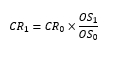
where:
CRo = the Conversion Rate in effect immediately before the Open of Business on the Ex-Dividend Date for such dividend or distribution, or immediately before the Open of Business on the effective date of such stock split or stock combination, as applicable;
CRi = the Conversion Rate in effect immediately after the Open of Business on such Ex-Dividend Date or effective date, as applicable;
OS0 = the number of shares of Common Stock outstanding immediately before the Open of Business on such Ex-Dividend Date or effective date, as applicable, without giving effect to such dividend, distribution, stock split or stock combination; and
OS1 = the number of shares of Common Stock outstanding immediately after giving effect to such dividend, distribution, stock split or stock combination.
If any dividend, distribution, stock split or stock combination of the type described in this Section 5.05(A)(i) is declared or announced, but not so paid or made, then the Conversion Rate will be readjusted, effective as of the date the Board of Directors determines not to pay such dividend or distribution or to effect such stock split or stock combination, to the Conversion Rate that would then be in effect had such dividend, distribution, stock split or stock combination not been declared or announced.
(ii) Rights, Options and Warrants. If (1) the Company distributes, to all or substantially all holders of Common Stock, rights, options or warrants (other than rights issued or otherwise distributed pursuant to a stockholder rights plan, as to which Sections 5.05(A)(iii)(1) and 5.05(F) will apply) entitling such holders, for a period of not more than sixty (60) calendar days after the record date of such distribution, to subscribe for or purchase shares of Common Stock at a price per share that is less than the average of the Last Reported Sale Prices per share of Common Stock for the ten (10) consecutive Trading Days ending on, and including, the Trading Day immediately before the date such distribution is announced; and (2) the Public Company Date has occurred on or before the first Trading Day of the ten (10) consecutive Trading Day period referred to in clause (1), then the Conversion Rate will be increased based on the following formula:
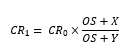
where:
CR0 = the Conversion Rate in effect immediately before the Open of Business on the Ex-Dividend Date for such distribution;
CRi = the Conversion Rate in effect immediately after the Open of Business on such Ex-Dividend Date;
OS = the number of shares of Common Stock outstanding immediately before the Open of Business on such Ex-Dividend Date;
X = the total number of shares of Common Stock issuable pursuant to such rights, options or warrants; and a number of shares of Common Stock obtained by dividing (x) the aggregate price payable to exercise such rights, options or warrants by (y) the average of the Last Reported Sale Prices per share of Common Stock for the ten (10) consecutive Trading Days ending on, and including, the Trading Day immediately before the date such distribution is announced.
To the extent such rights, options or warrants are not so distributed, the Conversion Rate will be readjusted to the Conversion Rate that would then be in effect had the increase to the Conversion Rate for such distribution been made on the basis of only the rights, options or warrants, if any, actually distributed. In addition, to the extent that shares of Common Stock are not delivered after the expiration of such rights, options or warrants (including as a result of such rights, options or warrants not being exercised), the Conversion Rate will be readjusted to the Conversion Rate that would then be in effect had the increase to the Conversion Rate for such distribution been made on the basis of delivery of only the number of shares of Common Stock actually delivered upon exercise of such rights, option or warrants.
For purposes of this Section 5.05(A)(ii), in determining whether any rights, options or warrants entitle holders of Common Stock to subscribe for or purchase shares of Common Stock at a price per share that is less than the average of the Last Reported Sale Prices per share of Common Stock for the ten (10) consecutive Trading Days ending on, and including, the Trading Day immediately before the date the distribution of such rights, options or warrants is announced, and in determining the aggregate price payable to exercise such rights, options or warrants, there will be taken into account any consideration the Company receives for such rights, options or warrants and any amount payable on exercise thereof, with the value of such consideration, if not cash, to be determined by the Company in good faith and in a commercially reasonable manner.
(iii) Spin-Offs and Other Distributed Property.
(1) Distributions Other than Spin-Offs. If (I) the Company distributes shares of its Capital Stock, evidences of its indebtedness or other assets or property of the Company, or rights, options or warrants to acquire Capital Stock of the Company or other securities, to all or substantially all holders of the Common Stock; (II) the Public Company Date has occurred on or before the first Trading Day of the ten (10) consecutive Trading Day period referred to the definition of SP below; and (III) such distribution is not any of the following:
(u) dividends, distributions, rights, options or warrants for which an adjustment to the Conversion Rate is required (or would be required without regard to Section 5.05(C)) pursuant to Section 5.05(A)(i) or 5.05(A)(ii);
(v) dividends or distributions paid exclusively in cash for which an adjustment to the Conversion Rate is required (or would be required without regard to Section 5.05(C)) pursuant to Section 5.05(A)(iv);
(w) rights issued or otherwise distributed pursuant to a stockholder rights plan, except to the extent provided in Section 5.05(F);
(x) Spin-Offs for which an adjustment to the Conversion Rate is required (or would be required without regard to Section 5.05(C)) pursuant to Section 5.05(A)(iii)(2);
(y) a distribution solely pursuant to a tender offer or exchange offer for shares of Common Stock, as to which Section 5.05(A)(v) will apply; and
(z) a distribution solely pursuant to a Common Stock Change Event, as to which Section 5.09 will apply, then the Conversion Rate will be increased based on the following formula:
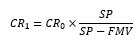
where:
CR0 = the Conversion Rate in effect immediately before the Open of Business on the Ex-Dividend Date for such distribution;
CR1 = the Conversion Rate in effect immediately after the Open of Business on such Ex-Dividend Date;
SP = the average of the Last Reported Sale Prices per share of Common Stock for the ten (10) consecutive Trading Days ending on, and including, the Trading Day immediately before such Ex-Dividend Date; and
FMV = the fair market value (as determined by the Board of Directors in good faith without regard to any accounting treatment), as of such Ex-Dividend Date, of the shares of Capital Stock, evidences of indebtedness, assets, property, rights, options or warrants distributed per share of Common Stock pursuant to such distribution;
provided, however, that if FMV is equal to or greater than SP, then, in lieu of the foregoing adjustment to the Conversion Rate, each Holder will receive, for each Note held by such Holder on the record date for such distribution, at the same time and on the same terms as holders of Common Stock, the amount and kind of shares of Capital Stock, evidences of indebtedness, assets, property, rights, options or warrants that such Holder would have received if such Holder had owned, on such record date, a number of shares of Common Stock equal to the product of (a) the quotient obtained by dividing (i) the principal amount of such Note immediately after the Close of Business on such record date by (ii) one thousand dollars ($1,000); and (b) the Conversion Rate in effect on such record date.
To the extent such distribution is not so paid or made, the Conversion Rate will be readjusted to the Conversion Rate that would then be in effect had the adjustment been made on the basis of only the distribution, if any, actually made or paid.
(2) Spin-Offs. If (I) the Company distributes or dividends shares of Capital Stock of any class or series, or similar equity interests, of or relating to an Affiliate, a Subsidiary or other business unit of the Company to all or substantially all holders of the Common Stock (other than solely pursuant to (x) a Common Stock Change Event, as to which Section 5.09 will apply; or (y) a tender offer or exchange offer for shares of Common Stock, as to which Section 5.05(A)(v) will apply), and such Capital Stock or equity interests are listed or quoted (or will be listed or quoted upon the consummation of the transaction) on a U.S. national securities exchange (a “Spin-Off’); and (II) the Public Company Date has occurred on or before the first Trading Day of the Spin-Off Valuation Period for such Spin-Off, then the Conversion Rate will be increased based on the following formula:
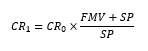
where:
CRo = the Conversion Rate in effect immediately before the Close of Business on the last Trading Day of such Spin-Off Valuation Period for such Spin-Off;
CR1 = the Conversion Rate in effect immediately after the Close of Business on the last Trading Day of the Spin-Off Valuation Period;
FMV = the product of (x) the average of the Last Reported Sale Prices per share or unit of the Capital Stock or equity interests distributed in such Spin-Off over the ten (10) consecutive Trading Day period (the “Spin-Off Valuation Period”) beginning on, and including, the Ex-Dividend Date for such Spin-Off (such average to be determined as if references to Common Stock in the definitions of Last Reported Sale Price, Trading Day and Market Disruption Event were instead references to such Capital Stock or equity interests); and (y) the number of shares or units of such Capital Stock or equity interests distributed per share of Common Stock in such Spin-Off; and
SP = the average of the Last Reported Sale Prices per share of Common Stock for each Trading Day in the Spin-Off Valuation Period.
Notwithstanding anything to the contrary in this Section 5.05(A)(iii)(2), (i) if any VWAP Trading Day of the Observation Period for a Note whose conversion will be settled pursuant to Cash Settlement or Combination Settlement occurs during the Spin-Off Valuation Period for such Spin-Off, then, solely for purposes of determining the Conversion Rate for such VWAP Trading Day for such conversion, such Spin-Off Valuation Period will be deemed to consist of the Trading Days occurring in the period from, and including, the Ex-Dividend Date for such Spin-Off to, and including, such VWAP Trading Day; and (ii) if the Conversion Date for a Note whose conversion will be settled pursuant to Physical Settlement occurs during the Spin-Off Valuation Period for such Spin-Off, then, solely for purposes of determining the Conversion Consideration for such conversion, such Spin-Off Valuation Period will be deemed to consist of the Trading Days occurring in the period from, and including, the Ex-Dividend Date for such Spin-Off to, and including, such Conversion Date.
To the extent any dividend or distribution of the type set forth in this Section 5.05(A)(iii)(2) is declared but not made or paid, the Conversion Rate will be readjusted to the Conversion Rate that would then be in effect had the adjustment been made on the basis of only the dividend or distribution, if any, actually made or paid.
(iv) Cash Dividends or Distributions. If (1) any cash dividend or distribution is made to all or substantially all holders of Common Stock; and (2) the Public Company Date has occurred on or before the Trading Day immediately before the Ex-Dividend Date for such dividend or distribution, then the Conversion Rate will be increased based on the following formula:
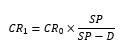
where:
CRo = the Conversion Rate in effect immediately before the Open of Business on such Ex-Dividend Date;
CR1 = the Conversion Rate in effect immediately after the Open of Business on such Ex-Dividend Date;
SP = the Last Reported Sale Price per share of Common Stock on the Trading Day immediately before such Ex-Dividend Date; and
D = the cash amount distributed per share of Common Stock in such dividend or distribution;
provided, however, that if D is equal to or greater than SP, then, in lieu of the foregoing adjustment to the Conversion Rate, each Holder will receive, for each Note held by such Holder on the record date for such dividend or distribution, at the same time and on the same terms as
holders of Common Stock, and without having to convert its Notes, the amount of cash that such Holder would have received if such Holder had owned, on such record date, a number of shares of Common Stock equal to the product of (1) the quotient obtained by dividing (a) the principal amount of such Note immediately after the Close of Business on such record date by (b) one thousand dollars ($1,000); and (2) the Conversion Rate in effect on such record date.
To the extent such dividend or distribution is declared but not made or paid, the Conversion Rate will be readjusted to the Conversion Rate that would then be in effect had the adjustment been made on the basis of only the dividend or distribution, if any, actually made or paid.
(v) Tender Offers or Exchange Offers. If (1) the Company or any of its
Subsidiaries makes a payment in respect of a tender offer or exchange offer for shares of Common Stock (other than solely pursuant to an odd-lot tender offer pursuant to Rule 13e-4(h)(5) under the Exchange Act), and the value (determined as of the Expiration Time by the Company in good faith and in a commercially reasonable manner) of the cash and other consideration paid per share of Common Stock in such tender or exchange offer exceeds the Last Reported Sale Price per share of Common Stock on the Trading Day immediately after the last date (the “Expiration Date”) on which tenders or exchanges may be made pursuant to such tender or exchange offer (as it may be amended); and (2) the first Trading Day of the Tender/Exchange Offer Valuation Period for such tender or exchange offer occurs on or after the Public Company Date, then the Conversion Rate will be increased based on the following formula:
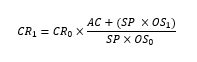
where:
CR0 = the Conversion Rate in effect immediately before the Close of Business on the last Trading Day of the Tender/Exchange Offer Valuation Period for such tender or exchange offer;
CR1 = the Conversion Rate in effect immediately after the Close of Business on the last Trading Day of the Tender/Exchange Offer Valuation Period;
AC = the aggregate value (determined as of the time (the “Expiration Time”) such tender or exchange offer expires by the Company in good faith and in a commercially reasonable manner) of all cash and other consideration paid for shares of Common Stock purchased or exchanged in such tender or exchange offer;
OS0 = the number of shares of Common Stock outstanding immediately before the Expiration Time (including all shares of Common Stock accepted for purchase or exchange in such tender or exchange offer);
OS1 = the number of shares of Common Stock outstanding immediately after the Expiration Time (excluding all shares of Common Stock accepted for purchase or exchange in such tender or exchange offer); and
SP = the average of the Last Reported Sale Prices per share of Common Stock over the ten (10) consecutive Trading Day period (the “Tender/Exchange Offer Valuation Period”) beginning on, and including, the Trading Day immediately after the Expiration Date;
provided, however, that the Conversion Rate will in no event be adjusted down pursuant to this Section 5.05(A)(v), except to the extent provided in the immediately following paragraph. Notwithstanding anything to the contrary in this Section 5.05(A)(v), (i) if any VWAP Trading Day of the Observation Period for a Note whose conversion will be settled pursuant to Cash Settlement or Combination Settlement occurs during the Tender/Exchange Offer Valuation Period for such tender or exchange offer, then, solely for purposes of determining the Conversion Rate for such VWAP Trading Day for such conversion, such Tender/Exchange Offer Valuation Period will be deemed to consist of the Trading Days occurring in the period from, and including, the Trading Day immediately after the Expiration Date for such tender or exchange offer to, and including, such VWAP Trading Day; and (ii) if the Conversion Date for a Note whose conversion will be settled pursuant to Physical Settlement occurs during the Tender/Exchange Offer Valuation Period for such tender or exchange offer, then, solely for purposes of determining the Conversion Consideration for such conversion, such Tender/Exchange Offer Valuation Period will be deemed to consist of the Trading Days occurring in the period from, and including, the Trading Day immediately after the Expiration Date to, and including, such Conversion Date.
To the extent such tender or exchange offer is announced but not consummated (including as a result of the Company being precluded from consummating such tender or exchange offer under applicable law), or any purchases or exchanges of shares of Common Stock in such tender or exchange offer are rescinded, the Conversion Rate will be readjusted to the Conversion Rate that would then be in effect had the adjustment been made on the basis of only the purchases or exchanges of shares of Common Stock, if any, actually made, and not rescinded, in such tender or exchange offer.
(B)No Adjustments in Certain Cases.
(i) Where Holders Participate in the Transaction or Event Without Conversion. Notwithstanding anything to the contrary in Section 5.05(A), the Company will not be obligated to adjust the Conversion Rate on account of a transaction or other event otherwise requiring an adjustment pursuant to Section 5.05(A) (other than a stock split or combination of the type set forth in Section 5.05(A)(i) or a tender or exchange offer of the type set forth in Section 5.05(A)(v)) if each Holder participates, at the same time and on the same terms as holders of Common Stock, and solely by virtue of being a Holder of Notes, in such transaction or event without having to convert such Holder’s Notes and as if such Holder held a number of shares of Common Stock equal to the product of (i) the quotient obtained by dividing (1) the aggregate principal amount of all Notes held by such Holder immediately after the Close of Business on the related record date by (2) one thousand dollars ($1,000); and (ii) the Conversion Rate in effect on such record date.
(ii) Certain Events. The Company will not be required to adjust the Conversion Rate except as provided in Section 5.05 or in the definition of “Conversion Rate.” Without limiting the foregoing, the Company will not be obligated to adjust the Conversion Rate on account of:
(1) except as otherwise provided in Section 5.05, the sale of shares of Common Stock for a purchase price that is less than the market price per share of Common Stock or less than the Conversion Price;
(2) the issuance of any shares of Common Stock pursuant to any present or future plan providing for the reinvestment of dividends or interest payable on the Company’s securities and the investment of additional optional amounts in shares of Common Stock under any such plan;
(3) the issuance of any shares of Common Stock or options or rights to purchase shares of Common Stock pursuant to any present or future employee, director or consultant benefit or incentive plan or program of, or assumed by, the Company or any of its Subsidiaries;
(4) the issuance of any shares of Common Stock pursuant to any option, warrant, right or convertible, exercisable or exchangeable security of the Company outstanding as of the Issue Date;
(5) solely a change in the par value of the Common Stock;
(6) the repurchase of any of shares of Common Stock pursuant to an open market share purchase program or other buyback transaction, including structured or derivative transactions such as accelerated share repurchase transactions or similar forward derivatives, or other buyback transaction, in each case, that is not subject to Section 5.05(A)(v);
(7) accrued and unpaid interest on the Notes (without limiting the generality of Section 5.03(B)); or
(8) a third-party tender offer, other than a tender offer that is subject to Section 5.05(A)(v).
(C)Adjustment Deferral. If an adjustment to the Conversion Rate otherwise required by this Article 5 would result in a change of less than one percent (1%) to the Conversion Rate, then, notwithstanding anything to the contrary in this Article 5, the Company may, at its election, defer and carry forward such adjustment, except that all such deferred adjustments must be given effect immediately upon the earliest of the following: (i) when all such deferred adjustments would, had they not been so deferred and carried forward, result in a change of at least one percent (1%) to the Conversion Rate; (ii) the Conversion Date of, or any VWAP Trading Day of an Observation Period for, any Note; (iii) the date a Fundamental Change occurs; (iv) the date the Company calls any Notes for Redemption; (v) the date the Company sends an Optional Repurchase Offer Notice; and (vi) the Final Settlement Method Election Deadline Date.
(D)Adjustments Not Yet Effective. Notwithstanding anything to the contrary in this Indenture or the Notes, if:
(i) a Note is to be converted pursuant to Physical Settlement or Combination Settlement;
(ii) the record date, effective date or Expiration Time for any event that requires an adjustment to the Conversion Rate pursuant to Section 5.05(A) has occurred on or before the Conversion Date for such conversion (in the case of Physical Settlement) or on or before any VWAP Trading Day in the Observation Period for such conversion (in the case of Combination Settlement), but an adjustment to the Conversion Rate for such event has not yet become effective as of such Conversion Date or VWAP Trading Day, as applicable;
(iii) the Conversion Consideration due upon such conversion includes any whole shares of Common Stock (in the case of Physical Settlement) or due in respect of such VWAP Trading Day includes any whole or fractional shares of Common Stock (in the case of Combination Settlement); and
(iv) such shares are not entitled to participate in such event (because they were not held on the related record date or otherwise), then, solely for purposes of such conversion, the Company will, without duplication, give effect to such adjustment on such Conversion Date (in the case of Physical Settlement) or such VWAP Trading Day (in the case of Combination Settlement) and, for the avoidance of doubt, such shares will not be entitled to participate in such event. In such case, if the date on which the Company is otherwise required to deliver the consideration due upon such conversion is before the first date on which the amount of such adjustment can be determined, then the Company will delay the settlement of such conversion until the second (2nd) Business Day after such first date.
(E)Conversion Rate Adjustments where Converting Holders Participate in the Relevant Transaction or Event. Notwithstanding anything to the contrary in this Indenture or the Notes, if:
(i) a Conversion Rate adjustment for any dividend or distribution becomes effective on any Ex-Dividend Date pursuant to Section 5.05(A);
(ii) a Note is to be converted pursuant to Physical Settlement or Combination Settlement;
(iii) the Conversion Date for such conversion (in the case of Physical Settlement) or any VWAP Trading Day in the Observation Period for such conversion (in the case of Combination Settlement) occurs on or after such Ex-Dividend Date and on or before the related record date;
(iv) the Conversion Consideration due upon such conversion includes any whole shares of Common Stock (in the case of Physical Settlement) or due in respect of such VWAP Trading Day includes any whole or fractional shares of Common Stock (in the case of Combination Settlement), in each case, based on a Conversion Rate that is adjusted for such dividend or distribution; and
(v) such shares would be entitled to participate in such dividend or distribution (including pursuant to Section 5.02(C)), then (x) in the case of Physical Settlement, such Conversion Rate adjustment will not be given effect for such conversion and the shares of Common Stock issuable upon such conversion based on such unadjusted Conversion Rate will not be entitled to participate in such dividend or distribution, but there will be added, to the Conversion Consideration otherwise due upon such conversion, the same kind and amount of consideration that would have been delivered in such dividend or distribution with respect to such shares of Common Stock had such shares been entitled to participate in such dividend or distribution; and (y) in the case of Combination Settlement, the Conversion Rate adjustment relating to such Ex-Dividend Date will be made for such conversion in respect of such VWAP Trading Day, but the shares of Common Stock issuable with respect to such VWAP Trading Day based on such adjusted Conversion Rate will not be entitled to participate in such dividend or distribution.
(F)Stockholder Rights Plans. If any shares of Common Stock are to be issued upon conversion of any Note and, at the time of such conversion, the Company has in effect any stockholder rights plan, then the Holder of such Note will be entitled to receive, in addition to, and concurrently with the delivery of, the Conversion Consideration otherwise payable under this Indenture upon such conversion, the rights set forth in such stockholder rights plan, unless such rights have separated from the Common Stock at such time, in which case, and only in such case, the Conversion Rate will be adjusted pursuant to Section 5.05(A)(iii)(1) on account of such separation as if (or, if the condition set forth in clause (II) of Section 5.05(A)(iii)(1) has not been satisfied, then, in lieu of such adjustment, Holders will be entitled to receive such rights pursuant to Section 5.06(A) as if), at the time of such separation, the Company had made a distribution of the type referred to in such Section to all holders of the Common Stock, subject to potential readjustment in accordance with the last paragraph of Section 5.05(A)(iii)(1).
(G)Limitation on Effecting Transactions Resulting in Certain Adjustments. The Company will not engage in or be a party to any transaction or event that would require the Conversion Rate to be adjusted pursuant to Section 5.05(A) to an amount that would result in the Conversion Price per share of Common Stock being less than the par value per share of Common Stock.
(H)Equitable Adjustments to Prices. Whenever any provision of this Indenture requires the Company to calculate the average of the Last Reported Sale Prices, or any function thereof, over a period of multiple days (including to calculate an adjustment to the Conversion Rate), or to calculate Daily VWAPs, Daily Conversion Values, Daily Cash Amounts or Daily Share Amounts, in each case, over a period of multiple days (including over an Observation Period or the periods referred to in the definition of Qualified Initial Public Offering Reference Price), the Company will make appropriate adjustments, if any, to such calculations to account for any adjustment to the Conversion Rate pursuant to Section 5.05(A) that becomes effective, or any event requiring such an adjustment to the Conversion Rate (or that would require such an adjustment after the Public Company Date without giving effect to (v) Section 5.05(C); (w) clause (2) of Section 5.05(A)(ii); (x) clause (II) of Section 5.05(A)(iii)(1); (y) clause (II) of Section 5.05(A)(iii)(2); or (z) clause (2) of Section 5.05(A)(iv)) where the Ex-Dividend Date, effective date or Expiration Date, as applicable, of such event occurs, at any time during such period or Observation Period, as applicable.
(I)Calculation of Number of Outstanding Shares of Common Stock. For purposes of Section 5.05(A), the number of shares of Common Stock outstanding at any time will (i) include shares issuable in respect of scrip certificates issued in lieu of fractions of shares of Common Stock; and (ii) exclude shares of Common Stock held in the Company’s treasury (unless the Company pays any dividend or makes any distribution on shares of Common Stock held in its treasury).
(J)Calculations. All calculations with respect to the Conversion Rate and adjustments thereto will be made to the nearest 1/10,000th of a share of Common Stock (with 5/1 00,000ths rounded upward).
(K)Notice of Conversion Rate Adjustments. Upon the effectiveness of any adjustment to the Conversion Rate pursuant to Section 5.05(A), the Company will promptly send notice to the Holders, the Trustee and the Conversion Agent containing (i) a brief description of the transaction or other event on account of which such adjustment was made; (ii) the Conversion Rate in effect immediately after such adjustment; and (iii) the effective time of such adjustment.
Section 5.06. Adjustments to the Conversion Rate Pre-IPO.
(A)Special Definitions. For purposes of this Section 5.06, the following definitions apply:
(i) “Options” means rights, options or warrants to subscribe for, purchase or otherwise acquire either Common Stock or Convertible Securities.
(ii) “Convertible Securities” means any evidences of indebtedness, shares or other securities convertible into or exchangeable for Common Stock.
(iii) “Additional Shares of Common Stock” means all shares of Common Stock issued (or, pursuant to Section 5.06(C), deemed to be issued) by the Company on or after the Issue Date, other than shares of Common Stock issued or deemed to be issued:
(1) upon conversion of Notes and any Preferred Stock (as defined in the Charter);
(2) as a dividend or distribution on Senior Preferred Stock (as defined in the Charter);
(3) to employees, directors and officers of, or consultants or advisors to, the Company pursuant to stock grants, stock option, stock bonus, stock purchase or other employee incentive programs, plans or agreements approved by the Board of Directors (provided that the approval of any securities issuable under this clause (3) in excess of the aggregate number of shares of Common Stock remaining available for issuance under the Company’s 2012 Stock Incentive Plan as of the date hereof will require the approval of a majority of the Preferred Directors (as defined in the Charter));
(4) in connection with bona fide acquisitions of other businesses or technologies by the Company by merger, consolidation, acquisition of stock or assets or otherwise that is approved by the Board of Directors (including a majority of the Preferred Directors (as defined in the Charter));
(5) to banks, equipment lessors or other financial institutions in connection with commercial lending or equipment leasing transactions, provided that such transactions are entered into for primarily non-equity financing purposes and are approved by the Board of Directors (including a majority of the Preferred Directors (as defined in the Charter));
(6) in connection with research, collaboration, manufacturing, supply, licensing, development, OEM, distribution, marketing or other similar strategic transactions or joint ventures, provided that such transactions are entered into for primarily non-equity financing purposes and are approved by the Board of Directors (including a majority of the Preferred Directors (as defined in the Charter));
(7) in connection with a Qualified Initial Public Offering;
(8) in connection with an event for which adjustment of the Conversion Rate is made pursuant to Section 5.06(B), (C) or (D) hereof
(9) in a transaction that the Holders of at least 83% of the number of Notes then outstanding elect in writing to exclude from the definition of Additional Shares of Common Stock, which election may be applied prospectively or retroactively and either generally or in a particular instance; or
(10) pursuant to any warrant issued in connection with the sale of the Series G Preferred Stock on the Series G Original Issue Date (in each case, as defined in the Charter).
(B)Deemed Issue of Additional Shares of Common Stock. In the event the Company at any time or from time to time after the Issue Date but prior to the Qualified Initial Public Offering Effective Date shall issue any Options or Convertible Securities or shall fix a record date for the determination of holders of any class of securities then entitled to receive any such Options or Convertible Securities, then the maximum number of shares (as set forth in the instrument relating thereto without regard to any provisions contained therein designed to protect against dilution) of Common Stock issuable upon the exercise of such Options or, in the case of Convertible Securities and Options therefor, the conversion or exchange of such Convertible Securities and exercise of such Options, shall be deemed to be Additional Shares of Common Stock issued as of the time of such issue or, in case such a record date shall have been fixed, as of the close of business on such record date, provided that in any such case in which Additional Shares of Common Stock are deemed to be issued:
(i) no further adjustments in the Conversion Rate shall be made upon the subsequent issue of Convertible Securities upon the exercise of such Options or shares of Common Stock upon the exercise of such Options or conversion or exchange of such Convertible Securities;
(ii) if such Options or Convertible Securities by their terms provide, with the passage of time or otherwise, for any increase or decrease in the consideration payable to the Company, or increase or decrease in the number of shares of Common Stock issuable, upon the exercise, conversion and/or exchange thereof, the Conversion Rate computed upon the original issue thereof (or upon the occurrence of a record date with respect thereto), and any subsequent adjustments based thereon, shall, upon any such increase or decrease becoming effective, be recomputed to reflect such increase or decrease as if such change had been in effect as of the original issue thereof (or upon the occurrence of the record date with respect thereto);
(iii) upon the expiration of any such Options or any rights of conversion or exchange under such Convertible Securities which shall not have been exercised, the Conversion Rate computed upon the original issue thereof (or upon the occurrence of a record date with respect thereto), and any subsequent adjustments based thereon, shall, upon such expiration, be recomputed as if:
(1) in the case of Convertible Securities or Options for Common Stock, the only Additional Shares of Common Stock issued were the shares of Common Stock, if any, actually issued upon the exercise of such Options or the conversion or exchange of such Convertible Securities and the consideration received therefor was the consideration actually received by the Company for the issue of all such Options, whether or not exercised, plus the consideration actually received by the Company upon such exercise, or for the issue of all such Convertible Securities which were actually converted or exchanged, plus the additional consideration, if any, actually received by the Company upon such conversion or exchange, and
(2) in the case of Options for Convertible Securities, only the Convertible Securities, if any, actually issued upon the exercise thereof were issued at the time of issue of such Options, and the consideration received by the Company for the Additional Shares of Common Stock deemed to have been then issued was the consideration actually received by the Company for the issue of all such Options, whether or not exercised, plus the consideration deemed to have been received by the Company (determined pursuant to Section 5.06(E)) upon the issue of the Convertible Securities with respect to which such Options were actually exercised;
(iv) no readjustment pursuant to clause (ii) or (iii) above shall have the effect of decreasing the Conversion Rate to an amount which is less than the higher of (a) the Conversion Rate on the original adjustment date, or (b) the Conversion Rate that would have resulted from any issuance of Additional Shares of Common Stock between the original adjustment date and such readjustment date; and
(v) in the case of any Options which expire by their terms not more than thirty (30) days after the date of issue thereof, no adjustment of Conversion Rate shall be made until the expiration or exercise of all such Options, whereupon such adjustment shall be made in the same manner provided in clause (iii) above.
(C)Adjustment of Conversion Rate Upon Issuance of Additional Shares of Common Stock. In the event the Company, at any time after the Issue Date but prior to the Qualified Initial Public Offering Effective Date, shall issue Additional Shares of Common Stock (including Additional Shares of Common Stock deemed to be issued pursuant to Section 5.06(B)) without consideration or for a consideration per share less than the Conversion Price in effect immediately prior to such issue (as adjusted for stock splits, stock dividends, reclassification and the like), then and in such event, the Conversion Rate shall be increased, concurrently with such issue, to a rate (rounded to the nearest fourth (4th) decimal place, with 5/100,000ths rounded upward) determined by multiplying the Conversion Rate by a fraction, (I) the numerator of which shall be the number of shares of Common Stock Outstanding immediately prior to such issue plus the number of such Additional Shares of Common Stock so issued, and (II) the denominator of which shall be the number of shares of Common Stock Outstanding (as defined below) immediately prior to such issue plus the number of shares of Common Stock which the aggregate consideration received by the Company for the total number of Additional Shares of Common Stock so issued would purchase at the Conversion Price in effect immediately prior to such issue. For the purpose of the above calculation, “Common Stock Outstanding” means the number of shares of Common Stock outstanding immediately prior to such issue, calculated on a fully diluted basis as if all Convertible Securities had been fully converted into shares of Common Stock immediately prior to such issue and any outstanding Options (whether or not then vested or exercisable) had been fully exercised immediately prior to such issue (and the resulting securities fully converted into shares of Common Stock, if so convertible) as of such date, but not including in such calculation any additional shares of Common Stock issuable with respect to Convertible Securities or Options solely as a result of the adjustment of the applicable Conversion Price for any share of Senior Preferred Stock (or other conversion ratios) resulting from the issuance of Additional Shares of Common Stock causing such adjustment.
(D)Multiple Closing Dates. In the event that the Company shall issue, after the Issue Date but prior to the Qualified Initial Public Offering Effective Date, on more than one date, Additional Shares of Common Stock (including Additional Shares of Common Stock deemed to be issued pursuant to Section 5.06(B)) that would result in an adjustment to the Conversion Rate pursuant to the terms of Section 5.06(B), as part of the same transaction or a series of related transactions, then, upon the final such issuance, the Conversion Rate shall be readjusted to give effect to all such issuances as if they had all occurred on the date of the first such issuance (and without giving any effect to any interim adjustments from such issuances that were part of the same transaction or series of related transactions).
(E)Determination of Consideration. For purposes of this Section 5.06, the consideration received by the Company for the issue (or deemed issue) of any Additional Shares of Common Stock shall be computed by the Company as follows:
(i) Cash and Property. Such consideration shall:
(1) insofar as it consists of cash, be computed at the aggregate amount of cash received by the Company excluding amounts paid or payable for accrued interest or accrued dividends and before deducting any reasonable discounts, commissions or other expenses allowed, paid or incurred by the Company for any underwriting or otherwise in connection with such issuance;
(2) insofar as it consists of property other than cash, be computed at the fair value thereof at the time of such issue; and
(3) in the event Additional Shares of Common Stock are issued together with other shares or securities or other assets of the Company for consideration which covers both, be the proportion of such consideration so received, computed as provided in clauses (1) and (2) above.
(ii) Options and Convertible Securities. The consideration per share received by the Company for Additional Shares of Common Stock deemed to have been issued pursuant to Section 5.06(C) hereof, relating to Options and Convertible Securities, shall be determined by dividing:
(1) the total amount, if any, received or receivable by the Company as consideration for the issue of such Options or Convertible Securities, plus the minimum aggregate amount of additional consideration (as set forth in the instruments relating thereto, without regard to any provision contained therein designed to protect against dilution) payable to the Company upon the exercise of such Options or the conversion or exchange of such Convertible Securities, or in the case of Options for Convertible Securities, the exercise of such Options for Convertible Securities and the conversion or exchange of such Convertible Securities, by
(2) the maximum number of shares of Common Stock (as set forth in the instruments relating thereto, without regard to any provision contained therein designed to protect against the dilution) issuable upon the exercise of such Options and/or conversion or exchange of such Convertible Securities.
(F)Adjustments to Conversion Rate for Stock Dividends and for Combinations or Subdivisions of Common Stock. In the event that the Company after the date hereof, shall declare or pay, without consideration, any dividend on the Common Stock payable in Common Stock or in any right to acquire Common Stock for no consideration, or shall effect a subdivision of the outstanding shares of Common Stock into a greater number of shares of Common Stock (by stock split, reclassification or otherwise than by payment of a dividend in Common Stock or in any right to acquire Common Stock as provided below), or in the event the outstanding shares of Common Stock shall be combined or consolidated, by reclassification or otherwise, into a lesser number of shares of Common Stock, then the Conversion Rate in effect immediately prior to such event shall, concurrently with the effectiveness of such event, be proportionately decreased or increased, as appropriate. In the event that the Company shall declare or pay, without consideration, any dividend on the Common Stock payable in any right to acquire Common Stock for no consideration, then the Company shall be deemed to have made a dividend payable in Common Stock in an amount of shares equal to the maximum number of shares issuable upon exercise of such rights to acquire Common Stock.
(G)Other Distributions. In the event the Company shall declare a distribution payable in securities of other persons, evidences of indebtedness issued by the Company or other persons, assets (excluding cash dividends) or options or rights not referred to in Section 5.09, then, in each
such case for the purpose of this Section 5.06(G), the Holders of the Notes shall be entitled to a proportionate share of any such distribution as though they were the holders of the number of shares of Common Stock of the Company into which their Notes are then convertible, if any, as of the record date fixed for the determination of the holders of Common Stock of the Company entitled to receive such distribution.
(H)Certificates as to Adjustments. Upon the occurrence of each adjustment or readjustment of the Conversion Rate pursuant to this Section 5.06, the Company at its expense shall promptly compute such adjustment or readjustment in accordance with the terms hereof and prepare and furnish to each Holder, the Trustee and the Conversion Agent, a certificate executed by an Officer setting forth such adjustment or readjustment and showing in detail the facts upon which such adjustment or readjustment is based. The Company shall, upon the written request at any time of any Holder, furnish or cause to be furnished to such Holder, the Trustee and the Conversion Agent a like certificate setting forth (i) such adjustments and readjustments, (ii) the applicable Conversion Rate at the time in effect, and (iii) the number of shares of Common Stock and the amount, if any, of other property which at the time would be received upon the conversion of the Notes.
(I)Pre-IPO. On and following the Qualified Initial Public Offering Effective Date, other than Section 5.06(J) below, the provisions in this Section 5.06 shall no longer be effective.
(J)Certain Tender Offers. The Company will not, and will not permit its Subsidiaries to, engage in any tender or exchange offer of the types described in Section 5.05(A)(v) for consideration per share of Common Stock in excess of the fair market value thereof if the Public Company Date has not occurred on or before the first Trading Day of the Tender/Exchange Offer Valuation Period for such tender or exchange offer.
Section 5.07. Voluntary Adjustments.
(A)Generally. To the extent permitted by law and applicable stock exchange rules, the Company, from time to time, may (but is not required to) increase the Conversion Rate by any amount if (i) the Board of Directors determines that such increase is either (x) in the best interest of the Company; or (y) advisable to avoid or diminish any income tax imposed on holders of Common Stock or rights to purchase Common Stock as a result of any dividend or distribution of shares (or rights to acquire shares) of Common Stock or any similar event; (ii) such increase is in effect for a period of at least twenty (20) Business Days; and (iii) such increase is irrevocable during such period.
(B)Notice of Voluntary Increases. If the Board of Directors determines to increase the Conversion Rate pursuant to Section 5.07(A), then, no later than the first Business Day of the related twenty (20) Business Day period referred to in Section 5.07(A), the Company will send notice to each Holder, the Trustee and the Conversion Agent of such increase, the amount thereof and the period during which such increase will be in effect.
Section 5.08. Exchange in Lieu of Conversion.
Notwithstanding anything to the contrary in this Article 5, and subject to the terms of this Section 5.08, if a Note is submitted for conversion, the Company may elect to arrange to have
such Note exchanged in lieu of conversion by a financial institution designated by the Company. To make such election, the Company must send notice of such election to the Holder of such Note, the Trustee and the Conversion Agent before the Close of Business on the Business Day immediately following the Conversion Date for such Note. If the Company has made such election, then:
(A)no later than the Business Day immediately following such Conversion Date, the Company must deliver (or cause the Conversion Agent to deliver) such Note, together with delivery instructions for the Conversion Consideration due upon such conversion (including wire instructions, if applicable), to a financial institution designated by the Company that has agreed to deliver such Conversion Consideration in the manner and at the time the Company would have had to deliver the same pursuant to this Article 5;
(B)if such Note is a Global Note, then (i) such designated institution will send written confirmation to the Conversion Agent promptly after wiring the cash Conversion Consideration, if any, and delivering any other Conversion Consideration, due upon such conversion to the Holder of such Note; and (ii) the Conversion Agent will as soon as reasonably practicable thereafter contact such Holder’s custodian with the Depositary to confirm receipt of the same; and
(C)such Note will not cease to be outstanding by reason of such exchange in lieu of conversion; provided, however, that if such financial institution does not accept such Note or fails to timely deliver such Conversion Consideration, then the Company will be responsible for delivering such Conversion Consideration in the manner and at the time provided in this Article 5 as if the Company had not elected to make an exchange in lieu of conversion.
Section 5.09. Effect of Common Stock Change Event.
(A)Generally. If there occurs any:
(i) recapitalization, reclassification or change of the Common Stock (other than (x) changes solely resulting from a subdivision or combination of the Common Stock, (y) a change only in par value or from par value to no par value or no par value to par value and (z) stock splits and stock combinations that do not involve the issuance of any other series or class of securities);
(ii) consolidation, merger, combination or binding or statutory share exchange involving the Company (including, for the avoidance of doubt, a Qualified Initial Public Offering that is a Qualified Business Combination);
(iii) sale, lease or other transfer of all or substantially all of the assets of the Company and its Subsidiaries, taken as a whole, to any Person; or
(iv) other similar event, and, as a result of which, the Common Stock is converted into, or is exchanged for, or represents solely the right to receive, other securities, cash or other property, or any combination of the foregoing (such an event, a “Common Stock Change Event,” and such other securities, cash or property, the “Reference Property,” and the amount and kind of Reference Property that a holder of one (1) share of Common Stock would be entitled to receive on account of such Common Stock Change
Event (without giving effect to any arrangement not to issue or deliver a fractional portion of any security or other property), a “Reference Property Unit”), then, notwithstanding anything to the contrary in this Indenture or the Notes,
(1) from and after the effective time of such Common Stock Change Event, (I) the Conversion Consideration due upon conversion of any Note, and the conditions to any such conversion, will be determined in the same manner as if each reference to any number of shares of Common Stock in this Article 5 (or in any related definitions) were instead a reference to the same number of Reference Property Units; (II) for purposes of Section 4.04, each reference to any number of shares of Common Stock in such Section (or in any related definitions) will instead be deemed to be a reference to the same number of Reference Property Units; and (III) for purposes of the definition of “Fundamental Change,” references to “Common Stock” and the Company’s “common equity” will be deemed to refer to the common equity (including depositary receipts representing common equity), if any, forming part of such Reference Property;
(2) if such Reference Property Unit consists entirely of cash, then (I) each conversion of any Note with a Conversion Date that occurs on or after the effective date of such Common Stock Change Event will be settled entirely in cash in an amount, per Note being converted, equal to the product of (a) the quotient obtained by dividing (x) the aggregate principal amount such Note immediately after the Close of Business on such Conversion Date by (y) one thousand dollars ($1,000); and (b) the Conversion Rate in effect on such Conversion Date; and (c) the amount of cash constituting such Reference Property Unit; and (II) the Company will settle each such conversion no later than the fifth (5th) Business Day after the relevant Conversion Date;
(3) for these purposes, (I) the Daily VWAP of any Reference Property Unit or portion thereof that consists of a class of common equity securities will be determined by reference to the definition of “Daily VWAP,” substituting, if applicable, the Bloomberg page for such class of securities in such definition; and (II) the Daily VWAP of any Reference Property Unit or portion thereof that does not consist of a class of common equity securities, and the Last Reported Sale Price of any Reference Property Unit or portion thereof that does not consist of a class of securities, will be the fair value of such Reference Property Unit or portion thereof, as applicable, determined in good faith and in a commercially reasonable manner by the Company (or, in the case of cash denominated in U.S. dollars, the face amount thereof); and
(4) if the Reference Property consists of more than a single type of consideration to be determined based in part upon any form of stockholder election, then (x) the composition of the Reference Property Unit will be deemed to be the weighted average of the types and amounts of consideration actually received, per share of Common Stock, by the holders of Common Stock; and (y) the Company will notify Holders, the Trustee and the Conversion Agent of such weighted average as soon as practicable after such determination is made; provided, however, that if
such Common Stock Change Event is a Qualified Initial Public Offering that is a Qualified Business Combination, then, notwithstanding anything to the contrary in this Indenture or the Notes, the following provisions will apply from and after the effective time of such Common Stock Change Event in lieu of the preceding clauses (1), (2), (3) and (4): (x) the term “Common Stock” will mean the Qualified Business Combination Common Stock of such Qualified Business Combination; (y) references in this Indenture to any number of shares of Common Stock will be deemed to refer to the same number of shares or other units of such Qualified Business Combination Common Stock; and (z) for purposes of the definition of “Fundamental Change,” references to the Company’s “common equity” will be deemed to refer to such Qualified Business Combination Common Stock.
At or before the effective time of such Common Stock Change Event, the Company and the resulting, surviving or transferee Person (if not the Company) of such Common Stock Change Event (the “Successor Person”) will execute and deliver to the Trustee a supplemental indenture pursuant to Section 8.01(F), which supplemental indenture will (x) provide for subsequent conversions of Notes in the manner set forth in this Section 5.09; (y) provide for subsequent adjustments to the Conversion Rate pursuant to Section 5.05(A) in a manner consistent with this Section 5.09; and (z) contain such other provisions, if any, that the Company reasonably determines are appropriate to preserve the economic interests of the Holders and to give effect to the provisions of this Section 5.09(A). If the Reference Property includes shares of stock or other securities (other than cash or cash equivalents) of a Person other than the Successor Person, then (x) such other Person (the “Underlying Issuer”) will also execute such supplemental indenture; and (y) such supplemental indenture will contain such additional provisions, if any, that the Company reasonably determines are appropriate to preserve the economic interests of the Holders (including, where appropriate, adding references to the Underlying Issuer in the definition of “Liquidity Conditions,” Section 2.10(D), Section 3.04 and related definitions).
(B)Notice of Common Stock Change Events. The Company will provide notice of each Common Stock Change Event to Holders, the Trustee and the Conversion Agent no later than the second (2nd) Business Day after the effective date of such Common Stock Change Event.
(C)Compliance Covenant. The Company will not become a party to any Common Stock Change Event unless its terms are consistent with this Section 5.09.
Section 5.10. Notice of the Qualified Initial Public Offering and Related Information.
No later than the later of (i) the fourth (4th) Business Day after the Qualified Initial Public Offering Effective Date (or, in the case of a Qualified Direct Listing, the fourth (4th) Business Day after the last VWAP Trading Day in the period referred to in clause (B) of the definition of “Qualified Initial Public Offering Reference Price”) and (ii) the date on which the Company calculates the Initial Public Conversion Rate and the corresponding Conversion Price, the Company will (A) send notice to each Holder (with a copy to the Trustee and the Conversion Agent) of the occurrence of the Qualified Initial Public Offering, setting forth the Initial Public Conversion Rate and the corresponding Conversion Price; and (B) file with the SEC a report on Form 8-K (or any successor form) that discloses the same information.
For the avoidance of doubt, the establishment of the Initial Public Conversion Rate pursuant to this Article 5 will be effective without the need to amend this Indenture or the Notes, including pursuant to Section 8.01(H). However, the Company may nonetheless choose to execute such an amendment at the Company’s option.
Section 5.11. Beneficial Ownership Limitation.
Notwithstanding anything to the contrary in this Indenture or the Notes, but subject to the last paragraph of this Section 5.11, no shares of Common Stock will be issued or delivered upon conversion of any Note, and no Note will be convertible by the Holder thereof, in each case, to the extent, and only to the extent, that such issuance, delivery, conversion or convertibility would result in such Holder, or a “person” or “group” (within the meaning of Section 13(d)(3) of the Exchange Act) that includes such Holder, beneficially owning in excess of nine and nine-tenths percent (9.9%) of the then-outstanding shares of Common Stock (the restrictions set forth in this sentence, the “Ownership Limitation”). For these purposes, beneficial ownership and calculations of percentage ownership will be determined in accordance with Rule 13d-3 under the Exchange Act. For the avoidance of doubt, the limitations on the convertibility of any Note pursuant to this Section 5.11 will not, in themselves, cause such Note to cease to be outstanding (and interest will continue to accrue on any portion of a Note that has been tendered for conversion and whose convertibility is suspended pursuant to this Section 5.11), and such limitations will cease to apply if and when such Note’s convertibility and conversion will not violate this Section 5.11. For the avoidance of doubt, nothing in this Section 5.11 will affect the Company’s ability to elect any Settlement Method in accordance with this Indenture.
If any Conversion Consideration otherwise due upon the conversion of any Note is not delivered as a result of the Ownership Limitation, then the Company’s obligation to deliver such Conversion Consideration will not be extinguished, and the Company will deliver such Conversion Consideration as soon as reasonably practicable after the Holder of such Note provides written confirmation to the Company that such delivery will not contravene the Ownership Limitation. Any purported delivery of shares of Common Stock upon conversion of any Note will be void and have no effect to the extent, and only to the extent, that such delivery would contravene the Ownership Limitation.
The satisfaction, by a Holder of any Note, of the requirements set forth in Section 5.02(A) to convert such Note will be deemed to be a representation, by such Holder to the Company, that the settlement of such conversion in full (assuming Physical Settlement), and without regard to this Section 5.11, will not contravene the Ownership Limitation.
A beneficial owner of any Note may, by written notice to the Company, elect that the Ownership Limitation cease to apply to such beneficial owner; provided, however, that such notice will not be effective (and the Ownership Limitation will not cease to apply to such beneficial owner) until the sixty first (61st) calendar day after the date on which such notice is delivered to the Company.
Upon the occurrence of a Common Stock Change Event, (i) the Ownership Limitation and this Section 5.11 will thereafter apply as if each reference to “Common Stock” in this Section 5.11 were instead a reference to the common equity (including depositary receipts representing common equity), if any, forming part of the Reference Property of such Common Stock Change Event; and (ii) if such Reference Property includes no such common equity or depositary receipts, then the Ownership Limitation and this Section 5.11 will thereafter cease to apply.
Neither the Trustee nor the Conversion Agent shall have any duty to monitor the Ownership Limitation or to monitor the Company’s or any Holder’s compliance with this Section 5.11.
Article 6. Successors
Section 6.01. When the Company May Merge, Etc.
(A)Generally. The Company will not consolidate with or merge with or into, or (directly, or indirectly through one or more of its Subsidiaries) sell, lease or otherwise transfer, in one transaction or a series of transactions, all or substantially all of the assets of the Company and its Subsidiaries, taken as a whole, to another Person (a “Business Combination Event”), unless:
(i) the resulting, surviving or transferee Person either (x) is the Company or (y) if not the Company, is a Qualified Successor Entity (such Qualified Successor Entity, the “Successor Entity”) duly organized and existing under the laws of the United States of America, any State thereof or the District of Columbia that expressly assumes (by executing and delivering to the Trustee, at or before the effective time of such Business Combination Event, a supplemental indenture pursuant to Section 8.01(E)) all of the Company’s obligations under this Indenture and the Notes (including, for the avoidance of doubt, the obligation to pay Additional Amounts pursuant to Section 3.06); and
(ii) immediately after giving effect to such Business Combination Event, no Default or Event of Default will have occurred and be continuing.
(B)Delivery of Officer’s Certificate and Opinion of Counsel to the Trustee. At or before the effective time of any Business Combination Event of which the Company is not the resulting, surviving or transferee Person, the Company will deliver to the Trustee an Officer’s Certificate and Opinion of Counsel, each stating that (i) such Business Combination Event (and, if applicable, the related supplemental indenture) comply with Section 6.01(A); and (ii) all conditions precedent to such Business Combination Event provided in this Indenture have been satisfied.
Section 6.02. Successor Entity Substituted.
At the effective time of any Business Combination Event that complies with Section 6.01, the Successor Entity (if not the Company) will succeed to, and may exercise every right and power of, the Company under this Indenture and the Notes with the same effect as if such Successor Entity had been named as the Company in this Indenture and the Notes, and, except in the case of a lease, the predecessor Company will be discharged from its obligations under this Indenture and the Notes.
Section 6.03. Exclusion for Asset Transfers with Wholly Owned Subsidiaries.
Notwithstanding anything to the contrary in this Article 6, this Article 6 will not apply to any transfer of assets between or among the Company and (A) prior to the Qualified Initial Public Offering Effective Date, the Company or any one or more Guarantors not effected by merger or consolidation; and (B) after the Qualified Initial Public Offering Effective Date, the Company or any one or more of the Company’s or a Guarantor’s Wholly Owned Subsidiaries not effected by merger or consolidation.
Article 7. Defaults and Remedies
Section 7.01. Events of Default.
(A)Definition of Events of Default. “Event of Default” means the occurrence of any of the following:
(i) a default in the payment when due (whether at maturity, upon Redemption, Repurchase Upon Fundamental Change or Optional Repurchase or otherwise) of the principal of, or the Redemption Price, Fundamental Change Repurchase Price or Optional Repurchase Price for, any Note;
(ii) a default for thirty (30) consecutive days in the payment when due of interest on any Note;
(iii) the Company’s failure to deliver, when required by this Indenture, a Fundamental Change Notice, an Optional Repurchase Offer Notice, or a notice pursuant to Section 5.01(C)(i)(3), if such failure is not cured within five (5) Business Days after its occurrence;
(iv) a default in the Company’s obligation to convert a Note in accordance with Article 5 upon the exercise of the conversion right with respect thereto, if such default is not cured (x) with respect to any Conversion Date that is before the Qualified Initial Public Offering Effective Date, within five (5) Business Days after its occurrence; or (y) with respect to any Conversion Date that is on or after the Qualified Initial Public Offering Effective Date, within two (2) Business Days after its occurrence;
(v) a default in the Company’s obligations under Article 6 or in any Guarantor’s obligations under Section 9.04;
(vi) a default in any of the Company’s obligations or agreements, or in any Guarantor’s obligations or agreements, under this Indenture or the Notes or breach of Section 6 (other than Section 6(e), (f), (g), (h) or (i) thereof) of the Purchase Agreement (other than a default set forth in clause (i), (ii), (iii), (iv), (v), (xii) or (xiii) of this Section 7.01(A)) where such default is not cured or waived within sixty (60) days after written notice to the Company by the Trustee, or to the Company and the Trustee by Holders of at least fifty percent (50%) of the number of Notes then outstanding, which notice must specify such default, demand that it be remedied and state that such notice is a “Notice of Default”;
(vii) a default by the Company, any Guarantor or any of their respective Significant Subsidiaries with respect to any one or more mortgages, agreements or other instruments under which there is outstanding, or by which there is secured or evidenced, any indebtedness for money borrowed of at least ten million dollars ($10,000,000) (or its foreign currency equivalent) in aggregate principal amount of the Company, any Guarantor or any of their respective Significant Subsidiaries, whether such indebtedness exists as of the Issue Date or is thereafter created, where such default:
(1) constitutes a failure to pay the principal of such indebtedness when due and payable at its final stated maturity, upon required repurchase, upon declaration of acceleration or otherwise, in each case, after the expiration of any applicable grace period; or
(2) results in such indebtedness becoming or being declared due and payable before its stated maturity (an “Acceleration”), in either case, where such Acceleration has not been rescinded or annulled, or such failure to pay or default is not cured or waived, or such indebtedness is not paid or discharged in full, within forty-five (45) days after written notice to the Company by the Trustee or to the Company and the Trustee by Holders of at least fifty percent (50%) of the number of Notes then outstanding;
(viii) failure by the Company, any Guarantor or any of the Company’s or any Guarantor’s respective Significant Subsidiaries to pay one or more final judgments of at least ten million dollars ($10,000,000) (or its foreign currency equivalent) in the aggregate (excluding any amounts covered by insurance), where such judgment is not paid, discharged or stayed within sixty (60) days after such judgment becomes final;
(ix) except as expressly permitted by this Indenture, any Guarantee ceases to be in full force and effect or any Guarantor denies or disaffirms in writing its obligations under its Guarantee, and any such default continues for ten (10) days;
(x) the Company, any Guarantor or any of their respective Significant Subsidiaries, pursuant to or within the meaning of any Bankruptcy Law, either:
(1) commences a voluntary case or proceeding;
(2) consents to the entry of an order for relief against it in an involuntary case or proceeding;
(3) consents to the appointment of a custodian of it or for any substantial part of its property;
(4) makes a general assignment for the benefit of its creditors;
(5) takes any comparable action under any foreign Bankruptcy Law; or
(6) generally is not paying its debts as they become due; or
(xi) a court of competent jurisdiction enters an order or decree under any Bankruptcy Law that either:
(1) is for relief against the Company, any Guarantor or any of their respective Significant Subsidiaries in an involuntary case or proceeding;
(2) appoints a custodian of the Company, any Guarantor or any of their respective Significant Subsidiaries, or for any substantial part of the property of the Company, any Guarantor or any of their respective Significant Subsidiaries;
(3) orders the winding up or liquidation of the Company, any Guarantor or any of their respective Significant Subsidiaries; or
(4) grants any similar relief under any foreign Bankruptcy Law, and, in each case, under this Section 7.01(A)(xi), such order or decree remains unstayed and in effect for at least sixty (60) days;
(xii) any breach of Section 6(e), (f), (h) or (i) of the Purchase Agreement or of Section 3.05(B)(y) hereof, where such breach is not cured or waived within two (2) days after written notice to the Company by the Trustee, or to the Company and the Trustee by Holders of at least twenty-five percent (25%) of the number of Notes then outstanding, which notice must specify such default, demand that it be remedied and state that such notice is a “Notice of Default”; and
(xiii) any breach of Section 6(g) of the Purchase Agreement where such breach is not cured or waived within forty-five (45) days after written notice to the Company by the Trustee, or to the Company and the Trustee by Holders of at least fifty percent (50%) of the number of Notes then outstanding, which notice must specify such default, demand that it be remedied and state that such notice is a “Notice of Default”.
(B)Cause Irrelevant. Each of the events set forth in Section 7.01(A) will constitute an Event of Default regardless of the cause thereof or whether voluntary or involuntary or effected by operation of law or pursuant to any judgment, decree or order of any court or any order, rule or regulation of any administrative or governmental body.
Section 7.02. Acceleration.
(A)Automatic Acceleration in Certain Circumstances. If an Event of Default set forth in Section 7.01(A)(x) or (A)(xi) occurs with respect to the Company or any Guarantor (and not solely with respect to any Significant Subsidiary of the Company or any Guarantor), then the principal amount of, and all accrued and unpaid interest on, any Acceleration Premium for, and other amounts due with respect to, all of the Notes then outstanding will immediately become due and payable without any further action or notice by any Person.
(B)Optional Acceleration. Subject to Section 7.03, if an Event of Default (other than an Event of Default set forth in Section 7.01(A)(x) or (A)(xi) with respect to the Company or any Guarantor (and not solely with respect to any Significant Subsidiary of the Company or any Guarantor) occurs and is continuing, then the Trustee, by notice to the Company, or Holders of at
least twenty-five percent (25%) of the number of Notes then outstanding, by notice to the Company and the Trustee, may declare the principal amount of, and all accrued and unpaid interest on, the Acceleration Premium for, and other amounts due with respect to, all of the Notes then outstanding to become due and payable immediately.
(C)Rescission of Acceleration. Notwithstanding anything to the contrary in this Indenture or the Notes, the Holders of a majority of the number of Notes then outstanding, by notice to the Company and the Trustee, may, on behalf of all Holders, rescind any acceleration of the Notes and its consequences if (i) such rescission would not conflict with any judgment or decree of a court of competent jurisdiction; and (ii) all existing Events of Default (except the non-payment of principal of, or interest on, and the Acceleration Premium for, the Notes that has become due solely because of such acceleration) have been cured or waived. No such rescission will affect any subsequent Default or impair any right consequent thereto.
(D)No Penalty. The Company acknowledges and agrees that the Target Return Repurchase Amount and the Acceleration Premium is not intended to act as a penalty or to punish the Company for any such redemption, prepayment, repayment, or other event or occurrence as a result of which such amount becomes due and payable, including in connection with the acceleration of the Notes. Notwithstanding anything to the contrary in this Indenture or the Notes, it is understood and agreed that if the obligations under the Notes are accelerated as a result of the occurrence and continuance of any Event of Default (including as a result of the commencement of any proceeding under Bankruptcy Laws or by operation of law or otherwise), the Acceleration Premium will also be due and payable and shall constitute part of the obligations due under the Indenture and the Notes for all purposes herein.
Any Acceleration Premium shall be presumed to be equal to the liquidated damages sustained by the Holders as the result of the occurrence of an Event of Default and acceleration of the Notes, and the Company agrees that it is reasonable under the circumstances currently existing. The Acceleration Premium shall also be payable in the event the obligations under the Indenture and the Notes are satisfied or released by foreclosure (whether by power of judicial proceeding), deed in lieu of foreclosure or by any other means. THE COMPANY EXPRESSLY WAIVES, TO THE FULLEST EXTENT PERMITTED BY APPLICABLE LAW, THE PROVISIONS OF ANY PRESENT OR FUTURE STATUTE OR LAW THAT PROHIBITS OR MAY PROHIBIT THE ACCRUAL OR COLLECTION OF THE FOREGOING ACCELERATION PREMIUM IN CONNECTION WITH ANY SUCH ACCELERATION. The Company expressly agrees that (i) the Acceleration Premium is reasonable and is the product of an arm’s length transaction between sophisticated business people, ably represented by counsel; (ii) the Acceleration Premium shall be payable notwithstanding the then prevailing market rates at the time payment is made; (iii) there has been a course of conduct between the Holders and the Company giving specific consideration in this transaction for such agreement to pay the Acceleration Premium; (iv) the Company shall be estopped hereafter from claiming differently than as agreed to in this Section 7.02; (v) the agreement to pay the Acceleration Premium is a material inducement to the Holders to purchase the Notes; and (vi) the Acceleration Premium represents a good faith, reasonable estimate and calculation of the lost profits or damages of the Holders and that it would be impractical and extremely difficult to ascertain the actual amount of damages to the Holders or profits lost by the Holders as a result of any Event of Default or acceleration of the Notes.
Section 7.03. Sole Remedy for a Failure to Report.
(A)Generally. Notwithstanding anything to the contrary in this Indenture or the Notes, the Company may elect that the sole remedy for any Event of Default (a “Reporting Event of Default”) pursuant to Section 7.01(A)(vi) arising from the Company’s failure to comply with Section 3.02 will, for each of the first three hundred and sixty-five (365) calendar days on which a Reporting Event of Default has occurred and is continuing, consist exclusively of the accrual of Special Interest on the Notes. If the Company has made such an election, then (i) the Notes will be subject to acceleration pursuant to Section 7.02 on account of the relevant Reporting Event of Default from, and including, the three hundred and sixty-sixth (366th) calendar day on which a Reporting Event of Default has occurred and is continuing or if the Company fails to pay any accrued and unpaid Special Interest when due; and (ii) Special Interest will cease to accrue on any Notes from, and including, such three hundred and sixty-sixth (366th) calendar day (it being understood that interest on any defaulted Special Interest will nonetheless accrue pursuant to Section 2.05(D)).
(B)Amount and Payment of Special Interest. Any Special Interest that accrues on a Note pursuant to Section 7.03(A) will be payable on the same dates and in the same manner as the Stated Interest on such Note and will accrue at a rate per annum equal to (i) one-quarter of one percent (0.25%) of the principal amount thereof for the first ninety (90) days on which Special Interest accrues, (ii) one-half of one percent (0.50%) of the principal amount thereof for the ninety (90) days immediately following the ninety (90) day period referred to in the immediately preceding clause (i) on which Special Interest accrues, (iii) three-quarters of one percent (0.75%) of the principal amount thereof for the ninety (90) days immediately following the ninety (90) day period referred to in the immediately preceding clause (ii) on which Special Interest accrues and (iv) thereafter, at a rate per annum equal to one percent (1.00%) of the principal amount thereof; provided, however, that (1) in no event will Special Interest, together with any Additional Interest, accrue on any day on a Note at a combined rate per annum that exceeds one-half of one percent (1.00%). For the avoidance of doubt, any Special Interest that accrues on a Note will be in addition to the Stated Interest that accrues on such Note and, subject to the proviso of the immediately preceding sentence, in addition to any Additional Interest that accrues on such Note; and (2) Special Interest will be payable solely in cash.
(C)Notice of Election. To make the election set forth in Section 7.03(A), the Company must send to the Holders, the Trustee and the Paying Agent, before the date on which each Reporting Event of Default first occurs, a notice that (i) briefly describes the report(s) that the Company failed to file with the SEC; (ii) states that the Company is electing that the sole remedy for such Reporting Event of Default consist of the accrual of Special Interest; and (iii) briefly describes the periods during which and rate at which Special Interest will accrue and the circumstances under which the Notes will be subject to acceleration on account of such Reporting Event of Default.
(D)Notice to Trustee and Paying Agent; Trustee’s Disclaimer. If Special Interest accrues on any Note, then, no later than five (5) Business Days before each date on which such Special Interest is to be paid, the Company will deliver an Officer’s Certificate to the Trustee and the Paying Agent stating (i) that the Company is obligated to pay Special Interest on such Note on such date of payment; and (ii) the amount of such Special Interest that is payable on such date of
payment. The Trustee will have no duty to determine whether any Special Interest is payable or the amount thereof
(E)No Effect on Other Events of Default. No election pursuant to this Section 7.03 with respect to a Reporting Event of Default will affect the rights of any Holder with respect to any other Event of Default, including with respect to any other Reporting Event of Default.
Section 7.04. Other Remedies.
(A)Trustee May Pursue All Remedies. If an Event of Default occurs and is continuing, then the Trustee may pursue any available remedy to collect the payment of any amounts due with respect to the Notes or to enforce the performance of any provision of this Indenture or the Notes.
(B)Procedural Matters. The Trustee may maintain a proceeding even if it does not possess any of the Notes or does not produce any of them in such proceeding. A delay or omission by the Trustee or any Holder in exercising any right or remedy following an Event of Default will not impair the right or remedy or constitute a waiver of, or acquiescence in, such Event of Default. All remedies will be cumulative to the extent permitted by law.
Section 7.05. Waiver of Past Defaults.
An Event of Default pursuant to clause (i), (ii), (iv) or (vi) of Section 7.01(A) (that, in the case of clause (vi) only, results from a Default under any covenant that cannot be amended without the consent of each affected Holder), and a Default that could lead to such an Event of Default, can be waived only with the consent of each affected Holder and an Event of Default pursuant to clause (xii) of Section 7.01(A) resulting from a breach of Section 6(e) of the Purchase Agreement may only be waived, on behalf of all holders, by the Holders of at least 55% of the number of Notes then outstanding. Each other Default or Event of Default may be waived, on behalf of all Holders, by the Holders of a majority of the number of Notes then outstanding. If an Event of Default is so waived, then it will cease to exist. If a Default is so waived, then it will be deemed to be cured and any Event of Default arising therefrom will be deemed not to occur. However, no such waiver will extend to any subsequent or other Default or Event of Default or impair any right arising therefrom.
Section 7.06. Control by Majority.
Holders of a majority of the number of Notes then outstanding may direct the time, method and place of conducting any proceeding for exercising any remedy available to the Trustee or exercising any trust or power conferred on it. However, the Trustee may refuse to follow any direction that conflicts with law, this Indenture or the Notes, or that, subject to Section 11.01, the Trustee determines may be unduly prejudicial to the rights of other Holders or may involve the Trustee in liability, unless the Trustee is offered, and, if requested, provided security and indemnity satisfactory to the Trustee against any loss, liability or expense to the Trustee that may result from the Trustee’s following such direction.
Section 7.07. Limitation on Suits.
No Holder may pursue any remedy with respect to this Indenture or the Notes (except to enforce (x) its rights to receive the principal of, or the Fundamental Change Repurchase Price, Optional Repurchase Price or Redemption Price for, interest on, or any Acceleration Premium for, any Notes; or (y) the Company’s obligations to convert any Notes pursuant to Article 5), unless:
(A)such Holder has previously delivered to the Trustee notice that an Event of Default is continuing;
(B)Holders of at least fifty percent (50%) of the number of Notes then outstanding deliver a request to the Trustee to pursue such remedy;
(C)such Holder or Holders offer and, if requested, provide to the Trustee security and indemnity satisfactory to the Trustee against any loss, liability or expense to the Trustee that may result from the Trustee’s following such request;
(D)the Trustee does not comply with such request within sixty (60) calendar days after its receipt of such request and such offer of security or indemnity; and
(E)during such sixty (60) calendar day period, Holders of a majority of the number of Notes then outstanding do not deliver to the Trustee a direction that is inconsistent with such request.
A Holder of a Note may not use this Indenture to prejudice the rights of another Holder or to obtain a preference or priority over another Holder. The Trustee will have no duty to determine whether any Holder’s use of this Indenture complies with the preceding sentence.
Section 7.08. Absolute Right of Holders to Institute Suit for the Enforcement of the Right to Receive Payment and Conversion Consideration.
Notwithstanding anything to the contrary in this Indenture or the Notes (but without limiting Section 8.01), the right of each Holder of a Note to bring suit for the enforcement of any payment or delivery, as applicable, of the principal of, or the Fundamental Change Repurchase Price, Optional Repurchase Price or Redemption Price for, or any interest on, or any Acceleration Premium for, or the Conversion Consideration due pursuant to Article 5 upon conversion of, such Note on or after the respective due dates therefor provided in this Indenture and the Notes, will not be impaired or affected without the consent of such Holder.
Section 7.09. Collection Suit by Trustee.
The Trustee will have the right, upon the occurrence and continuance of an Event of Default pursuant to clause (i), (ii) or (iv) of Section 7.01(A), to recover judgment in its own name and as trustee of an express trust against the Company for the total unpaid or undelivered principal of, or Fundamental Change Repurchase Price, Optional Repurchase Price or Redemption Price for, or any interest on, or any Acceleration Premium for, or the Conversion Consideration due pursuant to Article 5 upon conversion of, the Notes, as applicable, and, to the extent lawful, any Default Interest on any Defaulted Amounts, and such further amounts sufficient to cover the costs and expenses of collection, including compensation provided for in Section 11.06.
Section 7.10. Trustee May File Proofs of Claim.
The Trustee has the right to (A) file such proofs of claim and other papers or documents as may be necessary or advisable in order to have the claims of the Trustee and the Holders allowed in any judicial proceedings relative to the Company (or any other obligor upon the Notes) or its creditors or property and (B) collect, receive and distribute any money or other property payable or deliverable on any such claims. Each Holder authorizes any custodian in such proceeding to make such payments to the Trustee, and, if the Trustee consents to the making of such payments directly to the Holders, to pay to the Trustee any amount due to the Trustee for the reasonable compensation, expenses, disbursements and advances of the Trustee, and its agents and counsel, and any other amounts payable to the Trustee pursuant to Section 11.06. To the extent that the payment of any such compensation, expenses, disbursements, advances and other amounts out of the estate in such proceeding, is denied for any reason, payment of the same will be secured by a lien (senior to the rights of Holders) on, and will be paid out of, any and all distributions, dividends, money, securities and other properties that the Holders may be entitled to receive in such proceeding (whether in liquidation or under any plan of reorganization or arrangement or otherwise). Nothing in this Indenture will be deemed to authorize the Trustee to authorize, consent to, accept or adopt on behalf of any Holder any plan of reorganization, arrangement, adjustment or composition affecting the Notes or the rights of any Holder, or to authorize the Trustee to vote in respect of the claim of any Holder in any such proceeding.
Section 7.11. Priorities.
The Trustee will pay or deliver in the following order any money or other property that it collects pursuant to this Article 7:
First: to the Trustee, the Note Agents and their respective agents and attorneys for amounts due under Section 11.06, including payment of all fees, compensation, expenses and liabilities incurred, and all advances made, by the Trustee and the costs and expenses of collection;
Second: to Holders for unpaid amounts or other property due on the Notes, including the principal of, or the Fundamental Change Repurchase Price, Optional Repurchase Price or Redemption Price for, or any interest on, any Acceleration Premium for, or any Conversion Consideration due upon conversion of, the Notes, ratably, and without preference or priority of any kind, according to such amounts or other property due and payable on all of the Notes; and
Third: to the Company or such other Person as a court of competent jurisdiction directs.
The Trustee may fix a record date and payment date for any payment or delivery to the Holders pursuant to this Section 7.11, in which case the Trustee will instruct the Company to, and the Company will, deliver, at least fifteen (15) calendar days before such record date, to each Holder and the Trustee a notice stating such record date, such payment date and the amount of such payment or nature of such delivery, as applicable.
Section 7.12. Undertaking for Costs.
In any suit for the enforcement of any right or remedy under this Indenture or the Notes or in any suit against the Trustee for any action taken or omitted by it as Trustee, a court, in its discretion, may (A) require the filing by any litigant party in such suit of an undertaking to pay the costs of such suit; and (B) assess reasonable costs (including reasonable attorneys’ fees) against any litigant party in such suit, having due regard to the merits and good faith of the claims or defenses made by such litigant party; provided, however, that this Section 7.12 does not apply to any suit by the Trustee, any suit by a Holder pursuant to Section 7.08 or any suit by one or more Holders of more than ten percent (10%) of the number of Notes then outstanding.
Article 8. Amendments, Supplements and Waivers
Section 8.01. Without the Consent of Holders.
Notwithstanding anything to the contrary in Section 8.02, the Company, the Guarantors and the Trustee may amend or supplement this Indenture, the Notes or the Guarantees without the consent of any Holder to:
(A)cure any ambiguity or correct any omission, defect or inconsistency in this Indenture or the Notes;
(B)add guarantees with respect to the Company’s obligations under this Indenture or the Notes;
(C)secure the Notes or any Guarantees;
(D)add to the Company’s or any Guarantor’s covenants or Events of Default for the benefit of the Holders or surrender any right or power conferred on the Company or any Guarantor;
(E)provide for the assumption of the Company’s or any Guarantor’s obligations under this Indenture and the Notes pursuant to, and in compliance with, Article 6 or Section 9.04, as applicable;
(F)enter into supplemental indentures pursuant to, and in accordance with, Section 5.09 in connection with a Common Stock Change Event;
(G)irrevocably elect or eliminate any Settlement Method or Specified Dollar Amount; provided, however, that no such election or elimination will affect any Settlement Method theretofore elected (or deemed to be elected) with respect to any Note pursuant to Section 5.03(A);
(H)adjust the Conversion Rate (including the establishment of the Initial Public Conversion Rate) in accordance with, and subject to the terms of, this Indenture;
(I)evidence or provide for the acceptance of the appointment, under this Indenture, of a successor Trustee or Note Agent or facilitate the administration of the trusts under this Indenture by more than one trustee;
(J)provide for or confirm the issuance of additional Notes pursuant to Section 2.03(B);
(K)comply with any requirement of the SEC in connection with any qualification of this Indenture or any supplemental indenture under the Trust Indenture Act, as then in effect; or
(L)make any other change to this Indenture or the Notes that does not, individually or in the aggregate with all other such changes, adversely affect the rights of the Holders, as such, in any material respect.
Section 8.02. With the Consent of Holders.
(A)Generally. Subject to Sections 8.01, 7.05 and 7.08 and the immediately following sentence, the Company, the Guarantors and the Trustee may, with the consent of the Holders of a majority of the number of Notes then outstanding, amend or supplement this Indenture, the Notes or the Guarantees or waive compliance with any provision of this Indenture, the Notes or the Guarantees. Notwithstanding anything to the contrary in the foregoing sentence, but subject to Section 8.01, without the consent of each affected Holder, no amendment or supplement to this Indenture, the Notes or the Guarantees, or waiver of any provision of this Indenture, the Notes or the Guarantees, may:
(i) reduce the principal, or change the stated maturity, of any Note;
(ii) reduce the Redemption Price, Fundamental Change Repurchase Price, Optional Repurchase Price or Acceleration Premium for any Note or change the times at which, or the circumstances under which, the Notes may or will be redeemed or repurchased by the Company;
(iii) reduce the rate, or extend the time for the payment, of interest on any Note;
(iv) make any change that adversely affects the conversion rights of any Note (including, for the avoidance of doubt, reducing the Conversion Rate (other than an adjustment in accordance with this Indenture));
(v) impair the rights of any Holder set forth in Section 7.08 (as such section is in effect on the Issue Date);
(vi) change the ranking of the Notes or the Guarantees;
(vii) modify or amend the terms and conditions of the obligations of the Guarantors, as guarantors of the Notes, in any manner that is adverse to the rights of the Holders, as such, other than any elimination or release of a Guarantee in accordance with this Indenture;
(viii) make any Note payable in money, or at a place of payment, other than that stated in this Indenture or the Note;
(ix) make any direct or indirect change to Section 3.07 in any manner that is adverse to the rights of the Holders or beneficial owners of the Notes;
(x) reduce the amount of Notes whose Holders must consent to any amendment, supplement, waiver or other modification; or
(xi) make any direct or indirect change to any amendment, supplement, waiver or modification provision of this Indenture or the Notes that requires the consent of each affected Holder.
For the avoidance of doubt, pursuant to clauses (i), (ii), (iii) and (iv) of this Section 8.02(A), no amendment or supplement to this Indenture or the Notes, or waiver of any provision of this Indenture or the Notes, may change the amount or type of consideration due on any Note (whether on an Interest Payment Date, Redemption Date, Fundamental Change Repurchase Date, Optional Repurchase Date or the Maturity Date or upon conversion or acceleration, or otherwise), or the date(s) or time(s) such consideration is payable or deliverable, as applicable, without the consent of each affected Holder.
(B)Holders Need Not Approve the Particular Form of any Amendment. A consent of any Holder pursuant to this Section 8.02 need approve only the substance, and not necessarily the particular form, of the proposed amendment, supplement or waiver.
Section 8.03. Notice of Amendments, Supplements and Waivers.
As soon as reasonably practicable after any amendment, supplement or waiver pursuant to Section 8.01 or 8.02 becomes effective, the Company will send to the Holders and the Trustee notice that (A) describes the substance of such amendment, supplement or waiver in reasonable detail and (B) states the effective date thereof; provided, however, that the Company will not be required to provide such notice to the Holders if such amendment, supplement or waiver is included in a periodic report filed by the Company with the SEC within four (4) Business Days of its effectiveness. The failure to send, or the existence of any defect in, such notice will not impair or affect the validity of such amendment, supplement or waiver.
Section 8.04. Revocation, Effect and Solicitation of Consents; Special Record Dates; Etc.
(A)Revocation and Effect of Consents. The consent of a Holder of a Note to an amendment, supplement or waiver will bind (and constitute the consent of) each subsequent Holder of any Note to the extent the same evidences any portion of the same indebtedness as the consenting Holder’s Note, subject to the right of any Holder of a Note to revoke (if not prohibited pursuant to Section 8.04(B)) any such consent with respect to such Note by delivering notice of revocation to the Trustee before the time such amendment, supplement or waiver becomes effective.
(B)Special Record Dates. The Company may, but is not required to, fix a record date for the purpose of determining the Holders entitled to consent or take any other action in connection with any amendment, supplement or waiver pursuant to this Article 8. If a record date is fixed, then, notwithstanding anything to the contrary in Section 8.04(A), only Persons who are Holders as of such record date (or their duly designated proxies) will be entitled to give such consent, to revoke any consent previously given or to take any such action, regardless of whether such Persons continue to be Holders after such record date; provided, however, that no such consent will be valid or effective for more than one hundred and twenty (120) calendar days after such record date.
(C)Solicitation of Consents. For the avoidance of doubt, each reference in this Indenture or the Notes to the consent of a Holder will be deemed to include any such consent obtained in connection with a repurchase of, or tender or exchange offer for, any Notes.
(D)Effectiveness and Binding Effect. Each amendment, supplement or waiver pursuant to this Article 8 will become effective in accordance with its terms and, when it becomes effective with respect to any Note, will thereafter bind every Holder of such Note.
Section 8.05. Notations and Exchanges.
If any amendment, supplement or waiver changes the terms of a Note or a Guarantee, then the Trustee or the Company may, in its discretion, require the Holder of such Note to deliver the Certificate representing such Note to the Trustee so that the Trustee may place an appropriate notation prepared by the Company on such Certificate and return such Certificate to such Holder. Alternatively, at its discretion, the Company may, in exchange for such Certificate, issue, execute and deliver, and the Trustee will authenticate, in each case, in accordance with Section 2.02, a new Certificate that reflects the changed terms. The failure to make any appropriate notation or issue a new Certificate pursuant to this Section 8.05 will not impair or affect the validity of such amendment, supplement or waiver.
Section 8.06. Trustee to Execute Supplemental Indentures.
The Trustee will execute and deliver any amendment or supplemental indenture authorized pursuant to this Article 8; provided, however, that the Trustee need not (but may, in its sole and absolute discretion) execute or deliver any such amendment or supplemental indenture that the Trustee concludes adversely affects the Trustee’s rights, duties, liabilities or immunities. In executing any amendment or supplemental indenture, the Trustee will be entitled to receive, and (subject to Sections 11.01 and 11.02) will be fully protected in relying on, an Officer’s Certificate and an Opinion of Counsel stating that (A) the execution and delivery of such amendment or supplemental indenture is authorized or permitted by this Indenture; and (B) in the case of the Opinion of Counsel, such amendment or supplemental indenture is valid, binding and enforceable against the Company in accordance with its terms.
Article 9. Guarantees
Section 9.01. Guarantees.
(A)Generally. By its execution of this Indenture (or any amended or supplemental indenture pursuant to Section 8.01(B)), each Guarantor acknowledges and agrees that it receives substantial benefits from the Company and that such Guarantor is providing its Guarantee for good and valuable consideration. Subject to this Article 9, each of the Guarantors hereby, jointly and severally, fully and unconditionally guarantees, to each Holder of a Note authenticated and delivered by the Trustee and to the Trustee and its successors and assigns, regardless of the validity or enforceability of this Indenture, the Notes or the obligations of the Company under this Indenture or the Notes, that:
(i) the principal of, any interest on, any Acceleration Premium for, and the Fundamental Change Repurchase Price, Optional Repurchase Price and any Conversion Consideration for, the Notes will be promptly paid in full when due, whether at maturity, by acceleration, on a Fundamental Change Repurchase Date or an Optional Repurchase Date, upon Redemption or otherwise, and interest on the overdue principal of, any interest on, any Acceleration Premium for, or the Fundamental Change Repurchase Price, Optional Repurchase Price or any Conversion Consideration for, the Notes, if lawful, and all other obligations of the Company to the Holders or the Trustee under this Indenture or the Notes, will be promptly paid or delivered in full or performed, as applicable, in each case, in accordance with this Indenture and the Notes; and
(ii) in case of any extension of time of payment or renewal of any Notes or any of such other obligations, that the same will be promptly paid in full when due or performed in accordance with the terms of the extension or renewal, whether at stated maturity, by acceleration, on a Fundamental Change Repurchase Date or an Optional Repurchase Date, upon Redemption or otherwise, (collectively, the “Guaranteed Obligations”), in each case, subject to Section 9.02.
Upon the failure of any payment when due of any amount so guaranteed, and upon the failure of any performance so guaranteed, for whatever reason, Guarantors will be jointly and severally obligated to pay or perform, as applicable, the same immediately. Each Guarantor agrees that this is a guarantee of payment and not a guarantee of collection.
(B)Guarantee Is Unconditional; Waiver of Diligence, Presentment, Etc. Each Guarantor agrees that its Guarantee of the Guaranteed Obligations is unconditional, regardless of the validity or enforceability of this Indenture, the Notes or the obligations of the Company under this Indenture or the Notes, the absence of any action to enforce the same, any waiver or consent by any Holder with respect to any provisions of this Indenture or the Notes, the recovery of any judgment against the Company, any action to enforce the same or any other circumstance (other than payment in full of all Guaranteed Obligations) that might otherwise constitute a legal or equitable discharge or defense of a guarantor. Each Guarantor waives diligence, presentment, demand of payment, filing of claims with a court in the event of insolvency or bankruptcy of the Company, any right to require a proceeding first against the Company, protest, notice and all demands whatsoever, and covenants that this Guarantee will not be discharged except by complete performance of the obligations contained in this Indenture and the Notes.
(C)Reinstatement of Guarantee Upon Return of Payments. If any Holder or the Trustee is required by any court or otherwise to return, to the Company, the Guarantors or any custodian, trustee, liquidator or other similar official acting in relation to the Company or the Guarantors, any consideration paid or delivered by the Company or the Guarantors to such Holder or the Trustee, then each Guarantee, to the extent theretofore discharged, will be reinstated in full force and effect.
(D)Subrogation. Each Guarantor agrees that any right of subrogation, reimbursement or contribution it may have in relation to the Holders or in respect of any Guaranteed Obligations will be subordinated to, and will not be enforceable until payment in full of, all Guaranteed Obligations. Each Guarantor further agrees that, as between the Guarantors, on the one hand, and the Holders and the Trustee, on the other hand, (i) the maturity of the Guaranteed Obligations may be accelerated as provided in Article 7, notwithstanding any stay, injunction or other prohibition preventing such acceleration in respect of the Guaranteed Obligations; and (ii) if any Guaranteed Obligations are accelerated pursuant to Article 7, then such Guaranteed Obligations will, whether or not due and payable, immediately become due and payable by the Guarantors. Each Guarantor will have the right to seek contribution from any non-paying Guarantor, but only if the exercise of such right does not impair the rights of the Holders under any Guarantee.
Section 9.02. Limitation on Guarantor Liability.
Each Guarantor, and, by its acceptance of any Note, each Holder, confirms that each Guarantor and the Holders intend that the Guarantee of each Guarantor not constitute a fraudulent transfer or conveyance for purposes of Bankruptcy Law, the Uniform Fraudulent Conveyance Act, the Uniform Fraudulent Transfer Act or any similar federal or state law to the extent applicable to any Guarantee. Each of the Trustee, the Holders and each Guarantor irrevocably agrees that the obligations of each Guarantor under its Guarantee will be limited to the maximum amount that will, after giving effect to such maximum amount and all other contingent and fixed liabilities of such Guarantor that are relevant under such laws, and after giving effect to any collections from, rights to receive contribution from or payments made by or on behalf of any other Guarantor in respect of the obligations of such other Guarantor under its Guarantee, result in the obligations of such Guarantor under its Guarantee not constituting a fraudulent transfer or conveyance.
Section 9.03. Execution and Delivery of Guarantee.
The execution by each Guarantor of an amended or supplemental indenture pursuant to Section 8.01(B) evidences the Guarantee of such Guarantor, whereupon each Note then or thereafter outstanding will also represent, and will be entitled to the benefits of, such Guarantee. A Guarantee’s validity will not be affected by the failure of any officer of a Guarantor executing any such amended or supplemental indenture on such Guarantor’s behalf to hold, at the time any Note is authenticated, the same or any other office at such Guarantor, and each Guarantee will be valid and enforceable even if no notation, certificate or other instrument is set upon or attached to, or otherwise executed and delivered to the Holder of, any Note.
Section 9.04. When the Guarantors May Merge, Etc.
(A)Generally. Except as otherwise provided in Section 9.05(A), no Guarantor will consolidate with or merge with or into, or (directly, or indirectly through one or more of its Subsidiaries) sell, lease or otherwise transfer, in one transaction or a series of transactions, all or substantially all of the assets of such Guarantor and its Subsidiaries, taken as a whole, to another Person (a “Guarantor Business Combination Event”), unless either:
(i) the resulting, surviving or transferee Person either (x) is such Guarantor, another Guarantor or the Company or (y) if not such Guarantor, another Guarantor or the Company, is a corporation, limited liability company, limited partnership or other similar entity (the “Successor Guarantor Entity”) that is not an Excluded Subsidiary and that expressly assumes (by executing and delivering to the Trustee, at or before the effective time of such Guarantor Business Combination Event, a supplemental indenture pursuant to Section 8.01(E)) all of such Guarantor’s obligations under this Indenture and the Notes; or
(ii) both of the following conditions are satisfied: (1) the Guarantee of such Guarantor is released in accordance with Section 9.05(A) upon, or in connection with, such sale, lease or transfer; and (2) immediately after giving effect to such Guarantor Business Combination Event, no Event of Default will have occurred and be continuing.
(B)Delivery of Officer’s Certificate and Opinion of Counsel to the Trustee. At or before the effective time of any Guarantor Business Combination Event of which such Guarantor, the Company or another Guarantor is not the resulting, surviving or transferee Person, the Company will deliver to the Trustee an Officer’s Certificate and Opinion of Counsel, each stating that (i) such Guarantor Business Combination Event (and, if applicable, the related supplemental indenture) comply with Section 9.04(A); and (ii) all conditions precedent to such Guarantor Business Combination Event provided in this Indenture have been satisfied.
(C)Successor Guarantor Entity Substituted. At the effective time of any Guarantor Business Combination Event that complies with Section 9.04(A) and Section 9.04(B), the Successor Guarantor Entity (if not the applicable Guarantor, the Company or another Guarantor) will succeed to, and may exercise every right and power of, such Guarantor under this Indenture and the Notes with the same effect as if such Successor Guarantor Entity had been named as a Guarantor in this Indenture and the Notes, and, except in the case of a lease, the predecessor Guarantor will be discharged from its obligations under this Indenture and the Notes.
(D)Exclusion for Asset Transfers with Wholly Owned Subsidiaries. Notwithstanding anything to the contrary in this Section 9.04, this Section 9.04 will not apply to any transfer of assets between or among a Guarantor and (i) prior to the Qualified Initial Public Offering Effective Date, the Company or any one or more other Guarantors not effected by merger or consolidation; and (ii) after the Qualified Initial Public Offering Effective Date, the Company or any one or more of the Company’s or a Guarantor’s Wholly Owned Subsidiaries not effected by merger or consolidation.
Section 9.05. Release of Guarantee.
A Guarantor will be automatically and unconditionally released from all obligations under its Guarantee, and such Guarantee will thereupon terminate and be discharged and of no further force and effect, as follows: (A) concurrently with any sale, exchange, disposition or transfer (by consolidation, merger or otherwise) of any of its Capital Stock or all or substantially all assets of such Guarantor, if (i) such Guarantor is no longer a Subsidiary after giving effect to such sale, exchange, disposition or transfer or (ii) the transferee thereof is the Company or any other Guarantor; (B) upon the request of the Company if such Guarantor becomes an Excluded Subsidiary; or (C) upon satisfaction and discharge of this Indenture pursuant to Article 10; provided, however, that no such release, termination and discharge will occur if, immediately after giving effect thereto, an Event of Default would be continuing.
For the avoidance of doubt, any Guarantor not released from its obligations under its Guarantee as provided in this Section 9.05 will remain liable for the Guaranteed Obligations as provided in this Article 9.
Section 9.06. Future Guarantors.
If, after the Issue Date, any Subsidiary (other than the Guarantors existing on the Issue Date) becomes (including by acquisition or creation) a Subsidiary that is not an Excluded Subsidiary or ceases to be an Excluded Subsidiary, then the Company will, as soon as reasonably practicable but no later than (A) if such Subsidiary is a Specified Domestic Subsidiary, ten (10) Business Days and (B) if such Subsidiary is a Foreign Subsidiary, twenty (20) Business Days after the date that such Subsidiary was acquired, formed or ceased to be an Excluded Subsidiary, as applicable, cause such Subsidiary to execute an amended or supplemental indenture pursuant to Section 8.01(B) causing such Subsidiary to become a Guarantor under this Indenture. Notwithstanding anything to the contrary in this Section 9.06 or otherwise in this Indenture, any amended or supplemental indenture entered into pursuant to this Section 9.06 shall include any Applicable Guarantee Limitations (in addition to applicable limitations set forth in this Article 9) to the extent the Company has delivered to the Trustee an Officer’s Certificate certifying that it has been advised by counsel in the applicable jurisdiction of the Guarantor as to necessity of such Applicable Guarantee Limitations. For the avoidance of doubt, no Opinion of Counsel shall be required to be delivered in respect of the necessity of any Applicable Guarantee Limitations and any Opinion of Counsel delivered in connection with such amended or supplemental indenture pursuant to this Section 9.06 may rely on such Officer’s Certificate as to the necessity of such Applicable Guarantee Limitations.
Section 9.07. Application of Certain Provisions to the Guarantors.
(A)Officer’s Certificates and Opinions of Counsel. Upon any request or application by any Guarantor to the Trustee to take any action under this Indenture, the Trustee will be entitled to receive an Officer’s Certificate and an Opinion of Counsel pursuant to Section 12.02 with the same effect as if each reference to the Company in Section 12.02 or in the definitions of “Officer,” “Officer’s Certificate” or “Opinion of Counsel” were instead a reference to such Guarantor.
(B)Company Order. A Company Order may be given by any Guarantor with the same effect as if each reference to the Company in the definitions of “Company Order” or “Officer” were instead a reference to such Guarantor.
Article 10. Satisfaction and Discharge
Section 10.01. Termination of Company’s Obligations.
This Indenture will be discharged, and will cease to be of further effect as to all Notes issued under this Indenture, when:
(A)all Notes then outstanding (other than Notes replaced pursuant to Section 2.13) have (i) been delivered to the Trustee for cancellation; or (ii) become due and payable (whether on a Redemption Date, a Fundamental Change Repurchase Date, an Optional Repurchase Date, the Maturity Date, upon conversion or otherwise) for an amount of cash or Conversion Consideration, as applicable, that has been fixed;
(B)the Company has caused there to be irrevocably deposited with the Trustee, or with the Paying Agent (or, with respect to Conversion Consideration, the Conversion Agent), in each case, for the benefit of the Holders, or has otherwise caused there to be delivered to the Holders, cash (or, with respect to Notes to be converted, Conversion Consideration) sufficient to satisfy all amounts or other property (including, if applicable, all related Additional Amounts) due on all Notes then outstanding (other than Notes replaced pursuant to Section 2.13);
(C)the Company has paid all other amounts payable by it under this Indenture; and
(D)the Company has delivered to the Trustee an Officer’s Certificate and an Opinion of Counsel, each stating that the conditions precedent to the discharge of this Indenture have been satisfied; provided, however, that Section 2.10(E), Article 11 and Section 12.01 will survive such discharge and, until no Notes remain outstanding, Section 2.15 and the obligations of the Trustee, the Paying Agent and the Conversion Agent with respect to money or other property deposited with them will survive such discharge.
At the Company’s request, the Trustee will acknowledge the satisfaction and discharge of this Indenture.
Section 10.02. Repayment to Company.
Subject to applicable unclaimed property law, the Trustee, the Paying Agent and the Conversion Agent will promptly notify the Company if there exists (and, at the Company’s request, promptly deliver to the Company) any cash, Conversion Consideration or other property held by any of them for payment or delivery on the Notes that remain unclaimed two (2) years after the date on which such payment or delivery was due. After such delivery to the Company, the Trustee, the Paying Agent and the Conversion Agent will have no further liability to any Holder with respect to such cash, Conversion Consideration or other property, and Holders entitled to the payment or delivery of such cash, Conversion Consideration or other property must look to the Company for payment as a general creditor of the Company.
Section 10.03. Reinstatement.
If the Trustee, the Paying Agent or the Conversion Agent is unable to apply any cash or other property deposited with it pursuant to Section 10.01 because of any legal proceeding or any order or judgment of any court or other governmental authority that enjoins, restrains or otherwise prohibits such application, then the discharge of this Indenture pursuant to Section 10.01 will be rescinded; provided, however, that if the Company thereafter pays or delivers any cash or other property due on the Notes to the Holders thereof, then the Company will be subrogated to the rights of such Holders to receive such cash or other property from the cash or other property, if any, held by the Trustee, the Paying Agent or the Conversion Agent, as applicable.
Article 11. Trustee
Section 11.01. Duties of the Trustee.
(A)If an Event of Default has occurred and is continuing of which a Responsible Officer of the Trustee has written notice or actual knowledge, the Trustee will (for the avoidance of doubt, subject to Section 11.02(F)) exercise such of the rights and powers vested in it by this Indenture, and use the same degree of care and skill in its exercise, as a prudent person would exercise or use under the circumstances in the conduct of such person’s own affairs.
(B)Except during the continuance of an Event of Default:
(i) the duties of the Trustee will be determined solely by the express provisions of this Indenture, and the Trustee need perform only those duties that are specifically set forth in this Indenture and no others, and no implied covenants or obligations will be read into this Indenture against the Trustee; and
(ii) in the absence of gross negligence or willful misconduct on its part, the Trustee may conclusively rely, as to the truth of the statements and the correctness of the opinions expressed therein, upon Officer’s Certificates or Opinions of Counsel that are provided to the Trustee and conform to the requirements of this Indenture. However, the Trustee will examine the certificates and opinions to determine whether or not they conform to the requirements of this Indenture (but need not confirm or investigate the accuracy of mathematical calculations or other facts stated therein).
(C)The Trustee may not be relieved from liabilities for its negligence or willful misconduct, except that:
(i) this paragraph will not limit the effect of Section 11.01(B);
(ii) the Trustee will not be liable for any error of judgment made in good faith by a Responsible Officer, unless it is proved that the Trustee was negligent in ascertaining the pertinent facts; and
(iii) the Trustee will not be liable with respect to any action it takes or omits to take in good faith in accordance with a direction received by it pursuant to Section 7.06.
(D)Each provision of this Indenture that in any way relates to the Trustee is subject to clauses (A), (B) and (C) of this Section 11.01, regardless of whether such provision so expressly provides.
(E)No provision of this Indenture will require the Trustee to expend or risk its own funds or incur any liability.
(F)The Trustee will not be liable for interest on any money received by it, except as the Trustee may agree in writing with the Company. Money held in trust by the Trustee need not be segregated from other funds, except to the extent required by law.
(G)Whether or not therein provided, every provision of this Indenture relating to the conduct or affecting the liability of, or affording protection to, the Trustee will be subject to this Section 11.01.
(H)If any party fails to deliver a notice relating to an event the fact of which, pursuant to this Indenture, requires notice to be sent to the Trustee, the Trustee may conclusively rely on its failure to receive such notice as reason to act as if no such event occurred, unless a Responsible Officer of the Trustee had actual knowledge of such event.
Section 11.02. Rights of the Trustee.
(A)The Trustee may conclusively rely on any document that it believes to be genuine and signed or presented by the proper Person, and the Trustee need not investigate any fact or matter stated in such document.
(B)Before the Trustee acts or refrains from acting, it may require an Officer’s Certificate, an Opinion of Counsel or both. The Trustee will not be liable for any action it takes or omits to take in good faith in reliance on such Officer’s Certificate or Opinion of Counsel. The Trustee may consult with counsel; and the written advice of such counsel, or any Opinion of Counsel, will constitute full and complete authorization of the Trustee to take or omit to take any action in good faith in reliance thereon without liability.
(C)The Trustee may act through its attorneys and agents and will not be responsible for the misconduct or negligence of any such agent appointed with due care.
(D)The Trustee will not be liable for any action it takes or omits to take in good faith and that it believes to be authorized or within the rights or powers vested in it by this Indenture.
(E)Unless otherwise specifically provided in this Indenture, any demand, request, direction or notice from the Company will be sufficient if signed by an Officer of the Company.
(F)The Trustee need not exercise any rights or powers vested in it by this Indenture at the request or direction of any Holder unless such Holder has offered, and, if requested, provided, the Trustee security or indemnity satisfactory to the Trustee against any loss, liability or expense that it may incur in complying with such request or direction.
(G)The Trustee will not be responsible or liable for any punitive, special, indirect or consequential loss or damage (including lost profits), even if the Trustee has been advised of the likelihood of such loss or damage and regardless of the form of action.
(H)The permissive rights of the Trustee set forth in this Indenture will not be construed as duties imposed on the Trustee.
(I)The Trustee will not be required to give any bond or surety in respect of the execution or performance of this Indenture or otherwise.
(J)Unless a Responsible Officer of the Trustee has received notice from the Company that Additional Interest is owing on the Notes or that the Company has elected to pay Special Interest on the Notes, the Trustee may assume no Additional Interest or Special Interest, as applicable, is payable.
(K)The rights, privileges, protections, immunities and benefits given to the Trustee, including its right to be indemnified, are extended to, and will be enforceable by, the Trustee in each of its capacities under this Indenture, including as Note Agent.
(L)The Trustee will not be charged with knowledge of any document or agreement other than this Indenture and the Notes (including, without limitation, the Purchase Agreement).
(M)The Trustee may request that the Company deliver a certificate setting forth the names of individuals or titles of officers authorized at such time to take specified actions pursuant to this Indenture.
Section 11.03. Individual Rights of the Trustee.
The Trustee, in its individual or any other capacity, may become the owner or pledgee of any Note and may otherwise deal with the Company or any of its Affiliates with the same rights that it would have if it were not Trustee; provided, however, that if the Trustee acquires a “conflicting interest” (within the meaning of Section 310(b) of the Trust Indenture Act), then it must eliminate such conflict within ninety (90) days or resign as Trustee. Each Note Agent will have the same rights and duties as the Trustee under this Section 11.03.
Section 11.04. Trustee’s Disclaimer.
The Trustee will not be (A) responsible for, and makes no representation as to, the validity or adequacy of this Indenture or the Notes; (B) accountable for the Company’s use of the proceeds from the Notes or any money paid to the Company or upon the Company’s direction under any provision of this Indenture; (C) responsible for the use or application of any money received by any Paying Agent other than the Trustee; and (D) responsible for any statement or recital in this Indenture, the Notes or any other document relating to the sale of the Notes or this Indenture, other than the Trustee’s certificate of authentication.
Section 11.05. Notice of Defaults.
If a Default or Event of Default occurs and is continuing and is actually known to a Responsible Officer of the Trustee, then the Trustee will send Holders a notice of such Default or Event of Default within ninety (90) days after it occurs or, if it is not actually known to a Responsible Officer of the Trustee at such time, promptly (and in any event within ten (10) Business Days) after it becomes actually known to a Responsible Officer of the Trustee; provided, however, that, except in the case of a Default or Event of Default in the payment of the principal of, or interest on, any Note, or a Default in the payment or delivery of any Conversion Consideration upon conversion of any Note, the Trustee may withhold such notice if and for so long as it in good faith determines that withholding such notice is in the interests of the Holders. The Trustee will not be deemed to have notice or be charged with knowledge of any Default or Event of Default unless written notice thereof has been received by a Responsible Officer, and such notice references the Notes and this Indenture and states on its face that a Default or Event of Default has occurred.
Section 11.06. Compensation and Indemnity.
(A)The Company will, from time to time, pay the Trustee and the Note Agents reasonable compensation for its acceptance of this Indenture and services under this Indenture, as separately agreed by the Company and the Trustee. The Trustee’s compensation will not be limited by any law on compensation of a trustee of an express trust. In addition to the compensation for the Trustee’s services, the Company will reimburse the Trustee promptly upon request for all reasonable disbursements, advances and expenses incurred or made by it under this Indenture, including the reasonable compensation, disbursements and expenses of the Trustee’s agents and counsel.
(B)The Company will indemnify the Trustee (in each of its capacities under this Indenture) and its directors, officers, employees and agents, in their capacities as such, against any and all losses, liabilities or expenses incurred by it arising out of or in connection with the acceptance or administration of its duties under this Indenture, including the costs and expenses of enforcing this Indenture against the Company (including this Section 11.06) and defending itself against any claim (whether asserted by the Company, any Holder or any other Person) or liability in connection with the exercise or performance of any of its powers or duties under this Indenture, except to the extent any such loss, liability or expense is attributable to its negligence or willful misconduct, as determined by a final decision of a court of competent jurisdiction. The Trustee will promptly notify the Company of any claim for which it may seek indemnity, but the Trustee’s failure to so notify the Company will not relieve the Company of its obligations under this Section 11.06(B), except to the extent the Company is materially prejudiced by such failure. The Company will defend such claim, and the Trustee will cooperate in such defense. If the Trustee is advised by counsel that it may have defenses available to it that are in conflict with the defenses available to the Company, or that there is an actual or potential conflict of interest, then the Trustee may retain separate counsel, and the Company will pay the reasonable fees and expenses of such counsel (including the reasonable fees and expenses of counsel to the Trustee incurred in evaluating whether such a conflict exists). The Company need not pay for any settlement of any such claim made without its consent, which consent will not be unreasonably withheld.
(C)The obligations of the Company under this Section 11.06 will survive the resignation or removal of the Trustee and the discharge of this Indenture.
(D)To secure the Company’s payment obligations in this Section 11.06, the Trustee will have a lien prior to the Notes on all money or property held or collected by the Trustee, except that held in trust to pay principal of, or interest on, particular Notes, which lien will survive the discharge of this Indenture.
(E)If the Trustee incurs expenses or renders services after an Event of Default pursuant to clause (x) or (xi) of Section 7.01(A) occurs, then such expenses and the compensation for such services (including the fees and expenses of its agents and counsel) are intended to constitute expenses of administration under any Bankruptcy Law.
Section 11.07. Replacement of the Trustee.
(A)Notwithstanding anything to the contrary in this Section 11.07, a resignation or removal of the Trustee, and the appointment of a successor Trustee, will become effective only upon such successor Trustee’s acceptance of appointment as provided in this Section 11.07.
(B)The Trustee may resign at any time and be discharged from the trust created by this Indenture by so notifying the Company. The Holders of a sixty percent (60%) of the number of Notes then outstanding may remove the Trustee by so notifying the Trustee and the Company in writing. The Company may remove the Trustee if:
(i) the Trustee fails to comply with Section 11.09;
(ii) the Trustee is adjudged to be bankrupt or insolvent or an order for relief is entered with respect to the Trustee under any Bankruptcy Law;
(iii) a custodian or public officer takes charge of the Trustee or its property; or
(iv) the Trustee becomes incapable of acting.
(C)If the Trustee resigns or is removed, or if a vacancy exists in the office of the Trustee for any reason, then (i) the Company will promptly appoint a successor Trustee; and (ii) at any time within one (1) year after the successor Trustee takes office, the Holders of a majority of the number of Notes then outstanding may appoint a successor Trustee to replace such successor Trustee appointed by the Company.
(D)If a successor Trustee does not take office within sixty (60) days after the retiring Trustee resigns or is removed, then the retiring Trustee, the Company or the Holders of at least ten percent (10%) of the number of Notes then outstanding may petition any court of competent jurisdiction for the appointment of a successor Trustee.
(E)If the Trustee, after written request by a Holder of at least six (6) months, fails to comply with Section 11.09, then such Holder may petition any court of competent jurisdiction for the removal of the Trustee and the appointment of a successor Trustee.
(F)A successor Trustee will deliver a written acceptance of its appointment to the retiring Trustee and to the Company, upon which notice the resignation or removal of the retiring Trustee will become effective and the successor Trustee will have all the rights, powers and duties of the Trustee under this Indenture. The successor Trustee will send notice of its succession to Holders. The retiring Trustee will, upon payment of all amounts due to it under this Indenture, promptly transfer all property held by it as Trustee to the successor Trustee, which property will, for the avoidance of doubt, be subject to the lien provided for in Section 11.06(D).
Section 11.08. Successor Trustee by Merger, Etc.
Any entity into which the Trustee may be merged or converted or with which it may be consolidated, or any entity resulting from any merger, conversion or consolidation to which the Trustee is a party, or any entity succeeding to all or substantially all of the corporate trust business of the Trustee, will (without the execution or filing of any paper or any further act on the part of any of the parties to this Indenture) be the successor of the Trustee under this Indenture, provided that such entity must be otherwise qualified and eligible under this Article 11.
Section 11.09. Eligibility; Disqualification.
There will at all times be a Trustee under this Indenture that is a corporation organized and doing business under the laws of the United States of America or of any state thereof, that is authorized under such laws to exercise corporate trustee power, that is subject to supervision or examination by federal or state authorities and that has a combined capital and surplus of at least $100.0 million as set forth in its most recent published annual report of condition.
Article 12. Miscellaneous
Section 12.01. Notices.
Any notice or communication by the Company or any Guarantor or the Trustee to the other will be deemed to have been duly given if in writing and delivered in person or by first class mail (registered or certified, return receipt requested), facsimile transmission, electronic transmission or other similar means of unsecured electronic communication or overnight air courier guaranteeing next day delivery, or to the other’s address, which initially is as follows:
If to the Company or any Guarantor:
Netskope, Inc.
2445 Augustin Dr., 3rd Floor
Santa Clara, CA 94054
Attention: General Counsel
with a copy (which will not constitute notice) to:
Pillsbury Winthrop Shaw Pittman LLP
2550 Hanover Street
Palo Alto, CA 94304
Attention: Stanley Pierson; Drew Simon-Rooke
If to the Trustee:
U.S. Bank Trust Company, National Association
Global Corporate Trust Services
60 Livingston Avenue
Saint Paul, Minnesota 55107
Attention: Account Administration
E-mail: [***]
The Company, any Guarantor or the Trustee, by notice to the others, may designate additional or different addresses (including facsimile numbers and electronic addresses) for subsequent notices or communications.
The Trustee will not have any duty to confirm that the person sending any notice, instruction or other communication by electronic transmission (including by e-mail, facsimile transmission, web portal or other electronic methods) is, in fact, a person authorized to do so. Electronic signatures believed by the Trustee to comply with the ESIGN Act of 2000 or other applicable law (including electronic images of handwritten signatures and digital signatures provided by DocuSign, Orbit, Adobe Sign or any other digital signature provider acceptable to the Trustee) will be deemed original signatures for all purposes. Each other party assumes all risks arising out of the use of electronic signatures and electronic methods to send communications to the Trustee, including the risk of the Trustee acting on an unauthorized communication, and the risk of interception or misuse by third parties. Notwithstanding anything to the contrary in the foregoing, the Trustee may, in any instance and in its sole discretion, require that an original document bearing a manual signature be delivered to the Trustee in lieu of, or in addition to, any such electronic communication.
All notices and communications (other than those sent to Holders) will be deemed to have been duly given: (A) at the time delivered by hand, if personally delivered; (B) five (5) Business Days after being deposited in the mail, postage prepaid, if mailed; (C) when receipt acknowledged, if transmitted by facsimile, electronic transmission or other similar means of unsecured electronic communication; and (D) the next Business Day after timely delivery to the courier, if sent by overnight air courier guaranteeing next day delivery.
All notices or communications required to be made to a Holder pursuant to this Indenture must be made in writing and will be deemed to be duly sent or given in writing if mailed by first class mail, certified or registered, return receipt requested, or by overnight air courier guaranteeing next day delivery, to its address shown on the Register; provided, however, that a notice or communication to a Holder of a Global Note may, but need not, instead be sent pursuant to the Depositary Procedures (in which case, such notice will be deemed to be duly sent or given in writing). The failure to send a notice or communication to a Holder, or any defect in such notice or communication, will not affect its sufficiency with respect to any other Holder.
If the Trustee is then acting as the Depositary’s custodian for the Notes, then, at the reasonable request of the Company to the Trustee, the Trustee will cause any notice prepared by the Company to be sent to any Holder(s) pursuant to the Depositary Procedures, provided such request is evidenced in a Company Order delivered, together with the text of such notice, to the
Trustee at least two (2) Business Days before the date such notice is to be so sent. For the avoidance of doubt, such Company Order need not be accompanied by an Officer’s Certificate or Opinion of Counsel. The Trustee will not have any liability relating to the contents of any notice that it sends to any Holder pursuant to any such Company Order.
If a notice or communication is mailed or sent in the manner provided above within the time prescribed, it will be deemed to have been duly given, whether or not the addressee receives it.
Notwithstanding anything to the contrary in this Indenture or the Notes, (A) whenever any provision of this Indenture requires a party to send notice to another party, no such notice need be sent if the sending party and the recipient are the same Person acting in different capacities; and (B) whenever any provision of this Indenture requires a party to send notice to more than one receiving party, and each receiving party is the same Person acting in different capacities, then only one such notice need be sent to such Person.
Section 12.02. Delivery of Officer’s Certificate and Opinion of Counsel as to Conditions Precedent.
Upon any request or application by the Company to the Trustee to take any action under this Indenture (other than the initial authentication of Notes under this Indenture), the Company will furnish to the Trustee:
(A) an Officer’s Certificate in form reasonably satisfactory to the Trustee that complies with Section 12.03 and states that, in the opinion of the signatory thereto, all conditions precedent and covenants, if any, provided for in this Indenture relating to such action have been satisfied; and
(B) an Opinion of Counsel in form reasonably satisfactory to the Trustee that complies with Section 12.03 and states that, in the opinion of such counsel, all such conditions precedent and covenants, if any, have been satisfied.
Section 12.03. Statements Required in Officer’s Certificate and Opinion of Counsel.
Each Officer’s Certificate (other than an Officer’s Certificate pursuant to Section 3.05) or Opinion of Counsel with respect to compliance with a covenant or condition provided for in this Indenture will include:
(A) a statement that the signatory thereto has read such covenant or condition;
(B) a brief statement as to the nature and scope of the examination or investigation upon which the statements or opinions contained therein are based;
(C) a statement that, in the opinion of such signatory, he, she or it has made such examination or investigation as is necessary to enable him, her or it to express an informed opinion as to whether or not such covenant or condition has been satisfied; and
(D) a statement as to whether, in the opinion of such signatory, such covenant or condition has been satisfied.
Section 12.04. Rules by the Trustee, the Registrar, the Paying Agent and the Conversion Agent.
The Trustee may make reasonable rules for action by or at a meeting of Holders. Each of the Registrar, the Paying Agent and the Conversion Agent may make reasonable rules and set reasonable requirements for its functions.
Section 12.05. No Personal Liability of Directors, Officers, Employees and Stockholders.
No past, present or future director, officer, employee, incorporator or stockholder of the Company or any Guarantor, as such, will have any liability for any obligations of the Company or any Guarantor under this Indenture, the Notes or the Guarantees or for any claim based on, in respect of, or by reason of, such obligations or their creation. By accepting any Note, each Holder waives and releases all such liability. Such waiver and release are part of the consideration for the issuance of the Notes.
Section 12.06. Governing Law; Waiver of Jury Trial.
THIS INDENTURE, THE GUARANTEES AND THE NOTES, AND ANY CLAIM, CONTROVERSY OR DISPUTE ARISING UNDER OR RELATED TO THIS INDENTURE, THE GUARANTEES OR THE NOTES, WILL BE GOVERNED BY AND CONSTRUED IN ACCORDANCE WITH THE LAWS OF THE STATE OF NEW YORK. EACH OF THE COMPANY, EACH GUARANTOR AND THE TRUSTEE IRREVOCABLY WAIVES, TO THE FULLEST EXTENT PERMITTED BY APPLICABLE LAW, ANY AND ALL RIGHT TO TRIAL BY JURY IN ANY LEGAL PROCEEDING ARISING OUT OF OR RELATING TO THIS INDENTURE, THE NOTES, THE GUARANTEES OR THE TRANSACTIONS CONTEMPLATED BY THIS INDENTURE, THE NOTES OR THE GUARANTEES.
Section 12.07. Submission to Jurisdiction.
Any legal suit, action or proceeding arising out of or based upon this Indenture or the transactions contemplated by this Indenture may be instituted in the federal courts of the United States of America located in The City of New York or the courts of the State of New York, in each case, located in The City of New York (collectively, the “Specified Courts”), and each party irrevocably submits to the non-exclusive jurisdiction of such courts in any such suit, action or proceeding. Service of any process, summons, notice or document by mail (to the extent allowed under any applicable statute or rule of court) to such party’s address set forth in Section 12.01 will be effective service of process for any such suit, action or proceeding brought in any such court. Each of the Company, each Guarantor, the Trustee and each Holder (by its acceptance of any Note) irrevocably and unconditionally waives any objection to the laying of venue of any suit, action or other proceeding in the Specified Courts and irrevocably and unconditionally waives and agrees not to plead or claim any such suit, action or other proceeding has been brought in an inconvenient forum.
Section 12.08. No Adverse Interpretation of Other Agreements.
Neither this Indenture nor the Notes may be used to interpret any other indenture, note, loan or debt agreement of the Company or its Subsidiaries or of any other Person, and no such indenture, note, loan or debt agreement may be used to interpret this Indenture or the Notes.
Section 12.09. Successors.
All agreements of the Company in this Indenture and the Notes will bind its successors. All agreements of the Trustee in this Indenture will bind its successors.
Section 12.10. Force Majeure.
The Trustee and each Note Agent will not incur any liability for not performing any act or fulfilling any duty, obligation or responsibility under this Indenture or the Notes by reason of any occurrence beyond its control (including any act or provision of any present or future law or regulation or governmental authority, act of God or war, civil unrest, local or national disturbance or disaster, act of terrorism or unavailability of the Federal Reserve Bank wire or facsimile or other wire or communication facility).
Section 12.11. U.S.A. PATRIOT Act.
The Company acknowledges that, in accordance with Section 326 of the U.S.A. PATRIOT Act, the Trustee, like all financial institutions, in order to help fight the funding of terrorism and money laundering, is required to obtain, verify and record information that identifies each person or legal entity that establishes a relationship or opens an account with the Trustee. The Company agrees to provide the Trustee with such information as it may request to enable the Trustee to comply with the U.S.A. PATRIOT Act.
Section 12.12. Calculations.
Except as otherwise provided in this Indenture, the Company will be responsible for making all calculations called for under this Indenture or the Notes, including determinations of the Last Reported Sale Price, the Daily Conversion Value, the Daily Cash Amount, the Daily Share Amount, accrued interest (including Cash Interest, PIK Interest, Additional Interest or Special Interest) on the Notes, the Conversion Rate, the Conversion Price, the Acceleration Premium, the Optional Repurchase Price, the Optional Repurchase Fee, the Target Return Repurchase Amount, the Par and Unpaid Interest Amount, the Minimum Return Multiple and the Realized Return Amount.
The Company will make all calculations in good faith, and, absent manifest error, its calculations will be final and binding on all Holders. The Company will provide a schedule of its calculations to the Trustee and the Conversion Agent, and each of the Trustee and the Conversion Agent may rely conclusively on the accuracy of the Company’s calculations without independent verification. The Trustee will promptly forward a copy of each such schedule to a Holder upon its written request therefor. For the avoidance of doubt, the Trustee will not be obligated to make or confirm any calculations called for under this Indenture or the Notes.
Section 12.13. Severability.
If any provision of this Indenture or the Notes is invalid, illegal or unenforceable, then the validity, legality and enforceability of the remaining provisions of this Indenture or the Notes will not in any way be affected or impaired thereby.
Section 12.14. Counterparts.
The parties may sign any number of copies of this Indenture. Each signed copy will be an original, and all of them together represent the same agreement. Delivery of an executed counterpart of this Indenture by facsimile, electronically in portable document format or in any other format will be effective as delivery of a manually or electronically executed counterpart.
Section 12.15. Table of Contents, Headings, Etc.
The table of contents and the headings of the Articles and Sections of this Indenture have been inserted for convenience of reference only, are not to be considered a part of this Indenture and will in no way modify or restrict any of the terms or provisions of this Indenture.
Section 12.16. Taxes.
(A) The Company and each Holder intends to take the position that: (i) the Notes are treated as debt instruments that are not contingent payment debt instruments within the meaning of Treasury Regulation Section 1.1275-4; (ii) (x) payments and accruals of interest (including interest that is paid by its addition to the principal amount of any Note pursuant to Section 2.05(B)(ii) or Section 5.03(B)(i)) on the Notes are treated as interest and do not have the result of dividends or deemed dividends for U.S. tax purposes and (y) conversion of the Notes into Common Stock would be a tax-free transaction (and the Company shall not take any action that would be reasonably expected to change such treatment under clauses (ii)(x) and (ii)(y)); provided, for the avoidance of doubt, that the Company’s treatment of the Notes for financial accounting purposes shall not be considered an action that would be reasonably expected to change such tax treatment; and (iii) any payment or accrual of interest or payment or delivery of any amount received upon the sale, exchange, conversion or other disposition of the Notes (including upon Redemption, Repurchase Upon Fundamental Change or Optional Repurchase) (A) would not be treated as “contingent interest” (that does not qualify as “portfolio interest”) described under Section 871(h)(4) or 881(c)(4) of the Internal Revenue Code or other similar rule or law, and, (B) shall be paid free and clear of and without any deduction or withholding for or on account of, any and all Taxes; provided that a beneficial owner of Notes that is not a United States person (as defined in Section 7701(a)(30) of the Internal Revenue Code) either (1) meets the other requirements of the portfolio interest exemption or (2) is otherwise entitled to benefits of a tax treaty, or other exemption, that provides 0% withholding Tax rate on United States source interest. The Company shall, and shall use commercially reasonable efforts to cause any Paying Agent or other agent of the Company to, report consistently with, and take no positions or actions inconsistent with (including on any IRS Form 1099 or any other information return), the intended tax treatment set forth in the preceding clauses (i) through (iii) (including by way of withholding) unless otherwise required by a change in law or a final determination of a taxing authority which, in each case, is binding on the Company.
(B) The Company shall (i) provide to any Holder or beneficial owner, within 5 days of written request of such Holder or beneficial owner, a certification that the Notes do not constitute a “United States real property interest,” in accordance with Treasury Regulations Section 1.897-2(h)(1), or written notice of the Company’s legal inability to do so and (ii) in connection with the provision of any certification pursuant to the preceding clause (i), comply with the notice provisions set forth in Treasury Regulations Section 1.897-2(h). In the event the Company becomes aware of any facts or circumstances that could reasonably be expected to cause it to become a “United States real property holding corporation”, the Company shall use commercially reasonable efforts to promptly notify the Holders and the Trustee.
(C) The Company acknowledges its potential obligations to file and/or publicly post (as applicable) an IRS Form 8937 (or similar tax form) if an adjustment (or lack thereof) to the terms of the Notes results in a distribution under Section 305(c) of the Internal Revenue Code, and agrees to notify each Investor (as defined in the Purchase Agreement) on a timely basis in the event of such an adjustment (or lack thereof) and, in the case of any required IRS Form 8937 filing, consider, in good faith, any timely received, reasonable comments of the Investors in preparing such IRS Form 8937. For the avoidance of doubt, if there is more than one permissible method to determine the amount of the constructive dividend for tax purposes, unless any Investor gives notice otherwise, the Company agrees to select the method that results in the lowest constructive dividend amount.
[The Remainder of This Page Intentionally Left Blank; Signature Page Follows]
IN WITNESS WHEREOF, the parties to this Indenture have caused this Indenture to be duly executed as of the date first written above.
|
|
|
Netskope, Inc., |
as the Company |
|
|
By: |
/s/ Sanjay Beri |
|
Name: |
Sanjay Beri |
|
Title: |
Chief Executive Officer |
|
|
|
Netskope SASE Gateway LLC, |
as a Guarantor |
|
|
By: |
/s/ Sanjay Beri |
|
Name: |
Sanjay Beri |
|
Title: |
Chief Executive Officer |
|
|
|
U.S. Bank Trust Company, National Association, |
as Trustee |
|
|
By: |
/s/ Brandon Bonfig |
|
Name: |
Brandon Bonfig |
|
Title: |
Vice President |
[Signature Page to Indenture]
EXHIBIT A
FORM OF NOTE
[Insert Global Certificate Legend, if applicable]
[Insert Restricted Note Legend, if applicable]
[Insert Non-Affiliate Legend]
[Insert OID Legend]
NETSKOPE, INC.
3.75% Convertible Senior PIK Toggle Note due 2027
CUSIP No.: [______][Insert for a “restricted” CUSIP number: *] Certificate No. [______]
ISIN No.: [______][Insert for a “restricted” ISIN number: *]
Netskope, Inc., a Delaware corporation, for value received, certifies that [Cede & Co.] is the registered owner of [______] Notes (as defined in the Indenture referred to below)]† [the number of Notes (as defined in the Indenture referred to below) set forth in the Schedule of Exchanges of Interests in the Global Note, which are]† represented by this certificate (this “Certificate”), and promises to pay to such registered owner, or its registered assigns, the principal amount of such Notes on December 15, 2027 and to pay interest thereon, as provided in the Indenture referred to below, until the principal and all accrued and unpaid interest are paid or duly provided for. The initial principal amount of each Note represented by this Certificate is $[______]
|
|
Interest Payment Dates: |
March 15, June 15, September 15 and December 15 of each year, commencing on [date]. |
Regular Record Dates: |
March 1, June 1, September 1 and December 1. |
Additional provisions of this Note are set forth on the other side of this Note.
[The Remainder of This Page Intentionally Left Blank; Signature Page Follows]
* This Note will be deemed to be identified by CUSIP No. [______]and ISIN No [______]from and after such time when the Company delivers, pursuant to Section 2.12 of the within-mentioned Indenture, written notice to the Trustee of the deemed removal of the Restricted Note Legend affixed to this Note.
† Insert bracketed language for Physical Notes only.
† Insert bracketed language for Global Notes only.
IN WITNESS WHEREOF, Netskope, Inc. has caused this instrument to be duly executed as of the date set forth below.
|
|
|
|
|
|
|
|
Netskope, Inc. |
|
|
|
|
Date: |
|
|
By: |
|
|
|
|
Name: |
|
|
|
Title: |
TRUSTEE’S CERTIFICATE OF AUTHENTICATION
U.S. Bank Trust Company, National Association, as Trustee, certifies that this is one of the Notes referred to in the within-mentioned Indenture.
|
|
|
|
|
Date: |
|
|
By: |
|
|
|
|
|
Authorized Signatory |
NETSKOPE, INC.
3.75% Convertible Senior PIK Toggle Note due 2027
The Note(s) represented by this Certificate are of a duly authorized issue of notes of Netskope, Inc., a Delaware corporation (the “Company”), designated as its 3.75% Convertible Senior PIK Toggle Notes due 2027 (the “Notes”), all issued or to be issued pursuant to an indenture, dated as of December 22, 2022 (as the same may be amended from time to time, the “Indenture”), between the Company and U.S. Bank Trust Company, National Association, as trustee. Capitalized terms used in this Certificate without definition have the respective meanings ascribed to them in the Indenture.
The Indenture sets forth the rights and obligations of the Company, the Guarantors, the Trustee and the Holders and the terms of the Notes. Notwithstanding anything to the contrary in this Note, to the extent that any provision of this Certificate conflicts with the provisions of the Indenture, the provisions of the Indenture will control.
1.Principal Amount; Interest. The principal amount of each Note represented by this Certificate is the Initial Principal Amount of such Note, subject to adjustment as provided in the Indenture. The Note(s) represented by this Certificate will accrue interest at a rate and in the manner set forth, and will be payable as provided, in Section 2.05 of the Indenture. Stated Interest on this Note will begin to accrue from, and including, [date].
2.Maturity. This Note will mature on December 15, 2027, unless earlier repurchased, redeemed or converted.
3.Guarantees. The Company’s obligations under the Indenture and the Notes are fully and unconditionally guaranteed by the Guarantors as provided in Article 9 of the Indenture.
4.Method of Payment. Cash amounts due on the Notes will be paid in the manner set forth in Section 2.04 of the Indenture.
5.Persons Deemed Owners. The Holder of any Note will be treated as the owner of such Note for all purposes.
6.Denominations; Transfers and Exchanges. The Notes will be issuable only in registered form, without interest coupons, and only in whole numbers of Notes. Subject to the terms of the Indenture, the Holder of the Note(s) represented by this Certificate may transfer or exchange such Note(s) by presenting this Certificate to the Registrar and delivering any required documentation or other materials.
7.Right of Holders to Require the Company to Repurchase Notes Upon a Fundamental Change. If a Fundamental Change (other than an Exempted Fundamental Change) occurs, then each Holder will have the right to require the Company to repurchase such Holder’s Notes for cash in the manner, and subject to the terms, set forth in Section 4.02 of the Indenture.
8.Right of Holders to Require the Company to Repurchase Notes on the Optional Repurchase Dates. Each Holder will have the right to require the Company to
repurchase such Holder’s Notes on each Optional Repurchase Date for cash in the manner, and subject to the terms, set forth in Section 4.03 of the Indenture.
9.Right of the Company to Redeem the Notes. The Company will have the right to redeem the Notes for cash in the manner, and subject to the terms, set forth in Section 4.04 of the Indenture.
10.Conversion. The Holder of any Note may convert such Note into Conversion Consideration in the manner, and subject to the terms, set forth in Article 5 of the Indenture.
11.When the Company May Merge, Etc. Article 6 of the Indenture places limited restrictions on the Company’s ability to be a party to a Business Combination Event.
12.Defaults and Remedies. If an Event of Default occurs, then the principal amount of, and all accrued and unpaid interest on, the Acceleration Premium for, and all other payment amounts owed with respect to, all of the Notes then outstanding may (and, in certain circumstances, will automatically) become due and payable in the manner, and subject to the terms, set forth in Article 7 of the Indenture.
13.Amendments, Supplements and Waivers. The Company, the Guarantors and the Trustee may amend or supplement the Indenture, the Notes or the Guarantees or waive compliance with any provision of the Indenture, the Notes or the Guarantees in the manner, and subject to the terms, set forth in Section 7.05 and Article 8 of the Indenture.
14.No Personal Liability of Directors, Officers, Employees and Stockholders. No past, present or future director, officer, employee, incorporator or stockholder of the Company or any Guarantor, as such, will have any liability for any obligations of the Company or any Guarantor under the Indenture, the Notes or the Guarantees or for any claim based on, in respect of, or by reason of, such obligations or their creation. By accepting any Note, each Holder waives and releases all such liability. Such waiver and release are part of the consideration for the issuance of the Notes.
15.Authentication. No Note represented by this Certificate will be valid until this Certificate is authenticated by the Trustee. This Certificate will be deemed to be duly authenticated only when an authorized signatory of the Trustee (or a duly appointed authenticating agent) manually signs the certificate of authentication of this Certificate.
16.Abbreviations. Customary abbreviations may be used in the name of a Holder or its assignee, such as TEN COM (tenants in common), TEN ENT (tenants by the entireties), JT TEN (joint tenants with right of survivorship and not as tenants in common), CUST (custodian), and U/G/M/A (Uniform Gift to Minors Act).
17.Governing Law. THE NOTES, AND ANY CLAIM, CONTROVERSY OR DISPUTE ARISING UNDER OR RELATED TO THE NOTES, WILL BE GOVERNED BY AND CONSTRUED IN ACCORDANCE WITH THE LAWS OF THE STATE OF NEW YORK.
* * *
To request a copy of the Indenture, which the Company will provide to any Holder at no charge, please send a written request to the following address:
Netskope, Inc.
2445 Augustin Dr., 3rd Floor
Santa Clara, CA 94054
Attention: General Counsel
SCHEDULE OF EXCHANGES OF INTERESTS IN THE GLOBAL CERTIFICATE*
INITIAL NUMBER OF NOTES REPRESENTED BY THIS GLOBAL CERTIFICATE: [ ]
The following exchanges, transfers or cancellations of the Note(s) represented by this Global Certificate have been made:
|
|
|
|
|
|
|
Date |
|
Amount of Increase (Decrease) in Number of Notes Represented by this Global Certificate |
|
Number of Notes Represented by this Global Certificate After Such Increase (Decrease) |
|
Signature of Authorized Signatory of Trustee |
|
|
|
|
|
|
|
|
|
|
|
|
|
|
|
|
|
|
|
|
|
|
|
|
|
|
|
|
|
|
|
|
|
|
|
|
|
|
|
|
|
|
|
|
|
|
|
|
|
|
|
|
|
|
|
|
|
|
|
|
|
|
|
|
|
|
|
|
|
|
|
|
|
|
|
|
|
|
|
|
|
|
|
|
|
|
|
|
|
|
|
|
|
|
|
|
|
|
|
|
|
|
|
|
|
* Insert for Global Certificates only.
CONVERSION NOTICE
NETSKOPE, INC.
3.75% Convertible Senior PIK Toggle Notes due 2027
Subject to the terms of the Indenture, by executing and delivering this Conversion Notice, the undersigned Holder of the Note(s) identified below directs the Company to convert (check one):
☐ all of the Notes
☐ *______ Note(s)
identified by CUSIP No. ________and Certificate No.________.
The undersigned acknowledges that if the Conversion Date of a Note to be converted is after a Regular Record Date and before the next Interest Payment Date, then such Note, when surrendered for conversion, must, in certain circumstances, be accompanied with an amount of cash equal to the unpaid Cash Interest, Additional Interest or Special Interest, as applicable, that would have accrued on such Note to, but excluding, such Interest Payment Date (assuming, solely for these purposes, that such Note remained outstanding through such Interest Payment Date).
|
|
|
|
|
Date: |
|
|
|
|
|
|
|
|
|
|
(Legal Name of Holder) |
|
|
|
By: |
|
|
|
|
|
Name; |
|
|
|
|
Title: |
|
|
|
|
|
|
|
|
Signature Guaranteed: |
|
|
|
|
|
|
|
|
|
|
|
|
Participant in a Recognized Signature Guarantee Medallion Program |
|
|
|
|
|
|
|
|
By: |
|
|
|
|
|
Authorized Signatory |
* Must be a whole number.
FUNDAMENTAL CHANGE REPURCHASE NOTICE
NETSKOPE, INC.
3.75% Convertible Senior PIK Toggle Notes due 2027
Subject to the terms of the Indenture, by executing and delivering this Fundamental Change Repurchase Notice, the undersigned Holder of the Note(s) identified below is exercising its Fundamental Change Repurchase Right with respect to (check one):
☐ all of the Notes
☐ *________ Note(s)
identified by CUSIP No. ________ and Certificate No. ________
The undersigned acknowledges that this Certificate, duly endorsed for transfer, must be delivered to the Paying Agent before the Fundamental Change Repurchase Price will be paid.
|
|
|
|
|
Date: |
|
|
|
|
|
|
|
|
|
|
(Legal Name of Holder) |
|
|
|
By: |
|
|
|
|
|
Name; |
|
|
|
|
Title: |
|
|
|
|
|
|
|
|
Signature Guaranteed: |
|
|
|
|
|
|
|
|
|
|
|
|
Participant in a Recognized Signature Guarantee Medallion Program |
|
|
|
|
|
|
|
|
By: |
|
|
|
|
|
Authorized Signatory |
* Must be a whole number.
OPTIONAL REPURCHASE ELECTION NOTICE
NETSKOPE, INC.
3.75% Convertible Senior PIK Toggle Notes due 2027
Subject to the terms of the Indenture, by executing and delivering this Optional Repurchase Election Notice, the undersigned Holder of the Note(s) identified below is exercising its Optional Repurchase Right with respect to (check one):
☐ all of the Notes
☐ ________* Notes(s) identified by CUSIP No. ________and Certificate No. ________
The undersigned directs the Company to purchase the above-referenced Note(s) on the Repurchase Date.
The undersigned acknowledges that this Note, duly endorsed for transfer, must be delivered to the Paying Agent before the Optional Repurchase Price will be paid.
|
|
|
|
|
Date: |
|
|
|
|
|
|
|
|
|
|
(Legal Name of Holder) |
|
|
|
By: |
|
|
|
|
|
Name; |
|
|
|
|
Title: |
|
|
|
|
|
|
|
|
Signature Guaranteed: |
|
|
|
|
|
|
|
|
|
|
|
|
Participant in a Recognized Signature Guarantee Medallion Program |
|
|
|
|
|
|
|
|
By: |
|
|
|
|
|
Authorized Signatory |
* Must be a whole number.
ASSIGNMENT FORM
NETSKOPE, INC.
3.75% Convertible Senior PIK Toggle Notes due 2027
Subject to the terms of the Indenture, the undersigned Holder of the Note(s) identified below assigns (check one):
|
|
☐ |
all of the Notes |
|
|
☐ |
* Note(s) |
identified by CUSIP No. and Certificate No. , and all rights thereunder, to:
|
|
|
Name: |
|
|
|
|
|
Address: |
|
|
|
|
|
Social security or tax id. #: |
|
|
|
|
|
and irrevocably appoints: |
|
|
as agent to transfer the Note(s) identified above on the books of the Company. The agent may substitute another to act for him/her.
|
|
|
|
|
Date: |
|
|
|
|
|
|
|
|
|
|
|
(Legal Name of Holder) |
|
|
|
|
|
|
|
|
By: |
|
|
|
|
Name: |
|
|
|
|
Title: |
|
|
|
|
|
|
|
|
|
Signature Guaranteed: |
|
|
|
|
|
|
|
|
|
|
|
|
Participant in a Recognized Signature Guarantee Medallion Program |
|
|
|
|
|
|
|
|
By: |
|
|
|
|
Authorized Signatory |
* Must be a whole number.
TRANSFEROR ACKNOWLEDGMENT
If the within Certificate bears a Restricted Note Legend, the undersigned further certifies that (check one):
1.☐Such Transfer is being made to the Company or a Subsidiary of the Company.
2.☐Such Transfer is being made pursuant to, and in accordance with, a registration statement that is effective under the Securities Act at the time of the Transfer.
3.☐Such Transfer is being made pursuant to, and in accordance with, Rule 144A under the Securities Act, and, accordingly, the undersigned further certifies that the Note(s) subject to such Transfer are being transferred to a Person that the undersigned reasonably believes is purchasing such Note(s) for its own account, or for one or more accounts with respect to which such Person exercises sole investment discretion, and such Person and each such account is a “qualified institutional buyer” within the meaning of Rule 144A under the Securities Act in a transaction meeting the requirements of Rule 144A. If this item is checked, then the transferee must complete and execute the acknowledgment contained on the next page.
4.☐Such Transfer is being made pursuant to, and in accordance with, any other available exemption from the registration requirements of the Securities Act (including, if available, the exemption provided by Rule 144 under the Securities Act).
|
|
Dated: |
|
|
|
|
|
(Legal Name of Holder) |
|
|
By: |
|
|
Name: |
|
Title: |
|
|
Signature Guaranteed: |
|
|
|
|
(Participant in a Recognized Signature Guarantee Medallion Program) |
|
|
By: |
|
|
Authorized Signatory |
TRANSFEREE ACKNOWLEDGMENT
The undersigned represents that it is purchasing the Note(s) identified in the Assignment Form to which this Transferee Acknowledgment is attached for its own account, or for one or more accounts with respect to which the undersigned exercises sole investment discretion, and that and the undersigned and each such account is a “qualified institutional buyer” within the meaning of Rule 144A under the Securities Act. The undersigned acknowledges that the transferor is relying, in transferring such Note(s), on the exemption from the registration and prospectus-delivery requirements of the Securities Act of 1933, as amended, provided by Rule 144A and that the undersigned has received such information regarding the Company as the undersigned has requested pursuant to Rule 144A.
|
|
Dated: |
|
|
|
|
|
(Legal of Transferee) |
|
|
By: |
|
|
Name: |
|
Title: |
EXHIBIT B-1
FORM OF RESTRICTED NOTE LEGEND
[***]
EXHIBIT B-2
FORM OF GLOBAL CERTIFICATE LEGEND
[***]
EXHIBIT B-3
FORM OF NON-AFFILIATE LEGEND
[***]
EXHIBIT B-4
Form Of OID Legend
[***]
EX-4.3
NETSKOPE, INC.
and
U.S. BANK TRUST COMPANY, NATIONAL ASSOCIATION
as Trustee
INDENTURE
Dated as of September 30, 2024
3.00% Convertible Senior PIK Toggle Notes due 2029
TABLE OF CONTENTS
|
|
|
|
|
|
|
|
|
Page |
|
|
|
|
|
Article 1. |
|
DEFINITIONS; RULES OF CONSTRUCTION |
|
1 |
|
|
|
|
|
Section 1.01. |
|
Definitions. |
|
1 |
Section 1.02. |
|
Other Definitions. |
|
21 |
Section 1.03. |
|
Rules of Construction. |
|
22 |
|
|
|
|
|
Article 2. |
|
THE NOTES |
|
23 |
|
|
|
|
|
Section 2.01. |
|
Form, Dating and Denominations. |
|
23 |
Section 2.02. |
|
Execution, Authentication and Delivery. |
|
23 |
Section 2.03. |
|
Initial Notes and Additional Notes. |
|
24 |
Section 2.04. |
|
Method of Payment. |
|
25 |
Section 2.05. |
|
Accrual and Payment of Interest; Principal Amount; Defaulted Amounts; When Payment Date is Not a Business Day. |
|
25 |
Section 2.06. |
|
Registrar, Paying Agent and Conversion Agent. |
|
27 |
Section 2.07. |
|
Paying Agent and Conversion Agent to Hold Property in Trust. |
|
28 |
Section 2.08. |
|
Holder Lists. |
|
29 |
Section 2.09. |
|
Legends. |
|
29 |
Section 2.10. |
|
Transfers and Exchanges; Certain Transfer Restrictions. |
|
30 |
Section 2.11. |
|
Exchange and Cancellation of Notes to Be Converted or to Be Repurchased Pursuant to a Repurchase Upon Fundamental Change, Optional Repurchase or Redemption. |
|
36 |
Section 2.12. |
|
Removal of Transfer Restrictions. |
|
37 |
Section 2.13. |
|
Replacement Notes. |
|
37 |
Section 2.14. |
|
Registered Holders; Certain Rights with Respect to Global Notes. |
|
38 |
Section 2.15. |
|
Cancellation. |
|
38 |
Section 2.16. |
|
Notes Held by The Company or Its Affiliates. |
|
38 |
Section 2.17. |
|
Temporary Notes. |
|
38 |
Section 2.18. |
|
Outstanding Notes. |
|
39 |
Section 2.19. |
|
Repurchases by the Company. |
|
39 |
Section 2.20. |
|
CUSIP and ISIN Numbers. |
|
40 |
|
|
|
|
|
Article 3. |
|
COVENANTS |
|
40 |
|
|
|
|
|
Section 3.01. |
|
Payment on Notes. |
|
40 |
Section 3.02. |
|
Exchange Act Reports. |
|
40 |
Section 3.03. |
|
Rule 144A Information. |
|
41 |
Section 3.04. |
|
Additional Interest. |
|
41 |
Section 3.05. |
|
Compliance and Default Certificates. |
|
43 |
Section 3.06. |
|
Taxes. |
|
43 |
Section 3.07. |
|
Additional Amounts. |
|
43 |
Section 3.08. |
|
Stay, Extension and Usury Laws. |
|
46 |
|
|
|
|
|
Section 3.09. |
|
Acquisition of Notes by The Company and its Affiliates. |
|
47 |
Section 3.10. |
|
Covenant Relating to Certain Events During the Valuation Period for a Direct Listing. |
|
47 |
|
|
|
|
|
Article 4. |
|
REPURCHASE AND REDEMPTION |
|
47 |
|
|
|
|
|
Section 4.01. |
|
No Sinking Fund. |
|
47 |
Section 4.02. |
|
Right of Holders to Require the Company to Repurchase Notes Upon a Fundamental Change. |
|
47 |
Section 4.03. |
|
Right of Holders to Require the Company to Repurchase Notes on The Optional Repurchase Dates. |
|
52 |
Section 4.04. |
|
Right of the Company to Redeem the Notes. |
|
57 |
|
|
|
|
|
Article 5. |
|
CONVERSION |
|
62 |
|
|
|
|
|
Section 5.01. |
|
Right to Convert. |
|
62 |
Section 5.02. |
|
Conversion Procedures. |
|
63 |
Section 5.03. |
|
Settlement Upon Conversion. |
|
65 |
Section 5.04. |
|
Reserve and Status of Common Stock Issued Upon Conversion. |
|
70 |
Section 5.05. |
|
Adjustments to the Conversion Rate Post-IPO. |
|
70 |
Section 5.06. |
|
Adjustments to the Conversion Rate Pre-IPO. |
|
82 |
Section 5.07. |
|
Voluntary Adjustments. |
|
88 |
Section 5.08. |
|
Exchange in Lieu of Conversion. |
|
88 |
Section 5.09. |
|
Effect of Common Stock Change Event. |
|
89 |
Section 5.10. |
|
Notice of the Qualified Initial Public Offering and Related Information. |
|
91 |
Section 5.11. |
|
Beneficial Ownership Limitation. |
|
91 |
|
|
|
|
|
Article 6. |
|
SUCCESSORS |
|
92 |
|
|
|
|
|
Section 6.01. |
|
When the Company May Merge, Etc. |
|
92 |
Section 6.02. |
|
Successor Entity Substituted. |
|
93 |
Section 6.03. |
|
Exclusion for Asset Transfers with Wholly Owned Subsidiaries. |
|
93 |
|
|
|
|
|
Article 7. |
|
DEFAULTS AND REMEDIES |
|
93 |
|
|
|
|
|
Section 7.01. |
|
Events of Default. |
|
93 |
Section 7.02. |
|
Acceleration. |
|
96 |
Section 7.03. |
|
Sole Remedy for a Failure to Report. |
|
97 |
Section 7.04. |
|
Other Remedies. |
|
98 |
Section 7.05. |
|
Waiver of Past Defaults. |
|
99 |
Section 7.06. |
|
Control by Majority. |
|
99 |
Section 7.07. |
|
Limitation on Suits. |
|
99 |
Section 7.08. |
|
Absolute Right of Holders to Institute Suit for the Enforcement of The Right to Receive Payment and Conversion Consideration. |
|
100 |
Section 7.09. |
|
Collection Suit by Trustee. |
|
100 |
|
|
|
|
|
Section 7.10. |
|
Trustee May File Proofs of Claim. |
|
100 |
Section 7.11. |
|
Priorities. |
|
101 |
Section 7.12. |
|
Undertaking for Costs. |
|
101 |
|
|
|
|
|
Article 8. |
|
AMENDMENTS, SUPPLEMENTS AND WAIVERS |
|
102 |
|
|
|
|
|
Section 8.01. |
|
Without the Consent of Holders. |
|
102 |
Section 8.02. |
|
With the Consent of Holders. |
|
103 |
Section 8.03. |
|
Notice of Amendments, Supplements and Waivers. |
|
104 |
Section 8.04. |
|
Revocation, Effect and Solicitation of Consents; Special Record Dates; Etc. |
|
104 |
Section 8.05. |
|
Notations and Exchanges. |
|
105 |
Section 8.06. |
|
Trustee to Execute Supplemental Indentures. |
|
105 |
|
|
|
|
|
Article 9. |
|
GUARANTEES |
|
105 |
|
|
|
|
|
Section 9.01. |
|
Guarantees. |
|
105 |
Section 9.02. |
|
Limitation on Guarantor Liability. |
|
107 |
Section 9.03. |
|
Execution and Delivery of Guarantee. |
|
107 |
Section 9.04. |
|
When the Guarantors May Merge, Etc. |
|
107 |
Section 9.05. |
|
Release of Guarantee. |
|
108 |
Section 9.06. |
|
Future Guarantors. |
|
109 |
Section 9.07. |
|
Application of Certain Provisions to the Guarantors. |
|
109 |
|
|
|
|
|
Article 10. |
|
SATISFACTION AND DISCHARGE |
|
109 |
|
|
|
|
|
Section 10.01. |
|
Termination of Company’s Obligations. |
|
109 |
Section 10.02. |
|
Repayment to Company. |
|
110 |
Section 10.03. |
|
Reinstatement. |
|
110 |
|
|
|
|
|
Article 11. |
|
TRUSTEE |
|
111 |
|
|
|
|
|
Section 11.01. |
|
Duties of the Trustee. |
|
111 |
Section 11.02. |
|
Rights of the Trustee. |
|
112 |
Section 11.03. |
|
Individual Rights of the Trustee. |
|
113 |
Section 11.04. |
|
Trustee’s Disclaimer. |
|
113 |
Section 11.05. |
|
Notice of Defaults. |
|
113 |
Section 11.06. |
|
Compensation and Indemnity. |
|
114 |
Section 11.07. |
|
Replacement of the Trustee. |
|
115 |
Section 11.08. |
|
Successor Trustee by Merger, Etc. |
|
116 |
Section 11.09. |
|
Eligibility; Disqualification. |
|
116 |
|
|
|
|
|
Article 12. |
|
MISCELLANEOUS |
|
116 |
|
|
|
|
|
Section 12.01. |
|
Notices. |
|
116 |
|
|
|
|
|
Section 12.02. |
|
Delivery of Officer’s Certificate and Opinion of Counsel as to Conditions Precedent. |
|
118 |
Section 12.03. |
|
Statements Required in Officer’s Certificate and Opinion of Counsel. |
|
118 |
Section 12.04. |
|
Rules by the Trustee, the Registrar, the Paying Agent and the Conversion Agent. |
|
118 |
Section 12.05. |
|
No Personal Liability of Directors, Officers, Employees and Stockholders. |
|
119 |
Section 12.06. |
|
Governing Law; Waiver of Jury Trial. |
|
119 |
Section 12.07. |
|
Submission To Jurisdiction. |
|
119 |
Section 12.08. |
|
No Adverse Interpretation of Other Agreements. |
|
119 |
Section 12.09. |
|
Successors. |
|
119 |
Section 12.10. |
|
Force Majeure. |
|
120 |
Section 12.11. |
|
U.S.A. PATRIOT Act. |
|
120 |
Section 12.12. |
|
Calculations. |
|
120 |
Section 12.13. |
|
Severability. |
|
120 |
Section 12.14. |
|
Counterparts. |
|
121 |
Section 12.15. |
|
Table of Contents, Headings, Etc. |
|
121 |
Section 12.16. |
|
Taxes. |
|
121 |
|
|
Exhibits |
|
Exhibit A: Form of Note |
A-1 |
|
|
Exhibit B-1: Form of Restricted Note Legend |
B1-1 |
|
|
Exhibit B-2: Form of Global Certificate Legend |
B2-1 |
|
|
Exhibit B-3: Form of Non-Affiliate Legend |
B3-1 |
|
|
Exhibit B-4: Form of OID Legend |
B4-1 |
INDENTURE, dated as of September 30, 2024, between Netskope, Inc., a Delaware corporation, as issuer (the “Company”), the Guarantors (as defined herein) from time to time party hereto and U.S. Bank Trust Company, National Association, as trustee (the “Trustee”).
Each party to this Indenture (as defined below), including any future Guarantor under this Indenture, agrees as follows for the benefit of the other parties and for the equal and ratable benefit of the Holders (as defined below) of the Company’s 3.00% Convertible Senior PIK Toggle Notes due 2029 (the “Notes”).
Article 1. DEFINITIONS; RULES OF CONSTRUCTION
Section 1.01. Definitions.
“Acceleration Premium” means, with respect to any Note that is accelerated pursuant to Section 7.02, the excess, if any, of (A) the Target Return Repurchase Amount of such Note on the date on which the accelerated amounts are paid on such Note pursuant to Article 7 (calculated using the Target Return Multiple applicable to such acceleration and the date on which the accelerated amounts are paid pursuant to Article 7) over (B) the principal amount of, and all accrued and unpaid interest on, such Note on such date. The Trustee will have no obligation to calculate or verify the calculation of the Acceleration Premium.
“Additional Interest” means any interest that accrues on any Note pursuant to Section 3.04.
“Affiliate” has the meaning set forth in Rule 144 as in effect on the Issue Date.
“Applicable Guarantee Limitations” means, with respect to any Guarantee, limitations thereon as necessary to prevent such Guarantee from constituting a fraudulent conveyance, fraudulent transfer or unlawful financial assistance under applicable law, or otherwise to reflect limitations under applicable law, including, in the case of any Foreign Subsidiary, limitations to avoid any breach of corporate benefit, financial assistance, fraudulent preference, related or connected person transaction or thin capitalization rules or the laws or regulations (or analogous restrictions) of any applicable jurisdiction or any similar restrictions that may limit the ability of such Foreign Subsidiary to provide a guarantee or may require that such guarantee be limited by an amount or scope or otherwise and to avoid any material risk to the officers or directors of such Foreign Subsidiary of contravention of their fiduciary duties or any legal prohibition and risk to the officers or directors of such Foreign Subsidiary of civil or criminal liability.
“Bankruptcy Law” means Title 11, United States Code, or any similar U.S. federal or state or non-U.S. law for the relief of debtors.
“Board of Directors” means the board of directors of the Company or a committee of such board duly authorized to act on behalf of such board.
“Business Day” means any day other than a Saturday, a Sunday or any day on which the Federal Reserve Bank of New York is authorized or required by law or executive order to close or be closed.
“Capital Stock” of any Person means any and all shares of, interests in, rights to purchase, warrants or options for, participations in, or other equivalents of, in each case, howsoever designated, the equity of such Person, but excluding any debt securities convertible into such equity.
“Certificate” means a Physical Certificate or a Global Certificate.
“Change in Tax Law” means any change or amendment in the laws, rules or regulations of a Relevant Taxing Jurisdiction, or any change in an official written interpretation, administration or application of such laws, rules or regulations by any legislative body, court, governmental taxing authority or regulatory or administrative authority of such Relevant Taxing Jurisdiction (including the enactment of any legislation and the publication of any judicial decision or regulatory or administrative interpretation or determination) affecting taxation, which change or amendment (A) had not been theretofore publicly announced; and (B) becomes effective after the date of the Purchase Agreement (or, if the Relevant Taxing Jurisdiction was not a Relevant Taxing Jurisdiction on such date, the date on which such Relevant Taxing Jurisdiction became a Relevant Taxing Jurisdiction).
“Charter” means the Amended and Restated Certificate of Incorporation of the Company, dated November 29, 2022, as amended by (i) the Certificate of Amendment to the Amended and Restated Certificate of Incorporation of the Company dated December 21, 2022 and (ii) the Certificate of Amendment to the Amended and Restated Certificate of Incorporation of the Company dated August 13, 2024, as the same may be amended, restated or amended and restated from time to time.
“Close of Business” means 5:00 p.m., New York City time.
“Common Stock” means the common stock, $0.0001 par value per share, of the Company, subject to Section 5.09.
“Company” means the Person named as such in the first paragraph of this Indenture and, subject to Article 6, its successors and assigns.
“Company Order” means a written request or order signed on behalf of the Company by one (1) of its Officers and delivered to the Trustee.
“Conversion Date” means, with respect to a Note, the first Business Day on which the requirements set forth in Section 5.02(A) to convert such Note are satisfied, subject to Section 5.03(C).
“Conversion Price” means, as of any time, an amount equal to (A) one thousand dollars ($1,000) divided by (B) the Conversion Rate in effect at such time.
“Conversion Rate” initially means the Initial Private Conversion Rate; provided, however, that, effective immediately after the Open of Business on each Qualified Equity Capital Raise Effective Date, the Conversion Rate will be the Qualified Equity Capital Raise Conversion Rate; provided, however, that, effective immediately after the Open of Business on the Qualified Initial Public Offering Effective Date (with retroactive effect to immediately after the Open of Business
on the Qualified Initial Public Offering Effective Date if the Qualified Initial Public Offering Reference Price is determined pursuant to clause (B) of the definition thereof), the Conversion Rate will be the Initial Public Conversion Rate; provided, further, that, in all cases, the Conversion Rate is subject to adjustment pursuant to Article 5. Whenever this Indenture refers to the Conversion Rate as of a particular date without setting forth a particular time on such date, such reference will be deemed to be to the Conversion Rate immediately after the Close of Business on such date.
“Conversion Share” means any share of Common Stock issued or issuable upon conversion of any Note.
“Daily Cash Amount” means, with respect to any VWAP Trading Day for any Note, the lesser of (A) the applicable Daily Maximum Cash Amount for such Note; and (B) the Daily Conversion Value for such VWAP Trading Day for such Note.
“Daily Conversion Value” means, with respect to any VWAP Trading Day for any Note, the product of (A) the quotient obtained by dividing (i) the principal amount of such Note immediately after the Close of Business on such VWAP Trading Day by (ii) one thousand dollars ($1,000); and (B) one-fortieth (1/40th) of the product of (i) the Conversion Rate on such VWAP Trading Day (which Conversion Rate is, for the avoidance of doubt, expressed as a number of shares per $1,000 principal amount); and (ii) the Daily VWAP per share of Common Stock on such VWAP Trading Day.
“Daily Maximum Cash Amount” means, with respect to any VWAP Trading Day for any Note to be converted, the product of (A) the quotient obtained by dividing (i) the principal amount of such Note immediately after the Close of Business on such VWAP Trading Day by (ii) one thousand dollars ($1,000); and (B) the quotient obtained by dividing (i) the Specified Dollar Amount applicable to such conversion by (ii) forty (40).
“Daily Share Amount” means, with respect to any VWAP Trading Day for any Note, the quotient obtained by dividing (A) the excess, if any, of the Daily Conversion Value for such VWAP Trading Day for such Note over the applicable Daily Maximum Cash Amount for such Note by (B) the Daily VWAP for such VWAP Trading Day. For the avoidance of doubt, the Daily Share Amount will be zero (0) for such VWAP Trading Day if such Daily Conversion Value does not exceed such Daily Maximum Cash Amount.
“Daily VWAP” means, for any VWAP Trading Day, the per share volume-weighted average price of the Common Stock as displayed under the heading “Bloomberg VWAP” on Bloomberg page identified by the ticker symbol for the Common Stock on the principal U.S. national or regional securities exchange on which the Common Stock is then listed (or, if there is no such exchange, the primary exchange or other market for the Common Stock) appended by the suffix “<EQUITY> AQR” (or, if such page is not available, its equivalent successor page) in respect of the period from the scheduled open of trading until the scheduled close of trading of the primary trading session on such VWAP Trading Day (or, if such volume-weighted average price is unavailable, the market value of one (1) share of Common Stock on such VWAP Trading Day, determined, using a volume-weighted average price method, by a nationally recognized independent investment banking firm selected by the Company). The Daily VWAP will be determined without regard to after-hours trading or any other trading outside of the regular trading session.
“De-Legending Deadline Date” means, with respect to any Note, the date that is fifteen (15) days after the Free Trade Date of such Note; provided, however, that if the De-Legending Deadline Date determined as aforesaid would be after a Regular Record Date and on or before the next Interest Payment Date, then the De-Legending Deadline Date for such Note will instead be the Business Day immediately after such Interest Payment Date.
“Default” means any event that is (or, after notice, passage of time or both, would be) an Event of Default.
“Default Settlement Method” has the following meaning with respect to any conversion: (A) if the Conversion Date for such conversion is before the Qualified Initial Public Offering Effective Date, Physical Settlement; and (B) in all other cases, Combination Settlement with a Specified Dollar Amount of $1,000 per $1,000 principal amount of Notes; provided, however, that (x) subject to Section 5.03(A)(iii), the Company may, from time to time on or after the Qualified Initial Public Offering Effective Date, change the Default Settlement Method by sending notice of the new Default Settlement Method to the Holders, the Trustee and the Conversion Agent; and (y) the Default Settlement Method will be subject to Section 5.03(A)(ii).
“Depositary” means The Depository Trust Company or its successor.
“Depositary Participant” means any member of, or participant in, the Depositary.
“Depositary Procedures” means, with respect to any conversion, transfer, exchange or other transaction involving a Global Note or any beneficial interest therein, the rules and procedures of the Depositary applicable to such conversion, transfer, exchange or transaction.
“Ex-Dividend Date” means, with respect to an issuance, dividend or distribution on the Common Stock, the first date on which shares of Common Stock trade on the applicable exchange or in the applicable market, regular way, without the right to receive such issuance, dividend or distribution (including pursuant to due bills or similar arrangements required by the relevant stock exchange). For the avoidance of doubt, any alternative trading convention on the applicable exchange or market in respect of the Common Stock under a separate ticker symbol or CUSIP number will not be considered “regular way” for this purpose.
“Exchange Act” means the U.S. Securities Exchange Act of 1934, as amended.
“Excluded Subsidiary” means (A) each Subsidiary that is prohibited from providing the Guarantee by any requirement of law or that would require consent, approval, license or authorization of a governmental authority to provide the Guarantee (unless such consent, approval, license or authorization has been received, provided that the Company or applicable Subsidiary have used commercially reasonable efforts to obtain such consent, approval, license or authorization); (B) each Subsidiary acquired by the Company or any Subsidiary after the Issue Date that is prohibited by any applicable contractual requirement not prohibited under this Indenture from providing the Guarantee at the time such Subsidiary becomes a Subsidiary (not created in contemplated of the acquisition by the Company of such Subsidiary, and only for so long as such restriction or any replacement or renewal thereof is in effect); (C) any Foreign Subsidiary acquired by the Company or any Subsidiary after the Issue Date for which the provision of a Guarantee could reasonably be expected to result in a violation or breach of, or conflict with,
fiduciary duties of such Subsidiary’s officers, directors or managers, but only if such Subsidiary and the Company have used reasonable efforts to overcome any such obstacle to the provision of such Guarantee; (D) any Foreign Subsidiary if the provision of a Guarantee by such Subsidiary would result in material adverse tax consequences (as reasonably determined by the Company in good faith), (E) any Subsidiary organized under the law of India or any state or union territory thereof (for so long as such Subsidiary does not own or exclusively control intellectual property that is material to the business of the Company and its Subsidiaries taken as a whole) and (F) each Immaterial Subsidiary. Notwithstanding anything to the contrary in this Indenture, neither the Company nor any Guarantor will transfer ownership or exclusive control of any intellectual property that is material to the business of the Company and its Subsidiaries taken as a whole to any Excluded Subsidiary.
“Exempted Fundamental Change” means any Fundamental Change with respect to which, in accordance with Section 4.02(I), the Company does not offer to repurchase any Notes.
“Final Settlement Method Election Deadline Date” means the forty-fifth (45th) Scheduled Trading Day immediately before the Maturity Date.
“Foreign Subsidiary” means any Subsidiary that is not a Specified Domestic Subsidiary.
The “Free Trade Date” for a Note will be deemed to occur on the date that is the later of (A) one (1) year after the Last Original Issue Date of such Note; and (B) the Public Company Date; provided, however, that the Free Trade Date will not occur for such Note if the Company (or the Underlying Issuer) is a Rule 144(i) Issuer as of the date referred to in clause (B) above.
“Freely Tradable” means, with respect to any Security, that such Security would be eligible to be offered, sold or otherwise transferred pursuant to Rule 144 or otherwise if held by a Person that is not an Affiliate of the Company, and that has not been an Affiliate of the Company during the immediately preceding three (3) months, without any requirements as to volume, manner of sale, availability of current public information or notice under the Securities Act; provided, however, that (A) any such requirement as to the availability of current public information will be disregarded if the same is satisfied at that time; and (B) notwithstanding anything to the contrary in clause (A), if (i) such Security is a Note; and (ii) the Company is not a Rule 144(i) Issuer as of the Public Company Date, from and after the De-Legending Deadline Date for such Note, such Note will not be “Freely Tradable” unless such Note (x) is not identified by a “restricted” CUSIP or ISIN number; and (y) is not represented by any certificate that bears the Restricted Note Legend. For the avoidance of doubt, whether a Note is deemed to be identified by a “restricted” CUSIP or ISIN number or to bear the Restricted Note Legend is subject to Section 2.12.
“Fundamental Change” means any of the following events:
(A)a “person” or “group” (within the meaning of Section 13(d)(3) of the Exchange Act), other than the Company or its Wholly Owned Subsidiaries, or their respective employee benefit plans, has become the direct or indirect “beneficial owner” (as defined below) of shares of the Common Stock representing more than fifty percent (50%) of the voting power of all of the Company’s Common Stock; provided, however, that (i) if the Common Stock is registered under Section 12 of the Exchange Act or otherwise satisfies the requirements of Rule 13d-1(i)
under the Exchange Act (or any successor rule thereto), as the same may be amended from time to time, then the condition set forth in this clause (A) will not be satisfied unless and until such person or group files any report with the SEC indicating that such person or group has become such a beneficial owner; and (ii) no “person” or “group” (within the meaning of Section 13(d)(3) of the Exchange Act) will be deemed to be the beneficial owner of any securities tendered pursuant to a tender or exchange offer made by or on behalf of such person or group until such tendered securities are accepted for purchase or exchange under such offer;
(B)the consummation of (i) any sale, lease or other transfer, in one transaction or a series of transactions, of all or substantially all of the assets of the Company and its Subsidiaries, taken as a whole, to any Person, other than solely to one or more of the Company’s Wholly Owned Subsidiaries; or (ii) any transaction or series of related transactions in connection with which (whether by means of merger, consolidation, share exchange, combination, reclassification, recapitalization, acquisition, liquidation or otherwise) all of the Common Stock is exchanged for, converted into, acquired for, or constitutes solely the right to receive, other securities, cash or other property (other than changes resulting solely from a subdivision or combination, or change in par value, of the Common Stock); provided, however, that any merger, consolidation, share exchange or combination of the Company pursuant to which the Persons that directly or indirectly “beneficially owned” (as defined below) all classes of the Company’s common equity immediately before such transaction directly or indirectly “beneficially own,” immediately after such transaction, more than fifty percent (50%) of all classes of common equity of the surviving, continuing or acquiring company or other transferee, as applicable, or the parent thereof, in substantially the same proportions vis-à-vis each other as immediately before such transaction will be deemed not to be a Fundamental Change pursuant to this clause (B);
(C)the Company’s stockholders approve any plan or proposal for the liquidation or dissolution of the Company; or
(D)from and after the Qualified Initial Public Offering Effective Date (or, if earlier, the first date on which the Common Stock is listed on any Qualified Market), the Common Stock is not, or otherwise ceases to be, listed on a Qualified Market;
provided, however, that a transaction or event described in clause (A) or (B) above will not constitute a Fundamental Change if (i) such transaction or event is a Qualified De-SPAC Business Combination; or (ii) at least ninety percent (90%) of the consideration received or to be received by the holders of Common Stock (excluding cash payments for fractional shares or pursuant to dissenters rights), in connection with such transaction or event, consists of shares of common stock or other corporate common equity interests listed (or depositary receipts representing shares of common stock or other corporate common equity interests, which depositary receipts are listed) on a Qualified Market, or that will be so listed when issued or exchanged in connection with such transaction or event, and such transaction or event constitutes a Common Stock Change Event whose Reference Property consists of such consideration; or (iii) such transaction or event is permitted under Article 6.
For the avoidance of doubt, references in this definition to the Company, the Common Stock and the Company’s “common equity” will be subject to (x) Article 6 and (y) Section 5.09(A)(1)(III).
For the purposes of this definition, (x) any transaction or event described in both clause (A) and in clause (B)(i) or (ii) above (without regard to the proviso in clause (B)) will be deemed to occur solely pursuant to clause (B) above (subject to such proviso); and (y) whether a Person is a “beneficial owner” and whether shares are “beneficially owned” will be determined in accordance with Rule 13d-3 under the Exchange Act, subject to the proviso to clause (A) above.
“Fundamental Change Repurchase Date” means the date fixed for the repurchase of any Notes by the Company pursuant to Section 4.02(C) in connection with a Repurchase Upon Fundamental Change.
“Fundamental Change Repurchase Notice” means a notice (including a notice substantially in the form of the “Fundamental Change Repurchase Notice” set forth in Exhibit A) containing the information, or otherwise complying with the requirements, set forth in Section 4.02(F)(i) and Section 4.02(F)(ii).
“Fundamental Change Repurchase Price” means the cash price payable by the Company to repurchase any Note upon its Repurchase Upon Fundamental Change, calculated pursuant to Section 4.02(D).
“GAAP” means generally accepted accounting principles in the United States of America consistently applied by the Company.
“Global Certificate” means any certificate representing any Note(s), which certificate is substantially in the form set forth in Exhibit A, registered in the name of the Depositary or its nominee, duly executed by the Company and authenticated by the Trustee, and deposited with the Trustee, as custodian for the Depositary.
“Global Certificate Legend” means a legend substantially in the form set forth in Exhibit B-2.
“Global Note” means any Note represented by a Global Certificate.
“Guarantee” means the guarantee by each Guarantor of the Company’s obligations under this Indenture and the Notes pursuant to Article 9.
“Guarantor” means each Person that becomes a Guarantor by executing an amended or supplemental indenture pursuant to Sections 8.01(B), 9.03 and 9.06 and, subject to Section 9.04, the successors and assigns of the foregoing; provided that upon the release or discharge of such Person from its Guarantee in accordance with this Indenture, such Person shall cease to be a Guarantor. For the avoidance of doubt, the provisions of this Indenture relating to any Guarantor or Guarantee will apply only to the extent a person becomes, and remains a Guarantor. Notwithstanding anything to the contrary in this Indenture or the Notes, no Excluded Subsidiary will be required to be a Guarantor.
“Holder” means a person in whose name a Note is registered on the Registrar’s books.
“Immaterial Subsidiary” means, (1) as of the Effective Date, any Subsidiary other than Netskope SASE Gateway LLC, a Delaware limited liability company, and, (2) as any date thereafter, shall include any Subsidiary that (A) has total assets (other than intercompany receivables owed or owing by the Company or any Guarantor and operating leases that are capitalized under ASC 842), as of such date, that are less than five percent (5.0%) of the consolidated total assets of the Company and its Subsidiaries as of the last day of the most recently ended fiscal quarter for which completed financial statements are available; (B) has total revenues (excluding any intercompany revenues), for the period consisting of the last four (4) completed fiscal quarters most recently ended preceding such date for which completed financial statements are available, that are less than five percent (5.0%) of the consolidated revenues of the Company and its Subsidiaries during such period; provided, however, that, with respect to the preceding clauses (A) and (B), if, as of any date after the Issue Date, Immaterial Subsidiaries that (x) have total assets (other than intercompany receivables and operating leases that are capitalized under ASC 842), as of such date, that are more than fifteen percent (15.0%) of the consolidated total assets of the Company and its Subsidiaries as of the last day of the most recently ended fiscal quarter for which completed financial statements are available or (y) have total revenues (excluding any intercompany revenues), for the period consisting of the last four (4) completed fiscal quarters most recently ended preceding such date for which completed financial statements are available, that are more than fifteen percent (15%) of the consolidated revenues of the Company and its Subsidiaries during the same period, then the Company will, not later than ten (10) Business Days with respect to any Specified Domestic Subsidiary and twenty (20) Business Days with respect to any Foreign Subsidiary after the date by which financial statements for such period are required to be delivered pursuant to Section 3.02 or Section 6(b) of the Purchase Agreement, designate in writing to the Trustee that one or more of such Subsidiaries is no longer an Immaterial Subsidiary pursuant to the preceding clause (A) or (B), as applicable, such that clause (x) and (y) are no longer true; (C) does not, as of such date, directly or indirectly guarantee or otherwise provide direct credit support for any indebtedness for borrowed money of the Company or any Guarantor; and (D) does not, as of such date, own or exclusively control intellectual property that is material to the business of the Company and its Subsidiaries taken as a whole.
“Indenture” means this Indenture, as amended or supplemented from time to time.
“Initial Principal Amount” has the following meaning with respect to any Note: (A) if such Note is an Initial Note, one thousand dollars ($1,000); and (B) otherwise, such amount set forth in Section 2.03(B).
“Initial Private Conversion Rate” means 34.4632 shares of Common Stock per $1,000 principal amount of Notes.
“Initial Public Conversion Price” has the following meaning with respect to the Qualified Initial Public Offering:
(A)if such Qualified Initial Public Offering is a Qualified Underwritten Initial Public Offering or a Qualified Direct Listing, the lesser of (i) the Conversion Price in effect immediately before the Open of Business on the Qualified Initial Public Offering Effective Date of such Qualified Initial Public Offering; and (ii) the product of (1) one hundred and thirty
percent (130%); and (2) the Qualified Initial Public Offering Reference Price of such Qualified Initial Public Offering; and
(B)if such Qualified Initial Public Offering is a Qualified Business Combination, the lesser of (i) the quotient obtained by dividing (1) the Conversion Price in effect immediately before the Open of Business on the Qualified Initial Public Offering Effective Date of such Qualified Initial Public Offering by (2) the number of shares or units of the Qualified Business Combination Common Stock of such Qualified Business Combination that is distributed or otherwise received (or to be distributed or received) per share of Common Stock in such Qualified Business Combination; and (ii) the product of (1) one hundred and thirty percent (130%); and (2) the Qualified Initial Public Offering Reference Price of such Qualified Business Combination.
“Initial Public Conversion Rate” means a number of shares of Common Stock per $1,000 principal amount of Notes equal to the quotient (rounded to the nearest fourth (4th) decimal place, with 5/100,000ths rounded upward) obtained by dividing (A) one thousand dollars ($1,000) by (B) the Initial Public Conversion Price.
“Interest Payment Date” means, with respect to a Note, each March 15, June 15, September 15 and December 15 of each year, commencing on December 15, 2024 (or commencing on such other date specified in the Certificate representing such Note). For the avoidance of doubt, the Maturity Date is an Interest Payment Date.
“Interest Period” means the period commencing on and including an Interest Payment Date and ending on and including the day immediately preceding the next succeeding Interest Payment Date, with the exception that the first Interest Period shall commence on and include the Signing Date and end on and include the day immediately preceding the first scheduled Interest Payment Date (the Interest Payment Date for any Interest Period shall be the Interest Payment Date occurring on the day immediately following the last day of such Interest Period).
“Internal Revenue Code” means the Internal Revenue Code of 1986, as amended.
“Issue Date” means September 30, 2024.
“Last Original Issue Date” means (A) with respect to any Notes issued pursuant to the Purchase Agreement, and any Notes issued in exchange therefor or in substitution thereof, the Issue Date; and (B) with respect to any Notes issued pursuant to Section 2.03(B), and any Notes issued in exchange therefor or in substitution thereof, either (i) the date such Notes are originally issued; or (ii) such other date as is specified in an Officer’s Certificate delivered to the Trustee before the original issuance of such Notes.
“Last Reported Sale Price” of the Common Stock for any Trading Day means the closing sale price per share (or, if no closing sale price is reported, the average of the last bid price and the last ask price per share or, if more than one in either case, the average of the average last bid prices and the average last ask prices per share) of Common Stock on such Trading Day as reported in composite transactions for the principal U.S. national or regional securities exchange on which the Common Stock is then listed. If the Common Stock is not listed on a U.S. national or regional securities exchange on such Trading Day, then the Last Reported Sale Price will be the last quoted
bid price per share of Common Stock on such Trading Day in the over-the-counter market as reported by OTC Markets Group Inc. or a similar organization. If the Common Stock is not so quoted on such Trading Day, then the Last Reported Sale Price will be the average of the mid�point of the last bid price and the last ask price per share of Common Stock on such Trading Day from a nationally recognized independent investment banking firm selected by the Company, which may include the placement agent for the Notes issued pursuant to the Purchase Agreement. Neither the Trustee nor the Conversion Agent will have any duty to determine the Last Reported Sale Price. The “Last Reported Sale Price” will be determined without regard to after-hours trading or any other trading outside of the regular trading session hours.
The “Liquidity Conditions” with respect to the Redemption of any Notes will be satisfied if each of the following has been satisfied as of the Redemption Notice Date for such Redemption and is reasonably expected to continue to be satisfied through at least the thirtieth (30th) calendar day after the Redemption Date for such Redemption: (A) the Company (or the Underlying Issuer) has satisfied the reporting conditions set forth in Rule 144(c) and Rule 144(i)(2) under the Securities Act (including, for the avoidance of doubt, the requirement for current Form 10 information); and (B) the shares of Common Stock, if any, issued or issuable upon conversion of the Notes are Freely Tradable; provided, however, that the Liquidity Conditions will also be deemed to be satisfied with respect to such Redemption if, in accordance with Section 5.03(A)(i)(4), the Company has elected to settle all conversions of Notes with a Conversion Date that occurs on or after such Redemption Notice Date and on or before the Business Day immediately before such Redemption Date by Cash Settlement. For the avoidance of doubt, in accordance with Section 4.04(B), the Liquidity Conditions will not be applicable to any Redemption if the Underlying Issuer is not a Rule 144(i) Issuer as of the Redemption Notice Date for such Redemption.
“Market Disruption Event” means, with respect to any date, the occurrence or existence, during the one-half hour period ending at the scheduled close of trading on such date on the principal U.S. national or regional securities exchange or other market on which the Common Stock is listed for trading or trades, of any material suspension or limitation imposed on trading (by reason of movements in price exceeding limits permitted by the relevant exchange or otherwise) in the Common Stock or in any options contracts or futures contracts relating to the Common Stock.
“Maturity Date” means August 1, 2029.
“Minimum Return Multiple” means, with respect to any Note as of any date of determination, a multiple equal to one (1) plus a rate of return calculated from, and including, the Signing Date to, but excluding, such day, at a rate equal to thirteen and a half percent (13.50%) per annum and compounded quarterly, computed on the basis of a 360-day year comprised of twelve thirty (30)-day months.
“Non-Affiliate Legend” means a legend substantially in the from set forth in Exhibit B‑3.
“Note Agent” means any Registrar, Paying Agent or Conversion Agent.
“Notes” means the 3.00% Convertible Senior PIK Toggle Notes due 2029 issued by the Company pursuant to this Indenture. For the avoidance of doubt, the Notes will be issuable only in whole numbers of Notes as provided in Section 2.01.
“Observation Period” means, with respect to any Note to be converted, (A) subject to clause (B) below, if the Conversion Date for such Note occurs before the Final Settlement Method Election Deadline Date, the forty (40) consecutive VWAP Trading Days beginning on, and including, the third (3rd) VWAP Trading Day immediately after such Conversion Date; (B) if such Conversion Date occurs on or after the date the Company has sent a Redemption Notice calling all or any Notes for Redemption pursuant to Section 4.04(G) and on or before the Business Day before the related Redemption Date, the forty (40) consecutive VWAP Trading Days beginning on, and including, the forty-first (41st) Scheduled Trading Day immediately before such Redemption Date; and (C) subject to clause (B) above, if such Conversion Date occurs on or after the Final Settlement Method Election Deadline Date, the forty (40) consecutive VWAP Trading Days beginning on, and including, the forty-first (41st) Scheduled Trading Day immediately before the Maturity Date.
“Officer” means the Chairman of the Board of Directors, the Chief Executive Officer, the President, the Chief Operating Officer, the Chief Financial Officer, the Treasurer, any Assistant Treasurer, the Controller, the Secretary or any Vice-President of the Company.
“Officer’s Certificate” means a certificate that is signed on behalf of the Company by one (1) of its Officers and that meets the requirements of Section 12.03.
“OID Legend” means a legend substantially in the form set forth in Exhibit B-4.
“Open of Business” means 9:00 a.m., New York City time.
“Opinion of Counsel” means an opinion, from legal counsel (including an employee of, or counsel to, the Company or any of its Subsidiaries) reasonably acceptable to the Trustee, that meets the requirements of Section 12.03, subject to customary qualifications and exclusions.
“Optional Repurchase” means the repurchase of any Note by the Company pursuant to Section 4.03.
“Optional Repurchase Date” means, with respect to any Optional Repurchase Offer, the date fixed, pursuant to Section 4.03(D), for the settlement of the repurchase of any Notes by the Company pursuant to an Optional Repurchase Offer Notice for such Optional Repurchase Offer.
“Optional Repurchase Election Notice” means, with respect to any Optional Repurchase Offer, a notice (including a notice substantially in the form of the “Optional Repurchase Election Notice” set forth in Exhibit A) containing the information, or otherwise complying with the requirements, set forth in Sections 4.03(E)(i), 4.03(E)(ii) and 4.03(E)(iv) delivered to the Company by a Holder in connection with such Optional Repurchase Offer.
“Optional Repurchase Fee” means, for any Note tendered in connection with respect to any Optional Repurchase Offer, the excess, if any, of (A) the Target Return Repurchase Amount for such Note on the Optional Repurchase Date for such Optional Repurchase Offer (calculated
using the Target Return Multiple applicable to an Optional Repurchase on such Optional Repurchase Date) over (B) the Par and Unpaid Interest Amount for such Note as of such Optional Repurchase Date.
“Optional Repurchase Price” means, with respect to any Optional Repurchase Offer, the cash amount payable by the Company to repurchase any Note in connection with such Optional Repurchase Offer, calculated pursuant to Section 4.03(C).
“Par and Unpaid Interest Amount” means, with respect to any Note as of any day (such day being referred to as the “reference day” for purposes of this definition), an amount equal to (x) the principal amount of such Note as of such reference day plus (y) accrued and unpaid interest on such Note to, but excluding, such reference day; provided, however, that if such reference day is after a Regular Record Date and on or before the next Interest Payment Date, then (i) the Par and Unpaid Interest Amount for such Note will be determined without reference to clause (y) above; and (ii) the interest due on such Note on such Interest Payment Date (whether in cash (in the case of Additional Interest, Special Interest, Default Interest or Cash Interest) or by its addition to the principal amount of such Note (in the case of PIK Interest)) will, to the extent the same is not included in the principal amount of such Note on such reference day, be added to the Par and Unpaid Interest Amount for such Note, provided, that if any of the interest referred to in this clause (ii) is added to the Realized Return Amount pursuant to clause (y)(A) of the definition of Realized Return Amount, then the portion so paid in cash will not be added to the Par and Unpaid Interest Amount pursuant to this clause (ii) (it being understood, for the avoidance of doubt, that such portion so added will be paid in cash by the Company pursuant to clause (y)(B) of the definition of Realized Return Amount).
“Person” or “person” means any individual, corporation, partnership, limited liability company, joint venture, association, joint-stock company, trust, unincorporated organization or government or other agency or political subdivision thereof Any division or series of a limited liability company, limited partnership or trust will constitute a separate “person” under this Indenture.
“Physical Certificate” means any certificate (other than a Global Certificate) representing any Note(s), which certificate is substantially in the form set forth in Exhibit A, registered in the name of the Holder of such Note(s), duly executed by the Company and authenticated by the Trustee.
“Physical Note” means any Note represented by a Physical Certificate.
“Public Company Date” means the first date, if at all, when the Company is subject to the reporting requirements of Section 13 or 15(d) of the Exchange Act. For the avoidance of doubt, nothing in this Indenture will impact the restrictions set forth in Section 8 of the Purchase Agreement.
“Purchase Agreement” means that certain Note Purchase Agreement, dated August 13, 2024, between the Company and the investors named therein.
“Qualified Business Combination” means a Qualified De-SPAC Business Combination or a Qualified Non-De-SPAC Business Combination.
“Qualified Business Combination Common Stock” means, with respect to a Qualified De-SPAC Business Combination or a Qualified Non-De-SPAC Business Combination, the common stock or other corporate common equity interests referred to in the definition of “Qualified De-SPAC Business Combination” or “Qualified Non-De-SPAC Business Combination,” as applicable.
“Qualified De-SPAC Business Combination” means any business combination or similar transaction involving the Company and a publicly traded special purpose acquisition company (or any similar entity), provided, that (A) all or any portion of the consideration received or to be received by the holders of Common Stock, in connection with such combination or transaction, consists of shares of common stock or other corporate common equity interests listed on a Qualified Market or that will be so listed when issued or exchanged in connection with such combination or transaction; and (B) such combination or transaction does not occur after the occurrence of a Qualified Underwritten Initial Public Offering, a Qualified Direct Listing or a Qualified Non-De-SPAC Business Combination.
“Qualified Direct Listing” means any direct listing or other similar transaction following which the Common Stock is listed on a Qualified Market; provided, that in connection with such direct listing or other similar transaction, all of the Company’s preferred stock is converted into shares of Common Stock or otherwise ceases to be outstanding. For the avoidance of doubt, a Qualified Business Combination or Qualified Underwritten Initial Public Offering will not be a Qualified Direct Listing.
“Qualified Initial Public Offering” means the first to occur of a Qualified Underwritten Initial Public Offering, a Qualified Direct Listing or a Qualified Business Combination.
“Qualified Equity Capital Raise” means, following the Issue Date but prior to any Qualified Initial Public Offering Effective Date, any bona fide financing involving the sale of equity interests in the Company of (i) not less than seventy-five million dollars ($75,000,000) in a financing in which all of the investors are non-financial investors (which shall not, for the avoidance of doubt, include any collective investment vehicles including any collective investment vehicle that operates as an investment vehicle for a corporate strategic partner) making such investment in connection with one or more strategic partnerships with the Company (a “Strategic Investor”) or (ii) not less than twenty-five million dollars ($25,000,000) in any financing in which there are any investors other than Strategic Investors. For the avoidance of doubt, the issuance of shares of Common Stock by the Company as consideration to the acquisition target (or its interest holders) in a bona fide acquisition of other businesses or technologies by the Company by merger, consolidation, acquisition of stock or assets or otherwise shall not be deemed to constitute a Qualified Equity Capital Raise.
“Qualified Equity Capital Raise Effective Date” with respect to any Qualified Equity Capital Raise, means the closing date of such Qualified Equity Capital Raise.
“Qualified Equity Capital Raise Conversion Price” means with respect to any Qualified Equity Capital Raise, means the lesser of (i) the Conversion Price in effect immediately before the Open of Business on the Qualified Equity Capital Raise Effective Date of such Qualified Equity Capital Raise and (ii) the product of (x) the Qualified Equity Capital Raise Per Share Price and (y) one hundred and thirty percent (130%).
“Qualified Equity Capital Raise Conversion Rate” means a number of shares of Common Stock per $1,000 principal amount of Notes equal to the quotient (rounded to the nearest fourth (4th) decimal place, with 5/100,000ths rounded upward) obtained by dividing (A) one thousand dollars ($1,000) by (B) the Qualified Equity Capital Raise Conversion Price.
“Qualified Equity Capital Raise Per Share Price” means a price per share of Common Stock determined by dividing the lowest effective price per share of Capital Stock purchased by an investor in a Qualified Equity Capital Raise by the number of shares of Common Stock into which each share of Capital stock purchased in the Qualified Equity Capital Raise is convertible or exchangeable.
“Qualified Initial Public Offering Effective Date” has the following meaning:
(A)if there occurs a Qualified Initial Public Offering that is a Qualified Underwritten Initial Public Offering, the initial closing date of such Qualified Underwritten Initial Public Offering;
(B)if there occurs a Qualified Initial Public Offering that is a Qualified Direct Listing, the first day on which the Common Stock trades on a Qualified Market in connection with such Qualified Direct Listing; or
(C)if there occurs a Qualified Initial Public Offering that is Qualified Business Combination, the effective date thereof
“Qualified Initial Public Offering Reference Price” has the following meaning with respect to the Qualified Initial Public Offering:
(A)if such Qualified Initial Public Offering is a Qualified Underwritten Initial Public Offering, the initial public offering price per share of Common Stock in such Qualified Underwritten Initial Public Offering, as set forth in the related final prospectus;
(B)if such Qualified Initial Public Offering is a Qualified Direct Listing, the average of the Daily VWAPs per share of Common Stock for the fifteen (15) consecutive VWAP Trading Days beginning on, and including, the first VWAP Trading Day on which the Common Stock trades on a Qualified Market in connection with such Qualified Direct Listing; or
(C)if such Qualified Initial Public Offering is a Qualified Business Combination, the average of the Daily VWAPs per share or unit of the Qualified Business Combination Common Stock of such Qualified Business Combination for the fifteen (15) consecutive VWAP Trading Days ending on, and including, the VWAP Trading Day immediately preceding the first date on which such Qualified Business Combination is publicly announced (such average to be determined as if references to Common Stock in the definitions of Daily VWAP, VWAP Trading Day and VWAP Market Disruption Event were instead references to such Qualified Business Combination Common Stock).
“Qualified Market” means any of the New York Stock Exchange, the Nasdaq Global Market or the Nasdaq Global Select Market (or any of their respective successor markets).
“Qualified Non-De-SPAC Business Combination” means any merger, consolidation or similar transaction (in each case, other than a Qualified De-SPAC Business Combination) to which the Company is a party, provided, that (A) at least ninety percent (90%) of the consideration received or to be received by the holders of Common Stock (excluding cash payments for fractional shares or pursuant to dissenters rights), in connection with such merger, consolidation or similar transaction, consists of shares of common stock or other corporate common equity interests listed on a Qualified Market or that will be so listed when issued or exchanged in connection with such merger, consolidation or similar transaction; and (B) such merger, consolidation or similar transaction does not occur after the occurrence of a Qualified Underwritten Initial Public Offering, a Qualified Direct Listing or a Qualified De-SPAC Business Combination.
“Qualified Successor Entity” means, with respect to a Business Combination Event, a corporation; provided, however, that a limited liability company, limited partnership or other similar entity will also constitute a Qualified Successor Entity with respect to such Business Combination Event if either (A) such Business Combination Event is an Exempted Fundamental Change; or (B) both of the following conditions are satisfied: (i) either (1) such limited liability company, limited partnership or other similar entity, as applicable, is treated as a corporation or is a direct or indirect Wholly Owned Subsidiary of, and disregarded as an entity separate from, a corporation, in each case, for U.S. federal income tax purposes; or (2) the Company has received an opinion of a nationally recognized tax counsel to the effect that such Business Combination Event will not be treated as an exchange under Section 1001 of the Internal Revenue Code for Holders or beneficial owners of the Notes; and (ii) such Business Combination Event constitutes a Common Stock Change Event whose Reference Property consists solely of any combination of cash in U.S. dollars and shares of common stock (or other corporate common equity interests) of an entity that is (1) treated as a corporation for U.S. federal income tax purposes; and (2) duly organized and existing under the laws of the United States of America, any State thereof or the District of Columbia.
“Qualified Underwritten Initial Public Offering” means the initial underwritten public offering of Common Stock that satisfies all of the following conditions: (A) such offering is registered under the Securities Act; (B) in connection with such offering, all of the Company’s preferred stock is converted into shares of Common Stock or otherwise ceases to be outstanding; (C) following such offering, the Common Stock is listed on a Qualified Market; and (D) such offering does not occur after the occurrence of a Qualified Direct Listing or a Qualified Business Combination.
“Realized Return Amount” means, with respect to any Note as of any day (such day being referred to as the “reference day” for purposes of this definition), the sum of all interest payments paid in cash (excluding, for the avoidance of doubt, all PIK Interest that is added to the principal amount of any Note pursuant to this Indenture) on such Note on or before such day (assuming, if such Note is not an Initial Note, that (i) such Note were outstanding from, and including, the Signing Date and (ii) the Company had made all interest payments on such Note in cash that otherwise would have come due on such Note on or before such day so long as the Company had paid such interest payments on the Initial Notes and replacements thereof in cash on the date such interest payments came due); provided, however, that if (x) such reference day is after a Regular Record Date and before the next Interest Payment Date; and (y) any accrued and unpaid Cash Interest, Additional Interest or Special Interest exists on such Note as of such Regular Record Date,
then (A) there will be added, to the Realized Return Amount for such Note, an amount equal to the unpaid Cash Interest, Additional Interest or Special Interest, as applicable, that would have accrued on such Note to, but excluding, such Interest Payment Date (assuming, solely for these purposes, that such Note remained outstanding through such Interest Payment Date, if Note otherwise ceases to be outstanding on or before such Interest Payment Date), provided, that nothing in this clause (A) will be construed to require the accrual of Cash Interest, Additional Interest or Special Interest on any day when the conditions for such accrual set forth in Section 3.04 or Section 7.03, as applicable, have not been satisfied; and (B) such unpaid Cash Interest, Additional Interest or Special Interest, as applicable, referred to in clause (A) will be paid on or, at the Company’s election, before such Interest Payment Date, to the Holder of such Note as of the Close of Business on such Regular Record Date.
“Redemption” means the repurchase of any Note by the Company pursuant to Section 4.04.
“Redemption Date” means the date fixed, pursuant to Section 4.04(E), for the settlement of the repurchase of any Notes by the Company pursuant to a Redemption.
“Redemption Notice Date” means, with respect to a Redemption, the date on which the Company sends the Redemption Notice for such Redemption pursuant to Section 4.04(G).
“Redemption Price” means the cash price payable by the Company to redeem any Note upon its Redemption, calculated pursuant to Section 4.04(F).
“Redemption Trigger Date” means the date that is the first (1st) year anniversary of the Qualified Initial Public Offering Effective Date (or, if such date is not a Business Day, the next Business Day); provided that, to the extent the effective date of a Fundamental Change occurs prior to such anniversary, the Redemption Trigger Date shall be such effective date of such Fundamental Change during the period from, and including, such effective date to, but excluding, the sixty-fifth (65th) Scheduled Trading Day following the date the Company sends the related Fundamental Change Notice and, after such period, the Redemption Trigger Date shall revert back to such anniversary.
“Regular Record Date” has the following meaning with respect to an Interest Payment Date: (A) if such Interest Payment Date occurs on March 15, the immediately preceding March 1; (B) if such Interest Payment Date occurs on June 15, the immediately preceding June 1; (C) if such Interest Payment Date occurs on September 15, the immediately preceding September 1; and (D) if such Interest Payment Date occurs on December 15, the immediately preceding December 1.
“Repurchase Upon Fundamental Change” means the repurchase of any Note by the Company pursuant to Section 4.02.
“Responsible Officer” means (A) any officer within the corporate trust group of the Trustee (or any successor group of the Trustee) or any other officer of the Trustee customarily performing functions similar to those performed by any of such officers; and (B) with respect to a particular corporate trust matter relating to this Indenture, any other officer to whom such matter is referred because of his or her knowledge of, and familiarity with, the particular subject, and in each case, has direct responsibility for the administration of this Indenture.
“Restricted Note Legend” means a legend substantially in the form set forth in Exhibit B-1.
“Restricted Stock Legend” means, with respect to any Conversion Share, a legend substantially to the effect that the offer and sale of such Conversion Share have not been registered under the Securities Act and that such Conversion Share cannot be sold or otherwise transferred except pursuant to a transaction that is registered under the Securities Act or that is exempt from, or not subject to, the registration requirements of the Securities Act.
“Rule 144” means Rule 144 under the Securities Act (or any successor rule thereto), as the same may be amended from time to time.
“Rule 144(i) Issuer” means an issuer of the type set forth in Rule 144(i) under the Securities Act (or any successor rule thereto), as the same may be amended from time to time.
“Rule 144A” means Rule 144A under the Securities Act (or any successor rule thereto), as the same may be amended from time to time.
“Scheduled Trading Day” means any day that is scheduled to be a Trading Day on the principal U.S. national or regional securities exchange on which the Common Stock is then listed or, if the Common Stock is not then listed on a U.S. national or regional securities exchange, on the principal other market on which the Common Stock is then traded. If the Common Stock is not so listed or traded, then “Scheduled Trading Day” means a Business Day.
“SEC” means the U.S. Securities and Exchange Commission.
“Securities Act” means the U.S. Securities Act of 1933, as amended.
“Security” means any Note or Conversion Share.
“Settlement Method” means Cash Settlement, Physical Settlement or Combination Settlement.
“Significant Subsidiary” means, with respect to any Person, any Subsidiary of such Person that constitutes a “significant subsidiary” (as defined in Rule 1-02(w) of Regulation S-X under the Exchange Act) of such Person; provided, however, that, if a Subsidiary meets the criteria of clause (1)(iii), but not clause (1)(i) or (1)(ii), of the definition of “significant subsidiary” in Rule 1-02(w) (or, if applicable, the respective successor clauses to the aforementioned clauses), then such Subsidiary will be deemed not to be a Significant Subsidiary unless such Subsidiary’s total revenues (excluding any intercompany revenues), for the last completed fiscal year before the date of determination exceeds five million dollars ($5,000,000).
“Signing Date” means August 13, 2024.
“Special Interest” means any interest that accrues on any Note pursuant to Section 7.03.
“Specified Dollar Amount” means, with respect to the conversion of a Note to which Combination Settlement applies, the maximum cash amount per $1,000 principal amount of such
Note deliverable upon such conversion (excluding cash in lieu of any fractional share of Common Stock).
“Specified Domestic Subsidiary” means any Subsidiary of the Company that (A) is organized and existing under the laws of the United States of America, any State thereof or the District of Columbia; (B) is not a Person that is a “controlled foreign corporation” within the meaning of Section 957 of the Internal Revenue Code or a Subsidiary of such Person; and (C) is not a Subsidiary all or substantially all of whose assets consists of, directly or indirectly, the equity interests of (or such equity interests and obligations owed or treated as owed by) one or more Persons of the type described in the immediately preceding clause (B).
“Subsidiary” means, with respect to any Person, (A) any corporation, association or other business entity (other than a partnership or limited liability company) of which more than fifty percent (50%) of the total voting power of the Capital Stock entitled (without regard to the occurrence of any contingency, but after giving effect to any voting agreement or stockholders’ agreement that effectively transfers voting power) to vote in the election of directors, managers or trustees, as applicable, of such corporation, association or other business entity is owned or controlled, directly or indirectly, by such Person or one or more of the other Subsidiaries of such Person; and (B) any partnership or limited liability company where (i) more than fifty percent (50%) of the capital accounts, distribution rights, equity and voting interests, or of the general and limited partnership interests, as applicable, of such partnership or limited liability company are owned or controlled, directly or indirectly, by such Person or one or more of the other Subsidiaries of such Person, whether in the form of membership, general, special or limited partnership or limited liability company interests or otherwise; and (ii) such Person or any one or more of the other Subsidiaries of such Person is a controlling general partner of, or otherwise controls, such partnership or limited liability company. Unless otherwise specified, as used in this Indenture, “Subsidiary” means a Subsidiary of the Company.
“Synthetic Lease Obligation” means the monetary obligation of a person under (a) a so-called synthetic, off-balance sheet or tax retention lease or (b) an agreement for the use or possession of property creating obligations that do not appear on the balance sheet of such person but, upon the insolvency or bankruptcy of such person, would be characterized as the indebtedness of such person (without regard to accounting treatment).
“Target Return Repurchase Amount” means, with respect to any Note and Target Return Multiple as of any day, the excess, if any, of (A) the product of (i) one thousand dollars ($1,000); and (ii) such Target Return Multiple; over (B) the Realized Return Amount of such Note on such day.
“Target Return Multiple” has the following meaning:
(A)in the case of a Repurchase Upon Fundamental Change where the related Fundamental Change Repurchase Date occurs:
(i)after the Issue Date and on or before the second (2nd) annual anniversary of the Signing Date, one hundred and forty percent (140%);
(ii)after the second (2nd) annual anniversary of the Signing Date and on or before the third (3rd) annual anniversary of the Signing Date, one hundred and fifty-five percent (155%); or
(iii)after the third (3rd) annual anniversary of the Signing Date and on or before the Maturity Date, one hundred and seventy percent (170%);
(B)in the case of an Optional Repurchase on any Optional Repurchase Date, the Minimum Return Multiple as of such Optional Repurchase Date; and
(C)in the case of an acceleration of the Notes following an Event of Default where the date on which the accelerated amounts are paid pursuant to Article 7 occurs:
(i)after the Issue Date and on or before the second (2nd) annual anniversary of the Signing Date, one hundred and forty percent (140%);
(ii)after the second (2nd) annual anniversary of the Signing Date and on or before the third (3rd) annual anniversary of the Signing Date, one hundred and fifty-five percent (155%); or
(iii)after the third (3rd) annual anniversary of the Signing Date and on or before the Maturity Date, one hundred and seventy percent (170%);
provided, however, that, (x) in the case of an acceleration following an Event of Default arising from the Company’s failure to pay the Fundamental Change Repurchase Price due in respect of a Fundamental Change, the Target Return Multiple pursuant to this clause (C) will instead be the Target Return Multiple applicable to such Fundamental Change as provided in clause (A) above; (y) in the case of an acceleration following an Event of Default arising from the Company’s failure to pay the Optional Repurchase Price due in respect of such Optional Repurchase Date, the Target Return Multiple pursuant to this clause (C) will instead be the Target Return Multiple applicable to such Optional Repurchase as provided in clause (B) above; and (z) in the case of a Repurchase Upon Fundamental Change, the Target Return Multiple as provided in clause (A) above shall not be lower than the Minimum Return Multiple as of the related Fundamental Change Repurchase Date.
“Tax” means any tax, duty, levy, impost, assessment or other governmental charge (including penalties and interest related thereto).
“Tax Redemption” means the Redemption of any Note pursuant to Section 4.04(C).
“Trading Day” means any day on which (A) trading in the Common Stock generally occurs on the principal U.S. national or regional securities exchange on which the Common Stock is then listed or, if the Common Stock is not then listed on a U.S. national or regional securities exchange, on the principal other market on which the Common Stock is then traded; and (B) there is no Market Disruption Event. If the Common Stock is not so listed or traded, then “Trading Day” means a Business Day.
“Transfer-Restricted Security” means any Security that constitutes a “restricted security” (as defined in Rule 144); provided, however, that such Security will cease to be a Transfer-Restricted Security upon the earliest to occur of the following events:
(A)such Security is sold or otherwise transferred to a Person (other than the Company or an Affiliate of the Company) pursuant to a registration statement that was effective under the Securities Act at the time of such sale or transfer;
(B)such Security is sold or otherwise transferred to a Person (other than the Company or an Affiliate of the Company) pursuant to an available exemption (including Rule 144) from the registration and prospectus-delivery requirements of, or in a transaction not subject to, the Securities Act and, immediately after such sale or transfer, such Security ceases to constitute a “restricted security” (as defined in Rule 144); and
(C)such Security is eligible for resale, by a Person that is not an Affiliate of the Company and that has not been an Affiliate of the Company during the immediately preceding three (3) months, pursuant to Rule 144 without any limitations thereunder as to volume, manner of sale, availability of current public information or notice; provided, however, that, unless otherwise determined by the Company in its reasonable discretion, this clause (C) will not apply if the Company is a Rule 144(i) Issuer.
The Trustee is under no obligation to determine whether any Security is a Transfer-Restricted Security and may conclusively rely on an Officer’s Certificate with respect thereto.
“Trust Indenture Act” means the U.S. Trust Indenture Act of 1939, as amended.
“Trustee” means the Person named as such in the first paragraph of this Indenture until a successor replaces it in accordance with the provisions of this Indenture and, thereafter, means such successor.
“VWAP Market Disruption Event” means, with respect to any date, (A) the failure by the principal U.S. national or regional securities exchange on which the Common Stock is then listed, or, if the Common Stock is not then listed on a U.S. national or regional securities exchange, the principal other market on which the Common Stock is then traded, to open for trading during its regular trading session on such date; or (B) the occurrence or existence, for more than one half hour period in the aggregate, of any suspension or limitation imposed on trading (by reason of movements in price exceeding limits permitted by the relevant exchange or otherwise) in the Common Stock or in any options contracts or futures contracts relating to the Common Stock, and such suspension or limitation occurs or exists at any time before 1:00 p.m., New York City time, on such date.
“VWAP Trading Day” means a day on which (A) there is no VWAP Market Disruption Event; and (B) trading in the Common Stock generally occurs on the principal U.S. national or regional securities exchange on which the Common Stock is then listed or, if the Common Stock is not then listed on a U.S. national or regional securities exchange, on the principal other market on which the Common Stock is then traded. If the Common Stock is not so listed or traded, then “VWAP Trading Day” means a Business Day.
“Wholly Owned Subsidiary” of a Person means any Subsidiary of such Person all of the outstanding Capital Stock or other ownership interests of which (other than directors’ qualifying shares) are owned by such Person or one or more Wholly Owned Subsidiaries of such Person.
Section 1.02. Other Definitions.
|
|
Term |
Defined in
Section |
“Additional Amounts” |
3.07(A) |
“Acceleration” |
7.01(A)(vii)(2) |
“Business Combination Event” |
6.01(A) |
“Cash Interest” |
2.05(B) |
“Cash Settlement” |
5.03(A) |
“Combination Settlement” |
5.03(A) |
“Common Stock Change Event” |
Section 5.09(A) |
“Conversion Agent” |
2.06(A) |
“Conversion Consideration” |
5.03(B) |
“Default Interest” |
2.05(D) |
“Defaulted Amount” |
2.05(D) |
“Event of Default” |
7.01(A) |
“Expiration Date” |
5.05(A)(v) |
“Expiration Time” |
5.05(A)(v) |
“FATCA” |
3.07(A)(iv) |
“Fundamental Change Notice” |
4.02(E) |
“Fundamental Change Repurchase Right” |
4.02(A) |
“Guaranteed Obligations” |
9.01 |
“Guarantor Business Combination Event” |
9.04(A) |
“Initial Notes” |
2.03(A) |
“IRS” |
Section 12.16 |
“Optional Repurchase Offer” |
4.03(D) |
“Optional Repurchase Offer Notice” |
4.03(D) |
“Optional Repurchase Trigger Date” |
4.03(D) |
“Optional Repurchase Trigger Date Notice” |
4.03(D) |
“Optional Repurchase Trigger Demand” |
4.03(D) |
“Optional Repurchase Right” |
4.03(D) |
“Ownership Limitation” |
Section 5.11 |
“Paying Agent” |
2.06(A) |
“Payor” |
3.07(A) |
“Physical Settlement” |
5.03(A) |
“PIK Interest” |
2.05(B) |
“Redemption Notice” |
4.04(G) |
“Reference Property” |
Section 5.09(A) |
“Reference Property Unit” |
Section 5.09(A) |
“Register” |
2.06(B) |
“Registrar” |
2.06(A) |
“Relevant Taxing Jurisdiction” |
3.07(A) |
|
|
“Reporting Event of Default” |
7.03(A) |
“Specified Courts” |
12.07 |
“Spin-Off” |
5.05(A)(iii)(2) |
“Spin-Off Valuation Period” |
5.05(A)(iii)(2) |
“Stated Interest” |
2.05(A) |
“Successor Entity” |
6.01(A) |
“Successor Guarantor Entity” |
9.04(A)(i) |
“Successor Person” |
Section 5.09(A) |
“Tax Redemption Opt-Out Election” |
4.04(C)(ii) |
“Tax Redemption Opt-Out Election Notice” |
4.04(C)(ii)(1) |
“Tender/Exchange Offer Valuation Period” |
5.05(A)(v) |
“Transfer Taxes” |
3.07(B) |
“Underlying Issuer” |
Section 5.09(A) |
Section 1.03. Rules of Construction.
For purposes of this Indenture:
(A)“or” is not exclusive;
(B)“including” means “including without limitation”;
(C)“will” expresses a command;
(D)the “average” of a set of numerical values refers to the arithmetic average of such numerical values;
(E)a merger involving, or a transfer of assets by, a limited liability company, limited partnership or trust will be deemed to include any division of or by, or an allocation of assets to a series of, such limited liability company, limited partnership or trust, or any unwinding of any such division or allocation;
(F)words in the singular include the plural and in the plural include the singular, unless the context requires otherwise;
(G)“herein,” “hereof’ and other words of similar import refer to this Indenture as a whole and not to any particular Article, Section or other subdivision of this Indenture, unless the context requires otherwise;
(H)references to currency mean the lawful currency of the United States of America, unless the context requires otherwise;
(I)the exhibits, schedules and other attachments to this Indenture are deemed to form part of this Indenture;
(J)the term “principal amount” or “principal,” when used with respect to a Note, will have the meaning set forth in Section 2.05(C); and
(K)the term “interest,” when used with respect to a Note, includes any Cash Interest, Default Interest, Additional Interest and Special Interest, unless the context requires otherwise.
Article 2. THE NOTES
Section 2.01. Form, Dating and Denominations.
The Notes and the Trustee’s certificate of authentication will be substantially in the form set forth in Exhibit A. The Notes will bear the legends required by Section 2.09 and may bear notations, legends or endorsements required by law, stock exchange rule or usage or the Depositary. Each Certificate representing any Note(s) will be dated as of the date of its authentication.
Except to the extent otherwise provided in a Company Order delivered to the Trustee in connection with the issuance and authentication thereof, the Notes will be issued initially in the form of one or more Global Notes. Global Notes may be exchanged for Physical Notes, and Physical Notes may be exchanged for Global Notes, only as provided in Section 2.10.
The Notes will be issuable only in registered form without interest coupons and only in whole numbers of Notes. For these purposes, (A) one (1) Note refers to a Note having an initial principal amount as provided in Section 2.05(C); and (B) for the avoidance of doubt, the principal amount of each Note is subject to adjustment pursuant to Sections 2.05(B) and 5.03(B)(i).
Each Certificate representing any Note(s) will bear a unique registration number that is not affixed to any other Certificate representing another outstanding Note.
The terms contained in the Certificates representing the Notes constitute part of this Indenture, and, to the extent applicable, the Company and the Trustee, by their execution and delivery of this Indenture, agree to such terms and to be bound thereby; provided, however, that, to the extent that any provision of the Certificate representing any Note conflicts with the provisions of this Indenture, the provisions of this Indenture will control for purposes of this Indenture and such Note.
Notwithstanding anything to the contrary in this Indenture, any Note or the Purchase Agreement, no Certificate shall consist of a Physical Certificate (other than a Global Certificate) and no Note shall be represented by a Physical Certificate (other than a Global Certificate) and not in limitation but in furtherance thereof, any provision herein providing for, or relating to, Physical Certificates (other than Global Certificates) or Physical Notes (other than Physical Notes represented by Global Certificates) shall not be given any force or effect.
Section 2.02. Execution, Authentication and Delivery.
(A) Due Execution by the Company. At least one (1) duly authorized Officer will sign each Certificate representing any Note(s) on behalf of the Company by manual, electronic (other than for a Physical Certificate) or facsimile signature. A Note’s validity will not be affected by the failure of any Officer whose signature is on the Certificate representing such Note to hold, at the time such Certificate is authenticated, the same or any other office at the Company.
(B) Authentication by the Trustee and Delivery.
(i) No Note will be valid until the Certificate representing such Note is authenticated by the Trustee. A Note will be deemed to be duly authenticated only when an authorized signatory of the Trustee (or a duly appointed authenticating agent) manually signs the certificate of authentication contained in the Certificate representing such Note.
(ii) The Trustee will cause an authorized signatory of the Trustee (or a duly appointed authenticating agent) to manually sign the certificate of authentication of the Certificate representing any Note(s) only if (1) the Company delivers such Certificate to the Trustee; (2) such Certificate is executed by the Company in accordance with Section 2.02(A); and (3) the Company delivers a Company Order to the Trustee that (a) requests the Trustee to authenticate such Certificate; and (b) sets forth the name of the Holder of such Note(s) and the date as of which such Note(s) are to be authenticated. If such Company Order also requests the Trustee to deliver such Note(s) to any Holder or to the Depositary, then the Trustee will promptly deliver such Note(s) in accordance with such Company Order.
(iii) The Trustee may appoint an authenticating agent acceptable to the Company to authenticate any Certificate. A duly appointed authenticating agent may authenticate any Certificate whenever the Trustee may do so under this Indenture, and a Certificate authenticated as provided in this Indenture by such an agent will be deemed, for purposes of this Indenture, to be authenticated by the Trustee. Each duly appointed authenticating agent will have the same rights to deal with the Company as the Trustee would have if it were performing the duties that the authenticating agent was validly appointed to undertake.
Section 2.03. Initial Notes and Additional Notes.
(A) Initial Notes. On the Issue Date, there will be originally issued $75,000,000 aggregate principal amount of Notes, subject to the provisions of this Indenture (including Section 2.02). Notes issued pursuant to this Section 2.03(A), and any Notes issued in exchange therefor or in substitution thereof, are referred to in this Indenture as the “Initial Notes.”
(B) Additional Notes. Without the consent of any Holder, the Company may, subject to the provisions of this Indenture (including Section 2.02), originally issue additional Notes with the same terms as the Initial Notes (except, to the extent applicable, with respect to the date as of which interest begins to accrue on such additional Notes and the initial principal amount, the first Interest Payment Date and the Last Original Issue Date of such additional Notes), which additional Notes will, subject to the foregoing, be considered to be part of the same series of, and rank equally and ratably with all other, Notes issued under this Indenture; provided, however, that (i) if any such additional Notes (and any Notes that are resold after such Notes have been purchased or otherwise acquired by the Company or its Subsidiaries) are not fungible with other Notes issued under this Indenture for purposes of federal income tax or federal securities laws or, if applicable, the Depositary Procedures, then such additional or resold Notes will be identified by a separate
CUSIP number or by no CUSIP number; and (ii) all such additional Notes must, upon their original issuance, have the same principal amount, per Note, as the other Notes outstanding at the time such additional Notes are originally issued.
Section 2.04. Method of Payment.
(A) Global Notes. The Company will pay, or cause the Paying Agent to pay, the principal, Redemption Price, Optional Repurchase Price or Fundamental Change Repurchase Price (whether due upon maturity on the Maturity Date, Redemption on a Redemption Date, Optional Repurchase on an Optional Repurchase Date or repurchase on a Fundamental Change Repurchase Date or otherwise) of, interest (other than in respect of interest consisting of PIK Interest, which PIK Interest shall be paid in accordance with Section 2.05(B)(ii)) on, any Acceleration Premium for, and any cash Conversion Consideration for, any Global Note to the Depositary by wire transfer of immediately available funds no later than the time the same is due as provided in this Indenture.
(B) Physical Notes. The Company will pay, or cause the Paying Agent to pay, the principal, Redemption Price, Optional Repurchase Price or Fundamental Change Repurchase Price (whether due upon maturity on the Maturity Date, Redemption on a Redemption Date, Optional Repurchase on an Optional Repurchase Date or repurchase on a Fundamental Change Repurchase Date or otherwise) of, interest (other than in respect of interest consisting of PIK Interest, which PIK Interest shall be paid in accordance with Section 2.05(B)(ii)) on, any Acceleration Premium for, and any cash Conversion Consideration for, any Physical Note(s) represented by any Physical Certificate no later than the time the same is due as provided in this Indenture as follows: (i) if the principal amount of all Physical Note(s) represented by such Physical Certificate is at least five million dollars ($5,000,000) (or such lower amount as the Company may choose in its sole and absolute discretion) and the Holder of such Physical Note entitled to such payment has delivered to the Paying Agent or the Trustee, no later than the time set forth in the immediately following sentence, a written request that the Company make such payment for all such Physical Note(s) by wire transfer to a single account of such Holder within the United States, by wire transfer of immediately available funds to such account; and (ii) in all other cases, by check mailed to the address of the Holder of such Physical Note(s) entitled to such payment as set forth in the Register. To be timely, such written request must be so delivered no later than the Close of Business on the following date: (x) with respect to the payment of any interest due on an Interest Payment Date, the immediately preceding Regular Record Date; (y) with respect to any cash Conversion Consideration, the relevant Conversion Date; and (z) with respect to any other payment, the date that is fifteen (15) calendar days immediately before the date such payment is due.
Section 2.05. Accrual and Payment of Interest; Principal Amount; Defaulted Amounts; When Payment Date is Not a Business Day.
(A) Accrual of Interest. Each Note will accrue interest at a rate per annum equal to three percent (3.00%) (the “Stated Interest”), plus any Additional Interest and Special Interest that may accrue pursuant to Sections 3.04 and 7.03, respectively. Stated Interest on each Note will (i) accrue from, and including, the most recent date to which Stated Interest has been paid or duly provided for (or, if no Stated Interest has theretofore been paid or duly provided for, the date set forth in the Certificate representing such Note as the date from, and including, which Stated Interest will begin to accrue in such circumstance) to, but excluding, the date of payment of such
Stated Interest; and (ii) be, subject to Sections 2.05(B), 4.02(D), 4.03(C), 4.04(F) and 5.02(D) (but without duplication of any payment of interest), payable quarterly in arrears on each Interest Payment Date, beginning on the first Interest Payment Date set forth in the Certificate representing such Note, which interest will, in the case of Additional Interest, Special Interest or Cash Interest, if any, be paid to the Holder of such Note as of the Close of Business on the immediately preceding Regular Record Date. Stated Interest, and, if applicable, Additional Interest and Special Interest, on the Notes will be computed on the basis of a 360-day year comprised of twelve (12) thirty (30)-day months. For each day on which any such interest accrues on any Note, such interest will accrue on the principal amount of such Note as of immediately after the Close of Business on such day.
(B) Method of Payment of Interest.
(i) Generally. All Additional Interest and Special Interest, if any, that has accrued on any Note will be paid in cash. The Company shall notify the Holders and the Trustee on the first day of each Interest Period whether it elects to pay Stated Interest in cash (“Cash Interest”) or in-kind by adding to the principal amount of each Note in the manner set forth in Section 2.05(B)(ii) (“PIK Interest”) for such Interest Period; provided that (1) if the Company does not so timely elect the form of interest payment, then the Company will be deemed to have selected PIK Interest (and, for the avoidance of doubt, the failure to timely make such election will not constitute a Default or Event of Default) and (2) the Company shall be deemed to have elected to pay interest that accrues from the Signing Date to the first Interest Payment Date in the form of PIK Interest. The Company agrees to deliver a Company Order no later than five (5) Business Days prior to each Interest Payment Date with respect to which the Company has elected to pay Cash Interest stating the amount of accrued and unpaid Cash Interest payable on each Note for the applicable Interest Period to the nearest cent (with half of one cent rounded upward), together with all other information requested by the Depositary, the Trustee or any Holder in order to allocate such payment.
(ii) PIK Interest. Any PIK Interest on the Notes will be payable to Holders by its addition to the principal amount of each Note in the manner provided in the next sentence. Subject to Section 5.03(B)(i), effective immediately before the Close of Business on each Interest Payment Date, the principal amount of each Note then outstanding will be deemed to be increased by the amount of accrued and unpaid PIK Interest on such Note for the applicable Interest Period to the nearest cent (with half of one cent rounded upward), and the Trustee will, upon receipt of a Company Order, record such increase in principal amount.
(iii) Construction. Any PIK Interest the amount of which is added to the principal amount of the Notes pursuant to Section 2.05(B)(ii) will be deemed to be “paid” on the Notes for all purposes of this Indenture.
(C) Principal Amount; Calculations. As of the time of original issuance of any Note, such note will have a principal amount equal to the Initial Principal Amount of such Note; provided, however, that the principal amount of each Note is subject to adjustment pursuant to Sections 2.05(B) and 5.03(B)(i). All adjustments to the principal amount of any Note will be made to the nearest cent (with half of one cent rounded upward). Whenever this Indenture refers to the principal amount of any Note as of a particular date without setting forth a particular time on such date, such reference will be deemed to be to the principal amount of such Note immediately after the Close of Business on such date. For the avoidance of doubt, the principal amount of any Note that is payable on the Maturity Date will be the principal amount of such Note immediately after the Close of Business on the Maturity Date.
(D) Defaulted Amounts. If the Company fails to pay any amount (a “Defaulted Amount”) payable on a Note on or before the due date therefor as provided in this Indenture, then, regardless of whether such failure constitutes an Event of Default, (i) such Defaulted Amount will forthwith cease to be payable to the Holder of such Note otherwise entitled to such payment; (ii) to the extent lawful, interest (“Default Interest”) will accrue on such Defaulted Amount at a rate per annum equal to the rate per annum at which Stated Interest accrues, from, and including, such due date to, but excluding, the date of payment of such Defaulted Amount and Default Interest; (iii) such Defaulted Amount and Default Interest will be paid in cash on a payment date selected by the Company to the Holder of such Note as of the Close of Business on a special record date selected by the Company, provided that such special record date must be no more than fifteen (15), nor less than ten (10), calendar days before such payment date; and (iv) at least fifteen (15) calendar days before such special record date, the Company will send notice to the Trustee and the Holders that states such special record date, such payment date and the amount of such Defaulted Amount and Default Interest to be paid on such payment date.
(E) Delay of Payment when Payment Date is Not a Business Day. If the due date for a cash payment on a Note as provided in this Indenture is not a Business Day, then, notwithstanding anything to the contrary in this Indenture or the Notes, such payment may be made on the immediately following Business Day and no interest will accrue on such payment as a result of the related delay. Solely for purposes of the immediately preceding sentence, a day on which the applicable place of payment is authorized or required by law or executive order to close or be closed will be deemed not to be a “Business Day.”
Section 2.06. Registrar, Paying Agent and Conversion Agent.
(A) Generally. The Company will maintain (i) an office or agency in the continental United States where Notes may be presented for registration of transfer or for exchange (the “Registrar”); (ii) an office or agency in the continental United States where Notes may be presented for payment (the “Paying Agent”); and (iii) an office or agency in the continental United States where Notes may be presented for conversion (the “Conversion Agent”). If the Company fails to maintain a Registrar, Paying Agent or Conversion Agent, then the Trustee will act as such and will receive compensation therefor in accordance with this Indenture and any other agreement between the Company and the Trustee. For the avoidance of doubt, the Company or any of its Subsidiaries may act as Registrar, Paying Agent or Conversion Agent. Notwithstanding anything to the contrary in this Section 2.06(A), each of the Registrar, Paying Agent and Conversion Agent with respect to any Global Note must at all times be a Person that is eligible to act in that capacity under the Depositary Procedures.
(B) Duties of the Registrar. The Registrar will keep a record (the “Register”) of the names and addresses of the Holders, the Notes held by each Holder (including the principal amount of each Note) and the transfer, exchange, repurchase, Redemption and conversion of Notes. Absent manifest error, the entries in the Register will be conclusive and the Company and the Trustee may treat each Person whose name is recorded as a Holder in the Register as a Holder for all purposes. The Register will be in written form or in any form capable of being converted into written form reasonably promptly. This Section 2.06(B) and the registration requirement provided for in this Indenture are intended to be construed, and will be construed, such that the Notes are at all times maintained in “registered form” within the meaning of Section 5f.103-1(c) or Proposed Section 1.163-5(b) of the United States Treasury Regulations (or any other successor provision of such regulations).
(C) Co-Agents; Company’s Right to Appoint Successor Registrars, Paying Agents and Conversion Agents. The Company may appoint one or more co-Registrars, co-Paying Agents and co-Conversion Agents, each of whom will be deemed to be a Registrar, Paying Agent or Conversion Agent, as applicable, under this Indenture. Subject to Section 2.06(A), the Company may change any Registrar, Paying Agent or Conversion Agent (including appointing itself or any of its Subsidiaries to act in such capacity) without notice to any Holder. The Company will notify the Trustee (and, upon request, any Holder) of the name and address of each Note Agent, if any, not a party to this Indenture and will enter into an appropriate agency agreement with each such Note Agent, which agreement will implement the provisions of this Indenture that relate to such Note Agent.
(D) Initial Appointments. The Company appoints the Trustee as the initial Paying Agent, the initial Registrar and the initial Conversion Agent and designates the corporate trust offices of the Trustee in the United States as the offices for the same.
Section 2.07. Paying Agent and Conversion Agent to Hold Property in Trust.
The Company will require each Paying Agent or Conversion Agent that is not the Trustee to agree in writing that such Note Agent will (A) hold in trust for the benefit of Holders or the Trustee all money and other property held by such Note Agent for payment or delivery due on the Notes; and (B) notify the Trustee of any default by the Company in making any such payment or delivery. The Company, at any time, may, and the Trustee, while any Default continues, may, require a Paying Agent or Conversion Agent to pay or deliver, as applicable, all money and other property held by it to the Trustee, after which payment or delivery, as applicable, such Note Agent (if not the Company or any of its Subsidiaries) will have no further liability for such money or property. If the Company or any of its Subsidiaries acts as Paying Agent or Conversion Agent, then (A) it will segregate and hold in a separate trust fund for the benefit of the Holders or the Trustee all money and other property held by it as Paying Agent or Conversion Agent; and (B) references in this Indenture or the Notes to the Paying Agent or Conversion Agent holding cash or other property, or to the delivery of cash or other property to the Paying Agent or Conversion Agent, in each case, for payment or delivery to any Holders or the Trustee or with respect to the Notes, will be deemed to refer to cash or other property so segregated and held separately, or to the segregation and separate holding of such cash or other property, respectively. Upon the occurrence of any event pursuant to clause (x) or (xi) of Section 7.01(A) with respect to the Company (or with respect to any Subsidiary of the Company acting as Paying Agent or Conversion
Agent), the Trustee will serve as the Paying Agent or Conversion Agent, as applicable, for the Notes.
Section 2.08. Holder Lists.
If the Trustee is not the Registrar, then the Company will furnish to the Trustee, no later than seven (7) Business Days before each Interest Payment Date, and at such other times as the Trustee may request, a list, in such form and as of such date or time as the Trustee may reasonably require, of the names and addresses of the Holders.
Section 2.09. Legends.
(A) Global Certificate Legend. Each Global Certificate will bear the Global Certificate Legend (or any similar legend, not inconsistent with this Indenture, required by the Depositary for such Global Certificate).
(B) Non Affiliate Legend. Each Certificate will bear the Non-Affiliate Legend.
(C) OID Legend. Each Certificate will bear the OID Legend.
(D) Restricted Note Legend. Subject to Section 2.12,
(i) each Certificate representing any Note that is a Transfer-Restricted Security will bear the Restricted Note Legend; and
(ii) if a Note is issued in exchange for, or in substitution of, another Note or is issued in connection with the conversion of another Note represented by the same Certificate (such other Note being referred to as the “old Note” for purposes of this Section 2.09(D)(ii)), including pursuant to Section 2.10(B), 2.10(C), 2.11 or 2.13, then the Certificate representing such Note will bear the Restricted Note Legend if the Certificate representing such old Note bore the Restricted Note Legend at the time of such exchange or substitution, or on the related Conversion Date with respect to such conversion, as applicable; provided, however, that the Certificate representing such Note need not bear the Restricted Note Legend if such Note does not constitute a Transfer-Restricted Security immediately after such exchange or substitution, or as of such Conversion Date, as applicable.
(E) Other Legends. A Certificate representing any Note(s) may bear any other legend or text, not inconsistent with this Indenture, as may be required by applicable law or by any securities exchange or automated quotation system on which such Note(s) are traded or quoted.
(F) Acknowledgment and Agreement by the Holders. A Holder’s acceptance of any Note represented by a Certificate bearing any legend required by this Section 2.09 will constitute such Holder’s acknowledgment of, and agreement to comply with, the restrictions set forth in such legend.
(G) Restricted Stock Legend.
(i) Each Conversion Share will bear the Restricted Stock Legend if the Note upon the conversion of which such Conversion Share was issued was (or would have been had it not been converted) a Transfer-Restricted Security at the time such Conversion Share was issued; provided, however, that such Conversion Share need not bear the Restricted Stock Legend if the Company determines, in its reasonable discretion, that such Conversion Share need not bear the Restricted Stock Legend.
(ii) Notwithstanding anything to the contrary in this Section 2.09(G), a Conversion Share need not bear a Restricted Stock Legend if such Conversion Share is issued in an uncertificated form that does not permit affixing legends thereto, provided the Company takes measures (including the assignment thereto of a “restricted” CUSIP number) that it reasonably deems appropriate to enforce the transfer restrictions referred to in the Restricted Stock Legend.
Section 2.10. Transfers and Exchanges; Certain Transfer Restrictions.
(A) Provisions Applicable to All Transfers and Exchanges.
(i) Generally. Subject to this Section 2.10, Notes represented by a Physical Certificate, and beneficial interests in a Global Certificate representing any Notes, may be transferred or exchanged from time to time and the Registrar will record each such transfer or exchange in the Register (except, in the case of a Global Certificate, the Registrar will not be obligated to record any transfer or exchange in any beneficial interest in any of the Notes represented by such Global Certificate that does not change the registered Holder thereof).
(ii) Transferred and Exchanged Notes Remain Valid Obligations of the Company. Each Note issued upon transfer or exchange of any other Note (such other Note being referred to as the “old Note” for purposes of this Section 2.10(A)(ii)) in accordance with this Indenture will be the valid obligation of the Company, evidencing the same indebtedness, and entitled to the same benefits under this Indenture, as such old Note.
(iii) No Services Charge; Transfer Taxes. None of the Company, the Guarantors, the Trustee or the Note Agents may impose any service charge on any Holder for any transfer, exchange or conversion of Notes; provided, however, that the Company, the Guarantors, the Trustee, the Registrar and the Conversion Agent may require payment of a sum sufficient to cover any transfer tax or similar governmental charge that may be imposed in connection with any transfer, exchange or conversion of Notes (for the avoidance of doubt, in the case of conversions, solely to the extent specified by Section 5.02(E)), other than exchanges pursuant to Section 2.11, 2.17 or 8.05 not involving any transfer.
(iv) No Transfers or Exchanges of Fractional Notes. Notwithstanding anything to the contrary in this Indenture or the Notes, all transfers or exchanges of Notes must be in an amount representing a whole number of Notes and no fractional Note may be transferred or exchanged.
(v) Trustee’s Disclaimer. The Trustee will have no obligation or duty to monitor, determine or inquire as to compliance with any transfer restrictions imposed under this Indenture or applicable law with respect to any Security, other than to require the delivery of such certificates or other documentation or evidence as expressly required by this Indenture and to examine the same to determine substantial compliance as to form with the requirements of this Indenture.
(vi) Legends. Each Certificate representing any Note issued upon transfer of, or in exchange for, another Note will bear each legend, if any, required by Section 2.09.
(vii) Settlement of Transfers and Exchanges. Upon satisfaction of the requirements of this Indenture to effect a transfer or exchange of any Note, the Company will cause such transfer or exchange to be effected as soon as reasonably practicable but in no event later than the second (2nd) Business Day after the date of such satisfaction.
(viii) Interpretation. For the avoidance of doubt, and subject to the terms of this Indenture, as used in this Section 2.10, an “exchange” of a Global Note or a Physical Note includes (x) an exchange effected for the sole purpose of removing any Restricted Note Legend affixed to the Certificate representing such Global Note or Physical Note; and (y) if such Global Note or Physical Note is identified by a “restricted” CUSIP number, an exchange effected for the sole purpose of causing such Global Note or Physical Note to be identified by an “unrestricted” CUSIP number.
(ix) Neither the Trustee nor any Note Agent will have any responsibility for any action taken or not taken by the Depositary.
(B) Transfers and Exchanges of Global Notes.
(i) Certain Restrictions. Subject to the immediately following sentence, no Global Note may be transferred or exchanged in whole except (x) by the Depositary to a nominee of the Depositary; (y) by a nominee of the Depositary to the Depositary or to another nominee of the Depositary; or (z) by the Depositary or any such nominee to a successor Depositary or a nominee of such successor Depositary. No Global Note may be transferred to, or exchanged for, a Physical Note; provided, however, that a Global Certificate representing any Note(s) will be exchanged, pursuant to customary procedures, for one or more Physical Certificates representing such Note(s) if:
(1) (x) the Depositary notifies the Company or the Trustee that the Depositary is unwilling or unable to continue as depositary for such Global Certificate or (y) the Depositary ceases to be a “clearing agency” registered under Section 17A of the Exchange Act and, in each case, the Company fails to appoint a successor Depositary within ninety (90) days of such notice or cessation;
(2) an Event of Default has occurred and is continuing and the Company, the Trustee or the Registrar has received a written request from the Depositary, or from a holder of a beneficial interest in such Global Certificate, to exchange such Global Certificate or beneficial interest, as applicable, for one or more Physical Certificates; or
(3) the Company, in its sole discretion, permits the exchange of any beneficial interest in such Global Certificate for one or more Physical Certificates at the request of the owner of such beneficial interest.
(ii) Effecting Transfers and Exchanges. Upon satisfaction of the requirements of this Indenture to effect a transfer or exchange of any Note(s) represented by a Global Certificate:
(1) the Trustee will reflect any resulting decrease of the number of Notes represented by such Global Certificate by notation on the “Schedule of Exchanges of Interests in the Global Certificate” forming part of such Global Certificate (and, if such notation results in such Global Certificate representing zero number of Notes, then the Company may (but is not required to) instruct the Trustee to cancel such Global Certificate pursuant to Section 2.15);
(2) if required to effect such transfer or exchange, then the Trustee will reflect any resulting increase of the number of Notes represented by any other Global Certificate by notation on the “Schedule of Exchanges of Interests in the Global Certificate” forming part of such other Global Certificate;
(3) if required to effect such transfer or exchange, then the Company will issue, execute and deliver, and the Trustee will authenticate, in each case, in accordance with Section 2.02, a new Global Certificate bearing each legend, if any, required by Section 2.09; and
(4) if the Note(s) represented by such Global Certificate, or any beneficial interest therein, are to be exchanged for Note(s) represented by one or more Physical Certificates, then the Company will issue, execute and deliver, and the Trustee will authenticate, in each case, in accordance with Section 2.02, one or more Physical Certificates that (x) each represent a whole number of Notes and, in the aggregate, represent a total number of Notes equal to the number of Notes represented by such Global Certificate that are to be so exchanged; (y) are registered in such name(s) as the Depositary specifies (or as otherwise determined pursuant to customary procedures); and (z) bear each legend, if any, required by Section 2.09.
(iii) Compliance with Depositary Procedures. Each transfer or exchange of a beneficial interest in any Global Certificate will be made in accordance with the Depositary Procedures.
(C) Transfers and Exchanges of Physical Notes.
(i) Requirements for Transfers and Exchanges. Subject to this Section 2.10, a Holder of any Note(s) represented by a Physical Certificate may (x) transfer any whole number of such Note(s) to one or more other Person(s); (y) exchange any whole number of such Note(s) for an equal number of Note(s) represented by one or more other Physical Certificates; and (z) if then permitted by the Depositary Procedures, transfer any whole number of such Note(s) in exchange for a beneficial interest in the same number of Note(s) represented by one or more Global Certificates; provided, however, that, to effect any such transfer or exchange, such Holder must:
(1) surrender such Physical Certificate representing the Note(s) to be transferred or exchanged to the office of the Registrar, together with any endorsements or transfer instruments reasonably required by the Company, the Trustee or the Registrar; and
(2) deliver such certificates, documentation or evidence as may be required pursuant to Section 2.10(D).
(ii) Effecting Transfers and Exchanges. Upon the satisfaction of the requirements of this Indenture to effect a transfer or exchange of any whole number of a Holder’s Note(s) represented by a Physical Certificate (such Physical Certificate being referred to as the “old Physical Certificate” for purposes of this Section 2.10(C)(ii)):
(1) such old Physical Certificate will be promptly cancelled pursuant to Section 2.15;
(2) if less than all of the Notes represented by such old Physical Certificate are to be so transferred or exchanged, then the Company will issue, execute and deliver, and the Trustee will authenticate, in each case, in accordance with Section 2.02, one or more Physical Certificates that (x) each represent a whole number of Notes and, in the aggregate, represent a total number of Notes equal to the number of Notes represented by such old Physical Certificate not to be so transferred or exchanged; (y) are registered in the name of such Holder; and (z) bear each legend, if any, required by Section 2.09;
(3) in the case of a transfer:
(a) to the Depositary or a nominee thereof that will hold its interest in the Note(s) to be so transferred in the form of one or more Global Certificates, the Trustee will reflect an increase in the number of Notes represented by one or more existing Global Certificates by notation on the “Schedule of Exchanges of Interests in the Global Certificate” forming part of such Global Certificate(s), which increase(s) are each in whole numbers
of Notes and aggregate to the total number of Note(s) to be so transferred, and which Global Certificate(s) bear each legend, if any, required by Section 2.09; provided, however, that if such transfer cannot be so effected by notation on one or more existing Global Certificates (whether because no Global Certificates bearing each legend, if any, required by Section 2.09 then exist, because any such increase will result in any Global Certificates representing a number of Notes exceeding the maximum permitted by the Depositary or otherwise), then the Company will issue, execute and deliver, and the Trustee will authenticate, in each case, in accordance with Section 2.02, one or more Global Certificates that (x) each represent a whole number of Notes and, in the aggregate, represent a total number of Notes equal to the number of Notes that are to be so transferred but that are not effected by notation as provided above; and (y) bear each legend, if any, required by Section 2.09; and
(b) to a transferee that will hold its interest in the Note(s) to be so transferred in the form of one or more Physical Certificates, the Company will issue, execute and deliver, and the Trustee will authenticate, in each case, in accordance with Section 2.02, one or more Physical Certificates that (x) each represent a whole number of Notes and, in the aggregate, represent a total number of Notes equal to the number of Notes to be so transferred; (y) are registered in the name of such transferee; and (z) bear each legend, if any, required by Section 2.09; and
(4) in the case of an exchange, the Company will issue, execute and deliver, and the Trustee will authenticate, in each case, in accordance with Section 2.02, one or more Physical Certificates that (x) each represent a whole number of Notes and, in the aggregate, represent a total number of Notes equal to the number of Notes to be so exchanged; (y) are registered in the name of the Person to whom such old Physical Note was registered; and (z) bear each legend, if any, required by Section 2.09.
(D) Requirement to Deliver Documentation and Other Evidence. If a Holder of any Note that is identified by a “restricted” CUSIP number or that is represented by a Certificate that bears a Restricted Note Legend or is a Transfer-Restricted Security requests to:
(i) cause such Note to be identified by an “unrestricted” CUSIP number;
(ii) remove such Restricted Note Legend; or
(iii) register the transfer of such Note to the name of another Person,
then the Company, the Guarantors, the Trustee and the Registrar may refuse to effect such identification, removal or transfer, as applicable, unless there is delivered to the Company, the Guarantors, the Trustee and the Registrar such certificates or other documentation or evidence as the Company, the Guarantors, the Trustee and the Registrar may reasonably require to determine that such identification, removal or transfer, as applicable, complies with the Securities Act and other applicable securities laws; provided, however, that (1) if neither the Company nor the Underlying Issuer is a Rule 144(i) Issuer, then no such certificates, documentation or evidence need be so delivered on or after the Free Trade Date with respect to such Note unless the Company determines, in its reasonable discretion, that such Note is not eligible to be offered, sold or otherwise transferred pursuant to Rule 144 or otherwise without any requirements as to volume, manner of sale, availability of current public information or notice under the Securities Act; (2) if the Company (or the Underlying Issuer) is a Rule 144(i) Issuer, then, without limiting Section 2.10(E), no such certificates, documentation or evidence (other than a written request in the form contemplated by Section 2.10(E)) need be so delivered with respect to any transfer pursuant to Rule 144 on or and after the later of (A) the Public Company Date and (B) the date that is six (6) months after the Last Original Issue Date of such Note if the requirements of Rule 144(c) and (i) are then satisfied with respect to the Company; and (3) notwithstanding anything to the contrary in this Section 2.10(D), before the Public Company Date, the Company will not be required pursuant to this Section 2.10(D) to cause any Note to be identified by an “unrestricted” CUSIP number or to remove a Restricted Note Legend from the Certificate representing any Note if such Note constitutes a “restricted security” within the meaning of Rule 144.
(E) Certain De-Legending Procedures. If a Holder of any Note or share of Common Stock issued upon conversion of any Note, or an owner of a beneficial interest in any Global Note, or in a global certificate representing any share of Common Stock issued upon conversion of any Note, transfers such Note or share in compliance with Rule 144 and delivers to the Company a written request in customary form (including a certification that it is not, and has not been at any time during the preceding three (3) months, an Affiliate of the Company) to reissue the Certificate(s) or certificate(s) representing such Note or share without a Restricted Note Legend or Restricted Stock Legend, as applicable, then the Company will use its commercially reasonable efforts to cause the same to occur (and, if applicable, cause such Note or share to thereafter be represented by an “unrestricted” CUSIP or ISIN number in the facilities of the related depositary) within five (5) Trading Days; provided, however, this Section 2.10(E) will not apply from and after the Public Company Date unless the Company (or the Underlying Issuer) is a Rule 144(i) Issuer.
(F) Transfers of Notes Subject to Redemption, Repurchase or Conversion. Notwithstanding anything to the contrary in this Indenture or the Notes, the Company, the Guarantors, the Trustee and the Registrar will not be required to register the transfer of or exchange any Note that (i) has been surrendered for conversion; (ii) is subject to a Fundamental Change Repurchase Notice or Optional Repurchase Election Notice validly delivered, and not withdrawn, pursuant to Section 4.02(F) or 4.03(E), respectively, except to the extent that the Company fails to pay the applicable Fundamental Change Repurchase Price or Optional Repurchase Price, as applicable, when due; or (iii) has been selected for Redemption pursuant to a Redemption Notice, except to the extent that the Company fails to pay the applicable Redemption Price when due.
Section 2.11. Exchange and Cancellation of Notes to Be Converted or to Be Repurchased Pursuant to a Repurchase Upon Fundamental Change, Optional Repurchase or Redemption.
(A) Conversions of Less than All Physical Notes Represented by a Certificate; Repurchases of Less than All Physical Notes Represented by a Certificate Pursuant to a Repurchase Upon Fundamental Change, Optional Repurchase or Redemption. If less than all of the Physical Notes of a Holder represented by a Certificate are to be converted pursuant to Article 5 or repurchased pursuant to a Repurchase Upon Fundamental Change, Optional Repurchase or Redemption, then, as soon as reasonably practicable after such Certificate is surrendered for such conversion or repurchase, as applicable, the Company will cause such Certificate to be exchanged, pursuant and subject to Section 2.10(C), for (i) one or more Physical Certificates that each represent a whole number of Notes and, in the aggregate, represent a total number of Notes equal to the number of Notes represented by such surrendered Certificate not to be so converted or repurchased, as applicable, and deliver such Physical Certificate(s) to such Holder; and (ii) a Physical Certificate representing the total number of Notes represented by such surrendered Certificate that are to be so converted or repurchased, as applicable, which Notes will be converted or repurchased, as applicable, pursuant to the terms of this Indenture; provided, however, that the Physical Certificate referred to in this clause (ii) need not be issued at any time after which such Notes subject to such conversion or repurchase, as applicable, are deemed to cease to be outstanding pursuant to Section 2.18.
(B) Cancellation of Notes that Are Converted and Notes that Are Repurchased Pursuant to a Repurchase Upon Fundamental Change, Optional Repurchase or Redemption.
(i) Physical Notes. If any Physical Note(s) of a Holder represented by a Certificate are to be converted pursuant to Article 5 or repurchased pursuant to a Repurchase Upon Fundamental Change, Optional Repurchase or Redemption, then, promptly after the later of the time such Physical Note(s) are deemed to cease to be outstanding pursuant to Section 2.18 and the time such Certificate is surrendered for such conversion or repurchase, as applicable, (1) such Certificate will be cancelled pursuant to Section 2.15; and (2) in the event that less than all of the Physical Notes represented by such Certificate are to be so converted or repurchased, as applicable, the Company will issue, execute and deliver to such Holder, and the Trustee will authenticate, in each case, in accordance with Section 2.02, one or more Physical Certificates that (x) each represent a whole number of Notes and, in the aggregate, represent a total number of Notes equal to the number of Notes represented by such surrendered Certificate that are not to be so converted or repurchased, as applicable; (y) are registered in the name of such Holder; and (z) bear each legend, if any, required by Section 2.09.
(ii) Global Notes. If any Global Note(s) represented by a Certificate are to be converted pursuant to Article 5 or repurchased pursuant to a Repurchase Upon Fundamental Change, Optional Repurchase or Redemption, then, promptly after the time such Global Note(s) are deemed to cease to be outstanding pursuant to Section 2.18, the Trustee will reflect a decrease of the number of Notes represented by such Certificate in an amount equal to the number of such Global Note(s) to be
so converted or repurchased, as applicable, by notation on the “Schedule of Exchanges of Interests in the Global Certificate” forming part of such Certificate (and, if such notation results in such Certificate representing zero number of Notes, cancel such Certificate pursuant to Section 2.15).
Section 2.12. Removal of Transfer Restrictions.
Without limiting the generality of any other provision of this Indenture (including Section 3.04), if the Company is not a Rule 144(i) Issuer, then the Restricted Note Legend affixed to any Certificate representing any Note will be deemed, pursuant to this Section 2.12 and the footnote to such Restricted Note Legend, to be removed therefrom upon the Company’s delivery to the Trustee of notice (which will be at the Company’s option in its sole discretion), signed on behalf of the Company by one (1) of its Officers, to such effect (and, for the avoidance of doubt, such notice need not be accompanied by an Officer’s Certificate or an Opinion of Counsel in order to be effective to cause such Restricted Note Legend to be deemed to be removed from such Note). If such Note bears a “restricted” CUSIP or ISIN number at the time of such delivery, then, upon such delivery, such Note will be deemed, pursuant to this Section 2.12 and the footnotes to the CUSIP and ISIN numbers set forth on the face of the Certificate representing such Note, to thereafter bear the “unrestricted” CUSIP and ISIN numbers identified in such footnotes; provided, however, that if such Note is a Global Note and the Depositary thereof requires a mandatory exchange or other procedure to cause such Global Note to be identified by “unrestricted” CUSIP and ISIN numbers in the facilities of such Depositary, then (i) the Company will use its reasonable efforts to effect such exchange or procedure as soon as practicable; and (ii) for purposes of Section 3.04 and the definition of Freely Tradable, such Global Note will not be deemed to be identified by “unrestricted” CUSIP and ISIN numbers until such time as such exchange or procedure is effected.
Section 2.13. Replacement Notes.
If a Holder of any Note claims that the Certificate representing such Note has been mutilated, lost, destroyed or wrongfully taken, then the Company will issue, execute and deliver, and the Trustee will authenticate, in each case, in accordance with Section 2.02, a replacement Certificate upon surrender to the Trustee of such mutilated Certificate, or upon delivery to the Trustee of evidence of such loss, destruction or wrongful taking reasonably satisfactory to the Trustee and the Company. In the case of a lost, destroyed or wrongfully taken Note, the Company and the Trustee may require the Holder thereof to provide such security or indemnity that is satisfactory to the Company and the Trustee to protect the Company and the Trustee from any loss that any of them may suffer if such Note is replaced. The Company may charge for its and the Trustee’s expenses in replacing a Note.
Every replacement Note issued pursuant to this Section 2.13 will be an additional obligation of the Company and will be entitled to all of the benefits of this Indenture equally and ratably with all other Notes issued under this Indenture, whether or not the lost, destroyed or wrongfully taken Note will at any time be enforceable by anyone.
Section 2.14. Registered Holders; Certain Rights with Respect to Global Notes.
Only the Holder of a Note will have rights under this Indenture as the owner of such Note. Without limiting the generality of the foregoing, Depositary Participants will have no rights as such under this Indenture with respect to any Global Note held on their behalf by the Depositary or its nominee, or by the Trustee as its custodian, and the Company, the Guarantors, the Trustee and the Note Agents, and their respective agents, may treat the Depositary as the absolute owner of such Global Note for all purposes whatsoever; provided, however, that (A) the Holder of any Global Note may grant proxies and otherwise authorize any Person, including Depositary Participants and Persons that hold interests in Notes through Depositary Participants, to take any action that such Holder is entitled to take with respect to such Global Note under this Indenture or the Notes; and (B) the Company and the Trustee, and their respective agents, may give effect to any written certification, proxy or other authorization furnished by the Depositary.
Section 2.15. Cancellation.
The Company may at any time deliver Notes to the Trustee for cancellation. The Registrar, the Paying Agent and the Conversion Agent will forward to the Trustee each Note duly surrendered to them for transfer, exchange, payment or conversion. The Trustee will promptly cancel all Notes so surrendered to it in accordance with its customary procedures. Without limiting the generality of Section 2.03(B), the Company may not originally issue new Notes to replace Notes that it has paid or that have been cancelled upon transfer, exchange, payment or conversion.
Section 2.16. Notes Held by The Company or Its Affiliates.
Without limiting the generality of Section 2.18, in determining whether the Holders of the required number of Notes have concurred in any direction, waiver or consent, Notes owned by the Company or any of its Affiliates will be deemed not to be outstanding; provided, however, that, for purposes of determining whether the Trustee is protected in relying on any such direction, waiver or consent, only Notes that a Responsible Officer of the Trustee knows are so owned will be so disregarded.
Section 2.17. Temporary Notes.
Until definitive Certificates are ready for delivery, the Company may issue, execute and deliver, and the Trustee will authenticate, in each case, in accordance with Section 2.02, temporary Certificates. Temporary Certificates will be substantially in the form of definitive Certificates but may have variations that the Company considers appropriate for temporary Certificates. The Company will promptly prepare, issue, execute and deliver, and the Trustee will authenticate, in each case, in accordance with Section 2.02, definitive Certificates in exchange for temporary Certificates. Until so exchanged, each Note represented by a temporary Certificate will in all respects be entitled to the same benefits under this Indenture as a Note represented by a definitive Certificate.
Section 2.18. Outstanding Notes.
(A) Generally. The Notes that are outstanding at any time will be deemed to be those Notes that, at such time, have been duly executed and authenticated, excluding those Notes that have theretofore been (i) cancelled by the Trustee or delivered to the Trustee for cancellation in accordance with Section 2.15; (ii) assigned a number of outstanding Notes of zero (0) by notation on the “Schedule of Exchanges of Interests in the Global Certificate” forming part of the Global Certificate representing such Notes; (iii) paid in full (including upon conversion) in accordance with this Indenture; or (iv) deemed to cease to be outstanding to the extent provided in, and subject to, clause (B), (C) or (D) of this Section 2.18.
(B) Replaced Notes. If a Note is replaced pursuant to Section 2.13, then such Note will cease to be outstanding at the time of its replacement, unless the Trustee and the Company receive proof reasonably satisfactory to them that such Note is held by a “bona fide purchaser” under applicable law.
(C) Maturing Notes and Notes Called for Redemption or Subject to Repurchase. If, on a Redemption Date, a Fundamental Change Repurchase Date, Optional Repurchase Date or the Maturity Date, the Paying Agent holds money sufficient to pay the aggregate Redemption Price, Fundamental Change Repurchase Price, Optional Repurchase Price or principal amount, respectively, together, in each case, with the aggregate interest due on such date, then (unless there occurs a Default in the payment of any such amount) (i) the Notes to be redeemed or repurchased, or that mature, on such date will be deemed, as of such date, to cease to be outstanding, except to the extent provided in Section 4.02(D), 4.03(C), 4.04(F) or 5.02(D); and (ii) the rights of the Holders of such Notes, as such, will terminate with respect to such Notes, other than the right to receive the Redemption Price, Fundamental Change Repurchase Price, Optional Repurchase Price or principal amount, as applicable, of, and accrued and unpaid interest on, such Notes, in each case, as provided in this Indenture.
(D) Notes to Be Converted. At the Close of Business on the Conversion Date for any Note to be converted, such Note will (unless there occurs a Default in the delivery of the Conversion Consideration or interest due, pursuant to Section 5.03(B) or Section 5.02(D), upon such conversion) be deemed to cease to be outstanding, except to the extent provided in Section 5.02(D) or Section 5.08.
(E) Cessation of Accrual of Interest. Except as provided in Section 4.02(D), 4.03(C), 4.04(F) or 5.02(D), interest will cease to accrue on each Note from, and including, the date that such Note is deemed, pursuant to this Section 2.18, to cease to be outstanding, unless there occurs a default in the payment or delivery of any cash or other property due on such Note.
Section 2.19. Repurchases by the Company.
Without limiting the generality of Section 2.15, the Company may, from time to time, repurchase Notes in open market purchases or in negotiated transactions without delivering prior notice to Holders.
Section 2.20. CUSIP and ISIN Numbers.
Subject to Section 2.12, the Company may use one or more CUSIP or ISIN numbers to identify any of the Notes, and, if so, the Company and the Trustee will use such CUSIP or ISIN number(s) in notices to Holders; provided, however, that (i) the Trustee makes no representation as to the correctness or accuracy of any such CUSIP or ISIN number; and (ii) the effectiveness of any such notice will not be affected by any defect in, or omission of, any such CUSIP or ISIN number. The Company will promptly notify the Trustee of any change in the CUSIP or ISIN number(s) identifying any Notes.
Article 3. COVENANTS
Section 3.01. Payment on Notes.
(A) Generally. The Company will pay or cause to be paid all the principal of, the Fundamental Change Repurchase Price, Optional Repurchase Price and Redemption Price for, interest on, any Acceleration Premium for, and other amounts due with respect to, the Notes on the dates and in the manner set forth in this Indenture.
(B) Deposit of Funds. Before 11:00 A.M., New York City time, on each Redemption Date, Fundamental Change Repurchase Date, Optional Repurchase Date or Interest Payment Date, and on the Maturity Date or any other date on which any cash amount is due on the Notes, the Company will deposit, or will cause there to be deposited, with the Paying Agent cash, in funds immediately available on such date, sufficient to pay the cash amount due on the applicable Notes on such date. The Paying Agent will return to the Company, as soon as practicable, any money not required for such purpose.
Section 3.02. Exchange Act Reports.
(A) Generally. Commencing on the Public Company Date, the Company will send to the Trustee copies of any annual or quarterly reports (on Form 10-K or Form 10-Q or any respective successor form), if any, that the Company is required to file with the SEC pursuant to Section 13(a) or 15(d) of the Exchange Act within fifteen (15) calendar days after the date that the Company is required to file the same (after giving effect to all applicable grace periods under the Exchange Act); provided, however, that the Company need not send to the Trustee any material for which the Company has received, or is seeking in good faith and has not been denied, confidential treatment by the SEC. Any report that the Company files with the SEC through the EDGAR system (or any successor thereto) will be deemed to be sent to the Trustee at the time such report is so filed via the EDGAR system (or such successor). Upon the request of any Holder, the Trustee will provide to such Holder a copy of any report that the Company has sent the Trustee pursuant to this Section 3.02(A), other than a report that is deemed to be sent to the Trustee pursuant to the preceding sentence. For the avoidance of doubt, during all periods prior to the Public Company Date, nothing in this Section 3.02(A) will require the Company to prepare or send any reports that the Company would have been required to file with the SEC pursuant to such Sections of the Exchange Act during such periods.
(B) Trustee’s Disclaimer. The Trustee need not determine whether the Company has filed any material via the EDGAR system (or such successor). The sending or filing of reports pursuant to Section 3.02(A) will not be deemed to constitute constructive notice to the Trustee of any information contained, or determinable from information contained, therein, including the Company’s compliance with any of its covenants under this Indenture (as to which the Trustee may conclusively rely on Officer’s Certificates).
Section 3.03. Rule 144A Information.
If the Company is not subject to Section 13 or 15(d) of the Exchange Act at any time when any Notes or shares of Common Stock issuable upon conversion of the Notes are outstanding and constitute “restricted securities” (as defined in Rule 144), then the Company (or its successor) will promptly provide, upon written request of any Holder or any beneficial owner, to such Holder, such beneficial owner or any prospective purchaser of such Notes or shares identified by such Holder or beneficial owner, the information required to be delivered pursuant to Rule 144A(d)(4) under the Securities Act to facilitate the resale of such Notes or shares by such Holder or such beneficial owner pursuant to Rule 144A.
Section 3.04. Additional Interest.
(A) Accrual of Additional Interest. Additional Interest will accrue on a Note on each day (such day being referred to as the “reference day” for purposes of this Section 3.04(A)), if any, on which all of the conditions set forth in clauses (i), (ii), (iii) and (iv) below are satisfied:
(i) either of the following conditions is satisfied:
(1) (a) such reference day occurs on or after the date that is six (6) months after the Last Original Issue Date of such Note; and (b) the Company is, as of such reference day, and has been for a period of at least ninety (90) days immediately preceding such reference day, subject to the reporting requirements of Section 13 or 15(d) of the Exchange Act; or
(2) such reference day occurs on or after the date that is one (1) year after the Last Original Issue Date of such Note;
(ii) as of such reference day, either:
(1) the Company is not a Rule 144(i) Issuer; or
(2) a period of at least one (1) year has lapsed from the date on which the Company filed (or, if earlier, was required to file) “Form 10 information” with the SEC within the meaning of Rule 144(i)(2); and
(iii) any one or more of the following conditions is satisfied:
(1) (a) such reference day occurs before the date that is one (1) year after the Last Original Issue Date of such Note; (b) the Company is, as of such reference day, and has been for a period of at least ninety (90) days immediately preceding such reference day, subject to the reporting requirements of Section 13 or 15(d) of the Exchange Act; and (c) the Company has not satisfied the reporting conditions set forth in Rule 144(c)(1) as of such reference day;
(2) as of such reference day, the Company is a Rule 144(i) Issuer and has not satisfied the reporting conditions set forth in Rule 144(i)(2) under the Securities Act (including, for the avoidance of doubt, the requirement for current Form 10 information); or
(3) such Note is not otherwise Freely Tradable as of such reference day; and
(iv) such reference day occurs after the Public Company Date.
(B) Amount and Payment of Additional Interest. Any Additional Interest that accrues on a Note pursuant to Section 3.04(A) will be payable on the same dates and in the same manner as the Stated Interest on such Note and will accrue at a rate per annum equal to one-quarter of one percent (0.25%) of the principal amount thereof for the first ninety (90) days on which Additional Interest accrues and, thereafter, at a rate per annum equal to one-half of one percent (0.50%) of the principal amount thereof; provided, however, that (i) in no event will Additional Interest, together with any Special Interest, accrue on any day on a Note at a combined rate per annum that exceeds one percent (1.00%). For the avoidance of doubt, any Additional Interest that accrues on a Note will be in addition to the Stated Interest that accrues on such Note and, subject to the proviso of the immediately preceding sentence, in addition to any Special Interest that accrues on such Note; and (ii) Additional Interest will be payable solely in cash.
(C) Notice of Accrual of Additional Interest; Trustee’s Disclaimer. The Company will send notice to the Holder of each Note, and to the Trustee, of the commencement and termination of any period in which Additional Interest accrues on such Note. In addition, if Additional Interest accrues on any Note, then, no later than five (5) Business Days before each date on which such Additional Interest is to be paid, the Company will deliver an Officer’s Certificate to the Trustee and the Paying Agent stating (i) that the Company is obligated to pay Additional Interest on such Note on such date of payment; and (ii) the amount of such Additional Interest that is payable on such date of payment. The Trustee will have no duty to determine whether any Additional Interest is payable or the amount thereof.
(D) Exclusive Remedy. The accrual of Additional Interest will be the exclusive remedy available to Holders for the failure of their Notes to become Freely Tradable.
Section 3.05. Compliance and Default Certificates.
(A) Annual Compliance Certificate. Within ninety (90) days after the last day of each fiscal year of the Company, beginning with the first such fiscal year ending after the date of this Indenture, the Company will deliver an Officer’s Certificate to the Trustee stating (i) that the signatory thereto has supervised a review of the activities of the Company and its Subsidiaries during such fiscal year with a view towards determining whether any Default or Event of Default has occurred; and (ii) whether, to such signatory’s knowledge, a Default or Event of Default has occurred or is continuing (and, if so, describing all such Defaults or Events of Default and what action the Company is taking or proposes to take with respect thereto) except for any Default or Event of Default that has been cured.
(B) Default Certificate. If a Default or Event of Default occurs, then the Company will, (x) within thirty (30) days of or, (y) in the case of a Default or Event of Default under Section 7.01(A)(xii) or (xiii), immediately after obtaining actual knowledge thereof, deliver an Officer’s Certificate to the Trustee describing the same and what action the Company is taking or proposes to take with respect thereto; provided, however, that the Company is not required to deliver such Officer’s Certificate if such Default or Event of Default has been cured.
Section 3.06. Taxes.
The Company shall pay or discharge, and cause each of its Subsidiaries to pay or discharge before the same become delinquent all material taxes, assessments and governmental charges levied or imposed upon the Company or any Subsidiary or its income or profits or property, other than any such tax, assessment or governmental charge that is being contested in good faith by appropriate negotiations or proceedings for which adequate reserves are being maintained, to the extent required by GAAP, or with respect to which the failure to make payment or discharge could not reasonably be expected to have a material adverse effect to the Holders of the Notes as determined in good faith by the Board of Directors.
Section 3.07. Additional Amounts.
(A) Requirement to Pay Additional Amounts. All payments and deliveries made by, or on behalf of, any Guarantor that is a Foreign Subsidiary under or with respect to the Notes (including payment of the principal of, or the Fundamental Change Repurchase Price, Optional Repurchase Price or Redemption Price for, or any interest on, or the delivery of any Conversion Consideration due upon conversion of, any Note, and including any payments or deliveries pursuant to any Guarantee) will be made without withholding or deduction for, or on account of, any present or future Taxes, unless such withholding or deduction is required by law or regulation or by governmental policy having the force of law. If, with respect to any such Guarantor, any Taxes levied by or on behalf of any jurisdiction (or any political subdivision or taxing authority thereof or therein), other than the United States or any political subdivision or taxing authority thereof or therein, in which such Guarantor or any Successor Guarantor Entity of such Guarantor, in each case, by or on behalf of which a payment or delivery is actually made under or with respect to the Notes or any Guarantee (each, a “Payor”) is, for tax purposes, incorporated, organized, resident or doing business, or through which payment or delivery is made or deemed to be made by or on behalf of such Payor (each such jurisdiction, subdivision or authority, as applicable, a
“Relevant Taxing Jurisdiction”) are required to be withheld or deducted from any payments or deliveries made by or on behalf of such Payor under or with respect to the Notes or any Guarantee, then, subject to Section 4.04(C)(ii), the applicable Payor will pay to the Holder of each Note such additional amounts (the “Additional Amounts”) as may be necessary to ensure that the net amount received by the beneficial owner of such Note after such withholding or deduction (and after withholding or deducting any Taxes on the Additional Amounts) will equal the amounts that would have been received by such beneficial owner had no such withholding or deduction been required; provided, however, that such obligation to pay Additional Amounts will not apply to:
(i) any Tax that would not have been imposed but for:
(1) the existence of any present or former connection between the Holder or beneficial owner (or between a fiduciary, settlor, beneficiary, member or shareholder of, or possessor of power over, the relevant holder or beneficial owner, if the relevant holder or beneficial owner is an estate, nominee, trust, partnership, limited liability company or corporation) of such Note and the Relevant Taxing Jurisdiction (other than merely holding or being a beneficial owner of such Note or the receipt or enforcement of payments or deliveries under such Note or Guarantee), including such Holder or beneficial owner being or having been a national, domiciliary or resident, or treated as a resident, of, or being or having been physically present or engaged in a trade or business, or having had a permanent establishment, in, such Relevant Taxing Jurisdiction;
(2) in cases where presentation of such Note is required to receive such payment or delivery, the presentation of such Note after a period of thirty (30) days after the later of (x) the date on which such payment or delivery became due and payable or deliverable, as applicable, pursuant to the terms of this Indenture and (y) the date such payment or delivery was made or duly provided for, except, in each case, to the extent that such Holder or beneficial owner would have been entitled to Additional Amounts if it presented such Note for payment or delivery, as applicable, at the end of such thirty (30) day period; or
(3) the failure of such Holder or beneficial owner to comply with a timely written request from such Guarantor or Successor Guarantor Entity, addressed to such Holder or beneficial owner, to (x) provide certification, information, documentation or other evidence concerning such Holder’s or beneficial owner’s nationality, residence, identity or connection with such Relevant Taxing Jurisdiction; or (y) make any declaration or satisfy any other reporting requirement relating to such matters, in each case, if and to the extent that such Holder or beneficial owner is legally entitled without material burden to comply with such request and due and timely compliance with such request is required by statute, regulation or administrative practice of such Relevant Taxing Jurisdiction in order to reduce or eliminate such withholding or deduction;
(ii) any estate, inheritance, gift, sale, transfer, excise tax imposed upon transfer of the Notes, personal property or similar Tax;
(iii) any Tax that is payable other than by withholding or deduction from payments or deliveries under or with respect to the Notes or any Guarantee;
(iv) any withholding or deduction required by (x) Sections 1471 through 1474 of the Internal Revenue Code, or any amended or successor version of such Sections, and any current or future U.S. Treasury Regulations or rulings promulgated thereunder or official interpretations thereof (“FATCA”); (y) any law, regulation or other official guidance enacted in any jurisdiction implementing FATCA or any inter-governmental agreement between the United States and any other non-U.S. jurisdiction to implement FATCA or any similar law, regulation or other official guidance enacted by such other jurisdiction to give effect to such agreement; or (z) any agreement with the U.S. Internal Revenue Service pursuant to Section 1471(b)(1) of the Internal Revenue Code;
(v) any tax imposed in connection with a note presented for payment (where presentation is required for payment) by or on behalf of a Holder or beneficial owner of any Note who would have been able to avoid such tax, assessment or governmental charge by presenting the relevant Note to, or otherwise accepting payment from, another paying agent;
(vi) any taxes imposed on or with respect to any payment by such Guarantor to such Holder if such Holder is a fiduciary, partnership or person other than the sole beneficial owner of such payment, to the extent that such payment would be required, under the laws of such Relevant Taxing Jurisdiction, to be included for tax purposes in the income of a beneficiary or settlor with respect to such fiduciary, a partner or member of such partnership, or a beneficial owner, who would not have been entitled to such Additional Amounts had such beneficiary, settlor, partner, member or beneficial owner been the Holder thereof;
(vii) for the avoidance of doubt, any withholding Tax imposed by the United States, any state thereof or the District of Columbia; or
(viii) any combination of items referred to in the preceding clauses (i) through (vii), inclusive, above.
(B) Indemnification for Transfer Taxes. The Payors will pay and indemnify each Holder and beneficial owner for any present or future stamp, issue, registration, transfer, court, documentary, excise or property Taxes (“Transfer Taxes”) levied by any Relevant Taxing Jurisdiction in connection with the execution, delivery, registration, issuance or enforcement of any of the Notes or the receipt of any payments or deliveries with respect to the Notes; provided, however, that, with respect to any such taxes attributable to the receipt of any payments or deliveries with respect to the Notes, Transfer Taxes will not include those excluded under any combination of clauses (i), (ii), (iv), (v), (A)(vi) and (A)(vii) of Section 3.07(A).
(C) Special Provision Regarding Interest. For the avoidance of doubt, if any Note is called for a Tax Redemption and the Redemption Date is after a Regular Record Date and on or before the next Interest Payment Date, then the Payor’s obligation to pay Additional Amounts will apply to the interest payment due on such Note on such Interest Payment Date unless such Note is subject to a Tax Redemption Opt-Out Election Notice.
(D) Tax Receipts. The Payor will make all withholdings and deductions required by law and will remit the full amount deducted or withheld to the relevant tax authority in accordance with applicable law. If a Payor is required to make any deduction or withholding from any payments or deliveries with respect to the Notes or any Guarantee, then (i) the Payor will use commercially reasonable efforts to deliver to the Trustee official tax receipts (or, if, after expending such commercially reasonable efforts, the Payor is unable to obtain such receipts, other evidence of payments) evidencing the remittance to the relevant tax authorities of the amounts so withheld or deducted; and (ii) the Trustee will provide a copy of such receipts or evidence, as applicable, to any Holder or beneficial owner of any Notes upon request.
(E) Officer’s Certificate. If a Payor becomes obligated to pay Additional Amounts, the Payor shall deliver to the Trustee on a date at least thirty (30) days prior to the date of payment (unless the obligation to pay Additional Amounts arises after the thirtieth (30th) day prior to that payment date, in which case the Payor shall notify the trustee promptly thereafter) an Officer’s Certificate stating the fact that Additional Amounts will be payable and the amount estimated to be so payable. The Officer’s Certificate must also set forth any other information reasonably necessary to enable the Paying Agent to pay Additional Amounts on the relevant payment date. The Trustee shall be entitled to rely solely on such Officer’s Certificate as conclusive proof that such payments are necessary.
(F) Interpretation of Indenture and Notes. All references in this Indenture or the Notes to any payment on, or delivery with respect to, the Notes (including payment of the principal of, or the Fundamental Change Repurchase Price, Optional Repurchase Price or Redemption Price for, or any interest on, or the delivery of any Conversion Consideration due upon conversion of, any Note, and including any payments or deliveries pursuant to any Guarantee) will, to the extent that Additional Amounts are payable in respect thereof, be deemed to include the payment of such Additional Amounts.
(G) Survival of Obligations. The obligations set forth in this Section 3.06 will survive any termination, defeasance or discharge of this Indenture and any transfer of Notes by a Holder or beneficial owner thereof (or, in the case of a Global Note, a holder of a beneficial interest therein).
Section 3.08. Stay, Extension and Usury Laws.
To the extent that it may lawfully do so, the Company (A) agrees that it will not at any time insist upon, plead, or in any manner whatsoever claim or take the benefit or advantage of, any stay, extension or usury law (wherever or whenever enacted or in force) that may affect the covenants or the performance of this Indenture; and (B) expressly waives all benefits or advantages of any such law and agrees that it will not, by resort to any such law, hinder, delay or impede the execution of any power granted to the Trustee by this Indenture, but will suffer and permit the execution of every such power as though no such law has been enacted.
Section 3.09. Acquisition of Notes by The Company and its Affiliates.
Without limiting the generality of Section 2.18, Notes that the Company or any of its Subsidiaries have purchased or otherwise acquired will be deemed to remain outstanding (except to the extent provided in Section 2.16) until such time as such Notes are delivered to the Trustee for cancellation.
Section 3.10. Covenant Relating to Certain Events During the Valuation Period for a Direct Listing.
Without limiting the generality of Section 5.05(H), if there occurs a Qualified Initial Public Offering that is a Qualified Direct Listing, then the Company will not voluntarily engage in any transaction or take any other voluntary action that would result in any of the following events occurring during the period of fifteen (15) consecutive VWAP Trading Days referred to in clause (B) of the definition of Qualified Initial Public Offering Reference Price: (A) the Ex-Dividend Date, effective date or Expiration Date of any event described in Section 5.05(A); or (B) the effective date of a Fundamental Change or Common Stock Change Event.
Article 4. REPURCHASE AND REDEMPTION
Section 4.01. No Sinking Fund.
No sinking fund is required to be provided for the Notes.
Section 4.02. Right of Holders to Require the Company to Repurchase Notes Upon a Fundamental Change.
(A) Right of Holders to Require the Company to Repurchase Notes Upon a Fundamental Change. Subject to the other terms of this Section 4.02, if a Fundamental Change occurs, then each Holder will have the right (the “Fundamental Change Repurchase Right”) to require the Company to repurchase all or any whole number of such Holder’s Notes on the Fundamental Change Repurchase Date for such Fundamental Change for a cash purchase price equal to the Fundamental Change Repurchase Price.
(B) Repurchase Prohibited in Certain Circumstances. If the principal amount of the Notes has been accelerated and such acceleration has not been rescinded on or before the Fundamental Change Repurchase Date for a Repurchase Upon Fundamental Change (including a rescission as a result of the payment of the related Fundamental Change Repurchase Price, and any related cash interest pursuant to the second sentence of Section 4.02(D), on such Fundamental Change Repurchase Date), then (i) the Company may not repurchase any Notes pursuant to this Section 4.02; and (ii) the Company will cause any Notes theretofore surrendered for such Repurchase Upon Fundamental Change to be returned to the Holders thereof (or, if applicable with respect to Global Notes, cancel any instructions for book-entry transfer to the Company, the Trustee or the Paying Agent of the applicable beneficial interest in such Notes in accordance with the Depositary Procedures).
(C) Fundamental Change Repurchase Date. The Fundamental Change Repurchase Date for any Fundamental Change will be as follows: (i) in the case of a Fundamental Change pursuant to clause (C) or (D) of the definition of such term, a Business Day of the Company’s choosing that is no more than thirty-five (35), nor less than twenty (20), Business Days after the date the Company sends the related Fundamental Change Notice pursuant to Section 4.02(E); and (ii) in all other cases, the Business Day immediately before the effective date of such Fundamental Change.
(D) Fundamental Change Repurchase Price. The Fundamental Change Repurchase Price for any Note to be repurchased upon a Repurchase Upon Fundamental Change following a Fundamental Change is an amount in cash equal to the greater of (x) the Target Return Repurchase Amount for such Note on the related Fundamental Change Repurchase Date (calculated using the Target Return Multiple applicable to a Repurchase Upon Fundamental Change on such Fundamental Change Repurchase Date); and (y) the Par and Unpaid Interest Amount for such Note on such Fundamental Change Repurchase Date. If such Fundamental Change Repurchase Date is after a Regular Record Date and on or before the next Interest Payment Date, and any accrued and unpaid Cash Interest, Additional Interest or Special Interest exists on such Note as of such Regular Record Date, then the Holder of such Note at the Close of Business on such Regular Record Date will be entitled, notwithstanding such Repurchase Upon Fundamental Change, to receive, on or, at the Company’s election, before such Interest Payment Date, the unpaid Cash Interest, Additional Interest or Special Interest, as applicable, that would have accrued on such Note to, but excluding, such Interest Payment Date (assuming, solely for these purposes, that such Note remained outstanding through such Interest Payment Date, if such Fundamental Change Repurchase Date is before such Interest Payment Date), provided, that nothing in this sentence will be construed to require the accrual of Additional Interest or Special Interest on any day when the conditions for such accrual set forth in Section 3.04 or Section 7.03, as applicable, have not been satisfied.
(E) Fundamental Change Notice. The Company will send to each Holder, the Trustee, the Conversion Agent and the Paying Agent a notice of each Fundamental Change (a “Fundamental Change Notice”) no later than the date on which the related notice of such Fundamental Change pursuant to Section 5.01(C)(i)(3) is due.
Such Fundamental Change Notice must state:
(i) briefly, the events causing such Fundamental Change;
(ii) the effective date of such Fundamental Change;
(iii) the procedures that a Holder must follow to require the Company to repurchase its Notes pursuant to this Section 4.02, including the deadline for exercising the Fundamental Change Repurchase Right and the procedures for submitting and withdrawing a Fundamental Change Repurchase Notice;
(iv) the Fundamental Change Repurchase Date for such Fundamental Change;
(v) the Fundamental Change Repurchase Price per $1,000 principal amount of Notes for such Fundamental Change (and, if such Fundamental Change Repurchase Date is after a Regular Record Date and on or before the next Interest Payment Date, the amount, manner and timing of any interest payment payable pursuant to the second sentence of Section 4.02(D));
(vi) the name and address of the Paying Agent and the Conversion Agent;
(vii) (1) the principal amount of each Note and the Conversion Rate in effect on the date of such Fundamental Change Notice; and (2) a description and quantification of any adjustments to the Conversion Rate that may result from such Fundamental Change;
(viii) that Notes for which a Fundamental Change Repurchase Notice has been duly tendered and not duly withdrawn must be delivered to the Paying Agent for the Holder thereof to be entitled to receive the Fundamental Change Repurchase Price;
(ix) that Notes that are subject to a Fundamental Change Repurchase Notice that has been duly tendered may be converted only if such Fundamental Change Repurchase Notice is withdrawn in accordance with this Indenture; and
(x) the CUSIP and ISIN numbers, if any, of the Notes.
Neither the failure to deliver a Fundamental Change Notice nor any defect in a Fundamental Change Notice will limit the Fundamental Change Repurchase Right of any Holder or otherwise affect the validity of any proceedings relating to any Repurchase Upon Fundamental Change.
(F) Procedures to Exercise the Fundamental Change Repurchase Right.
(i) Delivery of Fundamental Change Repurchase Notice and Notes to Be Repurchased. To exercise its Fundamental Change Repurchase Right for a Note following a Fundamental Change, the Holder thereof must deliver to the Paying Agent:
(1) before the Close of Business on the Business Day immediately before the related Fundamental Change Repurchase Date (or such later time as may be required by law), a duly completed, written Fundamental Change Repurchase Notice with respect to such Note; and
(2) such Note, duly endorsed for transfer (if such Note is a Physical Note) or by book-entry transfer (if such Note is a Global Note).
The Paying Agent will promptly deliver to the Company a copy of each Fundamental Change Repurchase Notice that it receives.
(ii) Contents of Fundamental Change Repurchase Notices. Each Fundamental Change Repurchase Notice with respect to any Notes represented by a Certificate must state:
(1) if such Certificate is a Physical Certificate, the certificate number of such Certificate;
(2) the number of Notes represented by such Certificate that are to be repurchased, which must be a whole number; and
(3) that such Holder is exercising its Fundamental Change Repurchase Right with respect to such Notes;
provided, however, that if such Certificate is a Global Certificate, then such Fundamental Change Repurchase Notice must comply with the Depositary Procedures (and any such Fundamental Change Repurchase Notice delivered in compliance with the Depositary Procedures will be deemed to satisfy the requirements of this Section 4.02(F)).
(iii) Withdrawal of Fundamental Change Repurchase Notice. A Holder that has delivered a Fundamental Change Repurchase Notice with respect to any Note(s) represented by a Certificate may withdraw such Fundamental Change Repurchase Notice by delivering a written notice of withdrawal to the Paying Agent at any time before the Close of Business on the Business Day immediately before the related Fundamental Change Repurchase Date. Such withdrawal notice must state:
(1) if such Certificate is a Physical Certificate, the certificate number of such Certificate;
(2) the number of Notes represented by such Certificate that are to be withdrawn, which must be a whole number; and
(3) the number of Notes represented by such Certificate, if any, that remain subject to such Fundamental Change Repurchase Notice, which must be a whole number;
provided, however, that if such Certificate is a Global Certificate, then such withdrawal notice must comply with the Depositary Procedures (and any such withdrawal notice delivered in compliance with the Depositary Procedures will be deemed to satisfy the requirements of this Section 4.02(F)).
Upon receipt of any such withdrawal notice with respect to any Note, the Paying Agent will (x) promptly deliver a copy of such withdrawal notice to the Company; and (y) if the Certificate representing such Note is surrendered to the Paying Agent, cause such Certificate (or one or more replacement Certificates in accordance with Section 2.11, treating such Certificate as having been then surrendered for partial repurchase in the amount set forth in such withdrawal notice as remaining subject to repurchase) to be returned to the Holder thereof (or, if applicable with respect to any Global Certificate,
cancel any instructions for book-entry transfer to the Company, the Trustee or the Paying Agent of the applicable beneficial interest in such Certificate in accordance with the Depositary Procedures).
(G) Payment of the Fundamental Change Repurchase Price. Without limiting the Company’s obligation to deposit the Fundamental Change Repurchase Price within the time proscribed by Section 3.01(B), the Company will cause the Fundamental Change Repurchase Price for a Note to be repurchased pursuant to a Repurchase Upon Fundamental Change to be paid to the Holder thereof on or before the later of (i) the applicable Fundamental Change Repurchase Date; and (ii) the date (x) the Certificate representing such Note is delivered to the Paying Agent (in the case of a Physical Note) or (y) the Depositary Procedures relating to the repurchase, and the delivery to the Paying Agent, of such Holder’s beneficial interest in such Note to be repurchased are complied with (in the case of a Global Note). For the avoidance of doubt, interest payable in cash pursuant to the second sentence of Section 4.02(D) on any Note to be repurchased pursuant to a Repurchase Upon Fundamental Change must be paid pursuant to such sentence regardless of whether the Certificate representing such Note is delivered or such Depositary Procedures are complied with pursuant to the first sentence of this Section 4.02(G).
(H) Third Party May Conduct Repurchase Offer In Lieu of the Company. Notwithstanding anything to the contrary in this Section 4.02, the Company will be deemed to satisfy its obligations under this Section 4.02 if (i) one or more third parties conduct any Repurchase Upon Fundamental Change and related offer to repurchase Notes otherwise required by this Section 4.02 in a manner that would have satisfied the requirements of this Section 4.02 if conducted directly by the Company; and (ii) an owner of a beneficial interest in any Note repurchased by such third party or parties will not receive a payment of a lesser amount as a result of taxes than such owner would have received had the Company repurchased such Note.
(I) No Requirement to Conduct an Offer to Repurchase Notes if the Fundamental Change Results in the Notes Becoming Convertible into an Amount of Cash Exceeding the Fundamental Change Repurchase Price. Notwithstanding anything to the contrary in this Section 4.02, the Company will not be required to send a Fundamental Change Notice pursuant to Section 4.02(E), or offer to repurchase or repurchase any Notes pursuant to this Section 4.02, in connection with a Common Stock Change Event that constitutes a Fundamental Change pursuant to clause (B)(ii) of the definition thereof (regardless of whether such Common Stock Change Event also constitutes a Fundamental Change pursuant to any other clause of such definition), if (i) the Reference Property of such Common Stock Change Event consists entirely of cash in U.S. dollars; (ii) immediately after such Fundamental Change, the Notes become convertible, pursuant to Section 5.09(A), into consideration that consists solely of U.S. dollars in an amount per Note that equals or exceeds the Fundamental Change Repurchase Price per Note (calculated assuming that the same includes accrued and unpaid interest to, but excluding, the latest possible Fundamental Change Repurchase Date for such Fundamental Change); and (iii) the Company timely sends the notice relating to such Fundamental Change required pursuant to Section 5.01(C)(i)(3) and includes, in such notice, a statement that the Company is relying on this Section 4.02(I).
(J) Compliance with Applicable Securities Laws. To the extent applicable, the Company will comply, in all material respects, with all federal and state securities laws in connection with a Repurchase Upon Fundamental Change (including complying with Rules 13e�4 and 14e-1 under the Exchange Act and filing any required Schedule TO, to the extent applicable) so as to permit effecting such Repurchase Upon Fundamental Change in the manner set forth in this Indenture; provided, however, that, to the extent that the Company’s obligations pursuant to this Section 4.02 conflict with any law or regulation that is applicable to the Company, the Company’s compliance with such law or regulation will not be considered to be a Default of such obligations.
(K) Partial Repurchases Prohibited. Notes may be repurchased pursuant to this Section 4.02 only in whole numbers of Notes.
(L) Right to Convert Not Affected. For the avoidance of doubt, a Repurchase Upon Fundamental Change will not affect any Holder’s or beneficial owner’s right to convert any Notes (and the relevant Payor’s obligation, if the Conversion Date for such conversion occurs before the applicable Fundamental Change Repurchase Date, to pay any Additional Amounts with respect to such conversion).
Section 4.03. Right of Holders to Require the Company to Repurchase Notes on The Optional Repurchase Dates.
(A) Right of Holders to Require the Company to Repurchase Notes on each Optional Repurchase Date. Subject to the terms of this Section 4.03, each Holder will have the right (the “Optional Repurchase Right”) at any time following the Optional Repurchase Trigger Date to require the Company to (i) make an offer to repurchase (an “Optional Repurchase Offer”) all or any whole number of such Holder’s Notes on the Optional Repurchase Date relating to the exercise by such Holder of the Optional Repurchase Right for a cash repurchase price equal to the Optional Repurchase Amount and (ii) repurchase all such Notes validly tendered and not withdrawn in connection with such Optional Repurchase Offer on such Optional Repurchase Date.
(B) Repurchase Prohibited in Certain Circumstances. If the principal amount of the Notes has been accelerated and such acceleration has not been rescinded on or before an Optional Repurchase Date (including a rescission as a result of the payment of the related Optional Repurchase Price, and any related interest pursuant to the second sentence of Section 4.03(C), on such Optional Repurchase Date), then (i) the Company may not repurchase any Notes otherwise subject to Optional Repurchase on such Optional Repurchase Date pursuant to this Section 4.03; and (ii) the Company will cause any Notes theretofore surrendered for such Optional Repurchase to be returned to the Holders thereof (or, if applicable with respect to Global Notes, cancel any instructions for book-entry transfer to the Company, the Trustee or the Paying Agent of the applicable beneficial interest in such Notes in accordance with the Depositary Procedures).
(C) Optional Repurchase Price. The Optional Repurchase Price for any Note to be repurchased on any Optional Repurchase Date pursuant to an Optional Repurchase is an amount in cash equal to the sum of (x) the Par and Unpaid Interest Amount for such Note on such Optional Repurchase Date; and (y) the Optional Repurchase Fee applicable to such Note and such Optional Repurchase. If such Optional Repurchase Date is after a Regular Record Date and on or before the next Interest Payment Date, and any accrued and unpaid Cash Interest, Additional Interest or Special Interest exists on such Note as of such Regular Record Date, then the Holder of such Note at the Close of Business on such Regular Record Date will be entitled, notwithstanding such Optional Repurchase, to receive, on or, at the Company’s election, before such Interest Payment Date, the unpaid Cash Interest, Additional Interest or Special Interest, as applicable, that would have accrued on such Note to, but excluding, such Interest Payment Date (assuming, solely for these purposes, that such Note remained outstanding through such Interest Payment Date, if such Optional Repurchase Date is before such Interest Payment Date, provided, that nothing in this sentence will be construed to require the accrual of Additional Interest or Special Interest on any day when the conditions for such accrual set forth in Section 3.04 or Section 7.03, as applicable, have not been satisfied).
(D) Optional Repurchase Trigger Date Notice. At least one (1) Business Day before the earlier of (x) the date that is the fourth (4th) annual anniversary of the Signing Date and (ii) the date that is third (3rd) annual anniversary of a Qualified Institutional Public Offering Effective Date (such earlier date, the “Optional Repurchase Trigger Date”), the Company will send a notice (the “Optional Repurchase Trigger Date Notice”) to each Holder and the Trustee specifying the date on which the Optional Repurchase Trigger Date will occur. On any day following such Optional Repurchase Trigger Date but prior to the ninety-first (91st) calendar day prior to the Maturity Date, each Holder may, by delivery of written notice to the Company, request in writing that the Company make an Optional Repurchase Offer (such request, an “Optional Repurchase Trigger Demand”), and the Company will, on or prior to the twenty-first (21st) Business Day preceding the Optional Repurchase Date for the related Optional Repurchase Offer, send to each Holder, the Trustee, the Conversion Agent and the Paying Agent a notice of the Optional Repurchase Offer (an “Optional Repurchase Offer Notice”); provided that, if the Company has received an Optional Repurchase Trigger Demand from any Holder and also subsequently receives one or more other Optional Repurchase Trigger Demands on or prior to the Optional Repurchase Date specified in such Optional Repurchase Offer Notice, each such other Optional Repurchase Trigger Demand shall be disregarded by the Company for purposes of this Section 4.03(D).
Each such Optional Repurchase Offer Notice must state:
(i) the procedures that a Holder must follow to require the Company to repurchase its Notes pursuant to this Section 4.03, including the procedures for submitting and withdrawing an Optional Repurchase Election Notice;
(ii) the Optional Repurchase Date for such Optional Repurchase Offer, which shall be a Business Day of the Company’s choosing that is a Business Day that is the earlier of the date that is (x) the ninetieth (90th) calendar day after the date on which the Company received the Optional Repurchase Trigger Demand that gave rise to the obligation of the Company to make such Optional Repurchase Offer and (y) the Business Day immediately preceding the Maturity Date;
(iii) the Optional Repurchase Price for such Optional Repurchase Offer (and, if such Optional Repurchase Date is after a Regular Record Date and on or before the next Interest Payment Date, the amount, manner and timing of any interest payment payable pursuant to the second sentence of Section 4.03(C));
(iv) the name and address of the Paying Agent and the Conversion Agent;
(v) the principal amount of each Note and Conversion Rate in effect on the date of such Optional Repurchase Offer Notice;
(vi) that Notes for which an Optional Repurchase Election Notice has been duly tendered and not duly withdrawn must be delivered to the Paying Agent for the Holder thereof to be entitled to receive the Optional Repurchase Price;
(vii) that Notes that are subject to an Optional Repurchase Election Notice that has been duly tendered may be converted (if otherwise then convertible pursuant to Article 5) only if such Optional Repurchase Election Notice is withdrawn in accordance with this Indenture; and
(viii) the CUSIP and ISIN numbers, if any, of the Notes.
Neither the failure to deliver notice that the Optional Repurchase Trigger Date will occur pursuant to Section 4.03(A) or an Optional Repurchase Offer Notice nor any defect in an Optional Repurchase Offer Notice will limit the Optional Repurchase Right of any Holder or otherwise affect the validity of any proceedings relating to any Optional Repurchase.
(E) Procedures to Exercise the Optional Repurchase Right.
(i) Delivery of Optional Repurchase Election Notice and Notes to Be Repurchased. To exercise its Optional Repurchase Right for a Note, the Holder thereof must deliver to the Paying Agent:
(1) before the Close of Business on the Business Day immediately before the related Optional Repurchase Date (or such later time as may be required by law), a duly completed, written Optional Repurchase Election Notice with respect to such Note; and
(2) such Note, duly endorsed for transfer (if such Note is a Physical Note) or by book-entry transfer (if such Note is a Global Note).
The Paying Agent will promptly deliver to the Company a copy of each Optional Repurchase Election Notice that it receives.
(ii) Contents of Optional Repurchase Election Notices. Each Optional Repurchase Election Notice with respect to any Notes represented by a Certificate must state:
(1) if such Certificate is a Physical Certificate, the certificate number of such Certificate;
(2) the number of Notes represented by such Certificate that are to be repurchased, which must be a whole number; and
(3) that such Holder is exercising its Optional Repurchase Right with respect to such Notes;
provided, however, that if such Certificate is a Global Certificate, then such Optional Repurchase Election Notice must comply with the Depositary Procedures (and any such Optional Repurchase Election Notice delivered in compliance with the Depositary Procedures will be deemed to satisfy the requirements of this Section 4.03(E)).
(iii) Withdrawal of Optional Repurchase Election Notice. A Holder that has delivered an Optional Repurchase Election Notice for an Optional Repurchase Date with respect to any Note(s) represented by a Certificate may withdraw such Optional Repurchase Election Notice by delivering a written notice of withdrawal to the Paying Agent at any time before the Close of Business on the Business Day immediately before such Optional Repurchase Date. Such withdrawal notice must state:
(1) if such Certificate is a Physical Certificate, the certificate number of such Certificate;
(2) the number of Notes represented by such Certificate that are to be withdrawn, which must be a whole number; and
(3) the number of Notes represented by such Certificate, if any, that remain subject to such Optional Repurchase Election Notice, which must be a whole number;
provided, however, that if such Certificate is a Global Certificate, then such withdrawal notice must comply with the Depositary Procedures (and any such withdrawal notice delivered in compliance with the Depositary Procedures will be deemed to satisfy the requirements of this Section 4.03(E)).
Upon receipt of any such withdrawal notice with respect to any Note, the Paying Agent will (x) promptly deliver a copy of such withdrawal notice to the Company; and (y) if the Certificate representing such Note is surrendered to the Paying Agent, cause such Certificate (or one or more replacement Certificates in accordance with Section 2.11, treating such Certificate as having been then surrendered for partial repurchase in the amount set forth in such withdrawal notice as remaining subject to repurchase) to be returned to the Holder thereof (or, if applicable with respect to any Global Certificate, cancel any instructions for book-entry transfer to the Company, the Trustee or the Paying Agent of the applicable beneficial interest in such Certificate in accordance with the Depositary Procedures).
(iv) No Optional Repurchase of Notes Subject to a Fundamental Change Repurchase Notice. Notwithstanding anything to the contrary in this Section 4.03(E), no Optional Repurchase Election Notice with respect to any Notes may be delivered and no Note may be surrendered for repurchase pursuant to this Section 4.03 if a Fundamental Change Repurchase Notice is validly delivered pursuant to Section 4.02(F) and not validly withdrawn in accordance with Section 4.02(F).
(F) Payment of the Optional Repurchase Price. Without limiting the Company’s obligation to deposit the Optional Repurchase Price within the time proscribed by Section 3.01(B), the Company will cause the Optional Repurchase Price for a Note to be repurchased pursuant to an Optional Repurchase to be paid to the Holder thereof on or before the later of (i) the applicable Optional Repurchase Date; and (ii) the date (x) the Certificate representing such Note is delivered to the Paying Agent (in the case of a Physical Note) or (y) the Depositary Procedures relating to the repurchase, and the delivery to the Paying Agent, of such Holder’s beneficial interest in such Note to be repurchased are complied with (in the case of a Global Note). For the avoidance of doubt, interest payable in cash pursuant to the second sentence of Section 4.03(C) on any Note to be repurchased pursuant to an Optional Repurchase must be paid pursuant to such proviso regardless of whether the Certificate representing such Note is delivered or such Depositary Procedures are complied with pursuant to the first sentence of this Section 4.03(F).
(G) Third Party May Conduct Repurchase Offer In Lieu of the Company. Notwithstanding anything to the contrary in this Section 4.03, the Company will be deemed to satisfy its obligations under this Section 4.03 if (i) one or more third parties conduct an Optional Repurchase and related offer to repurchase Notes otherwise required by this Section 4.03 in a manner that would have satisfied the requirements of this Section 4.03 if conducted directly by the Company; and (ii) an owner of a beneficial interest in any Note repurchased by such third party or parties will not receive a payment of a lesser amount as a result of taxes than such owner would have received had the Company repurchased such Note.
(H) Compliance with Applicable Securities Laws. To the extent applicable, the Company will comply, in all material respects, with all federal and state securities laws in connection with an Optional Repurchase (including complying with Rules 13e-4 and 14e-1 under the Exchange Act and filing any required Schedule TO, to the extent applicable) so as to permit effecting such Optional Repurchase in the manner set forth in this Indenture; provided, however, that, to the extent that the Company’s obligations pursuant to this Section 4.03 conflict with any law or regulation that is applicable to the Company, the Company’s compliance with such law or regulation will not be considered to be a Default of such obligations.
(I) Partial Repurchases. Notes may be repurchased pursuant to this Section 4.03 only in whole numbers of Notes.
Section 4.04. Right of the Company to Redeem the Notes.
(A) No Right to Redeem Before the Redemption Trigger Date. The Company may not redeem the Notes at its option at any time before the Redemption Trigger Date, except pursuant to a Tax Redemption.
(B) Right to Redeem the Notes on or After the Redemption Trigger Date. Subject to the terms of this Section 4.04, the Company has the right, at its election, to redeem all, or any whole number, of the Notes, at any time, and from time to time, on a Redemption Date on or after the Redemption Trigger Date and on or before the fortieth (40th) Scheduled Trading Day immediately before the Maturity Date, for a cash purchase price equal to the Redemption Price, but only if (a)(i) the Last Reported Sale Price per share of Common Stock exceeds two hundred percent (200%) of the Conversion Price on (x) each of at least twenty (20) Trading Days (whether or not consecutive) during the thirty (30) consecutive Trading Days ending on, and including, the Trading Day immediately before the Redemption Notice Date for such Redemption; and (y) the Trading Day immediately before such Redemption Notice Date or (ii) the Redemption Trigger Date is the effective date of a Fundamental Change pursuant to the proviso of the definition of “Redemption Trigger Date” herein; and (b) if the Company (or the Underlying Issuer) is a Rule 144(i) Issuer, the Liquidity Conditions have been satisfied; provided, however, that the Company will not be entitled to call less than all of the outstanding Notes for Redemption unless the excess of the principal amount of Notes outstanding as of the time the Company sends the related Redemption Notice over the aggregate principal amount of Notes set forth in such Redemption Notice as being subject to such Redemption is at least $50,000,000.
(C) Right to Redeem the Notes After a Change in Tax Law.
(i) Generally. Subject to the terms of this Section 4.04, and without limiting the Company’s right to redeem any Notes pursuant to Section 4.04(B), the Company has the right, at its election, to redeem all, but not less than all, of the Notes, at any time, on a Redemption Date before the Maturity Date, for a cash purchase price equal to the Redemption Price, but only if (1) a Payor has (or, on the next Interest Payment Date, would) become obligated to pay any Additional Amounts to Holders as a result of any Change in Tax Law; (2) the Payor cannot avoid such obligation by taking reasonable measures available to it (but only if the payment giving rise to such requirement cannot be made by another Payor without the obligation to pay Additional Amounts); and (3) the Company delivers to the Trustee (x) an Opinion of Counsel from outside legal counsel of recognized standing in the Relevant Taxing Jurisdiction attesting to clause (1) above; and (y) an Officer’s Certificate attesting to clauses (1) and (2) above.
(ii) Tax Redemption Opt-Out Election. If the Company calls the Notes for a Tax Redemption, then, notwithstanding anything to the contrary in this Section 4.04 or in Section 3.06, each Holder or beneficial owner will have the right to elect (a “Tax Redemption Opt-Out Election”) not to have such Holder’s or beneficial owner’s Notes (or any whole number of such Holder’s or beneficial owner’s Notes) redeemed pursuant to such Tax Redemption, in which case, from and after the Redemption Date for such Tax Redemption (or, if the Company fails to pay the Redemption Price due on such Redemption Date in full, from and after
such time as the Company pays such Redemption Price in full), the relevant Payor will no longer have any obligation to pay any Additional Amounts with respect to such Notes solely as a result of such Change in Tax Law, and all future payments with respect to such Notes will be subject to the deduction or withholding of such Relevant Taxing Jurisdiction’s taxes required by law to be deducted or withheld as a result of such Change in Tax Law; provided, however, that if such Holder or beneficial owner converts such Notes with a Conversion Date occurring before such Redemption Date (or, if the Company fails to pay the Redemption Price due on such Redemption Date in full, such Notes are submitted for conversion at any time until such time as the Company pays such Redemption Price in full, then the relevant Payor will be obligated to pay Additional Amounts, if any, with respect to such conversion).
(1) Tax Redemption Opt-Out Election Notice. To make a Tax Redemption Opt-Out Election with respect to any Note, the Holder or beneficial owner of such Note must (subject, in the case of a Global Note or any portion thereof, to the Depositary Procedures) deliver a notice (a “Tax Redemption Opt-Out Election Notice”) to the Paying Agent before the Close of Business on the Business Day immediately before the related Redemption Date, which notice must state: (x) if such Note is a Physical Note, the certificate number of such Note; and (y) that such Holder or beneficial owner is making a Tax Redemption Opt-Out Election with respect to such Note; provided, however, that if such Note is a Global Note, then such notice must comply with the Depositary Procedures (and any such notice delivered in compliance with the Depositary Procedures will be deemed to satisfy the requirements of this Section 4.04(C)(ii)(1)).
(2) Withdrawal of Tax Redemption Opt-Out Election Notice. A Holder or beneficial owner that has delivered a Tax Redemption Opt-Out Election Notice with respect to any Note may (subject, in the case of a Global Note or any portion thereof, to the Depositary Procedures) withdraw such Tax Redemption Opt-Out Election Notice by delivering a withdrawal notice to the Paying Agent at any time before the Close of Business on the Business Day immediately before the related Redemption Date (or, if the Company fails to pay the Redemption Price due on such Redemption Date in full, at any time until such time as the Company pays such Redemption Price in full), which withdrawal notice must state: (x) if such Note is a Physical Note, the certificate number of such Note; and (y) that such Holder or beneficial owner is withdrawing the Tax Redemption Opt-Out Election with respect to such Note; provided, however, that if such Note is a Global Note, then such withdrawal notice must comply with the Depositary Procedures (and any such withdrawal notice delivered in compliance with the Depositary Procedures will be deemed to satisfy the requirements of this Section 4.04(C)(ii)(2)).
(iii) Right to Convert Not Affected. For the avoidance of doubt, a Tax Redemption will not affect any Holder’s or beneficial owner’s right to convert any Notes (and the relevant Payor’s obligation, if the Conversion Date for such conversion occurs before the applicable Redemption Date, to pay any Additional Amounts with respect to such conversion).
(D) Redemption Prohibited in Certain Circumstances. If the principal amount of the Notes has been accelerated and such acceleration has not been rescinded on or before the Redemption Date (including a rescission as a result of the payment of the related Redemption Price, and any related interest pursuant to the proviso to the first sentence of Section 4.04(F), on such Redemption Date), then (i) the Company may not call for Redemption or otherwise redeem any Notes pursuant to this Section 4.04; and (ii) the Company will cause any Notes theretofore surrendered for such Redemption to be returned to the Holders thereof (or, if applicable with respect to Global Notes, cancel any instructions for book-entry transfer to the Company, the Trustee or the Paying Agent of the applicable beneficial interests in such Notes in accordance with the Depositary Procedures).
(E) Redemption Date. The Redemption Date for any Redemption will be a Business Day of the Company’s choosing that is no more than sixty five (65), nor less than forty five (45), Scheduled Trading Days after the Redemption Notice Date for such Redemption; provided, however, that if, in accordance with Section 5.03(A)(i)(4), the Company has elected to settle all conversions of Notes with a Conversion Date that occurs on or after such Redemption Notice Date and on or before the Business Day immediately before the Redemption Date by Physical Settlement, then the Company may instead elect to choose a Redemption Date that is a Business Day no more than sixty (60), nor less than twenty (20), calendar days after such Redemption Notice Date.
(F) Redemption Price. The Redemption Price for any Note called for Redemption is an amount in cash equal to (x) the principal amount of such Note as of the Redemption Date for such Redemption plus (y) accrued and unpaid interest on such Note to, but excluding, such Redemption Date; provided, however, that the following provisions will apply if such Redemption Date is after a Regular Record Date and on or before the next Interest Payment Date: (i) the Redemption Price will be determined without reference to clause (y) above; (ii) if any accrued and unpaid Cash Interest, Additional Interest or Special Interest exists on such Note as of such Regular Record Date, then the Holder of such Note at the Close of Business on such Regular Record Date will be entitled, notwithstanding such Redemption, to receive, on or, at the Company’s election, before such Interest Payment Date, the unpaid Cash Interest, Additional Interest or Special Interest, as applicable, that would have accrued on such Note to, but excluding, such Interest Payment Date (assuming, solely for these purposes, that such Note remained outstanding through such Interest Payment Date, if such Redemption Date is before such Interest Payment Date), provided, that nothing in this clause (ii) will be construed to require the accrual of Additional Interest or Special Interest on any day when the conditions for such accrual set forth in Section 3.04 or Section 7.03, as applicable, have not been satisfied; and (iii) the amount of accrued and unpaid PIK Interest on such Note that would have been added to the principal amount of such Note on such Interest Payment Date pursuant to Section 2.05(B)(i) will, to the extent the same is not included in the principal amount of such Note on such Redemption Date, be added to the Redemption Price. For the avoidance of doubt, if an Interest Payment Date is not a Business Day within the meaning of Section 2.05(E) and such Redemption Date occurs on the Business Day immediately after such Interest Payment Date, then (x) accrued and unpaid interest on Notes to, but excluding, such Interest Payment Date will, subject to Section 2.05(B)(i), be paid, in accordance with Section 2.05(E), on the next Business Day to Holders as of the Close of Business on the immediately preceding Regular Record Date; and (y) the Redemption Price will include interest on Notes to be redeemed from, and including, such Interest Payment Date. Notwithstanding the foregoing, during
the period while the Redemption Trigger Date is the effective date of a Fundamental Change pursuant to the proviso of the definition of “Redemption Trigger Date” herein, the Redemption Price for any Note called for Redemption with a Redemption Date during such period is an amount equal to the Fundamental Change Repurchase Price as if the Redemption Date were the Fundamental Change Repurchase Date, as calculated pursuant to Section 4.02(D).
(G) Redemption Notice. To call any Notes for Redemption, the Company must send to each Holder of such Notes, the Trustee, the Conversion Agent and the Paying Agent a written notice of such Redemption (a “Redemption Notice”).
Such Redemption Notice must state:
(i) that such Notes have been called for Redemption, briefly describing the Company’s Redemption right under this Indenture and, if the Company is a Rule 144(i) Issuer as of the Redemption Notice Date, stating that the Liquidity Conditions have been satisfied;
(ii) the Redemption Date for such Redemption;
(iii) the Redemption Price per Note for such Redemption (and, if the Redemption Date is after a Regular Record Date and on or before the next Interest Payment Date, the amount, manner and timing of the interest payment payable pursuant to the proviso to the first sentence of Section 4.04(F));
(iv) the name and address of the Paying Agent and the Conversion Agent;
(v) that Notes called for Redemption may be converted at any time before the Close of Business on the Business Day immediately before the Redemption Date (or, if the Company fails to pay the Redemption Price due on such Redemption Date in full, at any time until such time as the Company pays such Redemption Price in full);
(vi) (1) the principal amount of each Note and the Conversion Rate in effect on the Redemption Notice Date for such Redemption; and (2) a description and quantification of any adjustments to the Conversion Rate that may result from such Redemption;
(vii) the Settlement Method that will apply to all conversions of Notes with a Conversion Date that occurs on or after such Redemption Notice Date and on or before the Business Day before such Redemption Date; and
(viii) the CUSIP and ISIN numbers, if any, of the Notes.
On or before the Redemption Notice Date, the Company will send a copy of such Redemption Notice to the Trustee, the Conversion Agent and the Paying Agent.
(H) Special Requirement for Notice of Tax Redemption. A Redemption Notice relating to a Tax Redemption must be sent pursuant to Section 4.04(G) no earlier than one hundred and eighty (180) calendar days before the earliest date on which the Payor would have been required to make the related payment or withholding (assuming a payment in respect of the Notes were then due), and the obligation to pay Additional Amounts must be expected to come into effect as of the date the Company sends such Redemption Notice.
(I) Selection and Conversion of Notes to Be Redeemed in Part.
(i) If less than all Notes then outstanding are called for Redemption, then the Notes to be redeemed will be selected by the Company as follows: (1) in the case of Global Notes, in accordance with the Depositary Procedures; and (2) in the case of Physical Notes, pro rata, by lot or by such other method the Trustee considers fair and appropriate.
(ii) If less than all of the Notes represented by a Certificate are subject to Redemption (including as a result of a Tax Redemption Opt-Out Election Notice that applies to only a portion of the Notes represented by such Certificate) and any Note(s) represented by such Certificate are converted, then the converted portion of such Certificate will be deemed to be from the portion of such Certificate that was subject to Redemption.
(J) Payment of the Redemption Price. Without limiting the Company’s obligation to deposit the Redemption Price by the time proscribed by Section 3.01(B), the Company will cause the Redemption Price for a Note subject to Redemption to be paid to the Holder thereof on or before the applicable Redemption Date. For the avoidance of doubt, interest payable pursuant to the proviso to the first sentence of Section 4.04(F) on any Note subject to Redemption must be paid pursuant to such proviso.
(K) Special Provisions for Partial Calls. If the Company elects to redeem less than all of the outstanding Notes pursuant to this Section 4.04, and the Holder of any Note, or any owner of a beneficial interest in any Global Note, is reasonably not able to determine, before the Close of Business on the forty second (42nd) Scheduled Trading Day (or, if, in accordance with Section 5.03(A)(i)(4), the Company has elected to settle all conversions of Notes with a Conversion Date that occurs on or after the Redemption Notice Date for such Redemption and on or before the Business Day immediately before the Redemption Date by Physical Settlement, the tenth (10th) calendar day) immediately before the Redemption Date for such Redemption, whether such Note or beneficial interest, as applicable, is to be redeemed pursuant to such Redemption, then such Holder or owner, as applicable, will be entitled to convert such Note or beneficial interest, as applicable, at any time before the Close of Business on the Business Day immediately before such Redemption Date, and each such conversion will be deemed to be of a Note called for Redemption for purposes of this Section 4.04. The Trustee will have no obligation to make any determination in connection with the foregoing.
Article 5. CONVERSION
Section 5.01. Right to Convert.
(A) Generally. Subject to the provisions of this Article 5, each Holder may, at its option, convert such Holder’s Notes into Conversion Consideration.
(B) Partial Conversion Prohibited. Subject to the terms of this Indenture, Notes may be converted pursuant to this Article 5 only in whole numbers of Notes. Except where the context requires otherwise, provisions of this Article 5 applying to the conversion of multiple Notes will apply to the conversion of any single or other whole number of Notes, mutatis mutandis.
(C) When Notes May Be Converted.
(i) Generally. Subject to Section 5.01(C)(ii), a Note may be converted only in the following circumstances:
(1) Conversions Before the Qualified Initial Public Offering. A Holder may convert its Notes at any time from, and including, the date that is the second (2nd) annual anniversary of the Signing Date (or, if such date is not a Business Day, the next Business Day) to, and including, the Business Day immediately before the earlier of (a) the Maturity Date; and (b) the Qualified Initial Public Offering Effective Date.
(2) Conversions After the Qualified Initial Public Offering. Except as provided in Section 5.01(C)(i)(3), a Holder may not convert its Notes from, and including, the Qualified Initial Public Offering Effective Date to, and including, the date that is nine (9) calendar months after the Qualified Initial Public Offering Effective Date. A Holder may convert its Notes at any time on any Business Day following the date that is nine (9) calendar months after the Qualified Initial Public Offering Effective Date to, and including, the Business Day immediately before the Maturity Date.
(3) Conversions Related to Certain Corporate Events. If a Fundamental Change or Common Stock Change Event occurs (other than (x) a merger or other business combination transaction that is effected solely to change the Company’s jurisdiction of incorporation and that does not constitute a Fundamental Change; or (y) the Qualified Initial Public Offering), then, in each case, Holders may convert their Notes at any time from, and including, the effective date of such transaction or event to, and including, the thirty-fifth (35th) Trading Day after such effective date (or, if such transaction or event also constitutes a Fundamental Change (other than an Exempted Fundamental Change), to, but excluding, the related Fundamental Change Repurchase Date); provided, however, that if the Company does not provide the notice referred to in the immediately following sentence by the second (2nd) Business Day after such effective date, then the last day on which the Notes are convertible pursuant to this sentence will be extended by the number of Business Days from, and including, the second (2nd) Business Day after such effective date to, but excluding, the date the Company provides such notice. No later than the second (2nd) Business Day after such effective date, the Company will send notice to the Holders, the Trustee and the Conversion Agent of such transaction or event, such effective date of such transaction or event and the related right to convert Notes.
(4) Conversions Based on Tax Redemption. If the Company calls any Notes for Tax Redemption, then the Holder may convert their Notes at any time before the Close of Business on the Business Day immediately before the related Redemption Date (or, if the Company fails to pay the Redemption Price due on such Redemption Date in full, at any time until such time as the Company pays such Redemption Price in full).
For the avoidance of doubt, the Notes may become convertible pursuant to any one or more of the preceding sub-paragraphs of this Section 5.01(C)(i) and the Notes ceasing to be convertible pursuant to a particular sub-paragraph of this Section 5.01(C)(i) will not preclude the Notes from being convertible pursuant to any other sub-paragraph of this Section 5.01(C)(i).
(ii) Limitations and Closed Periods. Notwithstanding anything to the contrary in this Indenture or the Notes:
(1) Notes may be surrendered for conversion only after the Open of Business and before the Close of Business on a day that is a Business Day;
(2) in no event may any Note be converted after the Close of Business on the Business Day immediately before the Maturity Date;
(3) if the Company calls any Note for Redemption pursuant to Section 4.04, then the Holder of such Note may not convert such Note after the Close of Business on the Business Day immediately before the applicable Redemption Date, except to the extent the Company fails to pay the Redemption Price for such Note in accordance with this Indenture; and
(4) if a Fundamental Change Repurchase Notice or Optional Repurchase Election Notice is validly delivered pursuant to Section 4.02(F) or 4.03(E), respectively, with respect to any Note, then such Note may not be converted, except to the extent (a) such Note is not subject to such notice; (b) such notice is withdrawn in accordance with Section 4.02(F) or 4.03(E), as applicable; or (c) the Company fails to pay the Fundamental Change Repurchase Price or Optional Repurchase Price, as applicable, for such Note in accordance with this Indenture.
Section 5.02. Conversion Procedures.
(A) Generally.
(i) Global Notes. To convert a beneficial interest in a Global Note that is convertible pursuant to Section 5.01(C), the owner of such beneficial interest must (1) comply with the Depositary Procedures for converting such beneficial interest (at which time such conversion will become irrevocable) and, if the Conversion Date for such conversion is before the Qualified Initial Public Offering Effective Date, comply with Section 5.02(A)(iii) below; and (2) pay any amounts due pursuant to Section 5.02(D) or Section 5.02(E).
(ii) Physical Notes. To convert any Physical Note that is convertible pursuant to Section 5.01(C), the Holder of such Note must (1) complete, manually sign and deliver to the Conversion Agent the conversion notice attached to the Certificate representing such Note or a facsimile of such conversion notice; (2) deliver such Certificate to the Conversion Agent (at which time such conversion will become irrevocable); (3) furnish any endorsements and transfer documents that the Company or the Conversion Agent may require; (4) if the Conversion Date for such conversion is before the Qualified Initial Public Offering Effective Date, comply with Section 5.02(A)(iii) below; and (5) pay any amounts due pursuant to Section 5.02(D) or Section 5.02(E).
(iii) Conversion before Qualified Initial Public Offering. If the Conversion Date for any conversion of a Note (or a beneficial interest therein) is before the Qualified Initial Public Offering Effective Date, then the converting Holder (or the owner of such beneficial interest) will provide written notice to the Company of its election to convert the same and will state therein the name or names in which the certificate(s) for shares of Common Stock are to be issued.
(B) Effect of Converting a Note. At the Close of Business on the Conversion Date for a Note to be converted, such Note will (unless there occurs a Default in the delivery of the Conversion Consideration or interest due, pursuant to Section 5.03(B) or 5.02(D), upon such conversion) be deemed to cease to be outstanding (and, for the avoidance of doubt, no Person will be deemed to be a Holder of such Note as of the Close of Business on such Conversion Date), except to the extent provided in Section 5.02(D).
(C) Holder of Record of Conversion Shares. The Person in whose name any share of Common Stock is issuable upon conversion of any Note will be deemed to become the holder of record of such share as of the Close of Business on (i) the Conversion Date for such conversion, in the case of Physical Settlement; or (ii) the last VWAP Trading Day of the Observation Period for such conversion, in the case of Combination Settlement.
(D) Interest Payable Upon Conversion in Certain Circumstances. If (x) the Conversion Date of a Note is after a Regular Record Date and before the next Interest Payment Date; and (y) any accrued and unpaid Cash Interest, Additional Interest or Special Interest exists on such Note as of such Regular Record Date, then (i) the Holder of such Note at the Close of Business on such Regular Record Date will be entitled, notwithstanding such conversion, to receive, on or, at the Company’s election, before such Interest Payment Date, the unpaid Cash Interest, Additional Interest or Special Interest, as applicable, that would have accrued on such Note to, but excluding, such Interest Payment Date (assuming, solely for these purposes, that such Note remained outstanding through such Interest Payment Date; provided, that nothing in this clause (i) will be construed to require the accrual of Additional Interest or Special Interest on any day when the conditions for such accrual set forth in Section 3.04 or Section 7.03, as applicable, have not been satisfied) and (ii) the Holder surrendering such Note for conversion must deliver to the Conversion Agent, at the time of such surrender, an amount of cash equal to the amount of such interest referred to in clause (i) above; provided, however, that the Holder surrendering such Note for conversion need not deliver such cash (v) if the Company has specified a Redemption Date that is after such Regular Record Date and on or before the Business Day immediately after such Interest Payment
Date; (w) if such Conversion Date occurs after the Regular Record Date immediately before the Maturity Date; (x) if the Company has specified a Fundamental Change Repurchase Date or an Optional Repurchase Date, as the case may be, that is after such Regular Record Date and on or before the Business Day immediately after such Interest Payment Date; or (y) to the extent of any overdue interest or interest that has accrued on any overdue interest.
(E) Taxes and Duties. If a Holder converts a Note, the Company will pay or cause to be paid any documentary, stamp or similar issue or transfer tax or duty due on the issue or delivery of any shares of Common Stock upon such conversion; provided, however, that if any tax or duty is due because such Holder requested such shares to be registered in a name other than such Holder’s name, then such Holder will pay such tax or duty and, until having received a sum sufficient to pay such tax or duty, the Conversion Agent may refuse to deliver any such shares to be issued in a name other than that of such Holder.
(F) Conversion Agent to Notify Company of Conversions. If any Note is submitted for conversion to the Conversion Agent or the Conversion Agent receives any notice of conversion with respect to a Note, then the Conversion Agent will promptly (and, in any event, no later than the Business Day following the date the Conversion Agent receives such Note or notice) notify the Company and the Trustee of such occurrence, together with any other information reasonably requested by the Company, and will cooperate with the Company to determine the Conversion Date for such Note.
Section 5.03. Settlement Upon Conversion.
(A) Settlement Method. Upon the conversion of any Note, the Company will settle such conversion by paying or delivering, as applicable and as provided in this Article 5, either (x) shares of Common Stock, together, if applicable, with cash in lieu of fractional shares as provided in Section 5.03(B)(i)(1) (a “Physical Settlement”); (y) solely cash as provided in Section 5.03(B)(i)(2) (a “Cash Settlement”); or (z) a combination of cash and shares of Common Stock, together, if applicable, with cash in lieu of fractional shares as provided in Section 5.03(B)(i)(3) (a “Combination Settlement”).
(i) The Company’s Right to Elect Settlement Method. The Company will have the right to elect the Settlement Method applicable to any conversion of a Note; provided, however, that:
(1) Physical Settlement will apply to all conversions of Notes with a Conversion Date that is before the Qualified Initial Public Offering Effective Date;
(2) subject to clauses (1) above and (4) below, all conversions of Notes with a Conversion Date that occurs on or after the Final Settlement Method Election Deadline Date will be settled using the same Settlement Method, and the Company will send notice of such Settlement Method to Holders, the Trustee and the Conversion Agent no later than the Open of Business on the Final Settlement Method Election Deadline Date;
(3) subject to clauses (1) above and (4) below, if the Company elects a Settlement Method with respect to the conversion of any Note whose Conversion Date occurs before the Final Settlement Method Election Deadline Date, then the Company will send notice of such Settlement Method to the Holder of such Note and the Conversion Agent no later than the Close of Business on the Business Day immediately after such Conversion Date;
(4) if any Notes are called for Redemption, then (a) the Company will specify, in the related Redemption Notice (and, in the case of a Redemption of less than all outstanding Notes, in a notice simultaneously sent to all Holders of Notes not called for Redemption) sent pursuant to Section 4.04(G), the Settlement Method that will apply to all conversions of Notes with a Conversion Date that occurs on or after the related Redemption Notice Date and on or before the Business Day before the related Redemption Date; and (b) if such Redemption Date occurs on or after the Final Settlement Method Election Deadline Date, then such Settlement Method must be the same Settlement Method that, pursuant to clause (1) or (2), as applicable, above, applies to all conversions of Notes with a Conversion Date that occurs on or after the Final Settlement Method Election Deadline Date; provided, that the Company may only elect Physical Settlement or Combination Settlement with a Specified Dollar Amount of no more than $1,000 per $1,000 principal amount of Notes as such Settlement Method;
(5) the Company will use the same Settlement Method for all conversions of Notes with the same Conversion Date (and, for the avoidance of doubt, the Company will not be obligated to use the same Settlement Method with respect to conversions of Notes with different Conversion Dates, except as provided in clause (1), (2) or (4) above);
(6) if the Company does not timely elect a Settlement Method with respect to the conversion of a Note, then the Company will be deemed to have elected the Default Settlement Method (and, for the avoidance of doubt, the failure to timely make such election will not constitute a Default or Event of Default); and
(7) subject to clause (1) above, if Combination Settlement applies to the conversion of a Note but the Company has not timely elected the applicable Specified Dollar Amount, then the Specified Dollar Amount for such conversion will be deemed to be $1,000 per $1,000 principal amount of Notes (and, for the avoidance of doubt, the failure to timely send such notification will not constitute a Default or Event of Default).
(ii) The Company’s Right to Irrevocably Fix or Eliminate Settlement Methods. The Company will have the right, exercisable at its election by sending notice of such exercise to the Holders (with a copy to the Trustee and the Conversion Agent), to (1) irrevocably fix the Settlement Method (including fixing a particular Specified Dollar Amount) that will apply to all conversions of Notes with a Conversion Date that occurs on or after the date such notice is sent to Holders; or (2) irrevocably eliminate any one or more (but not all) Settlement Methods (including eliminating Combination Settlement with a particular Specified Dollar Amount or range of Specified Dollar Amounts) with respect to all
conversions of Notes with a Conversion Date that occurs on or after the date such notice is sent to Holders, provided, in each case, that (w) the Settlement Method so elected pursuant to clause (1) above, or the Settlement Method(s) remaining after any elimination pursuant to clause (2) above, as applicable, must be a Settlement Method or Settlement Method(s), as applicable, that the Company is then permitted to elect (for the avoidance of doubt, including pursuant to, and subject to, the other provisions of this Section 5.03(A)); (x) no such irrevocable election will affect any Settlement Method theretofore elected (or deemed to be elected) with respect to any Note pursuant to this Indenture (including pursuant to Section 8.01(G) or this Section 5.03(A)); (y) upon any such irrevocable election pursuant to clause (1) above, the Default Settlement Method will automatically be deemed to be set to the Settlement Method so fixed; and (z) upon any such irrevocable election pursuant to clause (2) above, the Company will, if needed, simultaneously change the Default Settlement Method to a Settlement Method that is consistent with such irrevocable election. Such notice, if sent, must set forth the applicable Settlement Method(s) so elected or eliminated, as applicable, and the Default Settlement Method applicable immediately after such election, and expressly state that the election is irrevocable and applicable to all conversions of Notes with a Conversion Date that occurs on or after the date such notice is sent to Holders. For the avoidance of doubt, such an irrevocable election, if made, will be effective without the need to amend this Indenture or the Notes, including pursuant to Section 8.01(G) (it being understood, however, that the Company may nonetheless choose to execute such an amendment at its option).
(iii) Requirement to Publicly Disclose the Fixed or Default Settlement Method. On and after the Qualified Initial Public Offering Effective Date, if the Company changes the Default Settlement Method pursuant to clause (x) of the proviso to the definition of such term or irrevocably fixes the Settlement Method(s) pursuant to Section 5.03(A)(ii), then the Company will either post the Default Settlement Method or fixed Settlement Method(s), as applicable, on its website or disclose the same in a Current Report on Form 8-K (or any successor form) that is filed with, or furnished to, the SEC.
(B) Conversion Consideration.
(i) Generally. Subject to Sections 5.03(B)(ii), 5.03(B)(iii) and Section 5.09(A)(2), the type and amount of consideration (the “Conversion Consideration”) due in respect of each Note to be converted will be as follows:
(1) if Physical Settlement applies to such conversion, a number of shares of Common Stock equal to the product of (a) the quotient obtained by dividing (I) the principal amount of such Note immediately after the Close of Business on the Conversion Date for such conversion by (II) one thousand dollars ($1,000); and (b) the Conversion Rate in effect on such Conversion Date (which Conversion Rate is, for the avoidance of doubt, expressed as a number of shares per $1,000 principal amount);
(2) if Cash Settlement applies to such conversion, cash in an amount equal to the sum of the Daily Conversion Values for each VWAP Trading Day in the Observation Period for such conversion; or
(3) if Combination Settlement applies to such conversion, consideration consisting of (a) a number of shares of Common Stock equal to the sum of the Daily Share Amounts for each VWAP Trading Day in the Observation Period for such conversion; and (b) an amount of cash equal to the sum of the Daily Cash Amounts for each VWAP Trading Day in such Observation Period;
provided, however, that if (a) the Conversion Date for such conversion is after a Regular Record Date and on or before the next Interest Payment Date; and (b) either (I) the Company has specified a Redemption Date that is after such Regular Record Date and on or before the Business Day immediately after such Interest Payment Date; (II) a Fundamental Change Repurchase Date or an Optional Repurchase Date occurs after such Regular Record Date and on or before the Business Day immediately after such Interest Payment Date; or (III) such Regular Record Date is the Regular Record Date immediately before the Maturity Date, then, solely for purposes of calculating the kind and amount of Conversion Consideration due to settle such conversion, the addition to the principal amount of such Note that would have occurred, pursuant to Section 2.05(B)(i), effective immediately before the Close of Business on such Interest Payment Date will, instead, be made, if earlier, effective immediately before the Close of Business on (x) such Conversion Date (in the case of Physical Settlement); or (y) the first VWAP Trading Day of the Observation Period for such conversion (in the case of Cash Settlement or Combination Settlement). For the avoidance of doubt, nothing in the proviso to the preceding sentence will affect the amount of accrual of any interest on such Note pursuant to the last sentence of Section 2.05(A), which will be calculated without regard to such proviso.
(ii) Cash in Lieu of Fractional Shares. If Physical Settlement or Combination Settlement applies to the conversion of any Note and the number of shares of Common Stock deliverable pursuant to Section 5.03(B)(i) upon such conversion is not a whole number, then such number will be rounded down to the nearest whole number and the Company will deliver, in addition to the other consideration due upon such conversion, cash in lieu of the related fractional share in an amount equal to the product of (1) such fraction and (2) (x) the Daily VWAP on the Conversion Date for such conversion (or, if such Conversion Date is not a VWAP Trading Day, the immediately preceding VWAP Trading Day), in the case of Physical Settlement; or (y) the Daily VWAP on the last VWAP Trading Day of the Observation Period for such conversion, in the case of Combination Settlement.
(iii) Conversion of Multiple Notes by a Single Holder. If a Holder converts more than one (1) Note on a single Conversion Date, then the Conversion Consideration due in respect of such conversion will (in the case of any Global Note, to the extent permitted by, and practicable under, the Depositary Procedures) be computed based on the total principal amount of Notes converted on such Conversion Date by such Holder.
(iv) Notice of Calculation of Conversion Consideration. If Cash Settlement or Combination Settlement applies to the conversion of any Note, then the Company will determine the Conversion Consideration due thereupon promptly following the last VWAP Trading Day of the applicable Observation Period and will promptly thereafter send notice to the Trustee and the Conversion Agent of the same and the calculation thereof in reasonable detail. Neither the Trustee nor the Conversion Agent will have any duty to make any such determination.
(C) Delivery of the Conversion Consideration. Except as set forth in Sections 5.05(D) and Section 5.09(A), the Company will pay or deliver, as applicable, the Conversion Consideration due upon the conversion of any Note to the Holder as follows: (i) if Cash Settlement or Combination Settlement applies to such conversion, on or before the second (2nd) Business Day immediately after the last VWAP Trading Day of the Observation Period for such conversion; and (ii) if Physical Settlement applies to such conversion, on or before the second (2nd) Business Day immediately after the Conversion Date for such conversion; provided, however, that (A) if Physical Settlement applies to the conversion of any Note with a Conversion Date that is after the Regular Record Date immediately before the Maturity Date, or of any Note that has been called (or deemed, pursuant to Section 4.04(K), to be called) for Redemption, then, solely for purposes of such conversion, (x) the Company will pay or deliver, as applicable, the Conversion Consideration due upon such conversion on or before the Maturity Date (or, if the Maturity Date is not a Business Day, the next Business Day), in the case of a conversion of any Note with a Conversion Date that is after the Regular Record Date immediately before the Maturity Date, or the related Redemption Date, in the case of a conversion of any Note that has been called (or deemed, pursuant to Section 4.04(K), to be called) for Redemption; and (y) the Conversion Date will instead be deemed to be the second (2nd) Business Day immediately before the date referred to in clause (x); and (B) if the Conversion Date for any conversion of such Note is before the Qualified Initial Public Offering Effective Date, then the Company will, within the period set forth in this Section 5.03(C), issue and deliver at its principal corporate office to such Holder, or to the nominee or nominees of such Holder, certificate(s) for the number of shares of Common Stock to which such Holder (or such owner of beneficial interest) will be entitled as aforesaid.
(D) Deemed Payment of Principal and Interest; Settlement of Accrued Interest Notwithstanding Conversion. If a Holder converts a Note, then the Company will not adjust the Conversion Rate to account for any accrued and unpaid interest on such Note, and, except as provided in Section 5.02(D), the Company’s delivery of the Conversion Consideration due in respect of such conversion will be deemed to fully satisfy and discharge the Company’s obligation to pay the principal of, and accrued and unpaid interest, if any, on, such Note to, but excluding the Conversion Date. As a result, except as provided in Section 5.02(D), any accrued and unpaid interest on a converted Note will be deemed to be paid in full rather than cancelled, extinguished or forfeited. In addition, subject to Section 5.02(D), if the Conversion Consideration for a Note consists of both cash and shares of Common Stock, then accrued and unpaid interest that is deemed to be paid therewith will be deemed to be paid first out of such cash.
Section 5.04. Reserve and Status of Common Stock Issued Upon Conversion.
(A) Stock Reserve. At all times when any Notes are outstanding, the Company will reserve (out of its authorized and not outstanding shares of Common Stock that are not reserved for other purposes) a number of shares of Common Stock sufficient to permit the conversion of all then-outstanding Notes, assuming Physical Settlement will apply to such conversion. To the extent the Company delivers shares of Common Stock held in its treasury in settlement of the conversion of any Notes, each reference in this Indenture or the Notes to the issuance of shares of Common Stock in connection therewith will be deemed to include such delivery, mutatis mutandis.
(B) Status of Conversion Shares; Listing. Each Conversion Share, if any, delivered upon conversion of any Note will be a newly issued or treasury share (except that any Conversion Share delivered by a designated financial institution pursuant to Section 5.08 need not be a newly issued or treasury share) and will be duly authorized, validly issued, fully paid, non-assessable, free from preemptive rights and free of any lien or adverse claim (except to the extent of any lien or adverse claim created by the action or inaction of the Holder of such Note or the Person to whom such Conversion Share will be delivered). If the Common Stock is then listed on any securities exchange, or quoted on any inter-dealer quotation system, then the Company will use commercially reasonable efforts to cause each Conversion Share, when delivered upon conversion of any Note, to be admitted for listing on such exchange or quotation on such system.
Section 5.05. Adjustments to the Conversion Rate Post-IPO.
(A) Events Requiring an Adjustment to the Conversion Rate. On and following the Qualified Initial Public Offering Effective Date, the Conversion Rate will be adjusted from time to time as follows:
(i) Stock Dividends, Splits and Combinations. If the Company issues solely shares of Common Stock as a dividend or distribution on all or substantially all shares of the Common Stock, or if the Company effects a stock split or a stock combination of the Common Stock (in each case, excluding an issuance solely pursuant to a Common Stock Change Event, as to which Section 5.09 will apply), then the Conversion Rate will be adjusted based on the following formula:
|
|
|
where: |
|
|
|
|
|
CR0 |
= |
the Conversion Rate in effect immediately before the Open of Business on the Ex-Dividend Date for such dividend or distribution, or immediately before the Open of Business on the effective date of such stock split or stock combination, as applicable; |
|
|
|
CR1 |
= |
the Conversion Rate in effect immediately after the Open of Business on such Ex-Dividend Date or effective date, as applicable; |
|
|
|
OS0 |
= |
the number of shares of Common Stock outstanding immediately before the Open of Business on such Ex-Dividend Date or effective date, as applicable, without giving effect to such dividend, distribution, stock split or stock combination; and |
|
|
|
OS1 |
= |
the number of shares of Common Stock outstanding immediately after giving effect to such dividend, distribution, stock split or stock combination. |
If any dividend, distribution, stock split or stock combination of the type described in this Section 5.05(A)(i) is declared or announced, but not so paid or made, then the Conversion Rate will be readjusted, effective as of the date the Board of Directors determines not to pay such dividend or distribution or to effect such stock split or stock combination, to the Conversion Rate that would then be in effect had such dividend, distribution, stock split or stock combination not been declared or announced.
(ii) Rights, Options and Warrants. If (1) the Company distributes, to all or substantially all holders of Common Stock, rights, options or warrants (other than rights issued or otherwise distributed pursuant to a stockholder rights plan, as to which Sections 5.05(A)(iii)(1) and 5.05(F) will apply) entitling such holders, for a period of not more than sixty (60) calendar days after the record date of such distribution, to subscribe for or purchase shares of Common Stock at a price per share that is less than the average of the Last Reported Sale Prices per share of Common Stock for the ten (10) consecutive Trading Days ending on, and including, the Trading Day immediately before the date such distribution is announced; and (2) the Public Company Date has occurred on or before the first Trading Day of the ten (10) consecutive Trading Day period referred to in clause (1), then the Conversion Rate will be increased based on the following formula:
|
|
CR1 = CR0 × |
OS + X |
OS + Y |
|
|
|
where: |
|
|
|
|
|
CR0 |
= |
the Conversion Rate in effect immediately before the Open of Business on
the Ex-Dividend Date for such distribution; |
|
|
|
CR1 |
= |
the Conversion Rate in effect immediately after the Open of Business on such Ex-Dividend Date; |
|
|
|
OS |
= |
the number of shares of Common Stock outstanding immediately before the Open of Business on such Ex-Dividend Date; |
|
|
|
X |
= |
the total number of shares of Common Stock issuable pursuant to such rights, options or warrants; and |
|
|
|
Y |
= |
a number of shares of Common Stock obtained by dividing (x) the aggregate price payable to exercise such rights, options or warrants by (y) the average of the Last Reported Sale Prices per share of Common Stock for the ten (10) consecutive Trading Days ending on, and including, the Trading Day immediately before the date such distribution is announced. |
To the extent such rights, options or warrants are not so distributed, the Conversion Rate will be readjusted to the Conversion Rate that would then be in effect had the increase to the Conversion Rate for such distribution been made on the basis of only the rights, options or warrants, if any, actually distributed. In addition, to the extent that shares of Common Stock are not delivered after the expiration of such rights, options or warrants (including as a result of such rights, options or warrants not being exercised), the Conversion Rate will be readjusted to the Conversion Rate that would then be in effect had the increase to the Conversion Rate for such distribution been made on the basis of delivery of only the number of shares of Common Stock actually delivered upon exercise of such rights, option or warrants.
For purposes of this Section 5.05(A)(ii), in determining whether any rights, options or warrants entitle holders of Common Stock to subscribe for or purchase shares of Common Stock at a price per share that is less than the average of the Last Reported Sale Prices per share of Common Stock for the ten (10) consecutive Trading Days ending on, and including, the Trading Day immediately before the date the distribution of such rights, options or warrants is announced, and in determining the aggregate price payable to exercise such rights, options or warrants, there will be taken into account any consideration the Company receives for such rights, options or warrants and any amount payable on exercise thereof, with the value of such consideration, if not cash, to be determined by the Company in good faith and in a commercially reasonable manner.
(iii) Spin-Offs and Other Distributed Property.
(1) Distributions Other than Spin-Offs. If (I) the Company distributes shares of its Capital Stock, evidences of its indebtedness or other assets or property of the Company, or rights, options or warrants to acquire Capital Stock of the Company or other securities, to all or substantially all holders of the Common Stock; (II) the Public Company Date has occurred on or before the first Trading Day of the ten (10) consecutive Trading Day period referred to the definition of SP below; and (III) such distribution is not any of the following:
(u) dividends, distributions, rights, options or warrants for which an adjustment to the Conversion Rate is required (or would be required without regard to Section 5.05(C)) pursuant to Section 5.05(A)(i) or 5.05(A)(ii);
(v) dividends or distributions paid exclusively in cash for which an adjustment to the Conversion Rate is required (or would be required without regard to Section 5.05(C)) pursuant to Section 5.05(A)(iv);
(w) rights issued or otherwise distributed pursuant to a stockholder rights plan, except to the extent provided in Section 5.05(F);
(x) Spin-Offs for which an adjustment to the Conversion Rate is required (or would be required without regard to Section 5.05(C)) pursuant to Section 5.05(A)(iii)(2);
(y) a distribution solely pursuant to a tender offer or exchange offer for shares of Common Stock, as to which Section 5.05(A)(v) will apply; and
(z) a distribution solely pursuant to a Common Stock Change Event, as to which Section 5.09 will apply,
then the Conversion Rate will be increased based on the following formula:
|
|
|
where: |
|
|
|
|
|
CR0 |
= |
the Conversion Rate in effect immediately before the Open of Business on the Ex-Dividend Date for such distribution; |
|
|
|
CR1 |
= |
the Conversion Rate in effect immediately after the Open of Business on such Ex-Dividend Date; |
|
|
|
SP |
= |
the average of the Last Reported Sale Prices per share of Common Stock for the ten (10) consecutive Trading Days ending on, and including, the Trading Day immediately before such Ex-Dividend Date; and |
|
|
|
FMV |
= |
the fair market value (as determined by the Board of Directors in good faith without regard to any accounting treatment), as of such Ex-Dividend Date, of the shares of Capital Stock, evidences of indebtedness, assets, property, rights, options or warrants distributed per share of Common Stock pursuant to such distribution; |
provided, however, that if FMV is equal to or greater than SP, then, in lieu of the foregoing adjustment to the Conversion Rate, each Holder will receive, for each Note held by such Holder on the record date for such distribution, at the same time and on the same terms as holders of Common Stock, the amount and kind of shares of Capital Stock, evidences of indebtedness, assets, property, rights, options or warrants that such Holder would have received if such Holder had owned, on such record date, a number of shares of Common Stock equal to the product of (a) the quotient obtained by dividing (i) the principal amount of such Note immediately after the Close of Business on such record date by (ii) one thousand dollars ($1,000); and (b) the Conversion Rate in effect on such record date.
To the extent such distribution is not so paid or made, the Conversion Rate will be readjusted to the Conversion Rate that would then be in effect had the adjustment been made on the basis of only the distribution, if any, actually made or paid.
(2) Spin-Offs. If (I) the Company distributes or dividends shares of Capital Stock of any class or series, or similar equity interests, of or relating to an Affiliate, a Subsidiary or other business unit of the Company to all or substantially all holders of the Common Stock (other than solely pursuant to (x) a Common Stock Change Event, as to which Section 5.09 will apply; or (y) a tender offer or exchange offer for shares of Common Stock, as to which Section 5.05(A)(v) will apply), and such Capital Stock or equity interests are listed or quoted (or will be listed or quoted upon the consummation of the transaction) on a U.S. national securities exchange (a “Spin-Off”); and (II) the Public Company Date has occurred on or before the first Trading Day of the Spin-Off Valuation Period for such Spin-Off, then the Conversion Rate will be increased based on the following formula:
|
|
|
where: |
|
|
|
|
|
CR0 |
= |
the Conversion Rate in effect immediately before the Close of Business on the last Trading Day of such Spin-Off Valuation Period for such Spin-Off; |
|
|
|
CR1 |
= |
the Conversion Rate in effect immediately after the Close of Business on the last Trading Day of the Spin-Off Valuation Period; |
|
|
|
FMV |
= |
the product of (x) the average of the Last Reported Sale Prices per share or unit of the Capital Stock or equity interests distributed in such Spin-Off over the ten (10) consecutive Trading Day period (the “Spin-Off Valuation Period”) beginning on, and including, the Ex-Dividend Date for such Spin-Off (such average to be determined as if references to Common Stock in the definitions of Last Reported Sale Price, Trading Day and Market Disruption Event were instead references to such Capital Stock or equity interests); and (y) the number of shares or units of such Capital Stock or equity interests distributed per share of Common Stock in such Spin-Off; and |
|
|
|
SP |
= |
the average of the Last Reported Sale Prices per share of Common Stock for each Trading Day in the Spin-Off Valuation Period. |
Notwithstanding anything to the contrary in this Section 5.05(A)(iii)(2), (i) if any VWAP Trading Day of the Observation Period for a Note whose conversion will be settled pursuant to Cash Settlement or Combination Settlement occurs during the Spin-Off Valuation Period for such Spin-Off, then, solely for purposes of determining the Conversion Rate for such VWAP Trading Day for such conversion, such Spin-Off Valuation Period will be deemed to consist of the Trading Days occurring in the period from, and including, the Ex-Dividend Date for such Spin-Off to, and including, such VWAP Trading Day; and (ii) if the Conversion Date for a Note whose conversion will be settled pursuant to Physical Settlement occurs during the Spin-Off Valuation Period for such Spin-Off, then, solely for purposes of determining the Conversion Consideration for such conversion, such Spin-Off Valuation Period will be deemed to consist of the Trading Days occurring in the period from, and including, the Ex-Dividend Date for such Spin-Off to, and including, such Conversion Date.
To the extent any dividend or distribution of the type set forth in this Section 5.05(A)(iii)(2) is declared but not made or paid, the Conversion Rate will be readjusted to the Conversion Rate that would then be in effect had the adjustment been made on the basis of only the dividend or distribution, if any, actually made or paid.
(iv) Cash Dividends or Distributions. If (1) any cash dividend or distribution is made to all or substantially all holders of Common Stock; and (2) the
Public Company Date has occurred on or before the Trading Day immediately before the Ex-Dividend Date for such dividend or distribution, then the Conversion Rate will be increased based on the following formula:
|
|
|
where: |
|
|
|
|
|
CR0 |
= |
the Conversion Rate in effect immediately before the Open of Business on such Ex-Dividend Date; |
|
|
|
CR1 |
= |
the Conversion Rate in effect immediately after the Open of Business on such Ex-Dividend Date; |
|
|
|
SP |
= |
the Last Reported Sale Price per share of Common Stock on the Trading Day immediately before such Ex-Dividend Date; and |
|
|
|
D |
= |
the cash amount distributed per share of Common Stock in such dividend or distribution; |
provided, however, that if D is equal to or greater than SP, then, in lieu of the foregoing adjustment to the Conversion Rate, each Holder will receive, for each Note held by such Holder on the record date for such dividend or distribution, at the same time and on the same terms as holders of Common Stock, and without having to convert its Notes, the amount of cash that such Holder would have received if such Holder had owned, on such record date, a number of shares of Common Stock equal to the product of (1) the quotient obtained by dividing (a) the principal amount of such Note immediately after the Close of Business on such record date by (b) one thousand dollars ($1,000); and (2) the Conversion Rate in effect on such record date.
To the extent such dividend or distribution is declared but not made or paid, the Conversion Rate will be readjusted to the Conversion Rate that would then be in effect had the adjustment been made on the basis of only the dividend or distribution, if any, actually made or paid.
(v) Tender Offers or Exchange Offers. If (1) the Company or any of its Subsidiaries makes a payment in respect of a tender offer or exchange offer for shares of Common Stock (other than solely pursuant to an odd-lot tender offer pursuant to Rule 13e-4(h)(5) under the Exchange Act), and the value (determined as of the Expiration Time by the Company in good faith and in a commercially reasonable manner) of the cash and other consideration paid per share of Common Stock in such tender or exchange offer exceeds the Last Reported Sale Price per share of Common Stock on the Trading Day immediately after the last date (the “Expiration Date”) on which tenders or exchanges may be made pursuant to such tender or exchange offer (as it may be amended); and (2) the first Trading Day of
the Tender/Exchange Offer Valuation Period for such tender or exchange offer occurs on or after the Public Company Date, then the Conversion Rate will be increased based on the following formula:
|
|
CR1 = CR0 × |
AC + (SP × OS1) |
SP × OS0 |
|
|
|
where: |
|
|
|
|
|
CR0 |
= |
the Conversion Rate in effect immediately before the Close of Business on the last Trading Day of the Tender/Exchange Offer Valuation Period for such tender or exchange offer; |
|
|
|
CR1 |
= |
the Conversion Rate in effect immediately after the Close of Business on the last Trading Day of the Tender/Exchange Offer Valuation Period; |
|
|
|
AC |
= |
the aggregate value (determined as of the time (the “Expiration Time”) such tender or exchange offer expires by the Company in good faith and in a commercially reasonable manner) of all cash and other consideration paid for shares of Common Stock purchased or exchanged in such tender or exchange offer; |
|
|
|
OS0 |
= |
the number of shares of Common Stock outstanding immediately before the Expiration Time (including all shares of Common Stock accepted for purchase or exchange in such tender or exchange offer); |
|
|
|
OS1 |
= |
the number of shares of Common Stock outstanding immediately after the Expiration Time (excluding all shares of Common Stock accepted for purchase or exchange in such tender or exchange offer); and |
|
|
|
SP |
= |
the average of the Last Reported Sale Prices per share of Common Stock over the ten (10) consecutive Trading Day period (the “Tender/Exchange Offer Valuation Period”) beginning on, and including, the Trading Day immediately after the Expiration Date; |
provided, however, that the Conversion Rate will in no event be adjusted down pursuant to this Section 5.05(A)(v), except to the extent provided in the immediately following paragraph. Notwithstanding anything to the contrary in this Section 5.05(A)(v), (i) if any VWAP Trading Day of the Observation Period for a Note whose conversion will be settled pursuant to Cash Settlement or Combination Settlement occurs during the Tender/Exchange Offer Valuation Period for such tender or exchange offer, then, solely for purposes of determining the Conversion Rate for such VWAP Trading Day for such conversion, such Tender/Exchange Offer Valuation Period will be deemed to consist of the Trading Days occurring in the period from, and including, the Trading Day immediately after the Expiration Date for such tender or exchange offer to, and including, such VWAP
Trading Day; and (ii) if the Conversion Date for a Note whose conversion will be settled pursuant to Physical Settlement occurs during the Tender/Exchange Offer Valuation Period for such tender or exchange offer, then, solely for purposes of determining the Conversion Consideration for such conversion, such Tender/Exchange Offer Valuation Period will be deemed to consist of the Trading Days occurring in the period from, and including, the Trading Day immediately after the Expiration Date to, and including, such Conversion Date.
To the extent such tender or exchange offer is announced but not consummated (including as a result of the Company being precluded from consummating such tender or exchange offer under applicable law), or any purchases or exchanges of shares of Common Stock in such tender or exchange offer are rescinded, the Conversion Rate will be readjusted to the Conversion Rate that would then be in effect had the adjustment been made on the basis of only the purchases or exchanges of shares of Common Stock, if any, actually made, and not rescinded, in such tender or exchange offer.
(B) No Adjustments in Certain Cases.
(i) Where Holders Participate in the Transaction or Event Without Conversion. Notwithstanding anything to the contrary in Section 5.05(A), the Company will not be obligated to adjust the Conversion Rate on account of a transaction or other event otherwise requiring an adjustment pursuant to Section 5.05(A) (other than a stock split or combination of the type set forth in Section 5.05(A)(i) or a tender or exchange offer of the type set forth in Section 5.05(A)(v)) if each Holder participates, at the same time and on the same terms as holders of Common Stock, and solely by virtue of being a Holder of Notes, in such transaction or event without having to convert such Holder’s Notes and as if such Holder held a number of shares of Common Stock equal to the product of (i) the quotient obtained by dividing (1) the aggregate principal amount of all Notes held by such Holder immediately after the Close of Business on the related record date by (2) one thousand dollars ($1,000); and (ii) the Conversion Rate in effect on such record date.
(ii) Certain Events. The Company will not be required to adjust the Conversion Rate except as provided in Section 5.05 or in the definition of “Conversion Rate.” Without limiting the foregoing, the Company will not be obligated to adjust the Conversion Rate on account of:
(1) except as otherwise provided in Section 5.05, the sale of shares of Common Stock for a purchase price that is less than the market price per share of Common Stock or less than the Conversion Price;
(2) the issuance of any shares of Common Stock pursuant to any present or future plan providing for the reinvestment of dividends or interest payable on the Company’s securities and the investment of additional optional amounts in shares of Common Stock under any such plan;
(3) the issuance of any shares of Common Stock or options or rights to purchase shares of Common Stock pursuant to any present or future employee, director or consultant benefit or incentive plan or program of, or assumed by, the Company or any of its Subsidiaries;
(4) the issuance of any shares of Common Stock pursuant to any option, warrant, right or convertible, exercisable or exchangeable security of the Company outstanding as of the Issue Date;
(5) solely a change in the par value of the Common Stock;
(6) the repurchase of any of shares of Common Stock pursuant to an open market share purchase program or other buyback transaction, including structured or derivative transactions such as accelerated share repurchase transactions or similar forward derivatives, or other buyback transaction, in each case, that is not subject to Section 5.05(A)(v);
(7) accrued and unpaid interest on the Notes (without limiting the generality of Section 5.03(B)); or
(8) a third-party tender offer, other than a tender offer that is subject to Section 5.05(A)(v).
(C) Adjustment Deferral. If an adjustment to the Conversion Rate otherwise required by this Article 5 would result in a change of less than one percent (1%) to the Conversion Rate, then, notwithstanding anything to the contrary in this Article 5, the Company may, at its election, defer and carry forward such adjustment, except that all such deferred adjustments must be given effect immediately upon the earliest of the following: (i) when all such deferred adjustments would, had they not been so deferred and carried forward, result in a change of at least one percent (1%) to the Conversion Rate; (ii) the Conversion Date of, or any VWAP Trading Day of an Observation Period for, any Note; (iii) the date a Fundamental Change occurs; (iv) the date the Company calls any Notes for Redemption; (v) the date the Company sends an Optional Repurchase Offer Notice; and (vi) the Final Settlement Method Election Deadline Date.
(D) Adjustments Not Yet Effective. Notwithstanding anything to the contrary in this Indenture or the Notes, if:
(i) a Note is to be converted pursuant to Physical Settlement or Combination Settlement;
(ii) the record date, effective date or Expiration Time for any event that requires an adjustment to the Conversion Rate pursuant to Section 5.05(A) has occurred on or before the Conversion Date for such conversion (in the case of Physical Settlement) or on or before any VWAP Trading Day in the Observation Period for such conversion (in the case of Combination Settlement), but an adjustment to the Conversion Rate for such event has not yet become effective as of such Conversion Date or VWAP Trading Day, as applicable;
(iii) the Conversion Consideration due upon such conversion includes any whole shares of Common Stock (in the case of Physical Settlement) or due in respect of such VWAP Trading Day includes any whole or fractional shares of Common Stock (in the case of Combination Settlement); and
(iv) such shares are not entitled to participate in such event (because they were not held on the related record date or otherwise),
then, solely for purposes of such conversion, the Company will, without duplication, give effect to such adjustment on such Conversion Date (in the case of Physical Settlement) or such VWAP Trading Day (in the case of Combination Settlement) and, for the avoidance of doubt, such shares will not be entitled to participate in such event. In such case, if the date on which the Company is otherwise required to deliver the consideration due upon such conversion is before the first date on which the amount of such adjustment can be determined, then the Company will delay the settlement of such conversion until the second (2nd) Business Day after such first date.
(E) Conversion Rate Adjustments where Converting Holders Participate in the Relevant Transaction or Event. Notwithstanding anything to the contrary in this Indenture or the Notes, if:
(i) a Conversion Rate adjustment for any dividend or distribution becomes effective on any Ex-Dividend Date pursuant to Section 5.05(A);
(ii) a Note is to be converted pursuant to Physical Settlement or Combination Settlement;
(iii) the Conversion Date for such conversion (in the case of Physical Settlement) or any VWAP Trading Day in the Observation Period for such conversion (in the case of Combination Settlement) occurs on or after such Ex-Dividend Date and on or before the related record date;
(iv) the Conversion Consideration due upon such conversion includes any whole shares of Common Stock (in the case of Physical Settlement) or due in respect of such VWAP Trading Day includes any whole or fractional shares of Common Stock (in the case of Combination Settlement), in each case, based on a Conversion Rate that is adjusted for such dividend or distribution; and
(v) such shares would be entitled to participate in such dividend or distribution (including pursuant to Section 5.02(C)),
then (x) in the case of Physical Settlement, such Conversion Rate adjustment will not be given effect for such conversion and the shares of Common Stock issuable upon such conversion based on such unadjusted Conversion Rate will not be entitled to participate in such dividend or distribution, but there will be added, to the Conversion Consideration otherwise due upon such conversion, the same kind and amount of consideration that would have been delivered in such dividend or distribution with respect to such shares of Common Stock had such shares been entitled to participate in such dividend or distribution; and (y) in the case of Combination Settlement, the Conversion Rate adjustment relating to such Ex-Dividend Date will be made for such conversion in respect of such VWAP Trading Day, but the shares of Common Stock issuable with respect to such VWAP Trading Day based on such adjusted Conversion Rate will not be entitled to participate in such dividend or distribution.
(F) Stockholder Rights Plans. If any shares of Common Stock are to be issued upon conversion of any Note and, at the time of such conversion, the Company has in effect any stockholder rights plan, then the Holder of such Note will be entitled to receive, in addition to, and concurrently with the delivery of, the Conversion Consideration otherwise payable under this Indenture upon such conversion, the rights set forth in such stockholder rights plan, unless such rights have separated from the Common Stock at such time, in which case, and only in such case, the Conversion Rate will be adjusted pursuant to Section 5.05(A)(iii)(1) on account of such separation as if (or, if the condition set forth in clause (II) of Section 5.05(A)(iii)(1) has not been satisfied, then, in lieu of such adjustment, Holders will be entitled to receive such rights pursuant to Section 5.06(A) as if), at the time of such separation, the Company had made a distribution of the type referred to in such Section to all holders of the Common Stock, subject to potential readjustment in accordance with the last paragraph of Section 5.05(A)(iii)(1).
(G) Limitation on Effecting Transactions Resulting in Certain Adjustments. The Company will not engage in or be a party to any transaction or event that would require the Conversion Rate to be adjusted pursuant to Section 5.05(A) to an amount that would result in the Conversion Price per share of Common Stock being less than the par value per share of Common Stock.
(H) Equitable Adjustments to Prices. Whenever any provision of this Indenture requires the Company to calculate the average of the Last Reported Sale Prices, or any function thereof, over a period of multiple days (including to calculate an adjustment to the Conversion Rate), or to calculate Daily VWAPs, Daily Conversion Values, Daily Cash Amounts or Daily Share Amounts, in each case, over a period of multiple days (including over an Observation Period or the periods referred to in the definition of Qualified Initial Public Offering Reference Price), the Company will make appropriate adjustments, if any, to such calculations to account for any adjustment to the Conversion Rate pursuant to Section 5.05(A) that becomes effective, or any event requiring such an adjustment to the Conversion Rate (or that would require such an adjustment after the Public Company Date without giving effect to (v) Section 5.05(C); (w) clause (2) of Section 5.05(A)(ii); (x) clause (II) of Section 5.05(A)(iii)(1); (y) clause (II) of Section 5.05(A)(iii)(2); or (z) clause (2) of Section 5.05(A)(iv)) where the Ex-Dividend Date, effective date or Expiration Date, as applicable, of such event occurs, at any time during such period or Observation Period, as applicable.
(I) Calculation of Number of Outstanding Shares of Common Stock. For purposes of Section 5.05(A), the number of shares of Common Stock outstanding at any time will (i) include shares issuable in respect of scrip certificates issued in lieu of fractions of shares of Common Stock; and (ii) exclude shares of Common Stock held in the Company’s treasury (unless the Company pays any dividend or makes any distribution on shares of Common Stock held in its treasury).
(J) Calculations. All calculations with respect to the Conversion Rate and adjustments thereto will be made to the nearest 1/10,000th of a share of Common Stock (with 5/100,000ths rounded upward).
(K) Notice of Conversion Rate Adjustments. Upon the effectiveness of any adjustment to the Conversion Rate pursuant to Section 5.05(A), the Company will promptly send notice to the Holders, the Trustee and the Conversion Agent containing (i) a brief description of the transaction or other event on account of which such adjustment was made; (ii) the Conversion Rate in effect immediately after such adjustment; and (iii) the effective time of such adjustment.
Section 5.06. Adjustments to the Conversion Rate Pre-IPO.
(A) Special Definitions. For purposes of this Section 5.06, the following definitions apply:
(i) “Options” means rights, options or warrants to subscribe for, purchase or otherwise acquire either Common Stock or Convertible Securities.
(ii) “Convertible Securities” means any evidences of indebtedness, shares or other securities convertible into or exchangeable for Common Stock.
(iii) “Additional Shares of Common Stock” means all shares of Common Stock issued (or, pursuant to Section 5.06(C), deemed to be issued) by the Company on or after the Issue Date, other than shares of Common Stock issued or deemed to be issued:
(1) upon conversion of Notes and any Preferred Stock (as defined in the Charter);
(2) as a dividend or distribution on Senior Preferred Stock (as defined in the Charter);
(3) to employees, directors and officers of, or consultants or advisors to, the Company pursuant to stock grants, stock option, stock bonus, stock purchase or other employee incentive programs, plans or agreements approved by the Board of Directors (provided that the approval of any securities issuable under this clause (3) in excess of the aggregate number of shares of Common Stock remaining available for issuance under the Company’s 2022 Stock Incentive Plan as of the date hereof will require the approval of a majority of the Preferred Directors (as defined in the Charter));
(4) in connection with bona fide acquisitions of other businesses or technologies by the Company by merger, consolidation, acquisition of stock or assets or otherwise that is approved by the Board of Directors (including a majority of the Preferred Directors (as defined in the Charter));
(5) to banks, equipment lessors or other financial institutions in connection with commercial lending or equipment leasing transactions, provided that such transactions are entered into for primarily non-equity financing purposes and are approved by the Board of Directors (including a majority of the Preferred Directors (as defined in the Charter));
(6) in connection with research, collaboration, manufacturing, supply, licensing, development, OEM, distribution, marketing or other similar strategic transactions or joint ventures, provided that such transactions are entered into for primarily non-equity financing purposes and are approved by the Board of Directors (including a majority of the Preferred Directors (as defined in the Charter));
(7) in connection with a Qualified Initial Public Offering;
(8) in connection with an event for which adjustment of the Conversion Rate is made pursuant to Section 5.06(B), (C) or (D) hereof
(9) in a transaction that the Holders of at least 83% of the number of Notes then outstanding elect in writing to exclude from the definition of Additional Shares of Common Stock, which election may be applied prospectively or retroactively and either generally or in a particular instance; or
(10) pursuant to any warrant issued in connection with the sale of the Series G Preferred Stock on the Series G Original Issue Date (in each case, as defined in the Charter).
(B) Deemed Issue of Additional Shares of Common Stock. In the event the Company at any time or from time to time after the Issue Date but prior to the Qualified Initial Public Offering Effective Date shall issue any Options or Convertible Securities or shall fix a record date for the determination of holders of any class of securities then entitled to receive any such Options or Convertible Securities, then the maximum number of shares (as set forth in the instrument relating thereto without regard to any provisions contained therein designed to protect against dilution) of Common Stock issuable upon the exercise of such Options or, in the case of Convertible Securities and Options therefor, the conversion or exchange of such Convertible Securities and exercise of such Options, shall be deemed to be Additional Shares of Common Stock issued as of the time of such issue or, in case such a record date shall have been fixed, as of the close of business on such record date, provided that in any such case in which Additional Shares of Common Stock are deemed to be issued:
(i) no further adjustments in the Conversion Rate shall be made upon the subsequent issue of Convertible Securities upon the exercise of such Options or shares of Common Stock upon the exercise of such Options or conversion or exchange of such Convertible Securities;
(ii) if such Options or Convertible Securities by their terms provide, with the passage of time or otherwise, for any increase or decrease in the consideration payable to the Company, or increase or decrease in the number of shares of Common Stock issuable, upon the exercise, conversion and/or exchange thereof, the Conversion Rate computed upon the original issue thereof (or upon the occurrence of a record date with respect thereto), and any subsequent adjustments based thereon, shall, upon any such increase or decrease becoming effective, be recomputed to reflect such increase or decrease as if such change had been in effect as of the original issue thereof (or upon the occurrence of the record date with respect thereto);
(iii) upon the expiration of any such Options or any rights of conversion or exchange under such Convertible Securities which shall not have been exercised, the Conversion Rate computed upon the original issue thereof (or upon the occurrence of a record date with respect thereto), and any subsequent adjustments based thereon, shall, upon such expiration, be recomputed as if:
(1) in the case of Convertible Securities or Options for Common Stock, the only Additional Shares of Common Stock issued were the shares of Common Stock, if any, actually issued upon the exercise of such Options or the conversion or exchange of such Convertible Securities and the consideration received therefor was the consideration actually received by the Company for the issue of all such Options, whether or not exercised, plus the consideration actually received by the Company upon such exercise, or for the issue of all such Convertible Securities which were actually converted or exchanged, plus the additional consideration, if any, actually received by the Company upon such conversion or exchange, and
(2) in the case of Options for Convertible Securities, only the Convertible Securities, if any, actually issued upon the exercise thereof were issued at the time of issue of such Options, and the consideration received by the Company for the Additional Shares of Common Stock deemed to have been then issued was the consideration actually received by the Company for the issue of all such Options, whether or not exercised, plus the consideration deemed to have been received by the Company (determined pursuant to Section 5.06(E)) upon the issue of the Convertible Securities with respect to which such Options were actually exercised;
(iv) no readjustment pursuant to clause (ii) or (iii) above shall have the effect of decreasing the Conversion Rate to an amount which is less than the higher of (a) the Conversion Rate on the original adjustment date, or (b) the Conversion Rate that would have resulted from any issuance of Additional Shares of Common Stock between the original adjustment date and such readjustment date; and
(v) in the case of any Options which expire by their terms not more than thirty (30) days after the date of issue thereof, no adjustment of Conversion Rate shall be made until the expiration or exercise of all such Options, whereupon such adjustment shall be made in the same manner provided in clause (iii) above.
(C) Adjustment of Conversion Rate Upon Issuance of Additional Shares of Common Stock. In the event the Company, at any time after the Issue Date but prior to the Qualified Initial Public Offering Effective Date, shall issue Additional Shares of Common Stock (including Additional Shares of Common Stock deemed to be issued pursuant to Section 5.06(B)) without consideration or for a consideration per share less than the Conversion Price in effect immediately prior to such issue (as adjusted for stock splits, stock dividends, reclassification and the like), then and in such event, the Conversion Rate shall be increased, concurrently with such issue, to a rate (rounded to the nearest fourth (4th) decimal place, with 5/100,000ths rounded upward) determined by multiplying the Conversion Rate by a fraction, (I) the numerator of which shall be the number of shares of Common Stock Outstanding immediately prior to such issue plus the number of such Additional Shares of Common Stock so issued, and (II) the denominator of which shall be the number of shares of Common Stock Outstanding (as defined below) immediately prior to such issue plus the number of shares of Common Stock which the aggregate consideration received by the Company for the total number of Additional Shares of Common Stock so issued would purchase at the Conversion Price in effect immediately prior to such issue. For the purpose of the above calculation, “Common Stock Outstanding” means the number of shares of Common Stock outstanding immediately prior to such issue, calculated on a fully diluted basis as if all Convertible Securities had been fully converted into shares of Common Stock immediately prior to such issue and any outstanding Options (whether or not then vested or exercisable) had been fully exercised immediately prior to such issue (and the resulting securities fully converted into shares of Common Stock, if so convertible) as of such date, but not including in such calculation any additional shares of Common Stock issuable with respect to Convertible Securities or Options solely as a result of the adjustment of the applicable Conversion Price for any share of Senior Preferred Stock (or other conversion ratios) resulting from the issuance of Additional Shares of Common Stock causing such adjustment.
(D) Multiple Closing Dates. In the event that the Company shall issue, after the Issue Date but prior to the Qualified Initial Public Offering Effective Date, on more than one date, Additional Shares of Common Stock (including Additional Shares of Common Stock deemed to be issued pursuant to Section 5.06(B)) that would result in an adjustment to the Conversion Rate pursuant to the terms of Section 5.06(B), as part of the same transaction or a series of related transactions, then, upon the final such issuance, the Conversion Rate shall be readjusted to give effect to all such issuances as if they had all occurred on the date of the first such issuance (and without giving any effect to any interim adjustments from such issuances that were part of the same transaction or series of related transactions).
(E) Determination of Consideration. For purposes of this Section 5.06, the consideration received by the Company for the issue (or deemed issue) of any Additional Shares of Common Stock shall be computed by the Company as follows:
(i) Cash and Property. Such consideration shall:
(1) insofar as it consists of cash, be computed at the aggregate amount of cash received by the Company excluding amounts paid or payable for accrued interest or accrued dividends and before deducting any reasonable discounts, commissions or other expenses allowed, paid or incurred by the Company for any underwriting or otherwise in connection with such issuance;
(2) insofar as it consists of property other than cash, be computed at the fair value thereof at the time of such issue; and
(3) in the event Additional Shares of Common Stock are issued together with other shares or securities or other assets of the Company for consideration which covers both, be the proportion of such consideration so received, computed as provided in clauses (1) and (2) above.
(ii) Options and Convertible Securities. The consideration per share received by the Company for Additional Shares of Common Stock deemed to have been issued pursuant to Section 5.06(C) hereof, relating to Options and Convertible Securities, shall be determined by dividing:
(1) the total amount, if any, received or receivable by the Company as consideration for the issue of such Options or Convertible Securities, plus the minimum aggregate amount of additional consideration (as set forth in the instruments relating thereto, without regard to any provision contained therein designed to protect against dilution) payable to the Company upon the exercise of such Options or the conversion or exchange of such Convertible Securities, or in the case of Options for Convertible Securities, the exercise of such Options for Convertible Securities and the conversion or exchange of such Convertible Securities, by
(2) the maximum number of shares of Common Stock (as set forth in the instruments relating thereto, without regard to any provision contained therein designed to protect against the dilution) issuable upon the exercise of such Options and/or conversion or exchange of such Convertible Securities.
(F) Adjustments to Conversion Rate for Stock Dividends and for Combinations or Subdivisions of Common Stock. In the event that the Company after the date hereof, shall declare or pay, without consideration, any dividend on the Common Stock payable in Common Stock or in any right to acquire Common Stock for no consideration, or shall effect a subdivision of the outstanding shares of Common Stock into a greater number of shares of Common Stock (by stock split, reclassification or otherwise than by payment of a dividend in Common Stock or in any right to acquire Common Stock as provided below), or in the event the outstanding shares of Common Stock shall be combined or consolidated, by reclassification or otherwise, into a lesser number of shares of Common Stock, then the Conversion Rate in effect immediately prior to such event shall, concurrently with the effectiveness of such event, be proportionately decreased or increased, as appropriate. In the event that the Company shall declare or pay, without consideration, any dividend on the Common Stock payable in any right to acquire Common Stock for no consideration, then the Company shall be deemed to have made a dividend payable in Common Stock in an amount of shares equal to the maximum number of shares issuable upon exercise of such rights to acquire Common Stock.
(G) Other Distributions. In the event the Company shall declare a distribution payable in securities of other persons, evidences of indebtedness issued by the Company or other persons, assets (excluding cash dividends) or options or rights not referred to in Section 5.09, then, in each such case for the purpose of this Section 5.06(G), the Holders of the Notes shall be entitled to a proportionate share of any such distribution as though they were the holders of the number of shares of Common Stock of the Company into which their Notes are then convertible, if any, as of the record date fixed for the determination of the holders of Common Stock of the Company entitled to receive such distribution.
(H) Certificates as to Adjustments. Upon the occurrence of each adjustment or readjustment of the Conversion Rate pursuant to this Section 5.06, the Company at its expense shall promptly compute such adjustment or readjustment in accordance with the terms hereof and prepare and furnish to each Holder, the Trustee and the Conversion Agent, a certificate executed by an Officer setting forth such adjustment or readjustment and showing in detail the facts upon which such adjustment or readjustment is based. The Company shall, upon the written request at any time of any Holder, furnish or cause to be furnished to such Holder, the Trustee and the Conversion Agent a like certificate setting forth (i) such adjustments and readjustments, (ii) the applicable Conversion Rate at the time in effect, and (iii) the number of shares of Common Stock and the amount, if any, of other property which at the time would be received upon the conversion of the Notes.
(I) Pre-IPO. On and following the Qualified Initial Public Offering Effective Date, other than Section 5.06(J) below, the provisions in this Section 5.06 shall no longer be effective.
(J) Certain Tender Offers. The Company will not, and will not permit its Subsidiaries to, engage in any tender or exchange offer of the types described in Section 5.05(A)(v) for consideration per share of Common Stock in excess of the fair market value thereof if the Public Company Date has not occurred on or before the first Trading Day of the Tender/Exchange Offer Valuation Period for such tender or exchange offer.
Section 5.07. Voluntary Adjustments.
(A) Generally. To the extent permitted by law and applicable stock exchange rules, the Company, from time to time, may (but is not required to) increase the Conversion Rate by any amount if (i) the Board of Directors determines that such increase is either (x) in the best interest of the Company; or (y) advisable to avoid or diminish any income tax imposed on holders of Common Stock or rights to purchase Common Stock as a result of any dividend or distribution of shares (or rights to acquire shares) of Common Stock or any similar event; (ii) such increase is in effect for a period of at least twenty (20) Business Days; and (iii) such increase is irrevocable during such period.
(B) Notice of Voluntary Increases. If the Board of Directors determines to increase the Conversion Rate pursuant to Section 5.07(A), then, no later than the first Business Day of the related twenty (20) Business Day period referred to in Section 5.07(A), the Company will send notice to each Holder, the Trustee and the Conversion Agent of such increase, the amount thereof and the period during which such increase will be in effect.
Section 5.08. Exchange in Lieu of Conversion.
Notwithstanding anything to the contrary in this Article 5, and subject to the terms of this Section 5.08Section 5.08, if a Note is submitted for conversion, the Company may elect to arrange to have such Note exchanged in lieu of conversion by a financial institution designated by the Company. To make such election, the Company must send notice of such election to the Holder of such Note, the Trustee and the Conversion Agent before the Close of Business on the Business Day immediately following the Conversion Date for such Note. If the Company has made such election, then:
(A) no later than the Business Day immediately following such Conversion Date, the Company must deliver (or cause the Conversion Agent to deliver) such Note, together with delivery instructions for the Conversion Consideration due upon such conversion (including wire instructions, if applicable), to a financial institution designated by the Company that has agreed to deliver such Conversion Consideration in the manner and at the time the Company would have had to deliver the same pursuant to this Article 5;
(B) if such Note is a Global Note, then (i) such designated institution will send written confirmation to the Conversion Agent promptly after wiring the cash Conversion Consideration, if any, and delivering any other Conversion Consideration, due upon such conversion to the Holder of such Note; and (ii) the Conversion Agent will as soon as reasonably practicable thereafter contact such Holder’s custodian with the Depositary to confirm receipt of the same; and
(C) such Note will not cease to be outstanding by reason of such exchange in lieu of conversion;
provided, however, that if such financial institution does not accept such Note or fails to timely deliver such Conversion Consideration, then the Company will be responsible for delivering such Conversion Consideration in the manner and at the time provided in this Article 5 as if the Company had not elected to make an exchange in lieu of conversion.
Section 5.09. Effect of Common Stock Change Event.
(A) Generally. If there occurs any:
(i) recapitalization, reclassification or change of the Common Stock (other than (x) changes solely resulting from a subdivision or combination of the Common Stock, (y) a change only in par value or from par value to no par value or no par value to par value and (z) stock splits and stock combinations that do not involve the issuance of any other series or class of securities);
(ii) consolidation, merger, combination or binding or statutory share exchange involving the Company (including, for the avoidance of doubt, a Qualified Initial Public Offering that is a Qualified Business Combination);
(iii) sale, lease or other transfer of all or substantially all of the assets of the Company and its Subsidiaries, taken as a whole, to any Person; or
(iv) other similar event,
and, as a result of which, the Common Stock is converted into, or is exchanged for, or represents solely the right to receive, other securities, cash or other property, or any combination of the foregoing (such an event, a “Common Stock Change Event,” and such other securities, cash or property, the “Reference Property,” and the amount and kind of Reference Property that a holder of one (1) share of Common Stock would be entitled to receive on account of such Common Stock Change Event (without giving effect to any arrangement not to issue or deliver a fractional portion of any security or other property), a “Reference Property Unit”), then, notwithstanding anything to the contrary in this Indenture or the Notes,
(1) from and after the effective time of such Common Stock Change Event, (I) the Conversion Consideration due upon conversion of any Note, and the conditions to any such conversion, will be determined in the same manner as if each reference to any number of shares of Common Stock in this Article 5 (or in any related definitions) were instead a reference to the same number of Reference Property Units; (II) for purposes of Section 4.04, each reference to any number of shares of Common Stock in such Section (or in any related definitions) will instead be deemed to be a reference to the same number of Reference Property Units; and (III) for purposes of the definition of “Fundamental Change,” references to “Common Stock” and the Company’s “common equity” will be deemed to refer to the common equity (including depositary receipts representing common equity), if any, forming part of such Reference Property;
(2) if such Reference Property Unit consists entirely of cash, then (I) each conversion of any Note with a Conversion Date that occurs on or after the effective date of such Common Stock Change Event will be settled entirely in cash in an amount, per Note being converted, equal to the product of (a) the quotient obtained by dividing (x) the aggregate principal amount such Note immediately after the Close of Business on such Conversion Date by (y) one thousand dollars ($1,000); and (b) the Conversion Rate in effect on such Conversion Date; and (c) the amount of cash constituting such Reference Property Unit; and (II) the Company will settle each such conversion no later than the fifth (5th) Business Day after the relevant Conversion Date;
(3) for these purposes, (I) the Daily VWAP of any Reference Property Unit or portion thereof that consists of a class of common equity securities will be determined by reference to the definition of “Daily VWAP,” substituting, if applicable, the Bloomberg page for such class of securities in such definition; and (II) the Daily VWAP of any Reference Property Unit or portion thereof that does not consist of a class of common equity securities, and the Last Reported Sale Price of any Reference Property Unit or portion thereof that does not consist of a class of securities, will be the fair value of such Reference Property Unit or portion thereof, as applicable, determined in good faith and in a commercially reasonable manner by the Company (or, in the case of cash denominated in U.S. dollars, the face amount thereof); and
(4) if the Reference Property consists of more than a single type of consideration to be determined based in part upon any form of stockholder election, then (x) the composition of the Reference Property Unit will be deemed to be the weighted average of the types and amounts of consideration actually received, per share of Common Stock, by the holders of Common Stock; and (y) the Company will notify Holders, the Trustee and the Conversion Agent of such weighted average as soon as practicable after such determination is made;
provided, however, that if such Common Stock Change Event is a Qualified Initial Public Offering that is a Qualified Business Combination, then, notwithstanding anything to the contrary in this Indenture or the Notes, the following provisions will apply from and after the effective time of such Common Stock Change Event in lieu of the preceding clauses (1), (2), (3) and (4): (x) the term “Common Stock” will mean the Qualified Business Combination Common Stock of such Qualified Business Combination; (y) references in this Indenture to any number of shares of Common Stock will be deemed to refer to the same number of shares or other units of such Qualified Business Combination Common Stock; and (z) for purposes of the definition of “Fundamental Change,” references to the Company’s “common equity” will be deemed to refer to such Qualified Business Combination Common Stock.
At or before the effective time of such Common Stock Change Event, the Company and the resulting, surviving or transferee Person (if not the Company) of such Common Stock Change Event (the “Successor Person”) will execute and deliver to the Trustee a supplemental indenture pursuant to Section 8.01(F), which supplemental indenture will (x) provide for subsequent conversions of Notes in the manner set forth in this Section 5.09; (y) provide for subsequent adjustments to the Conversion Rate pursuant to Section 5.05(A) in a manner consistent with this Section 5.09; and (z) contain such other provisions, if any, that the Company reasonably determines are appropriate to preserve the economic interests of the Holders and to give effect to the provisions of this Section 5.09(A). If the Reference Property includes shares of stock or other securities (other than cash or cash equivalents) of a Person other than the Successor Person, then (x) such other Person (the “Underlying Issuer”) will also execute such supplemental indenture; and (y) such supplemental indenture will contain such additional provisions, if any, that the Company reasonably determines are appropriate to preserve the economic interests of the Holders (including, where appropriate, adding references to the Underlying Issuer in the definition of “Liquidity Conditions,” Section 2.10(D), Section 3.04 and related definitions).
(B) Notice of Common Stock Change Events. The Company will provide notice of each Common Stock Change Event to Holders, the Trustee and the Conversion Agent no later than the second (2nd) Business Day after the effective date of such Common Stock Change Event.
(C) Compliance Covenant. The Company will not become a party to any Common Stock Change Event unless its terms are consistent with this Section 5.09.
Section 5.10. Notice of the Qualified Initial Public Offering and Related Information.
No later than the later of (i) the fourth (4th) Business Day after the Qualified Initial Public Offering Effective Date (or, in the case of a Qualified Direct Listing, the fourth (4th) Business Day after the last VWAP Trading Day in the period referred to in clause (B) of the definition of “Qualified Initial Public Offering Reference Price”) and (ii) the date on which the Company calculates the Initial Public Conversion Rate and the corresponding Conversion Price, the Company will (A) send notice to each Holder (with a copy to the Trustee and the Conversion Agent) of the occurrence of the Qualified Initial Public Offering, setting forth the Initial Public Conversion Rate and the corresponding Conversion Price; and (B) file with the SEC a report on Form 8-K (or any successor form) that discloses the same information.
For the avoidance of doubt, the establishment of the Initial Public Conversion Rate pursuant to this Article 5 will be effective without the need to amend this Indenture or the Notes, including pursuant to Section 8.01(H). However, the Company may nonetheless choose to execute such an amendment at the Company’s option.
Section 5.11. Beneficial Ownership Limitation.
Notwithstanding anything to the contrary in this Indenture or the Notes, but subject to the last paragraph of this Section 5.11, no shares of Common Stock will be issued or delivered upon conversion of any Note, and no Note will be convertible by the Holder thereof, in each case, to the extent, and only to the extent, that such issuance, delivery, conversion or convertibility would result in such Holder, or a “person” or “group” (within the meaning of Section 13(d)(3) of the Exchange Act) that includes such Holder, beneficially owning in excess of nine and nine-tenths percent (9.9%) of the then-outstanding shares of Common Stock (the restrictions set forth in this sentence, the “Ownership Limitation”). For these purposes, beneficial ownership and calculations of percentage ownership will be determined in accordance with Rule 13d-3 under the Exchange Act. For the avoidance of doubt, the limitations on the convertibility of any Note pursuant to this Section 5.11 will not, in themselves, cause such Note to cease to be outstanding (and interest will continue to accrue on any portion of a Note that has been tendered for conversion and whose convertibility is suspended pursuant to this Section 5.11), and such limitations will cease to apply if and when such Note’s convertibility and conversion will not violate this Section 5.11. For the avoidance of doubt, nothing in this Section 5.11 will affect the Company’s ability to elect any Settlement Method in accordance with this Indenture.
If any Conversion Consideration otherwise due upon the conversion of any Note is not delivered as a result of the Ownership Limitation, then the Company’s obligation to deliver such Conversion Consideration will not be extinguished, and the Company will deliver such Conversion Consideration as soon as reasonably practicable after the Holder of such Note provides written confirmation to the Company that such delivery will not contravene the Ownership Limitation. Any purported delivery of shares of Common Stock upon conversion of any Note will be void and have no effect to the extent, and only to the extent, that such delivery would contravene the Ownership Limitation.
The satisfaction, by a Holder of any Note, of the requirements set forth in Section 5.02(A) to convert such Note will be deemed to be a representation, by such Holder to the Company, that the settlement of such conversion in full (assuming Physical Settlement), and without regard to this Section 5.11, will not contravene the Ownership Limitation.
A beneficial owner of any Note may, by written notice to the Company, elect that the Ownership Limitation cease to apply to such beneficial owner; provided, however, that such notice will not be effective (and the Ownership Limitation will not cease to apply to such beneficial owner) until the sixty first (61st) calendar day after the date on which such notice is delivered to the Company.
Upon the occurrence of a Common Stock Change Event, (i) the Ownership Limitation and this Section 5.11 will thereafter apply as if each reference to “Common Stock” in this Section 5.11 were instead a reference to the common equity (including depositary receipts representing common equity), if any, forming part of the Reference Property of such Common Stock Change Event; and (ii) if such Reference Property includes no such common equity or depositary receipts, then the Ownership Limitation and this Section 5.11 will thereafter cease to apply.
Neither the Trustee nor the Conversion Agent shall have any duty to monitor the Ownership Limitation or to monitor the Company’s or any Holder’s compliance with this Section 5.11.
Article 6. SUCCESSORS
Section 6.01. When the Company May Merge, Etc.
(A) Generally. The Company will not consolidate with or merge with or into, or (directly, or indirectly through one or more of its Subsidiaries) sell, lease or otherwise transfer, in one transaction or a series of transactions, all or substantially all of the assets of the Company and its Subsidiaries, taken as a whole, to another Person (a “Business Combination Event”), unless:
(i) the resulting, surviving or transferee Person either (x) is the Company or (y) if not the Company, is a Qualified Successor Entity (such Qualified Successor Entity, the “Successor Entity”) duly organized and existing under the laws of the United States of America, any State thereof or the District of Columbia that expressly assumes (by executing and delivering to the Trustee, at or before the effective time of such Business Combination Event, a supplemental indenture pursuant to Section 8.01(E)) all of the Company’s obligations under this Indenture
and the Notes (including, for the avoidance of doubt, the obligation to pay Additional Amounts pursuant to Section 3.06); and
(ii) immediately after giving effect to such Business Combination Event, no Default or Event of Default will have occurred and be continuing.
(B) Delivery of Officer’s Certificate and Opinion of Counsel to the Trustee. At or before the effective time of any Business Combination Event of which the Company is not the resulting, surviving or transferee Person, the Company will deliver to the Trustee an Officer’s Certificate and Opinion of Counsel, each stating that (i) such Business Combination Event (and, if applicable, the related supplemental indenture) comply with Section 6.01(A); and (ii) all conditions precedent to such Business Combination Event provided in this Indenture have been satisfied.
Section 6.02. Successor Entity Substituted.
At the effective time of any Business Combination Event that complies with Section 6.01, the Successor Entity (if not the Company) will succeed to, and may exercise every right and power of, the Company under this Indenture and the Notes with the same effect as if such Successor Entity had been named as the Company in this Indenture and the Notes, and, except in the case of a lease, the predecessor Company will be discharged from its obligations under this Indenture and the Notes.
Section 6.03. Exclusion for Asset Transfers with Wholly Owned Subsidiaries.
Notwithstanding anything to the contrary in this Article 6, this Article 6 will not apply to any transfer of assets between or among the Company and (A) prior to the Qualified Initial Public Offering Effective Date, the Company or any one or more Guarantors not effected by merger or consolidation; and (B) after the Qualified Initial Public Offering Effective Date, the Company or any one or more of the Company’s or a Guarantor’s Wholly Owned Subsidiaries not effected by merger or consolidation.
Article 7. DEFAULTS AND REMEDIES
Section 7.01. Events of Default.
(A)Definition of Events of Default. “Event of Default” means the occurrence of any of the following:
(i)a default in the payment when due (whether at maturity, upon Redemption, Repurchase Upon Fundamental Change or Optional Repurchase or otherwise) of the principal of, or the Redemption Price, Fundamental Change Repurchase Price or Optional Repurchase Price for, any Note;
(ii)a default for thirty (30) consecutive days in the payment when due of interest on any Note;
(iii)the Company’s failure to deliver, when required by this Indenture, a Fundamental Change Notice, an Optional Repurchase Offer Notice, or a notice pursuant to Section 5.01(C)(i)(3), if such failure is not cured within five (5) Business Days after its occurrence;
(iv)a default in the Company’s obligation to convert a Note in accordance with Article 5 upon the exercise of the conversion right with respect thereto, if such default is not cured (x) with respect to any Conversion Date that is before the Qualified Initial Public Offering Effective Date, within five (5) Business Days after its occurrence; or (y) with respect to any Conversion Date that is on or after the Qualified Initial Public Offering Effective Date, within two (2) Business Days after its occurrence;
(v)a default in the Company’s obligations under Article 6 or in any Guarantor’s obligations under Section 9.04;
(vi)a default in any of the Company’s obligations or agreements, or in any Guarantor’s obligations or agreements, under this Indenture or the Notes or breach of Section 6 (other than Section 6(e), (f), (g), (h) or (i) thereof) of the Purchase Agreement (other than a default set forth in clause (i), (ii), (iii), (iv), (v), (xii) or (xiii) of this Section 7.01(A)) where such default is not cured or waived within sixty (60) days after written notice to the Company by the Trustee, or to the Company and the Trustee by Holders of at least fifty percent (50%) of the number of Notes then outstanding, which notice must specify such default, demand that it be remedied and state that such notice is a “Notice of Default”;
(vii)a default by the Company, any Guarantor or any of their respective Significant Subsidiaries with respect to any one or more mortgages, agreements or other instruments under which there is outstanding, or by which there is secured or evidenced, any indebtedness for money borrowed of at least ten million dollars ($10,000,000) (or its foreign currency equivalent) in aggregate principal amount of the Company, any Guarantor or any of their respective Significant Subsidiaries, whether such indebtedness exists as of the Issue Date or is thereafter created, where such default:
(1)constitutes a failure to pay the principal of such indebtedness when due and payable at its final stated maturity, upon required repurchase, upon declaration of acceleration or otherwise, in each case, after the expiration of any applicable grace period; or
(2)results in such indebtedness becoming or being declared due and payable before its stated maturity (an “Acceleration”), in either case, where such Acceleration has not been rescinded or annulled, or such failure to pay or default is not cured or waived, or such indebtedness is not paid or discharged in full, within forty-five (45) days after written notice to the Company by the Trustee or to the Company and the Trustee by Holders of at least fifty percent (50%) of the number of Notes then outstanding;
(viii)failure by the Company, any Guarantor or any of the Company’s or any Guarantor’s respective Significant Subsidiaries to pay one or more final judgments of at least ten million dollars ($10,000,000) (or its foreign currency equivalent) in the aggregate (excluding any amounts covered by insurance), where such judgment is not paid, discharged or stayed within sixty (60) days after such judgment becomes final;
(ix)except as expressly permitted by this Indenture, any Guarantee ceases to be in full force and effect or any Guarantor denies or disaffirms in writing its obligations under its Guarantee, and any such default continues for ten (10) days;
(x)the Company, any Guarantor or any of their respective Significant Subsidiaries, pursuant to or within the meaning of any Bankruptcy Law, either:
(1)commences a voluntary case or proceeding;
(2)consents to the entry of an order for relief against it in an involuntary case or proceeding;
(3)consents to the appointment of a custodian of it or for any substantial part of its property;
(4)makes a general assignment for the benefit of its creditors;
(5)takes any comparable action under any foreign Bankruptcy Law; or
(6)generally is not paying its debts as they become due; or
(xi)a court of competent jurisdiction enters an order or decree under any Bankruptcy Law that either:
(1)is for relief against the Company, any Guarantor or any of their respective Significant Subsidiaries in an involuntary case or proceeding;
(2)appoints a custodian of the Company, any Guarantor or any of their respective Significant Subsidiaries, or for any substantial part of the property of the Company, any Guarantor or any of their respective Significant Subsidiaries;
(3)orders the winding up or liquidation of the Company, any Guarantor or any of their respective Significant Subsidiaries; or
(4)grants any similar relief under any foreign Bankruptcy Law, and, in each case, under this Section 7.01(A)(xi), such order or decree remains unstayed and in effect for at least sixty (60) days;
(xii)any breach of Section 6(e), (f), (h) or (i) of the Purchase Agreement or of Section 3.05(B)(y) hereof, where such breach is not cured or waived within two (2) days after written notice to the Company by the Trustee, or to the Company and the Trustee by Holders of at least twenty-five percent (25%) of the number of Notes then outstanding, which notice must specify such default, demand that it be remedied and state that such notice is a “Notice of Default”; and
(xiii)any breach of Section 6(g) of the Purchase Agreement where such breach is not cured or waived within forty-five (45) days after written notice to the Company by the Trustee, or to the Company and the Trustee by Holders of at least fifty percent (50%) of the number of Notes then outstanding, which notice must specify such default, demand that it be remedied and state that such notice is a “Notice of Default”.
(B)Cause Irrelevant. Each of the events set forth in Section 7.01(A) will constitute an Event of Default regardless of the cause thereof or whether voluntary or involuntary or effected by operation of law or pursuant to any judgment, decree or order of any court or any order, rule or regulation of any administrative or governmental body.
Section 7.02. Acceleration.
(A)Automatic Acceleration in Certain Circumstances. If an Event of Default set forth in Section 7.01(A)(x) or Section 7.01(A)(xi) occurs with respect to the Company or any Guarantor (and not solely with respect to any Significant Subsidiary of the Company or any Guarantor), then the principal amount of, and all accrued and unpaid interest on, any Acceleration Premium for, and other amounts due with respect to, all of the Notes then outstanding will immediately become due and payable without any further action or notice by any Person.
(B)Optional Acceleration. Subject to Section 7.03, if an Event of Default (other than an Event of Default set forth in Section 7.01(A)(x) or Section 7.01(A)(xi) with respect to the Company or any Guarantor (and not solely with respect to any Significant Subsidiary of the Company or any Guarantor) occurs and is continuing, then the Trustee, by notice to the Company, or Holders of at least twenty-five percent (25%) of the number of Notes then outstanding, by notice to the Company and the Trustee, may declare the principal amount of, and all accrued and unpaid interest on, the Acceleration Premium for, and other amounts due with respect to, all of the Notes then outstanding to become due and payable immediately.
(C)Rescission of Acceleration. Notwithstanding anything to the contrary in this Indenture or the Notes, the Holders of a majority of the number of Notes then outstanding, by notice to the Company and the Trustee, may, on behalf of all Holders, rescind any acceleration of the Notes and its consequences if (i) such rescission would not conflict with any judgment or decree of a court of competent jurisdiction; and (ii) all existing Events of Default (except the non�payment of principal of, or interest on, and the Acceleration Premium for, the Notes that has become due solely because of such acceleration) have been cured or waived. No such rescission will affect any subsequent Default or impair any right consequent thereto.
(D)No Penalty. The Company acknowledges and agrees that the Target Return Repurchase Amount and the Acceleration Premium is not intended to act as a penalty or to punish the Company for any such redemption, prepayment, repayment, or other event or occurrence as a result of which such amount becomes due and payable, including in connection with the acceleration of the Notes. Notwithstanding anything to the contrary in this Indenture or the Notes, it is understood and agreed that if the obligations under the Notes are accelerated as a result of the occurrence and continuance of any Event of Default (including as a result of the commencement of any proceeding under Bankruptcy Laws or by operation of law or otherwise), the Acceleration Premium will also be due and payable and shall constitute part of the obligations due under the Indenture and the Notes for all purposes herein.
Any Acceleration Premium shall be presumed to be equal to the liquidated damages sustained by the Holders as the result of the occurrence of an Event of Default and acceleration of the Notes, and the Company agrees that it is reasonable under the circumstances currently existing. The Acceleration Premium shall also be payable in the event the obligations under the Indenture and the Notes are satisfied or released by foreclosure (whether by power of judicial proceeding), deed in lieu of foreclosure or by any other means. THE COMPANY EXPRESSLY WAIVES, TO THE FULLEST EXTENT PERMITTED BY APPLICABLE LAW, THE PROVISIONS OF ANY PRESENT OR FUTURE STATUTE OR LAW THAT PROHIBITS OR MAY PROHIBIT THE ACCRUAL OR COLLECTION OF THE FOREGOING ACCELERATION PREMIUM IN CONNECTION WITH ANY SUCH ACCELERATION. The Company expressly agrees that (i) the Acceleration Premium is reasonable and is the product of an arm’s length transaction between sophisticated business people, ably represented by counsel; (ii) the Acceleration Premium shall be payable notwithstanding the then prevailing market rates at the time payment is made; (iii) there has been a course of conduct between the Holders and the Company giving specific consideration in this transaction for such agreement to pay the Acceleration Premium; (iv) the Company shall be estopped hereafter from claiming differently than as agreed to in this Section 7.02; (v) the agreement to pay the Acceleration Premium is a material inducement to the Holders to purchase the Notes; and (vi) the Acceleration Premium represents a good faith, reasonable estimate and calculation of the lost profits or damages of the Holders and that it would be impractical and extremely difficult to ascertain the actual amount of damages to the Holders or profits lost by the Holders as a result of any Event of Default or acceleration of the Notes.
Section 7.03. Sole Remedy for a Failure to Report.
(A)Generally. Notwithstanding anything to the contrary in this Indenture or the Notes, the Company may elect that the sole remedy for any Event of Default (a “Reporting Event of Default”) pursuant to Section 7.01(A)(vi) arising from the Company’s failure to comply with Section 3.02 will, for each of the first three hundred and sixty-five (365) calendar days on which a Reporting Event of Default has occurred and is continuing, consist exclusively of the accrual of Special Interest on the Notes. If the Company has made such an election, then (i) the Notes will be subject to acceleration pursuant to Section 7.02 on account of the relevant Reporting Event of Default from, and including, the three hundred and sixty-sixth (366th) calendar day on which a Reporting Event of Default has occurred and is continuing or if the Company fails to pay any accrued and unpaid Special Interest when due; and (ii) Special Interest will cease to accrue on any Notes from, and including, such three hundred and sixty-sixth (366th) calendar day (it being understood that interest on any defaulted Special Interest will nonetheless accrue pursuant to Section 2.05(D)).
(B)Amount and Payment of Special Interest. Any Special Interest that accrues on a Note pursuant to Section 7.03(A) will be payable on the same dates and in the same manner as the Stated Interest on such Note and will accrue at a rate per annum equal to (i) one-quarter of one percent (0.25%) of the principal amount thereof for the first ninety (90) days on which Special Interest accrues, (ii) one-half of one percent (0.50%) of the principal amount thereof for the ninety (90) days immediately following the ninety (90) day period referred to in the immediately preceding clause (i) on which Special Interest accrues, (iii) three-quarters of one percent (0.75%) of the principal amount thereof for the ninety (90) days immediately following the ninety (90) day period referred to in the immediately preceding clause (ii) on which Special Interest accrues and (iv) thereafter, at a rate per annum equal to one percent (1.00%) of the principal amount thereof; provided, however, that (1) in no event will Special Interest, together with any Additional Interest, accrue on any day on a Note at a combined rate per annum that exceeds one-half of one percent (1.00%). For the avoidance of doubt, any Special Interest that accrues on a Note will be in addition to the Stated Interest that accrues on such Note and, subject to the proviso of the immediately preceding sentence, in addition to any Additional Interest that accrues on such Note; and (2) Special Interest will be payable solely in cash.
(C)Notice of Election. To make the election set forth in Section 7.03(A), the Company must send to the Holders, the Trustee and the Paying Agent, before the date on which each Reporting Event of Default first occurs, a notice that (i) briefly describes the report(s) that the Company failed to file with the SEC; (ii) states that the Company is electing that the sole remedy for such Reporting Event of Default consist of the accrual of Special Interest; and (iii) briefly describes the periods during which and rate at which Special Interest will accrue and the circumstances under which the Notes will be subject to acceleration on account of such Reporting Event of Default.
(D)Notice to Trustee and Paying Agent; Trustee’s Disclaimer. If Special Interest accrues on any Note, then, no later than five (5) Business Days before each date on which such Special Interest is to be paid, the Company will deliver an Officer’s Certificate to the Trustee and the Paying Agent stating (i) that the Company is obligated to pay Special Interest on such Note on such date of payment; and (ii) the amount of such Special Interest that is payable on such date of payment. The Trustee will have no duty to determine whether any Special Interest is payable or the amount thereof.
(E)No Effect on Other Events of Default. No election pursuant to this Section 7.03 with respect to a Reporting Event of Default will affect the rights of any Holder with respect to any other Event of Default, including with respect to any other Reporting Event of Default.
Section 7.04. Other Remedies.
(A)Trustee May Pursue All Remedies. If an Event of Default occurs and is continuing, then the Trustee may pursue any available remedy to collect the payment of any amounts due with respect to the Notes or to enforce the performance of any provision of this Indenture or the Notes.
(B)Procedural Matters. The Trustee may maintain a proceeding even if it does not possess any of the Notes or does not produce any of them in such proceeding. A delay or omission by the Trustee or any Holder in exercising any right or remedy following an Event of Default will not impair the right or remedy or constitute a waiver of, or acquiescence in, such Event of Default. All remedies will be cumulative to the extent permitted by law.
Section 7.05. Waiver of Past Defaults.
An Event of Default pursuant to clause (i), (ii), (iv) or (vi) of Section 7.01(A) (that, in the case of clause (vi) only, results from a Default under any covenant that cannot be amended without the consent of each affected Holder), and a Default that could lead to such an Event of Default, can be waived only with the consent of each affected Holder and an Event of Default pursuant to clause (xii) of Section 7.01(A) resulting from a breach of Section 6(e) of the Purchase Agreement may only be waived, on behalf of all holders, by the Holders of at least 60% of the number of Notes then outstanding. Each other Default or Event of Default may be waived, on behalf of all Holders, by the Holders of a majority of the number of Notes then outstanding. If an Event of Default is so waived, then it will cease to exist. If a Default is so waived, then it will be deemed to be cured and any Event of Default arising therefrom will be deemed not to occur. However, no such waiver will extend to any subsequent or other Default or Event of Default or impair any right arising therefrom.
Section 7.06. Control by Majority.
Holders of a majority of the number of Notes then outstanding may direct the time, method and place of conducting any proceeding for exercising any remedy available to the Trustee or exercising any trust or power conferred on it. However, the Trustee may refuse to follow any direction that conflicts with law, this Indenture or the Notes, or that, subject to Section 11.01, the Trustee determines may be unduly prejudicial to the rights of other Holders or may involve the Trustee in liability, unless the Trustee is offered, and, if requested, provided security and indemnity satisfactory to the Trustee against any loss, liability or expense to the Trustee that may result from the Trustee’s following such direction.
Section 7.07. Limitation on Suits.
No Holder may pursue any remedy with respect to this Indenture or the Notes (except to enforce (x) its rights to receive the principal of, or the Fundamental Change Repurchase Price, Optional Repurchase Price or Redemption Price for, interest on, or any Acceleration Premium for, any Notes; or (y) the Company’s obligations to convert any Notes pursuant to Article 5), unless:
(A)such Holder has previously delivered to the Trustee notice that an Event of Default is continuing;
(B)Holders of at least fifty percent (50%) of the number of Notes then outstanding deliver a request to the Trustee to pursue such remedy;
(C)such Holder or Holders offer and, if requested, provide to the Trustee security and indemnity satisfactory to the Trustee against any loss, liability or expense to the Trustee that may result from the Trustee’s following such request;
(D)the Trustee does not comply with such request within sixty (60) calendar days after its receipt of such request and such offer of security or indemnity; and
(E)during such sixty (60) calendar day period, Holders of a majority of the number of Notes then outstanding do not deliver to the Trustee a direction that is inconsistent with such request.
A Holder of a Note may not use this Indenture to prejudice the rights of another Holder or to obtain a preference or priority over another Holder. The Trustee will have no duty to determine whether any Holder’s use of this Indenture complies with the preceding sentence.
Section 7.08. Absolute Right of Holders to Institute Suit for the Enforcement of The Right to Receive Payment and Conversion Consideration.
Notwithstanding anything to the contrary in this Indenture or the Notes (but without limiting Section 8.01), the right of each Holder of a Note to bring suit for the enforcement of any payment or delivery, as applicable, of the principal of, or the Fundamental Change Repurchase Price, Optional Repurchase Price or Redemption Price for, or any interest on, or any Acceleration Premium for, or the Conversion Consideration due pursuant to Article 5 upon conversion of, such Note on or after the respective due dates therefor provided in this Indenture and the Notes, will not be impaired or affected without the consent of such Holder.
Section 7.09. Collection Suit by Trustee.
The Trustee will have the right, upon the occurrence and continuance of an Event of Default pursuant to clause (i), (ii) or (iv) of Section 7.01(A), to recover judgment in its own name and as trustee of an express trust against the Company for the total unpaid or undelivered principal of, or Fundamental Change Repurchase Price, Optional Repurchase Price or Redemption Price for, or any interest on, or any Acceleration Premium for, or the Conversion Consideration due pursuant to Article 5 upon conversion of, the Notes, as applicable, and, to the extent lawful, any Default Interest on any Defaulted Amounts, and such further amounts sufficient to cover the costs and expenses of collection, including compensation provided for in Section 11.06.
Section 7.10. Trustee May File Proofs of Claim.
The Trustee has the right to (A) file such proofs of claim and other papers or documents as may be necessary or advisable in order to have the claims of the Trustee and the Holders allowed in any judicial proceedings relative to the Company (or any other obligor upon the Notes) or its creditors or property and (B) collect, receive and distribute any money or other property payable or deliverable on any such claims. Each Holder authorizes any custodian in such proceeding to make such payments to the Trustee, and, if the Trustee consents to the making of such payments directly to the Holders, to pay to the Trustee any amount due to the Trustee for the reasonable compensation, expenses, disbursements and advances of the Trustee, and its agents and counsel, and any other amounts payable to the Trustee pursuant to Section 11.06. To the extent that the payment of any such compensation, expenses, disbursements, advances and other amounts out of the estate in such proceeding, is denied for any reason, payment of the same will be secured by a lien (senior to the rights of Holders) on, and will be paid out of, any and all distributions, dividends, money, securities and other properties that the Holders may be entitled to receive in such
proceeding (whether in liquidation or under any plan of reorganization or arrangement or otherwise). Nothing in this Indenture will be deemed to authorize the Trustee to authorize, consent to, accept or adopt on behalf of any Holder any plan of reorganization, arrangement, adjustment or composition affecting the Notes or the rights of any Holder, or to authorize the Trustee to vote in respect of the claim of any Holder in any such proceeding.
Section 7.11. Priorities.
The Trustee will pay or deliver in the following order any money or other property that it collects pursuant to this Article 7:
First: to the Trustee, the Note Agents and their respective agents and attorneys for amounts due under Section 11.06, including payment of all fees, compensation, expenses and liabilities incurred, and all advances made, by the Trustee and the costs and expenses of collection;
Second: to Holders for unpaid amounts or other property due on the Notes, including the principal of, or the Fundamental Change Repurchase Price, Optional Repurchase Price or Redemption Price for, or any interest on, any Acceleration Premium for, or any Conversion Consideration due upon conversion of, the Notes, ratably, and without preference or priority of any kind, according to such amounts or other property due and payable on all of the Notes; and
Third: to the Company or such other Person as a court of competent jurisdiction directs.
The Trustee may fix a record date and payment date for any payment or delivery to the Holders pursuant to this Section 7.11, in which case the Trustee will instruct the Company to, and the Company will, deliver, at least fifteen (15) calendar days before such record date, to each Holder and the Trustee a notice stating such record date, such payment date and the amount of such payment or nature of such delivery, as applicable.
Section 7.12. Undertaking for Costs.
In any suit for the enforcement of any right or remedy under this Indenture or the Notes or in any suit against the Trustee for any action taken or omitted by it as Trustee, a court, in its discretion, may (A) require the filing by any litigant party in such suit of an undertaking to pay the costs of such suit; and (B) assess reasonable costs (including reasonable attorneys’ fees) against any litigant party in such suit, having due regard to the merits and good faith of the claims or defenses made by such litigant party; provided, however, that this Section 7.12 does not apply to any suit by the Trustee, any suit by a Holder pursuant to Section 7.08 or any suit by one or more Holders of more than ten percent (10%) of the number of Notes then outstanding.
Article 8. AMENDMENTS, SUPPLEMENTS AND WAIVERS
Section 8.01. Without the Consent of Holders.
Notwithstanding anything to the contrary in Section 8.02, the Company, the Guarantors and the Trustee may amend or supplement this Indenture, the Notes or the Guarantees without the consent of any Holder to:
(A) cure any ambiguity or correct any omission, defect or inconsistency in this Indenture or the Notes;
(B) add guarantees with respect to the Company’s obligations under this Indenture or the Notes;
(C) secure the Notes or any Guarantees;
(D) add to the Company’s or any Guarantor’s covenants or Events of Default for the benefit of the Holders or surrender any right or power conferred on the Company or any Guarantor;
(E) provide for the assumption of the Company’s or any Guarantor’s obligations under this Indenture and the Notes pursuant to, and in compliance with, Article 6 or Section 9.04, as applicable;
(F) enter into supplemental indentures pursuant to, and in accordance with, Section 5.09 in connection with a Common Stock Change Event;
(G) irrevocably elect or eliminate any Settlement Method or Specified Dollar Amount; provided, however, that no such election or elimination will affect any Settlement Method theretofore elected (or deemed to be elected) with respect to any Note pursuant to Section 5.03(A);
(H) adjust the Conversion Rate (including the establishment of the Initial Public Conversion Rate) in accordance with, and subject to the terms of, this Indenture;
(I) evidence or provide for the acceptance of the appointment, under this Indenture, of a successor Trustee or Note Agent or facilitate the administration of the trusts under this Indenture by more than one trustee;
(J) provide for or confirm the issuance of additional Notes pursuant to Section 2.03(B);
(K) comply with any requirement of the SEC in connection with any qualification of this Indenture or any supplemental indenture under the Trust Indenture Act, as then in effect; or
(L) make any other change to this Indenture or the Notes that does not, individually or in the aggregate with all other such changes, adversely affect the rights of the Holders, as such, in any material respect.
Section 8.02. With the Consent of Holders.
(A) Generally. Subject to Sections 8.01, 7.05 and 7.08 and the immediately following sentence, the Company, the Guarantors and the Trustee may, with the consent of the Holders of a majority of the number of Notes then outstanding, amend or supplement this Indenture, the Notes or the Guarantees or waive compliance with any provision of this Indenture, the Notes or the Guarantees. Notwithstanding anything to the contrary in the foregoing sentence, but subject to Section 8.01, without the consent of each affected Holder, no amendment or supplement to this Indenture, the Notes or the Guarantees, or waiver of any provision of this Indenture, the Notes or the Guarantees, may:
(i) reduce the principal, or change the stated maturity, of any Note;
(ii) reduce the Redemption Price, Fundamental Change Repurchase Price, Optional Repurchase Price or Acceleration Premium for any Note or change the times at which, or the circumstances under which, the Notes may or will be redeemed or repurchased by the Company;
(iii) reduce the rate, or extend the time for the payment, of interest on any Note;
(iv) make any change that adversely affects the conversion rights of any Note (including, for the avoidance of doubt, reducing the Conversion Rate (other than an adjustment in accordance with this Indenture));
(v) impair the rights of any Holder set forth in Section 7.08 (as such section is in effect on the Issue Date);
(vi) change the ranking of the Notes or the Guarantees;
(vii) modify or amend the terms and conditions of the obligations of the Guarantors, as guarantors of the Notes, in any manner that is adverse to the rights of the Holders, as such, other than any elimination or release of a Guarantee in accordance with this Indenture;
(viii) make any Note payable in money, or at a place of payment, other than that stated in this Indenture or the Note;
(ix) make any direct or indirect change to Section 3.07 in any manner that is adverse to the rights of the Holders or beneficial owners of the Notes;
(x) reduce the amount of Notes whose Holders must consent to any amendment, supplement, waiver or other modification; or
(xi) make any direct or indirect change to any amendment, supplement, waiver or modification provision of this Indenture or the Notes that requires the consent of each affected Holder.
For the avoidance of doubt, pursuant to clauses (i), (ii), (iii) and (iv) of this Section 8.02(A), no amendment or supplement to this Indenture or the Notes, or waiver of any provision of this Indenture or the Notes, may change the amount or type of consideration due on any Note (whether on an Interest Payment Date, Redemption Date, Fundamental Change Repurchase Date, Optional Repurchase Date or the Maturity Date or upon conversion or acceleration, or otherwise), or the date(s) or time(s) such consideration is payable or deliverable, as applicable, without the consent of each affected Holder.
(B) Holders Need Not Approve the Particular Form of any Amendment. A consent of any Holder pursuant to this Section 8.02 need approve only the substance, and not necessarily the particular form, of the proposed amendment, supplement or waiver.
Section 8.03. Notice of Amendments, Supplements and Waivers.
As soon as reasonably practicable after any amendment, supplement or waiver pursuant to Section 8.01 or 8.02 becomes effective, the Company will send to the Holders and the Trustee notice that (A) describes the substance of such amendment, supplement or waiver in reasonable detail and (B) states the effective date thereof; provided, however, that the Company will not be required to provide such notice to the Holders if such amendment, supplement or waiver is included in a periodic report filed by the Company with the SEC within four (4) Business Days of its effectiveness. The failure to send, or the existence of any defect in, such notice will not impair or affect the validity of such amendment, supplement or waiver.
Section 8.04. Revocation, Effect and Solicitation of Consents; Special Record Dates; Etc.
(A) Revocation and Effect of Consents. The consent of a Holder of a Note to an amendment, supplement or waiver will bind (and constitute the consent of) each subsequent Holder of any Note to the extent the same evidences any portion of the same indebtedness as the consenting Holder’s Note, subject to the right of any Holder of a Note to revoke (if not prohibited pursuant to Section 8.04(B)) any such consent with respect to such Note by delivering notice of revocation to the Trustee before the time such amendment, supplement or waiver becomes effective.
(B) Special Record Dates. The Company may, but is not required to, fix a record date for the purpose of determining the Holders entitled to consent or take any other action in connection with any amendment, supplement or waiver pursuant to this Article 8. If a record date is fixed, then, notwithstanding anything to the contrary in Section 8.04(A), only Persons who are Holders as of such record date (or their duly designated proxies) will be entitled to give such consent, to revoke any consent previously given or to take any such action, regardless of whether such Persons continue to be Holders after such record date; provided, however, that no such consent will be valid or effective for more than one hundred and twenty (120) calendar days after such record date.
(C) Solicitation of Consents. For the avoidance of doubt, each reference in this Indenture or the Notes to the consent of a Holder will be deemed to include any such consent obtained in connection with a repurchase of, or tender or exchange offer for, any Notes.
(D) Effectiveness and Binding Effect. Each amendment, supplement or waiver pursuant to this Article 8 will become effective in accordance with its terms and, when it becomes effective with respect to any Note, will thereafter bind every Holder of such Note.
Section 8.05. Notations and Exchanges.
If any amendment, supplement or waiver changes the terms of a Note or a Guarantee, then the Trustee or the Company may, in its discretion, require the Holder of such Note to deliver the Certificate representing such Note to the Trustee so that the Trustee may place an appropriate notation prepared by the Company on such Certificate and return such Certificate to such Holder. Alternatively, at its discretion, the Company may, in exchange for such Certificate, issue, execute and deliver, and the Trustee will authenticate, in each case, in accordance with Section 2.02, a new Certificate that reflects the changed terms. The failure to make any appropriate notation or issue a new Certificate pursuant to this Section 8.05 will not impair or affect the validity of such amendment, supplement or waiver.
Section 8.06. Trustee to Execute Supplemental Indentures.
The Trustee will execute and deliver any amendment or supplemental indenture authorized pursuant to this Article 8; provided, however, that the Trustee need not (but may, in its sole and absolute discretion) execute or deliver any such amendment or supplemental indenture that the Trustee concludes adversely affects the Trustee’s rights, duties, liabilities or immunities. In executing any amendment or supplemental indenture, the Trustee will be entitled to receive, and (subject to Sections 11.01 and 11.02) will be fully protected in relying on, an Officer’s Certificate and an Opinion of Counsel stating that (A) the execution and delivery of such amendment or supplemental indenture is authorized or permitted by this Indenture; and (B) in the case of the Opinion of Counsel, such amendment or supplemental indenture is valid, binding and enforceable against the Company in accordance with its terms.
Article 9. GUARANTEES
Section 9.01. Guarantees.
(A) Generally. By its execution of this Indenture (or any amended or supplemental indenture pursuant to Section 8.01(B)), each Guarantor acknowledges and agrees that it receives substantial benefits from the Company and that such Guarantor is providing its Guarantee for good and valuable consideration. Subject to this Article 9, each of the Guarantors hereby, jointly and severally, fully and unconditionally guarantees, to each Holder of a Note authenticated and delivered by the Trustee and to the Trustee and its successors and assigns, regardless of the validity or enforceability of this Indenture, the Notes or the obligations of the Company under this Indenture or the Notes, that:
(i) the principal of, any interest on, any Acceleration Premium for, and the Fundamental Change Repurchase Price, Optional Repurchase Price and any Conversion Consideration for, the Notes will be promptly paid in full when due, whether at maturity, by acceleration, on a Fundamental Change Repurchase Date or an Optional Repurchase Date, upon Redemption or otherwise, and interest on the overdue principal of, any interest on, any Acceleration Premium for, or the
Fundamental Change Repurchase Price, Optional Repurchase Price or any Conversion Consideration for, the Notes, if lawful, and all other obligations of the Company to the Holders or the Trustee under this Indenture or the Notes, will be promptly paid or delivered in full or performed, as applicable, in each case, in accordance with this Indenture and the Notes; and
(ii) in case of any extension of time of payment or renewal of any Notes or any of such other obligations, that the same will be promptly paid in full when due or performed in accordance with the terms of the extension or renewal, whether at stated maturity, by acceleration, on a Fundamental Change Repurchase Date or an Optional Repurchase Date, upon Redemption or otherwise,
(collectively, the “Guaranteed Obligations”), in each case, subject to Section 9.02.
Upon the failure of any payment when due of any amount so guaranteed, and upon the failure of any performance so guaranteed, for whatever reason, Guarantors will be jointly and severally obligated to pay or perform, as applicable, the same immediately. Each Guarantor agrees that this is a guarantee of payment and not a guarantee of collection.
(B) Guarantee Is Unconditional; Waiver of Diligence, Presentment, Etc. Each Guarantor agrees that its Guarantee of the Guaranteed Obligations is unconditional, regardless of the validity or enforceability of this Indenture, the Notes or the obligations of the Company under this Indenture or the Notes, the absence of any action to enforce the same, any waiver or consent by any Holder with respect to any provisions of this Indenture or the Notes, the recovery of any judgment against the Company, any action to enforce the same or any other circumstance (other than payment in full of all Guaranteed Obligations) that might otherwise constitute a legal or equitable discharge or defense of a guarantor. Each Guarantor waives diligence, presentment, demand of payment, filing of claims with a court in the event of insolvency or bankruptcy of the Company, any right to require a proceeding first against the Company, protest, notice and all demands whatsoever, and covenants that this Guarantee will not be discharged except by complete performance of the obligations contained in this Indenture and the Notes.
(C) Reinstatement of Guarantee Upon Return of Payments. If any Holder or the Trustee is required by any court or otherwise to return, to the Company, the Guarantors or any custodian, trustee, liquidator or other similar official acting in relation to the Company or the Guarantors, any consideration paid or delivered by the Company or the Guarantors to such Holder or the Trustee, then each Guarantee, to the extent theretofore discharged, will be reinstated in full force and effect.
(D) Subrogation. Each Guarantor agrees that any right of subrogation, reimbursement or contribution it may have in relation to the Holders or in respect of any Guaranteed Obligations will be subordinated to, and will not be enforceable until payment in full of, all Guaranteed Obligations. Each Guarantor further agrees that, as between the Guarantors, on the one hand, and the Holders and the Trustee, on the other hand, (i) the maturity of the Guaranteed Obligations may be accelerated as provided in Article 7, notwithstanding any stay, injunction or other prohibition preventing such acceleration in respect of the Guaranteed Obligations; and (ii) if any Guaranteed Obligations are accelerated pursuant to Article 7, then such Guaranteed Obligations will, whether or not due and payable, immediately become due and payable by the Guarantors. Each Guarantor
will have the right to seek contribution from any non-paying Guarantor, but only if the exercise of such right does not impair the rights of the Holders under any Guarantee.
Section 9.02. Limitation on Guarantor Liability.
Each Guarantor, and, by its acceptance of any Note, each Holder, confirms that each Guarantor and the Holders intend that the Guarantee of each Guarantor not constitute a fraudulent transfer or conveyance for purposes of Bankruptcy Law, the Uniform Fraudulent Conveyance Act, the Uniform Fraudulent Transfer Act or any similar federal or state law to the extent applicable to any Guarantee. Each of the Trustee, the Holders and each Guarantor irrevocably agrees that the obligations of each Guarantor under its Guarantee will be limited to the maximum amount that will, after giving effect to such maximum amount and all other contingent and fixed liabilities of such Guarantor that are relevant under such laws, and after giving effect to any collections from, rights to receive contribution from or payments made by or on behalf of any other Guarantor in respect of the obligations of such other Guarantor under its Guarantee, result in the obligations of such Guarantor under its Guarantee not constituting a fraudulent transfer or conveyance.
Section 9.03. Execution and Delivery of Guarantee.
The execution by each Guarantor of an amended or supplemental indenture pursuant to Section 8.01(B) evidences the Guarantee of such Guarantor, whereupon each Note then or thereafter outstanding will also represent, and will be entitled to the benefits of, such Guarantee. A Guarantee’s validity will not be affected by the failure of any officer of a Guarantor executing any such amended or supplemental indenture on such Guarantor’s behalf to hold, at the time any Note is authenticated, the same or any other office at such Guarantor, and each Guarantee will be valid and enforceable even if no notation, certificate or other instrument is set upon or attached to, or otherwise executed and delivered to the Holder of, any Note.
Section 9.04. When the Guarantors May Merge, Etc.
(A) Generally. Except as otherwise provided in Section 9.05(A), no Guarantor will consolidate with or merge with or into, or (directly, or indirectly through one or more of its Subsidiaries) sell, lease or otherwise transfer, in one transaction or a series of transactions, all or substantially all of the assets of such Guarantor and its Subsidiaries, taken as a whole, to another Person (a “Guarantor Business Combination Event”), unless either:
(i) the resulting, surviving or transferee Person either (x) is such Guarantor, another Guarantor or the Company or (y) if not such Guarantor, another Guarantor or the Company, is a corporation, limited liability company, limited partnership or other similar entity (the “Successor Guarantor Entity”) that is not an Excluded Subsidiary and that expressly assumes (by executing and delivering to the Trustee, at or before the effective time of such Guarantor Business Combination Event, a supplemental indenture pursuant to Section 8.01(E)) all of such Guarantor’s obligations under this Indenture and the Notes; or
(ii) both of the following conditions are satisfied: (1) the Guarantee of such Guarantor is released in accordance with Section 9.05(A) upon, or in connection with, such sale, lease or transfer; and (2) immediately after giving effect to such Guarantor Business Combination Event, no Event of Default will have occurred and be continuing.
(B) Delivery of Officer’s Certificate and Opinion of Counsel to the Trustee. At or before the effective time of any Guarantor Business Combination Event of which such Guarantor, the Company or another Guarantor is not the resulting, surviving or transferee Person, the Company will deliver to the Trustee an Officer’s Certificate and Opinion of Counsel, each stating that (i) such Guarantor Business Combination Event (and, if applicable, the related supplemental indenture) comply with Section 9.04(A); and (ii) all conditions precedent to such Guarantor Business Combination Event provided in this Indenture have been satisfied.
(C) Successor Guarantor Entity Substituted. At the effective time of any Guarantor Business Combination Event that complies with Section 9.04(A) and Section 9.04(B), the Successor Guarantor Entity (if not the applicable Guarantor, the Company or another Guarantor) will succeed to, and may exercise every right and power of, such Guarantor under this Indenture and the Notes with the same effect as if such Successor Guarantor Entity had been named as a Guarantor in this Indenture and the Notes, and, except in the case of a lease, the predecessor Guarantor will be discharged from its obligations under this Indenture and the Notes.
(D) Exclusion for Asset Transfers with Wholly Owned Subsidiaries. Notwithstanding anything to the contrary in this Section 9.04, this Section 9.04 will not apply to any transfer of assets between or among a Guarantor and (i) prior to the Qualified Initial Public Offering Effective Date, the Company or any one or more other Guarantors not effected by merger or consolidation; and (ii) after the Qualified Initial Public Offering Effective Date, the Company or any one or more of the Company’s or a Guarantor’s Wholly Owned Subsidiaries not effected by merger or consolidation.
Section 9.05. Release of Guarantee.
A Guarantor will be automatically and unconditionally released from all obligations under its Guarantee, and such Guarantee will thereupon terminate and be discharged and of no further force and effect, as follows: (A) concurrently with any sale, exchange, disposition or transfer (by consolidation, merger or otherwise) of any of its Capital Stock or all or substantially all assets of such Guarantor, if (i) such Guarantor is no longer a Subsidiary after giving effect to such sale, exchange, disposition or transfer or (ii) the transferee thereof is the Company or any other Guarantor; (B) upon the request of the Company if such Guarantor becomes an Excluded Subsidiary; or (C) upon satisfaction and discharge of this Indenture pursuant to Article 10; provided, however, that no such release, termination and discharge will occur if, immediately after giving effect thereto, an Event of Default would be continuing.
For the avoidance of doubt, any Guarantor not released from its obligations under its Guarantee as provided in this Section 9.05 will remain liable for the Guaranteed Obligations as provided in this Article 9.
Section 9.06. Future Guarantors.
If, after the Issue Date, any Subsidiary (other than the Guarantors existing on the Issue Date) becomes (including by acquisition or creation) a Subsidiary that is not an Excluded Subsidiary or ceases to be an Excluded Subsidiary, then the Company will, as soon as reasonably practicable but no later than (A) if such Subsidiary is a Specified Domestic Subsidiary, ten (10) Business Days and (B) if such Subsidiary is a Foreign Subsidiary, twenty (20) Business Days after the date that such Subsidiary was acquired, formed or ceased to be an Excluded Subsidiary, as applicable, cause such Subsidiary to execute an amended or supplemental indenture pursuant to Section 8.01(B) causing such Subsidiary to become a Guarantor under this Indenture. Notwithstanding anything to the contrary in this Section 9.06 or otherwise in this Indenture, any amended or supplemental indenture entered into pursuant to this Section 9.06 shall include any Applicable Guarantee Limitations (in addition to applicable limitations set forth in this Article 9) to the extent the Company has delivered to the Trustee an Officer’s Certificate certifying that it has been advised by counsel in the applicable jurisdiction of the Guarantor as to necessity of such Applicable Guarantee Limitations. For the avoidance of doubt, no Opinion of Counsel shall be required to be delivered in respect of the necessity of any Applicable Guarantee Limitations and any Opinion of Counsel delivered in connection with such amended or supplemental indenture pursuant to this Section 9.06 may rely on such Officer’s Certificate as to the necessity of such Applicable Guarantee Limitations.
Section 9.07. Application of Certain Provisions to the Guarantors.
(A) Officer’s Certificates and Opinions of Counsel. Upon any request or application by any Guarantor to the Trustee to take any action under this Indenture, the Trustee will be entitled to receive an Officer’s Certificate and an Opinion of Counsel pursuant to Section 12.02 with the same effect as if each reference to the Company in Section 12.02 or in the definitions of “Officer,” “Officer’s Certificate” or “Opinion of Counsel” were instead a reference to such Guarantor.
(B) Company Order. A Company Order may be given by any Guarantor with the same effect as if each reference to the Company in the definitions of “Company Order” or “Officer” were instead a reference to such Guarantor.
Article 10. SATISFACTION AND DISCHARGE
Section 10.01. Termination of Company’s Obligations.
This Indenture will be discharged, and will cease to be of further effect as to all Notes issued under this Indenture, when:
(A) all Notes then outstanding (other than Notes replaced pursuant to Section 2.13) have (i) been delivered to the Trustee for cancellation; or (ii) become due and payable (whether on a Redemption Date, a Fundamental Change Repurchase Date, an Optional Repurchase Date, the Maturity Date, upon conversion or otherwise) for an amount of cash or Conversion Consideration, as applicable, that has been fixed;
(B) the Company has caused there to be irrevocably deposited with the Trustee, or with the Paying Agent (or, with respect to Conversion Consideration, the Conversion Agent), in each case, for the benefit of the Holders, or has otherwise caused there to be delivered to the Holders, cash (or, with respect to Notes to be converted, Conversion Consideration) sufficient to satisfy all amounts or other property (including, if applicable, all related Additional Amounts) due on all Notes then outstanding (other than Notes replaced pursuant to Section 2.13);
(C) the Company has paid all other amounts payable by it under this Indenture; and
(D) the Company has delivered to the Trustee an Officer’s Certificate and an Opinion of Counsel, each stating that the conditions precedent to the discharge of this Indenture have been satisfied;
provided, however, that Section 2.10(E), Article 11 and Section 12.01 will survive such discharge and, until no Notes remain outstanding, Section 2.15 and the obligations of the Trustee, the Paying Agent and the Conversion Agent with respect to money or other property deposited with them will survive such discharge.
At the Company’s request, the Trustee will acknowledge the satisfaction and discharge of this Indenture.
Section 10.02. Repayment to Company.
Subject to applicable unclaimed property law, the Trustee, the Paying Agent and the Conversion Agent will promptly notify the Company if there exists (and, at the Company’s request, promptly deliver to the Company) any cash, Conversion Consideration or other property held by any of them for payment or delivery on the Notes that remain unclaimed two (2) years after the date on which such payment or delivery was due. After such delivery to the Company, the Trustee, the Paying Agent and the Conversion Agent will have no further liability to any Holder with respect to such cash, Conversion Consideration or other property, and Holders entitled to the payment or delivery of such cash, Conversion Consideration or other property must look to the Company for payment as a general creditor of the Company.
Section 10.03. Reinstatement.
If the Trustee, the Paying Agent or the Conversion Agent is unable to apply any cash or other property deposited with it pursuant to Section 10.01 because of any legal proceeding or any order or judgment of any court or other governmental authority that enjoins, restrains or otherwise prohibits such application, then the discharge of this Indenture pursuant to Section 10.01 will be rescinded; provided, however, that if the Company thereafter pays or delivers any cash or other property due on the Notes to the Holders thereof, then the Company will be subrogated to the rights of such Holders to receive such cash or other property from the cash or other property, if any, held by the Trustee, the Paying Agent or the Conversion Agent, as applicable.
Article 11. TRUSTEE
Section 11.01. Duties of the Trustee.
(A) If an Event of Default has occurred and is continuing of which a Responsible Officer of the Trustee has written notice or actual knowledge, the Trustee will (for the avoidance of doubt, subject to Section 11.02(F)) exercise such of the rights and powers vested in it by this Indenture, and use the same degree of care and skill in its exercise, as a prudent person would exercise or use under the circumstances in the conduct of such person’s own affairs.
(B) Except during the continuance of an Event of Default:
(i) the duties of the Trustee will be determined solely by the express provisions of this Indenture, and the Trustee need perform only those duties that are specifically set forth in this Indenture and no others, and no implied covenants or obligations will be read into this Indenture against the Trustee; and
(ii) in the absence of gross negligence or willful misconduct on its part, the Trustee may conclusively rely, as to the truth of the statements and the correctness of the opinions expressed therein, upon Officer’s Certificates or Opinions of Counsel that are provided to the Trustee and conform to the requirements of this Indenture. However, the Trustee will examine the certificates and opinions to determine whether or not they conform to the requirements of this Indenture (but need not confirm or investigate the accuracy of mathematical calculations or other facts stated therein).
(C) The Trustee may not be relieved from liabilities for its negligence or willful misconduct, except that:
(i) this paragraph will not limit the effect of Section 11.01(B);
(ii) the Trustee will not be liable for any error of judgment made in good faith by a Responsible Officer, unless it is proved that the Trustee was negligent in ascertaining the pertinent facts; and
(iii) the Trustee will not be liable with respect to any action it takes or omits to take in good faith in accordance with a direction received by it pursuant to Section 7.06.
(D) Each provision of this Indenture that in any way relates to the Trustee is subject to clauses (A), (B) and (C) of this Section 11.01, regardless of whether such provision so expressly provides.
(E) No provision of this Indenture will require the Trustee to expend or risk its own funds or incur any liability.
(F) The Trustee will not be liable for interest on any money received by it, except as the Trustee may agree in writing with the Company. Money held in trust by the Trustee need not be segregated from other funds, except to the extent required by law.
(G) Whether or not therein provided, every provision of this Indenture relating to the conduct or affecting the liability of, or affording protection to, the Trustee will be subject to this Section 11.01.
(H) If any party fails to deliver a notice relating to an event the fact of which, pursuant to this Indenture, requires notice to be sent to the Trustee, the Trustee may conclusively rely on its failure to receive such notice as reason to act as if no such event occurred, unless a Responsible Officer of the Trustee had actual knowledge of such event.
Section 11.02. Rights of the Trustee.
(A) The Trustee may conclusively rely on any document that it believes to be genuine and signed or presented by the proper Person, and the Trustee need not investigate any fact or matter stated in such document.
(B) Before the Trustee acts or refrains from acting, it may require an Officer’s Certificate, an Opinion of Counsel or both. The Trustee will not be liable for any action it takes or omits to take in good faith in reliance on such Officer’s Certificate or Opinion of Counsel. The Trustee may consult with counsel; and the written advice of such counsel, or any Opinion of Counsel, will constitute full and complete authorization of the Trustee to take or omit to take any action in good faith in reliance thereon without liability.
(C) The Trustee may act through its attorneys and agents and will not be responsible for the misconduct or negligence of any such agent appointed with due care.
(D) The Trustee will not be liable for any action it takes or omits to take in good faith and that it believes to be authorized or within the rights or powers vested in it by this Indenture.
(E) Unless otherwise specifically provided in this Indenture, any demand, request, direction or notice from the Company will be sufficient if signed by an Officer of the Company.
(F) The Trustee need not exercise any rights or powers vested in it by this Indenture at the request or direction of any Holder unless such Holder has offered, and, if requested, provided, the Trustee security or indemnity satisfactory to the Trustee against any loss, liability or expense that it may incur in complying with such request or direction.
(G) The Trustee will not be responsible or liable for any punitive, special, indirect or consequential loss or damage (including lost profits), even if the Trustee has been advised of the likelihood of such loss or damage and regardless of the form of action.
(H) The permissive rights of the Trustee set forth in this Indenture will not be construed as duties imposed on the Trustee.
(I) The Trustee will not be required to give any bond or surety in respect of the execution or performance of this Indenture or otherwise.
(J) Unless a Responsible Officer of the Trustee has received notice from the Company that Additional Interest is owing on the Notes or that the Company has elected to pay Special Interest on the Notes, the Trustee may assume no Additional Interest or Special Interest, as applicable, is payable.
(K) The rights, privileges, protections, immunities and benefits given to the Trustee, including its right to be indemnified, are extended to, and will be enforceable by, the Trustee in each of its capacities under this Indenture, including as Note Agent.
(L) The Trustee will not be charged with knowledge of any document or agreement other than this Indenture and the Notes (including, without limitation, the Purchase Agreement).
(M) The Trustee may request that the Company deliver a certificate setting forth the names of individuals or titles of officers authorized at such time to take specified actions pursuant to this Indenture.
Section 11.03. Individual Rights of the Trustee.
The Trustee, in its individual or any other capacity, may become the owner or pledgee of any Note and may otherwise deal with the Company or any of its Affiliates with the same rights that it would have if it were not Trustee; provided, however, that if the Trustee acquires a “conflicting interest” (within the meaning of Section 310(b) of the Trust Indenture Act), then it must eliminate such conflict within ninety (90) days or resign as Trustee. Each Note Agent will have the same rights and duties as the Trustee under this Section 11.03.
Section 11.04. Trustee’s Disclaimer.
The Trustee will not be (A) responsible for, and makes no representation as to, the validity or adequacy of this Indenture or the Notes; (B) accountable for the Company’s use of the proceeds from the Notes or any money paid to the Company or upon the Company’s direction under any provision of this Indenture; (C) responsible for the use or application of any money received by any Paying Agent other than the Trustee; and (D) responsible for any statement or recital in this Indenture, the Notes or any other document relating to the sale of the Notes or this Indenture, other than the Trustee’s certificate of authentication.
Section 11.05. Notice of Defaults.
If a Default or Event of Default occurs and is continuing and is actually known to a Responsible Officer of the Trustee, then the Trustee will send Holders a notice of such Default or Event of Default within ninety (90) days after it occurs or, if it is not actually known to a Responsible Officer of the Trustee at such time, promptly (and in any event within ten (10) Business Days) after it becomes actually known to a Responsible Officer of the Trustee; provided, however, that, except in the case of a Default or Event of Default in the payment of the principal of, or interest on, any Note, or a Default in the payment or delivery of any Conversion Consideration upon conversion of any Note, the Trustee may withhold such notice if and for so
long as it in good faith determines that withholding such notice is in the interests of the Holders. The Trustee will not be deemed to have notice or be charged with knowledge of any Default or Event of Default unless written notice thereof has been received by a Responsible Officer, and such notice references the Notes and this Indenture and states on its face that a Default or Event of Default has occurred.
Section 11.06. Compensation and Indemnity.
(A) The Company will, from time to time, pay the Trustee and the Note Agents reasonable compensation for its acceptance of this Indenture and services under this Indenture, as separately agreed by the Company and the Trustee. The Trustee’s compensation will not be limited by any law on compensation of a trustee of an express trust. In addition to the compensation for the Trustee’s services, the Company will reimburse the Trustee promptly upon request for all reasonable disbursements, advances and expenses incurred or made by it under this Indenture, including the reasonable compensation, disbursements and expenses of the Trustee’s agents and counsel.
(B) The Company will indemnify the Trustee (in each of its capacities under this Indenture) and its directors, officers, employees and agents, in their capacities as such, against any and all losses, liabilities or expenses incurred by it arising out of or in connection with the acceptance or administration of its duties under this Indenture, including the costs and expenses of enforcing this Indenture against the Company (including this Section 11.06) and defending itself against any claim (whether asserted by the Company, any Holder or any other Person) or liability in connection with the exercise or performance of any of its powers or duties under this Indenture, except to the extent any such loss, liability or expense is attributable to its negligence or willful misconduct, as determined by a final decision of a court of competent jurisdiction. The Trustee will promptly notify the Company of any claim for which it may seek indemnity, but the Trustee’s failure to so notify the Company will not relieve the Company of its obligations under this Section 11.06(B), except to the extent the Company is materially prejudiced by such failure. The Company will defend such claim, and the Trustee will cooperate in such defense. If the Trustee is advised by counsel that it may have defenses available to it that are in conflict with the defenses available to the Company, or that there is an actual or potential conflict of interest, then the Trustee may retain separate counsel, and the Company will pay the reasonable fees and expenses of such counsel (including the reasonable fees and expenses of counsel to the Trustee incurred in evaluating whether such a conflict exists). The Company need not pay for any settlement of any such claim made without its consent, which consent will not be unreasonably withheld.
(C) The obligations of the Company under this Section 11.06 will survive the resignation or removal of the Trustee and the discharge of this Indenture.
(D) To secure the Company’s payment obligations in this Section 11.06, the Trustee will have a lien prior to the Notes on all money or property held or collected by the Trustee, except that held in trust to pay principal of, or interest on, particular Notes, which lien will survive the discharge of this Indenture.
(E) If the Trustee incurs expenses or renders services after an Event of Default pursuant to clause (x) or (xi) of Section 7.01(A) occurs, then such expenses and the compensation for such services (including the fees and expenses of its agents and counsel) are intended to constitute expenses of administration under any Bankruptcy Law.
Section 11.07. Replacement of the Trustee.
(A) Notwithstanding anything to the contrary in this Section 11.07, a resignation or removal of the Trustee, and the appointment of a successor Trustee, will become effective only upon such successor Trustee’s acceptance of appointment as provided in this Section 11.07.
(B) The Trustee may resign at any time and be discharged from the trust created by this Indenture by so notifying the Company. The Holders of a sixty percent (60%) of the number of Notes then outstanding may remove the Trustee by so notifying the Trustee and the Company in writing. The Company may remove the Trustee if:
(i) the Trustee fails to comply with Section 11.09;
(ii) the Trustee is adjudged to be bankrupt or insolvent or an order for relief is entered with respect to the Trustee under any Bankruptcy Law;
(iii) a custodian or public officer takes charge of the Trustee or its property; or
(iv) the Trustee becomes incapable of acting.
(C) If the Trustee resigns or is removed, or if a vacancy exists in the office of the Trustee for any reason, then (i) the Company will promptly appoint a successor Trustee; and (ii) at any time within one (1) year after the successor Trustee takes office, the Holders of a majority of the number of Notes then outstanding may appoint a successor Trustee to replace such successor Trustee appointed by the Company.
(D) If a successor Trustee does not take office within sixty (60) days after the retiring Trustee resigns or is removed, then the retiring Trustee, the Company or the Holders of at least ten percent (10%) of the number of Notes then outstanding may petition any court of competent jurisdiction for the appointment of a successor Trustee.
(E) If the Trustee, after written request by a Holder of at least six (6) months, fails to comply with Section 11.09, then such Holder may petition any court of competent jurisdiction for the removal of the Trustee and the appointment of a successor Trustee.
(F) A successor Trustee will deliver a written acceptance of its appointment to the retiring Trustee and to the Company, upon which notice the resignation or removal of the retiring Trustee will become effective and the successor Trustee will have all the rights, powers and duties of the Trustee under this Indenture. The successor Trustee will send notice of its succession to Holders. The retiring Trustee will, upon payment of all amounts due to it under this Indenture, promptly transfer all property held by it as Trustee to the successor Trustee, which property will, for the avoidance of doubt, be subject to the lien provided for in Section 11.06(D).
Section 11.08. Successor Trustee by Merger, Etc.
Any entity into which the Trustee may be merged or converted or with which it may be consolidated, or any entity resulting from any merger, conversion or consolidation to which the Trustee is a party, or any entity succeeding to all or substantially all of the corporate trust business of the Trustee, will (without the execution or filing of any paper or any further act on the part of any of the parties to this Indenture) be the successor of the Trustee under this Indenture, provided that such entity must be otherwise qualified and eligible under this Article 11.
Section 11.09. Eligibility; Disqualification.
There will at all times be a Trustee under this Indenture that is a corporation organized and doing business under the laws of the United States of America or of any state thereof, that is authorized under such laws to exercise corporate trustee power, that is subject to supervision or examination by federal or state authorities and that has a combined capital and surplus of at least $100.0 million as set forth in its most recent published annual report of condition.
Article 12. MISCELLANEOUS
Section 12.01. Notices.
Any notice or communication by the Company or any Guarantor or the Trustee to the other will be deemed to have been duly given if in writing and delivered in person or by first class mail (registered or certified, return receipt requested), facsimile transmission, electronic transmission or other similar means of unsecured electronic communication or overnight air courier guaranteeing next day delivery, or to the other’s address, which initially is as follows:
If to the Company or any Guarantor:
Netskope, Inc.
2445 Augustin Dr., 3rd Floor
Santa Clara, CA 94054
Attention: General Counsel
with a copy (which will not constitute notice) to:
Pillsbury Winthrop Shaw Pittman LLP
2550 Hanover Street
Palo Alto, CA 94304
Attention: Stanley Pierson; Drew Simon-Rooke
If to the Trustee:
U.S. Bank Trust Company, National Association
Global Corporate Trust Services
60 Livingston Avenue
Saint Paul, Minnesota 55107
Attention: Account Administration
E-mail: Brandon.Bonfig@usbank.com
The Company, any Guarantor or the Trustee, by notice to the others, may designate additional or different addresses (including facsimile numbers and electronic addresses) for subsequent notices or communications.
The Trustee will not have any duty to confirm that the person sending any notice, instruction or other communication by electronic transmission (including by e-mail, facsimile transmission, web portal or other electronic methods) is, in fact, a person authorized to do so. Electronic signatures believed by the Trustee to comply with the ESIGN Act of 2000 or other applicable law (including electronic images of handwritten signatures and digital signatures provided by DocuSign, Orbit, Adobe Sign or any other digital signature provider acceptable to the Trustee) will be deemed original signatures for all purposes. Each other party assumes all risks arising out of the use of electronic signatures and electronic methods to send communications to the Trustee, including the risk of the Trustee acting on an unauthorized communication, and the risk of interception or misuse by third parties. Notwithstanding anything to the contrary in the foregoing, the Trustee may, in any instance and in its sole discretion, require that an original document bearing a manual signature be delivered to the Trustee in lieu of, or in addition to, any such electronic communication.
All notices and communications (other than those sent to Holders) will be deemed to have been duly given: (A) at the time delivered by hand, if personally delivered; (B) five (5) Business Days after being deposited in the mail, postage prepaid, if mailed; (C) when receipt acknowledged, if transmitted by facsimile, electronic transmission or other similar means of unsecured electronic communication; and (D) the next Business Day after timely delivery to the courier, if sent by overnight air courier guaranteeing next day delivery.
All notices or communications required to be made to a Holder pursuant to this Indenture must be made in writing and will be deemed to be duly sent or given in writing if mailed by first class mail, certified or registered, return receipt requested, or by overnight air courier guaranteeing next day delivery, to its address shown on the Register; provided, however, that a notice or communication to a Holder of a Global Note may, but need not, instead be sent pursuant to the Depositary Procedures (in which case, such notice will be deemed to be duly sent or given in writing). The failure to send a notice or communication to a Holder, or any defect in such notice or communication, will not affect its sufficiency with respect to any other Holder.
If the Trustee is then acting as the Depositary’s custodian for the Notes, then, at the reasonable request of the Company to the Trustee, the Trustee will cause any notice prepared by the Company to be sent to any Holder(s) pursuant to the Depositary Procedures, provided such request is evidenced in a Company Order delivered, together with the text of such notice, to the Trustee at least two (2) Business Days before the date such notice is to be so sent. For the avoidance of doubt, such Company Order need not be accompanied by an Officer’s Certificate or Opinion of Counsel. The Trustee will not have any liability relating to the contents of any notice that it sends to any Holder pursuant to any such Company Order.
If a notice or communication is mailed or sent in the manner provided above within the time prescribed, it will be deemed to have been duly given, whether or not the addressee receives it.
Notwithstanding anything to the contrary in this Indenture or the Notes, (A) whenever any provision of this Indenture requires a party to send notice to another party, no such notice need be sent if the sending party and the recipient are the same Person acting in different capacities; and (B) whenever any provision of this Indenture requires a party to send notice to more than one receiving party, and each receiving party is the same Person acting in different capacities, then only one such notice need be sent to such Person.
Section 12.02. Delivery of Officer’s Certificate and Opinion of Counsel as to Conditions Precedent.
Upon any request or application by the Company to the Trustee to take any action under this Indenture (other than the initial authentication of Notes under this Indenture), the Company will furnish to the Trustee:
(A) an Officer’s Certificate in form reasonably satisfactory to the Trustee that complies with Section 12.03 and states that, in the opinion of the signatory thereto, all conditions precedent and covenants, if any, provided for in this Indenture relating to such action have been satisfied; and
(B) an Opinion of Counsel in form reasonably satisfactory to the Trustee that complies with Section 12.03 and states that, in the opinion of such counsel, all such conditions precedent and covenants, if any, have been satisfied.
Section 12.03. Statements Required in Officer’s Certificate and Opinion of Counsel.
Each Officer’s Certificate (other than an Officer’s Certificate pursuant to Section 3.05) or Opinion of Counsel with respect to compliance with a covenant or condition provided for in this Indenture will include:
(A) a statement that the signatory thereto has read such covenant or condition;
(B) a brief statement as to the nature and scope of the examination or investigation upon which the statements or opinions contained therein are based;
(C) a statement that, in the opinion of such signatory, he, she or it has made such examination or investigation as is necessary to enable him, her or it to express an informed opinion as to whether or not such covenant or condition has been satisfied; and
(D) a statement as to whether, in the opinion of such signatory, such covenant or condition has been satisfied.
Section 12.04. Rules by the Trustee, the Registrar, the Paying Agent and the Conversion Agent.
The Trustee may make reasonable rules for action by or at a meeting of Holders. Each of the Registrar, the Paying Agent and the Conversion Agent may make reasonable rules and set reasonable requirements for its functions.
Section 12.05. No Personal Liability of Directors, Officers, Employees and Stockholders.
No past, present or future director, officer, employee, incorporator or stockholder of the Company or any Guarantor, as such, will have any liability for any obligations of the Company or any Guarantor under this Indenture, the Notes or the Guarantees or for any claim based on, in respect of, or by reason of, such obligations or their creation. By accepting any Note, each Holder waives and releases all such liability. Such waiver and release are part of the consideration for the issuance of the Notes.
Section 12.06. Governing Law; Waiver of Jury Trial.
THIS INDENTURE, THE GUARANTEES AND THE NOTES, AND ANY CLAIM, CONTROVERSY OR DISPUTE ARISING UNDER OR RELATED TO THIS INDENTURE, THE GUARANTEES OR THE NOTES, WILL BE GOVERNED BY AND CONSTRUED IN ACCORDANCE WITH THE LAWS OF THE STATE OF NEW YORK. EACH OF THE COMPANY, EACH GUARANTOR AND THE TRUSTEE IRREVOCABLY WAIVES, TO THE FULLEST EXTENT PERMITTED BY APPLICABLE LAW, ANY AND ALL RIGHT TO TRIAL BY JURY IN ANY LEGAL PROCEEDING ARISING OUT OF OR RELATING TO THIS INDENTURE, THE NOTES, THE GUARANTEES OR THE TRANSACTIONS CONTEMPLATED BY THIS INDENTURE, THE NOTES OR THE GUARANTEES.
Section 12.07. Submission To Jurisdiction.
Any legal suit, action or proceeding arising out of or based upon this Indenture or the transactions contemplated by this Indenture may be instituted in the federal courts of the United States of America located in The City of New York or the courts of the State of New York, in each case, located in The City of New York (collectively, the “Specified Courts”), and each party irrevocably submits to the non-exclusive jurisdiction of such courts in any such suit, action or proceeding. Service of any process, summons, notice or document by mail (to the extent allowed under any applicable statute or rule of court) to such party’s address set forth in Section 12.01 will be effective service of process for any such suit, action or proceeding brought in any such court. Each of the Company, each Guarantor, the Trustee and each Holder (by its acceptance of any Note) irrevocably and unconditionally waives any objection to the laying of venue of any suit, action or other proceeding in the Specified Courts and irrevocably and unconditionally waives and agrees not to plead or claim any such suit, action or other proceeding has been brought in an inconvenient forum.
Section 12.08. No Adverse Interpretation of Other Agreements.
Neither this Indenture nor the Notes may be used to interpret any other indenture, note, loan or debt agreement of the Company or its Subsidiaries or of any other Person, and no such indenture, note, loan or debt agreement may be used to interpret this Indenture or the Notes.
Section 12.09. Successors.
All agreements of the Company in this Indenture and the Notes will bind its successors. All agreements of the Trustee in this Indenture will bind its successors.
Section 12.10. Force Majeure.
The Trustee and each Note Agent will not incur any liability for not performing any act or fulfilling any duty, obligation or responsibility under this Indenture or the Notes by reason of any occurrence beyond its control (including any act or provision of any present or future law or regulation or governmental authority, act of God or war, civil unrest, local or national disturbance or disaster, act of terrorism or unavailability of the Federal Reserve Bank wire or facsimile or other wire or communication facility).
Section 12.11. U.S.A. PATRIOT Act.
The Company acknowledges that, in accordance with Section 326 of the U.S.A. PATRIOT Act, the Trustee, like all financial institutions, in order to help fight the funding of terrorism and money laundering, is required to obtain, verify and record information that identifies each person or legal entity that establishes a relationship or opens an account with the Trustee. The Company agrees to provide the Trustee with such information as it may request to enable the Trustee to comply with the U.S.A. PATRIOT Act.
Section 12.12. Calculations.
Except as otherwise provided in this Indenture, the Company will be responsible for making all calculations called for under this Indenture or the Notes, including determinations of the Last Reported Sale Price, the Daily Conversion Value, the Daily Cash Amount, the Daily Share Amount, accrued interest (including Cash Interest, PIK Interest, Additional Interest or Special Interest) on the Notes, the Conversion Rate, the Conversion Price, the Acceleration Premium, the Optional Repurchase Price, the Optional Repurchase Fee, the Target Return Repurchase Amount, the Par and Unpaid Interest Amount, the Minimum Return Multiple and the Realized Return Amount.
The Company will make all calculations in good faith, and, absent manifest error, its calculations will be final and binding on all Holders. The Company will provide a schedule of its calculations to the Trustee and the Conversion Agent, and each of the Trustee and the Conversion Agent may rely conclusively on the accuracy of the Company’s calculations without independent verification. The Trustee will promptly forward a copy of each such schedule to a Holder upon its written request therefor. For the avoidance of doubt, the Trustee will not be obligated to make or confirm any calculations called for under this Indenture or the Notes.
Section 12.13. Severability.
If any provision of this Indenture or the Notes is invalid, illegal or unenforceable, then the validity, legality and enforceability of the remaining provisions of this Indenture or the Notes will not in any way be affected or impaired thereby.
Section 12.14. Counterparts.
The parties may sign any number of copies of this Indenture. Each signed copy will be an original, and all of them together represent the same agreement. Delivery of an executed counterpart of this Indenture by facsimile, electronically in portable document format or in any other format will be effective as delivery of a manually or electronically executed counterpart.
Section 12.15. Table of Contents, Headings, Etc.
The table of contents and the headings of the Articles and Sections of this Indenture have been inserted for convenience of reference only, are not to be considered a part of this Indenture and will in no way modify or restrict any of the terms or provisions of this Indenture.
Section 12.16. Taxes.
(A) The Company and each Holder intends to take the position that: (i) the Notes are treated as debt instruments that are not contingent payment debt instruments within the meaning of Treasury Regulation Section 1.1275-4; (ii) (x) payments and accruals of interest (including interest that is paid by its addition to the principal amount of any Note pursuant to Section 2.05(B)(ii) or Section 5.03(B)(i)) on the Notes are treated as interest and do not have the result of dividends or deemed dividends for U.S. tax purposes and (y) conversion of the Notes into Common Stock would be a tax-free transaction (and the Company shall not take any action that would be reasonably expected to change such treatment under clauses (ii)(x) and (ii)(y)); provided, for the avoidance of doubt, that the Company’s treatment of the Notes for financial accounting purposes shall not be considered an action that would be reasonably expected to change such tax treatment; and (iii) any payment or accrual of interest or payment or delivery of any amount received upon the sale, exchange, conversion or other disposition of the Notes (including upon Redemption, Repurchase Upon Fundamental Change or Optional Repurchase) (A) would not be treated as “contingent interest” (that does not qualify as “portfolio interest”) described under Section 871(h)(4) or 881(c)(4) of the Internal Revenue Code or other similar rule or law, and, (B) shall be paid free and clear of and without any deduction or withholding for or on account of, any and all Taxes; provided that a beneficial owner of Notes that is not a United States person (as defined in Section 7701(a)(30) of the Internal Revenue Code) either (1) meets the other requirements of the portfolio interest exemption or (2) is otherwise entitled to benefits of a tax treaty, or other exemption, that provides 0% withholding Tax rate on United States source interest. The Company shall, and shall use commercially reasonable efforts to cause any Paying Agent or other agent of the Company to, report consistently with, and take no positions or actions inconsistent with (including on any IRS Form 1099 or any other information return), the intended tax treatment set forth in the preceding clauses (i) through (iii) (including by way of withholding) unless otherwise required by a change in law or a final determination of a taxing authority which, in each case, is binding on the Company.
(B) The Company shall (i) provide to any Holder or beneficial owner, within 5 days of written request of such Holder or beneficial owner, a certification that the Notes do not constitute a “United States real property interest,” in accordance with Treasury Regulations Section 1.897�2(h)(1), or written notice of the Company’s legal inability to do so and (ii) in connection with the provision of any certification pursuant to the preceding clause (i), comply with the notice
provisions set forth in Treasury Regulations Section 1.897-2(h). In the event the Company becomes aware of any facts or circumstances that could reasonably be expected to cause it to become a “United States real property holding corporation”, the Company shall use commercially reasonable efforts to promptly notify the Holders and the Trustee.
(C) The Company acknowledges its potential obligations to file and/or publicly post (as applicable) an IRS Form 8937 (or similar tax form) if an adjustment (or lack thereof) to the terms of the Notes results in a distribution under Section 305(c) of the Internal Revenue Code, and agrees to notify each Investor (as defined in the Purchase Agreement) on a timely basis in the event of such an adjustment (or lack thereof) and, in the case of any required IRS Form 8937 filing, consider, in good faith, any timely received, reasonable comments of the Investors in preparing such IRS Form 8937. For the avoidance of doubt, if there is more than one permissible method to determine the amount of the constructive dividend for tax purposes, unless any Investor gives notice otherwise, the Company agrees to select the method that results in the lowest constructive dividend amount.
[The Remainder of This Page Intentionally Left Blank; Signature Page Follows]
IN WITNESS WHEREOF, the parties to this Indenture have caused this Indenture to be duly executed as of the date first written above.
|
|
|
|
|
Netskope, Inc., |
as the Company |
|
|
|
|
|
By: |
|
/s/ Sanjay Beri |
|
|
Name: |
|
Sanjay Beri |
|
|
Title: |
|
Chief Executive Officer |
|
|
|
|
|
Netskope SASE Gateway LLC, |
as a Guarantor |
|
|
|
|
|
By: |
|
/s/ Sanjay Beri |
|
|
Name: |
|
Sanjay Beri |
|
|
Title: |
|
Chief Executive Officer |
|
|
|
|
|
U.S. Bank Trust Company, National association, |
as Trustee |
|
|
|
|
|
By: |
|
/s/ Brandon Bonfig |
|
|
Name: |
|
Brandon Bonfig |
|
|
Title: |
|
Vice President |
[Signature Page to Indenture]
EXHIBIT A
FORM OF NOTE
[Insert Global Certificate Legend, if applicable]
[Insert Restricted Note Legend, if applicable]
[Insert Non-Affiliate Legend]
[Insert OID Legend]
NETSKOPE, INC.
3.00% Convertible Senior PIK Toggle Note due 2029
CUSIP No.: [____][Insert for a “restricted” CUSIP number: **] Certificate No. [____]
ISIN No.: [____][Insert for a “restricted” ISIN number: *]
Netskope, Inc., a Delaware corporation, for value received, certifies that [Cede & Co.] is the registered owner of [[____] Notes (as defined in the Indenture referred to below)]]† [the number of Notes (as defined in the Indenture referred to below) set forth in the Schedule of Exchanges of Interests in the Global Note, which are]‡represented by this certificate (this “Certificate”), and promises to pay to such registered owner, or its registered assigns, the principal amount of such Notes on August 1, 2029 and to pay interest thereon, as provided in the Indenture referred to below, until the principal and all accrued and unpaid interest are paid or duly provided for. The initial principal amount of each Note represented by this Certificate is $[___].
Interest Payment Dates: March 15, June 15, September 15 and December 15 of each year, commencing on [December 15, 2024] [date]§.
Regular Record Dates: March 1, June 1, September 1 and December 1.
Additional provisions of this Note are set forth on the other side of this Note.
[The Remainder of This Page Intentionally Left Blank; Signature Page Follows]
* This Note will be deemed to be identified by CUSIP No. [___] and ISIN No. [____] from and after such time when the Company delivers, pursuant to Section 2.12 of the within-mentioned Indenture, written notice to the Trustee of the deemed removal of the Restricted Note Legend affixed to this Note.
† Insert bracketed language for Physical Notes only.
‡ Insert bracketed language for Global Notes only.
§§ Insert the former in the case of each Initial Note and the latter in the case of each additional Note with the Interest Payment Date that immediately succeeds the date of issue of such additional Note inserted
IN WITNESS WHEREOF, Netskope, Inc. has caused this instrument to be duly executed as of the date set forth below.
|
|
|
|
|
|
|
|
Netskope, Inc. |
|
|
|
|
|
Date: |
|
|
By: |
|
|
|
|
|
Name: |
|
|
|
|
Title: |
TRUSTEE’S CERTIFICATE OF AUTHENTICATION
U.S. Bank Trust Company, National Association, as Trustee, certifies that this is one of the Notes referred to in the within-mentioned Indenture.
|
|
|
|
|
Date: |
|
|
By: |
|
|
|
|
Authorized Signatory |
|
|
|
|
|
NETSKOPE, INC.
3.00% Convertible Senior PIK Toggle Note due 2029
The Note(s) represented by this Certificate are of a duly authorized issue of notes of Netskope, Inc., a Delaware corporation (the “Company”), designated as its 3.00% Convertible Senior PIK Toggle Notes due 2029 (the “Notes”), all issued or to be issued pursuant to an indenture, dated as of September 30, 2024 (as the same may be amended from time to time, the “Indenture”), between the Company and U.S. Bank Trust Company, National Association, as trustee. Capitalized terms used in this Certificate without definition have the respective meanings ascribed to them in the Indenture.
The Indenture sets forth the rights and obligations of the Company, the Guarantors, the Trustee and the Holders and the terms of the Notes. Notwithstanding anything to the contrary in this Note, to the extent that any provision of this Certificate conflicts with the provisions of the Indenture, the provisions of the Indenture will control.
1.Principal Amount; Interest. The principal amount of each Note represented by this Certificate is the Initial Principal Amount of such Note, subject to adjustment as provided in the Indenture. The Note(s) represented by this Certificate will accrue interest at a rate and in the manner set forth, and will be payable as provided, in Section 2.05 of the Indenture. Stated Interest on this Note will begin to accrue from, and including, [August 13, 2024] [date]*
2.Maturity. This Note will mature on August 1, 2029, unless earlier repurchased, redeemed or converted.
3.Guarantees. The Company’s obligations under the Indenture and the Notes are fully and unconditionally guaranteed by the Guarantors as provided in Article 9 of the Indenture.
4.Method of Payment. Cash amounts due on the Notes will be paid in the manner set forth in Section 2.04 of the Indenture.
5.Persons Deemed Owners. The Holder of any Note will be treated as the owner of such Note for all purposes.
6.Denominations; Transfers and Exchanges. The Notes will be issuable only in registered form, without interest coupons, and only in whole numbers of Notes. Subject to the terms of the Indenture, the Holder of the Note(s) represented by this Certificate may transfer or exchange such Note(s) by presenting this Certificate to the Registrar and delivering any required documentation or other materials.
** Insert the former in the case of each Initial Note and the latter in the case of each additional Note with the date of issue of such additional Note inserted.
7.Right of Holders to Require the Company to Repurchase Notes Upon a Fundamental Change. If a Fundamental Change (other than an Exempted Fundamental Change) occurs, then each Holder will have the right to require the Company to repurchase such Holder’s Notes for cash in the manner, and subject to the terms, set forth in Section 4.02 of the Indenture.
8.Right of Holders to Require the Company to Repurchase Notes on the Optional Repurchase Dates. Each Holder will have the right to require the Company to repurchase such Holder’s Notes on each Optional Repurchase Date for cash in the manner, and subject to the terms, set forth in Section 4.03 of the Indenture.
9.Right of the Company to Redeem the Notes. The Company will have the right to redeem the Notes for cash in the manner, and subject to the terms, set forth in Section 4.04 of the Indenture.
10.Conversion. The Holder of any Note may convert such Note into Conversion Consideration in the manner, and subject to the terms, set forth in Article 5 of the Indenture.
11.When the Company May Merge, Etc. Article 6 of the Indenture places limited restrictions on the Company’s ability to be a party to a Business Combination Event.
12.Defaults and Remedies. If an Event of Default occurs, then the principal amount of, and all accrued and unpaid interest on, the Acceleration Premium for, and all other payment amounts owed with respect to, all of the Notes then outstanding may (and, in certain circumstances, will automatically) become due and payable in the manner, and subject to the terms, set forth in Article 7 of the Indenture.
13.Amendments, Supplements and Waivers. The Company, the Guarantors and the Trustee may amend or supplement the Indenture, the Notes or the Guarantees or waive compliance with any provision of the Indenture, the Notes or the Guarantees in the manner, and subject to the terms, set forth in Section 7.05 and Article 8 of the Indenture.
14.No Personal Liability of Directors, Officers, Employees and Stockholders. No past, present or future director, officer, employee, incorporator or stockholder of the Company or any Guarantor, as such, will have any liability for any obligations of the Company or any Guarantor under the Indenture, the Notes or the Guarantees or for any claim based on, in respect of, or by reason of, such obligations or their creation. By accepting any Note, each Holder waives and releases all such liability. Such waiver and release are part of the consideration for the issuance of the Notes.
15.Authentication. No Note represented by this Certificate will be valid until this Certificate is authenticated by the Trustee. This Certificate will be deemed to be duly authenticated only when an authorized signatory of the Trustee (or a duly appointed authenticating agent) manually signs the certificate of authentication of this Certificate.
16.Abbreviations. Customary abbreviations may be used in the name of a Holder or its assignee, such as TEN COM (tenants in common), TEN ENT (tenants by the entireties), JT TEN (joint tenants with right of survivorship and not as tenants in common), CUST (custodian), and U/G/M/A (Uniform Gift to Minors Act).
17.Governing Law. THE NOTES, AND ANY CLAIM, CONTROVERSY OR DISPUTE ARISING UNDER OR RELATED TO THE NOTES, WILL BE GOVERNED BY AND CONSTRUED IN ACCORDANCE WITH THE LAWS OF THE STATE OF NEW YORK.
* * *
To request a copy of the Indenture, which the Company will provide to any Holder at no charge, please send a written request to the following address:
Netskope, Inc.
2445 Augustin Dr., 3rd Floor
Santa Clara, CA 94054
Attention: General Counsel
SCHEDULE OF EXCHANGES OF INTERESTS IN THE GLOBAL CERTIFICATE*
INITIAL NUMBER OF NOTES REPRESENTED BY THIS GLOBAL CERTIFICATE: [__]
The following exchanges, transfers or cancellations of the Note(s) represented by this Global Certificate have been made:
|
|
|
|
|
|
|
Date |
|
Amount of Increase
(Decrease) in
Number of Notes
Represented by this
Global Certificate |
|
Number of Notes Represented by this
Global Certificate
After Such Increase
(Decrease) |
|
Signature of
Authorized
Signatory of Trustee |
|
|
|
|
|
|
|
|
|
|
|
|
|
|
|
|
|
|
|
|
|
|
|
|
|
|
|
|
|
|
|
|
|
|
|
|
|
|
|
|
|
|
|
|
|
|
|
|
|
|
|
|
|
|
|
|
|
|
|
|
|
|
|
|
|
|
|
|
|
|
|
|
|
|
|
|
|
|
|
|
|
|
|
|
|
|
|
|
|
|
|
|
|
|
|
|
|
|
|
|
|
|
|
|
|
* Insert for Global Certificates only.
CONVERSION NOTICE
NETSKOPE, INC.
3.00% Convertible Senior PIK Toggle Notes due 2029
Subject to the terms of the Indenture, by executing and delivering this Conversion Notice, the undersigned Holder of the Note(s) identified below directs the Company to convert (check one):
☐ all of the Notes
☐ _____* Note(s)
identified by CUSIP No. _______ and Certificate No.________.
The undersigned acknowledges that if the Conversion Date of a Note to be converted is after a Regular Record Date and before the next Interest Payment Date, then such Note, when surrendered for conversion, must, in certain circumstances, be accompanied with an amount of cash equal to the unpaid Cash Interest, Additional Interest or Special Interest, as applicable, that would have accrued on such Note to, but excluding, such Interest Payment Date (assuming, solely for these purposes, that such Note remained outstanding through such Interest Payment Date).
|
|
|
|
|
Date: |
|
|
|
|
|
|
|
|
|
|
|
|
(Legal Name of Holder) |
|
|
|
|
By: |
|
|
|
Name: |
|
|
Title: |
|
|
|
|
|
|
|
Signature Guaranteed: |
|
|
|
|
|
|
|
Participant in a Recognized Signature Guarantee Medallion Program |
|
|
|
|
|
|
|
|
|
|
By: |
|
|
|
Authorized Signatory |
* Must be a whole number.
FUNDAMENTAL CHANGE REPURCHASE NOTICE
NETSKOPE, INC.
3.00% Convertible Senior PIK Toggle Notes due 2029
Subject to the terms of the Indenture, by executing and delivering this Fundamental Change Repurchase Notice, the undersigned Holder of the Note(s) identified below is exercising its Fundamental Change Repurchase Right with respect to (check one):
☐ all of the Notes
☐ _____* Note(s)
identified by CUSIP No. _______ and Certificate No.________.
The undersigned acknowledges that this Certificate, duly endorsed for transfer, must be delivered to the Paying Agent before the Fundamental Change Repurchase Price will be paid.
|
|
|
|
|
Date: |
|
|
|
|
|
|
|
(Legal Name of Holder) |
|
|
|
|
By: |
|
|
Name: |
|
|
Title: |
|
|
|
|
|
|
|
|
Signature Guaranteed: |
|
|
|
|
|
|
|
Participant in a Recognized Signature Guarantee Medallion Program |
|
|
|
|
|
|
|
|
|
|
By: |
|
|
|
Authorized Signatory |
* Must be a whole number.
OPTIONAL REPURCHASE ELECTION NOTICE
NETSKOPE, INC.
3.00% Convertible Senior PIK Toggle Notes due 2029
Subject to the terms of the Indenture, by executing and delivering this Optional Repurchase Election Notice, the undersigned Holder of the Note(s) identified below is exercising its Optional Repurchase Right with respect to (check one):
☐ all of the Notes
☐ _____* Note(s)
identified by CUSIP No. _______ and Certificate No.________.
The undersigned directs the Company to purchase the above-referenced Note(s) on the Repurchase Date.
The undersigned acknowledges that this Note, duly endorsed for transfer, must be delivered to the Paying Agent before the Optional Repurchase Price will be paid.
|
|
|
|
|
Date: |
|
|
|
|
|
|
|
(Legal Name of Holder) |
|
|
|
|
By: |
|
|
Name: |
|
|
Title: |
|
|
|
|
|
|
|
|
Signature Guaranteed: |
|
|
|
|
|
|
|
Participant in a Recognized Signature Guarantee Medallion Program |
|
|
|
|
|
|
|
|
|
|
By: |
|
|
|
Authorized Signatory |
* Must be a whole number.
ASSIGNMENT FORM
NETSKOPE, INC.
3.00% Convertible Senior PIK Toggle Notes due 2029
Subject to the terms of the Indenture, the undersigned Holder of the Note(s) identified below assigns (check one):
|
|
☐ |
all of the Notes |
|
|
☐ |
* Note(s) |
identified by CUSIP No. and Certificate No. , and all rights thereunder, to:
|
|
|
Name: |
|
|
|
|
|
Address: |
|
|
|
|
|
Social security or tax id. #: |
|
|
|
|
|
and irrevocably appoints: |
|
|
as agent to transfer the Note(s) identified above on the books of the Company. The agent may substitute another to act for him/her.
|
|
|
|
|
Date: |
|
|
|
|
|
|
|
|
|
|
|
(Legal Name of Holder) |
|
|
|
|
|
|
|
|
By: |
|
|
|
|
Name: |
|
|
|
|
Title: |
|
|
|
|
|
|
|
|
|
Signature Guaranteed: |
|
|
|
|
|
|
|
|
|
|
|
|
Participant in a Recognized Signature
Guarantee Medallion Program |
|
|
|
|
|
|
|
|
By: |
|
|
|
|
Authorized Signatory |
* Must be a whole number
TRANSFEROR ACKNOWLEDGMENT
If the within Certificate bears a Restricted Note Legend, the undersigned further certifies that (check one):
|
|
|
1. |
☐ |
Such Transfer is being made to the Company or a Subsidiary of the Company. |
|
|
|
2. |
☐ |
Such Transfer is being made pursuant to, and in accordance with, a registration statement that is effective under the Securities Act at the time of the Transfer. |
|
|
|
3. |
☐ |
Such Transfer is being made pursuant to, and in accordance with, Rule 144A under the Securities Act, and, accordingly, the undersigned further certifies that the Note(s) subject to such Transfer are being transferred to a Person that the undersigned reasonably believes is purchasing such Note(s) for its own account, or for one or more accounts with respect to which such Person exercises sole investment discretion, and such Person and each such account is a “qualified institutional buyer” within the meaning of Rule 144A under the Securities Act in a transaction meeting the requirements of Rule 144A. If this item is checked, then the transferee must complete and execute the acknowledgment contained on the next page. |
|
|
|
4. |
☐ |
Such Transfer is being made pursuant to, and in accordance with, any other available exemption from the registration requirements of the Securities Act (including, if available, the exemption provided by Rule 144 under the Securities Act). |
|
|
Dated: |
|
|
|
|
|
(Legal Name of Holder) |
|
|
|
|
By: |
|
|
Name: |
|
Title: |
|
|
Signature Guaranteed: |
|
|
|
|
|
(Participant in a Recognized Signature Guarantee Medallion Program) |
|
|
|
|
By: |
|
|
Authorized Signatory |
TRANSFEREE ACKNOWLEDGMENT
The undersigned represents that it is purchasing the Note(s) identified in the Assignment Form to which this Transferee Acknowledgment is attached for its own account, or for one or more accounts with respect to which the undersigned exercises sole investment discretion, and that and the undersigned and each such account is a “qualified institutional buyer” within the meaning of Rule 144A under the Securities Act. The undersigned acknowledges that the transferor is relying, in transferring such Note(s), on the exemption from the registration and prospectus-delivery requirements of the Securities Act of 1933, as amended, provided by Rule 144A and that the undersigned has received such information regarding the Company as the undersigned has requested pursuant to Rule 144A.
|
|
Dated: |
|
|
|
|
(Name of Transferee) |
|
|
|
|
By: |
|
|
Name: |
|
Title: |
EXHIBIT B-1
FORM OF RESTRICTED NOTE LEGEND
[***]
EXHIBIT B-2
FORM OF GLOBAL CERTIFICATE LEGEND
[***]
EXHIBIT B-3
FORM OF NON-AFFILIATE LEGEND
[***]
EXHIBIT B-4
FORM OF OID LEGEND
[***]
NETSKOPE, INC.
3.00% Convertible Senior PIK Toggle Note due 2029
|
|
CUSIP No.: 64119N 301* |
Certificate No. Q-1 |
ISIN No.: US64119N3017* |
|
Netskope, Inc., a Delaware corporation, for value received, certifies that Cede & Co. is the registered owner of the number of Notes (as defined in the Indenture referred to below) set forth in the Schedule of Exchanges of Interests in the Global Note, which are represented by this certificate (this “Certificate”), and promises to pay to such registered owner, or its registered assigns, the principal amount of such Notes on August 1, 2029 and to pay interest thereon, as provided in the Indenture referred to below, until the principal and all accrued and unpaid interest are paid or duly provided for. The initial principal amount of each Note represented by this Certificate is $1,000.
|
|
Interest Payment Dates: |
March 15, June 15, September 15 and December 15 of each year, commencing on December 15, 2024. |
Regular Record Dates: |
March 1, June 1, September 1 and December 1. |
Additional provisions of this Note are set forth on the other side of this Note.
[The Remainder of This Page Intentionally Left Blank; Signature Page Follows]
* This Note will be deemed to be identified by CUSIP No. 64119N 400 and ISIN No. US64119N4007 from and after such time when the Company delivers, pursuant to Section 2.12 of the within-mentioned Indenture, written notice to the Trustee of the deemed removal of the Restricted Note Legend affixed to this Note.
IN WITNESS WHEREOF, Netskope, Inc. has caused this instrument to be duly executed as of the date set forth below.
|
|
|
|
|
|
|
|
|
Netskope, Inc |
|
|
|
|
|
|
|
|
|
|
Date: |
September 30, 2024 |
|
By: |
/s/ Sanjay Beri |
|
|
|
|
Name: Sanjay Beri |
|
|
|
|
Title: Chief Executive Officer |
TRUSTEE’S CERTIFICATE OF AUTHENTICATION
U.S. Bank Trust Company, National Association, as Trustee, certifies that this is one of the Notes referred to in the within-mentioned Indenture.
|
|
|
|
|
|
|
Date: |
|
September 30, 2024 |
|
By: |
|
|
|
|
|
|
|
|
Authorized Signatory |
EX-4.6
NETSKOPE, INC.
and
U.S. BANK TRUST COMPANY, NATIONAL ASSOCIATION
as Trustee
FIRST SUPPLEMENTAL INDENTURE
Dated as of April 25, 2025
3.75% Convertible Senior PIK Toggle Notes due 2027
THIS FIRST SUPPLEMENTAL INDENTURE (this “Supplemental Indenture”), entered into as of April 25, 2025, among Netskope, Inc., a Delaware corporation, as issuer (the “Company”), Netskope SASE Gateway LLC (the “Undersigned”) and U.S. Bank Trust Company, National Association, as trustee (the “Trustee”).
RECITALS
WHEREAS, the Company, the Guarantors party thereto and the Trustee entered into an Indenture, dated as of December 22, 2022 (as amended, supplemented, or otherwise modified prior to the date hereof, the “Indenture”), relating to the Company’s 3.75% Convertible Senior PIK Toggle Notes due 2027 (the “Notes”);
WHEREAS, Section 8.02 of the Indenture provides, subject to certain exceptions, that the Indenture may be amended and supplemented with the written consent of the Holders of at least a majority of the number of the Notes then outstanding or each affected Holder, as the case may be (in each case, the “Requisite Consents”);
WHEREAS, the Company has distributed this Supplemental Indenture, including the Proposed Amendments (as defined below) to the Indenture, to the Holders in connection with the solicitation of the Requisite Consents from such Holders as to the Proposed Amendments;
WHEREAS, certain of the Holders representing more than a majority of the number of the Notes outstanding and/or each Affected Holder, as applicable, have consented to the amendments, deletions and revisions provided in Section 2 of this Supplemental Indenture (collectively, the “Proposed Amendments”);
WHEREAS, the Board of Directors (or similar governing body) of the Company and the Guarantors have approved the Proposed Amendments and the execution of this Supplemental Indenture;
WHEREAS, the Company has heretofore delivered, or is delivering contemporaneously herewith, to the Trustee, (i) evidence that the Requisite Consents have been received and (ii) the Officer’s Certificate and the Opinion of Counsel described in Sections 8.06, 9.07, 12.02 and 12.03 of the Indenture with respect to this Supplemental Indenture;
WHEREAS, all other acts and proceedings required by law and the Indenture necessary to authorize the execution and delivery of this Supplemental Indenture and to make this Supplemental Indenture a valid and binding agreement for the purposes expressed herein, in accordance with its terms, have been complied with or have been duly done or performed;
WHEREAS, having received the Requisite Consents pursuant to Section 8.02 of the Indenture, the Company and the Guarantors desire to amend the Indenture to effectuate the Proposed Amendments on the date hereof; and
WHEREAS, pursuant to Section 8.02 of the Indenture, the Trustee is authorized to execute and deliver this Supplemental Indenture.
AGREEMENT
NOW, THEREFORE, in consideration of the premises and mutual covenants herein contained and intending to be legally bound, the parties to this Supplemental Indenture hereby agree as follows:
Section 1. Capitalized terms used herein and not otherwise defined herein are used as defined in the Indenture.
Section 2.
(a)The definition of “Maturity Date” is hereby deleted in its entirety and replaced with the following:
““Maturity Date” means December 15, 2027, provided that, on the Qualified Initial Public Offering Effective Date, the Maturity Date shall automatically be extended to December 15, 2028. If the Maturity Date is so extended, the Issuer shall provide written notice thereof to the Holders and the Trustee and shall take such actions as may be required by the Depositary in connection therewith.”
(b)The subclause (z) in the last proviso of the definition of “Target Return Multiple” is hereby deleted in its entirety and replaced with the following:
“(z) in the case of a Repurchase Upon Fundamental Change or an acceleration of the Notes following an Event of Default, the Target Return Multiple as provided in clause (A) or clause (C) above, as applicable, shall not be lower than the Minimum Return Multiple as of the related Fundamental Change Repurchase Date or the date on which the accelerated amounts are paid pursuant to Article 7, as applicable.”
(c)Section 4.03(D) of the Indenture is hereby amended by replacing the first paragraph thereof in its entirety with the following:
“(D) Optional Repurchase Trigger Date Notice. At least one (1) Business Day before the date that is the fourth (4th) annual anniversary of the Issue Date (such date, the “Optional Repurchase Trigger Date”), the Company will send a notice (the “Optional Repurchase Trigger Date Notice”) to each Holder and the Trustee specifying the date on which the Optional Repurchase Trigger Date will occur; provided that, if the Qualified Initial Public Offering Effective Date occurs prior to the receipt by the Company of any Optional Repurchase Trigger Demand, such Optional Repurchase Trigger Date Notice, if sent, shall immediately be deemed revoked on such Qualified Initial Public Offering Effective Date (and for the avoidance of doubt, no Optional Repurchase Trigger Date shall apply any longer with respect to such Optional Repurchase Trigger Date Notice) and regardless of whether any such notice has been sent, the Company will at least one (1) Business Day before 120th calendar day before the Maturity Date send an Optional Repurchase Trigger Date Notice to each Holder and the Trustee specifying such Business Day as the date on which the Optional Repurchase Trigger Date will occur. On any day following such Optional Repurchase Trigger Date but prior to the ninety-first (91st) calendar day prior to the Maturity Date, each Holder may, by delivery of written notice to
the Company, request in writing that the Company make an Optional Repurchase Offer (such request, an “Optional Repurchase Trigger Demand”), and the Company will, on or prior to the twenty-first (21st) Business Day preceding the Optional Repurchase Date for the related Optional Repurchase Offer, send to each Holder, the Trustee, the Conversion Agent and the Paying Agent a notice of the Optional Repurchase Offer (an “Optional Repurchase Offer Notice”); provided that, if the Company has received an Optional Repurchase Trigger Demand from any Holder and also subsequently receives one or more other Optional Repurchase Trigger Demands on or prior to the Optional Repurchase Date specified in such Optional Repurchase Offer Notice, each such other Optional Repurchase Trigger Demand shall be disregarded by the Company for purposes of this Section 4.03(D).”
(d)Section 4.04(B) of the Indenture is hereby deleted in its entirety and replaced with the following:
“(B) Right to Redeem the Notes on or After the Redemption Trigger Date. Subject to the terms of this Section 4.04, the Company has the right, at its election, to redeem all, or any whole number, of the Notes, at any time, and from time to time, on a Redemption Date on or after the Redemption Trigger Date and on or before the fortieth (40th) Scheduled Trading Day immediately before the Maturity Date, for a cash purchase price equal to the Redemption Price, but only if (a)(i) on (x) each of at least twenty (20) Trading Days (whether or not consecutive) during the thirty (30) consecutive Trading Days ending on, and including, the Trading Day immediately before the Redemption Notice Date for such Redemption; and (y) the Trading Day immediately before such Redemption Notice Date, the Last Reported Sale Price per share of Common Stock exceeds, (1) if such Redemption Notice Date occurs on or prior to December 15, 2027, two hundred percent (200%) of the Conversion Price, or (2) if such Redemption Notice Date occurs after December 15, 2027, two hundred and thirty percent (230%) of the Conversion Price or (ii) the Redemption Trigger Date is the effective date of a Fundamental Change pursuant to the proviso of the definition of “Redemption Trigger Date” herein; and (b) if the Company (or the Underlying Issuer) is a Rule 144(i) Issuer, the Liquidity Conditions have been satisfied; provided, however, that the Company will not be entitled to call less than all of the outstanding Notes for Redemption unless the excess of the principal amount of Notes outstanding as of the time the Company sends the related Redemption Notice over the aggregate principal amount of Notes set forth in such Redemption Notice as being subject to such Redemption is at least $100,000,000.”
Section 3. By signing this Amendment, the Company and the Guarantor hereby confirms that the obligations of the Company and the Guarantor under the Indenture (as modified or supplemented hereby) or the Notes, (i) are entitled to the benefits of the Guarantees set forth in the Indenture (as modified or supplemented hereby) or the Notes, (ii) constitute “Guaranteed Obligations” or other similar term for purposes of Indenture (as modified or supplemented hereby) or the Notes, and (iii) notwithstanding the effectiveness of the terms hereof, the Guarantee set forth in the Indenture (as modified or supplemented hereby) or the Notes is, and shall continue to be, in full force and effect and is hereby ratified and confirmed in all respects (giving effect to the amendments set forth herein).
Section 4. The parties hereto acknowledge and agree that, for U.S. federal and applicable state and local income tax purposes, the effectuation of the Proposed Amendments is not intended to be treated as resulting in a significant modification of the Notes within the meaning of Section 1.1001-3 of the U.S. Treasury regulations, and agree not to file tax returns or report in a manner inconsistent with such treatment unless required by a change in applicable law after the date hereof or a final “determination” within the meaning of Section 1313(a) of the Code.
Section 5. This Supplemental Indenture shall be governed by and construed in accordance with the laws of the State of New York.
Section 6. This Supplemental Indenture may be signed in various counterparts which together shall constitute one and the same instrument.
Section 7. This Supplemental Indenture is an amendment supplemental to the Indenture, and the Indenture and this Supplemental Indenture shall henceforth be read together. Except as expressly amended hereby, the Indenture shall remain in full force and effect.
Section 8. The recitals and statements herein are deemed to be those of the Company and the Undersigned and not the Trustee. The Trustee shall not be responsible in any manner whatsoever for or in respect of the validity or sufficiency of this Supplemental Indenture or for the recitals.
[Signature Page Follows]
IN WITNESS WHEREOF, the parties hereto have caused this Supplemental Indenture to be duly executed as of the date first above written.
|
|
|
|
NETSKOPE, INC., as the Company |
|
|
|
|
By: |
/s/ Sanjay Beri |
|
Name: Sanjay Beri |
|
Title: CEO |
|
|
|
|
NETSKOPE SASE GATEWAY LLC, as a
Guarantor |
|
|
|
|
By: |
/s/ Sanjay Beri |
|
Name: Sanjay Beri |
|
Title: CEO |
|
|
|
|
U.S. BANK TRUST COMPANY, NATIONAL
ASSOCIATION, as Trustee |
|
|
|
|
By: |
/s/ Brandon Bonfig |
|
Name: Brandon Bonfig |
|
Title: Vice President |
EX-5.1
Exhibit 5.1
|
|

|
Wilson Sonsini Goodrich & Rosati
Professional Corporation 650 Page Mill Road
Palo Alto, California 94304-1050 o: 650.493.9300
f: 650.493.6811 |
September 8, 2025
Netskope, Inc.
2445 Augustine Drive, Suite 301
Santa Clara, CA 95054
Re: Registration Statement on Form S-1
Ladies and Gentlemen:
This opinion is furnished to you in connection with the Registration Statement on Form S-1 (Registration No. 333-289786), as amended (the “Registration Statement”), filed by Netskope, Inc., a Delaware corporation (the “Company”) with the Securities and Exchange Commission (the “Commission”) in connection with the registration pursuant to the Securities Act of 1933, as amended (the “Act”), of up to 54,970,000 shares (including up to 7,170,000 shares issuable upon exercise of an option granted to the underwriters by the Company) of the Company’s Class A common stock, $0.0001 par value per share (the “Shares”), to be issued and sold by the Company. We understand that the Shares are to be sold to the underwriters for resale to the public as described in the Registration Statement and pursuant to an underwriting agreement, substantially in the form filed as an exhibit to the Registration Statement, to be entered into by and among the Company and representatives of the several underwriters named therein (the “Underwriting Agreement”).
We are acting as counsel for the Company in connection with the sale of the Shares by the Company. In such capacity, we have examined originals or copies, certified or otherwise identified to our satisfaction, of such instruments, documents, certificates and records that we have deemed relevant and necessary for the basis of our opinions hereinafter expressed. As to questions of fact material to this opinion, we have relied on certificates or comparable documents of public officials and of officers and representatives of the Company. In our examination, we have assumed: (a) the authenticity of original documents and the genuineness of all signatures; (b) the conformity to the originals of all documents submitted to us as copies; (c) the truth, accuracy and completeness of the information, representations and warranties contained in the instruments, documents, certificates and records we have reviewed; and (d) the legal competence of all signatories to such documents.
We express no opinion herein as to the laws of any state or jurisdiction other than the General Corporation Law of the State of Delaware (including the statutory provisions and all applicable judicial decisions interpreting those laws) and the federal laws of the United States of America.
On the basis of the foregoing, we are of the opinion that upon the effectiveness of the Company’s Amended and Restated Certificate of Incorporation, a form of which has been filed as an exhibit to the Registration Statement, the Shares to be issued and sold by the Company have been duly authorized and, when such Shares are issued and paid for in accordance with the terms of the Underwriting Agreement, will be validly issued, fully paid and nonassessable.
* * *
austin boston BOULDER brussels hong kong london los angeles new york palo alto
SALT LAKE CITY san diego san francisco seattle shanghai washington, dc wilmington, de

September 8, 2025
Page 2
We consent to the filing of this opinion as an exhibit to the above-referenced Registration Statement, and we consent to the use of our name wherever it appears in the prospectus forming part of the Registration Statement, and in any amendment or supplement thereto. In giving such consent, we do not thereby admit that we are in the category of persons whose consent is required under Section 7 of the Act or the rules or regulations of the Commission thereunder.
|
|
|
Very truly yours, |
|
|
|
WILSON SONSINI GOODRICH & ROSATI |
|
Professional Corporation |
|
|
|
/s/ Wilson Sonsini Goodrich & Rosati, P.C. |
EX-10.1
Exhibit 10.1
NETSKOPE, INC.
INDEMNIFICATION AGREEMENT
This Indemnification Agreement (this “Agreement”) is dated as of [insert date], and is between Netskope, Inc., a Delaware corporation (the “Company”), and [insert name of indemnitee] (“Indemnitee”).
RECITALS
A.Indemnitee’s service to the Company substantially benefits the Company.
B.Individuals are reluctant to serve as directors or officers of corporations or in certain other capacities unless they are provided with adequate protection through insurance or indemnification against the risks of claims and actions against them arising out of such service.
C.Indemnitee does not regard the protection currently provided by applicable law, the Company’s governing documents and any insurance as adequate under the present circumstances, and Indemnitee may not be willing to serve as a director or officer without additional protection.
D.In order to induce Indemnitee to continue to provide services to the Company, it is reasonable, prudent and necessary for the Company to contractually obligate itself to indemnify, and to advance expenses on behalf of, Indemnitee as permitted by applicable law.
E.This Agreement is a supplement to and in furtherance of the indemnification provided in the Company’s certificate of incorporation and bylaws, and any resolutions adopted pursuant thereto, and this Agreement shall not be deemed a substitute therefor, nor shall this Agreement be deemed to limit, diminish or abrogate any rights of Indemnitee thereunder.
The parties therefore agree as follows:
(a)A “Change in Control” shall be deemed to occur upon the earliest to occur after the date of this Agreement of any of the following events:
(i)Acquisition of Stock by Third Party. Any Person (as defined below) becomes the Beneficial Owner (as defined below), directly or indirectly, of securities of the Company representing fifteen percent (15%) or more of the combined voting power of the Company’s then outstanding securities; provided that if any of the Founders (as defined in the Company’s certificate of incorporation) is or becomes the Beneficial Owner, directly or indirectly, of securities of the Company representing fifteen percent (15%) or more of the combined voting power of the Company’s then outstanding securities in any transaction or transactions approved by the Company’s board of directors or a committee thereof, including pursuant to any compensatory awards approved by the Company’s board of directors or a committee thereof, such acquisition of securities shall not be deemed a Change in Control. For the avoidance of doubt, a Change in Control shall not be deemed to occur to the extent that a Founder becomes the Beneficial Owner of securities representing fifteen percent (15%) or more of the combined voting power of the Company’s then outstanding securities solely as a result of (1) a decrease in the number of shares of stock of the Company outstanding or (2) the conversion of shares of Class B common stock of the Company into shares of Class A common stock of the Company.
(ii)Change in Board Composition. During any period of two consecutive years (not including any period prior to the execution of this Agreement), individuals who at the beginning of such period constitute the Company’s board of directors, and any new directors (other than a director designated by a person who has entered into an agreement with the Company to effect a transaction described in Sections 1(a)(i), 1(a)(iii) or 1(a)(iv)) whose election by the board of directors or nomination for election by the Company’s stockholders was approved by a vote of at least two-thirds of the directors then still in office who either were directors at the beginning of the period or whose election or nomination for election was previously so approved, cease for any reason to constitute at least a majority of the members of the Company’s board of directors;
(iii)Corporate Transactions. The effective date of a merger or consolidation of the Company with any other entity, other than a merger or consolidation which would result in the voting securities of the Company outstanding immediately prior to such merger or consolidation continuing to represent (either by remaining outstanding or by being converted into voting securities of the surviving entity) more than 50% of the combined voting power of the voting securities of the surviving entity outstanding immediately after such merger or consolidation and with the power to elect at least a majority of the board of directors or other governing body of such surviving entity;
(iv)Liquidation. The approval by the stockholders of the Company of a complete liquidation of the Company or an agreement for the sale or disposition by the Company of all or substantially all of the Company’s assets; and
(v)Other Events. Any other event of a nature that would be required to be reported in response to Item 6(e) of Schedule 14A of Regulation 14A (or in response to any similar item on any similar schedule or form) promulgated under the Securities Exchange Act of 1934, as amended, whether or not the Company is then subject to such reporting requirement.
For purposes of this Section 1(a), the following terms shall have the following meanings:
(1)“Person” shall have the meaning as set forth in Sections 13(d) and 14(d) of the Securities Exchange Act of 1934, as amended; provided, however, that “Person” shall exclude (i) the Company, (ii) any trustee or other fiduciary holding securities under an employee benefit plan of the Company, and (iii) any corporation owned, directly or indirectly, by the stockholders of the Company in substantially the same proportions as their ownership of stock of the Company.
(2)“Beneficial Owner” shall have the meaning given to such term in Rule 13d-3 under the Securities Exchange Act of 1934, as amended; provided, however, that “Beneficial Owner” shall exclude any Person otherwise becoming a Beneficial Owner by reason of (i) the stockholders of the Company approving a merger of the Company with another entity or (ii) the Company’s board of directors approving a sale of securities by the Company to such Person.
(b)“Corporate Status” describes the status of a person who is or was a director, trustee, general partner, managing member, officer, employee, agent or fiduciary of the Company or any other Enterprise.
(c)“DGCL” means the General Corporation Law of the State of Delaware.
(d)“Disinterested Director” means a director of the Company who is not and was not a party to the Proceeding in respect of which indemnification is sought by Indemnitee.
(e)“Enterprise” means the Company and any other corporation, partnership, limited liability company, joint venture, trust, employee benefit plan or other enterprise of which Indemnitee is or was serving at the request of the Company as a director, trustee, general partner, managing member, officer, employee, agent or fiduciary.
(f)“Expenses” include all reasonable and actually incurred attorneys’ fees, retainers, court costs, transcript costs, fees and costs of experts, witness fees, travel expenses, duplicating costs, printing and binding costs, telephone charges, postage, delivery service fees, and all other disbursements or expenses of the types customarily incurred in connection with prosecuting, defending, preparing to prosecute or defend, investigating, being or preparing to be a witness in, or otherwise participating in, a Proceeding. Expenses also include (i) Expenses incurred in connection with any appeal resulting from any Proceeding, including without limitation the premium, security for, and other costs relating to any cost bond, supersedeas bond or other appeal bond or their equivalent, and (ii) for purposes of Section 12(d), Expenses incurred by Indemnitee in connection with the interpretation, enforcement or defense of Indemnitee’s rights under this Agreement or under any directors’ and officers’ liability insurance policies maintained by the Company. Expenses, however, shall not include amounts paid in settlement by Indemnitee or the amount of judgments or fines against Indemnitee.
(g)“Independent Counsel” means a law firm, or a partner or member of a law firm, that is experienced in matters of corporation law and neither presently is, nor in the past five years has been, retained to represent (i) the Company or Indemnitee in any matter material to either such party (other than as Independent Counsel with respect to matters concerning Indemnitee under this Agreement, or other indemnitees under similar indemnification agreements), or (ii) any other party to the Proceeding giving rise to a claim for indemnification hereunder. Notwithstanding the foregoing, the term “Independent Counsel” shall not include any person who, under the applicable standards of professional conduct then prevailing, would have a conflict of interest in representing either the Company or Indemnitee in an action to determine Indemnitee’s rights under this Agreement.
(h)“Proceeding” means any threatened, pending or completed action, suit, arbitration, mediation, alternate dispute resolution mechanism, investigation, inquiry, administrative hearing or proceeding, whether brought in the right of the Company or otherwise and whether of a civil, criminal, administrative or investigative nature, including any appeal therefrom and including without limitation any such Proceeding pending as of the date of this Agreement, in which Indemnitee was, is or will be involved as a party, a potential party, a non-party witness or otherwise by reason of (i) the fact that Indemnitee is or was a director or officer of the Company, (ii) any action taken by Indemnitee or any action or inaction on Indemnitee’s part while acting as a director or officer of the Company, or (iii) the fact that he or she is or was serving at the request of the Company as a director, trustee, general partner, managing member, officer, employee, agent or fiduciary of the Company or any other Enterprise, in each case whether or not serving in such capacity at the time any liability or Expense is incurred for which indemnification or advancement of expenses can be provided under this Agreement.
(i)Reference to “other enterprises” shall include employee benefit plans; references to “fines” shall include any excise taxes assessed on a person with respect to any employee benefit plan; references to “serving at the request of the Company” shall include any service as a director, officer, employee or agent of the Company which imposes duties on, or involves services by, such director, officer, employee or agent with respect to an employee benefit plan, its participants or beneficiaries; and a person who acted in good faith and in a manner he or she reasonably believed to be in the best interests of the participants and beneficiaries of an employee benefit plan shall be deemed to have acted in a manner “not opposed to the best interests of the Company” as referred to in this Agreement.
2.Indemnity in Third-Party Proceedings. The Company shall indemnify Indemnitee in accordance with the provisions of this Section 2 if Indemnitee is, or is threatened to be made, a party to or a participant in any Proceeding, other than a Proceeding by or in the right of the Company to procure a judgment in its favor. Pursuant to this Section 2, Indemnitee shall be indemnified to the fullest extent permitted by applicable law against all Expenses, judgments, fines and amounts paid in settlement actually and reasonably incurred by Indemnitee or on his or her behalf in connection with such Proceeding or any claim, issue or matter therein, if Indemnitee acted in good faith and in a manner he or she reasonably believed to be in or not opposed to the best interests of the Company and, with respect to any criminal action or proceeding, had no reasonable cause to believe that his or her conduct was unlawful.
3.Indemnity in Proceedings by or in the Right of the Company. The Company shall indemnify Indemnitee in accordance with the provisions of this Section 3 if Indemnitee is, or is threatened to be made, a party to or a participant in any Proceeding by or in the right of the Company to procure a judgment in its favor. Pursuant to this Section 3, Indemnitee shall be indemnified to the fullest extent permitted by applicable law against all Expenses actually and reasonably incurred by Indemnitee or on Indemnitee’s behalf in connection with such Proceeding or any claim, issue or matter therein, if Indemnitee acted in good faith and in a manner he or she reasonably believed to be in or not opposed to the best interests of the Company. No indemnification for Expenses shall be made under this Section 3 in respect of any claim, issue or matter as to which Indemnitee shall have been adjudged by a court of competent jurisdiction to be liable to the Company, unless and only to the extent that the Delaware Court of Chancery or any court in which the Proceeding was brought shall determine upon application that, despite the adjudication of liability but in view of all the circumstances of the case, Indemnitee is fairly and reasonably entitled to indemnification for such expenses as the Delaware Court of Chancery or such other court shall deem proper.
4.Indemnification for Expenses of a Party Who is Wholly or Partly Successful. To the extent that Indemnitee is a party to or a participant in and is successful (on the merits or otherwise) in defense of any Proceeding or any claim, issue or matter therein, the Company shall indemnify Indemnitee against all Expenses actually and reasonably incurred by Indemnitee or on Indemnitee’s behalf in connection therewith. For purposes of this section, the termination of any claim, issue or matter in such a Proceeding by dismissal, with or without prejudice, shall be deemed to be a successful result as to such claim, issue or matter.
5.Indemnification for Expenses of a Witness. To the extent that Indemnitee is, by reason of his or her Corporate Status, a witness in any Proceeding to which Indemnitee is not a party, Indemnitee shall be indemnified to the extent permitted by applicable law against all Expenses actually and reasonably incurred by Indemnitee or on Indemnitee’s behalf in connection therewith.
6.Additional Indemnification.
(a)Notwithstanding any limitation in Sections 2, 3 or 4, the Company shall indemnify Indemnitee to the fullest extent permitted by applicable law if Indemnitee is, or is threatened to be made, a party to or a participant in any Proceeding (including a Proceeding by or in the right of the Company to procure a judgment in its favor) against all Expenses, judgments, fines and amounts paid in settlement actually and reasonably incurred by Indemnitee or on his or her behalf in connection with the Proceeding or any claim, issue or matter therein.
(b)For purposes of Section 6(a), the meaning of the phrase “to the fullest extent permitted by applicable law” shall include, but not be limited to:
(i)the fullest extent permitted by the provision of the DGCL that authorizes or contemplates additional indemnification by agreement, or the corresponding provision of any amendment to or replacement of the DGCL; and
(ii)the fullest extent authorized or permitted by any amendments to or replacements of the DGCL adopted after the date of this Agreement that increase the extent to which a corporation may indemnify its officers and directors.
7.Exclusions. Notwithstanding any provision in this Agreement, the Company shall not be obligated under this Agreement to make any indemnity in connection with any Proceeding (or any part of any Proceeding):
(a)for which payment has actually been made to or on behalf of Indemnitee under any statute, insurance policy, indemnity provision, vote or otherwise, except with respect to any excess beyond the amount paid;
(b)for an accounting or disgorgement of profits pursuant to Section 16(b) of the Securities Exchange Act of 1934, as amended, or similar provisions of federal, state or local statutory law or common law, if Indemnitee is held liable therefor (including pursuant to any settlement arrangements);
(c)for any reimbursement of the Company by Indemnitee of any bonus or other incentive-based or equity-based compensation or of any profits realized by Indemnitee from the sale of securities of the Company, in either case as required under any clawback or compensation recovery policy adopted by the Company, applicable securities exchange and association listing requirements, including, without limitation, those adopted in accordance with Rule 10D‑1 under the Securities Exchange Act of 1934, as amended, and/or the Securities Exchange Act of 1934, as amended (including, without limitation, any such reimbursements that arise from an accounting restatement of the Company pursuant to Section 304 of the Sarbanes-Oxley Act of 2002 (the “Sarbanes-Oxley Act”), or the payment to the Company of profits arising from the purchase and sale by Indemnitee of securities in violation of Section 306 of the Sarbanes-Oxley Act), if Indemnitee is held liable therefor (including pursuant to any settlement arrangements);
(d)initiated by Indemnitee, including any Proceeding (or any part of any Proceeding) initiated by Indemnitee against the Company or its directors, officers, employees, agents or other indemnitees, unless (i) the Company’s board of directors authorized the Proceeding (or the relevant part of the Proceeding) prior to its initiation, (ii) the Company provides the indemnification, in its sole discretion, pursuant to the powers vested in the Company under applicable law, (iii) otherwise authorized in Section 12(d) or (iv) otherwise required by applicable law; or
(e)if prohibited by applicable law.
8.Advances of Expenses. The Company shall advance the Expenses incurred by Indemnitee in connection with any Proceeding prior to its final disposition, and such advancement shall be made as soon as reasonably practicable, but in any event no later than 90 days, after the receipt by the Company of a written statement or statements requesting such advances from time to time (which shall include invoices received by Indemnitee in connection with such Expenses but, in the case of invoices in connection with legal services, any references to legal work performed or to expenditure made that would cause Indemnitee to waive any privilege accorded by applicable law shall not be included with the invoice). Advances shall
be unsecured and interest free and made without regard to Indemnitee’s ability to repay such advances. Indemnitee hereby undertakes to repay any advance to the extent that it is ultimately determined that Indemnitee is not entitled to be indemnified by the Company. This Section 8 shall not apply to the extent advancement is prohibited by law and shall not apply to any Proceeding (or any part of any Proceeding) for which indemnity is not permitted under this Agreement, but shall apply to any Proceeding (or any part of any Proceeding) referenced in Section 7(b) or 7(c) prior to a determination that Indemnitee is not entitled to be indemnified by the Company.
9.Procedures for Notification and Defense of Claim.
(a)Indemnitee shall notify the Company in writing of any matter with respect to which Indemnitee intends to seek indemnification or advancement of Expenses as soon as reasonably practicable following the receipt by Indemnitee of notice thereof. The written notification to the Company shall include, in reasonable detail, a description of the nature of the Proceeding and the facts underlying the Proceeding. The failure by Indemnitee to notify the Company will not relieve the Company from any liability which it may have to Indemnitee hereunder or otherwise than under this Agreement, and any delay in so notifying the Company shall not constitute a waiver by Indemnitee of any rights, except to the extent that such failure or delay materially prejudices the Company.
(b)If, at the time of the receipt of a notice of a Proceeding pursuant to the terms hereof, the Company has directors’ and officers’ liability insurance in effect that may be applicable to the Proceeding, the Company shall give prompt notice of the commencement of the Proceeding to the insurers in accordance with the procedures set forth in the applicable policies. The Company shall thereafter take all commercially-reasonable action to cause such insurers to pay, on behalf of Indemnitee, all amounts payable as a result of such Proceeding in accordance with the terms of such policies.
(c)In the event the Company may be obligated to make any indemnity in connection with a Proceeding, the Company shall be entitled to assume the defense of such Proceeding with counsel approved by Indemnitee, which approval shall not be unreasonably withheld, conditioned or delayed, upon the delivery to Indemnitee of written notice of its election to do so. After delivery of such notice, approval of such counsel by Indemnitee and the retention of such counsel by the Company, the Company will not be liable to Indemnitee for any fees or expenses of counsel subsequently incurred by Indemnitee with respect to the same Proceeding. Notwithstanding the Company’s assumption of the defense of any such Proceeding, the Company shall be obligated to pay the fees and expenses of Indemnitee’s separate counsel to the extent (i) the employment of separate counsel by Indemnitee is authorized by the Company, (ii) counsel for the Company or Indemnitee shall have reasonably concluded that there is a conflict of interest between the Company and Indemnitee in the conduct of any such defense such that Indemnitee needs to be separately represented, (iii) the Company is not financially or legally able to perform its indemnification obligations or (iv) the Company shall not have retained, or shall not continue to retain, counsel to defend such Proceeding. The Company shall have the right to conduct such defense as it sees fit in its sole discretion. Regardless of any provision in this Agreement, Indemnitee shall have the right to employ counsel in any Proceeding at Indemnitee’s personal expense. The Company shall not be entitled, without the consent of Indemnitee, to assume the defense of any claim brought by or in the right of the Company.
(d)Indemnitee shall give the Company such information and cooperation in connection with the Proceeding as may be reasonably appropriate.
(e)The Company shall not be liable to indemnify Indemnitee for any settlement of any Proceeding (or any part thereof) without the Company’s prior written consent, which shall not be unreasonably withheld, conditioned or delayed.
(f)The Company shall not settle any Proceeding (or any part thereof) in a manner that imposes any penalty or liability on Indemnitee without Indemnitee’s prior written consent, which shall not be unreasonably withheld, conditioned or delayed.
10.Procedures upon Application for Indemnification.
(a)To obtain indemnification, Indemnitee shall submit to the Company a written request, including therein or therewith such documentation and information as is reasonably available to Indemnitee and as is reasonably necessary to determine whether and to what extent Indemnitee is entitled to indemnification following the final disposition of the Proceeding. Any delay in providing the request will not relieve the Company from its obligations under this Agreement, except to the extent such failure is prejudicial.
(b)Upon written request by Indemnitee for indemnification pursuant to Section 10(a), a determination with respect to Indemnitee’s entitlement thereto shall be made in the specific case (i) if a Change in Control shall have occurred, by Independent Counsel in a written opinion to the Company’s board of directors, a copy of which shall be delivered to Indemnitee or (ii) if a Change in Control shall not have occurred, (A) by a majority vote of the Disinterested Directors, even though less than a quorum of the Company’s board of directors, (B) by a committee of Disinterested Directors designated by a majority vote of the Disinterested Directors, even though less than a quorum of the Company’s board of directors, (C) if there are no such Disinterested Directors or, if such Disinterested Directors so direct, by Independent Counsel in a written opinion to the Company’s board of directors, a copy of which shall be delivered to Indemnitee or (D) if so directed by the Company’s board of directors, by the stockholders of the Company. If it is determined that Indemnitee is entitled to indemnification, payment to Indemnitee shall be made within ten days after such determination. Indemnitee shall cooperate with the person, persons or entity making the determination with respect to Indemnitee’s entitlement to indemnification, including providing to such person, persons or entity upon reasonable advance request any documentation or information that is not privileged or otherwise protected from disclosure and that is reasonably available to Indemnitee and reasonably necessary to such determination. Any costs or expenses (including attorneys’ fees and disbursements) actually and reasonably incurred by Indemnitee in so cooperating with the person, persons or entity making such determination shall be borne by the Company, to the extent permitted by applicable law.
(c)In the event the determination of entitlement to indemnification is to be made by Independent Counsel pursuant to Section 10(b), the Independent Counsel shall be selected as provided in this Section 10(c). If a Change in Control shall not have occurred, the Independent Counsel shall be selected by the Company’s board of directors, and the Company shall give written notice to Indemnitee advising him or her of the identity of the Independent Counsel so selected. If a Change in Control shall have occurred, the Independent Counsel shall be selected by Indemnitee (unless Indemnitee shall request that such selection be made by the Company’s board of directors, in which event the preceding sentence shall apply), and Indemnitee shall give written notice to the Company advising it of the identity of the Independent Counsel so selected. In either event, Indemnitee or the Company, as the case may be, may, within ten days after such written notice of selection shall have been given, deliver to the Company or to Indemnitee, as the case may be, a written objection to such selection; provided, however, that such objection may be asserted only on the ground that the Independent Counsel so selected does not meet the requirements of “Independent Counsel” as defined in Section 1 of this Agreement, and the objection shall set forth with particularity the factual basis of such assertion. Absent a proper and timely objection, the person so selected shall act as Independent Counsel. If such written objection is so made and substantiated, the Independent Counsel so selected may not serve as Independent Counsel unless and until such objection is withdrawn or a court has determined that such objection is without merit. If, within 20 days after the later of (i) submission by Indemnitee of a written request for indemnification pursuant to Section 10(a) hereof and (ii) the final
disposition of the Proceeding, the parties have not agreed upon an Independent Counsel, either the Company or Indemnitee may petition a court of competent jurisdiction for resolution of any objection which shall have been made by the Company or Indemnitee to the other’s selection of Independent Counsel and for the appointment as Independent Counsel of a person selected by the court or by such other person as the court shall designate, and the person with respect to whom all objections are so resolved or the person so appointed shall act as Independent Counsel under Section 10(b) hereof. Upon the due commencement of any judicial proceeding or arbitration pursuant to Section 12(a) of this Agreement, the Independent Counsel shall be discharged and relieved of any further responsibility in such capacity (subject to the applicable standards of professional conduct then prevailing).
(d)The Company agrees to pay the reasonable fees and expenses of any Independent Counsel.
11.Presumptions and Effect of Certain Proceedings.
(a)In making a determination with respect to entitlement to indemnification hereunder, the person, persons or entity making such determination shall, to the fullest extent not prohibited by law, presume that Indemnitee is entitled to indemnification under this Agreement, and the Company shall, to the fullest extent not prohibited by law, have the burden of proof to overcome that presumption.
(b)The termination of any Proceeding or of any claim, issue or matter therein, by judgment, order, settlement or conviction, or upon a plea of nolo contendere or its equivalent, shall not (except as otherwise expressly provided in this Agreement) of itself create a presumption that Indemnitee did not act in good faith and in a manner which he or she reasonably believed to be in or not opposed to the best interests of the Company or, with respect to any criminal Proceeding, that Indemnitee had reasonable cause to believe that his or her conduct was unlawful.
(c)Neither the knowledge, actions nor failure to act of any other director, officer, agent or employee of the Enterprise shall be imputed to Indemnitee for purposes of determining the right to indemnification under this Agreement.
12.Remedies of Indemnitee.
(a)Subject to Section 12(e), in the event that (i) a determination is made pursuant to Section 10 of this Agreement that Indemnitee is not entitled to indemnification under this Agreement, (ii) advancement of Expenses is not timely made pursuant to Section 8 or 12(d) of this Agreement, (iii) no determination of entitlement to indemnification shall have been made pursuant to Section 10 of this Agreement within 90 days after the later of the receipt by the Company of the request for indemnification or the final disposition of the Proceeding, (iv) payment of indemnification pursuant to this Agreement is not made (A) within ten days after a determination has been made that Indemnitee is entitled to indemnification or (B) with respect to indemnification pursuant to Sections 4, 5 and 12(d) of this Agreement, within 30 days after receipt by the Company of a written request therefor, or (v) the Company or any other person or entity takes or threatens to take any action to declare this Agreement void or unenforceable, or institutes any litigation or other action or proceeding designed to deny, or to recover from, Indemnitee the benefits provided or intended to be provided to Indemnitee hereunder, Indemnitee shall be entitled to an adjudication by a court of competent jurisdiction of his or her entitlement to such indemnification or advancement of Expenses. Alternatively, Indemnitee, at his or her option, may seek an award in arbitration with respect to his or her entitlement to such indemnification or advancement of Expenses, to be conducted by a single arbitrator pursuant to the Commercial Arbitration Rules of the American Arbitration Association. Indemnitee shall commence such proceeding seeking an adjudication or an award in arbitration within 180 days following the date on which Indemnitee first has the right to
commence such proceeding pursuant to this Section 12(a); provided, however, that the foregoing clause shall not apply in respect of a proceeding brought by Indemnitee to enforce his or her rights under Section 4 of this Agreement. The Company shall not oppose Indemnitee’s right to seek any such adjudication or award in arbitration in accordance with this Agreement.
(b)Neither (i) the failure of the Company, its board of directors, any committee or subgroup of the board of directors, Independent Counsel or stockholders to have made a determination that indemnification of Indemnitee is proper in the circumstances because Indemnitee has met the applicable standard of conduct, nor (ii) an actual determination by the Company, its board of directors, any committee or subgroup of the board of directors, Independent Counsel or stockholders that Indemnitee has not met the applicable standard of conduct, shall create a presumption that Indemnitee has or has not met the applicable standard of conduct. In the event that a determination shall have been made pursuant to Section 10 of this Agreement that Indemnitee is not entitled to indemnification, any judicial proceeding or arbitration commenced pursuant to this Section 12 shall be conducted in all respects as a de novo trial, or arbitration, on the merits, and Indemnitee shall not be prejudiced by reason of that adverse determination. In any judicial proceeding or arbitration commenced pursuant to this Section 12, the Company shall, to the fullest extent not prohibited by law, have the burden of proving Indemnitee is not entitled to indemnification or advancement of Expenses, as the case may be.
(c)To the fullest extent not prohibited by law, the Company shall be precluded from asserting in any judicial proceeding or arbitration commenced pursuant to this Section 12 that the procedures and presumptions of this Agreement are not valid, binding and enforceable and shall stipulate in any such court or before any such arbitrator that the Company is bound by all the provisions of this Agreement. If a determination shall have been made pursuant to Section 10 of this Agreement that Indemnitee is entitled to indemnification, the Company shall be bound by such determination in any judicial proceeding or arbitration commenced pursuant to this Section 12, absent (i) a misstatement by Indemnitee of a material fact, or an omission of a material fact necessary to make Indemnitee’s statements not materially misleading, in connection with the request for indemnification, or (ii) a prohibition of such indemnification under applicable law.
(d)To the extent not prohibited by law, the Company shall indemnify Indemnitee against all Expenses that are incurred by Indemnitee in connection with any action for indemnification or advancement of Expenses from the Company under this Agreement or under any directors’ and officers’ liability insurance policies maintained by the Company to the extent Indemnitee is successful in such action, and, if requested by Indemnitee, shall (as soon as reasonably practicable, but in any event no later than 90 days, after receipt by the Company of a written request therefor) advance such Expenses to Indemnitee, subject to the provisions of Section 8.
(e)Notwithstanding anything in this Agreement to the contrary, no determination as to entitlement to indemnification shall be required to be made prior to the final disposition of the Proceeding.
13.Contribution. To the fullest extent permissible under applicable law, if the indemnification provided for in this Agreement is unavailable to Indemnitee, the Company, in lieu of indemnifying Indemnitee, shall contribute to the amounts incurred by Indemnitee, whether for Expenses, judgments, fines or amounts paid or to be paid in settlement, in connection with any claim relating to an indemnifiable event under this Agreement, in such proportion as is deemed fair and reasonable in light of all of the circumstances of such Proceeding in order to reflect (i) the relative benefits received by the Company and Indemnitee as a result of the events and transactions giving rise to such Proceeding; and (ii) the relative fault of Indemnitee and the Company (and its other directors, officers, employees and agents) in connection with such events and transactions.
14.Non-exclusivity. The rights of indemnification and to receive advancement of Expenses as provided by this Agreement shall not be deemed exclusive of any other rights to which Indemnitee may at any time be entitled under applicable law, the Company’s certificate of incorporation or bylaws, any agreement, a vote of stockholders or a resolution of directors, or otherwise. To the extent that a change in Delaware law, whether by statute or judicial decision, permits greater indemnification or advancement of Expenses than would be afforded currently under the Company’s certificate of incorporation and bylaws and this Agreement, it is the intent of the parties hereto that Indemnitee shall enjoy by this Agreement the greater benefits so afforded by such change, subject to the restrictions expressly set forth herein or therein. Except as expressly set forth herein, no right or remedy herein conferred is intended to be exclusive of any other right or remedy, and every other right and remedy shall be cumulative and in addition to every other right and remedy given hereunder or now or hereafter existing at law or in equity or otherwise. Except as expressly set forth herein, the assertion or employment of any right or remedy hereunder, or otherwise, shall not prevent the concurrent assertion or employment of any other right or remedy.
15.Primary Responsibility. The Company acknowledges that, to the extent Indemnitee is serving as a director on the Company’s board of directors at the request or direction of a venture capital fund or entity and/or certain of its affiliates (collectively, the “Secondary Indemnitors”), Indemnitee has certain rights to indemnification and advancement of expenses provided by such Secondary Indemnitors. The Company agrees that, as between the Company and the Secondary Indemnitors, the Company is primarily responsible for amounts required to be indemnified or advanced under the Company’s certificate of incorporation or bylaws or this Agreement and any obligation of the Secondary Indemnitors to provide indemnification or advancement for the same amounts is secondary to those Company obligations. To the extent not in contravention of any insurance policy or policies providing liability or other insurance for the Company or any director, trustee, general partner, managing member, officer, employee, agent or fiduciary of the Company or any other Enterprise, the Company waives any right of contribution or subrogation against the Secondary Indemnitors with respect to the liabilities for which the Company is primarily responsible under this Section 15. In the event of any payment by the Secondary Indemnitors of amounts otherwise required to be indemnified or advanced by the Company under the Company’s certificate of incorporation or bylaws or this Agreement, the Secondary Indemnitors shall be subrogated to the extent of such payment to all of the rights of recovery of Indemnitee for indemnification or advancement of expenses under the Company’s certificate of incorporation or bylaws or this Agreement or, to the extent such subrogation is unavailable and contribution is found to be the applicable remedy, shall have a right of contribution with respect to the amounts paid; provided, however, that the foregoing sentence will be deemed void if and to the extent that it would violate any applicable insurance policy. The Secondary Indemnitors are express third-party beneficiaries of the terms of this Section 15.
16.No Duplication of Payments. The Company shall not be liable under this Agreement to make any payment of amounts otherwise indemnifiable hereunder (or for which advancement is provided hereunder) if and to the extent that Indemnitee has otherwise actually received payment for such amounts under any insurance policy, contract, agreement or otherwise.
(a)To the extent that the Company maintains an insurance policy or policies providing liability insurance for directors, trustees, general partners, managing members, officers, employees, agents or fiduciaries of the Company or any other Enterprise, Indemnitee shall be covered by such policy or policies to the same extent as the most favorably-insured persons under such policy or policies in a comparable position.
(b)In the event of a Change in Control that would cause the Company’s directors and officers insurance policy or policies to cease providing coverage for acts and events that take place after
the Change in Control, or the Company’s becoming insolvent, the Company shall, to the extent reasonably practicable, maintain in force any and all insurance policies then maintained by the Company in providing insurance—directors’ and officers’ liability, fiduciary, employment practices or otherwise—in respect of the individual directors and officers of the Company, for a fixed period of six (6) years thereafter (a “Tail Policy”). Such coverage shall be non-cancellable and shall be placed and serviced for the duration of its term by the Company’s incumbent insurance broker. Such broker shall place the Tail Policy with the incumbent insurance carriers using the policies that were in place at the time of the Change in Control event or prior to insolvency (unless the incumbent carriers will not offer such policies, in which case the Tail Policy placed by the Company’s insurance broker shall be substantially comparable in scope and amount as the expiring policies, and the insurance carriers for the Tail Policy shall have an AM Best rating that is the same or better than the AM Best ratings of the expiring policies).
18.Subrogation. In the event of any payment under this Agreement, the Company shall be subrogated to the extent of such payment to all of the rights of recovery of Indemnitee, who shall execute all papers required and take all action necessary to secure such rights, including execution of such documents as are necessary to enable the Company to bring suit to enforce such rights.
19.Services to the Company. Indemnitee agrees to serve as a director or officer of the Company or, at the request of the Company, as a director, trustee, general partner, managing member, officer, employee, agent or fiduciary of another Enterprise, for so long as Indemnitee is duly elected or appointed or until Indemnitee tenders his or her resignation or is removed from such position. Indemnitee may at any time and for any reason resign from such position (subject to any other contractual obligation or any obligation imposed by operation of law), in which event the Company shall have no obligation under this Agreement to continue Indemnitee in such position. This Agreement shall not be deemed an employment contract between the Company (or any of its subsidiaries or any Enterprise) and Indemnitee. Indemnitee specifically acknowledges that any employment with the Company (or any of its subsidiaries or any Enterprise) is at will, and Indemnitee may be discharged at any time for any reason, with or without cause, with or without notice, except as may be otherwise expressly provided in any executed, written employment contract between Indemnitee and the Company (or any of its subsidiaries or any Enterprise), any existing formal severance policies adopted by the Company’s board of directors or, with respect to service as a director or officer of the Company, the Company’s certificate of incorporation or bylaws or the DGCL. No such document shall be subject to any oral modification thereof. [Indemnitee acknowledges that Indemnitee serves as an officer of the Company. Indemnitee consents to be identified as an officer of the Company for purposes of Section 3114(b) of the DGCL. Indemnitee acknowledges that (a) Indemnitee is deemed to have consented to the appointment of the registered agent of the Company (or, if there is none, the Delaware Secretary of State) as an agent upon whom service of process may be made in all civil actions or proceedings brought in the State of Delaware, by or on behalf of, or against the Company, in which Indemnitee is a necessary or proper party, or in any action or proceeding against Indemnitee for violation of a duty in Indemnitee’s capacity as an officer of the Company, whether or not Indemnitee continues to serve as an officer at the time suit is commenced; and (b) Indemnitee’s acceptance of appointment, or Indemnitee’s service, as an officer of the Company shall be a signification of Indemnitee’s consent that any process when so served shall be of the same legal force and validity as if served upon Indemnitee within the State of Delaware and such appointment of the registered agent of the Company (or, if there is none, the Delaware Secretary of State) shall be irrevocable.]
20.Duration. This Agreement shall continue until and terminate upon the later of (a) ten years after the date that Indemnitee shall have ceased to serve as a director or officer of the Company or as a director, trustee, general partner, managing member, officer, employee, agent or fiduciary of any other Enterprise, as applicable; or (b) one year after the final termination of any Proceeding, including any appeal, then pending in respect of which Indemnitee is granted rights of indemnification or advancement of Expenses hereunder and of any proceeding commenced by Indemnitee pursuant to Section 12 of this Agreement relating thereto.
21.Successors. This Agreement shall be binding upon the Company and its successors and assigns, including any direct or indirect successor, by purchase, merger, consolidation or otherwise, to all or substantially all of the business or assets of the Company, and shall inure to the benefit of Indemnitee and Indemnitee’s heirs, executors and administrators. The Company shall require and cause any successor (whether direct or indirect by purchase, merger, consolidation or otherwise) to all or substantially all of the business or assets of the Company, by written agreement, expressly to assume and agree to perform this Agreement in the same manner and to the same extent that the Company would be required to perform if no such succession had taken place.
22.Severability. Nothing in this Agreement is intended to require or shall be construed as requiring the Company to do or fail to do any act in violation of applicable law. The Company’s inability, pursuant to court order or other applicable law, to perform its obligations under this Agreement shall not constitute a breach of this Agreement. If any provision or provisions of this Agreement shall be held to be invalid, illegal or unenforceable for any reason whatsoever: (i) the validity, legality and enforceability of the remaining provisions of this Agreement (including without limitation, each portion of any section of this Agreement containing any such provision held to be invalid, illegal or unenforceable, that is not itself invalid, illegal or unenforceable) shall not in any way be affected or impaired thereby and shall remain enforceable to the fullest extent permitted by law; (ii) such provision or provisions shall be deemed reformed to the extent necessary to conform to applicable law and to give the maximum effect to the intent of the parties hereto; and (iii) to the fullest extent possible, the provisions of this Agreement (including, without limitation, each portion of any section of this Agreement containing any such provision held to be invalid, illegal or unenforceable, that is not itself invalid, illegal or unenforceable) shall be construed so as to give effect to the intent manifested thereby.
23.Enforcement. The Company expressly confirms and agrees that it has entered into this Agreement and assumed the obligations imposed on it hereby in order to induce Indemnitee to serve as a director or officer of the Company, and the Company acknowledges that Indemnitee is relying upon this Agreement in serving as a director or officer of the Company.
24.Entire Agreement. This Agreement constitutes the entire agreement between the parties hereto with respect to the subject matter hereof and supersedes all prior agreements and understandings, oral, written and implied, between the parties hereto with respect to the subject matter hereof; provided, however, that this Agreement is a supplement to and in furtherance of the Company’s certificate of incorporation and bylaws and applicable law.
25.Modification and Waiver. No supplement, modification or amendment to this Agreement shall be binding unless executed in writing by the parties hereto. No amendment, alteration or repeal of this Agreement shall adversely affect any right of Indemnitee under this Agreement in respect of any action taken or omitted by such Indemnitee in his or her Corporate Status prior to such amendment, alteration or repeal. No waiver of any of the provisions of this Agreement shall constitute or be deemed a waiver of any other provision of this Agreement nor shall any waiver constitute a continuing waiver.
26.Notices. All notices and other communications required or permitted hereunder shall be in writing and shall be mailed by registered or certified mail, postage prepaid, sent by facsimile or electronic mail or otherwise delivered by hand, messenger or courier service addressed:
(a)if to Indemnitee, to Indemnitee’s address, facsimile number or electronic mail address as shown on the signature page of this Agreement or in the Company’s records, as may be updated in accordance with the provisions hereof; or
(b)if to the Company, to the attention of the Chief Executive Officer or Chief Financial Officer of the Company at 2445 Augustine Drive, Suite 301, Santa Clara, California 95054, or at such other current address as the Company shall have furnished to Indemnitee, with a copy (which shall not constitute notice) to Allison Spinner, Wilson Sonsini Goodrich & Rosati, P.C., 650 Page Mill Road, Palo Alto, CA 94304-1050.
Each such notice or other communication shall for all purposes of this Agreement be treated as effective or having been given (i) if delivered by hand, messenger or courier service, when delivered (or if sent via a nationally-recognized overnight courier service, freight prepaid, specifying next-business-day delivery, one business day after deposit with the courier), (ii) if sent via mail, at the earlier of its receipt or five days after the same has been deposited in a regularly-maintained receptacle for the deposit of the United States mail, addressed and mailed as aforesaid, or (iii) if sent via facsimile, upon confirmation of facsimile transfer or, if sent via electronic mail, upon confirmation of delivery when directed to the relevant electronic mail address, if sent during normal business hours of the recipient, or if not sent during normal business hours of the recipient, then on the recipient’s next business day.
27.Applicable Law and Consent to Jurisdiction. This Agreement and the legal relations among the parties shall be governed by, and construed and enforced in accordance with, the laws of the State of Delaware, without regard to its conflict of laws rules. Except with respect to any arbitration commenced by Indemnitee pursuant to Section 12(a) of this Agreement, the Company and Indemnitee hereby irrevocably and unconditionally (i) agree that any action or proceeding arising out of or in connection with this Agreement shall be brought only in the Delaware Court of Chancery, and not in any other state or federal court in the United States of America or any court in any other country, (ii) consent to submit to the exclusive jurisdiction of the Delaware Court of Chancery for purposes of any action or proceeding arising out of or in connection with this Agreement, (iii) appoint, to the extent such party is not otherwise subject to service of process in the State of Delaware, The Corporation Trust Company, 1209 Orange Street, in the City of Wilmington, County of New Castle, Delaware 19801, as its agent in the State of Delaware as such party’s agent for acceptance of legal process in connection with any such action or proceeding against such party with the same legal force and validity as if served upon such party personally within the State of Delaware, (iv) waive any objection to the laying of venue of any such action or proceeding in the Delaware Court of Chancery, and (v) waive, and agree not to plead or to make, any claim that any such action or proceeding brought in the Delaware Court of Chancery has been brought in an improper or inconvenient forum.
28.Counterparts. This Agreement may be executed in one or more counterparts, each of which shall for all purposes be deemed to be an original but all of which together shall constitute one and the same Agreement. This Agreement may also be executed and delivered by facsimile signature and in counterparts, each of which shall for all purposes be deemed to be an original but all of which together shall constitute one and the same Agreement. Only one such counterpart signed by the party against whom enforceability is sought needs to be produced to evidence the existence of this Agreement.
29.Captions. The headings of the paragraphs of this Agreement are inserted for convenience only and shall not be deemed to constitute part of this Agreement or to affect the construction thereof.
(signature page follows)
The parties are signing this Indemnification Agreement as of the date stated in the introductory sentence.
|
NETSKOPE, INC. |
|
|
|
(Signature) |
|
|
|
(Print name) |
|
|
|
(Title) |
|
[INSERT INDEMNITEE NAME] |
|
|
|
(Signature) |
|
|
|
(Print name) |
|
|
|
(Street address) |
|
|
(City, State and ZIP) |
EX-10.2
Exhibit 10.2
NETSKOPE, INC.
2025 EQUITY INCENTIVE PLAN
1. Purposes of the Plan. The purposes of this Plan are:
•to attract and retain the best available personnel for positions of substantial responsibility,
•to provide additional incentive to Employees, Directors and Consultants, and
•to promote the success of the Company’s business.
The Plan permits the grant of Incentive Stock Options, Nonstatutory Stock Options, Stock Appreciation Rights, Restricted Stock, Restricted Stock Units and Performance Awards.
2. Definitions. As used herein, the following definitions will apply:
2.1 “Administrator” means the Board or any of its Committees as will be administering the Plan, in accordance with Section 4 of the Plan.
2.2 “Applicable Laws” means the legal and regulatory requirements relating to the administration of equity-based awards, including but not limited to the related issuance of shares of Common Stock, including but not limited to, under U.S. federal and state corporate laws, U.S. federal and state securities laws, the Code, any stock exchange or quotation system on which the Common Stock is listed or quoted and the applicable laws of any non-U.S. country or jurisdiction where Awards are, or will be, granted under the Plan.
2.3 “Award” means, individually or collectively, a grant under the Plan of Options, Stock Appreciation Rights, Restricted Stock, Restricted Stock Units, or Performance Awards.
2.4 “Award Agreement” means the written or electronic agreement setting forth the terms and provisions applicable to each Award granted under the Plan. The Award Agreement is subject to the terms and conditions of the Plan.
2.5 “Board” means the Board of Directors of the Company.
2.6 “Change in Control” means the occurrence of any of the following events:
(a) Change in Ownership of the Company. A change in the ownership of the Company which occurs on the date that any one person, or more than one person acting as a group (“Person”), acquires ownership of the stock of the Company that, together with the stock held by such Person, constitutes more than fifty percent (50%) of the total voting power of the stock of the Company; provided, however, that for purposes of this subsection (a), the acquisition
of additional stock by any one Person, who is considered to own more than fifty percent (50%) of the total voting power of the stock of the Company will not be considered a Change in Control; provided, further, that any change in the ownership of the stock of the Company as a result of a private financing of the Company that is approved by the Board also will not be considered a Change in Control. Further, if the stockholders of the Company immediately before such change in ownership continue to retain immediately after the change in ownership, in substantially the same proportions as their ownership of shares of the Company’s voting stock immediately prior to the change in ownership, direct or indirect beneficial ownership of fifty percent (50%) or more of the total voting power of the stock of the Company or of the ultimate parent entity of the Company, such event will not be considered a Change in Control under this subsection (a). For this purpose, indirect beneficial ownership will include, without limitation, an interest resulting from ownership of the voting securities of one or more corporations or other business entities which own the Company, as the case may be, either directly or through one or more subsidiary corporations or other business entities; or
(b) Change in Effective Control of the Company. If the Company has a class of securities registered pursuant to Section 12 of the Exchange Act, a change in the effective control of the Company which occurs on the date that a majority of members of the Board is replaced during any twelve (12) month period by Directors whose appointment or election is not endorsed by a majority of the members of the Board prior to the date of the appointment or election. For purposes of this subsection (b), if any Person is considered to be in effective control of the Company, the acquisition of additional control of the Company by the same Person will not be considered a Change in Control; or
(c) Change in Ownership of a Substantial Portion of the Company’s Assets. A change in the ownership of a substantial portion of the Company’s assets which occurs on the date that any Person acquires (or has acquired during the twelve (12) month period ending on the date of the most recent acquisition by such Person or Persons) assets from the Company that have a total gross fair market value equal to or more than fifty percent (50%) of the total gross fair market value of all of the assets of the Company immediately prior to such acquisition or acquisitions; provided, however, that for purposes of this subsection (c), the following will not constitute a change in the ownership of a substantial portion of the Company’s assets: (i) a transfer to an entity that is controlled by the Company’s stockholders immediately after the transfer, or (ii) a transfer of assets by the Company to: (A) a stockholder of the Company (immediately before the asset transfer) in exchange for or with respect to the Company’s stock, (B) an entity, fifty percent (50%) or more of the total value or voting power of which is owned, directly or indirectly, by the Company, (C) a Person, that owns, directly or indirectly, fifty percent (50%) or more of the total value or voting power of all the outstanding stock of the Company, or (D) an entity, at least fifty percent (50%) of the total value or voting power of which is owned, directly or indirectly, by a Person described in this subsection (c)(ii)(C). For purposes of this subsection (c), gross fair market value means the value of the assets of the Company, or the value of the assets being disposed of, determined without regard to any liabilities associated with such assets.
For purposes of this Section 2.6, persons will be considered to be acting as a group if they are owners of a corporation that enters into a merger, consolidation, purchase or acquisition of stock, or similar business transaction with the Company.
Notwithstanding the foregoing, a transaction will not be deemed a Change in Control unless the transaction qualifies as a change in control event within the meaning of Code Section 409A.
Further and for the avoidance of doubt, a transaction will not constitute a Change in Control if: (x) its sole purpose is to change the jurisdiction of the Company’s incorporation, (y) its sole purpose is to create a holding company that will be owned in substantially the same proportions by the persons who held the Company’s securities immediately before such transaction, or (z) the Change in Control occurs by virtue of: (1) any acquisition of additional securities of the Company or voting power with respect thereto by any Founder or a Permitted Entity of such Founder, including as a result of a Permitted Transfer or in connection with a transaction or issuance (including pursuant to outstanding Company equity awards) or any other transaction approved by the Administrator, or (2) any acquisition or disposition of shares of Class B Common Stock by any Founder or a Permitted Entity of such Founder or change in the total voting power of the capital stock of the Company held by any Founder and such Founder’s Permitted Entities as a result of (i) the conversion of any shares of Class B Common Stock into shares of Common Stock or (ii) any change in the voting power of the holders of the Class B Common Stock, including solely as a result of any decrease in the total number of shares of capital stock or of any series of class thereof, as applicable, outstanding.
2.7 “Charter” means the Amended and Restated Certificate of Incorporation of the Company effective within one week after the Registration Date (such date, the “Charter Effective Date”), as it may thereinafter be amended.
2.8 “Class B Common Stock” has the meaning set forth in the Charter.
2.9 “Code” means the U.S. Internal Revenue Code of 1986, as amended. Reference to a specific section of the Code or regulation thereunder will include such section or regulation, any valid regulation or other formal guidance of general or direct applicability promulgated under such section, and any comparable provision of any future legislation or regulation amending, supplementing or superseding such section or regulation.
2.10 “Committee” means a committee of Directors or of other individuals satisfying Applicable Laws appointed by the Board, or by a duly authorized committee of the Board, in accordance with Section 4 hereof.
2.11 “Common Stock” means the Class A common stock of the Company, which shall remain as Class A common stock of the Company as of and following the Charter Effective Date.
2.12 “Company” means Netskope, Inc., a Delaware corporation, or any successor thereto.
2.13 “Consultant” means any natural person, including an advisor, engaged by the Company or any of its Parent or Subsidiaries to render bona fide services to such entity, provided the services (a) are not in connection with the offer or sale of securities in a capital-raising transaction, and (b) do not directly promote or maintain a market for the Company’s securities, in each case, within the meaning of Form S-8 promulgated under the Securities Act, and provided further, that a Consultant will include only those persons to whom the issuance of Shares may be registered under Form S-8 promulgated under the Securities Act.
2.14 “Director” means a member of the Board.
2.15 “Disability” means total and permanent disability as defined in Code Section 22(e)(3), provided that in the case of Awards other than Incentive Stock Options, the Administrator in its discretion may determine whether a permanent and total disability exists in accordance with uniform and non-discriminatory standards adopted by the Administrator from time to time.
2.16 “Employee” means any person, including Officers and Directors, employed by the Company or any Parent or Subsidiary of the Company. Neither service as a Director nor payment of a director’s fee by the Company will be sufficient to constitute “employment” by the Company.
2.17 “Exchange Act” means the U.S. Securities Exchange Act of 1934, as amended, including the rules and regulations promulgated thereunder.
2.18 “Exchange Program” means a program under which (a) outstanding Awards are surrendered or cancelled in exchange for awards of the same type (which may have higher or lower exercise prices and different terms), awards of a different type, and/or cash, (b) Participants would have the opportunity to transfer any outstanding Awards to a financial institution or other person or entity selected by the Administrator, and/or (c) the exercise price of an outstanding Award is reduced or increased. The Administrator will determine the terms and conditions of any Exchange Program in its sole discretion.
2.19 “Fair Market Value” means, as of any date and unless the Administrator determines otherwise, the value of Common Stock determined as follows:
(a) If the Common Stock is listed on any established stock exchange or a national market system, including without limitation the New York Stock Exchange or the Nasdaq Global Select Market, the Nasdaq Global Market, or the Nasdaq Capital Market of The Nasdaq Stock Market, its Fair Market Value will be the closing sales price for such stock (or, if no closing sales price was reported on that date, as applicable, on the last Trading Day such closing sales price was reported) as quoted on such exchange or system on the date of determination, as reported in The Wall Street Journal or such other source as the Administrator deems reliable;
(b) If the Common Stock is regularly quoted by a recognized securities dealer but selling prices are not reported, the Fair Market Value of a Share will be the mean between the high bid and low asked prices for the Common Stock on the day of determination (or, if no bids and asks were reported on that date, as applicable, on the last Trading Day such bids and
asks were reported), as reported in The Wall Street Journal or such other source as the Administrator deems reliable;
(c) For purposes of any Awards granted on the Registration Date, the Fair Market Value will be the initial price to the public as set forth in the final prospectus included within the registration statement on Form S-1 filed with the Securities and Exchange Commission for the initial public offering of the Common Stock; or
(d) In the absence of an established market for the Common Stock, the Fair Market Value will be determined in good faith by the Administrator.
2.20 “Fiscal Year” means the fiscal year of the Company.
2.21 “Founder” has the meaning set forth in the Charter.
2.22 “Incentive Stock Option” means an Option that by its terms qualifies and is otherwise intended to qualify as an incentive stock option within the meaning of Code Section 422 and the regulations promulgated thereunder.
2.23 “Nonstatutory Stock Option” means an Option that by its terms does not qualify or is not intended to qualify as an Incentive Stock Option.
2.24 “Officer” means a person who is an officer of the Company within the meaning of Section 16 of the Exchange Act and the rules and regulations promulgated thereunder.
2.25 “Option” means a stock option granted pursuant to the Plan.
2.26 “Outside Director” means a Director who is not an Employee.
2.27 “Parent” means a “parent corporation,” whether now or hereafter existing, as defined in Code Section 424(e).
2.28 “Participant” means the holder of an outstanding Award.
2.29 “Performance Awards” means an Award which may be earned in whole or in part upon attainment of performance goals or other vesting criteria as the Administrator may determine and which may be cash- or stock-denominated and may be settled for cash, Shares or other securities or a combination of the foregoing under Section 10.
2.30 “Performance Period” means Performance Period as defined in Section 10.1.
2.31 “Period of Restriction” means the period (if any) during which the transfer of Shares of Restricted Stock are subject to restrictions and therefore, the Shares are subject to a substantial risk of forfeiture. Such restrictions may be based on the passage of time, the achievement of target levels of performance, or the occurrence of other events as determined by the Administrator.
2.32 “Permitted Entity” has the meaning set forth in the Charter.
2.33 “Permitted Transfer” has the meaning set forth in the Charter.
2.34 “Plan” means this 2025 Equity Incentive Plan.
2.35 “Registration Date” means the effective date of the first registration statement that is filed by the Company and declared effective pursuant to Section 12(b) of the Exchange Act, with respect to any class of the Company’s securities.
2.36 “Restricted Stock” means Shares issued pursuant to an Award of Restricted Stock under Section 8 of the Plan, or issued pursuant to the early exercise of an Option.
2.37 “Restricted Stock Unit” means a bookkeeping entry representing an amount equal to the fair market value of one Share, granted pursuant to Section 9. Each Restricted Stock Unit represents an unfunded and unsecured obligation of the Company.
2.38 “Rule 16b‑3” means Rule 16b‑3 of the Exchange Act or any successor to Rule 16b‑3, as in effect when discretion is being exercised with respect to the Plan.
2.39 “Section 16(b)” means Section 16(b) of the Exchange Act.
2.40 “Section 409A” means Code Section 409A and the U.S. Treasury Regulations and guidance thereunder, and any applicable state law equivalent, as each may be promulgated, amended or modified from time to time.
2.41 “Securities Act” means the U.S. Securities Act of 1933, as amended, including the rules and regulations promulgated thereunder.
2.42 “Service Provider” means an Employee, Director or Consultant.
2.43 “Share” means a share of the Common Stock, as adjusted in accordance with Section 15 of the Plan.
2.44 “Stock Appreciation Right” means an Award, granted alone or in connection with an Option, that pursuant to Section 7 is designated as a Stock Appreciation Right.
2.45 “Subsidiary” means a “subsidiary corporation,” whether now or hereafter existing, as defined in Code Section 424(f).
2.46 “Trading Day” means a day that the primary stock exchange, national market system, or other trading platform, as applicable, upon which the Common Stock is listed (or otherwise trades regularly, as determined by the Administrator, in its sole discretion) is open for trading.
2.47 “U.S. Treasury Regulations” means the Treasury Regulations of the Code. Reference to a specific Treasury Regulation or Section of the Code will include such Treasury Regulation or Section, any valid regulation promulgated under such Section, and any comparable provision of any future legislation or regulation amending, supplementing or superseding such Section or regulation.
3. Stock Subject to the Plan.
3.1 Stock Subject to the Plan. Subject to adjustment upon changes in capitalization of the Company as provided in Section 15 and the automatic increase set forth in Section 3.2, the maximum aggregate number of Shares that may be subject to Awards and sold under the Plan will be equal to (a) 38,210,000 Shares, plus (b) a number of Shares equal to the number of shares subject to stock options, restricted stock units, or similar awards granted under the Company’s 2012 Stock Incentive Plan and the 2022 Stock Incentive Plan that, on or after the Registration Date, expire or otherwise terminate without having been exercised in full, are tendered to or withheld by the Company for payment of an exercise price or for tax withholding obligations, or are forfeited to or repurchased by the Company due to failure to vest, with the maximum number of Shares to be added to the Plan pursuant to clause (b) equal to 105,800,420 Shares. In addition, Shares may become available for issuance under Sections 3.2 and 3.3. The Shares may be authorized but unissued, or reacquired Common Stock.
3.2 Automatic Share Reserve Increase. Subject to adjustment upon changes in capitalization of the Company as provided in Section 15, the number of Shares available for issuance under the Plan will be increased on the first day of each Fiscal Year beginning with the 2027 Fiscal Year, in an amount equal to the least of (a) 38,210,000 Shares, (b) 5% of the outstanding shares of capital stock of the Company on the last day of the immediately preceding Fiscal Year, or (c) such number of Shares determined by the Board no later than the last day of the immediately preceding Fiscal Year.
3.3 Lapsed Awards. If an Award expires or becomes unexercisable without having been exercised in full, is surrendered pursuant to an Exchange Program, or, with respect to Restricted Stock, Restricted Stock Units, or Performance Awards is forfeited to or repurchased by the Company due to the failure to vest, the unpurchased Shares (or for Awards other than Options or Stock Appreciation Rights the forfeited or repurchased Shares) which were subject thereto will become available for future grant or sale under the Plan (unless the Plan has terminated). With respect to Stock Appreciation Rights, only Shares actually issued pursuant to a Stock Appreciation Right will cease to be available under the Plan; all remaining Shares under Stock Appreciation Rights will remain available for future grant or sale under the Plan (unless the Plan has terminated). Shares that have actually been issued under the Plan under any Award will not be returned to the Plan and will not become available for future distribution under the Plan; provided, however, that if Shares issued pursuant to Awards of Restricted Stock, Restricted Stock Units or Performance Awards are repurchased by the Company or are forfeited to the Company due to the failure to vest, such Shares will become available for future grant under the Plan. Shares used to pay the exercise price of an Award or to satisfy the tax liabilities or withholdings related to an Award will become available for future grant or sale under the Plan. To the extent an Award under the Plan is paid out in cash rather than Shares, such cash payment will not result in reducing the number of Shares available for issuance under the Plan. Notwithstanding the foregoing and, subject to adjustment
as provided in Section 15, the maximum number of Shares that may be issued upon the exercise of Incentive Stock Options will equal the aggregate Share number stated in Section 3.1, plus, to the extent allowable under Code Section 422 and the U.S. Treasury Regulations promulgated thereunder, any Shares that become available for issuance under the Plan pursuant to Sections 3.2 and 3.3.
3.4 Share Reserve. The Company, during the term of this Plan, will at all times reserve and keep available such number of Shares as will be sufficient to satisfy the requirements of the Plan.
4. Administration of the Plan.
4.1 Procedure.
4.1.1 Multiple Administrative Bodies. Different Committees with respect to different groups of Service Providers may administer the Plan.
4.1.2 Rule 16b-3. To the extent desirable to qualify transactions hereunder as exempt under Rule 16b-3, the transactions contemplated hereunder will be structured to satisfy the requirements for exemption under Rule 16b-3.
4.1.3 Other Administration. Other than as provided above, the Plan will be administered by (A) the Board or (B) a Committee, which Committee will be constituted to comply with Applicable Laws.
4.2 Powers of the Administrator. Subject to the provisions of the Plan, and in the case of a Committee, subject to the specific duties delegated by the Board to such Committee, the Administrator will have the authority, in its discretion:
(a) to determine the Fair Market Value;
(b) to select the Service Providers to whom Awards may be granted hereunder;
(c) to determine the number of Shares to be covered by each Award granted hereunder;
(d) to approve forms of Award Agreements for use under the Plan;
(e) to determine the terms and conditions, not inconsistent with the terms of the Plan, of any Award granted hereunder. Such terms and conditions include, but are not limited to, the exercise price, the time or times when Awards may be exercised (which may be based on performance criteria), any vesting acceleration or waiver of forfeiture restrictions, and any restriction or limitation regarding any Award or the Shares relating thereto (including but not limited to, temporarily suspending the exercisability of an Award if the Administrator deems such suspension to be necessary or appropriate for administrative purposes or to comply with Applicable Laws, provided that such suspension must be lifted prior to the expiration of the
maximum term and post-termination exercisability period of an Award), based in each case on such factors as the Administrator will determine;
(f) to institute and determine the terms and conditions of an Exchange Program, including, subject to Section 20.3, to unilaterally implement an Exchange Program without the consent of the applicable Award holder;
(g) to construe and interpret the terms of the Plan and Awards granted pursuant to the Plan;
(h) to prescribe, amend and rescind rules and regulations relating to the Plan, including rules and regulations relating to sub-plans established for the purpose of satisfying applicable non‑U.S. laws or for qualifying for favorable tax treatment under applicable non‑U.S. laws;
(i) to modify or amend each Award (subject to Section 20.3), including but not limited to the discretionary authority to extend the post-termination exercisability period of Awards and to extend the maximum term of an Option or Stock Appreciation Right (subject to Sections 6.4 and 7.5);
(j) to allow Participants to satisfy withholding tax obligations in a manner prescribed in Section 16;
(k) to authorize any person to execute on behalf of the Company any instrument required to effect the grant of an Award previously granted by the Administrator;
(l) to allow a Participant to defer the receipt of the payment of cash or the delivery of Shares that otherwise would be due to such Participant under an Award; and
(m) to make all other determinations deemed necessary or advisable for administering the Plan.
4.3 Effect of Administrator’s Decision. The Administrator’s decisions, determinations and interpretations will be final and binding on all Participants and any other holders of Awards and will be given the maximum deference permitted by Applicable Laws.
5. Eligibility. Nonstatutory Stock Options, Stock Appreciation Rights, Restricted Stock, Restricted Stock Units, and Performance Awards may be granted to Service Providers. Incentive Stock Options may be granted only to Employees.
6. Stock Options.
6.1 Grant of Options. Subject to the terms and provisions of the Plan, the Administrator, at any time and from time to time, may grant Options to Service Providers in such amounts as the Administrator, in its sole discretion, will determine.
6.2 Option Agreement. Each Award of an Option will be evidenced by an Award Agreement that will specify the exercise price, the term of the Option, the number of Shares
subject to the Option, the exercise restrictions, if any, applicable to the Option, and such other terms and conditions as the Administrator, in its sole discretion, will determine.
6.3 Limitations. Each Option will be designated in the Award Agreement as either an Incentive Stock Option or a Nonstatutory Stock Option. Notwithstanding such designation, however, to the extent that the aggregate Fair Market Value of the Shares with respect to which Incentive Stock Options are exercisable for the first time by the Participant during any calendar year (under all plans of the Company and any Parent or Subsidiary) exceeds one hundred thousand dollars ($100,000), such Options will be treated as Nonstatutory Stock Options. For purposes of this Section 6.3, Incentive Stock Options will be taken into account in the order in which they were granted, the Fair Market Value of the Shares will be determined as of the time the Option with respect to such Shares is granted, and calculation will be performed in accordance with Code Section 422 and the U.S. Treasury Regulations promulgated thereunder.
6.4 Term of Option. The term of each Option will be stated in the Award Agreement; provided, however, that the term will be no more than ten (10) years from the date of grant thereof. In the case of an Incentive Stock Option granted to a Participant who, at the time the Incentive Stock Option is granted, owns stock representing more than ten percent (10%) of the total combined voting power of all classes of stock of the Company or any Parent or Subsidiary, the term of the Incentive Stock Option will be five (5) years from the date of grant or such shorter term as may be provided in the Award Agreement.
6.5 Option Exercise Price and Consideration.
6.5.1 Exercise Price. The per Share exercise price for the Shares to be issued pursuant to the exercise of an Option will be determined by the Administrator, but will be no less than one hundred percent (100%) of the Fair Market Value per Share on the date of grant. In addition, in the case of an Incentive Stock Option granted to an Employee who owns stock representing more than ten percent (10%) of the voting power of all classes of stock of the Company or any Parent or Subsidiary, the per Share exercise price will be no less than one hundred ten percent (110%) of the Fair Market Value per Share on the date of grant. Notwithstanding the foregoing provisions of this Section 6.5.1, Options may be granted with a per Share exercise price of less than one hundred percent (100%) of the Fair Market Value per Share on the date of grant pursuant to a transaction described in, and in a manner consistent with, Code Section 424(a).
6.5.2 Waiting Period and Exercise Dates. At the time an Option is granted, the Administrator will fix the period within which the Option may be exercised and will determine any conditions that must be satisfied before the Option may be exercised.
6.5.3 Form of Consideration. The Administrator will determine the acceptable form of consideration for exercising an Option, including the method of payment. In the case of an Incentive Stock Option, the Administrator will determine the acceptable form of consideration at the time of grant. Such consideration may consist entirely of: (a) cash (including cash equivalents); (b) check; (c) promissory note, to the extent permitted by Applicable Laws, (d) other Shares, provided that such Shares have a Fair Market Value on the date of surrender equal to the aggregate exercise price of the Shares as to which such Option will be exercised and provided further that accepting such Shares will not result in any adverse accounting consequences
to the Company, as the Administrator determines in its sole discretion; (e) consideration received by the Company under a cashless exercise program (whether through a broker or otherwise) implemented by the Company in connection with the Plan; (f) by net exercise; (g) such other consideration and method of payment for the issuance of Shares to the extent permitted by Applicable Laws, or (h) any combination of the foregoing methods of payment. In making its determination as to the type of consideration to accept, the Administrator will consider if acceptance of such consideration may be reasonably expected to benefit the Company.
6.6 Exercise of Option.
6.6.1 Procedure for Exercise; Rights as a Stockholder. Any Option granted hereunder will be exercisable according to the terms of the Plan and at such times and under such conditions as determined by the Administrator and set forth in the Award Agreement. An Option may not be exercised for a fraction of a Share.
An Option will be deemed exercised when the Company receives: (a) notice of exercise (in such form as the Administrator may specify from time to time) from the person entitled to exercise the Option, and (b) full payment for the Shares with respect to which the Option is exercised (together with applicable tax withholding). Full payment may consist of any consideration and method of payment authorized by the Administrator and permitted by the Award Agreement and the Plan. Shares issued upon exercise of an Option will be issued in the name of the Participant or, if requested by the Participant, in the name of the Participant and his or her spouse. Until the Shares are issued (as evidenced by the appropriate entry on the books of the Company or of a duly authorized transfer agent of the Company), no right to vote or receive dividends or any other rights as a stockholder will exist with respect to the Shares subject to an Option, notwithstanding the exercise of the Option. The Company will issue (or cause to be issued) such Shares promptly after the Option is exercised. No adjustment will be made for a dividend or other right for which the record date is prior to the date the Shares are issued, except as provided in Section 15 of the Plan.
Exercising an Option in any manner will decrease the number of Shares thereafter available, both for purposes of the Plan and for sale under the Option, by the number of Shares as to which the Option is exercised.
6.6.2 Termination of Relationship as a Service Provider. If a Participant ceases to be a Service Provider, other than upon the Participant’s termination as the result of the Participant’s death or Disability, the Participant may exercise his or her Option, to the extent that the Option is vested on the date of termination, within three (3) months of termination, or such shorter or longer period of time, as is specified in the Award Agreement or in writing by the Administrator, in each case, in no event later than the expiration of the term of such Option as set forth in the Award Agreement. Unless otherwise provided by the Administrator, if on the date of termination the Participant is not vested as to his or her entire Option, the Shares covered by the unvested portion of the Option will revert to the Plan. If after termination the Participant does not
exercise his or her Option within the time specified by the Administrator, the Option will terminate, and the Shares covered by such Option will revert to the Plan.
6.6.3 Disability of Participant. If a Participant ceases to be a Service Provider as a result of the Participant’s Disability, the Participant may exercise his or her Option within twelve (12) months of termination, or such longer or shorter period of time as is specified in the Award Agreement or in writing by the Administrator (but in no event later than the expiration of the term of such Option as set forth in the Award Agreement) to the extent the Option is vested on the date of termination. Unless otherwise provided by the Administrator, if on the date of termination the Participant is not vested as to his or her entire Option, the Shares covered by the unvested portion of the Option will revert to the Plan. If after termination the Participant does not exercise his or her Option within the time specified herein, the Option will terminate, and the Shares covered by such Option will revert to the Plan.
6.6.4 Death of Participant. If a Participant dies while a Service Provider, the Option may be exercised within twelve (12) months following the Participant’s death, or within such longer or shorter period of time as is specified in the Award Agreement or in writing by the Administrator (but in no event later than the expiration of the term of such Option as set forth in the Award Agreement) to the extent that the Option is vested on the date of death, by the Participant’s designated beneficiary, provided such beneficiary has been designated prior to the Participant’s death in a form (if any) acceptable to the Administrator. If no such beneficiary has been designated by the Participant, then such Option may be exercised by the personal representative of the Participant’s estate or by the person(s) to whom the Option is transferred pursuant to the Participant’s will or in accordance with the laws of descent and distribution (each, a “Legal Representative”). If the Option is exercised pursuant to this Section 6.6.4, Participant’s designated beneficiary or Legal Representative shall be subject to the terms of this Plan and the Award Agreement, including but not limited to the restrictions on transferability and forfeitability applicable to the Service Provider. Unless otherwise provided by the Administrator, if at the time of death Participant is not vested as to his or her entire Option, the Shares covered by the unvested portion of the Option will immediately revert to the Plan. If the Option is not so exercised within the time specified herein, the Option will terminate, and the Shares covered by such Option will revert to the Plan.
6.6.5 Tolling Expiration. A Participant’s Award Agreement may also provide that:
(a) if the exercise of the Option following the cessation of Participant’s status as a Service Provider (other than upon the Participant’s death or Disability) would result in liability under Section 16(b), then the Option will terminate on the earlier of (i) the expiration of the term of the Option set forth in the Award Agreement, or (ii) the tenth (10th) day after the last date on which such exercise would result in liability under Section 16(b); or
(b) if the exercise of the Option following the cessation of the Participant’s status as a Service Provider (other than upon the Participant’s death or Disability) would be prohibited at any time solely because the issuance of Shares would violate the registration requirements under the Securities Act, then the Option will terminate on the earlier of (i) the expiration of the term of the Option or (ii) the expiration of a period of thirty (30) days after the
cessation of the Participant’s status as a Service Provider during which the exercise of the Option would not be in violation of such registration requirements.
7. Stock Appreciation Rights.
7.1 Grant of Stock Appreciation Rights. Subject to the terms and conditions of the Plan, a Stock Appreciation Right may be granted to Service Providers at any time and from time to time as will be determined by the Administrator, in its sole discretion.
7.2 Number of Shares. The Administrator will have complete discretion to determine the number of Shares subject to any Award of Stock Appreciation Rights.
7.3 Exercise Price and Other Terms. The per Share exercise price for the Shares that will determine the amount of the payment to be received upon exercise of a Stock Appreciation Right as set forth in Section 7.6 will be determined by the Administrator and will be no less than one hundred percent (100%) of the Fair Market Value per Share on the date of grant. Otherwise, the Administrator, subject to the provisions of the Plan, will have complete discretion to determine the terms and conditions of Stock Appreciation Rights granted under the Plan.
7.4 Stock Appreciation Right Agreement. Each Stock Appreciation Right grant will be evidenced by an Award Agreement that will specify the exercise price, the term of the Stock Appreciation Right, the conditions of exercise, and such other terms and conditions as the Administrator, in its sole discretion, will determine.
7.5 Expiration of Stock Appreciation Rights. A Stock Appreciation Right granted under the Plan will expire upon the date determined by the Administrator, in its sole discretion, and set forth in the Award Agreement. Notwithstanding the foregoing, the rules of Section 6.4 relating to the maximum term and Section 6.5 relating to exercise also will apply to Stock Appreciation Rights.
7.6 Payment of Stock Appreciation Right Amount. Upon exercise of a Stock Appreciation Right, a Participant will be entitled to receive payment from the Company in an amount determined by multiplying:
(a) The difference between the Fair Market Value of a Share on the date of exercise over the exercise price; times
(b) The number of Shares with respect to which the Stock Appreciation Right is exercised.
At the discretion of the Administrator, the payment upon Stock Appreciation Right exercise may be in cash, in Shares of equivalent value, or in some combination thereof.
8. Restricted Stock.
8.1 Grant of Restricted Stock. Subject to the terms and provisions of the Plan, the Administrator, at any time and from time to time, may grant Shares of Restricted Stock to Service Providers in such amounts as the Administrator, in its sole discretion, will determine.
8.2 Restricted Stock Agreement. Each Award of Restricted Stock will be evidenced by an Award Agreement that will specify the Period of Restriction (if any), the number of Shares granted, and such other terms and conditions as the Administrator, in its sole discretion, will determine. Unless the Administrator determines otherwise, the Company as escrow agent will hold Shares of Restricted Stock until the restrictions on such Shares have lapsed.
8.3 Transferability. Except as provided in this Section 8 or as the Administrator determines, Shares of Restricted Stock may not be sold, transferred, pledged, assigned, or otherwise alienated or hypothecated until the end of the applicable Period of Restriction.
8.4 Other Restrictions. The Administrator, in its sole discretion, may impose such other restrictions on Shares of Restricted Stock as it may deem advisable or appropriate.
8.5 Removal of Restrictions. Except as otherwise provided in this Section 8, Shares of Restricted Stock covered by each Restricted Stock grant made under the Plan will be released from escrow as soon as practicable after the last day of the Period of Restriction or at such other time as the Administrator may determine. The Administrator, in its discretion, may accelerate the time at which any restrictions will lapse or be removed.
8.6 Voting Rights. During the Period of Restriction, Service Providers holding Shares of Restricted Stock granted hereunder may exercise full voting rights with respect to those Shares, unless the Administrator determines otherwise.
8.7 Dividends and Other Distributions. During the Period of Restriction, Service Providers holding Shares of Restricted Stock will be entitled to receive all dividends and other distributions paid with respect to such Shares, unless the Administrator provides otherwise. If any such dividends or distributions are paid in Shares, the Shares will be subject to the same restrictions on transferability and forfeitability as the Shares of Restricted Stock with respect to which they were paid.
8.8 Return of Restricted Stock to Company. On the date set forth in the Award Agreement, the Restricted Stock for which restrictions have not lapsed will revert to the Company and again will become available for grant under the Plan.
9. Restricted Stock Units.
9.1 Grant. Restricted Stock Units may be granted at any time and from time to time as determined by the Administrator. After the Administrator determines that it will grant Restricted Stock Units, it will advise the Participant in an Award Agreement of the terms, conditions, and restrictions related to the grant, including the number of Restricted Stock Units.
9.2 Vesting Criteria and Other Terms. The Administrator will set vesting criteria in its discretion, which, depending on the extent to which the criteria are met, will determine the number of Restricted Stock Units that will be paid out to the Participant. The Administrator may set vesting criteria based upon the achievement of Company-wide, divisional, business unit, or individual goals (including, but not limited to, continued employment or service), applicable federal or state securities laws or any other basis determined by the Administrator in its discretion.
9.3 Earning Restricted Stock Units. Upon meeting the applicable vesting criteria, the Participant will be entitled to receive a payout as determined by the Administrator. Notwithstanding the foregoing, at any time after the grant of Restricted Stock Units, the Administrator, in its sole discretion, may reduce or waive any vesting criteria that must be met to receive a payout.
9.4 Form and Timing of Payment. Payment of earned Restricted Stock Units will be made at the time(s) determined by the Administrator and set forth in the Award Agreement. The Administrator, in its sole discretion, may settle earned Restricted Stock Units in cash, Shares, or a combination of both.
9.5 Cancellation. On the date set forth in the Award Agreement, all unearned Restricted Stock Units will be forfeited to the Company.
10. Performance Awards.
10.1 Award Agreement. Each Performance Award will be evidenced by an Award Agreement that will specify any time period during which any performance objectives or other vesting provisions will be measured (“Performance Period”), and such other terms and conditions as the Administrator determines. Each Performance Award will have an initial value that is determined by the Administrator on or before its date of grant.
10.2 Objectives or Vesting Provisions and Other Terms. The Administrator will set any objectives or vesting provisions that, depending on the extent to which any such objectives or vesting provisions are met, will determine the value of the payout for the Performance Awards. The Administrator may set vesting criteria based upon the achievement of Company-wide, divisional, business unit, or individual goals (including, but not limited to, continued employment or service), applicable federal or state securities laws, or any other basis determined by the Administrator in its discretion.
10.3 Earning Performance Awards. After an applicable Performance Period has ended, the holder of a Performance Award will be entitled to receive a payout for the Performance Award earned by the Participant over the Performance Period. The Administrator, in its discretion, may reduce or waive any performance objectives or other vesting provisions for such Performance Award.
10.4 Form and Timing of Payment. Payment of earned Performance Awards will be made at the time(s) determined by the Administrator and set forth in the Award Agreement. The Administrator, in its sole discretion, may settle earned Performance Awards in cash, Shares, or a combination of both.
10.5 Cancellation of Performance Awards. On the date set forth in the Award Agreement, all unearned or unvested Performance Awards will be forfeited to the Company, and again will be available for grant under the Plan.
11. Compliance With Section 409A. Awards will be designed and operated in such a manner that they are either exempt from the application of, or comply with, the requirements of Section 409A such that the grant, payment, settlement or deferral will not be subject to the additional tax or interest applicable under Section 409A, except as otherwise determined in the sole discretion of the Administrator. The Plan and each Award Agreement under the Plan is intended to be exempt from or meet the requirements of Section 409A and will be construed and interpreted in accordance with such intent (including with respect to any ambiguities or ambiguous terms), except as otherwise determined in the sole discretion of the Administrator. To the extent that an Award or payment, or the settlement or deferral thereof, is subject to Section 409A the Award will be granted, paid, settled or deferred in a manner that will meet the requirements of Section 409A, such that the grant, payment, settlement or deferral will not be subject to the additional tax or interest applicable under Section 409A. In no event will the Company or any of its Parent or Subsidiaries have any responsibility, liability, or obligation to reimburse, indemnify, or hold harmless a Participant (or any other person) in respect of Awards, for any taxes, penalties or interest that may be imposed on, or other costs incurred by, Participant (or any other person) as a result of Section 409A.
12. Outside Director Limitations. No Outside Director may be paid, issued, or granted, in any Fiscal Year, equity awards (including any Awards issued under this Plan) with an aggregate value (the value of which will be based on their grant date fair value determined in accordance with U.S. generally accepted accounting principles) and any other compensation (including without limitation any cash retainers or fees) that, in the aggregate, exceed $750,000 (with the limit increased to $1,000,000 for the initial year of service). Any Awards or other compensation paid or provided to an individual for his or her services as an Employee, or for his or her services as a Consultant (other than as an Outside Director), will not count for purposes of the limitation under this Section 12.
13. Leaves of Absence/Transfer Between Locations. Unless the Administrator provides otherwise or as otherwise required by Applicable Laws, vesting of Awards granted hereunder will be suspended during any unpaid leave of absence. A Participant will not cease to be an Employee in the case of (a) any leave of absence approved by the Company or (b) transfers between locations of the Company or between the Company, its Parent, or any of its Subsidiaries. For purposes of Incentive Stock Options, no such leave may exceed three (3) months, unless reemployment upon expiration of such leave is guaranteed by statute or contract. If reemployment upon expiration of a leave of absence approved by the Company is not so guaranteed, then six (6) months following the first (1st) day of such leave, any Incentive Stock Option held by the Participant will cease to be treated as an Incentive Stock Option and will be treated for tax purposes as a Nonstatutory Stock Option.
14. Limited Transferability of Awards. Unless determined otherwise by the Administrator, Awards may not be sold, pledged, assigned, hypothecated, transferred, or disposed of in any manner other than by will or by the laws of descent and distribution (which, for purposes of clarification, shall be deemed to include through a beneficiary designation if available in
accordance with Section 6.6), and may be exercised, during the lifetime of the Participant, only by the Participant. If the Administrator makes an Award transferable, such Award will contain such additional terms and conditions as the Administrator deems appropriate.
15. Adjustments; Dissolution or Liquidation; Merger or Change in Control.
15.1 Adjustments. In the event that any dividend or other distribution (whether in the form of cash, Shares, other securities, or other property), recapitalization, stock split, reverse stock split, reorganization, merger, consolidation, split-up, spin-off, combination, reclassification, repurchase, or exchange of Shares or other securities of the Company, or other change in the corporate structure of the Company affecting the Shares occurs (other than any ordinary dividends or other ordinary distributions), the Administrator, in order to prevent diminution or enlargement of the benefits or potential benefits intended to be made available under the Plan, will adjust the number and class of shares of stock that may be delivered under the Plan and/or the number, class, and price of shares of stock covered by each outstanding Award, and numerical Share limits in Section 3.
15.2 Dissolution or Liquidation. In the event of the proposed dissolution or liquidation of the Company, the Administrator will notify each Participant as soon as practicable prior to the effective date of such proposed transaction. To the extent it has not been previously exercised, an Award will terminate immediately prior to the consummation of such proposed action.
15.3 Merger or Change in Control. In the event of a merger of the Company with or into another corporation or other entity or a Change in Control, each outstanding Award will be treated as the Administrator determines (subject to the provisions of the following paragraph) without a Participant’s consent, including, without limitation, that (a) Awards will be assumed, or substantially equivalent awards will be substituted, by the acquiring or succeeding corporation (or an affiliate thereof) with appropriate adjustments as to the number and kind of shares and prices; (b) upon written notice to a Participant, that the Participant’s Awards will terminate upon or immediately prior to the consummation of such merger or Change in Control; (c) outstanding Awards will vest and become exercisable, realizable, or payable, or restrictions applicable to an Award will lapse, in whole or in part prior to or upon consummation of such merger or Change in Control, and, to the extent the Administrator determines, terminate upon or immediately prior to the effectiveness of such merger or Change in Control; (d) (i) the termination of an Award in exchange for an amount of cash and/or property, if any, equal to the amount that would have been attained upon the exercise of such Award or realization of the Participant’s rights as of the date of the occurrence of the transaction (and, for the avoidance of doubt, if as of the date of the occurrence of the transaction the Administrator determines in good faith that no amount would have been attained upon the exercise of such Award or realization of the Participant’s rights, then such Award may be terminated by the Company without payment), or (ii) the replacement of such Award with other rights or property selected by the Administrator in its sole discretion; or (e) any combination of the foregoing. In taking any of the actions permitted under this Section 15.3, the Administrator will not be obligated to treat all Awards, all Awards held by a Participant, all Awards of the same type, or all portions of Awards, similarly.
In the event that the successor corporation does not assume or substitute for the Award (or portion thereof), the Participant will fully vest in and have the right to exercise his or her outstanding Options and Stock Appreciation Rights (or portions thereof) not assumed or substituted for, including Shares as to which such Awards would not otherwise be vested or exercisable, all restrictions on Restricted Stock, Restricted Stock Units, and Performance Awards (or portions thereof) not assumed or substituted for will lapse, and, with respect to Awards with performance-based vesting (or portions thereof) not assumed or substituted for, all performance goals or other vesting criteria will be deemed achieved at one hundred percent (100%) of target levels and all other terms and conditions met, in each case, unless specifically provided otherwise under the applicable Award Agreement or other written agreement between the Participant and the Company or any of its Subsidiaries or Parents, as applicable. In addition, unless specifically provided otherwise under the applicable Award Agreement or other written agreement between the Participant and the Company or any of its Subsidiaries or Parents, as applicable, if an Option or Stock Appreciation Right (or portion thereof) is not assumed or substituted in the event of a merger or Change in Control, the Administrator will notify the Participant in writing or electronically that the Option or Stock Appreciation Right (or its applicable portion) will be exercisable for a period of time determined by the Administrator in its sole discretion, and the Option or Stock Appreciation Right (or its applicable portion) will terminate upon the expiration of such period.
For the purposes of this Section 15.3 and Section 15.4 below, an Award will be considered assumed if, following the merger or Change in Control, the Award confers the right to purchase or receive, for each Share subject to the Award immediately prior to the merger or Change in Control, the consideration (whether stock, cash, or other securities or property) received in the merger or Change in Control by holders of Common Stock for each Share held on the effective date of the transaction (and if holders were offered a choice of consideration, the type of consideration chosen by the holders of a majority of the outstanding Shares); provided, however, that if such consideration received in the merger or Change in Control is not solely common stock of the successor corporation or its Parent, the Administrator may, with the consent of the successor corporation, provide for the consideration to be received upon the exercise of an Option or Stock Appreciation Right or upon the payout of a Restricted Stock Unit, or Performance Award, for each Share subject to such Award, to be solely common stock of the successor corporation or its Parent equal in fair market value to the per share consideration received by holders of Common Stock in the merger or Change in Control.
Notwithstanding anything in this Section 15.3 to the contrary, an Award that vests, is earned or paid-out upon the satisfaction of one or more performance goals will not be considered assumed if the Company or its successor modifies any of such performance goals without the Participant’s consent, in all cases, unless specifically provided otherwise under the applicable Award Agreement or other written agreement between the Participant and the Company or any of its Subsidiaries or Parents, as applicable; provided, however, a modification to such performance goals only to reflect the successor corporation’s post-Change in Control corporate structure will not be deemed to invalidate an otherwise valid Award assumption.
Notwithstanding anything in this Section 15.3 to the contrary, and unless otherwise provided in an Award Agreement, if an Award that vests, is earned or paid-out under an Award Agreement is subject to Section 409A and if the change in control definition contained in the
Award Agreement (or other agreement related to the Award, as applicable) does not comply with the definition of “change in control” for purposes of a distribution under Section 409A, then any payment of an amount that is otherwise accelerated under this Section will be delayed until the earliest time that such payment would be permissible under Section 409A without triggering any penalties applicable under Section 409A.
15.4 Outside Director Awards. With respect to Awards granted to an Outside Director, the Outside Director will fully vest in and have the right to exercise Options and/or Stock Appreciation Rights as to all of the Shares underlying such Award, including those Shares which otherwise would not be vested or exercisable, all restrictions on Restricted Stock and Restricted Stock Units will lapse, and, with respect to Awards with performance-based vesting, all performance goals or other vesting criteria will be deemed achieved at one hundred percent (100%) of target levels and all other terms and conditions met, unless specifically provided otherwise under the applicable Award Agreement or other written agreement between the Participant and the Company or any of its Parent or Subsidiaries, as applicable.
16. Tax Withholding.
16.1 Withholding Requirements. Prior to the delivery of any Shares or cash pursuant to an Award (or exercise thereof) or such earlier time as any tax withholdings are due, the Company (or any of its Parent, Subsidiaries, or affiliates employing or retaining the services of a Participant, as applicable) will have the power and the right to deduct or withhold, or require a Participant to remit to the Company (or any of its Parent, Subsidiaries, or affiliates, as applicable) or a relevant tax authority, an amount sufficient to satisfy U.S. federal, state, local, non‑U.S., and other taxes (including the Participant’s FICA obligation) required to be withheld or paid with respect to such Award (or exercise thereof).
16.2 Withholding Arrangements. The Administrator, in its sole discretion and pursuant to such procedures as it may specify from time to time, may permit a Participant to satisfy such tax liability or withholding obligation, in whole or in part by such methods as the Administrator shall determine, including, without limitation, (a) paying cash, check or other cash equivalents, (b) electing to have the Company withhold otherwise deliverable cash or Shares having a fair market value equal to the minimum statutory amount required to be withheld or such greater amount as the Administrator may determine if such amount would not have adverse accounting consequences, as the Administrator determines in its sole discretion, (c) delivering to the Company already-owned Shares having a fair market value equal to the minimum statutory amount required to be withheld or such greater amount as the Administrator may determine, in each case, provided the delivery of such Shares will not result in any adverse accounting consequences, as the Administrator determines in its sole discretion, (d) selling a sufficient number of Shares otherwise deliverable to the Participant through such means as the Administrator may determine in its sole discretion (whether through a broker or otherwise) equal to the amount required to be withheld or paid or such greater amount as the Administrator may determine; provided in each case that the delivery of such Shares will not result in any adverse accounting consequences, as the Administrator determines in its sole discretion, (e) such other consideration and method of payment for the meeting of tax liabilities or withholding obligations as the Administrator may determine to the extent permitted by Applicable Laws, or (f) any combination of the foregoing methods of payment. The amount of the withholding requirement will be deemed
to include any amount which the Administrator agrees may be withheld at the time the election is made, not to exceed the amount determined by using the maximum federal, state or local marginal income tax rates applicable to the Participant with respect to the Award on the date that the amount of tax to be withheld is to be determined or such greater amount as the Administrator may determine if such amount would not have adverse accounting consequences, as the Administrator determines in its sole discretion. The fair market value of the Shares to be withheld or delivered will be determined as of the date that the taxes are required to be withheld.
17. No Effect on Employment or Service. Neither the Plan nor any Award will confer upon a Participant any right with respect to continuing the Participant’s relationship as a Service Provider with the Company or its Subsidiaries or Parents, as applicable, nor will they interfere in any way with the Participant’s right or the right of the Company and its Subsidiaries or Parents, as applicable, to terminate such relationship at any time, with or without cause, to the extent permitted by Applicable Laws.
18. Date of Grant. The date of grant of an Award will be, for all purposes, the date on which the Administrator makes the determination granting such Award, or such other later date as is determined by the Administrator. Notice of the determination will be provided to each Participant within a reasonable time after the date of such grant.
19. Term of Plan. Subject to Section 23 of the Plan, the Plan will become effective as of one business day prior to the Registration Date. The Plan will continue in effect until terminated under Section 20, but (a) no Options that qualify as incentive stock options within the meaning of Code Section 422 may be granted after ten (10) years from the earlier of the Board or stockholder approval of the Plan and (b) Section 3.2 relating to automatic share reserve increases will operate only until the ten (10) year anniversary of the earlier of the Board or stockholder approval of the Plan.
20. Amendment and Termination of the Plan.
20.1 Amendment and Termination. The Administrator may at any time amend, alter, suspend or terminate the Plan.
20.2 Stockholder Approval. The Company will obtain stockholder approval of any Plan amendment to the extent necessary and desirable to comply with Applicable Laws.
20.3 Effect of Amendment or Termination. No amendment, alteration, suspension or termination of the Plan will materially impair the rights of any Participant, unless mutually agreed otherwise between the Participant and the Administrator, which agreement must be in writing and signed by the Participant and the Company. Termination of the Plan will not affect the Administrator’s ability to exercise the powers granted to it hereunder with respect to Awards granted under the Plan prior to the date of such termination.
21. Conditions Upon Issuance of Shares.
21.1 Legal Compliance. Shares will not be issued pursuant to the exercise of an Award unless the exercise of such Award and the issuance and delivery of such Shares will comply
with Applicable Laws and will be further subject to the approval of counsel for the Company with respect to such compliance.
21.2 Investment Representations. As a condition to the exercise of an Award, the Company may require the person exercising such Award to represent and warrant at the time of any such exercise that the Shares are being purchased only for investment and without any present intention to sell or distribute such Shares if, in the opinion of counsel for the Company, such a representation is required.
22. Inability to Obtain Authority. The inability of the Company to obtain authority from any regulatory body having jurisdiction or to complete or comply with the requirements of any registration or other qualification of the Shares under any U.S. state or federal law or non‑U.S. law or under the rules and regulations of the Securities and Exchange Commission, the stock exchange on which Shares of the same class are then listed, or any other governmental or regulatory body, which authority, registration, qualification or rule compliance is deemed by the Company’s counsel to be necessary or advisable for the issuance and sale of any Shares hereunder, will relieve the Company of any liability in respect of the failure to issue or sell such Shares as to which such requisite authority, registration, qualification or rule compliance will not have been obtained.
23. Stockholder Approval. The Plan will be subject to approval by the stockholders of the Company within twelve (12) months after the date the Plan is adopted by the Board. Such stockholder approval will be obtained in the manner and to the degree required under Applicable Laws.
24. Forfeiture Events. The Administrator may specify in an Award Agreement that the Participant’s rights, payments, and benefits with respect to an Award will be subject to the reduction, cancellation, forfeiture, recoupment, reimbursement, or reacquisition upon the occurrence of certain specified events, in addition to any otherwise applicable vesting or performance conditions of an Award. Notwithstanding any provisions to the contrary under this Plan, an Award shall be subject to the Company’s clawback policy as may be established and/or amended from time to time to comply with Applicable Laws (including without limitation pursuant to the listing standards of any national securities exchange or association on which the Company’s securities are listed or as may be required by the Dodd‑Frank Wall Street Reform and Consumer Protection Act) (the “Clawback Policy”). The Administrator may require a Participant to forfeit, return or reimburse the Company all or a portion of the Award and any amounts paid thereunder pursuant to the terms of the Clawback Policy or as necessary or appropriate to comply with Applicable Laws. Unless this Section 24 specifically is mentioned and waived in an Award Agreement or other document, no recovery of compensation under a Clawback Policy or otherwise will constitute an event that triggers or contributes to any right of a Participant to resign for “good reason” or “constructive termination” (or similar term) under any agreement with the Company or any Parent or Subsidiary of the Company.
NETSKOPE., INC.
2025 EQUITY INCENTIVE PLAN
FRENCH RSU PLAN
1. Introduction
Netskope, Inc. (the “Company”) has established the 2025 Equity Incentive Plan (the “U.S. Plan”), as may be amended from time to time, for the purpose of offering selected service providers the opportunity to acquire equity in the Company through awards of RSUs (as defined below) and other Awards thereby attracting and retaining the best available personnel, providing additional incentives to such personnel and promoting the success of the Company. Unless otherwise defined herein, capitalized terms used herein shall have the same meanings as set forth in the U.S. Plan.
Section 4.2 of the U.S. Plan authorizes the Board or its Committee, subject to the specific duties delegated by the Board to such Committee, to prescribe rules and regulations relating to the U.S. Plan, including rules and regulations relating to sub-plans established for the purpose of satisfying applicable non-U.S. laws or for qualifying for favorable tax treatment under applicable non-U.S. laws. The Committee has determined that it is advisable to establish a sub-plan for the purpose of permitting RSUs to qualify for specific tax and social security treatment in France. The Committee, therefore, has established this Sub-Plan for RSU awards to French Participants (as defined below) (the “French RSU Plan” and together with the U.S. Plan, the “Plan”) as a sub-plan to the U.S. Plan for the purpose of granting RSUs under Section 9 of the U.S. Plan that qualify for the treatment available under Sections L. 225-197-1 to L. 225-197-5 and L. 22-10-59 to L. 22-10-60 of the French Commercial Code, as amended (“French-qualified RSUs”), to qualifying Employees who are resident in France for French tax purposes and/or subject to the French social security regime, as described in Section 3 of this French RSU Plan (the “French Participants”).
The terms of the U.S. Plan shall, subject to the limitations set forth herein, constitute the rules of the Plan for French-qualified RSUs granted to French Participants. RSUs granted to French Participants pursuant to the French Sub-Plan are intended to be French-qualified RSUs. However, RSUs may be granted to French Participants under the U.S. Plan and not under the French RSU Sub-Plan, in the Committee’s discretion.
2. Definitions
(a) “Closed Period” means the specific periods set forth by Section L. 22-10-59 of the French Commercial Code as amended from time to time, during which the sale or transfer of Shares acquired at vesting of French-qualified RSUs cannot be sold or transferred, as described in Section 4(c) below, including: (i) the thirty (30) calendar day period before the announcement of an intermediate financial report or end-of-year report that the Company is required to make public; and (ii) with respect to such persons, any period during which the chief executive officer (directeur général), any deputy chief executive officer (directeur général délégué), or any member of the board of directors (conseil d’administration), the supervisory board (conseil de surveillance) or the executive board (directoire) of the Company, or any Employee possesses knowledge of inside information (within the meaning of Article 7 of the Regulation (EU) No 596/2014 of the European Parliament and of the Council of April 16, 2014 on market abuse (Market Abuse Regulation) and
cancelling the Directive 2003/6/UE and Directives 2003/124/CE Parliament and 2004/72/CE of the Commission) which has not been disclosed to the public.
If, after adoption of the French RSU Plan, French law or regulations are amended to modify the definition and/or applicability of Closed Periods to French-qualified RSUs, such amendments shall apply to any French-qualified RSUs granted under this French RSU Plan, to the extent permitted or required under French law.
(b) “French Corporate Officer” means any individual who is Chairman of the Board (“président du conseil d’administration”), Chief Executive Officer (“directeur general”), Deputy Chief Executive Officer (“directeur général délégué”), Member of the Executive Board (“membre du directoire”) or Managing Director of a joint-stock company (“gérant de sociétés par actions”) of a French Entity.
(c) “Disability” means total and permanent disability as meets the requirements of categories 2 and 3 under Section L. 341-4 of the French Social Security Code, as amended, subject to the fulfillment of related conditions.
(d) “French Entity” means a Subsidiary or Parent of the Company incorporated in France or a branch of the Company or of any Subsidiary or Parentof the Company registered in France, whether existing currently or in the future, of which the Company holds directly or indirectly at least 10% of the share capital.
(e) “Grant Date” means the date on which the Committee both (i) designates the French Participants, and (ii) specifies the terms and conditions of the French-qualified RSUs being granted, such as the number of Shares subject to each grant of French-qualified RSUs, the vesting conditions of the French-qualified RSUs, and any restrictions on the sale of Shares subject to the French-qualified RSUs.
(f) “RSUs” refers to Restricted Stock Units and means a promise by the Company to issue or deliver Shares in the future, for no consideration, subject to specific terms and conditions, restrictions and vesting requirements (including time-based vesting requirements and/or performance-based vesting requirements) as provided for in Section 9 of the U.S. Plan. RSUs are not transferable except by reason of death of the French Participant as provided in Section 6 below.
(g) “Vesting Date” means the relevant date on which French-qualified RSUs have met all vesting conditions specified by the Committee and the French Participant holding such French-qualified RSUs becomes entitled to receive the Shares underlying such French-qualified RSUs for no cash consideration and the Shares are issued or delivered.
3. Eligibility
(a) Any individual who is a salaried employee under the terms and conditions of an employment contract (“contrat de travail”) with a French Entity or who is an executive corporate officer of the Company at the Grant Date, shall be eligible to receive RSUs under the French RSU Plan provided that he or she also satisfies the eligibility conditions set forth in the U.S. Plan. Any individual who is a French Corporate Officer at the Grant Date, shall be eligible to receive RSUs under the French RSU Plan provided that he or she also satisfies the eligibility conditions set forth
in the U.S. Plan. French-qualified RSUs may not be granted to Consultants and / or Directors as defined in the U.S. Plan.
(b) French-qualified RSUs may not be granted to an executive corporate officer of a French Entity, other than the French Corporate Officers (“mandataires sociaux,” i.e., Président du Conseil d’Administration, Directeur Général, Directeur Général Délégué, Membre du Directoire, Gérant de Sociétés par actions), unless the corporate officer is employed by a French Entity, as defined by French law and is otherwise eligible to receive French-qualified RSUs under the Plan.
(c) French-qualified RSUs may not be granted under the French RSU Plan to French Participants owning more than ten percent (10%) of the Shares at the Grant Date (as calculated pursuant to Section L. 225-197-1 of the French Commercial Code, as amended). Grants of RSUs under this French Sub-Plan may not result in any French Participant owning more than ten percent (10%) of the Company’s share capital (as calculated pursuant to Section L. 225-197-1 of the French Commercial Code, as amended) as a result of the vesting of such French-qualified RSUs.
(d) To the extent permissible under French tax and social security laws, including guidelines and specific tax or social security rulings issued by French tax and social security authorities, any individual who is employed by the Company, a Subsidiary, Parent, or a French Entity shall be eligible to receive RSUs under the French RSU Plan (provided that he or she also satisfies the eligibility conditions set forth in the U.S. Plan) even if the individual is not a French tax resident and/or subject to the French social contribution regime at the Grant Date and such an individual shall be considered, to the extent applicable (as determined by the Committee in its sole discretion), as a French Participant for purposes of this French RSU Plan.
4. Conditions of the RSUs.
(a) Notwithstanding any provision in the U.S. Plan to the contrary, the terms and conditions of the RSUs will not be modified after the Grant Date, except as provided under Sections 5, 6, and 7 of the French RSU Plan or as otherwise in keeping with French law.
(b) Vesting and Settlement of RSUs
(i) Minimum Vesting Period. Subject to Section 6, the first Vesting Date for RSUs granted under the French RSU Plan shall not occur prior to the expiration of the period as is required to comply with the minimum mandatory vesting period applicable to French-qualified RSUs under Section L. 225-197-1 of the French Commercial Code, as amended, or the relevant sections of the French Tax Code or the French Social Security Code, as amended, to qualify for the specific tax and social security regime under French law.
(ii) Settlement. RSUs that vest in accordance with the terms and conditions of the applicable Award Agreement shall be settled only by the issuance of Shares.
(c) Additional Restrictions on Shares
(i) Minimum Holding Period. The Shares issued upon vesting of the RSUs may not be sold or otherwise disposed of prior to the expiration of the period as is required to comply with the minimum mandatory holding period applicable under Section L. 225-197-1 of the French Commercial Code, as amended, or the relevant section of the French Tax Code, as amended, or of the French Social Security Code, as amended, to qualify for the specific tax and social security regime under French law (the “Minimum Holding Period”). The Minimum Holding Period applies even after the French Participant is no longer an eligible Employee or executive corporate officer of a French Entity, except in case of the French Participant’s death or Disability.
(ii) French Participant’s Account. The Shares issued pursuant to the vesting of the RSUs granted under the French RSU Plan shall be recorded and held in an account in the name of the French Participant with the Company or a broker or in such other manner as the Company may determine in order to ensure compliance with applicable laws, including the Minimum Holding Period.
(iii) Closed Periods. Shares cannot be sold or transferred during a Closed Period.
(iv) French Corporate Officers. To the extent and as long as applicable to French-qualified RSUs granted by the Company, a specific holding period for the Shares shall be imposed in the applicable Award Agreement for French Participants who qualify as French Corporate Officers of the Company under French law (equivalent to executive corporate officers as set forth in Section 3 above).
5. Changes in Capitalization. Notwithstanding any provisions in the U.S. Plan, adjustments to the RSUs and/or the Shares subject to the RSUs issued hereunder may be made to preclude the dilution or enlargement of benefits under the RSUs in the event of certain corporate transactions by the Company provided that such adjustment is authorized under French law and applicable guidelines of the authorities. In the event of an adjustment in violation of the applicable French rules, the RSUs may no longer qualify for specific tax and social security treatment under French law.
6. Death. If a French Participant ceases to provide services by reason of death while holding RSUs that are not fully vested at the time of death, the unvested RSUs shall become fully transferable to the heirs of the French Participant. Notwithstanding any other provision of the Plan, in the event of death of a French Participant, the French Participant’s heirs are entitled to request that the number of Shares corresponding to the unvested RSUs at the date of death be delivered to them, provided such request is made within six months following the date of the French Participant’s death. If the French Participant’s heirs do not request the delivery of the Shares within six months following the French Participant’s death, the RSUs will be forfeited automatically and with no further indemnification.
7. Adjustments and Change in Control. In the event of capitalization adjustments or adjustments upon a corporate transaction as set forth Section 15 of the U.S. Plan, the French-qualified RSUs may no longer qualify unless the adjustments are recognized under applicable French tax and legal rules. The Committee, at its discretion, may make adjustments to the French-qualified RSUs, notwithstanding that the adjustments are not recognized under French law, in which case the RSUs may no longer qualify as French-qualified RSUs. If the French-qualified RSUs are assumed or substituted or if the vesting or the holding period is accelerated or otherwise adjusted due transactions as set forth Section 9 of the Plan, the RSUs may no longer be considered as French-qualified RSUs. Finally, in the event that a significant decrease in the value of the RSUs granted to French Participants occurs or is likely to occur as a result of a Change of Control of the Company, or a liquidation, reorganization, merger, consolidation or amalgamation with another company in which the Company is not the surviving company, the Committee may, in its discretion, authorize the immediate vesting of the RSUs before the date on which any such Change of Control, liquidation, reorganization, merger, consolidation, or amalgamation becomes effective. If this occurs, the RSUs may no longer qualify for specific tax and social security treatment under French law.
8. Disqualification of RSUs. If the RSUs are modified or adjusted in a manner in keeping with the terms of the U.S. Plan or as mandated as a matter of law and the modification or adjustment is contrary to the terms and conditions of this French RSU Plan, the RSUs may no longer qualify for the specific tax and social security treatment under French law.
If the RSUs no longer qualify for the specific tax and social security treatment under French law, the Board or Committee may, provided it is authorized to do so under the U.S. Plan, lift, shorten or terminate certain restrictions applicable to the vesting of the RSUs or the sale of Shares which may have been imposed under this French RSU Plan or in the Award Agreement delivered to the French Participant.
9. Scheme Limits. The aggregate number of French-qualified RSUs shall not exceed fifteen percent (15%) of the Company’s share capital, or such other percentage as may be required by French law or regulations as amended after adoption of this French RSU Plan.
10. Non-Transferability of RSUs. Notwithstanding any provision in the U.S. Plan to the contrary (and except in the case of death as set forth in Section 6 above), RSUs cannot be transferred to any third party.
11. Settlement in Shares Only. Except regarding adjustments which would be recognized under applicable French tax and legal rules as not triggering the disqualification of the RSUs, only Shares, and not the cash equivalent in lieu of such Shares, may be delivered to any French Participant pursuant to the French-qualified RSUs granted under this French RSU Plan.
12. No Dividend Equivalent Rights. No dividend equivalent right shall be granted to the French Participants with respect to a grant of any French-qualified RSUs.
13. Interpretation. It is intended that the RSUs granted under the French RSU Plan shall qualify for the specific tax and social security treatment applicable to RSUs granted under Sections L. 225-197-1 to L. 225-197-5 and L. 22-10-59 to L. 22-10-60 of the French Commercial Code, as amended, and in accordance with the relevant provisions set forth by French tax law and the French tax administration, but the Company makes no undertaking to maintain this status. The terms of the French RSU Plan shall be interpreted accordingly and in accordance with the relevant provisions set forth by French tax and social security laws, the French tax and social security administrations, any relevant guidelines published by the French tax and social security administrations and are subject to the fulfillment of legal, tax and reporting obligations.
14. Employment Rights. The adoption of this French RSU Plan shall not confer upon the French Participants, or any Employees of a French Entity, any employment rights and shall not be construed as a part of any employment contracts that a French Entity has with its Employees.
15. Amendments. Subject to the terms of the U.S. Plan, the Committee reserves the right to amend or terminate the French RSU Plan at any time, without any retroactive effect.
16. Number of Shares Granted and Stockholder Authorization. The U.S. Plan and the stock limitations contained in Section 3 of the U.S. Plan thereof have been or will be authorized by the Company’s stockholders for grants to French Participants. Such authorization is intended to meet the requirements of Sections L. 225-197-1 and L. 225-197-5 and L. 22-10-59 to L. 22-10-60 of the French Commercial Code, as amended, to the extent applicable to RSU awards granted by the Company.
17. Adoption and Effective Date. The French RSU Plan is adopted by the Committee on September 3, 2025 and is effective as of that date.
NETSKOPE, INC.
2025 EQUITY INCENTIVE PLAN
STOCK OPTION AGREEMENT
NOTICE OF STOCK OPTION GRANT
Unless otherwise defined herein, the terms defined in the Netskope, Inc. 2025 Equity Incentive Plan (the “Plan”) shall have the same defined meanings in this Stock Option Agreement, which includes the Notice of Stock Option Grant (the “Notice of Grant”), the Terms and Conditions of Stock Option Grant, attached hereto as Exhibit A, the Exercise Notice, attached hereto as Exhibit B, and all other exhibits, appendices, and addenda attached hereto (together, the “Option Agreement”).
Participant Name:
Address:
The undersigned Participant has been granted an Option to purchase Common Stock of the Company, subject to the terms and conditions of the Plan and this Option Agreement, as follows:
|
|
|
|
|
Grant Number: |
|
|
|
|
|
|
|
|
|
Date of Grant: |
|
|
|
|
|
|
|
|
|
Vesting Commencement Date: |
|
|
|
|
|
|
|
|
|
Exercise Price per Share: |
|
$ |
|
|
|
|
|
|
|
Total Number of Shares Granted: |
|
|
|
|
|
|
|
|
|
Total Exercise Price: |
|
$ |
|
|
|
|
|
|
|
Type of Option: |
|
|
Incentive Stock Option |
|
|
|
|
|
|
|
|
|
Nonstatutory Stock Option |
|
|
|
|
|
|
Term/Expiration Date: |
|
|
|
|
|
|
|
|
|
Vesting Schedule: |
|
|
|
|
Subject to any acceleration provisions contained in the Plan, this Option Agreement or any other written agreement between Participant and the Company (or any Parent or Subsidiary of the Company, as applicable) governing the terms of this Option, this Option shall vest and be exercisable, in whole or in part, according to the following vesting schedule:
[Insert vesting schedule, e.g.: Twenty-five percent (25%) of the Total Number of Shares Granted under the Option shall be scheduled to vest on the one (1) year anniversary of the Vesting Commencement Date, and one forty-eighth (1/48th) of the Total Number of Shares Granted under the Option shall be scheduled to vest each month thereafter on the same day of the month as the Vesting Commencement Date (and if there is no corresponding day in a particular month, on the last day of the month), subject to Participant continuing to be a Service Provider through each such date.]
Termination Period:
This Option shall be exercisable, to the extent vested, for three (3) months after Participant ceases to be a Service Provider, unless such termination is due to Participant’s death or Disability, in which case this Option shall be exercisable, to the extent vested, for twelve (12) months after Participant ceases to be a Service Provider. Notwithstanding the foregoing sentence, in no event may this Option be exercised after the Term/Expiration Date as provided above and this Option may be subject to earlier termination as provided in Section 15 of the Plan.
By Participant’s signature and the signature of the representative of the Company below, Participant and the Company agree that this Option is granted under and governed by the terms and conditions of the Plan and this Option Agreement, including the Terms and Conditions of Stock Option Grant, attached hereto as Exhibit A, the Exercise Notice, attached hereto as Exhibit B, and all other exhibits, appendices and addenda attached hereto, all of which are made a part of this document. Participant acknowledges receipt of a copy of the Plan. Participant has reviewed the Plan and this Option Agreement in their entirety, has had an opportunity to obtain the advice of counsel prior to executing this Option Agreement and fully understands all provisions of the Plan and the Option Agreement. Participant hereby agrees to accept as binding, conclusive and final all decisions or interpretations of the Administrator upon any questions relating to the Plan or this Option Agreement. Participant further agrees to notify the Company upon any change in Participant’s residence address indicated below.
|
|
|
PARTICIPANT |
|
NETSKOPE, INC. |
|
|
|
|
|
|
|
|
|
Signature |
|
Signature |
|
|
|
Print Name |
|
Print Name |
|
|
|
|
|
Title |
|
|
|
|
|
|
Residence Address: |
|
|
|
|
|
|
|
|
|
|
|
|
|
|
EXHIBIT A
NETSKOPE, INC.
2025 EQUITY INCENTIVE PLAN
STOCK OPTION AGREEMENT
TERMS AND CONDITIONS OF STOCK OPTION GRANT
1. Grant of Option.
(a) The Company hereby grants to the individual (“Participant”) named in the Notice of Stock Option Grant of this Option Agreement (the “Notice of Grant”), an option (the “Option”) to purchase the number of Shares set forth in the Notice of Grant, at the exercise price per Share set forth in the Notice of Grant (the “Exercise Price”), subject to all of the terms and conditions in this Option Agreement and the Plan, which is incorporated herein by reference. Subject to Section 20 of the Plan, in the event of a conflict between the terms and conditions of the Plan and this Option Agreement, the terms and conditions of the Plan shall prevail.
(b) For U.S. taxpayers, if designated in the Notice of Grant as an Incentive Stock Option (“ISO”), this Option is intended to qualify as an Incentive Stock Option as defined in Section 422 of the Code. Nevertheless, to the extent that it exceeds the $100,000 rule of Code Section 422(d), this Option shall be treated as a Nonstatutory Stock Option (“NSO”). Further, if for any reason this Option (or portion thereof) shall not qualify as an ISO, then, to the extent of such nonqualification, such Option (or portion thereof) shall be regarded as a NSO granted under the Plan. In no event shall the Administrator, the Company or any Parent or Subsidiary or any of their respective employees or directors have any liability to Participant (or any other person) due to the failure of the Option to qualify for any reason as an ISO.
(c) For non-U.S. taxpayers, the Option will be designated as an NSO.
2. Vesting Schedule. Except as provided in Section 3, the Option awarded by this Option Agreement will vest in accordance with the vesting provisions set forth in the Notice of Grant. Unless specifically provided otherwise in this Option Agreement or other written agreement between Participant and the Company or any Parent or Subsidiary of the Company, as applicable, Shares subject to this Option that are scheduled to vest on a certain date or upon the occurrence of a certain condition will not vest in accordance with any of the provisions of this Option Agreement, unless Participant will have been continuously a Service Provider from the Date of Grant until the date such vesting occurs.
3. Administrator Discretion. The Administrator, in its discretion, may accelerate the vesting of the balance, or some lesser portion of the balance, of the unvested Option at any time, subject to the terms of the Plan. If so accelerated, such Option will be considered as having vested as of the date specified by the Administrator.
4. Exercise of Option.
(a) Right to Exercise. This Option shall be exercisable during its term in accordance with the Vesting Schedule set out in the Notice of Grant and with the applicable provisions of the Plan and this Option Agreement.
(b) Method of Exercise. This Option shall be exercisable by delivery of an exercise notice (the “Exercise Notice”) in the form attached as Exhibit B to the Notice of Grant or in a manner and pursuant to such procedures as the Administrator may determine, which shall state the election to exercise the Option, the number of Shares with respect to which the Option is being exercised (the “Exercised Shares”), and such other representations and agreements as may be required by the Company. The Exercise Notice shall be completed by Participant and delivered to the Company, accompanied by payment of the aggregate Exercise Price as to all Exercised Shares, together with any applicable Tax Obligations (as defined below). This Option shall be deemed to be exercised upon receipt by the Company of such fully executed Exercise Notice accompanied by the aggregate Exercise Price, together with any applicable Tax Obligations.
No Shares shall be issued pursuant to the exercise of an Option unless such issuance and such exercise comply with Applicable Laws. Assuming such compliance, for income tax purposes the Shares shall be considered transferred to Participant on the date on which the Option is exercised with respect to such Shares.
5. Method of Payment. Payment of the aggregate Exercise Price shall be by any of the following, or a combination thereof, at the election of Participant:
(a) cash;
(b) check;
(c) consideration received by the Company under a formal cashless exercise program adopted by the Company in connection with the Plan; or
(d) if Participant is a U.S. employee, surrender of other Shares which (i) shall be valued at its fair market value on the date of surrender, and (ii) must be owned free and clear of any liens, claims, encumbrances or security interests, if accepting such Shares, in the sole discretion of the Administrator, shall not result in any adverse accounting consequences to the Company.
A non-U.S. resident’s methods of exercise may be restricted by the terms and conditions of any appendix to this Agreement for Participant’s country (including the Country Addendum, as defined below).
6. Non-Transferability of Option. This Option may not be transferred in any manner otherwise than by will or by the laws of descent or distribution and may be exercised during the lifetime of Participant only by Participant.
7. Term of Option. This Option may be exercised only within the term set out in the Notice of Grant, and may be exercised during such term only in accordance with the Plan and the terms of this Option Agreement.
8. Tax Obligations.
(a) Responsibility for Taxes. Participant acknowledges that, regardless of any action taken by the Company or, if different, Participant’s employer or any Parent or Subsidiary to which Participant is providing services (together, the “Service Recipients”), the ultimate liability for any tax and/or social insurance liability obligations and requirements in connection with the Option, including, without limitation, (i) all federal, state, and local taxes (including Participant’s Federal Insurance Contributions Act (FICA) obligations) that are required to be withheld by any Service Recipient or other payment of tax-related items related to Participant’s participation in the Plan and legally applicable to Participant, (ii) Participant’s and, to the extent required by any Service Recipient, the Service Recipient’s fringe benefit tax liability, if any, associated with the grant, vesting, or exercise of the Option or sale of Shares, and (iii) any other Service Recipient taxes the responsibility for which Participant has, or has agreed to bear, with respect to the Option (or exercise thereof or issuance of Shares thereunder) (collectively, the “Tax Obligations”), is and remains Participant’s sole responsibility and may exceed the amount actually withheld by the applicable Service Recipient(s). Participant further acknowledges that no Service Recipient (A) makes any representations or undertakings regarding the treatment of any Tax Obligations in connection with any aspect of the Option, including, but not limited to, the grant, vesting or exercise of the Option, the subsequent sale of Shares acquired pursuant to such exercise and the receipt of any dividends or other distributions, and (B) makes any commitment to and is under any obligation to structure the terms of the grant or any aspect of the Option to reduce or eliminate Participant’s liability for Tax Obligations or achieve any particular tax result. Further, if Participant is subject to Tax Obligations in more than one jurisdiction between the Date of Grant and the date of any relevant taxable or tax withholding event, as applicable, Participant acknowledges that the applicable Service Recipient(s) (or former employer, as applicable) may be required to withhold or account for Tax Obligations in more than one jurisdiction. If Participant fails to make satisfactory arrangements for the payment of any required Tax Obligations hereunder at the time of the applicable taxable event, Participant acknowledges and agrees that the Company may refuse to issue or deliver the Shares.
(b) Tax Withholding. Pursuant to such procedures as the Administrator may specify from time to time, the applicable Service Recipient(s) will withhold the amount required to be withheld for the payment of Tax Obligations. The Administrator, in its sole discretion and pursuant to such procedures as it may specify from time to time, may permit Participant to satisfy such Tax Obligations, in whole or in part (without limitation), if permissible by applicable local law, by (i) paying cash, (ii) electing to have the Company withhold otherwise deliverable Shares having a fair market value equal to the minimum amount that is necessary to meet the withholding requirement for such Tax Obligations (or such greater amount as Participant may elect if permitted by the Administrator, if such greater amount would not result in adverse financial accounting consequences), (iii) having the amount of such Tax Obligations withheld from Participant’s wages or other cash compensation paid to Participant by the applicable Service Recipient(s), (iv) delivering to the Company Shares that Participant owns and that have vested with a fair market value equal to such Tax Obligations, or (v) selling a sufficient number of such Shares otherwise
deliverable to Participant through such means as the Company may determine in its sole discretion (whether through a broker or otherwise) equal to the minimum amount that is necessary to meet the withholding requirement for such Tax Obligations (or such greater amount as Participant may elect if permitted by the Administrator, if such greater amount would not result in adverse financial accounting consequences). To the extent determined appropriate by the Administrator in its discretion, the Administrator will have the right (but not the obligation) to satisfy any Tax Obligations by reducing the number of Shares otherwise deliverable to Participant.
(c) Notice of Disqualifying Disposition of ISO Shares. If the Option granted to Participant herein is an ISO, and if Participant sells or otherwise disposes of any of the Shares acquired pursuant to the ISO on or before the later of (i) the date two (2) years after the Date of Grant, or (ii) the date one (1) year after the date of exercise, Participant shall immediately notify the Company in writing of such disposition. Participant agrees that Participant may be subject to income tax withholding by the Company on the compensation income recognized by Participant.
(d) Section 409A. Under Section 409A, a stock right (such as the Option) that vests after December 31, 2004 (or that vested on or prior to such date but which was materially modified after October 3, 2004), that was granted with a per share exercise price that is determined by the Internal Revenue Service (the “IRS”) to be less than the fair market value of an underlying share on the date of grant (a “discount option”) may be considered “deferred compensation.” A stock right that is a “discount option” may result in (i) income recognition by the recipient of the stock right prior to the exercise of the stock right, (ii) an additional twenty percent (20%) federal income tax, and (iii) potential penalty and interest charges. The “discount option” may also result in additional state income, penalty and interest tax to the recipient of the stock right. Participant acknowledges that the Company cannot and has not guaranteed that the IRS will agree that the per Share exercise price of this Option equals or exceeds the fair market value of a Share on the date of grant in a later examination. Participant agrees that if the IRS determines that the Option was granted with a per Share exercise price that was less than the fair market value of a Share on the date of grant, Participant shall be solely responsible for Participant’s costs related to such a determination. In no event will the Company or any of its Parent or Subsidiaries have any responsibility, liability, or obligation to reimburse, indemnify, or hold harmless Participant (or any other person) in respect of this Option or any other Awards, for any taxes, penalties or interest that may be imposed on, or other costs incurred by, Participant (or any other person) as a result of Section 409A.
9. Rights as Stockholder. Neither Participant nor any person claiming under or through Participant will have any of the rights or privileges of a stockholder of the Company in respect of any Shares deliverable hereunder unless and until certificates representing such Shares (which may be in book entry form) will have been issued, recorded on the records of the Company or its transfer agents or registrars, and delivered to Participant (including through electronic delivery to a brokerage account). After such issuance, recordation and delivery, Participant will have all the rights of a stockholder of the Company with respect to voting such Shares and receipt of dividends and distributions on such Shares.
10. Entire Agreement; Governing Law. The Plan is incorporated herein by reference. The Plan and this Option Agreement constitute the entire agreement of the parties with respect to the subject matter hereof and supersede in their entirety all prior undertakings and agreements of
the Company and Participant with respect to the subject matter hereof, and may not be modified adversely to Participant’s interest except by means of a writing signed by the Company and Participant. This Option Agreement is governed by the internal substantive laws but not the choice of law rules of the State of California.
11. No Guarantee of Continued Service. PARTICIPANT ACKNOWLEDGES AND AGREES THAT THE VESTING OF SHARES PURSUANT TO THE VESTING SCHEDULE HEREOF IS EARNED ONLY BY CONTINUING AS A SERVICE PROVIDER, WHICH UNLESS PROVIDED OTHERWISE UNDER APPLICABLE LAWS IS AT THE WILL OF THE COMPANY (OR THE PARENT OR SUBSIDIARY EMPLOYING OR RETAINING PARTICIPANT) AND NOT THROUGH THE ACT OF BEING HIRED, BEING GRANTED THIS OPTION OR ACQUIRING SHARES HEREUNDER. PARTICIPANT FURTHER ACKNOWLEDGES AND AGREES THAT THIS OPTION AGREEMENT, THE TRANSACTIONS CONTEMPLATED HEREUNDER AND THE VESTING SCHEDULE SET FORTH HEREIN DO NOT CONSTITUTE AN EXPRESS OR IMPLIED PROMISE OF CONTINUED ENGAGEMENT AS A SERVICE PROVIDER FOR THE VESTING PERIOD, FOR ANY PERIOD, OR AT ALL, AND SHALL NOT INTERFERE IN ANY WAY WITH PARTICIPANT’S RIGHT OR THE RIGHT OF THE COMPANY (OR THE PARENT OR SUBSIDIARY EMPLOYING OR RETAINING PARTICIPANT) TO TERMINATE PARTICIPANT’S RELATIONSHIP AS A SERVICE PROVIDER, SUBJECT TO APPLICABLE LAW, WHICH TERMINATION, UNLESS PROVIDED OTHERWISE UNDER APPLICABLE LAW, MAY BE AT ANY TIME, WITH OR WITHOUT CAUSE.
12. Nature of Grant. In accepting the Option, Participant acknowledges, understands and agrees that:
(a) the grant of the Option is voluntary and occasional and does not create any contractual or other right to receive future grants of options, or benefits in lieu of options, even if options have been granted in the past;
(b) all decisions with respect to future option or other grants, if any, will be at the sole discretion of the Administrator;
(c) Participant is voluntarily participating in the Plan;
(d) the Option and any Shares acquired under the Plan are not intended to replace any pension rights or compensation;
(e) the Option and Shares acquired under the Plan and the income and value of same, are not part of normal or expected compensation for purposes of calculating any severance, resignation, termination, redundancy, dismissal, end-of-service payments, bonuses, long-service awards, pension or retirement or welfare benefits or similar payments;
(f) the future value of the Shares underlying the Option is unknown, indeterminable, and cannot be predicted with certainty;
(g) if the underlying Shares do not increase in value, the Option will have no value;
(h) if Participant exercises the Option and acquires Shares, the value of such Shares may increase or decrease in value, even below the Exercise Price;
(i) for purposes of the Option, Participant’s status as a Service Provider will be considered terminated as of the date Participant is no longer actively providing services to the Company or any Parent or Subsidiary (regardless of the reason for such termination and whether or not later found to be invalid or in breach of employment laws in the jurisdiction where Participant is a Service Provider or the terms of Participant’s employment or service agreement, if any), and unless otherwise expressly provided in this Option Agreement (including by reference in the Notice of Grant to other arrangements or contracts) or determined by the Administrator, (i) Participant’s right to vest in the Option under the Plan, if any, will terminate as of such date and will not be extended by any notice period (e.g., Participant’s period of service would not include any contractual notice period or any period of “garden leave” or similar period mandated under employment laws in the jurisdiction where Participant is a Service Provider or the terms of Participant’s employment or service agreement, if any, unless Participant is providing bona fide services during such time); and (ii) the period (if any) during which Participant may exercise the Option after such termination of Participant’s engagement as a Service Provider will commence on the date Participant ceases to actively provide services and will not be extended by any notice period mandated under employment laws in the jurisdiction where Participant is employed or terms of Participant’s engagement agreement, if any; the Administrator shall have the exclusive discretion to determine when Participant is no longer actively providing services for purposes of this Option grant (including whether Participant may still be considered to be providing services while on a leave of absence and consistent with local law); and
(j) unless otherwise provided in the Plan or by the Administrator in its discretion, the Option and the benefits evidenced by this Option Agreement do not create any entitlement to have the Option or any such benefits transferred to, or assumed by, another company nor be exchanged, cashed out or substituted for, in connection with any corporate transaction affecting the Shares.
13. No Advice Regarding Grant. The Company is not providing any tax, legal or financial advice, nor is the Company making any recommendations regarding Participant’s participation in the Plan, or Participant’s acquisition or sale of the Shares underlying the Option. Participant is hereby advised to consult with his or her own personal tax, legal and financial advisers regarding his or her participation in the Plan before taking any action related to the Plan.
14. Address for Notices. Any notice to be given to the Company under the terms of this Option Agreement will be addressed to the Company at Netskope, Inc., 2445 Augustine Drive 3rd floor, Santa Clara, CA 95054, or at such other address as the Company may hereafter designate in writing.
15. Successors and Assigns. The Company may assign any of its rights under this Option Agreement to single or multiple assignees, and this Option Agreement shall inure to the benefit of the successors and assigns of the Company. Subject to the restriction on transfer herein
set forth, this Option Agreement shall be binding upon the executors, administrators, heirs, successors and assigns of Participant. The rights and obligations of Participant under this Option Agreement may be assigned only with the prior written consent of the Company.
16. Additional Conditions to Issuance of Stock. If at any time the Company will determine, in its discretion, that the listing, registration, qualification or rule compliance of the Shares upon any securities exchange or under any state, federal or non-U.S. law, the tax code and related regulations or under the rulings or regulations of the U.S. Securities and Exchange Commission or any other governmental regulatory body or the clearance, consent or approval of the U.S. Securities and Exchange Commission or any other governmental regulatory authority is necessary or desirable as a condition to the exercise of the Options or the purchase by, or issuance of Shares, to Participant (or his or her estate) hereunder, such exercise, purchase or issuance will not occur unless and until such listing, registration, qualification, rule compliance, clearance, consent or approval will have been completed, effected or obtained free of any conditions not acceptable to the Company. Subject to the terms of the Option Agreement and the Plan, the Company will not be required to issue any certificate or certificates for (or make any entry on the books of the Company or of a duly authorized transfer agent of the Company of) the Shares hereunder prior to the lapse of such reasonable period of time following the date of exercise of the Option as the Administrator may establish from time to time for reasons of administrative convenience.
17. Interpretation. The Administrator will have the power to interpret the Plan and this Option Agreement and to adopt such rules for the administration, interpretation and application of the Plan as are consistent therewith and to interpret or revoke any such rules (including, but not limited to, the determination of whether or not any Shares subject to the Option have vested). All actions taken and all interpretations and determinations made by the Administrator in good faith will be final and binding upon Participant, the Company and all other interested persons. Neither the Administrator nor any person acting on behalf of the Administrator will be personally liable for any action, determination or interpretation made in good faith with respect to the Plan or this Option Agreement.
18. Electronic Delivery and Acceptance. The Company may, in its sole discretion, decide to deliver any documents related to the Option awarded under the Plan or future options that may be awarded under the Plan by electronic means or require Participant to participate in the Plan by electronic means. Participant hereby consents to receive such documents by electronic delivery and agrees to participate in the Plan through any on-line or electronic system established and maintained by the Company or a third party designated by the Company.
19. Captions. Captions provided herein are for convenience only and are not to serve as a basis for interpretation or construction of this Option Agreement.
20. Option Agreement Severable. In the event that any provision in this Option Agreement will be held invalid or unenforceable, such provision will be severable from, and such invalidity or unenforceability will not be construed to have any effect on, the remaining provisions of this Option Agreement.
21. Amendment, Suspension or Termination of the Plan. By accepting this Option, Participant expressly warrants that he or she has received an Option under the Plan, and has received, read and understood a description of the Plan. Participant understands that the Plan is discretionary in nature and may be amended, suspended or terminated by the Administrator at any time.
22. Country Addendum. Notwithstanding any provisions in this Option Agreement, this Option shall be subject to any special terms and conditions set forth in an appendix (if any) to this Option Agreement for any country whose laws are applicable to Participant and this Option (as determined by the Administrator in its sole discretion) (the “Country Addendum”). Moreover, if Participant relocates to one of the countries included in the Country Addendum (if any), the special terms and conditions for such country will apply to Participant, to the extent the Company determines that the application of such terms and conditions is necessary or advisable for legal or administrative reasons. The Country Addendum (if any) constitutes a part of this Option Agreement.
23. Modifications to the Option Agreement. This Option Agreement constitutes the entire understanding of the parties on the subjects covered. Participant expressly warrants that he or she is not accepting this Option Agreement in reliance on any promises, representations, or inducements other than those contained herein. Modifications to this Option Agreement or the Plan can be made only in an express written contract executed by a duly authorized officer of the Company. Notwithstanding anything to the contrary in the Plan or this Option Agreement, the Company reserves the right to revise this Option Agreement as it deems necessary or advisable, in its sole discretion and without the consent of Participant, to comply with Section 409A or to otherwise avoid imposition of any additional tax or income recognition under Section 409A in connection with the Option.
24. No Waiver. Either party’s failure to enforce any provision or provisions of this Option Agreement shall not in any way be construed as a waiver of any such provision or provisions, nor prevent that party from thereafter enforcing each and every other provision of this Option Agreement. The rights granted both parties herein are cumulative and shall not constitute a waiver of either party’s right to assert all other legal remedies available to it under the circumstances.
25. Tax Consequences. Participant has reviewed with his or her own tax advisers the U.S. federal, state, local and non-U.S. tax consequences of this investment and the transactions contemplated by this Option Agreement. With respect to such matters, Participant relies solely on such advisers and not on any statements or representations of the Company or any of its agents, written or oral. Participant understands that Participant (and not the Company) shall be responsible for Participant’s own tax liability that may arise as a result of this investment or the transactions contemplated by this Option Agreement.
EXHIBIT B
NETSKOPE, INC.
2025 EQUITY INCENTIVE PLAN
STOCK OPTION AGREEMENT
EXERCISE NOTICE
Netskope, Inc.
2445 Augustine Drive 3rd floor,
Santa Clara, CA 95054
Attention: Stock Administration
1.Exercise of Option. Effective as of today, ________________, ____, the undersigned (“Participant”) hereby elects to exercise Participant’s option (the “Option”) to purchase ________________ shares of the Common Stock (the “Shares”) of Netskope, Inc. (the “Company”) under and pursuant to the 2025 Equity Incentive Plan (the “Plan”) and the Stock Option Agreement dated ______________, _____, including the Notice of Stock Option Grant, and the Terms and Conditions of Stock Option Grant attached as Exhibit A thereto and other exhibits, appendices and addenda attached thereto (the “Option Agreement”). Unless otherwise defined herein, capitalized terms used in this Exercise Notice will be ascribed the same defined meanings as set forth in the Option Agreement (or the Plan or other written agreement as specified in the Option Agreement).
2.Delivery of Payment. Participant herewith delivers to the Company the full purchase price of the Shares, as set forth in the Option Agreement, and any Tax Obligations to be paid in connection with the exercise of the Option.
3.Representations of Participant. Participant acknowledges that Participant has received, read and understood the Plan and the Option Agreement and agrees to abide by and be bound by their terms and conditions.
4.Rights as Stockholder. Until the issuance of the Shares (as evidenced by the appropriate entry on the books of the Company or of a duly authorized transfer agent of the Company), no right to vote or receive dividends or any other rights as a stockholder shall exist with respect to the Common Stock subject to the Option, notwithstanding the exercise of the Option. The Shares so acquired shall be issued to Participant as soon as practicable after the Option is exercised in accordance with the Option Agreement. No adjustment shall be made for a dividend or other right for which the record date is prior to the date of issuance except as provided in Section 15 of the Plan.
5.Tax Consultation. Participant understands that Participant may suffer adverse tax consequences as a result of Participant’s purchase or disposition of the Shares. Participant represents that Participant has consulted with any tax consultants Participant deems advisable in connection with the purchase or disposition of the Shares and that Participant is not relying on the Company for any tax advice.
6.Interpretation. Any dispute regarding the interpretation of this Exercise Notice shall be submitted by Participant or by the Company forthwith to the Administrator, which shall review such dispute at its next regular meeting. The resolution of such a dispute by the Administrator shall be final and binding on all parties to the maximum extent permitted by law.
7.Governing Law; Severability. This Exercise Notice is governed by the internal substantive laws, but not the choice of law rules, of California. In the event that any provision hereof becomes or is declared by a court of competent jurisdiction to be illegal, unenforceable or void, this Exercise Notice shall continue in full force and effect.
8.Entire Agreement. The Plan and Option Agreement are incorporated herein by reference. The Plan and the Option Agreement (including this Exercise Notice and any exhibits, appendices, and addenda attached to the Notice of Stock Option Grant of the Option Agreement) constitute the entire agreement of the parties with respect to the subject matter hereof and supersede in their entirety all prior undertakings and agreements of the Company and Participant with respect to the subject matter hereof, and may not be modified adversely to Participant’s interest except by means of a writing signed by the Company and Participant.
|
|
|
|
Submitted by: |
|
|
Accepted by: |
PARTICIPANT |
|
|
NETSKOPE, INC. |
|
|
|
|
|
|
|
|
|
|
|
|
Signature |
|
|
By |
|
|
|
|
Print Name |
|
|
Print Name |
|
|
|
|
|
|
|
Title |
|
|
|
|
Address: |
|
|
Address: |
|
|
|
|
|
|
|
|
|
|
|
|
|
|
|
|
|
|
|
|
|
|
|
Date Received |
APPENDIX A
NETSKOPE, INC.
2025 EQUITY INCENTIVE PLAN
COUNTRY ADDENDUM TO STOCK OPTION AGREEMENT
Unless otherwise defined herein, capitalized terms used in this Country Addendum to Stock Option Agreement (the “Country Addendum”) will be ascribed the same defined meanings as set forth in the Option Agreement of which this Country Addendum forms a part (or the Plan or other written agreement as specified in the Option Agreement).
Terms and Conditions
This Country Addendum includes additional terms and conditions that govern this Option awarded to Participant under the Plan if he or she resides and/or works in one of the countries listed below. If Participant is a citizen or resident (or is considered as such for local law purposes) of a country other than the country in which Participant is currently residing and/or working, or if Participant relocates to another country after the Options is granted, the Company, in its discretion, shall determine to what extent the terms and conditions contained herein shall apply to Participant.
Notifications
This Country Addendum also may include information regarding exchange controls and certain other issues of which Participant should be aware with respect to participation in the Plan. The information is based on the securities, exchange control, and other Applicable Laws in effect in the respective countries as of [DATE]. Such Applicable Laws often are complex and change frequently. As a result, the Company strongly recommends that Participant not rely on the information in this Country Addendum as the only source of information relating to the consequences of Participant’s participation in the Plan because the information may be out of date at the time Participant vests in or exercises the Option or sells Shares acquired under the Plan.
In addition, the information contained in this Country Addendum is general in nature and may not apply to Participant’s particular situation, and the Company is not in a position to assure Participant of a particular result. Participant should seek appropriate professional advice as to how the Applicable Laws in Participant’s country may apply to his or her situation.
Finally, if Participant is a citizen or resident of a country other than the one in which Participant currently is residing and/or working, transfers residence and/or employment to another country after this Option is awarded, or is considered a resident of another country for local law purposes, the information in this Country Addendum may not apply to Participant in the same manner.
NETSKOPE, INC.
2025 EQUITY INCENTIVE PLAN
RESTRICTED STOCK UNIT AGREEMENT
NOTICE OF RESTRICTED STOCK UNIT GRANT
Unless otherwise defined herein, the terms defined in the Netskope, Inc. 2025 Equity Incentive Plan (the “Plan”) will have the same defined meanings in this Restricted Stock Unit Agreement which includes the Notice of Restricted Stock Unit Grant (the “Notice of Grant”), the Terms and Conditions of Restricted Stock Unit Grant, attached hereto as Exhibit A, and all other exhibits, appendices, and addenda attached hereto (the “Award Agreement”).
Participant Name:
Address:
The undersigned Participant has been granted the right to receive an Award of Restricted Stock Units, subject to the terms and conditions of the Plan and this Award Agreement, as follows:
|
|
|
|
Grant Number: |
|
|
|
|
|
|
|
Date of Grant: |
|
|
|
|
|
|
|
Vesting Commencement Date: |
|
|
|
|
|
|
|
Total Number of |
|
|
|
|
|
|
|
Restricted Stock Units: |
|
|
|
Vesting Schedule:
Subject to any acceleration provisions contained in the Plan or set forth below, the Restricted Stock Units will be scheduled to vest in accordance with the following schedule:
[Insert vesting schedule, e.g.: Twenty-five percent (25%) of the Restricted Stock Units will vest on the one (1)-year anniversary of the Vesting Commencement Date, and one sixteenth (1/16th) of the Restricted Stock Units will vest on each Quarterly Vesting Date (as defined below) thereafter, subject to Participant continuing to be a Service Provider through each such date.]
A “Quarterly Vesting Date” is [January 1, April 1, July 1, and October 1].
In the event of cessation of Participant’s status as a Service Provider for any or no reason before Participant vests in the Restricted Stock Units, the Restricted Stock Units and Participant’s right to acquire any Shares hereunder will terminate immediately, unless specifically provided otherwise in this Award Agreement or other written agreement between Participant and the Company or any of its Subsidiaries or Parents, as applicable.
By Participant’s signature and the signature of the representative of Netskope, Inc. (the “Company”) below, Participant and the Company agree that this Award of Restricted Stock Units is granted under and governed by the terms and conditions of the Plan and this Award Agreement, including the Terms and Conditions of Restricted Stock Unit Grant, attached hereto as Exhibit A, and all other exhibits, appendices, and addenda attached hereto, all of which are made a part of this document. Participant acknowledges receipt of a copy of the Plan. Participant has reviewed the Plan and this Award Agreement in their entirety, has had an opportunity to obtain the advice of counsel prior to executing this Award Agreement, and fully understands all provisions of the Plan and this Award Agreement. Participant hereby agrees to accept as binding, conclusive, and final all decisions or interpretations of the Administrator upon any questions relating to the Plan or this Award Agreement. Participant further agrees to notify the Company upon any change in the residence address indicated below.
|
|
|
PARTICIPANT |
|
NETSKOPE, INC. |
|
|
|
|
|
|
|
|
|
Signature |
|
Signature |
|
|
|
Print Name |
|
Print Name |
|
|
|
|
|
Title |
|
|
|
|
|
|
Address: |
|
|
EXHIBIT A
TERMS AND CONDITIONS OF RESTRICTED STOCK UNIT GRANT
1. Grant of Restricted Stock Units. The Company hereby grants to the individual (“Participant”) named in the Notice of Restricted Stock Unit Grant of this Award Agreement (the “Notice of Grant”) under the Plan an Award of Restricted Stock Units, and subject to the terms and conditions of this Award Agreement and the Plan, which is incorporated herein by reference. Subject to Section 20 of the Plan, in the event of a conflict between the terms and conditions of the Plan and this Award Agreement, the terms and conditions of the Plan will prevail.
2. Company’s Obligation to Pay. Each Restricted Stock Unit represents the right to receive a Share on the date it vests. Unless and until the Restricted Stock Units will have vested in the manner set forth in Section 3 or 4, Participant will have no right to payment of any such Restricted Stock Units. Prior to actual payment of any vested Restricted Stock Units, such Restricted Stock Unit will represent an unsecured obligation of the Company, payable (if at all) only from the general assets of the Company.
3. Vesting Schedule. Except as provided in Section 4, and subject to Section 5, the Restricted Stock Units awarded by this Award Agreement will vest in accordance with the vesting provisions set forth in the Notice of Grant, subject to Participant continuing to be a Service Provider through each applicable vesting date.
4. Payment after Vesting.
(a) General Rule. Subject to Section 8, any Restricted Stock Units that vest will be paid to Participant (or in the event of Participant’s death, to his or her properly designated beneficiary or estate) in whole Shares. Subject to the provisions of Section 4(b), such vested Restricted Stock Units will be paid in whole Shares as soon as practicable after vesting, but in each such case within sixty (60) days following the vesting date. In no event will Participant be permitted, directly or indirectly, to specify the taxable year of payment of any Restricted Stock Units payable under this Award Agreement.
(b) Acceleration.
(i) Discretionary Acceleration. The Administrator, in its discretion, may accelerate the vesting of the balance, or some lesser portion of the balance, of the unvested Restricted Stock Units at any time, subject to the terms of the Plan. If so accelerated, such Restricted Stock Units will be considered as having vested as of the date specified by the Administrator. If Participant is a U.S. taxpayer, the payment of Shares vesting pursuant to this Section 4(b) will in all cases be paid at a time or in a manner that is exempt from, or complies with, Section 409A. The prior sentence may be superseded in a future agreement or amendment to this Award Agreement only by direct and specific reference to such sentence.
(ii) Notwithstanding anything in the Plan or this Award Agreement or any other agreement (whether entered into before, on or after the Date of Grant), if the vesting of the balance, or some lesser portion of the balance, of the Restricted Stock Units is accelerated in connection with the cessation of Participant’s status as a Service Provider (provided that such
termination is a “separation from service” within the meaning of Section 409A, as determined by the Administrator), other than due to Participant’s death, and if (x) Participant is a U.S. taxpayer and a “specified employee” within the meaning of Section 409A at the time of such termination as a Service Provider and (y) the payment of such accelerated Restricted Stock Units will result in the imposition of additional tax under Section 409A if paid to Participant on or within the six (6) month period following the cessation of Participant’s status as a Service Provider, then the payment of such accelerated Restricted Stock Units will not be made until the date six (6) months and one (1) day following the date of cessation of Participant’s status as a Service Provider, unless Participant dies following his or her termination as a Service Provider, in which case, the Restricted Stock Units will be paid in Shares to Participant’s estate as soon as practicable following his or her death.
(c) Section 409A. It is the intent of this Award Agreement that it and all payments and benefits to U.S. taxpayers hereunder be exempt from, or comply with, the requirements of Section 409A so that none of the Restricted Stock Units provided under this Award Agreement or Shares issuable thereunder will be subject to the additional tax imposed under Section 409A, and any ambiguities herein will be interpreted to be so exempt or so comply. Each payment payable under this Award Agreement is intended to constitute a separate payment for purposes of Treasury Regulation Section 1.409A-2(b)(2). However, in no event will the Company or any of its Parent or Subsidiaries have any liability or obligation to reimburse, indemnify, or hold harmless Participant for any taxes, penalties, and interest that may be imposed, or other costs that may be incurred, as a result of Section 409A.
5. Forfeiture Upon Termination as a Service Provider. Unless specifically provided otherwise in this Award Agreement or other written agreement between Participant and the Company or any of its Subsidiaries or Parents, as applicable, if Participant ceases to be a Service Provider for any or no reason, the then-unvested Restricted Stock Units awarded by this Award Agreement will thereupon be forfeited at no cost to the Company and Participant will have no further rights thereunder.
6. Tax Consequences. Participant has reviewed with his or her own tax advisors the U.S. federal, state, local, and non-U.S. tax consequences of this investment and the transactions contemplated by this Award Agreement. With respect to such matters, Participant relies solely on such advisors and not on any statements or representations of the Company or any of its agents, written or oral. Participant understands that Participant (and not the Company) will be solely responsible for Participant’s own tax liability that may arise as a result of this investment or the transactions contemplated by this Award Agreement.
7. Death of Participant. Any distribution or delivery to be made to Participant under this Award Agreement will, if Participant is then deceased, be made to Participant’s designated beneficiary, or if no beneficiary survives Participant, the administrator or executor of Participant’s estate. Any such transferee must furnish the Company with (a) written notice of his or her status as transferee, and (b) evidence satisfactory to the Company to establish the validity of the transfer and compliance with any laws or regulations pertaining to said transfer.
8. Tax Obligations
(a) Responsibility for Taxes. Participant acknowledges that, regardless of any action taken by the Company or, if different, Participant’s employer (the “Employer”) or any Parent or Subsidiary to which Participant is providing services (together, the “Service Recipients”), the ultimate liability for any tax and/or social insurance liability obligations and requirements in connection with the Restricted Stock Units, including, without limitation, (i) all federal, state, and local taxes (including Participant’s Federal Insurance Contributions Act (FICA) obligations) that are required to be withheld by any Service Recipient or other payment of tax-related items related to Participant’s participation in the Plan and legally applicable to Participant; (ii) Participant’s and, to the extent required by any Service Recipient, the Service Recipient’s fringe benefit tax liability, if any, associated with the grant, vesting, or settlement of the Restricted Stock Units or sale of Shares; and (iii) any other Service Recipient taxes the responsibility for which Participant has, or has agreed to bear, with respect to the Restricted Stock Units (or settlement thereof or issuance of Shares thereunder) (collectively, the “Tax Obligations”), is and remains Participant’s sole responsibility and may exceed the amount actually withheld by the applicable Service Recipient(s). Participant further acknowledges that no Service Recipient (A) makes any representations or undertakings regarding the treatment of any Tax Obligations in connection with any aspect of the Restricted Stock Units, including, but not limited to, the grant, vesting or settlement of the Restricted Stock Units, the subsequent sale of Shares acquired pursuant to such settlement and the receipt of any dividends or other distributions, and (B) makes any commitment to and is under any obligation to structure the terms of the grant or any aspect of the Restricted Stock Units to reduce or eliminate Participant’s liability for Tax Obligations or achieve any particular tax result. Further, if Participant is subject to Tax Obligations in more than one jurisdiction between the Date of Grant and the date of any relevant taxable or tax withholding event, as applicable, Participant acknowledges that the applicable Service Recipient(s) (or former employer, as applicable) may be required to withhold or account for Tax Obligations in more than one jurisdiction. If Participant fails to make satisfactory arrangements for the payment of any required Tax Obligations hereunder at the time of the applicable taxable event, Participant acknowledges and agrees that the Company may refuse to issue or deliver the Shares.
(b) Tax Withholding and Default Method of Tax Withholding. When Shares are issued as payment for vested Restricted Stock Units, Participant generally will recognize immediate U.S. taxable income if Participant is a U.S. taxpayer. If Participant is a non-U.S. taxpayer, Participant will be subject to applicable taxes in his or her jurisdiction. The minimum amount of Tax Obligations which the Company determines must be withheld with respect to this Award (“Tax Withholding Obligation”) will be satisfied by Shares being sold on Participant’s behalf at the prevailing market price pursuant to such procedures as the Administrator may specify from time to time, including through a broker-assisted arrangement (it being understood that the Shares to be sold must have vested pursuant to the terms of this Award Agreement and the Plan). The proceeds from the sale will be used to satisfy Participant’s Tax Withholding Obligation arising with respect to this Award. In addition to Shares sold to satisfy the Tax Withholding Obligation, additional Shares will be sold to satisfy any associated broker or other fees. Only whole Shares will be sold to satisfy any Tax Withholding Obligation. Any proceeds from the sale of Shares in excess of the Tax Withholding Obligation and any associated broker or other fees will be paid to Participant in accordance with procedures the Company may specify from time to time. By accepting this Award, Participant expressly consents to the sale of Shares to cover the Tax Withholding Obligations (and any associated broker or other fees) and agrees and acknowledges that Participant may not satisfy them by any means
other than such sale of Shares, unless required to do so by the Administrator or pursuant to the Administrator’s express written consent.
(c) Administrator Discretion. If the Administrator determines that Participant cannot satisfy Participant’s Tax Withholding Obligation through the default procedure described in Section 8(b) or the Administrator otherwise determines to allow Participant to satisfy Participant’s Tax Withholding Obligation by a method other than through the default procedure set forth in Section 8(b), it may permit or require Participant to satisfy Participant’s Tax Withholding Obligation, in whole or in part (without limitation), if permissible by applicable local law, by (i) paying cash in U.S. dollars; (ii) electing to have the Company withhold otherwise deliverable Shares having a value equal to the minimum amount statutorily required to be withheld (or such greater amount as Participant may elect if permitted by the Administrator, if such greater amount would not result in adverse financial accounting consequences); (iii) having the amount of such Tax Withholding Obligation withheld from Participant’s wages or other cash compensation paid to Participant by the applicable Service Recipient(s); (iv) delivering to the Company Shares that Participant owns and that have vested with a fair market value equal to the minimum amount statutorily required to be withheld (or such greater amount as Participant may elect if permitted by the Administrator, if such greater amount would not result in adverse financial accounting consequences); or (v) such other means as the Administrator deems appropriate.
(d) No Representations. Participant has reviewed with his or her own tax advisers the U.S. federal, state, local and non-U.S. tax consequences of this investment and the transactions contemplated by this Award Agreement. With respect to such matters, Participant relies solely on such advisers and not on any statements or representations of the Company or any of its agents, written or oral. Participant understands that Participant (and not the Company) will be responsible for Participant’s own tax liability that may arise as a result of this investment or the transactions contemplated by this Award Agreement.
(e) Company’s Obligation to Deliver Shares. For clarification purposes, in no event will the Company issue Participant any Shares unless and until arrangements satisfactory to the Administrator have been made for the payment of Participant’s Tax Withholding Obligation. If Participant fails to make satisfactory arrangements for the payment of such Tax Withholding Obligations hereunder at the time any applicable Restricted Stock Units otherwise are scheduled to vest pursuant to Sections 3 or 4 or Participant’s Tax Withholding Obligations otherwise become due, Participant will permanently forfeit such Restricted Stock Units to which Participant’s Tax Withholding Obligation relates and any right to receive Shares thereunder and such Restricted Stock Units will be returned to the Company at no cost to the Company.
9. Rights as Stockholder. Neither Participant nor any person claiming under or through Participant will have any of the rights or privileges of a stockholder of the Company in respect of any Shares deliverable hereunder unless and until certificates representing such Shares (which may be in book entry form) will have been issued, recorded on the records of the Company or its transfer agents or registrars, and delivered to Participant (including through electronic delivery to a brokerage account). After such issuance, recordation, and delivery, Participant will have all the rights of a stockholder of the Company with respect to voting such Shares and receipt of dividends and distributions on such Shares.
10. No Guarantee of Continued Service. PARTICIPANT ACKNOWLEDGES AND AGREES THAT THE VESTING OF THE RESTRICTED STOCK UNITS PURSUANT TO THE VESTING SCHEDULE HEREOF IS EARNED ONLY BY CONTINUING AS A SERVICE PROVIDER, WHICH UNLESS PROVIDED OTHERWISE UNDER APPLICABLE LAW IS AT THE WILL OF THE APPLICABLE SERVICE RECIPIENT AND NOT THROUGH THE ACT OF BEING HIRED, BEING GRANTED THIS RESTRICTED STOCK UNIT AWARD OR ACQUIRING SHARES HEREUNDER. PARTICIPANT FURTHER ACKNOWLEDGES AND AGREES THAT THIS AWARD AGREEMENT, THE TRANSACTIONS CONTEMPLATED HEREUNDER AND THE VESTING SCHEDULE SET FORTH HEREIN DO NOT CONSTITUTE AN EXPRESS OR IMPLIED PROMISE OF CONTINUED ENGAGEMENT AS A SERVICE PROVIDER FOR THE VESTING PERIOD, FOR ANY PERIOD, OR AT ALL, AND WILL NOT INTERFERE IN ANY WAY WITH PARTICIPANT’S RIGHT OR THE RIGHT OF ANY SERVICE RECIPIENT TO TERMINATE PARTICIPANT’S RELATIONSHIP AS A SERVICE PROVIDER, SUBJECT TO APPLICABLE LAW, WHICH TERMINATION, UNLESS PROVIDED OTHERWISE UNDER APPLICABLE LAW, MAY BE AT ANY TIME, WITH OR WITHOUT CAUSE.
11. Grant is Not Transferable. Except to the limited extent provided in Section 7, this grant and the rights and privileges conferred hereby will not be transferred, assigned, pledged or hypothecated in any way (whether by operation of law or otherwise) and will not be subject to sale under execution, attachment or similar process. Upon any attempt to transfer, assign, pledge, hypothecate or otherwise dispose of this grant, or any right or privilege conferred hereby, or upon any attempted sale under any execution, attachment or similar process, this grant and the rights and privileges conferred hereby immediately will become null and void.
12. Nature of Grant. In accepting this Award of Restricted Stock Units, Participant acknowledges, understands and agrees that:
(a) the grant of the Restricted Stock Units is voluntary and occasional and does not create any contractual or other right to receive future grants of Restricted Stock Units, or benefits in lieu of Restricted Stock Units, even if Restricted Stock Units have been granted in the past;
(b) all decisions with respect to future Restricted Stock Units or other grants, if any, will be at the sole discretion of the Administrator;
(c) Participant is voluntarily participating in the Plan;
(d) the Restricted Stock Units and the Shares subject to the Restricted Stock Units are not intended to replace any pension rights or compensation;
(e) the Restricted Stock Units and the Shares subject to the Restricted Stock Units, and the income and value of same, are not part of normal or expected compensation for purposes of calculating any severance, resignation, termination, redundancy, dismissal, end-of-service payments, bonuses, long-service awards, pension or retirement, or welfare benefits or similar payments;
(f) the future value of the Shares underlying the Restricted Stock Units is unknown, indeterminable, and cannot be predicted;
(g) for purposes of the Restricted Stock Units, Participant’s status as a Service Provider will be considered terminated as of the date Participant is no longer actively providing services to the Company or any Parent or Subsidiary (regardless of the reason for such termination and whether or not later found to be invalid or in breach of employment laws in the jurisdiction where Participant is a Service Provider or the terms of Participant’s employment or service agreement, if any), and unless otherwise expressly provided in this Award Agreement (including by reference in the Notice of Grant to other arrangements or contracts) or determined by the Administrator, Participant’s right to vest in the Restricted Stock Units under the Plan, if any, will terminate as of such date and will not be extended by any notice period (e.g., Participant’s period of service would not include any contractual notice period or any period of “garden leave” or similar period mandated under employment laws in the jurisdiction where Participant is a Service Provider or the terms of Participant’s employment or service agreement, if any, unless Participant is providing bona fide services during such time); the Administrator will have the exclusive discretion to determine when Participant is no longer actively providing services for purposes of the Restricted Stock Units grant (including whether Participant may still be considered to be providing services while on a leave of absence and consistent with local law);
(h) unless otherwise provided in the Plan or by the Administrator in its discretion, the Restricted Stock Units and the benefits evidenced by this Award Agreement do not create any entitlement to have the Restricted Stock Units or any such benefits transferred to, or assumed by, another company nor be exchanged, cashed out or substituted for, in connection with any corporate transaction affecting the Shares; and
(i) the following provisions apply only if Participant is providing services outside the United States:
(i) the Restricted Stock Units and the Shares subject to the Restricted Stock Units are not part of normal or expected compensation or salary for any purpose;
(ii) Participant acknowledges and agrees that no Service Recipient will be liable for any foreign exchange rate fluctuation between Participant’s local currency and the United States Dollar that may affect the value of the Restricted Stock Units or of any amounts due to Participant pursuant to the settlement of the Restricted Stock Units or the subsequent sale of any Shares acquired upon settlement; and
(iii) no claim or entitlement to compensation or damages will arise from forfeiture of the Restricted Stock Units resulting from the termination of Participant’s status as a Service Provider (for any reason whatsoever whether or not later found to be invalid or in breach of employment laws in the jurisdiction where Participant is a Service Provider or the terms of Participant’s employment or service agreement, if any), and in consideration of the grant of the Restricted Stock Units to which Participant is otherwise not entitled, Participant irrevocably agrees never to institute any claim against any Service Recipient, waives his or her ability, if any, to bring any such claim, and releases each Service Recipient from any such claim; if, notwithstanding the foregoing, any such claim is allowed by a court of competent jurisdiction, then, by participating in the Plan, Participant will be deemed irrevocably to have agreed not to pursue such claim and agrees to execute any and all documents necessary to request dismissal or withdrawal of such claim.
13. No Advice Regarding Grant. The Company is not providing any tax, legal, or financial advice, nor is the Company making any recommendations regarding Participant’s participation in the Plan, or Participant’s acquisition or sale of the Shares underlying the Restricted Stock Units. Participant is hereby advised to consult with his or her own personal tax, legal, and financial advisors regarding his or her participation in the Plan before taking any action related to the Plan.
14. Data Privacy. Participant hereby explicitly and unambiguously consents to the collection, use, and transfer, in electronic or other form, of Participant’s personal data as described in this Award Agreement and any other Restricted Stock Unit grant materials by and among, as applicable, the Service Recipients for the exclusive purpose of implementing, administering, and managing Participant’s participation in the Plan.
Participant understands that the Company and the Service Recipient may hold certain personal information about Participant, including, but not limited to, Participant’s name, home address and telephone number, date of birth, social insurance number or other identification number, salary, nationality, job title, any Shares or directorships held in the Company, details of all Restricted Stock Units or any other entitlement to Shares awarded, canceled, exercised, vested, unvested or outstanding in Participant’s favor (“Data”), for the exclusive purpose of implementing, administering, and managing the Plan.
Participant understands that Data may be transferred to a stock plan service provider, as may be selected by the Company in the future, assisting the Company with the implementation, administration, and management of the Plan. Participant understands that the recipients of the Data may be located in the United States or elsewhere, and that the recipients’ country of operation (e.g., the United States) may have different data privacy laws and protections than Participant’s country. Participant understands that if he or she resides outside the United States, he or she may request a list with the names and addresses of any potential recipients of the Data by contacting his or her local human resources representative. Participant authorizes the Company, any stock plan service provider selected by the Company, and any other possible recipients which may assist the Company (presently or in the future) with implementing, administering, and managing the Plan to receive, possess, use, retain, and transfer the Data, in electronic or other form, for the sole purpose of implementing, administering, and managing his or her participation in the Plan. Participant understands that Data will be held only as long as is necessary to implement, administer, and manage Participant’s participation in the Plan. Participant understands if he or she resides outside the United States, he or she may, at any time, view Data, request additional information about the storage and processing of Data, require any necessary amendments to Data or refuse or withdraw the consents herein, in any case without cost, by contacting in writing his or her local human resources representative. Further, Participant understands that he or she is providing the consents herein on a purely voluntary basis. If Participant does not consent, or if Participant later seeks to revoke his or her consent, his or her status as a Service Provider and career with the Service Recipient will not be adversely affected. The only adverse consequence of refusing or withdrawing Participant’s consent is that the Company would not be able to grant Participant Restricted Stock Units or other equity awards or administer or maintain such awards. Therefore, Participant understands that refusing or withdrawing his or her consent may affect Participant’s ability to participate in the Plan. For more information on the consequences of Participant’s refusal to
consent or withdrawal of consent, Participant understands that he or she may contact his or her local human resources representative.
15. Address for Notices. Any notice to be given to the Company under the terms of this Award Agreement will be addressed to the Company at Netskope, Inc., 2445 Augustine Drive 3rd floor, Santa Clara, CA 95054, or at such other address as the Company may hereafter designate in writing.
16. Electronic Delivery and Acceptance. The Company may, in its sole discretion, decide to deliver any documents related to the Restricted Stock Units awarded under the Plan or future Restricted Stock Units that may be awarded under the Plan by electronic means or require Participant to participate in the Plan by electronic means. Participant hereby consents to receive such documents by electronic delivery and agrees to participate in the Plan through any on-line or electronic system established and maintained by the Company or a third party designated by the Company.
17. No Waiver. Either party’s failure to enforce any provision or provisions of this Award Agreement will not in any way be construed as a waiver of any such provision or provisions, nor prevent that party from thereafter enforcing each and every other provision of this Award Agreement. The rights granted both parties herein are cumulative and will not constitute a waiver of either party’s right to assert all other legal remedies available to it under the circumstances.
18. Successors and Assigns. The Company may assign any of its rights under this Award Agreement to single or multiple assignees, and this Award Agreement will inure to the benefit of the successors and assigns of the Company. Subject to the restrictions on transfer herein set forth, this Award Agreement will be binding upon Participant and his or her heirs, executors, administrators, successors and assigns. The rights and obligations of Participant under this Award Agreement may be assigned only with the prior written consent of the Company.
19. Additional Conditions to Issuance of Stock. If at any time the Company will determine, in its discretion, that the listing, registration, qualification, or rule compliance of the Shares upon any securities exchange or under any state, federal or non-U.S. law, the tax code, and related regulations or under the rulings or regulations of the United States Securities and Exchange Commission or any other governmental regulatory body or the clearance, consent, or approval of the United States Securities and Exchange Commission or any other governmental regulatory authority is necessary or desirable as a condition to the issuance of Shares to Participant (or his or her estate) hereunder, such issuance will not occur unless and until such listing, registration, qualification, rule compliance, clearance, consent, or approval will have been completed, effected, or obtained free of any conditions not acceptable to the Company. Subject to the terms of the Award Agreement and the Plan, the Company will not be required to issue any certificate or certificates for (or make any entry on the books of the Company or of a duly authorized transfer agent of the Company of) the Shares hereunder prior to the lapse of such reasonable period of time following the date of vesting of the Restricted Stock Units as the Administrator may establish from time to time for reasons of administrative convenience.
20. Language. If Participant has received this Award Agreement or any other document related to the Plan translated into a language other than English and if the meaning of the translated version is different than the English version, the English version will control.
21. Interpretation. The Administrator will have the power to interpret the Plan and this Award Agreement and to adopt such rules for the administration, interpretation and application of the Plan as are consistent therewith and to interpret or revoke any such rules (including, but not limited to, the determination of whether or not any Restricted Stock Units have vested). All actions taken and all interpretations and determinations made by the Administrator in good faith will be final and binding upon Participant, the Company, and all other interested persons. Neither the Administrator nor any person acting on behalf of the Administrator will be personally liable for any action, determination or interpretation made in good faith with respect to the Plan or this Award Agreement.
22. Captions. Captions provided herein are for convenience only and are not to serve as a basis for interpretation or construction of this Award Agreement.
23. Amendment, Suspension or Termination of the Plan. By accepting this Award, Participant expressly warrants that he or she has received an Award of Restricted Stock Units under the Plan, and has received, read, and understood a description of the Plan. Participant understands that the Plan is discretionary in nature and may be amended, suspended, or terminated by the Administrator at any time.
24. Modifications to the Award Agreement. This Award Agreement constitutes the entire understanding of the parties on the subjects covered. Participant expressly warrants that he or she is not accepting this Award Agreement in reliance on any promises, representations, or inducements other than those contained herein. Modifications to this Award Agreement or the Plan can be made only in an express written contract executed by a duly authorized officer of the Company. Notwithstanding anything to the contrary in the Plan or this Award Agreement, the Company reserves the right to revise this Award Agreement as it deems necessary or advisable, in its sole discretion and without the consent of Participant, to comply with Section 409A or to otherwise avoid imposition of any additional tax or income recognition under Section 409A in connection with this Award of Restricted Stock Units.
25. Entire Agreement; Governing Law. The Plan is incorporated herein by reference. The Plan and this Award Agreement constitute the entire agreement of the parties with respect to the subject matter hereof and supersede in their entirety all prior undertakings and agreements of the Company and Participant with respect to the subject matter hereof, and may not be modified adversely to Participant’s interest except by means of a writing signed by the Company and Participant. This Award Agreement is governed by the internal substantive laws but not the choice of law rules of the State of California.
26. Entire Agreement. The Plan is incorporated herein by this reference. The Plan and this Award Agreement (including the appendices and exhibits referenced herein) constitute the entire agreement of the parties with respect to the subject matter hereof and supersede in their entirety all prior undertakings and agreements of the Company and Participant with respect to the subject matter
hereof, and may not be modified adversely to the Participant’s interest except by means of a writing signed by the Company and Participant.
27. Country Addendum. Notwithstanding any provisions in this Award Agreement, the Restricted Stock Unit grant will be subject to any special terms and conditions set forth in an appendix (if any) to this Award Agreement for any country whose laws are applicable to Participant and this Award of Restricted Stock Units (as determined by the Administrator in its sole discretion) (the “Country Addendum”). Moreover, if Participant relocates to one of the countries included in the Country Addendum (if any), the special terms and conditions for such country will apply to Participant, to the extent the Company determines that the application of such terms and conditions is necessary or advisable for legal or administrative reasons. The Country Addendum (if any) constitutes a part of this Award Agreement.
* * *
NETSKOPE, INC.
2025 EQUITY INCENTIVE PLAN
RESTRICTED STOCK UNIT AGREEMENT
COUNTRY ADDENDUM
Terms and Conditions
This Country Addendum includes additional terms and conditions that govern the Award of Restricted Stock Units granted pursuant to the terms and conditions of the Netskope, Inc. 2025 Equity Incentive Plan (the “Plan”) and the Restricted Stock Unit Agreement to which this Country Addendum is attached (the “Restricted Stock Unit Agreement”) to the extent the individual to whom the Restricted Stock Units were granted (“Participant”) resides in one of the countries listed below.
Notifications
This Country Addendum also includes information regarding exchange controls and certain other issues of which Participant should be aware with respect to his or her participation in the Plan. The information is based on the securities, exchange control and other laws in effect in the respective countries as of [DATE]. Such laws often are complex and change frequently. As a result, the Company strongly recommends that Participant not rely on the information in this Country Addendum as the only source of information relating to the consequences of Participant’s participation in the Plan because the information may be out of date at the time Participant vest in or receives or sells the Shares covered by the Restricted Stock Units.
In addition, the information contained herein is general in nature and may not apply to Participant’s particular situation and the Company is not in a position to assure Participant of any particular result. Accordingly, Participant is advised to seek appropriate professional advice as to how the relevant laws of Participant’s country may apply to his or her situation.
Finally, if Participant is a citizen or resident of a country other than the one in which Participant currently is working or transfers to another country after the grant of the Restricted Stock Units, or is considered a resident of another country for local law purposes, the information contained herein may not be applicable to Participant in the same manner. In addition, the Company, in its discretion, will determine the extent to which the terms and conditions contained herein will apply to Participant under these circumstances.
NETSKOPE, INC.
2025 EQUITY INCENTIVE PLAN
NON-U.S. RESTRICTED STOCK UNIT AGREEMENT
NOTICE OF RESTRICTED STOCK UNIT GRANT
Unless otherwise defined herein, the terms defined in the Netskope, Inc. 2025 Equity Incentive Plan (the “Plan”) will have the same defined meanings in this Restricted Stock Unit Agreement, which includes the Notice of Restricted Stock Unit Grant (the “Notice of Grant”), the Terms and Conditions of Restricted Stock Unit Grant, including any terms and conditions for Participant’s country in the Appendix, attached hereto as Exhibit A, and all other exhibits, appendices, and addenda attached hereto (together, the “Award Agreement”).
Participant Name:
Address:
The undersigned Participant has been granted the right to receive an Award of Restricted Stock Units, subject to the terms and conditions of the Plan and this Award Agreement, as follows:
|
|
|
Grant Number: |
|
|
|
|
|
Date of Grant: |
|
|
|
|
|
Vesting Commencement Date: |
|
[Reminder for France, the Vesting Commencement Date cannot be before the Date of Grant given the 1-year minimum vesting period from grant date for qualified status] |
|
|
|
Total Number of |
|
|
Restricted Stock Units: |
|
|
|
|
|
Vesting Schedule:
Subject to any acceleration provisions contained in the Plan or set forth below, the Restricted Stock Units will be scheduled to vest in accordance with the following schedule:
[Insert vesting schedule, e.g.: Twenty-five percent (25%) of the Restricted Stock Units will vest on the one (1)-year anniversary of the Vesting Commencement Date, and one sixteenth (1/16th) of the Restricted Stock Units will vest on each Quarterly Vesting Date (as defined below) thereafter, subject to Participant continuing to be a Service Provider through each such date.
A “Quarterly Vesting Date” is January 1, April 1, July 1, and October 1.
In the event of cessation of Participant’s status as a Service Provider for any or no reason before Participant vests in the Restricted Stock Units, the Restricted Stock Units and Participant’s right to acquire any Shares hereunder will terminate immediately, unless specifically provided otherwise in this Award Agreement or other written agreement between Participant and Netskope, Inc. (the “Company”) or any of its Subsidiaries or Parents, as applicable.
By Participant’s signature and the signature of the representative of the Company below, Participant and the Company agree that this Award of Restricted Stock Units is granted under and governed by the terms and conditions of the Plan and this Award Agreement, including the Terms and Conditions of Restricted Stock Unit Grant, including the Appendix, attached hereto as Exhibit A, and all other exhibits, appendices, and addenda attached hereto, all of which are made a part of this document. Participant acknowledges receipt of a copy of the Plan. Participant has reviewed the Plan and this Award Agreement in their entirety, has had an opportunity to obtain the advice of counsel prior to executing this Award Agreement, and fully understands all provisions of the Plan and this Award Agreement. Participant hereby agrees to accept as binding, conclusive, and final all decisions or interpretations of the Administrator upon any questions relating to the Plan or this Award Agreement. Participant further agrees to notify the Company upon any change in the residence address indicated below.
|
|
|
PARTICIPANT |
|
NETSKOPE, INC. |
|
|
|
|
|
|
|
|
|
Signature |
|
Signature |
|
|
|
Print Name |
|
Print Name |
|
|
|
|
|
Title |
|
|
|
Address: |
|
|
EXHIBIT A
NETSKOPE, INC.
2025 EQUITY INCENTIVE PLAN
NON-U.S. RESTRICTED STOCK UNIT AGREEMENT
TERMS AND CONDITIONS OF RESTRICTED STOCK UNIT GRANT
1. Grant of Restricted Stock Units. The Company hereby grants to the individual (“Participant”) named in the Notice of Restricted Stock Unit Grant of this Award Agreement (the “Notice of Grant”) under the Plan an Award of Restricted Stock Units, and subject to the terms and conditions of this Award Agreement and the Plan, which is incorporated herein by reference. Subject to Section 20 of the Plan, in the event of a conflict between the terms and conditions of the Plan and this Award Agreement, the terms and conditions of the Plan will prevail.
2. Company’s Obligation to Pay. Each Restricted Stock Unit represents the right to receive a Share on the date it vests. Unless and until the Restricted Stock Units will have vested in the manner set forth in Sections 3 or 4, Participant will have no right to payment of any such Restricted Stock Units. Prior to actual payment of any vested Restricted Stock Units, such Restricted Stock Unit will represent an unsecured obligation of the Company, payable (if at all) only from the general assets of the Company.
3. Vesting Schedule. Except as provided in Section 4, and subject to Section 5, of this Award Agreement, and subject to Section 15 of the Plan, the Restricted Stock Units awarded by this Award Agreement will vest in accordance with the vesting provisions set forth in the Notice of Grant, subject to Participant continuing to be a Service Provider through each applicable vesting date.
4. Payment after Vesting.
(a) General Rule. Subject to Section 7, any Restricted Stock Units that vest will be paid to Participant (or in the event of Participant’s death, to his or her properly designated beneficiary or estate) in whole Shares. Subject to the provisions of Section 4(b), such vested Restricted Stock Units will be paid in whole Shares as soon as practicable after vesting, but in each such case within sixty (60) days following the vesting date. In no event will Participant be permitted, directly or indirectly, to specify the taxable year of payment of any Restricted Stock Units payable under this Award Agreement.
(b) Acceleration.
(i) Discretionary Acceleration. The Administrator, in its discretion, may accelerate the vesting of the balance, or some lesser portion of the balance, of the unvested Restricted Stock Units at any time, subject to the terms of the Plan. If so accelerated, such Restricted Stock Units will be considered as having vested as of the date specified by the Administrator. If Participant is a U.S. taxpayer, the payment of Shares vesting pursuant to this Section 4(b) will in all cases be paid at a time or in a manner that is exempt from, or complies with, Section 409A. The prior sentence may be superseded in a future agreement or amendment to this Award Agreement only by direct and specific reference to such sentence.
(ii) Notwithstanding anything in the Plan or this Award Agreement or any other agreement (whether entered into before, on or after the Date of Grant), if the vesting of the balance, or some lesser portion of the balance, of the Restricted Stock Units is accelerated in connection with the cessation of Participant’s status as a Service Provider (provided that such termination is a “separation from service” within the meaning of Section 409A, as determined by the Administrator), other than due to Participant’s death, and if (x) Participant is a U.S. taxpayer and a “specified employee” within the meaning of Section 409A at the time of such termination as a Service Provider and (y) the payment of such accelerated Restricted Stock Units will result in the imposition of additional tax under Section 409A if paid to Participant on or within the six (6) month period following the cessation of Participant’s status as a Service Provider, then the payment of such accelerated Restricted Stock Units will not be made until the date six (6) months and one (1) day following the date of cessation of Participant’s status as a Service Provider, unless Participant dies following his or her termination as a Service Provider, in which case, the Restricted Stock Units will be paid in Shares to Participant’s estate as soon as practicable following his or her death.
(c) Section 409A. It is the intent of this Award Agreement that it and all payments and benefits to U.S. taxpayers hereunder be exempt from, or comply with, the requirements of Section 409A so that none of the Restricted Stock Units provided under this Award Agreement or Shares issuable thereunder will be subject to the additional tax imposed under Section 409A, and any ambiguities herein will be interpreted to be so exempt or so comply. Each payment payable under this Award Agreement is intended to constitute a separate payment for purposes of Treasury Regulation Section 1.409A-2(b)(2). However, in no event will the Company or any of its Parent or Subsidiaries have any liability or obligation to reimburse, indemnify, or hold harmless Participant for any taxes, penalties, and interest that may be imposed, or other costs that may be incurred, as a result of Section 409A.
5. Forfeiture Upon Termination as a Service Provider. Unless specifically provided otherwise in this Award Agreement or other written agreement between Participant and the Company or any of its Subsidiaries or Parents, as applicable, if Participant ceases to be a Service Provider for any or no reason, the then-unvested Restricted Stock Units awarded by this Award Agreement will thereupon be forfeited at no cost to the Company and Participant will have no further rights thereunder.
6. Death of Participant. Any distribution or delivery to be made to Participant under this Award Agreement will, if Participant is then deceased, be made to Participant’s designated beneficiary, or if no beneficiary survives Participant, the administrator or executor of Participant’s estate. Any such transferee must furnish the Company with (a) written notice of his or her status as transferee, and (b) evidence satisfactory to the Company to establish the validity of the transfer and compliance with any laws or regulations pertaining to said transfer.
7. Tax Obligations.
(a) Responsibility for Taxes. Participant acknowledges that, regardless of any action taken by the Company or, if different, Participant’s employer or any Parent or Subsidiary to which Participant is providing services (the “Service Recipient”), the ultimate liability for all income tax and social insurance contributions, including, without limitation, all U.S. and non-U.S. federal, state, and local taxes (including for Participants subject to social tax in the U.S., Participant’s Federal Insurance Contributions Act (FICA) obligations), payroll tax, fringe benefits tax, payment on account
or other tax-related items related to Participant’s participation in the Plan and legally applicable to Participant (“Tax-Related Items”) is and remains Participant’s responsibility and may exceed the amount, if any, actually withheld by the Company or the Service Recipient. Participant further acknowledges that the Company and the Service Recipient (i) make no representations or undertakings regarding the treatment of any Tax-Related Items in connection with any aspect of the Restricted Stock Units, and (ii) do not commit to and are under no obligation to structure the terms of the grant or any aspect of the Restricted Stock Units to reduce or eliminate Participant’s liability for Tax-Related Items or achieve any particular tax result. Further, if Participant is subject to Tax-Related Items in more than one jurisdiction, Participant acknowledges that the Company and/or the Service Recipient (or former service recipient, as applicable) may be required to withhold or account for Tax-Related Items in more than one jurisdiction.
(b) Tax Withholding and Default Method of Tax Withholding. When Shares are issued as payment for vested Restricted Stock Units, Participant generally will recognize immediate U.S. taxable income if Participant is a U.S. taxpayer. If Participant is a non-U.S. taxpayer, Participant will be subject to applicable taxes in accordance with the tax rules in his or her jurisdiction. The amount of Tax-Related Items which the Company determines must be withheld with respect to the Restricted Stock Units (“Tax Withholding Obligation”) will be satisfied by Shares being sold on Participant’s behalf at the prevailing market price pursuant to such procedures as the Administrator may specify from time to time, including through a broker-assisted arrangement (it being understood that the Shares to be sold must have vested pursuant to the terms of this Award Agreement and the Plan). The proceeds from the sale will be used to satisfy Participant’s Tax Withholding Obligation arising with respect to this Award. In addition to Shares sold to satisfy the Tax Withholding Obligation, additional Shares will be sold to satisfy any associated broker or other fees. Only whole Shares will be sold to satisfy any Tax Withholding Obligation. Any proceeds from the sale of Shares in excess of the Tax Withholding Obligation and any associated broker or other fees will be paid to Participant in accordance with procedures the Company may specify from time to time. By accepting the Restricted Stock Units, Participant expressly consents to the sale of Shares to cover the Tax Withholding Obligations (and any associated broker or other fees) and agrees and acknowledges that Participant may not satisfy them by any means other than such sale of Shares, unless required to do so by the Administrator or pursuant to the Administrator’s express written consent.
(c) Administrator Discretion. If the Administrator determines that Participant cannot satisfy Participant’s Tax Withholding Obligation through the default procedure described in Section 7(b) or the Administrator otherwise determines to allow Participant to satisfy Participant’s Tax Withholding Obligation by a method other than through the default procedure set forth in Section 7(b), it may permit or require Participant to satisfy Participant’s Tax Withholding Obligation, in whole or in part (without limitation), if permissible by applicable local law, by:
(i) paying cash in U.S. dollars;
(ii) having the Company withhold otherwise deliverable Shares having a value equal to the minimum amount statutorily required to be withheld (or such greater amount as Participant may elect if permitted by the Administrator, if such greater amount would not result in adverse financial accounting consequences);
(iii) having the amount of such Tax Withholding Obligation withheld from Participant’s wages or other cash compensation paid to Participant by the applicable Service Recipient(s);
(iv) if Participants is a U.S. Service Provider, delivering to the Company Shares that Participant owns and that have vested with a fair market value equal to the minimum amount statutorily required to be withheld (or such greater amount as Participant may elect if permitted by the Administrator, if such greater amount would not result in adverse financial accounting consequences); and/or
(v) such other means as the Administrator deems appropriate.
The Company may withhold for Tax-Related Items by considering statutory or other withholding rates, including up to the maximum applicable rates in Participant’s jurisdiction(s). In the event the application of such withholding rate leads to over-withholding, Participant may receive a refund of any over-withheld amount in cash from the Company or the Service Recipient (and, in no event, will Participant have any entitlement to the equivalent amount in Shares); alternatively, if not refunded by the Company or the Service Recipient, Participant may be able to seek a refund from the local tax authorities. In the event the application of such withholding rate leads to under-withholding, Participant may be required to pay any additional Tax-Related Items directly to the applicable tax authorities.
Participant agrees to pay the Company or the Service Recipient any amount of Tax-Related Items that the Company or the Service Recipient may be required to withhold or account for as a result of Participant’s participation in the Plan that cannot be satisfied by the means previously described. The Company may refuse to issue or deliver the Shares (or the cash equivalent) or the proceeds of the sale of Shares if Participant fails to comply with Participant’s obligations in connection with the Tax-Related Items.
9. Rights as Stockholder. Neither Participant nor any person claiming under or through Participant will have any of the rights or privileges of a stockholder of the Company in respect of any Shares deliverable hereunder unless and until certificates representing such Shares (which may be in book entry form) will have been issued, recorded on the records of the Company or its transfer agents or registrars, and delivered to Participant (including through electronic delivery to a brokerage account). After such issuance, recordation, and delivery, Participant will have all the rights of a stockholder of the Company with respect to voting such Shares and receipt of dividends and distributions on such Shares.
10. No Guarantee of Continued Service. PARTICIPANT ACKNOWLEDGES AND AGREES THAT THE VESTING OF THE RESTRICTED STOCK UNITS PURSUANT TO THE VESTING SCHEDULE HEREOF IS EARNED ONLY BY CONTINUING AS A SERVICE PROVIDER, WHICH UNLESS PROVIDED OTHERWISE UNDER APPLICABLE LAW IS AT THE WILL OF THE APPLICABLE SERVICE RECIPIENT AND NOT THROUGH THE ACT OF BEING HIRED, BEING GRANTED THIS RESTRICTED STOCK UNIT AWARD OR ACQUIRING SHARES HEREUNDER. PARTICIPANT FURTHER ACKNOWLEDGES AND AGREES THAT THIS AWARD AGREEMENT, THE TRANSACTIONS CONTEMPLATED HEREUNDER AND THE VESTING SCHEDULE SET FORTH HEREIN DO NOT CONSTITUTE
AN EXPRESS OR IMPLIED PROMISE OF CONTINUED ENGAGEMENT AS A SERVICE PROVIDER FOR THE VESTING PERIOD, FOR ANY PERIOD, OR AT ALL, AND WILL NOT INTERFERE IN ANY WAY WITH PARTICIPANT’S RIGHT OR THE RIGHT OF ANY SERVICE RECIPIENT TO TERMINATE PARTICIPANT’S RELATIONSHIP AS A SERVICE PROVIDER, SUBJECT TO APPLICABLE LAW, WHICH TERMINATION, UNLESS PROVIDED OTHERWISE UNDER APPLICABLE LAW, MAY BE AT ANY TIME, WITH OR WITHOUT CAUSE.
11. Grant is Not Transferable. Except to the limited extent provided in Section 6, this grant and the rights and privileges conferred hereby will not be transferred, assigned, pledged or hypothecated in any way (whether by operation of law or otherwise) and will not be subject to sale under execution, attachment or similar process. Upon any attempt to transfer, assign, pledge, hypothecate or otherwise dispose of this grant, or any right or privilege conferred hereby, or upon any attempted sale under any execution, attachment or similar process, this grant and the rights and privileges conferred hereby immediately will become null and void.
12. No Advice Regarding Grant. The Company is not providing any tax, legal, or financial advice, nor is the Company making any recommendations regarding Participant’s participation in the Plan, or Participant’s acquisition or sale of the Shares underlying the Restricted Stock Units. Participant should consult with his or her personal tax, legal, and financial advisors regarding his or her participation in the Plan before taking any action related to the Plan.
13. Data Privacy.
(a) Participant Consent. Participant hereby voluntarily and unambiguously consents to the collection, use and transfer, in electronic or other form, of Personal Data (as defined below), by and among, as applicable, the Company, the Service Recipient and any Parent or Subsidiary for the exclusive purpose of implementing, administering and managing Participant’s participation in the Plan.
(b) EU/EEA+ Participants Only. If Participant is based in the European Union (“EU”), the European Economic Area ("EEA"), Switzerland, or the United Kingdom (collectively, “EEA+”), Netskope, Inc., with its registered office at 2445 Augustine Drive, 3rd Floor, Santa Clara, California 95054, U.S.A. is the controller responsible for the processing of Participant's Personal Data in connection with the Plan. The Company's representative in the United Kingdom is Netskope UK LTD. with its primary office located at Suite 4, 7th Floor, 50 Broadway, London, SW1H 0BD, United Kingdom. For more information regarding the Company’s representative in the Participant’s country, Participant can contact privacy@netskope.com.
(c) Data Collection and Usage. The Company collects, processes and uses certain personal information about Participant, including, but not limited to, Participant’s name, home address, telephone number, email address, date of birth, social insurance number, passport or other identification number, salary, nationality, job title, any Shares or directorships held in the Company, details of all Restricted Stock Units or any other entitlement to Shares or equivalent benefits awarded, cancelled, exercised, purchased, vested, unvested or outstanding in Participant’s favor, which the Company receives from Participant or the Service Recipient (“Personal Data”),
for the legitimate purpose of implementing, administering and managing the Plan. Where required, the legal basis for the collection and processing of Personal Data is Participant’s consent.
(d) Stock Plan Administration and Service Providers. The Company may transfer Personal Data to E*TRADE Securities LLC and/or Morgan Stanley Smith Barney LLC (each, an “administrator”), each of which is an independent service provider based in the U.S., which is assisting the Company with the implementation, administration and management of the Plan. Administrators may open an account for Participant to receive and, when applicable, trade Shares. Participant may be asked to acknowledge, or agree to, separate terms and data processing practices with any administrator, with such acknowledgement or agreement being a condition to Participant’s ability to participate in the Plan.
(e) International Data Transfers. Personal Data will be transferred from Participant’s country to the U.S., where the Company and its service providers are based. Participant understands and acknowledges that the U.S. has enacted data privacy laws that are different from those applicable in Participant’s country of residence. Where required, the legal basis for the transfer of Personal Data to the U.S. is Participant’s consent.
(f) Data Retention. The Company will use Personal Data only as long as necessary to implement, administer and manage Participant’s participation in the Plan or as required to comply with legal or regulatory obligations, including, without limitation, under tax and securities laws. When the Company no longer needs Personal Data for any of the above purposes, the Company will cease to use Personal Data and remove it from its systems. If the Company keeps Personal Data longer (including possibly after Participant ceases to be a Service Provider), it would be to satisfy legal or regulatory obligations.
(g) Data Subject Rights. Participant understands that Participant may have a number of rights under data privacy laws in Participant’s jurisdiction. Subject to the conditions set out in the Applicable Law and depending on where Participant is based, such rights may include the right to (i) request access to, or copies of, Personal Data processed by the Company, (ii) rectification of incorrect Personal Data, (iii) deletion of Personal Data, (iv) restrictions on the processing of Personal Data, (v) object to the processing of Personal Data for legitimate interests, (vi) portability of Personal Data, (vii) lodge complaints with competent authorities in Participant’s jurisdiction, and/or to (viii) receive a list with the names and addresses of any potential recipients of Personal Data. To receive clarification regarding these rights or to exercise these rights, Participant can contact privacy@netskope.com.
(h) Voluntariness and Consequences of Consent Denial or Withdrawal. Participation in the Plan is voluntary and Participant is providing the consents herein on a voluntary basis. Participant understands that Participant may, at any time, refuse or withdraw the consents herein, in any case without cost, by contacting in writing privacy@netskope.com. If Participant does not consent or later seeks to revoke Participant’s consent, Participant’s employment relationship with the Company or the Service Recipient will not be affected. The only consequence of refusing or withdrawing consent is that the Company would not be able to allow Participant to participate in the Plan. Participant understands that the Personal Data will still be processed in relation to Participant’s employment relationship for record-keeping purposes. For
more information on the consequences of refusal to consent or withdrawal of consent, Participant should contact privacy@netskope.com.
14. Address for Notices. Any notice to be given to the Company under the terms of this Award Agreement will be addressed to the Company at Netskope, Inc., 2445 Augustine Drive, 3rd Floor, Santa Clara, California 95054, U.S.A., or at such other address as the Company may hereafter designate in writing.
15. Electronic Delivery and Acceptance. The Company may, in its sole discretion, decide to deliver any documents related to the Restricted Stock Units awarded under the Plan or future Restricted Stock Units that may be awarded under the Plan by electronic means or require Participant to participate in the Plan by electronic means. Participant hereby consents to receive such documents by electronic delivery and agrees to participate in the Plan through any on-line or electronic system established and maintained by the Company or a third party designated by the Company.
16. No Waiver. Either party’s failure to enforce any provision or provisions of this Award Agreement will not in any way be construed as a waiver of any such provision or provisions, nor prevent that party from thereafter enforcing each and every other provision of this Award Agreement. The rights granted both parties herein are cumulative and will not constitute a waiver of either party’s right to assert all other legal remedies available to it under the circumstances.
17. Successors and Assigns. The Company may assign any of its rights under this Award Agreement to single or multiple assignees, and this Award Agreement will inure to the benefit of the successors and assigns of the Company. Subject to the restrictions on transfer herein set forth, this Award Agreement will be binding upon Participant and his or her heirs, executors, administrators, successors and assigns. The rights and obligations of Participant under this Award Agreement may be assigned only with the prior written consent of the Company.
18. Additional Conditions to Issuance of Stock. If at any time the Company will determine, in its discretion, that the listing, registration, qualification, or rule compliance of the Shares upon any securities exchange or under any U.S. federal or state or non-U.S. law, tax code, and related regulations or under the rulings or regulations of the United States Securities and Exchange Commission or any other governmental regulatory body or the clearance, consent, or approval of the United States Securities and Exchange Commission or any other governmental regulatory authority is necessary or desirable as a condition to the issuance of Shares to Participant (or his or her estate) hereunder, such issuance will not occur unless and until such listing, registration, qualification, rule compliance, clearance, consent, or approval will have been completed, effected, or obtained free of any conditions not acceptable to the Company. Where the Company determines that the delivery of any Shares will violate U.S. or non-U.S. federal or state securities laws or other Applicable Laws, the Company will defer delivery until the earliest date at which the Company reasonably anticipates that the delivery of Shares will no longer cause such violation. The Company will make all reasonable efforts to meet the requirements of any such U.S. and non-U.S. federal or state law or securities exchange and to obtain any such consent and approval of any such governmental authority or securities exchange.
19. Interpretation. The Administrator will have the power to interpret the Plan and this Award Agreement and to adopt such rules for the administration, interpretation and application of the Plan as are consistent therewith and to interpret or revoke any such rules (including, but not limited to, the determination of whether or not any Restricted Stock Units have vested). All actions taken and all interpretations and determinations made by the Administrator in good faith will be final and binding upon Participant, the Company, and all other interested persons. Neither the Administrator nor any person acting on behalf of the Administrator will be personally liable for any action, determination or interpretation made in good faith with respect to the Plan or this Award Agreement.
20. Captions. Captions provided herein are for convenience only and are not to serve as a basis for interpretation or construction of this Award Agreement.
21. Award Agreement Severable. In the event that any provision in this Award Agreement will be held invalid or unenforceable, such provision will be severable from, and such invalidity or unenforceability will not be construed to have any effect on, the remaining provisions of this Award Agreement.
22. Amendment, Suspension or Termination of the Plan. By accepting this Award, Participant expressly warrants that he or she has received an Award of Restricted Stock Units under the Plan, and has received, read, and understood a description of the Plan. Participant understands that the Plan is discretionary in nature and may be amended, suspended, or terminated by the Administrator at any time.
23. Modifications to the Award Agreement & Imposition of Other Requirements. This Award Agreement constitutes the entire understanding of the parties on the subjects covered. Participant expressly warrants that he or she is not accepting this Award Agreement in reliance on any promises, representations, or inducements other than those contained herein. Modifications to this Award Agreement or the Plan can be made only in an express written contract executed by a duly authorized officer of the Company. Notwithstanding anything to the contrary in the Plan or this Award Agreement, the Company reserves the right to revise this Award Agreement as it deems necessary or advisable, in its sole discretion and without the consent of Participant, to comply with Section 409A or to otherwise avoid imposition of any additional tax or income recognition under Section 409A in connection with this Award of Restricted Stock Units. The Company further reserves the right to impose other requirements on Participant’s participation in the Plan, on the Restricted Stock Units and on any Shares acquired under the Plan, as it deems necessary or advisable for legal or administrative reasons, and to require Participant to sign any additional agreements or undertaking as may be necessary to accomplish the foregoing.
24. Entire Agreement; Governing Law. The Plan is incorporated herein by reference. The Plan and this Award Agreement constitute the entire agreement of the parties with respect to the subject matter hereof and supersede in their entirety all prior undertakings and agreements of the Company and Participant with respect to the subject matter hereof, and may not be modified adversely to Participant’s interest except by means of a writing signed by the Company and Participant. This Award Agreement is governed by the internal substantive laws but not the choice of law rules of the State of California.
25. Country-Specific Provisions. Notwithstanding any provisions in this Award Agreement, the Restricted Stock Units shall be subject to any additional or different terms and conditions for Participant’s country set forth in the Appendix to this Award Agreement. Moreover, if Participant relocates to one of the countries included in the Appendix, the additional or different terms and conditions for such country will apply to Participant, to the extent the Company determines that the application of such terms and conditions is necessary or advisable for legal or administrative reasons. The Appendix constitutes part of this Award Agreement.
26. Tax Consequences. Participant has reviewed with his or her own tax advisors the U.S. federal, state, local, and non-U.S. tax consequences of this investment and the transactions contemplated by this Award Agreement. With respect to such matters, Participant relies solely on such advisors and not on any statements or representations of the Company or any of its agents, written or oral. Participant understands that Participant (and not the Company, the Service Recipient or any other Parent or Subsidiary) will be solely responsible for Participant’s own tax liability that may arise as a result of this investment or the transactions contemplated by this Award Agreement.
* * *
APPENDIX
NETSKOPE, INC.
2025 EQUITY INCENTIVE PLAN
NON-U.S. RESTRICTED STOCK UNIT AGREEMENT
COUNTRY-SPECIFIC PROVISIONS FOR PARTICIPANTS OUTSIDE THE U.S.
This Appendix forms part of the Award Agreement. Capitalized terms used but not defined in this Appendix have the meanings set forth in the Plan and/or the Award Agreement.
Terms and Conditions
This Appendix forms part of the Award Agreement and includes additional or different terms and conditions that govern the Restricted Stock Units granted to Participant under the Plan if Participant resides and/or works in one of the jurisdictions listed below.
If Participant is a citizen or resident (or is considered as such for local law purposes) of a country other than the country in which Participant is currently residing and/or working, or if Participant relocates to another country after the grant of the Restricted Stock Units, the Company shall, in its discretion, determine to what extent the additional terms and conditions contained herein shall be applicable to Participant.
Notifications
This Appendix may also include information regarding securities, exchange control and certain other issues of which Participant should be aware with respect to participation in the Plan. The information is based on the securities, exchange control and other laws in effect in the respective countries as of August 2025. Such laws are often complex and change frequently. As a result, the Company strongly recommends that Participant not rely on the information in this Appendix as the only source of information relating to the consequences of Participant’s participation in the Plan because the information may be out of date at the time Participant vests in the Restricted Stock Units, acquires Shares or sells Shares acquired under the Plan.
In addition, the information contained below is general in nature and may not apply to Participant’s particular situation and, as a result, the Company is not in a position to assure Participant of any particular result. Accordingly, Participant should seek appropriate professional advice as to how the relevant laws in Participant’s country may apply to Participant’s individual situation.
Finally, if Participant is a citizen or resident (or is considered as such for local law purposes) of a country other than the country in which Participant is currently residing and/or working, or if Participant relocates to a different country after the grant of the Restricted Stock Units, the information contained in this Appendix may not be applicable to Participant in the same manner.
All Countries Outside the United States
1. Nature of Grant. By accepting the Restricted Stock Units, Participant acknowledges, understands and agrees that:
(a) the Plan is established voluntarily by the Company, it is discretionary in nature and it may be modified, amended, suspended or terminated by the Company at any time, to the extent permitted by the Plan;
(b) no Parent or Subsidiary (including, but not limited to, the Service Recipient) has any obligation to make any payment of any kind to Participant under the Award Agreement and any rights Participant may have under the Award Agreement may be raised only against the Company and not any Parent or Subsidiary (including, but not limited to, the Service Recipient);
(c) the Restricted Stock Units are exceptional, voluntary and occasional and does not create any contractual or other right to receive future grants of restricted stock units, or benefits in lieu of restricted stock units, even if restricted stock units have been granted in the past;
(d) all decisions with respect to future Restricted Stock Units or other grants, if any, will be at the sole discretion of the Company;
(e) the grant of the Restricted Stock Units and Participant’s participation in the Plan will not create a right to employment or be interpreted as forming or amending an employment or service contract with the Company or the Service Recipient, and will not interfere with the right of the Company or the Service Recipient, as applicable, to terminate Participant’s status as a Service Provider;
(f) Participant is voluntarily participating in the Plan;
(g) the Restricted Stock Units and any Shares subject acquired under the Plan, and the income from and value of same, are not intended to replace any pension rights or compensation;
(h) the Restricted Stock Units and any Shares acquired under the Plan, and the income from and value of same, are not part of normal or expected compensation for any purpose, including but not limited to, the calculation of any severance, resignation, termination, redundancy, dismissal, end-of-service payments, bonuses, holiday pay, long-service awards, pension or retirement or welfare benefits or similar mandatory payments;
(i) unless otherwise agreed with the Company in writing, the Restricted Stock Units and the underlying Shares subject to the Restricted Stock Units, and the income from and value of same, are not granted as consideration for, or in connection with, the service Participant may provide as a director of a Parent or Subsidiary;
(j) the future value of the underlying Shares is unknown, indeterminable and cannot be predicted with certainty;
(k) no claim or entitlement to compensation or damages shall arise from (i) forfeiture of the Restricted Stock Units resulting from the termination of Participant’s status as a Service Provider (for any reason whatsoever, whether or not later found to be invalid or in breach of employment or labor laws in the jurisdiction where Participant is employed or the terms of Participant’s employment or service agreement, if any), and/or (ii) from the application of any clawback or recoupment policy adopted by the Company or imposed by Applicable Law;
(l) for purposes of the Restricted Stock Units, Participant’s status as a Service Provider will be considered terminated as of the date Participant is no longer actively providing services to the Company, the Service Recipient or any Parent or Subsidiary (regardless of the reason for such termination and whether or not later found to be invalid or in breach of employment or labor laws in the jurisdiction where Participant is employed or the terms of Participant’s employment or service agreement, if any), and such date will not be extended by any notice period (e.g., Participant’s period of employment or service would not include any contractual notice period or any period of “garden leave” or similar period mandated under employment or labor laws in the jurisdiction where Participant is employed or the terms of Participant’s employment or service agreement, if any); the Company shall have the exclusive discretion to determine when Participant is no longer actively providing services for purposes of the Restricted Stock Units (including whether Participant may still be considered to be providing services while on a leave of absence); and
(m) neither the Company, the Service Recipient nor any Parent or Subsidiary will be liable for any foreign exchange rate fluctuation between Participant’s local currency and the U.S. dollar that may affect the value of the Restricted Stock Units or of any amounts due to Participant pursuant to the vesting of the Restricted Stock Units and the acquisition of Shares or the subsequent sale of any Shares acquired upon vesting.
2. Language. Participant acknowledges and represents that Participant is sufficiently proficient in the English language, or has consulted with an advisor who is sufficiently proficient in the English language, so as to enable Participant to understand the provisions of the Award Agreement and the Plan. If Participant has received this document or any other document related to the Plan translated into a language other than English and if the meaning of the translated version is different than the English version, the English version will control, unless otherwise required by Applicable Law.
3. Foreign Asset/Account, Exchange Control and Tax Reporting. Participant acknowledges that, depending on Participant’s country, there may be certain foreign asset and/or account reporting requirements or exchange control restrictions which may affect Participant’s ability to acquire the Restricted Stock Units or the Shares or cash received from participating in the Plan (including proceeds from the sale of Shares and dividends paid on Shares) in a brokerage or bank account outside Participant’s country. Participant may be required to report such accounts, assets or related transactions to the tax or other authorities in Participant’s country. Participant also may be required to repatriate sale proceeds or other funds received as a result of participating in the Plan to Participant’s country through a designated bank or broker and/or within a certain time after receipt. Participant acknowledges that Participant is responsible for ensuring compliance
with any applicable foreign asset/account, exchange control and tax reporting requirements and should consult with a personal legal and tax advisors on this matter.
4. Insider Trading Restrictions/Market Abuse Laws. Participant may be subject to insider trading restrictions and/or market abuse laws in applicable jurisdictions, including but not limited to the United States and Participant’s country, which may affect Participant’s ability to accept, acquire, sell or otherwise dispose of Shares, rights to Shares (e.g., the Restricted Stock Units) or rights linked to the value of Shares during such times as Participant is considered to have “inside information” regarding the Company (as defined by the laws in applicable jurisdictions). Local insider trading laws and regulations may prohibit the cancellation or amendment orders Participant placed before Participant possessed inside information. Furthermore, Participant could be prohibited from (i) disclosing the inside information to any third party, and (ii) “tipping” third parties or causing them otherwise to buy or sell securities. Participant should keep in mind third parties includes fellow employees and service providers. Any restrictions under these laws or regulations are separate from and in addition to any restrictions that may be imposed under any applicable insider trading policy of the Company. Participant acknowledges that it is his or her responsibility to comply with any applicable restrictions and Participant should speak with a personal legal advisor on this matter.
5. Venue. For purposes of any action, lawsuit or other proceedings brought to enforce the Award Agreement, relating to it, or arising from it, the parties hereby submit to and consent to the sole and exclusive jurisdiction of the courts of Santa Clara, California, or the federal courts for the United States for the Northern District of California, and no other courts, where this grant is made and/or to be performed.
Country-Specific Provisions
AUSTRALIA
Notifications
Securities Law Information. This offer of Restricted Stock Units is being made pursuant to Division 1A, Part 7.12 of the Corporations Act 2001 (Cth).
Tax Information. The Plan is a plan to which Subdivision 83A-C of the Income Tax Assessment Act 1997 (Cth) (the “Act”) applies (subject to the conditions in such Act).
Exchange Control Information. Exchange control reporting is required for cash transactions exceeding AUD 10,000 and international fund transfers. The Australian bank assisting with the transaction may file the report. If there is no Australian bank involved in the transfer, Participant will have to file the report. Participant should consult with a personal advisor to ensure that Participant is properly complying with applicable reporting requirements in Australia.
AUSTRIA
Notifications
Exchange Control Information. If Participant holds securities (including Shares acquired under the Plan) or cash (including proceeds from the sale of Shares) outside Austria, Participant may be subject to reporting obligations to the Austrian National Bank.
If the value of the Shares meets or exceeds a certain threshold, Participant must report the securities held on a quarterly basis to the Austrian National Bank as of the last day of the quarter, on or before the 15th day of the month following the end of the calendar quarter. Where cash amounts held outside of Austria meet or exceed a certain threshold, monthly reporting obligations may also apply as explained in the next paragraph.
If Participant sells his or her Shares, or receives cash dividends, Participant may have exchange control obligations if Participant holds the cash proceeds outside Austria. If the transaction volume of all Participant’s accounts abroad meets or exceeds a certain threshold, Participant must report the movements and balances of all accounts to the Austrian National Bank on a monthly basis, as of the last day of the month, on or before the 15th day of the following month, on the prescribed forms.
Participant should consult with a personal tax advisor to determine Participant’s personal reporting obligations.
BELGIUM
Notifications
Foreign Asset/Account Reporting Information. Participant is required to report any security or bank account (including brokerage accounts) Participant maintains outside of Belgium on his or
her annual tax return. The first time Participant reports the foreign security and/or bank account on Participant’s annual income tax return, Participant will have to provide the National Bank of Belgium Central Contact Point with the account number, the name of the bank and the country in which the account was opened in a separate form. The form, as well as additional information on how to complete it, can be found on the websites of the National Bank of Belgium (www.nbb.be) under the caption Kredietcentrales / Centrales des crédit.
Stock Exchange Tax Information. A stock exchange tax applies to transactions executed by a Belgian resident through a non-Belgian financial intermediary, such as a U.S. broker. The stock exchange tax likely will not apply at vesting or settlement of the Restricted Stock Units, but likely will apply when Shares are sold. Participant should consult with a personal tax or financial advisor for additional details on Participant’s obligations with respect to the stock exchange tax.
Annual Securities Account Tax Information. An “annual securities accounts tax” imposes a 0.15% annual tax on the value of qualifying securities held in a Belgian or foreign securities account. The tax will not apply unless the total value of Shares Participant holds in such an account exceeds an average of EUR 1 million on four reference dates within the relevant reporting period (i.e., December 31, March 31, June 30 and September 30). Different payment obligations may apply, depending on whether the securities account is held with a Belgian or foreign financial institution. Participant should consult with a personal tax advisor for more information regarding Participant’s annual securities accounts tax payment obligations.
BRAZIL
Terms and Conditions
Compliance with Law. By accepting the Restricted Stock Units, Participant agrees to comply with all applicable Brazilian laws and pay any and all applicable Tax-Related Items associated with the vesting of the Restricted Stock Units and the issuance and/or sale of Shares acquired under the Plan or the receipt of dividends.
Nature of Grant. The following provision supplements Section 1 of this Appendix:
By accepting the Restricted Stock Units, Participant agrees that, for all legal purposes, (i) the benefits provided to Participant under the Plan are the result of commercial transactions unrelated to Participant’s employment; (ii) the Plan is not a part of the terms and conditions of Participant’s employment; and (iii) the income from the Restricted Stock Units and the underlying Shares, if any, is not part of Participant’s remuneration from employment. Participant further agrees that (a) Participant is making an investment decision, and (b) the value of the underlying Shares is not fixed and may increase or decrease without compensation to Participant.
Notifications
Exchange Control Information. If Participant is resident or domiciled in Brazil, Participant will be required to submit an annual declaration of assets and rights held outside of Brazil to the Central Bank of Brazil if the aggregate value of such assets and rights is greater than USD 1,000,000 as of December 31 of each year. If the aggregate value exceeds USD 100,000,000 as of the end of each
quarter, a declaration must be submitted quarterly. Assets and rights that must be reported include Shares acquired under the Plan. Participant should consult with a personal legal advisor to ensure compliance with the applicable reporting requirements.
Tax on Financial Transaction (IOF). Repatriation of funds into Brazil and the conversion of USD into BRL associated with such fund transfers may be subject to the Tax on Financial Transactions. Brazilian residents must comply with any applicable Tax on Financial Transactions arising from participation in the Plan. Brazilian residents should consult with their personal tax advisor for additional details.
CANADA
Terms and Conditions
Form of Settlement. Restricted Stock Units granted to Participants resident in Canada shall be paid in Shares only. In no event shall the Restricted Stock Units be paid in cash, notwithstanding any discretion contained in the Plan or the Award Agreement to the contrary.
Termination Date. The following provision replaces Section 1(l) of this Appendix:
In the event of Participant’s termination as a Service Provider (for any reason whatsoever, whether or not later found to be invalid or in breach of Applicable Law in the jurisdiction where Participant is employed or otherwise rendering services or the terms of Participant’s employment or service agreement, if any), Participant’s right (if any) to vest in the Restricted Stock Units will terminate effective as of the date Participant is no longer actually providing service to the Company or a Parent or Subsidiary (the “Termination Date”). Unless explicitly required by applicable legislation, the Termination Date shall exclude and shall not be extended by any period during which notice, pay in lieu of notice or related payments or damages are provided or required to be provided under statute, contract, common/civil law or otherwise. Subject to Applicable Law, the Company shall have exclusive discretion to determine when Participant is no longer actively providing services for purposes of the Restricted Stock Units (including whether Participant may still be considered to be providing services while on a leave of absence). Participant will not earn or be entitled to any pro-rated vesting for that portion of time before the Termination Date, nor will Participant be entitled to any compensation for lost vesting.
Notwithstanding the foregoing, if applicable employment standards legislation explicitly requires continued vesting during a statutory notice period, Participant acknowledges that his or her right to continue vesting in the Restricted Stock Units under the Plan, if any, will terminate effective as of the last day of Participant’s minimum statutory notice period, but Participant will not earn or be entitled to pro-rated vesting if the vesting date falls after the end of the statutory notice period, nor will Participant be entitled to any compensation for lost vesting. For further clarity, any reference to Participant’s termination of status as a Service Provider under the Award Agreement or the Plan will be interpreted to mean the Termination Date.
The following terms and conditions apply to participants who reside in Quebec:
French Language Documents. A French translation of the Award Agreement, the Plan and certain other documents related to the Restricted Stock Units will be made available to Participant as soon as reasonably practicable following Participant’s written request.
Documents en Langue Française. Une traduction française de l’Accord d’Attribution, du Plan et de certains autres documents relatifs aux Unités d’Actions Restreintes sera mise à la disposition du Participant dès que raisonnablement possible après la demande écrite du Participant.
Data Privacy Consent. The following provision supplements Section 13 of the Award Agreement:
Participant hereby authorizes the Company and the Company’s representatives to discuss with and obtain all relevant information from all personnel, professional or non-professional, involved with the administration of the Plan. Participant further authorizes the Company and any Parent or Subsidiary and the Board or any committee appointed by the Board to disclose and discuss the Plan with their advisors and to record all relevant information and keep such information in Participant’s employee file. Participant acknowledges and agrees that his or her personal information, including sensitive personal information, may be transferred or disclosed outside of the Province of Quebec, including to the United States. Participant also acknowledges and authorizes the Company and any Parent or Subsidiary and other parties involved in the administration of the Plan, to use technology for profiling purposes and to make automated decisions that may have an impact on Participant or the administration of the Plan.
Notifications
Securities Law Information. Participant is permitted to sell Shares acquired upon the vesting and settlement of the Restricted Stock Units through the administrator appointed under the Plan, if any, provided the resale of Shares acquired under the Plan takes place outside of Canada through the facilities of a stock exchange on which the Shares are listed. The Shares are currently listed on the Nasdaq Stock Market.
Foreign Asset/Account Reporting Information. Participant is required to report foreign specified property on form T1135 (Foreign Income Verification Statement) if the total cost of their foreign specified property exceeds CAD 100,000 at any time in the year. Restricted Stock Units must be reported (generally at nil cost) if the CAD 100,000 cost threshold is exceeded because of other foreign specified property held. When Shares are acquired, their cost is generally the adjusted cost base (“ACB”) of the Shares. The ACB ordinarily would equal the fair market value of the Shares at the time of acquisition, but if Participant owns shares of the same company, this ACB may have to be averaged with the ACB of the other shares. The form T1135 generally must be filed by April 30 of the following year. Participant should consult with a personal legal advisor to ensure compliance with applicable reporting obligations.
CHILE
Notifications
Securities Law Information. This offer conforms to general ruling N°336 of the Chilean Commission for the Financial Market (“CMF”). The offer deals with securities not registered in the registry of securities or in the registry of foreign securities of the CMF, and therefore such securities are not subject to its oversight. The issuer is not obligated to provide public information in Chile regarding the foreign securities, since such securities are not registered with the CMF. The securities shall not be subject to public offering as long as they are not registered with the corresponding registry of securities in Chile, unless they fulfill the requirements set forth in general ruling N°336 of the CMF.
Exchange Control Information. Participant is not required to repatriate proceeds obtained from the sale of Shares or from dividends to Chile. However, if Participant decides to repatriate proceeds from the sale of Shares and/or dividends and the amount to be repatriated exceeds USD 10,000, Participant acknowledges that he or she must effect such repatriation through the Formal Exchange Market (i.e., a commercial bank or registered foreign exchange office).
Foreign Asset/Account Reporting Information. The Chilean Internal Revenue Service (the “CIRS”) requires all taxpayers to provide information annually regarding (i) the results of investments held abroad and (ii) any taxes paid abroad which taxpayers will use as a credit against Chilean income tax. The sworn statements disclosing this information (or Formularios) must be submitted electronically through the CIRS website, www.sii.cl, using Form 1929, which is due on July 1 each year.
COLOMBIA
Terms and Conditions
Nature of Grant. The following provision supplements Section 1 of this Appendix:
Participant acknowledges that pursuant to Article 128 of the Colombian Labor Code, the Plan and related benefits granted by the Company entirely on a discretionary basis, do not exclusively depend upon Participant’s performance with the Company or the Service Recipient, and do not constitute a component of Participant’s “salary” for any legal purpose. Therefore, the Restricted Stock Units and related benefits will not be included and/or considered for purposes of calculating any and all labor benefits, such as legal/fringe benefits, vacations, indemnities, payroll taxes, social insurance contributions and/or any other labor-related amounts which may be payable, subject to any limitations as may be imposed under local law.
Notifications
Securities Law Information. The Shares are not and will not be registered with the Colombian registry of publicly traded securities (Registro Nacional de Valores y Emisores). Therefore, the Shares may not be offered to the public in Colombia. Nothing in the Award Agreement should be construed as making a public offer of securities in Colombia.
Exchange Control Information. Colombian residents must register Shares acquired under the Plan, regardless of value, with the Central Bank of Colombia (Banco de la República) as foreign investments held abroad. In addition, the liquidation of such investments must be transferred through the Colombian foreign exchange market (e.g., local banks), which includes the obligation of correctly completing and filing the appropriate foreign exchange form (declaración de cambio). Participant is responsible for complying with applicable exchange control requirements in Colombia.
Foreign Asset/Account Reporting Information. Participant must file an annual informative return with the local tax authority regarding the assets held abroad, which includes any Shares acquired under the Plan (for every year the Shares are held). This obligation is only applicable if the value of the assets held abroad exceeds 2,000 Tax Units.
COSTA RICA
There are no country-specific provisions.
CZECH REPUBLIC
Notifications
Exchange Control Information. The Czech National Bank (the “CNB”) may require Czech residents to fulfill certain notification duties in relation to the acquisition of Shares and the opening and maintenance of a foreign account. In addition, Czech residents may need to report the following even in the absence of a request from the CNB: (i) foreign direct investments with a value of CZK 2,500,000 or more in the aggregate and (ii) other foreign financial assets with a value meeting or exceeding a prescribed threshold. Because exchange control regulations change frequently and without notice, Participant should consult with a personal legal advisor regarding participation in the Plan to ensure compliance with current regulations. It is Participant’s responsibility to comply with any applicable Czech exchange control laws.
DENMARK
Terms and Conditions
Danish Stock Option Act. Participant acknowledges that Participant has received the Employer Statement in Danish, which sets forth certain information regarding the Restricted Stock Units and is being provided to comply with the provisions of the Danish Act on the Use of Rights to Purchase or Subscribe for Shares of Stock etc. in Employment Relationships, as amended with effect from January 1, 2019 (the “Stock Option Act”) to the extent that the Stock Option Act applies to Participant. Participant understands that the Stock Option Act applies to “employees” as that term is defined in Section 2 of the Stock Option Act. If Participant is a member of registered management of a Parent or Subsidiary in Denmark or otherwise does not satisfy the definition of employee, Participant is not subject to the Stock Option Act and the Employer Information Statement will not apply to Participant.
Notifications
Foreign Asset/Account Reporting Information. If Participant establishes an account holding Shares or cash outside of Denmark, Participant must report the account and deposits on Participant’s annual tax return in the section on foreign affairs and income. Participant should consult with a personal tax advisor to ensure compliance with the applicable reporting requirements.
Attachment to Appendix for Denmark
|
|
SPECIAL NOTICE FOR EMPLOYEES IN DENMARK EMPLOYER STATEMENT Pursuant to Section 3(1) of the Danish Act on the Use of Stock Options and Warrants in Employment Relationships, as amended with effect from January 1, 2019 (the “Stock Option Act”), the Participant named in the Notice of Restricted Stock Unit Grant (the “Notice of Grant”) is entitled to receive the following information regarding the Restricted Stock Units granted to Participant by Netskope, Inc. (the “Company”) under the Netskope, Inc. 2025 Equity Incentive Plan (the “Plan”) in a separate written statement (the “Employer Statement”). This Employer Statement contains information applicable to Participant’s participation in the Plan, as required under the Stock Option Act, while the other terms and conditions of the Restricted Stock Units are described in detail in the Plan, and the Notice of Grant and the Restricted Stock Unit Agreement, including the appendices thereto (together with the Notice of Grant, the “Agreement”), which have been made available to Participant. Capitalized terms used but not defined herein shall have the same meanings given to them in the Plan or the Agreement, as applicable. 1. Date of Grant The Date of Grant of the Restricted Stock Units is the date that the Board of Directors of the Company (or its delegate, jointly the “Board”) approved a grant for Participant and determined it would be effective, which is set forth in the Notice of Grant. |
SÆRLIG MEDDELELSE TIL MEDARBEJDERE I DANMARK ARBEJDSGIVERERKLÆRING I henhold til § 3, stk. 1 i lov om brug af køberet eller tegningsret til aktier m.v. i ansættelsesforhold som ændret med virkning fra 1. januar 2019 (“Aktieoptionsloven”) er Deltageren, hvis navn fremgår af Meddelelsen om Tildeling af Betingede Aktier (“Tildelingsmeddelelsen”), berettiget til i en særskilt skriftlig erklæring (“Erklæring”) at modtage følgende oplysninger om de Betingede Aktier (“RSU’er”), som Deltageren har fået tildelt af Netskope, Inc. (“Selskabet”) i henhold til Netskope, Inc. 2025 Equity Incentive Plan (“Planen”). Denne Erklæring indeholder oplysninger, der gælder for Deltagerens deltagelse i Planen, og som er krævet i henhold til Aktieoptionsloven. De øvrige kriterier og betingelser for de Betingede Aktier er nærmere beskrevet i Planen, i Tildelingsmeddelelsen og i Aftalen om Tildeling af Betingede Aktier inkl. bilag (sammen med Tildelingsmeddelelsen benævnt “Aftalen”), som er gjort tilgængelige for Deltageren. Begreber, der står med stort begyndelsesbogstav i denne arbejdsgivererklæring, men som ikke er defineret heri, har den i Planen eller Aftalen anførte betydning. 1. Tildelingstidspunkt Tidspunktet for tildelingen af de Betingede Aktier er den dag, hvor Selskabets Bestyrelse (eller dennes repræsentant, samlet benævnt “Bestyrelsen”) godkendte Deltagerens tildeling og besluttede, at den skulle træde i kraft. Tidspunktet fremgår af Tildelingsmeddelelsen. |
|
|
2. Terms or conditions for grant of Restricted Stock Unit Award The grant of Restricted Stock Units under the Plan is made at the sole discretion of the Company. Service Providers of the Company and any Parent or Subsidiary are eligible to receive grants under the Plan. The Board has broad discretion to determine who will receive an award of Restricted Stock Units under the Plan and to set the terms and conditions of the Restricted Stock Units. The Company may decide, in its sole discretion, not to grant Restricted Stock Units to Participant in the future. Under the terms of the Plan and the Agreement, Participant has no entitlement or claim to receive future grants of Restricted Stock Units. 3. Vesting conditions The Restricted Stock Units will vest over a specified period of time, provided the Participant’s status as a Service Provider does not terminate. The specified period of time for vesting is set forth in the Agreement. 4. Exercise price No exercise price is payable in connection with the Restricted Stock Units and the issuance of the underlying Shares to Participant. 5. The Participant’s rights upon termination of status as a Service Provider The treatment of the Restricted Stock Units upon Participant’s termination of status as a Service Provider will be determined in accordance with the termination provisions of the Agreement, which are summarized immediately below. In the event of a conflict between the terms of the Agreement and the |
2. Kriterier eller betingelser for tildelingen af Betingede Aktier De af Planen omfattede RSU’er tildeles udelukkende efter Selskabets skøn. Tjenesteydere i Selskabet og dets Moderselskab, Datterselskab eller Tilknyttede Selskab er kvalificerede til at modtage tildelinger i henhold til Planen. Bestyrelsen har vide beføjelser til at bestemme, hvem der skal modtage en tildeling af RSU’er i henhold til Planen, samt til at fastlægge kriterier og betingelser for RSU’erne. Selskabet kan frit vælge fremover ikke at tildele Deltageren nogen RSU’er. I henhold til bestemmelserne i Planen og Aftalen har Deltageren hverken ret til eller krav på fremover at få tildelt RSU’er. 3. Modningsvilkår De Betingede Aktier modnes over en bestemt periode, forudsat at Deltagerens ansættelse ikke ophører. Modningsperioden fremgår af Aftalen. 4. Udnyttelseskurs Der skal ikke betales nogen udnyttelseskurs i forbindelse med de Betingede Aktier og udstedelsen af de bagvedliggende Aktier til Deltageren. 5. Deltagerens retsstilling i forbindelse med fratræden I tilfælde af Deltagerens fratræden vil de Betingede Aktier blive behandlet i overensstemmelse med ophørsbestemmelserne i Aftalen, der er opsummeret nedenfor. I tilfælde af uoverensstemmelse mellem vilkårene i Aftalen og sammendraget nedenfor er det vilkårene i Aftalen, der er gældende for de Betingede Aktier. |
|
|
summary below, the terms set forth in the Agreement will govern the treatment of the Restricted Stock Units. Unless specifically provided otherwise in the Agreement or other written agreement between Participant and the Company or any Parent or Subsidiary, as applicable, if Participant ceases to be a Service Provider for any or no reason, any unvested Restricted Stock Units will be forfeited at no cost to the Company and Participant will have no further rights to the Restricted Stock Units or the Shares underlying the Restricted Stock Units. 6. Financial aspects of participating in the Plan The grant of the Restricted Stock Units has no immediate financial consequences for Participant. The value of the Restricted Stock Units is not taken into account when calculating holiday allowances, pension contributions or other statutory consideration calculated on the basis of salary. Shares are financial instruments and investing in shares will always have financial risk. The future value of the Shares is unknown and cannot be predicted with certainty. Netskope, Inc. 2445 Augustine Drive, 3rd Floor Santa Clara, California 95054 United States of America |
Medmindre andet specifikt følger af Aftalen eller anden skriftlig aftale indgået mellem Deltageren og Selskabet eller et Moderselskab eller Datterselskab, bortfalder alle ikke-modnede Betingede Aktier ved Deltagerens fratræden (uanset årsag) uden omkostninger for Selskabet, og Deltageren har ingen yderligere rettigheder i forhold til de Betingede Aktier eller de bagvedliggende Aktier. 6. Økonomiske aspekter ved deltagelse i Planen Tildelingen af Betingede Aktier har ingen umiddelbare økonomiske konsekvenser for Deltageren. Værdien af de Betingede Aktier indgår ikke i beregningen af feriepenge, pensionsbidrag eller øvrige lovbestemte, vederlagsafhængige ydelser. Aktier er finansielle instrumenter, og investering i ordinære aktier vil altid være forbundet med en økonomisk risiko. Den fremtidige værdi af Aktierne kendes ikke og kan ikke forudsiges med sikkerhed. Netskope, Inc. 2445 Augustine Drive, 3rd Floor Santa Clara, California 95054 United States of America |
FINLAND
There are no country-specific provisions.
FRANCE
Terms and Conditions
Language Consent. By accepting the Restricted Sock Units (RSUs), Participant confirms having read and understood the Plan, the French RSU Plan and the Award Agreement, which were provided in the English language. Participant accepts the terms of those documents accordingly.
Consentement sur la Langue. En acceptant cette attribution d’actions gratuites (RSUs), le Participant confirme avoir lu et compris le Plan, le Sous-Plan et le Contrat d’Attribution, qui ont été communiqués en anglais. Le Participant accepte les termes de ces documents en conséquence.
French-Qualified RSUs. The following provisions apply only if Participant is eligible to be granted French-qualified RSUs under the French RSU Plan (as defined below) and it is intended for the Restricted Stock Units to be French-qualified RSUs. If Participant is ineligible to be granted French-qualified RSUs under the French RSU Plan or if such Restricted Stock Units are not granted as French-qualified RSUs, the Restricted Stock Units will not qualify for the special French tax and social security treatment under Sections L. 225-197-1 to L. 225-197-5 and Sections L. 22-10-59 to L. 22-10-60 of the French Commercial Code, as amended.
Type of Grant. The Restricted Stock Units are granted as French-qualified RSUs and are intended to qualify for the special tax and social security treatment applicable to Shares granted for no consideration under Sections L. 225-197-1 to L. 225-197-5 and Sections L. 22-10-59 to L. 22-10-60 of the French Commercial Code, as amended. The French-qualified RSUs are granted subject to the terms and conditions of the Netskope, Inc. 2025 Equity Incentive Plan French RSU Plan (the “French RSU Plan”).
Certain events may affect the status of the Restricted Stock Units as French-qualified RSUs or the underlying Shares, and the French-qualified RSUs or the underlying Shares may be disqualified in the future. The Company does not make any undertaking or representation to maintain the qualified status of the French-qualified RSUs or of the underlying Shares.
Capitalized terms not defined herein, in the Award Agreement or in the Plan shall have the meanings ascribed to them in the French RSU Plan.
Restrictions on Sale or Transfer of Shares.
(a) Minimum Mandatory Vesting Period. No vesting shall occur prior to the first anniversary of the Grant Date, or such other minimum vesting period applicable to French-qualified RSUs under Section L. 225-197-1 of the French Commercial Code, as amended, or by the French Tax Code or the French Social Security Code, as amended, to benefit from the special tax and social security regime in France.
(b) Minimum Holding Period. Participant may not sell or transfer any Shares issued at vesting until the second anniversary of the Grant Date, or such other period as is required to comply with the minimum mandatory holding period applicable to Shares underlying French-qualified RSUs under Section L. 225-197-1 of the French Commercial Code, as amended, or by the French Tax Code or the French Social Security Code, as amended, to benefit from the special tax and social security regime in France. By way of exception, the Minimum Holding Period shall not apply in the event of death or Disability of the Participant, in accordance with Section L. 225-197-1 of the French Commercial Code.
(c) Closed Periods. Participant may not sell any Shares issued upon vesting of the French-qualified RSUs during certain Closed Periods, to the extent applicable to the Shares underlying the French-qualified RSUs granted by the Company, as described in the French RSU Plan.
(d) Effect of Termination of Service. The restrictions described in provisions (a), (b) and (c) above will continue to apply even after cessation of Participant’s status as a Service Provider.
(e) Effect of Termination of Service due to Death. In accordance with Section 6 of the French RSU Plan, Restricted Stock Units that are not fully vested at the time of death shall become fully transferable to the heirs of the French Participant. The French Participant’s heirs must request that French-qualified RSUs are delivered to them, provided such request is made within six months following the date of the French Participant’s death.
Holding Periods for Executive Corporate Officers. If on the Grant Date the Participant qualifies as an French Corporate Officer of the Company (“mandataires sociaux” as defined Section 3(b)of the French RSU Plan) or any similar official capacity of the Company, Participant may not sell the percentage (%) of the Shares acquired upon vesting of the French-qualified RSUs that is separately specified by the Company until the termination of such official capacity, as long as this restriction is applicable to French-qualified RSUs.
No Transfer of French-Qualified RSUs. French-qualified RSUs may not be sold, assigned, transferred, pledged, hypothecated, or otherwise disposed of in any manner during French Participant’s lifetime and upon death only in accordance with Section 6 of the French RSU Plan, and only to the extent required by applicable French laws.
Settlement. French-qualified RSUs that vest in accordance with the terms and conditions herein shall be settled only by the issuance/delivery of Shares.
Notifications
Foreign Asset/Account Reporting Information. If Participant holds cash or Shares acquired under the Plan and the French RSU Plan outside of France, through a foreign bank or brokerage account (including accounts that were opened, held, used and/or closed during the tax year) is required to declare all foreign accounts to the French tax authorities, on a yearly basis in Participant’s annual income tax return, as long as Participant open, holds, uses or closes such account. Failure to comply could trigger significant penalties.
GERMANY
Notifications
Exchange Control Information. Cross-border payments in excess of EUR 50,000 must be reported to the German Federal Bank (Bundesbank). If Participant makes or receives a payment in excess of this amount (including if Participant acquires Shares with a value in excess of this amount under the Plan or sells Shares via a foreign broker, bank, or service provider and receives proceeds in excess of this amount) and/or if the Company withholds Shares with a value in excess of this amount to satisfy its tax withholding obligation related to Tax-Related Items due in connection with the Restricted Stock Units, Participant must report the payment and/or the value of the Shares withheld to Bundesbank either electronically using the “General Statistics Reporting Portal” (“Allgemeines Meldeportal Statistik”) available at the Bundesbank’s website (www.bundesbank.de) or via such other method (e.g., by email or telephone) as is permitted by Bundesbank. The report must be submitted monthly or within other such timing as is permitted or required by Bundesbank. Participant should consult with a personal legal advisor to ensure compliance with applicable reporting requirements.
Foreign Asset/Account Reporting Information. In the unlikely event Participant’s acquisition of Shares leads to a so-called “qualified participation” at any point during the calendar year, Participant will need to report the acquisition when Participant files a tax return for the relevant year. A qualified participation occurs only if (i) Participant owns 1% or more of the Company and the value of the Shares exceeds EUR 150,000, or (ii) Participant holds Shares exceeding 10% of the Company’s total Common Stock.
GREECE
There are no country-specific provisions.
HONG KONG
Terms and Conditions
Form of Settlement. Notwithstanding any discretion contained in the Plan, the grant of Restricted Stock Units does not provide any right for Participant to receive a cash payment; the Restricted Stock Units are payable in Shares only.
Sale of Shares. For any Restricted Stock Units that vest within six (6) months of the Date of Grant, Participant agrees that Participant will not dispose of the Shares acquired prior to the six-month anniversary of the Date of Grant.
Notifications
Securities Law Information. WARNING: The Restricted Stock Units and the Shares issued upon vesting do not constitute a public offering of securities under Hong Kong law and are available only to certain employees or other service providers. The Award Agreement, including this Appendix, the Plan and other incidental communication materials have not been prepared in
accordance with and are not intended to constitute a “prospectus” for a public offering of securities under the applicable securities legislation in Hong Kong. In addition, the documents have not been reviewed by any regulatory authority in Hong Kong. The Restricted Stock Units are intended only for the personal use of each Participant and may not be distributed to any other person. If Participant is in any doubt about any of the contents of the Award Agreement, including this Appendix, or the Plan, Participant should obtain independent professional advice.
INDIA
Notifications
Exchange Control Information. Participant must repatriate any funds received from participation in the Plan (e.g., proceeds from the sale of Shares) within such time as prescribed under applicable Indian exchange control laws, which may be amended from time to time. Participant should obtain a foreign inward remittance certificate (“FIRC”) from the bank where Participant deposits the foreign currency and maintain the FIRC as evidence of the repatriation of funds in the event the Reserve Bank of India or the Company or the Service Recipient requests proof of repatriation. Participant may be required to provide information regarding funds received from participation in the Plan to the Company and/or the Service Recipient to enable them to comply with their filing requirements under Applicable Laws. Participant is personally responsible for complying with exchange control laws in India, and neither the Company nor the Service Recipient will be liable for any fines or penalties resulting from Participant’s failure to comply with Applicable Laws. Participant should consult with a personal legal advisor to ensure compliance with the applicable requirements.
Foreign Asset/Account Reporting Information. Participant is required to declare the following items in his or her annual tax return: (i) any foreign assets held by Participant (including Shares acquired under the Plan), and (ii) any foreign bank accounts for which Participant has signing authority. It is Participant’s responsibility to comply with applicable tax laws in India. Participant should consult with a personal tax advisor to ensure compliance with the applicable requirements.
IRELAND
There are no country-specific provisions.
ISRAEL
Notifications
Securities Law Information. An exemption from filing a prospectus in relation to the Plan has been granted to the Company by the Israeli Securities Authority. Copies of the Plan and the Company’s Registration Statements for the Plan on Form S-1 and Form S-8 filed or to be filed, as appropriate, with the U.S. Securities and Exchange Commission (“SEC”) are available upon request to the Company or on the U.S. SEC’s website at www.SEC.gov.
ITALY
Terms and Conditions
Plan Document Acknowledgment. By accepting the Restricted Stock Units, Participant acknowledges that Participant has received a copy of the Plan and the Award Agreement, has reviewed those documents in their entirety and fully understands and accepts all provisions of the Plan and the Award Agreement.
Participant further acknowledges that he or she has read and specifically and expressly approves, without limitation, the following sections of the Award Agreement: Section 4: Payment after Vesting; Section 7: Tax Obligations; Section 13: Data Privacy; and the following sections in this Appendix: Section 1: Nature of Grant; Section 2: Language; and Section 5: Venue.
Notifications
Foreign Asset/Account Reporting Information. Italian residents who, at any time during the fiscal year, hold foreign financial assets (e.g., cash, Shares, etc.) which may generate income taxable in Italy are required to report such investments or assets on their annual tax returns (UNICO Form, RW Schedule) or on a special form if no tax return is due. The same reporting duties apply to Italian residents who are beneficial owners of the foreign financial assets pursuant to Italian money laundering provisions, even if they do not directly hold the foreign asset abroad. Participant should consult with a personal tax advisor to ensure compliance with the applicable requirements.
Tax on Foreign Financial Assets. The value of any Shares (and certain other foreign assets) Participant holds outside of Italy will be subject to a foreign financial assets tax. Financial assets include Shares acquired under the Plan. The taxable amount will be the fair market value of the financial assets assessed at the end of each calendar year.
JAPAN
Notifications
Exchange Control Information. If Participant acquires Shares valued at more than JPY 100,000,000 in a single transaction, Participant must file a Securities Acquisition Report with the Ministry of Finance through the Bank of Japan within 20 days after the acquisition of Shares. Participant should consult with a personal tax advisor to ensure compliance with the applicable reporting requirements.
Foreign Asset/Account Reporting Information. If Participant holds assets outside of Japan (e.g., Shares acquired under the Plan) with a value exceeding JPY 50,000,000 (as of December 31 each year), Participant is required to comply with annual tax reporting obligations with respect to such assets. Such report is due by June 30 each year. Participant should consult with a personal tax advisor to ensure compliance with applicable reporting requirements.
MALAYSIA
Notifications
Director Notification Obligation. If Participant is a director of a Malaysian Parent or Subsidiary, Participant is subject to certain notification requirements under the Malaysian Companies Act, 2016. Among these requirements is an obligation to notify the Malaysian Parent or Subsidiary in writing when Participant receives an interest (e.g., the Restricted Stock Units, Shares, etc.) in the Company or any related company. In addition, Participant must notify the Malaysian Parent or Subsidiary when Participant sells Shares of the Company or any related company (including when Participant sells Shares acquired pursuant to the vesting of the Restricted Stock Units). These notifications must be made within 14 days of acquiring or disposing of any interest in the Company or any related company.
MEXICO
Terms and Conditions
Acknowledgement of the Award Agreement. By accepting the Restricted Stock Units, Participant acknowledges that he or she has received a copy of the Plan and the Award Agreement, which he or she has reviewed. Participant further acknowledges that he or she accepts all the provisions of the Plan and the Award Agreement. Participant also acknowledges that he or she has read and specifically and expressly approves the terms and conditions set forth in Section 1 of this Appendix, which clearly provide as follows:
(1) Participant’s participation in the Plan does not constitute an acquired right;
(2) The Plan and Participant’s participation in it are offered by the Company on a wholly discretionary basis;
(3) Participant’s participation in the Plan is voluntary; and
(4) The Company and any Parent or Subsidiary are not responsible for any decrease in the value of any Shares acquired under the Plan.
Labor Law Acknowledgement and Policy Statement. By accepting the Restricted Stock Units, Participant acknowledges that the Company, with registered offices at 2445 Augustine Drive, 3rd Floor, Santa Clara, California 95054, U.S.A., is solely responsible for the administration of the Plan. Participant further acknowledges that his or her participation in the Plan, the grant of Restricted Stock Units and any acquisition of Shares under the Plan do not constitute an employment relationship between Participant and the Company because Participant is participating in the Plan on a wholly commercial basis. Based on the foregoing, Participant expressly acknowledges that the Plan and the benefits that he or she may derive from participation in the Plan do not establish any rights between Participant and the Service Recipient and do not form part of the employment conditions and/or benefits provided by the Service Recipient, and any modification of the Plan or its termination shall not constitute a change or impairment of the terms and conditions of Participant’s employment.
Participant further understands that his or her participation in the Plan is the result of a unilateral and discretionary decision of the Company and, therefore, the Company reserves the absolute right to amend and/or discontinue Participant’s participation in the Plan at any time, without any liability to Participant.
Finally, Participant hereby declares that he or she does not reserve to him- or herself any action or right to bring any claim against the Company for any compensation or damages regarding any provision of the Plan or the benefits derived under the Plan, and that he or she therefore grants a full and broad release to the Company, its Parent, Subsidiaries, branches, representation offices, stockholders, officers, agents or legal representatives, with respect to any claim that may arise.
Spanish Translation
Reconocimiento del Acuerdo de Adjudicación. Al aceptar las Unidades de Acciones Restringidas (“RSUs”), el Participante reconoce que ha recibido y revisado una copia del Plan y del Acuerdo de Adjudicación. El Participante reconoce y acepta todas las disposiciones del Plan y del Acuerdo de Adjudicación. El Participante también reconoce que ha leído y aprobado de forma expresa los términos y condiciones establecidos en la Sección 1 de este Apéndice, que claramente establece lo siguiente:
(1) La participación del Participante en el Plan no constituye un derecho adquirido;
(2) El Plan y la participación del Participante en él es ofrecido por la Compañía de manera completamente discrecional;
(3) La participación del Participante en el Plan es voluntaria; y
(4) La Compañía y su Padre y su Subsidiaria no son responsables por ninguna disminución en el valor de las Acciones adquiridas en virtud del Plan.
Reconocimiento del Derecho Laboral y Declaración de la Política. Al aceptar el otorgamiento de los RSUs, el Participante reconoce que la Compañía, con domicilio social en 2445 Augustine Drive, 3rd Floor, Santa Clara, California 95054, EE.UU, es la única responsable de la administración del Plan. Además, el Participante reconoce que su participación en el Plan, la concesión de los RSUs y cualquier adquisición de Acciones en virtud del Plan no constituyen una relación laboral entre el Participante y la Compañía, en virtud de que el Participante está participando en el Plan sobre una base totalmente comercial. Por lo anterior, el Participante expresamente reconoce que el Plan y los beneficios que puedan derivarse de su participación no establecen ningún derecho entre el Participante y el Recipiente del Servicio y que no forman parte de las condiciones de trabajo y/o beneficios otorgados por el Recipiente del Servicio, y cualquier modificación del Plan o la terminación no constituirá un cambio o modificación de los términos y condiciones en el empleo del Participante.
Además, el Participante comprende que su participación en el Plan es el resultado de una decisión discrecional y unilateral de la Compañía, por lo que la misma se reserva el derecho absoluto de modificar y/o suspender la participación del Participante en el Plan en cualquier momento, sin responsabilidad alguna del Participante.
Finalmente, el Participante manifiesta que no se reserva acción o derecho alguno que origine una demanda en contra de la Compañía, por cualquier indemnización o daño relacionado con las disposiciones del Plan o de los beneficios otorgados en el mismo, y en consecuencia el Participante libera de la manera más amplia y total de responsabilidad a la Compañía, sus padre, subsidiarias, sucursales, oficinas de representación, sus accionistas, directores, agentes y representantes legales con respecto a cualquier demanda que pudiera surgir.
Notifications
Securities Law Information. The Restricted Stock Units granted, and any Shares acquired, under the Plan have not been registered with the National Register of Securities maintained by the Mexican National Banking and Securities Commission and cannot be offered or sold publicly in Mexico. In addition, the Plan, Award Agreement and any other document relating to the Restricted Stock Units may not be publicly distributed in Mexico. These materials are addressed to Participant because of his or her existing relationship with the Company and these materials should not be reproduced or copied in any form. The offer contained in these materials does not constitute a public offering of securities, but rather a private placement of securities addressed specifically to individuals who are present employees made in accordance with the provisions of the Mexican Securities Market Law, and any rights under such offering shall not be assigned or transferred.
NETHERLANDS
There are no country-specific provisions.
NEW ZEALAND
Notifications
Securities Law Information. WARNING: Participant is being offered Restricted Stock Units which, upon vesting in accordance with the terms of the Award Agreement and the Plan, will enable Participant to acquire Shares. The Shares, if issued, will give Participant a stake in the ownership of the Company. Participant may receive a return if dividends are paid.
If the Company runs into financial difficulties and is wound up, Participant will be paid only after all creditors and holders of preference shares (if any) have been paid. Participant may lose some or all of his or her investment, if any.
New Zealand law normally requires people who offer financial products to give information to investors before they invest. This information is designed to help investors to make an informed decision. The usual rules do not apply to this offer because it is made under an employee share
purchase scheme. As a result, Participant may not be given all the information usually required. Participant will also have fewer other legal protections for this investment.
The Shares are quoted on the Nasdaq Stock Market. This means that if the Participant acquires Shares under the Plan, Participant may be able to sell such Shares on the Nasdaq if there are interested buyers. If Participant sells his or her investment, the price Participant gets may vary depending on factors such as the financial condition of the Company. Participant may receive less than the full amount that Participant paid for the investment, if anything. The price will depend on the demand for Shares.
A copy of the Company’s most recent financial statements (and, if applicable, a copy of the auditor’s report on those financial statements) as well as information on risk factors impacting the Company’s business that may affect the value of the Shares, are included in the Company’s Registration Statement on Form S-1 and (when applicable) the Company’s Annual Reports on Form 10-K and Quarterly Reports on Form 10-Q. These documents have been or will be filed with the U.S. Securities and Exchange Commission and are or will be available to Participant free of charge online at www.sec.gov or on the Company’s website at https://www.netskope.com/ under “Investor Relations” or other similar tab.
Participant should ask questions, read all documents carefully, and seek independent financial advice before committing himself or herself.
PHILIPPINES
Terms and Conditions
Necessary Approvals. The offering of the Plan is subject to certain securities approval/confirmation requirements in the Philippines with the Philippine Securities and Exchange Commission. If the Company has not obtained, or does not maintain, the necessary securities approval/confirmation prior to any vesting date, Participant will not vest in the Restricted Stock Units and no Shares will be issued under the Plan. The Restricted Stock Units shall vest and Shares shall be issued only if and when all necessary securities approvals/confirmations have been obtained and are maintained.
Notifications
Securities Law Information. Participant acknowledges that there are risks with participating in the Plan, which include (without limitation) the risk of fluctuation in the price of the Shares on the open market and the risk of currency fluctuations between the U.S. dollar and Participant’s local currency. In this regard, Participant should note that the value of any Shares Participant may acquire under the Plan may decrease after the Shares are issued, and fluctuations in foreign exchange rates between Participant’s local currency and the U.S. dollar may affect the value of the Shares or any amounts due to Participant pursuant to the vesting of the Restricted Stock Units or the subsequent sale of any Shares. The Company is not making any representations, projections or assurances about the value of the Shares now or in the future.
For further information on risk factors impacting the Company’s business that may affect the value of the Shares, Participant understands that Participant can refer to the risk factors discussion in the Company’s Registration Statement on Form S-1 and (when applicable) the Company’s Annual Reports on Form 10-K and Quarterly Reports on Form 10-Q, which are filed with the U.S. Securities and Exchange Commission and are available online at www.sec.gov, as well as on the Company’s website at https://www.netskope.com/. In addition, Participant may receive, free of charge, a copy of the Company’s Registration Statement on Form S-1 and (when applicable) the Company’s Annual Report, Quarterly Reports, or any other reports, proxy statements or communications distributed to the Company’s stockholders by contacting Investor Relations at Netskope, Inc., 2445 Augustine Drive, 3rd Floor, Santa Clara, California 95054, U.S.A.
Participant acknowledges that Participant is permitted to sell Shares acquired under the Plan through the administrator appointed by the Company (or such other broker to whom Participant transfers Shares), provided that such sale takes place outside of the Philippines through the facilities of the Nasdaq Stock Market on which the Shares are listed.
POLAND
Notifications
Exchange Control Information. If Participant holds cash and foreign securities (e.g., Shares) and/or maintains accounts abroad, Participant must report information to the National Bank of Poland on transactions and balances of the securities and cash deposited in such accounts if the value of such securities and cash (when combined with all other assets possessed abroad) exceeds PLN 7 million. If required, the reports must be filed on a quarterly basis on special forms that are available on the website of the National Bank of Poland. Further, if Participant transfers funds in excess of EUR 15,000 into or out of Poland, the funds must be transferred via a bank account. Participant is required to retain the documents connected with a foreign exchange transaction for a period of five (5) years, as measured from the end of the year in which such transaction occurred. Participant should consult with a personal legal advisor to ensure compliance with applicable reporting requirements.
PORTUGAL
Terms and Conditions
Language Consent. Participant hereby expressly declares that Participant has full knowledge of the English language and has read, understood and fully accepted and agreed with the terms and conditions established in the Notice of Grant, the Award Agreement and the Plan.
Conhecimento da Lingua. O Participante declara expressamente que possui pleno conhecimento da língua inglesa e leu, compreendeu, aceitou e concordou integralmente com os termos e condições estabelecidos no Aviso de Concessão, no Contrato de Concessão e no Plano.
Notifications
Exchange Control Information. If Participant receives Shares upon vesting and settlement of the Restricted Stock Units, the acquisition of such Shares should be reported to the Banco de Portugal for statistical purposes. If the Shares are deposited with a commercial bank or financial intermediary in Portugal, such bank or financial intermediary will submit the report on Participant’s behalf. If the Shares are not deposited with a commercial bank or financial intermediary in Portugal, Participant is responsible for submitting the report to the Banco de Portugal.
ROMANIA
Terms and Conditions
Language Consent. By accepting the Restricted Stock Units, Participant acknowledges that he or she is proficient in reading and understanding English, and has read and acknowledges that Participant has fully understood the terms of the documents related to the grant (the Notice of Grant, the Award Agreement and the Plan), which were provided in the English language. Participant accepts the terms of these documents accordingly.
Consimtamant cu privire la limba. Prin acceptarea Unităților de Acțiuni Restricționate, Participantul recunoaște că are cunoștințe avansate de citire și înțelegere a limbii engleze și a citit și recunoaște că Participantul a înțeles pe deplin termenii documentelor aferente grantului (Notificarea de Grant, Acordul de Atribuire și Planul), care au fost furnizate în limba engleză. Participantul acceptă termenii acestor documente în consecință.
Notifications
Exchange Control Information. Participant is generally not required to seek authorization from the National Bank of Romania to participate in the Plan or to open and operate a foreign bank account to receive any proceeds under the Plan. However, Participant may be required to provide the Romanian bank to which Participant transfers any proceeds under the Plan with appropriate documentation regarding the source of income. Participant should consult with a personal legal advisor to ensure compliance with applicable reporting requirements.
SAUDI ARABIA
Notifications
Securities Law Information. The Award Agreement and related Plan documents may not be distributed in the Kingdom of Saudi Arabia except to such persons as are permitted under the Rules on the Offers of Securities and Continuing Obligations issued by the Capital Market Authority (“CMA”). The CMA does not make any representation as to the accuracy or completeness of the Award Agreement, and expressly disclaims any liability whatsoever for any loss arising from, or incurred in reliance upon, any part of the Award Agreement. Participant should conduct his or her own due diligence on the accuracy of the information relating to the Shares. If Participant does
not understand the contents of the Award Agreement, Participant should consult with an authorized financial adviser.
SINGAPORE
Notifications
Securities Law Information. The Restricted Stock Units are granted pursuant to the “Qualifying Person” exemption under section 273(1)(f) of the Securities and Futures Act (Chapter 289, 2006 Ed.) (“SFA”) under which they are exempt from the prospectus and registration requirements and are not made with a view to the underlying Shares being subsequently offered for sale to any other party. The Plan has not been lodged or registered as a prospectus with the Monetary Authority of Singapore. Participant should note that the Restricted Stock Units are subject to section 257 of the SFA and that Participant will not be able to make any offer or subsequent sale of the Shares in Singapore, unless such offer or sale is made (i) after six (6) months from the Date of Grant, or (ii) pursuant to the exemptions under Part XIII Division (1) Subdivision (4) (other than section 280) of the SFA, or pursuant to, and in accordance with the conditions of, any other applicable provisions of the SFA.
Director Notification Obligation. If Participant is a director, associate director or shadow director of a Singapore Parent or Subsidiary, Participant is subject to certain notification requirements under the Singapore Companies Act. Among these requirements is an obligation to notify the Singaporean Parent or Subsidiary in writing when he or she receives or sells an interest in the Company or any related companies (including when Participant receives or sells Shares acquired under the Plan). These notifications must be made within two business days of acquiring or disposing of any interest in the Company or any related company. In addition, a notification must be made of Participant’s interests in the Company within two business days of becoming a director. These notification requirements apply regardless of whether the directors are residents of or employed in Singapore. If Participant is the chief executive officer (“CEO”) of a Singapore Parent or Subsidiary and the above notification requirements are determined to apply to the CEO of a Singapore Parent or Subsidiary, the above notification requirements also will apply to Participant.
SOUTH AFRICA
Terms and Conditions
Tax Obligations. The following provision supplements Section 7 of the Award Agreement:
By accepting the Restricted Stock Units, Participant agrees that, immediately upon vesting and settlement of the Restricted Stock Units, Participant shall notify the Service Recipient of the amount of any gain realized upon receipt of the Shares. If Participant fails to advise the Service Recipient of the gain realized upon vesting and settlement, Participant may be liable for a fine. Participant shall be solely responsible for paying any difference between the actual tax liability and any amount withheld by the Service Recipient.
Notifications
Securities Law Information. A copy of the Company’s most recent financial statements (and, if applicable, a copy of the auditor’s report on those financial statements) as well as information on risk factors impacting the Company’s business that may affect the value of the Shares, are included in the Company’s Registration Statement on Form S-1 and (when applicable) the Company’s Annual Reports on Form 10-K and Quarterly Reports on Form 10-Q. These documents have been or will be filed with the U.S. Securities and Exchange Commission and are or will be available to Participant free of charge online at www.sec.gov or on the Company’s website at https://www.netskope.com/ under “Investor Relations” or other similar tab.
A copy of the above documents, as well as the Plan and Plan prospectus, will be sent to Participant free of charge upon written request to the Company at stockadmin@netskope.com.
Exchange Control Information. Because no transfer of funds from South Africa is required in connection with the Restricted Stock Units, no filing or reporting requirements should apply when the Restricted Stock Units are granted or when Shares are issued upon vesting and settlement of the Restricted Stock Units. However, because the exchange control regulations are subject to change, Participant should consult with a personal advisor prior to vesting and settlement of the Restricted Stock Units to ensure compliance with current regulations. Participant is responsible for ensuring compliance with all exchange control laws in South Africa.
SOUTH KOREA
Notifications
Exchange Control Information. If Participant sells Shares acquired under the Plan and/or receives cash dividends on the Shares, Participant may have to file a report with a Korean foreign exchange bank, provided the proceeds are in excess of USD 5,000 (per transaction) and deposited into a non-Korean bank account. A report may not be required if proceeds are deposited into a non-Korean brokerage account. It is Participant’s responsibility to ensure compliance with any applicable exchange control reporting obligations. Participant should consult with a personal legal advisor to ensure compliance with applicable reporting requirements.
Foreign Asset/Account Reporting Information. Participant is required to declare all foreign financial accounts (e.g., non-Korean bank accounts, brokerage accounts, etc.) to the Korean tax authority and file a report with respect to such accounts in June of the following year if the monthly balance of such accounts exceeds KRW 500 million (or an equivalent amount in foreign currency) on any month-end date during a calendar year. Participant should consult with a personal legal advisor to ensure compliance with applicable reporting requirements.
SPAIN
Terms and Conditions
Nature of Grant. The following provision supplements Section 1 of this Appendix:
By accepting the Restricted Stock Units, Participant consents to participate in the Plan and acknowledges having received and read a copy of the Plan.
Participant understands that the Company has unilaterally, gratuitously and in its discretion decided to grant Restricted Stock Units under the Plan to select Service Providers of the Company or any Parent or Subsidiary throughout the world. The decision to grant the Restricted Stock Units is a limited decision that is entered into upon the express assumption and condition that (a) any Restricted Stock Unit grant will not economically or otherwise bind the Company or any Parent or Subsidiary, including the Service Recipient, on an ongoing basis other than as set forth in this Award Agreement (i.e., the Restricted Stock Units are not to be considered an acquired right or more beneficial condition to be repeated in the future); (b) the Restricted Stock Units shall not become part of any employment or service contract (whether with the Company or any Parent or Subsidiary, including the Service Provider) and shall not be considered a mandatory benefit, salary for any purpose (including severance compensation) or any other right whatsoever, and (c) the Restricted Stock Units will cease vesting upon termination of Participant’s status as a Service Provider, as detailed in the following paragraph. Further, Participant understands and freely accepts that there is no guarantee that any benefit shall arise from any gratuitous and discretionary grant since the future value of the Restricted Stock Units and Shares is unknown and unpredictable.
Participant understands and agrees that, as a condition of the grant of the Restricted Stock Units, Participant’s termination of status as a Service Provider for any reason (including for the reasons listed below) will automatically result in the cancellation and loss of any Restricted Stock Units that may have been granted to Participant and that were not fully vested on the date of termination of Participant’s status as a Service Provider. In particular, Participant understands and agrees that, unless otherwise expressly provided for by the Company at the Date of Grant, the Restricted Stock Units will be cancelled without entitlement to the Shares or to any amount as indemnification if Participant terminates status as a Service Provider by reason of, including, but not limited to: resignation, death, disability, retirement, disciplinary dismissal adjudged to be with cause, disciplinary dismissal adjudged or recognized to be without cause (i.e., subject to a “despido improcedente”), individual or collective layoff on objective grounds, whether adjudged to be with cause or adjudged or recognized to be without cause, material modification of the terms of employment under Article 41 of the Workers’ Statute, relocation under Article 40 of the Workers’ Statute, Article 50 of the Workers’ Statute, unilateral withdrawal by the Company or the Service Recipient, and under Article 10.3 of Royal Decree 1382/1985.
Participant also understands that the Restricted Stock Units would not be granted but for the assumptions and conditions set forth herein; thus, Participant understands, acknowledges and freely accepts that, should any or all of the assumptions be mistaken or any of the conditions not be met for any reason, the Restricted Stock Units and any rights to the underlying Shares shall be null and void.
Notifications
Securities Law Information. No “offer of securities to the public,” within the meaning of Spanish law, has taken place or will take place in the Spanish territory in connection with the Restricted Stock Units. The Plan, the Award Agreement and any other documents evidencing the grant of the Restricted Stock Units have not been, nor will they be, registered with the Comisión Nacional del Mercado de Valores (the Spanish securities regulator), and none of those documents constitutes a public offering prospectus.
Exchange Control Information. Participant is required to electronically declare to the Bank of Spain any security accounts (including brokerage accounts held abroad), as well as the securities (including Shares acquired under the Plan) held in such accounts if the value of the transactions for all such accounts during the prior year or the balances of such accounts as of December 31 of the prior year exceeds EUR 1 million.
Different thresholds and deadlines to file the declaration apply. However, if neither such transactions during the immediately preceding year nor the balances / positions as of December 31 exceed EUR 1 million, no such declaration must be filed unless expressly required by the Bank of Spain. If any of such thresholds were exceeded during the current year, Participant may be required to file the relevant declaration corresponding to the prior year, however, a summarized form of declaration may be available. Participant should consult his or her personal tax or legal advisor for further information regarding applicable exchange control reporting obligations.
Foreign Asset/Account Reporting Information. Participant is required to report assets or rights deposited or held outside of Spain (including Shares acquired under the Plan or cash proceeds from the sale of Shares acquired under the Plan) if the value of such right or asset exceeds EUR 50,000 per type of asset or right. This obligation applies to assets and rights held as of December 31 (or at any time during the year in which the asset or right is sold or otherwise disposed of) and requires that information on such assets and rights be included in Participant’s tax return filed with the Spanish tax authorities for such year. After such assets or rights are initially reported, the reporting obligation will apply for subsequent years only if the value of any previously reported asset or right increases by more than EUR 20,000 or if ownership of such asset or right is transferred or relinquished during the year.
SWEDEN
Terms and Conditions
Tax Obligations. The following provision supplements Section 7 of the Award Agreement:
Without limiting the Company’s and the Service Recipient’s authority to satisfy their withholding obligations for Tax-Related Items as set forth in Section 7 of the Award Agreement, by accepting the Restricted Stock Units, Participant authorizes the Company and/or the Service Recipient to sell or withhold Shares otherwise deliverable to Participant upon vesting and settlement to satisfy
Tax-Related Items, regardless of whether the Company and/or the Service Recipient have an obligation to withhold such Tax-Related Items.
SWITZERLAND
Notifications
Securities Law Information. Neither this document nor any other materials relating to the Restricted Stock Units (i) constitutes a prospectus according to articles 35 et seq. of the Swiss Federal Act on Financial Services (“FinSA”), (ii) may be publicly distributed or otherwise made publicly available in Switzerland to any person other than an employee of the Company, or (iii) has been or will be filed with, approved or supervised by any Swiss reviewing body according to article 51 FinSA or any Swiss regulatory authority, including the Swiss Financial Market Supervisory Authority (“FINMA”).
TAIWAN
Notifications
Securities Law Information. The grant of the Restricted Stock Units and the Shares to be issued upon settlement of the Restricted Stock Units are available only for Service Providers of the Company or the Service Recipient. It is not a public offer of securities by a Taiwanese company; therefore, it is exempt from registration in Taiwan.
Exchange Control Information. Participant may acquire and remit foreign currency (including proceeds from the sale of Shares) up to USD 10,000,000 per year without justification. If the transaction amount is TWD 500,000 or more in a single transaction, Participant must submit a Foreign Exchange Transaction Form and also provide supporting documentation to the satisfaction of the remitting bank. Participant should consult with a personal legal advisor to ensure compliance with applicable exchange control laws in Taiwan.
THAILAND
Notifications
Exchange Control Information. If Participant is a Thai resident, Participant may be required to immediately repatriate the proceeds from the sale of Shares acquired under the Plan or from any dividends paid on such Shares to Thailand if the funds received in a single transaction are USD 1,000,000 or more, unless an exemption applies (e.g., where funds will be used offshore for any permissible purposes under exchange control regulations and the relevant form and supporting documents have been submitted to a commercial bank in Thailand). Participant also may be required to either convert such repatriated proceeds to Thai Baht or deposit the proceeds into a foreign currency deposit account within 360 days of repatriation. The inward remittance must be specifically reported to the Bank of Thailand on a foreign exchange transaction form. Participant also may be required to provide details of the transaction (i.e., identification information and purpose of the transaction) to the receiving bank.
If Participant does not repatriate such funds and utilizes them offshore for permissible purposes (i.e., purposes not listed in the negative list prescribed by the Bank of Thailand), Participant must obtain a waiver of the repatriation requirement from a commercial bank in Thailand by submitting an application and supporting documents evidencing that such funds will be utilized offshore for permissible purposes.
UNITED ARAB EMIRATES
Notifications
Securities Law Information. Participation in the Plan is being offered only to eligible Service Providers and is in the nature of an “exempt personal offer” of equity incentives to such individuals in the United Arab Emirates. The Plan and the Award Agreement are intended for distribution only to such individuals and must not be delivered to, or relied on by, any other person. Prospective purchasers of any underlying Shares issued pursuant to the Restricted Stock Units should conduct their own due diligence on the securities. The Emirates Securities and Commodities Authority has no responsibility for reviewing or verifying any documents in connection with the Plan. Neither the Ministry of Economy nor the Dubai Department of Economic Development has approved the Plan or the Award Agreement nor taken steps to verify the information set out therein, and has no responsibility for such documents.
UNITED KINGDOM
Terms and Conditions
Form of Settlement. Notwithstanding anything to the contrary set out in the Award Agreement or the Plan, Restricted Stock Units granted to Participants in the United Kingdom shall be paid in Shares only, not cash.
Tax Obligations. The following provision supplements Section 7 of the Award Agreement:
Without limitation to Section 7 of the Award Agreement, Participant agrees that he or she is liable for all Tax-Related Items and hereby covenants to pay all such Tax-Related Items, as and when requested by the Company or the Service Recipient or by HM Revenue and Customs (“HMRC”) (or any other tax authority or any other relevant authority). Participant also agrees to indemnify and keep indemnified the Company and the Service Recipient against any Tax-Related Items that they are required to pay or withhold or have paid or will pay to HMRC (or any other tax authority or any other relevant authority) on Participant’s behalf.
Notwithstanding the foregoing, if Participant is a director or executive officer of the Company (within the meaning Section 13(k) of the Exchange Act), the terms of the immediately foregoing provision may not apply to Participant if the indemnification is viewed as a loan. In such case, if the amount of any income tax due is not collected from or paid by Participant within ninety (90) days of the end of the U.K. tax year in which an event giving rise to the indemnification described above occurs, the amount of any uncollected income tax may constitute an additional benefit to Participant on which additional income tax and National Insurance contributions (“NICs”) may be payable. Participant will be responsible for reporting and paying any income tax due on this
additional benefit directly to HMRC under the self-assessment regime and for paying the Company or the Service Recipient (as appropriate) for the value of any employee NICs due on this additional benefit, which the Company or the Service Recipient may obtain from Participant by any of the means referred to in the Plan or Section 7 of the Award Agreement.
Joint Election. As a condition of Participant’s participation in the Plan, Participant agrees to accept any liability for secondary Class 1 National Insurance contributions that may be payable by the Company or the Service Recipient (or any successor to the Company or the Service Recipient) in connection with the Restricted Stock Units and any event giving rise to Tax-Related Items (the “Employer NICs”). The Employer NICs may be collected by the Company or the Service Recipient using any of the methods described in the Plan or in Section 7 of the Award Agreement.
Without prejudice to the foregoing, by accepting the Restricted Stock Units, Participant agrees to enter into a joint election with the Company and/or the Service Recipient, the form of such Joint Election being formally approved or pre-approved by HMRC (the “NIC Joint Election”), a copy of which is attached to this Appendix, and any other consent or election required by the Company or the Service Recipient in respect of the Employer NICs liability. Participant further agrees to execute such other elections as may be required by any successor to the Company and/or the Service Recipient for the purpose of continuing the effectiveness of his or her Joint Election.
If Participant does not enter into the NIC Joint Election prior to the first vesting date or any event giving rise to Tax-Related Items, or if approval of the NIC Joint Election has been withdrawn by HMRC, or if the NIC Joint Election is jointly revoked by Participant and the Company, the Restricted Stock Units shall, without any liability to the Company, be forfeited. Unless expressly revoked, the NIC Joint Election shall apply to the Restricted Stock Units and to all future restricted stock units granted by the Company to Participant.
Attachment to Appendix for the United Kingdom
Important Note on the
Joint Election to Transfer Employer National Insurance Contributions
By accepting the Restricted Stock Units through the Company’s online acceptance procedure (or by signing the Award Agreement), Participant is agreeing to be bound by the terms of the Joint Election to Transfer Employer National Insurance Contributions (“NIC Joint Election”). Participant should read the terms of the NIC Joint Election carefully before accepting the Award Agreement.
Participant understands and agrees that regardless of how Participant has accepted the Restricted Stock Units, the Company or the Service Recipient may still require Participant to separately electronically sign to accept the NIC Joint Election or to sign a paper copy of the NIC Joint Election (or a substantially similar form) if the Company determines such is necessary to give effect to the NIC Joint Election.
By entering into the NIC Joint Election on the next page:
•Participant is agreeing that any Employer NICs liability that may arise in connection with the vesting of the Restricted Stock Units or the acquisition of Shares or other taxable events in connection with the Restricted Stock Units will be transferred to Participant; and
•Participant is authorizing the Company and/or the Service Recipient to recover an amount sufficient to cover this liability by any method set forth in the Award Agreement and/or the NIC Joint Election, including but not limited to deductions from Participant’s salary or other payments due or sale of sufficient Shares acquired pursuant to the Restricted Stock Units.
Participant should print and keep a copy of the NIC Joint Election for his or her records.
Election to Transfer the Employer’s Liability for
National Insurance Liability to the Employee
(UK Employees)
This Election is between:
(A)The individual who has gained authorized access to this Election (the “Employee”), who is employed by one of the employing companies listed in the attached schedule (the “Employer”) and who is eligible to receive and may have received stock options (“Options”) or restricted stock units (“RSUs” and together with Options, “Awards“) pursuant to the terms and conditions of the Netskope, Inc. 2025 Equity Incentive Plan (the “Plan”), and
(B)Netskope, Inc. of 2445 Augustine Drive, 3rd Floor, Santa Clara, California 95054 (the “Company”), which may grant Awards under the Plan and is entering into this Election on behalf of the Employer.
2.1.This Election relates to all Awards granted to Employee under the Plan up to the termination date of the Plan.
2.2.In this Election the following words and phrases have the following meanings:
“ITEPA” means the Income Tax (Earnings and Pensions) Act 2003.
“Relevant Employment Income” from Awards on which Employer’s National Insurance Contributions becomes due is defined as:
(i)an amount that counts as employment income of the earner under section 426 ITEPA (restricted securities: charge on certain post-acquisition events);
(ii)an amount that counts as employment income of the earner under section 438 of ITEPA (convertible securities: charge on certain post-acquisition events); or
(iii)any gain that is treated as remuneration derived from the earner’s employment by virtue of section 4(4)(a) SSCBA, including without limitation:
(A)the acquisition of securities pursuant to the Awards (within the meaning of section 477(3)(a) of ITEPA);
(B)the assignment (if applicable) or release of the Awards in return for consideration (within the meaning of section 477(3)(b) of ITEPA);
(C)the receipt of a benefit in connection with the Awards, other than a benefit within (i) or (ii) above (within the meaning of section 477(3)(c) of ITEPA).
“SSCBA” means the Social Security Contributions and Benefits Act 1992.
“Taxable Event” means any event giving rise to Relevant Employment Income.
2.3.This Election relates to the Employer’s secondary Class 1 National Insurance Contributions (the “Employer’s Liability”) which may arise in respect of Relevant Employment Income in respect of the Awards pursuant to section 4(4)(a) and/or paragraph 3B(1A) of Schedule 1 of the SSCBA.
2.4.This Election does not apply in relation to any liability, or any part of any liability, arising as a result of regulations being given retrospective effect by virtue of section 4B(2) of either the SSCBA or the Social Security Contributions and Benefits (Northern Ireland) Act 1992.
2.5.This Election does not apply to the extent that it relates to relevant employment income which is employment income of the earner by virtue of Chapter 3A of Part VII of ITEPA (employment income: securities with artificially depressed market value).
2.6.Any reference to the Company and/or the Employer shall include that entity’s successors in title and assigns as permitted in accordance with the terms of the Plan and the Award agreement. This Election will have effect in respect of the Awards and any awards which replace the Awards following their grant in circumstances where section 483 of ITEPA applies.
The Employee and the Company jointly elect that the entire liability of the Employer to pay the Employer’s Liability that arises on any Relevant Employment Income is hereby transferred to the Employee. The Employee understands that by electronically accepting or by signing this Election, or by accepting the Awards, he or she will become personally liable for the Employer’s Liability covered by this Election. This Election is made in accordance with paragraph 3B(1) of Schedule 1 to SSCBA.
4.Payment of the Employer’s Liability
4.1.The Employee hereby authorizes the Company and/or the Employer to collect the Employer’s Liability in respect of any Relevant Employment Income from the Employee at any time after the Taxable Event:
(i)by deduction from salary or any other payment payable to the Employee at any time on or after the date of the Taxable Event; and/or
(ii)directly from the Employee by payment in cash or cleared funds; and/or
(iii)by arranging, on behalf of the Employee, for the sale of some of the securities which the Employee is entitled to receive in respect of the Awards; and/or
(iv)where the proceeds of the gain are to be paid through a third party, by that party withholding an amount from the payment or selling some of the securities which the Employee is entitled to receive in respect of the Awards; and/or
(v)by any other means specified in the applicable Award agreement.
4.2.The Company hereby reserves for itself and the Employer the right to withhold the transfer of any securities in respect of the Awards to the Employee until full payment of the Employer’s Liability is received.
4.3.The Company agrees to procure the remittance by the Employer of the Employer’s Liability to HM Revenue and Customs on behalf of the Employee within 14 days after the end of the UK tax month during which the Taxable Event occurs (or within 17 days after the end of the UK tax month during which the Taxable Event occurs, if payments are made electronically).
5.1.The Employee and the Company agree to be bound by the terms of this Election regardless of whether the Employee is transferred abroad or is not employed by the Employer on the date on which the Employer’s Liability becomes due.
5.2.This Election will continue in effect until the earliest of the following:
(i)the Employee and the Company agree in writing that it should cease to have effect;
(ii)on the date the Company serves written notice on the Employee terminating its effect;
(iii)on the date HM Revenue and Customs withdraws approval of this Election; or
(iv)after due payment of the Employer’s Liability in respect of the entirety of the Awards to which this Election relates or could relate, such that the Election ceases to have effect in accordance with its terms.
5.3.This Election will continue in full force regardless of whether the Employee ceases to be an employee of the Employer.
Acceptance by the Employee
The Employee acknowledges that, as a condition of exercising Options and/or settlement of the RSUs, by electronically accepting or signing this Election and/or by accepting the Awards (whether by signing the Award Agreement or via the Company’s designated electronic acceptance procedures), the Employee agrees to be bound by the terms of this Election.
Acceptance by the Company
The Company acknowledges that, by arranging for the signature of an authorized representative to appear on this Election, the Company agrees to be bound by the terms of this Election.
|
|
[INSERT SCANNED SIGNATURE] |
|
|
By: |
[Name] |
|
[Title] |
Schedule of Employer Companies
The following Employer(s) shall be covered by the Joint Election:
Netskope UK LTD
|
|
Address: |
Suite 4, 7th Floor
50 Broadway
London
SW1H 0DB
United Kingdom |
Company Registration Number: |
09010620 |
Corporation Tax Number: |
9205320077 |
PAYE Reference: |
120/GB07439 |
EX-10.3
Exhibit 10.3
NETSKOPE, INC.
2025 EMPLOYEE STOCK PURCHASE PLAN
1. Purpose. The purpose of the Plan is to provide employees of the Company and its Designated Companies with an opportunity to purchase Common Stock through accumulated Contributions. The Company intends for the Plan to have two components: a component that is intended to qualify as an “employee stock purchase plan” under Code Section 423 (the “423 Component”) and a component that is not intended to qualify as an “employee stock purchase plan” under Code Section 423 (the “Non‑423 Component”). The provisions of the 423 Component, accordingly, will be construed so as to extend and limit Plan participation in a uniform and nondiscriminatory basis consistent with the requirements of Code Section 423. In addition, this Plan authorizes the grant of an option to purchase shares of Common Stock under the Non‑423 Component that does not qualify as an “employee stock purchase plan” under Code Section 423; an option granted under the Non‑423 Component will provide for substantially the same benefits as an option granted under the 423 Component, except that a Non‑423 Component option may include features necessary to comply with applicable non‑U.S. laws pursuant to rules, procedures or sub‑plans adopted by the Administrator. Except as otherwise provided herein or by the Administrator, the Non‑423 Component will operate and be administered in the same manner as the 423 Component.
2. Definitions.
2.1 “Administrator” means the Board or any Committee designated by the Board to administer the Plan pursuant to Section 4.
2.2 “Applicable Laws” means the legal and regulatory requirements relating to the administration of equity‑based awards, including but not limited to the related issuance of shares of Common Stock, including but not limited to, under U.S. federal and state corporate laws, U.S. federal and state securities laws, the Code, any stock exchange or quotation system on which the Common Stock is listed or quoted and the applicable laws of any non‑U.S. country or jurisdiction where options are, or will be, granted under the Plan.
2.3 “Board” means the Board of Directors of the Company.
2.4 “Change in Control” means the occurrence of any of the following events:
(a) Change in Ownership of the Company. A change in the ownership of the Company which occurs on the date that any one person, or more than one person acting as a group (“Person”), acquires ownership of the stock of the Company that, together with the stock held by such Person, constitutes more than fifty percent (50%) of the total voting power of the stock of the Company; provided, however, that for purposes of this subsection (a), the acquisition of additional stock by any one Person, who is considered to own more than fifty percent (50%) of the total voting power of the stock of the Company will not be considered a Change in Control; provided, further, that any change in the ownership of the stock of the Company as a result of a private financing of the Company that is approved by the Board also will not be considered a Change in Control. Further, if the stockholders of the Company immediately before such change in ownership continue to retain immediately after the change in ownership, in substantially the same proportions as their ownership of shares of the Company’s voting stock immediately prior to the change in ownership, direct or indirect beneficial ownership of fifty percent (50%) or more of the total voting power of the stock of the Company or of the ultimate parent entity of the Company, such event will not be considered a Change in Control under this subsection (a). For this purpose, indirect beneficial ownership will include, without limitation, an interest
resulting from ownership of the voting securities of one or more corporations or other business entities which own the Company, as the case may be, either directly or through one or more subsidiary corporations or other business entities; or
(b) Change in Effective Control of the Company. If the Company has a class of securities registered pursuant to Section 12 of the Exchange Act, a change in the effective control of the Company which occurs on the date that a majority of members of the Board is replaced during any twelve (12) month period by Directors whose appointment or election is not endorsed by a majority of the members of the Board prior to the date of the appointment or election. For purposes of this subsection (b), if any Person is considered to be in effective control of the Company, the acquisition of additional control of the Company by the same Person will not be considered a Change in Control; or
(c) Change in Ownership of a Substantial Portion of the Company’s Assets. A change in the ownership of a substantial portion of the Company’s assets which occurs on the date that any Person acquires (or has acquired during the twelve (12) month period ending on the date of the most recent acquisition by such Person or Persons) assets from the Company that have a total gross fair market value equal to or more than fifty percent (50%) of the total gross fair market value of all of the assets of the Company immediately prior to such acquisition or acquisitions; provided, however, that for purposes of this subsection (c), the following will not constitute a change in the ownership of a substantial portion of the Company’s assets: (i) a transfer to an entity that is controlled by the Company’s stockholders immediately after the transfer, or (ii) a transfer of assets by the Company to: (A) a stockholder of the Company (immediately before the asset transfer) in exchange for or with respect to the Company’s stock, (B) an entity, fifty percent (50%) or more of the total value or voting power of which is owned, directly or indirectly, by the Company, (C) a Person, that owns, directly or indirectly, fifty percent (50%) or more of the total value or voting power of all the outstanding stock of the Company, or (D) an entity, at least fifty percent (50%) of the total value or voting power of which is owned, directly or indirectly, by a Person described in this subsection (c)(ii)(C). For purposes of this subsection (c), gross fair market value means the value of the assets of the Company, or the value of the assets being disposed of, determined without regard to any liabilities associated with such assets.
For purposes of this Section 2.4, persons will be considered to be acting as a group if they are owners of a corporation that enters into a merger, consolidation, purchase or acquisition of stock, or similar business transaction with the Company.
Notwithstanding the foregoing, a transaction will not be deemed a Change in Control unless the transaction qualifies as a change in control event within the meaning of Section 409A.
Further and for the avoidance of doubt, a transaction will not constitute a Change in Control if: (x) its sole purpose is to change the jurisdiction of the Company’s incorporation, (y) its sole purpose is to create a holding company that will be owned in substantially the same proportions by the persons who held the Company’s securities immediately before such transaction, or (z) the Change in Control occurs by virtue of: (1) any acquisition of additional securities of the Company or voting power with respect thereto by any Founder or a Permitted Entity of such Founder, including as a result of a Permitted Transfer or in connection with a transaction or issuance (including pursuant to outstanding Company equity awards) or any other transaction approved by the Administrator, or (2) any acquisition or disposition of shares of Class B Common Stock by any Founder or a Permitted Entity of such Founder or change in the total voting power of the capital stock of the Company held by any Founder and such Founder’s Permitted Entities as a result of (i) the conversion of any shares of Class B Common Stock into shares of Common Stock or (ii) any change in the voting power of
the holders of the Class B Common Stock, including solely as a result of any decrease in the total number of shares of capital stock or of any series of class thereof, as applicable, outstanding.
2.5 “Charter” means the Amended and Restated Certificate of Incorporation of the Company effective within one week after the Registration Date (such date, the “Charter Effective Date”), as it may thereinafter be amended.
2.6 “Class B Common Stock” has the meaning set forth in the Charter.
2.7 “Code” means the U.S. Internal Revenue Code of 1986, as amended. Reference to a specific section of the Code or regulation thereunder will include such section or regulation, any valid regulation or other formal guidance of general or direct applicability promulgated under such section, and any comparable provision of any future legislation or regulation amending, supplementing or superseding such section or regulation.
2.8 “Committee” means a committee of the Board appointed in accordance with Section 4 hereof.
2.9 “Common Stock” means the Class A common stock of the Company, which shall remain as Class A common stock of the Company as of and following the Charter Effective Date.
2.10 “Company” means Netskope, Inc. a Delaware corporation, or any successor thereto.
2.11 “Compensation” includes an Eligible Employee’s base straight time gross earnings but excludes payments for commissions, incentive compensation, bonuses, payments for overtime and shift premium, equity compensation income and other similar compensation. For the avoidance of doubt, “Compensation” excludes any payments that an Eligible Employee receives from external sources, including government agencies or insurance carriers, such as disability insurance payments or paid family leave payments, during any leave of absence taken by an Eligible Employee. The Administrator, in its discretion, may, on a uniform and nondiscriminatory basis, establish a different definition of Compensation for a subsequent Offering Period.
2.12 “Contributions” means the payroll deductions and other additional payments that the Company may permit to be made by a Participant to fund the exercise of options granted pursuant to the Plan.
2.13 “Designated Company” means any Subsidiary or affiliate of the Company that has been designated by the Administrator from time to time in its sole discretion as eligible to participate in the Plan. For purposes of the 423 Component, only the Company and its Subsidiaries may be Designated Companies, provided, however that at any given time, a Subsidiary or affiliate of the Company that is a Designated Company under the 423 Component will not be a Designated Company under the Non‑423 Component.
2.14 “Director” means a member of the Board.
2.15 “Eligible Employee” means any individual who is a common law employee providing services to the Company or a Designated Company and is customarily employed for at least twenty (20) hours per week and more than five (5) months in any calendar year by the Employer, or any lesser number of hours per week and/or number of months in any calendar year established by the Administrator (if required under Applicable Laws) for purposes of any separate Offering or for Participants in the Non-423 Component. For purposes of the Plan, the employment relationship will be treated as continuing intact while the individual is on
sick leave or other leave of absence that the Employer approves or is legally protected under Applicable Laws with respect to the Participant’s participation in the Plan. Where the period of leave exceeds three (3) months and the individual’s right to reemployment is not approved by the Company in writing or guaranteed either by statute or by contract, the employment relationship will be deemed to have terminated three (3) months and one (1) day following the commencement of such leave. The Administrator, in its discretion, from time to time may, prior to an Enrollment Date for all options to be granted on such Enrollment Date in an Offering, determine (for each Offering under the 423 Component, on a uniform and nondiscriminatory basis or as otherwise permitted by U.S. Treasury Regulations Section 1.423‑2) that the definition of Eligible Employee will or will not include an individual if he or she: (a) has not completed at least two (2) years of service since his or her last hire date (or such lesser period of time as may be determined by the Administrator in its discretion), (b) customarily works not more than twenty (20) hours per week (or such lesser period of time as may be determined by the Administrator in its discretion), (c) customarily works not more than five (5) months per calendar year (or such lesser period of time as may be determined by the Administrator in its discretion), (d) is a highly compensated employee within the meaning of Code Section 414(q), or (e) is a highly compensated employee within the meaning of Code Section 414(q) with compensation above a certain level or is an officer or subject to the disclosure requirements of Section 16(a) of the Exchange Act, provided the exclusion is applied with respect to each Offering under the 423 Component in an identical manner to all highly compensated individuals of the Employer whose employees are participating in that Offering. Each exclusion will be applied with respect to an Offering under the 423 Component in a manner complying with U.S. Treasury Regulations Section 1.423‑2(e)(2)(ii). Such exclusions may be applied with respect to an Offering under the Non‑423 Component without regard to the limitations of U.S. Treasury Regulations Section 1.423‑2.
2.16 “Employer” means the employer of the applicable Eligible Employee(s).
2.17 “Enrollment Date” means the first Trading Day of each Offering Period.
2.18 “Exchange Act” means the U.S. Securities Exchange Act of 1934, as amended, including the rules and regulations promulgated thereunder.
2.19 “Exercise Date” means the last Trading Day of the Purchase Period. Notwithstanding the foregoing, in the event that an Offering Period is terminated prior to its expiration pursuant to Section 18, the Administrator, in its sole discretion, may determine that any Purchase Period also terminating under such Offering Period will terminate without options being exercised on the Exercise Date that otherwise would have occurred on the last Trading Day of such Purchase Period.
2.20 “Fair Market Value” means, as of any date and unless the Administrator determines otherwise, the value of a share of Common Stock determined as follows:
(a) If the Common Stock is listed on any established stock exchange or a national market system, including without limitation the New York Stock Exchange or the Nasdaq Global Select Market, the Nasdaq Global Market, or the Nasdaq Capital Market of The Nasdaq Stock Market, its Fair Market Value will be the closing sales price for such stock (or, if no closing sales price was reported on that date, as applicable, on the last Trading Day such closing sales price was reported) as quoted on such exchange or system on the date of determination, as reported in The Wall Street Journal or such other source as the Administrator deems reliable;
(b) If the Common Stock is regularly quoted by a recognized securities dealer but selling prices are not reported, the Fair Market Value of a share of Common Stock will be the mean between the high bid and low asked prices for the Common Stock on the day of determination (or if no bids and asks
were reported on that date, as applicable, on the last Trading Day such bids and asks were reported), as reported in The Wall Street Journal or such other source as the Administrator deems reliable;
(c) For purposes of the Enrollment Date of the first Offering Period under the Plan, the Fair Market Value will be the initial price to the public as set forth in the final prospectus included within the registration statement on Form S‑1 filed with the Securities and Exchange Commission for the initial public offering of the Common Stock (the “Registration Statement”); or
(d) In the absence of an established market for the Common Stock, the Fair Market Value will be determined in good faith by the Administrator.
The determination of fair market value for purposes of tax withholding may be made in the Administrator’s discretion subject to Applicable Laws and is not required to be consistent with the determination of Fair Market Value for other purposes.
2.21 “Fiscal Year” means the fiscal year of the Company.
2.22 “Founder” has the meaning set forth in the Charter.
2.23 “New Exercise Date” means a new Exercise Date if the Administrator shortens any Offering Period then in progress.
2.24 “Offering” means an offer under the Plan of an option that may be exercised during an Offering Period as further described in Section 6. For purposes of the Plan, the Administrator may designate separate Offerings under the Plan (the terms of which need not be identical) in which Eligible Employees of one or more Employers will participate, even if the dates of the applicable Offering Periods of each such Offering are identical and the provisions of the Plan will separately apply to each Offering. To the extent permitted by U.S. Treasury Regulations Section 1.423‑2(a)(1), the terms of each Offering need not be identical provided that the terms of the Plan and an Offering together satisfy U.S. Treasury Regulations Section 1.423‑2(a)(2) and (a)(3).
2.25 “Offering Periods” means the overlapping periods of approximately twelve (12) months during which an option granted pursuant to the Plan may be exercised, commencing on the first Trading Day on or after March 1 and September 1 of each year and terminating on the first Trading Day before March 1 and September 1, approximately twelve (12) months later; provided, however, that the first Offering Period under the Plan will commence with the Registration Date and will end on the first Trading Day before September 1, 2026, and provided, further, that the second Offering Period under the Plan will commence on the first Trading Day on or after March 1, 2026. The duration and timing of Offering Periods may be changed pursuant to Sections 6 and 18 -.
2.26 “Parent” means a “parent corporation,” whether now or hereafter existing, as defined in Code Section 424(e).
2.27 “Participant” means an Eligible Employee that participates in the Plan.
2.28 “Permitted Entity” has the meaning set forth in the Charter.
2.29 “Permitted Transfer” has the meaning set forth in the Charter.
2.30 “Plan” means this Netskope, Inc. 2025 Employee Stock Purchase Plan.
2.31 “Purchase Period” means the periods during an Offering Period during which shares of Common Stock may be purchased on a Participant’s behalf in accordance with the terms of the Plan. For the first Offering Period, Purchase Periods will (i) commence on the Registration Date and March 2, 2026 and (ii) subject to Section 30, terminate on the first Trading Day on or before February 28, 2026 and August 31, 2026, respectively. Unless the Administrator provides otherwise, Purchase Periods for all other Offering Periods will (i) commence on the first Trading Day on or after March 1 and September 1 and (ii) subject to Section 30, terminate on the first Trading Day on or before February 28 of the same year and August 31 of the following year, respectively.
2.32 “Purchase Price” means an amount equal to eighty-five percent (85%) of the lower of the Fair Market Value of a share of Common Stock on the Enrollment Date or the Fair Market Value of a share of Common Stock on the Exercise Date and at all times in compliance with Code Section 423 (or any successor rule or provision or any other Applicable Law, regulation or stock exchange rule) or pursuant to Section 18.
2.33 “Registration Date” means the effective date of the first registration statement that is filed by the Company and declared effective pursuant to Section 12(b) of the Exchange Act, with respect to any class of the Company’s securities.
2.34 “Section 409A” means Code Section 409A and the U.S. Treasury Regulations and guidance thereunder, and any applicable state law equivalent, as each may be promulgated, amended or modified from time to time.
2.35 “Subsidiary” means a “subsidiary corporation,” whether now or hereafter existing, as defined in Code Section 424(f).
2.36 “Trading Day” means a day that the primary stock exchange, national market system, or other trading platform, as applicable, upon which the Common Stock is listed (or otherwise trades regularly, as determined by the Administrator, in its sole discretion) is open for trading.
2.37 “U.S. Treasury Regulations” means the Treasury Regulations of the Code. Reference to a specific Treasury Regulation or Section of the Code will include such Treasury Regulation or Section, any valid regulation promulgated under such Section, and any comparable provision of any future legislation or regulation amending, supplementing or superseding such Section or regulation.
3. Stock.
3.1 Stock Subject to the Plan. Subject to adjustment upon changes in capitalization of the Company as provided in Section 17 hereof, the maximum number of shares of Common Stock that will be made available for sale under the Plan will be equal to 7,650,000 shares of Common Stock.
3.2 Automatic Share Reserve Increase. Subject to adjustment upon changes in capitalization of the Company as provided in Section 17 hereof, the number of shares of Common Stock available for issuance under the Plan will be increased on the first day of each Fiscal Year beginning with the 2027 Fiscal Year in an amount equal to the least of (a) 7,650,000 shares of Common Stock, (b) one percent (1%) of the outstanding shares of capital stock of the Company on the last day of the immediately preceding Fiscal Year, or (c) such number of shares of Common Stock determined by the Board no later than the last day
of the immediately preceding Fiscal Year. The shares of Common Stock may be authorized, but unissued, or reacquired Common Stock.
4. Administration. The Plan will be administered by the Board or a Committee appointed by the Board, which Committee will be constituted to comply with Applicable Laws. The Administrator will have full and exclusive discretionary authority to
(a) construe, interpret and apply the terms of the Plan,
(b) delegate ministerial duties to any of the Company’s employees,
(c) designate separate Offerings under the Plan,
(d) designate Subsidiaries and affiliates as participating in the 423 Component or Non‑423 Component,
(e) determine eligibility,
(f) adjudicate all disputed claims filed under the Plan, and
(g) establish such procedures that it deems necessary or advisable for the administration of the Plan (including, without limitation, to adopt such procedures, sub‑plans, and appendices to the enrollment agreement as are necessary or appropriate to permit the participation in the Plan by employees who are foreign nationals or employed outside the U.S., the terms of which sub‑plans and appendices may take precedence over other provisions of this Plan, with the exception of Section 3 hereof, but unless otherwise superseded by the terms of such sub‑plan or appendix, the provisions of this Plan will govern the operation of such sub‑plan or appendix). Unless otherwise determined by the Administrator, the Eligible Employees eligible to participate in each sub‑plan will participate in a separate Offering under the 423 Component, or if the terms would not qualify under the 423 Component, in the Non‑423 Component, in either case unless such designation would cause the 423 Component to violate the requirements of Code Section 423.
Without limiting the generality of the foregoing, the Administrator is specifically authorized to adopt rules and procedures regarding eligibility to participate, the definition of Compensation, handling of Contributions, making of Contributions to the Plan (including, without limitation, in forms other than payroll deductions), establishment of bank or trust accounts to hold Contributions, payment of interest, conversion of local currency, obligations to pay payroll tax, determination of beneficiary designation requirements, withholding procedures and handling of stock certificates that vary with applicable local requirements. The Administrator also is authorized to determine that, to the extent permitted by U.S. Treasury Regulations Section 1.423‑2(f), the terms of an option granted under the Plan or an Offering to citizens or residents of a non‑U.S. jurisdiction will be less favorable than the terms of options granted under the Plan or the same Offering to employees resident solely in the U.S. Every finding, decision and determination made by the Administrator will, to the full extent permitted by law, be final and binding upon all parties.
5. Eligibility.
5.1 Generally. Any individual who is an Eligible Employee on a given Enrollment Date will be eligible to participate in the Plan, subject to the requirements of Section 7.
5.2 Non‑U.S. Employees. Eligible Employees who are citizens or residents of a non‑U.S. jurisdiction (without regard to whether they also are citizens or residents of the United States or resident aliens (within the meaning of Code Section 7701(b)(1)(A))) may be excluded from participation in the Plan or an Offering if the participation of such Eligible Employees is prohibited under the laws of the applicable jurisdiction or if complying with the laws of the applicable jurisdiction would cause the Plan or an Offering to violate Code Section 423. In the case of the Non‑423 Component, an Eligible Employee may be excluded from participation in the Plan or an Offering if the Administrator has determined that participation of such Eligible Employee is not advisable or practicable.
5.3 Limitations. Any provisions of the Plan to the contrary notwithstanding, no Eligible Employee will be granted an option under the Plan (a) to the extent that, immediately after the grant, such Eligible Employee (or any other person whose stock would be attributed to such Eligible Employee pursuant to Code Section 424(d)) would own capital stock of the Company or any Parent or Subsidiary of the Company and/or hold outstanding options to purchase such stock possessing five percent (5%) or more of the total combined voting power or value of all classes of the capital stock of the Company or of any Parent or Subsidiary of the Company, or (b) to the extent that his or her rights to purchase stock under all employee stock purchase plans (as defined in Code Section 423) of the Company or any Parent or Subsidiary of the Company accrues at a rate, which exceeds twenty‑five thousand dollars ($25,000) worth of stock (determined at the Fair Market Value of the stock at the time such option is granted) for each calendar year in which such option is outstanding at any time, as determined in accordance with Code Section 423 and the regulations thereunder.
6. Offering Periods. The Plan will be implemented by consecutive, overlapping Offering Periods with a new Offering Period commencing on the first Trading Day on or after March 1 and September 1 each year, or on such other dates as the Administrator will determine; provided, however, that the first Offering Period under the Plan will commence with the Registration Date and end on the first Trading Day on or before August 31, 2026, and provided, further, that the second Offering Period under the Plan will commence on the first Trading Day on or after March 1, 2026. The Administrator will have the power to change the duration of Offering Periods (including the commencement dates thereof) with respect to future Offerings without stockholder approval if such change is announced prior to the scheduled beginning of the first Offering Period to be affected thereafter; provided, however, that no Offering Period may last more than twenty-seven (27) months.
7. Participation. An Eligible Employee may participate in the Plan pursuant to Section 5.1 by (a) submitting to the Company’s stock administration office (or its designee), a properly completed subscription agreement authorizing Contributions through the an online platform selected by the Company or in any other form provided by the Administrator for such purpose, or (b) following an electronic or other enrollment procedure determined by the Administrator, in either case, prior to an appliable Enrollment Date. An Eligible Employee’s failure to submit the subscription agreement in accordance with the procedure determined by the Administrator will result in the automatic termination of such individual’s participation in the first Offering Period
8. Contributions.
8.1 Contribution Amounts. At the time a Participant enrolls in the Plan pursuant to Section 7, he or she will elect to have Contributions (in the form of payroll deductions or otherwise, to the extent permitted by the Administrator) made on each pay day during the Offering Period in an amount not exceeding fifteen percent (15%) of the Compensation, which that Participant receives on each pay day during the Offering Period; provided, however, that should a pay day occur on an Exercise Date, a Participant will have any
Contributions made on such day applied to the Participant’s account under the then‑current Purchase Period or Offering Period.
8.2 Contribution Methods. The Administrator, in its sole discretion, may permit all Participants in a specified Offering to contribute amounts to the Plan through payment by cash, check or other means set forth in the subscription agreement prior to each Exercise Date of each Offering Period. A Participant’s subscription agreement will remain in effect for successive Offering Periods unless terminated as provided in Section 12 hereof.
(a) In the event Contributions are made in the form of payroll deductions, such payroll deductions for a Participant will commence on the first pay day following the Enrollment Date and will end on the last pay day on or prior to the last Exercise Date of such Offering Period to which such authorization is applicable, unless sooner terminated by the Participant as provided in Section 12 hereof; provided, however, that for the first Offering Period, payroll deductions will commence on the first pay day on or following the end of the period between the Registration Date and a date that is no later than ten (10) business days following the Registration Date, or such other date as the Administrator may determine.
(b) All Contributions made for a Participant will be credited to his or her account under the Plan and Contributions will be made in whole percentages of his or her Compensation only. A Participant may not make any additional payments into such account.
8.3 Participant Changes to Contributions. A Participant may discontinue his or her participation in the Plan as provided under Section 12. Unless determined otherwise by the Administrator, in its sole discretion, during any Offering Period, a Participant may not increase the rate of his or her Contributions and may only decrease the rate of his or her Contributions with respect to the current Offering Period, with any such elections to decrease Contributions occurring during an enrollment period and effective immediately following the end of the Purchase Period during which the enrollment period occurs, unless determined otherwise by the Administrator in its sole discretion. Unless determined otherwise by the Administrator, in its sole discretion, a Participant may increase or decrease the rate of his or her Contributions for the immediately subsequent Offering Period prior to the start of such new Offering Period, which may include a Contribution rate of up to the maximum percent of Compensation the Participant may contribute pursuant to Section 8.1, provided such elections to increase or decrease are made during the applicable enrollment period related to the immediately subsequent Offering Period.
(a) A Participant may make a Contribution rate adjustment pursuant to this Section 8.3 by (A) properly completing and submitting to the Company’s stock administration office (or its designee), a new subscription agreement authorizing the change in Contribution rate in the form provided by the Administrator for such purpose, or (B) following an electronic or other procedure prescribed by the Administrator, in either case, on or before a date determined by the Administrator prior to (x) the scheduled beginning of the Offering Period to be affected (for increases or decreases) or (y) an applicable Exercise Date (for decreases with respect to the current Offering Period only), as applicable. If a Participant has not followed such procedures to change the rate of Contributions, the rate of his or her Contributions will continue at the originally elected rate throughout the Offering Period and future Offering Periods (unless the Participant’s participation is terminated as provided in Sections 12 or 13).
(b) The Administrator may, in its sole discretion, limit or amend the nature and/or number of Contribution rate changes (including to permit, prohibit and/or limit increases and/or decreases to rate changes) that may be made by Participants during any Purchase Period or Offering Period, and may establish such other conditions or limitations as it deems appropriate for Plan administration.
(c) Any change in Contribution rate made pursuant to this Section 8.3 will be effective as of the first full payroll period occurring in the immediately subsequent Offering Period following the date on which the change is made by the Participant (unless the Administrator, in its sole discretion, elects to process a given change in Contribution rate earlier).
8.4 Other Contribution Changes. Notwithstanding the foregoing, to the extent necessary to comply with Code Section 423(b)(8) and Section 5.3 hereof (which generally limit participation in an Offering Period pursuant to certain Applicable Laws), a Participant’s Contributions may be decreased to zero percent (0%) by the Administrator at any time during an Offering Period (or a Purchase Period, as applicable). Subject to Code Section 423(b)(8) and Section 5.3 hereof, Contributions will recommence at the rate originally elected by the Participant effective as of the beginning of the first Offering Period (or Purchase Period, as applicable) scheduled to end in the following calendar year, unless the Participant’s participation has terminated as provided in Sections 12 or 13.
8.5 Cash Contributions. Notwithstanding any provisions to the contrary in the Plan, the Administrator may allow Participants to participate in the Plan via cash contributions instead of payroll deductions if (a) payroll deductions are not permitted or advisable under Applicable Laws, (b) the Administrator determines that cash contributions are permissible for Participants participating in the 423 Component and/or (c) the Participants are participating in the Non‑423 Component.
8.6 Tax Withholdings. At the time the option is exercised, in whole or in part, or at the time some or all of the Common Stock issued under the Plan is disposed of (or at any other time that a taxable event related to the Plan occurs), the Participant must make adequate provision for the Company’s or Employer’s federal, state, local or any other tax liability payable to any authority including taxes imposed by jurisdictions outside of the U.S., national insurance, social security or other tax withholding or payment on account obligations, if any, which arise upon the exercise of the option or the disposition of the Common Stock (or any other time that a taxable event related to the Plan occurs). At any time, the Company or the Employer may, but will not be obligated to, withhold from the Participant’s compensation the amount necessary for the Company or the Employer to meet applicable withholding obligations, including any withholding required to make available to the Company or the Employer any tax deductions or benefits attributable to the sale or early disposition of Common Stock by the Eligible Employee. In addition, the Company or the Employer may, but will not be obligated to, withhold from the proceeds of the sale of Common Stock or use any other method of withholding the Company or the Employer deems appropriate to the extent permitted by U.S. Treasury Regulations Section 1.423‑2(f).
8.7 Use of Funds. The Company may use all Contributions received or held by it under the Plan for any corporate purpose, and the Company will not be obligated to segregate such Contributions except under Offerings or for Participants in the Non‑423 Component for which Applicable Laws require that Contributions to the Plan by Participants be segregated from the Company’s general corporate funds and/or deposited with an independent third party, provided that, if such segregation or deposit with an independent third party is required by Applicable Laws, it will apply to all Participants in the relevant Offering under the 423 Component, except to the extent otherwise permitted by U.S. Treasury Regulations Section 1.423‑2(f). Until shares of Common Stock are issued, Participants will have only the rights of an unsecured creditor with respect to such shares.
9. Grant of Option. On the Enrollment Date of each Offering Period, each Eligible Employee participating in such Offering Period will be granted an option to purchase on each Exercise Date during such Offering Period (at the applicable Purchase Price) up to a number of shares of Common Stock determined by
dividing such Eligible Employee’s Contributions accumulated prior to such Exercise Date and retained in the Eligible Employee’s account as of the Exercise Date by the applicable Purchase Price.
9.1 Certain Option Limits. In no event will an Eligible Employee be permitted to purchase during each Purchase Period more than the lesser of (a) 5,000 shares of Common Stock and (b) a number of shares of Common Stock equal to the quotient (rounded down to the nearest whole share of): $12,500 divided by the Purchase Price for that Purchase Period, to be determined by the Administrator (subject to any adjustment pursuant to Section 17), and provided further that such purchase will be subject to the limitations set forth in Sections 3 and 5.3 and in the subscription agreement. For future Offering Periods, the Administrator, in its absolute discretion, may increase or decrease the maximum number of shares of Common Stock that an Eligible Employee may purchase during each Purchase Period or Offering Period, as applicable.
9.2 Option Receipt. The Eligible Employee may accept the grant of such option by submitting a properly completed subscription agreement in accordance with the requirements of Section 7.
9.3 Option Term. Exercise of the option will occur as provided in Section 10, unless the Participant’s participation has terminated pursuant to Sections 12 or 13. The option will expire on the last day of the Offering Period.
10. Exercise of Option.
10.1 Automatic Exercise. Unless a Participant’s participation in the Plan has terminated as provided in Sections 12 and 13, his or her option for the purchase of shares of Common Stock will be exercised automatically on the Exercise Date, and the maximum number of full shares subject to the option will be purchased for such Participant at the applicable Purchase Price with the accumulated Contributions from his or her account. No fractional shares of Common Stock will be purchased; any Contributions accumulated in a Participant’s account, which are not sufficient to purchase a full share will be retained in the Participant’s account for the subsequent Purchase Period or Offering Period, as applicable, subject to earlier withdrawal by the Participant as provided in Sections 12 or 13. Any other funds left over in a Participant’s account after the Exercise Date will be returned to the Participant. During a Participant’s lifetime, a Participant’s option to purchase shares of Common Stock hereunder is exercisable only by him or her.
10.2 Pro Rata Allocations. If the Administrator determines that, on a given Exercise Date, the number of shares of Common Stock with respect to which options are to be exercised may exceed (a) the number of shares of Common Stock that were available for sale under the Plan on the Enrollment Date of the applicable Offering Period, or (b) the number of shares of Common Stock available for sale under the Plan on such Exercise Date, the Administrator may in its sole discretion (x) provide that the Company will make a pro rata allocation of the shares of Common Stock available for purchase on such Enrollment Date or Exercise Date, as applicable, in as uniform a manner as will be practicable and as it will determine in its sole discretion to be equitable among all Participants exercising options to purchase Common Stock on such Exercise Date, and continue all Offering Periods then in effect or (y) provide that the Company will make a pro rata allocation of the shares of Common Stock available for purchase on such Enrollment Date or Exercise Date, as applicable, in as uniform a manner as will be practicable and as it will determine in its sole discretion to be equitable among all participants exercising options to purchase Common Stock on such Exercise Date, and terminate any or all Offering Periods then in effect pursuant to Section 18. The Company may make a pro rata allocation of the shares of Common Stock available on the Enrollment Date of any applicable Offering Period pursuant to the preceding sentence, notwithstanding any authorization of additional shares of Common Stock for issuance under the Plan by the Company’s stockholders subsequent to such Enrollment Date.
11. Delivery. As soon as reasonably practicable after each Exercise Date on which a purchase of shares of Common Stock occurs, the Company will arrange the delivery to each Participant of the shares purchased upon exercise of his or her option in a form determined by the Administrator (in its sole discretion) and pursuant to rules established by the Administrator. The Company may permit or require that shares be deposited directly with a broker designated by the Company or with a trustee or designated agent of the Company, and the Company may utilize electronic or automated methods of share transfer. The Company may require that shares be retained with such broker, trustee or agent for a designated period of time and/or may establish other procedures to permit tracking of disqualifying dispositions or other dispositions of such shares. No Participant will have any voting, dividend, or other stockholder rights with respect to shares of Common Stock subject to any option granted under the Plan until such shares have been purchased and delivered to the Participant as provided in this Section 11.
12. Withdrawal.
12.1 Withdrawal Procedures. A Participant may withdraw all but not less than all the Contributions credited to his or her account and not yet used to exercise his or her option under the Plan at any time by (a) submitting to the Company’s stock administration office (or its designee) a written notice of withdrawal in the form determined by the Administrator for such purpose (which may be similar to the form attached hereto as Exhibit B), or (b) following an electronic or other withdrawal procedure determined by the Administrator. The Administrator may set forth a deadline of when a withdrawal must occur to be effective prior to a given Exercise Date in accordance with policies it may approve from time to time. All of the Participant’s Contributions credited to his or her account will be paid to such Participant as soon as administratively practicable after receipt of notice of withdrawal and such Participant’s option for the Offering Period will be automatically terminated, and no further Contributions for the purchase of shares will be made for such Offering Period. If a Participant withdraws from an Offering Period, Contributions will not resume at the beginning of the succeeding Offering Period, unless the Participant re‑enrolls in the Plan in accordance with the provisions of Section 7.
12.2 No Effect on Future Participation. A Participant’s withdrawal from an Offering Period will not have any effect upon his or her eligibility to participate in any similar plan that may hereafter be adopted by the Company or in succeeding Offering Periods that commence after the termination of the Offering Period from which the Participant withdraws.
13. Termination of Employment. Upon a Participant’s ceasing to be an Eligible Employee, for any reason, he or she will be deemed to have elected to withdraw from the Plan and the Contributions credited to such Participant’s account during the Offering Period but not yet used to purchase shares of Common Stock under the Plan will be returned to such Participant, or, in the case of his or her death, to the person or persons entitled thereto, and such Participant’s option will be automatically terminated. Unless determined otherwise by the Administrator in a manner that, with respect to an Offering under the 423 Component, is permitted by, and compliant with, Code Section 423, a Participant whose employment transfers between entities through a termination with an immediate rehire (with no break in service) by the Company or a Designated Company will not be treated as terminated under the Plan; however, if a Participant transfers from an Offering under the 423 Component to the Non‑423 Component, the exercise of the option will be qualified under the 423 Component only to the extent it complies with Code Section 423; further, no Participant will be deemed to switch from an Offering under the Non‑423 Component to an Offering under the 423 Component or vice versa unless (and then only to the extent) such switch would not cause the 423 Component or any option thereunder to fail to comply with Code Section 423.
14. Section 409A. The Plan is intended to be exempt from the application of Section 409A, and, to the extent not exempt, is intended to comply with Section 409A and any ambiguities herein will be interpreted to so be exempt from, or comply with, Section 409A. In furtherance of the foregoing and notwithstanding any provision in the Plan to the contrary, if the Administrator determines that an option granted under the Plan may be subject to Section 409A or that any provision in the Plan would cause an option under the Plan to be subject to Section 409A, the Administrator may amend the terms of the Plan and/or of an outstanding option granted under the Plan, or take such other action the Administrator determines is necessary or appropriate, in each case, without the Participant’s consent, to exempt any outstanding option or future option that may be granted under the Plan from or to allow any such options to comply with Section 409A, but only to the extent any such amendments or action by the Administrator would not violate Section 409A. Notwithstanding the foregoing, the Company and any of its Parent or Subsidiaries will have no liability, obligation or responsibility to reimburse, indemnify, or hold harmless a Participant or any other party if the option to purchase Common Stock under the Plan that is intended to be exempt from or compliant with Section 409A is not so exempt or compliant or for any action taken by the Administrator with respect thereto. The Company makes no representation that the option to purchase Common Stock under the Plan is compliant with Section 409A.
15. Rights as Stockholder. Until the shares of Common Stock are issued (as evidenced by the appropriate entry on the books of the Company or of a duly authorized transfer agent of the Company), a Participant will have only the rights of an unsecured creditor with respect to such shares, and no right to vote or receive dividends or any other rights as a stockholder will exist with respect to such shares. Shares of Common Stock to be delivered to a Participant under the Plan will be registered in the name of the Participant or, if so required under Applicable Laws, in the name of the Participant and his or her spouse.
16. Transferability. Neither Contributions credited to a Participant’s account nor any rights with regard to the exercise of an option or to receive shares of Common Stock under the Plan may be assigned, transferred, pledged or otherwise disposed of in any way (other than by will or the laws of descent and distribution) by the Participant. Any such attempt at assignment, transfer, pledge or other disposition will be without effect, except that the Company may treat such act as an election to withdraw funds from an Offering Period in accordance with Section 12 hereof.
17. Adjustments, Dissolution, Liquidation, Merger or Change in Control.
17.1 Adjustments. In the event that any dividend or other distribution (whether in the form of cash, Common Stock, other securities, or other property), recapitalization, stock split, reverse stock split, reorganization, merger, consolidation, split‑up, spin‑off, combination, reclassification, repurchase, or exchange of Common Stock or other securities of the Company, or other change in the corporate structure of the Company affecting the Common Stock occurs (other than any ordinary dividends or other ordinary distributions), the Administrator, in order to prevent diminution or enlargement of the benefits or potential benefits intended to be made available under the Plan, will adjust the number and class of Common Stock that may be delivered under the Plan, the Purchase Price per share, the class and the number of shares of Common Stock covered by each option under the Plan that has not yet been exercised, and the numerical share limits of Sections 3 and 9.1.
17.2 Dissolution or Liquidation. In the event of the proposed dissolution or liquidation of the Company, any Offering Period then in progress will be shortened by setting a New Exercise Date, and will terminate immediately prior to the consummation of such proposed dissolution or liquidation, unless provided otherwise by the Administrator. The New Exercise Date will be before the date of the Company’s proposed dissolution or liquidation. The Administrator will notify each Participant in writing or electronically, prior to the New Exercise Date, that the Exercise Date for the Participant’s option has been changed to the New Exercise
Date and that the Participant’s option will be exercised automatically on the New Exercise Date, unless prior to such date the Participant has withdrawn from the Offering Period as provided in Section 12 hereof.
17.3 Merger or Change in Control. In the event of a merger of the Company with or into another corporation or other entity or Change in Control, each outstanding option will be assumed or an equivalent option substituted by the successor corporation or a Parent or Subsidiary of the successor corporation. In the event that the successor corporation refuses to assume or substitute for the option, the Offering Period with respect to which such option relates will be shortened by setting a New Exercise Date on which such Offering Period will end. The New Exercise Date will occur before the date of the Company’s proposed merger or Change in Control. The Administrator will notify each Participant in writing or electronically prior to the New Exercise Date, that the Exercise Date for the Participant’s option has been changed to the New Exercise Date and that the Participant’s option will be exercised automatically on the New Exercise Date, unless prior to such date the Participant has withdrawn from the Offering Period as provided in Section 12 hereof.
18. Amendment or Termination.
18.1 Amendment, Suspension, Termination. The Administrator, in its sole discretion, may amend, suspend, or terminate the Plan, or any part thereof, at any time and for any reason. If the Plan is terminated, the Administrator, in its discretion, may elect to terminate all outstanding Offering Periods either immediately or upon completion of the purchase of shares of Common Stock on the next Exercise Date (which may be sooner than originally scheduled, if determined by the Administrator in its discretion), or may elect to permit Offering Periods to expire in accordance with their terms (and subject to any adjustment pursuant to Section 17). If the Offering Periods are terminated prior to expiration, all amounts then credited to Participants’ accounts that have not been used to purchase shares of Common Stock will be returned to the Participants (without interest thereon, except as otherwise required under Applicable Laws, as further set forth in Section 22 hereof) as soon as administratively practicable.
18.2 Certain Administrator Changes. Without stockholder consent and without limiting Section 18.1, the Administrator will be entitled to change the Offering Periods and any Purchase Periods, designate separate Offerings, limit the frequency and/or number of changes in the amount withheld during an Offering Period, establish the exchange rate applicable to amounts withheld in a currency other than U.S. dollars, permit Contributions in excess of the amount designated by a Participant in order to adjust for delays or mistakes in the Company’s processing of properly completed Contribution elections, establish reasonable waiting and adjustment periods and/or accounting and crediting procedures to ensure that amounts applied toward the purchase of Common Stock for each Participant properly correspond with Contribution amounts, and establish such other limitations or procedures as the Administrator determines in its sole discretion advisable that are consistent with the Plan.
18.3 Changes Due to Accounting Consequences. In the event the Administrator determines that the ongoing operation of the Plan may result in unfavorable financial accounting consequences, the Administrator may, in its discretion and, to the extent necessary or desirable, modify, amend or terminate the Plan to reduce or eliminate such accounting consequence including, but not limited to:
(a) amending the Plan to conform with the safe harbor definition under the Financial Accounting Standards Board Accounting Standards Codification Topic 718 (or any successor thereto), including with respect to an Offering Period underway at the time;
(b) altering the Purchase Price for any Purchase Period or Offering Period including a Purchase Period or Offering Period underway at the time of the change in Purchase Price;
(c) shortening any Purchase Period or Offering Period by setting a New Exercise Date, including a Purchase Period or Offering Period underway at the time of the Administrator action;
(d) reducing the maximum percentage of Compensation a Participant may elect to set aside as Contributions; and
(e) reducing the maximum number of shares of Common Stock a Participant may purchase during any Purchase Period or Offering Period.
Such modifications or amendments will not require stockholder approval or the consent of any Participants.
19. Conditions Upon Issuance of Shares.
19.1 Legal Compliance. Shares of Common Stock will not be issued with respect to an option unless the exercise of such option and the issuance and delivery of such shares pursuant thereto will comply with Applicable Laws and will be further subject to the approval of counsel for the Company with respect to such compliance.
19.2 Investment Representations. As a condition to the exercise of an option, the Company may require the person exercising such option to represent and warrant at the time of any such exercise that the shares are being purchased only for investment and without any present intention to sell or distribute such shares if, in the opinion of counsel for the Company, such a representation is required.
20. Term of Plan. The Plan will become effective upon the later to occur of (a) its adoption by the Board or (b) the business day immediately prior to the Registration Date. It will continue in effect for a term of twenty (20) years, unless sooner terminated under Section 18, provided that Section 3.2 relating to automatic share reserve increases will operate only until the ten (10) year anniversary of the earlier of the Board or stockholder approval of the Plan.
21. Stockholder Approval. The Plan will be subject to approval by the stockholders of the Company within twelve (12) months after the date the Plan is adopted by the Board. Such stockholder approval will be obtained in the manner and to the degree required under Applicable Laws.
22. Interest. No interest will accrue on the Contributions of a participant in the Plan, except as may be required by Applicable Laws, as determined by the Company, and if so required by the laws of a particular jurisdiction, will apply, with respect to Offerings under the 423 Component, to all Participants in the relevant Offering, except to the extent otherwise permitted by U.S. Treasury Regulations Section 1.423‑2(f).
23. No Effect on Employment. Neither the Plan nor any option under the Plan will confer upon any Participant any right with respect to continuing the Participant’s employment with the Company or its Subsidiaries or Parents, as applicable, nor will they interfere in any way with the Participant’s right or the right of the Company and its Subsidiaries or Parents, as applicable, to terminate such employment relationship at any time, free from any liability or any claim under the Plan.
24. Reports. Individual accounts will be maintained for each Participant in the Plan. Statements of account will be given to participating Eligible Employees at least annually, which statements will set forth the amounts of Contributions, the Purchase Price, the number of shares of Common Stock purchased and the remaining cash balance, if any.
25. Notices. All notices or other communications by a Participant to the Company under or in connection with the Plan will be deemed to have been duly given when received in the form and manner specified by the Company at the location, or by the person, designated by the Company for the receipt thereof.
26. Legal Construction.
26.1 Gender and Number. Except where otherwise indicated by the context, any feminine term used herein also will include the masculine and any masculine term used herein also will include the feminine; the plural will include the singular and the singular will include the plural.
26.2 Severability. If any provision of the Plan is or becomes or is deemed to be invalid, illegal, or unenforceable for any reason in any jurisdiction or as to any Participant, such invalidity, illegality, or unenforceability will not affect the remaining parts of the Plan, and the Plan will be construed and enforced as to such jurisdiction or Participant as if the invalid, illegal, or unenforceable provision had not been included.
26.3 Governing Law. The Plan will be governed by, and construed in accordance with, the laws of the State of Delaware, but without regard to its conflict of law provisions.
26.4 Headings. Headings are provided herein for convenience only, and will not serve as a basis for interpretation of the Plan.
27. Compliance with Applicable Laws. The terms of this Plan are intended to comply with all Applicable Laws and will be construed accordingly.
EXHIBIT A
NETSKOPE, INC.
2025 EMPLOYEE STOCK PURCHASE PLAN
SUBSCRIPTION AGREEMENT
_____ Original Application Offering Date: _________________
_____ Change in Payroll Deduction Rate
1. ____________________ hereby elects to participate in the Netskope, Inc. 2025 Employee Stock Purchase Plan (the “Plan”) and subscribes to purchase shares of the Company’s Common Stock in accordance with this Subscription Agreement and the Plan. Any capitalized terms not specifically defined in this Subscription Agreement will have the meaning ascribed to them under the Plan.
2. I hereby authorize and consent to payroll deductions from each paycheck in the amount of ____% of my Compensation on each payday (from 1% to 15%) during the Offering Period in accordance with the Plan. (Please note that no fractional percentages are permitted.) I understand that only my first, one election to decrease the rate of my payroll deductions may be applied with respect to an ongoing Offering Period in accordance with the terms of the Plan, and any subsequent election to decrease the rate of my payroll deductions during the same Offering Period, and any election to increase the rate of my payroll deductions during any Offering Period, will not be applied to the ongoing Offering Period.
3. I understand that said payroll deductions will be accumulated for the purchase of shares of Common Stock at the applicable Purchase Price determined in accordance with the Plan. I understand that if I do not withdraw from an Offering Period, any accumulated payroll deductions will be used to automatically exercise my option and purchase Common Stock under the Plan. I further understand that if I am outside of the U.S., my payroll deductions will be converted to U.S. dollars at an exchange rate selected by the Company on the purchase date.
4. I have received a copy of the complete Plan and its accompanying prospectus. I understand that my participation in the Plan is in all respects subject to the terms of the Plan.
5. Shares of Common Stock purchased for me under the Plan should be issued in the name(s) of Eligible Employee (unless the Eligible Employee otherwise designates for the shares to be issued in the names of Eligible Employee and such Eligible Employee’s spouse in a manner prescribed by the Administrator).
6. If I am a U.S. taxpayer, I understand that if I dispose of any shares received by me pursuant to the Plan within two (2) years after the Offering Date (the first day of the Offering Period during which I purchased such shares) or one (1) year after the Exercise Date, I will be treated for federal income tax purposes as having received ordinary income at the time of such disposition in an amount equal to the excess of the fair market value of the shares at the time such shares were purchased by me over the price that I paid for the shares. I hereby agree to notify the Company in writing within thirty (30) days after the date of any disposition of my shares and I will make adequate provision for federal, state or other tax withholding obligations, if any, which arise upon the disposition of the Common Stock. The Company may, but will not be obligated to, withhold from my compensation the amount necessary to meet any applicable withholding obligation including any
withholding necessary to make available to the Company any tax deductions or benefits attributable to sale or early disposition of Common Stock by me. If I dispose of such shares at any time after the expiration of the two (2) year and one (1) year holding periods, I understand that I will be treated for federal income tax purposes as having received income only at the time of such disposition, and that such income will be taxed as ordinary income only to the extent of an amount equal to the lesser of (a) the excess of the fair market value of the shares at the time of such disposition over the purchase price which I paid for the shares, or (b) fifteen percent (15%) of the fair market value of the shares on the first day of the Offering Period. The remainder of the gain, if any, recognized on such disposition will be taxed as capital gain.
7. For employees that may be subject to tax in non U.S. jurisdictions, I acknowledge and agree that, regardless of any action taken by the Company or any Designated Company with respect to any or all income tax, social security, social insurances, National Insurance Contributions, payroll tax, fringe benefit, or other tax‑related items related to my participation in the Plan and legally applicable to me including, without limitation, in connection with the grant of such options, the purchase or sale of shares of Common Stock acquired under the Plan and/or the receipt of any dividends on such shares (“Tax‑Related Items”), the ultimate liability for all Tax‑Related Items is and remains my responsibility and may exceed the amount actually withheld by the Company or a Designated Company. Furthermore, I acknowledge that the Company and/or any Designated Company (a) make no representations or undertakings regarding the treatment of any Tax‑Related Items in connection with any aspect of the options under the Plan and (b) do not commit to and are under no obligation to structure the terms of the grant of options or any aspect of my participation in the Plan to reduce or eliminate my liability for Tax‑Related Items or achieve any particular tax result. Further, if I have become subject to tax in more than one jurisdiction between the date of my enrollment and the date of any relevant taxable or tax withholding event, as applicable, I acknowledge that the Company and/or the Employer (or former employer, as applicable) may be required to withhold or account for Tax‑Related Items in more than one jurisdiction.
Prior to the purchase of shares of Common Stock under the Plan or any other relevant taxable or tax withholding event, as applicable, I agree to make adequate arrangements satisfactory to the Company and/or the applicable Designated Company to satisfy all Tax‑Related Items. In this regard, I authorize the Company and/or the applicable Designated Company, or their respective agents, at their discretion, to satisfy any applicable withholding obligations with regard to all Tax‑Related Items by one or a combination of the following: (a) withholding from my wages or Compensation paid to me by the Company and/or the applicable Designated Company; or (b) withholding from proceeds of the sale of the shares of Common Stock purchased under the Plan either through a voluntary sale or through a mandatory sale arranged by the Company (on my behalf pursuant to this authorization). Depending on the withholding method, the Company may withhold or account for Tax‑Related Items by considering applicable maximum withholding rates, in which case I will receive a refund of any over‑withheld amount in cash and will have no entitlement to the Common Stock equivalent.
Finally, I agree to pay to the Company or the applicable Designated Company any amount of Tax‑Related Items that the Company or the applicable Designated Company may be required to withhold as a result of my participation in the Plan that cannot be satisfied by the means previously described. The Company may refuse to purchase shares of Common Stock under the Plan on my behalf and/or refuse to issue or deliver the shares or the proceeds of the sale of shares if I fail to comply with my obligations in connection with the Tax‑Related Items.
8. By electing to participate in the Plan, I acknowledge, understand and agree that:
(a) the Plan is established voluntarily by the Company, it is discretionary in nature and it may be modified, amended, suspended or terminated by the Company at any time, to the extent provided for in the Plan;
(b) all decisions with respect to future grants under the Plan, if applicable, will be at the sole discretion of the Company;
(c) the grant of options under the Plan will not create a right to employment or be interpreted as forming or amending an employment or service contract with the Company, or any Designated Company, and will not interfere with the ability of the Company or any Designated Company, as applicable, to terminate my employment (if any);
(d) I am voluntarily participating in the Plan;
(e) the options granted under the Plan and the shares of Common Stock underlying such options, and the income and value of same, are not intended to replace any pension rights or compensation;
(f) the options granted under the Plan and the shares of Common Stock underlying such options, and the income and value of same, are not part of my normal or expected compensation for any purpose, including, but not limited to, calculating any severance, resignation, termination, redundancy, dismissal, end‑of‑service payments, bonuses, long‑service awards, pension or retirement benefits or similar payments;
(g) the future value of the shares of Common Stock offered under the Plan is unknown, indeterminable and cannot be predicted with certainty;
(h) the shares of Common Stock that I acquire under the Plan may increase or decrease in value, even below the Purchase Price;
(i) no claim or entitlement to compensation or damages will arise from the forfeiture of options granted to me under the Plan as a result of the termination of my status as an Eligible Employee (for any reason whatsoever, and whether or not later found to be invalid or in breach of employment laws in the jurisdiction where I am employed or the terms of my employment agreement, if any) and, in consideration of the grant of options under the Plan to which I am otherwise not entitled, I irrevocably agree never to institute a claim against the Company, or any Designated Company, waive my ability, if any, to bring such claim, and release the Company, and any Designated Company from any such claim that may arise; if, notwithstanding the foregoing, any such claim is allowed by a court of competent jurisdiction, I will be deemed irrevocably to have agreed to not to pursue such claim and agree to execute any and all documents necessary to request dismissal or withdrawal of such claim; and
(j) in the event of the termination of my status as an Eligible Employee (for any reason whatsoever, whether or not later found to be invalid or in breach of employment laws in the jurisdiction where I am employed or the terms of my employment agreement, if any), my right to participate in the Plan and any options granted to me under the Plan, if any, will terminate effective as of the date that I am no longer actively employed by the Company or one of its Designated Companies and, in any event, will not be extended by any notice period mandated under the employment laws in the jurisdiction in which I am employed or the terms of my employment agreement, if any (e.g., active employment would not include a period of “garden leave” or similar period pursuant to the employment laws in the jurisdiction in which I am employed or the terms of my
employment agreement, if any); the Company will have the exclusive discretion to determine when I am no longer actively employed for purposes of my participation in the Plan (including whether I may still be considered to be actively employed while on a leave of absence).
9. I understand that the Company and/or any Designated Company may collect, where permissible under applicable law certain personal information about me, including, but not limited to, my name, home address and telephone number, date of birth, social insurance number or other identification number, salary, nationality, job title, any shares of Common Stock or directorships held in the Company, details of all options granted under the Plan or any other entitlement to shares of Common Stock awarded, canceled, exercised, vested, unvested or outstanding in my favor (“Data”), for the exclusive purpose of implementing, administering and managing the Plan. I understand that Company may transfer my Data to the United States, which is not considered by the European Commission to have data protection laws equivalent to the laws in my country. I understand that the Company will transfer my Data to its designated broker, or such other stock plan service provider as may be selected by the Company in the future, which is assisting the Company with the implementation, administration and management of the Plan. I understand that the recipients of the Data may be located in the United States or elsewhere, and that a recipient’s country of operation (e.g., the United States) may have different, including less stringent, data privacy laws that the European Commission or my jurisdiction does not consider to be equivalent to the protections in my country. I understand that I may request a list with the names and addresses of any potential recipients of the Data by contacting my local human resources representative. I authorize the Company, the Company’s designated broker and any other possible recipients which may assist the Company with implementing, administering and managing the Plan to receive, possess, use, retain and transfer the Data, in electronic or other form, for the sole purpose of implementing, administering and managing my participation in the Plan. I understand that Data will be held only as long as is necessary to implement, administer and manage my participation in the Plan. I understand that that I may, at any time, view Data, request additional information about the storage and processing of Data, require any necessary amendments to Data or refuse or withdraw the consents herein, in any case without cost, by contacting in writing my local human resources representative. Further, I understand that I am providing the consents herein on a purely voluntary basis. If I do not consent, or if I later seek to revoke my consent, my employment status or career with the Company or any Designated Company will not be adversely affected; the only adverse consequence of refusing or withdrawing my consent is that the Company would not be able to grant me options under the Plan or other equity awards, or administer or maintain such awards. Therefore, I understand that refusing or withdrawing my consent may affect my ability to participate in the Plan. For more information on the consequences of my refusal to consent or withdrawal of consent, I understand that I may contact my local human resources representative.
If I am an employee outside the U.S., I understand that in accordance with applicable law, I have the right to access, and to request a copy of, the Data held about me. I also understand that I have the right to discontinue the collection, processing, or use of my Data, or supplement, correct, or request deletion of my Data. To exercise my rights, I may contact my local human resources representative.
I hereby explicitly and unambiguously consent to the collection, use and transfer, in electronic or other form, of my personal data as described herein and any other Plan materials by and among, as applicable, the Company and its Subsidiaries for the exclusive purpose of implementing, administering and managing my participation in the Plan. I understand that my consent will be sought and obtained for any processing or transfer of my data for any purpose other than as described in the enrollment form and any other plan materials.
10. If I have received the Subscription Agreement or any other document related to the Plan translated into a language other than English and if the meaning of the translated version is different than the English version, the English version will control, subject to applicable laws.
11. The provisions of the Subscription Agreement and these appendices are severable and if any one or more provisions are determined to be illegal or otherwise unenforceable, in whole or in part, the remaining provisions nevertheless will be binding and enforceable.
12. Notwithstanding any provisions in this Subscription Agreement, I understand that if I am working or resident in a country other than the United States, my participation in the Plan also will be subject to the additional terms and conditions set forth on Appendix A and any special terms and conditions for my country set forth on Appendix A. Moreover, if I relocate to one of the countries included in Appendix A, the special terms and conditions for such country will apply to me to the extent the Company determines that the application of such terms and conditions is necessary or advisable for legal or administrative reasons. Appendix A constitutes part of this Subscription Agreement and the provisions of this Subscription Agreement govern each Appendix (to the extent not superseded or supplemented by the terms and conditions set forth in the applicable Appendix).
13. I hereby agree to be bound by the terms of the Plan. The effectiveness of this Subscription Agreement is dependent upon my eligibility to participate in the Plan.
|
|
Employee’s Social |
|
Security Number |
|
(for U.S.‑based employees): |
|
|
|
Employee’s Address: |
|
|
|
|
|
|
|
|
|
I UNDERSTAND THAT THIS SUBSCRIPTION AGREEMENT WILL REMAIN IN EFFECT THROUGHOUT SUCCESSIVE OFFERING PERIODS UNLESS TERMINATED BY ME.
|
|
|
|
Dated: |
|
|
|
|
|
|
Signature of Employee |
EXHIBIT B
NETSKOPE, INC.
2025 EMPLOYEE STOCK PURCHASE PLAN
NOTICE OF WITHDRAWAL
The undersigned Participant in the Offering Period of the Netskope, Inc. 2025 Employee Stock Purchase Plan (the “Plan”) that began on ____________, ______ (the “Offering Date”) hereby notifies the Company that he or she hereby withdraws from the Offering Period. He or she hereby directs the Company to pay to the undersigned as promptly as practicable all the payroll deductions credited to his or her account with respect to such Offering Period. The undersigned understands and agrees that his or her option for such Offering Period will be terminated automatically. The undersigned understands further that no further payroll deductions will be made for the purchase of shares in the current Offering Period and the undersigned will be eligible to participate in succeeding Offering Periods only by delivering to the Company a new Subscription Agreement. Capitalized terms not otherwise defined herein will have the meaning ascribed to them under the Plan.
|
|
Name and Address of Participant: |
|
|
|
|
Signature: |
|
Date: |
|
Netskope, Inc.
2025 Employee Stock Purchase Plan
Additional Terms and Conditions of Participation
By completing the online enrollment and payroll deduction authorization process to participate in the Netskope, Inc. 2025 Employee Stock Purchase Plan (the “Plan”), you are agreeing to the terms and conditions of the Plan and these Additional Terms and Conditions of Participation, including any terms and conditions for your country set forth in any appendices hereto (the “Appendices”) (collectively, the “Terms and Conditions”). Capitalized terms not explicitly defined herein but defined in the Plan shall have the meanings set forth in the Plan.
1. Review of the Plan and Plan Prospectus. You acknowledge that you have received a copy of the Plan and its accompanying prospectus.
2. Payroll Deduction Authorization. You understand that you may participate in the Plan through Contributions to be made from each of your paychecks in a whole percentage of your Compensation up to 15% (minimum 1%). You have designated your rate of Contributions in your online enrollment and you authorize the Company or, if different, the Designated Company employing you (the “Employer”) to make payroll deductions on your behalf at the designated rate. You understand that the Plan is a voluntary plan and acknowledge that any payroll deductions you elect to contribute are made on an entirely voluntary basis. You acknowledge that a lesser percentage of your Compensation than indicated by you may be contributed if necessary to comply with applicable laws (in particular, applicable laws related to minimum salary requirements). Further, you agree to execute a separate payroll deduction authorization agreement or consent that may be required by the Company or the Employer, either now or in the future, in connection with your payroll deductions under the Plan. You understand that you will not be able to participate in the Plan if you fail to execute any such consent or agreement.
3. Continuous Enrollment. You understand and agree that once you are enrolled in the Plan, you will be automatically re-enrolled in subsequent Offerings at the Contribution percentage most recently entered by you, unless (i) the Plan terminates, (ii) you withdraw from the Plan or (iii) you terminate employment with the Company or the Employer, as applicable, or you are otherwise no longer eligible to participate in the Plan. Participation in any subsequent Offering under the Plan will be governed by the terms and conditions of the Plan and the Terms and Conditions in effect at the beginning of such Offering.
4. Accumulation of Contributions and Purchase of Shares of Common Stock. You understand that Contributions will be accumulated for the purchase of shares of Common Stock at the applicable purchase price determined in accordance with the Plan. You understand that if you do not become ineligible to participate in the Plan or otherwise withdraw from an Offering, any accumulated Contributions will be used to automatically exercise your option and purchase shares of Common Stock under the Plan.
5. Withholding Obligations.
(a) Regardless of any action taken by the Company or the Employer, as applicable, with respect to any income tax, social insurance, payroll tax, fringe benefits tax, payment on account or other tax-related items associated with the grant, vesting, or exercise of the options or sale of the underlying Common Stock or other tax-related items related to your participation in the Plan and legally applicable to you or deemed applicable to you (the “Tax-Related Items”), you hereby acknowledge and agree that the Tax-Related Items are your ultimate responsibility and may exceed the amount, if any, actually withheld by the Company or the Employer. You further acknowledge that the Company and the Employer (i) make no representations or
undertakings regarding any Tax-Related Items in connection with any aspect of the options, including, but not limited to, the grant or exercise of the option, the issuance of Common Stock pursuant to such exercise, the subsequent sale of shares of Common Stock, and the payment of any dividends on the Common Stock; and (ii) do not commit to and are under no obligation to structure the terms of the grant or any aspect of the option to reduce or eliminate your Tax-Related Items or achieve a particular tax result. Further, if you are subject to Tax-Related Items in more than one jurisdiction, you acknowledge that the Company and/or the Employer (or former employer, as applicable) may be required to withhold or account for Tax-Related Items in more than one jurisdiction.
(b) Prior to any relevant taxable or tax withholding event, as applicable, you agree to make adequate arrangements satisfactory to the Company and/or the Employer to satisfy all Tax-Related Items. In this regard, you authorize the Company and the Employer to satisfy any applicable withholding obligations or rights with regard to the Tax-Related Items by one or a combination of the following: (i) causing you to pay any portion of the Tax-Related Items in cash or cash equivalent in a form acceptable to the Company; (ii) withholding from your wages or other cash compensation payable to you by the Company or the Employer; (iii) withholding from proceeds of the sale of shares of Common Stock acquired under the Plan, either through a voluntary sale or through a mandatory sale arranged by the Company (on your behalf pursuant to this authorization without further consent); (iv) withholding a sufficient number of whole shares of Common Stock following the exercise of your options having an aggregate value sufficient to pay the Tax-Related Items; provided, however, that to the extent necessary to qualify for an exemption from application of Section 16(b) of the Exchange Act, if applicable, such share withholding procedure will be subject to the express prior approval of the Board or the Committee of the Board; and/or (v) any other method determined by the Company to be in compliance with Applicable Law. Furthermore, you agree to pay the Company or the Employer any amount the Company or the Employer may be required to withhold, collect, or pay as a result of your participation in the Plan that cannot be satisfied by the means previously described. In the event it is determined that the amount of the Tax-Related Items was greater than the amount withheld by the Company and/or the Employer (as applicable), you agree to indemnify and hold the Company and/or the Employer (as applicable) harmless from any failure by the Company or the Employer to withhold the proper amount.
(c) The Company may withhold or account for your Tax-Related Items by considering statutory or other withholding rates applicable in your jurisdiction(s), including (i) maximum applicable rates in your jurisdiction(s), in which case you may receive a refund of any over-withheld amount in cash (whether from applicable tax authorities or the Company) and you will have no entitlement to the equivalent amount in Common Stock or (ii) minimum or such other applicable rates in your jurisdiction(s), in which case you may be solely responsible for paying any additional Tax-Related Items to the applicable tax authorities or to the Company and/or the Employer. If the Tax-Related Items are satisfied by withholding shares of Common Stock, for tax purposes, you are deemed to have been issued the full number of shares of Common Stock subject to the exercised options, notwithstanding that a number of the shares of Common Stock is held back solely for the purpose of paying such Tax-Related Items.
(d) You acknowledge that you may not participate in the Plan and the Company shall have no obligation to issue or deliver to you shares of Common Stock in respect of the options, or proceeds of the sale of shares of Common Stock, until you have fully satisfied your obligations in connection with the Tax-Related Items, as determined by the Company.
6. No Advice Regarding Grant. The Company is not providing any tax, legal or financial advice, nor is the Company making any recommendations regarding your participation in the Plan, or your acquisition or sale of the underlying shares of Common Stock. You should consult with your own personal tax,
financial and/or legal advisors regarding your participation in the Plan before taking any action related to the Plan.
7. Data Privacy. In order for the Company to administer the options and your participation in the Plan, the Company must collect, process and transfer certain of your personal data, as further described in Appendix A to the Additional Terms and Conditions of Participation. Appendix A constitutes part of the Terms and Conditions.
8. Governing Law. The Terms and Conditions and any controversy arising out of or relating to the Plan shall be governed by, and construed in accordance with, the internal laws of the State of Delaware, without regard to conflict of laws principles that would result in the application of any law other than the law of the State of Delaware.
9. Waiver. You acknowledge that a waiver by the Company of any provision, or breach thereof, of the Terms and Conditions on any occasion shall not operate or be construed as a waiver of such provision on any other occasion or as a waiver of any other provision of the Terms and Conditions, or of any subsequent breach by you or any other Participant.
10. Imposition of Other Requirements. The Company reserves the right to impose other requirements on your participation in the Plan, on the options and on any shares of Common Stock acquired under the Plan, to the extent the Company determines it is necessary or advisable for legal or administrative reasons, and to require you to sign any additional agreements or undertakings that may be necessary to accomplish the foregoing.
11. Severability. If any part of the Terms and Conditions or the Plan is declared by any court or governmental authority to be unlawful or invalid, such unlawfulness or invalidity will not invalidate any portion of the Terms and Conditions or the Plan not declared to be unlawful or invalid. Any section of the Terms and Conditions (or part of such a section) so declared to be unlawful or invalid will, if possible, be construed in a manner which will give effect to the terms of such section or part of a section to the fullest extent possible while remaining lawful and valid.
12. Country-Specific Provisions. The option shall be subject to any additional or different terms and conditions set forth in Appendix B to the Additional Terms and Conditions of Participation. Moreover, if you relocate to one of the countries included in Appendix B, the additional or different terms and conditions for such country will apply to you, to the extent the Company determines that the application of such terms and conditions is necessary or advisable for legal or administrative reasons. Appendix B constitutes part of the Terms and Conditions.
* * *
By your electronic enrollment in the Plan and acceptance of the Terms and Conditions and your participation in the Plan, you agree that the options are granted under and governed by the terms and conditions of the Plan and the Terms and Conditions. You understand that your participation in any subsequent Offering will be governed by the Plan and the Terms and Conditions in effect at the beginning of such Offering.
Further, by your electronic enrollment in the Plan and acceptance of the Terms and Conditions and your participation in the Plan, you declare, without limitation, your consent to the personal data collection, use and processing operations and to the transfer of your personal data as described in Appendix A to the Additional Terms and Conditions of Participation.
Netskope, Inc.
2025 Employee Stock Purchase Plan
Appendix A to the Additional Terms and Conditions of Participation
This Appendix A forms part of the Terms and Conditions. Capitalized terms used but not defined in this Appendix A have the meanings set forth in the Plan and/or in the Additional Terms and Conditions of Participation.
Data Privacy Consent
You hereby voluntarily and unambiguously consent to the collection, use and transfer, in electronic or other form, of Personal Data (as defined below), by and among, as applicable, the Company, the Employer and any Designated Company for the exclusive purpose of implementing, administering and managing your participation in the Plan.
If you are based in the European Union (“EU”), the European Economic Area (“EEA”), Switzerland, or the United Kingdom (collectively, “EEA+”), Netskope, Inc., with its registered office at 2445 Augustine Drive, 3rd Floor, Santa Clara, CA 95054 U.S.A. is the controller responsible for the processing of your Personal Data in connection with the Plan. The Company's representative in the United Kingdom is Netskope UK LTD. with its primary office located at Suite 4, 7th Floor, 50 Broadway, London, SW1H 0BD, United Kingdom. For more information regarding the Company's representative in your country, you can contact privacy@netskope.com.
(a) Data Collection and Usage. The Company collects, processes and uses certain personal information about you, including, but not limited to, your name, home address, telephone number, email address, date of birth, social insurance number, passport or other identification number, salary, nationality, job title, any shares of Common Stock or directorships held in the Company, details of all options over shares of Common Stock or any other entitlement to shares of Common stock or equivalent benefits awarded, cancelled, exercised, purchased, vested, unvested or outstanding in your favor, which the Company receives from you or the Employer (“Personal Data”), for the legitimate purpose of implementing, administering and managing the Plan. Where required, the legal basis for the collection and processing of Personal Data is your consent.
(b) Stock Plan Administration and Service Provides. The Company may transfer Personal Data to E*TRADE Securities LLC and/or Morgan Stanley Smith Barney LLC (each, an “administrator”), each of which is an independent service provider based in the U.S., which is assisting the Company with the implementation, administration and management of the Plan. Administrators may open an account for you to receive and, when applicable, trade shares of Common Stock. You may be asked to acknowledge, or agree to, separate terms and data processing practices with any administrator, with such acknowledgement or agreement being a condition to your ability to participate in the Plan.
(c) International Data Transfers. Personal Data will be transferred from your country to the U.S., where the Company and its service providers are based. You understand and acknowledge that the U.S. has enacted data privacy laws that are different from those applicable in your country of residence. Where required, the legal basis for the transfer of Personal Data to the U.S. is your consent.
(d) Data Retention. The Company will use Personal Data only as long as necessary to implement, administer and manage your participation in the Plan or as required to comply with legal or regulatory obligations, including, without limitation, under tax and securities laws. When the Company no
longer needs Personal Data for any of the above purposes, the Company will cease to use Personal Data and remove it from its systems. If the Company keeps Personal Data longer (including possibly after your termination of employment), it would be to satisfy legal or regulatory obligations.
(e) Data Subject Rights. You understand that you may have a number of rights under data privacy laws in your jurisdiction. Subject to the conditions set out in the Applicable Law and depending on where you are based, such rights may include the right to (i) request access to, or copies of, Personal Data processed by the Company, (ii) rectification of incorrect Personal Data, (iii) deletion of Personal Data, (iv) restrictions on the processing of Personal Data, (v) object to the processing of Personal Data for legitimate interests, (vi) portability of Personal Data, (vii) lodge complaints with competent authorities in your jurisdiction, and/or to (viii) receive a list with the names and addresses of any potential recipients of Personal Data. To receive clarification regarding these rights or to exercise these rights, you can contact privacy@netskope.com.
(f) Voluntariness and Consequences of Consent Denial or Withdrawal. Participation in the Plan is voluntary and you are providing the consents herein on a voluntary basis. You understand that you may, at any time, refuse or withdraw the consents herein, in any case without cost, by contacting in writing privacy@netskope.com. If you do not consent or later seek to revoke your consent, your employment relationship with the Company or the Employer will not be affected. The only consequence of refusing or withdrawing consent is that the Company would not be able to allow you to participate in the Plan. You understand that the Personal Data will still be processed in relation to your employment relationship for record-keeping purposes. For more information on the consequences of refusal to consent or withdrawal of consent, you should contact privacy@netskope.com.
Netskope, Inc.
2025 Employee Stock Purchase Plan
Appendix B to the Additional Terms and Conditions of Participation
Country-Specific Provisions For Participants Outside the U.S.
This Appendix B forms part of the Terms and Conditions. Capitalized terms used but not defined in this Appendix B have the meanings set forth in the Plan and/or in the Additional Terms and Conditions of Participation.
Terms and Conditions
This Appendix B forms part of the Terms and Conditions and includes additional or different terms and conditions that govern the options granted to you under the Plan if you reside and/or work in one of the jurisdictions listed below.
If you are a citizen or resident (or are considered as such for local law purposes) of a country other than the country in which you are currently residing and/or working, or if you relocate to another country after the grant of the options, the Company shall, in its discretion, determine to what extent the special terms and conditions contained herein shall be applicable to you.
Notifications
This Appendix B may also include information regarding securities, exchange control and certain other issues of which you should be aware with respect to participation in the Plan. The information is based on the securities, exchange control and other laws in effect in the respective countries as of August 2025. Such laws are often complex and change frequently. As a result, the Company strongly recommends that you not rely on the information in this Appendix B as the only source of information relating to the consequences of your participation in the Plan because the information may be out of date at the time the options are exercised and you acquire shares of Common Stock or you sell shares of Common Stock acquired under the Plan.
In addition, the information contained below is general in nature and may not apply to your particular situation and, as a result, the Company is not in a position to assure you of any particular result. Accordingly, you should seek appropriate professional advice as to how the relevant laws in your country may apply to your individual situation.
Finally, if you are a citizen or resident (or are considered as such for local law purposes) of a country other than the country in which you are currently residing and/or working, or if you relocate to a different country after the grant of the options, the information contained in this Appendix B may not be applicable to you in the same manner.
All Countries Outside the United States
Nature of Grant. By accepting the options, you acknowledge, understand and agree that:
(a) the Plan is established voluntarily by the Company, it is discretionary in nature and it may be modified, amended, suspended or terminated by the Company at any time, to the extent permitted by the Plan;
(b) no Subsidiary or affiliate of the Company (including, but not limited to, the Employer) has any obligation to make any payment of any kind to you under the Terms and Conditions and any rights you may have under the Terms and Conditions may be raised only against the Company and not any Subsidiary or affiliate of the Company (including, but not limited to, the Employer);
(c) the grant of the options is exceptional, voluntary and occasional and does not create any contractual or other right to receive future grants of options, or benefits in lieu of options, even if options have been granted in the past;
(d) all decisions with respect to future options or other grants, if any, will be at the sole discretion of the Company;
(e) the grant of the options and your participation in the Plan will not create a right to employment or be interpreted as forming or amending an employment or service contract with the Company or the Employer, and will not interfere with the right of the Company or the Employer, as applicable, to terminate your employment;
(f) you are voluntarily participating in the Plan;
(g) the options and any shares Common Stock subject acquired under the Plan, and the income from and value of same, are not intended to replace any pension rights or compensation;
(h) the options and any shares of Common Stock acquired under the Plan, and the income from and value of same, are not part of normal or expected compensation for purposes of, including but not limited to, calculating any severance, resignation, termination, redundancy, dismissal, end-of-service payments, bonuses, holiday pay, long-service awards, pension or retirement or welfare benefits or similar payments;
(i) unless otherwise agreed with the Company in writing, the options and the Common Stock subject to the options, and the income from and value of same, are not granted as consideration for, or in connection with, the service you may provide as a director of a Subsidiary or affiliate of the Company;
(j) the future value of the underlying shares of Common Stock is unknown, indeterminable and cannot be predicted with certainty; if you acquire shares of Common Stock pursuant to the exercise of the option, the value of the shares may increase or decrease, even below the Purchase Price;
(k) no claim or entitlement to compensation or damages shall arise from forfeiture of the options resulting from the termination of your employment (for any reason whatsoever, whether or not later found to be invalid or in breach of employment or labor laws in the jurisdiction where you are employed or the terms of your employment agreement, if any) or from the application of any clawback or recoupment policy adopted by the Company or imposed by Applicable Law;
(l) for purposes of the options, your employment will be considered terminated as of the date you are no longer actively providing services to the Company, the Employer or any Designated Company (regardless of the reason for such termination and whether or not later found to be invalid or in breach of employment or labor laws in the jurisdiction where you are employed or the terms of your employment agreement, if any), and such date will not be extended by any notice period (e.g., your period of employment would not include any contractual notice period or any period of “garden leave” or similar period mandated under employment or labor laws in the jurisdiction where you are employed or the terms of your employment agreement, if any); the Board or, if delegated pursuant to Section 4 of the Plan, the Committee, shall have the
exclusive discretion to determine when you are no longer actively providing services for purposes of the options (including whether you may still be considered to be providing services while on a leave of absence); and
(m) neither the Company, the Employer nor any other Designated Company will be liable for any foreign exchange rate fluctuation between your local currency and the U.S. dollar that may affect the value of the options or of any amounts due to you pursuant to the exercise of the options and the acquisition of shares of Common Stock or the subsequent sale of any shares Common Stock acquired upon exercise.
Language. You acknowledge and represent that you are sufficiently proficient in the English language, or have consulted with an advisor who is sufficiently proficient in the English language, so as to enable you to understand the provisions of the Terms and Conditions and the Plan. If you have received this document or any other document related to the Plan translated into a language other than English and if the meaning of the translated version is different than the English version, the English version will control, unless otherwise required by Applicable Law.
Foreign Asset/Account, Exchange Control and Tax Reporting. You acknowledge that, depending on your country, there may be certain foreign asset and/or account reporting requirements or exchange control restrictions which may affect your ability to acquire or hold the option or the shares of Common Stock or cash received from participating in the Plan (including proceeds from the sale of shares and dividends paid on shares) in a brokerage or bank account outside your country. You may be required to report such accounts, assets or related transactions to the tax or other authorities in your country. You also may be required to repatriate sale proceeds or other funds received as a result of participating in the Plan to your country through a designated bank or broker and/or within a certain time after receipt. You acknowledge that you are responsible for ensuring compliance with any applicable foreign asset/account, exchange control and tax reporting requirements and should consult your personal legal and tax advisors on this matter.
Insider Trading Restrictions/Market Abuse Laws. You may be subject to insider trading restrictions and/or market abuse laws in applicable jurisdictions, including but not limited to the United States and your country, which may affect your ability to accept, acquire, sell or otherwise dispose of shares of Common Stock, rights to shares of Common Stock (e.g., options) or rights linked to the value of shares of Common Stock during such times as you are considered to have “inside information” regarding the Company (as defined by the laws in applicable jurisdictions). Local insider trading laws and regulations may prohibit the cancellation or amendment orders you placed before you possessed inside information. Furthermore, you could be prohibited from (i) disclosing the inside information to any third party, and (ii) “tipping” third parties or causing them otherwise to buy or sell securities. You should keep in mind third parties includes fellow employees and service providers. Any restrictions under these laws or regulations are separate from and in addition to any restrictions that may be imposed under any applicable insider trading policy of the Company. You acknowledge that it is your responsibility to comply with any applicable restrictions and you should speak with your personal legal advisor on this matter.
Venue. For purposes of any action, lawsuit or other proceedings brought to enforce the Terms and Conditions, relating to it, or arising from it, the parties hereby submit to and consent to the sole and exclusive jurisdiction of the courts of Santa Clara, California, or the federal courts for the United States for the Northern District of California, and no other courts, where this grant is made and/or to be performed.
Country-Specific Provisions
Australia
Notifications
Tax Information. It is intended that Subdivision 83A-C of the Income Tax Assessment Act 1997 (Cth) applies to the options granted under the Plan, such that the options will be subject to deferred taxation.
Securities Law Information. The Company is pleased to provide you with this offer to participate in the Plan. This offer is being made under Division 1A of Part 7.12 of the Australian Corporations Act 2001 (Cth) (the “Corporations Act”). For the purposes of that Division, the Additional Terms and Conditions of Participation, including this Appendix B, are to be regarded as an “ESS Offer Document”.
The information in this ESS Offer Document is general information only. It is not advice or information that takes into account your objectives, financial situation and needs. You should consider obtaining your own financial product advice from a person who is licensed by the Australian Securities and Investments Commission (“ASIC”) to give such advice.
Additional Documents
In addition to the information set out in the Additional Terms and Conditions of Participation, including this Appendix B, you are also being provided with copies of the following documents:
(a) the Plan;
(b) the Plan prospectus; and
(c) FAQs.
(collectively, the “Additional Documents”).
The Additional Documents provide further information to help you make an informed investment decision about participating in the Plan. Neither the Plan nor the Plan prospectus is a prospectus for the purposes of the Corporations Act.
You should not rely on any oral statements made in relation to this offer. You should rely only on the statements contained in the Additional Terms and Conditions of Participation, including this Appendix B, and the Additional Documents when considering participation in the Plan.
General Information Only
The information herein is general information only. It is not advice or information that takes into account Australian Participants’ objectives, financial situation and needs.
You should consider obtaining your own financial product advice from a person who is licensed by ASIC to give such advice.
Risk Factors for Australian Residents
Investment in shares of Common Stock involves a degree of risk. Eligible Employees who elect to participate in the Plan should monitor their participation and consider all risk factors relevant to the purchase of shares under the Plan as set forth below and in the Additional Documents.
You should have regard to risk factors relevant to investment in securities generally and, in particular, to holding shares of Common Stock. For example, the price at which an individual share of Common Stock is quoted on the Nasdaq Global Select Market may increase or decrease due to a number of factors. There is no guarantee that the price of a share of Common Stock will increase. Factors that may affect the price of an individual share of Common Stock include fluctuations in the domestic and international market for listed stocks, general economic conditions, including interest rates, inflation rates, commodity and oil prices, changes to government fiscal, monetary or regulatory policies, legislation or regulation, the nature of the markets in which the Company operates and general operational and business risks.
More information about potential factors that could affect the Company’s business and financial results will be included in the Company’s Registration Statement on Form S-1 and subsequently, in its most recent Quarterly Report on Form 10-Q and, when available, Annual Report on Form 10-K. Copies of these reports are available at http://www.sec.gov/, on the Company’s website at https://www.netskope.com/ under “Investor Relations” or other similar tab, and upon request to the Company.
In addition, you should be aware that the Australian dollar (“AUD”) value of any shares of Common Stock purchased under the Plan will be affected by the USD/AUD exchange rate. Participation in the Plan involves certain risks related to fluctuations in this rate of exchange.
Common Stock in a U.S. Corporation
Common stock of a U.S. corporation is analogous to ordinary shares of an Australian corporation. Each holder of a share of Common Stock is entitled to one vote. Further, shares of Common Stock are not liable to any further calls for payment of capital or for other assessment by the Company and have no sinking fund provisions, pre-emptive rights, conversion rights or redemption provisions.
Ascertaining the Market Price of Shares
You may ascertain the current market price of an individual share of Common Stock as traded on the Nasdaq Global Select Market under the symbol “NTSK” at: https://www.nasdaq.com/market-activity/index/nqgs. The AUD equivalent of that price can be obtained at: https://www.rba.gov.au/statistics/frequency/exchange-rates.html.
This will not be a prediction of the market price of an individual share of Common Stock when such shares are purchased under the Plan or of the applicable exchange rate on the Exercise Date.
Ascertaining the Purchase Price of Shares
Unless otherwise determined by the Board, the Purchase Price for a share of Common Stock will be the lesser of (i) 85% of the Fair Market Value of such share of Common Stock on the Enrollment Date, and (ii) 85% of the Fair Market Value of such share of Common Stock on the applicable Exercise Date.
The Purchase Price is denominated in USD. The AUD equivalent of the Purchase Price will change with fluctuations in the USD/AUD exchange rate.
By way of example only, if the date of this offer were the Exercise Date, then the AUD equivalent of the Purchase Price would be 85% of the closing price of a share of Common Stock on the Nasdaq Global Select Market on the date of this offer, divided by the applicable USD/AUD exchange rate.
As noted in above, indicative USD/AUD exchange rates can be obtained at: http://www.rba.gov.au/statistics/frequency/exchange-rates.html.
Please note that this is only an indicative example of how the AUD equivalent of the Purchase Price may be calculated based on the assumption that the date of this offer is the relevant date for purposes of this calculation. The actual Purchase Price of a share of Common Stock under the Plan will depend on the closing price of a share of Common Stock on the Nasdaq Global Select Market on the Exercise Date, and the AUD equivalent of the Purchase Price will depend on the actual exchange rate applied when converting payroll deductions for purposes of purchasing shares on the Exercise Date.
Statutory Terms and Conditions. As noted above, this offer is being made under Division 1A of Part 7.12 of the Corporations Act. To comply with that Division, the following terms and conditions are included:
|
1. Enrollment period |
A new Offering Period under the Plan generally begins on March 1 and September 1 each year within which there are two Purchase Periods of approximately six months in duration. Enrollment periods for such Offering Periods generally begin February 1 and August 1 each year and remain open for a 10 day period (the “Enrollment Period”), as described in the Additional Documents. You may accept this offer at any time during an Enrollment Period. |
2. Acquisition of options and shares |
You cannot acquire any options or any shares of Common Stock until at least 14 days after receiving this ESS Offer Document. |
3. ESS contribution plan terms |
The Plan is an ESS contribution plan for the purposes of Division 1A of Part 7.12 of the Act. Accordingly, the following terms are included: (a) The Plan allows you to elect to have regular deductions made from your wages or salary for the purpose of acquiring shares of Common Stock. (b) Before you acquire any shares of Common Stock under this offer, any such deductions will be held on trust in an account with an Australian Authorized Deposit-Taking Institution that is kept solely for that purpose. (c) You may to elect to discontinue the deductions at any time. (d) If you do so elect: (i) any deductions from your wages or salary will cease, and any deductions made after the election will be repaid to you, within 45 days of the election; and (ii) the amount of the deductions or payments standing, at the time when your election is made, to the credit of the account for you will be repaid to you within 45 days of the election. |
|
(e) You must agree in writing (which may be electronic) to the terms of the Plan before participating in the Plan. |
4. Terms relating to disclosure |
This offer is also subject to various terms relating to accurate disclosure. Broadly, under those terms the Company must ensure that this ESS Offer Document and the terms of the offer do not contain any misleading or deceptive statements. If you suffer loss or damage because of a contravention of any of those terms, then subject to certain limitations you can recover the amount of the loss or damage. A full description of these terms can be found in: ● sections 1100Z(1)(a), (b), (d) and (f), and section 1100Z(2), of the Corporations Act, setting out mandatory terms regarding accurate disclosure (noting that section 1100Z(1)(b) has been modified by ASIC Instrument 2022/1021); and ● section 1100Z(3) of the Corporations Act, limiting your ability to recover for loss or damage in certain circumstances. All of the above terms are incorporated as terms of this offer, and you can find complete descriptions of these terms at the following links: CORPORATIONS ACT 2001 - SECT 1100Z Terms of the offer--misleading statements and omissions (austlii.edu.au) ASIC Corporations (Employee Share Schemes) Instrument 2022/1021 (legislation.gov.au) In addition, upon request, a copy of this ESS Offer Document, as supplemented to include the above terms in their entirety, will be provided to you. |
Austria
Terms and Conditions
Interest Waiver. By enrolling in the Plan and accepting the Terms and Conditions, you unambiguously consent to waive your right to any interest with respect to Contributions accumulated for you during any Purchase Period.
Amount of Contribution. Your individual Contributions are subject to compliance with the minimum salary and minimum subsistence level provisions under Applicable Laws in Austria. The Company and/or the Employer, at their discretion, may limit the amount of your Contributions to comply with such requirements.
Notifications
Exchange Control Information. If you hold securities (including shares of Common Stock acquired under the Plan outside Austria, even if you hold them outside of Austria with an Austrian bank) or cash (including proceeds from the sales of shares of Common Stock), you understand you must submit quarterly reports to the Austrian National Bank. An exemption applies if the value of the shares held outside Austria of any quarter does not exceed EUR 5,000,000. The deadline for filing the quarterly report is the 15th of the month following the end of the respective quarter.
If you sell shares of Common Stock or receive any cash dividends, there may be exchange control obligations if the cash received is held outside Austria, as a separate reporting requirement applies to any non-Austrian cash
accounts. If the transaction volume of all of your cash accounts abroad exceeds EUR 10,000,000, the movements and the balance of all accounts must be reported monthly, as of the last day of the month, on or before the 15th day of the following month, on the prescribed forms.
Belgium
Notifications
Foreign Asset/Account Reporting Information. You are required to report any securities (e.g., shares of Common Stock) or bank accounts (including brokerage accounts) held outside Belgium on your annual tax return. The first time you report the foreign security and/or bank accounts, you will have to provide the National Bank of Belgium Central Contact Point with the account number, the name of the bank and the country in which the account was opened in a separate form. The form, as well as additional information on how to complete it, can be found on the website of the National Bank of Belgium, www.nbb.be, under the caption Kredietcentrales / Centrales des crédits.
Stock Exchange Tax. A stock exchange tax applies to transactions executed by you through a non-Belgian financial intermediary, such as a U.S. broker. The stock exchange tax likely will apply when shares of Common Stock acquired under the Plan are sold. You understand you should consult your personal tax or financial advisor for additional details.
Annual Securities Accounts Tax. An annual securities accounts tax may be payable if the total value of securities held in a Belgian or foreign securities account (e.g., shares of Common Stock acquired under the Plan) exceeds a certain threshold on four reference dates within the relevant reporting period (i.e., December 31, March 31, June 30 and September 30). Different payment obligations apply depending on whether the securities account is held with a Belgian or foreign financial institution. You understand you should consult your personal tax advisor for more information regarding your annual securities accounts tax payment obligations.
Brazil
Terms and Conditions
Authorization for Transmission of Funds. In addition to completing the online enrollment and payroll deduction authorization process, you agree to execute a letter of authorization and any other agreements or consents that may be required to enable the Employer or its designee to remit accumulated payroll deductions from Brazil to the United States for the purchase of shares of Common Stock under the Plan. You understand that if you fail to execute the letter of authorization or any other agreements or consents that may be required for the remittance of payroll deductions, you may not be able to participate in the Plan.
Compliance with Law. By accepting the terms of the options and participating in the Plan, you agree that you will comply with all applicable Brazilian laws and pay any and all Tax-Related Items associated with the purchase and sale of shares of Common Stock acquired pursuant to the Plan and the receipt of any dividends paid on such shares.
Nature of Grant. The following provision supplements the Nature of Grant section of this Appendix B:
By enrolling and participating in the Plan, you agree that (i) you are making an investment decision and (ii) the value of the shares of Common Stock is not fixed and may increase or decrease without compensation to you.
Notifications
Exchange Control Information. If you are a resident or domiciled in Brazil, you will be required to submit a declaration of assets and rights (including shares of Common Stock acquired under the Plan) held outside of Brazil to the Central Bank of Brazil if the aggregate value of such assets and rights is equal to or greater than USD 1,000,000. You should consult your personal legal advisor to ensure compliance with the applicable reporting requirements.
Canada
Terms and Conditions
Termination of Employment. This provision replaces subsection (l) of the Nature of Grant provision of this Appendix B:
In the event of termination of your employment (for any reason whatsoever, whether or not later found to be invalid or in breach of Applicable Laws in the jurisdiction where you are employed or the terms of your employment agreement, if any), your right to participate in the Plan, if any, will terminate effective as of the date you are no longer actually providing service to a Designated Company (the “Termination Date”). Unless explicitly required by applicable legislation, the Termination Date shall exclude and shall not be extended by any period during which notice, pay in lieu of notice or related payments or damages are provided or required to be provided under statute, contract, common/civil law or otherwise. Subject to Applicable Laws, the Board or, if delegated pursuant to Section 4 of the Plan, the Committee or a designated officer of the Company (or a designee of any of the foregoing) shall have exclusive discretion to determine when you are no longer actively providing services for purposes of the options (including whether you may still be considered to be providing services while on a leave of absence). You will not earn or be entitled to any pro-rated participation in the Plan if the Exercise Date falls after the Termination Date, nor will you be entitled to any compensation for the lost ability to participate in the Plan.
Notwithstanding the foregoing, if applicable employment standards legislation explicitly requires continued participation during a statutory notice period, you acknowledge that your right to continue participating in the Plan, if any, will terminate effective as of the last day of your minimum statutory notice period, but you will not earn or be entitled to a pro-rata purchase if the Exercise Date falls after the end of your statutory notice period, nor will you be entitled to any compensation for your lost ability to purchase shares of Common Stock. For further clarity, any reference to a termination of your employment or a termination date under the Terms and Conditions or the Plan will be interpreted to mean the Termination Date.
Data Privacy. This provision supplements the Data Privacy provision of Appendix A:
You hereby authorize the Company or any Designated Company, including the Employer, and any agents or representatives to (i) discuss with and obtain all relevant information from all personnel, professional or non-professional, involved in the administration and operation of the Plan, and (ii) disclose and discuss any and all information relevant to the Plan with their advisors. You further authorize the Company or any Designated Company, including the Employer, and any agents or representatives to record such information and to keep such information in your file. If you are resident in Quebec, you acknowledge and agree that your personal information, including sensitive personal information, may be transferred or disclosed outside of the province of Quebec, including to the United States. You acknowledge and authorize the Company and other parties involved in the administration of the Plan to use technology for profiling purposes and to make automated decisions that may have an impact on you or the administration of the Plan.
The following provisions apply only if you reside in Quebec:
French Language Documents. A French translation of this document and certain other documents related to the options will be made available to you upon request and as soon as reasonably practicable thereafter.
Documents en Langue Française. Une traduction française de ce document et de certains autres documents relatifs aux options vous sera sur demande et dès que possible par la suite.
Notifications
Securities Law Information. The sale or other disposal of the shares of Common Stock acquired under the Plan may not take place within Canada. If the Common Stock is registered under the Securities Act, you will be permitted to sell shares of Common Stock acquired under the Plan through the designated broker appointed under the Plan, provided the resale of shares of Common Stock takes place outside Canada through the facilities of the exchange on which the shares of Common Stock are then listed. You should consult your personal legal advisor prior to selling shares of Common Stock to ensure compliance with any applicable requirements.
Foreign Asset/Account Reporting Information. You are required to report foreign property on form T1135 (Foreign Income Verification Statement) if the total cost of the foreign property exceeds CAD 100,000 at any time in the year. Foreign property includes shares of Common Stock acquired under the Plan and may include the options. The options must be reported--generally at a nil cost--if the CAD 100,000 cost threshold is exceeded because of other foreign property held. If shares of Common Stock are acquired, their cost generally is the adjusted cost base (“ACB”) of the shares. The ACB ordinarily would equal the fair market value of the shares at the time of acquisition, but if other shares of Common Stock are owned, this ACB may need to be averaged with the ACB of the other shares. The form T1135 generally must be filed by April 30 of the following year. You should consult your personal tax advisor to ensure compliance with the applicable reporting requirements.
Colombia
Terms and Conditions
Nature of Grant. This provision supplements the Nature of Grant provision of this Appendix B:
Pursuant to Article 128 of the Colombian Labor Code, the options and related benefits do not constitute a component of your “salary” for any legal purpose. Therefore, the options and related benefits will not be included and/or considered for purposes of calculating any and all labor benefits, such as legal/fringe benefits, vacations, indemnities, payroll taxes, social insurance contributions and/or any other labor-related amount which may be payable.
Notifications
Securities Law Information. The shares of Common Stock are not and will not be registered with the Colombian registry of publicly traded securities (Registro Nacional de Valores y Emisores) and therefore the shares of Common Stock may not be offered to the public in Colombia. Nothing in the Terms and Conditions should be construed as the making of a public offer of securities in Colombia.
Exchange Control Information. Investments in shares outside of Colombia (including shares of Common Stock acquired under the Plan) are subject to registration before the Central Bank (Banco de la República) as foreign investment held abroad, regardless of value. In addition, all payments related to the liquidation of such
investments must be transferred through the Colombian foreign exchange market (e.g., local banks), which includes the obligation of correctly completing and filing the appropriate foreign exchange form (declaración de cambio).
Foreign Asset/Account Reporting Information. Colombian residents must file an annual informative return with the local tax authority regarding the assets held abroad, which includes any shares of Common Stock acquired under the Plan (for every year the shares of Common Stock are held). This obligation is only applicable if the value of the assets held abroad exceeds 2,000 Tax Units.
Costa Rica
Terms and Conditions
Payroll Deduction Authorization. This provision supplements Section 2 (“Payroll Deduction Authorization”) of the Additional Terms and Conditions of Participation:
By accepting the options and participating in the Plan, you hereby expressly acknowledge that your authorization to the Employer to withhold a percentage of your Compensation, as indicated by you in your online enrollment, was given voluntarily for purposes of your participation in the Plan.
Czech Republic
Terms and Conditions
Payroll Deduction Authorization. This provision supplements Section 2 (“Payroll Deduction Authorization”) of the Additional Terms and Conditions of Participation:
By accepting the options and participating in the Plan, you expressly authorize the Employer to make payroll deductions from each of your paychecks in that percentage of your Compensation (from 1% to 15%) as you have designated in your online enrollment. Upon request of the Company or the Employer, you agree to execute a payroll deduction authorization form or any other agreements or consents that may be required by the Company or the Employer in connection with this authorization, either now or in the future. You understand that you will not be able to participate in the Plan if you fail to execute any such consent or agreement.
Notifications
Exchange Control Information. You may be required to notify the Czech National Bank that you acquired shares under the Plan and/or that you maintain a foreign account. Such notification will be required if the aggregate value of your foreign direct investments is CZK 2,500,000 or more, you have a certain threshold of foreign financial assets, or you are specifically requested to do so by the Czech National Bank. You should consult with your personal financial advisor regarding your reporting requirements.
Denmark
Terms and Conditions
Danish Stock Option Act. By participating in the Plan, you acknowledge that you have received an Employer Statement, translated into Danish, if you are entitled to receive one, which is provided to comply with the Danish Stock Option Act, as amended with effect from January 1, 2019.
Notifications
Foreign Asset/Account Reporting Information. If you establish an account holding shares of Common Stock or cash outside of Denmark, you must report the account and deposits on your annual tax return in the section on foreign affairs and income. You should consult your personal tax advisor to ensure compliance with the applicable reporting requirements.
|
|
SPECIAL NOTICE FOR EMPLOYEES IN DENMARK EMPLOYER STATEMENT Pursuant to Section 3(1) of the Danish Act on the Use of Rights to Purchase or Subscribe for Shares of Stock etc. in Employment Relationships as amended with effect from January 1, 2019 (the “Stock Option Act”), you are entitled to receive the following information regarding the options granted to you by Netskope, Inc. (the “Company”) under the Netskope, Inc. 2025 Employee Stock Purchase Plan (the “Plan”) in a separate written statement (the “Employer Statement”). This Employer Statement contains information applicable to your participation in the Plan, as required under the Stock Option Act, while the other terms and conditions of the options are described in detail in the Plan and the Additional Terms and Conditions of Participation, all of which have been made available to you. Capitalized terms used but not defined herein shall have the same meanings given to them in the Plan or the Additional Terms and Conditions of Participation, as applicable. 1. Grant of Options and Election to Participate Each Eligible Employee who decides to enroll in the Plan and become a Participant will be granted options at the beginning of each Offering. |
SÆRLIG MEDDELELSE TIL MEDARBEJDERE I DANMARK ARBEJDSGIVERERKLÆRING I henhold til § 3, stk. 1, i lov om brug af køberet eller tegningsret til aktier m.v. i ansættelsesforhold som ændret med virkning fra 1. januar 2019 (“Aktieoptionsloven”) er Deltageren berettiget til i en særskilt skriftlig erklæring (“Arbejdsgivererklæringen”) at modtage følgende oplysninger om de aktieoptioner, som Deltageren har fået tildelt af Netskope, Inc. (“Selskabet”) i henhold til Netskope, Inc. 2025 Employee Stock Purchase Plan (“Planen”). Denne Arbejdsgivererklæring indeholder oplysninger, som gælder for Deltagerens deltagelse i Planen, og som er krævet i henhold til Aktieoptionsloven. De øvrige kriterier og betingelser for aktieoptioner er nærmere beskrevet i Planen og i Additional Terms and Conditions (“Aftale”), som begge er gjort tilgængelige for Deltageren. Begreber, der står med stort begyndelsesbogstav i denne Arbejdsgivererklæring, men som ikke er defineret heri, har den i Planen eller Aftale anførte betydning. 1. Tildeling af aktieoptioner og beslutning om deltagelse Hver Berettiget Medarbejder, der beslutter sig for at deltage i Planen og dermed bliver en Deltager, vil få tildelt aktieoptioner ved begyndelsen af hvert Udbud. |
|
|
Each Offering Period will consist of two Purchase Periods approximately six months in duration with an Offering Period and Purchase Periods generally commencing each March 1 and September 1. A Participant elects to make contributions under the Plan by way of payroll deductions taken from each paycheck during the Purchase Period in the amount of a specific percentage of Compensation up to 15%. 2. Terms and Conditions of the Grant of Options The grant of options under the Plan is made at the sole discretion of the Company. Eligible Employees of the Company and its Designated Companies are eligible to receive grants under the Plan. The Committee has broad discretion to determine who is eligible to participate in the Plan and to set the terms and conditions of the Offering. The Company may decide, in its sole discretion, not to offer the Plan in the future. Under the terms of the Plan, you have no entitlement or claim to receive future grants of options. 3. Exercise Date Your Contributions will automatically be applied to the purchase of shares of Common Stock, on the last trading day of each Purchase Period (the “Exercise Date”). The number of shares of Common Stock purchased will depend on the purchase price, the amount of accumulated payroll deductions and any limitations in the Plan and the Additional Terms and Conditions for Participation. 4. Purchase Price The purchase price per share of Common Stock is 85% of the lower of (i) the Fair Market Value per share of Common Stock on the Enrollment Date or (ii) the Fair Market Value per share of Common Stock on the applicable Exercise Date. |
Hvert Udbud vil bestå af to Købsperiode af cirka seks måneders varighed, og der vil begynde et Udbud og en Købsperiode normalt hver den 1. marts og 1. september. Deltagerens bidrag i henhold til Planen betales ved, at der i Købsperioden fratrækkes et beløb fra Deltagerens løn svarende til en bestemt procentdel af Kompensation op til 15%. 2. Kriterier og betingelser for tildelingen af aktieoptioner De af Planen omfattede aktieoptioner tildeles udelukkende efter Selskabets skøn. Medarbejdere i Selskabet og dets Tilknyttede Selskaber (its Designated Companies) er kvalificerede til at modtage tildelinger i henhold til Planen. Udvalget har vide beføjelser til at bestemme, hvem der er berettiget til at deltage i Planen, samt til at fastlægge kriterier og betingelser for de Betingede Aktier. Selskabet kan frit vælge fremover ikke at tilbyde deltagelse i Planen. I henhold til bestemmelserne i Planen og Aftalen har Deltageren hverken ret til eller krav på fremover at få tildelt aktieoptioner. 3. Købstidspunkt En Deltagers Bidrag vil automatisk blive anvendt til køb af stamaktier, der vil blive dokumenteret i form af stamaktier, på den sidste handelsdag i hver Købsperiode (“Købstidspunkt”). Antallet af købte stamaktier vil afhænge af købskursen, af størrelsen af de akkumulerede løntræk og af eventuelle begrænsninger i Planen og i Aftale. 4. Købskurs Købskursen pr. stamaktier er 85% af den laveste værdi af enten (i) Markedskursen pr. Stamaktier på Udbuddets første dag eller (ii) Markedskursen pr. stamaktier på det gældende Købstidspunkt. |
|
|
5. Your Rights upon Termination of Employment The treatment of the options upon termination of employment are set out in the Plan and the Additional Terms and Conditions for Participation. In summary, the options granted pursuant to any Offering under the Plan will terminate immediately upon the your termination of employment and the Company will distribute all of your accumulated but unused Contributions (without interest) to you as soon as practicable. 6. Financial Aspects of Participating in the Plan Aside from payroll deductions that will start after enrollment in the Plan, participation in the Plan has no immediate financial consequences to you. The value of the options and the value of the shares of Common Stock purchased under the Plan are not taken into account when calculating holiday allowances, pension contributions or other statutory considerations calculated on the basis of salary. Shares of Common Stock are financial instruments and investing in such securities will always have financial risk. The future value of the shares of Common Stock is unknown and cannot be predicted with certainty. Netskope, Inc. 2445 Augustine Drive, 3rd Floor Santa Clara, CA 95054 United States of America |
5. Deltagerens retsstilling i forbindelse med fratræden I tilfælde af fratræden vil aktieoptioner blive behandlet som beskrevet i Planen. Sammenfattende kan det nævnes, at de aktieoptioner, der i forbindelse med et Udbud er tildelt i henhold til Planen, bortfalder omgående ved Deltagerens fratræden, og at Selskabet til Deltageren udbetaler alle hans eller hendes akkumulerede men ubenyttede Bidrag (uden rente), så snart det er praktisk muligt. 6. Økonomiske aspekter ved at deltage i Planen Bortset fra løntrækkene, der påbegyndes i forbindelse med tilmeldingen til Planen, har deltagelse i Planen ingen umiddelbare økonomiske konsekvenser for en Deltager. Værdien af aktieoptioner og værdien af de stamaktier’er, der købes i henhold til Planen, indgår ikke i beregningen af feriepenge, pensionsbidrag eller øvrige lovpligtige vederlagsafhængige ydelser. Stamaktier’er er finansielle instrumenter, og investering i sådanne værdipapirer vil altid være forbundet med en finansiel risiko. Den fremtidige værdi af stamaktier’erne kendes ikke og kan ikke forudsiges med sikkerhed. Netskope, Inc. 2445 Augustine Drive, 3rd Floor Santa Clara, CA 95054 United States of America |
France
Terms and Conditions
Payroll Deduction Authorization. Section 2 of the Terms and Conditions (“Payroll Deduction Authorization”) has been translated into French in order for you to expressly authorize the payroll deductions under the Plan:
La Section 2 des Conditions Générales a été traduite ci-dessous en français afin que vous puissiez autoriser de manière expresse les prélèvements sur votre salaire dans le cadre du Plan d’Achat d’Actions:
2. Payroll Deduction Authorization. You understand that you may participate in the Plan through Contributions to be made from each of your paychecks in a whole percentage of your Compensation up to 15% (minimum 1%). You have designated your rate of Contributions in your online enrollment and you authorize the Company or, if different, the Designated Company employing you (the “Employer”) to make payroll deductions on your behalf at the designated rate. You understand that the Plan is a voluntary plan and acknowledge that any payroll deductions you elect to contribute are made on an entirely voluntary basis. You acknowledge that a lesser percentage of your Compensation than indicated by you may be contributed if necessary to comply with applicable laws (in particular, applicable laws related to minimum salary requirements). Further, you agree to execute a separate payroll deduction authorization agreement or consent that may be required by the Company or the Employer, either now or in the future, in connection with your payroll deductions under the Plan. You understand that you will not be able to participate in the Plan if you fail to execute any such consent or agreement.
Autorisation relative aux prélèvements sur salaire. Vous comprenez que vous pouvez participer au Régime par le biais de cotisations prélevées sur chacun de vos chèques de paie, représentant un pourcentage entier de votre rémunération, jusqu'à 15 % (minimum 1 %). Vous avez indiqué votre taux de cotisation lors de votre inscription en ligne et vous autorisez la Société ou, si elle est différente, la Société désignée qui vous emploie (l'« Employeur ») à effectuer les retenues salariales en votre nom au taux indiqué. Vous comprenez que le Régime est un régime volontaire et reconnaissez que toutes les retenues salariales que vous choisissez de cotiser le sont sur une base entièrement volontaire. Vous reconnaissez qu'un pourcentage inférieur de votre rémunération que vous avez indiqué peut être cotisé si nécessaire pour se conformer aux lois applicables (notamment celles relatives au salaire minimum). De plus, vous acceptez de signer un accord d'autorisation ou de consentement distinct pour les retenues salariales qui pourraient être exigées par la Société ou l'Employeur, maintenant ou à l'avenir, relativement à vos retenues salariales au titre du Régime. Vous comprenez que vous ne pourrez pas participer au Régime si vous ne signez pas un tel consentement ou accord.
Language Consent. You confirm having read and understood the documents relating to the Plan, including the Terms and Conditions, with all terms and conditions included therein, which were provided in the English language. You accept the terms of those documents accordingly.
Consentement Relatif à la Langue Utilisée. Vous confirmez avoir lu et compris le Plan et ces termes et conditions («Termes and Conditions»), incluant tous leurs termes et conditions, qui ont été transmis en langue anglaise. Vous acceptez les dispositions de ces documents en connaissance de cause.
Notifications
Foreign Asset/Account Reporting Information. If you hold cash or securities (including shares of Common Stock acquired under the Plan) outside of France or maintain a foreign bank account, including the accounts that were opened, held, used and/or closed during the tax year, you must report such account to the French tax authorities when filing your annual tax return. You should consult your personal tax advisor to ensure compliance with applicable reporting requirements.
Germany
Notifications
Exchange Control Information. Cross-border payments in excess of EUR 50,000 must be reported to the German Federal Bank (Bundesbank). If you make or receive a payment in excess of this amount (including if you acquire shares of Common Stock with a value in excess of this amount under the Plan or sell shares of Common Stock via a foreign broker, bank or service provider and receive proceeds in excess of this amount) and/or if the Company withholds or sells shares of Common Stock with a value in excess of this amount to cover the Tax-Related Items, you must report the payment and/or the value of the shares of Common Stock withheld or sold to Bundesbank. Such reports must be made either electronically using the “General Statistics Reporting Portal” (“Allgemeine Meldeportal Statistik”) available on the Bundesbank website (www.bundesbank.de) or via such other method (e.g., by email or telephone) as is permitted or required by Bundesbank. The report must be submitted monthly or within other such timing as is permitted or required by Bundesbank. If, however, the Employer is charged with the cost of the options, you will not be responsible for the underlined reporting and instead, the Employer will report the value of any recharge payments exceeding the threshold. You will remain responsible for reporting in the other instances described above. You should consult your personal legal advisor to ensure compliance with applicable reporting requirements.
Greece
There are no country-specific provisions.
India
Notifications
Tax Collection at Source. By participating in the Plan, you may be subject to Tax Collection at Source (“TCS”) if your annual remittances out of India (including your Contributions under the Plan) exceed a certain amount (currently INR 1,000,000) during the Indian fiscal year (the “TCS Threshold”). Therefore, your annual remittances out of India, including Contributions under the Plan, may be subject to the TCS. Depending on the procedures established by the Employer and the bank remitting the funds out of India, you understand that the Employer or the bank may collect any applicable TCS from your Contributions and remit the remaining Contributions to the Company, which will impact the number of shares of Common Stock that you will be able to purchase with your Contributions under the Plan. If any applicable TCS is not deducted from your Contributions, you understand and agree that the Company or the Employer may deduct any applicable TCS via any withholding method set forth in Section 5 of the Terms and Conditions. You understand that you may be required to provide an employee declaration or other similar form to the Employer or the bank remitting the funds regarding whether the TCS Threshold has been exceeded based on all remittances out of India, including Contributions under the Plan, and you agree to provide such declaration upon request. You understand that, if you fail to provide such declaration upon request, TCS may be applied on all of your Contributions under the Plan regardless of whether the TCS Threshold has been reached.
Exchange Control Information. You must repatriate any funds received from participation in the Plan (e.g., proceeds from the sale of shares of Common Stock) within such time as prescribed under applicable Indian exchange control laws, which may be amended from time to time. You should obtain a foreign inward remittance certificate (“FIRC”) from the bank where you deposit the foreign currency and maintain the FIRC as evidence of the repatriation of funds in the event the Reserve Bank of India or the Company or the Employer requests proof of repatriation. You may be required to provide information regarding funds received from participation in the Plan to the Company and/or the Employer to enable them to comply with their filing requirements under exchange control laws in India. You are personally responsible for complying with exchange control laws in India, and neither the Company nor the Employer will be liable for any fines or penalties resulting from your failure to comply with Applicable Laws. You should consult your personal legal advisor to ensure compliance with the applicable requirements.
Foreign Asset/Account Reporting Information. You must declare the following items in your annual tax return: (i) any foreign assets held (including shares of Common Stock acquired under the Plan), and (ii) any foreign bank accounts for which you have signing authority. Penalties may apply for failing to report these assets/accounts. You should consult your personal tax advisor to ensure compliance with the applicable requirements.
Ireland
There are no country-specific provisions.
Israel
Notifications
Securities Law Notification. The offer of the option to purchase shares of Common Stock described in the Additional Terms and Conditions does not constitute a public offering under the Securities Law, 1968.
Italy
Terms and Conditions
Acknowledgement of Specific Provisions. By accepting the options and participating in the Plan, you acknowledge that you have received a copy of the Plan, have reviewed the Plan and the other Terms and Conditions in their entirety and fully understand and accept all provisions of the Plan and the other Terms and Conditions.
You further acknowledge that you have read and specifically and expressly approve the following sections of the Additional Terms and Conditions of Participation; Payroll Deduction Authorization; Withholding Obligations; Governing Law; Imposition of Other Requirements; Nature of Grant; and Venue.
Notifications
Foreign Asset/Account Reporting Information. If, at any time during the fiscal year, you hold foreign financial assets (including shares of Common Stock) which may generate income taxable in Italy, you are required to report these assets on your annual tax return (UNICO Form, RW Schedule) for the year during which the assets are held (or on a special form if no tax return is due). These reporting obligations will also apply to Italian
residents who are the beneficial owners of foreign financial assets under Italian money laundering provisions. You should consult your personal tax advisor to ensure compliance with the applicable requirements.
Japan
Terms and Conditions
Payroll Deduction Authorization. By electing to participate in the Plan, you hereby expressly authorize the Company or the Employer to make deductions from each of your paychecks during the Offering in that whole percentage of your Compensation up to 15% (minimum 1%) as you have designated in your online enrollment. You may discontinue your participation in the Plan in accordance with procedures established by the Company as provided in Section 12 of the Plan. Unless determined otherwise by the Administrator, during any Offering Period, you can increase or decrease your rate of Contributions for the immediately subsequent Offering Period, provided such elections to increase or decrease are made during the applicable enrollment period related to the immediately subsequent Purchase Period or as may be otherwise provided by the Administrator subject to the Plan. Upon request of the Company or the Employer, you agree to execute a participation consent form or any other agreements or consents that may be required by the Company or the Employer in connection with this authorization, either now or in the future. You understand that you will not be able to participate in the Plan if you fail to execute any such consent or agreement.
Notifications
Exchange Control Information. If you acquire shares of Common Stock valued at more than JPY 100,000,000 in a single transaction, you must file a Securities Acquisition Report with the Ministry of Finance through the Bank of Japan within twenty (20) days of the acquisition of the shares. You should consult your personal legal advisor to ensure compliance with applicable reporting requirements.
Foreign Asset/Account Reporting Information. You are required to report details of any assets held outside Japan as of December 31 (including shares of Common Stock acquired under the Plan), to the extent such assets have a total net fair market value exceeding JPY 50,000,000. Such report is due by June 30 each year. You should consult your personal tax advisor to ensure compliance with applicable reporting requirements.
Mexico
Terms and Conditions
Acknowledgement of the Terms and Conditions. By participating in the Plan, you acknowledge that you have received a copy of the Plan, have reviewed the Plan in its entirety and fully understand and accept all provisions of the Plan. You further acknowledge that you have read and expressly approved the terms and conditions set forth in the “Nature of Grant” Section of Appendix B, in which the following is clearly described and established: (i) your participation in the Plan does not constitute an acquired right; (ii) the Plan and your participation in the Plan are offered by the Company on a wholly discretionary basis; (iii) your participation in the Plan is voluntary; and (iv) the Company and its Subsidiaries and affiliates are not responsible for any decrease in the value of the underlying shares.
Labor Law Policy and Acknowledgement. By participating in the Plan, you expressly recognize that the Company, with its registered office at 2445 Augustine Drive, 3rd Floor, Santa Clara, California 95054 U.S.A., is solely responsible for the administration of the Plan and that your participation in the Plan and acquisition of shares do not constitute an employment relationship between you and the Company since you are participating in the Plan on a wholly commercial basis. Based on the foregoing, you expressly recognize that the Plan and
the benefits that you may derive from participation in the Plan do not establish any rights between you and the Employer and do not form part of the employment conditions and/or benefits provided by the Employer and any modification of the Plan or its termination shall not constitute a change or impairment of the terms and conditions of your employment.
You further understand that your participation in the Plan is as a result of a unilateral and discretionary decision of the Company; therefore, the Company reserves the absolute right to amend and/or discontinue your participation at any time without any liability to you.
Finally, you hereby declare that you do not reserve any action or right to bring any claim against the Company for any compensation or damages regarding any provision of the Plan or the benefits derived under the Plan, and you therefore grant a full and broad release to the Company, its Subsidiaries, affiliates, branches, representation offices, its shareholders, officers, agents or legal representatives with respect to any claim that may arise.
Reconocimiento del Términos y Condiciones. Al participar en el Plan, usted reconoce que ha recibido una copia del Plan, que ha revisado el Plan en su totalidad, y que entiende y acepta en su totalidad, todas y cada una de las disposiciones del Plan. Asimismo reconoce que ha leído y aprueba expresamente de los términos y condiciones señalados en la Sección “Naturaleza de la Concesión” del Apéndice B, en la que claramente se describe y establece lo siguiente: (i) su participación en el Plan no constituye un derecho adquirido; (ii) el Plan y su participación en el Plan son ofrecidos por la Compañía sobre una base completamente discrecional; (iii) su participación en el Plan es voluntaria; y (iv) la Compañía y sus Subsidiarias y afiliadas no son responsables de ninguna por la disminución en el valor de las Acciones Ordinarias subyacentes.
Política de Legislación Laboral y Reconocimiento. Al participar en el Plan, usted reconoce expresamente que la Compañía, con oficinas registradas en 2445 Augustine Drive, 3rd Floor, Santa Clara, California 95054, Estados Unidos de América, es la única responsable por la administración del Plan, y que su participación en el Plan, así como la adquisición de las Acciones Ordinarias, no constituye una relación laboral entre usted y la Compañía, porque usted está participando en el plan sobre una base comercial. Con base en lo anterior, usted reconoce expresamente que el Plan y los beneficios que pudiera obtener por su participación en el Plan, no establecen derecho alguno entre usted y el Empleador, y no forman parte de las condiciones y/o prestaciones laborales que el Empleador ofrece, y que las modificaciones al Plan o su terminación, no constituirán un cambio ni afectarán los términos y condiciones de su relación laboral.
Asimismo usted entiende que su participación en el Plan es el resultado de una decisión unilateral y discrecional de la Compañía; por lo tanto, la Compañía se reserva el derecho absoluto de modificar y/o suspender su participación en cualquier momento, sin que usted incurra en responsabilidad alguna.
Finalmente, usted declara que no se reserva acción o derecho alguno para interponer una reclamación alguna en contra de la Compañía, por concepto de compensación o daños relacionados con cualquier disposición del Plan o de los beneficios derivados del Plan, y por lo tanto, usted libera total y ampliamente de toda responsabilidad a la Compañía, a sus Subsidiarias, afiliadas, sucursales, oficinas de representación, sus accionistas, funcionarios, agentes o representantes legales, con respecto a cualquier reclamación que pudiera surgir.
Notifications
Securities Law Information. The options and the shares of Common Stock offered under the Plan have not been registered with the National Register of Securities maintained by the Mexican National Banking and Securities Commission and cannot be offered or sold publicly in Mexico. In addition, the Plan, the Terms and Conditions and any other document relating to the options may not be publicly distributed in Mexico. These materials are addressed to you only because of your existing relationship with the Company and its affiliates and these materials should not be reproduced or copied in any form. The offer contained in these materials does not constitute a public offering of securities but rather constitutes a private placement of securities addressed specifically to individuals who are present employees of Netskope Mexico, S de RL de CV made in accordance with the provisions of the Mexican Securities Market Law, and any rights under such offering shall not be assigned or transferred.
Netherlands

New Zealand
Notifications
Securities Law Information. WARNING: You are being offered an opportunity to participate in the Plan, which allows you to purchase shares of Common Stock under the Plan in accordance with the terms of the Plan and the Terms and Conditions. The shares of Common Stock, if issued, will give you a stake in the ownership of the Company. You may receive a return if dividends are paid.
If the Company runs into financial difficulties and is wound up, you will be paid only after all creditors and holders of preference shares (if any) have been paid. You may lose some or all of your investment, if any.
New Zealand law normally requires people who offer financial products to give information to investors before they invest. This information is designed to help investors to make an informed decision. The usual rules do not apply to this offer because it is made under an employee share purchase scheme. As a result, you may not be given all the information usually required. You will also have fewer other legal protections for this investment.
The shares of Common Stock are quoted on the Nasdaq Global Select Market. This means that if the you acquire shares of Common Stock under the Plan, you may be able to sell such shares on the Nasdaq Global Select Market if there are interested buyers. If you sell your investment, the price you get may vary depending on factors such as the financial condition of the Company. You may receive less than the full amount that you paid for the investment, if anything. The price will depend on the demand for shares of Common Stock.
A copy of the Company’s most recent financial statements (and, if applicable, a copy of the auditor's report on those financial statements) as well as information on risk factors impacting the Company’s business that may affect the value of the shares of Common Stock, are included in the Company’s Registration Statement on Form S-1 and (when applicable) the Company’s Annual Reports on Form 10-K and Quarterly Reports on Form 10-Q. These documents have been or will be filed with the U.S. Securities and Exchange Commission and are or will be available to you free of charge online at www.sec.gov or on the Company’s website at https://www.netskope.com/ under “Investor Relations” or other similar tab.
You should ask questions, read all documents carefully, and seek independent financial advice before committing yourself.
Philippines
Terms and Conditions
Necessary Approvals. The offering of the Plan is subject to certain securities approval/confirmation requirements in the Philippines with the Philippine Securities and Exchange Commission. If the Company has not obtained, or does not maintain, the necessary securities approval/confirmation prior to any Exercise Date(s), the Company may return Contributions credited to your account but not used to purchase shares of Common Stock during the Purchase Period, without interest, or take such other steps as it determines in its sole discretion to be necessary for the implementation of the Plan.
Notifications
Securities Law Information. You acknowledge that there are risks with participating in the Plan, which include (without limitation) the risk of fluctuation in the price of the shares of Common Stock on the Nasdaq Global Select Market and the risk of currency fluctuations between the U.S. dollar and your local currency. In this
regard, you should note that the value of any shares of Common Stock you may acquire under the Plan may decrease after the shares of Common Stock are issued, and fluctuations in foreign exchange rates between your local currency and the U.S. dollar may affect the value of the shares of Common Stock or any amounts due to you pursuant to the exercise of the options or the subsequent sale of any shares of Common stock. The Company is not making any representations, projections or assurances about the value of the shares of Common Stock now or in the future.
For further information on risk factors impacting the Company’s business that may affect the value of the shares of Common Stock, you understand that you can refer to the risk factors discussion in the Company’s Registration Statement on Form S-1 and (when applicable) the Company’s Annual Reports on Form 10-K and Quarterly Reports on Form 10-Q, which are filed with the U.S. Securities and Exchange Commission and are available online at www.sec.gov, as well as on the Company’s website at https://www.netskope.com/. In addition, you may receive, free of charge, a copy of the Company’s Registration Statement on Form S-1 and (when applicable) the Company’s Annual Report, Quarterly Reports, or any other reports, proxy statements or communications distributed to the Company’s stockholders by contacting Investor Relations or similar department at Netskope, Inc., 2445 Augustine Drive, 3rd Floor, Santa Clara, California 95054, U.S.A.
You acknowledge that you are permitted to sell shares of Common Stock acquired under the Plan through the designated broker appointed by the Company (or such other broker to whom you transfer shares of Common Stock), provided that such sale takes place outside of the Philippines through the facilities of the Nasdaq Global Select Market on which the shares of Common Stock are listed.
Poland
Terms and Conditions
Authorization for Payroll Deductions. You understand that as a condition of your participation in the Plan, you will be required to accept the attached Consent for Deduction form. You understand that, by electronically accepting these Terms and Conditions, you are accepting the attached Consent for Deduction form. You further agree to execute other agreements or consents that may be required by the Company or the Employer with respect to payroll deductions under the Plan. You understand that if you fail to execute the Consent for Deduction form (by electronically accepting these Terms and Conditions) or any other form of agreement or consent that is required with respect to payroll deductions under the Plan, you may not be able to participate in the Plan.
Notifications
Exchange Control Information. Polish residents holding cash and foreign securities (e.g., shares of Common Stock) and/or maintaining accounts abroad must report information to the National Bank of Poland on transactions and balances of the securities and cash deposited in such accounts if the value of such securities and cash (when combined with all other assets possessed abroad) exceeds PLN 7 million. If required, the reports must be filed on a quarterly basis on special forms that are available on the website of the National Bank of Poland. Further, if you transfer funds in excess of EUR 15,000 into or out of Poland, the funds must be transferred via a bank account. You are required to retain the documents connected with a foreign exchange transaction for a period of five (5) years, as measured from the end of the year in which such transaction occurred. You should consult your personal legal advisor to ensure compliance with applicable reporting requirements.
(Consent for Deduction on next page)
|
|
NETSKOPE, INC. 2025 EMPLOYEE STOCK PURCHASE PLAN For Participants in Poland |
NETSKOPE, INC. 2025 PRACOWNICZY PLAN NABYWANIA AKCJI Dla Uczestników w Polsce |
CONSENT FOR DEDUCTION |
ZGODA NA POTRĄCENIE |
In order to participate in the Netskope, Inc. 2025 Employee Stock Purchase Plan (“Plan”), I authorize my employer to withhold payroll deductions at the percentage of my Compensation I indicated on the online enrollment page, which I may subsequently change to the extent allowed under the Plan and by the Committee. I understand that this amount must not be more than 15% of my Compensation for any Offering with the reservation that the deductions are made in accordance with the applicable provisions of the Polish labor law. |
Aby wziąć udział w Planie zakupu akcji pracowniczych Netskope, Inc. 2025 („Plan”), ja upoważniam mojego pracodawcę do potrącenia procentu mojego Odszkodowanie wskazanego przeze mnie na stronie rejestracji on-line, którą mogę następnie zmienić w zakresie dozwolonym w ramach Planu i przez Komisji. Przyjmuję do wiadomości, iż ta kwota nie może być większa niż 15% mojego Odszkodowanie w każdym Okresie Oferty z zastrzeżeniem, że potrącenia będą dokonywane zgodnie z obowiązującymi przepisami polskiego prawa pracy. |
I acknowledge and agree that any past payroll deductions from my Compensation with respect to my participation in the Plan complied with Polish law and that I authorized all such deductions. |
Niniejszym potwierdzam i zgadzam się z tym, że jakiekolwiek przeszłe potrącenia z mojego Odszkodowanie dokonane w związku z moim uczestnictwem w Planie były zgodne z polskim prawem i że wyraziłem/am na nie zgodę. |
All the terms written in capital letters shall have the meanings given to them in the Plan. |
Wszystkie terminy pisane wielkimi literami mają znaczenie przypisane im w ramach Planu. |
In case of any discrepancies between the Polish language version of this document and its English language version, the Polish language version shall prevail. |
W przypadku jakichkolwiek rozbieżności pomiędzy polską a angielską wersją językową niniejszego dokumentu, wersja polska ma charakter wiążący. |
Romania
Terms and Conditions
Language Consent. By participating in the Plan, you acknowledge that you are proficient in reading and understanding English and fully understand the terms of the documents related to your participation (the Plan and the Terms and Conditions), which were provided in the English language. You accept the terms of those documents accordingly.
Consimtamant cu privire la limba. Prin participarea la Plan, confirmați că aveți cunoștințe avansate de citire și înțelegere a limbii engleze și că înțelegeți pe deplin termenii documentelor aferente participării dumneavoastră (Planul și Termenii și Condițiile), care au fost furnizate în limba engleză. Acceptați termenii acestor documente în consecință.
Notifications
Exchange Control Information. If you deposit the proceeds from the sale of shares of Common Stock acquired under the Plan into a bank account in Romania, you may be required to provide the Romanian bank with appropriate documentation explaining the source of the funds. You should consult your personal legal advisor to determine whether you will be required to submit such documentation to the Romanian bank.
Saudi Arabia
Notifications
Securities Law Information. This document may not be distributed in the Kingdom of Saudi Arabia except to such persons as are permitted under the Rules on the Offer of Securities and Continuing Obligations issued by the Capital Market Authority. The Capital Market Authority does not make any representation as to the accuracy or completeness of this document, and expressly disclaims any liability whatsoever for any loss arising from, or incurred in reliance upon, any part of this document. You should conduct your own due diligence on the accuracy of the information relating to the securities. If you do not understand the contents of this document, you should consult an authorized financial adviser.
Singapore
Notifications
Securities Law Information. The options are granted pursuant to the “Qualifying Person” exemption under section 273(1)(f) of the Securities and Futures Act (Chapter 289, 2006 Ed.) (“SFA”) under which they are exempt from the prospectus and registration requirements and is not made with a view to the underlying shares of Common Stock being subsequently offered for sale to any other party. The Plan has not been lodged or registered as a prospectus with the Monetary Authority of Singapore. You should note that the options are subject to section 257 of the SFA and that you will not be able to make any offer or subsequent sale of the shares of Common Stock in Singapore, unless such offer or sale is made (i) after six (6) months from the Enrollment Date or (ii) pursuant to the exemptions under Part XIII Division (1) Subdivision (4) (other than section 280) of the SFA, or pursuant to, and in accordance with the conditions of, any other applicable provisions of the SFA.
Director Reporting Information. If you are a director, associate director or shadow director of a Singapore Designated Company, you may be subject to certain notification requirements under the Singapore Companies
Act, regardless of whether you are a Singapore resident or employed in Singapore. These requirements include an obligation to notify the Singapore Designated Company in writing of an interest (e.g., the options, shares of Common Stock) in the Company, the Employer, or any Designated Company within two days of (i) its acquisition or disposal, (ii) any change in a previously disclosed interest (e.g., when the options are exercised), or (iii) becoming a director, associate director or shadow director if such an interest exists at that time. If you are the chief executive officer (“CEO”) of a Singapore Designated Company and the above notification requirements are determined to apply to the CEO of a Singapore Designated Company, the above notification requirements also may apply.
South Africa
Terms and Conditions
Tax Clearance Certificate for Plan Participation. You understand that in order to participate in the Plan, you may be required to obtain and provide to the Employer, or any third party designated by the Employer or the Company, a Tax Clearance Certificate (with respect to foreign investments – see Exchange Control Information below) bearing the official stamp and signature of the Exchange Control Department of the South African Revenue Service (“SARS”) and you must renew this Tax Clearance Certificate each year or such other period as may be required by the SARS. You acknowledge that your failure to provide a valid Tax Clearance Certificate by the deadline provided by the Employer or the Company may result in your withdrawal from participation in the Plan.
Notifications
Securities Law Information. The documents listed below are available for your review upon request to the Company at stockadmin@netskope.com and may also be available on its intranet:
1. The Company’s most recent annual financial statements; and
2. The Company’s most recent Plan prospectus.
A copy of the above documents will be sent to you free of charge on written request to the Company at stockadmin@netskope.com.
You should carefully read the materials provided before making a decision whether to participate in the Plan. In addition, you should contact your tax advisor for specific information concerning your personal tax situation with regard to Plan participation.
Exchange Control Information. Under current South African exchange control policy, South African residents may invest a maximum of a certain threshold (currently ZAR 11 million) per annum in offshore investments, including in shares of Common Stock. The ZAR 11 million allowance consists of a ZAR 1 million annual discretionary allowance which may be utilized for investment and non-investment purposes and without prior authorization, and a ZAR 10 million annual allowance which may be utilized solely for investment purposes and requires a tax clearance certificate. These limits do not apply to non-resident participants.
It is your responsibility to ensure that you do not exceed the combined limit. This limit is a cumulative allowance; therefore, your ability to remit funds for the purchase of Common Stock will be reduced if your foreign investment limit is utilized to make a transfer of funds offshore that is unrelated to the Plan. If the ZAR 11 million limit will be exceeded as a result of a purchase under the Plan, you may still participate in the Plan; however, you will need to immediately sell the shares of Common Stock purchased on your behalf under the
Plan and repatriate the proceeds to South Africa in order to ensure that you do not hold assets outside South Africa with a value in excess of the permitted offshore investment allowance amount.
As the investment limit and other exchange control requirements are subject to change without notice, you should consult your personal legal advisor prior to the purchase or sale of shares of Common Stock under the Plan to ensure compliance with current regulations. You are solely responsible for complying with exchange control requirements in South Africa and neither the Company nor any Designated Company will be liable for any fines or penalties resulting from your failure to do so.
Spain
Terms and Conditions
Nature of Grant. This provision supplements the Nature of Grant provision of this Appendix B:
By accepting the options, you consent to participation in the Plan and acknowledge that you have received a copy of the Plan.
You understand that the Company has unilaterally, gratuitously and in its sole discretion decided to grant options under the Plan to individuals who may be employees of the Company, the Employer, or another Designated Company throughout the world. The decision is limited and entered into based upon the express assumption and condition that (i) any option will not economically or otherwise bind the Company, the Employer, or any Designated Company on an ongoing basis, other than as expressly set forth in the Plan and the Terms and Conditions; (ii) the options and any underlying shares of Common Stock shall not become part of any employment or other service contract (whether with the Company, the Employer, or any Designated Company) and shall not be considered a mandatory benefit, salary for any purpose (including severance compensation) or any other right whatsoever; and (iii) except as provided for in the Nature of Grant provision in this Appendix B, your participation in the Plan and your Contributions to the Plan shall cease upon termination of your status as an Eligible Employee, as detailed below. Furthermore, you understand and freely accept that there is no guarantee that any benefit whatsoever shall arise from the options, which is gratuitous and discretionary, since the future value of the options and the underlying shares of Common Stock is unknown, indeterminable, and unpredictable.
Further, your participation in the Plan is expressly conditioned on your continued and active rendering of service, such that if your employment terminates for any reason, your participation in the Plan will cease immediately. This will be the case, for example, even if (a) you are considered to be unfairly dismissed without good cause (i.e., subject to a “despido improcedente”); (b) you are dismissed for disciplinary or objective reasons or due to a collective dismissal; (c) your employment ceases due to a change of work location, duties or any other employment or contractual condition; (d) your employment ceases due to a unilateral breach of contract by the Company, the Employer, or any of other Designated Company; or (e) your employment terminates for any other reason whatsoever. Consequently, upon termination of your employment for any of the above reasons, you automatically lose any right to participate in the Plan on the date of your termination of employment, as described in the Plan and the Terms and Conditions.
Notifications
Securities Law Information. The grant of the options and the shares of Common Stock issued pursuant to the exercise of the options are considered a private placement outside the scope of Spanish laws on public offerings
and issuances of securities. Neither the Plan nor the Terms and Conditions have been registered with the Comisión National del Mercado de Valores and do not constitute a public offering prospectus.
Exchange Control Information. You are required to electronically declare to the Bank of Spain any security accounts (including brokerage accounts held abroad), as well as the securities (including shares of Common Stock acquired under the Plan) held in such accounts if the value of the transactions for all such accounts during the prior tax year or the balances of such accounts as of December 31 of the prior tax year exceeds EUR 1 million. Different thresholds and deadlines to file this declaration apply. However, if neither such transactions during the immediately preceding year nor the balances / positions as of December 31 exceed EUR 1 million, no such declaration must be filed unless expressly required by the Bank of Spain. If any of such thresholds were exceeded during the current year, you may be required to file the relevant declaration corresponding to the prior year, however, a summarized form of declaration may be available. You should consult your personal legal advisor to ensure compliance with applicable reporting requirements.
Foreign Asset/Account Reporting Information. To the extent you hold rights or assets outside of Spain with a value in excess of EUR 50,000 per type of right or asset (e.g., shares of Common Stock, cash, etc.) as of December 31 each year, you will be required to report information on such rights and assets on your annual tax return for such year. After such rights and assets are initially reported, the reporting obligation will apply for subsequent years only if the value of any previously-reported rights or assets increases by more than EUR 20,000. You should consult your personal tax advisor to ensure compliance with applicable reporting requirements.
Sweden
Terms and Conditions
Authorization to Withhold. This provision supplements Section 5 (“Withholding Obligations”) of the Additional Terms and Conditions of Participation:
Without limiting the Company’s and the Employer’s authority to satisfy their withholding obligations for Tax-Related Items as set forth in Section 5 of the Additional Terms and Conditions, by accepting the options, you authorize the Company to withhold shares of Common Stock or to sell shares of Common Stock otherwise issuable to you upon exercise to satisfy Tax-Related Items, regardless of whether the Company and/or the Employer have an obligation to withhold such Tax-Related Items.
Switzerland
Notifications
Securities Law Information. Neither this document nor any other materials relating to the options (i) constitute a prospectus according to articles 35 et seq. of the Swiss Federal Act on Financial Services (“FinSA”), (ii) may be publicly distributed nor otherwise made publicly available in Switzerland to any person other than an employee of the Company or the Employer, or (iii) has been or will be filed with, approved or supervised by any Swiss reviewing body according to article 51 FinSA or any Swiss regulatory authority, including the Swiss Financial Market Supervisory Authority (“FINMA”).
Taiwan
Notifications
Securities Law Information. The offer to participate in the Plan and the shares of Common Stock to be purchased under the Plan are available only for Eligible Employees. It is not a public offer of securities by a Taiwanese company. Therefore, it is exempt from registration in Taiwan.
Exchange Control Information. You may acquire and remit foreign currency (including proceeds from the sale of shares of Common Stock and the receipt of any dividends paid on such shares) into and out of Taiwan up to USD 10,000,000 per year. If the transaction amount equals or exceeds TWD 500,000 in a single transaction, you must submit a Foreign Exchange Transaction Form and also provide supporting documentation to the satisfaction of the remitting bank.
United Arab Emirates
Notifications
Securities Law Information. The Additional Terms and Conditions of Participation, the Plan and other incidental communication materials related to the options are intended for distribution only to employees of the Company or the Employer for the purposes of an incentive scheme.
The Emirates Securities and Commodities Authority and the Central Bank have no responsibility for reviewing or verifying any documents in connection with this statement. Neither the Ministry of Economy nor the Dubai Department of Economic Development have approved this statement nor taken steps to verify the information set out in it, and have no responsibility for it.
The securities to which this statement relates may be illiquid and/or subject to restrictions on their resale. Prospective purchasers of the securities offered should conduct their own due diligence on the securities.
If you do not understand the contents of the Additional Terms and Conditions of Participation or the Plan, you should consult an authorized financial adviser.
United Kingdom
Terms and Conditions
Responsibility for Taxes. This provision supplements Section 5 (“Withholding Obligations”) of the Additional Terms and Conditions of Participation:
(a) Without limitation to Section 5 of the Additional Terms and Conditions of Participation, you agree that you are liable for all Tax-Related Items and you hereby covenant to pay all such Tax-Related Items, as and when requested by the Company and/or the Employer or by HM Revenue & Customs (“HMRC”) (or any other tax authority or any other relevant authority). You also agree to indemnify and keep indemnified the Company and/or the Employer against any Tax-Related Items that they are required to pay or withhold or have paid or will pay to HMRC (or any other tax authority or any other relevant authority) on your behalf. For the purposes of these Additional Terms and Conditions of Participation, Tax-Related Items includes (without limitation) employment income tax and employee National Insurance contributions.
(b) Notwithstanding the foregoing, if you are a director or executive officer of the Company, you understand that you may not be able to indemnify the Company for the amount of any Tax-Related Items not collected from or paid by you, in case the indemnification could be considered to be a loan. In this case, the Tax-Related Items not collected or paid may constitute a benefit to you on which additional income tax and National Insurance contributions (“NICs”) may be payable. You understand that you will be responsible for reporting and paying any income tax due on this additional benefit directly to HMRC under the self-assessment regime and for paying to the Company and/or the Employer (as appropriate) the amount of any NICs due on this additional benefit, which also may be obtained from you by any of the means referred to in the Plan or Section 5 of the Additional Terms and Conditions of Participation.
(c) As a condition of the exercise of, or the receipt of any benefit pursuant to, the options granted to you under the Plan, you agree to accept any liability for secondary Class 1 National Insurance contributions which may be payable by the Company and/or the Employer in connection with the options and any event giving rise to Tax-Related Items (the “Employer NICs”). Without prejudice to the foregoing, by enrolling in the Plan and accepting the options, you agree to enter into a joint election with the Company or the Employer, the form of such joint election being formally approved by HMRC (the “NIC Joint Election”), a copy of which is either attached to this Appendix B or provided to you under separate cover and any other required consent or election. You further agree to execute such other joint elections as may be required between you and any successor to the Company and/or the Employer. You further agree that the Company and/or the Employer may collect the Employer NICs from you by any of the means set forth in Section 5 of the Additional Terms and Conditions of Participation or the NIC Joint Election.
If you do not enter into the NIC Joint Election prior to the exercise of the options or any other event giving rise to Tax-Related Items, you will not be entitled to exercise the options and receive shares of Common Stock (or receive any benefit in connection with the options) unless and until you enter into the NIC Joint Election, and no shares of Common Stock or other benefit will be issued to you under the Plan, without any liability to the Company or the Employer.
(d) As a condition of the participation in the Plan, or the receipt of any benefit pursuant to, the options, you agree to sign, promptly, all documents required by the Company to effect the terms of the foregoing provisions.
Attachment to Appendix B for Participants in the United Kingdom
|
Important Note on the Joint Election to Transfer Employer National Insurance Contributions to the Employee |
As a condition of participation in the Plan, or the receipt of any benefit pursuant to, your options granted under the Plan, you are required to enter into a joint election to transfer to you any liability for employer National Insurance contributions (the “Employer NICs”) that may arise in connection with the options granted to you under the Plan (the “NIC Joint Election”).
If you do not agree to enter into the Joint Election, the grant of the options will be worthless and you will not be able to exercise the options or receive any benefit in connection with the options.
By entering into the Joint Election:
● you agree that any liability for Employer NICs that may arise in connection with or pursuant to the exercise of the options and the acquisition of shares of Common Stock of Netskope, Inc. (the “Company”) or other taxable events in connection with the options will be transferred to you; and
● you authorize the Company and/or your Employer to recover an amount sufficient to cover this liability by any method set forth in the Additional Terms and Conditions of Participation and/or the NIC Joint Election.
By submitting an online election to enroll and electronically accepting the Additional Terms and Conditions of Participation (or by signing and submitting the Additional Terms and Conditions of Participation and the NIC Joint Election in hard copy), you are agreeing to be bound by the terms of the Joint Election.
Please note that even if you have indicated your acceptance of the NIC Joint Election electronically, you may still be required to sign a paper copy of the NIC Joint Election (or a substantially similar form) if the Company determines such is necessary to give effect to the NIC Joint Election.
Please read the terms of the NIC Joint Election carefully before entering into the NIC Joint Election. You should print and keep a copy of the NIC Joint Election for your records.
Netskope, Inc.
2025 Employee Stock Purchase Plan
Election to Transfer the Employer’s Liability for
National Insurance Liability to the Employee
(UK Employees)
This Election is between:
(A)The individual who has gained authorized access to this Election (the “Employee”), who is employed by one of the employing companies listed in the attached schedule (the “Employer”) and who is eligible to receive options (“options”) pursuant to the terms and conditions of the Netskope, Inc. 2025 Employee Stock Purchase Plan, as amended from time to time (the “Plan”), and
(B)Netskope, Inc. of 2445 Augustine Drive, 3rd Floor, Santa Clara, CA 95054 U.S.A. (the “Company”), which may grant options under the Plan and is entering into this Election on behalf of the Employer.
2.1.This Election relates to all options granted to Employee under the Plan up to the termination date of the Plan.
2.2.In this Election the following words and phrases have the following meanings:
“ITEPA” means the Income Tax (Earnings and Pensions) Act 2003.
“Relevant Employment Income” from options on which Employer’s National Insurance Contributions becomes due is defined as:
(i)an amount that counts as employment income of the earner under section 426 ITEPA (restricted securities: charge on certain post-acquisition events);
(ii)an amount that counts as employment income of the earner under section 438 of ITEPA (convertible securities: charge on certain post-acquisition events); or
(iii)any gain that is treated as remuneration derived from the earner's employment by virtue of section 4(4)(a) SSCBA, including without limitation:
(A)the acquisition of securities pursuant to the options (within the meaning of section 477(3)(a) of ITEPA);
(B)the assignment (if applicable) or release of the options in return for consideration (within the meaning of section 477(3)(b) of ITEPA);
(C)the receipt of a benefit in connection with the options, other than a benefit within (i) or (ii) above (within the meaning of section 477(3)(c) of ITEPA).
“SSCBA” means the Social Security Contributions and Benefits Act 1992.
“Taxable Event” means any event giving rise to Relevant Employment Income.
2.3.This Election relates to the Employer’s secondary Class 1 National Insurance Contributions (the “Employer’s Liability”) which may arise in respect of Relevant Employment Income in respect of the options pursuant to section 4(4)(a) and/or paragraph 3B(1A) of Schedule 1 of the SSCBA.
2.4.This Election does not apply in relation to any liability, or any part of any liability, arising as a result of regulations being given retrospective effect by virtue of section 4B(2) of either the SSCBA or the Social Security Contributions and Benefits (Northern Ireland) Act 1992.
2.5.This Election does not apply to the extent that it relates to relevant employment income which is employment income of the earner by virtue of Chapter 3A of Part VII of ITEPA (employment income: securities with artificially depressed market value).
2.6.Any reference to the Company and/or the Employer shall include that entity’s successors in title and assigns as permitted in accordance with the terms of the Plan. This Election will have effect in respect of the options and any awards which replace or replaced the options following their grant in circumstances where section 483 of ITEPA applies.
The Employee and the Company jointly elect that the entire liability of the Employer to pay the Employer’s Liability that arises on any Relevant Employment Income is hereby transferred to the Employee. The Employee understands that by electronically accepting or by signing this Election or by enrolling in the Plan and authorizing payroll deductions under the Plan, he or she will become personally liable for the Employer’s Liability covered by this Election. This Election is made in accordance with paragraph 3B(1) of Schedule 1 to SSCBA.
4.Payment of the Employer’s Liability
4.1.The Employee hereby authorizes the Company and/or the Employer to collect the Employer’s Liability in respect of any Relevant Employment Income from the Employee at any time after the Taxable Event:
(i)by deduction from salary or any other payment payable to the Employee at any time on or after the date of the Taxable Event; and/or
(ii)directly from the Employee by payment in cash or cleared funds; and/or
(iii)by arranging, on behalf of the Employee, for the sale of some of the securities which the Employee is entitled to receive in respect of the options; and/or
(iv)where the proceeds of the gain are to be paid through a third party, by that party withholding an amount from the payment or selling some of the securities which the Employee is entitled to receive in respect of the options; and/or
(v)by any other means specified in the Plan or applicable enrollment documentation.
4.2.The Company hereby reserves for itself and the Employer the right to withhold the transfer of any securities in respect of the options to the Employee until full payment of the Employer’s Liability is received.
4.3.The Company agrees to procure the remittance by the Employer of the Employer’s Liability to HM Revenue and Customs on behalf of the Employee within 14 days after the end of the UK tax month during which the Taxable Event occurs (or within 17 days after the end of the UK tax month during which the Taxable Event occurs, if payments are made electronically).
5.1.The Employee and the Company agree to be bound by the terms of this Election regardless of whether the Employee is transferred abroad or is not employed by the Employer on the date on which the Employer’s Liability becomes due.
5.2.This Election will continue in effect until the earliest of the following:
(i)the Employee and the Company agree in writing that it should cease to have effect;
(ii)on the date the Company serves written notice on the Employee terminating its effect;
(iii)on the date HM Revenue and Customs withdraws approval of this Election; or
(iv)after due payment of the Employer’s Liability in respect of the entirety of the options to which this Election relates or could relate, such that the Election ceases to have effect in accordance with its terms.
5.3.This Election will continue in full force regardless of whether the Employee ceases to be an employee of the Employer.
Acceptance by the Employee
The Employee acknowledges that, as a condition of exercising the options, by electronically accepting or signing this Election and/or by enrolling in the Plan (whether by submitting an online election to enroll and electronically accepting the Additional Terms and Conditions or by signing and submitting the Additional Terms and Conditions and this Election in hard copy), the Employee agrees to be bound by the terms of this Election.
Acceptance by the Company
The Company acknowledges that, by arranging for the signature of an authorized representative to appear on this Election, the Company agrees to be bound by the terms of this Election.
|
|
|
/s/ James Bushnell |
|
Authorized Representative: |
|
|
By: |
James Bushnell |
|
Netskope Inc., General Counsel |
Schedule of Employer Companies
The following Employer(s) shall be covered by the Joint Election:
Netskope UK LTD
|
|
Address: |
Suite 4, 7th Floor 50 Broadway London SW1H 0DB United Kingdom |
Corporation Tax Number: |
9205320077 |
Company Registration Number |
09010620 |
PAYE Reference |
120/GB07439 |
EX-10.4
NETSKOPE, INC.
2012 Stock Incentive Plan
Adopted by the Board on October 5, 2012
Approved by the Stockholders on October 11, 2012
Amended by the Board on September 23, 2014
Approved by the Stockholders on October 17, 2014
Amended by the Board on April 12, 2016
Approved by the Stockholders on April 15, 2016
Amended by the Board on April 26, 2017
Approved by the Stockholders on April 27, 2017
Amended by the Board on April 30, 2018
Approved by the Stockholders on April 30, 2018
Amended by the Board on August 21, 2018
Amended by the Board on October 25, 2018
Approved by the Stockholders on October 26, 2018
Amended by the Board on March 26, 2019
Approved by the Stockholders on November 19, 2019
Amended by the Board on January 23, 2020
Approved by the Stockholders on January 26, 2020
Amended by the Board on October 12, 2020
Approved by the Stockholders on May 18, 2021
Amended by the Board on May 25, 2021
Amended by the Board on July 1, 2021
Approved by the Stockholders on July 7, 2021
Amended by the Board on January 20, 2022
Amended by the Board on April 29, 2022
TABLE OF CONTENTS
|
|
|
|
|
|
|
|
Page |
|
|
|
|
SECTION 1. |
|
PURPOSE. |
1 |
|
|
|
|
|
SECTION 2. |
|
DEFINITIONS. |
1 |
|
2.1 |
|
“Board” |
1 |
|
2.2 |
|
“Change in Control” |
1 |
|
2.3 |
|
“Code” |
2 |
|
2.4 |
|
“Committee” |
2 |
|
2.5 |
|
“Company” |
2 |
|
2.6 |
|
“Consultant” |
2 |
|
2.7 |
|
“Disability” |
2 |
|
2.8 |
|
“Employee” |
2 |
|
2.9 |
|
“Exchange Act” |
2 |
|
2.10 |
|
“Exercise Price” |
2 |
|
2.11 |
|
“Fair Market Value” |
3 |
|
2.12 |
|
“ISO” |
3 |
|
2.13 |
|
“NSO” |
3 |
|
2.14 |
|
“Option” |
3 |
|
2.15 |
|
“Optionee” |
3 |
|
2.16 |
|
“Outside Director” |
3 |
|
2.17 |
|
“Parent” |
3 |
|
2.18 |
|
“Plan” |
3 |
|
2.19 |
|
“Purchase Price” |
3 |
|
2.20 |
|
“Purchaser” |
3 |
|
2.21 |
|
“Restricted Share Agreement” |
3 |
|
2.22 |
|
“Securities Act” |
3 |
|
2.23 |
|
“Service” |
3 |
|
2.24 |
|
“Share” |
4 |
|
2.25 |
|
“Stock” |
4 |
|
2.26 |
|
“Stock Option Agreement” |
4 |
|
2.27 |
|
“Subsidiary” |
4 |
|
2.28 |
|
“Ten-Percent Stockholder” |
4 |
|
|
|
|
|
SECTION 3. |
|
ADMINISTRATION. |
4 |
|
3.1 |
|
General Rule |
4 |
|
3.2 |
|
Board Authority and Responsibility |
4 |
|
|
|
|
|
SECTION 4. |
|
ELIGIBILITY. |
4 |
|
4.1 |
|
General Rule |
4 |
|
|
|
|
|
SECTION 5. |
|
STOCK SUBJECT TO PLAN. |
5 |
|
5.1 |
|
Share Limit |
5 |
|
5.2 |
|
Additional Shares |
5 |
|
|
|
|
|
|
|
|
|
|
SECTION 6. |
|
RESTRICTED SHARES. |
5 |
|
6.1 |
|
Restricted Share Agreement |
5 |
|
6.2 |
|
Duration of Offers and Nontransferability of Purchase Rights |
5 |
|
6.3 |
|
Purchase Price |
5 |
|
6.4 |
|
Repurchase Rights and Transfer Restrictions |
5 |
|
|
|
|
|
SECTION 7. |
|
STOCK OPTIONS. |
6 |
|
7.1 |
|
Stock Option Agreement |
6 |
|
7.2 |
|
Number of Shares; Kind of Option |
6 |
|
7.3 |
|
Exercise Price |
6 |
|
7.4 |
|
Term |
6 |
|
7.5 |
|
Exercisability |
6 |
|
7.6 |
|
Repurchase Rights and Transfer Restrictions |
7 |
|
7.7 |
|
Transferability of Options |
7 |
|
7.8 |
|
Exercise of Options on Termination of Service |
7 |
|
7.9 |
|
No Rights as a Stockholder |
7 |
|
7.10 |
|
Modification, Extension and Renewal of Options |
8 |
|
|
|
|
|
SECTION 8. |
|
PAYMENT FOR SHARES. |
8 |
|
8.1 |
|
General |
8 |
|
8.2 |
|
Surrender of Stock |
8 |
|
8.3 |
|
Services Rendered |
8 |
|
8.4 |
|
Promissory Notes |
8 |
|
8.5 |
|
Exercise/Sale |
8 |
|
8.6 |
|
Exercise/Pledge |
9 |
|
8.7 |
|
Other Forms of Payment |
9 |
|
|
|
|
|
SECTION 9. |
|
ADJUSTMENT OF SHARES. |
9 |
|
9.1 |
|
General |
9 |
|
9.2 |
|
Dissolution or Liquidation |
9 |
|
9.3 |
|
Mergers and Consolidations |
9 |
|
9.4 |
|
Reservation of Rights |
10 |
|
|
|
|
|
SECTION 10. |
|
REPURCHASE RIGHTS. |
10 |
|
10.1 |
|
Company’s Right To Repurchase Shares |
10 |
|
|
|
|
|
SECTION 11. |
|
WITHHOLDING AND OTHER TAXES. |
10 |
|
11.1 |
|
General |
10 |
|
11.2 |
|
Share Withholding |
10 |
|
11.3 |
|
Cashless Exercise/Pledge |
11 |
|
11.4 |
|
Other Forms of Payment |
11 |
|
11.5 |
|
Employer Fringe Benefit Taxes |
11 |
|
|
|
|
|
SECTION 12. |
|
SECURITIES LAW REQUIREMENTS. |
11 |
|
12.1 |
|
General |
11 |
|
12.2 |
|
Dividend Rights |
11 |
|
|
|
|
|
|
|
|
|
|
SECTION 13. |
|
NO RETENTION RIGHTS. |
11 |
|
|
|
|
|
SECTION 14. |
|
DURATION AND AMENDMENTS. |
11 |
|
14.1 |
|
Term of the Plan |
11 |
|
14.2 |
|
Right to Amend or Terminate the Plan |
12 |
|
14.3 |
|
Effect of Amendment or Termination |
12 |
NETSKOPE, INC.
2012 STOCK INCENTIVE PLAN
(as amended and restated on April 29, 2022)
SECTION 1. PURPOSE.
The Plan was adopted by the Board of Directors effective October 5, 2012. The purpose of the Plan is to offer selected service providers the opportunity to acquire equity in the Company through awards of Options (which may constitute incentive stock options or nonstatutory stock options) and the award or sale of Shares.
The award of Options and the award or sale of Shares under the Plan is intended to be exempt from the securities qualification requirements of the California Corporations Code by satisfying the exemption under section 25102(o) of the California Corporations Code. However, awards of Options and the award or sale of Shares may be made in reliance upon other state securities law exemptions. To the extent that such other exemptions are relied upon, the terms of this Plan which are included only to comply with section 25102(o) shall be disregarded to the extent provided in the Stock Option Agreement or Restricted Share Agreement. In addition, to the extent that section 25102(o) or the regulations promulgated thereunder are amended to delete any requirements set forth in such law or regulations, the terms of this Plan which are included only to comply with section 25102(o) or the regulations promulgated thereunder as in effect prior to any such amendment shall be disregarded to the extent permitted by applicable law.
SECTION 2. DEFINITIONS.
2.1.“Board” shall mean the Board of Directors of the Company, as constituted from time to time.
2.2.“Change in Control” shall mean the occurrence of any of the following events:
(a)The consummation of a merger or consolidation of the Company with or into another entity or any other corporate reorganization, if persons who were not stockholders of the Company immediately prior to such merger, consolidation or other reorganization own immediately after such merger, consolidation or other reorganization fifty percent (50%) or more of the voting power of the outstanding securities of each of (A) the continuing or surviving entity and (B) any direct or indirect parent corporation of such continuing or surviving entity;
(b)The consummation of the sale, transfer or other disposition of all or substantially all of the Company’s assets or the stockholders of the Company approve a plan of complete liquidation of the Company; or
(c)Any “person” (as defined below) who, by the acquisition or aggregation of securities, is or becomes the “beneficial owner” (as defined in Rule 13d-3 under the Exchange Act), directly or indirectly, of securities of the Company representing fifty percent (50%) or more of the combined voting power of the Company’s then outstanding securities ordinarily (and apart from rights accruing
under special circumstances) having the right to vote at elections of directors (the “Base Capital Stock”); except that any change in the relative beneficial ownership of the Company’s securities by any person resulting solely from a reduction in the aggregate number of outstanding shares of Base Capital Stock, and any decrease thereafter in such person’s ownership of securities, shall be disregarded until such person increases in any manner, directly or indirectly, such person’s beneficial ownership of any securities of the Company.
For purposes of Section 2.2(c), the term “person” shall have the same meaning as when used in sections 13(d) and 14(d) of the Exchange Act but shall exclude (1) a trustee or other fiduciary holding securities under an employee benefit plan maintained by the Company or a Parent or Subsidiary and (2) a corporation owned directly or indirectly by the stockholders of the Company in substantially the same proportions as their ownership of the Stock.
Notwithstanding the foregoing, the term “Change in Control” shall not include (a) a transaction the sole purpose of which is to change the state of the Company’s incorporation, (b) a transaction the sole purpose of which is to form a holding company that will be owned in substantially the same proportions by the persons who held the Company’s securities immediately before such transaction, (c) a transaction the sole purpose of which is to make an initial public offering of the Company’s Stock or (d) any change in the beneficial ownership of the securities of the Company as a result of a private financing of the Company that is approved by the Board.
2.3.“Code” shall mean the Internal Revenue Code of 1986, as amended.
2.4.“Committee” shall mean the committee designated by the Board, which is authorized to administer the Plan, as described in Section 3 hereof.
2.5.“Company” shall mean Netskope, Inc., a Delaware corporation.
2.6.“Consultant” shall mean a consultant or advisor who is not an Employee or Outside Director and who performs bona fide services for the Company, a Parent or Subsidiary.
2.7.“Disability” shall mean a condition that renders an individual unable to engage in substantial gainful activity by reason of any medically determinable physical or mental impairment.
2.8.“Employee” shall mean any individual who is a common-law employee of the Company, a Parent or a Subsidiary and who is an “employee” within the meaning of section 3401(c) of the Code and regulations issued thereunder.
2.9.“Exchange Act” shall mean the U.S. Securities and Exchange Act of 1934, as amended.
2.10.“Exercise Price” shall mean the amount for which one Share may be purchased upon the exercise of an Option, as specified in a Stock Option Agreement.
2.11.“Fair Market Value” means, with respect to a Share, the market price of one Share of Stock, determined by the Board in good faith. Such determination shall be conclusive and binding on all persons.
2.12.“ISO” shall mean an incentive stock option described in section 422(b) of the Code.
2.13.“NSO” shall mean a stock option that is not an ISO.
2.14.“Option” shall mean an ISO or NSO granted under the Plan and entitling the holder to purchase Shares.
2.15.“Optionee” shall mean a person that holds an Option.
2.16.“Outside Director” shall mean a member of the Board of the Company, a Parent or a Subsidiary who is not an Employee.
2.17.“Parent” shall mean any corporation (other than the Company) in an unbroken chain of corporations ending with the Company, if each of the corporations other than the Company owns stock possessing fifty percent (50%) or more of the total combined voting power of all classes of stock in one of the other corporations in such chain. A corporation that attains the status of a Parent on a date after the adoption of the Plan shall be considered a Parent commencing as of such date.
2.18.“Plan” shall mean the Netskope, Inc. 2012 Stock Incentive Plan.
2.19.“Purchase Price” shall mean the consideration for which one Share may be acquired under the Plan (other than upon exercise of an Option).
2.20.“Purchaser” shall mean a person to whom the Board has offered the right to acquire Shares under the Plan (other than upon exercise of an Option).
2.21.“Restricted Share Agreement” shall mean the agreement between the Company and a Purchaser who acquires Shares under the Plan that contains the terms, conditions and restrictions pertaining to the acquisition of such Shares.
2.22.“Securities Act” shall mean the U.S. Securities Act of 1933, as amended.
2.23.“Service” shall mean service as an Employee, a Consultant or an Outside Director, subject to such further limitations as may be set forth in the applicable Stock Option Agreement or Restricted Share Agreement. Service shall be deemed to continue during a bona fide leave of absence approved by the Company in writing if and to the extent that continued crediting of Service for purposes of the Plan is expressly required by the terms of such leave or by applicable law, as determined by the Company. However, for purposes of determining whether an Option is entitled to ISO status, and to the extent required under the Code, an Employee’s employment will be treated as terminating three (3) months after such Employee went on leave, unless such Employee’s right to return to active work is guaranteed by law or by a contract or such Employee immediately returns to active work. The Company determines which leaves count toward Service, and when Service terminates for all purposes under the Plan.
2.24.“Share” shall mean one share of Stock, as adjusted in accordance with Section 9 (if applicable).
2.25.“Stock” shall mean the common stock of the Company.
2.26.“Stock Option Agreement” shall mean the agreement between the Company and an Optionee which contains the terms, conditions and restrictions pertaining to the Optionee’s Option.
2.27.“Subsidiary” means any corporation (other than the Company) in an unbroken chain of corporations beginning with the Company, if each of the corporations other than the last corporation in the unbroken chain owns stock possessing fifty percent (50%) or more of the total combined voting power of all classes of stock in one of the other corporations in such chain. A corporation that attains the status of a Subsidiary on a date after the adoption of the Plan shall be considered a Subsidiary commencing as of such date.
2.28.“Ten-Percent Stockholder” means an individual who owns more than ten percent (10%) of the total combined voting power of all classes of outstanding stock of the Company, its Parent or any of its Subsidiaries. In determining stock ownership for purposes of this Section 2.28, the attribution rules of section 424(d) of the Code shall be applied.
SECTION 3. ADMINISTRATION.
3.1.General Rule. The Plan shall be administered by the Board. However, the Board may delegate any or all administrative functions under the Plan otherwise exercisable by the Board to one or more Committees. Each Committee shall consist of at least one member of the Board who has been appointed by the Board. Each Committee shall have the authority and be responsible for such functions as the Board has assigned to it. If a Committee has been appointed, any reference to the Board in the Plan shall be construed as a reference to the Committee to whom the Board has assigned a particular function. To the extent permitted by applicable law, the Board may also authorize one or more officers of the Company to designate Employees, other than such authorized officer or officers, to receive awards and/or to determine the number of such awards to be received by such persons; provided, however, that the Board shall specify the total number of awards that such officer or officers may so award.
3.2.Board Authority and Responsibility. Subject to the provisions of the Plan, the Board shall have full authority and discretion to take any actions it deems necessary or advisable for the administration of the Plan. All decisions, interpretations and any other actions of the Board with respect to the Plan shall be final and binding on all persons deriving rights under the Plan.
SECTION 4. ELIGIBILITY.
4.1.General Rule. Only Employees shall be eligible for the grant of ISOs. Only Employees, Consultants and Outside Directors shall be eligible for the grant of NSOs or the award or sale of Shares.
SECTION 5. STOCK SUBJECT TO PLAN.
5.1.Share Limit. Subject to Sections 5.2 and 9, the aggregate number of Shares which may be issued under the Plan shall not exceed 127,243,597 (as amended on April 29, 2022) Shares. The number of Shares which are subject to Options or other rights outstanding at any time shall not exceed the number of Shares which then remain available for issuance under the Plan. The Company, during the term of the Plan, shall at all times reserve and keep available sufficient Shares to satisfy the requirements of the Plan. Shares offered under the Plan may be authorized but unissued Shares or treasury Shares.
5.2.Additional Shares. In the event that any outstanding Option or other right expires or is canceled for any reason, the Shares allocable to the unexercised portion of such Option or other right shall remain available for issuance pursuant to the Plan. If a Share previously issued under the Plan is reacquired by the Company pursuant to a forfeiture provision, then such Share shall again become available for issuance under the Plan.
SECTION 6. RESTRICTED SHARES.
6.1.Restricted Share Agreement. Each award or sale of Shares under the Plan (other than upon exercise of an Option) shall be evidenced by a Restricted Share Agreement between the Purchaser and the Company. Such award or sale shall be subject to all applicable terms and conditions of the Plan and may be subject to any other terms and conditions imposed by the Board, as set forth in the Restricted Share Agreement, that are not inconsistent with the Plan. The provisions of the various Restricted Share Agreements entered into under the Plan need not be identical.
6.2.Duration of Offers and Nontransferability of Purchase Rights. Any right to acquire Shares (other than an Option) shall automatically expire if not exercised by the Purchaser within thirty (30) days after the Company communicates the grant of such right to the Purchaser. Such right shall be nontransferable and shall be exercisable only by the Purchaser to whom the right was granted.
6.3.Purchase Price. To the extent an award consists of newly issued Shares, the award recipient shall furnish consideration having a value not less than the par value of such Shares as determined by the Board. Subject to the foregoing in this Section 6.3, the Board shall determine the amount of the Purchase Price in its sole discretion. The Purchase Price shall be payable in a form described in Section 8.
6.4.Repurchase Rights and Transfer Restrictions. Each award or sale of Shares shall be subject to such forfeiture conditions, rights of repurchase, rights of first refusal and other transfer restrictions as the Board may determine, subject to the requirements of Section 10. Such restrictions shall be set forth in the applicable Restricted Share Agreement and shall apply in addition to any restrictions otherwise applicable to holders of Shares generally.
SECTION 7. STOCK OPTIONS.
7.1.Stock Option Agreement. Each grant of an Option under the Plan shall be evidenced by a Stock Option Agreement between the Optionee and the Company. The Option shall be subject to all applicable terms and conditions of the Plan and may be subject to any other terms and conditions imposed by the Board, as set forth in the Stock Option Agreement, which are not inconsistent with the Plan. The provisions of the various Stock Option Agreements entered into under the Plan need not be identical.
7.2.Number of Shares; Kind of Option. Each Stock Option Agreement shall specify the number of Shares that are subject to the Option and shall provide for the adjustment of such number in accordance with Section 9. The Stock Option Agreement shall also specify whether the Option is intended to be an ISO or an NSO.
7.3.Exercise Price. Each Stock Option Agreement shall set forth the Exercise Price, which shall be payable in a form described in Section 8. Subject to the following requirements, the Exercise Price under any Option shall be determined by the Board in its sole discretion:
(a)Minimum Exercise Price for ISOs. The Exercise Price per Share of an ISO shall not be less than one hundred percent (100%) of the Fair Market Value of a Share on the date of grant; provided, however, that the Exercise Price per Share of an ISO granted to a Ten-Percent Stockholder shall not be less than one hundred ten percent (110%) of the Fair Market Value of a Share on the date of grant.
(b)Minimum Exercise Price for NSOs. The Exercise Price per Share of an NSO shall not be less than one-hundred percent (100%) of the Fair Market Value of a Share on the date of grant.
7.4.Term. Each Stock Option Agreement shall specify the term of the Option. The term of an Option shall in no event exceed ten (10) years from the date of grant. The term of an ISO granted to a Ten-Percent Stockholder shall not exceed five (5) years from the date of grant. Subject to the foregoing, the Board in its sole discretion shall determine when an Option shall expire.
7.5.Exercisability. Each Stock Option Agreement shall specify the date when all or any installment of the Option is to become exercisable; provided, however, that no Option shall be exercisable unless the Optionee has delivered to the Company an executed copy of the Stock Option Agreement. Subject to the following restrictions, the Board in its sole discretion shall determine when all or any installment of an Option is to become exercisable and may, in its discretion, provide for accelerated exercisability in the event of a Change in Control or other events:
(a)Options Granted to Outside Directors. The exercisability of an Option granted to an Optionee for service as an Outside Director shall be automatically accelerated in full in the event of a Change in Control.
(b)Early Exercise. A Stock Option Agreement may permit the Optionee to exercise the Option as to Shares that are subject to a right of repurchase by the Company in accordance with the requirements of Section 10.1.
7.6.Repurchase Rights and Transfer Restrictions. Shares purchased on exercise of Options shall be subject to such forfeiture conditions, rights of repurchase, rights of first refusal and other transfer restrictions as the Board may determine, subject to the requirements of Section 10. Such restrictions shall be set forth in the applicable Stock Option Agreement and shall apply in addition to any restrictions otherwise applicable to holders of Shares generally.
7.7.Transferability of Options. During an Optionee’s lifetime, his or her Options shall be exercisable only by the Optionee or by the Optionee’s guardian or legal representatives, and shall not be transferable other than by beneficiary designation, will or the laws of descent and distribution. Notwithstanding the foregoing, however, to the extent permitted by the Board in its sole discretion, an NSO may be transferred by the Optionee to a revocable trust or to one or more family members or a trust established for the benefit of the Optionee and/or one or more family members to the extent permitted by section 260.140.41(c) of Title 10 of the California Code of Regulations and Rule 701 of the Securities Act.
7.8.Exercise of Options on Termination of Service. Each Option shall set forth the extent to which the Optionee shall have the right to exercise the Option following termination of the Optionee’s Service. Each Stock Option Agreement shall provide the Optionee with the right to exercise the Option following the Optionee’s termination of Service during the Option term, to the extent the Option was exercisable for vested Shares upon termination of Service, for at least thirty (30) days if termination of Service is due to any reason other than cause, death or Disability, and for at least six (6) months after termination of Service if due to death or Disability (but in no event later than the expiration of the Option term). If the Optionee’s Service is terminated for cause, the Stock Option Agreement may provide that the Optionee’s right to exercise the Option terminates immediately on the effective date of the Optionee’s termination. To the extent the Option was not exercisable for vested Shares upon termination of Service, the Option shall terminate when the Optionee’s Service terminates. Subject to the foregoing, such provisions shall be determined in the sole discretion of the Board, need not be uniform among all Options issued pursuant to the Plan, and may reflect distinctions based on the reasons for termination of Service.
7.9.No Rights as a Stockholder. An Optionee, or a transferee of an Optionee, shall have no rights as a stockholder with respect to any Shares covered by the Option until such person becomes entitled to receive such Shares by filing a notice of exercise and paying the Exercise Price pursuant to the terms of the Option. No adjustments shall be made, except as provided in Section 9.
7.10.Modification, Extension and Renewal of Options. Within the limitations of the Plan, the Board may modify, extend or renew outstanding Options or may accept the cancellation of outstanding Options (to the extent not previously exercised), whether or not granted hereunder, in return for the grant of new Options for the same or a different number of Shares and at the same or a different Exercise Price. The foregoing notwithstanding, no modification of an Option shall, without the consent of the Optionee, materially impair his or her rights or increase the Optionee’s obligations under such Option.
SECTION 8. PAYMENT FOR SHARES.
8.1.General. The entire Purchase Price or Exercise Price of Shares issued under the Plan shall be payable in cash, cash equivalents or one of the other forms provided in this Section 8.
8.2.Surrender of Stock. To the extent permitted by the Board in its sole discretion, payment may be made in whole or in part by surrendering (in good form for transfer), or attesting to ownership of, Shares which have already been owned by the Optionee; provided, however, that payment may not be made in such form if such action would cause the Company to recognize any (or additional) compensation expense with respect to the Option for financial reporting purposes. Such Shares shall be valued at their Fair Market Value on the date of Option exercise.
8.3.Services Rendered. As determined by the Board in its discretion, Shares may be awarded under the Plan in consideration of past or future services rendered to the Company, a Parent or Subsidiary.
8.4.Promissory Notes. To the extent permitted by the Board in its sole discretion, payment may be made in whole or in part with a full-recourse promissory note executed by the Optionee or Purchaser. The interest rate payable under the promissory note shall not be less than the minimum rate required to avoid the imputation of income for U.S. federal income tax purposes. Shares shall be pledged as security for payment of the principal amount of the promissory note, and interest thereon; provided that if the Optionee or Purchaser is a Consultant, such note must be collateralized with such additional security to the extent required by applicable laws. In no event shall the stock certificate(s) representing such Shares be released to the Optionee or Purchaser until such note is paid in full. Subject to the foregoing, the Board shall determine the term, interest rate and other provisions of the note.
8.5.Exercise/Sale. To the extent permitted by the Board in its sole discretion, and if a public market for the Shares exists, payment may be made in whole or in part by delivery (on a form prescribed by the Company) of an irrevocable direction to a securities broker approved by the Company to sell Shares and to deliver all or part of the sale proceeds to the Company in payment of all or part of the Exercise Price and any withholding taxes.
8.6.Exercise/Pledge. To the extent permitted by the Board in its sole discretion, and if a public market for the Shares exists, payment may be made in whole or in part by delivery (on a form prescribed by the Company) of an irrevocable direction to a securities broker or lender approved by the Company to pledge Shares, as security for a loan, and to deliver all or part of the loan proceeds to the Company in payment of all or part of the Exercise Price and any withholding taxes.
8.7.Other Forms of Payment. To the extent permitted by the Board in its sole discretion, payment may be made in any other form that is consistent with applicable laws, regulations and rules.
SECTION 9. ADJUSTMENT OF SHARES.
9.1.General. In the event of a subdivision of the outstanding Stock, a declaration of a dividend payable in Shares, a declaration of an extraordinary dividend payable in a form other than Shares in an amount that has a material effect on the Fair Market Value of the Stock, a combination or consolidation of the outstanding Stock into a lesser number of Shares, a recapitalization, a spin-off, a reclassification, or a similar occurrence, the Board shall make appropriate adjustments to the following: (i) the number of Shares available for future awards under Section 5; (ii) the number of Shares covered by each outstanding Option; (iii) the Exercise Price under each outstanding Option; and (iv) the price of Shares subject to the Company’s right of repurchase.
9.2.Dissolution or Liquidation. To the extent not previously exercised or settled, Options shall terminate immediately prior to the dissolution or liquidation of the Company.
9.3.Mergers and Consolidations. In the event that the Company is a party to a merger or other consolidation, or in the event of a transaction providing for the sale of all or substantially all of the Company’s stock or assets, outstanding Options shall be subject to the agreement of merger, consolidation or sale. Such agreement may provide for one or more of the following: (i) the continuation of the outstanding Options by the Company, if the Company is a surviving corporation; (ii) the assumption of the Plan and outstanding Options by the surviving corporation or its parent; (iii) the substitution by the surviving corporation or its parent of options with substantially the same terms for such outstanding Options; (iv) immediate exercisability of such outstanding Options followed by the cancellation of such Options; or (v) settlement of the intrinsic value of the outstanding Options (whether or not then exercisable) in cash or cash equivalents or equity (including cash or equity subject to deferred vesting and delivery consistent with the vesting restrictions applicable to such Options or the underlying Shares) followed by the cancellation of such Options; in each case without the Optionee’s consent.
9.4.Reservation of Rights. Except as provided in this Section 9, an Optionee or offeree shall have no rights by reason of any subdivision or consolidation of shares of stock of any class, the payment of any dividend or any other increase or decrease in the number of shares of stock of any class. Any issuance by the Company of shares of stock of any class, or securities convertible into shares of stock of any class, shall not affect, and no adjustment by reason thereof shall be made with respect to, the number or Exercise Price of Shares subject to an Option. The grant of an Option pursuant to the Plan shall not affect in any way the right or power of the Company to make adjustments, reclassifications, reorganizations or changes of its capital or business structure, to merge or consolidate or to dissolve, liquidate, sell or transfer all or any part of its business or assets.
SECTION 10. REPURCHASE RIGHTS.
10.1.Company’s Right To Repurchase Shares. The Company shall have the right to repurchase Shares that have been acquired through an award or sale of Shares or exercise of an Option upon termination of the Purchaser’s or Optionee’s Service if provided in the applicable Restricted Share Agreement or Stock Option Agreement. The Board in its sole discretion shall determine when the right to repurchase shall lapse as to all or any portion of the Shares, and may, in its discretion, provide for accelerated vesting in the event of a Change in Control or other events; provided, however, that the right to repurchase shall lapse as to all of the Shares issued to an Outside Director for service as an Outside Director in the event of Change in Control.
SECTION 11. WITHHOLDING AND OTHER TAXES.
11.1.General. An Optionee or Purchaser or his or her successor shall pay, or make arrangements satisfactory to the Board for the satisfaction of, any federal, state, local or foreign withholding tax obligations that may arise in connection with the Plan. The Company shall not be required to issue any Shares or make any cash payment under the Plan until such obligations are satisfied.
11.2.Share Withholding. The Board may permit an Optionee or Purchaser to satisfy all or part of his or her withholding or income tax obligations by having the Company withhold all or a portion of any Shares that would otherwise be issued to him or her upon exercise of an Option, or by surrendering all or a portion of any Shares that he or she previously acquired; provided, however, that in no event may an Optionee or Purchaser surrender Shares in excess of the legally required withholding amount based on the minimum statutory withholding rates for federal and state tax purposes that apply to supplemental taxable income. Such Shares shall be valued at their Fair Market Value on the date when taxes otherwise would be withheld in cash. Any payment of taxes by assigning Shares to the Company may be subject to restrictions, including any restrictions required by rules of any federal or state regulatory body or other authority. All elections by Optionees or Purchasers to have Shares withheld for this purpose shall be made in such form and under such conditions as the Board may deem necessary or advisable.
11.3.Cashless Exercise/Pledge. The Board may provide that if Company Shares are publicly traded at the time of exercise, arrangements may be made to meet the Optionee’s or Purchaser’s withholding obligation by cashless exercise or pledge.
11.4.Other Forms of Payment. The Board may permit such other means of tax withholding as it deems appropriate.
11.5.Employer Fringe Benefit Taxes. To the extent permitted by applicable federal, state, local and foreign law, an Optionee or Purchaser shall be liable for any fringe benefit tax that may be payable by the Company and/or the Optionee’s or Purchaser’s employer in connection with any award granted to the Optionee or Purchaser under the Plan, which the Company and/or employer may collect by any reasonable method established by the Company and/or employer.
SECTION 12. SECURITIES LAW REQUIREMENTS.
12.1.General. Shares shall not be issued under the Plan unless the issuance and delivery of such Shares complies with (or is exempt from) all applicable requirements of law, including (without limitation) the Securities Act, the rules and regulations promulgated thereunder, state securities laws and regulations, and the regulations of any stock exchange or other securities market on which the Company’s securities may then be listed.
12.2.Dividend Rights. A Restricted Share Agreement may require that the holders of Shares invest any cash dividends received in additional Shares. Such additional Shares shall be subject to the same conditions and restrictions as the award with respect to which the dividends were paid.
SECTION 13. NO RETENTION RIGHTS.
No provision of the Plan, or any right or Option granted under the Plan, shall be construed to give any Optionee or Purchaser any right to become an Employee, to be treated as an Employee, or to continue in Service for any period of time, or restrict in any way the rights of the Company (or Parent or subsidiary to whom the Optionee or Purchaser provides Service), which rights are expressly reserved, to terminate the Service of such person at any time and for any reason, with or without cause.
SECTION 14. DURATION AND AMENDMENTS.
14.1.Term of the Plan. The Plan, as set forth herein, shall become effective on the date of its adoption by the Board, subject to the approval of the Company’s stockholders. In the event that the stockholders fail to approve the Plan within twelve (12) months after its adoption by the Board, any grants, exercises or sales that have already occurred under the Plan shall be rescinded, and no additional grants, exercises or sales shall be made under the Plan after such date. The Plan shall terminate automatically ten (10) years after its adoption by the Board. The Plan may be terminated on any earlier date pursuant to Section 14.2 below.
14.2.Right to Amend or Terminate the Plan. The Board may amend, suspend, or terminate the Plan at any time and for any reason. An amendment of the Plan shall not be subject to the approval of the Company’s stockholders unless it (i) increases the number of Shares available for issuance under the Plan (except as provided in Section 9) or (ii) materially changes the class of persons who are eligible for the grant of Options or the award or sale of Shares.
14.3.Effect of Amendment or Termination. No Shares shall be issued or sold under the Plan after the termination thereof, except upon exercise of an Option granted prior to such termination. The termination of the Plan, or any amendment thereof, shall not adversely affect any Shares previously issued or any Option previously granted under the Plan without the holder’s consent.
THE SECURITIES REPRESENTED HEREBY HAVE NOT BEEN REGISTERED OR QUALIFIED UNDER THE U.S. SECURITIES ACT OF 1933 OR THE SECURITIES LAWS OF ANY STATE OR FOREIGN JURISDICTION, AND MAY BE OFFERED AND SOLD ONLY IF REGISTERED AND QUALIFIED PURSUANT TO THE RELEVANT PROVISIONS OF U.S. FEDERAL AND STATE OR APPLICABLE FOREIGN SECURITIES LAWS OR IF THE COMPANY IS PROVIDED AN OPINION OF COUNSEL SATISFACTORY TO THE COMPANY THAT REGISTRATION AND QUALIFICATION UNDER U.S. FEDERAL AND STATE OR APPLICABLE FOREIGN SECURITIES LAWS IS NOT REQUIRED.
NETSKOPE, Inc.
2012 STOCK INCENTIVE PLAN
NOTICE OF STOCK OPTION GRANT
Netskope, Inc. (the “Company”) hereby grants you the following Option to purchase shares of its common stock (“Shares”). The terms and conditions of this Option are set forth in the Stock Option Agreement and the Netskope, Inc. 2012 Stock Incentive Plan (the “Plan”), both of which are attached to and made a part of this document.
|
|
Date of Grant: |
«Grant_Date» |
Name of Optionee: |
«Name» |
Number of Option Shares: |
«Number_of_Shares» |
Exercise Price per Share: |
$«Exercise_Price» (The Exercise Price per Share of an Option shall not be less than one hundred percent (100%) of the Fair Market Value of a Share on the date of grant. If Optionee is a Ten-Percent Stockholder, the Exercise Price per Share of an ISO must be at least one hundred ten percent (110%) of Fair Market Value.) |
Vesting Start Date: |
«VestingStart_Date» |
Type of Option: |
«ISO_NSO» |
Vesting Schedule: |
Subject to the terms and conditions set forth in Section 2 of the Stock Option Agreement, the Option vests with respect to the first 25% of the Shares when the Optionee completes 12 months of continuous Service after the Vesting Start Date, and with respect to an additional 1/48th of the Shares when the Optionee completes each full month of continuous Service thereafter. |
By signing this document, you acknowledge receipt of a copy of the Plan, and agree that (a) you have carefully read, fully understand and agree to all of the terms and conditions described in the attached Stock Option Agreement, the Plan document and “Notice of Exercise and Common Stock Purchase Agreement” (the “Exercise Notice”); (b) you hereby make the purchaser’s investment representations contained in the Exercise Notice with respect to the grant of this Option; (c) you understand and agree that the Stock Option Agreement, including its cover sheet and attachments, constitutes the entire understanding between you and the Company regarding this Option, and that any prior agreements, commitments or negotiations concerning this Option are replaced and superseded; and (d) you have been given an opportunity to consult your own legal and tax counsel with respect to all matters relating to this Option prior to signing this cover sheet and that you have either consulted such counsel or voluntarily declined to consult such counsel.
|
|
|
|
«Name» |
|
NETSKOPE, Inc. |
|
|
|
|
|
|
|
|
|
|
|
|
|
|
By: |
|
|
|
|
|
|
|
Its: |
|
Netskope, Inc.
Notice of Stock Option Grant
-2-
NETSKOPE, Inc.
2012 STOCK INCENTIVE PLAN
STOCK OPTION AGREEMENT
SECTION 1. KIND OF OPTION.
This Option is intended to be either an incentive stock option intended to meet the requirements of section 422 of the Internal Revenue Code (an “ISO”) or a non-statutory option (an “NSO”), which is not intended to meet the requirements of an ISO, as indicated in the Notice of Stock Option Grant. Even if this Option is designated as an ISO, it shall be deemed to be an NSO to the extent required by the $100,000 annual limitation under Section 422(d) of the Code.
SECTION 2. VESTING.
Subject to the terms and conditions of the Plan and this Stock Option Agreement (the “Agreement”), your Option will be exercisable with respect to the Shares that have become vested in accordance with the schedule set forth in the Notice of Stock Option Grant. If your Option is granted in consideration of your Service as an Employee or a Consultant, after your Service as an Employee or a Consultant terminates for any reason, vesting of your Shares subject to such Option immediately stops and such Option expires immediately as to the number of Shares that are not vested as of the date your Service as an Employee or a Consultant terminates. If your Option is granted in consideration of your Service as an Outside Director, after your Service as an Outside Director terminates for any reason, vesting of your Shares subject to such Option immediately stops and such Option expires immediately as to the number of Shares that are not vested as of the date your Service as an Outside Director terminates.
SECTION 3. TERM.
Your Option will expire in any event at the close of business at Company headquarters on the date that is ten (10) years after the Date of Grant; provided, however, that if your Option is an ISO it will expire five (5) years after the Date of Grant if you are a Ten-Percent Stockholder of the Company (the “Expiration Date”). Also, your Option will expire earlier if your Service terminates, as described below.
SECTION 4. REGULAR TERMINATION.
(a)If your Service terminates for any reason except death or Disability, the vested portion of your Option will expire at the close of business at Company headquarters on the date three (3) months after your termination of Service. During that three (3) month period, you may exercise the portion of your Option that was vested on your termination date. Notwithstanding the foregoing, the Option may not be exercised after the Expiration Date determined under Section 3 above.
Netskope, Inc.
Stock Option Agreement
-1-
(b)If your Option is an ISO and you exercise it more than three months after termination of your Service as an Employee for any reason other than death or Disability expected to result in death or to last for a continuous period of at least twelve (12) months, your Option will cease to be eligible for ISO tax treatment.
(c)Your Option will cease to be eligible for ISO tax treatment if you exercise it more than three months after the first day following three months of a bona fide leave of absence approved by the Company, unless you return to employment immediately upon termination of such leave or your right to reemployment after your leave was guaranteed by statute or contract.
SECTION 5. DEATH.
If you die while in Service with the Company, the vested portion of your Option will expire at the close of business at Company headquarters on the date twelve (12) months after the date of your death. During that twelve (12) month period, your estate, legatees or heirs may exercise that portion of your Option that was vested on the date of your death. Notwithstanding the foregoing, the Option may not be exercised after the Expiration Date determined under Section 3 above.
SECTION 6. DISABILITY.
(a)If your Service terminates because of a Disability, the vested portion of your Option will expire at the close of business at Company headquarters on the date twelve (12) months after your termination date. During that twelve (12) month period, you may exercise that portion of your Option that was vested on the date of your Disability. “Disability” means that you are unable to engage in any substantial gainful activity by reason of any medically determinable physical or mental impairment. Notwithstanding the foregoing, the Option may not be exercised after the Expiration Date determined under Section 3 above.
(b)If your Option is an ISO and your Disability is not expected to result in death or to last for a continuous period of at least twelve (12) months, your Option will be eligible for ISO tax treatment only if it is exercised within three (3) months following the termination of your Service as an Employee.
SECTION 7. EXERCISING YOUR OPTION.
To exercise your Option, you must execute the Notice of Exercise and Common Stock Purchase Agreement (the “Exercise Notice”), attached as Exhibit A. You must submit this form, together with full payment, to the Company. Your exercise will be effective when it is received by the Company. If someone else wants to exercise your Option after your death, that person must prove to the Company’s satisfaction that he or she is entitled to do so.
Netskope, Inc.
Stock Option Agreement
-2-
SECTION 8. PAYMENT FORMS.
When you exercise your Option, you must include payment of the Exercise Price for the Shares you are purchasing in cash or cash equivalents. Alternatively, you may pay all or part of the Exercise Price by surrendering, or attesting to ownership of, Shares already owned by you, unless such action would cause the Company to recognize any (or additional) compensation expense with respect to the Option for financial reporting purposes. Such Shares shall be surrendered to the Company in good form for transfer and shall be valued at their Fair Market Value on the date of Option exercise. To the extent that a public market for the Shares exists and to the extent permitted by applicable law, in each case as determined by the Company, you also may exercise your Option by delivery (on a form prescribed by the Company) of an irrevocable direction to a securities broker to sell Shares and to deliver all or part of the sale proceeds to the Company in payment of the aggregate Exercise Price and, if requested, applicable withholding taxes. The Company will provide the forms necessary to make such a cashless exercise. The Board may permit such other payment forms as it deems appropriate, subject to applicable laws, regulations and rules.
SECTION 9. TAX WITHHOLDING AND REPORTING.
(a)You will not be allowed to exercise this Option unless you pay, or make acceptable arrangements to pay, any taxes required to be withheld as a result of the Option exercise or the sale of Shares acquired upon exercise of this Option. You hereby authorize withholding from payroll or any other payment due you from the Company or your employer to satisfy any such withholding tax obligation.
(b)If you sell or otherwise dispose of any of the Shares acquired pursuant to an ISO on or before the later of (i) two years after the grant date, or (ii) one year after the exercise date, you shall immediately notify the Company in writing of such disposition.
(c)By signing this Agreement, you explicitly and unambiguously consent and agree to assume any liability for fringe benefit tax that may be payable by the Company and/or your employer in connection with the Option granted under this Agreement to the extent permitted under applicable law. Further, by signing this Agreement, you agree that the Company and/or your employer may collect the fringe benefit tax from you by any reasonable method established by the Company and/or your employer. You further agree to execute any other consents or elections required to accomplish the above, promptly upon request of the Company and/or your employer.
Netskope, Inc.
Stock Option Agreement
-3-
SECTION 10. TRANSFER RESTRICTIONS AND RIGHT OF FIRST REFUSAL.
In the event that you propose to sell, pledge or otherwise transfer to a third party any Shares acquired under this Agreement, or any interest in such Shares, you will be subject to the “Transfer Restrictions” set forth in this Section 10, and the Company shall have a “Right of First Refusal” with respect to such Shares in accordance with the provisions of the Exercise Notice.
Transfer Restrictions. You shall not sell, assign, pledge or otherwise transfer (each, a “Transfer”) any Shares or any right or interest therein (such Shares or right or interest therein, including without limitation this Option, collectively the “Securities”), whether voluntarily, involuntarily, by operation of law, by gift or otherwise, without the prior written consent of the Company, evidenced by a writing approved by the Board (the “Transfer Restriction”). The Transfer Restriction shall not apply to any of the following exempt Transfers:
(a) Your Transfer of any or all Securities held either during your lifetime or on death by will or intestacy (1) to your Immediate Family, (2) to any custodian or trustee for the account or the benefit of your Immediate Family, or (3) to any limited partnership or limited liability company with respect to which the ownership interests are wholly owned by you, members of your Immediate Family or any trust for the account or benefit of your Immediate Family;
(b) Your bona fide pledge or mortgage of any Securities with a commercial lending institution that creates a mere security interest, provided that any subsequent Transfer of such Securities by such institution shall be subject to this Section 10; or
(c) Your Transfer of any or all of your Securities to the Company;
provided that with respect to Transfers pursuant to subsections (a) and (b) above, the Transferee shall receive and hold such Shares subject to the provisions of this Section 10, and there shall be no further Transfer of such Shares except in accord with this Section 10. The provisions of this Section 10 may be waived with respect to any Transfer, upon the written consent of the owners of a majority of the voting power of the Company (excluding the votes represented by those Shares to be Transferred by any Transferring stockholder). The provisions of this Section 10 shall terminate immediately prior to the date of the closing of a firm commitment underwritten public offering of the Company’s Stock pursuant to a registration statement filed with, and declared effective by, the Securities and Exchange Commission under the Securities Act. Any Transfer, or purported Transfer, of Securities of the Company shall be null and void unless the terms, conditions and provisions of this Section 10 are strictly observed and followed. The restrictions contained in this Section 10 shall be in addition to any restrictions on transfer that may otherwise be applicable, including without limitation those contained in the Company’s bylaws or pursuant to applicable securities laws.
Netskope, Inc.
Stock Option Agreement
-4-
SECTION 11. RESALE RESTRICTIONS/MARKET STAND-OFF.
In connection with any underwritten public offering by the Company of its equity securities pursuant to an effective registration statement filed under the U.S. Securities Act of 1933, as amended, including the Company’s initial public offering, you may be prohibited from engaging in any transaction with respect to any of the Company’s common stock without the prior written consent of the Company or its underwriters in accordance with the provisions of the Exercise Notice.
SECTION 12. TRANSFER OF OPTION.
Prior to your death, only you may exercise this Option. This Option and the rights and privileges conferred hereby cannot be sold, pledged or otherwise transferred (whether by operation of law or otherwise) and shall not be subject to sale under execution, attachment, levy or similar process. For instance, you may not sell this Option or use it as security for a loan. If you attempt to do any of these things, this Option will immediately become invalid. You may, however, dispose of this Option in your will. Regardless of any marital property settlement agreement, the Company is not obligated to honor an Exercise Notice from your spouse or former spouse, nor is the Company obligated to recognize such individual’s interest in your Option in any other way. Notwithstanding the foregoing, however, to the extent permitted by the Board in its sole discretion, an NSO may be transferred by you to a revocable trust or to one or more family members or to a trust established for your benefit and/or one or more of your family members to the extent permitted by the Plan.
SECTION 13. RETENTION RIGHTS.
This Agreement does not give you the right to be retained by the Company in any capacity. The Company reserves the right to terminate your Service at any time and for any reason without thereby incurring any liability to you.
SECTION 14. STOCKHOLDER RIGHTS.
Neither you nor your estate or heirs have any rights as a stockholder of the Company until a certificate for the Shares acquired upon exercise of this Option has been issued. No adjustments are made for dividends or other rights if the applicable record date occurs before your stock certificate is issued, except as described in the Plan.
SECTION 15. ADJUSTMENTS.
In the event of a stock split, a stock dividend or a similar change in the Company’s Stock, the number of Shares covered by this Option and the Exercise Price per share may be adjusted pursuant to the Plan. Your Option shall be subject to the terms of the agreement of merger, liquidation or reorganization in the event the Company is subject to such corporate activity as set forth in the Plan.
Netskope, Inc.
Stock Option Agreement
-5-
SECTION 16. LEGENDS.
All certificates representing the Shares issued upon exercise of this Option shall, where applicable, have endorsed thereon the following legends:
THE SECURITIES REPRESENTED BY THIS CERTIFICATE HAVE NOT BEEN REGISTERED OR QUALIFIED UNDER THE U.S. SECURITIES ACT OF 1933, AS AMENDED, OR THE SECURITIES LAWS OF ANY STATE OR FOREIGN JURISDICTION, AND MAY BE OFFERED AND SOLD ONLY IF REGISTERED AND QUALIFIED PURSUANT TO THE RELEVANT PROVISIONS OF U.S. FEDERAL AND STATE OR APPLICABLE FOREIGN SECURITIES LAWS OR IF THE COMPANY IS PROVIDED AN OPINION OF COUNSEL SATISFACTORY TO THE COMPANY THAT REGISTRATION AND QUALIFICATION UNDER U.S. FEDERAL, STATE OR APPLICABLE FOREIGN SECURITIES LAWS IS NOT REQUIRED.
THE SECURITIES REPRESENTED BY THIS CERTIFICATE MAY NOT BE SOLD, TRANSFERRED, ENCUMBERED OR IN ANY MANNER DISPOSED OF, EXCEPT IN COMPLIANCE WITH THE TERMS OF A WRITTEN AGREEMENT BETWEEN THE COMPANY AND THE INITIAL HOLDER HEREOF. SUCH AGREEMENT PROVIDES FOR CERTAIN TRANSFER RESTRICTIONS. THE COMPANY SHALL NOT REGISTER OR OTHERWISE RECOGNIZE OR GIVE EFFECT TO ANY PURPORTED TRANSFER OF SECURITIES THAT DOES NOT COMPLY WITH SUCH TRANSFER RESTRICTIONS. THE SECRETARY OF THE COMPANY WILL UPON WRITTEN REQUEST FURNISH A COPY OF SUCH AGREEMENT TO THE HOLDER HEREOF WITHOUT CHARGE.
If the Option is an ISO, then the following legend should be included:
THE SHARES REPRESENTED BY THIS CERTIFICATE WERE ISSUED UPON EXERCISE OF AN INCENTIVE STOCK OPTION, AND THE COMPANY MUST BE NOTIFIED IF THE SHARES SHALL BE TRANSFERRED BEFORE THE LATER OF THE TWO (2) YEAR ANNIVERSARY OF THE DATE OF GRANT OF THE OPTION OR THE ONE (1) YEAR ANNIVERSARY OF THE DATE ON WHICH THE OPTION WAS EXERCISED. THE REGISTERED HOLDER MAY RECOGNIZE ORDINARY INCOME IF THE SHARES ARE TRANSFERRED BEFORE SUCH DATE.
SECTION 17. TAX DISCLAIMER.
You agree that you are responsible for consulting your own tax advisor as to the tax consequences associated with your Option. The tax rules governing options are complex, change frequently and depend on the individual taxpayer’s situation. For your information, a memorandum that briefly summarizes current U.S. federal income tax law relating to certain aspects of stock options is attached hereto as Exhibit B. Please note that this memorandum does not purport to be complete. Although the Company will make available to you general tax information about stock options, you agree that the Company shall not be held liable or responsible for making such information available to you or for any tax or financial consequences that you may incur in connection with your Option.
Netskope, Inc.
Stock Option Agreement
-6-
In addition, as noted in Exhibit B, options granted at a discount from fair market value may be considered “deferred compensation” subject to adverse tax consequences under new Section 409A of the Internal Revenue Code, which is generally effective January 1, 2005. The Board has made a good faith determination that the exercise price per share of the Option is not less than the fair market value of the Shares underlying your Option on the Date of Grant. It is possible, however, that the Internal Revenue Service could later challenge that determination and assert that the fair market value of the Shares underlying your Option was greater on the Date of Grant than the exercise price determined by the Board, which could result in immediate income tax upon the vesting of your Option (whether or not exercised) and a 20% tax penalty, as well as the loss of incentive stock option status (if applicable). The Company gives no assurance that such adverse tax consequences will not occur and specifically assumes no responsibility therefor. By accepting this Option, you acknowledge that any tax liability or other adverse tax consequences to you resulting from the grant of the Option will be the responsibility of, and will be borne entirely by, you. YOU ARE THEREFORE ENCOURAGED TO CONSULT YOUR OWN TAX ADVISOR BEFORE ACCEPTING THE GRANT OF THIS OPTION.
SECTION 18. THE PLAN AND OTHER AGREEMENTS.
The text of the Plan is incorporated in this Agreement by reference. Certain capitalized terms used in this Agreement are defined in the Plan. The Notice of Stock Option Grant, this Agreement, including its attachments, and the Plan constitute the entire understanding between you and the Company regarding this Option. Any prior agreements, commitments or negotiations concerning this Option are superseded.
SECTION 19. MISCELLANEOUS PROVISIONS
(a)You understand and acknowledge that (i) the Plan is entirely discretionary, (ii) the Company and your employer have reserved the right to amend, suspend or terminate the Plan at any time, (iii) the grant of an option does not in any way create any contractual or other right to receive additional grants of options (or benefits in lieu of options) at any time or in any amount and (iv) all determinations with respect to any additional grants, including (without limitation) the times when options will be granted, the number of Shares offered, the Exercise Price and the vesting schedule, will be at the sole discretion of the Company.
(b)The value of this Option shall be an extraordinary item of compensation outside the scope of your employment contract, if any, and shall not be considered a part of your normal or expected compensation for purposes of calculating severance, resignation, redundancy or end-of-service payments, bonuses, long-service awards, pension or retirement benefits or similar payments.
(c)You understand and acknowledge that participation in the Plan ceases upon termination of your Service for any reason, except as may explicitly be provided otherwise in the Plan or this Agreement.
Netskope, Inc.
Stock Option Agreement
-7-
(d)You hereby authorize and direct your employer to disclose to the Company or any Subsidiary any information regarding your employment, the nature and amount of your compensation and the fact and conditions of your participation in the Plan, as your employer deems necessary or appropriate to facilitate the administration of the Plan.
(e)You consent to the collection, use and transfer of personal data as described in this Subsection. You understand and acknowledge that the Company, your employer and the Company’s other Subsidiaries hold certain personal information regarding you for the purpose of managing and administering the Plan, including (without limitation) your name, home address, telephone number, date of birth, social insurance number, salary, nationality, job title, any Shares or directorships held in the Company and details of all options or any other entitlements to Shares awarded, canceled, exercised, vested, unvested or outstanding in your favor (the “Data”). You further understand and acknowledge that the Company and/or its Subsidiaries will transfer Data among themselves as necessary for the purpose of implementation, administration and management of your participation in the Plan and that the Company and/or any Subsidiary may each further transfer Data to any third party assisting the Company in the implementation, administration and management of the Plan. You understand and acknowledge that the recipients of Data may be located in the United States or elsewhere. You authorize such recipients to receive, possess, use, retain and transfer Data, in electronic or other form, for the purpose of administering your participation in the Plan, including a transfer to any broker or other third party with whom you elect to deposit Shares acquired under the Plan of such Data as may be required for the administration of the Plan and/or the subsequent holding of Shares on your behalf. You may, at any time, view the Data, require any necessary modifications of Data or withdraw the consents set forth in this Subsection by contacting the Human Resources Department of the Company in writing.
SECTION 20. APPLICABLE LAW.
This Agreement will be interpreted and enforced under the laws of the State of California (without regard to their choice of law provisions).
Netskope, Inc.
Stock Option Agreement
-8-
EXHIBIT A
NETSKOPE, Inc. 2012 STOCK INCENTIVE PLAN
NOTICE OF EXERCISE AND COMMON STOCK PURCHASE AGREEMENT
THIS AGREEMENT is dated as of ___________, ____, between Netskope, Inc. (the “Company”), and «Name» (“Purchaser”).
W I T N E S S E T H:
WHEREAS, the Company granted Purchaser a stock option on «Grant_Date» (the “Date of Grant”) pursuant to a stock option agreement (the “Option Agreement”) under which Purchaser has the right to purchase up to «Number_of_Shares» shares of the Company’s common stock (the “Option Shares”); and
WHEREAS, the Option is exercisable with respect to certain of the Option Shares as of the date hereof; and
WHEREAS, pursuant to the Option Agreement, Purchaser desires to purchase shares of the Company as herein described, on the terms and conditions set forth in this Agreement, the Option Agreement and the Netskope, Inc. 2012 Stock Incentive Plan (the “Plan”). Certain capitalized terms used in this Agreement are defined in the Plan.
NOW, THEREFORE, it is agreed between the parties as follows:
SECTION 1. PURCHASE OF SHARES.
(a)Pursuant to the terms of the Option Agreement, Purchaser hereby agrees to purchase from the Company and the Company agrees to sell and issue to Purchaser _________ shares of the Company’s common stock (the “Common Stock”) for the Exercise Price per share specified in the Notice of Stock Option Grant payable by personal check, cashier’s check, money order or otherwise as permitted by the Option Agreement. Payment shall be delivered at the Closing, as such term is defined below.
(b)The closing (the “Closing”) under this Agreement shall occur at the offices of the Company as of the date hereof, or such other time and place as may be designated by the Company (the “Closing Date”).
SECTION 2. ADJUSTMENT OF SHARES.
Subject to the provisions of the Certificate of Incorporation of the Company, if (a) there is any stock dividend or liquidating dividend of cash and/or property, stock split or other change in the character or amount of any of the outstanding securities of the Company, or (b) there is any consolidation, merger or sale of all or substantially all of the assets of the Company, then, in such event, any and all new, substituted or additional securities or other cash or property to
Netskope, Inc.
Exhibit A To Stock Option Agreement
Notice of Exercise and Common Stock Purchase Agreement
A-1
which Purchaser is entitled by reason of Purchaser’s ownership of the shares shall be immediately subject to the Transfer Restriction and Right of First Refusal, as defined below, with the same force and effect as the shares subject to the Transfer Restriction and Right of First Refusal. Appropriate adjustments shall be made to the number and/or class of shares subject to the Transfer Restriction and Right of First Refusal to reflect the exchange or distribution of such securities. In the event of a merger or consolidation of the Company with or into another entity or any other corporate reorganization, the Transfer Restriction and Right of First Refusal may be exercised by the Company’s successor.
SECTION 3. TRANSFER RESTRICTION AND RIGHT OF FIRST REFUSAL.
Purchaser acknowledges that the Shares received under this Agreement are subject to the transfer restriction set forth in Section 10 of the Agreement (the “Transfer Restriction”). In addition, before any shares of Common Stock registered in the name of Purchaser may be sold or transferred, such shares shall first be offered to the Company pursuant to the right of first refusal contained in the Company’s bylaws, as amended from time to time, and in the absence of any such provision in the bylaws, then in accordance with the following (the “Right of First Refusal”):
(a)Purchaser shall promptly deliver a notice (“Notice”) to the Company stating (i) Purchaser’s bona fide intention to sell or transfer such shares, (ii) the number of such shares to be sold or transferred, and the basic terms and conditions of such sale or transfer, (iii) the price for which Purchaser proposes to sell or transfer such shares, (iv) the name of the proposed purchaser or transferee, and (v) proof satisfactory to the Company that the proposed sale or transfer will not violate any applicable U.S. federal, state or foreign securities laws. The Notice shall be signed by both Purchaser and the proposed purchaser or transferee and must constitute a binding commitment subject to the Company’s Right of First Refusal as set forth herein.
(b)Within thirty (30) days after receipt of the Notice, the Company may elect to purchase all or any portion of the shares to which the Notice refers, at the price per share specified in the Notice. If the Company elects not to purchase all or any portion of the shares, the Company may assign its right to purchase all or any portion of the shares. The assignees may elect within thirty (30) days after receipt by the Company of the Notice to purchase all or any portion of the shares to which the Notice refers, at the price per share specified in the Notice. An election to purchase shall be made by written notice to Purchaser. Payment for shares purchased pursuant to this Section 3 shall be made within thirty (30) days after receipt of the Notice by the Company and, at the option of the Company, may be made by cancellation of all or a portion of outstanding indebtedness, if any, or in cash or both.
Netskope, Inc.
Exhibit A To Stock Option Agreement
Notice of Exercise and Common Stock Purchase Agreement
A-2
(c)If all or any portion of the shares to which the Notice refers are not elected to be purchased, as provided in subparagraph 3(b), Purchaser may sell those shares to any person named in the Notice at the price specified in the Notice, provided that such sale or transfer is consummated within sixty (60) days of the date of said Notice to the Company, and provided, further, that any such sale is made in compliance with applicable U.S. federal, state and foreign securities laws and not in violation of any other contractual restrictions to which Purchaser is bound. The third-party purchaser shall be bound by, and shall acquire the shares of stock subject to, the provisions of this Agreement, including the Company’s Right of First Refusal.
(d)Any proposed transfer on terms and conditions different from those set forth in the Notice, as well as any subsequent proposed transfer shall again be subject to the Company’s Right of First Refusal and shall require compliance with the procedures described in this Section 3.
(e)Purchaser agrees to cooperate affirmatively with the Company, to the extent reasonably requested by the Company, to enforce rights and obligations pursuant to this Agreement.
(f)Notwithstanding the above, neither the Company nor any assignee of the Company under this Section 3 shall have any right under this Section 3 at any time subsequent to the closing of a public offering of the common stock of the Company pursuant to a registration statement declared effective under the U.S. Securities Act of 1933, as amended (the “Securities Act”).
(g)This Section 3 shall not apply to (i) a transfer by will or intestate succession, or (ii) a transfer to one or more members of Purchaser’s Immediate Family (defined below) or to a trust established by Purchaser for the benefit of Purchaser and/or one or more members of Purchaser’s Immediate Family, provided that the transferee agrees in writing on a form prescribed by the Company to be bound by all of the provisions of this Agreement to the same extent as they apply to Purchaser. The transferee shall execute a copy of the attached Annex I and file the same with the Secretary of the Company. For purposes of this Agreement, Immediate Family means any child, stepchild, grandchild, parent, stepparent, grandparent, spouse, sibling, mother-in-law, father-in-law, son-in-law, daughter-in-law, brother-in-law or sister-in-law, and shall include adoptive relationships.
(h)In the event of any transfer by operation of law or other involuntary transfer (including death, whether by will or intestate succession, or divorce, but excluding a transfer to Immediate Family as set forth above) of all or a portion of the shares of Common Stock by the record holder thereof, the Company’s Right of First Refusal shall consist of an option to purchase all of the shares transferred at the greater of the purchase price paid by the Purchaser pursuant to this Agreement or the Fair Market Value of the shares on the date of transfer (as
Netskope, Inc.
Exhibit A To Stock Option Agreement
Notice of Exercise and Common Stock Purchase Agreement
A-3
determined by the Board). Upon such a transfer, the person acquiring the shares shall promptly notify the Secretary of the Company of such transfer. The right to purchase such shares shall be provided to the Company for a period of thirty (30) days following receipt by the Company of written notice by the person acquiring the shares.
(i)Notwithstanding anything to the contrary set forth in this Agreement, Purchaser hereby agrees to be bound by any and all restrictions on the transfer of shares of Common Stock as set forth in the Company’s bylaws (as may be amended from time to time) and that such transfer restrictions shall supersede all other agreements, whether written or oral, in place by and between the Company and Purchaser regarding the transfer of the shares of Common Stock.
SECTION 4. PURCHASER’S RIGHTS AFTER EXERCISE OF RIGHT OF FIRST REFUSAL.
If the Company makes available, at the time and place and in the amount and form provided in this Agreement, the consideration for the Common Stock to be repurchased in accordance with the provisions of Section 3 of this Agreement, then from and after such time the person from whom such shares are to be repurchased shall no longer have any rights as a holder of such shares (other than the right to receive payment of such consideration in accordance with this Agreement). Such shares shall be deemed to have been repurchased in accordance with the applicable provisions hereof, whether or not the certificate(s) therefor have been delivered as required by this Agreement.
SECTION 5. LEGEND OF SHARES.
All certificates representing the Common Stock purchased under this Agreement shall, where applicable, have endorsed thereon the following legends and any other legends required by applicable securities laws:
THE SECURITIES REPRESENTED BY THIS CERTIFICATE HAVE NOT BEEN REGISTERED OR QUALIFIED UNDER THE U.S. SECURITIES ACT OF 1933, AS AMENDED, OR THE SECURITIES LAWS OF ANY STATE OR FOREIGN JURISDICTION, AND MAY BE OFFERED AND SOLD ONLY IF REGISTERED AND QUALIFIED PURSUANT TO THE RELEVANT PROVISIONS OF U.S. FEDERAL AND STATE OR APPLICABLE FOREIGN SECURITIES LAWS OR IF THE COMPANY IS PROVIDED AN OPINION OF COUNSEL SATISFACTORY TO THE COMPANY THAT REGISTRATION AND QUALIFICATION UNDER U.S. FEDERAL AND STATE OR APPLICABLE FOREIGN SECURITIES LAWS IS NOT REQUIRED.
Netskope, Inc.
Exhibit A To Stock Option Agreement
Notice of Exercise and Common Stock Purchase Agreement
A-4
THE SECURITIES REPRESENTED BY THIS CERTIFICATE MAY NOT BE SOLD, TRANSFERRED, ENCUMBERED OR IN ANY MANNER DISPOSED OF, EXCEPT IN COMPLIANCE WITH THE TERMS OF A WRITTEN AGREEMENT BETWEEN THE COMPANY AND THE INITIAL HOLDER HEREOF. SUCH AGREEMENT PROVIDES FOR CERTAIN TRANSFER RESTRICTIONS. THE COMPANY SHALL NOT REGISTER OR OTHERWISE RECOGNIZE OR GIVE EFFECT TO ANY PURPORTED TRANSFER OF SECURITIES THAT DOES NOT COMPLY WITH SUCH TRANSFER RESTRICTIONS. THE SECRETARY OF THE COMPANY WILL UPON WRITTEN REQUEST FURNISH A COPY OF SUCH AGREEMENT TO THE HOLDER HEREOF WITHOUT CHARGE.
If the Option is an ISO, then the following legend should be included:
THE SHARES REPRESENTED BY THIS CERTIFICATE WERE ISSUED UPON EXERCISE OF AN INCENTIVE STOCK OPTION, AND THE COMPANY MUST BE NOTIFIED IF THE SHARES SHALL BE TRANSFERRED BEFORE THE LATER OF THE TWO (2) YEAR ANNIVERSARY OF THE DATE OF GRANT OF THE OPTION OR THE ONE (1) YEAR ANNIVERSARY OF THE DATE ON WHICH THE OPTION WAS EXERCISED. THE REGISTERED HOLDER MAY RECOGNIZE ORDINARY INCOME IF THE SHARES ARE TRANSFERRED BEFORE SUCH DATE.
SECTION 6. PURCHASER’S INVESTMENT REPRESENTATIONS.
(a)This Agreement is made with Purchaser in reliance upon Purchaser’s representation to the Company, which by Purchaser’s acceptance hereof Purchaser confirms, that the Common Stock which Purchaser will receive will be acquired with Purchaser’s own funds for investment for an indefinite period for Purchaser’s own account, not as a nominee or agent, and not with a view to the sale or distribution of any part thereof, and that Purchaser has no present intention of selling, granting participation in, or otherwise distributing the same, but subject, nevertheless, to any requirement of law that the disposition of Purchaser’s property shall at all times be within Purchaser’s control. By executing this Agreement, Purchaser further represents that Purchaser does not have any contract, understanding or agreement with any person to sell, transfer, or grant participation to such person or to any third person, with respect to any of the Common Stock.
(b)Purchaser understands that the Common Stock will not be registered or qualified under applicable U.S. federal, state or foreign securities laws on the ground that the sale provided for in this Agreement is exempt from registration or qualification under applicable U.S. federal, state or foreign securities laws and that the Company’s reliance on such exemption is predicated on Purchaser’s representations set forth herein.
Netskope, Inc.
Exhibit A To Stock Option Agreement
Notice of Exercise and Common Stock Purchase Agreement
A-5
(c)Purchaser agrees that in no event shall Purchaser make a disposition of any of the Common Stock (including a disposition under Section 3 of this Agreement), unless and until (i) Purchaser shall have notified the Company of the proposed disposition and shall have furnished the Company with a statement of the circumstances surrounding the proposed disposition and (ii) Purchaser shall have furnished the Company with an opinion of counsel satisfactory to the Company to the effect that (A) such disposition will not require registration or qualification of such Common Stock under applicable U.S. federal, state or foreign securities laws or (B) appropriate action necessary for compliance with the applicable U.S. federal, state or foreign securities laws has been taken or (iii) the Company shall have waived, expressly and in writing, its rights under clauses (i) and (ii) of this Section.
(d)With respect to a transaction occurring prior to such date as the Plan and Common Stock thereunder are covered by a valid Form S-8 or similar U.S. federal registration statement, this Subsection shall apply unless the transaction is covered by the exemption in California Corporations Code section 25102(o) or a similar broad-based exemption. In connection with the investment representations made herein, Purchaser represents that Purchaser is able to fend for himself or herself in the transactions contemplated by this Agreement, has such knowledge and experience in financial and business matters as to be capable of evaluating the merits and risks of Purchaser’s investment, has the ability to bear the economic risks of Purchaser’s investment and has been furnished with and has had access to such information as would be made available in the form of a registration statement together with such additional information as is necessary to verify the accuracy of the information supplied and to have all questions answered by the Company.
(e)Purchaser understands that if the Company does not register with the U.S. Securities and Exchange Commission pursuant to section 12 of the U.S. Securities Exchange Act of 1934, as amended, or if a registration statement covering the Common Stock (or a filing pursuant to the exemption from registration under Regulation A of the Securities Act) under the Securities Act is not in effect when Purchaser desires to sell the Common Stock, Purchaser may be required to hold the Common Stock for an indeterminate period. Purchaser also acknowledges that Purchaser understands that any sale of the Common Stock which might be made by Purchaser in reliance upon Rule 144 under the Securities Act may be made only in limited amounts in accordance with the terms and conditions of that Rule.
Netskope, Inc.
Exhibit A To Stock Option Agreement
Notice of Exercise and Common Stock Purchase Agreement
A-6
SECTION 7. NO DUTY TO TRANSFER IN VIOLATION OF THIS AGREEMENT.
The Company shall not be required (a) to transfer on its books any shares of Common Stock of the Company which shall have been sold or transferred in violation of any of the provisions set forth in this Agreement or (b) to treat as owner of such shares or to accord the right to vote as such owner or to pay dividends to any transferee to whom such shares shall have been so transferred.
SECTION 8. RIGHTS OF PURCHASER.
(a)Except as otherwise provided herein, Purchaser shall, during the term of this Agreement, exercise all rights and privileges of a stockholder of the Company with respect to the Common Stock.
(b)Nothing in this Agreement shall be construed as a right by Purchaser to be retained by the Company, or a parent or subsidiary of the Company in any capacity. The Company reserves the right to terminate Purchaser’s Service at any time and for any reason without thereby incurring any liability to Purchaser.
SECTION 9. RESALE RESTRICTIONS/MARKET STAND-OFF.
Purchaser hereby agrees that in connection with any underwritten public offering by the Company of its equity securities pursuant to an effective registration statement filed under the Securities Act, including the Company’s initial public offering, Purchaser shall not, directly or indirectly, engage in any transaction prohibited by the underwriter, or sell, make any short sale of, contract to sell, transfer the economic risk of ownership in, loan, hypothecate, pledge, grant any option for the purchase of, or otherwise dispose or transfer for value or agree to engage in any of the foregoing transactions with respect to any Common Stock without the prior written consent of the Company or its underwriters, for such period of time after the effective date of such registration statement as may be requested by the Company or such underwriters. Such period of time shall not exceed one hundred eighty (180) days and may be required by the underwriter as a market condition of the offering; provided, however, that if either (a) during the last seventeen (17) days of such one hundred eighty (180) day period, the Company issues an earnings release or material news or a material event relating to the Company occurs or (b) prior to the expiration of such one hundred eighty (180) day period, the Company announces that it will release earnings results during the sixteen (16) day period beginning on the last day of the one hundred eighty (180) day period, then the restrictions imposed during such one hundred eighty (180) day period shall continue to apply until the expiration of the eighteen (18) day period beginning on the issuance of the earnings release or the occurrence of the material news or material event; provided, further, that in the event the Company or the underwriter requests that the one hundred eighty (180) day period be extended or modified pursuant to then-applicable law, rules, regulations or trading policies, the restrictions imposed during the one hundred eighty (180) day period shall continue to apply to the extent requested by the Company or the underwriter to comply with such law, rules, regulations or trading policies. Purchaser hereby agrees to execute and deliver such other agreements as may be reasonably requested by the
Netskope, Inc.
Exhibit A To Stock Option Agreement
Notice of Exercise and Common Stock Purchase Agreement
A-7
Company or the underwriter which are consistent with the foregoing or which are necessary to give further effect thereto. To enforce the provisions of this Section, the Company may impose stop-transfer instructions with respect to the Common Stock until the end of the applicable stand-off period.
SECTION 10. OTHER NECESSARY ACTIONS.
The parties agree to execute such further instruments and to take such further action as may reasonably be necessary to carry out the intent of this Agreement.
SECTION 11. NOTICE.
Any notice required or permitted under this Agreement shall be given in writing and shall be deemed effectively given upon the earliest of personal delivery, receipt or the third full day following deposit in the United States Post Office with postage and fees prepaid, addressed to the other party hereto at the address last known or at such other address as such party may designate by ten (10) days’ advance written notice to the other party hereto.
SECTION 12. SUCCESSORS AND ASSIGNS.
This Agreement shall inure to the benefit of the successors and assigns of the Company and, subject to the restrictions on transfer herein set forth, be binding upon Purchaser and Purchaser’s heirs, executors, administrators, successors and assigns. The failure of the Company in any instance to exercise the Transfer Restrictions or Right of First Refusal described herein shall not constitute a waiver of any other Transfer Restrictions or Right of First Refusal that may subsequently arise under the provisions of this Agreement. No waiver of any breach or condition of this Agreement shall be deemed to be a waiver of any other or subsequent breach or condition, whether of a like or different nature.
SECTION 13. APPLICABLE LAW.
This Agreement shall be governed by, and construed in accordance with, the laws of the State of California, as such laws are applied to contracts entered into and performed in such state.
SECTION 14. NO STATE QUALIFICATION.
THE SALE OF THE SECURITIES WHICH ARE THE SUBJECT OF THIS AGREEMENT HAS NOT BEEN QUALIFIED WITH THE COMMISSIONER OF CORPORATIONS OF THE STATE OF CALIFORNIA, AND THE ISSUANCE OF SUCH SECURITIES OR THE PAYMENT OR RECEIPT OF ANY PART OF THE CONSIDERATION THEREFOR PRIOR TO SUCH QUALIFICATION IS UNLAWFUL, UNLESS THE SALE OF SECURITIES IS EXEMPT FROM QUALIFICATION BY SECTION 25100, 25102 OR 25105 OF THE CALIFORNIA CORPORATIONS CODE. THE RIGHTS OF ALL PARTIES TO THIS AGREEMENT ARE EXPRESSLY CONDITIONED UPON SUCH QUALIFICATION BEING OBTAINED, UNLESS THE SALE IS SO EXEMPT.
Netskope, Inc.
Exhibit A To Stock Option Agreement
Notice of Exercise and Common Stock Purchase Agreement
A-8
SECTION 15. NO ORAL MODIFICATION.
No modification of this Agreement shall be valid unless made in writing and signed by the parties hereto.
SECTION 16. ENTIRE AGREEMENT.
This Agreement, the Option Agreement and the Plan constitute the entire complete and final agreement between the parties hereto with regard to the subject matter hereof.
IN WITNESS WHEREOF, the parties have executed this Agreement as of the day and year first above written.
|
|
|
|
NETSKOPE, Inc. |
|
«Name» (PURCHASER) |
|
|
|
|
By |
|
|
|
|
|
|
|
Its |
|
|
Signature |
Netskope, Inc.
Exhibit A To Stock Option Agreement
Notice of Exercise and Common Stock Purchase Agreement
A-9
ANNEX I
ACKNOWLEDGMENT OF AND AGREEMENT TO BE BOUND
BY THE NOTICE OF EXERCISE AND COMMON STOCK PURCHASE AGREEMENT
OF
NETSKOPE, Inc.
The undersigned, as transferee of shares of NetSkope, Inc. hereby acknowledges that he or she has read and reviewed the terms of the Notice of Exercise and Common Stock Purchase Agreement of NetSkope, Inc. and hereby agrees to be bound by the terms and conditions thereof, as if the undersigned had executed said Agreement as an original party thereto.
Dated: ___________________, _____.
|
|
|
|
|
|
|
|
|
|
|
|
|
|
|
|
|
|
|
|
|
|
|
(Signature of Transferee) |
|
|
|
|
|
|
|
|
|
|
|
|
|
|
|
|
|
|
|
|
|
|
|
(Printed Name of Transferee) |
Netskope, Inc.
Annex I
To Notice of Exercise and Common Stock Purchase Agreement
EXHIBIT B
U.S. FEDERAL TAX INFORMATION
(Current as of August 2012)
The following memorandum briefly summarizes current U.S. federal income tax law. The discussion is intended to be used solely for general information purposes and does not make specific representations to any participant. A taxpayer’s particular situation may be such that some variation of the basic rules is applicable to him or her. In addition, the U.S. federal income tax laws and regulations are revised frequently and may change again in the future. Each participant is urged to consult a tax advisor, both with respect to U.S. federal income tax consequences as well as any foreign, state or local tax consequences, before exercising any option or before disposing of any shares of stock acquired under the Plan.
Initial Grant of Options
The grant of an option, whether a nonqualified or nonstatutory stock option (“NSO”) or an incentive stock option (“ISO”), is not a taxable event for the optionee, and the Company obtains no deduction for the grant of the option. Note, however, that under Section 409A of the Internal Revenue Code, options granted at a discount from fair market value may be considered “deferred compensation” subject to adverse tax consequences, including immediate income tax upon the vesting of the option (whether or not exercised) and a 20% tax penalty.
Nonqualified or Nonstatutory Stock Options
The exercise of an NSO is a taxable event to the optionee. The amount by which the fair market value of the shares on the date of exercise exceeds the exercise price (the “spread”) will be taxed to the optionee as ordinary income. The spread will also be considered “wages” for purposes of FICA taxes. The Company will be entitled to a deduction in the same amount as the ordinary income recognized by the optionee from the exercise of the option that is reported to the IRS by the optionee or the Company. In general, the optionee’s tax basis in the shares acquired by exercising an NSO is equal to the fair market value of such shares on the date of exercise. Upon a subsequent sale of any such shares in a taxable transaction, the optionee will realize capital gain or loss (long-term or short-term, depending on whether the shares were held for the required holding period before the sale) in an amount equal to the difference between his or her basis in the shares and the sale price.
Internal Revenue Service regulations generally provide that, for the purpose of avoiding federal tax penalties, a taxpayer may rely only on formal written advice meeting specific requirements. The tax discussion in this document does not meet those requirements. Accordingly, the tax discussion was not intended or written to be used, and it cannot be used, for the purpose of avoiding federal tax penalties that may be imposed on you. Further, the tax discussion in this document could be considered to support the promotion or marketing of the transaction or matter discussed herein. You and any other person reading the tax discussion should seek advice based on his, her or its particular circumstances from an independent tax advisor.
B-1
The capital gains tax rules are complex. If shares are held for more than one year, the maximum tax rate on the gain has been reduced from twenty percent (20%) to fifteen percent (15%) for gain recognized on or after May 6, 2003, and before January 1, 2013. For tax years beginning after December 31, 2012, higher income taxpayers may also be subject to a new Medicare tax of 3.8% on some or all of their investment income, including capital gain income, if their income (both earned and investment) exceeds certain threshold amounts. Because the rules are complex and can vary in individual circumstances, each participant should consider consulting his or her own tax advisor.
If an optionee exercises an NSO and pays the exercise price with previously acquired shares of stock, special rules apply. The transaction is treated as a tax-free exchange of the old shares for the same number of new shares, except as described below with respect to shares acquired pursuant to ISOs. The optionee’s basis in the new shares is the same as his or her basis in the old shares, and the capital gains holding period runs without interruption from the date when the old shares were acquired. The value of any new shares received by the optionee in excess of the number of old shares surrendered minus any cash the optionee pays for the new shares will be taxed as ordinary income. The optionee’s basis in the additional shares is equal to the fair market value of such shares on the date the shares were transferred, and the capital gain holding period commences on the same date. The effect of these rules is to defer recognition of any gain in the old shares when those shares are used to buy new shares. Stated differently, these rules allow an optionee to finance the exercise of an NSO by using shares of stock that he or she already owns, without paying current tax on any unrealized appreciation in those old shares.
Incentive Stock Options
The holder of an ISO will not be subject to U.S. federal income tax upon the exercise of the ISO, and the Company will not be entitled to a tax deduction by reason of such exercise, provided that the holder is employed by the Company on the exercise date (or the holder’s employment terminated within the three (3) months preceding the exercise date). Exceptions to this exercise timing requirement apply in the event the optionee dies or becomes disabled. A subsequent sale of the shares received upon the exercise of an ISO will result in the realization of long-term capital gain or loss in the amount of the difference between the amount realized on the sale and the exercise price for such shares, provided that the sale occurs more than one (1) year after the exercise of the ISO and more than two (2) years after the grant of the ISO. In general, if a sale or disposition of the shares occurs prior to satisfaction of the foregoing holding periods (referred to as a “disqualifying disposition”), the optionee will recognize ordinary income and the Company will be entitled to a corresponding deduction, generally equal to the amount of ordinary income recognized by the optionee from the disqualifying disposition that is reported to the IRS by the optionee or the Company.
Favorable tax treatment is accorded to an optionee only to the extent that the value of the shares (determined at the time of grant) covered by an ISO first exercisable in any single calendar year does not exceed one hundred thousand dollars ($100,000). If ISOs for shares whose aggregate value exceeds one hundred thousand dollars ($100,000) become exercisable in the same calendar year, the excess will be treated as NSOs.
Netskope, Inc.
Exhibit B to Stock Option Agreement
U.S. Federal Tax Information
B-2
A special rule applies if an optionee pays all or part of the exercise price of an ISO by surrendering shares of stock that he or she previously acquired by exercising any other ISO. If the optionee has not held the old shares for the full duration of the applicable holding periods, then the surrender of such shares to fund the exercise of the new ISO will be treated as a disqualifying disposition of the old shares. As described above, the result of a disqualifying disposition is the loss of favorable tax treatment with respect to the acquisition of the old shares pursuant to the previously exercised ISO.
Where the applicable holding period requirements have been met, the use of previously acquired shares of stock to pay all or a portion of the exercise price of an ISO may offer significant tax advantages. In particular, a deferral of the recognition of any appreciation in the surrendered shares is available in the same manner as discussed above with respect to NSOs.
Alternative Minimum Tax
Alternative minimum tax is paid when such tax exceeds a taxpayer’s regular U.S. federal income tax. Alternative minimum tax is calculated based on alternative minimum taxable income, which is taxable income for U.S. federal income tax purposes, modified by certain adjustments and increased by tax preference items.
The “spread” under an ISO—that is, the difference between (a) the fair market value of the shares of stock at exercise and (b) the exercise price—is classified as alternative minimum taxable income for the year of exercise. Alternative minimum taxable income may be subject to the alternative minimum tax. However, if the shares of stock purchased upon the exercise of an ISO are sold in the same taxable year in which they are acquired, then the amount includible in the taxpayer’s alternative minimum taxable income will in no event exceed the amount realized upon such sale less the option exercise price paid for those shares.
In general, when a taxpayer sells stock acquired through the exercise of an ISO, only the difference between the fair market value of the shares on the date of exercise and the date of sale is used in computing any alternative minimum tax for the year of the sale. The portion of a taxpayer’s alternative minimum tax attributable to certain items of tax preference (including the spread upon the exercise of an ISO) can be credited against the taxpayer’s regular liability in later years subject to certain limitations.
Withholding Taxes
Exercise of an NSO produces taxable income which is subject to withholding. The Company will not deliver shares to the optionee unless the optionee has agreed to satisfactory arrangements for meeting all applicable U.S. federal, state and local withholding tax requirements.
U.S. federal tax law does not require unrecognized gain on exercise of an ISO to be treated as “wages” for the purposes of FICA taxes.
Netskope, Inc.
Exhibit B to Stock Option Agreement
U.S. Federal Tax Information
B-3
THIS TAX SUMMARY IS GENERAL IN NATURE AND SHOULD NOT BE RELIED UPON BY ANY PERSON IN DECIDING WHETHER OR WHEN TO EXERCISE AN OPTION. EACH PERSON SHOULD CONSULT HIS OR HER OWN TAX ADVISOR REGARDING THESE MATTERS.
Netskope, Inc.
Exhibit B to Stock Option Agreement
U.S. Federal Tax Information
B-4
THE SECURITIES REPRESENTED HEREBY HAVE NOT BEEN REGISTERED OR QUALIFIED UNDER THE U.S. SECURITIES ACT OF 1933 OR THE SECURITIES LAWS OF ANY STATE OR FOREIGN JURISDICTION, AND MAY BE OFFERED AND SOLD ONLY IF REGISTERED AND QUALIFIED PURSUANT TO THE RELEVANT PROVISIONS OF U.S. FEDERAL AND STATE OR APPLICABLE FOREIGN SECURITIES LAWS OR IF THE COMPANY IS PROVIDED AN OPINION OF COUNSEL SATISFACTORY TO THE COMPANY THAT REGISTRATION AND QUALIFICATION UNDER U.S. FEDERAL AND STATE OR APPLICABLE FOREIGN SECURITIES LAWS IS NOT REQUIRED.
NETSKOPE, Inc.
2012 STOCK INCENTIVE PLAN
NOTICE OF STOCK OPTION GRANT
Netskope, Inc. (the “Company”) hereby grants you the following Option to purchase shares of its common stock (“Shares”). The terms and conditions of this Option are set forth in the Stock Option Agreement and the Netskope, Inc. 2012 Stock Incentive Plan (the “Plan”), both of which are attached to and made a part of this document.
|
|
|
Date of Grant: |
|
«Grant_Date» |
Name of Optionee: |
|
«Name» |
Number of Option Shares: |
|
«Number_of_Shares» |
Exercise Price per Share: |
|
$«Exercise_Price» (The Exercise Price per Share of an Option shall not be less than one hundred percent (100%) of the Fair Market Value of a Share on the date of grant. If Optionee is a Ten-Percent Stockholder, the Exercise Price per Share of an ISO must be at least one hundred ten percent (110%) of Fair Market Value.) |
Vesting Start Date: |
|
«VestingStart_Date» |
Type of Option: |
|
«ISO_NSO» |
Vesting Schedule: |
|
Subject to the terms and conditions set forth in Section 2 of the Stock Option Agreement, the Option vests with respect to the first 25% of the Shares when the Optionee completes 12 months of continuous Service after the Vesting Start Date, and with respect to an additional 1/48th of the Shares when the Optionee completes each full month of continuous Service thereafter. |
Netskope, Inc.
Notice of Stock Option Grant
-1-
By signing this document, you acknowledge receipt of a copy of the Plan, and agree that (a) you have carefully read, fully understand and agree to all of the terms and conditions described in the attached Stock Option Agreement, the Plan document and “Notice of Exercise and Common Stock Purchase Agreement” (the “Exercise Notice”); (b) you hereby make the purchaser’s investment representations contained in the Exercise Notice with respect to the grant of this Option; (c) you understand and agree that the Stock Option Agreement, including its cover sheet and attachments, constitutes the entire understanding between you and the Company regarding this Option, and that any prior agreements, commitments or negotiations concerning this Option are replaced and superseded; and (d) you have been given an opportunity to consult your own legal and tax counsel with respect to all matters relating to this Option prior to signing this cover sheet and that you have either consulted such counsel or voluntarily declined to consult such counsel.
|
|
|
|
«Name» |
|
Netskope, Inc. |
|
|
|
|
|
|
|
|
|
|
|
By: |
|
|
|
|
|
|
|
Its: |
|
Netskope, Inc.
Notice of Stock Option Grant
-2-
NETSKOPE, Inc.
2012 STOCK INCENTIVE PLAN
STOCK OPTION AGREEMENT
SECTION 1. KIND OF OPTION.
This Option is intended to be either an incentive stock option intended to meet the requirements of section 422 of the Internal Revenue Code (an “ISO”) or a non-statutory option (an “NSO”), which is not intended to meet the requirements of an ISO, as indicated in the Notice of Stock Option Grant. Even if this Option is designated as an ISO, it shall be deemed to be an NSO to the extent required by the $100,000 annual limitation under Section 422(d) of the Code.
SECTION 2. VESTING.
Subject to the terms and conditions of the Plan and this Stock Option Agreement (the “Agreement”), your Option and the Shares shall vest in accordance with the schedule set forth in the Notice of Stock Option Grant. If your Option is granted in consideration of your Service as an Employee or a Consultant, after your Service as an Employee or a Consultant terminates for any reason, vesting of your Shares subject to such Option immediately stops and such Option expires immediately as to the number of Shares that are not vested as of the date your Service as an Employee or a Consultant terminates. If your Option is granted in consideration of your Service as an Outside Director, after your Service as an Outside Director terminates for any reason, vesting of your Shares subject to such Option immediately stops and such Option expires immediately as to the number of Shares that are not vested as of the date your Service as an Outside Director terminates.
SECTION 3. TERM.
Your Option will expire in any event at the close of business at Company headquarters on the date that is ten (10) years after the Date of Grant; provided, however, that if your Option is an ISO it will expire five (5) years after the Date of Grant if you are a Ten-Percent Stockholder of the Company (the “Expiration Date”). Also, your Option will expire earlier if your Service terminates, as described below.
SECTION 4. REGULAR TERMINATION.
(a)If your Service terminates for any reason except death or Disability, the vested portion of your Option will expire at the close of business at Company headquarters on the date three (3) months after your termination of Service. During that three (3) month period, you may exercise the portion of your Option that was vested on your termination date. Notwithstanding the foregoing, the Option may not be exercised after the Expiration Date determined under Section 3 above.
Netskope, Inc.
Stock Option Agreement
-1-
(b)If your Option is an ISO and you exercise it more than three months after termination of your Service as an Employee for any reason other than death or Disability expected to result in death or to last for a continuous period of at least twelve (12) months, your Option will cease to be eligible for ISO tax treatment.
(c)Your Option will cease to be eligible for ISO tax treatment if you exercise it more than three months after the first day following three months of a bona fide leave of absence approved by the Company, unless you return to employment immediately upon termination of such leave or your right to reemployment after your leave was guaranteed by statute or contract.
SECTION 5. DEATH.
If you die while in Service with the Company, the vested portion of your Option will expire at the close of business at Company headquarters on the date twelve (12) months after the date of your death. During that twelve (12) month period, your estate, legatees or heirs may exercise that portion of your Option that was vested on the date of your death. Notwithstanding the foregoing, the Option may not be exercised after the Expiration Date determined under Section 3 above.
SECTION 6. DISABILITY.
(a)If your Service terminates because of a Disability, the vested portion of your Option will expire at the close of business at Company headquarters on the date twelve (12) months after your termination date. During that twelve (12) month period, you may exercise that portion of your Option that was vested on the date of your Disability. “Disability” means that you are unable to engage in any substantial gainful activity by reason of any medically determinable physical or mental impairment. Notwithstanding the foregoing, the Option may not be exercised after the Expiration Date determined under Section 3 above.
(b)If your Option is an ISO and your Disability is not expected to result in death or to last for a continuous period of at least twelve (12) months, your Option will be eligible for ISO tax treatment only if it is exercised within three (3) months following the termination of your Service as an Employee.
SECTION 7. EXERCISING YOUR OPTION.
To exercise your Option, you must execute the Notice of Exercise and Common Stock Purchase Agreement (the “Exercise Notice”), attached as Exhibit A. You must submit this form, together with full payment, to the Company. Your exercise will be effective when it is received by the Company. If you exercise your Option prior to vesting as provided in Section 8, you must also sign an Assignment Separate from Certificate attached as Exhibit C. If someone else wants to exercise your Option after your death, that person must prove to the Company’s satisfaction that he or she is entitled to do so.
Netskope, Inc.
Stock Option Agreement
-2-
SECTION 8. EXERCISE OF OPTION BEFORE VESTING.
If you wish, you may exercise your Option before it is vested (“Early Exercise”). The Company may in its sole and absolute discretion prohibit you from undertaking an Early Exercise at any time prior to the expiration of six (6) months from the Date of Grant. Your Option Shares will be subject to a repurchase right which shall lapse according to the same vesting schedule applicable had you not exercised your Option. The repurchase right allows the Company to repurchase the unvested Shares for the Exercise Price. If you exercise this Option before it is vested, you should consider making an election under Section 83(b) of the Internal Revenue Code (the “83(b) Election”), a form of which can be found on page E‑3 of Exhibit E. Please review the document entitled “U.S. Federal Tax Information” attached as Exhibit F. A general explanation of Early Exercise can be found on page F‑3 of Exhibit F. The 83(b) Election must be filed within thirty (30) days after the date you exercise all or any portion of your Option in which you are not vested.
YOU SHOULD CONSULT A TAX AND/OR FINANCIAL ADVISOR BEFORE EXERCISING PRIOR TO VESTING.
SECTION 9. PAYMENT FORMS.
When you exercise your Option, you must include payment of the Exercise Price for the Shares you are purchasing in cash or cash equivalents. Alternatively, you may pay all or part of the Exercise Price by surrendering, or attesting to ownership of, Shares already owned by you, unless such action would cause the Company to recognize any (or additional) compensation expense with respect to the Option for financial reporting purposes. Such Shares shall be surrendered to the Company in good form for transfer and shall be valued at their Fair Market Value on the date of Option exercise. To the extent that a public market for the Shares exists and to the extent permitted by applicable law, in each case as determined by the Company, you also may exercise your Option by delivery (on a form prescribed by the Company) of an irrevocable direction to a securities broker to sell Shares and to deliver all or part of the sale proceeds to the Company in payment of the aggregate Exercise Price and, if requested, applicable withholding taxes. The Company will provide the forms necessary to make such a cashless exercise. The Board may permit such other payment forms as it deems appropriate, subject to applicable laws, regulations and rules.
SECTION 10. TAX WITHHOLDING AND REPORTING.
(a)You will not be allowed to exercise this Option unless you pay, or make acceptable arrangements to pay, any taxes required to be withheld as a result of the Option exercise or the sale of Shares acquired upon exercise of this Option. You hereby authorize withholding from payroll or any other payment due you from the Company or your employer to satisfy any such withholding tax obligation.
Netskope, Inc.
Stock Option Agreement
-3-
(b)If you sell or otherwise dispose of any of the Shares acquired pursuant to an ISO on or before the later of (i) two years after the grant date, or (ii) one year after the exercise date, you shall immediately notify the Company in writing of such disposition.
(c)By signing this Agreement, you explicitly and unambiguously consent and agree to assume any liability for fringe benefit tax that may be payable by the Company and/or your employer in connection with the Option granted under this Agreement to the extent permitted under applicable law. Further, by signing this Agreement, you agree that the Company and/or your employer may collect the fringe benefit tax from you by any reasonable method established by the Company and/or your employer. You further agree to execute any other consents or elections required to accomplish the above, promptly upon request of the Company and/or your employer.
SECTION 11. TRANSFER RESTRICTIONS AND RIGHT OF FIRST REFUSAL.
In the event that you propose to sell, pledge or otherwise transfer to a third party any Shares acquired under this Agreement, or any interest in such Shares, you will be subject to the “Transfer Restrictions” set forth in this Section 11, and the Company shall have a “Right of First Refusal” with respect to such Shares in accordance with the provisions of the Exercise Notice.
Transfer Restrictions. You shall not sell, assign, pledge or otherwise transfer (each, a “Transfer”) any Shares or any right or interest therein (such Shares or right or interest therein, including without limitation this Option, collectively the “Securities”), whether voluntarily, involuntarily, by operation of law, by gift or otherwise, without the prior written consent of the Company, evidenced by a writing approved by the Board (the “Transfer Restriction”). The Transfer Restriction shall not apply to any of the following exempt Transfers:
(a) Your Transfer of any or all Securities held either during your lifetime or on death by will or intestacy (1) to your Immediate Family, (2) to any custodian or trustee for the account or the benefit of your Immediate Family, or (3) to any limited partnership or limited liability company with respect to which the ownership interests are wholly owned by you, members of your Immediate Family or any trust for the account or benefit of your Immediate Family;
(b) Your bona fide pledge or mortgage of any Securities with a commercial lending institution that creates a mere security interest, provided that any subsequent Transfer of such Securities by such institution shall be subject to this Section 11; or
(c) Your Transfer of any or all of your Securities to the Company;
provided that with respect to Transfers pursuant to subsections (a) and (b) above, the Transferee shall receive and hold such Shares subject to the provisions of this Section 11, and there shall be no further Transfer of such Shares except in accord with this Section 11. The provisions of this Section 11 may be waived with respect to any Transfer, upon the written consent of the owners of a majority of the voting power of the Company (excluding the votes
Netskope, Inc.
Stock Option Agreement
-4-
represented by those Shares to be Transferred by any Transferring stockholder). The provisions of this Section 11 shall terminate immediately prior to the date of the closing of a firm commitment underwritten public offering of the Company’s Stock pursuant to a registration statement filed with, and declared effective by, the Securities and Exchange Commission under the Securities Act. Any Transfer, or purported Transfer, of Securities of the Company shall be null and void unless the terms, conditions and provisions of this Section 11 are strictly observed and followed. The restrictions contained in this Section 11 shall be in addition to any restrictions on transfer that may otherwise be applicable, including without limitation those contained in the Company’s bylaws or pursuant to applicable securities laws.
SECTION 12. RESALE RESTRICTIONS/MARKET STAND-OFF.
In connection with any underwritten public offering by the Company of its equity securities pursuant to an effective registration statement filed under the U.S. Securities Act of 1933, as amended, including the Company’s initial public offering, you may be prohibited from engaging in any transaction with respect to any of the Company’s common stock without the prior written consent of the Company or its underwriters in accordance with the provisions of the Exercise Notice.
SECTION 13. TRANSFER OF OPTION.
Prior to your death, only you may exercise this Option. This Option and the rights and privileges conferred hereby cannot be sold, pledged or otherwise transferred (whether by operation of law or otherwise) and shall not be subject to sale under execution, attachment, levy or similar process. For instance, you may not sell this Option or use it as security for a loan. If you attempt to do any of these things, this Option will immediately become invalid. You may, however, dispose of this Option in your will. Regardless of any marital property settlement agreement, the Company is not obligated to honor an Exercise Notice from your spouse or former spouse, nor is the Company obligated to recognize such individual’s interest in your Option in any other way. Notwithstanding the foregoing, however, to the extent permitted by the Board in its sole discretion, an NSO may be transferred by you to a revocable trust or to one or more family members or to a trust established for your benefit and/or one or more of your family members to the extent permitted by the Plan.
SECTION 14. RETENTION RIGHTS.
This Agreement does not give you the right to be retained by the Company in any capacity. The Company reserves the right to terminate your Service at any time and for any reason without thereby incurring any liability to you.
SECTION 15. STOCKHOLDER RIGHTS.
Neither you nor your estate or heirs have any rights as a stockholder of the Company until a certificate for the Shares acquired upon exercise of this Option has been issued. No adjustments are made for dividends or other rights if the applicable record date occurs before your stock certificate is issued, except as described in the Plan.
Netskope, Inc.
Stock Option Agreement
-5-
SECTION 16. ADJUSTMENTS.
In the event of a stock split, a stock dividend or a similar change in the Company’s Stock, the number of Shares covered by this Option and the Exercise Price per share may be adjusted pursuant to the Plan. Your Option shall be subject to the terms of the agreement of merger, liquidation or reorganization in the event the Company is subject to such corporate activity as set forth in the Plan.
SECTION 17. LEGENDS.
All certificates representing the Shares issued upon exercise of this Option shall, where applicable, have endorsed thereon the following legends:
THE SECURITIES REPRESENTED BY THIS CERTIFICATE HAVE NOT BEEN REGISTERED OR QUALIFIED UNDER THE U.S. SECURITIES ACT OF 1933, AS AMENDED, OR THE SECURITIES LAWS OF ANY STATE OR OTHER JURISDICTION, AND MAY BE OFFERED AND SOLD ONLY IF REGISTERED AND QUALIFIED PURSUANT TO THE RELEVANT PROVISIONS OF U.S. FEDERAL AND STATE OR APPLICABLE FOREIGN SECURITIES LAWS OR IF THE COMPANY IS PROVIDED AN OPINION OF COUNSEL SATISFACTORY TO THE COMPANY THAT REGISTRATION AND QUALIFICATION UNDER U.S. FEDERAL, STATE OR APPLICABLE FOREIGN SECURITIES LAWS IS NOT REQUIRED.
THE SECURITIES REPRESENTED BY THIS CERTIFICATE MAY NOT BE SOLD, TRANSFERRED, ENCUMBERED OR IN ANY MANNER DISPOSED OF, EXCEPT IN COMPLIANCE WITH THE TERMS OF A WRITTEN AGREEMENT BETWEEN THE COMPANY AND THE INITIAL HOLDER HEREOF. SUCH AGREEMENT PROVIDES FOR CERTAIN TRANSFER RESTRICTIONS. THE COMPANY SHALL NOT REGISTER OR OTHERWISE RECOGNIZE OR GIVE EFFECT TO ANY PURPORTED TRANSFER OF SECURITIES THAT DOES NOT COMPLY WITH SUCH TRANSFER RESTRICTIONS. THE SECRETARY OF THE COMPANY WILL UPON WRITTEN REQUEST FURNISH A COPY OF SUCH AGREEMENT TO THE HOLDER HEREOF WITHOUT CHARGE.
If the Option is an ISO, then the following legend should be included:
THE SHARES REPRESENTED BY THIS CERTIFICATE WERE ISSUED UPON EXERCISE OF AN INCENTIVE STOCK OPTION, AND THE COMPANY MUST BE NOTIFIED IF THE SHARES SHALL BE TRANSFERRED BEFORE THE LATER OF THE TWO (2) YEAR ANNIVERSARY OF THE DATE OF GRANT OF THE OPTION OR THE ONE (1) YEAR ANNIVERSARY OF THE DATE ON WHICH THE OPTION WAS EXERCISED. THE REGISTERED HOLDER MAY RECOGNIZE ORDINARY INCOME IF THE SHARES ARE TRANSFERRED BEFORE SUCH DATE.
Netskope, Inc.
Stock Option Agreement
-6-
SECTION 18. TAX DISCLAIMER.
You agree that you are responsible for consulting your own tax advisor as to the tax consequences associated with your Option. The tax rules governing options are complex, change frequently and depend on the individual taxpayer’s situation. For your information, a memorandum that briefly summarizes current U.S. federal income tax law relating to certain aspects of stock options is attached hereto as Exhibit F. Please note that this memorandum does not purport to be complete. Although the Company will make available to you general tax information about stock options, you agree that the Company shall not be held liable or responsible for making such information available to you or for any tax or financial consequences that you may incur in connection with your Option.
In addition, as noted in Exhibit F, options granted at a discount from fair market value may be considered “deferred compensation” subject to adverse tax consequences under new Section 409A of the Internal Revenue Code, which is generally effective January 1, 2005. The Board has made a good faith determination that the exercise price per share of the Option is not less than the fair market value of the Shares underlying your Option on the Date of Grant. It is possible, however, that the Internal Revenue Service could later challenge that determination and assert that the fair market value of the Shares underlying your Option was greater on the Date of Grant than the exercise price determined by the Board, which could result in immediate income tax upon the vesting of your Option (whether or not exercised) and a 20% tax penalty, as well as the loss of incentive stock option status (if applicable). The Company gives no assurance that such adverse tax consequences will not occur and specifically assumes no responsibility therefor. By accepting this Option, you acknowledge that any tax liability or other adverse tax consequences to you resulting from the grant of the Option will be the responsibility of, and will be borne entirely by, you. YOU ARE THEREFORE ENCOURAGED TO CONSULT YOUR OWN TAX ADVISOR BEFORE ACCEPTING THE GRANT OF THIS OPTION.
SECTION 19. THE PLAN AND OTHER AGREEMENTS.
The text of the Plan is incorporated in this Agreement by reference. Certain capitalized terms used in this Agreement are defined in the Plan. The Notice of Stock Option Grant, this Agreement, including its attachments, and the Plan constitute the entire understanding between you and the Company regarding this Option. Any prior agreements, commitments or negotiations concerning this Option are superseded.
SECTION 20. MISCELLANEOUS PROVISIONS.
(a)You understand and acknowledge that (i) the Plan is entirely discretionary, (ii) the Company and your employer have reserved the right to amend, suspend or terminate the Plan at any time, (iii) the grant of an option does not in any way create any contractual or other right to receive additional grants of options (or benefits in lieu of options) at any time or in any amount and (iv) all determinations with respect to any additional grants, including (without limitation) the times when options will be granted, the number of Shares offered, the Exercise Price and the vesting schedule, will be at the sole discretion of the Company.
Netskope, Inc.
Stock Option Agreement
-7-
(b)The value of this Option shall be an extraordinary item of compensation outside the scope of your employment contract, if any, and shall not be considered a part of your normal or expected compensation for purposes of calculating severance, resignation, redundancy or end-of-service payments, bonuses, long-service awards, pension or retirement benefits or similar payments.
(c)You understand and acknowledge that participation in the Plan ceases upon termination of your Service for any reason, except as may explicitly be provided otherwise in the Plan or this Agreement.
(d)You hereby authorize and direct your employer to disclose to the Company or any Subsidiary any information regarding your employment, the nature and amount of your compensation and the fact and conditions of your participation in the Plan, as your employer deems necessary or appropriate to facilitate the administration of the Plan.
(e)You consent to the collection, use and transfer of personal data as described in this Subsection. You understand and acknowledge that the Company, your employer and the Company’s other Subsidiaries hold certain personal information regarding you for the purpose of managing and administering the Plan, including (without limitation) your name, home address, telephone number, date of birth, social insurance number, salary, nationality, job title, any Shares or directorships held in the Company and details of all options or any other entitlements to Shares awarded, canceled, exercised, vested, unvested or outstanding in your favor (the “Data”). You further understand and acknowledge that the Company and/or its Subsidiaries will transfer Data among themselves as necessary for the purpose of implementation, administration and management of your participation in the Plan and that the Company and/or any Subsidiary may each further transfer Data to any third party assisting the Company in the implementation, administration and management of the Plan. You understand and acknowledge that the recipients of Data may be located in the United States or elsewhere. You authorize such recipients to receive, possess, use, retain and transfer Data, in electronic or other form, for the purpose of administering your participation in the Plan, including a transfer to any broker or other third party with whom you elect to deposit Shares acquired under the Plan of such Data as may be required for the administration of the Plan and/or the subsequent holding of Shares on your behalf. You may, at any time, view the Data, require any necessary modifications of Data or withdraw the consents set forth in this Subsection by contacting the Human Resources Department of the Company in writing.
SECTION 21. APPLICABLE LAW.
This Agreement will be interpreted and enforced under the laws of the State of California (without regard to their choice of law provisions).
Netskope, Inc.
Stock Option Agreement
-8-
EXHIBIT A
NETSKOPE, Inc. 2012 STOCK INCENTIVE PLAN
NOTICE OF EXERCISE AND COMMON STOCK PURCHASE AGREEMENT
THIS AGREEMENT is dated as of ___________, ____, between Netskope, Inc. (the “Company”), and «Name» (“Purchaser”).
W I T N E S S E T H:
WHEREAS, the Company granted Purchaser a stock option on «Grant_Date» (the “Date of Grant”) pursuant to a stock option agreement (the “Option Agreement”) under which Purchaser has the right to purchase up to «Number_of_Shares» shares of the Company’s common stock (the “Option Shares”); and
WHEREAS, the Option is exercisable with respect to certain of the Option Shares as of the date hereof; and
WHEREAS, pursuant to the Option Agreement, Purchaser desires to purchase shares of the Company as herein described, on the terms and conditions set forth in this Agreement, the Option Agreement and the Netskope, Inc. 2012 Stock Incentive Plan (the “Plan”). Certain capitalized terms used in this Agreement are defined in the Plan.
NOW, THEREFORE, it is agreed between the parties as follows:
SECTION 1. PURCHASE OF SHARES.
(a)Pursuant to the terms of the Option Agreement, Purchaser hereby agrees to purchase from the Company and the Company agrees to sell and issue to Purchaser _________ shares of the Company’s common stock (the “Common Stock”) for the Exercise Price per share specified in the Notice of Stock Option Grant payable by personal check, cashier’s check, money order or otherwise as permitted by the Option Agreement. Payment shall be delivered at the Closing, as such term is defined below.
(b)The closing (the “Closing”) under this Agreement shall occur at the offices of the Company as of the date hereof, or such other time and place as may be designated by the Company (the “Closing Date”).
Netskope, Inc.
Exhibit A to Stock Option Agreement
Notice of Exercise and Common Stock Purchase Agreement
A-1
SECTION 2. REPURCHASE RIGHT.
All shares of Common Stock purchased by Purchaser pursuant to this Agreement that have not vested under the terms of the Option Agreement, together with any shares of Common Stock issued as a dividend or other distribution on, in exchange for or upon the conversion of such unvested Stock (collectively, the “Subject Shares”) shall be subject to the following right of repurchase by the Company (the “Repurchase Right”).
SECTION 3. EXERCISE OF REPURCHASE RIGHT.
Upon termination of Purchaser’s Services to the Company (the “Termination Date”), the Company shall have the right to purchase from Purchaser all Subject Shares as of the Termination Date. The Company shall be deemed to have exercised its Repurchase Right automatically for all Subject Shares as of the Termination Date, unless within ninety (90) days thereafter, the Company notifies the holder of the Subject Shares pursuant to Section 16 that it will not exercise its Repurchase Rights as to some or all of the Subject Shares.
The repurchase price per share shall be the lower of (i) the Exercise Price per share paid by Purchaser for such shares pursuant to this Agreement and (ii) the Fair Market Value per share on the Termination Date. The Repurchase Right shall lapse with respect to the Subject Shares in accordance with the vesting schedule in the Option Agreement.
The certificate(s) representing the shares to be repurchased shall be delivered to the Company properly endorsed for transfer. The Company shall, concurrently with the receipt of such certificate(s), pay to Purchaser the repurchase price determined according to Section 2, above. The repurchase price shall be paid, at the option of the Company, by cancellation of all or a portion of outstanding indebtedness, if any, or in cash or both.
SECTION 4. WAIVER, ASSIGNMENT, EXPIRATION OF REPURCHASE RIGHT.
If the Company determines not to exercise the Repurchase Right as to all or a portion of the Subject Shares, the Company may, in the discretion of its Board of Directors, assign the Repurchase Right to any other holder or holders of preferred or common stock of the Company in such proportions as such Board of Directors may determine. In the event of such an assignment, the Board may require that the assignee pay to the Company in cash an amount equal to the fair market value of the Repurchase Right. The Company shall promptly, prior to expiration of the ninety (90) day period referred to in Section 3 above, notify Purchaser of the number of Subject Shares subject to the Repurchase Right assigned to such stockholders and shall notify both Purchaser and the assignees of the time, place and date for settlement of such purchase, which must be made within ninety (90) days from the Termination Date. In the event that the Company and/or such assignees elect not to exercise the Repurchase Right as to all or part of the Subject Shares, the Repurchase Right shall expire as to all shares which the Company and/or such assignees have elected not to purchase.
Netskope, Inc.
Exhibit A to Stock Option Agreement
Notice of Exercise and Common Stock Purchase Agreement
A-2
SECTION 5. ESCROW OF SHARES.
(a)To ensure that Purchaser’s unvested Shares are delivered to the Company upon its exercise of its Repurchase Right, Purchaser agrees at the Closing under this Agreement, to deliver to and deposit with the escrow agent (the “Escrow Agent”) named in the Joint Escrow Instructions attached as Exhibit B, the certificate(s) evidencing the unvested Shares and an Assignment Separate from Certificate executed by Purchaser (with date and number of shares in blank) in the form attached as Exhibit C. The certificate(s) evidencing the unvested Shares and the Assignment Separate from Certificate shall be delivered to the Escrow Agent and held under the Joint Escrow Instructions, which shall be delivered to the Escrow Agent at the Closing under this Agreement.
(b)Within thirty (30) days after the last day of each successive completed calendar quarter after the Closing Date, if Purchaser so requests, the Escrow Agent shall deliver to Purchaser certificates representing so many shares of Common Stock as are no longer subject to the Repurchase Right (less such shares as have been previously delivered). Ninety (90) days after the Termination Date, the Company shall direct the Escrow Agent to deliver to Purchaser a certificate or certificates representing the number of shares not repurchased by the Company or its assignees pursuant to exercise of the Repurchase Right (less such shares as have been previously delivered).
SECTION 6. ADJUSTMENT OF SHARES.
Subject to the provisions of the Certificate of Incorporation of the Company, if (a) there is any stock dividend or liquidating dividend of cash and/or property, stock split or other change in the character or amount of any of the outstanding securities of the Company, or (b) there is any consolidation, merger or sale of all or substantially all of the assets of the Company, then, in such event, any and all new, substituted or additional securities or other cash or property to which Purchaser is entitled by reason of Purchaser’s ownership of the shares shall be immediately subject to the Repurchase Right and the Transfer Restriction and Right of First Refusal, as defined below, with the same force and effect as the shares subject to the Repurchase Right and the Transfer Restriction and Right of First Refusal. While the total repurchase price shall remain the same after each such event, the repurchase price per share upon exercise of the Repurchase Right shall be appropriately and equitably adjusted as determined by the Board of Directors of the Company. Appropriate adjustments shall also be made to the number and/or class of shares subject to the Repurchase Right and the Transfer Restriction and Right of First Refusal to reflect the exchange or distribution of such securities. In the event of a merger or consolidation of the Company with or into another entity or any other corporate reorganization, the Repurchase Right and Transfer Restriction and Right of First Refusal may be exercised by the Company’s successor.
Netskope, Inc.
Exhibit A to Stock Option Agreement
Notice of Exercise and Common Stock Purchase Agreement
A-3
SECTION 7. TRANSFER RESTRICTION AND RIGHT OF FIRST REFUSAL.
Purchaser acknowledges that the Shares received under this Agreement are subject to the transfer restriction set forth in Section 11 of the Agreement (the “Transfer Restriction”). In addition, before any shares of Common Stock registered in the name of Purchaser may be sold or transferred, such shares shall first be offered to the Company pursuant to the right of first refusal contained in the Company’s bylaws, as amended from time to time, and in the absence of any such provision in the bylaws, then in accordance with the following (the “Right of First Refusal”):
(a)Purchaser shall promptly deliver a notice (“Notice”) to the Company stating (i) Purchaser’s bona fide intention to sell or transfer such shares, (ii) the number of such shares to be sold or transferred, and the basic terms and conditions of such sale or transfer, (iii) the price for which Purchaser proposes to sell or transfer such shares, (iv) the name of the proposed purchaser or transferee, and (v) proof satisfactory to the Company that the proposed sale or transfer will not violate any applicable U.S. federal, state or foreign securities laws. The Notice shall be signed by both Purchaser and the proposed purchaser or transferee and must constitute a binding commitment subject to the Company’s Right of First Refusal as set forth herein.
(b)Within thirty (30) days after receipt of the Notice, the Company may elect to purchase all or any portion of the shares to which the Notice refers, at the price per share specified in the Notice. If the Company elects not to purchase all or any portion of the shares, the Company may assign its right to purchase all or any portion of the shares. The assignees may elect within thirty (30) days after receipt by the Company of the Notice to purchase all or any portion of the shares to which the Notice refers, at the price per share specified in the Notice. An election to purchase shall be made by written notice to Purchaser. Payment for shares purchased pursuant to this Section 7 shall be made within thirty (30) days after receipt of the Notice by the Company and, at the option of the Company, may be made by cancellation of all or a portion of outstanding indebtedness, if any, or in cash or both.
(c)If all or any portion of the shares to which the Notice refers are not elected to be purchased, as provided in subparagraph 7(b), Purchaser may sell those shares to any person named in the Notice at the price specified in the Notice, provided that such sale or transfer is consummated within sixty (60) days of the date of said Notice to the Company, and provided, further, that any such sale is made in compliance with applicable U.S. federal, state and foreign securities laws and not in violation of any other contractual restrictions to which Purchaser is bound. The third-party purchaser shall be bound by, and shall acquire the shares of stock subject to, the provisions of this Agreement, including the Company’s Right of First Refusal.
Netskope, Inc.
Exhibit A to Stock Option Agreement
Notice of Exercise and Common Stock Purchase Agreement
A-4
(d)Any proposed transfer on terms and conditions different from those set forth in the Notice, as well as any subsequent proposed transfer shall again be subject to the Company’s Right of First Refusal and shall require compliance with the procedures described in this Section 7.
(e)Purchaser agrees to cooperate affirmatively with the Company, to the extent reasonably requested by the Company, to enforce rights and obligations pursuant to this Agreement.
(f)Notwithstanding the above, neither the Company nor any assignee of the Company under this Section 7 shall have any right under this Section 7 at any time subsequent to the closing of a public offering of the common stock of the Company pursuant to a registration statement declared effective under the U.S. Securities Act of 1933, as amended (the “Securities Act”).
(g)This Section 7 shall not apply to (i) a transfer by will or intestate succession, or (ii) a transfer to one or more members of Purchaser’s Immediate Family (defined below) or to a trust established by Purchaser for the benefit of Purchaser and/or one or more members of Purchaser’s Immediate Family, provided that the transferee agrees in writing on a form prescribed by the Company to be bound by all of the provisions of this Agreement to the same extent as they apply to Purchaser. The transferee shall execute a copy of the attached Exhibit D and file the same with the Secretary of the Company.
(h)In the event of any transfer by operation of law or other involuntary transfer (including death, whether by will or intestate succession, or divorce, but excluding a transfer to Immediate Family as set forth above) of all or a portion of the shares of Common Stock by the record holder thereof, the Company’s Right of First Refusal shall consist of an option to purchase all of the shares transferred at the greater of the purchase price paid by the Purchaser pursuant to this Agreement or the Fair Market Value of the shares on the date of transfer (as determined by the Board). Upon such a transfer, the person acquiring the shares shall promptly notify the Secretary of the Company of such transfer. The right to purchase such shares shall be provided to the Company for a period of thirty (30) days following receipt by the Company of written notice by the person acquiring the shares.
(i)Notwithstanding anything to the contrary set forth in this Agreement, Purchaser hereby agrees to be bound by any and all restrictions on the transfer of shares of Common Stock as set forth in the Company’s bylaws (as may be amended from time to time) and that such transfer restrictions shall supersede all other agreements, whether written or oral, in place by and between the Company and Purchaser regarding the transfer of the shares of Common Stock.
Netskope, Inc.
Exhibit A to Stock Option Agreement
Notice of Exercise and Common Stock Purchase Agreement
A-5
SECTION 8. PURCHASER’S RIGHTS AFTER EXERCISE OF REPURCHASE RIGHT OR RIGHT OF FIRST REFUSAL.
If the Company makes available, at the time and place and in the amount and form provided in this Agreement, the consideration for the Common Stock to be repurchased in accordance with the provisions of Sections 2 and 7 of this Agreement, then from and after such time the person from whom such shares are to be repurchased shall no longer have any rights as a holder of such shares (other than the right to receive payment of such consideration in accordance with this Agreement). Such shares shall be deemed to have been repurchased in accordance with the applicable provisions hereof, whether or not the certificate(s) therefor have been delivered as required by this Agreement.
SECTION 9. TRANSFER BY PURCHASER TO CERTAIN PEOPLE.
(a)Notwithstanding anything herein to the contrary, Purchaser may not transfer, assign, encumber or otherwise dispose of any Subject Shares without the Company’s written consent, except that Purchaser may transfer Subject Shares to one or more members of Purchaser’s Immediate Family (as defined below), or to a trust established by Purchaser for the benefit of Purchaser and/or one or more members of Purchaser’s Immediate Family, provided that the transferee agrees in writing on a form prescribed by the Company to be bound by all of the provisions of this Agreement to the same extent as they apply to Purchaser. The transferee shall execute a copy of Exhibit D and file the same with the Secretary of the Company.
(b)For purposes of this Agreement, Immediate Family means any child, stepchild, grandchild, parent, stepparent, grandparent, spouse, sibling, mother-in-law, father-in-law, son-in-law, daughter-in-law, brother-in-law or sister-in-law, and shall include adoptive relationships.
SECTION 10. LEGEND OF SHARES.
All certificates representing the Common Stock purchased under this Agreement shall, where applicable, have endorsed thereon the following legends and any other legends required by applicable securities laws:
THE SECURITIES REPRESENTED BY THIS CERTIFICATE HAVE NOT BEEN REGISTERED OR QUALIFIED UNDER THE U.S. SECURITIES ACT OF 1933, AS AMENDED, OR THE SECURITIES LAWS OF ANY STATE OR FOREIGN JURISDICTION, AND MAY BE OFFERED AND SOLD ONLY IF REGISTERED AND QUALIFIED PURSUANT TO THE RELEVANT PROVISIONS OF U.S. FEDERAL AND STATE OR APPLICABLE FOREIGN SECURITIES LAWS OR IF THE COMPANY IS PROVIDED AN OPINION OF COUNSEL SATISFACTORY TO THE COMPANY THAT REGISTRATION AND QUALIFICATION UNDER U.S. FEDERAL AND STATE OR APPLICABLE FOREIGN SECURITIES LAWS IS NOT REQUIRED.
Netskope, Inc.
Exhibit A to Stock Option Agreement
Notice of Exercise and Common Stock Purchase Agreement
A-6
THE SECURITIES REPRESENTED BY THIS CERTIFICATE MAY NOT BE SOLD, TRANSFERRED, ENCUMBERED OR IN ANY MANNER DISPOSED OF, EXCEPT IN COMPLIANCE WITH THE TERMS OF A WRITTEN AGREEMENT BETWEEN THE COMPANY AND THE INITIAL HOLDER HEREOF. SUCH AGREEMENT PROVIDES FOR CERTAIN TRANSFER RESTRICTIONS. THE COMPANY SHALL NOT REGISTER OR OTHERWISE RECOGNIZE OR GIVE EFFECT TO ANY PURPORTED TRANSFER OF SECURITIES THAT DOES NOT COMPLY WITH SUCH TRANSFER RESTRICTIONS. THE SECRETARY OF THE COMPANY WILL UPON WRITTEN REQUEST FURNISH A COPY OF SUCH AGREEMENT TO THE HOLDER HEREOF WITHOUT CHARGE.
If the Option is an ISO, then the following legend should be included:
THE SHARES REPRESENTED BY THIS CERTIFICATE WERE ISSUED UPON EXERCISE OF AN INCENTIVE STOCK OPTION, AND THE COMPANY MUST BE NOTIFIED IF THE SHARES SHALL BE TRANSFERRED BEFORE THE LATER OF THE TWO (2) YEAR ANNIVERSARY OF THE DATE OF GRANT OF THE OPTION OR THE ONE (1) YEAR ANNIVERSARY OF THE DATE ON WHICH THE OPTION WAS EXERCISED. THE REGISTERED HOLDER MAY RECOGNIZE ORDINARY INCOME IF THE SHARES ARE TRANSFERRED BEFORE SUCH DATE.
SECTION 11. PURCHASER’S INVESTMENT REPRESENTATIONS.
(a)This Agreement is made with Purchaser in reliance upon Purchaser’s representation to the Company, which by Purchaser’s acceptance hereof Purchaser confirms, that the Common Stock which Purchaser will receive will be acquired with Purchaser’s own funds for investment for an indefinite period for Purchaser’s own account, not as a nominee or agent, and not with a view to the sale or distribution of any part thereof, and that Purchaser has no present intention of selling, granting participation in, or otherwise distributing the same, but subject, nevertheless, to any requirement of law that the disposition of Purchaser’s property shall at all times be within Purchaser’s control. By executing this Agreement, Purchaser further represents that Purchaser does not have any contract, understanding or agreement with any person to sell, transfer, or grant participation to such person or to any third person, with respect to any of the Common Stock.
(b)Purchaser understands that the Common Stock will not be registered or qualified under applicable U.S. federal, state or foreign securities laws on the ground that the sale provided for in this Agreement is exempt from registration or qualification under applicable U.S. federal, state or foreign securities laws and that the Company’s reliance on such exemption is predicated on Purchaser’s representations set forth herein.
Netskope, Inc.
Exhibit A to Stock Option Agreement
Notice of Exercise and Common Stock Purchase Agreement
A-7
(c)Purchaser agrees that in no event shall Purchaser make a disposition of any of the Common Stock (including a disposition under Section 9 of this Agreement), unless and until (i) Purchaser shall have notified the Company of the proposed disposition and shall have furnished the Company with a statement of the circumstances surrounding the proposed disposition and (ii) Purchaser shall have furnished the Company with an opinion of counsel satisfactory to the Company to the effect that (A) such disposition will not require registration or qualification of such Common Stock under applicable U.S. federal, state or foreign securities laws or (B) appropriate action necessary for compliance with the U.S. federal, state or foreign securities laws has been taken or (iii) the Company shall have waived, expressly and in writing, its rights under clauses (i) and (ii) of this Section.
(d)With respect to a transaction occurring prior to such date as the Plan and Common Stock thereunder are covered by a valid Form S-8 or similar U.S. federal registration statement, this Subsection shall apply unless the transaction is covered by the exemption in California Corporations Code section 25102(o) or a similar broad-based exemption. In connection with the investment representations made herein, Purchaser represents that Purchaser is able to fend for himself or herself in the transactions contemplated by this Agreement, has such knowledge and experience in financial and business matters as to be capable of evaluating the merits and risks of Purchaser’s investment, has the ability to bear the economic risks of Purchaser’s investment and has been furnished with and has had access to such information as would be made available in the form of a registration statement together with such additional information as is necessary to verify the accuracy of the information supplied and to have all questions answered by the Company.
(e)Purchaser understands that if the Company does not register with the Securities and Exchange Commission pursuant to section 12 of the U.S. Securities Exchange Act of 1934, as amended, or if a registration statement covering the Common Stock (or a filing pursuant to the exemption from registration under Regulation A of the Securities Act) under the Securities Act is not in effect when Purchaser desires to sell the Common Stock, Purchaser may be required to hold the Common Stock for an indeterminate period. Purchaser also acknowledges that Purchaser understands that any sale of the Common Stock which might be made by Purchaser in reliance upon Rule 144 under the Securities Act may be made only in limited amounts in accordance with the terms and conditions of that Rule.
SECTION 12. NO DUTY TO TRANSFER IN VIOLATION OF THIS AGREEMENT.
The Company shall not be required (a) to transfer on its books any shares of Common Stock of the Company which shall have been sold or transferred in violation of any of the provisions set forth in this Agreement or (b) to treat as owner of such shares or to accord the right to vote as such owner or to pay dividends to any transferee to whom such shares shall have been so transferred.
Netskope, Inc.
Exhibit A to Stock Option Agreement
Notice of Exercise and Common Stock Purchase Agreement
A-8
SECTION 13. RIGHTS OF PURCHASER.
(a)Except as otherwise provided herein, Purchaser shall, during the term of this Agreement, exercise all rights and privileges of a stockholder of the Company with respect to the Common Stock.
(b)Nothing in this Agreement shall be construed as a right by Purchaser to be retained by the Company, or a parent or subsidiary of the Company in any capacity. The Company reserves the right to terminate Purchaser’s Service at any time and for any reason without thereby incurring any liability to Purchaser.
SECTION 14. RESALE RESTRICTIONS/MARKET STAND-OFF.
Purchaser hereby agrees that in connection with any underwritten public offering by the Company of its equity securities pursuant to an effective registration statement filed under the Securities Act, including the Company’s initial public offering, Purchaser shall not, directly or indirectly, engage in any transaction prohibited by the underwriter, or sell, make any short sale of, contract to sell, transfer the economic risk of ownership in, loan, hypothecate, pledge, grant any option for the purchase of, or otherwise dispose or transfer for value or agree to engage in any of the foregoing transactions with respect to any Common Stock without the prior written consent of the Company or its underwriters, for such period of time after the effective date of such registration statement as may be requested by the Company or such underwriters. Such period of time shall not exceed one hundred eighty (180) days; provided, however, that if either (a) during the last seventeen (17) days of such one hundred eighty (180) day period, the Company issues an earnings release or material news or a material event relating to the Company occurs or (b) prior to the expiration of such one hundred eighty (180) day period, the Company announces that it will release earnings results during the sixteen (16) day period beginning on the last day of the one hundred eighty (180) day period, then the restrictions imposed during such one hundred eighty (180) day period shall continue to apply until the expiration of the eighteen (18) day period beginning on the issuance of the earnings release or the occurrence of the material news or material event; and provided, further, that in the event the Company or the underwriter requests that the one hundred eighty (180) day period be extended or modified pursuant to then-applicable law, rules, regulations or trading policies, the restrictions imposed during the one hundred eighty (180) day period shall continue to apply to the extent requested by the Company or the underwriter to comply with such law, rules, regulations or trading policies. Purchaser hereby agrees to execute and deliver such other agreements as may be reasonably requested by the Company or the underwriter which are consistent with the foregoing or which are necessary to give further effect thereto. To enforce the provisions of this Section, the Company may impose stop-transfer instructions with respect to the Common Stock until the end of the applicable stand-off period.
Netskope, Inc.
Exhibit A to Stock Option Agreement
Notice of Exercise and Common Stock Purchase Agreement
A-9
SECTION 15. OTHER NECESSARY ACTIONS.
The parties agree to execute such further instruments and to take such further action as may reasonably be necessary to carry out the intent of this Agreement.
SECTION 16. NOTICE.
Any notice required or permitted under this Agreement shall be given in writing and shall be deemed effectively given upon the earliest of personal delivery, receipt or the third full day following deposit in the United States Post Office with postage and fees prepaid, addressed to the other party hereto at the address last known or at such other address as such party may designate by ten (10) days’ advance written notice to the other party hereto.
SECTION 17. SUCCESSORS AND ASSIGNS.
This Agreement shall inure to the benefit of the successors and assigns of the Company and, subject to the restrictions on transfer herein set forth, be binding upon Purchaser and Purchaser’s heirs, executors, administrators, successors and assigns. The failure of the Company in any instance to exercise the Repurchase Right or Transfer Restriction and Right of First Refusal described herein shall not constitute a waiver of any other Repurchase Right or Transfer Restriction and Right of First Refusal that may subsequently arise under the provisions of this Agreement. No waiver of any breach or condition of this Agreement shall be deemed to be a waiver of any other or subsequent breach or condition, whether of a like or different nature.
SECTION 18. APPLICABLE LAW.
This Agreement shall be governed by, and construed in accordance with, the laws of the State of California, as such laws are applied to contracts entered into and performed in such state.
SECTION 19. NO STATE QUALIFICATION.
THE SALE OF THE SECURITIES WHICH ARE THE SUBJECT OF THIS AGREEMENT HAS NOT BEEN QUALIFIED WITH THE COMMISSIONER OF CORPORATIONS OF THE STATE OF CALIFORNIA, AND THE ISSUANCE OF SUCH SECURITIES OR THE PAYMENT OR RECEIPT OF ANY PART OF THE CONSIDERATION THEREFOR PRIOR TO SUCH QUALIFICATION IS UNLAWFUL, UNLESS THE SALE OF SECURITIES IS EXEMPT FROM QUALIFICATION BY SECTION 25100, 25102 OR 25105 OF THE CALIFORNIA CORPORATIONS CODE. THE RIGHTS OF ALL PARTIES TO THIS AGREEMENT ARE EXPRESSLY CONDITIONED UPON SUCH QUALIFICATION BEING OBTAINED, UNLESS THE SALE IS SO EXEMPT.
Netskope, Inc.
Exhibit A to Stock Option Agreement
Notice of Exercise and Common Stock Purchase Agreement
A-10
SECTION 20. NO ORAL MODIFICATION.
No modification of this Agreement shall be valid unless made in writing and signed by the parties hereto.
SECTION 21. ENTIRE AGREEMENT.
This Agreement, the Option Agreement and the Plan constitute the entire complete and final agreement between the parties hereto with regard to the subject matter hereof.
Netskope, Inc.
Exhibit A to Stock Option Agreement
Notice of Exercise and Common Stock Purchase Agreement
A-11
IN WITNESS WHEREOF, the parties have executed this Agreement as of the day and year first above written.
|
|
|
|
|
NETSKOPE, Inc. |
|
«Name» (PURCHASER) |
|
|
|
|
|
By: |
|
|
|
|
|
|
Signature |
Its: |
|
|
|
|
Netskope, Inc.
Exhibit A to Stock Option Agreement
Notice of Exercise and Common Stock Purchase Agreement
A-12
EXHIBIT B
Joint Escrow Instructions
_________, ____
To Secretary
Netskope, Inc.
[Address of Company]
Dear Sir or Madam:
As Escrow Agent for Netskope, Inc. (the “Company”), and [Name of Optionee] (the “Purchaser”), you are authorized and directed to hold the Assignment Separate from Certificate form(s) executed by Purchaser and the certificate(s) of stock representing Purchaser’s unvested shares purchased in accordance with the terms of the notice of exercise and common stock purchase agreement (the “Agreement”) and stock option agreement (the “Option Agreement”) entered into between the Company and Purchaser, in accordance with the following instructions:
1. In the event that the Company elects to exercise the Repurchase Right as described in Section 2 of the Agreement, Purchaser and the Company hereby irrevocably authorize and direct you to close the transaction contemplated, and to promptly deliver the stock certificates.
2. At the closing, you are directed (a) to date the Assignment Separate from Certificate form(s) necessary for the transfer in question, (b) to fill in the number of shares being transferred, and (c) to deliver the form(s), together with the certificate or certificates evidencing the shares to be transferred, to the Company. The Company shall simultaneously deliver to you the repurchase price for the number of shares being purchased pursuant to the exercise of the Repurchase Right.
3. Purchaser irrevocably authorizes the Company to deposit with you any certificates evidencing shares to be held by you under this letter and any additions and substitutions to the shares as defined in the Agreement. Purchaser irrevocably appoints you as his or her attorney‑in‑fact and agent for the term of this escrow to execute, with respect to the shares of stock, all documents necessary or appropriate to make such securities negotiable and to complete any transaction contemplated by these Joint Escrow Instructions. Subject to the provisions of this Section 3, Purchaser shall exercise all rights and privileges, including but not limited to, the right to vote and to receive dividends (if any), of a stockholder of the Company while the shares are held by you.
4. In accordance with the terms of Section 5 of the Agreement, you may, from time to time, deliver to Purchaser a certificate or certificates representing shares that are no longer subject to the Repurchase Right.
Netskope, Inc.
Exhibit B to Stock Option Agreement
Joint Escrow Instructions
B-1
5. This escrow shall terminate upon the release of all shares held under the terms and provisions hereof.
6. If at the time of termination of this escrow you should have in your possession any documents, securities or other property belonging to Purchaser, you shall deliver them to Purchaser and shall be discharged from all further obligations under these Joint Escrow Instructions.
7. Your duties under these Joint Escrow Instructions may be altered, amended, modified or revoked only by a writing signed by all of the parties.
8. You shall be obligated to perform the duties described in these Joint Escrow Instructions and shall be protected in relying or refraining from acting on any instrument reasonably believed by you to be genuine and to have been signed or presented by the proper party or parties. You shall not be personally liable for any act or omission as Escrow Agent or as attorney-in-fact of Purchaser while acting in good faith and in the exercise of your own good judgment, and any act or omission by you pursuant to the advice of your own attorneys shall be conclusive evidence of such good faith.
9. You are expressly authorized to disregard any and all warnings given by any of the parties hereto or by any other person or corporation, excepting only orders or process of courts of law, and are expressly authorized to comply with and obey orders, judgments or decrees of any court. In case you obey or comply with any such order, judgment or decree of any court, you shall not be liable to any of the parties under these Joint Escrow Instructions or to any other person, firm or corporation by reason of such compliance, notwithstanding any such order, judgment or decree being subsequently reversed, modified, annulled, set aside, vacated or found to have been entered without jurisdiction.
10. You shall not be liable in any respect on account of the identity, authority or rights of the parties executing or delivering or purporting to execute or deliver the Agreement or any documents or papers deposited or called for under these Joint Escrow Instructions.
11. You shall not be liable for the outlawing of any rights under any statute of limitations with respect to these Joint Escrow Instructions or any documents deposited with you.
12. You shall be entitled to employ such legal counsel and other experts as you may deem necessary properly to advise you in connection with your obligations under these Joint Escrow Instructions and may rely upon the advice of such counsel.
13. Your responsibilities as Escrow Agent under these Joint Escrow Instructions shall terminate if you shall cease to be employed by the Company or if you shall resign by written notice to each party. In the event of any such termination, the Company shall appoint any officer of the Company as successor Escrow Agent.
Netskope, Inc.
Exhibit B to Stock Option Agreement
Joint Escrow Instructions
B-2
14. If you reasonably require other or further instruments in connection with these Joint Escrow Instructions or obligations under these Joint Escrow Instructions, the parties shall furnish such instruments.
15. It is understood and agreed that should any dispute arise with respect to the delivery and/or ownership or right of possession of the securities held by you under these Joint Escrow Instructions, you are authorized and directed to retain in your possession without liability to anyone all or any part of the securities until the dispute is settled either by mutual written agreement of the parties or by a final order, decree or judgment of a court of competent jurisdiction after the time for appeal has expired and no appeal has been perfected. You are under no duty whatsoever to institute or defend against any such proceedings.
16. Any notice required or permitted under these Joint Escrow Instructions shall be given in writing and will be deemed effectively given upon personal delivery or upon deposit in the United States Post Office, by registered or certified mail with postage and fees prepaid, addressed to each of the other parties.
17. By signing these Joint Escrow Instructions, you become a party only for the purpose of these Joint Escrow Instructions; you do not become a party to the Agreement.
18. This instrument shall be governed by and construed in accordance with the laws of the State of California.
19. This instrument shall be binding upon and inure to the benefit of the parties hereto and their respective successors and permitted assigns.
|
|
|
|
Very truly yours, |
|
|
|
NETSKOPE, Inc. |
|
|
|
By: |
|
|
|
|
|
Its: |
|
|
|
|
ESCROW AGENT: |
|
«Name» (PURCHASER) |
|
|
|
|
|
|
|
|
|
Signature |
|
Signature |
InstructionS: You must sign this letter if you are exercising prior to vesting (“early exercise”). If you are not early exercising, do not complete this form.
Netskope, Inc.
Exhibit B to Stock Option Agreement
Joint Escrow Instructions
B-3
EXHIBIT C
ASSIGNMENT SEPARATE FROM CERTIFICATE
FOR VALUE RECEIVED, «Name» sells, assigns and transfers to Netskope, Inc. (the “Company”) or its assignee _______________ (____________) shares of the Common Stock of the Company (the “Shares”), standing in his or her name on the books of the Company represented by Certificate No. ___________ and irrevocably constitutes and appoints [Name/Title of Escrow Agent] as Attorney to transfer the Shares on the books of the Company with full power of substitution in the premises.
Dated: ____________________, ____.
Spousal Consent (if applicable)
___________________ (Purchaser’s spouse) indicates by the execution of this Assignment his or her consent to be bound by the terms herein as to his or her interests, whether as community property or otherwise, if any, in the Shares.
INSTRUCTIONS: You must sign this form if you are exercising prior to vesting (“early exercise”). If you are not early exercising, do not complete this form. PLEASE DO NOT FILL IN ANY BLANKS OTHER THAN THE SIGNATURE LINE. THE PURPOSE OF THIS ASSIGNMENT IS TO ENABLE THE COMPANY TO EXERCISE ITS “REPURCHASE RIGHT” SET FORTH IN THE NOTICE OF EXERCISE AND COMMON STOCK PURCHASE AGREEMENT WITHOUT REQUIRING ADDITIONAL SIGNATURES.
Netskope, Inc.
Exhibit C to Stock Option Agreement
Assignment Separate from Certificate
C-1
EXHIBIT D
ACKNOWLEDGMENT OF AND AGREEMENT TO BE BOUND
BY THE NOTICE OF EXERCISE AND COMMON STOCK PURCHASE AGREEMENT OF
NETSKOPE, Inc.
The undersigned, as transferee of shares of Netskope, Inc. hereby acknowledges that he or she has read and reviewed the terms of the Notice of Exercise and Common Stock Purchase Agreement of Netskope, Inc. and hereby agrees to be bound by the terms and conditions thereof, as if the undersigned had executed said Agreement as an original party thereto.
|
|
|
|
|
|
Dated: |
|
, |
|
. |
|
|
|
|
|
|
|
|
|
|
|
|
|
|
|
|
|
|
|
|
|
|
|
|
(Signature of Transferee) |
|
|
|
|
|
|
|
|
|
|
|
|
|
|
|
|
|
|
|
|
|
|
|
(Printed Name of Transferee) |
Netskope, Inc.
Exhibit D to Stock Option Agreement
Acknowledgment of and Agreement to be Bound by the Notice of Exercise and Common Stock Purchase Agreement
D-1
EXHIBIT E
STEP-BY-STEP INSTRUCTIONS TO
MAKE A SECTION 83(b) ELECTION
WORD OF CAUTION: IF YOU CHOOSE TO FILE A SECTION 83(b) ELECTION, YOU MUST FILE YOUR SECTION 83(b) ELECTION FORM WITH THE IRS NO LATER THAN 30 DAYS FOLLOWING THE DATE ON WHICH YOU SIGN THE NOTICE OF EXERCISE (EXHIBIT A) AND PAY THE EXERCISE PRICE. THE 30-DAY DEADLINE IS ABSOLUTE AND CANNOT BE WAIVED UNDER ANY CIRCUMSTANCES. ALSO, ONCE FILED, YOUR SECTION 83(b) ELECTION FORM MAY NOT BE REVOKED, EXCEPT WITH THE CONSENT OF THE IRS (WHICH CONSENT IS GENERALLY DENIED).
THESE INSTRUCTIONS ARE DISTRIBUTED MERELY FOR CONVENIENCE IN THE EVENT YOU CHOOSE TO FILE AN 83(b) ELECTION. THEY SHOULD NOT BE RELIED UPON BY ANY PERSON IN DECIDING WHETHER OR WHEN TO EXERCISE AN OPTION OR TO MAKE AN 83(b) ELECTION. EACH PERSON SHOULD CONSULT HIS OR HER OWN TAX ADVISOR REGARDING THESE MATTERS.
|
|
Step 1. |
Complete and execute the 83(b) Form found on page E-4 of this Exhibit E (the “83(b) Form”). Do not fill in the blank in paragraph 6, which relates to the fair market value of the property at the time of transfer. Submit the 83(b) Form to the Company and ask that the Company insert the per share fair market value of the shares in paragraph 6 of the 83(b) Form. |
|
|
Step 2. |
Make four copies of the executed and completed 83(b) Form. |
|
|
Step 3. |
Mail (a) the cover letter on page E-3; (b) the original executed 83(b) Form on page E-4; and (c) if you are exercising an ISO, the Special Election Form on page E-5 to the Internal Revenue Service Center where you file your U.S. federal income tax return. PLEASE NOTE THAT IF YOU ARE EXERCISING AN ISO FOR UNVESTED SHARES, AN 83(b) ELECTION WILL NOT BE EFFECTIVE TO LIMIT THE AMOUNT OF ORDINARY INCOME THAT YOU MAY BE REQUIRED TO RECOGNIZE ON A DISQUALIFYING DISPOSITION, ACCORDING TO U.S. TREASURY REGULATIONS. PLEASE SEE |
Internal Revenue Service regulations generally provide that, for the purpose of avoiding federal tax penalties, a taxpayer may rely only on formal written advice meeting specific requirements. The tax discussion in this document does not meet those requirements. Accordingly, the tax discussion was not intended or written to be used, and it cannot be used, for the purpose of avoiding federal tax penalties that may be imposed on you. Further, the tax discussion in this document could be considered to support the promotion or marketing of the transaction or matter discussed herein. You and any other person reading the tax discussion should seek advice based on his, her or its particular circumstances from an independent tax advisor.
E-1
|
|
|
SUMMARY OF U.S. FEDERAL TAX INFORMATION AT EXHIBIT F AND CONSULT YOUR TAX ADVISOR WITH RESPECT TO THE EARLY EXERCISE OF AN ISO. The tax, if any, arising out of your election does not have to be paid until you file your tax return for the taxable year in which you purchased your option shares (except to the extent that withholding taxes or estimated taxes are payable). The forms must be filed no later than 30 days following the date on which you sign the Notice of Exercise (Exhibit A) and pay the exercise price. The 30‑day deadline is absolute and cannot be waived under any circumstances. The filing is deemed to be made on the date that the forms are mailed from the post office, i.e., the postmark date. Mail the forms by registered or certified mail, return receipt requested, so that you have proof that you filed the forms within the 30-day period. If you miss the deadline, you will be taxed on your option shares as they vest based on the value of the shares at that time. Your 83(b) filing with the Internal Revenue Service is deemed to cause a similar election with the California Franchise Tax Board for California income tax purposes. If you do not reside in California, you should seek local tax advice on whether you must make a separate filing with your state of residence. |
|
|
Step 4. |
Mail or submit a copy of the filing with the Company on the same day that you file the 83(b) Form, and make sure that you retain copies of the forms for your records and for filing with your tax returns (see Step 5). |
|
|
Step 5. |
File copies of the forms with your U.S. federal tax (and state tax, if appropriate) returns for the taxable year in which you purchased your option shares. |
Netskope, Inc.
Exhibit E to Stock Option Agreement
Step-By-Step Instructions to Make a Section 83(b) Election
E-2
«Name»
[Optionee’s Address]
[Date]
VIA CERTIFIED MAIL
Return Receipt Requested
Receipt [enter receipt # here]
Internal Revenue Service Center
[Appropriate IRS center address]
Re: Election Under Section 83(b) of the Internal Revenue Code
Ladies and Gentlemen:
Enclosed please find an executed form of election under Section 83(b) of the Internal Revenue Code of 1986 relating to the issuance of __________ shares of Netskope, Inc. Common Stock.
Also enclosed is a copy of the 83(b) election and a stamped, self‑addressed envelope. Please acknowledge receipt of these materials by stamping the enclosed copy of the 83(b) election with the date of receipt and returning it to me.
Thank you for your attention to this matter.
Enclosures
cc: Netskope, Inc. w/ encs.
Netskope, Inc.
Exhibit E to Stock Option Agreement
Step-By-Step Instructions to Make a Section 83(b) Election
E-3
Section 83(b) Election
This statement is being made under Section 83(b) of the Internal Revenue Code of 1986, pursuant to Treasury Regulation section 1.83‑2.
1. The taxpayer who performed the services is:
Name of Optionee: _____________
Optionee’s Address: _____________
Optionee’s Social Security Number: _____________
2. The property with respect to which the election is being made is _____________ shares of common stock of Netskope, Inc., a Delaware corporation (the “Company”).
3. The property was transferred on _______________, 20__. (Date of Exercise)
4. The taxable year in which the election is being made is the calendar year 20__.
5. If for any reason the taxpayer’s service with the issuer is terminated, the property is subject to a repurchase right pursuant to which the issuer has the right to acquire the property at the original purchase price without interest. The issuer’s repurchase right lapses in a series of installments over a _______ year period.
6. The Fair Market Value of the property at the time of transfer (determined without regard to any restriction other than a restriction which by its terms will never lapse) is $_______ per share.
7. The amount paid for such property is $____________.
8. A copy of this statement was furnished to the Company for whom the taxpayer rendered the service underlying the transfer of property.
9. This statement is executed as of ___________________, 20__.
|
|
|
|
|
|
Spouse (if any) |
|
[Name of Optionee]: Taxpayer |
Netskope, Inc.
Exhibit E to Stock Option Agreement
Step-By-Step Instructions to Make a Section 83(b) Election
E-4
SPECIAL ELECTION PURSUANT TO SECTION 83(b)
OF THE INTERNAL REVENUE CODE WITH RESPECT TO PROPERTY
ACQUIRED UPON EXERCISE OF AN INCENTIVE STOCK OPTION
The property described in the above Section 83(b) election is comprised of shares of common stock acquired pursuant to the exercise of an Incentive Stock Option under Section 422 of the Internal Revenue Code of 1986, as amended (the “Code”). Accordingly, it is the intent of the Taxpayer to utilize this election to have the alternative minimum taxable income attributable to the purchased shares measured by the amount by which the fair market value of such shares at the time of their transfer to the Taxpayer exceeds the purchase price paid for the shares. In the absence of this election, such alternative minimum taxable income would be measured by the spread between the fair market value of the purchased shares and the purchase price which exists on the various lapse dates in effect for the forfeiture restrictions applicable to such shares.
This election is intended to be effective to the full extent permitted under the Code.
Netskope, Inc.
Exhibit E to Stock Option Agreement
Step-By-Step Instructions to Make a Section 83(b) Election
E-5
EXHIBIT F
U.S. FEDERAL TAX INFORMATION
(Current as of October 2012)
The following memorandum briefly summarizes current U.S. federal income tax law. The discussion is intended to be used solely for general information purposes and does not make specific representations to any participant. A taxpayer’s particular situation may be such that some variation of the basic rules is applicable to him or her. In addition, the U.S. federal income tax laws and regulations are revised frequently and may change again in the future. Each participant is urged to consult a tax advisor, both with respect to U.S. federal income tax consequences as well as any foreign, state or local tax consequences, before exercising any option or before disposing of any shares of stock acquired under the Plan.
Initial Grant of Options
The grant of an option, whether a nonqualified or nonstatutory stock option (“NSO”) or an incentive stock option (“ISO”), is not a taxable event for the optionee, and the Company obtains no deduction for the grant of the option. Note, however, that under Section 409A of the Internal Revenue Code, options granted at a discount from fair market value may be considered “deferred compensation” subject to adverse tax consequences, including immediate income tax upon the vesting of the option (whether or not exercised) and a 20% tax penalty.
Nonqualified or Nonstatutory Stock Options
The exercise of an NSO is a taxable event to the optionee. The amount by which the fair market value of the shares on the date of exercise exceeds the exercise price (the “spread”) will be taxed to the optionee as ordinary income. The spread will also be considered “wages” for purposes of FICA taxes. The Company will be entitled to a deduction in the same amount as the ordinary income recognized by the optionee from the exercise of the option that is reported to the IRS by the optionee or the Company. In general, the optionee’s tax basis in the shares acquired by exercising an NSO is equal to the fair market value of such shares on the date of exercise. Upon a subsequent sale of any such shares in a taxable transaction, the optionee will realize capital gain or loss (long-term or short-term, depending on whether the shares were held for the required holding period before the sale) in an amount equal to the difference between his or her basis in the shares and the sale price.
Internal Revenue Service regulations generally provide that, for the purpose of avoiding federal tax penalties, a taxpayer may rely only on formal written advice meeting specific requirements. The tax discussion in this document does not meet those requirements. Accordingly, the tax discussion was not intended or written to be used, and it cannot be used, for the purpose of avoiding federal tax penalties that may be imposed on you. Further, the tax discussion in this document could be considered to support the promotion or marketing of the transaction or matter discussed herein. You and any other person reading the tax discussion should seek advice based on his, her or its particular circumstances from an independent tax advisor.
F-1
The capital gains tax rules are complex. If shares are held for more than one year, the maximum tax rate on the gain is currently fifteen percent (15%) for gain recognized on or after May 6, 2003, and before January 1, 2013. For tax years beginning after December 31, 2012, higher income taxpayers may also be subject to a new Medicare tax of 3.8% on some or all of their investment income, including capital gain income, if their income (both earned and investment) exceeds certain threshold amounts. Because the rules are complex and can vary in individual circumstances, each participant should consider consulting his or her own tax advisor.
If an optionee exercises an NSO and pays the exercise price with previously acquired shares of stock, special rules apply. The transaction is treated as a tax-free exchange of the old shares for the same number of new shares, except as described below with respect to shares acquired pursuant to ISOs. The optionee’s basis in the new shares is the same as his or her basis in the old shares, and the capital gains holding period runs without interruption from the date when the old shares were acquired. The value of any new shares received by the optionee in excess of the number of old shares surrendered minus any cash the optionee pays for the new shares will be taxed as ordinary income. The optionee’s basis in the additional shares is equal to the fair market value of such shares on the date the shares were transferred, and the capital gain holding period commences on the same date. The effect of these rules is to defer recognition of any gain in the old shares when those shares are used to buy new shares. Stated differently, these rules allow an optionee to finance the exercise of an NSO by using shares of stock that he or she already owns, without paying current tax on any unrealized appreciation in those old shares.
Incentive Stock Options
The holder of an ISO will not be subject to U.S. federal income tax upon the exercise of the ISO, and the Company will not be entitled to a tax deduction by reason of such exercise, provided that the holder is employed by the Company on the exercise date (or the holder’s employment terminated within the three (3) months preceding the exercise date). Exceptions to this exercise timing requirement apply in the event the optionee dies or becomes disabled. A subsequent sale of the shares received upon the exercise of an ISO will result in the realization of long-term capital gain or loss in the amount of the difference between the amount realized on the sale and the exercise price for such shares, provided that the sale occurs more than one (1) year after the exercise of the ISO and more than two (2) years after the grant of the ISO. In general, if a sale or disposition of the shares occurs prior to satisfaction of the foregoing holding periods (referred to as a “disqualifying disposition”), the optionee will recognize ordinary income and the Company will be entitled to a corresponding deduction, generally equal to the amount of ordinary income recognized by the optionee from the disqualifying disposition that is reported to the IRS by the optionee or the Company.
Favorable tax treatment is accorded to an optionee only to the extent that the value of the shares (determined at the time of grant) covered by an ISO first exercisable in any single calendar year does not exceed one hundred thousand dollars ($100,000). If ISOs for shares whose aggregate value exceeds one hundred thousand dollars ($100,000) become exercisable in the same calendar year, the excess will be treated as NSOs.
Netskope, Inc.
Exhibit F to Stock Option Agreement
U.S. Federal Tax Information
F-2
A special rule applies if an optionee pays all or part of the exercise price of an ISO by surrendering shares of stock that he or she previously acquired by exercising any other ISO. If the optionee has not held the old shares for the full duration of the applicable holding periods, then the surrender of such shares to fund the exercise of the new ISO will be treated as a disqualifying disposition of the old shares. As described above, the result of a disqualifying disposition is the loss of favorable tax treatment with respect to the acquisition of the old shares pursuant to the previously exercised ISO.
Where the applicable holding period requirements have been met, the use of previously acquired shares of stock to pay all or a portion of the exercise price of an ISO may offer significant tax advantages. In particular, a deferral of the recognition of any appreciation in the surrendered shares is available in the same manner as discussed above with respect to NSOs.
Alternative Minimum Tax
Alternative minimum tax is paid when such tax exceeds a taxpayer’s regular U.S. federal income tax. Alternative minimum tax is calculated based on alternative minimum taxable income, which is taxable income for U.S. federal income tax purposes, modified by certain adjustments and increased by tax preference items.
The “spread” under an ISO—that is, the difference between (a) the fair market value of the shares of stock at exercise and (b) the exercise price—is classified as alternative minimum taxable income for the year of exercise. Alternative minimum taxable income may be subject to the alternative minimum tax. However, if the shares of stock purchased upon the exercise of an ISO are sold in the same taxable year in which they are acquired, then the amount includible in the taxpayer’s alternative minimum taxable income will in no event exceed the amount realized upon such sale less the option exercise price paid for those shares.
In general, when a taxpayer sells stock acquired through the exercise of an ISO, only the difference between the fair market value of the shares on the date of exercise and the date of sale is used in computing any alternative minimum tax for the year of the sale. The portion of a taxpayer’s alternative minimum tax attributable to certain items of tax preference (including the spread upon the exercise of an ISO) can be credited against the taxpayer’s regular liability in later years subject to certain limitations.
Withholding Taxes
Exercise of an NSO produces taxable income which is subject to withholding. The Company will not deliver shares to the optionee unless the optionee has agreed to satisfactory arrangements for meeting all applicable U.S. federal, state and local withholding tax requirements.
U.S. federal tax law does not require unrecognized gain on exercise of an ISO to be treated as “wages” for the purposes of FICA taxes.
Netskope, Inc.
Exhibit F to Stock Option Agreement
U.S. Federal Tax Information
F-3
Early Exercise
If an optionee is permitted to exercise an option before the optionee’s rights in the shares subject to the option are vested, the tax aspects of such an “early exercise” will be as follows:
Incentive Stock Options
When an ISO is exercised, the spread is a “preference” item in the year of exercise, which is taken into account in computing an optionee’s alternative minimum tax. One technique which might enable an optionee to minimize the amount recognized as alternative minimum tax income is to exercise the option at or near the date of grant when the spread is nonexistent or small. If the option is not vested, the optionee would also make an election under Section 83(b) of the Code (“Section 83(b) Election”) within thirty (30) days after the date of exercise. In this way the optionee will pay alternative minimum tax based on the spread on the date of exercise instead of the spread on the date the shares vest. The exercise of the option also begins the one-year holding requirement under Section 422 of the Code that applies after the exercise of an ISO.
However, according to U.S. Treasury Regulations issued in August, 2004, an 83(b) Election will not be effective for purposes of measuring the amount of ordinary income in the event of a disqualifying disposition of the ISO Shares, and ordinary income will be recognized in an amount equal to the spread on the date the shares vest, instead of the spread on the date the ISO is exercised. For this reason, an optionee is urged to consult with a tax advisor before electing to exercise an ISO for unvested shares.
Nonstatutory Stock Options
If the option is not an ISO but instead is an NSO, exercise prior to vesting and timely filing of a Section 83(b) Election will accomplish two things: (1) it will start the capital gains holding period running, and (2) it will prevent the optionee from being taxed (at ordinary income tax rates) upon vesting, if, at that time, the fair market value of the stock has increased from the date of grant. Of course, when the shares are sold, the gain will be taxed according to how long the shares have been held.
Forfeiture of Unvested Shares
If service with the Company terminates before the shares are vested, the Company may repurchase the shares at the original purchase price of the shares. If you had made a Section 83(b) Election, you will not be entitled to deduct as a loss any income recognized on exercise of the option if the fair market value of the stock had exceeded the exercise price at that time.
THIS TAX SUMMARY IS GENERAL IN NATURE AND SHOULD NOT BE RELIED UPON BY ANY PERSON IN DECIDING WHETHER OR WHEN TO EXERCISE AN OPTION OR TO MAKE AN ELECTION UNDER SECTION 83(b) OF THE CODE. EACH PERSON SHOULD CONSULT HIS OR HER OWN TAX ADVISOR REGARDING THESE MATTERS.
Netskope, Inc.
Exhibit F to Stock Option Agreement
U.S. Federal Tax Information
F-4
EX-10.5
Exhibit 10.5
NETSKOPE, INC.
2022 Stock Incentive Plan
Adopted by the Board on October 4, 2022
Approved by the Stockholders on December 20, 2022
Amended by the Board on August 31, 2023
Amended by the Board on December 5, 2023
Amended by the Board on June 5, 2024
Amended by the Board on August 13, 2024
Approved by the Stockholders on August 13, 2024
Table of Contents
|
|
|
|
|
Page |
SECTION 1. |
PURPOSE |
1 |
|
|
|
SECTION 2. |
DEFINITIONS |
1 |
2.1 |
“Affiliate” |
1 |
2.2 |
“Award” |
1 |
2.3 |
“Award Agreement” |
1 |
2.4 |
“Board” |
1 |
2.5 |
“Cause” |
1 |
2.6 |
“Change in Control” |
2 |
2.7 |
“Code” |
3 |
2.8 |
“Committee” |
3 |
2.9 |
“Company” |
3 |
2.10 |
“Consultant” |
3 |
2.11 |
“Disability” |
3 |
2.12 |
“Employee” |
3 |
2.13 |
“Exchange Act” |
3 |
2.14 |
“Exercise Price” |
3 |
2.15 |
“Fair Market Value” |
3 |
2.16 |
“Immediate Family” |
3 |
2.17 |
“ISO” |
3 |
2.18 |
“NSO” |
4 |
2.19 |
“Option” |
4 |
2.20 |
“Other Stock Award” |
4 |
2.21 |
“Outside Director” |
4 |
2.22 |
“Parent” |
4 |
2.23 |
“Participant” |
4 |
2.24 |
“Plan” |
4 |
2.25 |
“Purchase Price” |
4 |
2.26 |
“Restricted Stock Award” |
4 |
2.27 |
“Restricted Stock Unit” |
4 |
2.28 |
“Securities Act” |
4 |
2.29 |
“Service” |
4 |
2.30 |
“Share” |
5 |
2.31 |
“Stock” |
5 |
2.32 |
“Stock Appreciation Right” or “SAR” |
5 |
2.33 |
“Subsidiary” |
5 |
2.34 |
“Ten-Percent Stockholder” |
5 |
|
|
|
SECTION 3. |
ADMINISTRATION |
5 |
3.1 |
General Rule |
5 |
3.2 |
Board Authority and Responsibility |
5 |
|
|
|
SECTION 4. |
ELIGIBILITY |
6 |
|
|
|
SECTION 5. |
STOCK SUBJECT TO PLAN |
6 |
5.1 |
Share Limit |
6 |
5.2 |
Additional Shares |
6 |
5.3 |
Incentive Stock Option Limit |
6 |
5.4 |
Substitution and Assumption of Awards |
7 |
|
|
|
SECTION 6. |
RESTRICTED STOCK |
7 |
6.1 |
Restricted Stock Award |
7 |
6.2 |
Duration of Offers and Nontransferability of Rights |
7 |
6.3 |
Consideration |
7 |
6.4 |
Vesting Restrictions |
7 |
|
|
|
SECTION 7. |
STOCK OPTIONS |
8 |
7.1 |
Stock Option Award |
8 |
7.2 |
Number of Shares; Kind of Option |
8 |
7.3 |
Exercise Price |
8 |
7.4 |
Term |
8 |
7.5 |
Exercisability |
8 |
7.6 |
Transferability of Options |
9 |
7.7 |
Exercise of Options on Termination of Service |
9 |
7.8 |
No Rights as a Stockholder |
9 |
7.9 |
Modification, Extension and Renewal of Options |
10 |
|
|
|
SECTION 8. |
STOCK APPRECIATION RIGHTS |
10 |
8.1 |
Stock Appreciation Right Award |
10 |
8.2 |
Number of Shares |
10 |
8.3 |
Exercise Price |
10 |
8.4 |
Term |
10 |
8.5 |
Exercisability |
10 |
8.6 |
Exercise of SARs |
11 |
8.7 |
Transferability of SARs |
11 |
8.8 |
Exercise of SARs on Termination of Service |
11 |
8.9 |
No Rights as a Stockholder |
11 |
8.10 |
Modification, Extension and Renewal of SARs |
11 |
|
|
|
SECTION 9. |
RESTRICTED STOCK UNITS AND OTHER STOCK AWARDS |
12 |
9.1 |
Restricted Stock Unit Award |
11 |
9.2 |
Number of Shares; Payment |
12 |
9.3 |
Vesting Conditions |
12 |
9.4 |
Settlement of Restricted Stock Units |
12 |
9.5 |
Transfer Restrictions |
12 |
9.6 |
No Rights as a Stockholder |
12 |
9.7 |
Other Stock Awards |
13 |
|
|
|
SECTION 10. |
PAYMENT FOR SHARES |
13 |
10.1 |
General |
13 |
|
|
|
10.2 |
Surrender of Stock |
13 |
10.3 |
Services Rendered |
13 |
10.4 |
Promissory Notes |
13 |
10.5 |
Exercise/Sale |
13 |
10.6 |
Exercise/Pledge |
14 |
10.7 |
Net Exercise |
14 |
10.8 |
Other Forms of Payment |
14 |
|
|
|
SECTION 11. |
ADJUSTMENT OF SHARES |
14 |
11.1 |
General |
14 |
11.2 |
Dissolution or Liquidation |
14 |
11.3 |
Mergers, Consolidations and Other Corporate Transactions |
14 |
11.4 |
Reservation of Rights |
15 |
11.5 |
Buyout Provisions |
15 |
|
|
|
SECTION 12. |
TRANSFER RESTRICTIONS AND REPURCHASE RIGHTS |
16 |
12.1 |
Transfer Restrictions |
16 |
12.2 |
Company's Right to Repurchase Shares |
16 |
|
|
|
SECTION 13. |
WITHHOLDING AND OTHER TAXES |
17 |
13.1 |
General |
17 |
13.2 |
Share Withholding |
17 |
13.3 |
Cashless Exercise/Pledge |
17 |
13.4 |
Other Forms of Payment |
17 |
13.5 |
Employer Fringe Benefit Taxes |
17 |
13.6 |
Section 409A |
17 |
|
|
|
SECTION 14. |
LEGAL AND REGULATORY REQUIREMENTS |
18 |
|
|
|
SECTION 15. |
NO RETENTION RIGHTS |
18 |
|
|
|
SECTION 16. |
DURATION AND AMENDMENTS |
18 |
16.1 |
Term of the Plan |
18 |
16.2 |
Right to Amend or Terminate the Plan |
19 |
16.3 |
Effect of Amendment or Termination |
19 |
|
|
|
SECTION 17. |
EXECUTION |
20 |
NETSKOPE, INC.
2022 Stock Incentive Plan
Section 1. Purpose.
The Plan was adopted by the Board of Directors effective October 4, 2022. The purpose of the Plan is to offer selected service providers the opportunity to acquire equity in the Company through awards of Options (which may constitute incentive stock options or nonstatutory stock options), Restricted Stock Awards, Stock Appreciation Rights, Restricted Stock Units and Other Stock Awards.
The Awards under the Plan are intended to be exempt from the securities qualification requirements of the California Corporations Code by satisfying the exemption under Section 25102(o) of the California Corporations Code. However, Awards may be made in reliance upon other state securities law exemptions. To the extent that other state exemptions are relied upon, the terms of this Plan which are included only to comply with Section 25102(o) shall be disregarded to the extent provided in the applicable Award Agreement. In addition, to the extent that Section 25102(o) or the regulations promulgated thereunder are amended to delete any requirements set forth in such law or regulations, the terms of this Plan which are included only to comply with Section 25102(o) or the regulations promulgated thereunder as in effect prior to any such amendment shall be disregarded to the extent permitted by applicable law.
Section 2. Definitions.
2.1.“Affiliate” shall mean any entity other than a Subsidiary, if the Company and/or one or more Subsidiaries own not less than 50% of such entity.
2.2.“Award” shall mean, individually or collectively, a grant under the Plan of Options, Restricted Stock Awards, Stock Appreciation Rights, Restricted Stock Units or Other Stock Awards.
2.3.“Award Agreement” shall mean the written or electronic agreement setting forth the terms and provisions applicable to each Award granted under the Plan, as determined by the Board. The Award Agreement is subject to the terms and conditions of the Plan.
2.4.“Board” shall mean the Board of Directors of the Company, as constituted from time to time.
2.5.“Cause” shall mean (i) in the case where the Employee, Consultant or Outside Director does not have an employment agreement, consulting agreement or similar agreement in effect with the Company or its Subsidiary at the time of grant of the Award or where there is such an agreement but it does not define “cause” (or words of like import), conduct related to the Employee’s, Consultant’s or Outside Director’s service to the Company or a Subsidiary for which either criminal or civil penalties against the Employee, Consultant or Outside Director may be sought, conviction of a felony having a detrimental effect on the Company, misconduct, insubordination, material violation of the Company’s or its Subsidiary’s policies, actions compromising the security of the Company’s systems or
confidential information, disclosing or misusing any confidential information or material concerning the Company or an affiliate or material breach of any employment agreement, consulting agreement or similar agreement, or (ii) in the case where the Employee, Consultant or Outside Director has an employment agreement, consulting agreement or similar agreement in effect with the Company or its Subsidiary at the time of grant of the Award that defines a termination for “cause” (or words of like import), “cause” as defined in such agreement; provided, however, that with regard to any agreement that defines “cause” on occurrence of or in connection with a change in control, such definition of “cause” shall not apply until a change in control actually occurs and then only with regard to a termination thereafter. Notwithstanding the foregoing, in the case of an Award which is intended to comply with Section 25102(o) of the California Corporations Code, such event must also constitute “cause” under applicable law.
2.6.“Change in Control” shall mean the occurrence of any of the following events:
(a)The consummation of a merger or consolidation of the Company with or into another entity or any other corporate reorganization, if persons who were not stockholders of the Company immediately prior to such merger, consolidation or other reorganization own immediately after such merger, consolidation or other reorganization fifty percent (50%) or more of the voting power of the outstanding securities of each of (A) the continuing or surviving entity and (B) any direct or indirect parent corporation of such continuing or surviving entity;
(b)The consummation of the sale, transfer or other disposition of all or substantially all of the Company’s assets or the stockholders of the Company approve a plan of complete liquidation of the Company; or
(c)Any “person” (as defined below) who, by the acquisition or aggregation of securities, is or becomes the “beneficial owner” (as defined in Rule 13d-3 under the Exchange Act), directly or indirectly, of securities of the Company representing fifty percent (50%) or more of the combined voting power of the Company’s then outstanding securities ordinarily (and apart from rights accruing under special circumstances) having the right to vote at elections of directors (the “Base Capital Stock”); except that any change in the relative beneficial ownership of the Company’s securities by any person resulting solely from a reduction in the aggregate number of outstanding shares of Base Capital Stock, and any decrease thereafter in such person’s ownership of securities, shall be disregarded until such person increases in any manner, directly or indirectly, such person’s beneficial ownership of any securities of the Company.
For purposes of Section 2.6(c), the term “person” shall have the same meaning as when used in Sections 13(d) and 14(d) of the Exchange Act but shall exclude (1) a trustee or other fiduciary holding securities under an employee benefit plan maintained by the Company or a Parent or Subsidiary and (2) a corporation owned directly or indirectly by the stockholders of the Company in substantially the same proportions as their ownership of the Stock.
Notwithstanding the foregoing, the term “Change in Control” shall not include (a) a transaction the sole purpose of which is to change the state of the Company’s incorporation, (b) a transaction the sole purpose of which is to form a holding company that will be owned in substantially the same proportions by the persons who held the Company’s securities immediately before such transaction, (c) a transaction the sole purpose of which is to make an initial public offering of the Company’s capital stock or (d) any change in the beneficial ownership of the securities of the Company as a result of a private financing of the Company that is approved by the Board.
2.7.“Code” shall mean the Internal Revenue Code of 1986, as amended.
2.8.“Committee” shall mean the committee designated by the Board, which is authorized to administer the Plan, as described in Section 3 hereof.
2.9.“Company” shall mean Netskope, Inc., a Delaware corporation.
2.10.“Consultant” shall mean a consultant or advisor who is not an Employee or Outside Director and who performs bona fide services for the Company, a Parent, a Subsidiary or an Affiliate.
2.11.“Disability” shall mean a condition that renders an individual unable to engage in substantial gainful activity by reason of any medically determinable physical or mental impairment as determined by the Committee; provided, however, that the Committee has no obligation to investigate whether Disability exists unless the Participant or representative thereof puts the Company on notice within ninety (90) days after the Participant’s termination of Service.
2.12.“Employee” shall mean any individual who is a common-law employee of the Company, a Parent, a Subsidiary or an Affiliate and who is an “employee” within the meaning of Section 3401(c) of the Code and regulations issued thereunder.
2.13.“Exchange Act” shall mean the U.S. Securities and Exchange Act of 1934, as amended.
2.14.“Exercise Price” shall mean the amount for which one Share may be purchased upon the exercise of an Option, or the amount from which appreciation is measured upon exercise of a Stock Appreciation Right, as specified in an Award Agreement.
2.15.“Fair Market Value” means, with respect to a Share, the market price of one Share of Stock, determined by the Board in good faith. Such determination shall be conclusive and binding on all persons.
2.16.“Immediate Family” shall mean a person’s child, stepchild, grandchild, parent, stepparent, grandparent, spouse, domestic partner, sibling, mother-in-law, father-in-law, son-in-law, daughter-in-law, brother-in-law or sister-in-law, including adoptive relationships.
2.17.“ISO” shall mean an incentive stock option described in Section 422(b) of the Code.
2.18.“NSO” shall mean a stock option that is not an ISO.
2.19.“Option” shall mean an ISO or NSO granted under the Plan and entitling the holder to purchase Shares.
2.20.“Other Stock Award” shall mean an Award based in whole or in part by reference to Stock which is granted pursuant to the terms and conditions of Section 9.7 of the Plan.
2.21.“Outside Director” shall mean a member of the Board of the Company, a Parent or a Subsidiary who is not an Employee.
2.22.“Parent” shall mean any corporation (other than the Company) in an unbroken chain of corporations ending with the Company, if each of the corporations other than the Company owns stock possessing fifty percent (50%) or more of the total combined voting power of all classes of stock in one of the other corporations in such chain. A corporation that attains the status of a Parent on a date after the adoption of the Plan shall be considered a Parent commencing as of such date.
2.23.“Participant” shall mean the holder of an outstanding Award.
2.24.“Plan” shall mean the Netskope, Inc. 2022 Stock Incentive Plan.
2.25.“Purchase Price” shall mean the consideration for which one Share may be acquired under the Plan pursuant to a Restricted Stock Award.
2.26.“Restricted Stock Award” shall mean an award or sale of Shares pursuant to the terms and conditions of Section 6 of the Plan.
2.27.“Restricted Stock Unit” shall mean an Award of an unfunded and unsecured right to receive Shares (or cash or a combination of Shares and cash, as determined in the sole discretion of the Board) upon settlement of the Award, which is granted pursuant to the terms and conditions of Section 9 of the Plan.
2.28.“Securities Act” shall mean the U.S. Securities Act of 1933, as amended.
2.29.“Service” shall mean service as an Employee, a Consultant or an Outside Director, subject to such further limitations as may be set forth in the applicable Award Agreement. Service shall be deemed to continue during a bona fide leave of absence approved by the Company in writing if and to the extent that continued crediting of Service for purposes of the Plan is expressly required by the terms of such leave or by applicable law, as determined by the Company. However, for purposes of determining whether an Option is entitled to ISO status, and to the extent required under the Code, an Employee’s employment will be treated as terminating three (3) months after such Employee went on leave, unless such Employee’s right to return to active work is guaranteed by law or by a contract or such Employee immediately returns to active work. The Company determines which leaves count toward Service, and when Service terminates for all purposes under the Plan. In the absence of such determination, vesting of an Award shall be tolled during any unpaid leave (unless otherwise required by applicable law); provided, however, that upon a Participant’s
return from military leave (under conditions that would entitle the Participant to protection upon such return under the Uniformed Services Employment and Reemployment Rights Act), the Participant shall be given vesting credit with respect to Awards to the same extent as would have applied had the Participant continued to provide services to the Company (or any Parent or Subsidiary, if applicable) throughout the leave on the same terms as the Participant was providing services immediately prior to such leave.
2.30.“Share” shall mean one share of Stock, as adjusted in accordance with Section 11 (if applicable).
2.31.“Stock” shall mean the common stock of the Company.
2.32.“Stock Appreciation Right” or “SAR” shall mean a stock appreciation right which is granted pursuant to the terms and conditions of Section 8 of the Plan.
2.33.“Subsidiary” means any corporation (other than the Company) in an unbroken chain of corporations beginning with the Company, if each of the corporations other than the last corporation in the unbroken chain owns stock possessing fifty percent (50%) or more of the total combined voting power of all classes of stock in one of the other corporations in such chain. A corporation that attains the status of a Subsidiary on a date after the adoption of the Plan shall be considered a Subsidiary commencing as of such date.
2.34.“Ten-Percent Stockholder” means an individual who owns more than ten percent (10%) of the total combined voting power of all classes of outstanding stock of the Company, its Parent or any of its Subsidiaries. In determining stock ownership for purposes of this Section 2.34, the attribution rules of Section 424(d) of the Code shall be applied.
Section 3. Administration.
3.1.General Rule. The Plan shall be administered by the Board. However, the Board may delegate any or all administrative functions under the Plan otherwise exercisable by the Board to one or more Committees. Each Committee shall consist of at least one member of the Board who has been appointed by the Board. Each Committee shall have the authority and be responsible for such functions as the Board has assigned to it. If a Committee has been appointed, any reference to the Board in the Plan shall be construed as a reference to the Committee to whom the Board has assigned a particular function. To the extent permitted by applicable law, the Board may also authorize one or more officers of the Company to designate Employees, other than such authorized officer or officers, to receive Awards and/or to determine the number of such Awards to be received by such persons; provided, however, that the Board shall specify the total number of Awards that such officer or officers may so award.
3.2.Board Authority and Responsibility. Subject to the provisions of the Plan, the Board shall have full authority and discretion to take any actions it deems necessary or advisable for the administration of the Plan. All decisions, interpretations and any other actions of the Board with respect to the Plan shall be final and binding on all persons deriving rights under the Plan.
Section 4. Eligibility.
Only Employees of the Company, a Parent or Subsidiary shall be eligible for the grant of ISOs. Employees of an Affiliate shall not be eligible for the grant of ISOs unless such entity is classified as a “disregarded entity” of the Company or the applicable Subsidiary under the Code and such Employees are treated as employees of the Company or applicable Subsidiary for purposes of Section 3401(c) of the Code. Only Employees, Consultants and Outside Directors shall be eligible for the grant of NSOs, Restricted Stock Awards, Stock Appreciation Rights, Restricted Stock Units or Other Stock Awards. Consultants which are entities shall be eligible for the grant of Awards (other than ISOs) subject to compliance with applicable securities law requirements.
Section 5. Stock Subject To Plan.
5.1.Share Limit. Subject to Section 11, the aggregate number of Shares which may be issued under the Plan shall be equal to the sum of (a) 34,186,282 Shares, plus (b) (i) the number of Shares that, effective upon the adoption of the Plan by the Board (the “Effective Date”), have been reserved but are not subject to outstanding awards under the Netskope, Inc. 2012 Stock Incentive Plan, as amended from time to time (the “2012 Plan”), plus (ii) the number of Shares subject to outstanding awards under the 2012 Plan as of the Effective Date that are subsequently forfeited or terminated for any reason without being exercised or settled, plus (iii) the number of Shares subject to vesting restrictions under the 2012 Plan as of the Effective Date that are subsequently forfeited or repurchased by the Company at the original purchase price, with the maximum number of Shares that may be issued under the Plan not to exceed 117,457,526 Shares (the “Authorized Share Limit”). The number of Shares which are subject to Options or other rights to acquire Shares pursuant to Awards which are outstanding at any time shall not exceed the number of Shares which then remain available for issuance under the Plan. The Company, during the term of the Plan, shall at all times reserve and keep available sufficient Shares to satisfy the requirements of the Plan. Shares offered under the Plan may be authorized but unissued Shares or treasury Shares.
5.2.Additional Shares. Shares subject to Awards that are cancelled, forfeited, settled in cash or expire by their terms, and Shares subject to Awards that are used to pay withholding obligations or the Exercise Price of an Option, will again be available for grant and issuance in connection with other Awards. However, Shares that have actually been issued under the Plan will not be added back to the number of Shares available for issuance under the Plan unless reacquired by the Company pursuant to a forfeiture provision.
5.3.Incentive Stock Option Limit. Subject to the foregoing limits, the aggregate number of Shares that may be issued under the Plan upon the exercise of ISOs shall not exceed ten times the Authorized Share Limit set forth in Section 5.1 (as amended from time to time and as adjusted pursuant to Section 11), plus, only to the extent allowable under Section 422 of the Code, any Shares previously issued under the Plan (other than pursuant to Section 5.4 below) that are reacquired by the Company pursuant to a forfeiture provision.
5.4.Substitution and Assumption of Awards. The Board may make Awards under the Plan by assumption, substitution or replacement of stock options, stock appreciation rights, stock units or similar awards granted by another entity (including a Parent or Subsidiary), if such assumption, substitution or replacement is in connection with an asset acquisition, stock acquisition, merger, consolidation or similar transaction involving the Company (and/or its Parent or Subsidiary) and such other entity (and/or its affiliate). The terms of such assumed, substituted or replaced Awards shall be as the Board, in its discretion, determines is appropriate, notwithstanding limitations on Awards in the Plan. Any such substitute or assumed Awards shall not count against the Authorized Share Limit set forth in Section 5.1 (nor shall Shares subject to such Awards be added to the Shares available for Awards under the Plan as provided in Section 5.2 above), except that Shares acquired by exercise of substitute ISOs will count against the maximum number of Shares that may be issued pursuant to the exercise of ISOs under the Plan.
Section 6. Restricted Stock.
6.1.Restricted Stock Award. Subject to the terms of the Plan, the Board may grant Restricted Stock Awards to Participants in such amounts as the Board, in its sole discretion, may determine. Each award or sale of Shares pursuant to a Restricted Stock Award under the Plan shall be evidenced by an Award Agreement between the Participant and the Company. Such award or sale shall be subject to all applicable terms and conditions of the Plan and may be subject to any other terms and conditions imposed by the Board, as set forth in the Award Agreement, that are not inconsistent with the Plan. The provisions of such Award Agreements need not be identical.
6.2.Duration of Offers and Nontransferability of Rights. Any right to acquire Shares pursuant to a Restricted Stock Award shall automatically expire if not exercised by the Participant within thirty (30) days after the Company communicates the grant of such right to the Participant, unless otherwise determined by the Board. Such right shall be nontransferable and shall be exercisable only by the Purchaser to whom the right was granted, except to the extent otherwise determined by the Board in its sole discretion.
6.3.Consideration. To the extent an Award consists of newly issued Shares, the Award recipient shall furnish consideration having a value not less than the par value of such Shares as determined by the Board. Subject to the foregoing in this Section 6.3, the Board shall determine the amount of the Purchase Price in its sole discretion. The Purchase Price shall be payable in a form described in Section 10.
6.4.Repurchase Rights, Transfer and Vesting Restrictions. Each award or sale of Shares shall be subject to such vesting, forfeiture conditions, rights of repurchase, rights of first refusal and other transfer restrictions as the Board may determine. Such restrictions shall be set forth in the applicable Award Agreement and shall apply in addition to restrictions set forth in the Plan or otherwise applicable to holders of Shares generally. Unless otherwise provided in the Award Agreement, shall also apply to any dividends paid with respect to such Shares. The vesting of a Restricted Stock Award granted to a Participant for Service as an Outside Director shall be automatically accelerated in full in the event of a Change in Control.
Section 7. Stock Options.
7.1.Stock Option Award. Subject to the terms of the Plan, the Board may grant Options to Participants in such amounts as the Board, in its sole discretion, may determine. Each grant of an Option under the Plan shall be evidenced by an Award Agreement between the Participant and the Company. The Option shall be subject to all applicable terms and conditions of the Plan and may be subject to any other terms and conditions imposed by the Board, as set forth in the Option Award Agreement, which are not inconsistent with the Plan. The provisions of the various Option Award Agreements entered into under the Plan need not be identical.
7.2.Number of Shares; Kind of Option. Each Option Award Agreement shall specify the number of Shares that are subject to the Option and shall provide for the adjustment of such number in accordance with Section 11. The Award Agreement shall also specify whether the Option is intended to be an ISO or an NSO.
7.3.Exercise Price. Each Award Agreement shall set forth the Exercise Price, which shall be payable in a form described in Section 10. Subject to the following requirements, the Exercise Price under any Option shall be determined by the Board in its sole discretion:
(a)Minimum Exercise Price for ISOs. The Exercise Price per Share of an ISO shall not be less than one hundred percent (100%) of the Fair Market Value of a Share on the date of grant; provided, however, that the Exercise Price per Share of an ISO granted to a Ten-Percent Stockholder shall not be less than one hundred ten percent (110%) of the Fair Market Value of a Share on the date of grant.
(b)Minimum Exercise Price for NSOs. The Exercise Price per Share of an NSO shall not be less than one-hundred percent (100%) of the Fair Market Value of a Share on the date of grant.
7.4.Term. Each Award Agreement shall specify the term of the Option. The term of an Option shall in no event exceed ten (10) years from the date of grant. The term of an ISO granted to a Ten-Percent Stockholder shall not exceed five (5) years from the date of grant. Subject to the foregoing, the Board in its sole discretion shall determine when an Option shall expire.
7.5.Exercisability. Each Award Agreement shall specify the date when all or any installment of the Option is to become exercisable; provided, however, that no Option shall be exercisable unless the Participant has delivered to the Company an executed copy of the Award Agreement. Subject to the following restrictions, the Board in its sole discretion shall determine when all or any installment of an Option is to become exercisable and may, in its discretion, provide for accelerated exercisability in the event of a Change in Control or other events:
(a)Options Granted to Outside Directors. The vesting and exercisability of an Option granted to a Participant for Service as an Outside Director shall be automatically accelerated in full in the event of a Change in Control.
(b)Early Exercise. An Option Award Agreement may permit the Participant to exercise the Option prior to the time that it has become vested provided that the Shares acquired on exercise will be treated as unvested and subject to a right of repurchase by the Company and any other restrictions that the Board determines appropriate as set forth in the Award Agreement.
7.6.Transferability of Options. During a Participant’s lifetime, his or her Options shall be exercisable only by the Participant or by the Participant’s guardian or legal representatives, and shall not be transferable other than by beneficiary designation, will or the laws of descent and distribution. Notwithstanding the foregoing, however, to the extent permitted by the Board in its sole discretion, an NSO may be transferred by the Participant to a revocable trust or to one or more family members or a trust established for the benefit of the Participant and/or one or more family members to the extent permitted by Section 260.140.41(c) of Title 10 of the California Code of Regulations and Rule 701 of the Securities Act.
7.7.Exercise of Options on Termination of Service. Each Option shall set forth the extent to which the Participant shall have the right to exercise the Option following termination of the Participant’s Service. Each Award Agreement shall provide the Participant with the right to exercise the Option following the Participant’s termination of Service during the Option term, to the extent the Option was exercisable for vested Shares upon termination of Service, for at least thirty (30) days if termination of Service is due to any reason other than Cause, death or Disability, and for at least six (6) months after termination of Service if due to death or Disability (but in no event later than the expiration of the Option term). If the Participant’s Service is terminated for Cause, the Option Award Agreement may provide that the Participant’s right to exercise the Option terminates immediately on the effective date of the Participant’s termination. To the extent the Option was not exercisable for vested Shares upon termination of Service, the Option shall terminate when the Participant’s Service terminates; provided, however, that if the Board or its duly authorized delegate amends the Option within thirty (30) days following the Participant’s termination of Service other than for Cause (but in no event later than the expiration of the term of the Option) to increase the number of vested Shares for which the Option would be exercisable, the Option shall not be considered to have terminated upon termination of Service with respect to such additional number of vested Shares, and such amendment shall be given effect as of the date of termination of Service. Subject to the foregoing, such provisions shall be determined in the sole discretion of the Board, need not be uniform among all Options issued pursuant to the Plan, and may reflect distinctions based on the reasons for termination of Service.
7.8.No Rights as a Stockholder. A Participant, or a transferee of a Participant, shall have no rights as a stockholder with respect to any Shares covered by the Option until such person becomes entitled to receive such Shares by filing a notice of exercise and paying the Exercise Price pursuant to the terms of the Option. No adjustments shall be made, except as provided in Section 11.
7.9.Modification, Extension and Renewal of Options. Within the limitations of the Plan, the Board may modify, extend or renew outstanding Options or may accept the cancellation of outstanding Options (to the extent not previously exercised), whether or not granted hereunder, in return for the grant of new Options for the same or a different number of Shares and at the same or a different Exercise Price, or in return for the grant of a different Award for the same or a different number of Shares. The foregoing notwithstanding, except for a modification required to comply with any applicable law, regulation or rule, no modification of an Option shall, without the consent of the Participant, materially impair his or her rights or increase the Participant’s obligations under such Option; provided, however, that a modification which may cause an ISO to become an NSO shall not be treated as materially impairing a Participant’s rights or increasing a Participant’s obligations under an Award.
Section 8. Stock Appreciation Rights.
8.1.Stock Appreciation Right Award. Subject to the terms of the Plan, the Board may grant Stock Appreciation Rights to Participants in such amounts as the Board, in its sole discretion, may determine. Each grant of a Stock Appreciation Right under the Plan shall be evidenced by an Award Agreement between the Participant and the Company. The Stock Appreciation Right shall be subject to all applicable terms and conditions of the Plan and may be subject to any other terms and conditions imposed by the Board, as set forth in the Award Agreement, which are not inconsistent with the Plan. The provisions of the various Stock Appreciation Right Award Agreements entered into under the Plan need not be identical.
8.2.Number of Shares. Each Award Agreement shall specify the number of Shares to which the SAR pertains and shall provide for the adjustment of such number in accordance with Section 11.
8.3.Exercise Price. Each Award Agreement shall specify the Exercise Price of the SAR. The Exercise Price shall not be less than 100% of the Fair Market Value of a Share on the date of grant.
8.4.Term. Each Award Agreement shall specify the term of the SAR. The term of a SAR shall in no event exceed ten (10) years from the date of grant. Subject to the foregoing, the Board in its sole discretion shall determine when an Option shall expire.
8.5.Exercisability. Each Award Agreement shall specify the date when all or any installment of the SAR is to become exercisable; provided, however, that no SAR shall be exercisable unless the Participant has delivered to the Company an executed copy of the Award Agreement. The Board in its sole discretion shall determine when all or any installment of a SAR is to become exercisable and may, in its discretion, provide for accelerated exercisability in the event of a Change in Control or other events. The vesting and exercisability of a SAR granted to a Participant for Service as an Outside Director shall be automatically accelerated in full in the event of a Change in Control. SARs may be awarded in combination with Options, and such Awards may provide that the SARs will not be exercisable unless the related Options are forfeited.
8.6.Exercise of SARs. Upon exercise of a SAR, the Participant (or any person having the right to exercise the SAR after his or her death) shall receive from the Company (a) Shares, (b) cash or (c) a combination of Shares and cash, as the Board shall determine. The amount of cash and/or the Fair Market Value of Shares received upon exercise of SARs shall, in the aggregate, be equal to the amount by which the Fair Market Value (on the date of surrender) of the Shares subject to the SARs exceeds the Exercise Price.
8.7.Transferability of SARs. During a Participant’s lifetime, his or her SARs shall be exercisable only by the Participant or by the Participant’s guardian or legal representatives, and shall not be transferable other than by beneficiary designation, will or the laws of descent and distribution. Notwithstanding the foregoing, however, to the extent permitted by the Board in its sole discretion, a SAR may be transferred by the Participant to a revocable trust or to one or more family members or a trust established for the benefit of the Participant and/or one or more family members to the extent permitted by Section 260.140.41(c) of Title 10 of the California Code of Regulations and Rule 701 of the Securities Act.
8.8.Exercise of SARs on Termination of Service. Each SAR shall set forth the extent to which the Participant shall have the right to exercise the SAR following termination of the Participant’s Service. Each Award Agreement shall provide the Participant with the right to exercise the SAR following the Participant’s termination of Service during the SAR term, to the extent the SAR was vested upon termination of Service, for at least thirty (30) days if termination of Service is due to any reason other than Cause, death or Disability, and for at least six (6) months after termination of Service if due to death or Disability (but in no event later than the expiration of the SAR term). If the Participant’s Service is terminated for Cause, the SAR Award Agreement may provide that the Participant’s right to exercise the SAR terminates immediately on the effective date of the Participant’s termination. To the extent the SAR was not vested upon termination of Service, the SAR shall terminate when the Participant’s Service terminates; provided, however, that if the Board or its duly authorized delegate amends the SAR within thirty (30) days following the Participant’s termination of Service other than for Cause (but in no event later than the expiration of the term of the SAR) to increase the number of vested Shares for which the SAR would be exercisable, the SAR shall not be considered to have terminated upon termination of Service with respect to such additional number of vested Shares, and such amendment shall be given effect as of the date of termination of Service. Subject to the foregoing, such provisions shall be determined in the sole discretion of the Board, need not be uniform among all SARs issued pursuant to the Plan, and may reflect distinctions based on the reasons for termination of Service.
8.9.No Rights as a Stockholder. A Participant, or a transferee of a Participant, shall have no rights as a stockholder with respect to any Shares covered by the SAR unless and until such person becomes entitled to receive Shares upon exercise of the SAR. No adjustments shall be made, except as provided in Section 11.
8.10.Modification, Extension and Renewal of SARs. Within the limitations of the Plan, the Board may modify, extend or renew outstanding SARs or may accept the cancellation of outstanding SARs (to the extent not previously exercised), whether or not granted
hereunder, in return for the grant of new SARs for the same or a different number of Shares and at the same or a different Exercise Price, or in return for the grant of a different Award for the same or a different number of Shares. The foregoing notwithstanding, except for a modification required to comply with any applicable law, regulation or rule, no modification of a SAR shall, without the consent of the Participant, materially impair his or her rights or increase the Participant’s obligations under such SAR.
Section 9. Restricted Stock Units and Other Stock Awards.
9.1.Restricted Stock Unit Award. Subject to the terms of the Plan, the Board may grant Restricted Stock Units to Participants in such amounts as the Board, in its sole discretion, may determine. Each Award of Restricted Stock Units under the Plan shall be evidenced by an Award Agreement between the Participant and the Company. Such Award shall be subject to all applicable terms and conditions of the Plan and any other terms and conditions imposed by the Board, as set forth in the Award Agreement, that are not inconsistent with the Plan. The provisions of the various Restricted Stock Unit Award Agreements entered into under the Plan need not be identical.
9.2.Number of Shares; Payment Each Restricted Stock Unit Award Agreement shall specify the number of Shares that are subject to the Award and shall provide for the adjustment of such number in accordance with Section 11. Unless otherwise provided in the Award Agreement, no consideration other than services shall be required of the Participant for a Restricted Stock Unit Award.
9.3.Vesting Conditions. Each Award of Restricted Stock Units may or may not be subject to vesting. Vesting shall occur, in full or in installments, upon satisfaction of the conditions specified in the Award Agreement. The Board may determine, at the time of granting Restricted Stock Units or thereafter, that all or part of such Award shall become vested in the event that a Change in Control occurs with respect to the Company. The vesting of a Restricted Stock Unit Award granted to a Participant for Service as an Outside Director shall be automatically accelerated in full in the event of a Change in Control.
9.4.Settlement of Restricted Stock Units. Unless otherwise provided in the Award Agreement, Restricted Stock Units shall be settled when they vest. The Award Agreement may provide that settlement may be deferred to any later date, provided that the terms of such deferral satisfy the requirements of Section 409A of the Code. Settlement of the Restricted Stock Units may be made in the form of cash or whole Shares or a combination thereof, as determined by the Board in its sole discretion.
9.5.Transfer Restrictions. Unless otherwise provided in the Award Agreement, Restricted Stock Units may not be transferred other than by beneficiary designation, will or the laws of descent and distribution.
9.6.No Rights as a Stockholder. A Participant, or a transferee of a Participant, shall have no voting, dividend or other rights as a stockholder with respect to any Shares covered by a Restricted Stock Unit Award until such person receives such Shares upon settlement of the Award. Unless the Award Agreement provides otherwise, the Participant shall have no
right to be credited with amounts equal to dividends paid on Shares subject to the Restricted Stock Unit Award. A Participant shall have no rights under a Restricted Stock Unit Award other than those of a general creditor of the Company.
9.7.Other Stock Awards. The Board may grant other forms of Award under the Plan that are based in whole or in part on Stock or the value thereof. Subject to the provisions of the Plan, the Board shall have authority in its sole discretion to determine the terms and conditions of such Other Stock Awards, including the number of Shares (or the cash equivalent thereof) to be granted pursuant to such Awards.
Section 10. Payment for Shares.
10.1.General. The entire Purchase Price of Shares or Exercise Price of Options issued under the Plan shall be payable in cash, cash equivalents or one of the other forms provided in this Section 10, to the extent provided under applicable law.
10.2.Surrender of Stock. To the extent permitted by the Board in its sole discretion, payment may be made in whole or in part by surrendering (in good form for transfer), or attesting to ownership of, Shares which have already been owned by the Participant; provided, however, that payment may not be made in such form if such action would cause the Company to recognize any (or additional) compensation expense with respect to the Award for financial reporting purposes. Such Shares shall be valued at their Fair Market Value on the date of surrender.
10.3.Services Rendered. As determined by the Board in its discretion, Shares may be awarded under the Plan in consideration of past or future services rendered to the Company, a Parent, a Subsidiary or an Affiliate.
10.4.Promissory Notes. To the extent permitted by the Board in its sole discretion, payment may be made in whole or in part with a full-recourse promissory note executed by the Participant. The interest rate payable under the promissory note shall not be less than the minimum rate required to avoid the imputation of income for U.S. federal income tax purposes. Shares shall be pledged as security for payment of the principal amount of the promissory note, and interest thereon; provided that if the Participant is a Consultant, such note must be collateralized with such additional security to the extent required by applicable laws. In no event shall the stock certificate(s) representing such Shares be released to the Participant until such note is paid in full. Subject to the foregoing, the Board shall determine the term, interest rate and other provisions of the note.
10.5.Exercise/Sale. To the extent permitted by the Board in its sole discretion, and if a public market for the Shares exists, payment may be made in whole or in part by delivery (on a form prescribed by the Company) of an irrevocable direction to a securities broker approved by the Company to sell Shares and to deliver all or part of the sale proceeds to the Company in payment of all or part of the Exercise Price and any withholding taxes.
10.6.Exercise/Pledge. To the extent permitted by the Board in its sole discretion, and if a public market for the Shares exists, payment may be made in whole or in part by delivery (on a form prescribed by the Company) of an irrevocable direction to a securities broker or lender approved by the Company to pledge Shares, as security for a loan, and to deliver all or part of the loan proceeds to the Company in payment of all or part of the Exercise Price and any withholding taxes.
10.7.Net Exercise. To the extent permitted by the Board in its sole discretion, payment of the Exercise Price may be made by a “net exercise” arrangement pursuant to which the number of Shares issuable upon exercise of the Option shall be reduced by the largest whole number of Shares having an aggregate Fair Market Value that does not exceed the aggregate Exercise Price (plus tax withholdings, if applicable) and any remaining balance of the aggregate Exercise Price (and/or applicable tax withholdings) not satisfied by such reduction in the number of whole Shares to be issued shall be paid by the Participant in cash or other form of payment permitted under the Option Award Agreement.
10.8.Other Forms of Payment. To the extent permitted by the Board in its sole discretion, payment may be made in any other form that is consistent with applicable laws, regulations and rules.
Section 11. Adjustment of Shares.
11.1.General. In the event of a subdivision of the outstanding Stock, a declaration of a dividend payable in Shares, a declaration of an extraordinary dividend payable in a form other than Shares in an amount that has a material effect on the Fair Market Value of the Stock, a combination or consolidation of the outstanding Stock into a lesser number of Shares, a recapitalization, a spin-off, a reclassification, or a similar occurrence, the Board shall make appropriate adjustments to the following: (i) the number and class of Shares available for future Awards under Section 5; (ii) the number and class of Shares covered by each outstanding Award; (iii) the Exercise Price under each outstanding Award; and (iv) the price of Shares subject to the Company’s right of repurchase; provided, however, that fractions of a Share will not be issued but will either be paid in cash at the Fair Market Value of such fraction of a Share or will be rounded down to the nearest whole Share, as determined by the Board.
11.2.Dissolution or Liquidation. To the extent not previously exercised or settled, Awards shall terminate immediately prior to the dissolution or liquidation of the Company.
11.3.Mergers, Consolidations and Other Corporate Transactions. In the event that the Company is a party to a merger or other consolidation, or in the event of a transaction providing for the sale of all or substantially all of the Company’s stock or assets, or in the event of such other corporate transaction, such as a separation or reorganization, outstanding Awards shall be treated as the Board determines, in each case without the Participant’s consent. Subject to compliance with Section 409A of the Code, the Board may provide, without limitation, for one or more of the following: (i) the continuation of the outstanding Awards by the Company, if the Company is a surviving corporation; (ii) the assumption, in whole or in part, of the outstanding Awards by the surviving corporation
or a successor entity or its parent; (iii) the substitution, in whole or in part, by the surviving corporation or a successor entity or its parent of its own awards for such outstanding Awards; (iv) exercisability and settlement, in whole or in part, of outstanding Awards to the extent vested and exercisable (if applicable) under the terms of the Award Agreement followed by the cancellation of such Awards (whether or not then vested or exercisable) upon or immediately prior to the effectiveness of the transaction; or (v) settlement of the intrinsic value of the outstanding Awards to the extent vested and exercisable (if applicable) under the terms of the Award Agreement, with payment made in cash or cash equivalents or property (including cash or property subject to deferred vesting and delivery consistent with the vesting restrictions applicable to such Awards or the underlying Shares) followed by the cancellation of such Awards (whether or not then vested or exercisable) (and, for the avoidance of doubt, if as of the date of the occurrence of the transaction the Board determines in good faith that no amount would have been attained upon the exercise of such Award or realization of the Participant’s rights, then such Award may be terminated by the Company without payment). For avoidance of doubt, the value of any property, including the value of property provided in settlement of an Award, shall be determined by the Board and, to the extent permitted under Section 409A of the Code, the settlement of an Award may provide for payment to be made on a delayed basis and/or contingent basis in recognition of and a reflection of escrows, earn-outs, or other limitations, conditions, contingencies or holdbacks applicable to holders of Stock in connection with the transaction. Any acceleration of payment of an amount that is subject to Section 409A of the Code will be delayed, if necessary, until the earliest time that such payment would be permissible under Section 409A without triggering any additional taxes applicable under Section 409A. The Company will have no obligation to treat all Awards, all Awards held by a Participant, or all Awards of the same type, similarly. The Board shall also have discretion to suspend the right of Participants to exercise outstanding Awards during a limited period of time preceding the closing of the transaction if such suspension is administratively necessary to facilitate the closing of the transaction, and may terminate the right of holders of Options to exercise Options prior to vesting in the Shares subject to the Option (i.e., “early exercise”), such that following the closing of the transaction the Option may only be exercised to the extent it is vested.
11.4.Reservation of Rights. Except as provided in this Section 11, a Participant shall have no rights by reason of any subdivision or consolidation of shares of stock of any class, the payment of any dividend or any other increase or decrease in the number of shares of stock of any class. Any issuance by the Company of shares of stock of any class, or securities convertible into shares of stock of any class, shall not affect, and no adjustment by reason thereof shall be made with respect to, the number or Exercise Price of Shares subject to an Award. The grant of an Award pursuant to the Plan shall not affect in any way the right or power of the Company to make adjustments, reclassifications, reorganizations or changes of its capital or business structure, to merge or consolidate or to dissolve, liquidate, sell or transfer all or any part of its business or assets.
11.5.Buyout Provisions. The Board may at any time (a) offer to buy out for a payment in cash or cash equivalents an Award previously granted, or (b) authorize a Participant to elect to cash out an Award previously granted, in either case at such time and based upon such terms and conditions as the Board shall establish.
Section 12. Transfer Restrictions and Repurchase Rights.
12.1.Transfer Restrictions. No person who shall have acquired Shares or shall have any right to acquire Shares under the Plan shall sell, assign, pledge or otherwise transfer (each, a “Transfer”) any such Shares or any right or interest therein (including, without limitation, any Option) (such Shares or right or interest therein, including without limitation any Option, collectively the “Securities”), whether voluntarily, involuntarily, by operation of law, by gift or otherwise, without the prior written consent of the Company, which consent may be subject to such additional requirements and restrictions (the “Transfer Restriction”). The Transfer Restriction shall not apply to any of the following exempt Transfers:
(a)A person’s Transfer of any or all Securities held either during such person’s lifetime or on death by will or intestacy (1) to such person’s Immediate Family, (2) to any custodian or trustee for the account or the benefit of such person or such person’s Immediate Family, or (3) to any limited partnership or limited liability company with respect to which the ownership interests are wholly owned by the person, members of such person’s Immediate Family or any trust for the account or benefit of such person or such person’s Immediate Family;
(b)A person’s bona fide pledge or mortgage of any Securities with a commercial lending institution that creates a mere security interest, provided that any subsequent Transfer of such Securities by such institution shall be subject to this Section 12; or
(c)A person’s Transfer of any or all of such person’s Securities to the Company;
provided that with respect to Transfers pursuant to subsections 12.1(a) and (b) above, the Transferee shall receive and hold such Shares subject to the provisions of this Section 12.1, and there shall be no further Transfer of such Shares except in accord with this Section 12.1. The provisions of this Section 12.1 may be waived with respect to any Transfer by the stockholders, upon the written consent of the owners of a majority of the voting power of the Company (excluding the votes represented by those Shares to be Transferred by any Transferring stockholder). The provisions of this Section 12.1 shall terminate immediately prior to the date of the closing of a firm commitment underwritten public offering of the Company’s Stock pursuant to a registration statement filed with, and declared effective by, the Securities and Exchange Commission under the Securities Act. Any Transfer, or purported Transfer, of Securities of the Company shall be null and void unless the terms, conditions and provisions of this Section 12.1 are strictly observed and followed. The restrictions contained in this Section 12.1 shall be in addition to any restrictions on transfer that may otherwise be applicable, including without limitation those contained in the Company’s bylaws or pursuant to applicable securities laws.
12.2.Company’s Right to Repurchase Shares. Shares acquired through an Award shall also be subject to such forfeiture conditions, rights of repurchase, rights of first refusal and other transfer restrictions as the Board may determine. Such restrictions shall be set forth in the applicable Award Agreement and, unless otherwise provided in the Award Agreement,
shall apply to any dividends paid with respect to such Shares. Such restrictions shall apply in addition to any restrictions otherwise applicable to holders of Shares generally.
Section 13. Withholding and Other Taxes.
13.1.General. A Participant or his or her successor shall pay, or make arrangements satisfactory to the Board for the satisfaction of, any federal, state, local or foreign withholding tax obligations that may arise in connection with the Plan. The Company shall not be required to issue any Shares or make any cash payment under the Plan if such obligations are not timely satisfied.
13.2.Share Withholding. The Board may permit a Participant to satisfy all or part of his or her withholding tax obligations by having the Company withhold all or a portion of any Shares that would otherwise be issued to him or her upon exercise or settlement of an Award, or by surrendering all or a portion of any Shares that he or she previously acquired; provided, however, that in no event may a Participant surrender Shares in excess of the maximum applicable tax withholding rate. Such Shares shall be valued at their Fair Market Value on the date when taxes otherwise would be withheld in cash. Any payment of taxes by assigning Shares to the Company may be subject to restrictions, including any restrictions required by rules of any federal or state regulatory body or other authority. All elections by Participants to have Shares withheld for this purpose shall be made in such form and under such conditions as the Board may deem necessary or advisable.
13.3.Cashless Exercise/Pledge. The Board may provide that if Company Shares are publicly traded at the time of exercise, arrangements may be made to meet the Participant’s withholding obligation by cashless exercise or pledge.
13.4.Other Forms of Payment. The Board may permit such other means of tax withholding as it deems appropriate.
13.5.Employer Fringe Benefit Taxes. To the extent permitted by applicable federal, state, local and foreign law, a Participant shall be liable for any fringe benefit tax that may be payable by the Company and/or the Participant’s employer in connection with any award granted to the Participant under the Plan, which the Company and/or employer may collect by any reasonable method established by the Company and/or employer.
13.6.Section 409A. Each Award that provides for “nonqualified deferred compensation” within the meaning of Section 409A of the Code shall be subject to such additional rules and requirements as specified by the Board from time to time in order to comply with Section 409A. If any amount under such an Award is payable upon a “separation from service” (within the meaning of Section 409A) to a Participant who is then considered a “specified employee” (within the meaning of Section 409A), then no such payment shall be made prior to the date that is the earlier of (i) six months and one day after the Participant’s separation from service, or (ii) the Participant’s death, but only to the extent such delay is necessary to prevent the Award from being subject to interest, penalties and/or additional tax imposed pursuant to Section 409A. In addition, the settlement of any such Award may not be accelerated except to the extent permitted by Section 409A. The provisions of the
Plan and each Award Agreement are intended to comply with or be exempt from the provisions of Section 409A and shall be interpreted in a manner consistent therewith. Notwithstanding any other provision of the Plan or an Award Agreement to the contrary, the Board may in its sole discretion (but without any obligation to do so) amend the terms of any Award to the extent it determines necessary to comply with Section 409A.
Section 14. Legal and Regulatory Requirements.
Shares shall not be issued under the Plan unless the issuance and delivery of such Shares complies with (or is exempt from) all applicable requirements of law, including (without limitation) the Securities Act, the rules and regulations promulgated thereunder, state securities laws and regulations and the regulations of any stock exchange on which the Company’s securities may then be listed, and the Company has obtained the approval or favorable ruling from any governmental agency which the Company determines is necessary or advisable. The Company shall not be liable to a Participant or other persons as to: (a) the non-issuance or sale of Shares as to which the Company has not obtained from any regulatory body having jurisdiction the authority deemed by the Company’s counsel to be necessary to the lawful issuance and sale of any Shares under the Plan; and (b) any tax consequences expected, but not realized, by any Participant or other person due to the receipt, exercise or settlement of any Award granted under the Plan.
Section 15. No Retention Rights.
No provision of the Plan, or any Award granted under the Plan, shall be construed to give any Participant any right to become an Employee or other Service provider, to be treated as an Employee, or to continue in Service for any period of time, or restrict in any way the rights of the Company (or Parent or Subsidiary to whom the Participant provides Service), which rights are expressly reserved, to terminate the Service of such person at any time and for any reason, with or without cause.
Section 16. Duration and Amendments.
16.1.Term of the Plan. The Plan, as set forth herein, shall become effective on the date of its adoption by the Board, subject to the approval of the Company’s stockholders. In the event that the stockholders fail to approve the Plan within twelve (12) months after its adoption by the Board, any grants, exercises or sales that have already occurred under the Plan shall be rescinded, and no additional grants, exercises or sales shall be made under the Plan after such date. The Plan shall terminate automatically ten (10) years after the later of (i) its adoption by the Board, or (ii) the most recent increase in the number of Shares reserved under Section 5 (other than pursuant to Section 11) that was approved by stockholders on or within twelve (12) months after the Board’s approval of such increase. The Plan may be terminated on any earlier date pursuant to Section 16.2 below.
16.2.Right to Amend or Terminate the Plan. The Board may amend, suspend, or terminate the Plan at any time and for any reason. An amendment of the Plan shall not be subject to the approval of the Company’s stockholders unless it (i) increases the number of Shares available for issuance under the Plan (except as provided in Section 11) or (ii) materially changes the class of persons who are eligible for the grant of Awards. Options may be granted and Shares may be issued which are in each instance in excess of the number of Shares then available for issuance under the Plan, provided any excess Shares actually issued under those Awards shall be held in escrow until there is obtained stockholder approval of an amendment sufficiently increasing the number of Shares available for issuance under the Plan. If such stockholder approval is not obtained within 12 months after the date the first such excess grants or issuances are made, then (1) any unexercised Options granted on the basis of such excess Shares shall terminate and (2) the Company shall promptly refund to the Participants the exercise or purchase price paid for any excess Shares issued under the Plan and held in escrow, together with interest (at the Internal Revenue Service short term Applicable Federal Rate) for the period the Shares were held in escrow, and such Shares shall thereupon be automatically cancelled and cease to be outstanding.
16.3.Effect of Amendment or Termination. No Shares shall be issued or sold under the Plan after the termination thereof, except upon exercise or settlement of an Award granted prior to such termination. Except as otherwise permitted by the Plan or an Award Agreement or as required to comply with any applicable law, regulation or rule, the termination of the Plan, or any amendment thereof, shall not have a material adverse effect on any Award previously granted under the Plan without the holder’s consent; provided, however, that an amendment which may cause an ISO to become an NSO shall not be treated as having a material adverse effect on an Award.
[Remainder of Page Intentionally Left Blank]
Section 17. Execution.
To record the adoption of the Plan by the Board on October 4, 2022, effective on such date, the Company has caused its authorized officer to execute the same.
|
|
NETSKOPE, INC. |
|
|
|
|
|
|
|
|
By /s/ Sanjay Beri |
|
Name: Sanjay Beri |
Title: Chief Executive Officer |
Netskope, Inc.
2022 Stock Incentive Plan
Signature Page
NETSKOPE, INC. 2022 Stock Incentive Plan
Appendix Regarding Plan Amendments
|
|
|
|
Description |
No. Shares Subject to Plan |
Board Approval |
Stockholder Approval |
Initial Adoption of Plan |
91,271,244 |
October 4, 2022 |
December 20, 2022 |
Amendment |
101,271,244 |
August 31, 2023 |
August 13, 2024 |
Amendment |
104,271,244 |
December 5, 2023 |
August13, 2024 |
Amendment |
114,271,244 |
June 5, 2024 |
August 13, 2024 |
Amendment |
117,457,526 |
August 13, 2024 |
August 13, 2024 |
|
|
|
|
THE SECURITIES REPRESENTED HEREBY HAVE NOT BEEN REGISTERED OR QUALIFIED UNDER THE U.S. SECURITIES ACT OF 1933 OR THE SECURITIES LAWS OF ANY STATE OR FOREIGN JURISDICTION, AND MAY BE OFFERED AND SOLD ONLY IF REGISTERED AND QUALIFIED PURSUANT TO THE RELEVANT PROVISIONS OF U.S. FEDERAL AND STATE AND APPLICABLE FOREIGN SECURITIES LAWS OR IF THE COMPANY IS PROVIDED AN OPINION OF COUNSEL SATISFACTORY TO THE COMPANY THAT REGISTRATION AND QUALIFICATION UNDER U.S. FEDERAL AND STATE AND APPLICABLE FOREIGN SECURITIES LAWS IS NOT REQUIRED.
Netskope, Inc.
2022 Stock Incentive Plan
Notice of Stock Option Grant
Netskope, Inc. (the “Company”) hereby grants you the following option (the “Option”) to purchase shares of its common stock (“Shares”) under the Company’s 2022 Stock Incentive Plan (the “Plan”). The Option is subject to the terms and conditions set forth in this Notice of Stock Option Grant (the “Notice of Grant”), and the Global Stock Option Agreement, including any terms and conditions for your country set forth in the appendix attached thereto as Exhibit B (the “Appendix” and together with the Notice and the Global Stock Option Agreement, the “Agreement”) and the Plan, which are attached to and incorporated in their entirety into this Notice of Grant.
|
|
Date of Grant: |
«Grant_Date» |
Name of Optionee: |
«Name» |
Number of Option Shares: «Number_of_Shares» |
|
Exercise Price per Share: |
$_____ |
Vesting Start Date: |
«VestingStart_Date» |
Type of Option: |
«ISO_NSO» |
Vesting Schedule: |
Subject to the terms and conditions set forth in Section 2 of the Global Stock Option Agreement, [the Option vests over four years. The Option vests with respect to the first 25% of the total Option Shares when the Optionee completes 12 months of continuous Service [as an Employee or Consultant][as a Director] after the Vesting Start Date, and with respect to an additional 1/48th of the total Option Shares when the Optionee completes each full month of continuous Service [as an Employee or Consultant][as a Director] thereafter.] Fractional vested Shares shall be rounded down to the nearest whole number at all times. |
By signing this document, which may be accomplished by e-signature or other electronic indication of acceptance, you acknowledge receipt of a copy of the Plan, and agree that (a) you have carefully read, fully understand and agree to all of the terms and conditions described in this Notice of Grant and the attached Global Stock Option Agreement (including the Appendix and any additional attachments), the Plan document and the Notice of Exercise and Common Stock Purchase Agreement (the “Exercise Notice”); (b) you hereby make the purchaser’s investment representations contained in the Exercise Notice with respect to the grant of this Option; (c) you understand and agree that this Notice of Grant, the Global Stock Option Agreement (including the Appendix and any additional attachments) and the Plan constitute the entire understanding between you and the Company regarding this Option, and that any prior agreements, commitments or negotiations concerning this Option are replaced and superseded; and (d) you have been given an opportunity to consult your own legal and tax counsel with respect to all matters relating to this Option prior to signing this document and that you have either consulted such counsel or voluntarily declined to consult such counsel.
|
|
|
|
|
|
OPTIONEE: |
|
COMPANY: Netskope, Inc. |
|
|
|
|
|
|
|
|
|
|
|
|
|
|
|
|
|
|
|
|
|
|
|
|
By: |
|
|
|
|
|
Name: [Name of Optionee] |
|
By: |
|
|
|
|
|
Name: |
Address: |
|
|
Title: |
|
|
|
|
Netskope, Inc.
Notice of Stock Option Grant
Signature Page
Netskope, Inc.
2022 Stock Incentive Plan
Global Stock Option Agreement
1. Kind of Option. This Option is intended to be either an incentive stock option intended to meet the requirements of Section 422 of the Code (an “ISO”) or a non-statutory option (an “NSO”), which is not intended to meet the requirements of an ISO, as indicated in the Notice of Stock Option Grant. Even if this Option is designated as an ISO, it shall be deemed to be an NSO to the extent required by the $100,000 annual limitation under Section 422(d) of the Code.
2. Vesting. Subject to the terms and conditions of the Plan and this Global Stock Option Agreement (the “Option Agreement”), your Option will be exercisable with respect to the Shares that have become vested in accordance with the schedule set forth in the Notice of Stock Option Grant. If your Option is granted in consideration of your Service as an Employee or a Consultant, after your Service as an Employee or a Consultant terminates for any reason, vesting of your Shares subject to such Option immediately stops and such Option expires immediately as to the number of Shares that are not vested as of the date your Service as an Employee or a Consultant terminates, except as otherwise provided under the Plan. If your Option is granted in consideration of your Service as an Outside Director, after your Service as a member of the Board of the Company, a Parent or Subsidiary (a “Director”) terminates for any reason, vesting of your Shares subject to such Option immediately stops and such Option expires immediately as to the number of Shares that are not vested as of the date your Service as a Director terminates, except as otherwise provided under the Plan.
3. Term. Your Option will expire in any event at the close of business at Company headquarters on the date that is ten (10) years after the Date of Grant; provided, however, that if your Option is an ISO it will expire five (5) years after the Date of Grant if you are a Ten-Percent Stockholder of the Company (the “Expiration Date”). Also, your Option will expire earlier if your Service terminates, as described below.
4. Regular Termination.
4.1 If your Service terminates for any reason except death or Disability, the vested portion of your Option will expire at the close of business at Company headquarters on the date three (3) months after your termination of Service. During that three (3) month period, you may exercise the portion of your Option that was vested on your termination date. Notwithstanding the foregoing, the Option may not be exercised after the Expiration Date determined under Section 3 above.
4.2 If your Option is an ISO and you exercise it more than three months after termination of your Service as an Employee for any reason other than death or Disability expected to result in death or to last for a continuous period of at least twelve (12) months, your Option will cease to be eligible for ISO tax treatment.
4.3 Your Option will cease to be eligible for ISO tax treatment if you exercise it more than three months after the first day following three months of a bona fide leave of absence approved by the Company, unless you return to employment immediately upon termination of such leave or your right to reemployment after your leave was guaranteed by statute or contract.
5. Death. If you die while in Service with the Company, the vested portion of your Option will expire at the close of business at Company headquarters on the date twelve (12) months after the date of your death. During that twelve (12) month period, your estate, legatees or heirs may exercise that portion of your Option that was vested on the date of your death. Notwithstanding the foregoing, the Option may not be exercised after the Expiration Date determined under Section 3 above.
6. Disability.
6.1 If your Service terminates because of a Disability, the vested portion of your Option will expire at the close of business at Company headquarters on the date twelve (12) months after your termination date. During that twelve (12) month period, you may exercise that portion of your Option that was vested on the date of your Disability. “Disability” means that you are unable to engage in any substantial gainful activity by reason of any medically determinable physical or mental impairment as determined by the Company; provided, however, that the Company has no obligation to investigate whether Disability is applicable unless you or your representative put the Company on notice within ninety (90) days after your termination of Service. Notwithstanding the foregoing, the Option may not be exercised after the Expiration Date determined under Section 3 above.
6.2 If your Option is an ISO and your Disability is not expected to result in death or to last for a continuous period of at least twelve (12) months, your Option will be eligible for ISO tax treatment only if it is exercised within three (3) months following the termination of your Service as an Employee.
7. Exercising Your Option. To exercise your Option, you must execute the Notice of Exercise and Common Stock Purchase Agreement (the “Exercise Notice”), attached as Exhibit A. You must submit this form, together with full payment, to the Company. Your exercise will be effective when it is received by the Company. If someone else wants to exercise your Option after your death, that person must prove to the Company’s satisfaction that he or she is entitled to do so.
8. Payment Forms. When you exercise your Option, you must include payment of the Exercise Price for the Shares you are purchasing in cash or cash equivalents. Alternatively, you may pay all or part of the Exercise Price by surrendering, or attesting to ownership of, Shares already owned by you, unless such action would cause the Company to recognize any (or additional) compensation expense with respect to the Option for financial reporting purposes. Such Shares shall be surrendered to the Company in good form for transfer and shall be valued at their Fair Market Value on the date of Option exercise. To the extent that a public market for the Shares exists and to the extent permitted by applicable law, in each case as determined by the Company, you also may exercise your Option by delivery (on a form prescribed by the Company) of an irrevocable direction to a securities broker to sell Shares and to deliver all or part of the sale
proceeds to the Company in payment of the aggregate Exercise Price and, if requested, applicable withholding taxes. The Company will provide the forms necessary to make such a cashless exercise. The Board may permit such other payment forms as it deems appropriate, subject to applicable laws, regulations and rules.
9. Responsibility for Taxes.
9.1 Regardless of any action taken by the Company or, if different, the Parent, Subsidiary or Affiliate that employs you or for which you otherwise provide Service (the “Service Recipient”), the ultimate liability for all income tax, social insurance, payroll tax, fringe benefits tax, payment on account or other tax-related items related to your participation in the Plan and legally applicable to you or deemed by the Company or the Service Recipient in its discretion to be an appropriate charge to you even if legally applicable to the Company or the Service Recipient (“Tax‑Related Items”) is and remains your responsibility and may exceed the amount, if any, actually withheld by the Company or the Service Recipient. You further acknowledge that the Company and/or the Service Recipient (1) make no representations or undertakings regarding the treatment of any Tax-Related Items in connection with any aspect of your Option, including, but not limited to, the grant, vesting or exercise of this Option, the subsequent sale of Shares acquired pursuant to such exercise and the receipt of any dividends; and (2) do not commit to and are under no obligation to structure the terms of the grant or any aspect of your Option to reduce or eliminate your liability for Tax-Related Items or achieve any particular tax result. Further, if you are subject to Tax-Related Items in more than one jurisdiction, the Company and/or the Service Recipient (or former service recipient, as applicable) may be required to withhold or account for Tax-Related Items in more than one jurisdiction.
9.2 You agree to make adequate arrangements satisfactory to the Company and/or the Service Recipient, as applicable, prior to exercise of your Option or other relevant taxable or tax withholding event, as applicable, to satisfy any tax withholding obligation related to all Tax-Related Items. In this regard, you authorize the Company and/or the Service Recipient, or their respective agents, at their discretion, to satisfy any tax withholding obligation related to all Tax-Related Items, if any, by one or a combination of the following:
a)withholding from your wages, salary or other cash compensation payable to you by the Company and/or the Service Recipient;
b)withholding from proceeds of the sale of Shares acquired upon exercise of your Option either through a voluntary sale or through a mandatory sale arranged by the Company (on your behalf pursuant to this authorization without further consent);
c)withholding Shares to be issued upon exercise of your Option; or
d)any other method of withholding determined by the Company and permitted by applicable law.
9.3 The Company may withhold or account for Tax-Related Items by considering statutory withholding rates or other applicable withholding rates, including maximum rates applicable in your jurisdiction(s). In the event of over-withholding, you may receive a refund of any over-withheld amount in cash (with no entitlement to the equivalent in Shares), or if not refunded, you may seek a refund from the applicable tax authorities. In the event of under-withholding, you may be required to pay additional Tax-Related Items directly to the applicable tax authorities or to the Company and/or Service Recipient. If the obligation for Tax-Related Items is satisfied by withholding Shares, for tax purposes, you are deemed to have been issued the full number of Shares for which this Option was exercised, notwithstanding that a number of the Shares are held back solely for the purpose of paying the Tax-Related Items. The Company may refuse to issue or deliver the Shares or the proceeds of the sale of Shares if you fail to comply with your obligations in connection with the Tax-Related Items.
9.4 If you sell or otherwise dispose of any of the Shares acquired pursuant to an ISO on or before the later of (i) two years after the grant date, or (ii) one year after the exercise date, you shall immediately notify the Company in writing of such disposition.
10. Transfer Restrictions and Right of First Refusal. In the event that you propose to sell, pledge or otherwise transfer to a third party any Shares acquired under this Agreement, or any interest in such Shares, you will be subject to the “Transfer Restrictions” set forth in this Section 10, and the Company shall have a “Right of First Refusal” with respect to such Shares in accordance with the provisions of the Exercise Notice.
10.1 You shall not sell, assign, pledge or otherwise transfer (each, a “Transfer”) any Shares or any right or interest therein (such Shares or right or interest therein, including without limitation this Option, collectively the “Securities”), whether voluntarily, involuntarily, by operation of law, by gift or otherwise, without the prior written consent of the Company, evidenced by a writing approved by the Board (the “Transfer Restriction”). The Transfer Restriction shall not apply to any of the following exempt Transfers:
a)Your Transfer of any or all Securities held either during your lifetime or on death by will or intestacy (1) to your Immediate Family, (2) to any custodian or trustee for the account or the benefit of your Immediate Family, or (3) to any limited partnership or limited liability company with respect to which the ownership interests are wholly owned by you, members of your Immediate Family or any trust for the account or benefit of your Immediate Family;
b)Your bona fide pledge or mortgage of any Securities with a commercial lending institution that creates a mere security interest, provided that any subsequent Transfer of such Securities by such institution shall be subject to this Section 10; or
c)Your Transfer of any or all of your Securities to the Company;
provided that with respect to Transfers pursuant to subsections (a) and (b) above, the transferee shall receive and hold such Shares subject to the provisions of this Section 10, and there shall be no further Transfer of such Shares except in accord with this Section 10. The provisions of this Section 10 may be waived with respect to any Transfer, upon the written consent of the owners of a majority of the voting power of the Company (excluding the votes represented by those Shares to be Transferred by any Transferring stockholder). The provisions of this Section 10 shall terminate immediately prior to the date of the closing of a firm commitment underwritten public offering of the Company’s Stock pursuant to a registration statement filed with, and declared effective by, the Securities and Exchange Commission under the Securities Act. Any Transfer, or purported Transfer, of Securities of the Company shall be null and void unless the terms, conditions and provisions of this Section 10 are strictly observed and followed. The restrictions contained in this Section 10 shall be in addition to any restrictions on transfer that may otherwise be applicable, including without limitation those contained in the Company’s bylaws or pursuant to applicable securities laws.
11. Resale Restrictions/Market Stand-Off. In connection with any underwritten public offering by the Company of its equity securities pursuant to an effective registration statement filed under the U.S. Securities Act of 1933, as amended, including the Company’s initial public offering, you may be prohibited from engaging in any transaction with respect to any of the Company’s common stock without the prior written consent of the Company or its underwriters in accordance with the provisions of the Exercise Notice.
12. Transfer of Option. Prior to your death, only you may exercise this Option. This Option and the rights and privileges conferred hereby cannot be sold, pledged or otherwise transferred (whether by operation of law or otherwise) and shall not be subject to sale under execution, attachment, levy or similar process. For instance, you may not sell this Option or use it as security for a loan. If you attempt to do any of these things, this Option will immediately become invalid. You may, however, dispose of this Option in your will. Regardless of any marital property settlement agreement, the Company is not obligated to honor an Exercise Notice from your spouse or former spouse, nor is the Company obligated to recognize such individual’s interest in your Option in any other way. Notwithstanding the foregoing, however, to the extent permitted by the Board in its sole discretion, an NSO may be transferred by you to a revocable trust or to one or more family members or to a trust established for your benefit and/or one or more of your family members to the extent permitted by the Plan.
13. Retention Rights. This Agreement does not give you the right to be retained by the Company in any capacity. The Company reserves the right to terminate your Service at any time and for any reason without thereby incurring any liability to you.
14. Stockholder Rights. Neither you nor your estate or heirs have any rights as a stockholder of the Company until a certificate for the Shares acquired upon exercise of this Option has been issued. No adjustments are made for dividends or other rights if the applicable record date occurs before your stock certificate is issued, except as described in the Plan.
15. Adjustments. In the event of a stock split, a stock dividend or a similar change in the Company’s Stock, the number of Shares covered by this Option and the Exercise Price per share may be adjusted pursuant to the Plan. Your Option shall be treated as the Board determines in the event the Company is subject to a merger, liquidation or reorganization as set forth in the Plan.
16. Legends. All certificates representing the Shares issued upon exercise of this Option shall, where applicable, have endorsed thereon the following legends:
THE SECURITIES REPRESENTED BY THIS CERTIFICATE HAVE NOT BEEN REGISTERED OR QUALIFIED UNDER THE U.S. SECURITIES ACT OF 1933, AS AMENDED, OR THE SECURITIES LAWS OF ANY STATE OR FOREIGN JURISDICTION, AND MAY BE OFFERED AND SOLD ONLY IF REGISTERED AND QUALIFIED PURSUANT TO THE RELEVANT PROVISIONS OF U.S. FEDERAL, STATE AND APPLICABLE FOREIGN SECURITIES LAWS OR IF THE COMPANY IS PROVIDED AN OPINION OF COUNSEL SATISFACTORY TO THE COMPANY THAT REGISTRATION AND QUALIFICATION UNDER U.S. FEDERAL, STATE AND APPLICABLE FOREIGN SECURITIES LAWS IS NOT REQUIRED.
THE SECURITIES REPRESENTED BY THIS CERTIFICATE MAY NOT BE SOLD, TRANSFERRED, ENCUMBERED OR IN ANY MANNER DISPOSED OF, EXCEPT IN COMPLIANCE WITH THE TERMS OF THE COMPANY’S STOCK PLAN AND A WRITTEN AGREEMENT BETWEEN THE COMPANY AND THE INITIAL HOLDER HEREOF. SUCH PLAN AND AGREEMENT PROVIDE FOR CERTAIN TRANSFER RESTRICTIONS, INCLUDING RIGHTS OF FIRST REFUSAL UPON AN ATTEMPTED TRANSFER OF THE SECURITIES AND CERTAIN REPURCHASE RIGHTS IN FAVOR OF THE COMPANY. THE COMPANY SHALL NOT REGISTER OR OTHERWISE RECOGNIZE OR GIVE EFFECT TO ANY PURPORTED TRANSFER OF SECURITIES THAT DOES NOT COMPLY WITH such transfer restrictions. THE SECRETARY OF THE COMPANY WILL UPON WRITTEN REQUEST FURNISH A COPY OF SUCH PLAN AND AGREEMENT TO THE HOLDER HEREOF WITHOUT CHARGE.
If the Option is an ISO, then the following legend should be included:
THE SHARES REPRESENTED BY THIS CERTIFICATE WERE ISSUED UPON EXERCISE OF AN INCENTIVE STOCK OPTION, AND THE COMPANY MUST BE NOTIFIED IF THE SHARES SHALL BE TRANSFERRED BEFORE THE LATER OF THE TWO (2) YEAR ANNIVERSARY OF THE DATE OF GRANT OF THE OPTION OR THE ONE (1) YEAR ANNIVERSARY OF THE DATE ON WHICH THE OPTION WAS EXERCISED. THE REGISTERED HOLDER MAY RECOGNIZE ORDINARY INCOME IF THE SHARES ARE TRANSFERRED BEFORE SUCH DATE.
17. Tax Disclaimer.
You agree that you are responsible for consulting your own tax advisor as to the tax consequences associated with your Option. The tax rules governing options are complex, change frequently and depend on the individual taxpayer’s situation. For your information, a memorandum that briefly summarizes current U.S. federal income tax law relating to certain aspects of stock options is attached hereto as Exhibit C. Please note that this memorandum does not purport to be complete. Although the Company will make available to you general tax information about stock options, you agree that the Company shall not be held liable or responsible for making such information available to you or for any tax or financial consequences that you may incur in connection with your Option.
In addition, as noted in Exhibit C, options granted at a discount from fair market value may be considered “deferred compensation” subject to adverse tax consequences under Section 409A of the Code. The Board has made a good faith determination that the exercise price per share of the Option is not less than the fair market value of the Shares underlying your Option on the Date of Grant. It is possible, however, that the Internal Revenue Service could later challenge that determination and assert that the fair market value of the Shares underlying your Option was greater on the Date of Grant than the exercise price determined by the Board, which could result in immediate income tax upon the vesting of your Option (whether or not exercised) and a 20% tax penalty, as well as the loss of incentive stock option status (if applicable). The Company gives no assurance that such adverse tax consequences will not occur and specifically assumes no responsibility therefor. By accepting this Option, you acknowledge that any tax liability or other adverse tax consequences to you resulting from the grant of the Option will be the responsibility of, and will be borne entirely by, you. YOU ARE THEREFORE ENCOURAGED TO CONSULT YOUR OWN TAX ADVISOR BEFORE ACCEPTING THE GRANT OF THIS OPTION.
18. The Plan and Other Agreements. The text of the Plan is incorporated in this Agreement by reference. Certain capitalized terms used in this Option Agreement are defined in the Notice of Grant or the Plan. The Notice of Stock Option Grant, this Agreement, including its attachments, and the Plan constitute the entire understanding between you and the Company regarding this Option. Any prior agreements, commitments or negotiations concerning this Option are superseded.
19. Miscellaneous Provisions.
19.1 You understand and acknowledge that (i) the Plan is entirely discretionary, (ii) the Company and your employer have reserved the right to amend, suspend or terminate the Plan at any time, (iii) the grant of an option does not in any way create any contractual or other right to receive additional grants of options (or benefits in lieu of options) at any time or in any amount and (iv) all determinations with respect to any additional grants, including (without limitation) the times when options will be granted, the number of Shares offered, the Exercise Price and the vesting schedule, will be at the sole discretion of the Company.
19.2 The value of this Option shall be an extraordinary item of compensation outside the scope of your employment contract, if any, and shall not be considered a part of your normal or expected compensation for purposes of calculating severance, resignation, redundancy or end-of-service payments, bonuses, long-service awards, pension or retirement benefits or similar payments.
19.3 You understand and acknowledge that participation in the Plan ceases upon termination of your Service for any reason, except as may explicitly be provided otherwise in the Plan or this Agreement.
19.4 You hereby authorize and direct your employer to disclose to the Company or any Subsidiary any information regarding your employment, the nature and amount of your compensation and the fact and conditions of your participation in the Plan, as your employer deems necessary or appropriate to facilitate the administration of the Plan.
19.5 You consent to the collection, use and transfer of personal data as described in this Subsection. You understand and acknowledge that the Company, your employer and the Company’s other Subsidiaries hold certain personal information regarding you for the purpose of managing and administering the Plan, including (without limitation) your name, home address, telephone number, date of birth, social insurance number, salary, nationality, job title, any Shares or directorships held in the Company and details of all options or any other entitlements to Shares awarded, canceled, exercised, vested, unvested or outstanding in your favor (the “Data”). You further understand and acknowledge that the Company and/or its Subsidiaries will transfer Data among themselves as necessary for the purpose of implementation, administration and management of your participation in the Plan and that the Company and/or any Subsidiary may each further transfer Data to any third party assisting the Company in the implementation, administration and management of the Plan. You understand and acknowledge that the recipients of Data may be located in the United States or elsewhere. You authorize such recipients to receive, possess, use, retain and transfer Data, in electronic or other form, for the purpose of administering your participation in the Plan, including a transfer to any broker or other third party with whom you elect to deposit Shares acquired under the Plan of such Data as may be required for the administration of the Plan and/or the subsequent holding of Shares on your behalf. You may, at any time, view the Data, require any necessary modifications of Data or withdraw the consents set forth in this Subsection by contacting the Human Resources Department of the Company in writing.
20. Applicable Law; Venue. This Agreement will be interpreted and enforced under the laws of the State of California (without regard to their choice of law provisions). The parties agree that any action brought by either party to interpret or enforce any provision of this Agreement shall be brought in, and each party agrees to, and does hereby, submit to the jurisdiction and venue of, the appropriate state court or federal district court for the area in which the Company’s headquarters is located.
[Remainder of Page Intentionally Left Blank]
Exhibit A
Form of Exercise Notice
Netskope, Inc.
2022 Stock Incentive Plan
Notice of Exercise and Common Stock Purchase Agreement
THIS AGREEMENT is dated as of _______________, between Netskope, Inc. (the “Company”), and [Name of Optionee] (“Purchaser”).
WITNESSETH:
WHEREAS, the Company granted Purchaser a stock option on [Date of Grant] (the “Date of Grant”) pursuant to a stock option agreement (the “Option Agreement”) under which Purchaser has the right to purchase up to [Number of Shares] shares of the Company’s common stock (the “Option Shares”); and
WHEREAS, the Option is exercisable with respect to certain of the Option Shares as of the date hereof; and
WHEREAS, pursuant to the Option Agreement, Purchaser desires to purchase shares of the Company as herein described, on the terms and conditions set forth in this Agreement, the Option Agreement and the Netskope, Inc. 2022 Stock Incentive Plan (the “Plan”). Certain capitalized terms used in this Agreement are defined in the Plan.
NOW, THEREFORE, it is agreed between the parties as follows:
1. Purchase of Shares.
1.1 Pursuant to the terms of the Option Agreement, Purchaser hereby agrees to purchase from the Company and the Company agrees to sell and issue to Purchaser _________ shares of the Company’s common stock (the “Common Stock”) for the Exercise Price per share specified in the Notice of Stock Option Grant payable by personal check, cashier’s check, money order or otherwise as permitted by the Option Agreement. Payment shall be delivered at the Closing, as such term is defined below.
1.2 The closing (the “Closing”) under this Agreement shall occur at the offices of the Company as of the date hereof, or such other time and place as may be designated by the Company (the “Closing Date”).
2. Adjustment of Shares. Subject to the provisions of the Certificate of Incorporation of the Company, if (a) there is any stock dividend or liquidating dividend of cash and/or property, stock split or other change in the character or amount of any of the outstanding securities of the Company, or (b) there is any consolidation, merger or sale of all or substantially all of the assets of the Company, then, in such event, any and all new, substituted or additional securities or other cash or property to which Purchaser is entitled by reason of Purchaser’s ownership of the shares shall be immediately subject to the Transfer Restriction and Right of First Refusal, as defined
below, with the same force and effect as the shares subject to the Transfer Restriction and Right of First Refusal. Appropriate adjustments shall be made to the number and/or class of shares subject to the Transfer Restriction and Right of First Refusal to reflect the exchange or distribution of such securities. In the event of a merger or consolidation of the Company with or into another entity or any other corporate reorganization, the Transfer Restriction and Right of First Refusal may be enforced or exercised by the Company’s successor.
3. Transfer Restriction and Right of First Refusal. Purchaser acknowledges that the Shares received under this Agreement are subject to the transfer restriction set forth in Section 12.1 of the Plan (as may be amended from time to time) (the “Transfer Restriction”). In addition, before any shares of Common Stock registered in the name of Purchaser may be sold or transferred, such shares shall first be offered to the Company pursuant to the right of first refusal contained in the Company’s bylaws, as amended from time to time, and in the absence of any such provision in the bylaws, then in accordance with the following (the “Right of First Refusal”):
3.1 Purchaser shall promptly deliver a notice (“Notice”) to the Company stating (i) Purchaser’s bona fide intention to sell or transfer such shares, (ii) the number of such shares to be sold or transferred, and the basic terms and conditions of such sale or transfer, (iii) the price for which Purchaser proposes to sell or transfer such shares, (iv) the name of the proposed purchaser or transferee, and (v) proof satisfactory to the Company that the proposed sale or transfer will not violate any applicable U.S. federal, state or foreign securities laws. The Notice shall be signed by both Purchaser and the proposed purchaser or transferee and must constitute a binding commitment subject to the Company’s Right of First Refusal as set forth herein.
3.2 Within thirty (30) days after receipt of the Notice, the Company may elect to purchase all or any portion of the shares to which the Notice refers, at the price per share specified in the Notice. If the Company elects not to purchase all or any portion of the shares, the Company may assign its right to purchase all or any portion of the shares. The assignees may elect within thirty (30) days after receipt by the Company of the Notice to purchase all or any portion of the shares to which the Notice refers, at the price per share specified in the Notice. If the price specified in the Notice consists of no legal consideration (as, for example, in the case of a transfer by gift), the purchase price will be the fair market value of the shares as determined in good faith by the Company. An election to purchase shall be made by written notice to Purchaser. Payment for shares purchased pursuant to this Section 3 shall be made within thirty (30) days after receipt of the Notice by the Company and, at the option of the Company, may be made by cancellation of all or a portion of outstanding indebtedness, if any, or in cash or both.
3.3 If all or any portion of the shares to which the Notice refers are not elected to be purchased, as provided in Section 3.2, Purchaser may sell those shares to any person named in the Notice at the price specified in the Notice, provided that such sale or transfer is consummated within sixty (60) days of the date of said Notice to the Company, and provided, further, that any such sale is made in compliance with applicable U.S. federal, state and foreign securities laws and not in violation of any other contractual restrictions to which Purchaser is bound. The third-party purchaser shall be bound by, and shall acquire the shares of stock subject to, the provisions of this
Agreement, including the Company’s Right of First Refusal, and shall execute and file with the Secretary of the Company a copy of the attached Annex I.
3.4 Any proposed transfer on terms and conditions different from those set forth in the Notice, as well as any subsequent proposed transfer shall again be subject to the Company’s Right of First Refusal and shall require compliance with the procedures described in this Section 3.
3.5 Purchaser agrees to cooperate affirmatively with the Company, to the extent reasonably requested by the Company, to enforce rights and obligations pursuant to this Agreement.
3.6 Notwithstanding the above, neither the Company nor any assignee of the Company under this Section 3 shall have any right under this Section 3 at any time subsequent to the closing of a public offering of the common stock of the Company pursuant to a registration statement declared effective under the U.S. Securities Act of 1933, as amended (the “Securities Act”).
3.7 This Section 3 shall not apply to a transfer, including by will or intestate succession, to one or more members of Purchaser’s Immediate Family or to a trust established by Purchaser for the benefit of Purchaser and/or one or more members of Purchaser’s Immediate Family, provided that the transferee agrees in writing on a form prescribed by the Company to be bound by all of the provisions of this Agreement to the same extent as they apply to Purchaser. The transferee shall execute a copy of the attached Annex I and file the same with the Secretary of the Company.
3.8 In the event of any transfer by operation of law or other involuntary transfer (including death, whether by will or intestate succession, or divorce, but excluding a transfer to Immediate Family as set forth in Section 3.7 above) of all or a portion of the shares of Common Stock by the record holder thereof, the Company’s Right of First Refusal shall consist of an option to purchase all of the shares transferred at the greater of the purchase price paid by the Purchaser pursuant to this Agreement or the Fair Market Value of the shares on the date of transfer (as determined by the Board). Upon such a transfer, the person acquiring the shares shall promptly notify the Secretary of the Company of such transfer. The right to purchase such shares shall be provided to the Company for a period of thirty (30) days following receipt by the Company of written notice by the person acquiring the shares.
3.9 Notwithstanding anything to the contrary set forth in this Agreement, Purchaser hereby agrees to be bound by any and all restrictions on the transfer of shares of Common Stock as set forth in the Company’s bylaws (as may be amended from time to time) and that such transfer restrictions shall supersede all other agreements, whether written or oral, in place by and between the Company and Purchaser regarding the transfer of the shares of Common Stock.
4. Purchaser’s Rights After Exercise of Right of First Refusal. If the Company makes available, at the time and place and in the amount and form provided in this Agreement, the consideration for the Common Stock to be repurchased in accordance with the provisions of Section 3 of this Agreement, then from and after such time the person from whom such shares are
to be repurchased shall no longer have any rights as a holder of such shares (other than the right to receive payment of such consideration in accordance with this Agreement). Such shares shall be deemed to have been repurchased in accordance with the applicable provisions hereof, whether or not the certificate(s) therefor have been delivered as required by this Agreement.
5. Legend of Shares. All certificates representing the Common Stock purchased under this Agreement shall, where applicable, have endorsed thereon the following legends and any other legends required by applicable securities laws:
THE SECURITIES REPRESENTED BY THIS CERTIFICATE HAVE NOT BEEN REGISTERED OR QUALIFIED UNDER THE U.S. SECURITIES ACT OF 1933, AS AMENDED, OR THE SECURITIES LAWS OF ANY STATE OR FOREIGN JURISDICTION, AND MAY BE OFFERED AND SOLD ONLY IF REGISTERED AND QUALIFIED PURSUANT TO THE RELEVANT PROVISIONS OF U.S. FEDERAL AND STATE AND APPLICABLE FOREIGN SECURITIES LAWS OR IF THE COMPANY IS PROVIDED AN OPINION OF COUNSEL SATISFACTORY TO THE COMPANY THAT REGISTRATION AND QUALIFICATION UNDER U.S. FEDERAL AND STATE AND APPLICABLE FOREIGN SECURITIES LAWS IS NOT REQUIRED.
THE SECURITIES REPRESENTED BY THIS CERTIFICATE MAY NOT BE SOLD, TRANSFERRED, ENCUMBERED OR IN ANY MANNER DISPOSED OF, EXCEPT IN COMPLIANCE WITH THE TERMS OF THE COMPANY’S STOCK PLAN AND A WRITTEN AGREEMENT BETWEEN THE COMPANY AND THE INITIAL HOLDER HEREOF. SUCH PLAN AND AGREEMENT PROVIDE FOR CERTAIN TRANSFER RESTRICTIONS. THE COMPANY SHALL NOT REGISTER OR OTHERWISE RECOGNIZE OR GIVE EFFECT TO ANY PURPORTED TRANSFER OF SECURITIES THAT DOES NOT COMPLY WITH such transfer restrictions. THE SECRETARY OF THE COMPANY WILL UPON WRITTEN REQUEST FURNISH A COPY OF SUCH PLAN AND AGREEMENT TO THE HOLDER HEREOF WITHOUT CHARGE.
If the Option is an ISO, then the following legend should be included:
THE SHARES REPRESENTED BY THIS CERTIFICATE WERE ISSUED UPON EXERCISE OF AN INCENTIVE STOCK OPTION, AND THE COMPANY MUST BE NOTIFIED IF THE SHARES SHALL BE TRANSFERRED BEFORE THE LATER OF THE TWO (2) YEAR ANNIVERSARY OF THE DATE OF GRANT OF THE OPTION OR THE ONE (1) YEAR ANNIVERSARY OF THE DATE ON WHICH THE OPTION WAS EXERCISED. THE REGISTERED HOLDER MAY RECOGNIZE ORDINARY INCOME IF THE SHARES ARE TRANSFERRED BEFORE SUCH DATE.
6. Purchaser’s Investment Representations.
6.1 This Agreement is made with Purchaser in reliance upon Purchaser’s representation to the Company, which by Purchaser’s acceptance hereof Purchaser confirms, that the Common Stock which Purchaser will receive will be acquired with Purchaser’s own funds for investment for an indefinite period for Purchaser’s own account, not as a nominee or agent, and not with a view to the sale or distribution of any part thereof, and that Purchaser has no present intention of selling, granting participation in, or otherwise distributing the same, but subject, nevertheless, to any requirement of law that the disposition of Purchaser’s property shall at all times be within Purchaser’s control. By executing this Agreement, Purchaser further represents that Purchaser does not have any contract, understanding or agreement with any person to sell, transfer, or grant participation to such person or to any third person, with respect to any of the Common Stock.
6.2 Purchaser understands that the Common Stock will not be registered or qualified under applicable U.S. federal, state or foreign securities laws on the ground that the sale provided for in this Agreement is exempt from registration or qualification under applicable U.S. federal, state or foreign securities laws and that the Company’s reliance on such exemption is predicated on Purchaser’s representations set forth herein.
6.3 Purchaser agrees that in no event shall Purchaser make a disposition of any of the Common Stock (including a disposition under Section 3 of this Agreement), unless and until (i) Purchaser shall have notified the Company of the proposed disposition and shall have furnished the Company with a statement of the circumstances surrounding the proposed disposition and (ii) Purchaser shall have furnished the Company with an opinion of counsel satisfactory to the Company to the effect that (A) such disposition will not require registration or qualification of such Common Stock under applicable U.S. federal, state or foreign securities laws or (B) appropriate action necessary for compliance with the applicable U.S. federal, state or foreign securities laws has been taken or (iii) the Company shall have waived, expressly and in writing, its rights under clauses (i) and (ii) of this Section.
6.4 With respect to a transaction occurring prior to such date as the Plan and Common Stock thereunder are covered by a valid Form S-8 or similar U.S. federal registration statement, this Subsection shall apply unless the transaction is covered by the exemption in California Corporations Code section 25102(o) or a similar broad-based exemption. In connection with the investment representations made herein, Purchaser represents that Purchaser is able to fend for himself or herself in the transactions contemplated by this Agreement, has such knowledge and experience in financial and business matters as to be capable of evaluating the merits and risks of Purchaser’s investment, has the ability to bear the economic risks of Purchaser’s investment and has been furnished with and has had access to such information as would be made available in the form of a registration statement together with such additional information as is necessary to verify the accuracy of the information supplied and to have all questions answered by the Company.
6.5 Purchaser understands that if the Company does not register with the U.S. Securities and Exchange Commission pursuant to section 12 of the U.S. Securities Exchange Act of 1934, as amended, or if a registration statement covering the Common Stock (or a filing pursuant to the exemption from registration under Regulation A of the Securities Act) under the Securities
Act is not in effect when Purchaser desires to sell the Common Stock, Purchaser may be required to hold the Common Stock for an indeterminate period. Purchaser also acknowledges that Purchaser understands that any sale of the Common Stock which might be made by Purchaser in reliance upon Rule 144 under the Securities Act may be made only in limited amounts in accordance with the terms and conditions of that Rule.
7. No Duty to Transfer in Violation of This Agreement. The Company shall not be required (a) to transfer on its books any shares of Common Stock of the Company which shall have been sold or transferred in violation of any of the provisions set forth in this Agreement or (b) to treat as owner of such shares or to accord the right to vote as such owner or to pay dividends to any transferee to whom such shares shall have been so transferred. Any sale or transfer of the Company’s Shares shall be void unless the provisions of this Agreement are satisfied.
8. Rights of Purchaser.
8.1 Except as otherwise provided herein, Purchaser shall, during the term of this Agreement, exercise all rights and privileges of a stockholder of the Company with respect to the Common Stock.
8.2 Nothing in this Agreement shall be construed as a right by Purchaser to be retained by the Company, or a parent or subsidiary of the Company in any capacity. The Company reserves the right to terminate Purchaser’s Service at any time and for any reason without thereby incurring any liability to Purchaser.
9. Approved Sale.
Purchaser hereby agrees that in connection with any Change in Control approved by the Board, Purchaser shall:
9.1 if stockholder approval is required, vote Purchaser’s Shares in favor of the transactions constituting such Change in Control, and in opposition to any and all other proposals that could reasonably be expected to delay or jeopardize the consummation thereof;
9.2 if the Change in Control requires the sale of Shares by Purchaser, sell Purchaser’s Shares on the same terms and conditions, and in the same proportion, as approved by the Board; and
9.3 refrain from exercising any dissenters’ rights or rights of appraisal under applicable law with respect to such transactions.
Purchaser further agrees to execute and deliver all reasonably required documentation and take such other action as is reasonably requested in order to consummate the transactions constituting such Change in Control.
10. Waiver of Statutory Information Rights. Purchaser hereby acknowledges and agrees that until the first sale of the Company’s Common Stock to the public pursuant to an effective registration statement filed under the Securities Act, Purchaser will be deemed to have waived any rights that Purchaser might otherwise have had under Section 220 of the Delaware General Corporation Law, or any other similar applicable law (including, but not limited to, California Corporations Code Section 1601), to inspect for any proper purpose and to make copies and extracts from the Company’s stock ledger, a list of stockholders and its other books and records or the books and records of any subsidiary. This waiver applies only in Purchaser’s capacity as a stockholder and does not affect any other inspection rights Purchaser may have under other law or pursuant to a written agreement with the Company.
11. Resale Restrictions/Market Stand-Off. Purchaser hereby agrees that in connection with any underwritten public offering by the Company of its equity securities pursuant to an effective registration statement filed under the Securities Act, including the Company’s initial public offering, Purchaser shall not, directly or indirectly, engage in any transaction prohibited by the underwriter, or sell, make any short sale of, contract to sell, transfer the economic risk of ownership in, loan, hypothecate, pledge, grant any option for the purchase of, or otherwise dispose or transfer for value or agree to engage in any of the foregoing transactions with respect to any Common Stock without the prior written consent of the Company or its underwriters, for such period of time after the effective date of such registration statement as may be requested by the Company or such underwriters. Such period of time shall not exceed one hundred eighty (180) days; provided, however, that if either (a) during the last seventeen (17) days of such one hundred eighty (180) day period, the Company issues an earnings release or material news or a material event relating to the Company occurs or (b) prior to the expiration of such one hundred eighty (180) day period, the Company announces that it will release earnings results during the sixteen (16) day period beginning on the last day of the one hundred eighty (180) day period, then the restrictions imposed during such one hundred eighty (180) day period shall continue to apply until the expiration of the eighteen (18) day period beginning on the issuance of the earnings release or the occurrence of the material news or material event; and provided, further, that in the event the Company or the underwriter requests that the one hundred eighty (180) day period be extended or modified pursuant to then-applicable law, rules, regulations or trading policies, the restrictions imposed during the one hundred eighty (180) day period shall continue to apply to the extent requested by the Company or the underwriter to comply with such law, rules, regulations or trading policies. Purchaser hereby agrees to execute and deliver such other agreements as may be reasonably requested by the Company or the underwriter which are consistent with the foregoing or which are necessary to give further effect thereto. To enforce the provisions of this Section, the Company may impose stop-transfer instructions with respect to the Common Stock until the end of the applicable stand-off period.
12. Other Necessary Actions. The parties agree to execute such further instruments and to take such further action as may reasonably be necessary to carry out the intent of this Agreement.
13. Notice. Any notice required or permitted under this Agreement shall be given in writing and shall be deemed effectively given upon the earliest of personal delivery, receipt or the third full day following deposit in the United States Post Office with postage and fees prepaid, addressed to the other party hereto at the address last known or at such other address as such party may designate by ten (10) days’ advance written notice to the other party hereto.
14. Successors and Assigns. This Agreement shall inure to the benefit of the successors and assigns of the Company and, subject to the restrictions on transfer herein set forth, be binding upon Purchaser and Purchaser’s heirs, executors, administrators, successors and assigns. The failure of the Company in any instance to exercise the Transfer Restrictions or Right of First Refusal described herein shall not constitute a waiver of any other Transfer Restriction or Right of First Refusal that may subsequently arise under the provisions of this Agreement. No waiver of any breach or condition of this Agreement shall be deemed to be a waiver of any other or subsequent breach or condition, whether of a like or different nature.
15. Applicable Law; Venue. This Agreement and all disputes or controversies arising out of or relating thereto shall be governed by, and construed in accordance with, the internal laws of the State of Delaware as to matters within the scope thereof, and as to all other matters, the internal laws of the State of California, without regard to the laws of any other jurisdiction that might be applied because of the conflicts of laws principles of any state. The parties agree that any action brought by either party to interpret or enforce any provision of this Agreement shall be brought in, and each party agrees to, and does hereby, submit to the jurisdiction and venue of, the appropriate state court or federal district court for the area in which the Company’s headquarters is located.
16. No State Qualification. THE SALE OF THE SECURITIES WHICH ARE THE SUBJECT OF THIS AGREEMENT HAS NOT BEEN QUALIFIED WITH THE COMMISSIONER OF CORPORATIONS OF THE STATE OF CALIFORNIA, AND THE ISSUANCE OF SUCH SECURITIES OR THE PAYMENT OR RECEIPT OF ANY PART OF THE CONSIDERATION THEREFOR PRIOR TO SUCH QUALIFICATION IS UNLAWFUL, UNLESS THE SALE OF SECURITIES IS EXEMPT FROM QUALIFICATION BY SECTION 25100, 25102 OR 25105 OF THE CALIFORNIA CORPORATIONS CODE. THE RIGHTS OF ALL PARTIES TO THIS AGREEMENT ARE EXPRESSLY CONDITIONED UPON SUCH QUALIFICATION BEING OBTAINED, UNLESS THE SALE IS SO EXEMPT.
17. No Oral Modification. No modification of this Agreement shall be valid unless made in writing and signed by the parties hereto.
18. Entire Agreement. This Agreement, the Option Agreement and the Plan constitute the entire complete and final agreement between the parties hereto with regard to the subject matter hereof.
[Signature Page Follows]
IN WITNESS WHEREOF, the parties have executed this Agreement as of the day and year first above written.
|
|
|
|
|
COMPANY: |
|
PURCHASER: |
Netskope, Inc. |
|
|
|
|
|
|
|
|
By |
|
|
By |
|
Name: |
|
Name: [Name of Optionee] |
Title: |
|
|
|
NETSKOPE, INC.
NOTICE OF EXERCISE AND COMMON STOCK PURCHASE AGREEMENT
SIGNATURE PAGE
Annex I
Acknowledgment of and Agreement to be Bound
by the Notice of Exercise and
Common Stock Purchase Agreement of
Netskope, Inc.
The undersigned, as transferee of shares of Netskope, Inc. hereby acknowledges that he or she has read and reviewed the terms of the Notice of Exercise and Common Stock Purchase Agreement of Netskope, Inc. and hereby agrees to be bound by the terms and conditions thereof, as if the undersigned had executed said Agreement as an original party thereto.
|
|
|
|
|
Dated: |
|
|
By |
|
|
|
|
|
(Signature of Transferee) |
|
|
|
|
|
|
|
|
Name: |
|
|
|
|
|
(Printed Name of Transferee) |
Netskope, Inc.
Notice of Exercise and Common Stock Purchase Agreement
Annex I
EXHIBIT B
APPENDIX
TO
NETSKOPE, INC.
2022 STOCK INCENTIVE PLAN
GLOBAL STOCK OPTION AGREEMENT
Capitalized terms used but not defined herein shall have the meanings ascribed to them in the Plan, the Notice of Stock Option Grant and/or the Global Stock Option Agreement.
Terms and Conditions
This Appendix includes additional terms and conditions that govern this Option if you reside and/or work in one of the countries listed below.
If you are a citizen or resident of a country other than the one in which you are currently working and/or residing, transfer to another country after the Date of Grant, or are considered a resident of another country for local law purposes, the Company shall, in its discretion, determine the extent to which the additional terms and conditions contained herein apply to you.
Notifications
This Appendix may also include information regarding exchange controls and certain other issues of which you should be aware with respect to your participation in the Plan. The information is provided solely for your convenience and is based on the securities, exchange control and other laws in effect in the respective countries as of April 2023. Such laws are often complex and change frequently. As a result, the Company strongly recommends that you should not rely on the information noted herein as the only source of information relating to the consequences of your participation in the Plan because the information may be out of date by the time your Option vests, you exercise your Option or you sell any Shares acquired under the Plan.
In addition, the information contained in this Appendix is general in nature and may not apply to your particular situation, and the Company is not in a position to assure you of any particular result. Accordingly, you should seek appropriate professional advice as to how the applicable laws in your country may apply to your situation.
Finally, you understand that if you are a citizen or resident of a country other than the one in which you currently reside and/or work, transfer to another country after the Date of Grant, or are considered a resident of another country for local law purposes, the information contained herein may not apply to you in the same manner.
UNITED KINGDOM
Terms and Conditions
Responsibility for Taxes. The following provision supplements Section 9 of the Option Agreement:
Without limitation to Section 9 of the Option Agreement, you agree that you are liable for all Tax-Related Items and hereby covenant to pay all such Tax-Related Items, as and when requested by the Company or the Service Recipient or by HM Revenue and Customs (“HMRC”) (or any other tax authority or any other relevant authority). You also agree to indemnify and keep indemnified the Company and the Service Recipient against any Tax-Related Items that they are required to pay or withhold or have paid or will pay to HMRC (or any other tax authority or any other relevant authority) on your behalf.
Notwithstanding the foregoing, if you are a director or executive officer of the Company (within the meaning Section 13(k) of the Exchange Act), the terms of the immediately foregoing provision may not apply to you if the indemnification is viewed as a loan. In such case, if the amount of any income tax due is not collected from or paid by you within 90 days of the end of the U.K. tax year in which an event giving rise to the indemnification described above occurs, the amount of any uncollected income tax may constitute an additional benefit to you on which additional income tax and National Insurance Contributions (“NICs”) may be payable. You will be responsible for reporting and paying any income tax due on this additional benefit directly to HMRC under the self-assessment regime and for paying the Company or the Service Recipient (as appropriate) for the value of any employee NICs due on this additional benefit, which the Company or the Service Recipient may obtain from you by any of the means referred to in the Plan or Section 9 of the Option Agreement.
Section 431 Election. As a condition of participation in the Plan and the exercise of this Option, you agree that, jointly with the Service Recipient, you will enter into a joint election within Section 431 of the U.K. Income Tax (Earnings and Pensions) Act 2003 (“ITEPA 2003”) in respect of computing any tax charge on the acquisition of “Restricted Securities” (as defined in Sections 423 and 424 of ITEPA 2003), and that you will not revoke such election at any time. This election will be to treat the Shares acquired pursuant to the exercise of this Option as if such Shares were not Restricted Securities (for U.K. tax purposes only). You must enter into the form of election, which is attached to this Appendix (Attachment 1 to Appendix for the United Kingdom), concurrent with the execution of the Agreement.
NIC Joint Election. As a condition of your participation in the Plan and the exercise of this Option or receipt of any benefit in connection with this Option, you agree to accept any liability for secondary Class 1 NICs that may be payable by the Company or the Service Recipient (or any successor to the Company or the Service Recipient) in connection with this Option and any event giving rise to Tax-Related Items (the “Employer’s Liability”). Without prejudice to the foregoing, you agree to enter into the joint election with the Company, the form of such joint election being formally approved by HMRC (the “Joint Election”) and attached to this Appendix (Attachment 2 to Appendix for the United Kingdom), and any other required consent or elections. You further agree to enter into such other Joint Elections as may be required between you and any
successor to the Company and/or the Service Recipient for the purpose of continuing the effectiveness of the Joint Election. You further agree that the Company and/or the Service Recipient may collect the Employer’s Liability from you by any of the means set forth in Section 9 of the Option Agreement.
You must enter into the form of election, which is attached to this Appendix, concurrent with the execution of the Option Agreement. If you do not enter into the Joint Election prior to the exercise of this Option or any other event giving rise to Tax-Related Items, you will not be entitled to exercise in this Option and receive Shares (or receive any benefit in connection with this Option) unless and until you enter into the Joint Election, and no Shares or other benefit will be issued to you under the Plan, without any liability to the Company or the Service Recipient.
Attachment to Appendix for the United Kingdom
Important Note on the Section 431 Election and
Joint Election to Transfer Employer National Insurance Contributions
By accepting this Option through the Company’s online acceptance procedure (or by signing the Option Agreement), you are agreeing to be bound by the terms of the Joint Election to Transfer Employer National Insurance Contributions (“NICs Joint Election”) and the Section 431 Election (together, the “Elections”). You should read the terms of the NICs Joint Election and the Section 431 Election carefully before accepting the Option Agreement, including the NICs Joint Election and the Section 431 Election.
You understand and agree that regardless of how you have accepted this Option, the Company or the Service Recipient may still require you to separately electronically sign to accept each Election or to sign a paper copy of each Election (or a substantially similar form(s)) if the Company determines such is necessary to give effect to the NICs Joint Election and/or the Section 431 Election.
By entering into the NICs Joint Election:
•You are agreeing that any employer's NICs liability that may arise in connection with the exercise of this Option or the acquisition of Shares or other taxable events in connection with this Option will be transferred to you; and
•You are authorizing the Company and/or the Service Recipient to recover an amount sufficient to cover this liability by any method set forth in the Option Agreement and/or the NICs Joint Election, including but not limited to deductions from your salary or other payments due or sale of sufficient Shares acquired pursuant to this Option.
By entering into the Section 431 Election:
•You are agreeing that you will be subject to income tax and, where applicable, NICs on the spread at exercise of this Option based on the full, unrestricted market value of the Shares that you acquire pursuant to the exercise of this Option.
Please print and keep a copy of the Elections for your records.
Attachment 1 to Appendix for the United Kingdom
Section 431 Joint Election Form
Joint Election under s431 ITEPA 2003
for full or partial disapplication of
Chapter 2 Income Tax (Earnings and Pensions) Act 2003
One Part Election
The employee who has obtained access to this joint election (the “Employee”)
and
|
|
the Company (who is the Employee's employer) |
Netskope Uk LTD |
|
|
of Company Registration Number |
9010620 |
This joint election is made pursuant to section 431(1) or 431(2) Income Tax (Earnings and Pensions) Act 2003 (ITEPA) and applies where employment-related securities, which are restricted securities by reason of section 423 ITEPA, are acquired.
The effect of an election under section 431(1) is that, for the relevant Income Tax and NIC purposes, the employment-related securities and their market value will be treated as if they were not restricted securities and that sections 425 to 430 ITEPA do not apply. An election under section 431(2) will ignore one or more of the restrictions in computing the charge on acquisition. Additional Income Tax will be payable (with PAYE and NIC where the securities are Readily Convertible Assets).
Should the value of the securities fall following the acquisition, it is possible that Income Tax/NIC that would have arisen because of any future chargeable event (in the absence of an election) would have been less than the Income Tax/NIC due by reason of this election. Should this be the case, there is no Income Tax/NIC relief available under Part 7 of ITEPA 2003; nor is it available if the securities acquired are subsequently transferred, forfeited or revert to the original owner.
This joint election is made not later than 14 days after the date of acquisition of the securities by the employee and applies to:
|
|
Number of securities |
All securities |
|
|
Description of securities |
Common Stock |
|
|
Name of issuer of securities |
Netskope, Inc. |
to be acquired by the Employee on or after the date of this Election under the terms of the Netskope, Inc. 2022 Equity Incentive Plan.
This election disapplies:
S.431(1) ITEPA: All restrictions attaching to the securities.
This election will become irrevocable upon the later of it is signed or accepted electronically or the acquisition and each subsequent acquisition of employment-related securities to which this election applies.
In signing or electronically accepting this joint election, we agree to be bound by its terms as stated above.
|
……………………………………….. …./…./………. |
Signature (Employee) Date |
|
|
|
|
………………………………………. …./…../……… |
Signature (for and on behalf of the Company) Date |
|
|
………………………….……………… |
Position in company |
Note: Where the election is in respect of multiple acquisitions, prior to the date of any subsequent acquisition of a security it may be revoked by agreement between the employee and employer in respect of that and any later acquisition.
Attachment 2 to Appendix for the United Kingdom
Election to Transfer the Employer’s Liability for
National Insurance Liability to the Employee
(UK Employees)
This Election is between:
(A)The individual who has gained authorized access to this Election (the “Employee”), who is employed by one of the employing companies listed in the attached schedule (the “Employer”) and who is eligible to receive and may have received stock options (“Options”) and/or restricted stock units (“RSUs”) (each an “Award” and together, the “Awards”) pursuant to the terms and conditions of the Netskope, Inc. 2022 Stock Incentive Plan (the “Plan”), and
(B)Netskope, Inc. of 2445 Augustine Drive, 3rd Floor, Santa Clara, CA 95054 (the “Company”), which may grant Options and/or RSUs under the Plan and is entering into this Election on behalf of the Employer.
2.1.This Election relates to all Awards granted to Employee under the Plan up to the termination date of the Plan.
2.2.In this Election the following words and phrases have the following meanings:
“ITEPA” means the Income Tax (Earnings and Pensions) Act 2003.
“Relevant Employment Income” from Awards on which Employer’s National Insurance Contributions becomes due is defined as:
(i)an amount that counts as employment income of the earner under section 426 ITEPA (restricted securities: charge on certain post-acquisition events);
(ii)an amount that counts as employment income of the earner under section 438 of ITEPA (convertible securities: charge on certain post-acquisition events); or
(iii)any gain that is treated as remuneration derived from the earner’s employment by virtue of section 4(4)(a) SSCBA, including without limitation:
(A)the acquisition of securities pursuant to the Awards (within the meaning of section 477(3)(a) of ITEPA);
(B)the assignment (if applicable) or release of the Awards in return for consideration (within the meaning of section 477(3)(b) of ITEPA);
(C)the receipt of a benefit in connection with the Awards, other than a benefit within (i) or (ii) above (within the meaning of section 477(3)(c) of ITEPA).
“SSCBA” means the Social Security Contributions and Benefits Act 1992.
“Taxable Event” means any event giving rise to Relevant Employment Income.
2.3.This Election relates to the Employer’s secondary Class 1 National Insurance Contributions (the “Employer’s Liability”) which may arise in respect of Relevant Employment Income in respect of the Awards pursuant to section 4(4)(a) and/or paragraph 3B(1A) of Schedule 1 of the SSCBA.
2.4.This Election does not apply in relation to any liability, or any part of any liability, arising as a result of regulations being given retrospective effect by virtue of section 4B(2) of either the SSCBA or the Social Security Contributions and Benefits (Northern Ireland) Act 1992.
2.5.This Election does not apply to the extent that it relates to relevant employment income which is employment income of the earner by virtue of Chapter 3A of Part VII of ITEPA (employment income: securities with artificially depressed market value).
2.6.Any reference to the Company and/or the Employer shall include that entity’s successors in title and assigns as permitted in accordance with the terms of the Plan and the Award agreement. This Election will have effect in respect of the Awards and any awards which replace the Awards following their grant in circumstances where section 483 of ITEPA applies.
The Employee and the Company jointly elect that the entire liability of the Employer to pay the Employer’s Liability that arises on any Relevant Employment Income is hereby transferred to the Employee. The Employee understands that by electronically accepting or by signing this Election, or by accepting the Awards, he or she will become personally liable for the Employer’s Liability covered by this Election. This Election is made in accordance with paragraph 3B(1) of Schedule 1 to SSCBA.
4.Payment of the Employer’s Liability
4.1.The Employee hereby authorizes the Company and/or the Employer to collect the Employer’s Liability in respect of any Relevant Employment Income from the Employee at any time after the Taxable Event:
(i)by deduction from salary or any other payment payable to the Employee at any time on or after the date of the Taxable Event; and/or
(ii)directly from the Employee by payment in cash or cleared funds; and/or
(iii)by arranging, on behalf of the Employee, for the sale of some of the securities which the Employee is entitled to receive in respect of the Awards; and/or
(iv)where the proceeds of the gain are to be paid through a third party, by that party withholding an amount from the payment or selling some of the securities which the Employee is entitled to receive in respect of the Awards; and/or
(v)by any other means specified in the applicable Award agreement.
4.2.The Company hereby reserves for itself and the Employer the right to withhold the transfer of any securities in respect of the Awards to the Employee until full payment of the Employer’s Liability is received.
4.3.The Company agrees to procure the remittance by the Employer of the Employer’s Liability to HM Revenue and Customs on behalf of the Employee within 14 days after the end of the UK tax month during which the Taxable Event occurs (or within 17 days after the end of the UK tax month during which the Taxable Event occurs, if payments are made electronically).
5.1.The Employee and the Company agree to be bound by the terms of this Election regardless of whether the Employee is transferred abroad or is not employed by the Employer on the date on which the Employer’s Liability becomes due.
5.2.This Election will continue in effect until the earliest of the following:
(i)the Employee and the Company agree in writing that it should cease to have effect;
(ii)on the date the Company serves written notice on the Employee terminating its effect;
(iii)on the date HM Revenue and Customs withdraws approval of this Election; or
(iv)after due payment of the Employer’s Liability in respect of the entirety of the Awards to which this Election relates or could relate, such that the Election ceases to have effect in accordance with its terms.
5.3.This Election will continue in full force regardless of whether the Employee ceases to be an employee of the Employer.
Acceptance by the Employee
The Employee acknowledges that, as a condition of exercising the Options and/or settlement of the RSUs, by electronically accepting or signing this Election and/or by accepting the Awards (whether by signing the Award Agreement or via the Company’s designated electronic acceptance procedures), the Employee agrees to be bound by the terms of this Election.
Acceptance by the Company
The Company acknowledges that, by arranging for the signature of an authorized representative to appear on this Election, the Company agrees to be bound by the terms of this Election.
|
|
|
[INSERT SIGNATURE] |
|
|
|
By: |
|
[Name] |
|
|
[Title] |
Schedule of Employer Companies
The following Employer(s) shall be covered by the Joint Election:
Netskope UK LTD
|
|
Address: |
Suite 4, 7th Floor 50 Broadway London SW1H 0DB United Kingdom |
Company Registration Number: |
09010620 |
Corporation Tax Number: |
9205320077 |
PAYE Reference: |
120/GB07439 |
Exhibit C
U.S. Federal Tax Information
(Last updated November 2021)
The following memorandum briefly summarizes current U.S. federal income tax law. The discussion is intended to be used solely for general information purposes and does not make specific representations to any participant. A taxpayer’s particular situation may be such that some variation of the basic rules is applicable to him or her. In addition, the U.S. federal income tax laws and regulations are revised frequently and may change again in the future, and the Company undertakes no obligation to update this memorandum. Each participant is urged to consult a tax advisor, both with respect to U.S. federal income tax consequences as well as any foreign, state or local tax consequences, before exercising any option or before disposing of any shares of stock acquired under the Plan.
Initial Grant of Options
The grant of an option, whether a nonqualified or nonstatutory stock option (“NSO”) or an incentive stock option (“ISO”), is not a taxable event for the optionee, and the Company obtains no deduction for the grant of the option. Note, however, that under Section 409A of the Internal Revenue Code, options granted at a discount from fair market value may be considered “deferred compensation” subject to adverse tax consequences, including immediate income tax upon the vesting of the option (whether or not exercised) and a 20% tax penalty.
Nonqualified or Nonstatutory Stock Options
The exercise of an NSO is a taxable event to the optionee. The amount by which the fair market value of the shares on the date of exercise exceeds the exercise price (the “spread”) will be taxed to the optionee as ordinary income. The spread will also be considered “wages” for purposes of FICA taxes. The Company will be entitled to a deduction in the same amount as the ordinary income recognized by the optionee from the exercise of the option that is reported to the IRS by the optionee or the Company. In general, the optionee’s tax basis in the shares acquired by exercising an NSO is equal to the fair market value of such shares on the date of exercise. Upon a subsequent sale of any such shares in a taxable transaction, the optionee will realize capital gain or loss (long-term or short-term, depending on whether the shares were held for the required holding period before the sale) in an amount equal to the difference between his or her basis in the shares and the sale price.
The capital gains tax rules are complex. If shares are held for more than one year, the maximum tax rate on the gain may be up to twenty percent (20%) to the extent that a taxpayer’s income exceeds certain thresholds. Higher income taxpayers may also be subject to a Medicare tax of 3.8% on some or all of their investment income, including capital gain income, if their income (both earned and investment) exceeds certain threshold amounts. Because the rules are complex and can vary in individual circumstances, each participant should consider consulting his or her own tax advisor.
If an optionee exercises an NSO and pays the exercise price with previously acquired shares of stock, special rules apply. The transaction is treated as a tax-free exchange of the old shares for the same number of new shares, except as described below with respect to shares acquired pursuant to ISOs. The optionee’s basis in the new shares is the same as his or her basis in the old shares, and the capital gains holding period runs without interruption from the date when the old shares were acquired. The value of any new shares received by the optionee in excess of the number of old shares surrendered minus any cash the optionee pays for the new shares will be taxed as ordinary income. The optionee’s basis in the additional shares is equal to the fair market value of such shares on the date the shares were transferred, and the capital gain holding period commences on the same date. The effect of these rules is to defer recognition of any gain in the old shares when those shares are used to buy new shares. Stated differently, these rules allow an optionee to finance the exercise of an NSO by using shares of stock that he or she already owns, without paying current tax on any unrealized appreciation in those old shares.
Incentive Stock Options
The holder of an ISO will not be subject to U.S. federal income tax upon the exercise of the ISO, and the Company will not be entitled to a tax deduction by reason of such exercise, provided that the holder is employed by the Company on the exercise date (or the holder’s employment terminated within the three (3) months preceding the exercise date). Exceptions to this exercise timing requirement apply in the event the optionee dies or becomes disabled. A subsequent sale of the shares received upon the exercise of an ISO will result in the realization of long-term capital gain or loss in the amount of the difference between the amount realized on the sale and the exercise price for such shares, provided that the sale occurs more than one (1) year after the exercise of the ISO and more than two (2) years after the grant of the ISO. In general, if a sale or disposition of the shares occurs prior to satisfaction of the foregoing holding periods (referred to as a “disqualifying disposition”), the optionee will recognize ordinary income and the Company will be entitled to a corresponding deduction, generally equal to the amount of ordinary income recognized by the optionee from the disqualifying disposition that is reported to the IRS by the optionee or the Company.
Favorable tax treatment is accorded to an optionee only to the extent that the value of the shares (determined at the time of grant) covered by an ISO first exercisable in any single calendar year does not exceed one hundred thousand dollars ($100,000). If ISOs for shares whose aggregate value exceeds one hundred thousand dollars ($100,000) become exercisable in the same calendar year, the excess will be treated as NSOs.
A special rule applies if an optionee pays all or part of the exercise price of an ISO by surrendering shares of stock that he or she previously acquired by exercising any other ISO. If the optionee has not held the old shares for the full duration of the applicable holding periods, then the surrender of such shares to fund the exercise of the new ISO will be treated as a disqualifying disposition of the old shares. As described above, the result of a disqualifying disposition is the loss of favorable tax treatment with respect to the acquisition of the old shares pursuant to the previously exercised ISO.
Where the applicable holding period requirements have been met, the use of previously acquired shares of stock to pay all or a portion of the exercise price of an ISO may offer significant tax advantages. In particular, a deferral of the recognition of any appreciation in the surrendered shares is available in the same manner as discussed above with respect to NSOs.
Alternative Minimum Tax
Alternative minimum tax is paid when such tax exceeds a taxpayer’s regular U.S. federal income tax. Alternative minimum tax is calculated based on alternative minimum taxable income, which is taxable income for U.S. federal income tax purposes, modified by certain adjustments and increased by tax preference items.
The “spread” under an ISO—that is, the difference between (a) the fair market value of the shares of stock at exercise and (b) the exercise price—is classified as alternative minimum taxable income for the year of exercise. Alternative minimum taxable income may be subject to the alternative minimum tax. However, if the shares of stock purchased upon the exercise of an ISO are sold in the same taxable year in which they are acquired, then the amount includible in the taxpayer’s alternative minimum taxable income will in no event exceed the amount realized upon such sale less the option exercise price paid for those shares.
In general, when a taxpayer sells stock acquired through the exercise of an ISO, only the difference between the fair market value of the shares on the date of exercise and the date of sale is used in computing any alternative minimum tax for the year of the sale. The portion of a taxpayer’s alternative minimum tax attributable to certain items of tax preference (including the spread upon the exercise of an ISO) can be credited against the taxpayer’s regular liability in later years subject to certain limitations.
Withholding Taxes
Exercise of an NSO produces taxable income which is subject to withholding. The Company will not deliver shares to the optionee unless the optionee has agreed to satisfactory arrangements for meeting all applicable U.S. federal, state and local withholding tax requirements.
U.S. federal tax law does not require unrecognized gain on exercise of an ISO to be treated as “wages” for the purposes of FICA taxes.
THIS TAX SUMMARY IS GENERAL IN NATURE AND SHOULD NOT BE RELIED UPON BY ANY PERSON IN DECIDING WHETHER OR WHEN TO EXERCISE AN OPTION. EACH PERSON SHOULD CONSULT HIS OR HER OWN TAX ADVISOR REGARDING THESE MATTERS.
THE SECURITIES REPRESENTED HEREBY HAVE NOT BEEN REGISTERED OR QUALIFIED UNDER THE U.S. SECURITIES ACT OF 1933 OR THE SECURITIES LAWS OF ANY STATE OR FOREIGN JURISDICTION, AND MAY BE OFFERED AND SOLD ONLY IF REGISTERED AND QUALIFIED PURSUANT TO THE RELEVANT PROVISIONS OF U.S. FEDERAL AND STATE AND APPLICABLE FOREIGN SECURITIES LAWS OR IF THE COMPANY IS PROVIDED AN OPINION OF COUNSEL SATISFACTORY TO THE COMPANY THAT REGISTRATION AND QUALIFICATION UNDER U.S. FEDERAL AND STATE AND APPLICABLE FOREIGN SECURITIES LAWS IS NOT REQUIRED.
Netskope, Inc.
2022 Stock Incentive Plan
Notice of Stock Option Grant
Netskope, Inc. (the “Company”) hereby grants you the following option (the “Option”) to purchase shares of its common stock (“Shares”) under the Company’s 2022 Stock Incentive Plan (the “Plan”). The Option is subject to the terms and conditions set forth in this Notice of Stock Option Grant (the “Notice of Grant”), and the Global Stock Option Agreement, including any terms and conditions for your country set forth in the appendix attached thereto as Exhibit B (the “Appendix” and together with the Notice and the Global Stock Option Agreement, the “Agreement”) and the Plan, which are attached to and incorporated in their entirety into this Notice of Grant.
|
|
Date of Grant: |
«Grant_Date» |
Name of Optionee: |
«Name» |
Number of Option Shares: |
«Number_of_Shares» |
Exercise Price per Share: |
$_____ |
Vesting Start Date: |
«VestingStart_Date» |
Type of Option: |
«ISO_NSO» |
Vesting Schedule: |
Subject to the terms and conditions set forth in Section 2 of the Global Stock Option Agreement, [the Option vests over four years. The Option vests with respect to the first 25% of the total Option Shares when the Optionee completes 12 months of continuous Service [as an Employee or Consultant][as a Director] after the Vesting Start Date, and with respect to an additional 1/48th of the total Option Shares when the Optionee completes each full month of continuous Service [as an Employee or Consultant][as a Director] thereafter.] Fractional vested Shares shall be rounded down to the nearest whole number at all times. |
By signing this document, which may be accomplished by e-signature or other electronic indication of acceptance, you acknowledge receipt of a copy of the Plan, and agree that (a) you have carefully read, fully understand and agree to all of the terms and conditions described in this Notice of Grant and the attached Global Stock Option Agreement (including the Appendix and any additional attachments), the Plan document and the Notice of Exercise and Common Stock Purchase Agreement (the “Exercise Notice”); (b) you hereby make the purchaser’s investment representations contained in the Exercise Notice with respect to the grant of this Option; (c) you understand and agree that this Notice of Grant, the Global Stock Option Agreement (including the Appendix and any additional attachments) and the Plan constitute the entire understanding between you and the Company regarding this Option, and that any prior agreements, commitments or negotiations concerning this Option are replaced and superseded; and (d) you have been given an opportunity to consult your own legal and tax counsel with respect to all matters relating to this Option prior to signing this document and that you have either consulted such counsel or voluntarily declined to consult such counsel.
|
|
|
|
|
|
|
OPTIONEE: |
|
COMPANY: |
|
|
|
|
|
|
|
|
|
Netskope, Inc. |
|
|
|
|
|
|
|
|
|
|
|
|
|
|
By: |
|
|
By: |
|
Name: [Name of Optionee] |
|
Name: |
|
|
|
|
|
Title: |
|
Address: |
|
|
|
|
|
|
|
|
|
|
|
|
Netskope, Inc.
Notice of Stock Option Grant
Signature Page
Netskope, Inc.
2022 Stock Incentive Plan
Global Stock Option Agreement
1. Kind of Option. This Option is intended to be either an incentive stock option intended to meet the requirements of Section 422 of the Code (an “ISO”) or a non-statutory option (an “NSO”), which is not intended to meet the requirements of an ISO, as indicated in the Notice of Stock Option Grant. Even if this Option is designated as an ISO, it shall be deemed to be an NSO to the extent required by the $100,000 annual limitation under Section 422(d) of the Code.
2. Vesting. Subject to the terms and conditions of the Plan and this Global Stock Option Agreement (the “Option Agreement”), your Option and the Shares shall vest in accordance with the schedule set forth in the Notice of Stock Option Grant. If your Option is granted in consideration of your Service as an Employee or a Consultant, after your Service as an Employee or a Consultant terminates for any reason, vesting of your Shares subject to such Option immediately stops and such Option expires immediately as to the number of Shares that are not vested as of the date your Service as an Employee or a Consultant terminates, except as otherwise provided under the Plan. If your Option is granted in consideration of your Service as an Outside Director, after your Service as a member of the Board of the Company, a Parent or Subsidiary (a “Director”) terminates for any reason, vesting of your Shares subject to such Option immediately stops and such Option expires immediately as to the number of Shares that are not vested as of the date your Service as a Director terminates, except as otherwise provided under the Plan.
3. Term. Your Option will expire in any event at the close of business at Company headquarters on the date that is ten (10) years after the Date of Grant; provided, however, that if your Option is an ISO it will expire five (5) years after the Date of Grant if you are a Ten-Percent Stockholder of the Company (the “Expiration Date”). Also, your Option will expire earlier if your Service terminates, as described below.
4. Regular Termination.
4.1 If your Service terminates for any reason except death or Disability, the vested portion of your Option will expire at the close of business at Company headquarters on the date three (3) months after your termination of Service. During that three (3) month period, you may exercise the portion of your Option that was vested on your termination date. Notwithstanding the foregoing, the Option may not be exercised after the Expiration Date determined under Section 3 above.
4.2 If your Option is an ISO and you exercise it more than three months after termination of your Service as an Employee for any reason other than death or Disability expected to result in death or to last for a continuous period of at least twelve (12) months, your Option will cease to be eligible for ISO tax treatment.
4.3 Your Option will cease to be eligible for ISO tax treatment if you exercise it more than three months after the first day following three months of a bona fide leave of absence approved by the Company, unless you return to employment immediately upon termination of such leave or your right to reemployment after your leave was guaranteed by statute or contract.
5. Death. If you die while in Service with the Company, the vested portion of your Option will expire at the close of business at Company headquarters on the date twelve (12) months after the date of your death. During that twelve (12) month period, your estate, legatees or heirs may exercise that portion of your Option that was vested on the date of your death. Notwithstanding the foregoing, the Option may not be exercised after the Expiration Date determined under Section 3 above.
6. Disability.
6.1 If your Service terminates because of a Disability, the vested portion of your Option will expire at the close of business at Company headquarters on the date twelve (12) months after your termination date. During that twelve (12) month period, you may exercise that portion of your Option that was vested on the date of your Disability. “Disability” means that you are unable to engage in any substantial gainful activity by reason of any medically determinable physical or mental impairment as determined by the Company; provided, however, that the Company has no obligation to investigate whether Disability is applicable unless you or your representative put the Company on notice within ninety (90) days after your termination of Service. Notwithstanding the foregoing, the Option may not be exercised after the Expiration Date determined under Section 3 above.
6.2 If your Option is an ISO and your Disability is not expected to result in death or to last for a continuous period of at least twelve (12) months, your Option will be eligible for ISO tax treatment only if it is exercised within three (3) months following the termination of your Service as an Employee.
7. Exercising Your Option. To exercise your Option, you must execute the Notice of Exercise and Common Stock Purchase Agreement (the “Exercise Notice”), attached as Exhibit A. You must submit this form, together with full payment, to the Company. Your exercise will be effective when it is received by the Company. If you exercise your Option prior to vesting as provided in Section 8, you must also sign an Assignment Separate from Certificate attached as Annex II. If someone else wants to exercise your Option after your death, that person must prove to the Company’s satisfaction that he or she is entitled to do so.
8. Exercise of Option Before Vesting.
If you wish, you may exercise your Option before it is vested (“Early Exercise”). The Company may in its sole and absolute discretion prohibit you from undertaking an Early Exercise at any time prior to the expiration of six (6) months from the Date of Grant. Your Option Shares will be subject to a repurchase right which shall lapse according to the same vesting schedule applicable had you not exercised your Option. The repurchase right allows the Company to repurchase the unvested Shares for the Exercise Price per Share paid by you for such Shares pursuant to the Exercise Notice. If you exercise this Option before it is vested, you should consider
making an election under Section 83(b) of the Internal Revenue Code (the “83(b) Election”), a form of which can be found in Exhibit C. Please review the document entitled “U.S. Federal Tax Information” attached as Exhibit D. A general explanation of Early Exercise can be found on page D-3 of Exhibit D. The 83(b) Election must be filed within thirty (30) days after the date you exercise all or any portion of your Option in which you are not vested.
BY PROVIDING THE FORM OF 83(b) ELECTION, THE COMPANY DOES NOT THEREBY UNDERTAKE TO FILE THE ELECTION FOR YOU, WHICH OBLIGATION TO FILE SHALL REMAIN SOLELY WITH YOU.
YOU SHOULD CONSULT A TAX AND/OR FINANCIAL ADVISOR BEFORE EXERCISING PRIOR TO VESTING.
9. Payment Forms. When you exercise your Option, you must include payment of the Exercise Price for the Shares you are purchasing in cash or cash equivalents. Alternatively, you may pay all or part of the Exercise Price by surrendering, or attesting to ownership of, Shares already owned by you, unless such action would cause the Company to recognize any (or additional) compensation expense with respect to the Option for financial reporting purposes. Such Shares shall be surrendered to the Company in good form for transfer and shall be valued at their Fair Market Value on the date of Option exercise. To the extent that a public market for the Shares exists and to the extent permitted by applicable law, in each case as determined by the Company, you also may exercise your Option by delivery (on a form prescribed by the Company) of an irrevocable direction to a securities broker to sell Shares and to deliver all or part of the sale proceeds to the Company in payment of the aggregate Exercise Price and, if requested, applicable withholding taxes. The Company will provide the forms necessary to make such a cashless exercise. The Board may permit such other payment forms as it deems appropriate, subject to applicable laws, regulations and rules.
10. Responsibility for Taxes.
10.1 Regardless of any action taken by the Company or, if different, the Parent, Subsidiary or Affiliate that employs you or for which you otherwise provide Service (the “Service Recipient”), the ultimate liability for all income tax, social insurance, payroll tax, fringe benefits tax, payment on account or other tax-related items related to your participation in the Plan and legally applicable to you or deemed by the Company or the Service Recipient in its discretion to be an appropriate charge to you even if legally applicable to the Company or the Service Recipient (“Tax‑Related Items”) is and remains your responsibility and may exceed the amount, if any, actually withheld by the Company or the Service Recipient. You further acknowledge that the Company and/or the Service Recipient (1) make no representations or undertakings regarding the treatment of any Tax-Related Items in connection with any aspect of your Option, including, but not limited to, the grant, vesting or exercise of this Option, the subsequent sale of Shares acquired pursuant to such exercise and the receipt of any dividends; and (2) do not commit to and are under no obligation to structure the terms of the grant or any aspect of your Option to reduce or eliminate your liability for Tax-Related Items or achieve any particular tax result. Further, if you are subject to Tax-Related Items in more than one jurisdiction, the Company and/or the Service Recipient (or
former service recipient, as applicable) may be required to withhold or account for Tax-Related Items in more than one jurisdiction.
10.2 You agree to make adequate arrangements satisfactory to the Company and/or the Service Recipient, as applicable, prior to exercise of your Option or other relevant taxable or tax withholding event, as applicable, to satisfy any tax withholding obligation related to all Tax-Related Items. In this regard, you authorize the Company and/or the Service Recipient, or their respective agents, at their discretion, to satisfy any tax withholding obligation related to all Tax-Related Items, if any, by one or a combination of the following:
a)withholding from your wages, salary or other cash compensation payable to you by the Company and/or the Service Recipient;
b)withholding from proceeds of the sale of Shares acquired upon exercise of your Option either through a voluntary sale or through a mandatory sale arranged by the Company (on your behalf pursuant to this authorization without further consent);
c)withholding Shares to be issued upon exercise of your Option; or
d)any other method of withholding determined by the Company and permitted by applicable law.
10.3 The Company may withhold or account for Tax-Related Items by considering statutory withholding rates or other applicable withholding rates, including maximum rates applicable in your jurisdiction(s). In the event of over-withholding, you may receive a refund of any over-withheld amount in cash (with no entitlement to the equivalent in Shares), or if not refunded, you may seek a refund from the applicable tax authorities. In the event of under-withholding, you may be required to pay additional Tax-Related Items directly to the applicable tax authorities or to the Company and/or Service Recipient. If the obligation for Tax-Related Items is satisfied by withholding Shares, for tax purposes, you are deemed to have been issued the full number of Shares for which this Option was exercised, notwithstanding that a number of the Shares are held back solely for the purpose of paying the Tax-Related Items. The Company may refuse to issue or deliver the Shares or the proceeds of the sale of Shares if you fail to comply with your obligations in connection with the Tax-Related Items.
10.4 If you sell or otherwise dispose of any of the Shares acquired pursuant to an ISO on or before the later of (i) two years after the grant date, or (ii) one year after the exercise date, you shall immediately notify the Company in writing of such disposition.
11. Transfer Restrictions and Right of First Refusal. In the event that you propose to sell, pledge or otherwise transfer to a third party any Shares acquired under this Agreement, or any
interest in such Shares, you will be subject to the “Transfer Restrictions” set forth in this Section 11, and the Company shall have a “Right of First Refusal” with respect to such Shares in accordance with the provisions of the Exercise Notice.
11.1 You shall not sell, assign, pledge or otherwise transfer (each, a “Transfer”) any Shares or any right or interest therein (such Shares or right or interest therein, including without limitation this Option, collectively the “Securities”), whether voluntarily, involuntarily, by operation of law, by gift or otherwise, without the prior written consent of the Company (the “Transfer Restriction”). The Transfer Restriction shall not apply to any of the following exempt Transfers:
a)Your Transfer of any or all Securities held either during your lifetime or on death by will or intestacy (1) to your Immediate Family, (2) to any custodian or trustee for the account or the benefit of your Immediate Family, or (3) to any limited partnership or limited liability company with respect to which the ownership interests are wholly owned by you, members of your Immediate Family or any trust for the account or benefit of your Immediate Family;
b)Your bona fide pledge or mortgage of any Securities with a commercial lending institution that creates a mere security interest, provided that any subsequent Transfer of such Securities by such institution shall be subject to this Section 11; or
c)Your Transfer of any or all of your Securities to the Company;
provided that with respect to Transfers pursuant to subsections (a) and (b) above, the transferee shall receive and hold such Shares subject to the provisions of this Section 11, and there shall be no further Transfer of such Shares except in accord with this Section 11. The provisions of this Section 11 may be waived with respect to any Transfer, upon the written consent of the owners of a majority of the voting power of the Company (excluding the votes represented by those Shares to be Transferred by any Transferring stockholder). The provisions of this Section 11 shall terminate immediately prior to the date of the closing of a firm commitment underwritten public offering of the Company’s Stock pursuant to a registration statement filed with, and declared effective by, the Securities and Exchange Commission under the Securities Act. Any Transfer, or purported Transfer, of Securities of the Company shall be null and void unless the terms, conditions and provisions of this Section 11 are strictly observed and followed. The restrictions contained in this Section 11 shall be in addition to any restrictions on transfer that may otherwise be applicable, including without limitation those contained in the Company’s bylaws or pursuant to applicable securities laws.
12. Resale Restrictions/Market Stand-Off. In connection with any underwritten public offering by the Company of its equity securities pursuant to an effective registration statement filed under the U.S. Securities Act of 1933, as amended, including the Company’s initial public offering, you may be prohibited from engaging in any transaction with respect to any of the Company’s common stock without the prior written consent of the Company or its underwriters in accordance with the provisions of the Exercise Notice.
13. Transfer of Option. Prior to your death, only you may exercise this Option. This Option and the rights and privileges conferred hereby cannot be sold, pledged or otherwise transferred (whether by operation of law or otherwise) and shall not be subject to sale under execution, attachment, levy or similar process. For instance, you may not sell this Option or use it as security for a loan. If you attempt to do any of these things, this Option will immediately become invalid. You may, however, dispose of this Option in your will. Regardless of any marital property settlement agreement, the Company is not obligated to honor an Exercise Notice from your spouse or former spouse, nor is the Company obligated to recognize such individual’s interest in your Option in any other way. Notwithstanding the foregoing, however, to the extent permitted by the Board in its sole discretion, an NSO may be transferred by you to a revocable trust or to one or more family members or to a trust established for your benefit and/or one or more of your family members to the extent permitted by the Plan.
14. Retention Rights. This Agreement does not give you the right to be retained by the Company in any capacity. The Company reserves the right to terminate your Service at any time and for any reason without thereby incurring any liability to you.
15. Stockholder Rights. Neither you nor your estate or heirs have any rights as a stockholder of the Company until a certificate for the Shares acquired upon exercise of this Option has been issued. No adjustments are made for dividends or other rights if the applicable record date occurs before your stock certificate is issued, except as described in the Plan.
16. Adjustments. In the event of a stock split, a stock dividend or a similar change in the Company’s Stock, the number of Shares covered by this Option and the Exercise Price per share may be adjusted pursuant to the Plan. Your Option shall be treated as the Board determines in the event the Company is subject to a merger, liquidation or reorganization as set forth in the Plan.
17. Legends. All certificates representing the Shares issued upon exercise of this Option shall, where applicable, have endorsed thereon the following legends:
THE SECURITIES REPRESENTED BY THIS CERTIFICATE HAVE NOT BEEN REGISTERED OR QUALIFIED UNDER THE U.S. SECURITIES ACT OF 1933, AS AMENDED, OR THE SECURITIES LAWS OF ANY STATE OR FOREIGN JURISDICTION, AND MAY BE OFFERED AND SOLD ONLY IF REGISTERED AND QUALIFIED PURSUANT TO THE RELEVANT PROVISIONS OF U.S. FEDERAL, STATE AND APPLICABLE FOREIGN SECURITIES LAWS OR IF THE COMPANY IS PROVIDED AN OPINION OF COUNSEL SATISFACTORY TO THE COMPANY THAT REGISTRATION AND QUALIFICATION UNDER U.S. FEDERAL, STATE AND APPLICABLE FOREIGN SECURITIES LAWS IS NOT REQUIRED.
THE SECURITIES REPRESENTED BY THIS CERTIFICATE MAY NOT BE SOLD, TRANSFERRED, ENCUMBERED OR IN ANY MANNER DISPOSED OF, EXCEPT IN COMPLIANCE WITH THE TERMS OF THE COMPANY’S STOCK PLAN AND A WRITTEN AGREEMENT BETWEEN THE COMPANY AND THE INITIAL HOLDER HEREOF. SUCH PLAN AND AGREEMENT PROVIDE FOR CERTAIN TRANSFER RESTRICTIONS, INCLUDING RIGHTS OF FIRST REFUSAL UPON AN
ATTEMPTED TRANSFER OF THE SECURITIES AND CERTAIN REPURCHASE RIGHTS IN FAVOR OF THE COMPANY. THE COMPANY SHALL NOT REGISTER OR OTHERWISE RECOGNIZE OR GIVE EFFECT TO ANY PURPORTED TRANSFER OF SECURITIES THAT DOES NOT COMPLY WITH such transfer restrictions. THE SECRETARY OF THE COMPANY WILL UPON WRITTEN REQUEST FURNISH A COPY OF SUCH PLAN AND AGREEMENT TO THE HOLDER HEREOF WITHOUT CHARGE.
If the Option is an ISO, then the following legend should be included:
THE SHARES REPRESENTED BY THIS CERTIFICATE WERE ISSUED UPON EXERCISE OF AN INCENTIVE STOCK OPTION, AND THE COMPANY MUST BE NOTIFIED IF THE SHARES SHALL BE TRANSFERRED BEFORE THE LATER OF THE TWO (2) YEAR ANNIVERSARY OF THE DATE OF GRANT OF THE OPTION OR THE ONE (1) YEAR ANNIVERSARY OF THE DATE ON WHICH THE OPTION WAS EXERCISED. THE REGISTERED HOLDER MAY RECOGNIZE ORDINARY INCOME IF THE SHARES ARE TRANSFERRED BEFORE SUCH DATE.
18. Tax Disclaimer.
You agree that you are responsible for consulting your own tax advisor as to the tax consequences associated with your Option. The tax rules governing options are complex, change frequently and depend on the individual taxpayer’s situation. For your information, a memorandum that briefly summarizes current U.S. federal income tax law relating to certain aspects of stock options is attached hereto as Exhibit D. Please note that this memorandum does not purport to be complete. Although the Company will make available to you general tax information about stock options, you agree that the Company shall not be held liable or responsible for making such information available to you or for any tax or financial consequences that you may incur in connection with your Option.
In addition, as noted in Exhibit D, options granted at a discount from fair market value may be considered “deferred compensation” subject to adverse tax consequences under Section 409A of the Code. The Board has made a good faith determination that the exercise price per share of the Option is not less than the fair market value of the Shares underlying your Option on the Date of Grant. It is possible, however, that the Internal Revenue Service could later challenge that determination and assert that the fair market value of the Shares underlying your Option was greater on the Date of Grant than the exercise price determined by the Board, which could result in immediate income tax upon the vesting of your Option (whether or not exercised) and a 20% tax penalty, as well as the loss of incentive stock option status (if applicable). The Company gives no assurance that such adverse tax consequences will not occur and specifically assumes no responsibility therefor. By accepting this Option, you acknowledge that any tax liability or other adverse tax consequences to you resulting from the grant of the Option will be the responsibility of, and will be borne entirely by, you. YOU ARE THEREFORE ENCOURAGED TO CONSULT YOUR OWN TAX ADVISOR BEFORE ACCEPTING THE GRANT OF THIS OPTION.
19. The Plan and Other Agreements. The text of the Plan is incorporated in this Agreement by reference. Certain capitalized terms used in this Option Agreement are defined in
the Notice of Grant or the Plan. The Notice of Stock Option Grant, this Agreement, including its attachments, and the Plan constitute the entire understanding between you and the Company regarding this Option. Any prior agreements, commitments or negotiations concerning this Option are superseded.
20. Miscellaneous Provisions.
20.1 You understand and acknowledge that (i) the Plan is entirely discretionary, (ii) the Company and your employer have reserved the right to amend, suspend or terminate the Plan at any time, (iii) the grant of an option does not in any way create any contractual or other right to receive additional grants of options (or benefits in lieu of options) at any time or in any amount and (iv) all determinations with respect to any additional grants, including (without limitation) the times when options will be granted, the number of Shares offered, the Exercise Price and the vesting schedule, will be at the sole discretion of the Company.
20.2 The value of this Option shall be an extraordinary item of compensation outside the scope of your employment contract, if any, and shall not be considered a part of your normal or expected compensation for purposes of calculating severance, resignation, redundancy or end-of-service payments, bonuses, long-service awards, pension or retirement benefits or similar payments.
20.3 You understand and acknowledge that participation in the Plan ceases upon termination of your Service for any reason, except as may explicitly be provided otherwise in the Plan or this Agreement.
20.4 You hereby authorize and direct your employer to disclose to the Company or any Subsidiary any information regarding your employment, the nature and amount of your compensation and the fact and conditions of your participation in the Plan, as your employer deems necessary or appropriate to facilitate the administration of the Plan.
20.5 You consent to the collection, use and transfer of personal data as described in this Subsection. You understand and acknowledge that the Company, your employer and the Company’s other Subsidiaries hold certain personal information regarding you for the purpose of managing and administering the Plan, including (without limitation) your name, home address, telephone number, date of birth, social insurance number, salary, nationality, job title, any Shares or directorships held in the Company and details of all options or any other entitlements to Shares awarded, canceled, exercised, vested, unvested or outstanding in your favor (the “Data”). You further understand and acknowledge that the Company and/or its Subsidiaries will transfer Data among themselves as necessary for the purpose of implementation, administration and management of your participation in the Plan and that the Company and/or any Subsidiary may each further transfer Data to any third party assisting the Company in the implementation, administration and management of the Plan. You understand and acknowledge that the recipients of Data may be located in the United States or elsewhere. You authorize such recipients to receive, possess, use, retain and transfer Data, in electronic or other form, for the purpose of administering your participation in the Plan, including a transfer to any broker or other third party with whom you elect to deposit Shares acquired under the Plan of such Data as may be required for the administration of the Plan and/or the subsequent holding of Shares on your behalf. You may, at
any time, view the Data, require any necessary modifications of Data or withdraw the consents set forth in this Subsection by contacting the Human Resources Department of the Company in writing.
21. Applicable Law; Venue. This Agreement will be interpreted and enforced under the laws of the State of California (without regard to their choice of law provisions). The parties agree that any action brought by either party to interpret or enforce any provision of this Agreement shall be brought in, and each party agrees to, and does hereby, submit to the jurisdiction and venue of, the appropriate state court or federal district court for the area in which the Company’s headquarters is located.
[Remainder of Page Intentionally Left Blank]
Exhibit A
Netskope, Inc.
2022 Stock Incentive Plan
Notice Of Exercise And Common Stock Purchase Agreement
THIS AGREEMENT is dated as of _______________, between Netskope, Inc. (the “Company”), and [Name of Optionee] (“Purchaser”).
WITNESSETH:
WHEREAS, the Company granted Purchaser a stock option on [Date of Grant] (the “Date of Grant”) pursuant to a stock option agreement (the “Option Agreement”) under which Purchaser has the right to purchase up to [Number of Shares] shares of the Company’s common stock (the “Option Shares”); and
WHEREAS, the Option is exercisable with respect to certain of the Option Shares as of the date hereof; and
WHEREAS, pursuant to the Option Agreement, Purchaser desires to purchase shares of the Company as herein described, on the terms and conditions set forth in this Agreement, the Option Agreement and the Netskope, Inc. 2022 Stock Incentive Plan (the “Plan”). Certain capitalized terms used in this Agreement are defined in the Plan.
NOW, THEREFORE, it is agreed between the parties as follows:
1. Purchase of Shares.
Pursuant to the terms of the Option Agreement, Purchaser hereby agrees to purchase from the Company and the Company agrees to sell and issue to Purchaser _________ shares of the Company’s common stock (the “Common Stock”) for the Exercise Price per share specified in the Notice of Stock Option Grant payable by personal check, cashier’s check, money order or otherwise as permitted by the Option Agreement. Payment shall be delivered at the Closing, as such term is defined below.
The closing (the “Closing”) under this Agreement shall occur at the offices of the Company as of the date hereof, or such other time and place as may be designated by the Company (the “Closing Date”).
2. Repurchase Right. All shares of Common Stock purchased by Purchaser pursuant to this Agreement that have not vested under the terms of the Option Agreement, together with any shares of Common Stock issued as a dividend or other distribution on, in exchange for or upon the conversion of such unvested Stock (collectively, the “Subject Shares”) shall be subject to the following right of repurchase by the Company (the “Repurchase Right”).
3. Exercise of Repurchase Right.
3.1.Upon termination of Purchaser’s Services to the Company (the “Termination Date”), the Company shall have the right to purchase from Purchaser all Subject Shares as of the Termination Date. The Company shall be deemed to have exercised its Repurchase Right automatically for all Subject Shares as of the Termination Date, unless within ninety (90) days thereafter, the Company notifies the holder of the Subject Shares pursuant to Section 16 that it will not exercise its Repurchase Rights as to some or all of the Subject Shares.
3.2.The repurchase price per share shall be the Exercise Price per share paid by Purchaser for such shares pursuant to this Agreement. The Repurchase Right shall lapse with respect to the Subject Shares in accordance with the vesting schedule in the Option Agreement.
3.3.The certificate(s) representing the shares to be repurchased shall be delivered to the Company properly endorsed for transfer. The Company shall, concurrently with the receipt of such certificate(s), pay to Purchaser the repurchase price determined according to this Section 3, above. The repurchase price shall be paid, at the option of the Company, by cancellation of all or a portion of outstanding indebtedness, if any, or in cash or both.
4. Waiver, Assignment, Expiration of Repurchase Right. If the Company determines not to exercise the Repurchase Right as to all or a portion of the Subject Shares, the Company may, in the discretion of its Board of Directors, assign the Repurchase Right to any other holder or holders of preferred or common stock of the Company in such proportions as such Board of Directors may determine. In the event of such an assignment, the Board may require that the assignee pay to the Company in cash an amount equal to the fair market value of the Repurchase Right. The Company shall promptly, prior to expiration of the ninety (90) day period referred to in Section 3 above, notify Purchaser of the number of Subject Shares subject to the Repurchase Right assigned to such stockholders and shall notify both Purchaser and the assignees of the time, place and date for settlement of such purchase, which must be made within ninety (90) days from the Termination Date. In the event that the Company and/or such assignees elect not to exercise the Repurchase Right as to all or part of the Subject Shares, the Repurchase Right shall expire as to all shares which the Company and/or such assignees have elected not to purchase.
5. Escrow Of Shares.
5.1.To ensure that Purchaser’s unvested Shares are delivered to the Company upon its exercise of its Repurchase Right, Purchaser agrees at the Closing under this Agreement, to deliver to and deposit with the escrow agent (the “Escrow Agent”) named in the Joint Escrow Instructions attached as Annex I, the certificate(s) evidencing the unvested Shares and an Assignment Separate from Certificate executed by Purchaser (with date and number of shares in blank) in the form attached as Annex II. The certificate(s) evidencing the unvested Shares and the Assignment Separate from Certificate shall be delivered to the Escrow Agent and held under the Joint Escrow Instructions, which shall be delivered to the Escrow Agent at the Closing under this Agreement.
5.2.Within thirty (30) days after the last day of each successive completed calendar quarter after the Closing Date, if Purchaser so requests, the Escrow Agent shall deliver to Purchaser certificates representing so many shares of Common Stock as are no longer subject to the Repurchase Right (less such shares as have been previously delivered). Ninety (90) days after the Termination Date, the Company shall direct the Escrow Agent to deliver to Purchaser a certificate or certificates representing the number of shares not repurchased by the Company or its assignees pursuant to exercise of the Repurchase Right (less such shares as have been previously delivered).
6. Adjustment of Shares. Subject to the provisions of the Certificate of Incorporation of the Company, if (a) there is any stock dividend or liquidating dividend of cash and/or property, stock split or other change in the character or amount of any of the outstanding securities of the Company, or (b) there is any consolidation, merger or sale of all or substantially all of the assets of the Company, then, in such event, any and all new, substituted or additional securities or other cash or property to which Purchaser is entitled by reason of Purchaser’s ownership of the shares shall be immediately subject to the Transfer Restriction, Repurchase Right and the Right of First Refusal, as defined below, with the same force and effect as the shares subject to the Transfer Restriction, Repurchase Right and the Right of First Refusal. While the total repurchase price shall remain the same after each such event, the repurchase price per share upon exercise of the Repurchase Right shall be appropriately and equitably adjusted as determined by the Board of Directors of the Company. Appropriate adjustments shall also be made to the number and/or class of shares subject to the Transfer Restriction, Repurchase Right and the Right of First Refusal to reflect the exchange or distribution of such securities. In the event of a merger or consolidation of the Company with or into another entity or any other corporate reorganization, the Transfer Restriction, Repurchase Right and Right of First Refusal may be enforced or exercised by the Company’s successor.
7. Transfer Restriction and Right of First Refusal. Purchaser acknowledges that the Shares received under this Agreement are subject to the transfer restriction set forth in Section 12.1 of the Plan (as may be amended from time to time) (the “Transfer Restriction”). In addition, before any shares of Common Stock registered in the name of Purchaser may be sold or transferred, such shares shall first be offered to the Company pursuant to the right of first refusal contained in the Company’s bylaws, as amended from time to time, and in the absence of any such provision in the bylaws, then in accordance with the following (the “Right of First Refusal”):
7.1.Purchaser shall promptly deliver a notice (“Notice”) to the Company stating (i) Purchaser’s bona fide intention to sell or transfer such shares, (ii) the number of such shares to be sold or transferred, and the basic terms and conditions of such sale or transfer, (iii) the price for which Purchaser proposes to sell or transfer such shares, (iv) the name of the proposed purchaser or transferee, and (v) proof satisfactory to the Company that the proposed sale or transfer will not violate any applicable U.S. federal, state or foreign securities laws. The Notice shall be signed by both Purchaser and the proposed purchaser or transferee and must constitute a binding commitment subject to the Company’s Right of First Refusal as set forth herein.
7.2.Within thirty (30) days after receipt of the Notice, the Company may elect to purchase all or any portion of the shares to which the Notice refers, at the price per share specified in the Notice. If the Company elects not to purchase all or any portion of the shares, the Company may assign its right to purchase all or any portion of the shares. The assignees may elect within thirty (30) days after receipt by the Company of the Notice to purchase all or any portion of the shares to which the Notice refers, at the price per share specified in the Notice. If the price specified in the Notice consists of no legal consideration (as, for example, in the case of a transfer by gift), the purchase price will be the fair market value of the shares as determined in good faith by the Company. An election to purchase shall be made by written notice to Purchaser. Payment for shares purchased pursuant to this Section 7 shall be made within thirty (30) days after receipt of the Notice by the Company and, at the option of the Company, may be made by cancellation of all or a portion of outstanding indebtedness, if any, or in cash or both.
7.3.If all or any portion of the shares to which the Notice refers are not elected to be purchased, as provided in Section 7.2, Purchaser may sell those shares to any person named in the Notice at the price specified in the Notice, provided that such sale or transfer is consummated within sixty (60) days of the date of said Notice to the Company, and provided, further, that any such sale is made in compliance with applicable U.S. federal, state and foreign securities laws and not in violation of any other contractual restrictions to which Purchaser is bound. The third-party purchaser shall be bound by, and shall acquire the shares of stock subject to, the provisions of this Agreement, including the Company’s Right of First Refusal, and shall execute and file with the Secretary of the Company a copy of the attached Annex II.
7.4.Any proposed transfer on terms and conditions different from those set forth in the Notice, as well as any subsequent proposed transfer shall again be subject to the Company’s Right of First Refusal and shall require compliance with the procedures described in this Section 7.
7.5.Purchaser agrees to cooperate affirmatively with the Company, to the extent reasonably requested by the Company, to enforce rights and obligations pursuant to this Agreement.
7.6.Notwithstanding the above, neither the Company nor any assignee of the Company under this Section 7 shall have any right under this Section 7 at any time subsequent to the closing of a public offering of the common stock of the Company pursuant to a registration statement declared effective under the U.S. Securities Act of 1933, as amended (the “Securities Act”).
7.7.This Section 7 shall not apply to a transfer, including by will or intestate succession, to one or more members of Purchaser’s Immediate Family or to a trust established by Purchaser for the benefit of Purchaser and/or one or more members of Purchaser’s Immediate Family, provided that the transferee agrees in writing on a form prescribed by the Company to be bound by all of the provisions of this Agreement to the same extent as they apply to Purchaser. The transferee shall execute a copy of the attached Annex II and file the same with the Secretary of the Company.
7.8.In the event of any transfer by operation of law or other involuntary transfer (including death, whether by will or intestate succession, or divorce, but excluding a transfer to Immediate Family as set forth in Section 7.7 above) of all or a portion of the shares of Common Stock by the record holder thereof, the Company’s Right of First Refusal shall consist of an option to purchase all of the shares transferred at the greater of the purchase price paid by the Purchaser pursuant to this Agreement or the Fair Market Value of the shares on the date of transfer (as determined by the Board). Upon such a transfer, the person acquiring the shares shall promptly notify the Secretary of the Company of such transfer. The right to purchase such shares shall be provided to the Company for a period of thirty (30) days following receipt by the Company of written notice by the person acquiring the shares.
7.9.Notwithstanding anything to the contrary set forth in this Agreement, Purchaser hereby agrees to be bound by any and all restrictions on the transfer of shares of Common Stock as set forth in the Company’s bylaws (as may be amended from time to time) and that such transfer restrictions shall supersede all other agreements, whether written or oral, in place by and between the Company and Purchaser regarding the transfer of the shares of Common Stock.
8. Purchaser’s Rights After Exercise of Repurchase Right or Right of First Refusal. If the Company makes available, at the time and place and in the amount and form provided in this Agreement, the consideration for the Common Stock to be repurchased in accordance with the provisions of Sections 2 and 7 of this Agreement, then from and after such time the person from whom such shares are to be repurchased shall no longer have any rights as a holder of such shares (other than the right to receive payment of such consideration in accordance with this Agreement). Such shares shall be deemed to have been repurchased in accordance with the applicable provisions hereof, whether or not the certificate(s) therefor have been delivered as required by this Agreement.
9. Legend of Shares. All certificates representing the Common Stock purchased under this Agreement shall, where applicable, have endorsed thereon the following legends and any other legends required by applicable securities laws:
THE SECURITIES REPRESENTED BY THIS CERTIFICATE HAVE NOT BEEN REGISTERED OR QUALIFIED UNDER THE U.S. SECURITIES ACT OF 1933, AS AMENDED, OR THE SECURITIES LAWS OF ANY STATE OR FOREIGN JURISDICTION, AND MAY BE OFFERED AND SOLD ONLY IF REGISTERED AND QUALIFIED PURSUANT TO THE RELEVANT PROVISIONS OF U.S. FEDERAL AND STATE AND APPLICABLE FOREIGN SECURITIES LAWS OR IF THE COMPANY IS PROVIDED AN OPINION OF COUNSEL SATISFACTORY TO THE COMPANY THAT REGISTRATION AND QUALIFICATION UNDER U.S. FEDERAL AND STATE AND APPLICABLE FOREIGN SECURITIES LAWS IS NOT REQUIRED.
THE SECURITIES REPRESENTED BY THIS CERTIFICATE MAY NOT BE SOLD, TRANSFERRED, ENCUMBERED OR IN ANY MANNER DISPOSED OF, EXCEPT IN COMPLIANCE WITH THE TERMS OF THE COMPANY’S STOCK PLAN AND A WRITTEN AGREEMENT BETWEEN THE COMPANY AND THE INITIAL HOLDER HEREOF. SUCH PLAN AND AGREEMENT PROVIDE FOR CERTAIN TRANSFER RESTRICTIONS. THE COMPANY SHALL NOT REGISTER OR OTHERWISE
RECOGNIZE OR GIVE EFFECT TO ANY PURPORTED TRANSFER OF SECURITIES THAT DOES NOT COMPLY WITH such transfer restrictions. THE SECRETARY OF THE COMPANY WILL UPON WRITTEN REQUEST FURNISH A COPY OF SUCH PLAN AND AGREEMENT TO THE HOLDER HEREOF WITHOUT CHARGE.
If the Option is an ISO, then the following legend should be included:
THE SHARES REPRESENTED BY THIS CERTIFICATE WERE ISSUED UPON EXERCISE OF AN INCENTIVE STOCK OPTION, AND THE COMPANY MUST BE NOTIFIED IF THE SHARES SHALL BE TRANSFERRED BEFORE THE LATER OF THE TWO (2) YEAR ANNIVERSARY OF THE DATE OF GRANT OF THE OPTION OR THE ONE (1) YEAR ANNIVERSARY OF THE DATE ON WHICH THE OPTION WAS EXERCISED. THE REGISTERED HOLDER MAY RECOGNIZE ORDINARY INCOME IF THE SHARES ARE TRANSFERRED BEFORE SUCH DATE.
10. Purchaser’s Investment Representations.
10.1.This Agreement is made with Purchaser in reliance upon Purchaser’s representation to the Company, which by Purchaser’s acceptance hereof Purchaser confirms, that the Common Stock which Purchaser will receive will be acquired with Purchaser’s own funds for investment for an indefinite period for Purchaser’s own account, not as a nominee or agent, and not with a view to the sale or distribution of any part thereof, and that Purchaser has no present intention of selling, granting participation in, or otherwise distributing the same, but subject, nevertheless, to any requirement of law that the disposition of Purchaser’s property shall at all times be within Purchaser’s control. By executing this Agreement, Purchaser further represents that Purchaser does not have any contract, understanding or agreement with any person to sell, transfer, or grant participation to such person or to any third person, with respect to any of the Common Stock.
10.2.Purchaser understands that the Common Stock will not be registered or qualified under applicable U.S. federal, state or foreign securities laws on the ground that the sale provided for in this Agreement is exempt from registration or qualification under applicable U.S. federal, state or foreign securities laws and that the Company’s reliance on such exemption is predicated on Purchaser’s representations set forth herein.
10.3.Purchaser agrees that in no event shall Purchaser make a disposition of any of the Common Stock (including a disposition under Section 7 of this Agreement), unless and until (i) Purchaser shall have notified the Company of the proposed disposition and shall have furnished the Company with a statement of the circumstances surrounding the proposed disposition and (ii) Purchaser shall have furnished the Company with an opinion of counsel satisfactory to the Company to the effect that (A) such disposition will not require registration or qualification of such Common Stock under applicable U.S. federal, state or foreign securities laws or (B) appropriate action necessary for compliance with the applicable U.S. federal, state or foreign
securities laws has been taken or (iii) the Company shall have waived, expressly and in writing, its rights under clauses (i) and (ii) of this Section.
10.4.With respect to a transaction occurring prior to such date as the Plan and Common Stock thereunder are covered by a valid Form S-8 or similar U.S. federal registration statement, this Subsection shall apply unless the transaction is covered by the exemption in California Corporations Code section 25102(o) or a similar broad-based exemption. In connection with the investment representations made herein, Purchaser represents that Purchaser is able to fend for himself or herself in the transactions contemplated by this Agreement, has such knowledge and experience in financial and business matters as to be capable of evaluating the merits and risks of Purchaser’s investment, has the ability to bear the economic risks of Purchaser’s investment and has been furnished with and has had access to such information as would be made available in the form of a registration statement together with such additional information as is necessary to verify the accuracy of the information supplied and to have all questions answered by the Company.
10.5.Purchaser understands that if the Company does not register with the U.S. Securities and Exchange Commission pursuant to section 12 of the U.S. Securities Exchange Act of 1934, as amended, or if a registration statement covering the Common Stock (or a filing pursuant to the exemption from registration under Regulation A of the Securities Act) under the Securities Act is not in effect when Purchaser desires to sell the Common Stock, Purchaser may be required to hold the Common Stock for an indeterminate period. Purchaser also acknowledges that Purchaser understands that any sale of the Common Stock which might be made by Purchaser in reliance upon Rule 144 under the Securities Act may be made only in limited amounts in accordance with the terms and conditions of that Rule.
11. No Duty to Transfer in Violation of This Agreement. The Company shall not be required (a) to transfer on its books any shares of Common Stock of the Company which shall have been sold or transferred in violation of any of the provisions set forth in this Agreement or (b) to treat as owner of such shares or to accord the right to vote as such owner or to pay dividends to any transferee to whom such shares shall have been so transferred. Any sale or transfer of the Company’s Shares shall be void unless the provisions of this Agreement are satisfied.
12. Rights of Purchaser.
12.1.Except as otherwise provided herein, Purchaser shall, during the term of this Agreement, exercise all rights and privileges of a stockholder of the Company with respect to the Common Stock.
12.2.Nothing in this Agreement shall be construed as a right by Purchaser to be retained by the Company, or a parent or subsidiary of the Company in any capacity. The Company reserves the right to terminate Purchaser’s Service at any time and for any reason without thereby incurring any liability to Purchaser.
13. Approved Sale. Purchaser hereby agrees that in connection with any Change in Control approved by the Board, Purchaser shall:
13.1.if stockholder approval is required, vote Purchaser’s Shares in favor of the transactions constituting such Change in Control, and in opposition to any and all other proposals that could reasonably be expected to delay or jeopardize the consummation thereof;
13.2.if the Change in Control requires the sale of Shares by Purchaser, sell Purchaser’s Shares on the same terms and conditions, and in the same proportion, as approved by the Board; and
13.3.refrain from exercising any dissenters’ rights or rights of appraisal under applicable law with respect to such transactions.
Purchaser further agrees to execute and deliver all reasonably required documentation and take such other action as is reasonably requested in order to consummate the transactions constituting such Change in Control.
14. Waiver of Statutory Information Rights. Purchaser hereby acknowledges and agrees that until the first sale of the Company’s Common Stock to the public pursuant to an effective registration statement filed under the Securities Act, Purchaser will be deemed to have waived any rights that Purchaser might otherwise have had under Section 220 of the Delaware General Corporation Law, or any other similar applicable law (including, but not limited to, California Corporations Code Section 1601), to inspect for any proper purpose and to make copies and extracts from the Company’s stock ledger, a list of stockholders and its other books and records or the books and records of any subsidiary. This waiver applies only in Purchaser’s capacity as a stockholder and does not affect any other inspection rights Purchaser may have under other law or pursuant to a written agreement with the Company.
15. Resale Restrictions/Market Stand-Off. Purchaser hereby agrees that in connection with any underwritten public offering by the Company of its equity securities pursuant to an effective registration statement filed under the Securities Act, including the Company’s initial public offering, Purchaser shall not, directly or indirectly, engage in any transaction prohibited by the underwriter, or sell, make any short sale of, contract to sell, transfer the economic risk of ownership in, loan, hypothecate, pledge, grant any option for the purchase of, or otherwise dispose or transfer for value or agree to engage in any of the foregoing transactions with respect to any Common Stock without the prior written consent of the Company or its underwriters, for such period of time after the effective date of such registration statement as may be requested by the Company or such underwriters. Such period of time shall not exceed one hundred eighty (180) days; provided, however, that if either (a) during the last seventeen (17) days of such one hundred eighty (180) day period, the Company issues an earnings release or material news or a material event relating to the Company occurs or (b) prior to the expiration of such one hundred eighty (180) day period, the Company announces that it will release earnings results during the sixteen (16) day period beginning on the last day of the one hundred eighty (180) day period, then the restrictions imposed during such one hundred eighty (180) day period shall continue to apply until the expiration of the eighteen (18) day period beginning on the issuance of the earnings release or the occurrence of the material news or material event; and provided, further, that in the event the
Company or the underwriter requests that the one hundred eighty (180) day period be extended or modified pursuant to then-applicable law, rules, regulations or trading policies, the restrictions imposed during the one hundred eighty (180) day period shall continue to apply to the extent requested by the Company or the underwriter to comply with such law, rules, regulations or trading policies. Purchaser hereby agrees to execute and deliver such other agreements as may be reasonably requested by the Company or the underwriter which are consistent with the foregoing or which are necessary to give further effect thereto. To enforce the provisions of this Section, the Company may impose stop-transfer instructions with respect to the Common Stock until the end of the applicable stand-off period.
16. Other Necessary Actions. The parties agree to execute such further instruments and to take such further action as may reasonably be necessary to carry out the intent of this Agreement.
17. Notice. Any notice required or permitted under this Agreement shall be given in writing and shall be deemed effectively given upon the earliest of personal delivery, receipt or the third full day following deposit in the United States Post Office with postage and fees prepaid, addressed to the other party hereto at the address last known or at such other address as such party may designate by ten (10) days’ advance written notice to the other party hereto.
18. Successors and Assigns. This Agreement shall inure to the benefit of the successors and assigns of the Company and, subject to the restrictions on transfer herein set forth, be binding upon Purchaser and Purchaser’s heirs, executors, administrators, successors and assigns. The failure of the Company in any instance to exercise the Transfer Restriction, Repurchase Right or Right of First Refusal described herein shall not constitute a waiver of any other Transfer Restriction, Repurchase Right or Right of First Refusal that may subsequently arise under the provisions of this Agreement. No waiver of any breach or condition of this Agreement shall be deemed to be a waiver of any other or subsequent breach or condition, whether of a like or different nature.
19. Applicable Law; Venue. This Agreement will be interpreted and enforced under the laws of the State of California (without regard to their choice of law provisions). The parties agree that any action brought by either party to interpret or enforce any provision of this Agreement shall be brought in, and each party agrees to, and does hereby, submit to the jurisdiction and venue of, the appropriate state court or federal district court for the area in which the Company’s headquarters is located.
20. No State Qualification. THE SALE OF THE SECURITIES WHICH ARE THE SUBJECT OF THIS AGREEMENT HAS NOT BEEN QUALIFIED WITH THE COMMISSIONER OF CORPORATIONS OF THE STATE OF CALIFORNIA, AND THE ISSUANCE OF SUCH SECURITIES OR THE PAYMENT OR RECEIPT OF ANY PART OF THE CONSIDERATION THEREFOR PRIOR TO SUCH QUALIFICATION IS UNLAWFUL, UNLESS THE SALE OF SECURITIES IS EXEMPT FROM QUALIFICATION BY SECTION 25100, 25102 OR 25105 OF THE CALIFORNIA CORPORATIONS CODE. THE RIGHTS OF ALL PARTIES TO THIS AGREEMENT ARE EXPRESSLY CONDITIONED UPON SUCH QUALIFICATION BEING OBTAINED, UNLESS THE SALE IS SO EXEMPT.
21. No Oral Modification. No modification of this Agreement shall be valid unless made in writing and signed by the parties hereto.
22. Entire Agreement. This Agreement, the Option Agreement and the Plan constitute the entire complete and final agreement between the parties hereto with regard to the subject matter hereof.
[Signature Page Follows]
IN WITNESS WHEREOF, the parties have executed this Agreement as of the day and year first above written.
|
|
|
|
|
COMPANY: |
|
PURCHASER: |
Netskope, Inc. |
|
|
|
|
|
|
|
|
By |
|
|
By |
|
Name: |
|
Name: [Name of Optionee] |
Title: |
|
|
|
Netskope, Inc.
Notice of Exercise and Common Stock Purchase Agreement
Signature Page
Annex I
Joint Escrow Instructions
______________, ____
To Secretary
Netskope, Inc.
[Address]
[Address]
Dear Sir or Madam:
As Escrow Agent for Netskope, Inc. (the “Company”), and [Name of Optionee] (the “Purchaser”), you are authorized and directed to hold the Assignment Separate from Certificate form(s) executed by Purchaser and the certificate(s) of stock representing Purchaser’s unvested shares purchased in accordance with the terms of the notice of exercise and common stock purchase agreement (the “Agreement”) and stock option agreement (the “Option Agreement”) entered into between the Company and Purchaser, in accordance with the following instructions:
1.In the event that the Company elects to exercise the Repurchase Right as described in Section 2 of the Agreement, Purchaser and the Company hereby irrevocably authorize and direct you to close the transaction contemplated, and to promptly deliver the stock certificates.
2.At the closing, you are directed (a) to date the Assignment Separate from Certificate form(s) necessary for the transfer in question, (b) to fill in the number of shares being transferred, and (c) to deliver the form(s), together with the certificate or certificates evidencing the shares to be transferred, to the Company. The Company shall simultaneously deliver to you the repurchase price for the number of shares being purchased pursuant to the exercise of the Repurchase Right.
3.Purchaser irrevocably authorizes the Company to deposit with you any certificates evidencing shares to be held by you under this letter and any additions and substitutions to the shares as defined in the Agreement. Purchaser irrevocably appoints you as his or her attorney‑in‑fact and agent for the term of this escrow to execute, with respect to the shares of stock, all documents necessary or appropriate to make such securities negotiable and to complete any transaction contemplated by these Joint Escrow Instructions. Subject to the provisions of this Section 3, Purchaser shall exercise all rights and privileges, including but not limited to, the right to vote and to receive dividends (if any), of a stockholder of the Company while the shares are held by you.
4.In accordance with the terms of Section 5 of the Agreement, you may, from time to time, deliver to Purchaser a certificate or certificates representing shares that are no longer subject to the Repurchase Right.
5.This escrow shall terminate upon the release of all shares held under the terms and provisions hereof.
Notice of Exercise and Common Stock Purchase Agreement
Annex I – Page 1
6.If at the time of termination of this escrow you should have in your possession any documents, securities or other property belonging to Purchaser, you shall deliver them to Purchaser and shall be discharged from all further obligations under these Joint Escrow Instructions.
7.Your duties under these Joint Escrow Instructions may be altered, amended, modified or revoked only by a writing signed by all of the parties.
8.You shall be obligated to perform the duties described in these Joint Escrow Instructions and shall be protected in relying or refraining from acting on any instrument reasonably believed by you to be genuine and to have been signed or presented by the proper party or parties. You shall not be personally liable for any act or omission as Escrow Agent or as attorney-in-fact of Purchaser while acting in good faith and in the exercise of your own good judgment, and any act or omission by you pursuant to the advice of your own attorneys shall be conclusive evidence of such good faith.
9.You are expressly authorized to disregard any and all warnings given by any of the parties hereto or by any other person or corporation, excepting only orders or process of courts of law, and are expressly authorized to comply with and obey orders, judgments or decrees of any court. In case you obey or comply with any such order, judgment or decree of any court, you shall not be liable to any of the parties under these Joint Escrow Instructions or to any other person, firm or corporation by reason of such compliance, notwithstanding any such order, judgment or decree being subsequently reversed, modified, annulled, set aside, vacated or found to have been entered without jurisdiction.
10.You shall not be liable in any respect on account of the identity, authority or rights of the parties executing or delivering or purporting to execute or deliver the Agreement or any documents or papers deposited or called for under these Joint Escrow Instructions.
11.You shall not be liable for the outlawing of any rights under any statute of limitations with respect to these Joint Escrow Instructions or any documents deposited with you.
12.You shall be entitled to employ such legal counsel and other experts as you may deem necessary properly to advise you in connection with your obligations under these Joint Escrow Instructions and may rely upon the advice of such counsel.
13.Your responsibilities as Escrow Agent under these Joint Escrow Instructions shall terminate if you shall cease to be employed by the Company or if you shall resign by written notice to each party. In the event of any such termination, the Company shall appoint any officer of the Company as successor Escrow Agent.
14.If you reasonably require other or further instruments in connection with these Joint Escrow Instructions or obligations under these Joint Escrow Instructions, the parties shall furnish such instruments.
Notice of Exercise and Common Stock Purchase Agreement
Annex I – Page 2
15.It is understood and agreed that should any dispute arise with respect to the delivery and/or ownership or right of possession of the securities held by you under these Joint Escrow Instructions, you are authorized and directed to retain in your possession without liability to anyone all or any part of the securities until the dispute is settled either by mutual written agreement of the parties or by a final order, decree or judgment of a court of competent jurisdiction after the time for appeal has expired and no appeal has been perfected. You are under no duty whatsoever to institute or defend against any such proceedings.
16.Any notice required or permitted under these Joint Escrow Instructions shall be given in writing and will be deemed effectively given upon personal delivery or upon deposit in the United States Post Office, by registered or certified mail with postage and fees prepaid, addressed to each of the other parties.
17.By signing these Joint Escrow Instructions, you become a party only for the purpose of these Joint Escrow Instructions; you do not become a party to the Agreement.
18.This instrument shall be governed by and construed in accordance with the laws of the State of California.
19.This instrument shall be binding upon and inure to the benefit of the parties hereto and their respective successors and permitted assigns.
|
|
Very truly yours, |
|
|
Netskope, Inc. |
|
|
|
|
By |
|
Name: |
|
Title: |
|
|
|
|
|
|
ESCROW AGENT: |
|
PURCHASER: |
|
|
|
|
|
|
|
|
|
|
By |
|
|
By |
|
Name: |
|
|
Name: |
[Name of Optionee] |
INSTRUCTIONS: YOU MUST SIGN THIS LETTER IF YOU ARE EXERCISING PRIOR TO VESTING (“EARLY EXERCISE”). IF YOU ARE NOT EARLY EXERCISING, DO NOT COMPLETE THIS FORM.
Notice of Exercise and Common Stock Purchase Agreement
Annex I – Page 3
Annex II
Acknowledgment of and Agreement to be Bound by
the Notice of Exercise and Common Stock Purchase Agreement
of Netskope, Inc.
The undersigned, as transferee of shares of Netskope, Inc. hereby acknowledges that he or she has read and reviewed the terms of the Notice of Exercise and Common Stock Purchase Agreement of Netskope, Inc. and hereby agrees to be bound by the terms and conditions thereof, as if the undersigned had executed said Agreement as an original party thereto.
|
|
|
|
|
Dated: |
|
|
|
|
|
|
|
|
|
|
|
|
By |
|
|
|
|
|
(Signature of Transferee) |
|
|
|
|
|
|
|
|
Name: |
|
|
|
|
|
(Printed Name of Transferee) |
Netskope, Inc.
Notice of Exercise and Common Stock Purchase Agreement
Annex II
EXHIBIT B
APPENDIX
TO
NETSKOPE, INC.
2022 STOCK INCENTIVE PLAN
GLOBAL STOCK OPTION AGREEMENT
Capitalized terms used but not defined herein shall have the meanings ascribed to them in the Plan, the Notice of Stock Option Grant and/or the Global Stock Option Agreement.
Terms and Conditions
This Appendix includes additional terms and conditions that govern this Option if you reside and/or work in one of the countries listed below.
If you are a citizen or resident of a country other than the one in which you are currently working and/or residing, transfer to another country after the Date of Grant, or are considered a resident of another country for local law purposes, the Company shall, in its discretion, determine the extent to which the additional terms and conditions contained herein apply to you.
Notifications
This Appendix may also include information regarding exchange controls and certain other issues of which you should be aware with respect to your participation in the Plan. The information is provided solely for your convenience and is based on the securities, exchange control and other laws in effect in the respective countries as of April 2023. Such laws are often complex and change frequently. As a result, the Company strongly recommends that you should not rely on the information noted herein as the only source of information relating to the consequences of your participation in the Plan because the information may be out of date by the time your Option vests, you exercise your Option or you sell any Shares acquired under the Plan.
In addition, the information contained in this Appendix is general in nature and may not apply to your particular situation, and the Company is not in a position to assure you of any particular result. Accordingly, you should seek appropriate professional advice as to how the applicable laws in your country may apply to your situation.
Finally, you understand that if you are a citizen or resident of a country other than the one in which you currently reside and/or work, transfer to another country after the Date of Grant, or are considered a resident of another country for local law purposes, the information contained herein may not apply to you in the same manner.
UNITED KINGDOM
Terms and Conditions
Responsibility for Taxes. The following provision supplements Section 9 of the Option Agreement:
Without limitation to Section 9 of the Option Agreement, you agree that you are liable for all Tax-Related Items and hereby covenant to pay all such Tax-Related Items, as and when requested by the Company or the Service Recipient or by HM Revenue and Customs (“HMRC”) (or any other tax authority or any other relevant authority). You also agree to indemnify and keep indemnified the Company and the Service Recipient against any Tax-Related Items that they are required to pay or withhold or have paid or will pay to HMRC (or any other tax authority or any other relevant authority) on your behalf.
Notwithstanding the foregoing, if you are a director or executive officer of the Company (within the meaning Section 13(k) of the Exchange Act), the terms of the immediately foregoing provision may not apply to you if the indemnification is viewed as a loan. In such case, if the amount of any income tax due is not collected from or paid by you within 90 days of the end of the U.K. tax year in which an event giving rise to the indemnification described above occurs, the amount of any uncollected income tax may constitute an additional benefit to you on which additional income tax and National Insurance Contributions (“NICs”) may be payable. You will be responsible for reporting and paying any income tax due on this additional benefit directly to HMRC under the self-assessment regime and for paying the Company or the Service Recipient (as appropriate) for the value of any employee NICs due on this additional benefit, which the Company or the Service Recipient may obtain from you by any of the means referred to in the Plan or Section 9 of the Option Agreement.
Section 431 Election. As a condition of participation in the Plan and the exercise of this Option, you agree that, jointly with the Service Recipient, you will enter into a joint election within Section 431 of the U.K. Income Tax (Earnings and Pensions) Act 2003 (“ITEPA 2003”) in respect of computing any tax charge on the acquisition of “Restricted Securities” (as defined in Sections 423 and 424 of ITEPA 2003), and that you will not revoke such election at any time. This election will be to treat the Shares acquired pursuant to the exercise of this Option as if such Shares were not Restricted Securities (for U.K. tax purposes only). You must enter into the form of election, which is attached to this Appendix (Attachment 1 to Appendix for the United Kingdom), concurrent with the execution of the Agreement.
NIC Joint Election. As a condition of your participation in the Plan and the exercise of this Option or receipt of any benefit in connection with this Option, you agree to accept any liability for secondary Class 1 NICs that may be payable by the Company or the Service Recipient (or any successor to the Company or the Service Recipient) in connection with this Option and any event giving rise to Tax-Related Items (the “Employer’s Liability”). Without prejudice to the foregoing, you agree to enter into the joint election with the Company, the form of such joint election being formally approved by HMRC (the “Joint Election”) and attached to this Appendix (Attachment 2 to Appendix for the United Kingdom), and any other required consent or elections. You further agree to enter into such other Joint Elections as may be required between you and any
successor to the Company and/or the Service Recipient for the purpose of continuing the effectiveness of the Joint Election. You further agree that the Company and/or the Service Recipient may collect the Employer’s Liability from you by any of the means set forth in Section 9 of the Option Agreement.
You must enter into the form of election, which is attached to this Appendix, concurrent with the execution of the Option Agreement. If you do not enter into the Joint Election prior to the exercise of this Option or any other event giving rise to Tax-Related Items, you will not be entitled to exercise in this Option and receive Shares (or receive any benefit in connection with this Option) unless and until you enter into the Joint Election, and no Shares or other benefit will be issued to you under the Plan, without any liability to the Company or the Service Recipient.
Attachment to Appendix for the United Kingdom
Important Note on the Section 431 Election and
Joint Election to Transfer Employer National Insurance Contributions
By accepting this Option through the Company’s online acceptance procedure (or by signing the Option Agreement), you are agreeing to be bound by the terms of the Joint Election to Transfer Employer National Insurance Contributions (“NICs Joint Election”) and the Section 431 Election (together, the “Elections”). You should read the terms of the NICs Joint Election and the Section 431 Election carefully before accepting the Option Agreement, including the NICs Joint Election and the Section 431 Election.
You understand and agree that regardless of how you have accepted this Option, the Company or the Service Recipient may still require you to separately electronically sign to accept each Election or to sign a paper copy of each Election (or a substantially similar form(s)) if the Company determines such is necessary to give effect to the NICs Joint Election and/or the Section 431 Election.
By entering into the NICs Joint Election:
•You are agreeing that any employer's NICs liability that may arise in connection with the exercise of this Option or the acquisition of Shares or other taxable events in connection with this Option will be transferred to you; and
•You are authorizing the Company and/or the Service Recipient to recover an amount sufficient to cover this liability by any method set forth in the Option Agreement and/or the NICs Joint Election, including but not limited to deductions from your salary or other payments due or sale of sufficient Shares acquired pursuant to this Option.
By entering into the Section 431 Election:
•You are agreeing that you will be subject to income tax and, where applicable, NICs on the spread at exercise of this Option based on the full, unrestricted market value of the Shares that you acquire pursuant to the exercise of this Option.
Please print and keep a copy of the Elections for your records.
Attachment 1 to Appendix for the United Kingdom
Section 431 Joint Election Form
Joint Election under s431 ITEPA 2003
for full or partial disapplication of
Chapter 2 Income Tax (Earnings and Pensions) Act 2003
One Part Election
The employee who has obtained access to this joint election (the “Employee”)
and
the Company (who is the Employee's employer) Netskope Uk LTD
of Company Registration Number 9010620
This joint election is made pursuant to section 431(1) or 431(2) Income Tax (Earnings and Pensions) Act 2003 (ITEPA) and applies where employment-related securities, which are restricted securities by reason of section 423 ITEPA, are acquired.
The effect of an election under section 431(1) is that, for the relevant Income Tax and NIC purposes, the employment-related securities and their market value will be treated as if they were not restricted securities and that sections 425 to 430 ITEPA do not apply. An election under section 431(2) will ignore one or more of the restrictions in computing the charge on acquisition. Additional Income Tax will be payable (with PAYE and NIC where the securities are Readily Convertible Assets).
Should the value of the securities fall following the acquisition, it is possible that Income Tax/NIC that would have arisen because of any future chargeable event (in the absence of an election) would have been less than the Income Tax/NIC due by reason of this election. Should this be the case, there is no Income Tax/NIC relief available under Part 7 of ITEPA 2003; nor is it available if the securities acquired are subsequently transferred, forfeited or revert to the original owner.
This joint election is made not later than 14 days after the date of acquisition of the securities by the employee and applies to:
|
|
Number of securities |
All securities |
|
|
Description of securities |
Common Stock |
|
|
Name of issuer of securities |
Netskope, Inc. |
to be acquired by the Employee on or after the date of this Election under the terms of the Netskope, Inc. 2022 Equity Incentive Plan.
This election disapplies:
S.431(1) ITEPA: All restrictions attaching to the securities.
This election will become irrevocable upon the later of it is signed or accepted electronically or the acquisition and each subsequent acquisition of employment-related securities to which this election applies.
In signing or electronically accepting this joint election, we agree to be bound by its terms as stated above.
|
|
|
|
|
|
|
…………………………… |
|
….…. |
/ |
….…. |
/ |
….….. |
Signature (Employee) |
|
Date |
|
|
|
|
|
|
|
………………………………… |
|
….…. |
/ |
….…. |
/ |
….…. |
Signature (for and on behalf of the Company) |
Date |
|
…………………………………… |
Position in company |
Note: Where the election is in respect of multiple acquisitions, prior to the date of any subsequent acquisition of a security it may be revoked by agreement between the employee and employer in respect of that and any later acquisition.
Attachment 2 to Appendix for the United Kingdom
Election to Transfer the Employer’s Liability for
National Insurance Liability to the Employee
(UK Employees)
1. Parties
This Election is between:
(A)The individual who has gained authorized access to this Election (the “Employee”), who is employed by one of the employing companies listed in the attached schedule (the “Employer”) and who is eligible to receive and may have received stock options (“Options”) and/or restricted stock units (“RSUs”) (each an “Award” and together, the “Awards”) pursuant to the terms and conditions of the Netskope, Inc. 2022 Stock Incentive Plan (the “Plan”), and
(B)Netskope, Inc. of 2445 Augustine Drive, 3rd Floor, Santa Clara, CA 95054 (the “Company”), which may grant Options and/or RSUs under the Plan and is entering into this Election on behalf of the Employer.
2. Purpose of Election
2.1.This Election relates to all Awards granted to Employee under the Plan up to the termination date of the Plan.
2.2.In this Election the following words and phrases have the following meanings:
“ITEPA” means the Income Tax (Earnings and Pensions) Act 2003.
“Relevant Employment Income” from Awards on which Employer’s National Insurance Contributions becomes due is defined as:
(i) an amount that counts as employment income of the earner under section 426 ITEPA (restricted securities: charge on certain post-acquisition events);
(ii) an amount that counts as employment income of the earner under section 438 of ITEPA (convertible securities: charge on certain post-acquisition events); or
(iii) any gain that is treated as remuneration derived from the earner’s employment by virtue of section 4(4)(a) SSCBA, including without limitation:
(A) the acquisition of securities pursuant to the Awards (within the meaning of section 477(3)(a) of ITEPA);
(B) the assignment (if applicable) or release of the Awards in return for consideration (within the meaning of section 477(3)(b) of ITEPA);
(C) the receipt of a benefit in connection with the Awards, other than a benefit within (i) or (ii) above (within the meaning of section 477(3)(c) of ITEPA).
“SSCBA” means the Social Security Contributions and Benefits Act 1992.
“Taxable Event” means any event giving rise to Relevant Employment Income.
2.3.This Election relates to the Employer’s secondary Class 1 National Insurance Contributions (the “Employer’s Liability”) which may arise in respect of Relevant Employment Income in respect of the Awards pursuant to section 4(4)(a) and/or paragraph 3B(1A) of Schedule 1 of the SSCBA.
2.4.This Election does not apply in relation to any liability, or any part of any liability, arising as a result of regulations being given retrospective effect by virtue of section 4B(2) of either the SSCBA or the Social Security Contributions and Benefits (Northern Ireland) Act 1992.
2.5.This Election does not apply to the extent that it relates to relevant employment income which is employment income of the earner by virtue of Chapter 3A of Part VII of ITEPA (employment income: securities with artificially depressed market value).
2.6.Any reference to the Company and/or the Employer shall include that entity’s successors in title and assigns as permitted in accordance with the terms of the Plan and the Award agreement. This Election will have effect in respect of the Awards and any awards which replace the Awards following their grant in circumstances where section 483 of ITEPA applies.
3. Election
The Employee and the Company jointly elect that the entire liability of the Employer to pay the Employer’s Liability that arises on any Relevant Employment Income is hereby transferred to the Employee. The Employee understands that by electronically accepting or by signing this Election, or by accepting the Awards, he or she will become personally liable for the Employer’s Liability covered by this Election. This Election is made in accordance with paragraph 3B(1) of Schedule 1 to SSCBA.
4. Payment of the Employer’s Liability
4.1.The Employee hereby authorizes the Company and/or the Employer to collect the Employer’s Liability in respect of any Relevant Employment Income from the Employee at any time after the Taxable Event:
(i)by deduction from salary or any other payment payable to the Employee at any time on or after the date of the Taxable Event; and/or
(ii)directly from the Employee by payment in cash or cleared funds; and/or
(iii)by arranging, on behalf of the Employee, for the sale of some of the securities which the Employee is entitled to receive in respect of the Awards; and/or
(iv)where the proceeds of the gain are to be paid through a third party, by that party withholding an amount from the payment or selling some of the securities which the Employee is entitled to receive in respect of the Awards; and/or
(v)by any other means specified in the applicable Award agreement.
4.2.The Company hereby reserves for itself and the Employer the right to withhold the transfer of any securities in respect of the Awards to the Employee until full payment of the Employer’s Liability is received.
4.3.The Company agrees to procure the remittance by the Employer of the Employer’s Liability to HM Revenue and Customs on behalf of the Employee within 14 days after the end of the UK tax month during which the Taxable Event occurs (or within 17 days after the end of the UK tax month during which the Taxable Event occurs, if payments are made electronically).
5. Duration of Election
5.1.The Employee and the Company agree to be bound by the terms of this Election regardless of whether the Employee is transferred abroad or is not employed by the Employer on the date on which the Employer’s Liability becomes due.
5.2.This Election will continue in effect until the earliest of the following:
(i)the Employee and the Company agree in writing that it should cease to have effect;
(ii)on the date the Company serves written notice on the Employee terminating its effect;
(iii)on the date HM Revenue and Customs withdraws approval of this Election; or
(iv)after due payment of the Employer’s Liability in respect of the entirety of the Awards to which this Election relates or could relate, such that the Election ceases to have effect in accordance with its terms.
5.3.This Election will continue in full force regardless of whether the Employee ceases to be an employee of the Employer.
Acceptance by the Employee
The Employee acknowledges that, as a condition of exercising the Options and/or settlement of the RSUs, by electronically accepting or signing this Election and/or by accepting
the Awards (whether by signing the Award Agreement or via the Company’s designated electronic acceptance procedures), the Employee agrees to be bound by the terms of this Election.
Acceptance by the Company
The Company acknowledges that, by arranging for the signature of an authorized representative to appear on this Election, the Company agrees to be bound by the terms of this Election.
[INSERT SIGNATURE]
Schedule of Employer Companies
The following Employer(s) shall be covered by the Joint Election:
Netskope UK LTD
|
|
Address: |
Suite 4, 7th Floor 50 Broadway London SW1H 0DB United Kingdom |
Company Registration Number: |
09010620 |
Corporation Tax Number: |
9205320077 |
PAYE Reference: |
120/GB07439 |
EXHIBIT C
Instructions to
Make a Section 83(b) Election
WORD OF CAUTION: IF YOU CHOOSE TO FILE A SECTION 83(b) ELECTION, YOU MUST FILE YOUR SECTION 83(b) ELECTION FORM WITH THE IRS NO LATER THAN 30 DAYS FOLLOWING THE DATE ON WHICH YOU SIGN THE NOTICE OF EXERCISE (EXHIBIT A) AND PAY THE EXERCISE PRICE. THE 30-DAY DEADLINE IS ABSOLUTE AND CANNOT BE WAIVED UNDER ANY CIRCUMSTANCES. ALSO, ONCE FILED, YOUR SECTION 83(b) ELECTION FORM MAY NOT BE REVOKED, EXCEPT WITH THE CONSENT OF THE IRS (WHICH CONSENT IS GENERALLY DENIED).
THESE INSTRUCTIONS ARE DISTRIBUTED MERELY FOR CONVENIENCE IN THE EVENT YOU CHOOSE TO FILE AN 83(b) ELECTION. THEY SHOULD NOT BE RELIED UPON BY ANY PERSON IN DECIDING WHETHER OR WHEN TO EXERCISE AN OPTION OR TO MAKE AN 83(b) ELECTION. EACH PERSON SHOULD CONSULT HIS OR HER OWN TAX ADVISOR REGARDING THESE MATTERS.
|
|
Step 1. |
Complete and execute the 83(b) Form found in this Exhibit C (the “83(b) Form”). Do not fill in the blank in paragraph 6, which relates to the fair market value of the property at the time of transfer. Submit the 83(b) Form to the Company and ask that the Company insert the per share fair market value of the shares in paragraph 6 of the 83(b) Form. |
Step 2. |
Make four copies of the executed and completed 83(b) Form. |
Step 3. |
Mail (a) the cover letter; (b) the original executed 83(b) Form; and (c) if you are exercising an ISO, the Special Election Form to the Internal Revenue Service Center where you file your U.S. federal income tax return. |
|
PLEASE NOTE THAT IF YOU ARE EXERCISING AN ISO FOR UNVESTED SHARES, AN 83(b) ELECTION WILL NOT BE EFFECTIVE TO LIMIT THE AMOUNT OF ORDINARY INCOME THAT YOU MAY BE REQUIRED TO RECOGNIZE ON A DISQUALIFYING DISPOSITION, ACCORDING TO U.S. TREASURY REGULATIONS. PLEASE SEE SUMMARY OF U.S. FEDERAL TAX INFORMATION AT EXHIBIT D AND CONSULT YOUR TAX ADVISOR WITH RESPECT TO THE EARLY EXERCISE OF AN ISO. |
|
The tax, if any, arising out of your election does not have to be paid until you file your tax return for the taxable year in which you purchased your option shares (except to the extent that withholding taxes or estimated taxes are payable). The forms must be filed no later than 30 days following the date on which you sign the Notice of Exercise (Exhibit A) and pay the exercise price. The 30‑day deadline is absolute and cannot be waived under any circumstances. The filing is deemed to be made on the date that the |
|
|
|
forms are mailed from the post office, i.e., the postmark date. Mail the forms by registered or certified mail, return receipt requested, so that you have proof that you filed the forms within the 30-day period. If you miss the deadline, you will be taxed on your option shares as they vest based on the value of the shares at that time. Your 83(b) filing with the Internal Revenue Service is deemed to cause a similar election with the California Franchise Tax Board for California income tax purposes. If you do not reside in California, you should seek local tax advice on whether you must make a separate filing with your state of residence. |
Step 4. |
Mail or submit a copy of the filing with the Company on the same day that you file the 83(b) Form, and make sure that you retain copies of the forms for your records and for filing with your tax returns (see Step 5). |
Step 5. |
File a copy of the form with your state tax return (if required) for the taxable year in which you purchased your option shares. |
[Name of Optionee]
[Optionee’s Address]
[Date]
VIA CERTIFIED MAIL
Return Receipt Requested
Receipt [enter receipt # here]
Internal Revenue Service Center
[Appropriate IRS center address]
Re: Election Under Section 83(b) of the Internal Revenue Code
Ladies and Gentlemen:
Enclosed please find an executed form of election under Section 83(b) of the Internal Revenue Code of 1986 relating to the issuance of [__________] shares of Netskope, Inc. Common Stock.
Also enclosed is a copy of the 83(b) election and a stamped, self‑addressed envelope. Please acknowledge receipt of these materials by stamping the enclosed copy of the 83(b) election with the date of receipt and returning it to me.
Thank you for your attention to this matter.
|
|
|
Very truly yours, |
|
|
|
|
|
[Name of Optionee] |
Enclosures |
|
|
|
cc: Netskope, Inc. w/ encs. |
|
Election Under Section 83(b) of
the Internal Revenue Code
This statement is being made under Section 83(b) of the Internal Revenue Code of 1986, pursuant to Treasury Regulation Section 1.83‑2.
1. The taxpayer who performed the services is:
|
|
|
|
[Name of Optionee] |
|
|
Address: |
|
|
|
|
|
|
|
|
|
|
|
Social Security Number: |
|
|
2. The property with respect to which the election is being made is _____________ shares of common stock of Netskope, Inc., a Delaware corporation (the “Company”).
3. The property was transferred on _________________ (Date of Exercise).
4. The taxable year in which the election is being made is the calendar year 20__.
5. If for any reason the taxpayer’s service with the issuer is terminated, the property is subject to a repurchase right pursuant to which the issuer has the right to acquire the property at the exercise price per share paid by the taxpayer for such shares. The issuer’s repurchase right lapses in a series of installments over a _______ year period.
6. The Fair Market Value of the property at the time of transfer (determined without regard to any restriction other than a restriction which by its terms will never lapse) is $_______ per share.
7. The amount paid for such property is $____________.
8. A copy of this statement was furnished to the Company for whom the taxpayer rendered the service underlying the transfer of property.
This statement is executed as of ____________________.
|
|
|
|
|
|
[Name of Optionee] (Taxpayer) |
|
Spouse (if any) |
SPECIAL ELECTION PURSUANT TO SECTION 83(b)
OF THE INTERNAL REVENUE CODE WITH RESPECT TO PROPERTY
ACQUIRED UPON EXERCISE OF AN INCENTIVE STOCK OPTION
The property described in the above Section 83(b) election is comprised of shares of common stock acquired pursuant to the exercise of an Incentive Stock Option under Section 422 of the Internal Revenue Code of 1986, as amended (the “Code”). Accordingly, it is the intent of the Taxpayer to utilize this election to have the alternative minimum taxable income attributable to the purchased shares measured by the amount by which the fair market value of such shares at the time of their transfer to the Taxpayer exceeds the purchase price paid for the shares. In the absence of this election, such alternative minimum taxable income would be measured by the spread between the fair market value of the purchased shares and the purchase price which exists on the various lapse dates in effect for the forfeiture restrictions applicable to such shares.
This election is intended to be effective to the full extent permitted under the Code.
Exhibit D
U.S. Federal Tax Information
(Last updated September 2022)
The following memorandum briefly summarizes current U.S. federal income tax law. The discussion is intended to be used solely for general information purposes and does not make specific representations to any participant. A taxpayer’s particular situation may be such that some variation of the basic rules is applicable to him or her. In addition, the U.S. federal income tax laws and regulations are revised frequently and may change again in the future, and the Company undertakes no obligation to update this memorandum. Each participant is urged to consult a tax advisor, both with respect to U.S. federal income tax consequences as well as any foreign, state or local tax consequences, before exercising any option or before disposing of any shares of stock acquired under the Plan.
Initial Grant of Options
The grant of an option, whether a nonqualified or nonstatutory stock option (“NSO”) or an incentive stock option (“ISO”), is not a taxable event for the optionee, and the Company obtains no deduction for the grant of the option. Note, however, that under Section 409A of the Internal Revenue Code, options granted at a discount from fair market value may be considered “deferred compensation” subject to adverse tax consequences, including immediate income tax upon the vesting of the option (whether or not exercised) and a 20% tax penalty.
Nonqualified or Nonstatutory Stock Options
The exercise of an NSO is a taxable event to the optionee. The amount by which the fair market value of the shares on the date of exercise exceeds the exercise price (the “spread”) will be taxed to the optionee as ordinary income. The spread will also be considered “wages” for purposes of FICA taxes. The Company will be entitled to a deduction in the same amount as the ordinary income recognized by the optionee from the exercise of the option that is reported to the IRS by the optionee or the Company. In general, the optionee’s tax basis in the shares acquired by exercising an NSO is equal to the fair market value of such shares on the date of exercise. Upon a subsequent sale of any such shares in a taxable transaction, the optionee will realize capital gain or loss (long-term or short-term, depending on whether the shares were held for the required holding period before the sale) in an amount equal to the difference between his or her basis in the shares and the sale price.
The capital gains tax rules are complex. If shares are held for more than one year, the maximum tax rate on the gain may be up to twenty percent (20%) to the extent that a taxpayer’s income exceeds certain thresholds. Higher income taxpayers may also be subject to a Medicare tax of 3.8% on some or all of their investment income, including capital gain income, if their income (both earned and investment) exceeds certain threshold amounts. Because the rules are complex and can vary in individual circumstances, each participant should consider consulting his or her own tax advisor.
If an optionee exercises an NSO and pays the exercise price with previously acquired shares of stock, special rules apply. The transaction is treated as a tax-free exchange of the old shares for the same number of new shares, except as described below with respect to shares acquired pursuant to ISOs. The optionee’s basis in the new shares is the same as his or her basis in the old shares, and the capital gains holding period runs without interruption from the date when the old shares were acquired. The value of any new shares received by the optionee in excess of the number of old shares surrendered minus any cash the optionee pays for the new shares will be taxed as ordinary income. The optionee’s basis in the additional shares is equal to the fair market value of such shares on the date the shares were transferred, and the capital gain holding period commences on the same date. The effect of these rules is to defer recognition of any gain in the old shares when those shares are used to buy new shares. Stated differently, these rules allow an optionee to finance the exercise of an NSO by using shares of stock that he or she already owns, without paying current tax on any unrealized appreciation in those old shares.
Incentive Stock Options
The holder of an ISO will not be subject to U.S. federal income tax upon the exercise of the ISO, and the Company will not be entitled to a tax deduction by reason of such exercise, provided that the holder is employed by the Company on the exercise date (or the holder’s employment terminated within the three (3) months preceding the exercise date). Exceptions to this exercise timing requirement apply in the event the optionee dies or becomes disabled. A subsequent sale of the shares received upon the exercise of an ISO will result in the realization of long-term capital gain or loss in the amount of the difference between the amount realized on the sale and the exercise price for such shares, provided that the sale occurs more than one (1) year after the exercise of the ISO and more than two (2) years after the grant of the ISO. In general, if a sale or disposition of the shares occurs prior to satisfaction of the foregoing holding periods (referred to as a “disqualifying disposition”), the optionee will recognize ordinary income and the Company will be entitled to a corresponding deduction, generally equal to the amount of ordinary income recognized by the optionee from the disqualifying disposition that is reported to the IRS by the optionee or the Company.
Favorable tax treatment is accorded to an optionee only to the extent that the value of the shares (determined at the time of grant) covered by an ISO first exercisable in any single calendar year does not exceed one hundred thousand dollars ($100,000). If ISOs for shares whose aggregate value exceeds one hundred thousand dollars ($100,000) become exercisable in the same calendar year, the excess will be treated as NSOs.
A special rule applies if an optionee pays all or part of the exercise price of an ISO by surrendering shares of stock that he or she previously acquired by exercising any other ISO. If the optionee has not held the old shares for the full duration of the applicable holding periods, then the surrender of such shares to fund the exercise of the new ISO will be treated as a disqualifying disposition of the old shares. As described above, the result of a disqualifying disposition is the loss of favorable tax treatment with respect to the acquisition of the old shares pursuant to the previously exercised ISO.
Where the applicable holding period requirements have been met, the use of previously acquired shares of stock to pay all or a portion of the exercise price of an ISO may offer significant tax advantages. In particular, a deferral of the recognition of any appreciation in the surrendered shares is available in the same manner as discussed above with respect to NSOs.
Alternative Minimum Tax
Alternative minimum tax is paid when such tax exceeds a taxpayer’s regular U.S. federal income tax. Alternative minimum tax is calculated based on alternative minimum taxable income, which is taxable income for U.S. federal income tax purposes, modified by certain adjustments and increased by tax preference items.
The “spread” under an ISO—that is, the difference between (a) the fair market value of the shares of stock at exercise and (b) the exercise price—is classified as alternative minimum taxable income for the year of exercise. Alternative minimum taxable income may be subject to the alternative minimum tax. However, if the shares of stock purchased upon the exercise of an ISO are sold in the same taxable year in which they are acquired, then the amount includible in the taxpayer’s alternative minimum taxable income will in no event exceed the amount realized upon such sale less the option exercise price paid for those shares.
In general, when a taxpayer sells stock acquired through the exercise of an ISO, only the difference between the fair market value of the shares on the date of exercise and the date of sale is used in computing any alternative minimum tax for the year of the sale. The portion of a taxpayer’s alternative minimum tax attributable to certain items of tax preference (including the spread upon the exercise of an ISO) can be credited against the taxpayer’s regular liability in later years subject to certain limitations.
Withholding Taxes
Exercise of an NSO produces taxable income which is subject to withholding. The Company will not deliver shares to the optionee unless the optionee has agreed to satisfactory arrangements for meeting all applicable U.S. federal, state and local withholding tax requirements.
U.S. federal tax law does not require unrecognized gain on exercise of an ISO to be treated as “wages” for the purposes of FICA taxes.
Early Exercise
If an optionee is permitted to exercise an option before the optionee’s rights in the shares subject to the option are vested, the tax aspects of such an “early exercise” will be as follows:
Incentive Stock Options
When an ISO is exercised for vested shares, the spread is a “preference” item in the year of exercise, which is taken into account in computing an optionee’s alternative minimum tax. When an ISO is exercised for unvested shares, the amount by which the fair market value of the shares exceeds the exercise price is a “preference” item in the years the shares vest. However, if the option is not vested, the optionee could make an election under Section 83(b) of the Code
(“Section 83(b) Election”) within thirty (30) days after the date of exercise. In that event, the optionee would pay alternative minimum tax based on the spread on the date of exercise instead of the spread on the dates the shares vest. The exercise of the option also begins the one-year holding requirement under Section 422 of the Code that applies after the exercise of an ISO.
However, according to U.S. Treasury Regulations, an 83(b) Election will not be effective for purposes of measuring the amount of ordinary income in the event of a disqualifying disposition of the ISO Shares, and ordinary income will be recognized in an amount equal to the spread on the date the shares vest, instead of the spread on the date the ISO is exercised. For this reason, an optionee is urged to consult with a tax advisor before electing to exercise an ISO for unvested shares.
Nonstatutory Stock Options
If the option is not an ISO but instead is an NSO, exercise prior to vesting and timely filing of a Section 83(b) Election will accomplish two things: (1) it will start the capital gains holding period running, and (2) it will prevent the optionee from being taxed (at ordinary income tax rates) upon vesting, if, at that time, the fair market value of the stock has increased from the date of grant. Of course, when the shares are sold, the gain will be taxed according to how long the shares have been held.
Forfeiture of Unvested Shares
If service with the Company terminates before the shares are vested, the Company may repurchase the shares at the exercise price per share paid by you for such shares. If you had made a Section 83(b) Election, you will not be entitled to deduct as a loss any income recognized on exercise of the option if the fair market value of the stock had exceeded the exercise price at that time.
THIS TAX SUMMARY IS GENERAL IN NATURE AND SHOULD NOT BE RELIED UPON BY ANY PERSON IN DECIDING WHETHER OR WHEN TO EXERCISE AN OPTION OR TO MAKE AN ELECTION UNDER SECTION 83(b) OF THE CODE. EACH PERSON SHOULD CONSULT HIS OR HER OWN TAX ADVISOR REGARDING THESE MATTERS.
THE SECURITIES REPRESENTED HEREBY HAVE NOT BEEN REGISTERED OR QUALIFIED UNDER THE U.S. SECURITIES ACT OF 1933 OR THE SECURITIES LAWS OF ANY STATE OR FOREIGN JURISDICTION, AND MAY BE OFFERED AND SOLD ONLY IF REGISTERED AND QUALIFIED PURSUANT TO THE RELEVANT PROVISIONS OF U.S. FEDERAL AND STATE OR APPLICABLE FOREIGN SECURITIES LAWS OR IF THE COMPANY IS PROVIDED AN OPINION OF COUNSEL SATISFACTORY TO THE COMPANY THAT REGISTRATION AND QUALIFICATION UNDER U.S. FEDERAL AND STATE OR APPLICABLE FOREIGN SECURITIES LAWS IS NOT REQUIRED.
Netskope, Inc.
2022 Stock Incentive Plan
RESTRICTED STOCK UNIT GRANT NOTICE
Netskope, Inc. (the “Company”), pursuant to its 2022 Stock Incentive Plan, as amended and restated from time to time (the “Plan”), hereby awards you (as of the date indicated below) a Restricted Stock Unit Award for the number of shares of Common Stock (the “Shares”) set forth below (the “Award”). The Award is subject to all of the terms and conditions as set forth in this Restricted Stock Unit Notice of Grant and in the Global Restricted Stock Unit Award Agreement, including any additional terms and conditions for your country set forth in the appendix thereto (the “Appendix” and, together with this Restricted Stock Unit Notice of Grant and the Global Restricted Stock Unit Agreement, the “Agreement”) and the Plan, which are attached hereto and incorporated herein in their entirety. Capitalized terms not otherwise defined herein will have the meanings set forth in the Plan or the Agreement. In the event of any conflict between the terms in the Award and the Plan, the terms of the Plan will control.
|
|
|
Date of Grant: |
|
[DATE OF GRANT] |
Name of Participant: |
|
[NAME OF PARTICIPANT] |
Total Number of Restricted Stock Units (“RSUs”): |
|
[_______] RSUs |
Vesting Start Date: |
|
[VESTING START DATE; Reminder for France, the Vesting Start Date cannot be before the Grant Date given the one-year minimum vesting period from grant date for qualified status] |
Expiration Date: |
|
The earlier of seven (7) years after Date of Grant or your termination from Service (as defined in the Plan). |
Vesting Schedule: |
|
You will receive a benefit with respect to an RSU only if it vests. Two (2) vesting requirements must be satisfied on or before the Expiration Date in order for an RSU to vest — the “Service-Based Requirement” and the “Liquidity Event Requirement” (each as described below). Your RSUs will not vest (in whole or in part) if only one (or if neither) of such requirements is satisfied on or before the Expiration Date. If both the |
Netskope, Inc.
2022 Stock Incentive Plan
Restricted Stock Unit Grant Notice
|
|
|
|
|
Service-Based Requirement and the Liquidity Event Requirement are satisfied on or before the Expiration Date, the vesting date (“Vesting Date”) of an RSU will be the first date upon which both of those requirements were satisfied with respect to that particular RSU. |
|
|
Service-Based Requirement: The Service-Based Requirement will be satisfied with respect to: 1/4 of the RSUs on the 12-month anniversary of the Vesting Start Date, and thereafter 1/16th of the RSUs quarterly on each 3-month anniversary of the Vesting Start Date, subject in each case to your continued Service with the Company or if different, the Parent, Subsidiary or Affiliate that employs you or for which you otherwise provide Service (the “Service Recipient”) on the date that the Service-Based Requirement is satisfied. For the avoidance of doubt, once your Service ends, no additional RSUs will be deemed to have the Service-Based Requirement satisfied with respect to such RSUs. Liquidity Event Requirement: The “Liquidity Event Requirement” will be satisfied as to any then-outstanding RSUs that have not theretofore been terminated pursuant to Section 3 of the RSU Agreement on the first to occur of: (i) an underwritten public offering by the Company of its securities that are registered under the U.S. Securities Act of 1933, as amended or pursuant to the listing of the Shares on a non-U.S. national stock exchange, including for these purposes an acquisition of the Company by a special purpose acquisition company (“SPAC”), or any similarly structured transaction (an “IPO”), or (ii) a Change in Control (as defined in the Plan) pursuant to which the Shares subject to the RSU will be exchanged for consideration of which at least 50% of such consideration is made up of cash and/or readily tradeable securities, or the Award will be settled for cash and/or readily tradeable securities, or as otherwise determined by the Board (the “RSU Change in Control”). |
Settlement: |
|
If an RSU vests as provided for above, the Company will deliver one Share for that RSU unless at the time of settlement, the Board, in its sole discretion, determines that settlement shall, in whole or in part, be in the form of cash, based on the then Fair Market Value of a Share. No fractional Shares will be issued or delivered pursuant to the Award, and the Company will determine whether cash will be paid in lieu of any fractional Share or whether such fractional Share and any rights thereto will be canceled, terminated or otherwise eliminated. Settlement will occur on or following the Vesting Date but in no event later than March 15th following the year in which the Vesting Date occurs; provided, however, if the Liquidity Event Requirement is satisfied in connection with an IPO, settlement will |
Netskope, Inc.
2022 Stock Incentive Plan
Restricted Stock Unit Grant Notice
-2-
|
|
|
|
|
not be made before the earliest of (i) the 181st day following the IPO, (ii) the March 15th following the year in which the IPO occurs and (iii) the Expiration Date. In no event will an RSU be settled later than March 15th of the year following the end of the year in which the Vesting Date applicable to that RSU occurs. If the Company requires you to pay withholdings taxes through a sale of Shares, settlement of each RSU may be deferred to the first permissible trading day (as defined below) for the Shares, but in no event later than December 31 of the calendar year in which the Vesting Date occurs (that is, the last day of your taxable year in which the Vesting Date occurs), or, if and only if permitted in a manner that complies with U.S. Treasury Regulation Section 1.409A-1(b)(4), no later than March 15th of the year following the year in which the Shares under this Award are no longer subject to a “substantial risk of forfeiture” within the meaning of U.S. Treasury Regulation Section 1.409A-1(d). For purposes of this Agreement, “permissible trading day” means a day that satisfies all of the following requirements: (1) the exchange on which the Shares are traded is open for trading on that day; (2) you are permitted to sell Shares on that day without incurring liability under Section 16(b) of the Exchange Act; (3) either (a) you are not in possession of material non-public information that would make it illegal for you to sell Shares on that day under Rule 10b-5 under the Exchange Act or (b) Rule 10b5-1 under the Exchange Act would apply to the sale; (4) you are permitted to sell Shares on that day under such written insider trading policy as may have been adopted by the Company; and (5) you are not prohibited from selling Shares on that day by a written agreement between you and the Company or a third party. |
Acknowledgements: |
|
You understand that unless otherwise specifically provided to the contrary in your employment agreement, consulting agreement or other services agreement with the Company or the Service Recipient, your employment, consulting or other service relationship with the Company or the Service Recipient is for an unspecified duration and can be terminated at any time (i.e., is “at-will”), and that nothing in this Notice of Grant, the Agreement or the Plan changes the at-will nature of that relationship. You acknowledge that the vesting of the RSUs pursuant to this Notice of Grant is conditioned on the satisfaction of the Service-Based Requirement and the occurrence, on or before the Expiration Date, of an IPO or an RSU Change in Control. You will have no right with respect to the RSUs to the extent an IPO or an RSU Change in Control does not occur on or before the Expiration Date (regardless of the extent to which the Service-Based Requirement was satisfied). |
Netskope, Inc.
2022 Stock Incentive Plan
Restricted Stock Unit Grant Notice
-3-
By signing this document, which may be accomplished by e-signature or other electronic indication of acceptance, you acknowledge receipt of a copy of the Plan, and agree that (i) you have carefully read, fully understand and agree to all of the terms and conditions described in this Restricted Stock Unit Grant Notice, the attached Agreement (including the Appendix and any additional attachments) and the Plan document; (ii) you understand and agree that this Restricted Stock Unit Grant Notice, the Agreement (including the Appendix and any additional attachments) and the Plan constitute the entire understanding between you and the Company regarding the Award, and that any prior agreements, commitments or negotiations concerning the Award are replaced and superseded; and (iii) you have been given an opportunity to consult your own legal and tax counsel with respect to all matters relating to the Award prior to signing this document and that you have either consulted such counsel or voluntarily declined to consult such counsel. You hereby agree to accept as binding, conclusive and final all decisions or interpretations of the Board upon any questions relating to the Plan, this Restricted Stock Unit Grant Notice and the Agreement. You further agree to notify the Company upon any change in your residence address or your email address.
You further agree to accept by email all documents relating to the Plan or the RSUs and all other documents that the Company is required to deliver to its security holders (including, without limitation, disclosures that may be required by the U.S. Securities and Exchange Commission). You also agree that the Company may deliver these documents by posting them on a website maintained by the Company or by a third party under contract with the Company. If the Company posts these documents on a website, it will notify you by email of their availability. You acknowledge that you may incur costs in connection with electronic delivery, including the cost of accessing the internet and printing fees, and that an interruption of internet access may interfere with your ability to access the documents.
|
|
|
|
|
|
|
PARTICIPANT: |
|
Netskope, Inc. |
|
|
|
|
|
|
|
By: |
|
|
By: |
|
Name: |
|
|
Name: |
|
|
|
|
|
Title: |
|
Address: |
|
|
|
|
|
|
|
|
|
|
|
ATTACHMENTS: Global Restricted Stock Unit Award Agreement and Appendix, 2022 Stock Incentive Plan
Netskope, Inc.
2022 Stock Incentive Plan
Restricted Stock Unit Grant Notice
Signature Page
NETSKOPE, INC.
2022 Stock Incentive Plan
GLOBAL RESTRICTED STOCK UNIT AWARD AGREEMENT
Unless otherwise defined herein, the terms defined in the Plan or in the related Restricted Stock Unit Grant Notice (the “Notice of Grant”), as the case may be, shall have the same defined meanings in this Global Restricted Stock Unit Agreement (the “RSU Agreement”).
1.Payment for Stock Units. No cash payment is required for the RSUs subject to this Award (except to the extent necessary to pay applicable withholding taxes and as provided in this Agreement).
2.Vesting. The RSUs will vest in accordance with the terms set forth in the Notice of Grant, subject to Section 3 of this RSU Agreement. If Participant’s work schedule changes (i.e., Participant’s work hours are increased or reduced), then the Company may, in its sole and absolute discretion, adjust the vesting schedule specified in the Notice of Grant to reflect Participant’s new work schedule.
3.Termination. If Participant’s Service is terminated for any reason, all RSUs as to which the Service-Based Requirement has not been satisfied as of the date of such termination shall automatically terminate upon such termination. In case of any dispute as to whether a termination of Participant’s Service has occurred, the Board shall have sole discretion to determine whether such termination has occurred and the effective date of such termination. Further, if an IPO or an RSU Change in Control does not occur on or before the Expiration Date, all RSUs (regardless of whether or not, or the extent to which, the Service-Based Requirement had been satisfied as to such RSUs) shall automatically terminate upon such Expiration Date. Upon a termination of one or more RSUs pursuant to this Section 3, Participant shall have no further right with respect to such RSUs.
For purposes of the RSUs, termination of Participant’s Service will be considered to occur as of the date Participant is no longer actively providing services to the Company, or the Service Recipient, as applicable (regardless of the reason for such termination and whether or not later found to be invalid or in breach of employment laws in the jurisdiction where Participant is employed or otherwise rendering services or the terms of Participant’s employment or service agreement, if any). Unless otherwise determined by the Company, Participant’s right to vest in the RSUs, if any, will cease as of this date, and such date will not be extended by any notice period (e.g., Participant’s period of Service would not include any contractual notice period or any period of “garden leave” or similar period mandated under employment laws in the jurisdiction where Participant is employed or otherwise rendering services, or the terms of Participant’s employment or service agreement, if any). Actively providing Service during only a portion of the vesting period prior to a Vesting Date shall not entitle Participant to vest in a pro-rata portion of the unvested RSUs that would have vested as of such Vesting Date nor will it entitle Participant to any compensation for the lost vesting.
4.Nature of Restricted Stock Units; Unsecured Obligation. The RSUs are mere bookkeeping entries. They represent only the Company’s unfunded and unsecured promise to issue Shares or make a payment in cash on a future date. As a holder of RSUs, Participant has no rights other than the rights of a general creditor of the Company. Nothing contained in this Agreement, and no action taken pursuant to its provisions, will create or be construed to create a trust of any kind or a fiduciary relationship between Participant and the Company or any other person.
5.No Stockholder Rights. Unless and until such time as Shares are issued in settlement of vested RSUs, Participant shall have no ownership of the Shares (including, without limitation, voting rights). Further, Participant shall have no right to dividends (or as to any adjustment for dividends, other than stock dividends) as to any dividend record date that occurs before such Shares are issued in settlement of vested RSUs.
6.1.Responsibility for Taxes. Regardless of any action taken by the Company or the Service Recipient, the ultimate liability for all income tax, social insurance, payroll tax, fringe benefits tax, payment on account or other tax-related items related to Participant’s participation in the Plan and legally applicable to Participant or deemed by the Company or the Service Recipient in its discretion to be an appropriate charge to Participant even if legally applicable to the Company or the Service Recipient (“Tax‑Related Items”) is and remains Participant’s responsibility and may exceed the amount, if any, actually withheld by the Company or the Service Recipient. If Participant is subject to Tax-Related Items in more than one jurisdiction, the Company and/or the Service Recipient (or former service recipient, as applicable) may be required to withhold or account for Tax-Related Items in more than one jurisdiction.
Prior to the settlement of the RSUs or other relevant taxable or tax withholding event with respect to the RSUs, Participant agrees to make adequate arrangements satisfactory to the Company and/or the Service Recipient, as applicable, to satisfy any tax withholding obligation related to all Tax-Related Items. In this regard, Participant authorizes the Company and/or the Service Recipient, or their respective agents, at their discretion, to satisfy any tax withholding obligation related to all Tax-Related Items, if any, by one or a combination of the following:
(a) withholding from any cash payment due upon settlement of the RSUs or withholding from Participant’s wages, salary or other cash compensation payable to Participant by the Company and/or the Service Recipient;
(b) withholding from proceeds of the sale of Shares acquired upon settlement of the RSUs either through a voluntary sale or through a mandatory sale arranged by the Company (on Participant’s behalf pursuant to this authorization without further consent);
Netskope, Inc.
2022 Stock Incentive Plan
Restricted Stock Unit Award Agreement
2
(c) withholding Shares to be issued upon settlement of RSUs; or
(d) any other method of withholding determined by the Company and permitted by applicable law.
The Company may withhold or account for Tax-Related Items by considering statutory withholding rates or other applicable withholding rates, including maximum rates applicable in Participant’s jurisdiction(s). In the event of over-withholding, Participant may receive a refund of any over-withheld amount in cash (with no entitlement to the equivalent in Shares), or if not refunded, Participant may seek a refund from the applicable tax authorities. In the event of under-withholding, Participant may be required to pay additional Tax-Related Items directly to the applicable tax authorities or to the Company and/or Service Recipient. If the obligation for Tax-Related Items is satisfied by withholding Shares, for tax purposes, Participant is deemed to have been issued the full number of Shares for which the RSUs were settled, notwithstanding that a number of the Shares are held back solely for the purpose of paying the Tax-Related Items. The Company may refuse to issue or deliver the Shares or the proceeds of the sale of Shares if Participant fails to comply with his or her obligations in connection with the Tax-Related Items.
6.2.Section 409A. The following section will apply to Participant only if Participant is a U.S. taxpayer. RSUs are intended to be exempt from the application of Section 409A of the Code pursuant to the “short-term deferral exemption” in U.S. Treasury Regulation section 1.409A-1(b)(4) and shall be administered and interpreted in a manner that complies with such exemption. To the extent that any provision of this Agreement is ambiguous as to its exemption from Section 409A of the Code, the provision shall be read in such a manner so that all payments hereunder are exempt from Section 409A of the Code. Notwithstanding the foregoing, if this Award is interpreted as not being exempt from Section 409A of the Code, it shall be interpreted to comply with the requirements of Section 409A of the Code so that the Award is not subject to additional tax or interest under Section 409A of the Code.
6.3 Acknowledgements. Participant acknowledges that there will be tax consequences upon vesting and/or settlement of the RSUs and/or disposition of the Shares, if any, received hereunder and that Participant should consult a tax advisor regarding the tax consequences associated with the RSUs, including any tax payment and/or reporting obligations that may apply to Participant. Participant further acknowledges that the Company and/or the Service Recipient (1) make no representations or undertakings regarding the treatment of any Tax-Related Items in connection with any aspect of the RSUs, including, but not limited to, the grant, vesting or settlement of the RSUs, the subsequent sale of Shares acquired pursuant to such settlement and the receipt of any dividends; and (2) do not commit to and are under no obligation to structure the terms of the grant or any aspect of the RSUs to reduce or eliminate Participant’s liability for Tax-Related Items or achieve any particular tax result. Participant shall not make any claim against the Company or its Board and/or the Service Recipient or its respective board of directors, officers or employees related to tax matters arising from this Award.
Netskope, Inc.
2022 Stock Incentive Plan
Restricted Stock Unit Award Agreement
3
7.No Transfer of RSUs. The RSUs and any interest therein shall not be sold, pledged or otherwise transferred (whether by operation of law or otherwise) in any manner other than by will or by the laws of descent or distribution, and shall not be subject to sale under execution, attachment, levy or similar process. The terms of the Plan and the Agreement shall be binding upon the executors, administrators, heirs, successors and assigns of Participant.
8.Share Transfer Restrictions. In addition to any other limitation on transfer created by applicable securities laws, Participant shall not assign, encumber or dispose of any interest in the Shares issued pursuant to this Agreement except in compliance with the terms of the Plan, this Agreement, and applicable securities laws. In the event that Participant proposes to sell, pledge or otherwise transfer to a third party any Shares acquired under this Agreement, or any interest in such Shares, Participant will be subject to the “Transfer Restriction” set forth in Section 12.1 of the Plan (as amended from time to time) and such Shares shall first be offered to the Company pursuant to the right of first refusal contained in the Company’s bylaws, as amended from time to time, and in the absence of any such provision in the bylaws, then in accordance with an agreement between the Company and all or certain of its stockholders providing for the Company’s right of first refusal. The Company shall not be required (i) to transfer on its books any Shares which shall have been sold or transferred in violation of any of the provisions set forth in this Agreement or (ii) to treat as owner of such Shares or to accord the right to vote as such owner or to pay dividends to any transferee to whom such Shares shall have been so transferred.
9.Resale Restrictions/Market Standoff. Participant hereby agrees that in connection with any underwritten public offering by the Company of its equity securities pursuant to an effective registration statement filed under the Securities Act, including the Company’s initial public offering, or in connection with the consummation of a transaction (including a merger with a SPAC), upon or following which the Company’s (or its successor’s) securities become registered on a U.S. national securities exchange, Participant shall not, directly or indirectly, engage in any transaction prohibited by the underwriter, or sell, make any short sale of, contract to sell, transfer the economic risk of ownership in, loan, hypothecate, pledge, grant any option for the purchase of, or otherwise dispose or transfer for value or agree to engage in any of the foregoing transactions with respect to any Shares without the prior written consent of the Company or its underwriters, for such period of time after the effective date of such registration statement as may be requested by the Company or such underwriters. Such period of time shall not exceed one hundred eighty (180) days and may be required by the underwriter as a market condition of the offering; provided, however, that if either (i) during the last seventeen (17) days of such one hundred eighty (180) day period, the Company issues an earnings release or material news or a material event relating to the Company occurs or (ii) prior to the expiration of such one hundred eighty (180) day period, the Company announces that it will release earnings results during the sixteen (16) day period beginning on the last day of the one hundred eighty (180) day period, then the restrictions imposed during such one hundred eighty (180) day period shall continue to apply until the expiration of the eighteen (18) day period beginning on the issuance of the earnings release or the occurrence of the material news or material event; provided, further, that in the event the Company or the underwriter requests that the one hundred eighty (180) day period be extended or modified pursuant to then-applicable law, rules, regulations or trading policies, the restrictions imposed during the one
Netskope, Inc.
2022 Stock Incentive Plan
Restricted Stock Unit Award Agreement
4
hundred eighty (180) day period shall continue to apply to the extent requested by the Company or the underwriter to comply with such law, rules, regulations or trading policies. Participant hereby agrees to execute and deliver such other agreements as may be reasonably requested by the Company or the underwriter which are consistent with the foregoing or which are necessary to give further effect thereto. To enforce the provisions of this Section, the Company may impose stop-transfer instructions with respect to the Shares until the end of the applicable stand-off period.
10.Compliance with Laws and Regulations. In accordance with Section 14 of the Plan, the issuance of Shares will be subject to and conditioned upon compliance with all applicable state and federal laws and regulations and with all applicable requirements of any stock exchange or automated quotation system on which the Company’s Common Stock may be listed or quoted at the time of such issuance or transfer. Participant (or the beneficiary or personal representative of Participant in the event of Participant’s death or incapacity, as the case may be) shall deliver to the Company any representations or other documents or assurances as the Company may deem necessary or reasonably desirable to ensure compliance with all applicable legal and regulatory requirements. Furthermore, the applicable laws of the country in which Participant is residing or working at the time of grant, vesting, and/or settlement of this Award (including any rules or regulations governing securities, foreign exchange, tax, labor or other matters) may restrict or prevent settlement of this Award. As a condition to the Award, the Company may require Participant to make any representation and warranty as may be required by applicable laws, as determined by the Company.
11.Waiver of Statutory Information Rights. Participant hereby acknowledges and agrees that until the first sale of the Company’s Stock to the public pursuant to an effective registration statement filed under the Securities Act, Participant will be deemed to have waived any rights that Participant might otherwise have had under Section 220 of the Delaware General Corporation Law or any other similar applicable law (including pursuant to California Corporations Code Section 1601, if applicable) to inspect for any proper purpose and to make copies and extracts from the Company’s stock ledger, a list of stockholders and its other books and records or the books and records of any subsidiary. This waiver applies only in Participant’s capacity as a stockholder and does not affect any other inspection rights Participant may have under other law or pursuant to a written agreement with the Company.
12.Stockholder Agreements. As a condition to this Award and to the Company’s issuance of any Shares under this Agreement, the Company may require Participant to execute and deliver a joinder agreement to any then applicable stockholder agreements (as amended from time to time) so as to become a party thereto, and to be bound by the conditions and terms thereof.
13.Legend on Certificates. The certificates representing the Shares issued hereunder shall be subject to such stop transfer orders and other restrictions as the Board may deem advisable under the Plan, this Agreement or the rules, regulations, and other requirements of the U.S. Securities and Exchange Commission, any stock exchange upon which such Shares are listed, and
Netskope, Inc.
2022 Stock Incentive Plan
Restricted Stock Unit Award Agreement
5
any applicable federal or state laws, and the Board may cause a legend or legends to be put on any such certificates to make appropriate reference to such restrictions, including the following:
THE SECURITIES REPRESENTED BY THIS CERTIFICATE HAVE NOT BEEN REGISTERED OR QUALIFIED UNDER THE U.S. SECURITIES ACT OF 1933, AS AMENDED, OR THE SECURITIES LAWS OF ANY STATE OR FOREIGN JURISDICTION, AND MAY BE OFFERED AND SOLD ONLY IF REGISTERED AND QUALIFIED PURSUANT TO THE RELEVANT PROVISIONS OF U.S. FEDERAL AND STATE AND APPLICABLE FOREIGN SECURITIES LAWS OR IF THE COMPANY IS PROVIDED AN OPINION OF COUNSEL SATISFACTORY TO THE COMPANY THAT REGISTRATION AND QUALIFICATION UNDER U.S. FEDERAL AND STATE AND APPLICABLE FOREIGN SECURITIES LAWS IS NOT REQUIRED.
THE SECURITIES REPRESENTED BY THIS CERTIFICATE MAY NOT BE SOLD, TRANSFERRED, ENCUMBERED OR IN ANY MANNER DISPOSED OF, EXCEPT IN COMPLIANCE WITH THE TERMS OF THE COMPANY’S STOCK PLAN AND A WRITTEN AGREEMENT BETWEEN THE COMPANY AND THE INITIAL HOLDER HEREOF. SUCH PLAN AND AGREEMENT PROVIDE FOR CERTAIN TRANSFER RESTRICTIONS, INCLUDING RIGHTS OF FIRST REFUSAL UPON AN ATTEMPTED TRANSFER OF THE SECURITIES AND CERTAIN REPURCHASE RIGHTS IN FAVOR OF THE COMPANY. THE COMPANY SHALL NOT REGISTER OR OTHERWISE RECOGNIZE OR GIVE EFFECT TO ANY PURPORTED TRANSFER OF SECURITIES THAT DOES NOT COMPLY WITH such transfer restrictions. THE SECRETARY OF THE COMPANY WILL UPON WRITTEN REQUEST FURNISH A COPY OF SUCH PLAN AND AGREEMENT TO THE HOLDER HEREOF WITHOUT CHARGE.
14.Successors and Assigns. The Company may assign any of its rights under this Agreement. This Agreement shall be binding upon and inure to the benefit of the successors and assigns of the Company. Subject to the restrictions on transfer set forth herein, this Agreement will be binding upon Participant and Participant’s heirs, executors, administrators, legal representatives, successors and assigns.
15.Investment Representations.
15.1.In connection with Participant’s acquisition of the Shares under the Award, Participant represents to the Company the following:
(a) Participant is aware of the Company’s business affairs and financial condition and has acquired sufficient information about the Company to reach an informed and knowledgeable decision to acquire the Shares. Participant is acquiring the Shares for investment for Participant’s own account only and not with a view to, or for resale in connection with, any
Netskope, Inc.
2022 Stock Incentive Plan
Restricted Stock Unit Award Agreement
6
“distribution” thereof within the meaning of the Securities Act or under any applicable provision of U.S. state law. Participant does not have any present intention to transfer the Shares to any other person or entity.
(b) Participant understands that the Shares have not been registered under the Securities Act by reason of a specific exemption therefrom, which exemption depends upon, among other things, the bona fide nature of Participant’s investment intent as expressed herein.
(c) Participant further acknowledges and understands that the securities must be held indefinitely unless they are subsequently registered under the Securities Act or an exemption from such registration is available. Participant further acknowledges and understands that the Company is under no obligation to register the securities. Participant understands that the certificate evidencing the Shares will be imprinted with a legend that prohibits the transfer of the Shares unless the Shares are registered, or such registration is not required in the opinion of counsel for the Company.
(d) Participant is familiar with the provisions of Rule 144, promulgated under the Securities Act (“Rule 144”), which, in substance, permits limited public resale of “restricted securities” acquired, directly or indirectly, from the issuer of the securities (or from an affiliate of such issuer), in a non-public offering subject to the satisfaction of certain conditions. Participant understands that the Company provides no assurances as to whether Participant will be able to resell any or all of the Shares pursuant to Rule 144, which rule requires, among other things, that the Company be subject to the reporting requirements of the Exchange Act, that resales of securities take place only after the holder of the Shares has held the Shares for certain specified time periods, and under certain circumstances, that resales of securities be limited in volume and take place only pursuant to brokered transactions. Notwithstanding this Section 15.1(d), Participant acknowledge and agree to the restrictions set forth in Section 15.1(e) below.
(e) Participant further understands that in the event all of the applicable requirements of Rule 144 are not satisfied, registration under the Securities Act, compliance with Regulation A, or some other registration exemption will be required; and that, notwithstanding the fact that Rule 144 is not exclusive, the Staff of the U.S. Securities and Exchange Commission has expressed its opinion that persons proposing to sell private placement securities other than in a registered offering and otherwise than pursuant to Rule 144 will have a substantial burden of proof in establishing that an exemption from registration is available for such offers or sales, and that such persons and their respective brokers who participate in such transactions do so at their own risk.
(f) Participant represents that Participant is not subject to any of the “Bad Actor” disqualifications described in Rule 506(d)(1)(i) to (viii) under the Securities Act. Participant also agrees to notify the Company if Participant becomes subject to such disqualifications after the date hereof.
Netskope, Inc.
2022 Stock Incentive Plan
Restricted Stock Unit Award Agreement
7
16.Entire Agreement; Amendment; Waiver; Severability. The Plan and Notice of Grant are incorporated herein by reference. The Plan, the Notice of Grant and this Agreement constitute the entire agreement of the parties with respect to the subject matter hereof and supersede in their entirety all prior undertakings and agreements of the Company and Participant with respect to the subject matter hereof. The Company reserves the right to cancel or forfeit outstanding grants or impose other requirements on Participant’s participation in the Plan, on this Award and the Shares subject to this Award and on any other Award or Shares acquired under the Plan, to the extent the Company determines it is necessary or advisable in order to comply with any applicable federal or state laws or facilitate the administration of the Plan. Participant agrees to sign any additional agreements or undertakings that may be necessary to accomplish the foregoing. Participant acknowledges that the Company may unilaterally waive any provision of the Award in writing, but no such waiver shall operate as or be construed to be a subsequent waiver of the same provision or a waiver of any other provision of this Agreement or of any subsequent breach by Participant or any other Participant. The provisions of this Agreement are severable and if any one or more provisions are determined to be illegal or otherwise unenforceable, in whole or in part, the remaining provisions shall nevertheless be binding and enforceable.
17.Plan. The RSUs and all rights of Participant under this Agreement are subject to the terms and conditions of the Plan. Unless otherwise expressly provided in other sections of this Agreement, provisions of the Plan that confer discretionary authority on the Board do not and shall not be deemed to create any rights in Participant unless such rights are expressly set forth herein or are otherwise in the sole discretion of the Board so conferred by appropriate action of the Board under the Plan after the date hereof.
18.No Rights as Employee, Director or Consultant. Nothing in the Plan, the Notice of Grant or this Agreement shall affect in any manner whatsoever the right or power of the Company or the Service Recipient of any Parent or Subsidiary of the Company, to terminate Participant’s Service, for any reason, with or without cause, affect Participant’s status, if he or she is an employee, as an employee at will who is subject to termination without cause, confer upon Participant any right to remain employed by or in Service with the Company or the Service Recipient or any Parent or Subsidiary of the Company, interfere in any way with the right of the Company, the Service Recipient or any Parent or Subsidiary of the Company at any time to terminate such employment or Service, or affect the right of the Company, the Service Recipient or any Parent or Subsidiary of the Employer to increase or decrease Participant’s other compensation.
Netskope, Inc.
2022 Stock Incentive Plan
Restricted Stock Unit Award Agreement
8
19.Clawback Policy. This Award is subject to the terms of the Company’s recoupment, clawback or similar policy as it may be in effect from time to time, as well as any similar provisions of applicable law, any of which could in certain circumstances require forfeiture of the Award and repayment or forfeiture of any Shares or other cash or property received with respect to the Award (including any value received from a disposition of the Shares acquired upon settlement of the Award).
20.1.By accepting the RSUs, Participant acknowledges, understands and agrees that:
(a)the Plan is established voluntarily by the Company, it is discretionary in nature, and may be amended, suspended or terminated by the Company at any time, to the extent permitted by the Plan;
(b)the grant of the RSUs is voluntary and occasional and does not create any contractual or other right to receive future grants of restricted stock units, or benefits in lieu of restricted stock units, even if restricted stock units have been granted in the past;
(c)all decisions with respect to future restricted stock units or other grants, if any, will be at the sole discretion of the Company;
(d)the RSUs and Participant’s participation in the Plan shall not create a right to employment or other service or be interpreted as forming or amending an employment or service contract with the Company, the Service Recipient, or any other Parent, Subsidiary or Affiliate and shall not interfere with the ability of the Company, the Service Recipient or any Parent, Subsidiary or Affiliate, as applicable, to terminate Participant’s employment or other service relationship;
(e)in the event Participant is not a direct Employee of the Company, the grant of the RSUs will not be interpreted to form an employment or other relationship with the Company;
(f)Participant is voluntarily participating in the Plan;
(g)the RSUs and any Shares acquired under the Plan are not intended to replace any pension or retirement rights or compensation;
(h)the RSUs and any Shares subject to the RSUs, and the income from and value of same, are not part of normal or expected compensation for any purpose, including, without limitation to, calculating any severance, resignation, termination, redundancy, dismissal, end-of-service payments, bonuses, long-service awards, holiday pay, leave-related pay, pension or retirement or welfare benefits or similar mandatory payments;
Netskope, Inc.
2022 Stock Incentive Plan
Restricted Stock Unit Award Agreement
9
(i)the future value of the Shares underlying the RSUs is unknown, indeterminable, and cannot be predicted with certainty;
(j)if Participant acquires Shares upon settlement of the RSUs, the value of such Shares may increase or decrease;
(k)no claim or entitlement to compensation or damages shall arise from forfeiture of the RSUs resulting from the termination of Participant’s Service (for any reason whatsoever, whether or not later found to be invalid or in breach of laws in the jurisdiction where Participant is rendering services or the terms of Participant’s employment or other service agreement, if any);
(l)unless otherwise agreed with the Company in writing, the RSUs and the Shares subject to the RSUs, and the income from and value of same, are not granted as consideration for, or in connection with, any Service Participant may provide as a director of a Parent, Subsidiary or Affiliate;
(m)unless otherwise provided in the Plan or by the Company in its discretion, the RSUs and the benefits evidenced by this Agreement do not create any entitlement to have the RSUs or any such benefits transferred to, or assumed by, another company nor to be exchanged, cashed out or substituted for, in connection with any corporate transaction affecting the shares of the Company; and
(n)neither the Company, the Service Recipient nor any other Parent, Subsidiary or Affiliate shall be liable for any foreign exchange rate fluctuation between Participant’s local currency and the United States Dollar that may affect the value of the RSUs or of any amounts due to Participant pursuant to the settlement of the RSUs or the subsequent sale of any Shares acquired upon settlement.
21.No Advice Regarding Grant. The Company is not providing any tax, legal or financial advice, nor is the Company making any recommendations regarding Participant’s participation in the Plan, or Participant’s acquisition or sale of the underlying Shares. Participant should consult with his or her own personal tax, legal and financial advisors regarding my participation in the Plan before taking any action related to the Plan.
22.1.Data Collection and Usage. The Company and the Service Recipient collect, process and use certain personal information about Participant, including, but not limited to, Participant’s name, home address, telephone number, email address, date of birth, social insurance number, passport or other identification number, salary, nationality, job title, any Stock or directorships held in the Company, details of all RSUs granted under the Plan or any other entitlement to Shares or equivalent benefits awarded, cancelled, exercised, vested, unvested or outstanding in Participant’s favor (“Data”), for the legitimate purpose of
Netskope, Inc.
2022 Stock Incentive Plan
Restricted Stock Unit Award Agreement
10
implementing, administering and managing the Plan. Where required, the legal basis for the collection and processing of Data is Participant’s consent.
22.2.Stock Plan Administration and Stock Plan Administrator. Participant understands that the Company may transfer Data to a third-party stock plan administrator/broker (“Stock Plan Administrator”), which assists the Company, presently or in the future, with the implementation, administration and management of the Plan. Participant may be asked to agree on separate terms and data processing practices with the Stock Plan Administrator, with such agreement being a condition to the ability to participate in the Plan.
22.3.International Data Transfers. The Company and the Stock Plan Administrator are based in the United States. Participant’s country or jurisdiction may have different data privacy laws and protections than the United States. Where required, the Company’s legal basis for the transfer of Data to the United States, including to the Stock Plan Administrator, is Participant’s consent.
22.4.Data Retention. The Company will hold and use Data only as long as is necessary to implement, administer and manage Participant’s participation in the Plan, or as required to comply with legal or regulatory obligations, including under tax, exchange control, securities and labor laws. This may mean Data is retained until after Participant’s employment or service relationship ends, plus any additional time periods necessary for compliance with law, exercise or defense of legal rights, archiving, back-up and deletion purposes.
22.5.Voluntariness and Consequences of Consent Denial or Withdrawal. Participation in the Plan is voluntary and Participant is providing the consents herein on a voluntary basis. Participant understands that he or she may request to stop the transfer and processing of the Data for purposes of Participant’s participation in the Plan and that Participant’s employment or service relationship with the Company or the Service Recipient will not be affected. The only consequence of refusing or withdrawing consent is that the Company would not be able to allow Participant to participate in the Plan. Participant understands that the Data will still be processed in relation to Participant’s employment or service relationship for record-keeping purposes.
22.6.Data Subject Rights. Participant may have a number of rights under data privacy laws in Participant’s jurisdiction. Depending on where Participant is based, such rights may include the right to (i) request access to or copies of Data that the Company processes, (ii) rectify incorrect Data, (iii) delete Data, (iv) restrict the processing of Data, (v) restrict the portability of Data, (vi) lodge complaints with competent authorities in Participant’s jurisdiction, and/or (vii) receive a list with the names and addresses of any potential recipients of Data. To receive clarifications regarding these rights or to exercise these rights, Participant can contact privacy@netskope.com.
Netskope, Inc.
2022 Stock Incentive Plan
Restricted Stock Unit Award Agreement
11
By signing the Notice of Grant or otherwise accepting the RSUs in accordance with the Company’s acceptance procedures, Participant hereby unambiguously consents to the collection, use and transfer of Data, by and among, as applicable, the Company and any Service Recipient or Parent, Subsidiary or Affiliate, including the transfer of Data from Participant’s country to the United States, for the exclusive purpose of implementing, administering and managing Participant’s participation in the Plan.
23.Governing Law and Venue. The RSU grant and the provisions of this Agreement are governed by, and subject to, the laws of the State of California, without regard to the conflict of law provisions. For purposes of any action, lawsuit or other proceedings brought to enforce this Agreement, relating to it, or arising from it, the parties hereby submit to and consent to the sole and exclusive jurisdiction of the courts of Santa Clara, California, or the federal courts for the United States for the Northern District of California, and no other courts, where this grant is made and/or to be performed.
24.Imposition of Other Requirements. The Company reserves the right to impose other requirements on Participant’s participation in the Plan, on the RSUs and on any Shares acquired under the Plan, to the extent the Company determines it is necessary or advisable for legal or administrative reasons, and to require Participant to sign any additional agreements or undertakings that may be necessary to accomplish the foregoing.
25.Electronic Delivery and Participation. The Company may, in its sole discretion, decide to deliver any documents related to Participant’s current or future participation in the Plan by electronic means. Participant hereby consents to receive such documents by electronic delivery and agrees to participate in the Plan through an online or electronic system established and maintained by the Company or a third party designated by the Company.
26.Language. Participant acknowledges and represents that Participant is sufficiently proficient in the English language, or has consulted with an advisor who is sufficiently proficient in the English language, so as to allow Participant to understand the terms of this Agreement and any other documents related to the Plan. If Participant has received this Agreement or any other document related to the Plan translated into a language other than English and if the meaning of the translated version is different from the English version, the English version will control, unless otherwise required by applicable law.
27.Appendix. Notwithstanding any provision in this RSU Agreement, any RSUs granted under the Plan will be subject to any additional terms and conditions for Participant’s country set forth in the Appendix attached hereto. Moreover, if Participant relocates to one of the countries included in the Appendix, the additional terms and conditions for such country will apply to Participant, to the extent the Company determines that the application of such terms and conditions is necessary or advisable for legal or administrative reasons.
Netskope, Inc.
2022 Stock Incentive Plan
Restricted Stock Unit Award Agreement
12
28.Insider Trading/Market Abuse Laws. Participant may be subject to insider trading restrictions and/or market abuse laws in applicable jurisdictions, including the United States and, if different, Participant’s country, Participant’s broker’s country and/or the country where Shares are listed, which may affect Participant’s ability to accept or otherwise acquire, or sell, attempt to sell or otherwise dispose of, Shares or rights to Shares under the Plan or rights linked to the value of Shares during such times as Participant is considered to have “inside information” regarding the Company (as defined by the laws or regulations in the applicable jurisdiction) or the trade in Shares or the trade in rights to Shares under the Plan. Local insider trading laws and regulations may prohibit the cancellation or amendment of orders Participant places before Participant possessed inside information. Furthermore, Participant could be prohibited from (1) disclosing the inside information to any third party and (2) “tipping” third parties or otherwise causing them to buy or sell Company securities; “third parties” includes fellow employees. Any restrictions under these laws or regulations are separate from and in addition to any restrictions that may be imposed under any applicable Company insider trading policy. It is Participant’s responsibility to comply with any applicable restrictions and Participant is advised to speak to Participant’s personal advisor on this matter.
29.Foreign Asset/Account Reporting Requirements and Exchange Controls. Participant’s country may have certain foreign asset and/or foreign account reporting requirements and exchange controls which may affect Participant’s ability to acquire or hold Shares acquired under the Plan or cash received from participating in the Plan (including from any dividends paid on or sales proceeds arising from the sale of Shares acquired under the Plan) in a brokerage or bank account outside Participant’s country. Participant may be required to report such accounts, assets or transactions to the tax or other authorities in Participant’s country. Participant also may be required to repatriate sale proceeds or other funds received as a result of Participant’s participation in the Plan to Participant’s country through a designated bank or broker within a certain time after receipt. It is Participant’s responsibility to be compliant with such regulations, and Participant is advised to consult Participant’s personal legal advisor for any details.
Netskope, Inc.
2022 Stock Incentive Plan
Restricted Stock Unit Award Agreement
13
APPENDIX
TO
NETSKOPE, Inc.
2022 STOCK INCENTIVE PLAN
GLOBAL RESTRICTED STOCK UNIT AWARD AGREEMENT
Capitalized terms used but not defined herein shall have the meanings ascribed to them in the Plan, the Restricted Stock Unit Notice of Grant and/or the Global Restricted Stock Unit Award Agreement.
Terms and Conditions
This Appendix includes additional terms and conditions that govern the RSUs granted to Participant under the Plan if Participant resides and/or works in one of the countries listed below.
If Participant is a citizen or resident of a country other than the one in which Participant is currently working and/or residing, transfers to another country after the Date of Grant, or is considered a resident of another country for local law purposes, the Company shall, in its discretion, determine the extent to which the additional terms and conditions contained herein apply to Participant.
Notifications
This Appendix may also include information regarding exchange controls and certain other issues of which Participant should be aware with respect to Participant’s participation in the Plan. The information is provided solely for the convenience of Participant and is based on the securities, exchange control and other laws in effect in the respective countries as of July 2023. Such laws are often complex and change frequently. As a result, the Company strongly recommends that Participant should not rely on the information noted herein as the only source of information relating to the consequences of Participant’s participation in the Plan because the information may be out of date by the time Participant vests in the RSUs, the RSUs are settled or Participant sells the Shares acquired under the Plan.
In addition, the information contained in this Appendix is general in nature and may not apply to Participant’s particular situation, and the Company is not in a position to assure Participant of any particular result. Accordingly, Participant should seek appropriate professional advice as to how the applicable laws in Participant’s country may apply to his or her situation.
Finally, Participant understands that if he or she is a citizen or resident of a country other than the one in which Participant currently resides and/or works, transfers to another country after the Date of Grant, or is considered a resident of another country for local law purposes, the information contained herein may not apply to Participant in the same manner.
Netskope, Inc.
2022 Stock Incentive Plan
Restricted Stock Unit Award Agreement
1
AUSTRALIA
Notifications
Securities Law Information. This offer of RSUs is being made pursuant to Division 1A, Part 7.12 of the Corporations Act 2001 (Cth). If Participant acquires Shares under the Plan and subsequently offers Shares for sale to a person or entity resident in Australia, the offer may be subject to disclosure requirements under Australian law. Participant should obtain legal advice on any disclosure obligations prior to making any such offer in Australia.
Tax Information. The Plan is a plan to which Subdivision 83A-C of the Income Tax Assessment Act 1997 (Cth) (the “Act”) applies (subject to the conditions in such Act).
Exchange Control Information. Exchange control reporting is required for cash transactions exceeding AUD 10,000 and international fund transfers. The Australian bank assisting with the transaction may file the report. If there is no Australian bank involved in the transfer, Participant will have to file the report. Participant should consult with his or her personal advisor to ensure that Participant is properly complying with applicable reporting requirements in Australia.
AUSTRIA
Notifications
Exchange Control Information. If Participant holds securities (including Shares acquired under the Plan) or cash (including proceeds from the sale of Shares) outside Austria, Participant may be subject to reporting obligations to the Austrian National Bank.
If the value of the Shares meets or exceeds a certain threshold, Participant must report the securities held on a quarterly basis to the Austrian National Bank as of the last day of the quarter, on or before the 15th day of the month following the end of the calendar quarter. In all other cases, an annual reporting obligation applies and the report has to be filed as of December 31 on or before January 31 of the following year using the form P2.
If Participant sells his or her Shares, or receives cash dividends, Participant may have exchange control obligations if Participant holds the cash proceeds outside Austria. If the transaction volume of all Participant’s accounts abroad meets or exceeds a certain threshold, Participant must report to the Austrian National Bank the movements and balances of all accounts on a monthly basis, as of the last day of the month, on or before the 15th day of the following month, on the prescribed form (Meldungen SI-Forderungen und/oder SI-Verpflichtungen).
Participant should consult with his or her personal tax advisor to determine his or her personal reporting obligations.
BELGIUM
Netskope, Inc.
2022 Stock Incentive Plan
Restricted Stock Unit Award Agreement
2
Notifications
Foreign Asset/Account Reporting Information. Belgian residents are required to report any security or bank account (including brokerage accounts) they maintain outside of Belgium on their annual tax return. In a separate report, they must provide the National Bank of Belgium with certain details regarding such foreign accounts (including the account number, bank name and country in which any such account was opened). The forms to complete this report are available on the website of the National Bank of Belgium.
Stock Exchange Tax Information. A stock exchange tax applies to transactions executed by a Belgian resident through a non-Belgian financial intermediary, such as a U.S. broker. The stock exchange tax likely will not apply at vesting or settlement of the RSUs, but likely will apply when Shares are sold. Participant should consult with his or her personal tax or financial advisor for additional details on Participant’s obligations with respect to the stock exchange tax.
Annual Securities Account Tax Information. An “annual securities accounts tax” imposes a 0.15% annual tax on the value of qualifying securities held in a Belgian or foreign securities account. The tax will not apply unless the total value of Shares Participant holds in such an account exceeds an average of EUR 1 million on four reference dates within the relevant reporting period (i.e., December 31, March 31, June 30 and September 30). Different payment obligations may apply, depending on whether the securities account is held with a Belgian or foreign financial institution. Participant should consult his or her personal tax advisor for more information regarding Participant’s annual securities accounts tax payment obligations.
BRAZIL
Terms and Conditions
Compliance with Law. By accepting the RSUs, Participant agrees to comply with all applicable Brazilian laws and pay any and all applicable Tax-Related Items associated with the vesting of the RSUs and the issuance and/or sale of Shares acquired under the Plan or the receipt of dividends.
Nature of Grant. Participant agrees that, for all legal purposes, (a) the benefits provided to Participant under the Plan are the result of commercial transactions unrelated to Participant’s employment; (b) the Plan is not a part of the terms and conditions of Participant’s employment; and (c) the income from the RSUs and the underlying Shares, if any, is not part of Participant’s remuneration from employment. Participant further agrees that (i) Participant is making an investment decision, and (ii) the value of the underlying Shares is not fixed and may increase or decrease without compensation to Participant.
Netskope, Inc.
2022 Stock Incentive Plan
Restricted Stock Unit Award Agreement
3
Notifications
Foreign Asset/Account Reporting Information. If Participant is resident or domiciled in Brazil, Participant will be required to submit an annual or quarterly declaration of assets and rights held outside of Brazil to the Central Bank of Brazil if the aggregate value of such assets and rights exceeds certain thresholds. Assets and rights that must be reported include Shares acquired under the Plan and may include RSUs.
Tax on Financial Transaction (IOF). Repatriation of funds into Brazil and the conversion of USD into BRL associated with such fund transfers may be subject to the Tax on Financial Transactions. Brazilian residents must comply with any applicable Tax on Financial Transactions arising from participation in the Plan. Brazilian residents should consult with their personal tax advisor for additional details.
CANADA
Terms and Conditions
Form of Settlement. RSUs granted to Participants resident in Canada shall be paid in Shares only. In no event shall the RSUs be paid in cash, notwithstanding any discretion contained in the Plan or the RSU Agreement to the contrary.
Termination. The following provision replaces the second paragraph of Section 3 of the RSU Agreement:
For purposes of the RSUs, termination of Participant’s Service will be considered to occur as of the date that is the earliest of: (a) the date Participant receives notice of termination of Service, (b) the date Participant’s Service is terminated, or (c) the date Participant is no longer actively providing services to the Company or the Service Recipient (regardless of the reason for such termination and whether or not later found to be invalid or in breach of employment laws in the jurisdiction where Participant is employed or otherwise rendering services or the terms of Participant’s employment or service agreement, if any) (the “Termination Date”). Unless otherwise determined by the Company, Participant’s right to vest in the RSUs, if any, will cease as of the Termination Date and such date will not be extended by any notice period or period of pay in lieu of such notice required under local law (including, but not limited to statutory law, regulatory law and/or common law). Actively providing services during only a portion of the vesting period prior to a Vesting Date shall not entitle Participant to vest in a pro-rata portion of the unvested RSUs that would have vested as of such Vesting Date nor will it entitle Participant to any compensation for any lost vesting.
Notwithstanding the foregoing, if applicable employment legislation explicitly requires continued vesting during a statutory notice period, Participant’s right to vest in the RSUs, if any, will terminate effective as of the last date of the minimum statutory notice period, but Participant will not earn or be entitled to pro-rata vesting if the Vesting Date falls after the end of Participant’s statutory notice period nor will Participant be entitled to any compensation for lost vesting.
Netskope, Inc.
2022 Stock Incentive Plan
Restricted Stock Unit Award Agreement
4
The following terms and conditions apply to participants who reside in Quebec:
French Language Documents. A French translation of the Agreement, the Plan and certain other documents related to the RSUs will be made available to Participant as soon as reasonably practicable following Participant’s written request.
Documents en Langue Française. Une traduction française de l’Accord, du Plan et de certains autres documents relatifs aux RSUs sera mise à la disposition du Participant dès que raisonnablement possible après la demande écrite du Participant.
Data Privacy. The following provision supplements Section 22 of the RSU Agreement:
Participant hereby authorizes the Company and the Company’s representatives to discuss with and obtain all relevant information from all personnel, professional or non-professional, involved with the administration of the Plan. Participant further authorizes the Company and any Parent, Subsidiary or Affiliate and the Board or any committee appointed by the Board to disclose and discuss the Plan with their advisors and to record all relevant information and keep such information in Participant’s employee file. Participant acknowledges and agrees that his or her personal information, including sensitive personal information, may be transferred or disclosed outside of the Province of Quebec, including to the United States. Participant also acknowledges and authorizes the Company and any Parent, Subsidiary or Affiliate and other parties involved in the administration of the Plan, to use technology for profiling purposes and to make automated decisions that may have an impact on Participant or the administration of the Plan.
Notifications
Securities Law Information. Participant is not permitted to sell or otherwise dispose of the Shares acquired under the Plan in Canada. Participant will only be permitted to sell or dispose of any Shares if such sale or disposal takes place outside of Canada.
Foreign Asset/Account Reporting Information. Canadian residents are required to report foreign specified property on form T1135 (Foreign Income Verification Statement) if the total cost of their foreign specified property exceeds C$100,000 at any time in the year. RSUs must be reported (generally at nil cost) if the C$100,000 cost threshold is exceeded because of other foreign specified property held. When Shares are acquired, their cost is generally the adjusted cost base (“ACB”) of the Shares. The ACB ordinarily would equal the fair market value of the Shares at the time of acquisition, but if Participant owns shares of the same company, this ACB may have to be averaged with the ACB of the other shares. The form T1135 generally must be filed by April 30 of the following year. Participant should consult with his or her personal legal advisor to ensure compliance with applicable reporting obligations.
Netskope, Inc.
2022 Stock Incentive Plan
Restricted Stock Unit Award Agreement
5
CHILE
Notifications
Securities Law Information. This offer conforms to general ruling N°336 of the Chilean Commission for the Financial Market (“CMF”). The offer deals with securities not registered in the registry of securities or in the registry of foreign securities of the CMF, and therefore such securities are not subject to its oversight. The issuer is not obligated to provide public information in Chile regarding the foreign securities, since such securities are not registered with the CMF. The securities shall not be subject to public offering as long as they are not registered with the corresponding registry of securities in Chile, unless they fulfill the requirements set forth in general ruling N°336 of the CMF.
Exchange Control Information. Participant is not required to repatriate proceeds obtained from the sale of Shares or from dividends to Chile. However, if Participant decides to repatriate proceeds from the sale of Shares and/or dividends and the amount to be repatriated exceeds US$10,000, Participant acknowledges that he or she must effect such repatriation through the Formal Exchange Market (i.e., a commercial bank or registered foreign exchange office).
Foreign Asset/Account Reporting Information. The Chilean Internal Revenue Service (the “CIRS”) requires all taxpayers to provide information annually regarding (i) the results of investments held abroad and (ii) any taxes paid abroad which taxpayers will use as a credit against Chilean income tax. The sworn statements disclosing this information (or Formularios) must be submitted electronically through the CIRS website, www.sii.cl, using Form 1929, which is due on July 1 each year.
COLOMBIA
Terms and Conditions
Nature of Grant. This provision supplements Section 20 of the RSU Agreement:
Participant acknowledges that pursuant to Article 128 of the Colombian Labor Code, the Plan and related benefits granted by the Company entirely on a discretionary basis, do not exclusively depend upon Participant’s performance with the Company or the Service Recipient, and do not constitute a component of Participant’s “salary” for any legal purpose. Therefore, the RSUs and related benefits will not be included and/or considered for purposes of calculating any and all labor benefits, such as legal/fringe benefits, vacations, indemnities, payroll taxes, social insurance contributions and/or any other labor-related amounts which may be payable, subject to any limitations as may be imposed under local law.
Notifications
Securities Law Information. The Shares are not and will not be registered with the Colombian registry of publicly traded securities (Registro Nacional de Valores y Emisores).
Netskope, Inc.
2022 Stock Incentive Plan
Restricted Stock Unit Award Agreement
6
Therefore, the Shares may not be offered to the public in Colombia. Nothing in the RSU Agreement should be construed as making a public offer of securities in Colombia.
Exchange Control Information. Colombian residents must register Shares acquired under the Plan, regardless of value, with the Central Bank of Colombia (Banco de la República) as foreign investments held abroad. In addition, the liquidation of such investments must be transferred through the Colombian foreign exchange market (e.g., local banks), which includes the obligation of correctly completing and filing the appropriate foreign exchange form (declaración de cambio). Participant is responsible for complying with applicable exchange control requirements in Colombia.
Foreign Asset/Account Reporting Information. Participant must file an annual informative return with the Colombian Tax Office detailing any assets held abroad. If the individual value of any of these assets exceeds a certain threshold, Participant must describe each asset and indicate the jurisdiction in which it is located, its nature and its value.
COSTA RICA
There are no country-specific provisions.
DENMARK
Notifications
Danish Stock Option Act. Participant acknowledges that Participant has received the Employer Statement in Danish, which is attached immediately below (Attachment to Appendix for Denmark) and sets forth certain information regarding the RSUs and is being provided to comply with the provisions of the Danish Act on the Use of Stock Options or Warrants in Employment Relationships, as amended with effect from January 1, 2019 (the “Stock Option Act”) to the extent that the Stock Option Act applies to Participant. Participant understands that the Stock Option Act applies to “employees” as that term is defined in Section 2 of the Stock Option Act. If Participant is a member of registered management of a Parent, Subsidiary or Affiliate of the Company in Denmark or otherwise does not satisfy the definition of employee, Participant is not subject to the Stock Option Act and the Employer Information Statement will not apply to Participant.
Foreign Asset/Account Reporting Information. If Participant establishes an account holding Shares or cash outside of Denmark, Participant must report the account and deposits on Participant’s annual tax return in the section on foreign affairs and income. Participant should consult his or her personal tax advisor to ensure compliance with the applicable reporting requirements.
Netskope, Inc.
2022 Stock Incentive Plan
Restricted Stock Unit Award Agreement
7
Attachment to Appendix for Denmark
|
|
SPECIAL NOTICE FOR EMPLOYEES IN DENMARK EMPLOYER STATEMENT Pursuant to Section 3(1) of the Danish Act on the Use of Stock Options and Warrants in Employment Relationships, as amended with effect from January 1, 2019 (the “Stock Option Act”), the Participant named in the Restricted Stock Unit Notice of Grant (the “Notice of Grant”) is entitled to receive the following information regarding the Restricted Stock Unit Award granted to Participant by Netskope, Inc. (the “Company”) under the Netskope, Inc. 2022 Stock Incentive Plan (the “Plan”) in a separate written statement (the ”Employer Statement”). This Employer Statement contains information applicable to Participant’s participation in the Plan, as required under the Stock Option Act, while the other terms and conditions of the Participant’s Award are described in detail in the Plan, and the Notice of Grant and the Global Restricted Stock Unit Award Agreement, including the appendix thereto (together with the Notice of Grant, the “Agreement”), which have been made available to Participant. Capitalized terms used but not defined herein shall have the same meanings given to them in the Plan or the Agreement, as applicable. 1. Date of Grant The Date of Grant of Participant’s Award is the date that the Board of Directors of the Company (or its delegate, jointly the “Board”) approved a grant for Participant and determined it would be effective, which is set forth in the Notice of Grant. |
SÆRLIG MEDDELELSE TIL MEDARBEJDERE I DANMARK ARBEJDSGIVERERKLÆRING I henhold til § 3, stk. 1 i lov om brug af køberet eller tegningsret til aktier m.v. i ansættelsesforhold som ændret med virkning fra 1. januar 2019 ("Aktieoptionsloven") er Deltageren, hvis navn fremgår af Meddelelsen om Tildeling af Betingede Aktier ("Tildelingsmeddelelsen"), berettiget til i en særskilt skriftlig erklæring ("Erklæring") at modtage følgende oplysninger om de Betingede Aktier ("RSU'er"), som Deltageren har fået tildelt af Netskope Inc. ("Selskabet") i henhold til Netskope Inc. 2022 Stock Incentive Plan ("Planen"). Denne Erklæring indeholder oplysninger, der gælder for Deltagerens deltagelse i Planen, og som er krævet i henhold til Aktieoptionsloven. De øvrige kriterier og betingelser for Deltagerens Tildeling er nærmere beskrevet i Planen, i Tildelingsmeddelelsen og i Aftalen om Tildeling af Betingede Aktier inkl. bilag (sammen med Tildelingsmeddelelsen benævnt "Aftalen"), som er gjort tilgængelige for Deltageren. Begreber, der står med stort begyndelsesbogstav i denne arbejdsgivererklæring, men som ikke er defineret heri, har den i Planen eller Aftalen anførte betydning. 1. Tildelingstidspunkt Tidspunktet for Tildelingen til Deltageren er den dag, hvor Selskabets Bestyrelse (eller dennes repræsentant, samlet benævnt "Bestyrelsen") godkendte Deltagerens tildeling og besluttede, at den |
Netskope, Inc.
2022 Stock Incentive Plan
Restricted Stock Unit Award Agreement
8
|
|
2. Terms or conditions for grant of Restricted Stock Unit Award The grant of RSUs under the Plan is made at the sole discretion of the Company. Service providers of the Company and any Parent, Subsidiary or Affiliate are eligible to receive grants under the Plan. The Board has broad discretion to determine who will receive an award of RSUs under the Plan and to set the terms and conditions of the RSUs. The Company may decide, in its sole discretion, not to grant RSUs to Participant in the future. Under the terms of the Plan and the Agreement, Participant has no entitlement or claim to receive future grants of RSUs. 3. Vesting conditions The Award will vest, subject to a Service-Based Requirement and a Liquidity Event Requirement. The Service-Based Requirement will be satisfied over a specified period of time, subject to Participant’s continued Service on the date the Service-Based Requirement is satisfied. The specified period of time for the Service-Based Requirement is set forth in the Notice of Grant. The Liquidity Event Requirement will be satisfied on the earliest of the following: (a) an underwritten public offering by the Company of its securities that are registered under the U.S. Securities Act of 1933, as amended or pursuant to the listing of the Shares on a non-U.S. national stock exchange, including for these purposes an acquisition of the Company by a special purpose acquisition company, or any similarly structured transaction; or (b) a Change in Control pursuant to which the Shares subject to the RSUs will be exchanged for consideration of which at least 50% of such consideration is made up of cash and/or readily tradable securities, or the Award will be settled |
skulle træde i kraft. Tidspunktet fremgår af Tildelingsmeddelelsen. 2. Kriterier eller betingelser for tildelingen af Betingede Aktier De af Planen omfattede RSU'er tildeles udelukkende efter Selskabets skøn. Tjenesteydere i Selskabet og dets Moderselskab, Datterselskab eller Tilknyttede Selskab er kvalificerede til at modtage tildelinger i henhold til Planen. Bestyrelsen har vide beføjelser til at bestemme, hvem der skal modtage en tildeling af RSU'er i henhold til Planen, samt til at fastlægge kriterier og betingelser for RSU'erne. Selskabet kan frit vælge fremover ikke at tildele Deltageren nogen RSU'er. I henhold til bestemmelserne i Planen og Aftalen har Deltageren hverken ret til eller krav på fremover at få tildelt RSU'er. 3. Modningsvilkår Tildelingen modnes på betingelse af opfyldelse af et Ansættelseskrav og et Likviditetskrav. Ansættelseskravet opfyldes over en nærmere fastsat periode, forudsat at Deltageren fortsat er ansat på datoen for opfyldelse af Ansættelseskravet. Den fastsatte periode fremgår af Tildelingsmeddelelsen. Likviditetskravet anses for opfyldt på det tidligste tidspunkt af: (a) datoen for et garanteret offentligt udbud af Selskabets værdipapirer, der er registreret i henhold til U.S. Securities Act of 1933 med senere ændringer, eller datoen for notering af Aktierne på en national fondsbørs uden for USA, herunder et SPAC-selskabs overtagelse af Selskabet eller en lignende struktureret transaktion eller (b) datoen for et Kontrolskifte, der indebærer ombytning af de til RSU'erne knyttede Aktier mod betaling af et vederlag, hvor minimum 50% af vederlaget består af kontanter og/eller let omsættelige |
Netskope, Inc.
2022 Stock Incentive Plan
Restricted Stock Unit Award Agreement
9
|
|
for cash and/or readily tradable securities, or as otherwise determined by the Board. 4. Exercise price No exercise price is payable in connection with the Award and the issuance of the underlying Shares to Participant. 5. The Participant’s rights upon termination of employment The treatment of the Award upon termination of Service will be determined in accordance with the termination provisions of the Agreement, which are summarized immediately below. In the event of a conflict between the terms of the Agreement and the summary below, the terms set forth in the Agreement will govern the treatment of the Award. Upon termination of Participant’s Service for any reason, any portion of the Award that has yet to satisfy the Service-Based Requirement will be forfeited at no cost to the Company and Participant will have no further right, title or interest in or to such Award or the Shares underlying such Award. However, Participant will retain any portion of the Award that has met the Service-Based Requirement as of the date that Participant’s Service terminates until the Liquidity Event Requirement is satisfied or the Award expires. 6. Financial aspects of participating in the Plan The grant of the Award has no immediate financial consequences for Participant. The value of the Award is not taken into account when calculating holiday allowances, pension contributions or other |
værdipapirer, eller hvor Tildelingen afregnes kontant og/eller i let omsættelige værdipapirer, eller i øvrigt som besluttet af Bestyrelsen. 4. Udnyttelseskurs Der skal ikke betales nogen udnyttelseskurs i forbindelse med Tildelingen og udstedelsen af de bagvedliggende Aktier til Deltageren. 5. Deltagerens retsstilling i forbindelse med fratræden I tilfælde af fratræden vil Tildelingen blive behandlet i overensstemmelse med ophørsbestemmelserne i Aftalen, der er opsummeret nedenfor. I tilfælde af uoverensstemmelse mellem vilkårene i Aftalen og sammendraget nedenfor er det vilkårene i Aftalen, der er gældende for Tildelingen. Ved Deltagerens fratræden (uanset årsag) bortfalder den del af Tildelingen, der endnu ikke har opfyldt Ansættelseskravet, uden omkostninger for Selskabet, og Deltageren vil ikke længere have nogen ret til eller interesse i Tildelingen eller i de bagvedliggende Aktier. Deltageren beholder dog den del af Tildelingen, der har opfyldt Ansættelseskravet på tidspunktet for Deltagerens fratræden, indtil Likviditetskravet er opfyldt, eller Tildelingen udløber. 6. Økonomiske aspekter ved deltagelse i Planen Tildelingen har ingen umiddelbare økonomiske konsekvenser for Deltageren. Værdien af Tildelingen indgår ikke i beregningen af feriepenge, pensionsbidrag eller øvrige lovbestemte, vederlagsafhængige ydelser. |
Netskope, Inc.
2022 Stock Incentive Plan
Restricted Stock Unit Award Agreement
10
|
|
statutory consideration calculated on the basis of salary. Shares are financial instruments and investing in shares will always have financial risk. The future value of the Company’s Stock is unknown and cannot be predicted with certainty. Netskope, Inc. 2445 Augustine Drive, 3rd Floor Santa Clara, California 95054 United States of America |
Aktier er finansielle instrumenter, og investering i ordinære aktier vil altid være forbundet med en økonomisk risiko. Den fremtidige værdi af Selskabets Aktier kendes ikke og kan ikke forudsiges med sikkerhed. Netskope, Inc. 2445 Augustine Drive, 3rd Floor Santa Clara, California 95054 United States of America |
FRANCE
Terms and Conditions
Language Consent. By accepting the RSUs, Participant confirms having read and understood the Plan and the RSU Agreement, which were provided in the English language. Participant accepts the terms of those documents accordingly.
Consentement sur la Langue. En acceptant les RSU, le Participant confirme avoir lu et compris le Plan et l'Accord RSU, qui ont été communiqués en anglais. Le Participant accepte les termes de ces documents en conséquence.
French-Qualified RSUs. The following provisions apply only if Participant is eligible to be granted French-Qualified RSUs under the French RSU Plan (defined below) and it is intended for the RSUs to be French-Qualified RSUs. If Participant is ineligible to be granted French-Qualified RSUs under the French RSU Plan and/or it is not intended for the RSUs to be French-Qualified RSUs, the RSUs will not qualify for the special French tax and social security treatment under Sections L. 225-197-1 to L. 225-197-5 and Sections L. 22-10-59 to L. 22-10-60 of the French Commercial Code, as amended.
Type of Grant. The RSUs are granted as French-Qualified RSUs and are intended to qualify for the special tax and social security treatment applicable to Shares granted for no consideration under Sections L. 225-197-1 to L. 225-197-5 and Sections L. 22-10-59 to L. 22-10-60 of the French Commercial Code, as amended. The French-Qualified RSUs are granted subject to the terms and conditions of the Netskope, Inc. 2022 Stock Incentive Plan French RSU Plan (the “French RSU Plan”).
Netskope, Inc.
2022 Stock Incentive Plan
Restricted Stock Unit Award Agreement
11
Certain events may affect the status of the RSUs as French-Qualified RSUs or the underlying Shares, and the French-Qualified RSUs or the underlying Shares may be disqualified in the future. The Company does not make any undertaking or representation to maintain the qualified status of the French-Qualified RSUs or of the underlying Shares.
Capitalized terms not defined herein, in the RSU Agreement or in the Plan shall have the meanings ascribed to them in the French RSU Plan.
Restrictions on Sale or Transfer of Shares.
(a)Minimum Mandatory Vesting Period. No vesting shall occur prior to the first anniversary of the Date of Grant, or such other minimum vesting period applicable to French-Qualified RSUs under Section L. 225-197-1 of the French Commercial Code, as amended, or by the French Tax Code or the French Social Security Code, as amended, to benefit from the special tax and social security regime in France.
(b)Minimum Holding Period. Participant may not sell or transfer any Shares issued at vesting until the second anniversary of the Date of Grant, or such other period as is required to comply with the minimum mandatory holding period applicable to Shares underlying French-Qualified RSUs under Section L. 225-197-1 of the French Commercial Code, as amended, or by the French Tax Code or the French Social Security Code, as amended, to benefit from the special tax and social security regime in France. By way of exception, the Minimum Holding Period shall not apply in the event of death or Disability (as defined in the French RSU Plan) of the Participant in accordance with Section L. 225-197-1 of the French Commercial Code.
(c)Closed Periods. Participant may not sell any Shares issued upon vesting of the French-Qualified RSUs during certain Closed Periods, to the extent applicable to the Shares underlying the French-Qualified RSUs granted by the Company, as described in the French RSU Plan.
(d)Effect of Termination of Service. The restrictions described in provisions (a), (b) and (c) above will continue to apply even after the Participant’s termination of Service.
(e)Effect of Termination of Service due to Death. In accordance with Section 6 of the French RSU Plan, RSUs that are not fully vested at the time of death based on the Service-Based Requirement shall become fully transferable to the heirs of the French Participant. However, if the Liquidity Event Requirement is not satisfied at the time of death, the underlying shares shall be transferred to the Participant’s heir upon occurrence of the Liquidity Event Requirement. The French Participant’s heirs must request that French-Qualified RSUs are delivered to them, provided such request is made within six months following the date of the French Participant’s death, but the underlying Shares shall be transferred after the occurrence of the Liquidity Event Requirement.
Netskope, Inc.
2022 Stock Incentive Plan
Restricted Stock Unit Award Agreement
12
No Transfer of French-Qualified RSUs. French-Qualified RSUs may not be sold, assigned, transferred, pledged, hypothecated, or otherwise disposed of in any manner during Participant's lifetime and upon death only in accordance with Section 6 of the French RSU Plan, and only to the extent required by applicable laws (including the provisions of Sections L. 225-197-1 to L. 225-197-6 of the French Commercial Code, as amended) and the French RSU Plan.
Form of Settlement. Notwithstanding anything to the contrary set out in the RSU Agreement or the Plan, French-Qualified RSUs granted to Participants in France shall be paid in Shares only, not cash.
Notifications
Foreign Asset/Account Reporting Information. Participant holding cash or Shares acquired under the Plan outside of France, through a foreign bank or brokerage account (including accounts that were opened and closed during the tax year) is required to declare all foreign accounts to the French tax authorities, on a yearly basis in Participant’s annual income tax return, as long as Participant open, holds, uses or closes such account. Failure to comply could trigger significant penalties.
GERMANY
Notifications
Exchange Control Information. Cross-border payments in excess of EUR 12,500 must be reported to the German Federal Bank (Bundesbank). If Participant makes or receives a payment in excess of this amount (including if Participant acquires Shares with a value in excess of this amount under the Plan or sells Shares via a foreign broker, bank, or service provider and receives proceeds in excess of this amount) and/or if the Company withholds Shares with a value in excess of EUR 12,500 to satisfy its tax withholding obligation related to Tax-Related Items due in connection with the RSUs, Participant must report the payment and/or the value of the Shares withheld to Bundesbank either electronically using the “General Statistics Reporting Portal” (“Allgemeines Meldeportal Statistik”) available at the Bundesbank’s website (www.bundesbank.de) or via such other method (e.g., by email or telephone) as is permitted by Bundesbank. The report must be submitted monthly or within other such timing as is permitted or required by Bundesbank.
Foreign Asset/Account Reporting Information. In the unlikely event Participant’s acquisition of Shares leads to a so-called “qualified participation” at any point during the calendar year, Participant will need to report the acquisition when Participant files a tax return for the relevant year. A qualified participation occurs only if (i) Participant owns 1% or more of the Company and the value of the Shares exceeds EUR 150,000 or (ii) Participant holds Shares exceeding 10% of the Company’s total Stock.
GREECE
There are no country-specific provisions.
Netskope, Inc.
2022 Stock Incentive Plan
Restricted Stock Unit Award Agreement
13
INDIA
Notifications
Exchange Control Information. Any funds realized in connection with the Plan (e.g., proceeds from the sale of Shares and cash dividends paid on the Shares) must be repatriated to India within a specified period of time after receipt as prescribed under Indian exchange control laws. It is Participant’s responsibility to obtain a foreign inward remittance certificate (“FIRC”) from the bank where Participant deposits the foreign currency and maintain the FIRC as evidence of the repatriation of funds in the event the Reserve Bank of India or the Service Recipient requests proof of repatriation. Participant is also responsible for complying with any other exchange control laws in India that may apply to the RSUs or the Shares acquired under the Plan.
Foreign Asset/Account Reporting Information. Participant is required to declare the following items in his or her annual tax return: (i) any foreign assets held by Participant (including Shares acquired under the Plan), and (ii) any foreign bank accounts for which Participant has signing authority. It is Participant’s responsibility to comply with applicable tax laws in India. Participant should consult with his or her personal tax advisor to ensure that Participant is properly reporting his or her foreign assets and bank accounts.
IRELAND
There are no country-specific provisions.
ISRAEL
Notifications
Securities Law Information. The grant of the RSUs does not constitute a public offering under the Securities Law, 1968.
ITALY
Terms and Conditions
Plan Document Acknowledgment. By accepting the RSUs granted hereunder, Participant acknowledges that (i) Participant has received a copy of the Plan, the Notice of Grant, the RSU Agreement and this Appendix; (ii) Participant has reviewed those documents in their entirety and fully understands the contents thereof; and (iii) Participant accepts all provisions of the Plan, the Notice of Grant, the RSU Agreement and this Appendix. Participant further acknowledges that he or she has read and specifically and expressly approves, without limitation, the following sections of the RSU Agreement: Section 3: Termination; Section 6: Tax Matters; Section 20: Nature of Grant; Section 22: Data Privacy Consent; Section 23: Governing Law and Venue; and Section 26: Language.
Netskope, Inc.
2022 Stock Incentive Plan
Restricted Stock Unit Award Agreement
14
Notifications
Foreign Asset/Account Reporting Information. Italian residents who, at any time during the fiscal year, hold foreign financial assets (e.g., cash, Shares, etc.) which may generate income taxable in Italy are required to report such investments or assets on their annual tax returns (UNICO Form, RW Schedule) or on a special form if no tax return is due. The same reporting duties apply to Italian residents who are beneficial owners of the foreign financial assets pursuant to Italian money laundering provisions, even if they do not directly hold the foreign asset abroad.
Tax on Foreign Financial Assets. The value of any Shares (and certain other foreign assets) Participant holds outside of Italy will be subject to a foreign financial assets tax. Financial assets include Shares acquired under the Plan. The taxable amount will be the fair market value of the financial assets assessed at the end of each calendar year.
JAPAN
Notifications
Exchange Control Information. If Participant acquires Shares valued at more than ¥100,000,000 in a single transaction, Participant must file a Securities Acquisition Report with the Ministry of Finance through the Bank of Japan within 20 days after the acquisition of Shares. Participant should consult with his or her personal tax advisor to ensure Participant is complying with the applicable reporting requirements.
Foreign Asset/Account Reporting Information. If Participant holds assets outside of Japan (e.g., Shares acquired under the Plan) with a value exceeding ¥50,000,000 (as of December 31 each year), Participant is required to comply with annual tax reporting obligations with respect to such assets. Participant should consult with his or her personal tax advisor to ensure that Participant is properly complying with applicable reporting requirements in Japan.
MEXICO
Terms and Conditions
Acknowledgement of the RSU Agreement. By accepting the RSUs, Participant acknowledges that he or she has received a copy of the Plan and the RSU Agreement, including this Appendix, which he or she has reviewed. Participant further acknowledges that he or she accepts all the provisions of the Plan and the RSU Agreement, including this Appendix. Participant also acknowledges that he or she has read and specifically and expressly approves the terms and conditions set forth in the “Nature of Grant” section of the RSU Agreement, which clearly provide as follows:
(1) Participant’s participation in the Plan does not constitute an acquired right;
Netskope, Inc.
2022 Stock Incentive Plan
Restricted Stock Unit Award Agreement
15
(2) The Plan and Participant’s participation in it are offered by the Company on a wholly discretionary basis;
(3) Participant’s participation in the Plan is voluntary; and
(4) The Company and any of its Parent and Subsidiaries are not responsible for any decrease in the value of any Shares acquired under the Plan.
Labor Law Acknowledgement and Policy Statement. By accepting the RSUs, Participant acknowledges that the Company, with registered offices at 2445 Augustine Drive, 3rd Floor, Santa Clara, California 95054, U.S.A., is solely responsible for the administration of the Plan. Participant further acknowledges that his or her participation in the Plan, the grant of RSUs and any acquisition of Shares under the Plan do not constitute an employment relationship between Participant and the Company because Participant is participating in the Plan on a wholly commercial basis. Based on the foregoing, Participant expressly acknowledges that the Plan and the benefits that he or she may derive from participation in the Plan do not establish any rights between Participant and the Service Recipient and do not form part of the employment conditions and/or benefits provided by the Service Recipient, and any modification of the Plan or its termination shall not constitute a change or impairment of the terms and conditions of Participant’s employment.
Participant further understands that his or her participation in the Plan is the result of a unilateral and discretionary decision of the Company and, therefore, the Company reserves the absolute right to amend and/or discontinue Participant’s participation in the Plan at any time, without any liability to Participant.
Finally, Participant hereby declares that he or she does not reserve to him- or herself any action or right to bring any claim against the Company for any compensation or damages regarding any provision of the Plan or the benefits derived under the Plan, and that he or she therefore grants a full and broad release to the Company, its Parent, Subsidiaries, branches, representation offices, stockholders, officers, agents or legal representatives, with respect to any claim that may arise.
Spanish Translation
Reconocimiento del Convenio de Concesión. Al aceptar las Unidades de Acciones Restringidas (“RSUs”), el Participante reconoce que ha recibido y revisado una copia del Plan y del Acuerdo de RSU, incluyendo este Apéndice. El Participante reconoce y acepta todas las disposiciones del Plan y del Acuerdo de RSU, incluyendo el Apéndice. El Participante también reconoce que ha leído y aprobado de forma expresa los términos y condiciones establecidos en la sección “Nature of Grant” del Acuerdo de RSU, que claramente establece lo siguiente:
(1) La participación del Participante en el Plan no constituye un derecho adquirido;
Netskope, Inc.
2022 Stock Incentive Plan
Restricted Stock Unit Award Agreement
16
(2) El Plan y la participación del Participante en él es ofrecido por la Compañía de manera completamente discrecional;
(3) La participación del Participante en el Plan es voluntaria; y
(4) La Compañía y su Padre y sus Subsidiarias no son responsables por ninguna disminución en el valor de las Acciones adquiridas en virtud del Plan.
Reconocimiento del Derecho Laboral y Declaración de la Política. Al aceptar el otorgamiento de los RSUs, el Participante reconoce que la Compañía, con domicilio social en 2445 Augustine Drive, 3rd Floor, Santa Clara, California 95054, EE.UU, es la única responsable de la administración del Plan. Además, el Participante reconoce que su participación en el Plan, la concesión de los RSUs y cualquier adquisición de Acciones en virtud del Plan no constituyen una relación laboral entre el Participante y la Compañía, en virtud de que el Participante está participando en el Plan sobre una base totalmente comercial. Por lo anterior, el Participante expresamente reconoce que el Plan y los beneficios que puedan derivarse de su participación no establecen ningún derecho entre el Participante y el Recipiente del Servicio y que no forman parte de las condiciones de trabajo y/o beneficios otorgados por el Recipiente del Servicio, y cualquier modificación del Plan o la terminación no constituirá un cambio o modificación de los términos y condiciones en el empleo del Participante.
Además, el Participante comprende que su participación en el Plan es el resultado de una decisión discrecional y unilateral de la Compañía, por lo que la misma se reserva el derecho absoluto de modificar y/o suspender la participación del Participante en el Plan en cualquier momento, sin responsabilidad alguna del Participante.
Finalmente, el Participante manifiesta que no se reserva acción o derecho alguno que origine una demanda en contra de la Compañía, por cualquier indemnización o daño relacionado con las disposiciones del Plan o de los beneficios otorgados en el mismo, y en consecuencia el Participante libera de la manera más amplia y total de responsabilidad a la Compañía, sus padre, subsidiarias, sucursales, oficinas de representación, sus accionistas, directores, agentes y representantes legales con respecto a cualquier demanda que pudiera surgir.
Notifications
Securities Law Information. The RSUs granted, and any Shares acquired, under the Plan have not been registered with the National Register of Securities maintained by the Mexican National Banking and Securities Commission and cannot be offered or sold publicly in Mexico. In addition, the Plan, RSU Agreement and any other document relating to the RSUs may not be publicly distributed in Mexico. These materials are addressed to Participant because of his or her existing relationship with the Company and these materials should not be reproduced or copied in any form. The offer contained in these materials does not constitute a public offering of securities, but rather a private placement of securities addressed specifically to individuals who are present
Netskope, Inc.
2022 Stock Incentive Plan
Restricted Stock Unit Award Agreement
17
employees made in accordance with the provisions of the Mexican Securities Market Law, and any rights under such offering shall not be assigned or transferred.
NETHERLANDS
There are no country-specific provisions.
NEW ZEALAND
Notifications
Securities Law Information.
WARNING
This is an offer of Shares. Shares give Participant a stake in the ownership of the Company. Participant may receive a return if dividends are paid.
If the Company runs into financial difficulties and is wound up, Participant will be paid, if at all, only after all creditors have been paid. Participant may lose some or all of his or her investment.
New Zealand law normally requires people who offer financial products to give information to investors before they invest. This information is designed to help investors to make an informed decision.
The usual rules do not apply to this offer because it is made under an employee share scheme. As a result, Participant may not be given all the information usually required. Participant will also have fewer other legal protections for this investment.
Upon request to the Company and free of charge, Participant has a right to receive a copy of the Company’s annual report (if any), recent financial statements, and any auditor’s report. The Company may provide these documents to Participant by electronic means or by informing Participant of where such documents may be accessed (i.e., a website or employee intranet portal). The Company is required to satisfy Participant’s request for any of the above mentioned documents within five (5) business days of receiving such request.
Participant is advised to ask questions, read all documents carefully, and seek independent financial advice before committing himself or herself.
PHILIPPINES
Terms and Conditions
Settlement. Notwithstanding any provision in the RSU Agreement to the contrary, any vested RSUs shall be settled by payment in cash based on the Fair Market value of a Share on the
Netskope, Inc.
2022 Stock Incentive Plan
Restricted Stock Unit Award Agreement
18
Settlement Date. Any references to the issuance of Shares in any documents related to the RSUs shall not be applicable. Notwithstanding the foregoing, the Company, in its sole discretion, may decide to settle the RSUs in Shares if it determines that it has obtained all securities law approvals required by the Philippine Securities and Exchange Commission and/or that such issuance will comply with all applicable local laws and regulations.
POLAND
Notifications
Exchange Control Information. Transfers of funds into (and out of) Poland in excess of EUR 15,000 (or PLN 15,000 if such transfer of funds is connected with the business activity of an entrepreneur) must be made via a bank account held at a bank in Poland. Additionally, Polish residents are required to store all documents connected with any foreign exchange transactions that Polish residents are engaged in for a period of five years, as measured from the end of the year in which such transaction occurred.
Foreign Asset/Account Reporting Information. If Participant maintains bank or brokerage accounts holding cash and foreign securities (including Shares) outside of Poland, Participant will be required to report information to the National Bank of Poland on transactions and balances in such accounts if the value of such cash and securities exceeds certain thresholds. If required, such reports must be filed on special forms available on the website of the National Bank of Poland. Participant should consult with his or her personal legal advisor to determine whether Participant will be required to submit reports to the National Bank of Poland.
PORTUGAL
Terms and Conditions
Language Consent. Participant hereby expressly declares that Participant has full knowledge of the English language and has read, understood and fully accepted and agreed with the terms and conditions established in the Notice of Grant, the RSU Agreement and the Plan.
Conhecimento da Lingua. El Beneficiário, pelo presente instrumento, declara expressamente que tem pleno conhecimento da língua inglesa e que leu, compreendeu e livremente aceitou e concordou com os termos e condições estabelecidas no Edital de Outorga, no Contrato RSU e no Plano.
Notifications
Exchange Control Information. If Portuguese residents receive Shares upon vesting and settlement of the RSUs, the acquisition of such Shares should be reported to the Banco de Portugal for statistical purposes. If the Shares are deposited with a commercial bank or financial intermediary in Portugal, such bank or financial intermediary will submit the report on Participant's behalf. If the Shares are not deposited with a commercial bank or financial intermediary in Portugal, Portuguese residents are responsible for submitting the report to the Banco de Portugal.
Netskope, Inc.
2022 Stock Incentive Plan
Restricted Stock Unit Award Agreement
19
ROMANIA
Terms and Conditions
Language Consent. By accepting the RSUs, Participant acknowledges that he or she is proficient in reading and understanding English, and has read and acknowledges that Participant has fully understood the terms of the documents related to the grant (the Notice of Grant, the RSU Agreement and the Plan), which were provided in the English language. Participant accepts the terms of these documents accordingly.
Consimtamant cu privire la limba. Prin acceptarea RSU-urilor, Participantul recunoaște că el sau ea este competent în citirea și înțelegerea limbii engleze și a citit și recunoaște că Participantul a înțeles pe deplin termenii documentelor legate de grant (Avizul de Grant, Acordul RSU și Planul), care au fost furnizate în limba engleză. Participantul acceptă termenii acestor documente în consecință.
Notifications
Exchange Control Information. Participant is generally not required to seek authorization from the National Bank of Romania to participate in the Plan or to open and operate a foreign bank account to receive any proceeds under the Plan. However, Participant may be required to provide the Romanian bank to which Participant transfers any proceeds under the Plan with appropriate documentation regarding the source of income. Participant should consult his or her personal legal advisor to ensure compliance with applicable reporting requirements.
SAUDI ARABIA
Notifications
Securities Law Information. The RSU Agreement and related Plan documents may not be distributed in the Kingdom of Saudi Arabia except to such persons as are permitted under the Rules on the Offers of Securities and Continuing Obligations issued by the Capital Market Authority (“CMA”). The CMA does not make any representation as to the accuracy or completeness of the RSU Agreement, and expressly disclaims any liability whatsoever for any loss arising from, or incurred in reliance upon, any part of the RSU Agreement. Participant should conduct his or her own due diligence on the accuracy of the information relating to the Shares. If Participant does not understand the contents of the RSU Agreement, Participant should consult an authorized financial adviser.
Netskope, Inc.
2022 Stock Incentive Plan
Restricted Stock Unit Award Agreement
20
SINGAPORE
Notifications
Private Placement Exemption. The grant of the RSUs is made in reliance on the private placement exemption under section 272B of the Securities and Futures Act 2001 of Singapore which applies where offers are made to no more than 50 individuals in Singapore within any period of 12 month.
Securities Law Information. This document has been given to Participant only who by accepting the RSUs, acknowledges that the offer is for the Participant only and confirms that he or she shall not forward, share, send or otherwise transfer send this document to any other person. This document and any other materials relating to the underlying Shares have not been, and will not be, lodged or registered as a prospectus in Singapore with the Monetary Authority of Singapore. The offer is not made to the Participant with a view to the RSUs or underlying Shares being subsequently offered for sale to any other party.
Director Notification Obligation. If Participant is a director, associate director or shadow director of a Singapore Parent, Subsidiary or Affiliate, Participant is subject to certain notification requirements under the Singapore Companies Act. Among these requirements is an obligation to notify the Singaporean Parent, Subsidiary or Affiliate in writing when he or she receives or sells an interest in the Company or any related companies (including when Participant receives or sells Shares acquired under the Plan). These notifications must be made within two business days of acquiring or disposing of any interest in the Company or any related company. In addition, a notification must be made of Participant’s interests in the Company within two business days of becoming a director. These notification requirements apply regardless of whether the directors are residents of or employed in Singapore. If Participant is the chief executive officer (“CEO”) of a Singapore Parent, Subsidiary or Affiliate and the above notification requirements are determined to apply to the CEO of a Singapore Parent, Subsidiary or Affiliate, the above notification requirements also will apply to Participant.
SOUTH AFRICA
Terms and Conditions
Tax Matters. The following provision supplements Section 6 of the RSU Agreement:
By accepting the RSUs, Participant agrees that, immediately upon vesting and settlement of the RSUs, Participant shall notify the Service Recipient of the amount of any gain realized upon receipt of the Shares. If Participant fails to advise the Service Recipient of the gain realized upon vesting and settlement, Participant may be liable for a fine. Participant shall be solely responsible for paying any difference between the actual tax liability and any amount withheld by the Service Recipient.
Netskope, Inc.
2022 Stock Incentive Plan
Restricted Stock Unit Award Agreement
21
Notifications
Securities Law Information. The grant of the RSUs and the Shares issued pursuant to the vesting of the RSUs are considered a small offering under Section 96 of the South Africa Companies Act, 2008 (Act No. 71 of 2008).
Exchange Control Information. Because no transfer of funds from South Africa is required in connection with the RSUs, no filing or reporting requirements should apply when the RSUs are granted or when Shares are issued upon vesting and settlement of the RSUs. However, because the exchange control regulations are subject to change, Participant should consult his or her personal advisor prior to vesting and settlement of the RSUs to ensure compliance with current regulations. Participant is responsible for ensuring compliance with all exchange control laws in South Africa.
SOUTH KOREA
Notifications
Exchange Control Information. South Korean residents who sell Shares acquired under the Plan and/or receive cash dividends on the Shares may have to file a report with a Korean foreign exchange bank, provided the proceeds are in excess of USD 5,000 (per transaction) and deposited into a non-Korean bank account. A report may not be required if proceeds are deposited into a non-Korean brokerage account. It is Participant's responsibility to ensure compliance with any applicable exchange control reporting obligations. Participant should consult their personal legal advisor to ensure compliance with applicable exchange control laws in Korea.
SPAIN
Terms and Conditions
Nature of Grant. This provision supplements Section 20 of the RSU Agreement:
By accepting the RSUs, Participant consents to participate in the Plan and acknowledges having received and read a copy of the Plan.
Participant understands that the Company has unilaterally, gratuitously and discretionally decided to grant the RSUs under the Plan to individuals who may be employees or other service providers throughout the world. The decision is a limited decision that is entered into upon the express assumption and condition that any grant will not bind the Company or the Service Recipient on an ongoing basis, other than as expressly set forth in the RSU Agreement. Consequently, Participant understands that the RSUs are given on the assumption and condition that the RSUs shall not become part of any employment contract (whether with the Company or the Service Recipient) and shall not be considered a mandatory benefit, salary for any purpose (including severance compensation) or any other right whatsoever. Furthermore, Participant understands and freely accepts that there is no guarantee that any benefit whatsoever shall arise
Netskope, Inc.
2022 Stock Incentive Plan
Restricted Stock Unit Award Agreement
22
from the RSUs, which are gratuitous and discretionary, since the future value of the RSUs and the underlying Shares is unknown and unpredictable.
Participant understands and agrees that, as a condition of the grant of the RSUs, Participant’s termination of Service for any reason (including for the reasons listed below) will automatically result in the cancellation and loss of any RSUs that may have been granted to Participant and that were not fully vested on the date of termination of Participant’s Service. In particular, Participant understands and agrees that, unless otherwise expressly provided for by the Company at the Date of Grant, the RSUs will be cancelled without entitlement to the Shares or to any amount as indemnification if Participant terminates Service by reason of, including, but not limited to: resignation, death, disability, retirement, disciplinary dismissal adjudged to be with cause, disciplinary dismissal adjudged or recognized to be without cause (i.e., subject to a “despido improcedente”), individual or collective layoff on objective grounds, whether adjudged to be with cause or adjudged or recognized to be without cause, material modification of the terms of employment under Article 41 of the Workers’ Statute, relocation under Article 40 of the Workers’ Statute, Article 50 of the Workers’ Statute, unilateral withdrawal by the Company or the Service Recipient, and under Article 10.3 of Royal Decree 1382/1985.
Participant also understands that the RSUs would not be granted but for the assumptions and conditions set forth hereinabove; thus, Participant understands, acknowledges and freely accepts that, should any or all of the assumptions be mistaken or any of the conditions not be met for any reason, the RSUs and any rights to the underlying Shares shall be null and void.
Securities Law Information. No “offer of securities to the public,” within the meaning of Spanish law, has taken place or will take place in the Spanish territory in connection with the RSUs. The Plan, the RSU Agreement and any other documents evidencing the grant of the RSUs have not been, nor will they be, registered with the Comisión Nacional del Mercado de Valores (the Spanish securities regulator), and none of those documents constitutes a public offering prospectus.
Exchange Control Information. Participant is required to electronically declare to the Bank of Spain any security accounts (including brokerage accounts held abroad), as well as the securities (including Shares acquired under the Plan) held in such accounts if the value of the transactions for all such accounts during the prior year or the balances of such accounts as of December 31 of the prior year exceeds EUR 1 million.
Different thresholds and deadlines to file the declaration apply. However, if neither such transactions during the immediately preceding year nor the balances / positions as of December 31 exceed EUR 1 million, no such declaration must be filed unless expressly required by the Bank of Spain. If any of such thresholds were exceeded during the current year, Participant may be required to file the relevant declaration corresponding to the prior year, however, a summarized form of declaration may be available. Participant should consult his or her personal tax or legal advisor for further information regarding applicable exchange control reporting obligations.
Netskope, Inc.
2022 Stock Incentive Plan
Restricted Stock Unit Award Agreement
23
Additionally, the acquisition, ownership and sale of Shares under the Plan must be declared to the Spanish Dirección General de Comercio e Inversiones (the “DGCI”), which is a department of the Ministry of Industry, Trade and Tourism. Participant must also declare ownership of any Shares by filing a Form D-6 with the Directorate of Foreign Transactions each January while the Shares are owned. In addition, the sale of Shares must also be declared on Form D-6 filed with the DGCI in January, unless the sale proceeds exceed the applicable threshold (currently €1,502,530) (or Participant holds 10% or more of the share capital of the Company or such other amount that would entitle Participant to join the Board), in which case, the filing is due within one month after the sale.
Foreign Asset/Account Reporting Information. Participant is required to report assets or rights deposited or held outside of Spain (including Shares acquired under the Plan or cash proceeds from the sale of Shares acquired under the Plan) if the value of such right or asset exceeds EUR 50,000 per type of asset or right. This obligation applies to assets and rights held as of December 31 (or at any time during the year in which the asset or right is sold or otherwise disposed of) and requires that information on such assets and rights be included in Participant’s tax return filed with the Spanish tax authorities for such year. After such assets or rights are initially reported, the reporting obligation will apply for subsequent years only if the value of any previously reported asset or right increases by more than EUR 20,000 or if ownership of such asset or right is transferred or relinquished during the year.
SWEDEN
Terms and Conditions
Tax Matters. The following provision supplements Section 6 of the RSU Agreement:
Without limiting the Company’s and the Service Recipient’s authority to satisfy their withholding obligations for Tax-Related Items as set forth in Section 6 of the RSU Agreement, by accepting the RSUs, Participant authorizes the Company and/or the Service Recipient to sell or withhold Shares otherwise deliverable to Participant upon vesting and settlement to satisfy Tax-Related Items, regardless of whether the Company and/or the Service Recipient have an obligation to withhold such Tax-Related Items.
SWITZERLAND
Notifications
Securities Law Information. Neither this document nor any other materials relating to the RSUs (i) constitutes a prospectus according to articles 35 et seq. of the Swiss Federal Act on Financial Services (“FinSA”), (ii) may be publicly distributed or otherwise made publicly available in Switzerland to any person other than an employee of the Company, or (iii) has been or will be filed with, approved or supervised by any Swiss reviewing body according to article 51 FinSA or any Swiss regulatory authority, including the Swiss Financial Market Supervisory Authority (“FINMA”).
Netskope, Inc.
2022 Stock Incentive Plan
Restricted Stock Unit Award Agreement
24
TAIWAN
Notifications
Securities Law Information. The grant of the RSUs and the Shares to be issued upon settlement of the RSUs are available only for employees or other service providers of the Company or the Service Recipient. It is not a public offer of securities by a Taiwanese company; therefore, it is exempt from registration in Taiwan.
Exchange Control Information. Participant may acquire and remit foreign currency (including proceeds from the sale of Shares) up to USD 5,000,000 per year without justification. If the transaction amount is TWD 500,000 or more in a single transaction, you must submit a Foreign Exchange Transaction Form. If the transaction amount is USD 500,000 or more, Participant understands that he or she may be required to provide additional supporting documentation to the satisfaction of the remitting bank. Participant acknowledges that he or she should consult Participant’s personal legal advisor to ensure compliance with applicable exchange control laws in Taiwan.
UNITED ARAB EMIRATES
Notifications
Securities Law Information. Participation in the Plan is being offered only to eligible employees and other service providers and is in the nature of an “exempt personal offer” of equity incentives to such individuals in the United Arab Emirates. The Plan and the Agreement are intended for distribution only to such individuals and must not be delivered to, or relied on by, any other person. Prospective purchasers of any underlying Shares issued pursuant to the RSUs should conduct their own due diligence on the securities. The Emirates Securities and Commodities Authority has no responsibility for reviewing or verifying any documents in connection with the Plan. Neither the Ministry of Economy nor the Dubai Department of Economic Development has approved the Plan or the Agreement nor taken steps to verify the information set out therein, and has no responsibility for such documents.
UNITED KINGDOM
Terms and Conditions
Form of Settlement. Notwithstanding anything to the contrary set out in the RSU Agreement or the Plan, RSUs granted to Participants in the United Kingdom shall be paid in Shares only, not cash.
Tax Matters. The following provision supplements Section 6 of the RSU Agreement:
Without limitation to Section 6 of the RSU Agreement, Participant agrees that he or she is liable for all Tax-Related Items and hereby covenants to pay all such Tax-Related Items, as and
Netskope, Inc.
2022 Stock Incentive Plan
Restricted Stock Unit Award Agreement
25
when requested by the Company or the Service Recipient or by HM Revenue and Customs (“HMRC”) (or any other tax authority or any other relevant authority). Participant also agrees to indemnify and keep indemnified the Company and the Service Recipient against any Tax-Related Items that they are required to pay or withhold or have paid or will pay to HMRC (or any other tax authority or any other relevant authority) on Participant’s behalf.
Notwithstanding the foregoing, if Participant is a director or executive officer of the Company (within the meaning Section 13(k) of the Exchange Act), the terms of the immediately foregoing provision may not apply to Participant if the indemnification is viewed as a loan. In such case, if the amount of any income tax due is not collected from or paid by Participant within 90 days of the end of the U.K. tax year in which an event giving rise to the indemnification described above occurs, the amount of any uncollected income tax may constitute an additional benefit to Participant on which additional income tax and National Insurance Contributions (“NICs”) may be payable. Participant will be responsible for reporting and paying any income tax due on this additional benefit directly to HMRC under the self-assessment regime and for paying the Company or the Service Recipient (as appropriate) for the value of any employee NICs due on this additional benefit, which the Company or the Service Recipient may obtain from Participant by any of the means referred to in the Plan or Section 6 of the RSU Agreement.
Section 431 Election. As a condition of participation in the Plan and the vesting and settlement of the RSUs, Participant agrees that, jointly with the Service Recipient, Participant will enter into a joint election within Section 431 of the U.K. Income Tax (Earnings and Pensions) Act 2003 (“ITEPA 2003”) in respect of computing any tax charge on the acquisition of “Restricted Securities” (as defined in Sections 423 and 424 of ITEPA 2003), and that Participant will not revoke such election at any time. This election will be to treat the Shares acquired pursuant to the vesting of the RSUs as if such Shares were not Restricted Securities (for U.K. tax purposes only). Participant must enter into the form of election, which is attached to this Appendix (Attachment 1 to Appendix for the United Kingdom), concurrent with the execution of the RSU Agreement.
NIC Joint Election. As a condition of Participant’s participation in the Plan and the vesting and settlement of the RSUs or receipt of any benefit in connection with the RSUs, Participant agrees to accept any liability for secondary Class 1 NICs that may be payable by the Company or the Service Recipient (or any successor to the Company or the Service Recipient) in connection with the RSUs and any event giving rise to Tax-Related Items (the “Employer’s Liability”). Without prejudice to the foregoing, Participant agrees to enter into the joint election with the Company, the form of such joint election being formally approved by HMRC (the “Joint Election”) and attached to this Appendix (Attachment 2 to Appendix for the United Kingdom), and any other required consent or elections. Participant further agrees to enter into such other Joint Elections as may be required between Participant and any successor to the Company and/or the Service Recipient for the purpose of continuing the effectiveness of the Joint Election. Participant further agrees that the Company and/or the Service Recipient may collect the Employer’s Liability from Participant by any of the means set forth in Section 6 of the RSU Agreement.
Netskope, Inc.
2022 Stock Incentive Plan
Restricted Stock Unit Award Agreement
26
Participant must enter into the form of election, which is attached to this Appendix, concurrent with the execution of the RSU Agreement. If Participant does not enter into the Joint Election prior to the vesting and settlement of the RSUs or any other event giving rise to Tax-Related Items, Participant will not be entitled to vest in the RSUs and receive Shares (or receive any benefit in connection with the RSUs) unless and until Participant enters into the Joint Election, and no Shares or other benefit will be issued to Participant under the Plan, without any liability to the Company or the Service Recipient.
Netskope, Inc.
2022 Stock Incentive Plan
Restricted Stock Unit Award Agreement
27
Attachment to Appendix for the United Kingdom
Important Note on the Section 431 Election and
Joint Election to Transfer Employer National Insurance Contributions
By accepting the RSUs through the Company’s online acceptance procedure (or by signing the RSU Agreement), Participant is agreeing to be bound by the terms of the Joint Election to Transfer Employer National Insurance Contributions (“NICs Joint Election”) and the Section 431 Election (together, the “Elections”). Participant should read the terms of the NICs Joint Election and the Section 431 Election carefully before accepting the RSU Agreement, including the NICs Joint Election and the Section 431 Election.
Participant understands and agrees that regardless of how Participant has accepted the RSUs, the Company or the Service Recipient may still require Participant to separately electronically sign to accept each Election or to sign a paper copy of each Election (or a substantially similar form(s)) if the Company determines such is necessary to give effect to the NICs Joint Election and/or the Section 431 Election.
By entering into the NICs Joint Election:
•Participant is agreeing that any employer's NICs liability that may arise in connection with the vesting of the RSUs or the acquisition of Shares or other taxable events in connection with the RSUs will be transferred to Participant; and
•Participant is authorizing the Company and/or the Service Recipient to recover an amount sufficient to cover this liability by any method set forth in the RSU Agreement and/or the NICs Joint Election, including but not limited to deductions from Participant’s salary or other payments due or sale of sufficient Shares acquired pursuant to the RSUs.
By entering into the Section 431 Election:
•Participant is agreeing that he or she will be subject to income tax and, where applicable, NICs on the fair market value at vesting of the RSUs based on the full, unrestricted market value of the Shares that Participant acquires pursuant to the vesting of the RSUs.
Please print and keep a copy of the Elections for your records.
Netskope, Inc.
2022 Stock Incentive Plan
Restricted Stock Unit Award Agreement
1
Attachment 1 to Appendix for the United Kingdom
Section 431 Joint Election Form
Joint Election under s431 ITEPA 2003
for full or partial disapplication of
Chapter 2 Income Tax (Earnings and Pensions) Act 2003
One Part Election
1. Between
The employee who has obtained access to this joint election (the “Employee”)
and
the Company (who is the Employee's employer) Netskope Uk LTD
of Company Registration Number 9010620
2. Purpose of Election
This joint election is made pursuant to section 431(1) or 431(2) Income Tax (Earnings and Pensions) Act 2003 (ITEPA) and applies where employment-related securities, which are restricted securities by reason of section 423 ITEPA, are acquired.
The effect of an election under section 431(1) is that, for the relevant Income Tax and NIC purposes, the employment-related securities and their market value will be treated as if they were not restricted securities and that sections 425 to 430 ITEPA do not apply. An election under section 431(2) will ignore one or more of the restrictions in computing the charge on acquisition. Additional Income Tax will be payable (with PAYE and NIC where the securities are Readily Convertible Assets).
Should the value of the securities fall following the acquisition, it is possible that Income Tax/NIC that would have arisen because of any future chargeable event (in the absence of an election) would have been less than the Income Tax/NIC due by reason of this election. Should this be the case, there is no Income Tax/NIC relief available under Part 7 of ITEPA 2003; nor is it available if the securities acquired are subsequently transferred, forfeited or revert to the original owner.
Netskope, Inc.
2022 Stock Incentive Plan
Restricted Stock Unit Award Agreement
1
3. Application
This joint election is made not later than 14 days after the date of acquisition of the securities by the employee and applies to:
|
|
Number of securities |
All securities |
|
|
Description of securities |
Common Stock |
|
|
Name of issuer of securities |
Netskope, Inc. |
to be acquired by the Employee on or after the date of this Election under the terms of the Netskope, Inc. 2022 Equity Incentive Plan.
4. Extent of Application
This election disapplies:
S.431(1) ITEPA: All restrictions attaching to the securities.
5. Declaration
This election will become irrevocable upon the later of it is signed or accepted electronically or the acquisition and each subsequent acquisition of employment-related securities to which this election applies.
In signing or electronically accepting this joint election, we agree to be bound by its terms as stated above.
|
|
|
....................................................................................... |
|
........./..../............................ |
Signature (Employee) |
|
Date |
|
|
|
....................................................................................... |
|
........./..../............................ |
Signature (for and on behalf of the Company) |
|
Date |
|
.............................................................................. |
Position in company |
Note: Where the election is in respect of multiple acquisitions, prior to the date of any subsequent acquisition of a security it may be revoked by agreement between the employee and employer in respect of that and any later acquisition.
Netskope, Inc.
2022 Stock Incentive Plan
Restricted Stock Unit Award Agreement
2
Attachment 2 to Appendix for the United Kingdom
Election to Transfer the Employer’s Liability for
National Insurance Liability to the Employee
(UK Employees)
This Election is between:
(A)The individual who has gained authorized access to this Election (the “Employee”), who is employed by one of the employing companies listed in the attached schedule (the “Employer”) and who is eligible to receive and may have received stock options (“Options”) and/or restricted stock units (“RSUs”) (each an “Award” and together, the “Awards”) pursuant to the terms and conditions of the Netskope, Inc. 2022 Stock Incentive Plan (the “Plan”), and
(B)Netskope, Inc. of 2445 Augustine Drive, 3rd Floor, Santa Clara, CA 95054 (the “Company”), which may grant Options and/or RSUs under the Plan and is entering into this Election on behalf of the Employer.
2.1.This Election relates to all Awards granted to Employee under the Plan up to the termination date of the Plan.
2.2.In this Election the following words and phrases have the following meanings:
“ITEPA” means the Income Tax (Earnings and Pensions) Act 2003.
“Relevant Employment Income” from Awards on which Employer’s National Insurance Contributions becomes due is defined as:
(i)an amount that counts as employment income of the earner under section 426 ITEPA (restricted securities: charge on certain post-acquisition events);
(ii)an amount that counts as employment income of the earner under section 438 of ITEPA (convertible securities: charge on certain post-acquisition events); or
(iii)any gain that is treated as remuneration derived from the earner’s employment by virtue of section 4(4)(a) SSCBA, including without limitation:
(A)the acquisition of securities pursuant to the Awards (within the meaning of section 477(3)(a) of ITEPA);
(B)the assignment (if applicable) or release of the Awards in return for consideration (within the meaning of section 477(3)(b) of ITEPA);
(C)the receipt of a benefit in connection with the Awards, other than a benefit within (i) or (ii) above (within the meaning of section 477(3)(c) of ITEPA).
“SSCBA” means the Social Security Contributions and Benefits Act 1992.
“Taxable Event” means any event giving rise to Relevant Employment Income.
2.3.This Election relates to the Employer’s secondary Class 1 National Insurance Contributions (the “Employer’s Liability”) which may arise in respect of Relevant Employment Income in respect of the Awards pursuant to section 4(4)(a) and/or paragraph 3B(1A) of Schedule 1 of the SSCBA.
2.4.This Election does not apply in relation to any liability, or any part of any liability, arising as a result of regulations being given retrospective effect by virtue of section 4B(2) of either the SSCBA or the Social Security Contributions and Benefits (Northern Ireland) Act 1992.
2.5.This Election does not apply to the extent that it relates to relevant employment income which is employment income of the earner by virtue of Chapter 3A of Part VII of ITEPA (employment income: securities with artificially depressed market value).
2.6.Any reference to the Company and/or the Employer shall include that entity’s successors in title and assigns as permitted in accordance with the terms of the Plan and the Award agreement. This Election will have effect in respect of the Awards and any awards which replace the Awards following their grant in circumstances where section 483 of ITEPA applies.
The Employee and the Company jointly elect that the entire liability of the Employer to pay the Employer’s Liability that arises on any Relevant Employment Income is hereby transferred to the Employee. The Employee understands that by electronically accepting or by signing this Election, or by accepting the Awards, he or she will become personally liable for the Employer’s Liability covered by this Election. This Election is made in accordance with paragraph 3B(1) of Schedule 1 to SSCBA.
4.Payment of the Employer’s Liability
4.1.The Employee hereby authorizes the Company and/or the Employer to collect the Employer’s Liability in respect of any Relevant Employment Income from the Employee at any time after the Taxable Event:
(i)by deduction from salary or any other payment payable to the Employee at any time on or after the date of the Taxable Event; and/or
(ii)directly from the Employee by payment in cash or cleared funds; and/or
(iii)by arranging, on behalf of the Employee, for the sale of some of the securities which the Employee is entitled to receive in respect of the Awards; and/or
(iv)where the proceeds of the gain are to be paid through a third party, by that party withholding an amount from the payment or selling some of the securities which the Employee is entitled to receive in respect of the Awards; and/or
(v)by any other means specified in the applicable Award agreement.
4.2.The Company hereby reserves for itself and the Employer the right to withhold the transfer of any securities in respect of the Awards to the Employee until full payment of the Employer’s Liability is received.
4.3.The Company agrees to procure the remittance by the Employer of the Employer’s Liability to HM Revenue and Customs on behalf of the Employee within 14 days after the end of the UK tax month during which the Taxable Event occurs (or within 17 days after the end of the UK tax month during which the Taxable Event occurs, if payments are made electronically).
5.1.The Employee and the Company agree to be bound by the terms of this Election regardless of whether the Employee is transferred abroad or is not employed by the Employer on the date on which the Employer’s Liability becomes due.
Netskope, Inc.
2022 Stock Incentive Plan
Restricted Stock Unit Award Agreement
2
5.2.This Election will continue in effect until the earliest of the following:
(i)the Employee and the Company agree in writing that it should cease to have effect;
(ii)on the date the Company serves written notice on the Employee terminating its effect;
(iii)on the date HM Revenue and Customs withdraws approval of this Election; or
(iv)after due payment of the Employer’s Liability in respect of the entirety of the Awards to which this Election relates or could relate, such that the Election ceases to have effect in accordance with its terms.
5.3.This Election will continue in full force regardless of whether the Employee ceases to be an employee of the Employer.
Acceptance by the Employee
The Employee acknowledges that, as a condition of exercising the Options and/or settlement of the RSUs, by electronically accepting or signing this Election and/or by accepting the Awards (whether by signing the Award Agreement or via the Company’s designated electronic acceptance procedures), the Employee agrees to be bound by the terms of this Election.
Acceptance by the Company
The Company acknowledges that, by arranging for the signature of an authorized representative to appear on this Election, the Company agrees to be bound by the terms of this Election.
|
|
[INSERT SIGNATURE] |
|
|
By: |
[Name] |
|
[Title] |
Netskope, Inc.
2022 Stock Incentive Plan
Restricted Stock Unit Award Agreement
3
Schedule of Employer Companies
The following Employer(s) shall be covered by the Joint Election:
Netskope UK LTD
|
|
Address: |
Suite 4, 7th Floor
50 Broadway
London
SW1H 0DB
United Kingdom |
Company Registration Number: |
09010620 |
Corporation Tax Number: |
9205320077 |
PAYE Reference: |
120/GB07439 |
Netskope, Inc.
2022 Stock Incentive Plan
Restricted Stock Unit Award Agreement
4
EX-10.6
Exhibit 10.6
NETSKOPE, INC.
OUTSIDE DIRECTOR COMPENSATION POLICY
Netskope, Inc. (the “Company”) believes that the granting of equity and cash compensation to members of the Company’s Board of Directors (the “Board,” and members of the Board, “Directors”) represents an effective tool to attract, retain and reward Directors who are not employees of the Company (“Outside Directors”). This Outside Director Compensation Policy (the “Policy”) is intended to formalize the Company’s policy regarding cash compensation and grants of equity awards to its Outside Directors. Unless otherwise defined herein, capitalized terms used in this Policy will have the meaning given such term in the Company’s 2025 Equity Incentive Plan, as amended from time to time, or if such plan no longer is in use at the time of the grant of an equity award, the meaning given such term or similar term in the equity plan then in place under which the equity award is granted (the “Plan”). Each Outside Director will be solely responsible for any tax obligations incurred by such Outside Director as a result of the equity awards and cash and other compensation such Outside Director receives under this Policy.
1. Effective Date. This Policy will be effective as of the effective date of the first registration statement that is filed by the Company and declared effective pursuant to Section 12(b) of the U.S. Securities Exchange Act of 1934, as amended, with respect to any class of the Company’s securities (such date, the “Effective Date”).
2. Cash Compensation
2.1 Board Member Annual Cash Retainer. Each Outside Director will be paid an annual cash retainer of $35,000. There are no per‑meeting attendance fees for attending Board meetings or meetings of any committee of the Board.
2.2 Additional Annual Cash Retainers. As of the Effective Date, each Outside Director who serves as the Chair of the Board, or the chair or a member of a committee of the Board, will be eligible to earn additional annual fees as follows:
|
|
Non-Executive Chair of the Board: |
$50,000 |
Lead Independent Director: |
$20,000 |
Audit Committee Chair: |
$20,000 |
Audit Committee Member: |
$10,000 |
Compensation Committee Chair: |
$15,000 |
Compensation Committee Member: |
$7,500 |
Nominating and Corporate Governance Committee Chair: |
$10,000 |
Nominating and Corporate Governance Committee Member: |
$5,000 |
For clarity, each Outside Director who serves as the chair of a committee will receive only the additional annual fee as the chair of the committee and not the additional annual fee as a member of such committee while serving as such chair, provided, that the Outside Director who serves as the Chair of the Board will receive the annual fee for services provided in such role as well as the annual fee as an Outside Director.
2.3 Payment Timing and Proration. Each annual cash retainer (an “Annual Cash Retainer”) under this Policy will be paid quarterly in arrears on a prorated basis to each Outside Director who has served in the relevant capacity at any time during the immediately preceding fiscal quarter of the Company (“Fiscal Quarter”), and such payment will be made no later than thirty (30) days following the end of such immediately preceding Fiscal Quarter. For clarity, an Outside Director who has served as an Outside Director, as a member of an applicable committee (or chair thereof) during only a portion of the relevant Fiscal Quarter will receive a prorated payment of the quarterly installment of the applicable Annual Cash Retainer(s), calculated based on the number of days during such Fiscal Quarter such Outside Director has served in the relevant capacities. For clarity, an Outside Director who has served as an Outside Director or as a member of an applicable committee (or chair thereof) from the Effective Date through the end of the Fiscal Quarter containing the Effective Date (the “Initial Period”), as applicable, will receive a prorated payment of the quarterly installment of the applicable Annual Cash Retainer(s), calculated based on the number of days during the Initial Period that such Outside Director has served in the relevant capacities.
3. Equity Compensation. Outside Directors will be eligible to receive all types of Awards (except Incentive Stock Options) under the Plan, including discretionary Awards not covered under this Policy, subject to Section 5 hereof. All grants of Awards to Outside Directors pursuant to Sections 3.2 and 3.3 of this Policy will be automatic and nondiscretionary, except as otherwise provided herein, and will be made in accordance with the following provisions:
3.1 No Discretion. No person will have any discretion to select which Outside Directors will be granted Annual Awards (as defined below) under this Policy or to determine the number of Shares to be covered by such Awards (except as provided in Sections 3.4.4 and 10 below).
3.2 Initial Awards. Each individual who first becomes an Outside Director following the Effective Date automatically will be granted an Award of Restricted Stock Units (an “Initial Award”) covering Shares with grant date fair value as determined in accordance with U.S. generally accepted accounting principles (the “Grant Value”) equal to $400,000, with any resulting fraction rounded down to the nearest whole Share. The grant date of the Initial Award will be the first Trading Day on or after the date on which such individual first becomes an Outside Director (such first date as an Outside Director, the “Initial Start Date”), whether through election by the stockholders of the Company or appointment by the Board to fill a vacancy. If an individual was an Employee-Director, becoming an Outside Director due to termination of the individual’s status as an Employee will not entitle the Outside Director to an Initial Award. Each Initial Award will be scheduled to vest as to one-third (1/3rd) of the Shares subject to the Initial Award on an annual basis following the Initial Award’s grant date on the same day of the month as such grant date (or on the last day of the month, if there is no corresponding day in such month), subject to the Outside Director remaining a Service Provider through the applicable vesting date.
3.3 Annual Award. On the first Trading Day immediately following each Annual Meeting of the Company’s stockholders (an “Annual Meeting”) that occurs after the Effective Date, each Outside Director automatically will be granted an Award of Restricted Stock Units covering Shares with a Grant Value equal to $200,000 (the “Annual Award”), with any resulting fraction rounded down to the nearest whole Share. The Annual Award will be scheduled to vest in full upon the first anniversary of the date of grant or, if earlier, the day immediately before the date of the next Annual Meeting that occurs after the Annual Award’s grant date, subject to the Outside Director remaining a Service Provider through the applicable vesting date.
3.4 Additional Terms of Initial Awards and Annual Awards. The terms and conditions of each Initial Award and Annual Award will be as follows.
3.4.1 Each Initial Award and Annual Award will be granted under and subject to the terms and conditions of the Plan and the applicable form of Award Agreement previously approved by the Board or its Committee, as applicable, for use thereunder.
3.4.2 The Board or its Committee, as applicable and in its discretion, may change and otherwise revise the terms of Initial Awards and Annual Awards granted pursuant to this Policy, including without limitation the number of Shares subject thereto and type of Award.
4. Change in Control. In the event of a Change in Control, each Outside Director will fully vest in his or her outstanding Company equity awards as of immediately prior to the Change in Control, including any Initial Award and Annual Award, provided that the Outside Director continues to be an Outside Director through the date of such Change in Control.
5. Annual Compensation Limit. No Outside Director may be granted, in any Fiscal Year, Awards with values (based on their grant date fair value determined in accordance with U.S. generally accepted accounting principles), and be provided any other compensation (including without limitation any cash retainers or fees) in amounts that, in any Fiscal Year, in the aggregate, exceed $750,000 provided that, in the Fiscal Year containing an Outside Director’s Initial Start Date, such limit will be increased to $1,000,000. Any Awards or other compensation provided to an individual (a) for his or her services as an Employee, or for his or her services as a Consultant other than as an Outside Director, or (b) prior to the Registration Date, will be excluded for purposes of this Section 5.
6. Travel Expenses. Each Outside Director’s reasonable, customary and properly documented travel expenses to meetings of the Board and any of its committees, as applicable, will be reimbursed by the Company.
7. Adjustments. In the event that any dividend or other distribution (whether in the form of cash, Shares, other securities or other property), recapitalization, stock split, reverse stock split, reorganization, merger, consolidation, split-up, spin-off, combination, reclassification, repurchase, or exchange of Shares or other securities of the Company, or other change in the corporate structure of the Company affecting the Shares occurs (other than any ordinary dividends or other ordinary distributions), the Administrator, in order to prevent diminution or enlargement of the benefits or potential benefits intended to be made available under this Policy, will adjust the number and class of the shares of stock issuable pursuant to Awards that may be granted pursuant to Section 3 of this Policy.
8. Section 409A. In no event will cash compensation or expense reimbursement payments under this Policy be paid after the later of (a) the fifteenth (15th) day of the third (3rd) month following the end of the Company’s taxable year in which the compensation is earned or expenses are incurred, as applicable, or (b) the fifteenth (15th) day of the third (3rd) month following the end of the calendar year in which the compensation is earned or expenses are incurred, as applicable, in compliance with the “short-term deferral” exception under Section 409A. It is the intent of this Policy that this Policy and all payments hereunder be exempt from or otherwise comply with the requirements of Section 409A so that none of the compensation to be provided hereunder will be subject to the additional tax imposed under Section 409A, and any ambiguities or ambiguous terms herein will be interpreted to be so exempt or comply. In no event will the Company or any of its Parents or Subsidiaries have any responsibility, liability, or obligation to reimburse, indemnify, or hold harmless an Outside Director (or any other person) for any taxes imposed, or other costs incurred, as a result of Section 409A.
9. Stockholder Approval. The initial adoption of this Policy will be subject to approval by the Company’s stockholders prior to the Effective Date. Unless otherwise required by applicable law, following such approval, this Policy will not be subject to approval by the Company’s stockholders, including, for clarity, as a result of or in connection with any action taken with respect to this Policy as contemplated in Section 10.
10. Revisions. The Board or any committee of the Board that has been designated appropriate authority with respect to Outside Director compensation (or with respect to any applicable element or elements thereof, authority with respect to such element or elements) (the “Committee”) may amend, alter, suspend or terminate this Policy at any time and for any reason. Further, the Board may provide for cash, equity, or other compensation to Outside Directors in addition to the compensation provided under this Policy. No amendment, alteration, suspension or termination of this Policy will materially impair the rights of an Outside Director with respect to compensation that already has been paid or awarded, unless otherwise mutually agreed between the Outside Director and the Company. Termination of this Policy will not affect the Board’s or the Committee’s ability to exercise the powers granted to it with respect to Awards granted under the Plan pursuant to this Policy before the date of such termination, including without limitation such applicable powers set forth in the Plan.
* * *
EX-10.7
Exhibit 10.7
NOTE PURCHASE AGREEMENT
This Note Purchase Agreement, dated as of December 22, 2022, (this “Agreement”) is entered into by and among Netskope, Inc., a Delaware corporation (the “Company”), and the persons and entities listed on the Schedule of Investors attached hereto as Schedule I (each, an “Investor” and, collectively, the “Investors”).
RECITALS
A.The Company has authorized the sale and issuance of the Company’s 3.75% Convertible Senior PIK Toggle Notes due 2027 (referred to herein as the “Note” or the “Notes”) in the form attached to, and governed by, that certain Indenture, to be dated as of the Closing Date, between the Company and U.S. Bank Trust Company, National Association (the “Trustee”), as trustee (in the form attached hereto as Exhibit A and as amended, supplemented or otherwise modified from time to time in accordance with its terms, the “Indenture”), and to be issued in accordance with the terms and conditions of the Indenture and this Agreement, in the aggregate principal amount of up to $401,000,000 to the Investors, including North Haven Tactical Value Fund and certain of its affiliated funds or investment vehicles (collectively, the “Lead Investor”).
B.The Company is relying on Section 4(a)(2) of the Securities Act of 1933, as amended (the “Securities Act”), for an exemption for the placement, sale and issuance of the Notes without reliance upon Regulation D of the Securities Act.
C.On the terms and subject to the conditions set forth herein, each Investor is willing to purchase from the Company, and the Company is willing to sell to such Investor, a Note in the principal amount set forth opposite such Investor’s name on Schedule I hereto.
D.In connection with the placement, sale and issuance of the Notes, the Company has entered into an engagement letter, dated July 21, 2022, with Morgan Stanley & Co. LLC (the “Placement Agent”).
E.Capitalized terms not otherwise defined herein shall have the meaning set forth in the Indenture.
AGREEMENT
NOW THEREFORE, in consideration of the foregoing, and the representations, warranties, and conditions set forth below, the parties hereto, intending to be legally bound, hereby agree as follows:
(a)Issuance of Notes. Subject to the terms and conditions of this Agreement, the Company agrees to issue and sell to each of the Investors, and each of the Investors severally and not jointly agrees to purchase and acquire from the Company, the principal amount of Notes listed opposite such Investor’s name on Schedule I for a purchase price equal to the principal
amount thereof (such price, the “Purchase Price”) at the Closing. The obligations of the Investors to purchase Notes are several and not joint.
(i)Sale and Purchase of Notes to Investors. Subject to the satisfaction or waiver of the conditions precedent set forth in Sections 5 and 6, the closing (the “Closing”) of the purchase and sale of the Notes hereunder shall take place on the date hereof or such other date as the Company and the Lead Investor mutually agree in writing upon (such date, the “Closing Date”).
(ii)To effect the purchase and sale of Notes, upon the terms and subject to the conditions set forth in this Agreement, at the Closing:
(A)The Company shall, and shall instruct the Trustee to, execute and deliver the Indenture. The Company shall deliver a copy of the fully executed Indenture to each Investor at the Closing, against payment in full by or on behalf of each Investor of the applicable Purchase Price for the Notes.
(B)The Company shall issue and deliver to each Investor the applicable Notes through the facilities of the Depositary, or at the option of an Investor, in physical form registered in the name of such Investor, against payment in full by or on behalf of such Investor of the applicable Purchase Price for the Notes, or otherwise in accordance with Section 1(a).
(C)Each Investor shall cause a wire transfer to be made in same day funds to an account of the Company designated in writing by the Company to each Investor in an amount equal to the applicable Purchase Price for the Notes.
2.Representations and Warranties of the Company. The Company hereby represents and warrants to each Investor and the Placement Agent that, except as set forth on the schedule of exceptions attached as Schedule III to this Agreement (the “Schedule of Exceptions”) furnished to each Investor, which exceptions shall be deemed to be part of the representations and warranties made hereunder, the following representations are true and complete as of the date hereof and as of the Closing. For the purposes of these representations and warranties (other than those in Subsections 2(a), 2(b), 2(c), 2(e) and 2(f)), the term “Company” shall include any subsidiaries of the Company, including without limitation netSkope Software India Private Limited, Netskope UK Ltd., Netskope Canada Ltd., Cloud Security do Brasil Ltda., Netskope South Africa Pte Ltd., Netskope Singapore Pte Ltd., Netskope Japan KK, Netskope Australia Pty Ltd, and NS Sift Acquisition, LLC, unless otherwise noted herein Netskope. The Schedule of Exceptions shall be arranged in sections corresponding to the sections contained in this Section 2; provided that any information disclosed under any section shall be deemed to be disclosed and
incorporated in any other section of the Agreement where such disclosure would be reasonably be apparent on its face without reference to any other document or item mentioned therein.
(a)Organization, Good Standing and Qualification. The Company is a corporation duly organized, validly existing and in good standing under the laws of the State of Delaware. The Company has all requisite corporate power and authority to execute and deliver this Agreement, the Indenture and the Notes (together, the “Note Documents”), to issue and sell the Notes and the underlying shares of the Company’s common stock, par value $0.0001 per share (the “Common Stock”) issuable upon conversion thereof (subject to Section 5.09 of the Indenture, the “Conversion Shares”), and to carry out the provisions of the Note Documents and the Company’s Amended and Restated Certificate of Incorporation, as amended (the “Certificate of Incorporation”), and to carry on its business as presently conducted and as currently proposed to be conducted. The Company has not failed to qualify to transact business as a foreign corporation in any jurisdiction where the failure to be so qualified would materially and adversely affect the business, assets (including intangible assets), liabilities, properties or condition (financial or otherwise) of the Company (a “Material Adverse Effect”).
(b)Authorization. All corporate action on the part of the Company, its officers, directors and stockholders necessary for the authorization, execution and delivery of the Note Documents, the performance of all obligations of the Company thereunder and the authorization, issuance (or reservation for issuance), sale and delivery of the Notes being sold hereunder and the Common Stock issuable upon conversion thereof has been taken prior to the Closing, and the Note Documents constitute valid and legally binding obligations of the Company, enforceable against the Company in accordance with their respective terms except (i) as limited by applicable bankruptcy, insolvency, reorganization, moratorium and other laws of general application affecting enforcement of creditors’ rights generally, (ii) as limited by laws relating to the availability of specific performance, injunctive relief or other equitable remedies, and (iii) to the extent the indemnification provisions contained in that certain Amended and Restated Investors’ Rights Agreement, dated July 7, 2021, by and among the Company and certain investors party thereto (the “Investors’ Rights Agreement”), may be limited by applicable laws and principles of public policy.
(c)Valid Sale of Notes. The Notes being sold by the Company hereunder, when sold and delivered in accordance with the terms of this Agreement for the consideration expressed herein, will be duly and validly sold and will be free of any liens or encumbrances other than liens and encumbrances created by or imposed upon the Notes by the Investors or under the Note Documents; provided, however, that the Notes may be subject to restrictions on transfer under state or federal securities laws as set forth herein or as otherwise required by such laws at the time a transfer is proposed. The Common Stock issuable upon conversion of the Notes has been duly and validly reserved for issuance and, upon issuance in accordance with the terms of the Notes, will be duly and validly issued, fully paid and nonassessable, and will be free of restrictions on transfer other than restrictions on transfer under the Note Documents and under the Securities Act and other applicable state and federal securities laws.
(d)Compliance with Laws; Permits. The Company is not in violation of any applicable statute, rule, regulation, order or restriction of any domestic or foreign government or any instrumentality or agency thereof (collectively, a “Governmental Authority”) in respect of
the conduct of its business or the ownership of its properties, which violation would have a Material Adverse Effect on the business, assets, liabilities, financial condition, operations or prospects of the Company. No governmental orders, permissions, consents, approvals or authorizations are required to be obtained and no registrations, qualifications, designations, declarations or other filings are required in connection with the execution and delivery of this Agreement or the issuance of the Notes or the Conversion Shares, except such as have been duly and validly obtained or filed prior to the Closing, or with respect to any filings that must be made after the Closing, as will be filed in a timely manner. The Company has all franchises, permits, licenses and any similar authority necessary for the conduct of its business as now being conducted by it, the lack of which could have a Material Adverse Effect on the business, assets, properties or financial condition of the Company and believes it can obtain, without undue burden or expense, any similar authority for the conduct of its business as planned to be conducted.
(e)Capitalization; Voting Rights. The authorized capital of the Company, immediately prior to the Closing, consists of:
(i)Preferred Stock. 222,058,192 shares of Preferred Stock (the “Preferred Stock”), 14,671,268 of which have been designated Series H Preferred Stock, 14,671,268 of which is issued or outstanding, 41,793,107 of which have been designated Series G Preferred Stock, all of which is issued or outstanding, 30,981,174 of which have been designated Series F Preferred Stock, all of which are issued or outstanding, 38,358,222 of which have been designated Series E Preferred Stock, all of which is issued or outstanding, 33,416,113 of which have been designated Series D Preferred Stock, all of which are issued and outstanding, 24,075,348 of which have been designated Series C Preferred Stock, 24,070,534 of which are issued and outstanding, 21,057,508 of which have been designated Series B Preferred Stock, all of which are issued and outstanding, 14,545,452 of which have been designated as Series A Preferred Stock, all of which are issued and outstanding, and 3,160,000 of which have been designated Founders Preferred Stock, all of which are issued and outstanding. The rights, preferences, privileges and restrictions of the Preferred Stock are as stated in the Certificate of Incorporation. All of the outstanding shares of Preferred Stock have been duly authorized, are fully paid and nonassessable and were issued in compliance with all applicable federal and state securities laws.
(ii)Common Stock. As of December 18, 2022 (the “Capitalization Date”), 385,000,000 shares of Common Stock, of which 88,022,342 shares are issued and outstanding. The Company has reserved an aggregate of 127,243,597 shares of its Common Stock for issuance to employees, directors and consultants of the Company pursuant to the Company’s 2012 Stock Incentive Plan (the “2012 Plan”) which was duly adopted by the Board of Directors of the Company and approved by the Company’s stockholders. The 2012 Plan was terminated by the Board of Directors of the Company effective as of October 4, 2022. As of the Capitalization Date, there are 44,664,509 shares of Common Stock issued and outstanding as a result of exercises of options granted under the 2012 Plan (which shares are included within the number of issued and outstanding shares of Common Stock set forth above); there are outstanding options to purchase an aggregate of 80,622,114 shares of Common Stock (which outstanding options have each been granted under the 2012 Plan). The Company has reserved an aggregate of 8,000,000 shares of its Common Stock for issuance to employees, directors and consultants of the Company pursuant to the Company’s 2022 Stock Incentive Plan (the “2022 Plan”), plus shares of its Common Stock that were reserved for issuance under the 2012 Plan that were either not subject to
outstanding awards under the 2012 Plan as of the effective date of the 2022 Plan or are subject to awards that are subsequently forfeited or repurchased, with the maximum number of shares reserved for issuance under the 2022 Plan being 91,271,244. The 2022 Plan was duly adopted by the Board of Directors of the Company and is expected to be approved by the Company’s stockholders within twelve (12) months following its adoption by the Board of Directors of the Company. As of the Capitalization Date, there are 0 shares of Common Stock issued and outstanding as a result of exercises of options granted under the 2022 Plan (which shares are included within the number of issued and outstanding shares of Common Stock set forth above); there are outstanding options to purchase an aggregate of 1,991,394 shares of Common Stock; there are outstanding restricted stock units with respect to an aggregate of 3,000,000 shares of Common Stock; and 5,184,747 shares of Common Stock remain available for issuance pursuant to for future grants under the 2022 Plan. The Company has not made any promises or representations (whether oral or written) regarding equity incentives to any officer, employee, director or consultant that are inconsistent with the foregoing. The Company has furnished to the Investors complete and accurate copies of the 2012 Plan and 2022 Plan and forms of agreements used thereunder. From the close of business on the Capitalization Date until the date of this Agreement, there have been no changes to the capitalization of the Company, except for in the ordinary course of business.
(iii)The outstanding shares of Common Stock and Preferred Stock are all duly and validly authorized and issued, fully paid and nonassessable, and have been issued in accordance with the registration or qualification provisions of the Securities Act and any relevant state securities laws or pursuant to valid exemptions therefrom. Except for (A) the conversion privileges of the Preferred Stock, (B) the rights provided in Section 3.1 of the Investors’ Rights Agreement, (C) outstanding warrants to purchase 4,814 shares of Series C Preferred Stock and an outstanding warrant to purchase 66,500 shares of Common Stock, (D) the equity interests described in Section 2(e)(i) and Section 2(e)(ii) of this Agreement and (E) the conversion privileges of the Notes and the Conversion Shares, there are no outstanding or promised options, warrants, rights (including conversion or preemptive rights or rights of first refusal rights), compensatory equity awards covering or agreements to acquire from the Company any shares of its capital stock. Other than that certain Amended and Restated Voting Agreement, dated July 7, 2021, by and among the Company and certain stockholders of the Company party thereto, the Company is not a party or subject to any agreement or understanding, and to the Company’s knowledge there is no agreement or understanding between any persons that affects or relates to the voting or giving of written consents with respect to any security or the voting by a director of the Company. All outstanding capital stock and other equity securities of the Company are subject to a one hundred eighty (180) day “market stand-off’ restriction upon an initial public offering of the Company’s securities pursuant to a registration statement filed with the Securities and Exchange Commission (“SEC”) pursuant to the Securities Act (an “Initial Public Offering”). All outstanding shares of the Company’s Common Stock and all shares of the Company’s Common Stock underlying outstanding options are subject to a right of first refusal in favor of the Company upon any proposed transfer (other than transfers for estate planning, or similar purposes including transfers to a transferor’s immediate family).
(iv)No stock plan, stock purchase, stock option or other agreement or understanding between the Company and any holder of any securities of the Company or rights exercisable or convertible for such securities provides for acceleration of (or lapse of a repurchase right of), or other changes in, the vesting provisions or other terms of such plan, agreement or understanding as the result of the occurrence of any event or combination of events, except in the case where the 2012 Plan is not or outstanding options are not assumed in an acquisition. The Company has never adjusted or amended the exercise price of any stock options previously awarded, whether through amendment, cancellation, replacement grant, repricing, or any other means.
(v)When issued in compliance with the provisions of the Note Documents, the Conversion Shares will be validly issued, fully paid and nonassessable, and will be free of any liens or encumbrances other than liens and encumbrances created by or imposed upon the Conversion Shares by the Investors; provided, however, that the Conversion Shares may be subject to restrictions on transfer under state or federal securities laws as set forth herein or as otherwise required by such laws at the time a transfer is proposed. The sale of the Notes and the subsequent conversion of the Notes into Conversion Shares are not and will not be subject to any preemptive rights or rights of first refusal that have not been properly waived or complied with. The Conversion Shares initially issuable upon conversion of the Notes (assuming, for these purposes, that all the Notes are converted by a single holder thereof) have been duly authorized and, upon issuance of the Notes, will be reserved for issuance upon conversion of the Notes. The Conversion Shares will be issued in accordance with the registration or qualification requirements of the Securities Act, any relevant state securities laws, or pursuant to valid exemptions therefrom.
(vi)The Company has obtained valid waivers of any rights by other parties to purchase any portion of the Notes.
(f)Subsidiaries. Other than as specifically set forth on Section 2(f) of the Schedule of Exceptions, the Company does not own or control, directly or indirectly, any interest in any other corporation, association, partnership, trust, joint venture, limited liability company or other business entity. Each of the Company’s subsidiaries are wholly controlled and wholly owned, directly or indirectly, by the Company. The Company is not a participant in any joint venture, partnership or similar arrangement. Each of the Company’s subsidiaries is duly qualified to transact business and is in good standing in each jurisdiction in which the failure to so qualify would have a Material Adverse Effect. The Company is not a participant in any joint venture, partnership, or similar arrangement.
(i)Except for agreements explicitly contemplated by the Note Documents, stock option, restricted stock unit or restricted stock purchase agreements under the Plan, standard offer letters or employment agreements and proprietary rights or inventions agreements (in each case, in the form provided to the Investors), there are no agreements, understandings or proposed transactions between the Company and any of its officers, directors, Affiliates, or any Affiliate thereof. For purposes of this Agreement, the term “Affiliate” means, with respect to any person, any other person who or which, directly or indirectly, controls, is controlled by, or is under common control with, such specified person, including, without
limitation, any general partner, managing member, officer, director, trustee or manager of such person and any venture capital fund, private equity fund, investment firm or registered investment company now or hereafter existing that is controlled by one or more general partners or managing members of, or is under common investment advisory with, such person.
(ii)There are no agreements, understandings, instruments, contracts, proposed transactions, judgments, orders, writs or decrees to which the Company is a party or by which it is bound that may involve (A) obligations (contingent or otherwise) of, or payments to, the Company in excess of $3,000,000, (B) any license of any patent, copyright, trade secret or other proprietary right to or from the Company (other than (1) the nonexclusive license of Company’s software and products in object code form in the ordinary course of business pursuant to standard end-user agreements on the Company’s standard forms, (2) the nonexclusive license to the Company of standard, generally commercially available, “off-the-shelf’ third party products or (3) Open Source Licenses), (C) provisions restricting or affecting the development, manufacture, sale or distribution of the Company’s products or services, or (D) indemnification by the Company with respect to infringements of proprietary rights (other than in connection with the sale or non-exclusive license of the Company’s products and services in the ordinary course of business).
(iii)The Company has not (A) declared or paid any dividends or authorized or made any distribution upon or with respect to any class or series of its capital stock, (B) incurred any indebtedness for money borrowed in excess of $3,000,000 in the aggregate, (C) made any loans or advances to any person, other than ordinary advances for travel expenses, or (D) sold, exchanged or otherwise disposed of any of its assets or rights, other than the sale or non-exclusive license of its products or services in the ordinary course of business.
(iv)For the purposes of subsections (ii) and (iii) above, all indebtedness, liabilities, agreements, understandings, instruments, contracts and proposed transactions involving the same person or entity (including persons or entities the Company has reason to believe are affiliated therewith) shall be aggregated for the purpose of meeting the individual minimum dollar amounts of such subsections.
(h)Related-Party Transactions. Other than ordinary advances for travel expenses and for payment of salary for services rendered, no employee, officer or director of the Company or member of his or her immediate family or Affiliate of such person is indebted to the Company, nor is the Company indebted (or committed to make loans or extend or guarantee credit) to any of them. To the Company’s knowledge, no such person has any direct or indirect ownership in any firm or corporation with which the Company is affiliated or with which the Company has a business relationship, or any firm or corporation that competes with the Company, except through the ownership of stock in (but not exceeding two percent (2%) of the outstanding capital stock of) publicly-traded companies. Except for agreements contemplated by Section 2(g)(i) hereof, to the Company’s knowledge, no officer or director or any member of their immediate families has, directly or indirectly, any (i) material commercial, consulting, legal, accounting, charitable or familial relationship with any of the Company’s customers, suppliers, service providers, joint venture partners, licensees or competitors, or (ii) financial interest in any contract with the Company (other than contracts relating to such person’s ownership of capital stock or other securities of the Company). The Company is not a guarantor or indemnitor of any indebtedness of any other person, firm or corporation.
(i)Registration Rights. Except as provided in Section 1 of the Investors’ Rights Agreement, the Company is not obligated to register under the Securities Act any of its presently outstanding securities or any of its securities that may subsequently be issued.
(j)Permits. The Company has all franchises, permits, licenses and any similar authority necessary for the conduct of its business as now being conducted and presently proposed to be conducted by it, the lack of which could have a Material Adverse Effect. The Company is not in default in any material respect under any of such franchises, permits, licenses or other similar authority.
(k)Compliance With Other Instruments. The Company is not in violation or default of any provision of the Certificate of Incorporation or bylaws of the Company or any provision of any mortgage, note, indenture, agreement, instrument, purchase order or contract to which it is a party or by which it is bound. The Company is not in violation of any federal or state judgment, order, writ, decree, statute, rule or regulation applicable to the Company, other than any such violation that would not have a Material Adverse Effect. The execution, delivery and performance by the Company of the Note Documents and the consummation of the transactions contemplated thereby will not, with or without the passage of time or giving of notice, result in any such violation or default or result in the creation of any lien, charge or encumbrance upon any assets of the Company or the suspension, revocation, impairment, forfeiture or nonrenewal of any permit, license, authorization or approval applicable to the Company, its business or operations, or any of its assets or properties.
(l)Litigation. There is no claim, action, suit, proceeding, arbitration, complaint, charge or investigation pending or, to the Company’s knowledge, currently threatened in writing (i) against the Company or any officer, director or key employee of the Company in their capacity as such, (ii) that questions the validity of the Note Documents or the right of the Company to enter into the Note Documents, or to consummate the transactions contemplated thereby, or (iii) that might result, if determined adversely to the Company, in a Material Adverse Effect, or in any material change in the current equity ownership of the Company, nor, to the Company’s knowledge, is there any basis for the foregoing. Neither the Company nor any of its officers or directors is a party to, or to the Company’s knowledge named in, any order, writ, injunction, judgment or decree of any court, government agency or instrumentality. There is no action, suit or proceeding by the Company currently pending or which the Company intends to initiate. The foregoing includes, without limitation, actions, suits, proceedings or investigations pending or threatened in writing (or any basis therefor known to the Company) involving the prior employment of any of the Company’s employees, their use in connection with the Company’s business, or any information or techniques allegedly proprietary to any of their former employers, or their obligations under any agreements with prior employers.
(m)Title to Property and Assets; Leases. Except (i) for liens for current taxes not yet delinquent, (ii) for liens imposed by law and incurred in the ordinary course of business for obligations not past due to carriers, warehousemen, laborers, materialmen and the like, (iii) for liens in respect of pledges or deposits under workers’ compensation laws or similar legislation, or (iv) for liens, encumbrances and minor defects in title, none of which, individually or in the aggregate, materially interferes with the use of such property, the Company owns its property and assets free and clear of all mortgages, liens, claims and encumbrances. With respect to the property
and assets it leases, the Company is in compliance in all material respects with such leases and, to the Company’s knowledge, holds a valid leasehold interest free of any liens, claims or encumbrances, subject to clauses (i) through (iv) above.
(n)Financial Statements; Material Liabilities. The Company has delivered to the Investors its audited balance sheet and statements of income, stockholders’ equity and cash flows for the fiscal year ended January 31, 2022 and unaudited balance sheet and statements of income, stockholders’ equity and cash flows for the nine- (9) month period ended as of October 31, 2022 (the “Financial Statements”). The Financial Statements have been prepared in accordance with generally accepted accounting principles (“GAAP”) applied on a consistent basis throughout the periods indicated, except that the unaudited Financial Statements may not contain all footnotes required by GAAP, and are correct in all material respects and present fairly the financial condition and operating results of the Company as of the date(s) and during the period(s) indicated. Except as set forth in the Financial Statements, the Company has no material liabilities or obligations, absolute or contingent (individually or in the aggregate), other than obligations and liabilities of less than $3,000,000 individually incurred in the ordinary course of business subsequent to January 31, 2022. The Company maintains and will continue to maintain a standard system of accounting established and administered in accordance with GAAP.
(o)Changes. Since October 31, 2022, there has not been:
(i)any material damage, destruction or loss, whether or not covered by insurance;
(ii)any waiver or compromise by the Company of a valuable right or of a debt owed to it;
(iii)any sale, assignment, license, pledge, abandonment, dedication to the public, transfer or lapse of any Company Intellectual Property (other than the non-exclusive licenses granted by the Company in Company Intellectual Property to end users of the Company’s software and products, and which licenses are granted in the ordinary course of business pursuant to standard end-user agreements);
(iv)any resignation or termination of employment of, or any material change in any employment or compensation arrangement or agreement with, any officer or key employee of the Company, or receipt of written notice by the Company of any of the foregoing;
(v)any declaration, payment, setting aside or other distribution of cash or other property to its stockholders with respect to its capital stock or other equity securities of the Company;
(vi)any mortgage, pledge, security interest or lien created by the Company with respect to any of its properties or assets, except for liens, claims or encumbrances described in clauses (i) through (iv) of this Section 2(o);
(vii)receipt of notice that there has been a loss of, or order cancellation by, any major customer of the Company;
(viii)any capital expenditures or commitments therefor that aggregate in excess of $3,000,000 by the Company;
(ix)any loans or advances to, guarantees for the benefit of, or any investments in, any person (including but not limited to any of the Company’s employees, officers or directors, or any members of their immediate families), corporation, partnership, joint venture or other entity, other than ordinary advances for travel expenses;
(x)any material change in the assets, liabilities, financial condition or operating results of the Company, except changes in the ordinary course of business;
(xi)any satisfaction or discharge of any lien, claim, encumbrance or payment of any obligation by the Company, except in the ordinary course of business;
(xii)any material change to a material contract or agreement by which the Company or any of its assets is bound or subject;
(xiii)any other event or condition of any character that has had or could reasonably be expected to have a Material Adverse Effect; or
(xiv)any agreement or commitment by the Company to do any of the things described in this Section 2(o).
(p)Intellectual Property.
(i)To the Company’s knowledge with respect to (x) patents, and (y) intellectual property of third parties purported to be licensed to the Company, the Company owns or possesses sufficient legal rights to all (A) patents, patent applications and inventions; (B) trade�marks, service marks, trade names, trade dress, logos, domain names or corporate names and registrations and applications for registration thereof, together with all of the goodwill associated therewith; (C) copyrights (registered or unregistered) and copyrightable works and registrations and applications for registrations thereof; (D) computer software, data, and databases and documentation thereof; (E) trade secrets and other confidential information; and (F) licenses, information and proprietary rights and processes necessary for its business as now conducted and, to the Company’s knowledge, as presently contemplated to be conducted as set forth in the Company’s business plan (collectively, “Company Intellectual Property”), without any known conflict with, misappropriation, violation or infringement of, the rights of any other person or entity.
(ii)The Company has granted no outstanding options, licenses or agreements of any kind relating to Company Intellectual Property (other than non-exclusive licenses granted in the ordinary course) nor is the Company bound by or a party to any options, licenses or agreements of any kind with respect to the patents, trademarks, service marks, trade names, copyrights, trade secrets, licenses, and proprietary rights of any other person or entity.
(iii)The Company has not received any written communications alleging that the Company has infringed, misappropriated or violated or, by conducting its business as proposed, does or would infringe, misappropriate or violate any of the patents, trademarks,
service marks, trade names, copyrights or trade secrets or other proprietary rights of any other person or entity. To the Company’s knowledge, no other person or entity is infringing, misappropriate, or violating any of the Company’s rights in any Company Intellectual Property owned or purported to be owned by the Company.
(iv)Each employee of the Company that is in the position to create, or has participated in the creation of, Intellectual Property has entered into a valid and enforceable agreement whereby they have validly assigned to the Company all intellectual property rights in and to any work product that such employee solely or jointly conceived, reduced to practice, developed or made during the period of his, her or its employment relationship with the Company. Each contractor and consultant of the Company that is in the position to create, or has participated in the creation of Company Intellectual Property has entered into a valid and enforceable agreement providing for the protection of the Company’s confidential information, and where applicable to the services provided by the contractor or consultant, validly assigned to the Company all intellectual property rights in and to the contracted work product that resulted from the performance of services for the Company. The Company is not aware that any of its employees is obligated under any contract (including licenses, covenants or commitments of any nature) or other agreement, or subject to any judgment, decree or order of any court or administrative agency, that would interfere with the use of his or her best efforts to promote the interests of the Company. The Company does not believe it is or will be necessary to utilize any inventions of any of its employees made prior to or outside the scope of their employment by the Company.
(v)The Company has not embedded any “open source,” “copyleft” or “community source” code in any of its products generally available or in development, including but not limited to any libraries or code licensed under any General Public License, Lesser General Public License or similar license arrangement in a manner that would require (or purport to require) the distribution, license or disclosure of the source code of such software or derivative works thereof.
(vi)The information technology systems owned or controlled by the Company (“Company IT Systems”) have been satisfactorily maintained and are in good working order and are sufficient in all material respects for conduct the business of the Company as currently conducted. The Company has in effect reasonable disaster recovery and backup procedures for its Company IT Systems and has taken commercially reasonable steps to (A) protect against loss and unauthorized access or use of its Company IT Systems, and (B) detect for and prevent the introduction of any third party code designed to disrupt, disable, harm or otherwise impede in any manner the operation of the Company’s business, including any “back door,” “drop dead device,” “time bomb,” “trojan horse,” “virus,” or “worm” software (as such terms are commonly understood in the software industry) (“Malicious Code”) into its Company IT Systems, and to the knowledge of the Company, there is no Malicious Code in any Company IT Systems. There have, as of the date hereof, been no unauthorized intrusions, theft, or breaches of the Company IT Systems or any of the data contained therein; provided that the foregoing is to the knowledge of the Company.
(i)There is no unfair labor practice charge, lockout, work stoppage, slowdown, picketing, hand billing, strike, labor dispute or union organization activities against or involving the Company pending, or, to the Company’s knowledge, threatened, and none has occurred since the Company’s incorporation. None of the Company’s employees belongs to, and the Company is not a party to any agreement with, and has no duty to bargain with, any union, collective bargaining unit or similar labor organization. The Company is and since the Company’s incorporation has been in compliance in all material respects with all applicable laws related to employment and labor, including laws relating to wages, hours, remote working, classification of employees as exempt or non-exempt, classification of independent contractors, collective bargaining, discrimination, harassment, retaliation, whistleblowing, workplace safety and health, COVID-19 (as related to employment or employment practices), disability rights or benefits, equal opportunity, plant closures and layoffs (including the Worker Adjustment and Retraining Notification Act of 1988, as amended, or any similar law), employee training and notices, worker’s compensation, labor relations, affirmative action, unemployment insurance, leaves of absence, immigration, workforce reductions, overtime, child labor, and record keeping.
(ii)To the Company’s knowledge, no officer or key employee, or group of officers or key employees, intends to terminate their employment with the Company, nor does the Company have a present intention to terminate the employment of any of the foregoing. Other than officers and employees that reside in jurisdictions that do not recognize at-will employment, and subject to principles of wrongful termination, the employment of each officer and employee of the Company is terminable at the will of the Company. Except as required by applicable law, upon the termination of any officer or employee of the Company, no severance or other payment will become due, and the Company has no contract, agreement, arrangement, practice, policy, plan, or program involving any right or entitlement to any severance pay or similar compensation in connection with a termination of employment.
(iii)To the Company’s knowledge, none of its employees is obligated under any contract (including licenses, covenants or commitments of any nature) or other agreement, or subject to any judgment, decree or order of any court or administrative agency, that would materially interfere with such employee’s ability to promote the interest of the Company or that would conflict with the Company’s business. Neither the execution or delivery of the Note Documents, nor the carrying on of the Company’s business by the employees of the Company, nor the conduct of the Company’s business as now conducted and as presently proposed to be conducted, will, to the Company’s knowledge, conflict with or result in a breach of the terms, conditions, or provisions of, or constitute a default under, any contract, covenant or instrument under which any such employee is now obligated.
(iv)The Company is not delinquent in payments to any of its employees, consultants, or independent contractors for any wages, salaries, commissions, bonuses, or other direct compensation for any service performed for it to the date hereof or amounts required to be reimbursed to such employees, consultants or independent contractors. The Company has withheld and paid to the appropriate Governmental Authority or is holding for payment not yet due to such Governmental Authority all amounts required to be withheld from employees of the Company and is not liable for any arrears of wages, taxes, penalties or other sums for failure to
comply with any of the foregoing. Since January 1, 2018, the Company has properly classified each current or former employee, independent contractor and other individual service provider of the Company as a consultant, independent contractor or employee (as applicable). To the Company’s knowledge, the Company has no material liabilities, including under or on account of any Benefit Plan, arising out of the hiring or retention of persons to provide services to the Company and treating such persons as consultants or independent contractors and not as employees of the Company.
(v)Neither the execution or delivery of the Note Documents or the consummation of the transactions contemplated thereby could reasonably be expected to (either alone or in combination with any other event) (A) result in any payment of compensation (whether of severance pay or otherwise), acceleration, forgiveness of indebtedness, vesting, distribution, increase in benefits or obligation to fund benefits with respect to any current or former Company employee or other individual service provider, (B) limit or restrict the Company’s ability to merge, amend or terminate any Benefit Plan, or (C) result in the payment (whether in cash or property or the vesting of property) of any amount that could, individually or in combination with any other payment, constitute an “excess parachute payment” (as defined in Section 280G(b)(1) of the Code).
(r)Tax Returns, Payments and Elections. The Company has filed all tax returns and reports as required by law or received timely extensions therefor. These returns and reports are true and correct in all material respects. The Company has paid all taxes and other assessments due, except those contested by it in good faith. The Company has not elected pursuant to the Internal Revenue Code of 1986, as amended (the “Code”), to be treated as an S corporation or a collapsible corporation pursuant to Section 341(f) or Section 1362(a) of the Code. The Company has not been advised in writing (i) that any of its returns have been or are being audited as of the date hereof, or (ii) of any deficiency in assessment or proposed judgment with respect to its federal, state or local taxes. The Company has withheld or collected from each payment made to each of its employees, the amount of all taxes, including, but not limited to, federal income taxes, Federal Insurance Contribution Act taxes, Federal Unemployment Tax Act taxes, and any other applicable withholding taxes required to be withheld or collected therefrom, and has paid the same to the proper tax receiving officers or authorized depositaries.
(s)Environmental and Safety Laws. The Company is not in material violation of any applicable statute, law or regulation relating to the environment or occupational health and safety, and to the Company’s knowledge, no material expenditures are or will be required in order to comply with any such existing statute, law or regulation. The Company has not received any citation, directive, letter or other communication, written or oral, or any notice of any proceeding, claim or lawsuit, from any person arising out of the ownership or occupation of any of its premises, or the conduct of its operations. No Hazardous Materials (as defined below) are used or have been used, stored, or disposed of by the Company or, to the Company’s knowledge, by any other person or entity on any property owned, leased or used by the Company. For the purposes of the preceding sentence, “Hazardous Materials” shall mean (i) materials which are listed or otherwise defined as “hazardous” or “toxic” under any applicable local, state, federal or foreign laws and regulations that govern the existence or remedy of contamination on property, the protection of the environment from contamination, the control of hazardous wastes, or other activities involving hazardous substances, including building materials or (ii) any petroleum products or nuclear materials.
(t)Offering. Subject in part to the truth and accuracy of each Investor’s representations set forth in this Agreement and their compliance with the agreements set forth herein and therein, the offer, sale of the Notes as contemplated by this Agreement are exempt from the registration requirements of the Securities Act, and neither the Company nor any authorized agent acting on its behalf will take any action hereafter that would cause the loss of such exemption.
(u)Real Property Holding Corporation. The Company is not a “United States real property holding corporation” within the meaning of Section 897(c)(2) of the Code.
(v)Corporate Documents; Minute Books. The Certificate of Incorporation and bylaws of the Company are in the form previously provided to counsel for the Investors. The minute books of the Company made available to each Investor contain a complete summary of all meetings and actions by written consent of directors and stockholders since the time of incorporation and reflect all transactions referred to in such minutes accurately in all material respects.
(w)Brokers. The Company has no contract, arrangement or understanding with any broker, finder or similar agent with respect to the transactions contemplated by this Agreement.
(x)Disclosure. The Company has made available to the Investors all the information reasonably available to the Company that the Investors have requested for deciding whether to acquire the Notes. No representation or warranty of the Company contained in this Agreement and the exhibits attached hereto, any certificate furnished or to be furnished to Investors at the Closing (when read together) contains any untrue statement of a material fact or omits to state a material fact necessary in order to make the statements contained herein or therein not misleading in light of the circumstances under which they were made; provided that, with respect to projections, forecasts, estimates, budgets and other forward-looking statements the Company makes in these representations and warranties, such representations and warranties were made in good faith upon assumptions believed by the Company to be reasonable at the time made, and the Investors have conducted their own independent investigation of such representations and warranties. It is understood that this representation is qualified by the fact that the Company has not delivered to the Investors, and has not been requested to deliver, a private placement or similar memorandum or any “Risk Factors” or “Management’s Discussion and Analysis of Financial Condition and Results of Operations” of the type typically contained therein.
(y)Employee Benefit Plans. Section 2(y) of the Schedule of Exceptions sets forth each “employee benefit plan” (within the meaning of Section 3(3) of the Employee Retirement Income Security Act of 1974, as amended (“ERISA”), whether or not subject to ERISA) and each other compensation arrangement and benefit plan that is maintained, established or sponsored by the Company, or in or to which the Company participates or contributes or has any actual or contingent liability with respect to current or former employees, individual independent contractors or directors of the Company (collectively, “Benefits Plans”). The Company has made, or properly accrued in accordance with applicable accounting standards, all required contributions to the Benefits Plans and has no outstanding liability under any Benefit Plan and the Company has complied in all material respects with all applicable laws applicable to each
Benefit Plan, including (if and to the extent applicable) ERISA, the Code, and the Patient Protection and Affordable Care Act. The Company does not have any current or contingent liability (including on account of at any time being considered within the past six (6) years a single employer under Section 414 of the Code with any other person) with respect to any plan that is or was within the past six (6) years subject to Title IV of ERISA, Code Section 412 or Section 302 of ERISA, including, but not limited to, any “multiemployer plan” (as defined in Section 3(37) of ERISA). No Benefit Plan provides for retiree or post-termination or post-ownership health or welfare benefits beyond those required under Section 4980B of the Code and any similar state law. The Company has not incurred (whether or not assessed) any liability under Sections 4980D, 4980H, 6721 or 6722 of the Code. Each Benefit Plan that is that is subject to the laws of a jurisdiction other than the United States (whether or not United States law also applies) and is required to be registered has been registered and has been maintained in good standing with applicable regulatory authorities, and there are no unfunded or underfunded liabilities with respect to any such Benefit Plan.
(z)Insurance. The Company has in full force and effect fire and casualty insurance policies, with extended coverage, sufficient in amount (subject to reasonable deductibles) to allow it to replace any of its properties that might be damaged or destroyed. Section 2(z) of the Schedule of Exceptions identifies each insurance policy of any kind maintained by the Company.
(aa)83(b) Elections. To the Company’s knowledge, all elections and notices under Section 83(b) of the Code, have been timely filed by all individuals who have acquired unvested shares of the Company’s Common Stock.
(bb)409A Compliance. All stock options or other equity-based awards issued or granted by the Company are exempt from the requirements of Section 409A of the Code. All stock options issued by the Company have an exercise price that is not less than the fair market value of the Common Stock on the date the option was granted, and no stock option issued by the Company has been repriced. No stock option issued by the Company has been retroactively granted, nor has the exercise price of any such stock option been determined retroactively, in any case, in contravention of any applicable law. Each Benefit Plan that is a “nonqualified deferred compensation plan” (as such term is defined under Section 409A(d)(1) of the Code and the guidance thereunder) subject to Section 409A of the Code (each, a “409A Plan”) complies in all material respects, in both form and operation, with the requirements of Section 409A of the Code and the Department of Treasury regulations promulgated thereunder. No payment to be made under any 409A Plan is or was, or to the knowledge of the Company will be, subject to the penalties of Section 409A(a)(1) of the Code. The Company has no obligation to, and is not a party to any agreement, plan, arrangement or other contract that provides for the obligation to, gross-up, reimburse or otherwise indemnify any individual for any taxes that could be imposed under Section 409A or 4999 of the Code.
(cc)No “Bad Actor” Disqualification. The Company has exercised reasonable care to determine whether any Covered Person (as defined below) is subject to any of the “bad actor” disqualifications described in Rule 506(d)(1)(i) to (viii) under the Securities Act (“Disqualification Events”). To the Company’s knowledge, no Covered Person is subject to a Disqualification Event, except for a Disqualification Event covered by Rule 506(d)(2) or (d)(3)
under the Securities Act. The Company has complied, to the extent applicable, with any disclosure obligations under Rule 506(e) under the Securities Act. “Covered Persons” are those persons specified in Rule 506(d)(1) under the Securities Act, including the Company; any predecessor or Affiliate of the Company; any director, executive officer or other officer participating in the sale of the Notes; any beneficial owner of twenty percent (20%) or more of the Company’s outstanding voting equity securities, calculated on the basis of voting power; any promoter (as defined in Rule 405 under the Securities Act) connected with the Company in any capacity at the time of the sale of the Notes; and any person that has been or will be paid (directly or indirectly) remuneration for solicitation of purchasers in connection with the sale of the Notes (a “Solicitor”), any general partner or managing member of any Solicitor, and any director, executive officer or other officer participating in the sale of the Notes of any Solicitor or general partner or managing member of any Solicitor.
(dd)Foreign Corrupt Practices Act. Within the past five (5) years, none of the Company nor any of the Company’s directors, officers or employees have made, directly or indirectly, any payment or promise to pay, or gift or promise to give or authorized such a promise or gift, of any money or anything of value, directly or indirectly, to (i) any foreign official (as such term is defined in the U.S. Foreign Corrupt Practices Act, as amended (the “FCPA”)) for the purpose of influencing any official act or decision of such official or inducing him or her to use his or her influence to affect any act or decision of a governmental authority or (ii) any foreign political party or official thereof or candidate for foreign political office for the purpose of influencing any official act or decision of such party, official or candidate or inducing such party, official or candidate to use his, her or its influence to affect any act or decision of a foreign governmental authority, in the case of both clauses (i) and (ii) above in order to assist the Company or any of its Affiliates to obtain or retain business for, or direct business to the Company or any of its Affiliates, as applicable. Within the past five (5) years, none of the Company nor any of its directors, officers or employees has made any bribe, rebate, payoff, influence payment, kickback or other unlawful payment of funds or received or retained any funds in violation of any law, rule or regulation. The Company further represents that it has maintained, and has caused each of its subsidiaries and Affiliates to maintain, systems of internal controls (including, but not limited to, accounting systems, purchasing systems and billing systems) and written policies reasonably designed to require compliance with the FCPA or any other applicable anti-bribery or anti�corruption law, and that all books and records of the Company accurately and fairly reflect, in reasonable detail, all transactions and dispositions of funds and assets. Neither the Company nor any of its: officers, directors or, to the Company’s knowledge, employees are the subject of any allegation, voluntary disclosure, investigation, prosecution or other enforcement action related to the FCPA or any other anti-corruption law.
(ee)Data Privacy. In connection with its collection, storage, transfer (including, without limitation, any transfer across national borders) or use (“Process”, “Processed” or “Processing”) of any information, in any form, that (i) identifies, relates to, describes, is capable of being associated with, or could be linked, directly or indirectly, to identify, contact, or locate a natural person, or (ii) is considered “personally identifiable information,” “personal information,” “personal data” or any similar term by one or more applicable laws (collectively “Personal Information”), the Company and to the Company’s knowledge, all vendors, processors or other third parties Processing or otherwise with access to Personal Information collected or processed by or for the Company and any third party sharing Personal Information with the Company
(collectively, “Data Partners”), comply and have been in compliance in all material respects with (A) applicable laws in the relevant jurisdictions, relating to the privacy, security, or Processing of Personal Information, data breach notification, website and mobile application privacy policies and practices, Social Security number protection, Processing and security of payment card information, and email, text message, or telephone communications (“Privacy Laws”), (B) each past or present Company policy, notice or statement relating to Personal Information (“Privacy Policies”), (C) and the requirements of any contract or codes of conduct to which the Company is a party (collectively, the “Data Privacy Requirements”). With respect to any Personal Information that the Company collects, (x) the Company has posted (or required the applicable customer to post or provide) a Privacy Policy that complies in all material respects with Privacy Laws, and (y) the Company has sufficient legal rights to access such Personal Information to the extent such information is used by the Company. The execution, delivery, and performance of this Agreement does not and will not conflict with or result in a violation or breach of any Data Privacy Requirements. The Company routinely engages in due diligence of Data Partners before allowing them to access, receive or Process Personal Information. The Company has, and has had over the past three (3) years, agreements in place with all Data Partners, which agreements comply with the requirements of all Privacy Laws and require such persons to protect such Personal Information in a manner consistent with the Data Privacy Requirements. The Company has commercially reasonable physical, technical, organizational and administrative security measures and policies in place to protect all Personal Information collected by it or on its behalf from and against unauthorized access, use or disclosure (a “Security Incident”). Neither the Company nor, to the Company’s knowledge, any of its Data Partners has (w) experienced any material Security Incidents, (x) been required pursuant to any Data Privacy Requirement to notify customers, consumers, employees, governmental authority, or any other person of any Security Incident, (y) been the subject of any inquiry, investigation or enforcement action of any governmental authority with respect to compliance with any applicable law, or (z) received any notice, request, claim, complaint, correspondence or other communication from any governmental authority or other person relating to any Security Incident or violation of any Data Privacy Requirement.
(ff)Export Control Laws. The Company has conducted all export transactions within the past five (5) years in accordance in all material respects with applicable provisions of United States export control laws and regulations, including the Export Administration Regulations, the International Traffic in Arms Regulations, the regulations administered by the Office of Foreign Assets Control of the U.S. Treasury Department, and the export control laws and regulations of any other applicable jurisdiction. Without limiting the foregoing: (i) the Company has obtained all export licenses and other approvals, timely filed all required filings and has assigned the appropriate export classifications to all products, in each case as required for its exports of products, software and technologies from the United States and any other applicable jurisdiction; (ii) the Company is in compliance with the terms of all applicable export licenses, classifications, filing requirements or other approvals; (iii) to the Company’s knowledge, there are no pending or threatened claims against the Company with respect to such exports, classifications, required filings or other approvals; (iv) to the Company’s knowledge, there are no pending investigations related to the Company’s exports; and (v) to the Company’s knowledge, there are no actions, conditions, or circumstances pertaining to the Company’s export transactions that would reasonably be expected to give rise to any material future claims.
(gg)Sanctions and Export Control Laws. None of the Company, any of its subsidiaries, any of their respective directors, officers, employees, or, to the Company’s knowledge, shareholders, representatives, or agents is or has been (i) a person or entity named on any Sanctions and Export Control Laws-related list of designated persons maintained by a Governmental Authority; (ii) located, organized or ordinarily resident in a country or territory that is itself the subject of or target of any comprehensive Sanctions and Export Control Laws (currently, the Crimea, Donetsk People’s Republic (“DNR”) and Luhansk People’s Republic (“LNR”) regions of Ukraine, Cuba, Iran, North Korea, Syria and Russia) (each, a “Sanctioned Country”); (iii) an entity fifty percent (50%) or more owned, directly or indirectly, by one or more persons or entities described in clauses (i) or (ii); or (iv) knowingly engaged in any transactions with or for the benefit of any person or entity in clauses (i) through (iii) or otherwise engaged in dealings with or for the benefit of any person or entity described in clauses (i) through (iii) or with any Sanctioned Country, in violation of Sanctions and Export Control Laws. Each of the Company and its subsidiaries is currently in compliance with all Sanctions and Export Control Laws and Anti-Money Laundering Laws. To the Company’s knowledge, there is no pending or threatened action, suit, proceeding, or investigation before any court or other Governmental Authority against any of the Company or any of its subsidiaries or any of their respective shareholders, directors, officers, employees, representatives, or agents that relates to a violation of Sanctions and Export Control Laws or Anti-Money Laundering Laws. The Company shall not use the proceeds transferred pursuant to this Agreement, directly or knowingly indirectly, in any manner that would cause an Investor to be in violation of applicable Anti-Money Laundering Laws or Sanctions and Export Control Laws. For purposes hereof, “Anti-Money Laundering Laws” means all applicable laws, rules, or regulations relating to terrorism, financial crime or money laundering, including without limitation the United States Bank Secrecy Act, as amended by the USA PATRIOT Act of 2001, the United States Money Laundering Control Act of 1986 (18 U.S.C. §§ 1956 and 1957), the Anti-Money Laundering Act of 2020, the Money Laundering, Terrorist Financing and Transfer of Funds (Information on the Payer) Regulations 2017 as amended including pursuant to the Money Laundering and Terrorist Financing (Amendment) Regulations 2019, Proceeds of Crime Act 2002, as amended and the rules and regulations (including those issued by any governmental or regulatory authority) thereunder, and “Sanctions and Export Control Laws” means any applicable law related to (A) import and export controls, including the U.S. Export Administration Regulations; (B) economic sanctions, including those administered by the Office of Foreign Assets Control of the U.S. Department of the Treasury, the U.S. Department of State, the European Union, any European Union Member State, the United Nations, His Majesty’s Treasury of the United Kingdom and Global Affairs Canada; or (C) anti-boycott measures.
(hh)Government Contracts. With respect to each contract (including any purchase, delivery or task order, basic ordering agreement, pricing agreement, letter contract, grant, cooperative agreement, or change order) between the Company, on one hand, and (a) any Governmental Authority, (b) any prime contractor to a Governmental Authority or (c) a higher-tier subcontractor with respect to a contract described in clause (a) or (b), on the other hand (a “Government Contract”) and any proposals or bids submitted for any Government Contract, during the five (5) years prior to the date hereof: (i) neither the Company nor any of its respective directors, officers, principals, or, to the knowledge of the Company, any current employee is or has been suspended or debarred, proposed for debarment or suspension, declared ineligible or determined non-responsive from holding, performing or bidding on any Government Contract, and
no such proceeding regarding suspension, debarment, ineligibility or non-responsibility has been commenced or threatened; (ii) no Governmental Authority nor prime contractor, or subcontractor has notified the Company, as applicable, in writing of any breach or violation of any applicable law; (iii) the Company has not received any written notice of termination for default or cause, cure notice, or show cause notice; (iv) the Company has not received any written notice of any audits or investigations by any Governmental Authority; (v) the Company has not been notified of any other material claim or other material dispute relating to any Government Contract; (vi) the Company has not conducted an internal investigation nor made any voluntary or mandatory disclosure to any Governmental Authority with respect to any irregularity, misstatement, significant overpayment, or actual, alleged or potential violation of law; and (vii) the Company has complied, in all material respects, with all laws applicable to Government Contracts and the terms and conditions of (including all representations and certifications relating to) each Government Contract.
(ii)No General Solicitation. Neither the Company nor any person acting on its behalf has engaged or will engage in any form of general solicitation or general advertising (as such terms are used in Regulation D under the Securities Act) in connection with any offer or sale of the Notes.
(jj)Guarantor Organization, Good Standing and Qualification. Each Guarantors is duly organized, validly existing and in good standing under the laws of its jurisdiction of organization. Each Guarantors has all requisite corporate or other power and authority to execute and deliver the Note Documents, to carry out the provisions of the Note Documents, and to carry on its business as presently conducted and as currently proposed to be conducted. No Guarantor has failed to qualify to transact business as a foreign corporation in any jurisdiction where the failure to be so qualified would constitute a Material Adverse Effect.
(kk)Guarantor Authorization. All corporate or other action on the part of each Guarantor, its officers, directors and stockholders necessary for the authorization, execution and delivery of the Note Documents and the performance of all obligations of such Guarantor thereunder has been taken prior to the Closing, and the Note Documents (other than the Guarantee of such Guarantor, which Guarantee, upon execution and authentication of the Notes in accordance with the Indenture and delivery of and payment therefor pursuant to the terms hereof, will) constitute valid and legally binding obligations of such Guarantor, enforceable against such Guarantor in accordance with their respective terms except (i) as limited by applicable bankruptcy, insolvency, reorganization, moratorium and other laws of general application affecting enforcement of creditors’ rights generally and (ii) as limited by laws relating to the availability of specific performance, injunctive relief or other equitable remedies.
3.Representations and Warranties of the Investor. Each Investor, severally and not jointly with any other Investor, represents and warrants to the Company and the Placement Agent as follows:
(a)Authorization. Such Investor has full power and authority to enter into the Note Documents to which it is a party, and the Note Documents, when executed and delivered by such Investor, constitute valid and legally binding obligations of such Investor, enforceable in accordance with their respective terms, except (i) as limited by applicable bankruptcy, insolvency,
reorganization, moratorium and other laws of general application affecting enforcement of creditors’ rights generally, (ii) as limited by laws relating to the availability of specific performance, injunctive relief or other equitable remedies, and (iii) to the extent the indemnification provisions contained in the Investors’ Rights Agreement may be limited by applicable laws and principles of public policy.
(b)Purchase Entirely for Own Account. This Agreement is made with such Investor in reliance upon, among other things, such Investor’s representation to the Company, which by such Investor’s execution of this Agreement such Investor hereby confirms, that the Notes to be purchased by such Investor will be acquired for investment for such Investor’s own account, not as a nominee or agent, and not with a view to the resale or distribution of any part thereof or the Conversion Shares, and that such Investor has no present intention of selling, granting any participation in, or otherwise distributing, the same or the Conversion Shares. By executing this Agreement, such Investor further represents that such Investor does not have any contract, undertaking, agreement or arrangement with any person to sell, transfer or grant participations to such person or to any third person, with respect to any of the Notes to be purchased by such Investor and the Conversion Shares.
(c)Reliance Upon the Investors’ Representations. Such Investor understands that the Notes are not, and any Conversion Shares acquired on conversion thereof at the time of issuance may not be, registered under the Securities Act on the ground that the sale provided for in this Agreement and the issuance of securities hereunder is exempt from registration under the Securities Act and that the Company’s reliance on such exemption is based, in part, on the Investors’ representations set forth herein. Such Investor realizes that the basis for such exemption may not be present if, notwithstanding such representations, such Investor has in mind merely acquiring the Notes or the Conversion Shares issuable upon conversion thereof for a fixed or determinable period in the future, or for a market rise, or for sale if the market does not rise.
(d)Receipt of Information. Such Investor further represents that through its representatives it has had an opportunity to ask questions and receive answers from the Company regarding the terms and conditions of the offering of the Notes and the business, properties, prospects and financial condition of the Company and to obtain additional information necessary to verify the accuracy of any information furnished to it or to which it had access. The foregoing, however, does not limit or modify the representations and warranties of the Company in Section 2 of this Agreement or the right of the Investors to rely thereon.
(e)Investment Experience. Such Investor is experienced in evaluating and investing in securities of companies in the development stage and acknowledges that it is able to fend for itself, can bear the economic risk of its investment, and has such knowledge and experience in financial and business matters that it is capable of evaluating the merits and risks of the investment in the Notes and is able, without impairing such Investor’s financial condition, to hold the Notes to be purchased by such Investor and the Conversion Shares issuable upon conversion thereof for an indefinite period of time and to suffer a complete loss of such Investor’s investment. If other than an individual, such Investor also represents it has not been organized for the purpose of acquiring the Notes. Such Investor understands that the Placement Agent has acted solely as an agent of the Company in this placement of the Notes and such Investor has not relied on the business, legal, tax or investment advice of the Placement Agent or any Person acting on its
behalf in making its investment decision hereunder, and confirms that none of such persons has made any representations or warranties to such Investor in connection with the transactions contemplated herein.
(f)Qualified Institutional Buyer. Such Investor represents and warrants that it is a “qualified institutional buyer” within the meaning of Rule 144A under the Securities Act.
(g)Restricted Securities. Such Investor understands that the Notes (and any Conversion Shares issued on conversion thereof) may not be sold, transferred or otherwise disposed of without registration under the Securities Act or an exemption therefrom, and that in the absence of an effective registration statement covering the Conversion Shares or an available exemption from registration under the Securities Act, the Notes (and any Conversion Shares issued on conversion thereof) must be held indefinitely. In particular, such Investor is aware that the Notes (and any Conversion Shares issued on conversion thereof) may not be sold pursuant to Rule 144 promulgated under the Securities Act unless all of the conditions of that Rule are met. Among the conditions for use of Rule 144 is the availability of current information to the public about the Company. Such information is not now available and the Company has no present plans to make such information available.
(h)Legends. It is understood that the certificates evidencing the Notes or Conversion Shares will bear the legends specified in the Indenture, as applicable.
(i)Brokers. No broker or finder is entitled to any brokerage or finder’s fee or commission payable by such Investor solely in connection with the sale of the Notes (or any Conversion Shares issued on conversion thereof) to such Investor based on any arrangement entered into by or on behalf of such Investor.
(j)CFIUS Foreign Person Status. Except for WSSS Investments E, SCSp, the Affiliates of each of the Ontario Teachers’ Pension Plan Board and the Canadian Pension Plan Investment Board who are Initial Investors or as otherwise disclosed to the Company in writing, (i) no Investor is a “foreign person” or a “foreign entity,” as defined in Section 721 of the Defense Production Act of 1950, as amended, including all implementing regulations thereof (the “DPA”) and (ii) no foreign person, foreign entity, or foreign government exercises any “control,” as defined by the DPA, over any of the Investors.
4.Conditions to Closing of the Investor. Each Investor’s obligation to purchase the Notes at the Closing is subject to the satisfaction, at or prior to the Closing, of the following conditions:
(a)Representations and Warranties. The representations and warranties made by the Company in Section 2 hereof shall have been true and correct when made, and shall be true and correct in all respects if qualified by materiality, or with respect to those representations and warranties that do not contain any materiality qualifier in all material respects, on the Closing Date.
(b)Covenants. The Company shall have performed all obligations and conditions required to be performed or observed by it on or prior to the Closing Date.
(c)Closing Certificate. The Company shall have duly executed and delivered to the Investors participating in the Closing a certificate from the Company in form and substance reasonably satisfactory to the Lead Investor, validly executed by the Chief Executive Officer of the Company for and on behalf of the Company, certifying as to the matters set forth in Section 4(a) and Section 4(b).
(d)Governmental Approvals and Filings. Except for any notices required or permitted to be filed after the Closing with certain federal and state securities commissions, the Company shall have obtained all governmental approvals required in connection with the lawful sale of the Notes.
(e)Legal Requirements. At the Closing, the sale by the Company, and the purchase by each Investor, of the Notes shall be legally permitted by all laws and regulations to which such Investor or the Company are subject.
(f)Proceedings and Documents. All corporate and other proceedings in connection with the transactions contemplated at the Closing and all documents and instruments incident to such transactions shall be reasonably satisfactory in substance and form to the Lead Investor.
(g)Material Adverse Effect and Events of Default. There shall have been no circumstance, effect, change, event or development that, individually or in the aggregate, has had, has or would reasonably be expected to have a Material Adverse Effect on the business, assets, liabilities, properties, condition (financial or otherwise) or operations of the Company, taken as a whole. No event that would constitute (i) an Event of Default (as defined in the Indenture) or any event that, with the passage of time, would constitute an Event of Default or (ii) an event of default or similar occurrence or violation under any agreement set forth on Section 2(g) of the Schedule of Exceptions has occurred and is continuing.
(h)Necessary Approvals. The Company shall have obtained any and all necessary approvals by the Company’s Board of Directors, the Company’s stockholders or applicable third parties for the consummation of the transactions contemplated by the Note Documents.
(i)Opinion of Company Counsel. Each Investor (as of the date hereof) shall have received a written opinion (addressed to such Investor and dated the Closing Date) of Pillsbury Winthrop Shaw Pittman LLP, counsel for the Company, in a form customary for private indebtedness transactions.
(j)Solvency Certificate. On the Closing Date, the chief executive officer of the Company shall deliver to each Investor a solvency certificate which certificate shall be substantially in the form of Exhibit B.
(k)Secretary’s Certificate. The Company shall have duly executed and delivered to each Investor participating in the Closing a certificate of the secretary or other officer of the Company and each Guarantor, dated as of the Closing Date, in customary form and substance as to (i) the certificate of incorporation or equivalent governing documents of the Company and each Guarantor as in effect as of the Closing Date, (ii) the bylaws of the Company
and each Guarantor (if any) as in effect as of the Closing Date, (iii) the resolutions of the Company’s board of directors and shareholders authorizing the execution, delivery and performance of this Agreement and the other Note Documents, (iv) the names and signatures of each officer executing any Note Document, and (v) a copy of good standing certificates for the Company and each Guarantor, which shall be attached to such certificate.
(l)Note Documents. The Company shall have duly executed and delivered to each Investor, and filed with the appropriate governmental authority, as applicable, the following Note Documents:
(ii)A copy of the Indenture executed by the Company and the other parties thereto; and
(iii)The Note issued to Cede & Co. hereunder at the Closing to be held beneficially by Cede & Co. on behalf of such Investor.
5.Conditions to Obligations of the Company. The Company’s obligation to issue and sell the Notes to the Investors at the Closing is subject to the satisfaction, on or prior to the Closing, of the following conditions:
(a)Representations and Warranties. The representations and warranties made by the Investors in Section 3 hereof shall be true and correct on as of the Closing, with the same force and effect as if they had been made on and as of said date.
(b)Governmental Approvals and Filings. Except for any notices required or permitted to be filed after the Closing with certain federal and state securities commissions, the Company shall have obtained all governmental approvals required in connection with the lawful sale and issuance of the Notes.
(c)Legal Requirements. At the Closing, the sale and issuance by the Company, and the purchase by the Investors, of the Notes shall be legally permitted by all laws and regulations to which the Investors or the Company are subject.
(d)Purchase Price. The Investors shall have each delivered to the Company the Purchase Price in respect of the Notes being purchased by the Investor referenced in Section 1 hereof.
(a)Definitions. For purposes of this Section 6, the following definitions shall apply; provided that capitalized terms used but not otherwise defined below shall have the meanings assigned to such terms in the Indenture:
“Actual LARR” means, as of any date of determination, the product of (a) the consolidated subscription revenue of the Company and its Subsidiaries for the most recently ended fiscal quarter for which financial statements are available, determined in accordance with GAAP multiplied by (b) four (4).
“Average Life” means, when applied to any Indebtedness at any date, the number of years obtained by dividing:
(a)the sum of the products obtained by multiplying (a) the amount of each then remaining installment, sinking fund, serial maturity or other required payments of principal, including payment at final maturity, in respect of the Indebtedness, by (b) the number of years (calculated to the nearest one-twelfth) that will elapse between such date and the making of such payment;
by
(b)the then outstanding aggregate principal amount of such Indebtedness.
“Capital Lease Obligations” means, as to any person, the obligations of such person to pay rent or other amounts under any lease of (or other arrangement conveying the right to use) real or personal property, or a combination thereof, which obligations are required to be classified and accounted for as capital (or finance) leases on a balance sheet of such person under GAAP and the amount of such obligations shall be the capitalized amount thereof determined in accordance with GAAP; provided that all leases of any person that are or would be characterized as operating leases in accordance with GAAP prior to the adoption of Financial Accounting Standards Board on February 25, 2016 of Accounting Standards Update No. 2016-02, Leases (Topic 842) (“ASU 2016 02”) (whether or not such operating leases were in effect on such date) shall be accounted for as operating leases (and not as capital leases) for purposes of this Agreement notwithstanding the fact that such obligations are required in accordance with ASU 2016 02 (on a prospective or retroactive basis or otherwise) to be treated as capitalized lease obligations, Capital Lease Obligations or Indebtedness in the financial statements to be delivered pursuant to Section 6(b) hereof or Section 3.02 of the Indenture.
“Cash Equivalents’’ means:
(a)U.S. dollars, or in the case of any foreign Subsidiary, such local currencies held by it from time to time in the ordinary course of business;
(b)securities or investment property issued or directly and fully guaranteed or insured by the United States government or any agency or instrumentality of the United States (provided that the full faith and credit of the United States is pledged in support thereof);
(c)marketable general obligations issued by any state of the United States of America or any political subdivision of any such state or any public instrumentality thereof maturing within one year from the date of acquisition and, at the time of acquisition, having a credit rating of “A” or better from S&P Global Ratings, “A-2” or better from Moody’s Investors Service, Inc., or “A” or better from Fitch Ratings, Inc., or carrying an equivalent rating by a nationally recognized Rating Agency, if all of the three named Rating Agencies cease publishing ratings of investments;
(d)certificates of deposit, demand deposits, time deposits, eurodollar time deposits, overnight bank deposits or bankers’ acceptances having maturities of not more than one year from the date of acquisition thereof issued by any commercial bank the long-term debt of which is rated at the time of acquisition thereof at least “A” or the equivalent thereof by S&P Global Ratings,
“A-2” or the equivalent thereof by Moody’s Investors Service, Inc., or “A” or the equivalent thereof by Fitch Ratings, Inc., or carrying an equivalent rating by a nationally recognized Rating Agency, if all of the three named Rating Agencies cease publishing ratings of investments, and having combined capital and surplus in excess of $250,000,000;
(e)commercial paper rated at the time of acquisition thereof at least “A-2” or the equivalent thereof by S&P Global Ratings, “P-2” or the equivalent thereof by Moody’s Investors Service, Inc., or “F2” or the equivalent thereof by Fitch Ratings, Inc., or carrying an equivalent rating by a nationally recognized Rating Agency, if all of the three named Rating Agencies cease publishing ratings of investments, and in any case maturing within one year after the date of acquisition thereof; and
(f)interests in any investment company or money market fund which invests ninety-five percent (95%) or more of its assets in instruments of the type specified in clauses (a) through (e) above; and
(g)instruments equivalent to those referred to in clauses (a) through (f) above denominated in Canadian Dollars, British Pound Sterling, Euros, Swiss Francs or Australian Dollars to the extent reasonably required in connection with any business conducted by the Company or any of its Subsidiaries.
“Casualty Event” means any event that gives rise to the receipt by the Company or any Subsidiary of any casualty insurance proceeds or condemnation awards or that gives rise to a taking by a governmental authority, in each case, in respect of any assets of the Company or any Subsidiary.
“Contingent Obligation” means, as to any person, any direct or indirect liability, contingent or otherwise of that person, (a) with respect to any Indebtedness or other obligation (the “primary obligation”) of another if the purpose or intent thereof by the person incurring the Contingent Obligation is to guarantee (or provide the economic effect of guaranteeing) to the obligee of such primary obligation of another that such primary obligation of another will be paid or discharged, or that any agreements relating thereto will be complied with, or that the holders of such primary obligation will be protected (in whole or in part) against loss in respect thereof, (b) with respect to any banker’s acceptance, letter of credit or surety bond or similar instrument issued for the account of that person or as to which that person is otherwise liable for reimbursement of drawings (but only with respect to the obligation (or a portion thereof) that is liable or reimbursable as of the time of determination), or (c) net obligations under Hedging Agreements; provided that “Contingent Obligations” shall not include endorsement for collection or deposit in the ordinary course of business.
“Disqualified Stock” means any Equity Interest that, by its terms (or by the terms of any security into which it is convertible or for which it is exchangeable), or upon the happening of any event, (a) matures (excluding any maturity as the result of an optional redemption by the issuer thereof) or is mandatorily redeemable (other than solely for Qualified Capital Stock), pursuant to a sinking fund obligation or otherwise, or is redeemable at the option of the holder thereof, in whole or in part, or requires the payment of any cash dividend or any other scheduled payment (other than payments solely in the form of issuances of Qualified Capital Stock)
constituting a return of capital, in each case, at any time on or prior to the date that is ninety-one (91) days following the Maturity Date; or (b) is convertible into or exchangeable (unless at the sole option of the issuer thereof) for (i) Indebtedness or (ii) any Equity Interest referred to in clause (a) above, in each case, at any time on or prior to the date that is ninety-one (91) days following the Maturity Date, except, in the case of clause (a), if as a result of a change of control event or asset sale or other disposition or Casualty Event, so long as any rights of the holders thereof to require the redemption thereof upon the occurrence of such a change of control event or asset sale or other disposition or Casualty Event are subject to termination of the Indenture pursuant to its terms; provided that (A) only the portion of Equity Interests that so matures or is mandatorily redeemable, is so convertible or exchangeable or is so redeemable at the option of the holder thereof prior to such date shall be deemed to be Disqualified Stock, (B) if such Equity Interests are issued to any employee or to any plan for the benefit of employees of the Company or its Subsidiaries or a direct or indirect parent of the Company or by any such plan to such employees, such Equity Interests shall not constitute Disqualified Stock solely because it may be required to be repurchased by the Company or its Subsidiaries or a parent company of the Company in order to satisfy applicable statutory or regulatory obligations or as a result of such employee’s termination, death or disability at a price per share equal to the lesser of cost or fair market value and (C) any class of Equity Interests of a person that by its terms authorizes such person to satisfy all its obligations thereunder solely by delivery of Equity Interests that are not Disqualified Stock shall not be deemed to be Disqualified Stock.
“Equity Interests” means shares or securities of capital stock, partnership interests, membership interests in a limited liability company, beneficial interests in a trust or other equity interests in any person, and any option, warrant or other similar right entitling the holder thereof to purchase or otherwise acquire any such equity interest (but excluding any debt security and other Indebtedness for borrowed money that is convertible into, or exchangeable for, capital stock or other equity interests, prior to such conversion or exchange).
“Expected Return” means, as of the date of determination, an amount equal to the excess of (a) the product of (i) $1,000 multiplied by (ii) the number of Notes then outstanding multiplied by (iii) the Minimum Return Multiple calculated as if such date of determination is the Maturity Date over (b) the aggregate amount of all interest paid in cash on such Notes since the Issue Date and prior to such date of determination; provided, however, that if any such Notes are not Initial Notes, then in determining the aggregate amount of all interest paid in cash on such Notes, (x) such Notes shall be deemed to have been issued on the Issue Date and (y) the Company shall be deemed to have made all interest payments that otherwise would have come due on such Notes during such period in cash that otherwise would have come due on such Note on or prior to such date of determination so long as the Company actually paid such interest on the Initial Notes or replacements thereof in cash on the date such interest payments came due.
“Fair Market Value” means, with respect to any asset or property, the price that could be negotiated in an arm’s-length, free market transaction, between a willing seller and a willing and able buyer, neither of whom is under undue pressure or compulsion to complete the transaction (as determined in good faith by the Company’s Board of Directors).
“Final Settlement Method Election Deadline Date” means the forty fifth (45th) Scheduled Trading Day immediately before the Maturity Date.
“Guarantor”, “Guarantee” and other permutations of such terms shall have the meanings respectively assigned to them in the Indenture.
“Hedging Agreement” means any interest rate protection agreement, foreign currency exchange agreement, commodity price protection agreement or other interest or currency exchange rate or commodity price hedging arrangement.
“Incur” means, with respect to any Indebtedness, Capital Stock or Lien, to issue, assume, guaranty, incur or otherwise become liable for such Indebtedness, Capital Stock or Lien; provided. however, that any Indebtedness, Capital Stock or Lien of a Person existing at the time such Person becomes a Subsidiary (whether by merger, amalgamation, consolidation, acquisition or otherwise) will be deemed to be Incurred by such Subsidiary at the time it becomes a Subsidiary; and the terms “Incurred” and “Incurrence” have meanings correlative to the foregoing.
“Indebtedness” means, as to any person, without duplication:
(a)all obligations of such person for borrowed money;
(b)all obligations of such person evidenced by bonds, debentures, notes or similar instruments;
(c)all obligations of such person under conditional sale or other title retention agreements relating to property or assets purchased by such person;
(d)all obligations of such person issued or assumed as the deferred purchase price of property or services, including any earn-out obligations but excluding (i) trade accounts payable and accrued obligations or similar obligation to a trade creditor incurred in the ordinary course of business and to the extent more than 180 days past due, being contested in good faith in the ordinary course of business, (ii) any earn-out obligations, contingent consideration, purchase price adjustments, deferred purchase money amounts, milestone or bonus payments (whether performance or time-based), and licensing arrangements otherwise permitted hereunder (unless such amounts are not paid within fifteen (15) days after becoming due and payable (after giving effect to any grace period) or appear (or would be required to appear pursuant to GAAP) as liabilities on the balance sheet of such Person)), (iii) royalty payments made in the ordinary course of business in respect of licenses, (iv) any accruals for payroll, taxes, and benefits, (v) deferred rent obligations and prepaids for which no reserves or notations under GAAP are required, (vi) other non-interest bearing liabilities accrued in the ordinary course of business and (vii) commitments related to the procurement of supply chain inventory, data-center materials, or the Company’s cloud service providers and obligations arising under service and licensing agreements, in each case, entered into in the ordinary course of business;
(e)all Indebtedness of others (excluding prepaid interest thereon) secured by any Lien on property owned or acquired by such person, whether or not the obligations secured thereby have been assumed; provided that the principal amount of such Indebtedness shall be deemed to
be equal to the lesser of (x) fair market value of such property as determined by such person reasonably and in good faith and (y) the amount of Indebtedness secured by such Lien;
(f)all Contingent Obligations of the type described in clause (a) of the definition thereof of such person in respect of Indebtedness of others described in clauses (a) through (e) above and clauses (g) through (k) below;
(g)all Capital Lease Obligations and Synthetic Lease Obligations of such person to the extent classified as indebtedness under GAAP (for the avoidance of doubt, lease payments under any operating leases described in the last sentence of the definition of “Capital Lease Obligation” shall not constitute Indebtedness);
(h)all obligations of such person as an account party in respect of letters of credit;
(i)all obligations of such person in respect of bankers’ acceptances;
(j)all obligations of such person in respect of Disqualified Stock; and
(k)all obligations of such person in respect of any Hedging Agreement, in each case, whether entered into for hedging or speculative purposes or otherwise.
“Initial Investors” means the Investors initially party to this Agreement and any assignee of the Notes pursuant to Section 10(b) that is an Affiliate of an Initial Investor, in each case, for so long as such Person holds any Notes.
“LARR” means, as of the date of determination, the sum of: (a) Actual LARR plus (b) Pro Forma LARR Adjustments.
“LARR-based Cap” means, as of the date of determination, an amount equal to one and one half times (1.5x) the LARR.
“Lien” means, with respect to any asset, (a) any mortgage, deed of trust, lien, pledge, hypothecation, encumbrance, charge or security interest in, on or of such asset, (b) the interest of a vendor or a lessor under any conditional sale agreement, capital lease or title retention agreement (or any financing lease having substantially the same economic effect as any of the foregoing) relating to such asset and (c) in the case of securities, any repurchase option, call or similar right of a third party with respect to such securities.
“Permitted Asset Sales” means:
(a)the surrender or waiver of contract rights or the settlement, release or surrender of contract, tort or other claims of any kind;
(b)any sale, exchange or other disposition of any property or equipment that has become damaged, worn out, obsolete or otherwise unsuitable or unnecessary for use in connection with the business of the Company or its Subsidiaries;
(c)foreclosures on, condemnations of or any similar action with respect to assets;
(d)the lease or sub-lease of any real or personal property in the ordinary course of business and the exercise of termination rights with respect thereto;
(e)the unwinding, settlement, sale or other disposition in the ordinary course of business of Hedging Agreements;
(f)to the extent permitted under Section 1031 of the Internal Revenue Code of 1986, as amended, or any comparable or successor provision, any exchange of like property (excluding any boot thereon) for use in the business of the Company and its Subsidiaries;
(g)the lapse or abandonment of any registrations for Company Intellectual Property, which in the reasonable determination of the Company’s management are not material to, or otherwise used in, the conduct of the business of the Company and its Subsidiaries taken as a whole; and
(h)dispositions or write-offs of receivables in connection with the compromise, settlement or collection thereof in the ordinary course of business or in bankruptcy or similar proceedings.
“Permitted Indebtedness” means:
(a)the Indebtedness under the Notes and the related Guarantees;
(b)equipment financing, Capital Lease Obligations and other Indebtedness secured by purchase money security interests in an aggregate principal amount not to exceed at any time $5,000,000;
(c)obligations under letters of credit, bankers’ acceptances, bank guaranties, surety or appeal bonds, performance of bids, performance bonds, corporate credit cards, debit cards, treasury services, depository services, netting services, overdraft protections, automatic clearing house transfer of funds and other cash management and payment services, in each case in the ordinary course of business;
(d)Indebtedness in respect of self-insurance obligations, financing of insurance premiums and obligations to pay insurance premiums incurred in the ordinary course of business;
(e)hedging obligations in the ordinary course of business to manage or mitigate risk and not for speculative purposes;
(f)intercompany debt and obligations among the Company and its Subsidiaries as otherwise not permitted under the terms of the Indenture or this Agreement;
(g)Indebtedness arising from agreements of the Company or any of its Subsidiaries providing for indemnification, holdback, adjustment of purchase price, performance-based earn out or similar obligations, in each case, incurred or assumed in connection with the acquisition or disposition of any business, assets or a Subsidiary, other than guarantees of Indebtedness incurred by any Person acquiring all or any portion of such business, assets or a Subsidiary for the purpose of financing such acquisition; provided that the maximum assumable liability in respect of all such
Indebtedness incurred or assumed in connection with such disposition shall at no time exceed the gross proceeds including non-cash proceeds (the fair market value of such non-cash proceeds being measured at the time received and without giving effect to any subsequent changes in value) actually received by the Company and its Subsidiaries in connection with such disposition; provided, further, that the Company and its Subsidiaries are in compliance with Sections 6(e), 6(f), 6(h) and 6(i) immediately prior to and immediately after giving effect to such acquisition or disposition.
(h)the guarantee by the Company or any of its Subsidiaries of Indebtedness of the Company or any of its Subsidiaries that was permitted to be incurred by another provision of this definition;
(i)any Permitted Revolver Indebtedness;
(j)following the date that is the one hundred and eightieth (180th) day after the Qualified Initial Public Offering Effective Date, additional Indebtedness in an aggregate principal amount outstanding at any time not to exceed the excess of (i) the LARR-based Cap over (ii) the sum of (A) the Expected Return and (B) the aggregate principal amount then outstanding of any Permitted Revolver Indebtedness; provided that any Permitted Indebtedness described in this clause (j) (1) may only be incurred by the Company or any Guarantor, (2) may only be guaranteed by the Company or another Guarantor and (3) shall be pari passu with or junior to (and not senior to by its terms, pursuant to a lien or security interest, or structurally) the Indebtedness under the Notes;
(k)any Subordinated Obligations; and
(l)the incurrence by the Company or any Guarantor of Refinancing Indebtedness in exchange for, or the net proceeds of which are used to, extend, refinance, renew, replace, redeem, repurchase or defease, refund or discharge Indebtedness that was permitted hereunder to be incurred under clause (a) or (k) above so long as such Refinancing Indebtedness is entered into substantially concurrently with such extension, refinancing, renewal, replacement, redemption, repurchase, defeasance or discharge.
“Permitted Revolver Indebtedness” means up to $150,000,000 aggregate principal amount of Indebtedness under any bona fide secured or unsecured revolving credit facility for working capital purposes on customary market terms for working capital revolving credit facilities; provided that such Indebtedness may only be incurred by the Company or any Guarantor and may only be guaranteed by the Company or any Guarantor.
“Pro Forma LARR Adjustments” means, as of any date of determination, the sum of, (a) without including and not in duplication of any subscription revenue described in the definition of Actual LARR, the pro forma annualized net increase in such subscription revenue directly resulting from any new customer contracts, contract renewals or contract amendments entered into during or following the most recently ended fiscal quarter for which financial statements are available (but only to the extent such revenue has been or will begin to be recognized in the three (3)-month period following the entry into such new customer contract, contract renewal or contract amendment) over the subscription revenue set forth in the definition of Actual LARR for the applicable subscription revenue so renewed or extended (or over zero (0)
in the case of a new customer contract), plus (b) the aggregate amount of pro forma annualized net decreases in such subscription revenue set forth in the definition of Actual LARR directly resulting from any contract renewals, contract amendments or contract terminations entered into or effected during or following the most recently ended fiscal quarter for which financial statements are available over the annualized subscription revenue over the subscription revenue that would have been recognized with respect to such customer but for such contract renewal, contract amendment or contract termination (which, for the avoidance of doubt, shall be a negative number for any such decrease); provided that the positive value of the Pro Forma LARR Adjustments shall not exceed an amount equal to fifteen percent (15%) of the amount of Actual LARR as of such date of determination; provided, further, that, for the avoidance of doubt, the negative value of the Pro Forma LARR Adjustment shall not be subject to any such limitation.
“Qualified Capital Stock” means, as to any person, any Equity Interest of such person that is not Disqualified Stock.
“Qualified Cash” means an amount equal to (a) the aggregate amount of Company’s and Subsidiaries’ cash and Cash Equivalents held in accounts of such Persons, minus (b) the Qualified Cash A/P Amount.
“Qualified Cash A/P Amount” means the mount of Company’s and Subsidiaries’ accounts payable under GAAP not paid after the ninetieth (90th) day following the invoice of such account payable.
“Refinancing Indebtedness” means Indebtedness that is Incurred to refund, refinance, replace, exchange, renew, redeem, repurchase, retire, repay or extend (including pursuant to any defeasance or discharge mechanism) (or successive refundings, refinancings, replacements, exchanges, renewals, repayments or extensions) as a whole, or in part, of any Indebtedness existing on the Issue Date or Incurred in compliance with this Agreement (including Indebtedness of the Company that refinances Indebtedness of any Subsidiary, Indebtedness of any Subsidiary that refinances Indebtedness of another Subsidiary or Indebtedness of any Guarantor that refinances Indebtedness of the Company or any Guarantor) including Indebtedness that refinances Refinancing Indebtedness, provided, however, that:
(a)the refinancing Indebtedness has a Stated Maturity no earlier than the Stated Maturity of the Indebtedness being refinanced;
(b)the refinancing Indebtedness has an Average Life at the time such refinancing Indebtedness is Incurred that is equal to or greater than the Average Life of the Indebtedness being refinanced;
(c)such refinancing Indebtedness is Incurred in an aggregate principal amount (or if issued with original issue discount, an aggregate issue price) that is equal to or less than the sum of the aggregate principal amount (or if issued with original issue discount, the aggregate accreted value) then outstanding of the Indebtedness being refinanced (plus, without duplication, any additional Indebtedness Incurred to pay interest, defeasance costs, prepayment, redemption or repurchase fees or premiums (including tender premiums) required by the instruments governing such existing Indebtedness and fees, underwriting discounts and other costs and expenses incurred in connection therewith);
(d)if the Indebtedness being refinanced is subordinated in right of payment to the Notes or the Guarantee, such refinancing Indebtedness is subordinated in right of payment to the Notes or the Guarantee on terms not materially less favorable, when taken as a whole, to the Investors as those contained in the documentation governing the Indebtedness being refinanced;
(e)refinancing Indebtedness shall not include Indebtedness of a Non-Guarantor Subsidiary that refinances Indebtedness of the Company or a Guarantor; and
(f)to the extent such refinancing Indebtedness is Permitted Revolver Indebtedness, the Liens, if any, securing such refinancing Indebtedness shall have a Lien priority equal or junior to the Liens securing the Indebtedness being extended, replaced, refunded, refinanced, renewed or defeased.
“Stated Maturity” means, with respect to any security, the date specified in the agreement governing or certificate relating to such Indebtedness as the fixed date on which the final payment of principal of such security is due and payable, including pursuant to any mandatory redemption provision, but shall not include any contingent obligations to repay, redeem or repurchase any such principal prior to the date originally scheduled for the payment thereof.
“Subordinated Obligation” means any Indebtedness of the Company, any Guarantor or any Subsidiary (whether outstanding on the Closing Date or thereafter Incurred) that is subordinated or junior to the Notes with respect to payment, security and enforcement pursuant to a written agreement on customary market terms (as reasonably determined by the Company’s Board of Directors with a Stated Maturity that is after the Maturity Date and that does not require any payment prior to the Maturity Date (other than amounts paid-in-kind and solely added to the principal outstanding) unless no Notes are outstanding under the Indenture at the time such payment is made); and, for greater certainty, such subordination agreement shall contain (a) a standstill period of at least one hundred and eighty (180) days which restricts the ability of the subordinated creditor to accelerate the subordinated obligations (except as may be necessary to preserve or prove claims in bankruptcy or insolvency proceedings) and to initiate bankruptcy or insolvency proceedings and (b) customary turnover provisions.
(b)Information Rights. Prior to a Qualified Initial Public Offering, the Company shall deliver to the Investors:
(i)as soon as practicable, but in any event no later than the earlier of (x) one hundred eighty (180) days after the end of each fiscal year of the Company and (y) the date on which the holders of Preferred Stock receive such information, an income statement for such fiscal year, a balance sheet of the Company and statement of stockholders’ equity as of the end of such year, and a statement of cash flows for such year, such year-end financial reports to be (A) in reasonable detail, prepared in accordance with GAAP, and audited and certified by independent public accountants of nationally recognized standing selected by the Company and (B) delivered together with an unqualified opinion from such accountants with no going concern limitation or similar qualification; and
(ii)as soon as practicable, but in any event within ninety (90) days after the end of each fiscal quarter of the Company, an unaudited income statement, statement of cash flows for such fiscal quarter and an unaudited balance sheet and a statement of stockholders’ equity as of the end of such fiscal quarter, all prepared in accordance with GAAP (except that such financial statements may (x) be subject to normal year-end audit adjustments and (y) not contain all notes thereto that may be required in accordance with GAAP).
(c)Listing of Conversion Shares. At all times when the Common Stock is listed on any U.S. national securities exchange, the Company will use commercially reasonable efforts to cause all Conversion Shares to be listed on such exchange.
(d)Compliance with Law. None of the Company, any subsidiary, nor any director, officer, employee, or other party acting on behalf of the Company or any of its subsidiaries shall take any action (including using the proceeds transferred pursuant to this Agreement), or refrain from taking any action, in each case, directly or knowingly and indirectly, that would cause an Investor to be in violation of any anti-corruption law, Anti-Money Laundering Law, or Sanctions and Export Control Law.
(e)Indebtedness. For so long as at least ten percent (10%) of the number of Initial Notes are then outstanding, neither the Company nor its Subsidiaries will, directly or indirectly (including by amendment, merger, consolidation, recapitalization, reclassification, or otherwise), or agree to Incur any Indebtedness (other than Permitted Indebtedness), without the prior consent of the Majority Investors.
The accrual of interest, the accretion or amortization of original issue discount, the payment of interest on any Indebtedness in the form of additional Indebtedness with the same terms (including the payment of PIK Interest on the Notes), and the payment of dividends on Disqualified Stock in the form of additional shares of the same class of Disqualified Stock will not be deemed to be an incurrence of Indebtedness or an issuance of Disqualified Stock for purposes of this Section 6(e). In addition, notwithstanding any other provision of this Section 6(e), the maximum amount of Indebtedness that may be incurred pursuant to this Section 6(e) will not be deemed to be exceeded, with respect to any outstanding Indebtedness, due solely to the result of fluctuations in the exchange rates of currencies; provided, however, for the avoidance of doubt, the principal amount of any Indebtedness incurred to refinance other Indebtedness, if incurred in a different currency from the Indebtedness being refinanced, shall be calculated based on the currency exchange rate applicable to the currencies in which such respective Indebtedness is denominated that is in effect on the date of such refinancing.
(i)Prior to the Qualified Initial Public Offering Effective Date, the Company shall not, and shall not permit any of its Subsidiaries, directly or indirectly, to:
(A)declare or pay any dividend or make any distribution on account of the Company’s or any of its Subsidiaries’ Capital Stock (including any payment in connection with any merger, amalgamation or consolidation involving the Company or any of its Subsidiaries) other than: (1) dividends or distributions payable solely in Capital Stock of the Company (other than Disqualified Stock); and (2) dividends or distributions by a Subsidiary to the holders of its Equity Interests (other than Disqualified Stock not held by the Company or a Guarantor) in accordance with the terms of such Equity Interests, so long as the Company or any of its Subsidiaries receives at least its pro rata share of such dividend or distribution;
(B)purchase, redeem, retire or otherwise acquire for value any Capital Stock of the Company or any direct or indirect parent of the Company held by Persons other than the Company or a Subsidiary (other than in exchange for Capital Stock of the Company (other than Disqualified Stock)); or
(C)make any principal payment on, or purchase, repurchase, redeem, defease or otherwise acquire or retire for value, prior to any scheduled maturity, scheduled repayment or scheduled sinking fund payment, any Subordinated Obligations, other than Indebtedness of the Company owing to and held by any Subsidiary or Indebtedness of a Guarantor owing to and held by the Company or any Subsidiary.
(all such payments and other actions referred to in clauses (A) through (C) (other than any exception thereto) being collectively referred to as “Restricted Payments”).
(ii)Section 6(f)(i) shall not prohibit:
(A)a Restricted Payment made by exchange for, or out of the proceeds of the issuance or sale of, Capital Stock of the Company (other than Disqualified Stock and other than Capital Stock issued or sold to a Subsidiary or an employee stock ownership plan or similar trust to the extent such sale to an employee stock ownership plan or similar trust is financed by loans from or Guaranteed by the Company or any Subsidiary unless such loans have been repaid with cash on or prior to the date of determination) or any cash capital contribution to the Company;
(B)any payment, purchase, repurchase, redemption, defeasance or other acquisition or retirement of Subordinated Obligations made by exchange for, or out of the proceeds of, Refinancing Indebtedness;
(C)the purchase, redemption or other acquisition, cancellation or retirement for value (or Restricted Payments to the Company or any direct or indirect parent of the Company to finance any such purchase, redemption or other acquisition, cancellation or retirement for value) of Capital Stock (including related stock appreciation rights or similar securities) of the Company or any direct or indirect parent of the Company
held, directly or indirectly, by any future, present or former employee, officer, director, manager, consultant or independent contractor of the Company or any Subsidiary of the Company or their assigns, estates, heirs, family members, spouses or former spouses or permitted transferees (including for all purposes of this clause (C), Capital Stock held by any entity whose Capital Stock is held by any such future, present or former employee, officer, director, manager, consultant or independent contractor of the Company or any Subsidiary of the Company or their assigns, estates, heirs, family members, spouses or former spouses or permitted transferees) pursuant to any stock option plan or management equity plan or any other management or employee benefit plan or other agreement or arrangement or any stock subscription or shareholder or similar agreement; provided that the aggregate amounts paid under this clause (C) shall not exceed $3,000,000 in the aggregate during any fiscal year, plus any portion of such amount that was unused in the immediately preceding fiscal year may be carried forward to the immediately following fiscal year (but shall not be carried forward to any subsequent fiscal years); provided, however, that such amount will be increased by the cash proceeds of key man life insurance policies received by the Company or its Subsidiaries;
(D)the purchase, redemption or other acquisition, cancellation or retirement of Equity Interests of the Company: (1) deemed to occur upon the exercise or exchange of options, warrants, other rights to purchase or acquire Equity Interests of the Company or other securities convertible into or exchangeable for Equity Interests of the Company if such Equity Interests represent a portion of the exercise or exchange price thereof, or (2) made in lieu of or in connection with withholding or similar taxes payable or expected to be payable by any future, present or former director, officer, employee, manager, consultant or independent contractor of the Company or direct or indirect parent of the Company or any Subsidiary of the Company (or their respective Affiliates, estates, heirs or immediate family members) in connection with the exercise or exchange of options, warrants, other rights to purchase or acquire Equity Interests of the Company or other securities convertible into or exchangeable for Equity Interests of the Company or the grant, vesting or delivery of any of the foregoing;
(E)payments in lieu of the issuance of fractional shares in connection with any merger, consolidation, amalgamation or other business combination, or in connection with any dividend, distribution or split of, or the exercise or exchange of options, warrants or other rights to purchase or acquire Equity Interests of the Company or other securities convertible into or exchangeable for, Equity Interests of the Company;
(F)the purchase, redemption, acquisition, cancellation or other retirement of any Capital Stock of the Company or a Subsidiary to the extent necessary, in the good faith judgment of the Company, to prevent the loss or secure the renewal or reinstatement of any license, permit or other authorization held by the Company or any of its Subsidiaries issued by any governmental or regulatory authority or to comply with government contracting regulations; and
(G)payments or distributions, in the nature of satisfaction of dissenters’ rights, pursuant to or in connection with a consolidation, merger or transfer of assets that complies with the provisions of the Indenture applicable to mergers, consolidations and transfers of all or substantially all the property and assets of the Company.
(g)Minimum Cash. At all times prior to the Qualified Initial Public Offering Effective Date, the Company and its Subsidiaries shall maintain Qualified Cash in an amount equal to or greater than $40,000,000, in aggregate.
(h)Asset Sales. Prior to the Qualified Initial Public Offering Effective Date, the Company shall not, and shall not permit its Subsidiaries to, effect any transaction or series of related transactions (whether by merger, stock purchase, asset purchase, joint venture or otherwise) for the direct or indirect acquisition of any Company assets (other than operating assets sold in the ordinary course of business), Subsidiaries or lines of business (including any associated goodwill), of value in excess of $5,000,000, individually or in aggregate (each, an “Asset Sale”) (other than to the Company or any of its Subsidiaries), except for (i) Asset Sales pursuant to which (A) seventy-five percent (75%) of the consideration to be received by the Company is in the form of cash or Cash Equivalents and (B) the Company’s Board of Directors has determined that such consideration is equal to the fair market value of the assets to be sold as of the applicable date of determination and (ii) Permitted Asset Sales; provided, however, that this Section 6(h) shall not restrict any Business Combination Event (as defined in the Indenture) that otherwise complies with Section 6.01 of the Indenture.
(i)Intellectual Property. Prior to the Qualified Initial Public Offering Effective Date, neither the Company nor any of its Subsidiaries shall sell, exclusively license or otherwise dispose of any Company Intellectual Property of or licensed by the Company or any of its Subsidiaries that is material to the business of the Company or any of its Subsidiaries (other than to the Company or any of its Subsidiaries or pursuant to a Permitted Asset Sale of the type set forth in clause (h) of such definition); provided, however, that this Section 6(i) shall not restrict any Business Combination Event that otherwise complies with Section 6.01 of the Indenture.
(j)Initial Investor Information. In each case, prior to an Initial Public Offering:
(i)On a quarterly basis, a senior member of Company management, if requested by an Initial Investor, will speak with representative(s) of an Initial Investor to provide a summary of material updates of the Company and permit the Initial Investor to ask questions.
(ii)The Company shall provide to the Initial Investors as soon as available, and in no event later than ninety (90) days after the end of each fiscal year, the Company’s annual financial plan.
(iii)As soon as practicable, but in any event within ninety (90) days after the end of each fiscal quarter of the Company, the Company shall provide the Initial Investors a statement of ARR and net retention rate for such fiscal quarter.
7.Investor Covenant. Investor acknowledges and agrees that it will not directly or indirectly engage in any “short sale” (as defined in Rule 3b-3) or otherwise establish or increase a “put equivalent position” or decrease or liquidate a “call-equivalent position” (as those terms are defined in Rule 16a-1); provided that such prohibition shall not limit any hedging transaction with respect to the Common Stock (as defined in the Indenture) received or to be received upon conversion of the Note (provided that such hedging transactions are entered into on or after the date that a conversion notice is duly submitted with respect to the related Note) or any hedging transaction with respect to any shares of Common Stock separately acquired by an Investor.
8.Market Stand-Off Agreement. Each Investor agrees that such Investor shall not sell or otherwise transfer, dispose of, make any short sale of, grant any option for the purchase of, or enter into any hedging, swaps, or other arrangements of similar transaction with the same economic effect as a sale of, any Common Stock (or other securities, including loans, derivatives or other financial instruments) of the Company held by such Investor immediately prior to the closing of the Company’s initial public offering (other than those included in the registration) during the one hundred eighty (180) day period following the effective date of an Initial Public Offering (or such longer period as the underwriters or the Company shall request in order to facilitate compliance with FINRA Rule 2711 or NYSE Member Rule 472 or any successor or similar rule or regulation) without the prior written consent of the managing underwriter; provided that the foregoing provisions of this Section 8 shall not apply to the sale of any securities to an underwriter pursuant to an underwriting agreement and shall only be applicable to the Investors if all then current officers and directors and greater than one percent (1%) stockholders of the Company enter into similar agreements; provided, further, that the obligations described in this Section 8 shall not apply to a registration relating solely to employee benefit plans on Form S-1 or Form S-8 or similar forms that may be promulgated in the future, or a registration relating solely to a Rule 145 transaction on Form S-4 or similar forms that may be promulgated in the future. The Company may impose stop-transfer instructions with respect to the securities subject to the foregoing restriction until the end of the applicable periods. Each Investor agrees to execute a market standoff agreement with the underwriters in customary form consistent with the provisions of this Section 8. Any discretionary waiver or termination of the restrictions of any or all of such agreements by the Company or the underwriters shall apply to all Investors subject to such agreements pro rata based on the number of shares subject to such agreements. For the avoidance of doubt, the foregoing restrictions of this Section 8 shall not apply to any securities acquired by the Investor in the Company’s Initial Public Offering or subsequent to the Company’s Initial Public Offering, including any securities acquired by an Investor or any of its Affiliates in such person’s capacity as an underwriter in connection with an Initial Public Offering.
9.Confidentiality of Records. At all times prior to an Initial Public Offering, each Investor, severally and not jointly, agrees to use the same degree of care as such Investor uses to protect its own confidential information for any information furnished to such Investor pursuant to any Note Document (including, for the avoidance of doubt, all information provided pursuant to Section 6(b) hereof or Section 3.03 of the Indenture) or in connection with the transactions contemplated hereunder or thereunder and such Investor acknowledges that it will not, unless otherwise required by law or the rules of any national securities exchange, association or marketplace, disclose such information without the prior written consent of the Company except such information that (a) was in the public domain prior to the time it was furnished to such Investor, (b) is or becomes (through no willful improper action or inaction by such Investor)
generally available to the public, (c) was in its possession or known by such Investor without restriction prior to receipt from the Company, (d) was rightfully disclosed to such Investor by a third party without restriction or (e) was independently developed without any use of the Company’s confidential information. Notwithstanding the foregoing, each Investor may disclose such proprietary information (i) to any Affiliate, partner, member, stockholder, subsidiary or parent of such Investor as long as such Affiliate, partner, member, stockholder, subsidiary or parent, as applicable, has agreed in writing to confidentiality provisions at least as restrictive as set forth herein; (ii) that is expressly communicated to it as being free of any obligation of confidentiality; (iii) that is developed by Investor or its agents independently of and without reference to any confidential information communicated by the Company; (iv) as required by applicable law, regulation, rule, court order, subpoena or any negotiation, including any filing or report under applicable securities laws or the rules or any securities exchange and including with respect to rules applicable to “registered funds” under the Investment Company Act of 1940, as amended, or in connection with any regulatory request, review, audit or investigation; (v) to its attorneys, accountants, consultants, and other professionals; (vi) to any prospective purchaser of any Notes from such Investor with the prior written consent of the Company (provided, however, that no such consent shall be required if such Investor is no longer restricted from transferring such Notes under Section 10 hereof), if such prospective purchaser agrees to be bound by terms at least as restrictive as those set forth in this Section 9; or (vii) if such Investor is a limited partnership or limited liability company, to any former partners or members who retained an economic interest in such Investor, current or prospective partner of the partnership or any subsequent partnership under common investment management, limited partner, general partner, member or management company of such Investor (or employee or representative of any of the foregoing) (each of the foregoing persons in clauses (i) through (vii), a “Permitted Disclosee”); provided that such Investor informs such Permitted Disclosee that such information is confidential and such Permitted Disclosee agrees in writing or is otherwise bound by professional obligation (e.g. attorney-client relationship) to maintain the confidentiality of such information.
10.Successors and Assigns; Assignments.
(a)Successors and Assigns Generally. The provisions of this Agreement shall be binding upon and inure to the benefit of the parties hereto and their respective successors and assigns permitted hereby, except that (i) the Company may not assign or otherwise transfer any of its rights or obligations hereunder without the prior written consent of each Investor except pursuant to a transaction that complies with Section 6.01 of the Indenture, and (ii) no Investor may assign or otherwise transfer any of its rights or obligations under its Notes or hereunder except to an assignee in accordance with the provisions of Section 10(b) (and any other attempted assignment or transfer by any party hereto shall be null and void). Nothing in this Agreement, expressed or implied, shall be construed to confer upon any person (other than the parties hereto, their respective successors and assigns permitted hereby) any legal or equitable right, remedy or claim under or by reason of this Agreement.
(b)Assignments by Investors. The Notes shall be freely assignable in accordance with the Indenture and the restrictive legends, if any, on the Notes; provided that, except for an assignment of a security interest solely pursuant to clause (iv). each assignee executes an assignment and assumption agreement in the form attached hereto as Exhibit C. For the avoidance of doubt, the rights under Section 6 shall be assignable solely in connection with an
assignment of the Notes. Notwithstanding anything to the contrary in this Section 10 or the Indenture, no Investor may assign any of its rights or obligations under its Notes or hereunder until the one hundred and eightieth (180th) day following the Qualified Initial Public Offering Effective Date without the prior written consent of the Company (which consent shall not be unreasonably refused, withheld, conditioned or delayed); provided, however, that the consent of the Company shall be not required (i) if an Event of Default shall have occurred and be continuing, (ii) for any assignment to any other Investor or an Affiliate of such other Investor, (iii) for any assignment by an Investor to an Affiliate of such Investor or (iv) for any pledge or assignment of a security interest in all or any portion of its rights under this Agreement (including under a Note, if any) to secure obligations of such Investor (provided that no such pledge or assignment shall release such Investor from any of its obligations hereunder or substitute any such pledgee or assignee for such Investor as a party hereto); provided, further, that it shall not be deemed unreasonable for the Company to refuse an assignment of a Note by an Investor to (1) any operating company that is in the same or a similar business as that of the Company and its Subsidiaries or (2) a natural person.
(a)Parties intend to take the position that:
(i)the Notes are treated as debt instruments that are not contingent payment debt instruments within the meaning of Treasury Regulation Section 1.1275-4;
(ii)(x) payments and accruals of interest (including in kind interest) on the Notes are treated as interest and do not have the result of dividends or deemed dividends for U.S. tax purposes and (y) conversion of the Notes into Common Stock would be a tax-free transaction (and the Company shall not take any action that would be reasonably expected to change such treatment under clauses (ii)(x) and (ii)(y)); provided, for the avoidance of doubt, that the Company’s treatment of the Notes for financial accounting purposes shall not be considered an action that would be reasonably expected to change such tax treatment; and
(iii)any payment or accrual of interest or payment or delivery of any amount received upon the sale, exchange, conversion or other disposition of the Notes (including upon redemption) (A) would not be treated as “contingent interest” (that does not qualify as “portfolio interest”) described under Code section 871(h)(4) or 881(c)(4) or other similar rule or law and (B) shall be paid free and clear of and without any deduction or withholding for or on account of, any and all taxes; provided that a beneficial owner of Notes that is not a United States person (as defined in Section 7701(a)(30) of the Code) either (1) meets the other requirements of the portfolio interest exemption or (2) is otherwise entitled to benefits of a tax treaty, or other exemption, that provides 0% withholding tax rate on US source interest.
(b)Company shall, and shall use commercially reasonable efforts to cause any paying agent or other agent of the Company to, report consistently with, and take no positions or actions inconsistent with (including on any IRS Form 1099 or any other information return), the intended tax treatment set forth in the preceding clauses (a)(i) through (a)(iii) (including by way of withholding) unless otherwise required by a change in law or a final determination of a taxing authority which, in each case, is binding on the Company.
(c)The Company shall (i) provide to any Investor, within 5 days of such Investor’s written request, a certification that the Notes do not constitute a “United States real property interest,” in accordance with Treasury Regulations Section 1.897-2(h)(1), or written notice of its legal inability to do so and (ii) in connection with the provision of any certification pursuant to the preceding clause (a), comply with the notice provisions set forth in Treasury Regulations Section 1.897-2(h). In the event the Company becomes aware of any facts or circumstances that could reasonably be expected to cause it to become a “United States real property holding corporation”, the Company shall use commercially reasonable efforts to promptly notify the Investors.
(d)The Company acknowledges its potential obligations to file or publicly post (as applicable) an IRS Form 8937 (or similar tax form) if an adjustment (or lack thereof) to the Note terms results in a distribution under Section 305(c) of the Code, and agrees to notify the Lead Investor on a timely basis in the event of such an adjustment (or lack thereof) and, in the case of any required IRS Form 8937 filing, consider, in good faith, any timely received, reasonable comments of the Lead Investor in preparing such IRS Form 8937. For the avoidance of doubt, if there is more than one (1) permissible method to determine the amount of the constructive dividend for tax purposes, unless the Lead Investor gives notice otherwise, the Company agrees to select the method that results in the lowest constructive dividend amount.
(a)Waivers and Amendments. Any provision of this Agreement may be amended, waived or terminated only upon the written consent of the Company and the Investors holding at least 55% of the then-outstanding aggregate principal amount of the Notes (the “Majority Investors”); provided, however, that Investors purchasing Notes pursuant to Section 10(b) may become parties to this Agreement by executing a counterpart signature page hereto without any amendment of this Agreement pursuant to this paragraph or any consent or approval of any other Investor, other than the updating of Schedule of Investors attached as Schedule I hereto to reflect each such assignment by adding, if applicable, each new Investor’s name and the principal amount of the Note purchased by each such Investor to, and adjusting the principal amount of the Notes held by each such assigning Investor (and if such assigning Investor no longer holds any Notes, removing it therefrom), in each case, to give effect to each such assignment on Schedule I hereto. Each Investor acknowledges that by the operation of this paragraph, the Majority Investors will have the right and power to diminish or eliminate all rights of any Investor under this Agreement; provided, however, that in no event shall any amendment, waiver or modification of this Agreement affect any Investor or subset of the Investors in a manner different from the other Investors, and no waiver or modification that applies to one or more (but not all) Investors differently than to all Investors shall become effective until approved by such differently affected Investor; provided, further, that no amendment, waiver or modification to Section 7, Section 8 or this Section 12(a) of this Agreement shall be effective against any Investor without the written consent of such Investor.
(b)Governing Law. This Agreement and all actions arising out of or in connection with this Agreement shall be governed by and construed in accordance with the laws of the State of New York, without regard to the conflicts of law provisions of the State of New York or of any other state.
(c)MUTUAL WAIVER OF JURY TRIAL. BECAUSE DISPUTES ARISING IN CONNECTION WITH COMPLEX TRANSACTIONS ARE MOST QUICKLY AND ECONOMICALLY RESOLVED BY AN EXPERIENCED AND EXPERT PERSON AND THE PARTIES WISH APPLICABLE STATE AND FEDERAL LAWS TO APPLY (RATHER THAN ARBITRATION RULES), THE PARTIES DESIRE THAT THEIR DISPUTES BE RESOLVED BY A JUDGE APPLYING SUCH APPLICABLE LAWS. THEREFORE, TO ACHIEVE THE BEST COMBINATION OF THE BENEFITS OF THE JUDICIAL SYSTEM AND OF ARBITRATION, EACH PARTY TO THIS AGREEMENT HEREBY WAIVES ALL RIGHTS TO TRIAL BY JURY IN ANY ACTION, SUIT OR PROCEEDING BROUGHT TO RESOLVE ANY DISPUTE BETWEEN OR AMONG ANY OF THE PARTIES HERETO, WHETHER ARISING IN CONTRACT, TORT OR OTHERWISE, ARISING OUT OF, CONNECTED WITH, RELATED OR INCIDENTAL TO THIS AGREEMENT, THE TRANSACTIONS CONTEMPLATED HEREBY OR THE RELATIONSHIPS ESTABLISHED AMONG THE PARTIES HEREUNDER.
(d)Survival. The representations, warranties, covenants and agreements made herein shall survive the execution and delivery of this Agreement.
(e)Entire Agreement. This Agreement together with the other Note Documents constitute and contain the entire agreement among the Company and the Investors and supersede any and all prior agreements, negotiations, correspondence, understandings and communications among the parties, whether written or oral, respecting the subject matter hereof (except with respect to any incidental information requests).
(f)Notices. All notices, requests, demands, consents, instructions or other communications required or permitted hereunder shall be in writing and mailed, electronically mailed or delivered to each party as follows: (i) if to an Investor, at the Investor’s address or electronic address set forth in the Schedule of Investors attached as Schedule I, or at such other address or electronic address as the Investor shall have furnished the Company in writing, or (ii) if to the Company, at 2445 Augustine Drive, Santa Clara, California 95054, Attention: Sanjay Beri, or at such other address or electronic address as the Company shall have furnished to the Investors in writing. All such notices and communications will be deemed effectively given the earlier of (i) when received, (ii) when delivered personally, (iii) when sent via electronic mail, upon system confirmation of delivery when directed to the relevant electronic mail address, (iv) one (1) business day after being deposited with an overnight courier service of recognized standing or (v) four (4) days after being deposited in the U.S. mail, first class with postage prepaid.
(g)Separability of Agreements; Severability of this Agreement. The Company’s agreement with each of the Investors is a separate agreement and the sale of the Notes to each of the Investors is a separate sale. The rights of each Investor hereunder are several rights, not rights jointly held with any of the other Investors and no Investor shall be responsible in any way for the performance obligations of any other Investor under this Agreement. If any provision of this Agreement shall be judicially determined to be invalid, illegal or unenforceable, the validity, legality and enforceability of the remaining provisions shall not in any way be affected or impaired thereby.
(h)Counterparts. This Agreement may be executed in one or more counterparts, each of which shall be deemed an original, but all of which together shall constitute one and the same instrument. This Agreement may also be executed and delivered by facsimile signature, PDF or any electronic signature complying with the U.S. federal ESIGN Act of 2000 (e.g., www.docusign.com).
(i)The words “or,” “any” and “either” are not exclusive.
(ii)Any reference in this Agreement to “Schedules,” “Sections” and “Exhibits” are intended to refer, respectively to “Schedules,” “Sections” and “Exhibits” to this Agreement, except as otherwise indicated.
(iii)The captions herein are included for convenience of reference only and shall be ignored in the construction and interpretation hereof.
(j)Expenses. The Company and each of the Investors shall be responsible for own fees and expenses (including fees of outside counsel and all other third party consultants) incurred in connection with the transactions contemplated hereby; provided, however, the expenses of the Lead Investor shall be reimbursed up to $200,000 and that certain Exclusivity Letter, dated as of November 11, 2022 between the Company and the Lead Investor is terminated.
(k)Currency. All currency amounts set forth in this Agreement are in U.S. Dollars.
(i)Each Investor acknowledges and agrees that, except in the case of fraud, the Placement Agent shall have no liability or obligation (including without limitation, for or with respect to any losses, claims, damages, obligations, penalties, judgments, awards, liabilities, costs, expenses or disbursements incurred by such Investors, the Company or any other person or entity), whether in contract, tort or otherwise, to the Investors, or to any person claiming through such Investors, in respect of the transactions contemplated hereby. Each Investor acknowledges and agrees that, except in the case of fraud, the Placement Agent shall have no liability or obligation on or with respect to the accuracy or completeness, as of any date, of any information set forth in, or any omission from, any valuation or other materials that may have been provided or made available to the Investors in connection with the transactions contemplated hereby. The Placement Agent shall be a third-party beneficiary of, and shall be entitled to rely on, the representations and warranties described in this Section 12(1)(i).
(ii)Each Investor further acknowledges and agrees, on behalf of itself and its Affiliates, that (A) such Investor is not relying upon any other person other than the Company and its officers and directors, in making their decision to purchase the Notes and (B) accordingly, no Investor, nor the respective controlling persons, directors, partners, agents, employees, representatives or other Affiliates of such Investor, shall be liable to any other Investor or any other Investor’s Affiliates for any action heretofore taken or omitted to be taken by any of them in connection with such Investor’s purchase of the Notes or its decision to purchase the Notes.
(m)Third-Party Beneficiaries. The Placement Agent shall be a third party beneficiary of the representations and warranties of the Company in Section 2 and the representations, warranties and covenants of the Investors in Section 3 of this Agreement. This Agreement is intended for the benefit of the parties hereto and the Placement Agent and its permitted successors and assigns and is not for the benefit of, nor may any provision hereof be enforced by, any other person, except as otherwise set forth in this Section 12(m).
(n)Independent Nature of the Investors’ Obligations and Rights. The obligations of each Investor under this Agreement and the Note Documents are several and not joint with the obligations of each other Investor, and no Investor shall be responsible in any way for the performance of the obligations of any other Investor under this Agreement or any other Note Document, unless specifically stated herein or therein. Nothing contained herein or in any other Note Document or related agreement, and no action taken by any Investor pursuant thereto, shall be deemed to constitute the Investor as a partnership, an association, a joint venture or any other kind of entity, or create a presumption that the Investor are in any way acting in concert or as a group with respect to such obligations or the transactions contemplated by this Agreement or any other related agreement.
(o)Publicity. Neither the Company nor any Subsidiary shall, without the express prior written approval of any Investor, display or use the name, logos, trademarks, or trade names of such Investor in any marketing or other promotional materials or press releases. Notwithstanding the foregoing, (i) the Company and its Affiliates may disclose the Purchase Agreement and related transaction documents and the fact that an Investor is an investor in the Company to its current or bona fide prospective investors, employees, directors, investment bankers, lenders, accountants and attorneys (that are subject to confidentiality obligations or professional duties), (ii) the Company may disclose the fact that each Investor is an investor in the Company as required in any future filings with the Securities and Exchange Commission or by any other regulatory agency or legal process and (iii) the Company and its advisors engaged in the transaction may reference information identify an Investor included in any press release or public announcement that has been approved or issued by such Investor or an Affiliate of such Investor.
(Signature Page Follows)
The parties have caused this Agreement to be duly executed and delivered by their proper and duly authorized officers as of the date and year first written above.
|
|
COMPANY: |
|
|
NETSKOPE, INC. |
|
|
By: |
/s/ Sanjay Beri |
Name: |
Sanjay Beri |
Title: |
Chief Executive Officer |
Netskope, Inc. – Signature Page to Note Purchase Agreement
The parties have caused this Agreement to be duly executed and delivered by their proper and duly authorized officers as of the date and year first written above.
|
|
NHTV NITRO HOLDING LLC |
|
|
By: |
/s/ David Zhong |
Name: |
Tian ce (David) Zhong |
Title: |
Vice President |
|
|
NHTV II NITRO HOLDING LLC |
|
|
By: |
/s/ David Zhong |
Name: |
Tian ce (David) Zhong |
Title: |
Vice President |
|
|
MSTV FUND II EMPLOYEES INVESTMENTS LP |
|
|
By: |
MSTV Fund II Employees LP |
Its: |
General Partner |
|
|
By: |
/s/ David Zhong |
Name: |
Tian ce (David) Zhong |
Title: |
Vice President |
Netskope, Inc. – Signature Page to Note Purchase Agreement
The parties have caused this Agreement to be duly executed and delivered by their proper and duly authorized officers as of the date and year first written above.
|
|
CPP INVESTMENT BOARD PRIVATE HOLDINGS (4) INC. |
|
|
By: |
/s/ Leon Pedersen |
Name: |
Leon Pedersen |
Title: |
Authorized Signatory |
|
|
By: |
/s/ Leon Pedersen |
Name: |
Paul McCracken |
Title: |
Authorized Signatory |
Netskope, Inc. – Signature Page to Note Purchase Agreement
The parties have caused this Agreement to be duly executed and delivered by their proper and duly authorized officers as of the date and year first written above.
|
|
ONTARIO TEACHERS’ PENSION PLAN BOARD |
|
|
Signature: |
/s/ Antony Waszkiewicz |
By: |
1000139094 Ontario Limited |
Name: |
Antony Waszkiewicz |
Title: |
Director |
Netskope, Inc. – Signature Page to Note Purchase Agreement
The parties have caused this Agreement to be duly executed and delivered by their proper and duly authorized officers as of the date and year first written above.
|
|
WEST STREET STRATEGIC SOLUTIONS FUND I, L.P. |
By: Goldman Sachs Asset Management, L.P., as Investment Manager |
|
|
By: |
/s/ Patrick Armstrong |
Name: |
Patrick Armstrong |
Title: |
Vice President |
|
|
WEST STREET STRATEGIC SOLUTIONS FUND I-(C), L.P. |
By: Goldman Sachs Asset Management, L.P., as Investment Manager |
|
|
By: |
/s/ Patrick Armstrong |
Name: |
Patrick Armstrong |
Title: |
Vice President |
|
|
WSSS INVESTMENT HOLDINGS A, L.P. |
By: Goldman Sachs Asset Management, L.P., as Investment Manager |
|
|
By: |
/s/ Patrick Armstrong |
Name: |
Patrick Armstrong |
Title: |
Vice President |
|
|
WSSS INVESTMENTS E, SCSP |
By: Goldman Sachs Asset Management, L.P., as Investment Manager |
|
|
By: |
/s/ Patrick Armstrong |
Name: |
Patrick Armstrong |
Title: |
Vice President |
Netskope, Inc. – Signature Page to Note Purchase Agreement
The parties have caused this Agreement to be duly executed and delivered by their proper and duly authorized officers as of the date and year first written above.
|
|
WSSS INVESTMENTS I, LLC |
|
|
By: |
/s/ Patrick Armstrong |
Name: |
Patrick Armstrong |
Title: |
Vice President |
|
|
WSSS INVESTMENTS U, LLC |
|
|
By: |
/s/ Patrick Armstrong |
Name: |
Patrick Armstrong |
Title: |
Vice President |
|
|
BROAD STREET CREDIT HOLDINGS LLC |
|
|
By: |
/s/ Patrick Armstrong |
Name: |
Patrick Armstrong |
Title: |
Vice President |
Netskope, Inc. – Signature Page to Note Purchase Agreement
Schedule I
SCHEDULE OF INVESTORS
|
|
|
Closing |
Investors |
Principal Amount / Purchase Price |
NHTV Nitro Holding LLC c/o Morgan Stanley Tactical Value 1585 Broadway, 23rd Floor New York, New York 10036 [***] With a copy (which shall not constitute notice) to: Latham & Watkins LLP 505 Montgomery Street, Suite 2000 San Francisco, California 94111 Attention: Haim Zaltzman, John Miller [***]; [***] |
$100,500,000 |
NHTV II Nitro Holding LLC c/o Morgan Stanley Tactical Value 1585 Broadway, 23rd Floor New York, New York 10036 [***] With a copy (which shall not constitute notice) to: Latham & Watkins LLP 505 Montgomery Street, Suite 2000 San Francisco, California 94111 Attention: Haim Zaltzman, John Miller [***]; [***] |
$94,832,000 |
MSTV Fund II Employees Investments LP c/o Morgan Stanley Tactical Value 1585 Broadway, 23rd Floor New York, New York 10036 [***] With a copy (which shall not constitute notice) to: Latham & Watkins LLP 505 Montgomery Street, Suite 2000 San Francisco, California 94111 Attention: Haim Zaltzman, John Miller [***]; [***] |
$5,668,000 |
|
|
West Street Strategic Solutions Fund I, L.P. 200 West Street New York, NY 10282 Attn: Patrick Armstrong E-mail: [***] With a copy (which shall not constitute notice) to: Sidley Austin LLP 60 State Street, 36th Floor Boston, MA 02109 Attn: William H. Schwab; Alexander B. Temel E-mail: [***]; [***] |
$27,964,000 |
West Street Strategic Solutions Fund I-(C), L.P. 200 West Street New York, NY 10282 Attn: Patrick Armstrong E-mail: [***] With a copy (which shall not constitute notice) to: Sidley Austin LLP 60 State Street, 36th Floor Boston, MA 02109 Attn: William H. Schwab; Alexander B. Temel E-mail: [***]; [***] |
$2,748,000 |
WSSS Investment Holdings A, L.P. 200 West Street New York, NY 10282 Attn: Patrick Armstrong E-mail: [***] With a copy (which shall not constitute notice) to: Sidley Austin LLP 60 State Street, 36th Floor Boston, MA 02109 Attn: William H. Schwab; Alexander B. Temel E-mail: [***]; [***] |
$34,370,000 |
WSSS Investments E, SCSp 200 West Street New York, NY 10282 Attn: Patrick Armstrong E-mail: [***] With a copy (which shall not constitute notice) to: |
$1,296,000 |
|
|
Sidley Austin LLP 60 State Street, 36th Floor Boston, MA 02109 Attn: William H. Schwab; Alexander B. Temel E-mail: [***]; [***] |
|
WSSS Investments I, LLC 200 West Street New York, NY 10282 Attn: Patrick Armstrong E-mail: [***] With a copy (which shall not constitute notice) to: Sidley Austin LLP 60 State Street, 36th Floor Boston, MA 02109 Attn: William H. Schwab; Alexander B. Temel E-mail: [***]; [***] |
$1,457,000 |
WSSS Investments U, LLC 200 West Street New York, NY 10282 Attn: Patrick Armstrong E-mail: [***] With a copy (which shall not constitute notice) to: Sidley Austin LLP 60 State Street, 36th Floor Boston, MA 02109 Attn: William H. Schwab; Alexander B. Temel E-mail: [***]; [***] |
$1,558,000 |
Broad Street Credit Holdings, LLC 200 West Street New York, NY 10282 Attn: Patrick Armstrong E-mail: [***] With a copy (which shall not constitute notice) to: Sidley Austin LLP 60 State Street, 36th Floor Boston, MA 02109 Attn: William H. Schwab; Alexander B. Temel E-mail: [***]; [***] |
$5,607,000 |
|
|
1000139094 Ontario Limited 5650 Yonge Street, Suite 1200 Toronto, Ontario, Canada M2M 4H5 With a copy (which shall not constitute notice) to: Weil, Gotshal & Manges LLP 767 Fifth Avenue New York, NY 10153 Attn: Michael Hickey Email: [***] |
$75,000,000 |
CPP Investment Board Private Holdings (4) Inc. 1 Queen Street East Suite 2500 Toronto, ON M5C 2W5 Canada Attention: Iliyan Kaytazov and Bryton Hewitt Email: [***]; [***]; [***] |
$50,000,000 |
Total |
$401,000,000 |
Schedule II
NETSKOPE, INC. WIRING INSTRUCTIONS
[***]
Schedule III
SCHEDULE OF EXCEPTIONS
[***]
Exhibit A
FORM OF INDENTURE
[***]
Exhibit B
FORM OF SOLVENCY CERTIFICATE
[***]
Exhibit C
FORM OF ASSIGNMENT AND ASSUMPTION AGREEMENT
[***]
EX-10.8
Exhibit 10.8
NOTE PURCHASE AGREEMENT
This Note Purchase Agreement, dated as of August 13, 2024, (the “Effective Date”) (this “Agreement”) is entered into by and among Netskope, Inc., a Delaware corporation (the “Company”), and the persons and entities listed on the Schedule of Investors attached hereto as Schedule I (each, an “Investor” and, collectively, the “Investors”).
RECITALS
A.The Company has authorized the sale and issuance of the Company’s 3.00% Convertible Senior PIK Toggle Notes due 2029 (referred to herein as the “Note” or the “Notes”) in the form attached to, and governed by, that certain Indenture, to be dated as of the Closing Date, between the Company and U.S. Bank Trust Company, National Association (the “Trustee”), as trustee (in the form attached hereto as Exhibit A and as amended, supplemented or otherwise modified from time to time in accordance with its terms, the “Indenture”), and to be issued in accordance with the terms and conditions of the Indenture and this Agreement, in the aggregate principal amount of up to $75,000,000 to the Investors, including North Haven Tactical Value Fund and certain of its affiliated funds or investment vehicles (collectively, the “Lead Investor”).
B.The Company is relying on Section 4(a)(2) of the Securities Act of 1933, as amended (the “Securities Act”), for an exemption for the placement, sale and issuance of the Notes without reliance upon Regulation D of the Securities Act.
C.On the terms and subject to the conditions set forth herein, each Investor is willing to purchase from the Company, and the Company is willing to sell to such Investor, a Note in the principal amount set forth opposite such Investor’s name on Schedule I hereto.
D.Capitalized terms not otherwise defined herein shall have the meaning set forth in the Indenture.
AGREEMENT
NOW THEREFORE, in consideration of the foregoing, and the representations, warranties, and conditions set forth below, the parties hereto, intending to be legally bound, hereby agree as follows:
(a)Issuance of Notes. Subject to the terms and conditions of this Agreement, the Company agrees to issue and sell to each of the Investors, and each of the Investors severally and not jointly agrees to purchase and acquire from the Company, the principal amount of Notes listed opposite such Investor’s name on Schedule I for a purchase price equal to the principal amount thereof (such price, the “Purchase Price”) at the Closing. The obligations of the Investors to purchase Notes are several and not joint.
(i)Sale and Purchase of Notes to Investors. Subject to the satisfaction or waiver of the conditions precedent set forth in Sections 5 and 6, the closing (the “Closing”) of the purchase and sale of the Notes hereunder shall take place on or after September 30, 2024, or such other date as the Company and the Majority Investors mutually agree in writing upon (such date, the “Closing Date”).
(ii)To effect the purchase and sale of Notes, upon the terms and subject to the conditions set forth in this Agreement, at the Closing:
(A)The Company shall, and shall instruct the Trustee to, execute and deliver the Indenture. The Company shall deliver a copy of the fully executed Indenture to each Investor at the Closing, against payment in full by or on behalf of each Investor of the applicable Purchase Price for the Notes.
(B)The Company shall issue and deliver to each Investor the applicable Notes through the facilities of the Depositary, or at the option of an Investor, in physical form registered in the name of such Investor, against payment in full by or on behalf of such Investor of the applicable Purchase Price for the Notes, or otherwise in accordance with Section 1(a).
(C)Each Investor shall cause a wire transfer to be made in same day funds to an account of the Company designated in writing by the Company to each Investor in an amount equal to the applicable Purchase Price for the Notes.
2.Representations and Warranties of the Company. The Company hereby represents and warrants to each Investor that, except as set forth on the schedule of exceptions attached as Schedule III to this Agreement (the “Schedule of Exceptions”) furnished to each Investor, which exceptions shall be deemed to be part of the representations and warranties made hereunder, the following representations are true and complete as of the Effective Date. For the purposes of these representations and warranties (other than those in Subsections 2(a), 2(b), 2(c), 2(e) and 2(f)), the term “Company” shall include any subsidiaries of the Company, including without limitation netSkope Software India Private Limited, Netskope UK Ltd., Netskope Canada Ltd., Cloud Security do Brasil Ltda., Netskope South Africa Pte Ltd., Netskope Singapore Pte Ltd., Netskope Japan KK, Netskope Australia Pty Ltd, WootCloud, Inc., Netskope Holding Company LLC, Netskope Costa Rica SRL, Netskope Network Technology (Shanghai) Company Ltd, Netskope Colombia SAS, Netskope Italy SRL, Netskope Mexico S de RL de CV, Netskope Netherlands B.V., and Netskope Arabia Ltd. unless otherwise noted herein Netskope. The Schedule of Exceptions shall be arranged in sections corresponding to the sections contained in this Section 2; provided that any information disclosed under any section shall be deemed to be disclosed and incorporated in any other section of the Agreement where such disclosure would be reasonably be apparent on its face without reference to any other document or item mentioned therein.
(a)Organization, Good Standing and Qualification. The Company is a corporation duly organized, validly existing and in good standing under the laws of the State of Delaware. The Company has all requisite corporate power and authority to execute and deliver this Agreement, the Indenture and the Notes (together, the “Note Documents”), to issue and sell the Notes and the underlying shares of the Company’s common stock, par value $0.0001 per share (the “Common Stock”) issuable upon conversion thereof (subject to Section 5.09 of the Indenture, the “Conversion Shares”), and to carry out the provisions of the Note Documents and the Company’s Amended and Restated Certificate of Incorporation, as amended (the “Certificate of Incorporation”), and to carry on its business as presently conducted and as currently proposed to be conducted. The Company has not failed to qualify to transact business as a foreign corporation in any jurisdiction where the failure to be so qualified would materially and adversely affect the business, assets (including intangible assets), liabilities, properties or condition (financial or otherwise) of the Company (a “Material Adverse Effect”).
(b)Authorization. All corporate action on the part of the Company, its officers, directors and stockholders necessary for the authorization, execution and delivery of the Note Documents, the performance of all obligations of the Company thereunder and the authorization, issuance (or reservation for issuance), sale and delivery of the Notes being sold hereunder and the Common Stock issuable upon conversion thereof has been taken prior to the Closing, and the Note Documents constitute valid and legally binding obligations of the Company, enforceable against the Company in accordance with their respective terms except (i) as limited by applicable bankruptcy, insolvency, reorganization, moratorium and other laws of general application affecting enforcement of creditors’ rights generally, (ii) as limited by laws relating to the availability of specific performance, injunctive relief or other equitable remedies, and (iii) to the extent the indemnification provisions contained in that certain Amended and Restated Investors’ Rights Agreement, dated July 7, 2021, by and among the Company and certain investors party thereto (the “Investors’ Rights Agreement”), may be limited by applicable laws and principles of public policy.
(c)Valid Sale of Notes. The Notes being sold by the Company hereunder, when sold and delivered in accordance with the terms of this Agreement for the consideration expressed herein, will be duly and validly sold and will be free of any liens or encumbrances other than liens and encumbrances created by or imposed upon the Notes by the Investors or under the Note Documents; provided, however, that the Notes may be subject to restrictions on transfer under state or federal securities laws as set forth herein or as otherwise required by such laws at the time a transfer is proposed. The Common Stock issuable upon conversion of the Notes has been duly and validly reserved for issuance and, upon issuance in accordance with the terms of the Notes, will be duly and validly issued, fully paid and nonassessable, and will be free of restrictions on transfer other than restrictions on transfer under the Note Documents and under the Securities Act and other applicable state and federal securities laws.
(d)Compliance with Laws; Permits. The Company is not in violation of any applicable statute, rule, regulation, order or restriction of any domestic or foreign government or any instrumentality or agency thereof (collectively, a “Governmental Authority”) in respect of the conduct of its business or the ownership of its properties, which violation would have a Material Adverse Effect on the business, assets, liabilities, financial condition, operations or prospects of the Company. No governmental orders, permissions, consents, approvals or
authorizations are required to be obtained and no registrations, qualifications, designations, declarations or other filings are required in connection with the execution and delivery of this Agreement or the issuance of the Notes or the Conversion Shares, except such as have been duly and validly obtained or filed prior to the Closing, or with respect to any filings that must be made after the Closing, as will be filed in a timely manner. The Company has all franchises, permits, licenses and any similar authority necessary for the conduct of its business as now being conducted by it, the lack of which could have a Material Adverse Effect on the business, assets, properties or financial condition of the Company and believes it can obtain, without undue burden or expense, any similar authority for the conduct of its business as planned to be conducted.
(e)Capitalization; Voting Rights. The authorized capital of the Company, immediately prior to the Closing, consists of:
(i)Preferred Stock. 222,058,192 shares of Preferred Stock (the “Preferred Stock”), 14,671,268 of which have been designated Series H Preferred Stock, all of which is issued or outstanding, 41,793,107 of which have been designated Series G Preferred Stock, all of which is issued or outstanding, 30,981,174 of which have been designated Series F Preferred Stock, all of which are issued or outstanding, 38,358,222 of which have been designated Series E Preferred Stock, all of which is issued or outstanding, 33,416,113 of which have been designated Series D Preferred Stock, all of which are issued and outstanding, 24,075,348 of which have been designated Series C Preferred Stock, 24,070,534 of which are issued and outstanding, 21,057,508 of which have been designated Series B Preferred Stock, all of which are issued and outstanding, 14,545,452 of which have been designated as Series A Preferred Stock, all of which are issued and outstanding, and 3,160,000 of which have been designated Founders Preferred Stock, all of which are issued and outstanding. The rights, preferences, privileges and restrictions of the Preferred Stock are as stated in the Certificate of Incorporation. All of the outstanding shares of Preferred Stock have been duly authorized, are fully paid and nonassessable and were issued in compliance with all applicable federal and state securities laws.
(ii)Common Stock. As of the Effective Date (the “Capitalization Date”), 459,000,000 shares of Common Stock, of which 94,598,135 shares are issued and outstanding. The Company has reserved an aggregate of 127,243,597 shares of its Common Stock for issuance to employees, directors and consultants of the Company pursuant to the Company’s 2012 Stock Incentive Plan (the “2012 Plan”) which was duly adopted by the Board of Directors of the Company and approved by the Company’s stockholders. The 2012 Plan was terminated by the Board of Directors of the Company effective as of October 4, 2022. As of the Capitalization Date, there are 50,635,395 shares of Common Stock issued and outstanding as a result of exercises of options granted under the 2012 Plan (which shares are included within the number of issued and outstanding shares of Common Stock set forth above); there are outstanding options to purchase an aggregate of 58,302,561 shares of Common Stock (which outstanding options have each been granted under the 2012 Plan). The Company has reserved an aggregate of 34,186,282 shares of its Common Stock for issuance to employees, directors and consultants of the Company pursuant to the Company’s 2022 Stock Incentive Plan (the “2022 Plan”), plus shares of its Common Stock that were reserved for issuance under the 2012 Plan that were either not subject to outstanding awards under the 2012 Plan as of the effective date of the 2022 Plan or are subject to awards that are subsequently forfeited or repurchased, with the maximum number of shares reserved for issuance under the 2022 Plan being 101,271,244. The 2022 Plan was duly adopted
by the Board of Directors of the Company and was approved by the Company’s stockholders within twelve (12) months following its adoption by the Board of Directors of the Company. As of the Capitalization Date, there are 23,739 shares of Common Stock issued and outstanding as a result of exercises of options granted under the 2022 Plan (which shares are included within the number of issued and outstanding shares of Common Stock set forth above); there are outstanding options to purchase an aggregate of 7,290,584 shares of Common Stock; there are outstanding restricted stock units with respect to an aggregate of 36,154,819 shares of Common Stock; and 8,990,073 shares of Common Stock remain available for issuance pursuant to for future grants under the 2022 Plan. The Company has not made any promises or representations (whether oral or written) regarding equity incentives to any officer, employee, director or consultant that are inconsistent with the foregoing. The Company has furnished to the Investors complete and accurate copies of the 2012 Plan and 2022 Plan and forms of agreements used thereunder. From the close of business on the Capitalization Date until the date of this Agreement, there have been no changes to the capitalization of the Company, except for in the ordinary course of business.
(iii)The outstanding shares of Common Stock and Preferred Stock are all duly and validly authorized and issued, fully paid and nonassessable, and have been issued in accordance with the registration or qualification provisions of the Securities Act and any relevant state securities laws or pursuant to valid exemptions therefrom. Except for (A) the conversion privileges of the Preferred Stock, (B) the rights provided in Section 3.1 of the Investors’ Rights Agreement, (C) outstanding warrants to purchase 4,814 shares of Series C Preferred Stock and an outstanding warrant to purchase 66,500 shares of Common Stock, (D) the equity interests described in Section 2(e)(i) and Section 2(e)(ii) of this Agreement and (E) the conversion privileges of the Notes and the Conversion Shares, there are no outstanding or promised options, warrants, rights (including conversion or preemptive rights or rights of first refusal rights), compensatory equity awards covering or agreements to acquire from the Company any shares of its capital stock. Other than that certain Amended and Restated Voting Agreement, dated July 7, 2021, by and among the Company and certain stockholders of the Company party thereto, the Company is not a party or subject to any agreement or understanding, and to the Company’s knowledge there is no agreement or understanding between any persons that affects or relates to the voting or giving of written consents with respect to any security or the voting by a director of the Company. All outstanding capital stock and other equity securities of the Company are subject to a one hundred eighty (180) day “market stand-off’ restriction upon an initial public offering of the Company’s securities pursuant to a registration statement filed with the Securities and Exchange Commission (“SEC”) pursuant to the Securities Act (an “Initial Public Offering”). All outstanding shares of the Company’s Common Stock and all shares of the Company’s Common Stock underlying outstanding options are subject to a right of first refusal in favor of the Company upon any proposed transfer (other than transfers for estate planning, or similar purposes including transfers to a transferor’s immediate family).
(iv)No stock plan, stock purchase, stock option or other agreement or understanding between the Company and any holder of any securities of the Company or rights exercisable or convertible for such securities provides for acceleration of (or lapse of a repurchase right of), or other changes in, the vesting provisions or other terms of such plan, agreement or understanding as the result of the occurrence of any event or combination of events, except in the case where the 2012 Plan is not or outstanding options are not assumed in an acquisition. The Company has never adjusted or amended the exercise price of any stock options previously awarded, whether through amendment, cancellation, replacement grant, repricing, or any other means.
(v)When issued in compliance with the provisions of the Note Documents, the Conversion Shares will be validly issued, fully paid and nonassessable, and will be free of any liens or encumbrances other than liens and encumbrances created by or imposed upon the Conversion Shares by the Investors; provided, however, that the Conversion Shares may be subject to restrictions on transfer under state or federal securities laws as set forth herein or as otherwise required by such laws at the time a transfer is proposed. The sale of the Notes and the subsequent conversion of the Notes into Conversion Shares are not and will not be subject to any preemptive rights or rights of first refusal that have not been properly waived or complied with. The Conversion Shares initially issuable upon conversion of the Notes (assuming, for these purposes, that all the Notes are converted by a single holder thereof) have been duly authorized and, upon issuance of the Notes, will be reserved for issuance upon conversion of the Notes. The Conversion Shares will be issued in accordance with the registration or qualification requirements of the Securities Act, any relevant state securities laws, or pursuant to valid exemptions therefrom.
(vi)The Company has obtained valid waivers of any rights by other parties to purchase any portion of the Notes.
(f)Subsidiaries. Other than as specifically set forth on Section 2(f) of the Schedule of Exceptions, the Company does not own or control, directly or indirectly, any interest in any other corporation, association, partnership, trust, joint venture, limited liability company or other business entity. Each of the Company’s subsidiaries are wholly controlled and wholly owned, directly or indirectly, by the Company. The Company is not a participant in any joint venture, partnership or similar arrangement. Each of the Company’s subsidiaries is duly qualified to transact business and is in good standing in each jurisdiction in which the failure to so qualify would have a Material Adverse Effect. The Company is not a participant in any joint venture, partnership, or similar arrangement.
(i)Except for agreements explicitly contemplated by the Note Documents, stock option, restricted stock unit or restricted stock purchase agreements under the Plan, standard offer letters or employment agreements and proprietary rights or inventions agreements (in each case, in the form provided to the Investors), there are no agreements, understandings or proposed transactions between the Company and any of its officers, directors, Affiliates, or any Affiliate thereof For purposes of this Agreement, the term “Affiliate” means, with respect to any person, any other person who or which, directly or indirectly, controls, is controlled by, or is under common control with, such specified person, including, without
limitation, any general partner, managing member, officer, director, trustee or manager of such person and any venture capital fund, private equity fund, investment firm or registered investment company now or hereafter existing that is controlled by one or more general partners or managing members of, or is under common investment advisory with, such person.
(ii)There are no agreements, understandings, instruments, contracts, proposed transactions, judgments, orders, writs or decrees to which the Company is a party or by which it is bound that may involve (A) obligations (contingent or otherwise) of, or payments to, the Company in excess of $3,000,000, (B) any license of any patent, copyright, trade secret or other proprietary right to or from the Company (other than (1) the nonexclusive license of Company’s software and products in object code form in the ordinary course of business pursuant to standard end-user agreements on the Company’s standard forms, (2) the nonexclusive license to the Company of standard, generally commercially available, “off-the-shelf’ third party products or (3) Open Source Licenses), (C) provisions restricting or affecting the development, manufacture, sale or distribution of the Company’s products or services, or (D) indemnification by the Company with respect to infringements of proprietary rights (other than in connection with the sale or non-exclusive license of the Company’s products and services in the ordinary course of business).
(iii)The Company has not (A) declared or paid any dividends or authorized or made any distribution upon or with respect to any class or series of its capital stock, (B) incurred any indebtedness for money borrowed in excess of $3,000,000 in the aggregate, (C) made any loans or advances to any person, other than ordinary advances for travel expenses, or (D) sold, exchanged or otherwise disposed of any of its assets or rights, other than the sale or non-exclusive license of its products or services in the ordinary course of business.
(iv)For the purposes of subsections (ii) and (iii) above, all indebtedness, liabilities, agreements, understandings, instruments, contracts and proposed transactions involving the same person or entity (including persons or entities the Company has reason to believe are affiliated therewith) shall be aggregated for the purpose of meeting the individual minimum dollar amounts of such subsections.
(h)Related-Party Transactions. Other than ordinary advances for travel expenses and for payment of salary for services rendered, no employee, officer or director of the Company or member of his or her immediate family or Affiliate of such person is indebted to the Company, nor is the Company indebted (or committed to make loans or extend or guarantee credit) to any of them. To the Company’s knowledge, no such person has any direct or indirect ownership in any firm or corporation with which the Company is affiliated or with which the Company has a business relationship, or any firm or corporation that competes with the Company, except through the ownership of stock in (but not exceeding two percent (2%) of the outstanding capital stock of) publicly-traded companies. Except for agreements contemplated by Section 2(g)(i) hereof, to the Company’s knowledge, no officer or director or any member of their immediate families has, directly or indirectly, any (i) material commercial, consulting, legal, accounting, charitable or familial relationship with any of the Company’s customers, suppliers, service providers, joint venture partners, licensees or competitors, or (ii) financial interest in any contract with the Company (other than contracts relating to such person’s ownership of capital stock or other securities of the Company). The Company is not a guarantor or indemnitor of any indebtedness of any other person, firm or corporation.
(i)Registration Rights. Except as provided in Section 1 of the Investors’ Rights Agreement, the Company is not obligated to register under the Securities Act any of its presently outstanding securities or any of its securities that may subsequently be issued.
(j)Permits. The Company has all franchises, permits, licenses and any similar authority necessary for the conduct of its business as now being conducted and presently proposed to be conducted by it, the lack of which could have a Material Adverse Effect. The Company is not in default in any material respect under any of such franchises, permits, licenses or other similar authority.
(k)Compliance With Other Instruments. The Company is not in violation or default of any provision of the Certificate of Incorporation or bylaws of the Company or any provision of any mortgage, note, indenture, agreement, instrument, purchase order or contract to which it is a party or by which it is bound. The Company is not in violation of any federal or state judgment, order, writ, decree, statute, rule or regulation applicable to the Company, other than any such violation that would not have a Material Adverse Effect. The execution, delivery and performance by the Company of the Note Documents and the consummation of the transactions contemplated thereby will not, with or without the passage of time or giving of notice, result in any such violation or default or result in the creation of any lien, charge or encumbrance upon any assets of the Company or the suspension, revocation, impairment, forfeiture or nonrenewal of any permit, license, authorization or approval applicable to the Company, its business or operations, or any of its assets or properties.
(l)Litigation. There is no claim, action, suit, proceeding, arbitration, complaint, charge or investigation pending or, to the Company’s knowledge, currently threatened in writing (i) against the Company or any officer, director or key employee of the Company in their capacity as such, (ii) that questions the validity of the Note Documents or the right of the Company to enter into the Note Documents, or to consummate the transactions contemplated thereby, or (iii) that might result, if determined adversely to the Company, in a Material Adverse Effect, or in any material change in the current equity ownership of the Company, nor, to the Company’s knowledge, is there any basis for the foregoing. Neither the Company nor any of its officers or directors is a party to, or to the Company’s knowledge named in, any order, writ, injunction, judgment or decree of any court, government agency or instrumentality. There is no action, suit or proceeding by the Company currently pending or which the Company intends to initiate. The foregoing includes, without limitation, actions, suits, proceedings or investigations pending or threatened in writing (or any basis therefor known to the Company) involving the prior employment of any of the Company’s employees, their use in connection with the Company’s business, or any information or techniques allegedly proprietary to any of their former employers, or their obligations under any agreements with prior employers.
(m)Title to Property and Assets; Leases. Except (i) for liens for current taxes not yet delinquent, (ii) for liens imposed by law and incurred in the ordinary course of business for obligations not past due to carriers, warehousemen, laborers, materialmen and the like, (iii) for liens in respect of pledges or deposits under workers’ compensation laws or similar legislation, or (iv) for liens, encumbrances and minor defects in title, none of which, individually or in the aggregate, materially interferes with the use of such property, the Company owns its property and assets free and clear of all mortgages, liens, claims and encumbrances. With respect to the property
and assets it leases, the Company is in compliance in all material respects with such leases and, to the Company’s knowledge, holds a valid leasehold interest free of any liens, claims or encumbrances, subject to clauses (i) through (iv) above.
(n)Financial Statements; Material Liabilities. The Company has delivered to the Investors its audited balance sheet and statements of income, stockholders’ equity and cash flows for the fiscal year ended January 31, 2024 and unaudited balance sheet and statements of income, stockholders’ equity and cash flows for the three-(3) month period ended as of April 30, 2024 (the “Financial Statements”). The Financial Statements have been prepared in accordance with generally accepted accounting principles (“GAAP”) applied on a consistent basis throughout the periods indicated, except that the unaudited Financial Statements may not contain all footnotes required by GAAP, and are correct in all material respects and present fairly the financial condition and operating results of the Company as of the date(s) and during the period(s) indicated. Except as set forth in the Financial Statements, the Company has no material liabilities or obligations, absolute or contingent (individually or in the aggregate), other than obligations and liabilities of less than $3,000,000 individually incurred in the ordinary course of business subsequent to January 31, 2024. The Company maintains and will continue to maintain a standard system of accounting established and administered in accordance with GAAP.
(o)Changes. Since January 31, 2024, there has not been:
(i)any material damage, destruction or loss, whether or not covered by insurance;
(ii)any waiver or compromise by the Company of a valuable right or of a debt owed to it;
(iii)any sale, assignment, license, pledge, abandonment, dedication to the public, transfer or lapse of any Company Intellectual Property (other than the non-exclusive licenses granted by the Company in Company Intellectual Property to end users of the Company’s software and products, and which licenses are granted in the ordinary course of business pursuant to standard end-user agreements);
(iv)any resignation or termination of employment of, or any material change in any employment or compensation arrangement or agreement with, any officer or key employee of the Company, or receipt of written notice by the Company of any of the foregoing;
(v)any declaration, payment, setting aside or other distribution of cash or other property to its stockholders with respect to its capital stock or other equity securities of the Company;
(vi)any mortgage, pledge, security interest or lien created by the Company with respect to any of its properties or assets, except for liens, claims or encumbrances described in clauses (i) through (iv) of this Section 2(o);
(vii)receipt of notice that there has been a loss of, or order cancellation by, any major customer of the Company;
(viii)any capital expenditures or commitments therefor that aggregate in excess of $3,000,000 by the Company;
(ix)any loans or advances to, guarantees for the benefit of, or any investments in, any person (including but not limited to any of the Company’s employees, officers or directors, or any members of their immediate families), corporation, partnership, joint venture or other entity, other than ordinary advances for travel expenses;
(x)any material change in the assets, liabilities, financial condition or operating results of the Company, except changes in the ordinary course of business;
(xi)any satisfaction or discharge of any lien, claim, encumbrance or payment of any obligation by the Company, except in the ordinary course of business;
(xii)any material change to a material contract or agreement by which the Company or any of its assets is bound or subject;
(xiii)any other event or condition of any character that has had or could reasonably be expected to have a Material Adverse Effect; or
(xiv)any agreement or commitment by the Company to do any of the things described in this Section 2(o).
(p)Intellectual Property.
(i)To the Company’s knowledge with respect to (x) patents, and (y) intellectual property of third parties purported to be licensed to the Company, the Company owns or possesses sufficient legal rights to all (A) patents, patent applications and inventions; (B) trade�marks, service marks, trade names, trade dress, logos, domain names or corporate names and registrations and applications for registration thereof, together with all of the goodwill associated therewith; (C) copyrights (registered or unregistered) and copyrightable works and registrations and applications for registrations thereof; (D) computer software, data, and databases and documentation thereof; (E) trade secrets and other confidential information; and (F) licenses, information and proprietary rights and processes necessary for its business as now conducted and, to the Company’s knowledge, as presently contemplated to be conducted as set forth in the Company’s business plan (collectively, “Company Intellectual Property”), without any known conflict with, misappropriation, violation or infringement of, the rights of any other person or entity.
(ii)The Company has granted no outstanding options, licenses or agreements of any kind relating to Company Intellectual Property (other than non-exclusive licenses granted in the ordinary course) nor is the Company bound by or a party to any options, licenses or agreements of any kind with respect to the patents, trademarks, service marks, trade names, copyrights, trade secrets, licenses, and proprietary rights of any other person or entity.
(iii)The Company has not received any written communications alleging that the Company has infringed, misappropriated or violated or, by conducting its business as proposed, does or would infringe, misappropriate or violate any of the patents, trademarks,
service marks, trade names, copyrights or trade secrets or other proprietary rights of any other person or entity. To the Company’s knowledge, no other person or entity is infringing, misappropriate, or violating any of the Company’s rights in any Company Intellectual Property owned or purported to be owned by the Company.
(iv)Each employee of the Company that is in the position to create, or has participated in the creation of, Company Intellectual Property has entered into a valid and enforceable agreement whereby they have validly assigned to the Company all intellectual property rights in and to any work product that such employee solely or jointly conceived, reduced to practice, developed or made during the period of his, her or its employment relationship with the Company. Each contractor and consultant of the Company that is in the position to create, or has participated in the creation of Company Intellectual Property has entered into a valid and enforceable agreement providing for the protection of the Company’s confidential information, and where applicable to the services provided by the contractor or consultant, validly assigned to the Company all intellectual property rights in and to the contracted work product that resulted from the performance of services for the Company. The Company is not aware that any of its employees is obligated under any contract (including licenses, covenants or commitments of any nature) or other agreement, or subject to any judgment, decree or order of any court or administrative agency, that would interfere with the use of his or her best efforts to promote the interests of the Company. The Company does not believe it is or will be necessary to utilize any inventions of any of its employees made prior to or outside the scope of their employment by the Company.
(v)The Company has not embedded any “open source,” “copyleft” or “community source” code in any of its products generally available or in development, including but not limited to any libraries or code licensed under any General Public License, Lesser General Public License or similar license arrangement in a manner that would require (or purport to require) the distribution, license or disclosure of the source code of such software or derivative works thereof
(vi)The information technology systems owned or controlled by the Company (“Company IT Systems”) have been satisfactorily maintained and are in good working order and are sufficient in all material respects for the conduct of the business of the Company as currently conducted. The Company has in effect reasonable disaster recovery and backup procedures for its Company IT Systems and has taken commercially reasonable steps to (A) protect against loss and unauthorized access or use of its Company IT Systems, and (B) detect for and prevent the introduction of any third party code designed to disrupt, disable, harm or otherwise impede in any manner the operation of the Company’s business, including any “back door,” “drop dead device,” “time bomb,” “trojan horse,” “virus,” or “worm” software (as such terms are commonly understood in the software industry) (“Malicious Code”) into its Company IT Systems, and to the knowledge of the Company, there is no Malicious Code in any Company IT Systems. There have, as of the Effective Date, been no unauthorized intrusions, theft, or breaches of the Company IT Systems or any of the data contained therein; provided that the foregoing is to the knowledge of the Company.
(i)There is no unfair labor practice charge, lockout, work stoppage, slowdown, picketing, hand billing, strike, labor dispute or union organization activities against or involving the Company pending, or, to the Company’s knowledge, threatened, and none has occurred since the Company’s incorporation. None of the Company’s employees belongs to, and the Company is not a party to any agreement with, and has no duty to bargain with, any union, collective bargaining unit or similar labor organization. The Company is and since the Company’s incorporation has been in compliance in all material respects with all applicable laws related to employment and labor, including laws relating to wages, hours, remote working, classification of employees as exempt or non-exempt, classification of independent contractors, collective bargaining, discrimination, harassment, retaliation, whistleblowing, workplace safety and health, COVID-19 (as related to employment or employment practices), disability rights or benefits, equal opportunity, plant closures and layoffs (including the Worker Adjustment and Retraining Notification Act of 1988, as amended, or any similar law), employee training and notices, worker’s compensation, labor relations, affirmative action, unemployment insurance, leaves of absence, immigration, workforce reductions, overtime, child labor, and record keeping.
(ii)To the Company’s knowledge, no officer or key employee, or group of officers or key employees, intends to terminate their employment with the Company, nor does the Company have a present intention to terminate the employment of any of the foregoing. Other than officers and employees that reside in jurisdictions that do not recognize at-will employment, and subject to principles of wrongful termination, the employment of each officer and employee of the Company is terminable at the will of the Company. Except as required by applicable law, upon the termination of any officer or employee of the Company, no severance or other payment will become due, and the Company has no contract, agreement, arrangement, practice, policy, plan, or program involving any right or entitlement to any severance pay or similar compensation in connection with a termination of employment.
(iii)To the Company’s knowledge, none of its employees is obligated under any contract (including licenses, covenants or commitments of any nature) or other agreement, or subject to any judgment, decree or order of any court or administrative agency, that would materially interfere with such employee’s ability to promote the interest of the Company or that would conflict with the Company’s business. Neither the execution or delivery of the Note Documents, nor the carrying on of the Company’s business by the employees of the Company, nor the conduct of the Company’s business as now conducted and as presently proposed to be conducted, will, to the Company’s knowledge, conflict with or result in a breach of the terms, conditions, or provisions of, or constitute a default under, any contract, covenant or instrument under which any such employee is now obligated.
(iv)The Company is not delinquent in payments to any of its employees, consultants, or independent contractors for any wages, salaries, commissions, bonuses, or other direct compensation for any service performed for it to the date hereof or amounts required to be reimbursed to such employees, consultants or independent contractors. The Company has withheld and paid to the appropriate Governmental Authority or is holding for payment not yet due to such Governmental Authority all amounts required to be withheld from employees of the Company and is not liable for any arrears of wages, taxes, penalties or other sums for failure to
comply with any of the foregoing. Since January 1, 2018, the Company has properly classified each current or former employee, independent contractor and other individual service provider of the Company as a consultant, independent contractor or employee (as applicable). To the Company’s knowledge, the Company has no material liabilities, including under or on account of any Benefit Plan, arising out of the hiring or retention of persons to provide services to the Company and treating such persons as consultants or independent contractors and not as employees of the Company.
(v)Neither the execution or delivery of the Note Documents or the consummation of the transactions contemplated thereby could reasonably be expected to (either alone or in combination with any other event) (A) result in any payment of compensation (whether of severance pay or otherwise), acceleration, forgiveness of indebtedness, vesting, distribution, increase in benefits or obligation to fund benefits with respect to any current or former Company employee or other individual service provider, (B) limit or restrict the Company’s ability to merge, amend or terminate any Benefit Plan, or (C) result in the payment (whether in cash or property or the vesting of property) of any amount that could, individually or in combination with any other payment, constitute an “excess parachute payment” (as defined in Section 280G(b)(1) of the Code).
(r)Tax Returns, Payments and Elections. The Company has filed all tax returns and reports as required by law or received timely extensions therefor. These returns and reports are true and correct in all material respects. The Company has paid all taxes and other assessments due, except those contested by it in good faith. The Company has not elected pursuant to the Internal Revenue Code of 1986, as amended (the “Code”), to be treated as an S corporation or a collapsible corporation pursuant to Section 341(f) or Section 1362(a) of the Code. The Company has not been advised in writing (i) that any of its returns have been or are being audited as of the Effective Date or (ii) of any deficiency in assessment or proposed judgment with respect to its federal, state or local taxes. The Company has withheld or collected from each payment made to each of its employees, the amount of all taxes, including, but not limited to, federal income taxes, Federal Insurance Contribution Act taxes, Federal Unemployment Tax Act taxes, and any other applicable withholding taxes required to be withheld or collected therefrom, and has paid the same to the proper tax receiving officers or authorized depositaries.
(s)Environmental and Safety Laws. The Company is not in material violation of any applicable statute, law or regulation relating to the environment or occupational health and safety, and to the Company’s knowledge, no material expenditures are or will be required in order to comply with any such existing statute, law or regulation. The Company has not received any citation, directive, letter or other communication, written or oral, or any notice of any proceeding, claim or lawsuit, from any person arising out of the ownership or occupation of any of its premises, or the conduct of its operations. No Hazardous Materials (as defined below) are used or have been used, stored, or disposed of by the Company or, to the Company’s knowledge, by any other person or entity on any property owned, leased or used by the Company. For the purposes of the preceding sentence, “Hazardous Materials” shall mean (i) materials which are listed or otherwise defined as “hazardous” or “toxic” under any applicable local, state, federal or foreign laws and regulations that govern the existence or remedy of contamination on property, the protection of the environment from contamination, the control of hazardous wastes, or other activities involving hazardous substances, including building materials or (ii) any petroleum products or nuclear materials.
(t)Offering. Subject in part to the truth and accuracy of each Investor’s representations set forth in this Agreement and their compliance with the agreements set forth herein and therein, the offer, sale of the Notes as contemplated by this Agreement are exempt from the registration requirements of the Securities Act, and neither the Company nor any authorized agent acting on its behalf will take any action hereafter that would cause the loss of such exemption.
(u)Real Property Holding Corporation. The Company is not a “United States real property holding corporation” within the meaning of Section 897(c)(2) of the Code.
(v)Corporate Documents; Minute Books. The Certificate of Incorporation and bylaws of the Company are in the form previously provided to counsel for the Investors. The minute books of the Company made available to each Investor contain a complete summary of all meetings and actions by written consent of directors and stockholders since the time of incorporation and reflect all transactions referred to in such minutes accurately in all material respects.
(w)Brokers. The Company has no contract, arrangement or understanding with any broker, finder or similar agent with respect to the transactions contemplated by this Agreement.
(x)Disclosure. The Company has made available to the Investors all the information reasonably available to the Company that the Investors have requested for deciding whether to acquire the Notes. No representation or warranty of the Company contained in this Agreement and the exhibits attached hereto, any certificate furnished or to be furnished to Investors at the Closing (when read together) contains any untrue statement of a material fact or omits to state a material fact necessary in order to make the statements contained herein or therein not misleading in light of the circumstances under which they were made; provided that, with respect to projections, forecasts, estimates, budgets and other forward-looking statements the Company makes in these representations and warranties, such representations and warranties were made in good faith upon assumptions believed by the Company to be reasonable at the time made, and the Investors have conducted their own independent investigation of such representations and warranties. It is understood that this representation is qualified by the fact that the Company has not delivered to the Investors, and has not been requested to deliver, a private placement or similar memorandum or any “Risk Factors” or “Management’s Discussion and Analysis of Financial Condition and Results of Operations” of the type typically contained therein.
(y)Employee Benefit Plans. Section 2(y) of the Schedule of Exceptions sets forth each “employee benefit plan” (within the meaning of Section 3(3) of the Employee Retirement Income Security Act of 1974, as amended (“ERISA”), whether or not subject to ERISA) and each other compensation arrangement and benefit plan that is maintained, established or sponsored by the Company, or in or to which the Company participates or contributes or has any actual or contingent liability with respect to current or former employees, individual independent contractors or directors of the Company (collectively, “Benefits Plans”). The Company has made, or properly accrued in accordance with applicable accounting standards, all required contributions to the Benefits Plans and has no outstanding liability under any Benefit Plan and the Company has complied in all material respects with all applicable laws applicable to each
Benefit Plan, including (if and to the extent applicable) ERISA, the Code, and the Patient Protection and Affordable Care Act. The Company does not have any current or contingent liability (including on account of at any time being considered within the past six (6) years a single employer under Section 414 of the Code with any other person) with respect to any plan that is or was within the past six (6) years subject to Title IV of ERISA, Code Section 412 or Section 302 of ERISA, including, but not limited to, any “multiemployer plan” (as defined in Section 3(37) of ERISA). No Benefit Plan provides for retiree or post-termination or post-ownership health or welfare benefits beyond those required under Section 4980B of the Code and any similar state law. The Company has not incurred (whether or not assessed) any liability under Sections 4980D, 4980H, 6721 or 6722 of the Code. Each Benefit Plan that is that is subject to the laws of a jurisdiction other than the United States (whether or not United States law also applies) and is required to be registered has been registered and has been maintained in good standing with applicable regulatory authorities, and there are no unfunded or underfunded liabilities with respect to any such Benefit Plan.
(z)Insurance. The Company has in full force and effect fire and casualty insurance policies, with extended coverage, sufficient in amount (subject to reasonable deductibles) to allow it to replace any of its properties that might be damaged or destroyed. Section 2(z) of the Schedule of Exceptions identifies each insurance policy of any kind maintained by the Company.
(aa)83(b) Elections. To the Company’s knowledge, all elections and notices under Section 83(b) of the Code, have been timely filed by all individuals who have acquired unvested shares of the Company’s Common Stock.
(bb)409A Compliance. All stock options or other equity-based awards issued or granted by the Company are exempt from the requirements of Section 409A of the Code. All stock options issued by the Company have an exercise price that is not less than the fair market value of the Common Stock on the date the option was granted, and no stock option issued by the Company has been repriced. No stock option issued by the Company has been retroactively granted, nor has the exercise price of any such stock option been determined retroactively, in any case, in contravention of any applicable law. Each Benefit Plan that is a “nonqualified deferred compensation plan” (as such term is defined under Section 409A(d)(1) of the Code and the guidance thereunder) subject to Section 409A of the Code (each, a “409A Plan”) complies in all material respects, in both form and operation, with the requirements of Section 409A of the Code and the Department of Treasury regulations promulgated thereunder. No payment to be made under any 409A Plan is or was, or to the knowledge of the Company will be, subject to the penalties of Section 409A(a)(1) of the Code. The Company has no obligation to, and is not a party to any agreement, plan, arrangement or other contract that provides for the obligation to, gross-up, reimburse or otherwise indemnify any individual for any taxes that could be imposed under Section 409A or 4999 of the Code.
(cc)No “Bad Actor” Disqualification. The Company has exercised reasonable care to determine whether any Covered Person (as defined below) is subject to any of the “bad actor” disqualifications described in Rule 506(d)(1)(i) to (viii) under the Securities Act (“Disqualification Events”). To the Company’s knowledge, no Covered Person is subject to a Disqualification Event, except for a Disqualification Event covered by Rule 506(d)(2) or (d)(3)
under the Securities Act. The Company has complied, to the extent applicable, with any disclosure obligations under Rule 506(e) under the Securities Act. “Covered Persons” are those persons specified in Rule 506(d)(1) under the Securities Act, including the Company; any predecessor or Affiliate of the Company; any director, executive officer or other officer participating in the sale of the Notes; any beneficial owner of twenty percent (20%) or more of the Company’s outstanding voting equity securities, calculated on the basis of voting power; any promoter (as defined in Rule 405 under the Securities Act) connected with the Company in any capacity at the time of the sale of the Notes; and any person that has been or will be paid (directly or indirectly) remuneration for solicitation of purchasers in connection with the sale of the Notes (a “Solicitor”), any general partner or managing member of any Solicitor, and any director, executive officer or other officer participating in the sale of the Notes of any Solicitor or general partner or managing member of any Solicitor.
(dd)Foreign Corrupt Practices Act. Within the past five (5) years, none of the Company nor any of the Company’s directors, officers or employees have made, directly or indirectly, any payment or promise to pay, or gift or promise to give or authorized such a promise or gift, of any money or anything of value, directly or indirectly, to (i) any foreign official (as such term is defined in the U.S. Foreign Corrupt Practices Act, as amended (the “FCPA”)) for the purpose of influencing any official act or decision of such official or inducing him or her to use his or her influence to affect any act or decision of a governmental authority or (ii) any foreign political party or official thereof or candidate for foreign political office for the purpose of influencing any official act or decision of such party, official or candidate or inducing such party, official or candidate to use his, her or its influence to affect any act or decision of a foreign governmental authority, in the case of both clauses (i) and (ii) above in order to assist the Company or any of its Affiliates to obtain or retain business for, or direct business to the Company or any of its Affiliates, as applicable. Within the past five (5) years, none of the Company nor any of its directors, officers or employees has made any bribe, rebate, payoff, influence payment, kickback or other unlawful payment of funds or received or retained any funds in violation of any law, rule or regulation. The Company further represents that it has maintained, and has caused each of its subsidiaries and Affiliates to maintain, systems of internal controls (including, but not limited to, accounting systems, purchasing systems and billing systems) and written policies reasonably designed to require compliance with the FCPA or any other applicable anti-bribery or anti�corruption law, and that all books and records of the Company accurately and fairly reflect, in reasonable detail, all transactions and dispositions of funds and assets. Neither the Company nor any of its: officers, directors or, to the Company’s knowledge, employees are the subject of any allegation, voluntary disclosure, investigation, prosecution or other enforcement action related to the FCPA or any other anti-corruption law.
(ee)Data Privacy. In connection with its collection, storage, transfer (including, without limitation, any transfer across national borders) or use (“Process”, “Processed” or “Processing”) of any information, in any form, that (i) identifies, relates to, describes, is capable of being associated with, or could be linked, directly or indirectly, to identify, contact, or locate a natural person, or (ii) is considered “personally identifiable information,” “personal information,” “personal data” or any similar term by one or more applicable laws (collectively “Personal Information”), the Company and to the Company’s knowledge, all vendors, processors or other third parties Processing or otherwise with access to Personal Information collected or processed by or for the Company and any third party sharing Personal Information with the Company
(collectively, “Data Partners”), comply and have been in compliance in all material respects with (A) applicable laws in the relevant jurisdictions, relating to the privacy, security, or Processing of Personal Information, data breach notification, website and mobile application privacy policies and practices, Social Security number protection, Processing and security of payment card information, and email, text message, or telephone communications (“Privacy Laws”), (B) each past or present Company policy, notice or statement relating to Personal Information (“Privacy Policies”), (C) and the requirements of any contract or codes of conduct to which the Company is a party (collectively, the “Data Privacy Requirements”). With respect to any Personal Information that the Company collects, (x) the Company has posted (or required the applicable customer to post or provide) a Privacy Policy that complies in all material respects with Privacy Laws, and (y) the Company has sufficient legal rights to access such Personal Information to the extent such information is used by the Company. The execution, delivery, and performance of this Agreement does not and will not conflict with or result in a violation or breach of any Data Privacy Requirements. The Company routinely engages in due diligence of Data Partners before allowing them to access, receive or Process Personal Information. The Company has, and has had over the past three (3) years, agreements in place with all Data Partners, which agreements comply with the requirements of all Privacy Laws and require such persons to protect such Personal Information in a manner consistent with the Data Privacy Requirements. The Company has commercially reasonable physical, technical, organizational and administrative security measures and policies in place to protect all Company IT Systems and all Personal Information and other confidential information collected by it or on its behalf from and against , unlawful or accidental unauthorized access, use or disclosure or any threat to the confidentiality, availability or integrity of such Company IT Systems, Personal Information and other confidential information (a “Security Incident”). Neither the Company nor, to the Company’s knowledge, any of its Data Partners has (w) experienced any material Security Incidents, (x) been required pursuant to any Data Privacy Requirement to notify customers, consumers, employees, governmental authority, or any other person of any Security Incident, (y) been the subject of any inquiry, investigation or enforcement action of any governmental authority with respect to compliance with any applicable law, or (z) received any notice, request, claim, complaint, correspondence or other communication from any governmental authority or other person relating to any Security Incident or violation of any Data Privacy Requirement.
(ff)Export Control Laws. The Company has conducted all export transactions within the past five (5) years in accordance in all material respects with applicable provisions of United States export control laws and regulations, including the Export Administration Regulations, the International Traffic in Arms Regulations, the regulations administered by the Office of Foreign Assets Control of the U.S. Treasury Department, and the export control laws and regulations of any other applicable jurisdiction. Without limiting the foregoing: (i) the Company has obtained all export licenses and other approvals, timely filed all required filings and has assigned the appropriate export classifications to all products, in each case as required for its exports of products, software and technologies from the United States and any other applicable jurisdiction; (ii) the Company is in compliance with the terms of all applicable export licenses, classifications, filing requirements or other approvals; (iii) to the Company’s knowledge, there are no pending or threatened claims against the Company with respect to such exports, classifications, required filings or other approvals; (iv) to the Company’s knowledge, there are no pending investigations related to the Company’s exports; and (v) to the Company’s knowledge, there are
no actions, conditions, or circumstances pertaining to the Company’s export transactions that would reasonably be expected to give rise to any material future claims.
(gg)Sanctions and Export Control Laws. None of the Company, any of its subsidiaries, any of their respective directors, officers, employees, or, to the Company’s knowledge, shareholders, representatives, or agents is or has been (i) a person or entity named on any Sanctions and Export Control Laws-related list of designated persons maintained by a Governmental Authority; (ii) located, organized or ordinarily resident in a country or territory that is itself the subject of or target of any comprehensive Sanctions and Export Control Laws (currently, the Crimea, Donetsk People’s Republic (“DNR”) and Luhansk People’s Republic (“LNR”) regions of Ukraine, Cuba, Iran, North Korea, Syria and Russia) (each, a “Sanctioned Country”); (iii) an entity fifty percent (50%) or more owned, directly or indirectly, by one or more persons or entities described in clauses (i) or (ii); or (iv) knowingly engaged in any transactions with or for the benefit of any person or entity in clauses (i) through (iii) or otherwise engaged in dealings with or for the benefit of any person or entity described in clauses (i) through (iii) or with any Sanctioned Country, in violation of Sanctions and Export Control Laws. Each of the Company and its subsidiaries is currently in compliance with all Sanctions and Export Control Laws and Anti-Money Laundering Laws. To the Company’s knowledge, there is no pending or threatened action, suit, proceeding, or investigation before any court or other Governmental Authority against any of the Company or any of its subsidiaries or any of their respective shareholders, directors, officers, employees, representatives, or agents that relates to a violation of Sanctions and Export Control Laws or Anti-Money Laundering Laws. The Company shall not use the proceeds transferred pursuant to this Agreement, directly or knowingly indirectly, in any manner that would cause an Investor to be in violation of applicable Anti-Money Laundering Laws or Sanctions and Export Control Laws. For purposes hereof, “Anti-Money Laundering Laws” means all applicable laws, rules, or regulations relating to terrorism, financial crime or money laundering, including without limitation the United States Bank Secrecy Act, as amended by the USA PATRIOT Act of 2001, the United States Money Laundering Control Act of 1986 (18 U.S.C. §§ 1956 and 1957), the Anti-Money Laundering Act of 2020, the Money Laundering, Terrorist Financing and Transfer of Funds (Information on the Payer) Regulations 2017 as amended including pursuant to the Money Laundering and Terrorist Financing (Amendment) Regulations 2019, Proceeds of Crime Act 2002, as amended and the rules and regulations (including those issued by any governmental or regulatory authority) thereunder, and “Sanctions and Export Control Laws” means any applicable law related to (A) import and export controls, including the U.S. Export Administration Regulations; (B) economic sanctions, including those administered by the Office of Foreign Assets Control of the U.S. Department of the Treasury, the U.S. Department of State, the European Union, any European Union Member State, the United Nations, His Majesty’s Treasury of the United Kingdom and Global Affairs Canada; or (C) anti-boycott measures.
(hh)Government Contracts. With respect to each contract (including any purchase, delivery or task order, basic ordering agreement, pricing agreement, letter contract, grant, cooperative agreement, or change order) between the Company, on one hand, and (a) any Governmental Authority, (b) any prime contractor to a Governmental Authority or (c) a higher-tier subcontractor with respect to a contract described in clause (a) or (b), on the other hand (a “Government Contract”) and any proposals or bids submitted for any Government Contract, during the five (5) years prior to the date hereof: (i) neither the Company nor any of its respective
directors, officers, principals, or, to the knowledge of the Company, any current employee is or has been suspended or debarred, proposed for debarment or suspension, declared ineligible or determined non-responsive from holding, performing or bidding on any Government Contract, and no such proceeding regarding suspension, debarment, ineligibility or non-responsibility has been commenced or threatened; (ii) no Governmental Authority nor prime contractor, or subcontractor has notified the Company, as applicable, in writing of any breach or violation of any applicable law; (iii) the Company has not received any written notice of termination for default or cause, cure notice, or show cause notice; (iv) the Company has not received any written notice of any audits or investigations by any Governmental Authority; (v) the Company has not been notified of any other material claim or other material dispute relating to any Government Contract; (vi) the Company has not conducted an internal investigation nor made any voluntary or mandatory disclosure to any Governmental Authority with respect to any irregularity, misstatement, significant overpayment, or actual, alleged or potential violation of law; and (vii) the Company has complied, in all material respects, with all laws applicable to Government Contracts and the terms and conditions of (including all representations and certifications relating to) each Government Contract.
(ii)No General Solicitation. Neither the Company nor any person acting on its behalf has engaged or will engage in any form of general solicitation or general advertising (as such terms are used in Regulation D under the Securities Act) in connection with any offer or sale of the Notes.
(jj)Guarantor Organization, Good Standing and Qualification. Each Guarantors is duly organized, validly existing and in good standing under the laws of its jurisdiction of organization. Each Guarantors has all requisite corporate or other power and authority to execute and deliver the Note Documents, to carry out the provisions of the Note Documents, and to carry on its business as presently conducted and as currently proposed to be conducted. No Guarantor has failed to qualify to transact business as a foreign corporation in any jurisdiction where the failure to be so qualified would constitute a Material Adverse Effect.
(kk)Guarantor Authorization. All corporate or other action on the part of each Guarantor, its officers, directors and stockholders necessary for the authorization, execution and delivery of the Note Documents and the performance of all obligations of such Guarantor thereunder has been taken prior to the Closing, and the Note Documents (other than the Guarantee of such Guarantor, which Guarantee, upon execution and authentication of the Notes in accordance with the Indenture and delivery of and payment therefor pursuant to the terms hereof, will) constitute valid and legally binding obligations of such Guarantor, enforceable against such Guarantor in accordance with their respective terms except (i) as limited by applicable bankruptcy, insolvency, reorganization, moratorium and other laws of general application affecting enforcement of creditors’ rights generally and (ii) as limited by laws relating to the availability of specific performance, injunctive relief or other equitable remedies.
3.Representations and Warranties of the Investor. Each Investor, severally and not jointly with any other Investor, represents and warrants to the Company as follows:
(a)Authorization. Such Investor has full power and authority to enter into the Note Documents to which it is a party, and the Note Documents, when executed and delivered by such Investor, constitute valid and legally binding obligations of such Investor, enforceable in accordance with their respective terms, except (i) as limited by applicable bankruptcy, insolvency, reorganization, moratorium and other laws of general application affecting enforcement of creditors’ rights generally, (ii) as limited by laws relating to the availability of specific performance, injunctive relief or other equitable remedies, and (iii) to the extent the indemnification provisions contained in the Investors’ Rights Agreement may be limited by applicable laws and principles of public policy.
(b)Purchase Entirely for Own Account. This Agreement is made with such Investor in reliance upon, among other things, such Investor’s representation to the Company, which by such Investor’s execution of this Agreement such Investor hereby confirms, that the Notes to be purchased by such Investor will be acquired for investment for such Investor’s own account, not as a nominee or agent, and not with a view to the resale or distribution of any part thereof or the Conversion Shares, and that such Investor has no present intention of selling, granting any participation in, or otherwise distributing, the same or the Conversion Shares. By executing this Agreement, such Investor further represents that such Investor does not have any contract, undertaking, agreement or arrangement with any person to sell, transfer or grant participations to such person or to any third person, with respect to any of the Notes to be purchased by such Investor and the Conversion Shares.
(c)Reliance Upon the Investors’ Representations. Such Investor understands that the Notes are not, and any Conversion Shares acquired on conversion thereof at the time of issuance may not be, registered under the Securities Act on the ground that the sale provided for in this Agreement and the issuance of securities hereunder is exempt from registration under the Securities Act and that the Company’s reliance on such exemption is based, in part, on the Investors’ representations set forth herein. Such Investor realizes that the basis for such exemption may not be present if, notwithstanding such representations, such Investor has in mind merely acquiring the Notes or the Conversion Shares issuable upon conversion thereof for a fixed or determinable period in the future, or for a market rise, or for sale if the market does not rise.
(d)Receipt of Information. Such Investor further represents that through its representatives it has had an opportunity to ask questions and receive answers from the Company regarding the terms and conditions of the offering of the Notes and the business, properties, prospects and financial condition of the Company and to obtain additional information necessary to verify the accuracy of any information furnished to it or to which it had access. The foregoing, however, does not limit or modify the representations and warranties of the Company in Section 2 of this Agreement or the right of the Investors to rely thereon.
(e)Investment Experience. Such Investor is experienced in evaluating and investing in securities of companies in the development stage and acknowledges that it is able to fend for itself, can bear the economic risk of its investment, and has such knowledge and experience in financial and business matters that it is capable of evaluating the merits and risks of
the investment in the Notes and is able, without impairing such Investor’s financial condition, to hold the Notes to be purchased by such Investor and the Conversion Shares issuable upon conversion thereof for an indefinite period of time and to suffer a complete loss of such Investor’s investment. If other than an individual, such Investor also represents it has not been organized for the purpose of acquiring the Notes.
(f)Accredited Investor. Such Investor is an “accredited investor” as defined in Rule 501(a) of Regulation D promulgated under the Securities Act.
(g)Restricted Securities. Such Investor understands that the Notes (and any Conversion Shares issued on conversion thereof) may not be sold, transferred or otherwise disposed of without registration under the Securities Act or an exemption therefrom, and that in the absence of an effective registration statement covering the Conversion Shares or an available exemption from registration under the Securities Act, the Notes (and any Conversion Shares issued on conversion thereof) must be held indefinitely. In particular, such Investor is aware that the Notes (and any Conversion Shares issued on conversion thereof) may not be sold pursuant to Rule 144 promulgated under the Securities Act unless all of the conditions of that Rule are met. Among the conditions for use of Rule 144 is the availability of current information to the public about the Company. Such information is not now available and the Company has no present plans to make such information available.
(h)Legends. It is understood that the certificates evidencing the Notes or Conversion Shares will bear the legends specified in the Indenture, as applicable.
(i)Brokers. No broker or finder is entitled to any brokerage or finder’s fee or commission payable by such Investor solely in connection with the sale of the Notes (or any Conversion Shares issued on conversion thereof) to such Investor based on any arrangement entered into by or on behalf of such Investor.
(j)CFIUS Foreign Person Status. Except for WSSS Investments E, SCSp, the Affiliates of each of the Ontario Teachers’ Pension Plan Board and the Canadian Pension Plan Investment Board who are Initial Investors or as otherwise disclosed to the Company in writing, (i) no Investor is a “foreign person” or a “foreign entity,” as defined in Section 721 of the Defense Production Act of 1950, as amended, including all implementing regulations thereof (the “DPA”) and (ii) no foreign person, foreign entity, or foreign government exercises any “control,” as defined by the DPA, over any of the Investors.
4.Conditions to Closing of the Investor.
(a)Conditions to Effective Date of the Investor. Each Investor’s obligation to purchase the Notes at the Closing is subject to the satisfaction, as of the Effective Date, of the following conditions:
(i)Representations and Warranties. The representations and warranties made by the Company in Section 2 hereof shall have been true and correct when made, and shall be true and correct in all respects if qualified by materiality, or with respect to those representations and warranties that do not contain any materiality qualifier in all material respects, on the Effective Date.
(ii)Covenants. The Company shall have performed all obligations and conditions required to be performed or observed by it on or prior to the Effective Date.
(iii)Closing Certificate. The Company shall have duly executed and delivered to the Investors participating in the Closing a certificate from the Company in form and substance reasonably satisfactory to the Lead Investor, validly executed by the Chief Executive Officer of the Company for and on behalf of the Company, certifying as to the matters set forth in Section 4(a)(i) and Section 4(a)(ii)(ii).
(iv)Governmental Approvals and Filings. Except for any notices required or permitted to be filed after the Closing with certain federal and state securities commissions, the Company shall have obtained all governmental approvals required in connection with the lawful sale of the Notes.
(v)Legal Requirements. At the Closing, the sale by the Company, and the purchase by each Investor, of the Notes shall be legally permitted by all laws and regulations to which such Investor or the Company are subject.
(vi)Proceedings and Documents. All corporate and other proceedings in connection with the transactions contemplated at the Closing and all documents and instruments incident to such transactions shall be reasonably satisfactory in substance and form to the Lead Investor.
(vii)Material Adverse Effect and Events of Default. There shall have been no circumstance, effect, change, event or development that, individually or in the aggregate, has had, has or would reasonably be expected to have a Material Adverse Effect on the business, assets, liabilities, properties, condition (financial or otherwise) or operations of the Company, taken as a whole. No event that would constitute (i) an Event of Default (as defined in the Indenture) or any event that, with the passage of time, would constitute an Event of Default or (ii) an event of default or similar occurrence or violation under any agreement set forth on Section 2(g) of the Schedule of Exceptions has occurred and is continuing.
(viii)Necessary Approvals. The Company shall have obtained any and all necessary approvals by the Company’s Board of Directors, the Company’s stockholders or applicable third parties for the consummation of the transactions contemplated by the Note Documents.
(ix)Opinion of Company Counsel. Each Investor (as of the date hereof) shall have received a written opinion (addressed to such Investor and dated the Effective Date) of Pillsbury Winthrop Shaw Pittman LLP, counsel for the Company, in a form customary for private indebtedness transactions.
(x)Secretary’s Certificate. The Company shall have duly executed and delivered to each Investor participating in the Closing a certificate of the secretary or other officer of the Company, dated as of the Effective Date, in customary form and substance as to (i) the certificate of incorporation or equivalent governing documents of the Company as in effect as of the Effective Date, (ii) the bylaws of the Company as in effect as of the Effective Date, (iii) the resolutions of the Company’s board of directors and shareholders authorizing the execution,
delivery and performance of this Agreement and the other Note Documents, (iv) the names and signatures of each officer of the Company executing any Note Document, and (v) a copy of a good standing certificate for the Company, which shall be attached to such certificate.
(xi)The Agreement. The Company shall have duly executed and delivered to each Investor a copy of this Agreement.
(b)Conditions to Closing Date of the Investor. Each Investor’s obligation to purchase the Notes at the Closing is subject to the satisfaction, as of the Closing Date, of the following conditions:
(i)Covenants. The Company shall have performed all obligations and conditions required to be performed or observed by it on or prior to the Closing Date.
(ii)Closing Certificate. The Company shall have duly executed and delivered to the Investors participating in the Closing a certificate from the Company in form and substance reasonably satisfactory to the Lead Investor, validly executed by the Chief Executive Officer of the Company for and on behalf of the Company, certifying as to the matters set forth in Section 4(b)(i).
(iii)Governmental Approvals and Filings. Except for any notices required or permitted to be filed after the Closing with certain federal and state securities commissions, the Company shall have obtained all governmental approvals required in connection with the lawful sale of the Notes.
(iv)Legal Requirements. At the Closing, the sale by the Company, and the purchase by each Investor, of the Notes shall be legally permitted by all laws and regulations to which such Investor or the Company are subject.
(v)Proceedings and Documents. All corporate and other proceedings in connection with the transactions contemplated at the Closing and all documents and instruments incident to such transactions shall be reasonably satisfactory in substance and form to the Lead Investor.
(vi)Events of Default. No event that would constitute an Event of Default (as defined in the Indenture).
(vii)Necessary Approvals. The Company shall have obtained any and all necessary approvals by the Company’s Board of Directors, the Company’s stockholders or applicable third parties for the consummation of the transactions contemplated by the Note Documents.
(viii)Opinion of Company Counsel. Each Investor shall have received a written opinion (addressed to such Investor and dated the Closing Date) of Pillsbury Winthrop Shaw Pittman LLP, counsel for the Company, in a form customary for private indebtedness transactions.
(ix)Solvency Certificate. As of the Closing Date, the chief executive officer of the Company shall deliver to each Investor a solvency certificate which certificate shall be substantially in the form of Exhibit B.
(x)Secretary’s Certificate. The Company shall deliver a duly executed and delivered to each Investor participating in the Closing a certificate of the secretary or other officer of the Company and each Guarantor, dated as of the Closing Date, in customary form and substance as to (i) the certificate of incorporation or equivalent governing documents of the Company and each Guarantor as in effect as of the Closing Date, (ii) the bylaws of the Company and each Guarantor (if any) as in effect as of the Closing Date, (iii) the resolutions of the Company’s board of directors and shareholders authorizing the execution, delivery and performance of this Agreement and the other Note Documents, (iv) the names and signatures of each officer of each of the Company and each Guarantor executing any Note Document, and (v) a copy of good standing certificates for the Company and each Guarantor, which shall be attached to such certificate; provided, however, that the Company may satisfy the foregoing requirements of this clause (ix) with respect to itself by confirming there have been no changes to the certificate delivered on the Effective Date under Section 4(a)(ix).
(xi)Outside Date. The Closing Date shall have occurred no later than October 18, 2024, or such later date as the Company and the Investors may agree in writing (such later date, the “Outside Date”).
(xii)Fees and Expenses. Receipt by Lead Investor of any fees and expenses to be reimbursed pursuant to Section 12(j).
(xiii)Note Documents. The Company shall have duly executed and delivered to each Investor the following Note Documents:
(A)A copy of the Indenture executed by the Company and the other parties thereto; and
(B)The Note issued to Cede & Co. hereunder at the Closing to be held beneficially by Cede & Co. on behalf of such Investor.
5.Conditions to Obligations of the Company. The Company’s obligation to issue and sell the Notes to the Investors at the Closing is subject to the satisfaction, on or prior to the Closing, of the following conditions:
(a)Representations and Warranties. The representations and warranties made by the Investors in Section 3 hereof shall be true and correct on as of the Closing, with the same force and effect as if they had been made on and as of said date.
(b)Governmental Approvals and Filings. Except for any notices required or permitted to be filed after the Closing with certain federal and state securities commissions, the Company shall have obtained all governmental approvals required in connection with the lawful sale and issuance of the Notes.
(c)Legal Requirements. At the Closing, the sale and issuance by the Company, and the purchase by the Investors, of the Notes shall be legally permitted by all laws and regulations to which the Investors or the Company are subject.
(d)Purchase Price. The Investors shall have each delivered to the Company the Purchase Price in respect of the Notes being purchased by the Investor referenced in Section 1 hereof.
(a)Definitions. For purposes of this Section 6, the following definitions shall apply; provided that capitalized terms used but not otherwise defined below shall have the meanings assigned to such terms in the Indenture:
“Actual LARK” means, as of any date of determination, the product of (a) the consolidated subscription revenue of the Company and its Subsidiaries for the most recently ended fiscal quarter for which financial statements are available, determined in accordance with GAAP multiplied by (b) four (4).
“Average Life” means, when applied to any Indebtedness at any date, the number of years obtained by dividing:
(a)the sum of the products obtained by multiplying (a) the amount of each then remaining installment, sinking fund, serial maturity or other required payments of principal, including payment at final maturity, in respect of the Indebtedness, by (b) the number of years (calculated to the nearest one-twelfth) that will elapse between such date and the making of such payment;
by
(b)the then outstanding aggregate principal amount of such Indebtedness.
“Capital Lease Obligations” means, as to any person, the obligations of such person to pay rent or other amounts under any lease of (or other arrangement conveying the right to use) real or personal property, or a combination thereof, which obligations are required to be classified and accounted for as capital (or finance) leases on a balance sheet of such person under GAAP and the amount of such obligations shall be the capitalized amount thereof determined in accordance with GAAP; provided that all leases of any person that are or would be characterized as operating leases in accordance with GAAP prior to the adoption of Financial Accounting Standards Board on February 25, 2016 of Accounting Standards Update No. 2016-02, Leases (Topic 842) (“ASU 2016 02”) (whether or not such operating leases were in effect on such date) shall be accounted for as operating leases (and not as capital leases) for purposes of this Agreement notwithstanding the fact that such obligations are required in accordance with ASU 2016 02 (on a prospective or retroactive basis or otherwise) to be treated as capitalized lease obligations, Capital Lease Obligations or Indebtedness in the financial statements to be delivered pursuant to Section 6(b) hereof or Section 3.02 of the Indenture.
“Cash Equivalents” means:
(a)U.S. dollars, or in the case of any foreign Subsidiary, such local currencies held by it from time to time in the ordinary course of business;
(b)securities or investment property issued or directly and fully guaranteed or insured by the United States government or any agency or instrumentality of the United States (provided that the full faith and credit of the United States is pledged in support thereof);
(c)marketable general obligations issued by any state of the United States of America or any political subdivision of any such state or any public instrumentality thereof maturing within one year from the date of acquisition and, at the time of acquisition, having a credit rating of “A” or better from S&P Global Ratings, “A-2” or better from Moody’s Investors Service, Inc., or “A” or better from Fitch Ratings, Inc., or carrying an equivalent rating by a nationally recognized Rating Agency, if all of the three named Rating Agencies cease publishing ratings of investments;
(d)certificates of deposit, demand deposits, time deposits, eurodollar time deposits, overnight bank deposits or bankers’ acceptances having maturities of not more than one year from the date of acquisition thereof issued by any commercial bank the long-term debt of which is rated at the time of acquisition thereof at least “A” or the equivalent thereof by S&P Global Ratings, “A-2” or the equivalent thereof by Moody’s Investors Service, Inc., or “A” or the equivalent thereof by Fitch Ratings, Inc., or carrying an equivalent rating by a nationally recognized Rating Agency, if all of the three named Rating Agencies cease publishing ratings of investments, and having combined capital and surplus in excess of $250,000,000;
(e)commercial paper rated at the time of acquisition thereof at least “A-2” or the equivalent thereof by S&P Global Ratings, “P-2” or the equivalent thereof by Moody’s Investors Service, Inc., or “F2” or the equivalent thereof by Fitch Ratings, Inc., or carrying an equivalent rating by a nationally recognized Rating Agency, if all of the three named Rating Agencies cease publishing ratings of investments, and in any case maturing within one year after the date of acquisition thereof; and
(f)interests in any investment company or money market fund which invests ninety-five percent (95%) or more of its assets in instruments of the type specified in clauses (a) through (e) above; and
(g)instruments equivalent to those referred to in clauses (a) through (f) above denominated in Canadian Dollars, British Pound Sterling, Euros, Swiss Francs or Australian Dollars to the extent reasonably required in connection with any business conducted by the Company or any of its Subsidiaries.
“Casualty Event” means any event that gives rise to the receipt by the Company or any Subsidiary of any casualty insurance proceeds or condemnation awards or that gives rise to a taking by a governmental authority, in each case, in respect of any assets of the Company or any Subsidiary.
“Contingent Obligation” means, as to any person, any direct or indirect liability, contingent or otherwise of that person, (a) with respect to any Indebtedness or other obligation (the “primary obligation”) of another if the purpose or intent thereof by the person incurring the Contingent Obligation is to guarantee (or provide the economic effect of guaranteeing) to the obligee of such primary obligation of another that such primary obligation of another will be paid or discharged, or that any agreements relating thereto will be complied with, or that the holders of such primary obligation will be protected (in whole or in part) against loss in respect thereof, (b) with respect to any banker’s acceptance, letter of credit or surety bond or similar instrument issued for the account of that person or as to which that person is otherwise liable for reimbursement of drawings (but only with respect to the obligation (or a portion thereof) that is liable or reimbursable as of the time of determination), or (c) net obligations under Hedging Agreements; provided that “Contingent Obligations” shall not include endorsement for collection or deposit in the ordinary course of business.
“Disqualified Stock” means any Equity Interest that, by its terms (or by the terms of any security into which it is convertible or for which it is exchangeable), or upon the happening of any event, (a) matures (excluding any maturity as the result of an optional redemption by the issuer thereof) or is mandatorily redeemable (other than solely for Qualified Capital Stock), pursuant to a sinking fund obligation or otherwise, or is redeemable at the option of the holder thereof, in whole or in part, or requires the payment of any cash dividend or any other scheduled payment (other than payments solely in the form of issuances of Qualified Capital Stock) constituting a return of capital, in each case, at any time on or prior to the date that is ninety-one (91) days following the Maturity Date; or (b) is convertible into or exchangeable (unless at the sole option of the issuer thereof) for (i) Indebtedness or (ii) any Equity Interest referred to in clause (a) above, in each case, at any time on or prior to the date that is ninety-one (91) days following the Maturity Date, except, in the case of clause (a), if as a result of a change of control event or asset sale or other disposition or Casualty Event, so long as any rights of the holders thereof to require the redemption thereof upon the occurrence of such a change of control event or asset sale or other disposition or Casualty Event are subject to termination of the Indenture pursuant to its terms; provided that (A) only the portion of Equity Interests that so matures or is mandatorily redeemable, is so convertible or exchangeable or is so redeemable at the option of the holder thereof prior to such date shall be deemed to be Disqualified Stock, (B) if such Equity Interests are issued to any employee or to any plan for the benefit of employees of the Company or its Subsidiaries or a direct or indirect parent of the Company or by any such plan to such employees, such Equity Interests shall not constitute Disqualified Stock solely because it may be required to be repurchased by the Company or its Subsidiaries or a parent company of the Company in order to satisfy applicable statutory or regulatory obligations or as a result of such employee’s termination, death or disability at a price per share equal to the lesser of cost or fair market value and (C) any class of Equity Interests of a person that by its terms authorizes such person to satisfy all its obligations thereunder solely by delivery of Equity Interests that are not Disqualified Stock shall not be deemed to be Disqualified Stock.
“Equity Interests” means shares or securities of capital stock, partnership interests, membership interests in a limited liability company, beneficial interests in a trust or other equity interests in any person, and any option, warrant or other similar right entitling the holder thereof to purchase or otherwise acquire any such equity interest (but excluding any debt security and
other Indebtedness for borrowed money that is convertible into, or exchangeable for, capital stock or other equity interests, prior to such conversion or exchange).
“Expected Return” means, as of the date of determination, an amount equal to the excess of (a) the product of (i) $1,000 multiplied by (ii) the number of Notes then outstanding multiplied by (iii) the Minimum Return Multiple calculated as if such date of determination is the Maturity Date over (b) the aggregate amount of all interest paid in cash on such Notes since the Issue Date and prior to such date of determination; provided, however, that if any such Notes are not Initial Notes, then in determining the aggregate amount of all interest paid in cash on such Notes, (x) such Notes shall be deemed to have been issued on the Issue Date with pre-accrued interest from the Effective Date and (y) the Company shall be deemed to have made all interest payments that otherwise would have come due on such Notes during such period in cash that otherwise would have come due on such Note on or prior to such date of determination so long as the Company actually paid such interest on the Initial Notes or replacements thereof in cash on the date such interest payments came due.
“Fair Market Value” means, with respect to any asset or property, the price that could be negotiated in an arm’s-length, free market transaction, between a willing seller and a willing and able buyer, neither of whom is under undue pressure or compulsion to complete the transaction (as determined in good faith by the Company’s Board of Directors).
“Final Settlement Method Election Deadline Date” means the forty fifth (45th) Scheduled Trading Day immediately before the Maturity Date.
“Guarantor”, “Guarantee” and other permutations of such terms shall have the meanings respectively assigned to them in the Indenture.
“Hedging Agreement” means any interest rate protection agreement, foreign currency exchange agreement, commodity price protection agreement or other interest or currency exchange rate or commodity price hedging arrangement.
“Incur” means, with respect to any Indebtedness, Capital Stock or Lien, to issue, assume, guaranty, incur or otherwise become liable for such Indebtedness, Capital Stock or Lien; provided, however, that any Indebtedness, Capital Stock or Lien of a Person existing at the time such Person becomes a Subsidiary (whether by merger, amalgamation, consolidation, acquisition or otherwise) will be deemed to be Incurred by such Subsidiary at the time it becomes a Subsidiary; and the terms “Incurred” and “Incurrence” have meanings correlative to the foregoing.
“Indebtedness” means, as to any person, without duplication:
(a)all obligations of such person for borrowed money;
(b)all obligations of such person evidenced by bonds, debentures, notes or similar instruments;
(c)all obligations of such person under conditional sale or other title retention agreements relating to property or assets purchased by such person;
(d)all obligations of such person issued or assumed as the deferred purchase price of property or services, including any earn-out obligations but excluding (i) trade accounts payable and accrued obligations or similar obligation to a trade creditor incurred in the ordinary course of business and to the extent more than 180 days past due, being contested in good faith in the ordinary course of business, (ii) any earn-out obligations, contingent consideration, purchase price adjustments, deferred purchase money amounts, milestone or bonus payments (whether performance or time-based), and licensing arrangements otherwise permitted hereunder (unless such amounts are not paid within fifteen (15) days after becoming due and payable (after giving effect to any grace period) or appear (or would be required to appear pursuant to GAAP) as liabilities on the balance sheet of such Person)), (iii) royalty payments made in the ordinary course of business in respect of licenses, (iv) any accruals for payroll, taxes, and benefits, (v) deferred rent obligations and prepaids for which no reserves or notations under GAAP are required, (vi) other non-interest bearing liabilities accrued in the ordinary course of business and (vii) commitments related to the procurement of supply chain inventory, data-center materials, or the Company’s cloud service providers and obligations arising under service and licensing agreements, in each case, entered into in the ordinary course of business;
(e)all Indebtedness of others (excluding prepaid interest thereon) secured by any Lien on property owned or acquired by such person, whether or not the obligations secured thereby have been assumed; provided that the principal amount of such Indebtedness shall be deemed to be equal to the lesser of (x) fair market value of such property as determined by such person reasonably and in good faith and (y) the amount of Indebtedness secured by such Lien;
(f)all Contingent Obligations of the type described in clause (a) of the definition thereof of such person in respect of Indebtedness of others described in clauses (a) through (e) above and clauses (g) through (k) below;
(g)all Capital Lease Obligations and Synthetic Lease Obligations of such person to the extent classified as indebtedness under GAAP (for the avoidance of doubt, lease payments under any operating leases described in the last sentence of the definition of “Capital Lease Obligation” shall not constitute Indebtedness);
(h)all obligations of such person as an account party in respect of letters of credit;
(i)all obligations of such person in respect of bankers’ acceptances;
(j)all obligations of such person in respect of Disqualified Stock; and
(k)all obligations of such person in respect of any Hedging Agreement, in each case, whether entered into for hedging or speculative purposes or otherwise.
“Initial Investors” means the Investors initially party to this Agreement and any assignee of the Notes pursuant to Section 10(b) that is an Affiliate of an Initial Investor, in each case, for so long as such Person holds any Notes.
“LARR” means, as of the date of determination, the sum of: (a) Actual LARR plus (b) Pro Forma LARR Adjustments.
“LARR-based Cap” means, as of the date of determination, an amount equal to one and one half times (1.5x) the LARR.
“Lien” means, with respect to any asset, (a) any mortgage, deed of trust, lien, pledge, hypothecation, encumbrance, charge or security interest in, on or of such asset, (b) the interest of a vendor or a lessor under any conditional sale agreement, capital lease or title retention agreement (or any financing lease having substantially the same economic effect as any of the foregoing) relating to such asset and (c) in the case of securities, any repurchase option, call or similar right of a third party with respect to such securities.
“Permitted Asset Sales” means:
(a)the surrender or waiver of contract rights or the settlement, release or surrender of contract, tort or other claims of any kind;
(b)any sale, exchange or other disposition of any property or equipment that has become damaged, worn out, obsolete or otherwise unsuitable or unnecessary for use in connection with the business of the Company or its Subsidiaries;
(c)foreclosures on, condemnations of or any similar action with respect to assets;
(d)the lease or sub-lease of any real or personal property in the ordinary course of business and the exercise of termination rights with respect thereto;
(e)the unwinding, settlement, sale or other disposition in the ordinary course of business of Hedging Agreements;
(f)to the extent permitted under Section 1031 of the Internal Revenue Code of 1986, as amended, or any comparable or successor provision, any exchange of like property (excluding any boot thereon) for use in the business of the Company and its Subsidiaries;
(g)the lapse or abandonment of any registrations for Company Intellectual Property, which in the reasonable determination of the Company’s management are not material to, or otherwise used in, the conduct of the business of the Company and its Subsidiaries taken as a whole; and
(h)dispositions or write-offs of receivables in connection with the compromise, settlement or collection thereof in the ordinary course of business or in bankruptcy or similar proceedings.
“Permitted Indebtedness” means:
(a)the Indebtedness under the Notes and the related Guarantees;
(b)the Indebtedness under the 3.75% Convertible Senior PIK Toggle Notes due 2027 that were issued pursuant to the Note Purchase Agreement (the “2027 Note Purchase Agreement”) and Indenture, in each case, dated as of December 22, 2022, and the related Guarantees (the “2027 Notes”);
(c)equipment financing, Capital Lease Obligations and other Indebtedness secured by purchase money security interests in an aggregate principal amount not to exceed at any time $5,000,000;
(d)obligations under letters of credit, bankers’ acceptances, bank guaranties, surety or appeal bonds, performance of bids, performance bonds, corporate credit cards, debit cards, treasury services, depository services, netting services, overdraft protections, automatic clearing house transfer of funds and other cash management and payment services, in each case in the ordinary course of business;
(e)Indebtedness in respect of self-insurance obligations, financing of insurance premiums and obligations to pay insurance premiums incurred in the ordinary course of business;
(f)hedging obligations in the ordinary course of business to manage or mitigate risk and not for speculative purposes;
(g)intercompany debt and obligations among the Company and its Subsidiaries as otherwise not permitted under the terms of the Indenture or this Agreement;
(h)Indebtedness arising from agreements of the Company or any of its Subsidiaries providing for indemnification, holdback, adjustment of purchase price, performance-based earn out or similar obligations, in each case, incurred or assumed in connection with the acquisition or disposition of any business, assets or a Subsidiary, other than guarantees of Indebtedness incurred by any Person acquiring all or any portion of such business, assets or a Subsidiary for the purpose of financing such acquisition; provided that the maximum assumable liability in respect of all such Indebtedness incurred or assumed in connection with such disposition shall at no time exceed the gross proceeds including non-cash proceeds (the fair market value of such non-cash proceeds being measured at the time received and without giving effect to any subsequent changes in value) actually received by the Company and its Subsidiaries in connection with such disposition; provided, further, that the Company and its Subsidiaries are in compliance with Sections 6(e), 6(f), 6(h) and 6(i) immediately prior to and immediately after giving effect to such acquisition or disposition.
(i)the guarantee by the Company or any of its Subsidiaries of Indebtedness of the Company or any of its Subsidiaries that was permitted to be incurred by another provision of this definition;
(j)any Permitted Revolver Indebtedness;
(k)following the date that is the one hundred and eightieth (180th) day after the Qualified Initial Public Offering Effective Date, additional Indebtedness in an aggregate principal amount outstanding at any time not to exceed the excess of (i) the LARR-based Cap over (ii) the sum of (A) the Expected Return and (B) the aggregate principal amount then outstanding of any Permitted Revolver Indebtedness; provided that any Permitted Indebtedness described in this clause (j) (1) may only be incurred by the Company or any Guarantor, (2) may only be guaranteed by the Company or another Guarantor and (3) shall be pari passu with or junior to (and not senior to by its terms, pursuant to a lien or security interest, or structurally) the Indebtedness under the Notes;
(l)any Subordinated Obligations; and
(m)the incurrence by the Company or any Guarantor of Refinancing Indebtedness in exchange for, or the net proceeds of which are used to, extend, refinance, renew, replace, redeem, repurchase or defease, refund or discharge Indebtedness that was permitted hereunder to be incurred under clause (a) or (k) above so long as such Refinancing Indebtedness is entered into substantially concurrently with such extension, refinancing, renewal, replacement, redemption, repurchase, defeasance or discharge.
“Permitted Revolver Indebtedness” means up to $150,000,000 aggregate principal amount of Indebtedness under any bona fide secured or unsecured revolving credit facility for working capital purposes on customary market terms for working capital revolving credit facilities; provided that such Indebtedness may only be incurred by the Company or any Guarantor and may only be guaranteed by the Company or any Guarantor.
“Pro Forma LARR Adjustments” means, as of any date of determination, the sum of, (a) without including and not in duplication of any subscription revenue described in the definition of Actual LARR, the pro forma annualized net increase in such subscription revenue directly resulting from any new customer contracts, contract renewals or contract amendments entered into during or following the most recently ended fiscal quarter for which financial statements are available (but only to the extent such revenue has been or will begin to be recognized in the three (3)-month period following the entry into such new customer contract, contract renewal or contract amendment) over the subscription revenue set forth in the definition of Actual LARR for the applicable subscription revenue so renewed or extended (or over zero (0) in the case of a new customer contract), plus (b) the aggregate amount of pro forma annualized net decreases in such subscription revenue set forth in the definition of Actual LARR directly resulting from any contract renewals, contract amendments or contract terminations entered into or effected during or following the most recently ended fiscal quarter for which financial statements are available over the annualized subscription revenue over the subscription revenue that would have been recognized with respect to such customer but for such contract renewal, contract amendment or contract termination (which, for the avoidance of doubt, shall be a negative number for any such decrease); provided that the positive value of the Pro Forma LARR Adjustments shall not exceed an amount equal to fifteen percent (15%) of the amount of Actual LARR as of such date of determination; provided, further, that, for the avoidance of doubt, the negative value of the Pro Forma LARR Adjustment shall not be subject to any such limitation.
“Qualified Capital Stock” means, as to any person, any Equity Interest of such person that is not Disqualified Stock.
“Qualified Cash” means an amount equal to (a) the aggregate amount of Company’s and Subsidiaries’ cash and Cash Equivalents held in accounts of such Persons, minus (b) the Qualified Cash A/P Amount.
“Qualified Cash A/P Amount” means the amount of Company’s and Subsidiaries’ accounts payable under GAAP not paid after the ninetieth (90th) day following the invoice of such account payable.
“Refinancing Indebtedness” means Indebtedness that is Incurred to refund, refinance, replace, exchange, renew, redeem, repurchase, retire, repay or extend (including pursuant to any defeasance or discharge mechanism) (or successive refundings, refinancings, replacements, exchanges, renewals, repayments or extensions) as a whole, or in part, of any Indebtedness existing on the Issue Date or Incurred in compliance with this Agreement (including Indebtedness of the Company that refinances Indebtedness of any Subsidiary, Indebtedness of any Subsidiary that refinances Indebtedness of another Subsidiary or Indebtedness of any Guarantor that refinances Indebtedness of the Company or any Guarantor) including Indebtedness that refinances Refinancing Indebtedness, provided, however, that:
(a)the refinancing Indebtedness has a Stated Maturity no earlier than the Stated Maturity of the Indebtedness being refinanced;
(b)the refinancing Indebtedness has an Average Life at the time such refinancing Indebtedness is Incurred that is equal to or greater than the Average Life of the Indebtedness being refinanced;
(c)such refinancing Indebtedness is Incurred in an aggregate principal amount (or if issued with original issue discount, an aggregate issue price) that is equal to or less than the sum of the aggregate principal amount (or if issued with original issue discount, the aggregate accreted value) then outstanding of the Indebtedness being refinanced (plus, without duplication, any additional Indebtedness Incurred to pay interest, defeasance costs, prepayment, redemption or repurchase fees or premiums (including tender premiums) required by the instruments governing such existing Indebtedness and fees, underwriting discounts and other costs and expenses incurred in connection therewith);
(d)if the Indebtedness being refinanced is subordinated in right of payment to the Notes or the Guarantee, such refinancing Indebtedness is subordinated in right of payment to the Notes or the Guarantee on terms not materially less favorable, when taken as a whole, to the Investors as those contained in the documentation governing the Indebtedness being refinanced;
(e)refinancing Indebtedness shall not include Indebtedness of a Non-Guarantor Subsidiary that refinances Indebtedness of the Company or a Guarantor; and
(f)to the extent such refinancing Indebtedness is Permitted Revolver Indebtedness, the Liens, if any, securing such refinancing Indebtedness shall have a Lien priority equal or junior to the Liens securing the Indebtedness being extended, replaced, refunded, refinanced, renewed or defeased.
“Stated Maturity” means, with respect to any security, the date specified in the agreement governing or certificate relating to such Indebtedness as the fixed date on which the final payment of principal of such security is due and payable, including pursuant to any mandatory redemption provision, but shall not include any contingent obligations to repay, redeem or repurchase any such principal prior to the date originally scheduled for the payment thereof
“Subordinated Obligation” means any Indebtedness of the Company, any Guarantor or any Subsidiary (whether outstanding on the Closing Date or thereafter Incurred) that is subordinated or junior to the Notes with respect to payment, security and enforcement pursuant to
a written agreement on customary market terms (as reasonably determined by the Company’s Board of Directors with a Stated Maturity that is after the Maturity Date and that does not require any payment prior to the Maturity Date (other than amounts paid-in-kind and solely added to the principal outstanding) unless no Notes are outstanding under the Indenture at the time such payment is made); and, for greater certainty, such subordination agreement shall contain (a) a standstill period of at least one hundred and eighty (180) days which restricts the ability of the subordinated creditor to accelerate the subordinated obligations (except as may be necessary to preserve or prove claims in bankruptcy or insolvency proceedings) and to initiate bankruptcy or insolvency proceedings and (b) customary turnover provisions.
(a)Information Rights. Prior to a Qualified Initial Public Offering, the Company shall deliver to the Investors:
(i)as soon as practicable, but in any event no later than the earlier of (x) one hundred eighty (180) days after the end of each fiscal year of the Company and (y) the date on which the holders of Preferred Stock receive such information, an income statement for such fiscal year, a balance sheet of the Company and statement of stockholders’ equity as of the end of such year, and a statement of cash flows for such year, such year-end financial reports to be (A) in reasonable detail, prepared in accordance with GAAP, and audited and certified by independent public accountants of nationally recognized standing selected by the Company and (B) delivered together with an unqualified opinion from such accountants with no going concern limitation or similar qualification; and
(ii)as soon as practicable, but in any event within ninety (90) days after the end of each fiscal quarter of the Company, an unaudited income statement, statement of cash flows for such fiscal quarter and an unaudited balance sheet and a statement of stockholders’ equity as of the end of such fiscal quarter, all prepared in accordance with GAAP (except that such financial statements may (x) be subject to normal year-end audit adjustments and (y) not contain all notes thereto that may be required in accordance with GAAP).
(b)Listing of Conversion Shares. At all times when the Common Stock is listed on any U.S. national securities exchange, the Company will use commercially reasonable efforts to cause all Conversion Shares to be listed on such exchange.
(c)Compliance with Law. None of the Company, any subsidiary, nor any director, officer, employee, or other party acting on behalf of the Company or any of its subsidiaries shall take any action (including using the proceeds transferred pursuant to this Agreement), or refrain from taking any action, in each case, directly or knowingly and indirectly, that would cause an Investor to be in violation of any anti-corruption law, Anti-Money Laundering Law, or Sanctions and Export Control Law.
(d)Indebtedness. From the Effective Date until and including the Closing Date, neither the Company nor its Subsidiaries will, directly or indirectly (including by amendment, merger, consolidation, recapitalization, reclassification, or otherwise), agree to Incur any Indebtedness (other than Permitted Indebtedness). From the Closing Date, for so long as at least ten percent (10%) of the aggregate principal amount of Initial Notes are then outstanding, neither the Company nor its Subsidiaries will, directly or indirectly (including by amendment, merger, consolidation,
recapitalization, reclassification, or otherwise), agree to Incur any Indebtedness (other than Permitted Indebtedness), without the prior consent of the Majority Investors.
The accrual of interest, the accretion or amortization of original issue discount, the payment of interest on any Indebtedness in the form of additional Indebtedness with the same terms (including the payment of PIK Interest on the Notes), and the payment of dividends on Disqualified Stock in the form of additional shares of the same class of Disqualified Stock will not be deemed to be an incurrence of Indebtedness or an issuance of Disqualified Stock for purposes of this Section 6(e). In addition, notwithstanding any other provision of this Section 6(e), the maximum amount of Indebtedness that may be incurred pursuant to this Section 6(e) will not be deemed to be exceeded, with respect to any outstanding Indebtedness, due solely to the result of fluctuations in the exchange rates of currencies; provided, however, for the avoidance of doubt, the principal amount of any Indebtedness incurred to refinance other Indebtedness, if incurred in a different currency from the Indebtedness being refinanced, shall be calculated based on the currency exchange rate applicable to the currencies in which such respective Indebtedness is denominated that is in effect on the date of such refinancing.
(i)Prior to the Qualified Initial Public Offering Effective Date, the Company shall not, and shall not permit any of its Subsidiaries, directly or indirectly, to:
(A)declare or pay any dividend or make any distribution on account of the Company’s or any of its Subsidiaries’ Capital Stock (including any payment in connection with any merger, amalgamation or consolidation involving the Company or any of its Subsidiaries) other than: (1) dividends or distributions payable solely in Capital Stock of the Company (other than Disqualified Stock); and (2) dividends or distributions by a Subsidiary to the holders of its Equity Interests (other than Disqualified Stock not held by the Company or a Guarantor) in accordance with the terms of such Equity Interests, so long as the Company or any of its Subsidiaries receives at least its pro rata share of such dividend or distribution;
(B)purchase, redeem, retire or otherwise acquire for value any Capital Stock of the Company or any direct or indirect parent of the Company held by Persons other than the Company or a Subsidiary (other than in exchange for Capital Stock of the Company (other than Disqualified Stock)); or
(C)make any principal payment on, or purchase, repurchase, redeem, defease or otherwise acquire or retire for value, prior to any scheduled maturity, scheduled repayment or scheduled sinking fund payment, any Subordinated Obligations, other than Indebtedness of the Company owing to and held by any Subsidiary or Indebtedness of a Guarantor owing to and held by the Company or any Subsidiary.
(all such payments and other actions referred to in clauses (A) through (C) (other than any exception thereto) being collectively referred to as “Restricted Payments”).
(ii)Section 6(f)(i) shall not prohibit:
(A)a Restricted Payment made by exchange for, or out of the proceeds of the issuance or sale of, Capital Stock of the Company (other than Disqualified Stock and other than Capital Stock issued or sold to a Subsidiary or an employee stock ownership plan or similar trust to the extent such sale to an employee stock ownership plan or similar trust is financed by loans from or Guaranteed by the Company or any Subsidiary unless such loans have been repaid with cash on or prior to the date of determination) or any cash capital contribution to the Company;
(B)any payment, purchase, repurchase, redemption, defeasance or other acquisition or retirement of Subordinated Obligations made by exchange for, or out of the proceeds of, Refinancing Indebtedness;
(C)the purchase, redemption or other acquisition, cancellation or retirement for value (or Restricted Payments to the Company or any direct or indirect parent of the Company to finance any such purchase, redemption or other acquisition, cancellation or retirement for value) of Capital Stock (including related stock appreciation rights or similar securities) of the Company or any direct or indirect parent of the Company held, directly or indirectly, by any future, present or former employee, officer, director, manager, consultant or independent contractor of the Company or any Subsidiary of the Company or their assigns, estates, heirs, family members, spouses or former spouses or permitted transferees (including for all purposes of this clause (C), Capital Stock held by any entity whose Capital Stock is held by any such future, present or former employee, officer, director, manager, consultant or independent contractor of the Company or any Subsidiary of the Company or their assigns, estates, heirs, family members, spouses or former spouses or permitted transferees) pursuant to any stock option plan or management equity plan or any other management or employee benefit plan or other agreement or arrangement or any stock subscription or shareholder or similar agreement; provided that the aggregate amounts paid under this clause (C) shall not exceed $3,000,000 in the aggregate during any fiscal year, plus any portion of such amount that was unused in the immediately preceding fiscal year may be carried forward to the immediately following fiscal year (but shall not be carried forward to any subsequent fiscal years); provided, however, that such amount will be increased by the cash proceeds of key man life insurance policies received by the Company or its Subsidiaries;
(D)the purchase, redemption or other acquisition, cancellation or retirement of Equity Interests of the Company: (1) deemed to occur upon the exercise or exchange of options, warrants, other rights to purchase or acquire Equity Interests of the Company or other securities convertible into or exchangeable for Equity Interests of the Company if such Equity Interests represent a portion of the exercise or exchange price thereof, or (2) made in lieu of or in connection with withholding or similar taxes payable or expected to be payable by any future, present or former director, officer, employee, manager, consultant or independent contractor of the Company or direct or indirect parent of the Company or any Subsidiary of the Company (or their respective Affiliates, estates, heirs or immediate family members) in connection with the exercise or exchange of options, warrants, other rights to purchase or acquire Equity Interests of the Company or
other securities convertible into or exchangeable for Equity Interests of the Company or the grant, vesting or delivery of any of the foregoing;
(E)payments in lieu of the issuance of fractional shares in connection with any merger, consolidation, amalgamation or other business combination, or in connection with any dividend, distribution or split of, or the exercise or exchange of options, warrants or other rights to purchase or acquire Equity Interests of the Company or other securities convertible into or exchangeable for, Equity Interests of the Company;
(F)the purchase, redemption, acquisition, cancellation or other retirement of any Capital Stock of the Company or a Subsidiary to the extent necessary, in the good faith judgment of the Company, to prevent the loss or secure the renewal or reinstatement of any license, permit or other authorization held by the Company or any of its Subsidiaries issued by any governmental or regulatory authority or to comply with government contracting regulations; and
(G)payments or distributions, in the nature of satisfaction of dissenters’ rights, pursuant to or in connection with a consolidation, merger or transfer of assets that complies with the provisions of the Indenture applicable to mergers, consolidations and transfers of all or substantially all the property and assets of the Company.
(f)Minimum Cash. At all times prior to the Qualified Initial Public Offering Effective Date, the Company and its Subsidiaries shall maintain Qualified Cash in an amount equal to or greater than $40,000,000, in aggregate.
(g)Asset Sales. Prior to the Qualified Initial Public Offering Effective Date, the Company shall not, and shall not permit its Subsidiaries to, effect any transaction or series of related transactions (whether by merger, stock purchase, asset purchase, joint venture or otherwise) for the direct or indirect acquisition of any Company assets (other than operating assets sold in the ordinary course of business), Subsidiaries or lines of business (including any associated goodwill), of value in excess of $5,000,000, individually or in aggregate (each, an “Asset Sale”) (other than to the Company or any of its Subsidiaries), except for (i) Asset Sales pursuant to which (A) seventy-five percent (75%) of the consideration to be received by the Company is in the form of cash or Cash Equivalents and (B) the Company’s Board of Directors has determined that such consideration is equal to the fair market value of the assets to be sold as of the applicable date of determination and (ii) Permitted Asset Sales; provided, however, that this Section 6(h) shall not restrict any Business Combination Event (as defined in the Indenture) that otherwise complies with Section 6.01 of the Indenture.
(h)Intellectual Property. Prior to the Qualified Initial Public Offering Effective Date, neither the Company nor any of its Subsidiaries shall sell, exclusively license or otherwise dispose of any Company Intellectual Property of or licensed by the Company or any of its Subsidiaries that is material to the business of the Company or any of its Subsidiaries (other than to the Company or any of its Subsidiaries or pursuant to a Permitted Asset Sale of the type set forth in clause (h)
of such definition); provided, however, that this Section 6(i) shall not restrict any Business Combination Event that otherwise complies with Section 6.01 of the Indenture.
(i)Initial Investor Information. In each case, prior to an Initial Public Offering:
(i)On a quarterly basis, a senior member of Company management, if requested by an Initial Investor, will speak with representative(s) of an Initial Investor to provide a summary of material updates of the Company and permit the Initial Investor to ask questions.
(ii)The Company shall provide to the Initial Investors as soon as available, and in no event later than ninety (90) days after the end of each fiscal year, the Company’s annual financial plan.
(iii)As soon as practicable, but in any event within ninety (90) days after the end of each fiscal quarter of the Company, the Company shall provide the Initial Investors a statement of ARR and net retention rate for such fiscal quarter.
(j)Default. From the Effective Date through and including the Closing Date, the Company shall not, nor permit any of its Subsidiaries to, default or allow an event of default to occur, with respect to any mortgages, agreements, or other instruments under which there is outstanding, or by which there is secured or evidenced, any indebtedness for money borrowed of at least ten million dollars ($10,000,000).
7.Investor Covenant. Investor acknowledges and agrees that it will not directly or indirectly engage in any “short sale” (as defined in Rule 3b-3) or otherwise establish or increase a “put equivalent position” or decrease or liquidate a “call-equivalent position” (as those terms are defined in Rule 16a-1); provided that such prohibition shall not limit any hedging transaction with respect to the Common Stock (as defined in the Indenture) received or to be received upon conversion of the Note (provided that such hedging transactions are entered into on or after the date that a conversion notice is duly submitted with respect to the related Note) or any hedging transaction with respect to any shares of Common Stock separately acquired by an Investor.
8.Market Stand-Off Agreement. Each Investor agrees that such Investor shall not sell or otherwise transfer, dispose of, make any short sale of, grant any option for the purchase of, or enter into any hedging, swaps, or other arrangements of similar transaction with the same economic effect as a sale of, any Common Stock (or other securities, including loans, derivatives or other financial instruments) of the Company held by such Investor immediately prior to the closing of the Company’s initial public offering (other than those included in the registration) during the one hundred eighty (180) day period following the effective date of an Initial Public Offering (or such longer period as the underwriters or the Company shall request in order to facilitate compliance with FINRA Rule 2711 or NYSE Member Rule 472 or any successor or similar rule or regulation) without the prior written consent of the managing underwriter; provided that the foregoing provisions of this Section 8 shall not apply to the sale of any securities to an underwriter pursuant to an underwriting agreement and shall only be applicable to the Investors if all then current officers and directors and greater than one percent (1%) stockholders of the Company enter into similar agreements; provided, further, that the obligations described in this Section 8 shall not apply to a registration relating solely to employee benefit plans on Form S-1 or
Form S-8 or similar forms that may be promulgated in the future, or a registration relating solely to a Rule 145 transaction on Form S-4 or similar forms that may be promulgated in the future. The Company may impose stop-transfer instructions with respect to the securities subject to the foregoing restriction until the end of the applicable periods. Each Investor agrees to execute a market standoff agreement with the underwriters in customary form consistent with the provisions of this Section 8. Any discretionary waiver or termination of the restrictions of any or all of such agreements by the Company or the underwriters shall apply to all Investors subject to such agreements pro rata based on the number of shares subject to such agreements. For the avoidance of doubt, the foregoing restrictions of this Section 8 shall not apply to any securities acquired by the Investor in the Company’s Initial Public Offering or subsequent to the Company’s Initial Public Offering, including any securities acquired by an Investor or any of its Affiliates in such person’s capacity as an underwriter in connection with an Initial Public Offering.
9.Confidentiality of Records. At all times prior to an Initial Public Offering, each Investor, severally and not jointly, agrees to use the same degree of care as such Investor uses to protect its own confidential information for any information furnished to such Investor pursuant to any Note Document (including, for the avoidance of doubt, all information provided pursuant to Section 6(b)hereof or Section 3.03 of the Indenture) or in connection with the transactions contemplated hereunder or thereunder and such Investor acknowledges that it will not, unless otherwise required by law or the rules of any national securities exchange, association or marketplace, disclose such information without the prior written consent of the Company except such information that (a) was in the public domain prior to the time it was furnished to such Investor, (b) is or becomes (through no willful improper action or inaction by such Investor) generally available to the public, (c) was in its possession or known by such Investor without restriction prior to receipt from the Company, (d) was rightfully disclosed to such Investor by a third party without restriction or (e) was independently developed without any use of the Company’s confidential information. Notwithstanding the foregoing, each Investor may disclose such proprietary information (i) to any Affiliate, partner, member, stockholder, subsidiary or parent of such Investor as long as such Affiliate, partner, member, stockholder, subsidiary or parent, as applicable, has agreed in writing to confidentiality provisions at least as restrictive as set forth herein; (ii) that is expressly communicated to it as being free of any obligation of confidentiality; (iii) that is developed by Investor or its agents independently of and without reference to any confidential information communicated by the Company; (iv) as required by applicable law, regulation, rule, court order, subpoena or any negotiation, including any filing or report under applicable securities laws or the rules or any securities exchange and including with respect to rules applicable to “registered funds” under the Investment Company Act of 1940, as amended, or in connection with any regulatory request, review, audit or investigation; (v) to its attorneys, accountants, consultants, and other professionals; (vi) to any prospective purchaser of any Notes from such Investor with the prior written consent of the Company (provided, however, that no such consent shall be required if such Investor is no longer restricted from transferring such Notes under Section 10 hereof), if such prospective purchaser agrees to be bound by terms at least as restrictive as those set forth in this Section 9; or (vii) if such Investor is a limited partnership or limited liability company, to any former partners or members who retained an economic interest in such Investor, current or prospective partner of the partnership or any subsequent partnership under common investment management, limited partner, general partner, member or management company of such Investor (or employee or representative of any of the foregoing) (each of the foregoing persons in clauses (i) through (vii), a “Permitted Disclosee”); provided that such
Investor informs such Permitted Disclosee that such information is confidential and such Permitted Disclosee agrees in writing or is otherwise bound by professional obligation (e.g. attorney-client relationship) to maintain the confidentiality of such information.
10.Successors and Assigns; Assignments.
(a)Successors and Assigns Generally. The provisions of this Agreement shall be binding upon and inure to the benefit of the parties hereto and their respective successors and assigns permitted hereby, except that (i) the Company may not assign or otherwise transfer any of its rights or obligations hereunder without the prior written consent of each Investor except pursuant to a transaction that complies with Section 6.01 of the Indenture, and (ii) no Investor may assign or otherwise transfer any of its rights or obligations under its Notes or hereunder except to an assignee in accordance with the provisions of Section 10(b) (and any other attempted assignment or transfer by any party hereto shall be null and void). Nothing in this Agreement, expressed or implied, shall be construed to confer upon any person (other than the parties hereto, their respective successors and assigns permitted hereby) any legal or equitable right, remedy or claim under or by reason of this Agreement.
(b)Assignments by Investors. The Notes shall be freely assignable in accordance with the Indenture and the restrictive legends, if any, on the Notes; provided that, except for an assignment of a security interest solely pursuant to clause (iv), each assignee executes an assignment and assumption agreement in the form attached hereto as Exhibit C. For the avoidance of doubt, the rights under Section 6 shall be assignable solely in connection with an assignment of the Notes. Notwithstanding anything to the contrary in this Section 10 or the Indenture, no Investor may assign any of its rights or obligations under its Notes or hereunder until the one hundred and eightieth (180th) day following the Qualified Initial Public Offering Effective Date without the prior written consent of the Company (which consent shall not be unreasonably refused, withheld, conditioned or delayed); provided, however, that the consent of the Company shall be not required (i) if an Event of Default shall have occurred and be continuing, (ii) for any assignment to any other Investor or an Affiliate of such other Investor, (iii) for any assignment by an Investor to an Affiliate of such Investor or (iv) for any pledge or assignment of a security interest in all or any portion of its rights under this Agreement (including under a Note, if any) to secure obligations of such Investor (provided that no such pledge or assignment shall release such Investor from any of its obligations hereunder or substitute any such pledgee or assignee for such Investor as a party hereto); provided, further, that it shall not be deemed unreasonable for the Company to refuse an assignment of a Note by an Investor to (1) any operating company that is in the same or a similar business as that of the Company and its Subsidiaries or (2) a natural person.
(a)Parties intend to take the position that:
(i)the Notes are treated as debt instruments that are not contingent payment debt instruments within the meaning of Treasury Regulation Section 1.1275-4;
(ii)(x) payments and accruals of interest (including in kind interest) on the Notes are treated as interest and do not have the result of dividends or deemed dividends for U.S. tax purposes and (y) conversion of the Notes into Common Stock would be a tax-free transaction (and the Company shall not take any action that would be reasonably expected to change such treatment under clauses (ii)(x) and (ii)(y)); provided, for the avoidance of doubt, that the Company’s treatment of the Notes for financial accounting purposes shall not be considered an action that would be reasonably expected to change such tax treatment; and
(iii)any payment or accrual of interest or payment or delivery of any amount received upon the sale, exchange, conversion or other disposition of the Notes (including upon redemption) (A) would not be treated as “contingent interest” (that does not qualify as “portfolio interest”) described under Code section 871(h)(4) or 881(c)(4) or other similar rule or law and (B) shall be paid free and clear of and without any deduction or withholding for or on account of, any and all taxes; provided that a beneficial owner of Notes that is not a United States person (as defined in Section 7701(a)(30) of the Code) either (1) meets the other requirements of the portfolio interest exemption or (2) is otherwise entitled to benefits of a tax treaty, or other exemption, that provides 0% withholding tax rate on US source interest.
(b)Company shall, and shall use commercially reasonable efforts to cause any paying agent or other agent of the Company to, report consistently with, and take no positions or actions inconsistent with (including on any IRS Form 1099 or any other information return), the intended tax treatment set forth in the preceding clauses (a)(i) through (a)(iii) (including by way of withholding) unless otherwise required by a change in law or a final determination of a taxing authority which, in each case, is binding on the Company.
(c)The Company shall (i) provide to any Investor, within 5 days of such Investor’s written request, a certification that the Notes do not constitute a “United States real property interest,” in accordance with Treasury Regulations Section 1.897-2(h)(1), or written notice of its legal inability to do so and (ii) in connection with the provision of any certification pursuant to the preceding clause (a), comply with the notice provisions set forth in Treasury Regulations Section 1.897-2(h). In the event the Company becomes aware of any facts or circumstances that could reasonably be expected to cause it to become a “United States real property holding corporation”, the Company shall use commercially reasonable efforts to promptly notify the Investors.
(d)The Company acknowledges its potential obligations to file or publicly post (as applicable) an IRS Form 8937 (or similar tax form) if an adjustment (or lack thereof) to the Note terms results in a distribution under Section 305(c) of the Code, and agrees to notify the Lead Investor on a timely basis in the event of such an adjustment (or lack thereof) and, in the case of any required IRS Form 8937 filing, consider, in good faith, any timely received, reasonable comments of the Lead Investor in preparing such IRS Form 8937. For the avoidance of doubt, if there is more than one (1) permissible method to determine the amount of the constructive dividend for tax purposes, unless the Lead Investor gives notice otherwise, the Company agrees to select the method that results in the lowest constructive dividend amount.
(a)Waivers and Amendments. Any provision of this Agreement may be amended, waived or terminated only upon the written consent of the Company and the Investors holding at least 60% of the then-outstanding aggregate principal amount of the Notes, or if prior to the Closing Date, upon the written consent of the Company and the Investors whose aggregate amount of “Anticipated Principal Amount of the Notes to be funded” as set forth in Schedule I constitutes at least 60% of the “Total” of the “Anticipated Principal Amount of the Notes to be funded” as set forth in Schedule I (the “Majority Investors”); provided, however, that Investors purchasing Notes pursuant to Section 10(b) may become parties to this Agreement by executing a counterpart signature page hereto without any amendment of this Agreement pursuant to this paragraph or any consent or approval of any other Investor, other than the updating of Schedule of Investors attached as Schedule I hereto to reflect each such assignment by adding, if applicable, each new Investor’s name and the principal amount of the Note purchased by each such Investor to, and adjusting the principal amount of the Notes held by each such assigning Investor (and if such assigning Investor no longer holds any Notes, removing it therefrom), in each case, to give effect to each such assignment on Schedule I hereto. Each Investor acknowledges that by the operation of this paragraph, the Majority Investors will have the right and power to diminish or eliminate all rights of any Investor under this Agreement; provided, however, that in no event shall any amendment, waiver or modification of this Agreement affect any Investor or subset of the Investors in a manner different from the other Investors, and no waiver or modification that applies to one or more (but not all) Investors differently than to all Investors shall become effective until approved by such differently affected Investor; provided, further, that no amendment, waiver or modification to Section 4(b), Section 6(k), Section 8 or this Section 12(a) of this Agreement shall be effective against any Investor without the written consent of such Investor.
(b)Governing Law. This Agreement and all actions arising out of or in connection with this Agreement shall be governed by and construed in accordance with the laws of the State of New York, without regard to the conflicts of law provisions of the State of New York or of any other state.
(c)MUTUAL WAIVER OF JURY TRIAL. BECAUSE DISPUTES ARISING IN CONNECTION WITH COMPLEX TRANSACTIONS ARE MOST QUICKLY AND ECONOMICALLY RESOLVED BY AN EXPERIENCED AND EXPERT PERSON AND THE PARTIES WISH APPLICABLE STATE AND FEDERAL LAWS TO APPLY (RATHER THAN ARBITRATION RULES), THE PARTIES DESIRE THAT THEIR DISPUTES BE RESOLVED BY A JUDGE APPLYING SUCH APPLICABLE LAWS. THEREFORE, TO ACHIEVE THE BEST COMBINATION OF THE BENEFITS OF THE JUDICIAL SYSTEM AND OF ARBITRATION, EACH PARTY TO THIS AGREEMENT HEREBY WAIVES ALL RIGHTS TO TRIAL BY JURY IN ANY ACTION, SUIT OR PROCEEDING BROUGHT TO RESOLVE ANY DISPUTE BETWEEN OR AMONG ANY OF THE PARTIES HERETO, WHETHER ARISING IN CONTRACT, TORT OR OTHERWISE, ARISING OUT OF, CONNECTED WITH, RELATED OR INCIDENTAL TO THIS AGREEMENT, THE TRANSACTIONS CONTEMPLATED HEREBY OR THE RELATIONSHIPS ESTABLISHED AMONG THE PARTIES HEREUNDER.
(d)Survival. The representations, warranties, covenants and agreements made herein shall survive the execution and delivery of this Agreement.
(e)Entire Agreement. This Agreement together with the other Note Documents constitute and contain the entire agreement among the Company and the Investors and supersede any and all prior agreements, negotiations, correspondence, understandings and communications among the parties, whether written or oral, respecting the subject matter hereof (except with respect to any incidental information requests).
(f)Notices. All notices, requests, demands, consents, instructions or other communications required or permitted hereunder shall be in writing and mailed, electronically mailed or delivered to each party as follows: (i) if to an Investor, at the Investor’s address or electronic address set forth in the Schedule of Investors attached as Schedule I, or at such other address or electronic address as the Investor shall have furnished the Company in writing, or (ii) if to the Company, at 2445 Augustine Drive, Santa Clara, California 95054, Attention: Sanjay Beri, or at such other address or electronic address as the Company shall have furnished to the Investors in writing. All such notices and communications will be deemed effectively given the earlier of (i) when received, (ii) when delivered personally, (iii) when sent via electronic mail, upon system confirmation of delivery when directed to the relevant electronic mail address, (iv) one (1) business day after being deposited with an overnight courier service of recognized standing or (v) four (4) days after being deposited in the U.S. mail, first class with postage prepaid.
(g)Separability of Agreements; Severability of this Agreement. The Company’s agreement with each of the Investors is a separate agreement and the sale of the Notes to each of the Investors is a separate sale. The rights of each Investor hereunder are several rights, not rights jointly held with any of the other Investors and no Investor shall be responsible in any way for the performance obligations of any other Investor under this Agreement. If any provision of this Agreement shall be judicially determined to be invalid, illegal or unenforceable, the validity, legality and enforceability of the remaining provisions shall not in any way be affected or impaired thereby.
(h)Counterparts. This Agreement may be executed in one or more counterparts, each of which shall be deemed an original, but all of which together shall constitute one and the same instrument. This Agreement may also be executed and delivered by facsimile signature, PDF or any electronic signature complying with the U.S. federal ESIGN Act of 2000 (e.g., www.docusign.com).
(i)The words “or,” “any” and “either” are not exclusive.
(ii)Any reference in this Agreement to “Schedules,” “Sections” and “Exhibits” are intended to refer, respectively to “Schedules,” “Sections” and “Exhibits” to this Agreement, except as otherwise indicated.
(iii)The captions herein are included for convenience of reference only and shall be ignored in the construction and interpretation hereof.
(j)Expenses. The Company and each of the Investors shall be responsible for own fees and expenses (including fees of outside counsel and all other third party consultants) incurred in connection with the transactions contemplated hereby; provided, however, the legal fees and expenses of the Lead Investor shall be reimbursed up to $100,000 and that certain Exclusivity Letter, dated as of April 22, 2024 between the Company and the Lead Investor is terminated; provided further, however, that if the Notes are not issued solely as a result of a failure of the Company to have satisfied the conditions set forth in Section 4, the reasonable legal and financial consulting fees and expenses of each Investor incurred in connection with the transactions contemplated hereby shall be reimbursed (provided further that the aggregate amount of all such fees and expenses reimbursed to all Investors (inclusive of the Lead Investor) shall not exceed $800,000).
(k)Currency. All currency amounts set forth in this Agreement are in U.S. Dollars.
(ii)Each Investor further acknowledges and agrees, on behalf of itself and its Affiliates, that (A) such Investor is not relying upon any other person other than the Company and its officers and directors, in making their decision to purchase the Notes and (B) accordingly, no Investor, nor the respective controlling persons, directors, partners, agents, employees, representatives or other Affiliates of such Investor, shall be liable to any other Investor or any other Investor’s Affiliates for any action heretofore taken or omitted to be taken by any of them in connection with such Investor’s purchase of the Notes or its decision to purchase the Notes.
(n)Independent Nature of the Investors’ Obligations and Rights. The obligations of each Investor under this Agreement and the Note Documents are several and not joint with the obligations of each other Investor, and no Investor shall be responsible in any way for the performance of the obligations of any other Investor under this Agreement or any other Note Document, unless specifically stated herein or therein. Nothing contained herein or in any other Note Document or related agreement, and no action taken by any Investor pursuant thereto, shall be deemed to constitute the Investor as a partnership, an association, a joint venture or any other kind of entity, or create a presumption that the Investor are in any way acting in concert or as a group with respect to such obligations or the transactions contemplated by this Agreement or any other related agreement.
(o)Publicity. Neither the Company nor any Subsidiary shall, without the express prior written approval of any Investor, display or use the name, logos, trademarks, or trade names of such Investor in any marketing or other promotional materials or press releases. Notwithstanding the foregoing, (i) the Company and its Affiliates may disclose the Purchase Agreement and related transaction documents and the fact that an Investor is an investor in the Company to its current or bona fide prospective investors, employees, directors, investment bankers, lenders, accountants and attorneys (that are subject to confidentiality obligations or
professional duties), (ii) the Company may disclose the fact that each Investor is an investor in the Company as required in any future filings with the Securities and Exchange Commission or by any other regulatory agency or legal process and (iii) the Company and its advisors engaged in the transaction may reference information identify an Investor included in any press release or public announcement that has been approved or issued by such Investor or an Affiliate of such Investor.
(i)This Agreement may be terminated at any time prior to the Closing Date:
(A)By the mutual written consent of the Majority Investors and the Company;
(B)By the Investors, if the Closing Date has not occurred on or before the Outside Date; or
(C)By the Majority Investors, if the Company has materially breached any of its representations, warranties, covenants or other agreements contained in this Agreement that would result in a failure of a condition set forth in Section 5; provided, that the Majority Investors may not terminate this Agreement pursuant to this Section 12(p)(i)(C) at any time when the Majority Investors are in material breach of this Agreement.
(ii)Effect of Termination. In the event of the termination of this Agreement by any party hereto pursuant to this Section 12 (“Early Termination Date”), the party seeking termination shall deliver written notice to the other parties specifying the provision hereof pursuant to which this Agreement is being terminated, and this Agreement shall become void and shall be deemed to have terminated without liability or obligation thereafter on the part of any party hereto except (a) for breach of this Agreement prior to any termination pursuant to Section 12(p)(i)(C) and (b) pursuant to the provisions of this Section 12(p)(ii) each of which shall survive the termination of this Agreement.
(q)2027 Notes. Each Investor acknowledges and agrees that the payment of all or any portion of the outstanding principal amount of the Notes and all interest thereon shall be pari passu in right of payment and in all other respects to the 2027 Notes.
(Signature Page Follows)
The parties have caused this Agreement to be duly executed and delivered by their proper and duly authorized officers as of the date and year first written above.
|
|
|
COMPANY: |
|
NETSKOPE, INC. |
|
By: |
|
/s/ Sanjay Beri |
Name: |
|
Sanjay Beri |
Title: |
|
Chief Executive Officer |
Netskope, Inc. — Signature Page to Note Purchase Agreement
The parties have caused this Agreement to be duly executed and delivered by their proper and duly authorized officers as of the date and year first written above.
|
|
|
NHTV II Nitro II Investor LP |
|
By: |
MS Tactical Value Fund II GP LP, its general partner |
|
|
|
By: |
MS Tactical Value Fund II GP Inc., its general partner |
|
|
|
|
|
|
By: |
|
/s/ David Zhong |
Name: |
Tian Ce (David) Zhong |
Title: |
Vice President |
|
|
|
MSTV Fund II Employees Investments LP |
|
By: |
MS Tactical Value Fund II GP LP, its general partner |
|
|
|
By: |
MS Tactical Value Fund II GP Inc., its general partner |
|
|
|
|
|
|
By: |
|
/s/ David Zhong |
Name: |
Tian Ce (David) Zhong |
Title: |
Vice President |
[Signature Page to Senior Note Purchase Agreement]
The parties have caused this Agreement to be duly executed and delivered by their proper and duly authorized officers as of the date and year first written above.
|
|
|
OTPP GLOBAL CREDIT LP, by its general partner OTPP GLOBAL CREDIT GP INC. |
|
|
|
By: |
|
/s/ Antony Waszkiewicz |
Name: |
Antony Waszkiewicz |
Title: |
Authorized Signatory |
Netskope, Inc. — Signature Page to Note Purchase Agreement
The parties have caused this Agreement to be duly executed and delivered by their proper and duly authorized officers as of the date and year first written above.
|
|
|
WEST STREET STRATEGIC SOLUTIONS FUND I, L.P. By: Goldman Sachs Asset Management, L.P., as Investment Manager |
|
|
|
By: |
|
/s/ Patrick Armstrong |
Name: |
Patrick Armstrong |
Title: |
Vice President |
|
|
|
WEST STREET STRATEGIC SOLUTIONS FUND I-(C), L.P. By: Goldman Sachs Asset Management, L.P., as Investment Manager |
|
|
|
By: |
|
/s/ Patrick Armstrong |
Name: |
Patrick Armstrong |
Title: |
Vice President |
|
|
|
WSSS INVESTMENT HOLDINGS A, L.P. By: Goldman Sachs Asset Management, L.P., as Investment Manager |
|
|
|
By: |
|
/s/ Patrick Armstrong |
Name: |
Patrick Armstrong |
Title: |
Vice President |
|
|
|
WSSS INVESTMENTS E, SCSP By: Goldman Sachs Asset Management, L.P., as Investment Manager |
|
|
|
By: |
|
/s/ Patrick Armstrong |
Name: |
Patrick Armstrong |
Title: |
Vice President |
Netskope, Inc. — Signature Page to Note Purchase Agreement
The parties have caused this Agreement to be duly executed and delivered by their proper and duly authorized officers as of the date and year first written above.
|
|
|
WSSS INVESTMENTS I, LLC |
|
|
|
By: |
|
/s/ Patrick Armstrong |
Name: |
Patrick Armstrong |
Title: |
Vice President |
|
|
|
WSSS INVESTMENTS U, LLC |
|
|
|
By: |
|
/s/ Patrick Armstrong |
Name: |
Patrick Armstrong |
Title: |
Vice President |
|
|
|
BROAD STREET CREDIT HOLDINGS LLC |
|
|
|
By: |
|
/s/ Patrick Armstrong |
Name: |
Patrick Armstrong |
Title: |
Vice President |
Netskope, Inc. — Signature Page to Note Purchase Agreement
Schedule I
SCHEDULE OF INVESTORS
|
|
|
|
Effective Date |
Closing |
Investors |
Anticipated
Principal Amount
of the Notes to be
funded |
Principal Amount
/ Purchase Price |
NHTV II Nitro II Investor LP c/o Morgan Stanley Tactical Value 1585 Broadway, 23rd Floor New York, New York 10036 [***] With a copy (which shall not constitute notice) to: Latham & Watkins LLP 505 Montgomery Street, Suite 2000 San Francisco, California 94111 Attention: Haim Zaltzman, John Miller [***]; [***] |
$41,853,000 |
$41,853,000 |
MSTV Fund II Employees Investments LP c/o Morgan Stanley Tactical Value 1585 Broadway, 23rd Floor New York, New York 10036 [***] With a copy (which shall not constitute notice) to: Latham & Watkins LLP 505 Montgomery Street, Suite 2000 San Francisco, California 94111 Attention: Haim Zaltzman, John Miller [***]; [***] |
$1,107,000 |
$1,107,000 |
West Street Strategic Solutions Fund I, L.P. 200 West Street New York, NY 10282 Attn: Patrick Armstrong E-mail: [***] With a copy (which shall not constitute notice) to: Paul Hastings LLP |
$5,973,000 |
$5,973,000 |
|
|
|
|
Effective Date |
Closing |
Investors |
Anticipated
Principal Amount
of the Notes to be
funded |
Principal Amount
/ Purchase Price |
200 Park Avenue New York, NY 10166 Attention: Alexander Temel and Luke Dixon E-mail: [***]; [***] |
|
|
West Street Strategic Solutions Fund I-(C), L.P. 200 West Street New York, NY 10282 Attn: Patrick Armstrong E-mail: [***] With a copy (which shall not constitute notice) to: Paul Hastings LLP 200 Park Avenue New York, NY 10166 Attention: Alexander Temel and Luke Dixon E-mail: [***]; [***] |
$587,000 |
$587,000 |
WSSS Investment Holdings A, L.P. 200 West Street New York, NY 10282 Attn: Patrick Armstrong E-mail: [***] With a copy (which shall not constitute notice) to: Paul Hastings LLP 200 Park Avenue New York, NY 10166 Attention: Alexander Temel and Luke Dixon E-mail: [***]; [***] |
$7,341,000 |
$7,341,000 |
WSSS Investments E, SCSp 200 West Street New York, NY 10282 Attn: Patrick Armstrong E-mail: [***] |
$277,000 |
$277,000 |
|
|
|
|
Effective Date |
Closing |
Investors |
Anticipated
Principal Amount
of the Notes to be
funded |
Principal Amount
/ Purchase Price |
With a copy (which shall not constitute notice) to: Paul Hastings LLP 200 Park Avenue New York, NY 10166 Attention: Alexander Temel and Luke Dixon E-mail: [***]; [***] |
|
|
WSSS Investments I, LLC 200 West Street New York, NY 10282 Attn: Patrick Armstrong E-mail: [***] With a copy (which shall not constitute notice) to: Paul Hastings LLP 200 Park Avenue New York, NY 10166 Attention: Alexander Temel and Luke Dixon E-mail: [***]; [***] |
$311,000 |
$311,000 |
WSSS Investments U, LLC 200 West Street New York, NY 10282 Attn: Patrick Armstrong E-mail: [***] With a copy (which shall not constitute notice) to: Paul Hastings LLP 200 Park Avenue New York, NY 10166 Attention: Alexander Temel and Luke Dixon E-mail: [***]; [***] |
$333,000 |
$333,000 |
Broad Street Credit Holdings, LLC 200 West Street New York, NY 10282 |
$1,198,000 |
$1,198,000 |
|
|
|
|
Effective Date |
Closing |
Investors |
Anticipated
Principal Amount
of the Notes to be
funded |
Principal Amount
/ Purchase Price |
Attn: Patrick Armstrong E-mail: [***] With a copy (which shall not constitute notice) to: Paul Hastings LLP 200 Park Avenue New York, NY 10166 Attention: Alexander Temel and Luke Dixon E-mail: [***]; [***] |
|
|
OTPP Global Credit LP c/o Ontario Teachers’ Pension Plan 160 Front Street West Toronto, ON M5J 2L6 With a copy (which shall not constitute notice) to: Weil, Gotshal & Manges LLP 767 Fifth Avenue New York, NY 10153 Attn: Michael Hickey Email: [***] |
$16,020,000 |
$16,020,000 |
Total |
$75,000,000 |
$75,000,000 |
Schedule II
NETSKOPE, INC. WIRING INSTRUCTIONS
[***]
Schedule III
SCHEDULE OF EXCEPTIONS
[***]
Exhibit A
FORM OF INDENTURE
[***]
Exhibit B
FORM OF SOLVENCY CERTIFICATE
[***]
Exhibit C
FORM OF ASSIGNMENT AND ASSUMPTION AGREEMENT
[***]
EX-10.9
FIRST AMENDMENT TO
NOTE PURCHASE AGREEMENT
This First Amendment to Note Purchase Agreement (this “Amending Agreement”), dated April 25, 2025, by and among Netskope, Inc., a Delaware corporation (the “Company”) and the Investors party hereto.
RECITALS
WHEREAS, the parties hereto have entered into that certain Note Purchase Agreement, together with the other parties thereto, dated as of December 22, 2022 (the “Original Agreement”, and the Original Agreement, as amended by this Amending Agreement, and as otherwise amended, restated, amended and restated, supplemented or otherwise modified from time to time, the “Agreement”);
WHEREAS, the Company and the undersigned holders party thereto have entered into that certain Consent of Majority Investors of Convertible Notes, dated as of August 13, 2024, to approve the issuance of the Company’s 3.00% Convertible Senior PIK Toggle Notes due 2029;
WHEREAS, the Company, the Guarantors party thereto and the Trustee are entering into that certain First Supplemental Indenture, dated as of the date hereof, to amend and supplement the Indenture governing the Company’s Notes;
WHEREAS, pursuant to Section 12(a) of the Original Agreement, the amendments to the Original Agreement contemplated hereby may be effected with the written consent of the Company and the Investors holding at least 55% of the aggregate outstanding principal amount of the Notes; and
WHEREAS, the Investors and the Company wish to so amend the Original Agreement;
NOW THEREFORE, in consideration of the foregoing and the covenants, agreements and conditions set forth in this Amending Agreement, and intending to be legally bound hereby, each party hereto hereby agrees as follows:
ARTICLE I.
DEFINITIONS
Section 1.1 Capitalized terms used in this Amending Agreement that are not defined herein have the meanings given to them in the Original Agreement.
ARTICLE II.
AMENDMENTS TO THE ORIGINAL AGREEMENT
Section 2.1 The definition of “Permitted Indebtedness” in Section 6(a) of the Original Agreement is hereby amended by
(a)inserting the following as the new clause (b) of such definition:
“(b) the Indebtedness under the 3.00% Convertible Senior PIK Toggle Notes due 2029 that were issued pursuant to the note purchase agreement, dated as of August 13, 2024 (as amended, restated, amended and restated, supplemented or otherwise modified from time to time, the “2029 Note Purchase Agreement”) and the indenture, dated as of September 30, 2024 (as amended, restated, amended and restated, supplemented or otherwise modified from time to time, the “2029 Notes Indenture”, and the notes issued thereunder, the “2029 Notes”) and the related guarantees;”;
(b)renumbering the original clauses (b), (c), (d), (e), (f), (g), (h), (i), (j), (k) and (l) of such definition as clauses (c), (d), (e), (f), (g), (h), (i), (j), (k), (l) and (m), respectively;
(c)deleting the reference to “this clause (j)” in new clause (k) of such definition in its entirety and replacing it with “this clause (k)”; and
(d)deleting the references to “clause (a) or (k)” in new clause (m) of such definition in its entirety and replacing it with “clause (a), (b), (l) or (m)”.
Section 2.2 Clause (c) of the definition of “Refinancing Indebtedness” in Section 6(a) of the Original Agreement is hereby deleted in its entirety and replaced with the following:
“(c) such refinancing Indebtedness is Incurred in an aggregate principal amount (or if issued with original issue discount, an aggregate issue price) that is equal to or less than the sum of the aggregate principal amount (or if issued with original issue discount, the aggregate accreted value) then outstanding of the Indebtedness being refinanced (plus, without duplication, any additional Indebtedness Incurred to pay interest, defeasance costs, prepayment, redemption or repurchase fees or premiums (including tender premiums) required by the instruments governing such existing Indebtedness (for the avoidance of doubt, with respect to the Indebtedness under the Notes or the 2029 Notes, as applicable, such fees and premiums shall include any fees and premiums incurred in connection with “Target Return Multiple” (as defined in the Indenture or the 2029 Notes Indenture, as applicable) and “Target Return Repurchase Amount” (as defined in the Indenture or the 2029 Notes Indenture, as applicable) pursuant to the Indenture or the 2029 Notes Indenture, as applicable) and fees, underwriting discounts and other costs and expenses incurred in connection therewith)”.
ARTICLE III.
MISCELLANEOUS
Section 3.1 Reference to and Effect on the Original Agreement.
On and after the date of this Amending Agreement, any reference to “this Agreement” in the Original Agreement and any reference to the Original Agreement in any other agreements will mean the Original Agreement as amended by this Amending Agreement. Except as specifically amended by this Amending Agreement, the provisions of the Original Agreement remain in full force and effect.
Section 3.2 Expenses.
The Company shall reimburse the Investors for their reasonable expenses (including the reasonable fees and expenses of outside counsel and all other third party consultants) incurred in connection with the transactions contemplated hereby, the amendment to the 2029 Note Purchase Agreement dated as of the date hereof and the First Supplemental Indenture, subject to a cap of $50,000.00 for all of the Investors party hereto other than the Lead Investor in the aggregate on a pro rata basis based on the number of Notes and/or 2029 Notes that they hold, and subject to a cap of $200,000.00 for the Lead Investor; provided, that (i) the amounts reimbursable by the Company under this Section 3.2 and Section 3.2 of such amendment to the 2029 Note Purchase Agreement shall not be duplicative and (ii) the total reimbursement to any Investor (as defined herein or under such amendment) (or group thereof) pursuant to this Section 3.2 and Section 3.2 of such amendment shall not exceed the applicable cap set forth above.
Section 3.3 Binding Effect.
This Amending Agreement and all of the provisions hereof shall be binding upon and shall inure to the benefit of the parties hereof and the parties to the Original Agreement and their respective successors and permitted assigns.
Section 3.4 Beneficial Ownership.
Each Investor party hereto hereby certifies, represents and warrants to each other party hereto that (i) it is the legal and beneficial holder of, or the investment manager with sole discretionary authority in respect of, the outstanding aggregate principal amount of Notes set forth under such Investor’s name on its signature page and (ii) that it continues to beneficially hold as of the date hereof the outstanding aggregate principal amount of the Notes set forth under its signature block.
Section 3.5 Miscellaneous.
Section 10, 12(b), 12(c), 12(e), 12(h), 12(i) and 12(k) of the Original Agreement shall apply to this Amending Agreement mutatis mutandis.
[Remainder of Page Intentionally Left Blank]
IN WITNESS WHEREOF, the parties hereto have caused this Amending Agreement to be executed by their duly authorized representatives as of the date first above written.
|
|
NETSKOPE, INC. |
|
By: |
/s/ Sanjay Beri |
Name: Sanjay Beri |
Title: CEO |
[Signature Page to First Amendment to Note Purchase Agreement]
IN WITNESS WHEREOF, the parties hereto have caused this Amending Agreement to be executed by their duly authorized representatives as of the date first above written.
|
|
NHTV NITRO HOLDING LLC |
|
By: |
/s/ David Zhong |
Name: Tian ce (David) Zhong |
Title: Executive Director |
|
|
Outstanding aggregate principal amount of Notes: |
$ 109,225,410.00 |
|
|
NHTV II NITRO HOLDING LLC |
|
By: |
/s/ David Zhong |
Name: Tian ce (David) Zhong |
Title: Executive Director |
|
|
Outstanding aggregate principal amount of Notes: |
$ 103,065,314.24 |
|
|
MSTV FUND II EMPLOYEES |
INVESTMENTS LP |
|
By: |
MSTV Fund II Employees LP |
Its: General Partner |
|
|
By: |
/s/ David Zhong |
Name: Tian ce (David) Zhong |
Title: Executive Director |
|
|
Outstanding aggregate principal amount of Notes: |
$ 6,160,095.76 |
[Signature Page to First Amendment to Note Purchase Agreement]
IN WITNESS WHEREOF, the parties hereto have caused this Amending Agreement to be executed by their duly authorized representatives as of the date first above written.
|
|
CPP INVESTMENT BOARD PRIVATE |
HOLDINGS (4) INC. |
|
By: |
/s/ Lori Gavin |
Name: Lori Gavin |
Title: Managing Director |
|
|
By: |
/s/ Paul McCracken |
Name: Paul McCracken |
Title: Managing Director |
|
|
Outstanding aggregate principal amount of Notes: |
$ 54,341,000 |
[Signature Page to First Amendment to Note Purchase Agreement]
IN WITNESS WHEREOF, the parties hereto have caused this Amending Agreement to be executed by their duly authorized representatives as of the date first above written.
|
|
1000139094 ONTARIO LIMITED |
|
By: |
/s/ Antony Waxzkiewicz |
Name: Antony Waszkiewicz |
Title: Authorized Signatory |
|
|
Outstanding aggregate principal amount of Notes: |
$ 81,511,500.00 |
[Signature Page to First Amendment to Note Purchase Agreement]
IN WITNESS WHEREOF, the parties hereto have caused this Amending Agreement to be executed by their duly authorized representatives as of the date first above written.
|
|
WEST STREET STRATEGIC SOLUTIONS |
FUND I, L.P. |
|
By: Goldman Sachs Asset Management, L.P., |
Attorney-in-Fact |
|
By: |
/s/ Michael Kondoleon |
Name: Michael Kondoleon |
Title: Managing Director |
|
|
Outstanding aggregate principal amount of Notes: |
$30,391,834.48 |
|
|
WEST STREET STRATEGIC SOLUTIONS |
FUND I-(C), L.P. |
|
By: Goldman Sachs Asset Management, L.P., |
Attorney-in-Fact |
|
By: |
/s/ Michael Kondoleon |
Name: Michael Kondoleon |
Title: Managing Director |
|
|
Outstanding aggregate principal amount of Notes: |
$2,986,581.36 |
|
|
WSSS INVESTMENT HOLDINGS A, L.P. |
|
By: Goldman Sachs Asset Management, L.P., |
Attorney-in-Fact |
|
By: |
/s/ Michael Kondoleon |
Name: Michael Kondoleon |
Title: Managing Director |
|
|
Outstanding aggregate principal amount of Notes: |
$37,354,003.40 |
[Signature Page to First Amendment to Note Purchase Agreement]
IN WITNESS WHEREOF, the parties hereto have caused this Amending Agreement to be executed by their duly authorized representatives as of the date first above written.
|
|
WSSS INVESTMENTS E, SCSP |
|
By: Goldman Sachs Asset Management, L.P., |
Attorney-in-Fact |
|
By: |
/s/ Michael Kondoleon |
Name: Michael Kondoleon |
Title: Managing Director |
|
|
Outstanding aggregate principal amount of Notes: |
$1,408,518.72 |
|
|
WSSS INVESTMENTS I, LLC |
|
By: |
/s/ Michael Kondoleon |
Name: Michael Kondoleon |
Title: Vice President |
|
|
Outstanding aggregate principal amount of Notes: |
$1,583,496.74 |
|
|
WSSS INVESTMENTS U, LLC |
|
By: |
/s/ Michael Kondoleon |
Name: Michael Kondoleon |
Title: Vice President |
|
|
Outstanding aggregate principal amount of Notes: |
$1,693,265.56 |
[Signature Page to First Amendment to Note Purchase Agreement]
IN WITNESS WHEREOF, the parties hereto have caused this Amending Agreement to be executed by their duly authorized representatives as of the date first above written.
|
|
BROAD STREET CREDIT HOLDINGS LLC |
|
By: |
/s/ Michael Kondoleon |
Name: Michael Kondoleon |
Title: Vice President |
|
|
Outstanding aggregate principal amount of Notes: |
$6,093,799.74 |
[Signature Page to First Amendment to Note Purchase Agreement]
EX-10.10
FIRST AMENDMENT TO
NOTE PURCHASE AGREEMENT
This First Amendment to Note Purchase Agreement (this “Amending Agreement”), dated April 25, 2025, by and among Netskope, Inc., a Delaware corporation (the “Company”) and the Investors party hereto.
RECITALS
WHEREAS, the parties hereto have entered into that certain Note Purchase Agreement, together with the other parties thereto, dated as of August 13, 2024 (the “Original Agreement”, and the Original Agreement, as amended by this Amending Agreement, and as otherwise amended, restated, amended and restated, supplemented or otherwise modified from time to time, the “Agreement”);
WHEREAS, pursuant to Section 12(a) of the Original Agreement, the amendments to the Original Agreement contemplated hereby may be effected with the written consent of the Company and the Investors holding at least 60% of the aggregate outstanding principal amount of the Notes; and
WHEREAS, the Investors and the Company wish to so amend the Original Agreement;
NOW THEREFORE, in consideration of the foregoing and the covenants, agreements and conditions set forth in this Amending Agreement, and intending to be legally bound hereby, each party hereto hereby agrees as follows:
Article I.
DEFINITIONS
Section 1.1 Capitalized terms used in this Amending Agreement that are not defined herein have the meanings given to them in the Original Agreement.
Article II.
AMENDMENTS TO THE ORIGINAL AGREEMENT
Section 2.1 The definition of “Permitted Indebtedness” in Section 6(a) of the Original Agreement is hereby amended by
(a)deleting clause (b) of such definition in its entirety and replacing it with the following:
“(b) the Indebtedness under the 3.75% Convertible Senior PIK Toggle Notes due 2027 that were issued pursuant to the note purchase agreement, dated as of December 22, 2022 (as amended by the First Amendment to the Note Purchase Agreement dated as of April 25, 2025, and as otherwise amended, restated, amended and restated, supplemented or otherwise modified from time to time, the “2027 Note Purchase Agreement”) and the indenture, dated as of December 22, 2022 (as amended and supplemented by the First Supplemental Indenture dated as of April 25, 2025 (the “First Supplemental Indenture”),
and as otherwise amended, restated, amended and restated, supplemented or otherwise modified from time to time, the “2027 Notes Indenture” and the notes issued thereunder, the “2027 Notes”) and the related guarantees;”;
(b)deleting the reference to “this clause (j)” in clause (k) of such definition in its entirety and replacing it with “this clause (k)”; and
(c)deleting the references to “clause (a) or (k)” in clause (m) of such definition in its entirety and replacing it with “clause (a), (b), (l) or (m)”.
Section 2.2 Clause (c) of the definition of “Refinancing Indebtedness” in Section 6(a) of the Original Agreement is hereby deleted in its entirety and replaced with the following:
“(c) such refinancing Indebtedness is Incurred in an aggregate principal amount (or if issued with original issue discount, an aggregate issue price) that is equal to or less than the sum of the aggregate principal amount (or if issued with original issue discount, the aggregate accreted value) then outstanding of the Indebtedness being refinanced (plus, without duplication, any additional Indebtedness Incurred to pay interest, defeasance costs, prepayment, redemption or repurchase fees or premiums (including tender premiums) required by the instruments governing such existing Indebtedness (for the avoidance of doubt, with respect to the Indebtedness under the 2027 Notes or the Notes, as applicable, such fees and premiums shall include any fees and premiums incurred in connection with “Target Return Multiple” (as defined in the 2027 Notes Indenture or the Indenture, as applicable) and “Target Return Repurchase Amount” (as defined in the 2027 Notes Indenture or the Indenture, as applicable) pursuant to the 2027 Notes Indenture or the Indenture, as applicable) and fees, underwriting discounts and other costs and expenses incurred in connection therewith)”.
Article III.
MISCELLANEOUS
Section 3.1 Reference to and Effect on the Original Agreement.
On and after the date of this Amending Agreement, any reference to “this Agreement” in the Original Agreement and any reference to the Original Agreement in any other agreements will mean the Original Agreement as amended by this Amending Agreement. Except as specifically amended by this Amending Agreement, the provisions of the Original Agreement remain in full force and effect.
Section 3.2 Expenses.
The Company shall reimburse the Investors for their reasonable expenses (including the reasonable fees and expenses of outside counsel and all other third party consultants) incurred in connection with the transactions contemplated hereby, the amendment to the 2027 Note Purchase Agreement dated as of the date hereof and the First Supplemental Indenture, subject to a cap of $50,000.00 for all of the Investors party hereto other than the Lead Investor in the aggregate on a pro rata basis based on the number of Notes and/or 2027 Notes that they hold, and subject to a cap of $200,000.00 for the Lead Investor; provided, that (i) the amounts reimbursable by the Company
under this Section 3.2 and Section 3.2 of such amendment to the 2027 Note Purchase Agreement shall not be duplicative and (ii) the total reimbursement to any Investor (as defined herein or under such amendment) (or group thereof) pursuant to this Section 3.2 and Section 3.2 of such amendment shall not exceed the applicable cap set forth above.
Section 3.3 Binding Effect.
This Amending Agreement and all of the provisions hereof shall be binding upon and shall inure to the benefit of the parties hereof and the parties to the Original Agreement and their respective successors and permitted assigns.
Section 3.4 Beneficial Ownership.
Each Investor party hereto hereby certifies, represents and warrants to each other party hereto that (i) except to the extent provided in Section 3 of Annex I to that certain Assignment and Assumption, dated as of December 3, 2024, between such Investors and NHTV II Nitro II Investor LP and acknowledged and consented to by the Company, in the case of each of Prospector Opportunities Fund, LP and Calamos Aksia Alternative Credit and Income Fund, it is the legal and beneficial holder of, or the investment manager with sole discretionary authority in respect of, the outstanding aggregate principal amount of Notes set forth under such Investor’s name on its signature page and (ii) that it continues to beneficially hold as of the date hereof the outstanding aggregate principal amount of the Notes set forth under its signature block.
Section 3.5 Miscellaneous.
Section 10, 12(b), 12(c), 12(e), 12(h), 12(i) and 12(k) of the Original Agreement shall apply to this Amending Agreement mutatis mutandis.
[Remainder of Page Intentionally Left Blank]
IN WITNESS WHEREOF, the parties hereto have caused this Amending Agreement to be executed by their duly authorized representatives as of the date first above written.
|
|
NETSKOPE, INC. |
|
|
By: |
/s/ Sanjay Beri |
Name: Sanjay Beri |
Title: CEO |
[Signature Page to First Amendment to Note Purchase Agreement]
IN WITNESS WHEREOF, the parties hereto have caused this Amending Agreement to be executed by their duly authorized representatives as of the date first above written.
|
NHTV II Nitro II Investor LP |
By: MS Tactical Value Fund II GP LP, its general partner |
|
By: MS Tactical Value Fund II GP Inc., its general partner |
|
|
By: |
/s/ David Zhong |
Name: Tian ce (David) Zhong |
Title: Executive Director |
|
|
Outstanding aggregate principal amount of Notes: |
$ 32,908,662,90 |
|
|
MSTV Fund II Employees Investments LP |
|
By: MS Tactical Value Fund II GP LP, its general partner |
|
By: MS Tactical Value Fund II GP Inc., its general partner |
|
|
By: |
/s/ David Zhong |
Name: Tian ce (David) Zhong |
Title: Executive Director |
|
|
Outstanding aggregate principal amount of Notes: |
$ 1,126,638.18 |
[Signature Page to First Amendment to Note Purchase Agreement]
IN WITNESS WHEREOF, the parties hereto have caused this Amending Agreement to be executed by their duly authorized representatives as of the date first above written.
|
|
Prospector Opportunities Fund, LP |
|
|
|
|
By: |
/s/ Kara King |
Name: Kara King |
Title: Authorized Signatory |
|
|
Outstanding aggregate principal amount of Notes: |
$ 4,843,424.66 |
[Signature Page to First Amendment to Note Purchase Agreement]
IN WITNESS WHEREOF, the parties hereto have caused this Amending Agreement to be executed by their duly authorized representatives as of the date first above written.
|
|
Calamos Aksia Alternative Credit and Income Fund |
|
|
|
|
By: |
/s/ Joshua Hemley |
Name: Joshua Hemley |
Title: Authorized Signatory |
|
|
Outstanding aggregate principal amount of Notes: |
$ 4,843,424.66 |
[Signature Page to First Amendment to Note Purchase Agreement]
IN WITNESS WHEREOF, the parties hereto have caused this Amending Agreement to be executed by their duly authorized representatives as of the date first above written.
|
|
OTPP GLOBAL CREDIT LP, by its general partner OTPP GLOBAL CREDIT GP INC. |
|
|
|
|
By: |
/s/ Antony Waszkiewicz |
Name: Antony Waszkiewicz |
Title: Authorized Signatory |
|
|
Outstanding aggregate principal amount of Notes: |
$ 16,304,194.80 |
[Signature Page to First Amendment to Note Purchase Agreement]
IN WITNESS WHEREOF, the parties hereto have caused this Amending Agreement to be executed by their duly authorized representatives as of the date first above written.
|
|
WEST STREET STRATEGIC SOLUTIONS FUND I, L.P. |
By: Goldman Sachs Asset Management, L.P., Attorney-in-Fact |
|
|
By: |
Name: Michael Kondoleon |
|
Title: Managing Director |
|
|
Outstanding aggregate principal amount of Notes: |
$6,078,961.02 |
|
|
WEST STREET STRATEGIC SOLUTIONS FUND I-(C), L.P. |
By: Goldman Sachs Asset Management, L.P., Attorney-in-Fact |
|
By: |
/s/ Michael Kondoleon |
|
Name: Michael Kondoleon |
|
Title: Managing Director |
|
|
Outstanding aggregate principal amount of Notes: |
$597,413.38 |
|
|
WSSS INVESTMENT HOLDINGS A, L.P. |
By: Goldman Sachs Asset Management, L.P., Attorney-in-Fact |
|
By: |
/s/ Michael Kondoleon |
|
Name: Michael Kondoleon |
|
Title: Managing Director |
|
|
Outstanding aggregate principal amount of Notes: |
$7,471,229.34 |
[Signature Page to First Amendment to Note Purchase Agreement]
IN WITNESS WHEREOF, the parties hereto have caused this Amending Agreement to be executed by their duly authorized representatives as of the date first above written.
|
|
WSSS INVESTMENTS E, SCSP |
By: Goldman Sachs Asset Management, L.P., Attorney-in-Fact |
|
By: |
/s/ Michael Kondoleon |
|
Name: Michael Kondoleon |
|
Title: Managing Director |
|
|
Outstanding aggregate principal amount of Notes: |
$281,913.98 |
|
|
WSSS INVESTMENTS I, LLC |
|
|
By: |
/s/ Michael Kondoleon |
|
Name: Michael Kondoleon |
|
Title: Vice President |
|
|
Outstanding aggregate principal amount of Notes: |
$316,517.14 |
|
|
WSSS INVESTMENTS U, LLC |
|
By: |
/s/ Michael Kondoleon |
|
Name: Michael Kondoleon |
|
Title: Vice President |
|
|
Outstanding aggregate principal amount of Notes: |
$338,907.42 |
[Signature Page to First Amendment to Note Purchase Agreement]
IN WITNESS WHEREOF, the parties hereto have caused this Amending Agreement to be executed by their duly authorized representatives as of the date first above written.
|
|
BROAD STREET CREDIT HOLDINGS LLC |
|
By: |
/s/ Michael Kondoleon |
|
Name: Michael Kondoleon |
|
Title: Vice President |
|
|
Outstanding aggregate principal amount of Notes: |
$1,219,252.52 |
[Signature Page to First Amendment to Note Purchase Agreement]
EX-10.11
Exhibit 10.11

April 1, 2025
Sanjay Beri
[***]
[***]
Netskope, Inc.
2445 Augustine Dr, 3rd Floor
Santa Clara, CA 95054
Re: Confirmatory Employment Letter
Dear Sanjay:
This letter agreement (the “Agreement”) is entered into between the undersigned (“you”) and Netskope, Inc. (the “Company” or “we”). This Agreement is effective as of the date you sign it, as indicated below (the “Effective Date”). The purpose of this Agreement is to confirm the current terms and conditions of your employment.
1.Position. Your position will continue to be Chief Executive Officer, and you will continue to report to the Company’s Board of Directors (the “Board”). This is a full-time position. You will perform the duties and have the responsibilities and authority customarily performed and held by an employee in your position or as otherwise may be assigned or delegated to you by the Company. While you render services to the Company, you will not engage in any other employment, consulting or other business activity (whether full-time or part-time) for any direct or indirect remuneration without the prior written approval of the Board. By signing this Agreement, you reconfirm to the Company that you have no contractual commitments or other legal obligations that would prohibit you from performing your duties for the Company.
2.Base Salary. Your current annual base salary is $550,000 which will be payable, less applicable withholdings and deductions, in accordance with the Company’s normal payroll practices. Your annual base salary will be subject to review and adjustment based upon the Company’s normal performance review practices.
3.Bonus. You are eligible to earn an annual cash bonus with a target value of 70% of your annual base salary, based on achieving performance objectives established by the Board or an authorized committee thereof (the “Committee”) in its sole discretion and payable upon achievement of those objectives as determined by the Committee. If any portion of such bonus
is earned, it will be paid when practicable after the Committee determines it has been earned, subject to you remaining employed with the Company through the applicable payment date. Your annual bonus opportunity will be subject to review and adjustment based upon the Company’s normal performance review practices.
4.Equity Awards. You will be eligible to receive awards of restricted stock units or other equity awards pursuant to any plans or arrangements the Company may have in effect from time to time. The Committee will determine in its discretion whether you will be granted any such equity awards and the terms of any such award in accordance with the terms of any applicable plan or arrangement that may be in effect from time to time.
5.Employee Benefits. As a regular full-time employee of the Company, you will continue to be eligible to participate in Company-sponsored benefits in accordance with the terms of the Company’s policies and benefits plans. With the exception of the Company’s at-will employment policy, discussed below, the Company may, from time to time, in its sole discretion, modify or eliminate its policies and/or benefits offered to employees.
6.Severance. You are eligible to participate in the Company’s Executive Change in Control and Severance Plan (the “Severance Plan”) pursuant to the Participation Agreement under the Severance Plan attached hereto as Appendix A. The Participation Agreement specifies the severance payments and benefits you could be eligible to receive in connection with certain terminations of your employment with the Company, subject to the terms and conditions of the Severance Plan (including your execution of a release of claims agreement in a form provided by the Company). These protections will supersede all other severance payments and benefits you would otherwise currently be eligible for, or would become eligible for in the future, under any plan, program or policy that the Company may have in effect from time to time.
7.Employee Proprietary Agreements. As an employee of the Company, you will continue to have access to certain confidential information of the Company and you may, during the course of your employment, develop certain information or inventions that will be the property of the Company. To protect the interests of the Company, in order to accept this Agreement, you must concurrently enter into a Proprietary Information and Inventions Agreement with the Company in the form attached hereto as Appendix B (the “Proprietary Agreement”). The Proprietary Agreement also requires you to arbitrate claims and disputes with the Company, and waive your right to sue in court as to such claims and disputes, as set forth in the Confidentiality Agreement.
8.Employment Relationship. Employment with the Company will continue to be for no specific period of time. Your employment with the Company will continue to be “at-will,” meaning that either you or the Company may terminate your employment at any time and for any reason, with or without cause. Any contrary representations that may have been made to you are superseded by this Agreement. This is the full and complete agreement between you
and the Company on this term. Although your job duties, title, compensation and benefits, as well as the Company’s personnel policies and procedures, may change from time to time, the “at-will” nature of your employment may only be changed in an express written agreement signed by you and a duly authorized member of the Board (other than you).
9.Governing Law; Venue. All questions concerning the construction, validity and interpretation of this Agreement and the exhibits hereto shall be governed by and construed in accordance with the domestic laws of the U.S. state in which you perform the majority of your employment services for the Company (the “Primary State of Employment”), without giving effect to any choice of law or conflict of law provision or rule (whether of the applicable Primary State of Employment or any other jurisdiction) that would cause the application of the laws of any jurisdiction other than the Primary State of Employment. Any lawsuit arising out of or in any way related to this Agreement to the Parties’ relationship hereunder shall be brought only in those state or federal courts having jurisdiction over actions arising in Santa Clara County in the State of California.
10.Miscellaneous. This Agreement, the Severance Plan, the Participation Agreement, and the Proprietary Agreement constitute the entire agreement between you and the Company regarding the subject matters discussed, and they supersede all prior negotiations, representations or agreements between you and the Company. This Agreement may only be modified by a written agreement signed by you and a duly authorized member of the Board (other than you).
To confirm the current terms and conditions of your employment, please sign and date in the spaces indicated and return this Agreement to the Company.
|
|
|
Sincerely, |
|
|
|
|
|
|
Netskope, Inc. |
|
|
|
|
|
|
By: |
/s/ James Bushnell |
|
James Bushnell |
|
General Counsel |
I have read and understood this Agreement and hereby acknowledge, accept and agree to the terms as set forth herein and further acknowledge that no other commitments were made to me as part of my employment offer except as specifically set forth herein.
|
|
/s/ Sanjay Beri |
Sanjay Beri |
|
|
Date: |
April 5, 2025 |
Appendix A
EXECUTIVE CHANGE IN CONTROL AND SEVERANCE PLAN
PARTICIPATION AGREEMENT
Appendix B
PROPRIETARY INFORMATION AND INVENTIONS AGREEMENT
EX-10.12
Exhibit 10.12

April 2, 2025
Drew Del Matto
[***]
[***]
Netskope, Inc.
2445 Augustine Dr, 3rd Floor
Santa Clara, CA 95054
Re: Confirmatory Employment Letter
Dear Drew:
This letter agreement (the “Agreement”) is entered into between the undersigned (“you”) and Netskope, Inc. (the “Company” or “we”). This Agreement is effective as of the date you sign it, as indicated below (the “Effective Date”). The purpose of this Agreement is to confirm the current terms and conditions of your employment.
1.Position. Your position will continue to be Chief Financial Officer, and you will continue to report to the Company’s Chief Executive Officer. This is a full-time position. You will perform the duties and have the responsibilities and authority customarily performed and held by an employee in your position or as otherwise may be assigned or delegated to you by the Company. While you render services to the Company, you will not engage in any other employment, consulting or other business activity (whether full-time or part-time) for any direct or indirect remuneration without the prior written approval of the Company’s General Counsel and Chief Executive Officer. By signing this Agreement, you reconfirm to the Company that you have no contractual commitments or other legal obligations that would prohibit you from performing your duties for the Company.
2.Base Salary. Your current annual base salary is $548,550 which will be payable, less applicable withholdings and deductions, in accordance with the Company’s normal payroll practices. Your annual base salary will be subject to review and adjustment based upon the Company’s normal performance review practices.
3.Bonus. You are eligible to earn an annual cash bonus with a target value of 50% of your annual base salary, based on achieving performance objectives established by the Company’s Board of Directors (the “Board”) or an authorized committee thereof (the “Committee”) in its sole discretion and payable upon achievement of those objectives as determined by the Committee. If
any portion of such bonus is earned, it will be paid when practicable after the Committee determines it has been earned, subject to you remaining employed with the Company through the applicable payment date. Your annual bonus opportunity will be subject to review and adjustment based upon the Company’s normal performance review practices.
4.Equity Awards. You will be eligible to receive awards of restricted stock units or other equity awards pursuant to any plans or arrangements the Company may have in effect from time to time. The Committee will determine in its discretion whether you will be granted any such equity awards and the terms of any such award in accordance with the terms of any applicable plan or arrangement that may be in effect from time to time.
5.Employee Benefits. As a regular full-time, employee of the Company, you will continue to be eligible to participate in Company-sponsored benefits in accordance with the terms of the Company’s policies and benefits plan. With the exception of the Company’s at-will employment policy, discussed below, the Company may, from time to time, in its sole discretion, modify or eliminate its policies and/or benefits offered to employees.
6.Severance. Following the Effective Date, you will be eligible to participate in the Company’s Executive Change in Control and Severance Plan (the “Severance Plan”). Your Participation Agreement under the Severance Plan in the form attached hereto as Appendix A specifies the severance payments and benefits you could be eligible to receive in connection with certain terminations of your employment with the Company, subject to the terms and conditions of the Severance Plan (including your execution of a release of claims agreement in a form provided by the Company). These protections will supersede all other severance payments and benefits you would otherwise currently be eligible for, or would become eligible for in the future, under any offer letter, employment agreement, plan, program or policy that the Company may have in effect from time to time.
7.Employee Proprietary Agreements. As an employee of the Company, you will continue to have access to certain confidential information of the Company and you may, during the course of your employment, develop certain information or inventions that will be the property of the Company. To protect the interests of the Company, in order to accept this Agreement you must concurrently enter into a Proprietary Information and Inventions Agreement with the Company in the form attached hereto as Appendix B (the “Proprietary Agreement”). The Proprietary Agreement also requires you to arbitrate claims and disputes with the Company, and waive your right to sue in court as to such claims and disputes, as set forth in the Proprietary Agreement.
8.Employment Relationship. Employment with the Company will continue to be for no specific period of time. Your employment with the Company will continue to be “at-will,” meaning that either you or the Company may terminate your employment at any time and for any reason, with or without cause. Any contrary representations that may have been made to you are superseded by this Agreement. This is the full and complete agreement between you and the Company on this term. Although your job duties, title, compensation and benefits, as well as the Company’s personnel policies and procedures, may change from time to time, the “at-will” nature of your employment may only be changed in an express written agreement signed by you and the Company’s Chief Executive Officer.
9.Governing Law; Venue. All questions concerning the construction, validity and interpretation of this Agreement and the exhibits hereto shall be governed by and construed in accordance with the domestic laws of the U.S. state in which you perform the majority of your employment services for the Company (the “Primary State of Employment”), without giving effect to any choice of law or conflict of law provision or rule (whether of the applicable Primary State of Employment or any other jurisdiction) that would cause the application of the laws of any jurisdiction other than the Primary State of Employment. Any lawsuit arising out of or in any way related to this Agreement to the Parties’ relationship hereunder shall be brought only in those state or federal courts having jurisdiction over actions arising in Santa Clara County in the State of California.
10.Miscellaneous. This Agreement, the Severance Plan, the Participation Agreement, and the Proprietary Agreement constitute the entire agreement between you and the Company regarding the subject matters discussed, and they supersede all prior negotiations, representations or agreements between you and the Company. This Agreement may only be modified by a written agreement signed by you and the Company’s Chief Executive Officer.
To confirm the current terms and conditions of your employment, please sign and date in the spaces indicated and return this Agreement to the Company.
|
|
Sincerely, |
|
|
|
|
Netskope, Inc. |
|
|
|
|
By: |
/s/ Sanjay Beri |
|
Sanjay Beri |
|
Chief Executive Officer |
I have read and understood this Agreement and hereby acknowledge, accept and agree to the terms as set forth herein and further acknowledge that no other commitments were made to me as part of my employment offer except as specifically set forth herein.
|
|
/s/ Andrew Del Matto |
Andrew Del Matto |
|
Date: |
July 6, 2025 |
Appendix A
EXECUTIVE CHANGE IN CONTROL AND SEVERANCE PLAN
PARTICIPATION AGREEMENT
Appendix B
PROPRIETARY INFORMATION AND INVENTIONS AGREEMENT
EX-10.13
Exhibit 10.13

21, March 2025
Raphaël Bousquet
[***]
[***]
[***]
Dear Raphaël Bousquet,
We are pleased to confirm your position of Chief Revenue Officer reporting to Sanjay Beri, Chief Executive Officer.
Your employment in the United Arab Emirates will be on the terms and conditions set out in the contract of employment. This offer letter summary is non-contractual and so far as there is any inconsistency between the terms of this letter and the enclosed contract, the terms of the employment contract will prevail.
As an employee, you will be eligible for the following:
•Salary – You shall receive a base salary of 1,929,733 AED per year paid in equal monthly installments by direct transfer on or before the last working day of each month to your personal bank.
•Commission – You will also be eligible to earn commission incentive compensation of up to 1,929,733 AED annually pursuant to the applicable commission plan in place and as amended from time to time. Commission is payable monthly in arrears. The details of the commission plan have been provided in a separate commission plan document.
•Transport allowance - A car allowance of 1,666.00 AED per month (payable monthly in arrears).
•Housing allowance - A housing allowance of 15,000.00 AED per month (in accordance with the payment schedule required by the landlord of the property).
•Education allowance - you will be paid in respect of one dependent child residing with you in the UAE, below the age of eighteen (18) and in full time education, an annual maximum education allowance of 42,000.00 AED, subject to a maximum of AED 3,500.00 per month, payable upon presentation of appropriate school fee invoices to the Employer.
We look forward to your transfer effective June 1, 2025, subject to visa requirements.
Please let me know if you have any questions about these or any other conditions. If you wish to accept our offer of employment, please sign the attached Contract of Employment.
|
|
|
SIGNED by Sanjay Beri |
for and on behalf of Netskope, Inc. – Dubai (BR) |
|
|
|
/s/ Sanjay Beri |
|
March 21, 2025 |
1
Netskope, Inc. – Dubai (BR)
I acknowledge receipt of this statement and accept the terms and conditions of employment that it contains and refers to.
|
|
|
SIGNED by Raphaël Bousquet |
|
|
|
/s/ Raphaël Bousquet |
|
March 22, 2025 |
2
Netskope, Inc. – Dubai (BR)
(1) Netskope, Inc. – Dubai (BR)
- and -
(2) Raphaël Bousquet
CONTRACT OF EMPLOYMENT
3
Netskope, Inc. – Dubai (BR)
This Agreement is made on March 22, 2025.
BETWEEN:
(1)Netskope, INC. – Dubai (BR) a company incorporated under the laws of Dubai Internet City and the Emirate of Dubai, the UAE and operating under trade licence number 97227 whose principal place of business is at United Arab Emirates (the "Employer"); and
(2)Raphaël Bousquet of [***], bearing Passport Number [***] ("You").
Together referred TO as the Parties.
IT IS AGREED:
“Group” means the Employer and all companies which are associated with the Employer;
“Group Company” means any company within the Group;
"Intellectual Property" means patents, rights in inventions, copyright and related rights, trademarks, trade names, service marks and domain names, rights in get-up, goodwill, registered designs, design rights, semi-conductor topography rights, database rights, confidential information, proprietary rights and any other intellectual property rights, in each case whether registered or unregistered, and including all applications or rights to apply for, and renewals or extensions of such rights and all similar or equivalent rights or forms of protection which subsist or will subsist now or in the future in any part of the world.
"Labour Law" means UAE Federal Decree Law No. 33 of 2021 and its Implementing Regulations (as amended).
"UAE" means the United Arab Emirates.
“US” means the United States of America.
2.COMMENCEMENT OF EMPLOYMENT
Your employment with the Employer will commence on a mutually agreed date to be agreed between the Parties following approval of the employee’s valid work permit (the "Commencement Date"). Your continuous service date is July 31, 2021 (original start date with a Netskope Group Company). You further agree that your service with Netskope Belgium SRL will hereby voluntarily terminate effective the date of your employment start date with Netskope, Inc. - Dubai (BR).
2.1.Your employment with Netskope, Inc. - Dubai (BR) - is conditional upon:
2.1.1.You signing a copy of this Agreement.
2.1.2.The requisite work permissions being obtained on your behalf.
Your employment will be for a limited period and shall expire on June 1, 2026 (the "Term"). On expiry of the Term, this Agreement shall be automatically renewed unless terminated in accordance with clause 18 below. Any extension or renewal will automatically count towards your continuous service.
4
Netskope, Inc. – Dubai (BR)
4.1.You are employed as Chief Revenue Officer. You will be required to undertake such additional duties as the Employer may reasonably require from time to time. You will report to the Chief Executive Officer or such other person as may be authorised by the Employer from time to time and notified to you.
4.2.You will not during your employment with the Employer, except with the written consent of the Employer, be directly or indirectly engaged, concerned or interested in any other business or occupation whatsoever. During your employment you shall well and faithfully serve the Employer and will endeavour to promote, develop and extend the business and interests of the Employer and shall devote your whole working time and attention to your role.
4.3.You agree that during your employment you shall not, except as a representative of the Employer, be directly or indirectly engaged, concerned, or have any financial interest in any capacity in any other business (including any family business).
4.4.If you are required to act as an authorised signatory of the Employer, you agree that you shall perform that role in good faith, shall notify the Employer of any conflicts in the performance of your role and shall adhere to any authorised signatory policy or guidance issued by the Employer, as amended from time to time.
Your normal place of work is at your home address in the UAE, but you agree and understand that you may be required to travel outside of the UAE as requested by the Employer.
6.1.Your normal hours of work are 9:00 am to 6:00 pm Monday to Friday inclusive.
oYou are allowed a one-hour break.
oYou accept that you occupy a senior position and that your role will require you to work beyond ordinary working hours for the proper discharge of your duties. You confirm and accept that due to the nature of your role you are exempt from overtime payment in accordance with the Labour Law.
7.1.This Agreement is expressly dependent upon you being medically fit to reside and work in the UAE and upon the same being, and continuing to be permitted by the competent authorities in the UAE including but not limited to the Dubai Development Authority (“DDA") (the "Authorities") and upon your holding and continuing to hold a valid national identity card, residence visa and employment ID card (“Immigration Permissions”) as applicable and any other requisite consents, approvals and authorisations from the Authorities and your complying with all other requirements (if any) of the Authorities arising out of your employment with the Employer and otherwise.
7.2.The Employer will take all reasonable steps required in order to obtain Immigration Permissions for you and will assist with the application for residence visas for your Immediate Family.
7.3.You agree to provide the Employer promptly with such documents, information and assistance as it may require in obtaining or in any way dealing with your Immigration Permissions and the residence visas for your Immediate Family.
5
Netskope, Inc. – Dubai (BR)
8.1.Your remuneration, which shall be made up of basic salary and allowances ("Remuneration").
8.1.1.Your basic salary will be 1,929,733 AED per annum ("Basic Salary") and will be paid in twelve equal instalments, monthly in arrears on the last day of each month, or on the first working day thereafter, by credit transfer into your nominated bank account in the UAE.
8.1.2.You will be paid a housing allowance at the rate of 15,000.00 AED per month payable by the Employer in accordance with the payment schedule required by the landlord of the property. In the event that your employment is terminated you agree that you will pay to the Employer the pro-rata sum of the accommodation allowance for the remainder of the year for which you will have received the full accommodation allowance.
8.1.3.You will be paid a transport allowance of 1,666.00 AED per month payable by the Employer monthly in arrears.
8.1.4.You will be paid, in respect of one dependent child residing with you in the UAE, below the age of eighteen (18) and in full time education, an annual maximum education allowance of AED 42,000, subject to a maximum of AED 3,500 per month, payable upon presentation of appropriate school fee invoices to the Employer.
8.1.5.In the event that your employment is terminated you agree that you will pay to the Employer the pro-rata sum of the education allowance for the remainder of the year for which you will have received the full education allowance.
8.2.Your pay will be reviewed each year although there will be no obligation on the Employer to award an upward increase following any such review.
8.3.The Employer shall be entitled to deduct any amounts owed to the Employer by you from your pay. If on the termination of your employment you owe any money to the Employer, the Employer shall be entitled to deduct any such money from any salary or other payment due to you.
8.4.Liability for taxation both in the UAE and in your country of domicile/or residence, if different from the UAE, will be your sole responsibility.
9.1.Medical Insurance: You and your Immediate Family shall be entitled to medical insurance in accordance with the policy of the Employer as amended from time to time.
9.2.Annual Flight: Upon completion of each year of employment, you shall be entitled to one economy class annual return flight ticket for you from Dubai to France in accordance with the Employer's policy. For the avoidance of doubt, you will not be entitled to the pro-rated cost of the air tickets in the event that your employment terminates part way through the year.
10.1.You are eligible to participate in the Employer's discretionary commission scheme on such terms and subject to such conditions as may be notified to you from time to time by the Employer. Your annual commission target will initially be 1,929,733 AED assuming full achievement of quota. The award of any commission is at the Employer's discretion and any
6
Netskope, Inc. – Dubai (BR)
award is only paid to employees in service and not under notice on the payment date. You do not have a contractual right to commission and the payment of any commission in one year provides neither an indication nor a guarantee that commission will be paid in any subsequent years. For the avoidance of doubt, any commission awarded shall not form part of your contractual Remuneration, Basic Salary or calculation for end of service gratuity, as applicable, under this Agreement.
You will be reimbursed for all reasonable travelling, hotel and other out of pocket expenses which are properly incurred by you in or about the performance of your duties and pre-approved entertainment and similar expenses, upon completion of the appropriate forms and on the condition that proper receipts or documents are provided to the reasonable satisfaction of the Employer.
12.1.The Employer's holiday year runs from January to December. You are entitled to:
12.1.1.all official holidays as declared for the private sector in the location where you are executing your duties; and
12.1.2.annual leave of 22 working days per year.
12.2.Any entitlement to holiday remaining at the end of any calendar year shall lapse without entitlement to payment in lieu thereof unless otherwise agreed by the Employer. Subject to the Employer's approval, a maximum of five days can be carried over to the next year. Such days must be taken before 31 March otherwise these days shall lapse without entitlement to payment in lieu thereof (unless otherwise agreed by the Employer).
12.3.Holiday entitlement for any part of the year worked will be calculated on a pro rata basis at the rate of days per complete calendar month worked. On termination of your employment, you shall be entitled to pay in lieu of any accrued but untaken holiday calculated on the basis of your basic pay.
12.4.On termination of your employment if you have taken more holiday than your pro rata holiday entitlement you will be required to repay (including by way of deduction from any monies which would otherwise be payable to you) to the Employer any amount received in respect of the excess.
12.5.You may be required by the Employer to take any accrued but untaken holiday during your notice period.
13.1.Sick leave is available for a maximum period of 90 calendar days of which the first 15 calendar days shall be at full pay, the next 30 calendar days at half pay and the balance of 45 calendar days without pay. If your sickness is due to your negligence, for example, having consumed alcohol or drugs there shall be no entitlement to sick leave or pay.
13.2.If you are absent from work because of sickness or injury you must:
13.2.1.notify your direct manager before 9:00 am on the first morning of absence, and if absent for more than one day, keep your direct manager regularly informed of the expected duration of your absence;
7
Netskope, Inc. – Dubai (BR)
13.2.2.provide the Employer with a medical certificate from a qualified and licensed UAE medical practitioner approved by the Employer for periods of sickness absence of longer than two days;
13.2.3.if requested by the Employer undergo a medical examination at the expense of the Employer with a medical practitioner nominated by the Employer; and
13.2.4.if requested by the Employer give written permission to the Employer to have access to any medical or health report in its complete form prepared by any health professional on your physical or mental condition.
13.3.Notwithstanding any other provisions in this Agreement, in the event that you are absent from work for more than an aggregate of 90 sick days in any twelve-month period, the Employer may terminate your service in accordance with clause 18 (Termination), even if you would or might forfeit any entitlement to benefit from private medical insurance.
14.1.The Employer holds personal information relating to you. By signing this Agreement, you consent to the Employer processing, both manually and by electronic means, both inside and, where necessary, outside the Middle East, your personal and sensitive personal data, for the purposes of the administration and management of your employment and/or the Employer's business.
14.2.You acknowledge that you may have access to personal and sensitive personal data during your employment with the Employer relating to other employees and you agree to comply with the Employer's data protection policy, as notified to you from time to time, at all times with regard to the handling and transfer of data to the US, the EEC and other countries.
14.3.By signing this Agreement, you agree and consent to the Employer (and/or any Group Company) monitoring and recording your use of the Employer's emails, fax, computer, mobile device and telephone systems to ensure compliance with applicable UAE laws and for the Employer's (and/or any Group Company's) legitimate business purposes. For the avoidance of doubt, you should not have any expectation of privacy when using the Employer's communication and computer equipment and systems including (but not limited to) messages sent from the Employer's email account or through any internal messaging system.
15.1.Any Intellectual Property created by you in the course of your employment is created at the request, and for the benefit, of the Employer. You acknowledge that you have a special obligation to further the interests of the Employer in relation to such Intellectual Property. You agree that you shall, promptly following creation, disclose to the Employer all such Intellectual Property.
15.2.You acknowledge that (except to the extent prohibited by or ineffective in law) all Intellectual Property and materials embodying any of them shall automatically belong to the Employer as from creation for the full term of those rights and (except to the extent prohibited by or ineffective in law), you hereby assign, by way of present and future assignment, any and all right, title and interest to the Employer.
15.3.To the extent any Intellectual Property does not vest in or transfer to the Employer automatically pursuant to clause 15.2, you agree to hold such property on trust for the Employer and you shall ensure that (at the Employer's election) such rights are assigned to the Employer and/or that the Employer is granted an exclusive, royalty-free, transferable, irrevocable, worldwide licence (with rights to sublicense through multiple tiers of sub-licensees) to practice such
8
Netskope, Inc. – Dubai (BR)
non-assignable rights, including, but not limited to, the right to use, reproduce, distribute, translate and modify any of the Intellectual Property. To the extent any of the rights in and to such Intellectual Property can neither be assigned nor licensed to the Employer, you irrevocably waive and agree never to assert such non-assignable and non-licensable rights against the Employer, any of its successors in interest, or any of its customers. No rights of any kind in or to the translation of any Intellectual Property are reserved to or by you or shall revert to or be reserved by or on behalf of you.
15.4.You agree to do everything necessary or requested by the Employer either during the term, or after the termination of, this Agreement to enable the Employer to own any Intellectual Property created by you in the course of your employment, including formally assigning those rights or assisting the Employer in obtaining registration of those rights in its own name.
15.5.To the maximum extent permissible by law, you waive any and all present and future moral rights in any Intellectual Property together with all similar and analogous rights in other territories under the relevant legislation in the relevant territory.
15.6.Rights and obligations under this Agreement shall continue in force after termination of the Employment in respect of any Intellectual Property.
16.1.You shall not at any time during your employment nor at any time after its termination except for a purpose of the Employer directly or indirectly use or disclose trade secrets or confidential information relating to the Employer or any Group Company or the Employer’s or any Group Company’s agents, customers, prospective customers or suppliers.
16.2.the business methods and information of the Employer and any Group Company (including prices charged, discounts given to customers or obtained from suppliers, product development, marketing and advertising programmes, costings, budgets, turnover, sales targets or other financial information);
16.3.lists and particulars of the Employer's and any Group Company's suppliers and customers and the individual contacts at such suppliers and customers;
16.4.details and terms of the Employer's and any Group Company's agreements with suppliers and customers;
16.5.secret manufacturing or production processes and know-how employed by the Employer and any Group Company or its/their suppliers;
16.6.confidential details as to the design of the Employer's and any Group Companies and its and/or their suppliers' products and inventions or developments relating to future products;
16.7.details of any promotions or future promotions or marketing or publicity exercises planned by the Employer and any Group Company;
16.8.details of any budgets or business plans of the Employer and any Group Company; and
16.9.any information which may affect the value of the business or the shares of the Employer or any Group Company.
16.10.This obligation will continue after the termination of your employment unless and until any such information comes into the public domain other than through any breach of this clause 16 by you.
9
Netskope, Inc. – Dubai (BR)
16.11.All documents and letters including all customer lists relating to the business of the Employer which come into your possession during the course of your employment with the Employer remain the property of the Employer. On termination of your employment you must return to the Employer such documents or letters which may be in your possession and not retain any copies.
17.1.You may be suspended in accordance with applicable law, during the course of an Employer investigation into your performance or conduct or during any disciplinary proceedings. You agree to comply with any conditions attached to the suspension and co-operate with any investigation.
18.TERMINATION OF YOUR EMPLOYMENT
18.1.Your employment may be terminated in accordance with the Labour Law including (but not limited to):
18.1.1.on 30 days‘ written notice;
18.1.2.without notice in the event of your behaviour falling within any of the prescribed categories referred to in the Labour Law as may be in force at that time (currently Article 44 of the Labour law).
18.2.In the event that you do not have the appropriate permissions to work, including being in possession of a valid work permit, for any reason whatsoever, the Employer reserves the right to dismiss you without notice.
18.3.Should you wish to terminate your employment with the Employer you agree to provide the Employer with 30 days' written notice.
18.4.The Employer reserves the right to make a payment in lieu of any notice period or place you on Garden Leave in accordance with clause 20.
18.5.On termination of your employment (or at any time if required to do so by the Employer) you shall immediately return to the Employer all of the Employer's property, including any credit card(s), keys, security pass, IT equipment and documents and letters of whatsoever nature or description you may have in any way related to the Employer's business and copies of such documents.
18.6.On the termination of your employment, you shall execute all documents necessary in order to cancel your work permit and residence visa and the residence visas of your Immediate Family, including documents required by the Authorities and the Employer.
18.7.After notice of termination has been given either by you or the Employer you agree to cooperate with the Employer to effect a smooth transition of your responsibilities and to ensure that the Employer is aware of all matters being handled by you.
19.1.The Employer's normal retirement age is 65, subject to the UAE's residence visa and work permit regulations, as may be amended from time to time.
10
Netskope, Inc. – Dubai (BR)
20.1.Following notice to terminate your employment by either party, the Employer may require you not to perform any services (or to perform only specified services) for the Employer during the notice period ("Garden Leave").
20.2.During any period of Garden Leave the Employer shall be under no obligation to provide any work to, or vest any powers in you. You shall have no right to perform any services for the Employer.
20.3.During any period of Garden Leave you shall:
20.3.1.continue to receive your pay and all contractual benefits (excluding commission payments) in the usual way and subject to the terms of any benefit arrangement;
20.3.2.remain an employee of the Employer and bound by the terms of this Agreement;
20.3.3.not, without the prior written consent of your line manager, attend your place of work or any other premises of the Employer;
20.3.4.not, without the prior written consent of your line manager, contact or deal with (or attempt to contact or deal with) any officer, employee, consultant, client, customer, supplier, agent, distributor, shareholder, adviser, or other business contact of the Employer; and
20.3.5.(except during any periods taken as holiday in the usual way) ensure that your line manger knows where you will be and how you can be contacted during each working day;
20.3.6.if requested by the Employer immediately return all of the Employer's property, including any keys, security pass, IT equipment and documents and letters of whatsoever nature or description you may have in any way related to the Employer's business and copies of such documents; and
20.3.7.cooperate with the Employer to effect a smooth transition of your responsibilities and to ensure that the Employer is aware of all matters being handled by you.
21.OBLIGATIONS UPON TERMINATION
21.1.On termination or at the start of a period of Garden Leave, if applicable, you shall if requested, immediately resign, without any claim for compensation, from any position as a director or officer in relation to the business of the Employer or any Group Company and comply with any requirements of the Employer to dissolve your responsibilities, including but not limited to complying with any board resolution and execute all and any documents necessary as required by the Employer to give effect to this clause.
22.1.You expressly undertake that you will not, within Dubai, for a period of twelve (12) months following the termination of your employment for whatever reason:
22.1.1.solicit or endeavour to entice or discourage from being employed by the Employer an employee of the Employer whether or not such person would commit a breach of contract by reason of leaving service or
22.1.2.take any action which is prejudicial to the name and/or trading position of the Employer which would or could cause damage to the Employer or any employee of the Employer,
11
Netskope, Inc. – Dubai (BR)
including but not limited to making any untrue, misleading, defamatory or disparaging oral or written statements about the Employer, its business and/or clients.
22.2.The restrictions imposed on you by this clause 22 apply to you acting:
22.2.1.directly or indirectly; and
22.2.2.on your own behalf or on behalf of, or in conjunction with, any firm, employer or person.
22.3.The period for which the restrictions in clause 22 apply shall be reduced by any period that you spend on Garden Leave immediately prior to the termination of your employment.
22.4.In the event that you breach or there is apparent danger that you will breach the covenants referred to in clause 22.1 you acknowledge that the Employer shall suffer irreparable damage and you shall pay the Employer on demand damages at the rate of 30 % of your salary at the time of your termination per day in respect of each breach calculated from the date on which the Employee breached the relevant obligation until the date on which such breach (if capable of remedy) is remedied by the Employee. If the breach is incapable of being remedied, the Employee agrees that they shall pay the sum of three months salary per breach.
22.5.The parties confirm that this sum represents a genuine pre-estimate of damages that the Employer would suffer and accordingly should not be considered exorbitant. The Employer reserves the right to claim further compensation in the event that damages incurred are greater than the compensation provided under this clause and shall be entitled to take all such remedies available to it.
22.6.Each of the restrictions in this clause 22 is intended to be separate and severable. If any of the restrictions shall be held to be void but would be valid if part of their wording were deleted, such restriction shall apply with such deletion as may be necessary to make it valid or effective.
23.GRIEVANCE AND DISCIPLINARY PROCEDURES
The disciplinary and grievance procedures which apply to your employment with the Employer are contained in the Employer's disciplinary and grievance policies, as notified to you from time to time. For the avoidance of doubt, these procedures are non-contractual.
24.ENTIRE AGREEMENT AND CHANGES TO YOUR TERMS OF EMPLOYMENT
24.1.The Agreement together with all and any policies, as may be in place from time to time replaces any previous particulars of employment issued to you and supersedes and replaces all prior agreements, understanding or undertaking whatsoever (whether verbal or written) in respect of your employment in the UAE.
24.2.The Employer reserves the right to make reasonable changes to any of your terms and conditions of employment and you will be notified of minor changes of detail by way of a general notice to all employees and any such changes will take effect from the date of the notice.
If at any time any one or more of the provisions hereof is or becomes invalid, illegal or unenforceable in any respect under any law, the validity, legality and enforceability of the remaining provisions shall not in any way be affected or impaired.
12
Netskope, Inc. – Dubai (BR)
26.1.This Employment Contract will be governed by, construed and given effect to in accordance with the DDA Rules and Regulations, the Labour Law and the other laws of the Dubai and the Federal Laws of the UAE laws applicable in Dubai.
26.2.Each of the parties agrees to submit to the exclusive jurisdiction of the DDA and Dubai courts with regard to any claim or matters arising under this Agreement.
26.3.References to any legislation and free zone rules and regulations, if applicable, shall be construed as references to legislation and free zone rules and regulations as from time to time amended, re-enacted or consolidated.
|
|
|
Signed by Sanjay Beri duly authorised to sign for and on behalf of the Netskope, Inc – Dubai (BR) |
|
/s/ Sanjay Beri |
|
|
|
Print name: |
|
Sanjay Beri |
|
|
|
Position: |
|
CEO |
|
|
|
Date |
|
March 21, 2025 |
|
|
|
|
|
|
I Raphaël Bousquet acknowledge receipt of this contract of employment and confirm that I have read, understood and accept the terms and conditions set out. |
|
|
|
Signed: |
|
/s/ Raphaël Bousquet |
|
|
|
Print name: |
|
Raphaël Bousquet_ |
|
|
|
Passport number: |
|
[***] |
|
|
|
Date: |
|
March 22, 2025 |
13
Netskope, Inc. – Dubai (BR)
EX-10.14
Exhibit 10.14
NETSKOPE, INC.
EXECUTIVE CHANGE IN CONTROL AND SEVERANCE PLAN
AND SUMMARY PLAN DESCRIPTION
1. Introduction. The purpose of this Netskope, Inc. Executive Change in Control and Severance Plan (the “Plan”) is to provide assurances of specified benefits to certain employees of the Company whose employment could be involuntarily terminated under the circumstances described in the Plan. This Plan is an “employee welfare benefit plan,” as defined in Section 3(1) of ERISA. This document is both the written instrument under which the Plan is maintained and the required summary plan description for the Plan.
This Plan will be effective as of December 1, 2022 (the “Effective Date”).
2. Important Terms. The following words and phrases, when the initial letter of the term is capitalized, will have the meanings set forth in this Section 2, unless a different meaning is plainly required by the context:
(a)“Administrator” means the Company, acting through the Compensation Committee or another duly constituted committee of members of the Board, or any person to whom the Administrator has delegated any authority or responsibility with respect to the Plan pursuant to Section 11, but only to the extent of such delegation.
(b)“Base Salary” means the Participant’s annual base salary as in effect immediately prior to the Executive’s Qualifying Termination (or if the termination is due to a resignation for Good Reason based on a material reduction in base salary, then the Executive’s annual base salary in effect immediately prior to the reduction) or, if the Executive’s Qualifying Termination is a CIC Qualifying Termination and the amount is greater, at the level in effect immediately prior to the Change in Control.
(c)“Board” means the Board of Directors of the Company.
(d)“Cause” means the following: (i) an act of dishonesty made by Participant in connection with Participant’s responsibilities as an employee, (ii) Participant’s conviction of, or plea of nolo contendere to, a felony or any crime involving fraud or embezzlement, (iii) Participant’s gross misconduct that results in material harm to the Company’s reputation, finances or business relationships, (iv) Participant’s unauthorized use or disclosure of any proprietary information or trade secrets of the Company or any other party to whom Participant owes an obligation of nondisclosure as a result of Participant’s relationship with the Company; (v) Participant’s willful breach of any obligations under any written agreement or covenant with the Company; or (vi) Participant’s violation of the Company’s policies prohibiting harassment, discrimination, and retaliation.
(e)“Change in Control” means the occurrence of any of the following events:
(i)Change in Ownership of the Company. A change in the ownership of the Company which occurs on the date that any one person, or more than one person acting as a group (“Person”), acquires ownership of the stock of the Company that, together with the stock held by such Person, constitutes more than 50% of the total voting power of the stock of the Company; provided, however, that for purposes of this subsection, the acquisition of additional stock by any one Person, who is considered to own more than 50% of the total voting power of the stock of the Company will not be considered a Change in Control. Further, if the stockholders of the Company immediately before such change in ownership continue to retain immediately after the change in ownership, in substantially the same proportions as their ownership of shares of the Company’s voting stock immediately prior to the change in ownership, direct or indirect beneficial ownership of 50% or more of the total voting power of the stock of the Company or of the ultimate parent entity of the Company, such event will not be considered a Change in Control under this subsection (i). For this purpose, indirect beneficial ownership will include, without limitation, an interest resulting from ownership of the voting securities of one or more corporations or other business entities which own the Company, as the case may be, either directly or through one or more subsidiary corporations or other business entities; or
(ii)Change in Effective Control of the Company. A change in the effective control of the Company which occurs on the date that a majority of members of the Board is replaced during any 12-month period by Directors whose appointment or election is not endorsed by a majority of the members of the Board prior to the date of the appointment or election. For purposes of this subsection (ii), if any Person is considered to be in effective control of the Company, the acquisition of additional control of the Company by the same Person will not be considered a Change in Control; or
(iii)Change in Ownership of a Substantial Portion of the Company’s Assets. A change in the ownership of a substantial portion of the Company’s assets which occurs on the date that any Person acquires (or has acquired during the 12-month period ending on the date of the most recent acquisition by such Person) assets from the Company that have a total gross fair market value equal to or more than 50% of the total gross fair market value of all of the assets of the Company immediately prior to such acquisition or acquisitions; provided, however, that for purposes of this subsection (iii), the following will not constitute a change in the ownership of a substantial portion of the Company’s assets: (A) a transfer to an entity that is controlled by the Company’s stockholders immediately after the transfer, or (B) a transfer of assets by the Company to: (1) a stockholder of the Company (immediately before the asset transfer) in exchange for or with respect to the Company’s stock, (2) an entity, 50% or more of the total value or voting power of which is owned, directly or indirectly, by the Company, (3) a Person, that owns, directly or indirectly, 50% or more of the total value or voting power of all the outstanding stock of the Company, or (4) an entity, at least 50% of the total value or voting power of which is
owned, directly or indirectly, by a Person described in this subsection (iii)(B)(3). For purposes of this subsection (iii), gross fair market value means the value of the assets of the Company, or the value of the assets being disposed of, determined without regard to any liabilities associated with such assets.
For purposes of this definition, persons will be considered to be acting as a group if they are owners of a corporation that enter into a merger, consolidation, purchase or acquisition of stock, or similar business transaction with the Company.
Notwithstanding the foregoing, a transaction will not be deemed a Change in Control unless the transaction qualifies as a “change in control event” within the meaning of Section 409A.
Further and for the avoidance of doubt, a transaction will not constitute a Change in Control if: (x) its primary purpose is to change the jurisdiction of the Company’s incorporation, (y) its primary purpose is to create a holding company that will be owned in substantially the same proportions by the persons who held the Company’s securities immediately before such transaction, or (z) it relates to implementation of changes related to an initial public offering of the Company’s securities. If as part of an initial public offering of the Company’s securities, the Company amends its certificate of incorporation to implement a class of super-voting stock, the definition of Change in Control in the equity incentive plan adopted as part of such initial public offering will replace the definition in this Plan as of the effectiveness of the initial public offering.
(f)“Change in Control Period” means the time period beginning on the date that is 3 months prior to a Change in Control and ending on the date that is 12 months following a Change in Control.
(g)“CIC Qualifying Termination” means a termination of a Participant’s employment with the Company (or any parent or subsidiary of the Company) within the Change in Control Period by (i) the Participant for Good Reason, or (ii) the Company (or any parent or subsidiary of the Company) for a reason other than Cause or the Participant’s death or Disability.
(h)“Code” means the Internal Revenue Code of 1986, as amended.
(i)“Company” means Netskope, Inc., a Delaware corporation, and any successor that assumes the obligations of the Company under the Plan, by way of merger, acquisition, consolidation or other transaction.
(j)“Compensation Committee” means the Compensation Committee of the Board.
(k)“Death/Disability Qualifying Termination” means a termination of the Participant’s employment with the Company (or any parent or subsidiary of the Company) due to the Participant’s death or Disability.
(l)“Director” means a member of the Board.
(m)“Disability” means “Disability” as defined in the Company’s long-term disability plan or policy then in effect with respect to that Participant, as such plan or policy may be in effect from time to time, and, if there is no such plan or policy, a total and permanent disability as defined in Code Section 22(e)(3).
(n)“Equity Awards” means a Participant’s outstanding stock options, stock appreciation rights, restricted stock, restricted stock units, performance shares, performance stock units and any other Company equity compensation awards.
(o)“ERISA” means the Employee Retirement Income Security Act of 1974, as amended.
(p)“Good Reason” means, unless otherwise specified in a Participant’s Participation Agreement, a material reduction of Participant’s duties, position or responsibilities, or the removal of Participant from such position and responsibilities, unless Participant is provided with a comparable position (i.e., a position of equal or greater organizational level, duties, authority, compensation and status).
(q)“Non-CIC Qualifying Termination” means a termination of a Participant’s employment with the Company (or any parent or subsidiary of the Company) other than within the Change in Control Period by the Company (or any parent or subsidiary of the Company) for a reason other than Cause, the Participant’s death or Disability, or as otherwise provided in the Participant’s Participation Agreement.
(r)“Participant” means an employee of the Company or of any subsidiary of the Company who (a) has been designated by the Administrator to participate in the Plan either by position or by name and (b) has timely and properly executed and delivered a Participation Agreement to the Company. Following the death of any Participant, “Participant” shall mean such Participant’s estate.
(s)“Participation Agreement” means the individual agreement (as will be provided in separate cover as Appendix A) provided by the Administrator to a Participant under the Plan, which has been signed and accepted by the Participant.
(t)“Plan” means the Netskope, Inc. Executive Change in Control and Severance Plan, as set forth in this document, and as hereafter amended from time to time.
(u)“Qualifying Termination” means a CIC Qualifying Termination, Non-CIC Qualifying Termination, or Death/Disability Qualifying Termination, as applicable.
(v)“Section 409A Limit” means 200% of the lesser of: (i) the Participant’s annualized compensation based upon the annual rate of pay paid to the Participant during the Participant’s taxable year preceding the Participant’s taxable year of the Participant’s termination of employment as determined under, and with such adjustments as are set forth in, Treasury Regulation 1.409A- 1(b)(9)(iii)(A)(1) and any Internal Revenue Service guidance issued with respect thereto; or (ii) the maximum amount that may be taken into account under a qualified plan pursuant to Section 401(a)(17) of the Code for the year in which the Participant’s employment is terminated.
(w)“Severance Benefits” means the compensation and other benefits that the Participant will be provided in the circumstances described in Section 4.
3. Eligibility for Severance Benefits. A Participant is eligible for Severance Benefits, as described in Section 4, only if the Participant experiences a Qualifying Termination.
4. Qualifying Termination. Upon a Qualifying Termination, then, subject to the Participant’s compliance with Section 6, the Participant will be eligible to receive the following Severance Benefits as specified in Participant’s Participation Agreement, subject to the terms and conditions of the Plan and the Participant’s Participation Agreement:
(a)Cash Severance Benefits. Only to the extent specifically provided in the Participant’s Participation Agreement, cash severance equal to the amount set forth in the Participant’s Participation Agreement and payable in cash at the time(s) specified in the Participant’s Participation Agreement. Any cash severance that is payable to a Participant under the terms of the Participant’s Participation Agreement after the Participant’s death will be paid to the Participant’s estate.
(b)Continued Medical Benefits. Only to the extent specifically provided in the Participant’s Participation Agreement, if the Participant, and any spouse and/or dependents of the Participant (“Family Members”) has or have coverage on the date of the Participant’s Qualifying Termination under a group health plan sponsored by the Company, the Company will reimburse the Participant the total applicable premium cost for continued group health plan coverage under the Consolidated Omnibus Budget Reconciliation Act of 1985, as amended (“COBRA”) during the period of time following the Participant’s employment termination, as set forth in the Participant’s Participation Agreement, provided that the Participant validly elects and is eligible to continue coverage under COBRA for the Participant and Participant’s Family Members. However, if the Company determines in its sole discretion that it cannot provide the COBRA reimbursement benefits without potentially violating applicable laws (including, without limitation, Section 2716 of the Public Health Service Act and the Employee Retirement Income Security Act of 1974, as amended), the Company will in lieu thereof provide to the Participant a lump sum payment equal to the monthly COBRA premium (on an after-tax basis) that the Participant would be required to pay to continue the group health coverage in effect on the date of the Participant’s termination of employment (which amount will be based on the premium for the first month of COBRA coverage), multiplied by the number of months in the period of time set forth in the Participant’s Participation Agreement following the termination, which payments will be made regardless of whether the Participant elects COBRA continuation coverage. Furthermore, for any Participant who, due to non-U.S. local law considerations, is covered by a health plan that is not subject to COBRA, the Company may (in its discretion) instead provide cash or continued coverage in a manner intended to replicate the benefits of this Section 4(b) and to comply with applicable local law considerations.
(c)Equity Award Vesting Acceleration Benefit. Only to the extent specifically provided in the Participant’s Participation Agreement, a portion of Participant’s Equity Awards will vest and, to the extent applicable, become immediately exercisable.
5. Limitation on Payments. In the event that the severance and other benefits provided for in this Plan or otherwise payable to a Participant (i) constitute “parachute payments” within the meaning of Section 280G of the Code (“280G Payments”), and (ii) but for this Section 5, would be subject to the excise tax imposed by Section 4999 of the Code (the “Excise Tax”), then the 280G Payments will be either:
(y)delivered as to such lesser extent which would result in no portion of such benefits being subject to the Excise Tax, whichever of the foregoing amounts, taking into account the applicable federal, state and local income taxes and the excise tax imposed by Section 4999, results in the receipt by Participant on an after-tax basis, of the greatest amount of benefits, notwithstanding that all or some portion of such benefits may be taxable under Section 4999 of the Code. If a reduction in the 280G Payments is necessary so that no portion of such benefits are subject to the Excise Tax, reduction will occur in the following order: (i) cancellation of equity awards (or any cash amounts converted from equity awards) granted “contingent on a change in ownership or control” (within the meaning of Code Section 280G); (ii) a pro rata reduction of (A) cash payments that are subject to Section 409A as deferred compensation and (B) cash payments not subject to Section 409A; (iii) a pro rata reduction of (A) employee benefits that are subject to Section 409A as deferred compensation and (B) employee benefits not subject to Section 409A; and (iv) a pro rata cancellation of (A) accelerated vesting of equity awards that are subject to Section 409A as deferred compensation and (B) equity awards (or any cash amounts converted from equity awards) not subject to Section 409A. In the event that acceleration of vesting of equity awards is to be cancelled, such acceleration of vesting will be cancelled in the reverse order of the date of grant of a Participant’s equity awards.
A nationally recognized professional services firm selected by the Company, the Company’s legal counsel or such other person or entity to which the parties mutually agree (the “Firm”) will make any determination required under this Section 5. Such determinations will be made in writing by the Firm and any good faith determinations of the Firm will be conclusive and binding upon Participant and the Company. For purposes of making the calculations required by this Section 5 the Firm may make reasonable assumptions and approximations concerning applicable taxes and may rely on reasonable, good faith interpretations concerning the application of Sections 280G and 4999 of the Code. Participant and the Company will furnish to the Firm such information and documents as the Firm may reasonably request in order to make a determination under this Section 5. The Company will bear all costs the Firm may incur in connection with any calculations contemplated by this Section 5.
6. Conditions to Receipt of Severance.
(a)Release Agreement. As a condition to receiving the Severance Benefits, each Participant will be required to sign and not revoke a separation and release of claims agreement in a form provided by the Company (the “Release”). In all cases, the Release must become effective and irrevocable no later than the 60th day following the Participant’s Qualifying Termination (the “Release Deadline Date”). If the Release does not become effective and irrevocable by the Release
Deadline Date, the Participant will forfeit any right to the Severance Benefits. In no event will the Severance Benefits be paid or provided until the Release becomes effective and irrevocable.
(b)Proprietary Agreement. A Participant’s receipt of Severance Benefits will be subject to the Participant continuing to comply with the terms of any proprietary information and inventions agreement and any other restrictive covenants between the Participant and the Company (each, a “Proprietary Agreement”).
(c)Non-Disparagement. As a condition to receiving Severance Benefits under this Plan, the Participant agrees that following the Participant’s termination, the Participant will not knowingly and materially disparage, libel, slander, or otherwise make any materially derogatory statements regarding the Company or any of its officers or directors. Notwithstanding the foregoing, nothing contained in the Plan will be deemed to restrict the Participant (x) from providing information to any governmental or regulatory agency or body (or in any way limit the content of any such information) to the extent the Participant is required to provide such information pursuant to a subpoena or as otherwise required by applicable law or regulation, or in accordance with any governmental investigation or audit relating to the Company or (y) from conducting the following activities:
(i)disclosing confidential information that Participant is specifically ordered by court order, valid subpoena, or law to disclose;
(ii)lawfully reporting waste, fraud, or abuse related to the performance of a government contract to a designated investigative or law enforcement representative of a federal, state, or local government agency;
(iii)filing and/or pursuing a charge or complaint with, or otherwise communicating or cooperating with or participating in any investigation or proceeding that may be conducted by, any federal, state or local government agency or commission, including the Securities and Exchange Commission, the Equal Employment Opportunity Commission, the Occupational Safety and Health Administration, and the National Labor Relations Board (“Government Agencies”), including disclosing documents or other information as permitted by law, without giving notice to, or receiving authorization from, the Company;
(iv)discussing or disclosing the terms, wages, and working conditions of Participant’s employment, as protected by applicable law; and/or
(v)discussing or disclosing, as protected by applicable law, information about unlawful acts in the workplace, such as harassment or discrimination or any other conduct that Participant has reason to believe is unlawful.
(d)Other Requirements. Severance Benefits under this Plan shall terminate immediately for a Participant if such Participant, at any time, violates any Proprietary Agreement and/or the provisions of the Plan (including this Section 6).
7. Timing of Severance Benefits. Unless otherwise provided in a Participant’s Participation Agreement, provided that the Release becomes effective and irrevocable by the Release Deadline Date and subject to Section 9, the Severance Benefits will be paid, or in the case of installments, will commence, as soon as practicable on or after the first Company payroll date following the Release Deadline Date, but in any event no later than March 15 of the year following the year of termination of the Participant’s employment with the Company (such payment date, the “Severance Start Date”), and any Severance Benefits otherwise payable to the Participant during the period immediately following the Participant’s
termination of employment with the Company through the Severance Start Date will be paid in a lump sum to the Participant on the Severance Start Date, with any remaining payments to be made as provided in this Plan and the Participant’s Participation Agreement.
8. Exclusive Benefit; No Duty to Mitigate. Except as otherwise specifically provided in a Participant’s Participation Agreement, the Severance Benefits will be the exclusive benefit for a Participant related to termination of employment with the Company (or any parent or subsidiary). Except with respect to any reductions specifically set forth in the Plan or a Participation Agreement, Participants will not be required to mitigate the amount of any Severance Benefits contemplated by the Plan, and no payment under the Plan will be reduced by any earnings that a Participant may receive from any other source.
9. Section 409A.
(a)Notwithstanding anything to the contrary in this Plan, no Severance Benefits to be paid or provided to a Participant, if any, under this Plan that, when considered together with any other severance payments or separation benefits, are considered deferred compensation under Section 409A of the Code, and the final regulations and any guidance promulgated thereunder (“Section 409A”) (together, the “Deferred Payments”) will be paid or provided until the Participant has a “separation from service” within the meaning of Section 409A. Similarly, no Severance Benefits payable to a Participant, if any, under this Plan that otherwise would be exempt from Section 409A pursuant to Treasury Regulation Section 1.409A-1(b)(9) will be payable until the Participant has a “separation from service” within the meaning of Section 409A.
(b)It is intended that none of the Severance Benefits will constitute Deferred Payments but rather will be exempt from Section 409A as a payment that would fall within the “short-term deferral period” as described in Section 9(d) below or resulting from an involuntary separation from service as described in Section 9(e) below. In no event will a Participant have discretion to determine the taxable year of payment of any Deferred Payment.
(c)Notwithstanding anything to the contrary in this Plan, if a Participant is a “specified employee” within the meaning of Section 409A at the time of the Participant’s separation from service (other than due to death), then the Deferred Payments, if any, that are payable within the first 6 months following the Participant’s separation from service, will become payable on the date 6 months and 1 day following the date of the Participant’s separation from service. All subsequent Deferred Payments, if any, will be payable in accordance with the payment schedule applicable to each payment or benefit. Notwithstanding anything herein to the contrary, in the event of the Participant’s death following the Participant’s separation from service, but before the 6 month anniversary of the separation from service, then any payments delayed in accordance with this paragraph will be payable in a lump sum as soon as administratively practicable after the date of the Participant’s death and all other Deferred Payments will be payable in accordance with the payment schedule applicable to each payment or benefit. Each payment and benefit payable under this Plan is intended to constitute a separate payment under Section 1.409A-2(b)(2) of the Treasury Regulations.
(d)Any amount paid under this Plan that satisfies the requirements of the “short-term deferral” rule set forth in Section 1.409A-1(b)(4) of the Treasury Regulations will not constitute Deferred Payments for purposes of this Section 9.
(e)Any amount paid under this Plan that qualifies as a payment made as a result of an involuntary separation from service pursuant to Section 1.409A-1(b)(9)(iii) of the Treasury Regulations that does not exceed the Section 409A Limit will not constitute Deferred Payments for purposes of this Section 9.
(f)The foregoing provisions are intended to comply with or be exempt from the requirements of Section 409A so that none of the Severance Benefits will be subject to the additional tax imposed under Section 409A, and any ambiguities herein will be interpreted to so comply or be exempt. Notwithstanding anything to the contrary in the Plan, including but not limited to Sections 11 and 13, the Company reserves the right to amend the Plan as it deems necessary or advisable, in its sole discretion and without the consent of the Participants, to comply with Section 409A or to avoid income recognition under Section 409A prior to the actual payment of Severance Benefits or imposition of any additional tax. In no event will the Company reimburse a Participant for any taxes or other costs that may be imposed on the Participant as result of Section 409A.
10. Withholdings. The Company will withhold from any Severance Benefits all applicable U.S. federal, state, local and non-U.S. taxes required to be withheld and any other required payroll deductions.
11. Administration. The Company is the administrator of the Plan (within the meaning of section 3(16)(A) of ERISA). The Plan will be administered and interpreted by the Administrator (in his or her sole discretion). The Administrator is the “named fiduciary” of the Plan for purposes of ERISA and will be subject to the fiduciary standards of ERISA when acting in such capacity. Any decision made or other action taken by the Administrator with respect to the Plan, and any interpretation by the Administrator of any term or condition of the Plan, or any related document, will be conclusive and binding on all persons and be given the maximum possible deference allowed by law. In accordance with Section 2(a), the Administrator (a) may, in its sole discretion and on such terms and conditions as it may provide, delegate in writing to one or more officers of the Company all or any portion of its authority or responsibility with respect to the Plan, and (b) has the authority to act for the Company (in a non-fiduciary capacity) as to any matter pertaining to the Plan; provided, however, that any Plan amendment or termination or any other action that reasonably could be expected to increase materially the cost of the Plan must be approved by the Board.
12. Eligibility to Participate. To the extent that the Administrator has delegated administrative authority or responsibility to one or more officers of the Company in accordance with Sections 2(a) and 11, each such officer will not be excluded from participating in the Plan if otherwise eligible, but he or she is not entitled to act upon or make determinations regarding any matters pertaining specifically to his or her own benefit or eligibility under the Plan. The Administrator will act upon and make determinations regarding any matters pertaining specifically to the benefit or eligibility of each such officer under the Plan.
13. Amendment or Termination. The Company, by action of the Administrator, reserves the right to amend or terminate the Plan at any time, without advance notice to any Participant and without regard to the effect of the amendment or termination on any Participant or on any other individual, subject to the following; provided, however, that any amendment or termination of the Plan that is materially detrimental to a Participant prior to such amendment or termination of the Plan will not be effective with respect to such Participant without such Participant’s prior written consent. Any amendment or termination of the Plan will be in writing. Notwithstanding the foregoing, any amendment to the Plan that (a) causes an individual to cease to be a Participant, or (b) reduces or alters to the detriment of the Participant the Severance Benefits potentially payable to that Participant (including, without limitation, imposing additional conditions or modifying the timing of payment), will not be effective without that Participant’s written consent. Any action of the Company in amending or terminating the Plan will be taken in a non-fiduciary capacity.
14. Claims and Appeals.
(a)Claims Procedure. Any employee or other person who believes he or she is entitled to any Severance Benefits may submit a claim in writing to the Administrator within 90 days of the earlier of (i) the date the claimant learned the amount of his or her Severance Benefits or (ii) the date the claimant learned that he or she will not be entitled to any Severance Benefits. If the claim is denied (in full or in part), the claimant will be provided a written notice explaining the specific reasons for the denial and referring to the provisions of the Plan on which the denial is based. The notice also will describe any additional information needed to support the claim and the Plan’s procedures for appealing the denial. The denial notice will be provided within 90 days after the claim is received. If special circumstances require an extension of time (up to 90 days), written notice of the extension will be given within the initial 90-day period. This notice of extension will indicate the special circumstances requiring the extension of time and the date by which the Administrator expects to render its decision on the claim.
(b)Appeal Procedure. If the claimant’s claim is denied, the claimant (or his or her authorized representative) may apply in writing to the Administrator for a review of the decision denying the claim. Review must be requested within 60 days following the date the claimant received the written notice of their claim denial or else the claimant loses the right to review. The claimant (or representative) then has the right to review and obtain copies of all documents and other information relevant to the claim, upon request and at no charge, and to submit issues and comments in writing. The Administrator will provide written notice of its decision on review within 60 days after it receives a review request. If additional time (up to 60 days) is needed to review the request, the claimant (or representative) will be given written notice of the reason for the delay. This notice of extension will indicate the special circumstances requiring the extension of time and the date by which the Administrator expects to render its decision. If the claim is denied (in full or in part), the claimant will be provided a written notice explaining the specific reasons for the denial and referring to the provisions of the Plan on which the denial is based. The notice also will include a statement that the claimant will be provided, upon request and free of charge, reasonable access to, and copies of, all documents and other information relevant to the claim and a statement regarding the claimant’s right to bring an action under Section 502(a) of ERISA.
15. Attorneys’ Fees. The parties shall each bear their own expenses, legal fees and other fees incurred in connection with this Plan.
16. Source of Payments. All payments under the Plan will be paid from the general funds of the Company; no separate fund will be established under the Plan, and the Plan will have no assets. No right of any person to receive any payment under the Plan will be any greater than the right of any other general unsecured creditor of the Company.
17. Inalienability. In no event may any Participant sell, transfer, anticipate, assign or otherwise dispose of any right or interest under the Plan. At no time will any such right or interest be subject to the claims of creditors nor liable to attachment, execution or other legal process.
18. No Enlargement of Employment Rights. Neither the establishment or maintenance or amendment of the Plan, nor the making of any benefit payment hereunder, will be construed to confer upon any individual any right to continue to be an employee of the Company. The Company expressly reserves the right to discharge any of its employees at any time, with or without cause. However, as described in the Plan, a Participant may be entitled to Severance Benefits depending upon the circumstances of his or her termination of employment.
19. Successors. Any successor to the Company of all or substantially all of the Company’s business and/or assets (whether direct or indirect and whether by purchase, merger, consolidation, liquidation or other transaction) will assume the obligations under the Plan and agree expressly to perform the obligations under the Plan in the same manner and to the same extent as the Company would be required to perform such obligations in the absence of a succession. For all purposes under the Plan, the term “Company” will include any successor to the Company’s business and/or assets which become bound by the terms of the Plan by operation of law, or otherwise.
20. Applicable Law. The provisions of the Plan will be construed, administered and enforced in accordance with ERISA and, to the extent applicable, the internal substantive laws of the state of California (but not its conflict of laws provisions).
21. Severability. If any provision of the Plan is held invalid or unenforceable, its invalidity or unenforceability will not affect any other provision of the Plan, and the Plan will be construed and enforced as if such provision had not been included.
22. Headings. Headings in this Plan document are for purposes of reference only and will not limit or otherwise affect the meaning hereof.
23. Indemnification. The Company hereby agrees to indemnify and hold harmless the officers and employees of the Company, and the members of the Board, from all losses, claims, costs or other liabilities arising from their acts or omissions in connection with the administration, amendment or termination of the Plan, to the maximum extent permitted by applicable law. This indemnity will cover all such liabilities, including judgments, settlements and costs of defense. The Company will provide this
indemnity from its own funds to the extent that insurance does not cover such liabilities. This indemnity is in addition to and not in lieu of any other indemnity provided to such person by the Company.
24. Additional Information.
|
|
Plan Name: |
Netskope, Inc. Executive Change in Control and Severance Plan |
|
|
Plan Sponsor: |
Netskope, Inc. 2445 Augustine Dr, 3rd Floor Santa Clara, CA 95054 [***] |
|
|
Identification Numbers: |
EIN: 46-1141117 PLAN: 501 |
|
|
Plan Year: |
Company’s fiscal year |
|
|
Plan Administrator: |
Netskope, Inc. Attention: Administrator of the Netskope, Inc. Executive Change in Control and Severance Plan 2445 Augustine Dr, 3rd Floor Santa Clara, CA 95054 [***] |
|
|
Agent for Service of Legal Process: |
Netskope, Inc. Attention: General Counsel 2445 Augustine Dr, 3rd Floor Santa Clara, CA 95054 [***] Service of process also may be made upon the Administrator. |
|
|
Type of Plan |
Severance Plan/Employee Welfare Benefit Plan |
|
|
Plan Costs |
The cost of the Plan is paid by the Company. |
25. Statement of ERISA Rights.
As a Participant under the Plan, you have certain rights and protections under ERISA:
•You may examine (without charge) all Plan documents, including any amendments and copies of all documents filed with the U.S. Department of Labor. These documents are available for your review in the Company’s human resources department.
•You may obtain copies of all Plan documents and other Plan information upon written request to the Administrator. A reasonable charge may be made for such copies.
In addition to creating rights for Participants, ERISA imposes duties upon the people who are responsible for the operation of the Plan. The people who operate the Plan (called “fiduciaries”) have a duty to do so prudently and in the interests of you and the other Participants. No one, including the Company or any other person, may fire you or otherwise discriminate against you in any way to prevent you from obtaining a benefit under the Plan or exercising your rights under ERISA. If your claim for a severance benefit is denied, in whole or in part, you must receive a written explanation of the reason for the denial. You have the right to have the denial of your claim reviewed. (The claim review procedure is explained in Section 14 above.)
Under ERISA, there are steps you can take to enforce the above rights. For example, if you request materials and do not receive them within 30 days, you may file suit in a federal court. In such a case, the court may require the Administrator to provide the materials and to pay you up to $110 a day until you receive the materials, unless the materials were not sent due to reasons beyond the control of the Administrator. If you have a claim which is denied or ignored, in whole or in part, you may file suit in a federal court. If it should happen that you are discriminated against for asserting your rights, you may seek assistance from the U.S. Department of Labor, or you may file suit in a federal court.
In any case, the court will decide who will pay court costs and legal fees. If you are successful, the court may order the person you have sued to pay these costs and fees. If you lose, the court may order you to pay these costs and fees, for example, if it finds that your claim is frivolous.
If you have any questions regarding the Plan, please contact the Administrator. If you have any questions about this statement or about your rights under ERISA, you may contact the nearest area office of the Employee Benefits Security Administration (formerly the Pension and Welfare Benefits Administration), U.S. Department of Labor, listed in your telephone directory, or the Division of Technical Assistance and Inquiries, Employee Benefits Security Administration, U.S. Department of Labor, 200 Constitution Avenue, N.W. Washington, D.C. 20210. You also may obtain certain publications about your rights and responsibilities under ERISA by calling the publications hotline of the Employee Benefits Security Administration.
EX-10.15
NETSKOPE, INC.
EXECUTIVE INCENTIVE COMPENSATION PLAN
1. Purposes of the Plan. The Plan is intended to increase stockholder value and the success of the Company by motivating Employees to (a) perform to the best of their abilities and (b) achieve the Company’s objectives.
2. Definitions.
2.1 “Actual Award” means as to any Performance Period, the actual award (if any) payable to a Participant for the Performance Period, subject to the authority of the Administrator (as defined in Section 3) under Section 4.4.
2.2 “Affiliate” means any corporation or other entity (including, but not limited to, partnerships and joint ventures) that, from time to time and at the time of any determination, directly or indirectly, is in control of or is controlled by the Company.
2.3 “Board” means the Board of Directors of the Company.
2.4 “Bonus Pool” means the pool of funds available for distribution to Participants. Subject to the terms of the Plan, the Administrator establishes the Bonus Pool for each Performance Period.
2.5 “Code” means the U.S. Internal Revenue Code of 1986, as amended. Reference to a specific section of the Code or regulation thereunder will include such section or regulation, any valid regulation or formal guidance of general or direct applicability promulgated under such section or regulation, and any comparable provision of any future legislation or regulation amending, supplementing or superseding such section or regulation.
2.6 “Committee” means a committee appointed by the Board (pursuant to Section 3) to administer the Plan.
2.7 “Company” means Netskope, Inc., a Delaware corporation, or any successor thereto.
2.8 “Company Group” means the Company and any Parents, Subsidiaries, and Affiliates.
2.9 “Disability” means a permanent and total disability determined in accordance with uniform and nondiscriminatory standards adopted by the Administrator from time to time.
2.10 “Employee” means any executive, officer, or other employee of the Company Group, whether such individual is so employed at the time the Plan is adopted or becomes so employed subsequent to the adoption of the Plan.
2.11 “Fiscal Year” means the fiscal year of the Company.
2.12 “Parent” means a “parent corporation,” whether now or hereafter existing, as defined in Code Section 424(e).
2.13 “Participant” means as to any Performance Period, an Employee who has been selected by the Administrator for participation in the Plan for that Performance Period.
2.14 “Performance Period” means the period of time for the measurement of the performance criteria that must be met to receive an Actual Award, as determined by the Administrator. A Performance Period may be divided into one or more shorter periods if, for example, but not by way of limitation, the Administrator desires to measure some performance criteria over twelve (12) months and other criteria over three (3) months.
2.15 “Plan” means this Executive Incentive Compensation Plan (including any appendix attached hereto), as may be amended from time to time.
2.16 “Section 409A” means Section 409A of the Code and any applicable state law equivalent, as each may be promulgated, amended or modified from time to time.
2.17 “Subsidiary” means a “subsidiary corporation,” whether now or hereafter existing, as defined in Code Section 424(f), in relation to the Company.
2.18 “Target Award” means the target award, at one hundred percent (100%) of target level performance achievement, payable under the Plan to a Participant for a Performance Period, as determined by the Administrator in accordance with Section 4.2.
2.19 “Tax Withholdings” means tax, social insurance and social security liability or premium obligations in connection with the awards under the Plan, including without limitation: (a) all federal, state, and local income, employment and any other taxes (including the Participant’s U.S. Federal Insurance Contributions Act (FICA) obligation) that are required to be withheld by the Company Group, (b) the Participant’s and, to the extent required by the Company Group, the fringe benefit tax liability of the Company Group associated with an award under the Plan, and (c) any other taxes or social insurance or social security liabilities or premium the responsibility for which the Participant has, or has agreed to bear, with respect to such award under the Plan.
2.20 “Termination of Employment” means a cessation of the employee-employer relationship between an Employee and the Company Group, including without limitation a termination by resignation, discharge, death, Disability, retirement, or the disaffiliation of a Parent, Subsidiary or Affiliate. For purposes of the Plan, transfer of employment of a Participant between any members of the Company Group (for example, between the Company and a Subsidiary) will not be deemed a Termination of Employment.
3. Administration of the Plan.
3.1 Administrator. The Plan will be administered by the Board or a Committee (the “Administrator”). To the extent necessary or desirable to satisfy applicable laws, the Committee acting as the Administrator will consist of not less than two (2) members of the Board. The members of any Committee will be appointed from time to time by, and serve at the pleasure of, the Board. The Board may retain the authority to administer the Plan concurrently with a
Committee and may revoke the delegation of some or all authority previously delegated. Different Administrators may administer the Plan with respect to different groups of Employees. Unless and until the Board otherwise determines, the Board’s Compensation Committee will administer the Plan.
3.2 Administrator Authority. It will be the duty of the Administrator to administer the Plan in accordance with the Plan’s provisions. The Administrator will have all powers and discretion necessary or appropriate to administer the Plan and to control its operation, including, but not limited to, the power to (a) determine which Employees will be granted awards, (b) prescribe the terms and conditions of awards, (c) interpret the Plan and the awards, (d) adopt such procedures and sub‑plans as are necessary or appropriate to permit participation in the Plan by Employees who are non‑U.S. nationals or employed outside of the U.S. or to qualify awards for special tax treatment under the laws of jurisdictions other than the U.S., (e) adopt rules for the administration, interpretation and application of the Plan as are consistent therewith, and (f) interpret, amend or revoke any such rules. Any determinations and decisions made or to be made by the Administrator pursuant to the provisions of the Plan, unless specified otherwise by the Administrator, will be in the Administrator’s sole discretion.
3.3 Decisions Binding. All determinations and decisions made by the Administrator and/or any delegate of the Administrator pursuant to the provisions of the Plan will be final, conclusive, and binding on all persons, and will be given the maximum deference permitted by law.
3.4 Delegation by Administrator. The Administrator, on such terms and conditions as it may provide, may delegate all or part of its authority and powers under the Plan to one or more directors and/or officers of the Company. Such delegation may be revoked at any time.
3.5 Indemnification. Each person who is or will have been a member of the Administrator will be indemnified and held harmless by the Company against and from (a) any loss, cost, liability, or expense that may be imposed upon or reasonably incurred by him or her in connection with or resulting from any claim, action, suit, or proceeding to which he or she may be a party or in which he or she may be involved by reason of any action taken or failure to act under the Plan or any award, and (b) from any and all amounts paid by him or her in settlement thereof, with the Company’s approval, or paid by him or her in satisfaction of any judgment in any such claim, action, suit, or proceeding against him or her, provided he or she will give the Company an opportunity, at its own expense, to handle and defend the same before he or she undertakes to handle and defend it on his or her own behalf. The foregoing right of indemnification will not be exclusive of any other rights of indemnification to which such persons may be entitled under the Company’s Certificate of Incorporation or Bylaws, by contract, as a matter of law, or otherwise, or under any power that the Company may have to indemnify them or hold them harmless.
4. Selection of Participants and Determination of Awards.
4.1 Selection of Participants. The Administrator will select the Employees who will be Participants for any Performance Period. Participation in the Plan will be on a Performance Period by Performance Period basis. Accordingly, an Employee who is a Participant for a given Performance Period in no way is guaranteed or assured of being selected for participation in any subsequent Performance Period or Performance Periods. No Employee will have the right to be selected to receive an award under this Plan or, if so selected, to be selected to receive a future award.
4.2 Determination of Target Awards. The Administrator may establish a Target Award for each Participant (which may be expressed as a percentage of a Participant’s average annual base salary for the Performance Period or a fixed dollar amount or such other amount or based on such other formula or factors as the Administrator determines).
4.3 Bonus Pool. Each Performance Period, the Administrator may establish a Bonus Pool, which pool may be established before, during or after the applicable Performance Period. Actual Awards will be paid from the Bonus Pool (if a Bonus Pool has been established).
4.4 Discretion to Modify Awards. Notwithstanding any contrary provision of the Plan, the Administrator, at any time prior to payment of an Actual Award, may: (a) increase, reduce or eliminate a Participant’s Actual Award, and/or (b) increase, reduce or eliminate the amount allocated to the Bonus Pool. The Actual Award may be below, at or above the Target Award, as determined by the Administrator. The Administrator may determine the amount of any increase, reduction, or elimination based on such factors as it deems relevant, and will not be required to establish any allocation or weighting with respect to the factors it considers.
4.5 Discretion to Determine Criteria. Notwithstanding any contrary provision of the Plan, the Administrator will determine the performance goals, if any, applicable to any Target Award (or portion thereof) which may include, without limitation, goals related to: attainment of research and development milestones; sales bookings; business divestitures and acquisitions; capital raising; cash flow; cash position; contract awards or backlog; corporate transactions; customer renewals; customer retention rates from an acquired company, subsidiary, business unit or division; earnings (which may include any calculation of earnings, including but not limited to earnings before interest and taxes, earnings before taxes, earnings before interest, taxes, depreciation and amortization and net taxes); earnings per share; expenses; financial milestones; gross margin; growth in stockholder value relative to the moving average of the S&P 500 Index or another index; internal rate of return; leadership development or succession planning; license or research collaboration arrangements; market share; net income; net profit; net sales; new product or business development; new product invention or innovation; number of customers; operating cash flow; operating expenses; operating income; operating margin; overhead or other expense reduction; patents; procurement; product defect measures; product release timelines; productivity; profit; regulatory milestones or regulatory-related goals; retained earnings; return on assets; return on capital; return on equity; return on investment; return on sales; revenue; revenue growth; sales results; sales growth; savings; stock price; time to market; total stockholder return; working capital; unadjusted or adjusted actual contract value; unadjusted or adjusted total contract value; and individual objectives such as peer reviews or other subjective or objective criteria. As
determined by the Administrator, the performance goals may be based on U.S. generally accepted accounting principles (“GAAP”) or non‑GAAP results and any actual results may be adjusted by the Administrator for one-time items or unbudgeted or unexpected items and/or payments of Actual Awards under the Plan when determining whether the performance goals have been met. The performance goals may be based on any factors the Administrator determines relevant, including without limitation on an individual, divisional, portfolio, project, business unit, segment or Company-wide basis. Any criteria used may be measured on such basis as the Administrator determines, including without limitation: (a) in absolute terms, (b) in combination with another performance goal or goals (for example, but not by way of limitation, as a ratio or matrix), (c) in relative terms (including, but not limited to, results for other periods, passage of time and/or against another company or companies or an index or indices), (d) on a per-share basis, (e) against the performance of the Company as a whole or a segment of the Company and/or (f) on a pre-tax or after-tax basis. The performance goals may differ from Participant to Participant and from award to award. Failure to meet the applicable performance goals will result in a failure to earn the Target Award, except as provided in Section 4.4.
5. Payment of Awards.
5.1 Right to Receive Payment. Each Actual Award will be paid solely from the general assets of the Company Group. Nothing in this Plan will be construed to create a trust or to establish or evidence any Participant’s claim of any right other than as an unsecured general creditor with respect to any payment to which the Participant may be entitled.
5.2 Timing of Payment. Payment of each Actual Award will be made as soon as practicable after the end of the Performance Period to which the Actual Award relates and after the Actual Award is approved by the Administrator, but in no event after the later of (a) the fifteenth (15th) day of the third (3rd) month of the Fiscal Year immediately following the Fiscal Year in which the Participant’s Actual Award first becomes no longer subject to a substantial risk of forfeiture, and (b) March 15 of the calendar year immediately following the calendar year in which the Participant’s Actual Award first becomes no longer subject to a substantial risk of forfeiture. Unless otherwise determined by the Administrator, to earn an Actual Award a Participant must be employed by the Company Group on the date the Actual Award is paid, and in all cases subject to the Administrator’s discretion pursuant to Section 4.4.
5.3 Form of Payment. Each Actual Award generally will be paid in cash (or its equivalent) in a single lump sum. The Administrator reserves the right to settle an Actual Award with a grant of an equity award with such terms and conditions, including any vesting requirements, as determined by the Administrator.
5.4 Payment in the Event of Death or Disability. If a Termination of Employment occurs due to a Participant’s death or Disability prior to payment of an Actual Award that the Administrator has determined will be paid for a prior Performance Period, then the Actual Award will be paid to the Participant or the Participant’s estate, as the case may be, subject to the Administrator’s discretion pursuant to Section 4.4.
6. General Provisions.
6.1 Tax Matters.
6.1.1 Section 409A. It is the intent that this Plan be exempt from or comply with the requirements of Section 409A so that none of the payments to be provided hereunder will be subject to the additional tax imposed under Section 409A, and any ambiguities or ambiguous terms will be interpreted to be so exempt or so comply. Each payment under this Plan is intended to constitute a separate payment for purposes of Treasury Regulations Section 1.409A‑2(b)(2). In no event will the Company Group have any liability, obligation, or responsibility to reimburse, indemnify or hold harmless any Participant or other Employee for any taxes, penalties or interest imposed, or other costs incurred, as a result of Section 409A.
6.1.2 Tax Withholdings. The Company Group will have the right and authority to deduct from any Actual Award all applicable Tax Withholdings. Prior to the payment of an Actual Award or such earlier time as any Tax Withholdings are due, the Company Group is permitted to deduct or withhold, or require a Participant to remit to the Company Group, an amount sufficient to satisfy any Tax Withholdings with respect to such Actual Award.
6.2 No Effect on Employment or Service. Neither the Plan nor any award under the Plan will confer upon a Participant any right regarding continuing the Participant’s relationship as an Employee or other service provider to the Company Group, nor will they interfere with or limit in any way the right of the Company Group or the Participant to terminate such relationship at any time, with or without cause, to the extent permitted by applicable laws.
6.3 Forfeiture Events.
6.3.1 Clawback Policy; Applicable Laws. All awards under the Plan will be subject to reduction, cancellation, forfeiture, or recoupment in accordance with any clawback policy that the Company Group is required to adopt pursuant to the listing standards of any national securities exchange or association on which the Company’s securities are listed or as is otherwise required by the Dodd-Frank Wall Street Reform and Consumer Protection Act or other applicable laws. In addition, the Administrator may impose such other clawback, recovery or recoupment provisions with respect to an award under the Plan as the Administrator determines necessary or appropriate, including without limitation a reacquisition right in respect of previously acquired cash, stock, or other property provided with respect to an award. Unless this Section 6.3.1 is specifically mentioned and waived in a written agreement between a Participant and a member of the Company Group or other document, no recovery of compensation under a clawback policy will give the Participant the right to resign for “good reason” or “constructive termination” (or similar term) under any agreement with a member of the Company Group.
6.3.2 Additional Forfeiture Terms. The Administrator may specify when providing for an award under the Plan that the Participant’s rights, payments, and benefits with respect to the award will be subject to reduction, cancellation, forfeiture, or recoupment upon the occurrence of specified events, in addition to any otherwise applicable vesting or performance conditions of the award. Such events may include, without limitation, termination of the Participant’s status as an Employee for “cause” or any act by a Participant, whether before or after the Participant’s status as an Employee terminates, that would constitute “cause.”
6.3.3 Accounting Restatements. If the Company is required to prepare an accounting restatement due to the material noncompliance of the Company, as a result of misconduct, with any financial reporting requirement under the securities laws, then any Participant who knowingly or through gross negligence engaged in the misconduct, or who knowingly or through gross negligence failed to prevent the misconduct, and any Participant who is one of the individuals subject to automatic forfeiture under Section 304 of the Sarbanes-Oxley Act of 2002, will reimburse the Company Group the amount of any payment with respect to an award earned or accrued during the twelve (12) month period following the first public issuance or filing with the U.S. Securities and Exchange Commission (whichever first occurred) of the financial document embodying such financial reporting requirement.
6.4 Successors. All obligations of the Company under the Plan, with respect to awards under the Plan, will be binding on any successor to the Company, whether the existence of such successor is the result of a direct or indirect purchase, merger, consolidation, or otherwise, of all or substantially all of the business or assets of the Company.
6.5 Nontransferability of Awards. No award under the Plan may be sold, transferred, pledged, assigned, or otherwise alienated or hypothecated, other than by will or by the laws of descent and distribution, and except as provided in Section 5.4. All rights with respect to an award granted to a Participant will be available during his or her lifetime only to the Participant.
7. Amendment, Termination, and Duration.
7.1 Amendment, Suspension, or Termination. The Administrator may amend or terminate the Plan, or any part thereof, at any time and for any reason. The amendment, suspension or termination of the Plan will not, without the consent of the Participant, alter or impair any rights or obligations under any Actual Award earned by such Participant. No award may be granted during any period of suspension or after termination of the Plan.
7.2 Duration of Plan. The Plan will commence on the date first adopted by the Board or the Compensation Committee of the Board, and subject to Section 7.1 (regarding the Administrator’s right to amend or terminate the Plan), will remain in effect thereafter until terminated.
8. Legal Construction.
8.1 Gender and Number. Unless otherwise indicated by the context, any feminine term used herein also will include the masculine and any masculine term used herein also will include the feminine; the plural will include the singular and the singular will include the plural.
8.2 Severability. If any provision of the Plan is or becomes or is deemed to be invalid, illegal, or unenforceable for any reason in any jurisdiction or as to any Participant, such invalidity, illegality, or unenforceability will not affect the remaining parts of the Plan, and the Plan will be construed and enforced as if the invalid, illegal, or unenforceable provision had not been included.
8.3 Governing Law. The Plan and all awards will be construed in accordance with and governed by the laws of the State of California, but without regard to its conflict of law provisions.
8.4 Bonus Plan. The Plan is intended to be a “bonus program” as defined under U.S. Department of Labor regulations section 2510.3‑2(c) and will be construed and administered in accordance with such intention.
8.5 Headings. Headings are provided herein for convenience only, and will not serve as a basis for interpretation or construction of the Plan.
9. Compliance with Applicable Laws. Awards under the Plan (including without limitation the granting of such awards) will be subject to all applicable laws, rules and regulations, and to such approvals by any governmental agencies or national securities exchanges as may be required.
* * *
EX-21.1
Exhibit 21.1
Subsidiaries of Netskope, Inc.
|
|
|
Name of Subsidiary |
Jurisdiction of Incorporation or Organization |
Netskope Arabia Ltd |
Saudi Arabia |
Netskope Australia PTY LTD |
Australia |
Netskope Belgium SRL |
Belgium |
Netskope Canada Ltd |
Canada |
Netskope Cloud Security Do Brasil LTDA |
Brazil |
Netskope Colombia SAS |
Colombia |
Netskope Costa Rica SRL |
Costa Rica |
Netskope France SARL |
France |
Netskope Germany GmbH |
Germany |
Netskope Holding Company LLC |
Delaware |
Netskope Italy SRL |
Italy |
Netskope Japan KK |
Japan |
Netskope Mexico, S de RL de CV |
Mexico |
Netskope Netherlands B.V. |
Netherlands |
Netskope Network Technology (Shanghai) Company Ltd |
China |
Netskope Philippines, Inc. |
Philippines |
Netskope SASE Gateway LLC |
Delaware |
Netskope Singapore Pte Ltd |
Singapore |
Netskope Software India Private Limited |
India |
Netskope South Africa Pty Ltd |
South Africa |
Netskope Spain, S.L. |
Spain |
Netskope Switzerland GmbH |
Switzerland |
Netskope Taiwan Co., Ltd |
Taiwan |
Netskope UK LTD |
United Kingdom |
Netskope, Inc Dubai Branch |
United Arab Emirates |
EX-23.1
Exhibit 23.1
Consent of Independent Registered Public Accounting Firm
We consent to the use of our report dated April 25, 2025, with respect to the consolidated financial statements of Netskope, Inc., included herein, and to the reference to our firm under the heading "Experts" in the prospectus.
/s/ KPMG LLP
Santa Clara, California
September 8, 2025
EX-FILING FEES
N/A333-2897860002063196N/AEX-FILING FEESS-1S-1/A000206319612025-09-082025-09-0800020631962025-09-082025-09-08000206319622025-09-082025-09-08xbrli:purexbrli:sharesiso4217:USD
Exhibit 107
Calculation of Filing Fee Tables
Form S-1
(Form Type)
Netskope, Inc.
(Exact Name of Registrant as Specified in its Charter)
Table 1: Newly Registered Securities
|
|
|
|
|
|
|
|
|
|
|
|
Security
Type |
Security Class Title |
Fee
Calculation
Rule |
Amount
Registered |
Proposed
Maximum
Offering Price
Per Unit |
Maximum
Aggregate
Offering Price |
Fee Rate |
Amount of
Registration
Fee |
Fees to
be Paid |
1 |
Equity |
Class A common stock, $0.0001 par value per share |
Rule 457(a) |
54,970,000 |
$17.00 |
$934,490,000 |
0.0001531 |
$143,070.42 |
Fees Previously Paid |
|
Equity |
Class A common stock, $0.0001 par value per share |
Rule 457(o) |
— |
— |
$100,000,000 |
0.0001531 |
$15,310.00 |
|
|
|
Total Offering Amounts |
|
|
|
$1,034,490,001 |
|
$158,380.42 |
|
|
|
Total Fees Previously Paid |
|
|
|
|
|
$15,310.00 |
|
|
|
Total Fee Offsets |
|
|
|
|
|
— |
|
|
|
Net Fee Due |
|
|
|
|
|
$143,070.42 |
(1) Includes an additional 7,170,000 shares of our Class A common stock that the underwriters have the option to purchase. Estimated solely for the purpose of calculating the registration fee in accordance with Rule 457(a) of the Securities Act of 1933, as amended.